







Abstract
One of China’s most important institutions is its hukou system, a registry that assigns benefits to household members based on rural or urban location. Changes in hukou status are not easy, but hukou mobility from rural to urban status is an important path to upward social mobility in China. While this hukou conversion is well covered in the literature pertaining to other research, previous studies have failed to solve the puzzle as to why this status change is achieved more often by rural women than rural men, even though these women are less likely to have more education, Communist Party membership, or military service – the three best-known predictors of hukou mobility in China. I believe this lapse in previous studies is because researchers assume that mobility is gender-neutral and then only examine the predictors of hukou conversion that favor rural men. These studies overlook a crucial predictor that probably favors women – marriage – and thus their findings are subject to an omitted variable bias. Using the Chinese General Social Survey (CGSS) 2008, a nationally representative dataset with unique information on the hukou conversion process, this paper explicitly brings the gender perspective into hukou mobility studies and finds gender-specific pathways in the hukou conversion process. The patterns of gendered divergence in hukou mobility reflect how the socioeconomic status of rural migrants is shaped by the institutional, economic, and sociocultural factors that impose constraints and provide opportunities in China.
Keywords
Introduction
For the past 50 years, the household registration, or hukou system, has been a central institutional mechanism reinforcing the rural–urban divide and inequalities between rural and urban individuals in China. The hukou system divides people into rural and urban hukou status based on place of birth. Rural hukou holders are excluded from many benefits enjoyed by those with urban hukou status. 1 Therefore, hukou conversion from rural to urban status is a clear pathway to a better life. 2 Of particular interest is the role gender plays in hukou mobility. Research has often overlooked gender due in large part to lack of data. However, there is still a puzzle concerning the role of gender in hukou mobility studies that has not been solved. It has been well documented that rural women in China are disadvantaged, compared to rural men, in various aspects of well-being such as parental investment in higher education (Li, 1994; Park, 1992; Song et al., 2006), exposure to labor market discrimination (Fan, 2003; Fan and Huang, 1998; Fan and Li, 2002; Honig and Hershatter, 1988; Huang, 2001; Knight and Song, 1995, 2005; Loscocco and Wang, 1992; Meng and Miller, 1995; Solinger, 1999). As a result, rural women are less likely than men to obtain higher education or state sector jobs – two important predictors of hukou conversion – even if they migrate to urban areas (Hannum and Xie, 1994; Wu and Treiman, 2004). This situation would lead us to believe that hukou conversion for rural women is less common than for rural men. However, several often-cited studies on hukou mobility surprisingly show the opposite, when controlling for education, occupational status, and other demographic characteristics (Goldstein et al., 2000: 225; Wu and Treiman, 2004: 376; Zhang and Treiman, 2013: 77). 3
Marriage migration studies shed much light on this surprising anomaly. Previous hukou mobility studies did not take gender into account when conducting their analyses, which led them to study predictors that merely favored rural men (i.e. education, party membership, or military service). They overlooked marriage as a predictor for female migration and status attainment in China. This paper reinforces previous research about the pathways to hukou conversion and adds to the prior research by solving the puzzle of why rural women are trumping rural men in achieving hukou mobility.
Why does the omission of marriage make rural women appear more favorable in hukou conversion? Why does it disadvantage men? How have previous findings been biased as a result of omitting marriage as a variable in hukou conversion? I believe that rural men and women use divergent pathways of hukou mobility, and if we merely control for the male-dominated predictors, the gendered effect (female omitted) will be negatively biased. Based on this supposition, I offer several predictions for empirical testing.
In order to test the predictions, I use the Chinese General Social Survey (CGSS) 2008, a nationally representative dataset with unique information on life events, such as spousal hukou status and the timing of hukou conversion for both respondents and their spouses. This information not only enables us to examine the impact of marriage on hukou mobility, but also allows us to set the temporal order among the correlated events to clarify the mechanisms and examine the gendered effect. This article is organized in the following manner. First, it briefly delineates the history of the hukou system and specifically documents the hukou conversion policies pertinent to the use of marriage in hukou conversion. Second, it elaborates on the puzzle concerning the gendered effect in hukou mobility, proposes explanations, and draws predictions for empirical testing. Next, it describes the data, variables, and models to test these predictions and presents the results and interpretations. The discussion, conclusions, and implications can then be found in the final section.
The Chinese household registration system
The hukou system was first established in cities in 1951 and extended to rural areas in 1955 (Chan, 1994; Chan and Zhang, 1999; State Council, 1955). In the long history of the hukou system, it has been charged with two main functions: migration control and resource allocation. Before the economic reform in 1978, the establishment and tightening of the hukou system reflected an effort by the government to cope with population pressures in the course of China’s rapid social industrialization (Chan and Zhang, 1999; Cheng and Selden, 1994; Wang, 2004, 2005; Wu and Treiman, 2004). During most of this period, rural–urban migration was severely restricted 4 and hukou conversion was also suppressed (Chan, 1994; Wu and Treiman, 2004, 2007; Zhang and Treiman, 2013).
Since the economic reform, a series of major reforms have taken place in China. The commune system and food rationing were abolished (Dong and Fuller, 2006; Wang, 1997), and the ‘household responsibility system’ was introduced, which greatly improved the efficiency of agricultural production. As a result, increasing numbers of rural residents were freed from the land to seek jobs in the industrial and service sectors in urban areas (Liang, 1999, 2001; Liang and Ma, 2004). To enhance the development of the urban service sector, the government allowed peasants to enter cities and establish small businesses (getihu), (Goldstein, 1990; Wu and Xie, 2003; Yang and Guo, 1996), resulting in a large ‘floating population’ of urban migrants. Thus, the function of the hukou system in migration control has been considerably weakened.
In the meantime, hukou policies have witnessed significant changes by introducing a series of new measures such as the temporary residence certificate, citizen identity card, ‘self-supplied food grain’ hukou, ‘blue-stamp’ urban hukou, and other reforms in small cities and towns (Chan and Zhang, 1999). Largely, the purpose of the new policies is to relax the conditions for rural–urban migration and satisfy the rising demand for cheap labor in urban areas by inducing rural migrants to fill the job vacancies that are unattractive to urban residents (Wang et al., 2002; Yang and Guo, 1996).
Although it has become easier for workers to migrate to urban areas, they are still considered ‘peasant workers’ – second-class citizens without urban hukou (Chan, 1994; Solinger, 1999) – and are subject to labor market discrimination and occupational segregation from urban hukou residents (Fan, 2001, 2002; Meng and Zhang, 2001; Wang et al., 2002; Yang and Guo, 1996; Yang, 2003).
Hukou conversion from rural to urban status
Among the mass of rural migrants, some succeed in obtaining local urban hukou status and thus are entitled to a set of social welfare benefits such as health insurance, a pension program, and access to local public schools for their children. This process is called hukou conversion (nongzhuanfei). Ample empirical evidence shows that the hukou converters become the real elites in the society, superior even to urban local residents in terms of education, occupation, and earnings (Fan, 2002; Li and Gu, 2011; Wu and Treiman, 2004, 2007; Zhang and Treiman, 2013), suggesting that this is a highly positive selection process. 5 From the inception of the hukou system, hukou conversion has been very selective, with a conversion rate of between 1.5 and 2.0 per thousand people each year, even during the reform era (Lu, 2003: 144 – 46). 6
De jure channels of hukou conversion (Chan and Buckingham, 2008; Chan and Zhang, 1999; Wang, 2004).
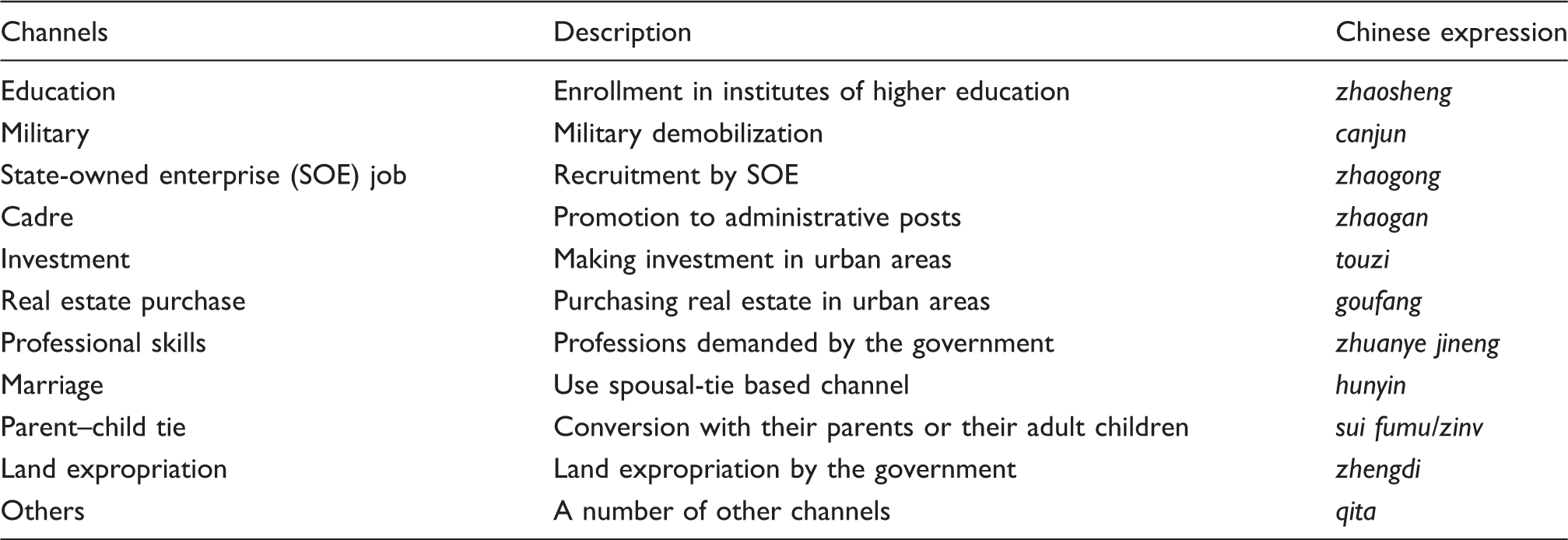
However, family-tie (marriage and parent–child tie) channels have not attracted sufficient attention in previous studies due in part to lack of data. Another possible reason is that marriage to a person with urban hukou has not unconditionally entitled one to permanent urban hukou status, particularly in the pre-reform era (Wang, 2005: 95; Whyte and Parish, 1984). 9 However, beginning in the early 1980s, the regulative authority over the hukou system was transferred from the central state government to local authorities (Chan, 1994, 2009; Cheng and Selden, 1994; Wang, 2005). According to local demands, the local government opened up a new set of channels for hukou conversion, particularly in small towns and cities, such as granting local urban hukou to the wealthy (mainly investors and home buyers), professionals, and family members (i.e. children, spouses, and parents) of permanent hukou migrants (Chan and Buckingham, 2008; Chan and Zhang, 1999; Ministry of Public Security (MPS), 1997; State Council, 1998; Wang, 2004, 2005). The family-tie channels mainly emerged in this context. I classify the family-tie channels into marriage- and parent–child-tie channels. The former refers to the fact that a rural migrant can achieve hukou conversion by marrying someone with urban hukou status who either was born urban or is a hukou converter. The latter is based on the parent–child relationship, which facilitates two kinds of conversion: children born in rural areas to parents who obtain urban hukou status may assume urban hukou status under certain conditions; elderly parents who pass their retirement age and need care can obtain hukou conversion through their adult children. 10 These family ties bear many sociological meanings. The parent–child tie is indicative of an ascriptive process by lineage or descent, whereas the marriage tie can be considered an achieved tie, conceived as partly a form of social exchange between a man and a woman, or even between their respective families. An ascribed tie is largely random, but an achieved tie is socially selective and thus susceptible to strategic motives.
Furthermore, during the process of rapid urbanization, local governments offer hukou conversion as one of the compensations to rural residents whose land is expropriated by the government for city expansion. These rural residents are concentrated on the east coast adjacent to cities undergoing rapid economic development. On the fringes of these urban areas are many migrants from remote rural areas in central or western China who moved to seek work or a marriage partner. Many rural women have migrated to these areas, married and settled in their husbands’ towns or small cities (Fan and Huang, 1998; Fan and Li, 2002). These women are granted urban hukou status due to land expropriation as the nearby cities expand into these towns or suburbs. In other words, these are, in fact, their husbands’ lands, perhaps inherited from the husbands’ parents, but they provide these migrating wives with access to the chance of hukou conversion. In this case, although hukou conversion does not result from marriage itself, these women are able to take advantage of their marriages and their husbands’ residences to gain access to hukou conversion via local governments.
Rural women’s advantage in hukou conversion: A puzzle
Previous research repeatedly confirms that rural women are disadvantaged relative to rural men in various measures of socioeconomic attainment. First, the status attainment of rural women is greatly constrained by sociocultural forces. For example, past studies have shown that there is a preference for sons among parents deciding how much to invest in education (Greenhalgh, 1985; Jacka, 1992; Song et al., 2006). As daughters are expected to eventually move out of their parents’ homes and join their husbands’ families, while sons are expected to take care of their parents in their old age, there is little incentive for the natal family to invest in their daughters (Fan and Huang, 1998; Li, 1994).
Second, the structural forces in the labor market greatly shape the occupational achievement of the rural migrants. For example, rural women are discriminated against in urban labor markets compared to rural male migrants or members of the local labor force. This is partly revealed in their occupational attainment, which is well documented in the literature on labor market segmentation and segregation in China (Fan, 2003; Fan and Huang, 1998; Fan and Li, 2002; Franklin, 1989; Honig and Hershatter, 1988; Huang, 2001; Knight and Song, 1995, 2005; Loscocco and Wang, 1992; Meng and Miller, 1995; Solinger, 1999; Yang and Guo, 1999). One of the manifestations relevant to our concern is that rural migrant women are less likely than rural men to obtain state-owned enterprise (SOE) jobs – an important predictor of hukou mobility – although rural migrants, men and women, are generally excluded from these positions (Wang et al., 2002; Yang and Guo, 1996). Moreover, the pathways of hukou conversion through investment or professional skills are also predominantly accessible to male migrants (Liang and Ma, 2004: 481).
In summary, compared to their male counterparts, female migrants are disadvantaged in both educational attainment and labor market conditions. Considering that these outcomes are important predictors of hukou conversion, rural women should be less likely than rural men to obtain urban hukou status.
However, several key studies on hukou mobility all surprisingly observe that the probability of hukou mobility is significantly higher for rural women than for rural men, controlling for education, occupational status, and other demographic characteristics (Goldstein et al., 2000: 225; Wu and Treiman, 2004: 376; Zhang and Treiman, 2013: 77).
Models of gender-specific pathways in the hukou conversion process are shown in Figure 1. This study argues that the puzzling outcome described here is due to the fact that previous studies predominantly examine predictors that favor rural men (i.e. education, party membership, or military service), which are represented in Figure 1(a), yet omit a significant predictor that probably favors rural women – marriage. The omission of this variable overlooks the gendered effect and results in biased findings.
Models of gender-specific pathways in hukou conversion: (a) male-dominated pathways; (b) female-dominated pathways; and (c) gender-specific pathways. Note: The analysis assumes a discrete-time logit model with a latent dependent variable Y*. A solid dot denotes a measured variable, whereas a hollow dot represents an unmeasured variable. The total effect of gender (male) on hukou conversion is the sum of effects through male-dominated predictors and marriage to an urban spouse, controlling for other relevant covariates.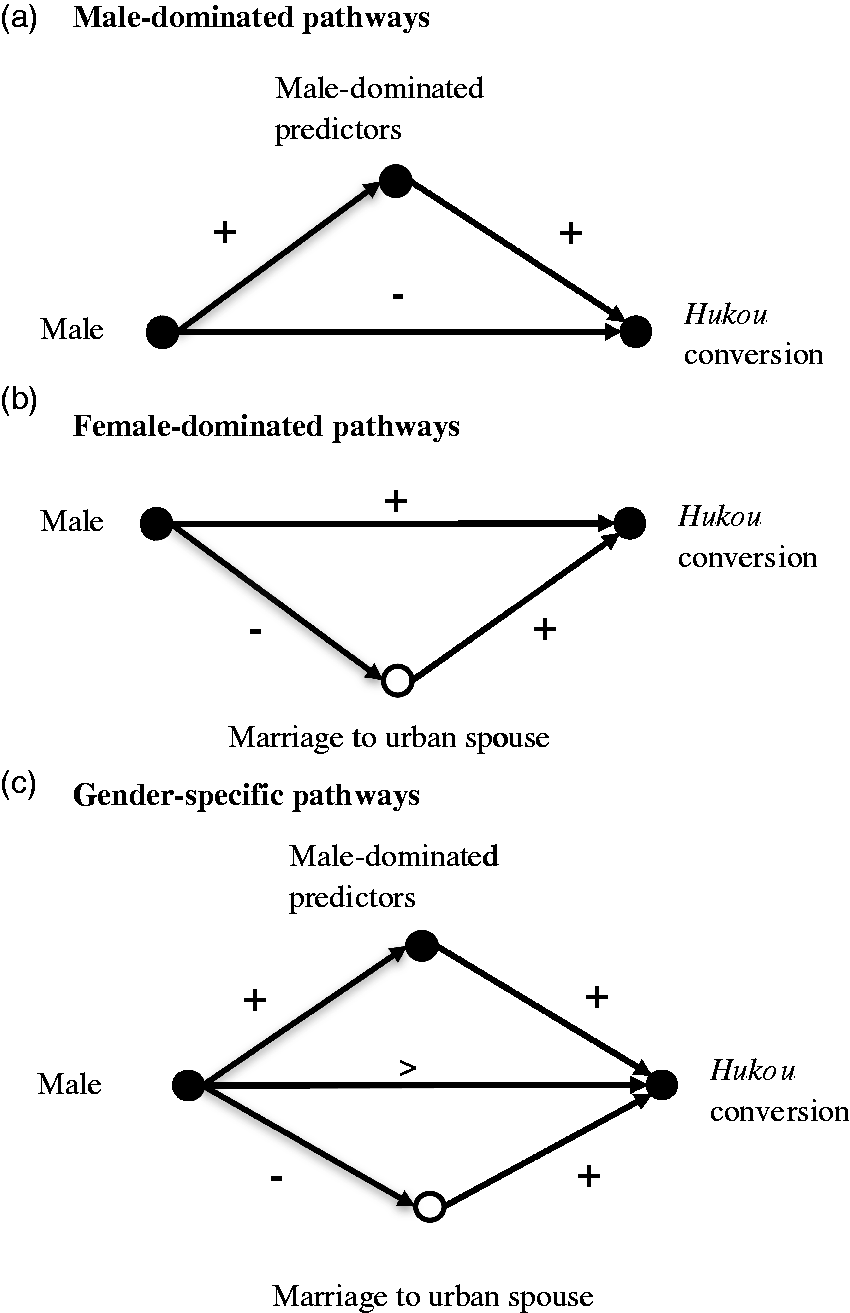
How do we know that marriage is an important way for rural migrant women to achieve hukou conversion? First, as noted earlier, the changes of hukou conversion policies lay the legislative foundations for marriage as a channel of hukou conversion. Second, constrained by macro-level cultural and structural forces, rural migrant women have fewer opportunities to achieve upward social mobility but resort to marriage as an economic strategy to break the constraints. Marriage provides a means for them to overcome the disadvantages of being an ‘outsider’ at the destination, and allows them to attain local hukou and to have access to local resources, including land (Fan and Huang, 1998; Fan and Li, 2002). Third, status hypergamy in the urban marriage market leads to the marriage squeeze for urban men with lower socioeconomic status. As the market gradually replaces state redistribution as the central mechanism for resource allocation in the post-reform era, commodity prices (e.g. housing) have witnessed a dramatic increase, and economic factors become the dominant determinant in the marriage market (Yu and Xie, 2013). This reform leads to a consumerism culture and acts to increase women’s desire to marry men who are more economically established, usually older men (Mu and Xie, 2014). As a result, urban men near the bottom of the socioeconomic hierarchy find it difficult to marry local urban women and have to resort to the migrant women (Fan and Huang, 1998; Fan and Li, 2002). Furthermore, while lower status urban men are not valued in the urban marriage market, their urban status and location give them an advantage in marrying rural female migrants. 11 In fact, this cross-border marriage market differs from the urban marriage market, but essentially resembles the international marriage market, in which such marriages occur in structurally and institutionally unequal contexts. International marriage migration is a prevalent pathway in upward social mobility, and this process is highly gendered, usually with women from poor countries marrying men in rich countries, but the socioeconomic status of these men is relatively low in their own local societies (Constable, 2011; Gaetano and Jacka, 2004; Palriwala and Uberoi, 2008; Williams, 2010). Similarly, men in urban China who marry rural migrant women are typically older and poorer, and some are even mentally or physically handicapped (Ma et al., 1995; Xu and Ye, 1992). Moreover, empirical evidence also shows that marriage is the major reason rural women give for their rural–urban migrations in China, because they find it hard to survive in urban areas without their local husbands’ economic and social support (Davin, 2007; Fan and Huang, 1998; Fan and Li, 2002).
The above explanations suggest that marriage is an important mechanism for rural women’s migration, but whether the marriage migration can lead to an institutional crossing of the hukou barrier is still an empirical question. To put this question to the empirical test, I derive several predictions based on a previous finding. Using a nationally representative dataset in 1996, Wu and Treiman (2004: 376) observed that rural-origin women were about as likely as rural-origin men to obtain an urban hukou without controlling for any covariates (i.e. at the zero-order level): 10.8% of women, compared to 11.8% of men, did so. This finding was corroborated in this study based on a nationally representative dataset in 2008, which will be shown later. Given that there is no zero-order gendered difference in the probability of hukou mobility, if marriage is the real omitted variable that favors women, then it will show a male advantage rather than disadvantage in hukou conversion when we only include marriage but omit the male-dominated variables, as shown in Figure 1(b). Thus, we have the following: Controlling for other covariates, if we only include marriage and omit male-dominated predictors, rural men will be more likely than rural women to achieve hukou conversion. If rural men and women have divergent pathways of hukou conversion, we may expect that the inclusion of both male- and female-dominated predictors will decrease the gendered difference in hukou conversion, as shown in Figure 1(c). Despite my assertion on the divergent pathways of hukou conversion for rural men and women, I do not mean that they use divergent paths exclusively and exhaustively. Instead, I argue that this is generally a gendered pattern of hukou conversion, and I do not deny the use of male-dominated channels by rural women and also female-dominated channels by men. However, I would argue that rural men are less likely than rural women to use the marriage channel, due to their relative advantage in alternative channels and the prevalent pattern of status hypergamy. An alternative but more direct approach to the testing of the gendered pattern is to examine the interaction effect between the predictors and gender. Hence, I would predict the following: Rural women are more likely to use the marriage channel, whereas rural men are more likely to use the education, employment in the state sector, and military channels.Prediction 1:
Prediction 2:
Prediction 3:
Data and methods
I use the CGSS 2008, a national stratified probability sample of 6000 adults aged 18–98, with a male–female ratio of 48:52. The sample for analysis is restricted to those who have already undergone or can potentially undergo hukou conversion, excluding urbanities by birth or those who converted their hukou statuses before 1955, when the hukou system did not exist nationally.
Several outstanding features of CGSS 2008 render it capable of testing the predictions. First of all, CGSS 2008 asked the respondent directly 12 whether he or she had undergone hukou conversion and records the exact year of hukou conversion as well as the person’s first marriage. This information is vital, because it allows us to check whether marriage occurs prior to hukou mobility to avoid the problem of reverse causation. Second, CGSS 2008 is superior for containing the spouse’s hukou status and the timing of the spouse in achieving hukou conversion. The timing of the spouse’s hukou mobility enables us to distinguish whether respondents convert their hukou status before or after their spouses do. We will apply the discrete-time hazard-rate model to carry out the analyses. Accordingly, the dataset will be constructed as a person-year structure.
Measures
Hukou conversion
The dependent variable is whether the respondent experiences rural–urban hukou conversion (yes = 1, no = 0). For the event history analysis, it refers to whether the respondent had experienced hukou conversion by the year of risk, which is a time-varying variable.
Independent variables
The independent variable of primary interest is gender (male = 1, female = 0), a time-constant variable. Three key predictors examined by previous studies are as follows: military experience (yes = 1, no = 0), the respondent’s party membership (party membership = 1, non-member = 0), and the respondent’s education (junior high school or lower = 0, senior high school = 1, vocational secondary school = 2, vocational college = 3, academic college or higher = 4). They are all time-varying variables. They refer to whether the respondent had military service, party membership, or a certain educational level by the year of risk respectively in the event history analysis. However, as indicated in previous studies on hukou conversion (Chan and Zhang, 1999) and the hukou conversion channels shown in Table 1, these three predictors are apparently not sufficient. I also add two predictor variables – employment in the state sector (yes = 1, no = 0) and cadre (cadre = 1, non-cadre = 0), both time-varying dummy variables. I argue that they are both favorable to rural men compared to their female counterparts.
In terms of the key variable – marriage, I create a variable named ‘married to urban spouse before hukou mobility (MTUSBHM)’ (MTUSBHM = 1, other = 0). 13 The urban spouses were either born urbanities or converted their hukou status before or after their marriages, through education, occupation, parent–child tie, or land expropriation channels. However, two restrictions are set to avoid the problem of reverse causation. One is that the respondents should obtain their hukou conversion later than their spouses do; the other is that their marriage should occur before the respondents’ hukou conversion. This is a time-varying variable in the event history analysis, referring to whether the respondent gets married to an urban spouse by the year of risk, under the above restrictions.
Control variables
Father’s education is coded according to four levels of education: junior high school or lower, academic senior high school, vocational secondary school or college, and university or higher.
Father’s party membership is a dichotomous variable, coded as 1 if the respondent’s father is a party member.
Father’s work unit type, a dummy variable, is coded as 1 if the father works in the state sector (i.e. in a governmental agency, state institution, or state enterprise).
Birth cohort is included as a set of dummy variables (1937–1946, 1947–1956, 1957–1966, 1967–1976, and 1977–1990) to control for birth cohort effect in hukou mobility. 14
These control variables are all time-constant variables. They only vary across individuals but not over time, because we assume that the father’s socioeconomic characteristics have been achieved before we count the time – at age 14 15 of the respondents – in the event history analysis. 16
Statistical models
A discrete-time logit model is applied to analyze the respondents’ hukou conversion (Allison, 1984; Kalbfleisch and Prentice, 2002). The discrete-time hazard function Pit is the conditional probability that the respondents’ hukou conversion occurs prior to time t. The dependence of Pit on the explanatory variables is assumed to follow a logit model
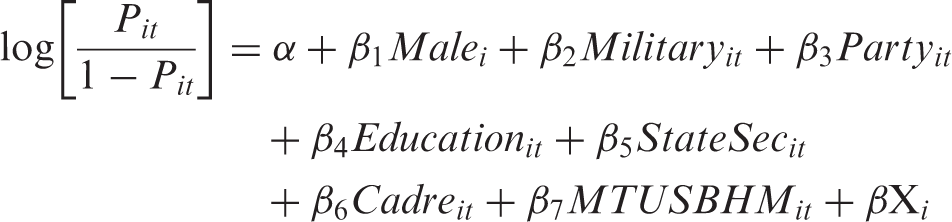
One of the advantages of applying event history models is that it avoids the problem of reverse causation. For example, some rural women may achieve urban hukou status by higher education before marriage and then get married to urban husbands; such cases will be automatically right-censored in this model. Furthermore, this model does not include the interaction effect, but the extended model will include it between the predictors and gender. In addition, standard errors are adjusted for clustering of observations within the respondents.
Results
Weighted percent distributions of variables, Chinese adults aged 18–71 for Chinese General Social Survey (CGSS) 2008.
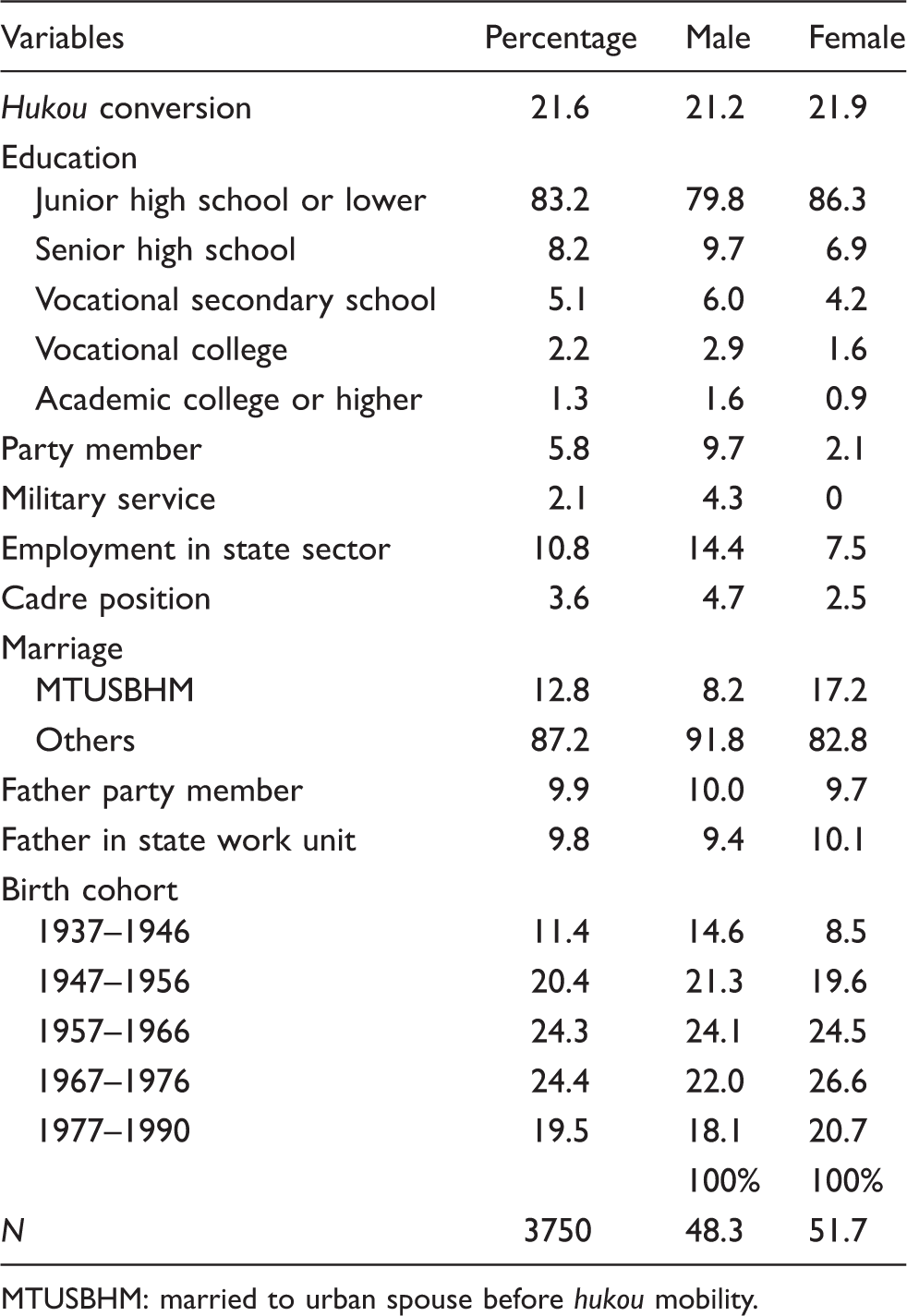
MTUSBHM: married to urban spouse before hukou mobility.
Coefficients from discrete-time hazard-rate models for predicting hukou conversion for Chinese General Social Survey (CGSS) 2008.

Junior high school or lower omitted.
MTUSBHM: married to urban spouse before hukou mobility; other categories include both unmarried and married other than the aforementioned situation.
Junior high or lower* male omitted.
Others* male omitted.
Junior high school or lower.
p < 0.05;
p < 0.01;
p < 0.001.
Note: Robust standard errors adjusted for clusters within individual respondents are reported in parentheses.
However, while we control for male-dominated predictors in model 3, it is shown that rural men are significantly less likely to obtain urban hukou status than rural women, in accordance with previous findings (Goldstein et al., 2000; Wu and Treiman, 2004; Zhang and Treiman, 2013). Moreover, consistent with previous findings, both education and military service have significant positive effects on hukou conversion. Not surprisingly, the state sector job significantly enhances the likelihood of obtaining urban hukou status. However, the negative effect of party membership and cadre position, though not significant for cadre position, might seem surprising. My previous study found that the negative rather than positive effect is mainly because we have tackled the problem of reverse causation with accurate data and appropriate methods (Xiang and Tam, 2013). 17 After dealing with the problem of reverse causation appropriately, we instead find that party membership and cadre positions in rural areas, which are often associated with key resources, undermine the occupants’ incentives for hukou mobility. This issue is beyond the scope of this paper; therefore, I will not go into detail about it.
The next model is intended to test prediction 1. I only include the female-dominated predictor, marriage, omitting all of the male-dominated predictors. The result confirms prediction 1, that rural men are significantly more likely to achieve hukou conversion than rural women. Moreover, marriage to an urban spouse indeed shows a substantial positive and significant effect on hukou conversion. Those married to an urban spouse are over 10 (e2.418−1) times more likely to achieve hukou conversion than those in other types of marital situations.
Both male- and female-dominated predictors are included in model 5. I predicted that the gendered difference should decline, because these predictors simultaneously explain rural men and women’s pathways of hukou conversion. Results support prediction 2. The gendered effect declines sharply and becomes insignificant, suggesting that the effects of male- and female-dominated predictors offset each other.
Moreover, the comparison of the coefficients between models 2 and 3 shows that the father’s education, party membership, and work unit type have significant positive effects on the children’s hukou conversion, but most of these effects are mediated by the children’s own educational or occupational attainments. Notwithstanding, the father’s work unit type still has a significant net effect, even accounting for the mediating effect by the children’s socioeconomic attainment. Additionally, stepwise inclusion of the father’s characteristics reveals that the effects of the father’s education and party membership are likely to be mediated by the effect of their work unit type (results not shown here). Controlling for other factors, the later cohorts are more likely to achieve hukou conversion compared with earlier cohorts. This is consistent with Wu and Treiman’s (2004: 380) finding that hukou conversion is mainly a young person’s game.
Furthermore, model 6 includes the interaction effects to test prediction 3. Since military service is exclusively held by men, as shown in Table 2, it indicates that rural men have an absolute advantage over women in employing this path and therefore its interaction with gender will not be included in this model. In addition, as party membership and cadre position have negative effects on hukou conversion, I will also not include their interaction effects with gender. Model 6 shows that the educational and sectoral effect on hukou conversion for rural migrant men does not significantly differ from that for women, though the coefficient suggests that a state sector job plays a more important role for male migrants. However, the interaction between marriage and gender shows that marriage has a significantly more important effect on hukou conversion for female migrants than for their male counterparts. The above results basically support prediction 3.
In summary, the findings substantiate my three predictions. Despite no overall gendered difference in the probability of hukou conversion, rural men and women have divergent pathways of hukou conversion. Rural men tend to use education, a state sector job, or military service for hukou conversion, whereas women are more likely to use marriage to achieve hukou mobility. Marriage provides women with an important pathway to conversion, which almost totally offsets the advantages afforded men in terms of educational and occupational opportunities.
Conclusions and discussion
For about half a century, hukou conversion has been an important status attainment and a crucial path to upward social mobility in China. It determines rural migrants’ access to a large number of social welfare benefits previously enjoyed only by Chinese urbanities. Obtaining urban hukou status allows rural migrants to cross the institutional barrier to a better life. Previous studies have examined the issue of how to achieve hukou conversion, but they basically assumed a gender-neutral perspective. However, under this assumption a puzzle concerning the gendered effect in hukou mobility went unsolved. Why do rural women have a higher probability of hukou conversion than rural men, even though these women are less likely to have better education, party membership, or military service – the three best-known predictors of hukou mobility in China?
In order to solve this puzzle, I examined this assumption and explicitly proposed a gender-specific pattern of hukou conversion. Taking into account marriage migration literature and hukou policy documents, I argued that rural women might use marriage to urban spouses to convert their hukou status in contrast to rural men, who mainly use educational or occupational characteristics. Previous studies focused on male-dominated predictors, while omitting the female-dominated predictor of marriage. Hence, the gendered effect is negatively biased by the omitted variable.
Using a nationally representative dataset with sufficient information on life history, this study tested predictions about gender-specific pathways to hukou conversion and found empirical support for three predictions. Marriage to an urban spouse is an important pathway to hukou conversion for rural women, while rural men mainly use education, a state sector job, or military service as a means to the same end. Inclusion of both male- and female-dominated predictors can almost fully explain the gender difference in hukou conversion, resulting in no overall gender difference in the probability of hukou conversion. This study contributes to the hukou mobility research by explicitly introducing the gendered perspective, explicating the gendered pathways of hukou conversion, and putting the gendered pattern to the empirical test.
One may wonder how so many rural female migrants manage to marry so many urban or rural men in better locations (i.e. east coast villages or towns adjacent to large cities). I think status exchange may be one explanation. A strand of research documents the process of status exchange between rural women and urban men (Constable, 2011; Davin, 2007; Fan and Huang, 1998; Fan and Li, 2002; Huang, 2001). For example, rural female migrants exchange their youth and labor for the urban hukou status and better residences of their husbands. 18 Although this strand of research mainly focuses on the process of marriage migration rather than hukou mobility, I would contend that the underlying social processes might be quite similar. Findings indicate that men who marry female migrants are socially and economically disadvantaged, but their favorable positions in the spatial hierarchy may compensate for these less desirable attributes and attract women from poorer regions (Fan and Huang, 1998). However, I recognize that there is likely to be a considerable amount of variation of the status of both urban men and rural migrants over time or across regions. For example, even though there may be a distinction between the urban marriage market and cross-border marriage market in terms of the exchange items, I do not deny that the role of hukou status may have changed historically. Perhaps urban hukou status as an item to be exchanged has become less desirable over time in terms of relative importance, considering that economic factors have become important and women’s education has significantly improved. 19 To address this issue rigorously, we may need specific models to gauge the price of such a marriage exchange. However, such analysis is beyond this study and is an important issue for further research.
Previous studies have maintained that men are more likely to obtain urban hukou status than females (Huang, 2001; Liu, 2005; Wu and Treiman, 2007). This research may indicate that women are not so disadvantaged in obtaining urban hukou status, but it does not assert that all rural women benefit from marriage to urban men, because the consequences of hukou conversion may vary by gender. Although female migrants may be better off than those who are unable to migrate, they might be far less successful in the labor market than their male counterparts. Men may have a better chance of upward social mobility after they obtain urban hukou, whereas women may not take advantage of this status. They may continue to stay at home to take care of their children and do housework. These issues may provide researchers with directions for future studies.
Footnotes
Acknowledgments
An earlier version of this paper was presented at the conference of the Research Committee on Social Stratification and Mobility (RC28) of the International Sociological Association (ISA) in Hong Kong in 2012 and the ISA conference in Japan in 2014. I would like to give thanks to Yu Xie at the University of Michigan, Donald J Treiman at the University of California, Los Angeles (UCLA), Xiaogang Wu at the Hong Kong University of Science and Technology (HKUST), Zhuoni Zhang at the City University of Hong Kong, and the anonymous reviewers for their invaluable comments and suggestions. I am indebted to Professor Tony Tam at the Chinese University of Hong Kong for many valuable suggestions and comments in the revision and completion of this paper.
Funding
This research received no specific grant from any funding agency in the public, commercial, or not-for-profit sectors.