







Abstract
This study explores the multidimensional process of assimilation in rural-to-urban migration in China. We distinguish between (a) intrinsic acculturation—the adoption of values; (b) extrinsic acculturation—the adoption of observable traits such as language; and (c) structural assimilation—the achievement of socio-economic status comparable to that of locals. Cross-provincial analysis shows that there are substantial variations in the social and economic distances faced by migrants across provinces. Our novel acculturation/assimilation measures take into account the different cultural and socioeconomic distances faced by migrants with heterogeneous places of origin and destinations. Hypothetical measurement errors are used in a robust hierarchical regression analysis to assess the potential effect of self-selection. Analyses of the Chinese General Social Survey 2012–2013 show that extrinsic acculturation typically takes place later than structural assimilation, while intrinsic acculturation can fail to happen despite a long stay. Assimilation is not guaranteed; only some rural-to-urban migrants, particularly those with high levels of education, from families of high socio-economic status, and interacting with friends and neighbors, manage to assimilate across all three dimensions.
Introduction
The integration of rural-to-urban migrants is one of the major social challenges in China. China’s internal migration—there were 281.7 million rural-to-urban migrants in China in 2016 alone (National Bureau of Statistics of the People’s Republic of China, 2016)—is comparable to total global international migration in scale and number (King and Skeldon, 2010). Most of these rural-to-urban migrants face strong institutional, economic, cultural, and social barriers, due mainly to the household registration system—hukou (Wang and Fan, 2012). This system limits the places where migrants can live and resources and benefits that they can receive, which makes integration difficult (Wang and Fan, 2012). Instead of being integrated, most rural-to-urban migrants occupy marginalized economic and social positions (Wong et al., 2007; Wu, 2004). They usually take low-skilled occupations that are physically demanding and dangerous (Yang and Guo, 1996).
Most of the existing research on China’s rural-to-urban migration focuses on the integration of migrants into the host cities (Chen and Wang, 2015; Li and Tian, 2012; Liu, 2010; Lu et al., 2013; Wang and Fan, 2012)—the more formal relationships between migrants and the institutions of the host society—while there is less research on the individual processes of assimilating the local norms and values.
The lack of research on assimilation in China’s rural-to-urban migration is largely due to the fact that assimilation is often studied in the context of international migration. However, with the significant cultural and economic differences between rural and urban residents in China (Fuligni and Zhang, 2004; Sicular et al., 2007; Sun and Wu, 2004; Yang, 1999; Yu, 2014; Zhong et al., 2016), rural-to-urban migrants in China are in many ways similar to international migrants. A recent study shows that both assimilation and integration are applicable within China’s social context (Xie et al., 2016).
Moreover, studying the assimilation process can provide new insights on the institutional processes of integration. For instance, the adoption of cultural traits will likely affect the level of prejudice and discrimination that migrants face in the city (Gordon, 1964). Furthermore, findings on assimilation can suggest how migration may promote the modernization process in the place of origin—for example, through cultural capital (i.e. values and behaviors) such as investment behavior, entrepreneurship, and family planning among returning migrants (Chen et al., 2010; Ma, 2002; Zhao, 2002;). Therefore, this study focuses on the multidimensional process of assimilation of rural migrants using Gordon’s (1964) theoretical framework, which is further described below.
Theoretical framework
Assimilation, the process by which people with distinct cultural backgrounds adopt the cultural practices of others, is an essential concept in migration studies. Because assimilation requires a lot of small steps and can take generations (Alba, 1999; Waters and Jiménez, 2005), the development of assimilation theory has mostly been along the lines of a generational perspective. For instance, the underlying idea of linear advancement in assimilation over generations in Warner and Srole’s (1945) ‘straight-line’ assimilation theory has been challenged. Gans (1992) proposes that the process can be non-linear across generations, that is, the so-called ‘bumpy line assimilation.’ Portes and Zhou (1993) further consider the possibility of assimilating into different sectors of US society, some of which can result in downward assimilation, but their focus is still on whether immigrants can assimilate into the mainstream over a generation.
While it is helpful to think of assimilation as a multigenerational process, it is crucial to recognize that it is also a multidimensional process. Assimilation can potentially include any socio-demographic dimension (c.f. Blau, 1977, 1989). Whether and how the multiple dimensions of assimilation have been correlated matters for our understanding of the assimilation process. Moreover, for the assimilation of temporary migrants, whose children may not be migrants, only the dimensional aspects may be applicable.
The classic work from a dimensional perspective is that of Gordon (1964), who proposed that assimilation has seven dimensions/stages. He argued that there is a fundamental distinction between acculturation and structural assimilation. He further proposed that structural assimilation is the capstone of the assimilation process, and that once structural assimilation occurs, all the remaining dimensions of assimilation will follow (Gordon, 1964).
Applying Gordon’s theoretical framework to China’s rural-to-urban migration, we investigate assimilation as a multidimensional process of rural-to-urban migration in China. Our goal is to explore the patterns of (a) intrinsic acculturation—the adoption of values; (b) extrinsic acculturation—the adoption of observable traits such as language; (c) structural assimilation—the achievement of socioeconomic status comparable to that of locals; and (d) the relationships between these three processes.
This study proposes a novel measure of acculturation and structural assimilation that addresses the heterogeneity of places of origin and destination. Specifically, we construct an appropriate comparison group using data from the place of origin. We treat acculturation and structural assimilation as a ‘competition’ to adopt cultural values and socio-economic levels comparable to those of the local residents in the cities where migrants reside. Acculturation and structural assimilation are measured by the percentage of ‘distance’ accomplished by migrants in this competition. Varying levels of hypothetical measurement errors are used to deal with potential bias due to self-selection in the decision to migrate.
Hypotheses
Gordon (1964) made the following claims regarding the relationship between acculturation and structural assimilation: (a) acculturation may happen first, but it can be independent of the other dimensions; (b) acculturation does not guarantee structural assimilation, while structural assimilation can guarantee acculturation. Although Gordon (1964) did not differentiate between intrinsic and extrinsic acculturation in his seven dimensions/stages, he discussed intrinsic and extrinsic traits and further argued that intrinsic traits are less likely to change than extrinsic traits. Thus, it can be argued that extrinsic acculturation is more likely to happen before intrinsic acculturation. Following Gordon’s argument, we propose the following hypotheses:
Data and methods
Identifying three sample groups
We used the Chinese General Social Survey (CGSS) from the years 2012–2013. We collected 23,203 observations by pooling the two-year data together. The dataset includes information on respondents’ current hukou status, type of hukou, and resident location. With this information, we identified 1099 rural-to-urban migrants, defined as those respondents who live in urban areas and have a non-local rural hukou. 1
Using the same information, we identified 8110 rural residents, defined as those who live in rural areas and have a local rural hukou, and 7347 urban residents, defined as those who live in urban areas and have a local urban hukou. The rest of the samples (e.g. mainly urban–urban migrants) are excluded from the analysis.
Main independent variables
Duration of residence is our main independent variable due to our interest in the temporal dimension of the assimilation processes. It is constructed using the information on the year of residence and the present year. To capture the individual factors, we use the following variables 2 : family economic status at age 14, 3 education level, social activities with neighbors and friends, 4 and the cultural difference between place of origin and place of destination (including logged physical distance between the place of origin and place of destination (kilometers), an indicator to show whether the migration was from the North to the South, and an indicator to show whether it was an inter-provincial migration). Other socio-demographic control variables include age, gender, logged income, employment status, occupation, and party membership. Year is also included to control for unobservable factors between the two years.
All the proxy measures of openness are at the province level. Data from the National Bureau of Statistics of the People’s Republic of China for the years 2012–2013 are used to measure the percentage of citizens with college degrees among residents. Studies have shown that people’s tolerance towards migrant and minority groups increases with their education level (Alba et al., 2005; Ford, 2011; Hainmueller and Hiscox, 2007). To capture openness at the community level, we use the percentage of migrants in the destination place. Previous research suggests that as the number of migrants increases in a community, the community will react favorably toward migrants, especially when the community’s development depends on migrants, although it can also become less tolerant if residents in the community feel threatened (Massey, 2008; Zúñiga and Hernández-León, 2005). Finally, studies have shown that communities can choose to deter migration by restricting job opportunities (Light, 2006; Varsanyi, 2010). We approximate the level of openness at the institution level using the percentage of jobs in migrant-concentrated industries.
Main dependent variables
The survey includes questions on the respondent’s intrinsic traits (i.e. values), extrinsic traits (i.e. lifestyles and behaviors), and socioeconomic status (i.e. income). We use such information to construct acculturation and assimilation indexes.
Intrinsic traits
To measure the adaptation of intrinsic traits among rural migrants, we first need to identify cultural beliefs that are relevant in the context of China and reflect a modern versus a traditionalist value system. Rural migrants and urban residents need to differ significantly in those values for assimilation to be possible. Some commonly used constructs in international studies, such as racial identity and religious beliefs, are less relevant in contemporary China. We choose to focus on gender and sexuality as a proxy measure of traditionalist values given its role in Chinese traditional culture (Zuo and Bian, 2001) and continuing influence, particularly in rural China.
We begin with factor analysis on the 15 questions in the ‘Social Attitude’ section of the data. The responses load on six sub-traits (after rotating). These six sub-traits can be classified under two main intrinsic traits—’Traditional Gender Values’ and ‘Sexual Permissiveness.’ We then normalize the scales so they fall between 0 and 1. Questions on ‘Traditional Gender Values’ included the following.
Do you agree that men should be career-oriented while women should be family-oriented? Do you agree that men are more capable than women by nature? Do you agree that marrying a good husband is more important than having a good job?
Responses for this set of questions ranged from 1 = ‘totally disagree’ to 5 = ‘totally agree.’
‘Sexual Permissiveness’ also plays an important role in the Chinese context (Zuo et al., 2012). The questions in this area were as follows.
What do you think about premarital sex? What do you think about extramarital sex? What do you think about homosexual sex?
Possible responses for this set of questions ranged from 1 = ‘always wrong’ to 5 = ‘always right.’
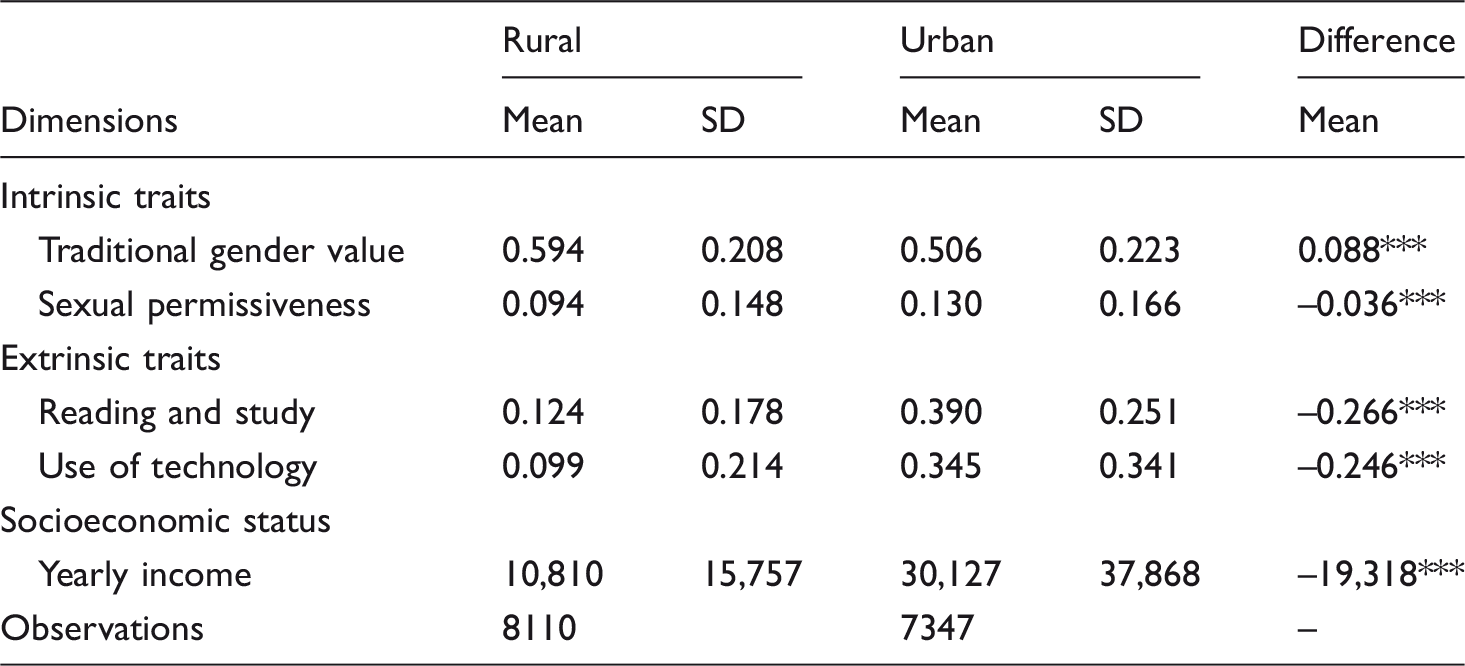
Robustness checks show that there are, in fact, statistically significant differences in these two traits between rural and urban areas and that they are therefore suitable as measures of intrinsic acculturalization.
Extrinsic traits
One of the standard measures of assimilation of extrinsic traits is language use and proficiency (Deyo et al., 1985; Evenson et al., 2004; Ng, 2007; Okafor et al., 2013; Tran, 2010). We do have data on acquiring the official language (i.e. speaking Mandarin) that is more commonly used in urban than in rural areas. However, because not all rural areas have their own dialect, this is not a suitable measure of extrinsic traits to be applied across all migrants. Instead, we focus on lifestyle questions in the CGSS. A factor analysis on 21 lifestyle questions loads on seven sub-traits (after rotating), which further cluster into two main extrinsic traits—‘Reading and Study’ and ‘Use of Technology.’
Given the relatively low education level and accessibility of cultural materials in rural China, the items in ‘Reading and Study’ reflect an external trait that is part of modern China (Wang et al., 2006). The questions on ‘Reading and Study’ traits included the following.
Over the past year, how frequently have you read ‘Newspapers’? Over the past year, how frequently have you read a ‘Magazine’? How frequently have you ever engaged in ‘Reading a Book/Newspaper/Magazine’ in your free time over the past year? Over the past year, how frequently have you studied in your free time?
Possible responses for this set of questions range from 1 = ‘never’ to 5 = ‘very often,’ except for the third question, which is reverse coded such that 1 = ‘never’ to 5 = ‘daily.’ ‘Use of Technology’ is also part of the new culture in modern China. China is one of the highest ranking countries regarding use of phones and the internet (Harwit, 2004). The use of the internet can shape the civil society in China (Yang, 2003a, 2003b). Yet there is still a significant gap between rural and urban in terms of adaptation to the internet. Internet use in rural areas was about 26.7%, while in urban areas it was about 73.3% in the year 2017 (CNNIC, 2017), leaving much room for cultural adaptation. The questions on ‘Use of Technology’ included the following.
Over the past year, how frequently have you used ‘the Internet’? Over the past year, how frequently have you used ‘Phone Customized Message’? Over the past year, how frequently have you surfed on the internet in your free time?
Possible responses for this set of questions ranged from 1 = ‘never’ to 5 = ‘very often,’ except for the last question, which was reverse coded, such that 1 = ‘never’ to 5 = ‘daily.’ Again, we normalize the scale to make them between 0 and 1. There are also statistically significant differences in these two traits between rural and urban areas.
Socioeconomic status
Descriptive summary of the intrinsic traits, extrinsic traits, and socioeconomic status by groups.
p < 0.001
Acculturation and assimilation indices
Acculturation and assimilation are generally measured by the change in the level of similarity between the migrants and local residents over time (Akresh, 2007; Antecol and Bedard, 2006; Borjas, 1985; Haller et al., 2011; Izquierdo et al., 2009; Kalter and Granato, 2002). Acculturation/assimilation is achieved if the cultural and socioeconomic distances become smaller over time. However, this measurement method has failed to take the starting point of the migrant into account. Failing to do so is problematic because it ignores the distances that the migrant needs to diminish to acculturate and assimilate. Two migrants who adopted the same cultural traits and achieved the same socioeconomic status as the average local would be regarded as equally acculturated and assimilated. However, one may already have had similar values and socioeconomic status to begin with while the other did not. Others have considered the gap between the place of origin and place of destination. Wimmer and Soehl (2014), for example, control for the average cultural and socioeconomic levels at the place of origin when studying the acculturation of cultural values among Europe’s immigrants. However, this does not deal with the heterogeneity of the migrants from the same place of origin; the migrant from a more privileged background can be more easily assimilated than a migrant of lower status from the same village.
We developed an original approach that uses time-invariant factors—age, gender, and father’s education—to calculate the distances of acculturation/assimilation faced by each migrant. Average values of intrinsic/extrinsic traits and socioeconomic status, stratified by these factors, are calculated using data from rural residents in the origin province as well as urban residents in the destination province. In other words, we use the rural residents of the same age and gender and with the same level of father’s education as the counterfactual group in our attempt to measure what their behaviors would be had they not migrated from rural to urban areas. Certainly, this counterfactual assumes no self-selection by unobserved variables in the decision to migrate, which is unlikely to occur. We thus include measurement errors in our statistical model (discussed below).
Figure 1 illustrates our measurements. ‘Counterfactual mean’ refers to the mean value (by age, gender, and father’s education) of the specific trait or socioeconomic status in the rural area of origin province. ‘Urban mean’ refers to the mean value (by age, gender, and father’s education) of the specific trait or socioeconomic status in the urban area of destination province. Where a rural-to-urban migrant stands (a) in this distance (a + b) between the two groups is the migrant’s level of acculturation/assimilation. In the case where a rural-to-urban migrant has passed the ending point, he or she is fully acculturated or assimilated (i.e. index = 100%). But in the case where a rural-to-urban migrant has lower or the same value as the starting point, he or she is not acculturated or assimilated at all (i.e. index = 0%).
Acculturation/assimilation indices as percentage of cultural/social distances.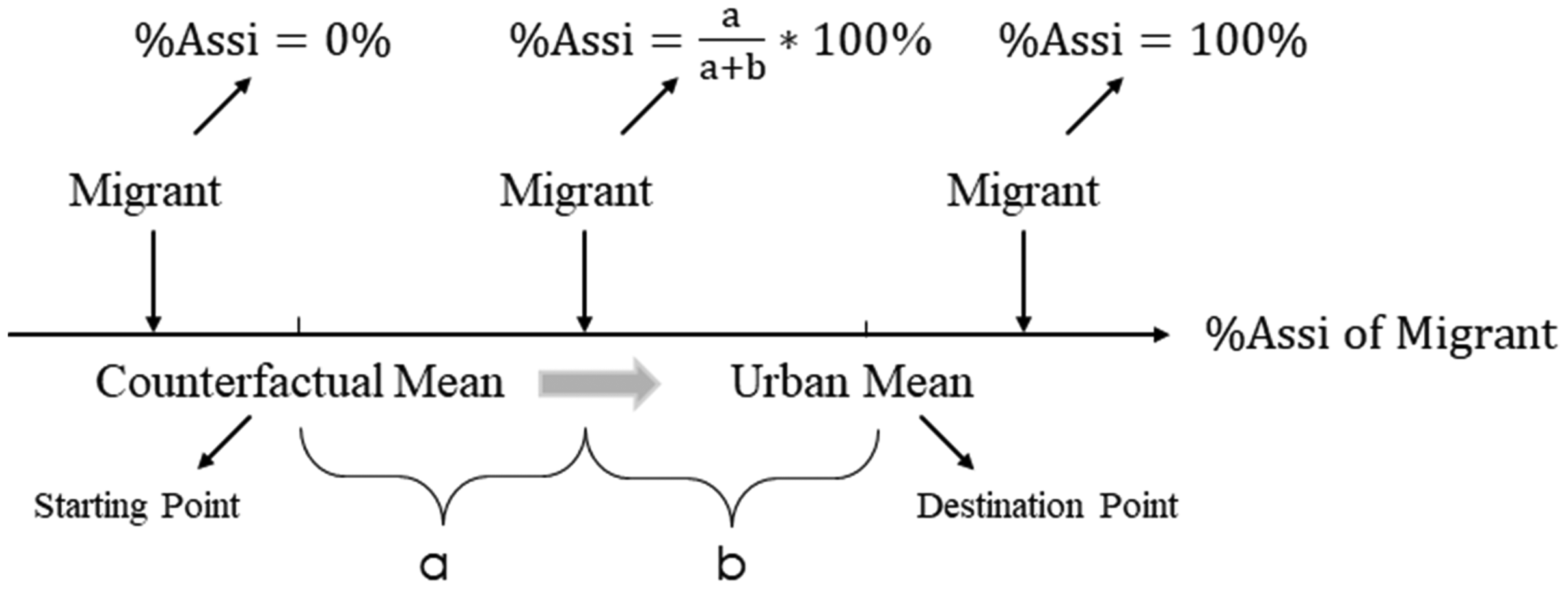
For both intrinsic and extrinsic acculturation, we take the average percentage acculturated of multiple traits. For example, intrinsic acculturation is equal to the average acculturalization percentage of (reversed coded) ‘Traditional Gender Value’ and ‘Sexual Permissiveness.’ We also run the analysis with multiple traits independently for robustness check. The results are consistent with our findings and are available upon request.
Potential measurement bias
As mentioned above, our indexes can be biased as the true counterfactual—what the migrant would be like had he or she not migrated—is unidentifiable. For our measure to be accurate, we must assume that rural residents with the same age, gender, and parent’s education should be the same as rural-to-urban migrants who had not migrated at the time of migration (Scenario 1 of Figure 2). But if there are differences between migrants and the counterfactual group (i.e. rural residents with the same time-invariant characteristics) we chose at the time of migration, our measurement will be biased (Scenario 2 of Figure 2). This will happen if (a) there is a selection at the time of migration (i.e. gap between ‘Migrant’ and ‘Rural’ at the ‘Time of Migration’ in Scenario 2 of Figure 2) and/or (b) rural-to-urban migrants who do not migrate tend to have a different rate and pattern in the changing of traits and socioeconomic status compared with their rural counterparts with the same time-invariant characteristics (i.e. a difference in the slope between ‘Migrant to True Counterfactual’ and ‘Rural to Estimated Counterfactual’ in Scenario 2 of Figure 2).
Counterfactual scenarios of migrants’ starting point in the acculturation/assimilation process.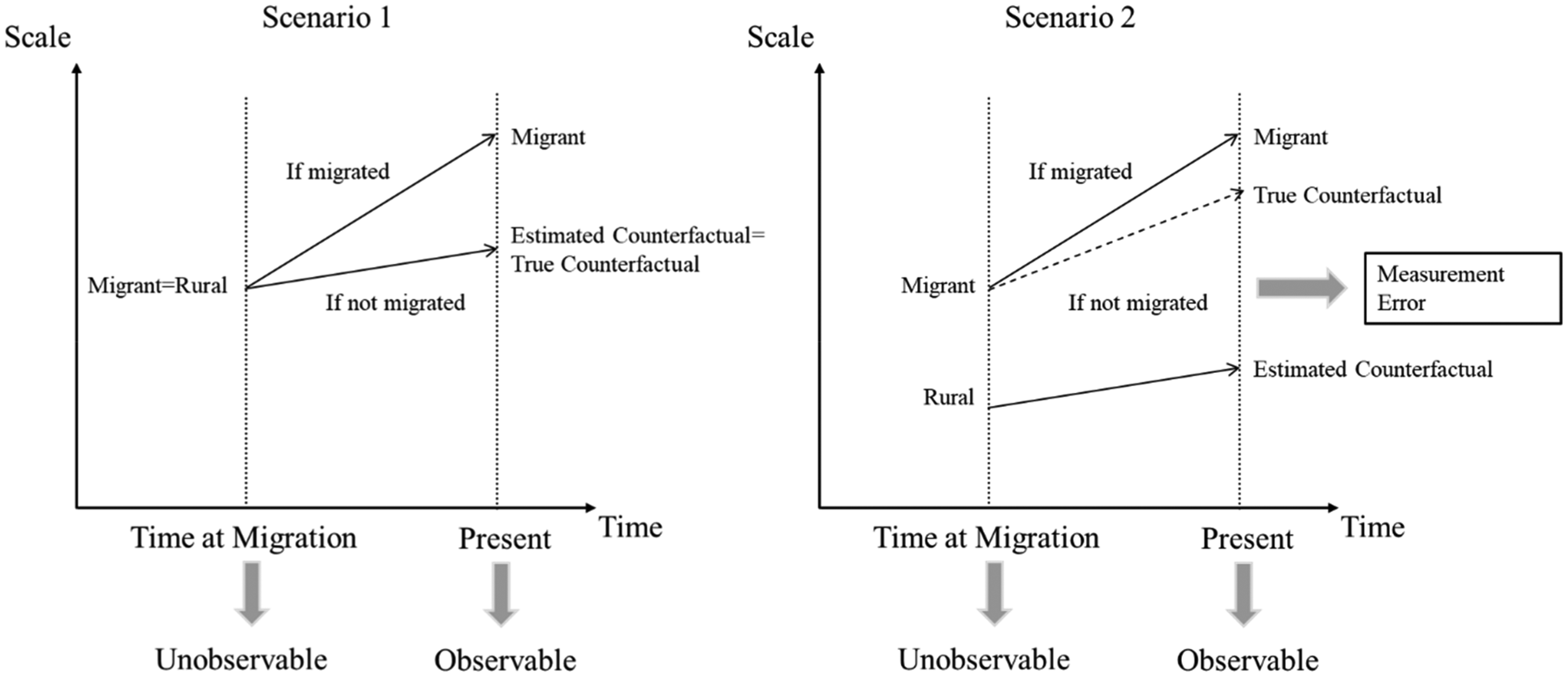
To deal with this measurement bias, we subtract potential measurement errors from both numerator and denominator of our indexes. Then, our
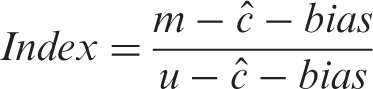

If most of the different estimated measurement errors give us the same results, this indicates that our indexes and the related findings are robust. For both intrinsic and extrinsic acculturation, we take the average value of multiple traits acculturation for each hypothetical measurement error used.
Figure 3 shows the average cultural and socioeconomic distances for rural-to-urban assimilation across provinces. These distances vary significantly across provinces. Given that the distances are the denominators of our indexes (i.e. Cultural and socioeconomic distances between origin and destination by province, 2012–2013.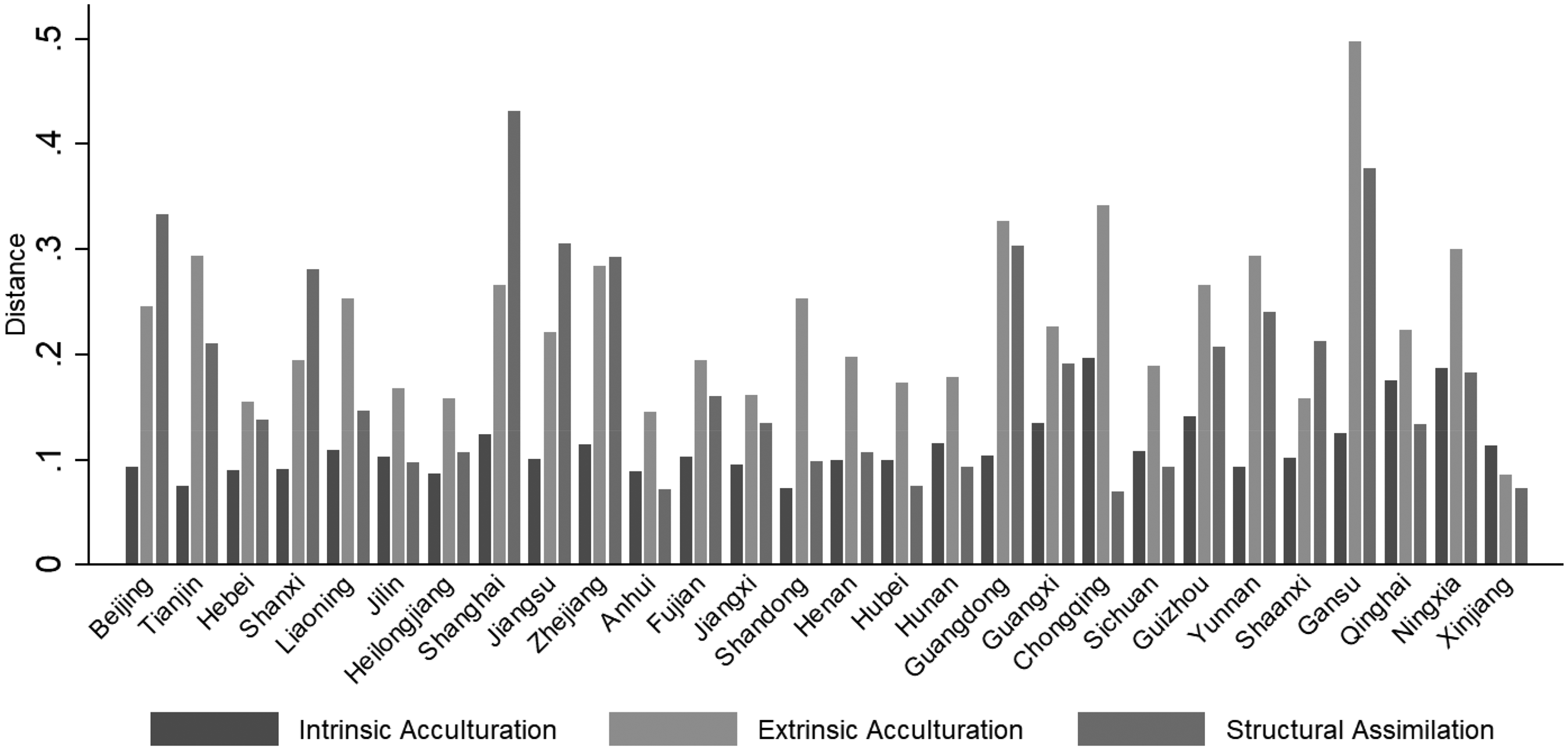
Hierarchical regression model
Our main model is specified as follows:
Level 1:

Level 2:

In this hierarchical model, the level-1 model characterizes individual differences in the provinces. The coefficients in the equation in level 1,
Findings
We estimate the hierarchical regression model with varying levels of measurement error. The results are generally consistent in terms of the size of the coefficients and the levels of statistical significance under all levels of hypothetical measurement errors as shown in Tables 3–5 in Appendix 1. However, this result may either be due to no error (i.e. our estimated counterfactual is the same as a true counterfactual), or the results are robust to error (i.e. the index is relatively independent of the error). To understand the consistency, we proceed with the following derivation for the index.


Given that
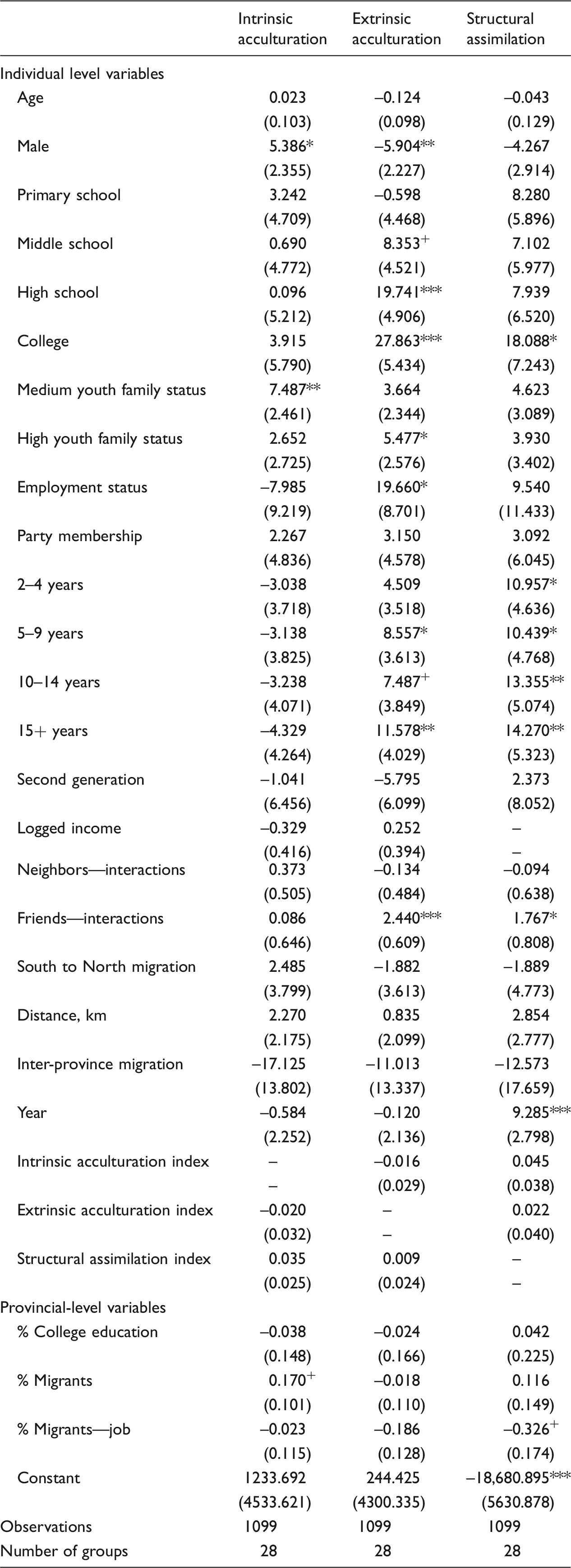
A multilevel model of acculturation and structural assimilation with bias percentage = 50.
Standard errors in parentheses.
Occupation code dummies are included in the model but not shown in the table. An omitted group for education is no education. An omitted group for youth family economic status is low level of family economic status. An omitted group for duration is one year.
p < 0.001
p < 0.01
p < 0.05
p < 0.1
Second, contrary to Hypothesis 2(ii) but consistent with Hypothesis 1(ii), acculturation and structural assimilation are independent of one another (Alternative Hypothesis 2). The results show that none of the dimensions can be significantly predicted by the other two. For example, neither intrinsic acculturation nor extrinsic acculturation has a statistically significant impact on structural assimilation. Our findings supplement Gordon’s theoretical framework by differentiating between patterns of intrinsic and extrinsic acculturation—while extrinsic acculturation can happen, intrinsic acculturation may not.
We next investigate how this multidimensional process of assimilation is modulated by individual factors. The findings show that all three dimensions are mainly shaped by the individual’s own abilities, but to varying degrees. Among all the individual factors, only youth family economic status has an impact on intrinsic acculturation, but in a non-linear way: only a medium level of youth family economic status has a statistically significant effect (around 7.5 percentage points) on a migrant’s intrinsic acculturation.
Extrinsic acculturation is influenced by multiple individual factors. Compared with migrants with low youth family economic status, migrants with high youth family economic status can attain an approximately 5.5% higher level of extrinsic acculturation. In addition, migrants with high school or college degrees can attain a 19.7–27.8% higher level of extrinsic acculturation when compared with those with no education. Finally, migrants’ extrinsic acculturation will increase as their frequency of interactions with friends increases.
Structural assimilation is mostly shaped by human and social capital. A college degree can give an immigrant an 18 percentage point advantage over a migrant with no education. However, the same factor has a significantly stronger impact on extrinsic acculturation. This may suggest that structural assimilation is harder to realize by simply attaining higher education. Besides human capital, interaction with friends can also promote structural assimilation. Our findings on interaction with friends are consistent with existent literature claiming that social network is one of the main channels for acculturation and socioeconomic integration (Chen and Wang, 2015; Yue et al., 2013). Although we cannot discern whether these friends are migrants from the same origin, migrants from different origins, or host residents, due to the data limitation, we show that interaction with friends is more important than interaction with neighbors.
Existing studies (Chen and Wang, 2015; Yue et al., 2013) find that interaction with both migrants and locals has positive effects on integration but has a stronger impact with locals, which suggests that while our finding may be the cumulative result of interacting with friends regardless of their place of origin, the largest weight of the impact may come from local residents. Furthermore, we have no information on social activities. Future research should examine whether some types of activities are particularly beneficial.
Our province-level measures of openness do not have consistent effects on the assimilation process. Each 1% increase in the share of migrants over total population in the destination province is associated with an approximately 0.17 percentage point higher level of intrinsic acculturation, but the effect is only marginally significant (p < 0.10). This may indicate that as the number of migrants increases, the transmission of urban intrinsic traits to migrants will become easier. This is likely to happen through the broader migrant community. In addition, each 1% increase in jobs from migrant-concentrated industries is associated with a 0.33% decrease in structural assimilation (p < 0.10). This may suggest that as jobs from migrant-concentrated industries increase, migrants are actually more likely to be confined to those industries, which may serve to prevent their further structural assimilation.
To summarize, our findings generally support our Hypothesis 3 that individual factors facilitate the assimilation process across all three dimensions. The findings also suggest that openness level matters in the assimilation process. For example, the ‘most stubborn’ dimension—intrinsic acculturation—can be positively affected by the community openness level at the destination place. However, the direction of impact may not be so simple as we propose in our Hypothesis 4. Openness level may not positively affect the assimilation process. Openness in terms of institutions or economies, for example, although potentially leading to more job opportunities for migrants, may also discourage migrants from taking advantage of other opportunities.
Conclusions
This study proposed a novel acculturation/assimilation measure that takes into account the different cultural and socioeconomic distances faced by migrants with heterogeneous places of origin and destinations and used varying levels of hypothetical measurement errors in a robust hierarchical regression analysis to assess the potential effect of self-selection. The results identified a multidimensional process for Chinese rural-to-urban migration. This process starts with structural assimilation, continues with extrinsic acculturation, and possibly ends with intrinsic acculturation, the three processes being independent of each other. Our findings supplement Gordon’s theoretical framework by showing that intrinsic traits may never change. Therefore, while acculturation may be inevitable, as suggested by Gordon (1964), it is probably inevitable only in terms of extrinsic traits rather than in terms of intrinsic traits in the context of first-generation migrants, who may not acculturate through schooling. Structural assimilation, while constituting a capstone step in the assimilation process, may not necessarily lead to acculturation.
We have also explored the factors that shape the assimilation process. Although not a single individual factor can promote assimilation across all three dimensions, each factor proves to have a substantial impact on at least one dimension. Our results suggest that assimilation is not guaranteed and that only some rural-to-urban migrants, particularly those with high levels of education, youth family economic status, and social interactions manage to assimilate across all three dimensions. Our measures of assimilation may not have tapped into all the important aspects; future research using more detailed measures should be incorporated into national surveys. Furthermore, our results also suggest that openness level in the destination place can affect specific dimensions, but in a complex way. Future research with more precise measures of openness than we used in this study will shed light on the interactions between migrants and their host societies.
These findings are important for policies designed to facilitate the acculturation and structural assimilation of rural-to-urban migrants. There is a specific need to consider intrinsic acculturation, since it is resistant to change. Although intrinsic acculturation will not affect the outcomes of migrants, it could strongly affect those of their descendants. For example, a study shows that gender values will affect mothers’ educational aspirations for their children, which later affect their children’s school attendance (Zhang et al., 2007). One possible solution from the rural or pre-migration perspective is to alleviate poverty in rural areas. If migrants, on average, can achieve higher economic statuses, they may become relatively more open to values adoption once they migrate. Because intrinsic acculturation may be promoted by the presence of a migrant community in the place of destination, a possible solution from the urban or post-migration perspective is to link the migrant community with migrants by creating migrant townsmen associations.
To facilitate the general assimilation process, it is also important to promote education in rural areas. In this way, migrants will experience a significantly higher level of extrinsic acculturation and structural assimilation. However, because present-day, first-generation migrants may have missed the chance for higher education, there is a need to find a solution for them. Encouraging social interactions for migrants with both other migrants (either same origin or not) and urban residents could be a solution since social capital promotes the process.
For future research, it is important to explore assimilation as a multidimensional process. By comparing the pattern of each dimension and exploring the factors that shape the outcome, we can gain a much more complete picture of assimilation. Moreover, because Gordon’s seven-dimension framework has limitations (Alba and Nee, 1997), future research should go beyond Gordon’s framework and test potential dimensions. Finally, it is likely that the multidimensional process may differ by country of origin, country of destination, type of migration, and historical period. Therefore, future research should explore multidimensional processes in specific rather than general contexts.