







Abstract
In recent years, a growing number of publications has focused on the state–non-governmental organization relationship in China. However, most of these studies regard the state as “the government” and neglect the role of the Communist Party of China, a key player, in shaping the state–non-governmental organization relationship, as well as the difference between the government and the Communist Party of China. As the ruling party, the Communist Party of China exercises a tremendous influence over people's daily life. Current studies indicate that the government tends to use a strategy of categorization to control non-governmental organizations. What remains unclear, however, is whether the Party has a different impact on non-governmental organizations compared to the government and how it influences the relationship between the government and these organizations. This paper examines the emerging role of the Party since the policy implementation of “Strengthening the Party Organization in NGOs” in 2015, which requires all non-governmental organizations to establish Communist Party of China branch units. Two grassroots environmental non-governmental organizations were selected for the comparative case study of this paper, to examine the different mechanisms whereby the Party impacts such organizations. The findings indicate that only the Party is able to co-opt the leaders of non-governmental organizations and give them political credentials and capital that help to expand these organizations’ social networks and create a hospitable regulative environment for growth. The findings suggest that a close tie with the state does not necessarily mean a loss of autonomy. This study is by no means a comprehensive discussion of the impact of the Party on non-governmental organizations, and further research is needed to study the actual impact of this relationship on public governance.
Keywords
Introduction
Since China's reform and opening up, with the rapid development of the market economy, various types of non-governmental organizations (NGOs) have sprung up and are playing an increasingly important role in public governance, which has attracted significant attention from the academic community. The focus of the existing research on domestic NGOs has gradually shifted from the macro-institutional level to micro-action strategies (Zhang, 2012) and, by acknowledging the decisive influence of the state on NGOs’ behavior, it seeks to reveal the complex relationship between NGOs and the state through a descriptive analysis of small events (Wang and Song, 2013). In this context, how to maintain the autonomy and independence of NGOs in order to obtain the most relaxed environment for growth and space for action has become a hot research topic (Huang and Ji, 2014; Ma, 2002; Yao, 2013). Although the state can control NGOs’ funds, venues, and personnel due to the “dual management system” (shuangchong guanli tizhi), NGOs can also reduce the negative impact of this on themselves by “depoliticizing” and “not fully cooperating” with the state as much as possible (Spires, 2011; Tang and Ma, 2011; Zhu and Lai, 2014), which fully demonstrates the complexity of state–society relations.
However, the current research on state–society relations lacks a more detailed exploration of the “state” as a subject agent, tending instead to equate the state with the government and focus on the relationship between the government and NGOs, while the relationship between the Communist Party of China (CPC) (another important player) and NGOs, as well as the Party's impact on NGOs, have not yet been systematically explored in depth (Ma, 2005; Wang et al., 2014). As the leader of China's political life, the Party undoubtedly plays a crucial role in shaping the state–society relations. Although the Party's influence on NGOs was more indirect and invisible in the early days due to the lack of connections at the institutional level (Wang and Wu, 2011; Zhu, 2010), with the need for Party-building in the contemporary era and spread of Party organizations in NGOs, it has gradually become possible for the Party to exert a direct influence on NGOs through these institutions. Many scholars point out that Party-building in NGOs is not only a state consideration intended to strengthen the Party's leadership position, but also has many positive implications for NGOs, especially in terms of expanding their resource channels and enhancing their political legitimacy, wherein Party organizations can play a very important role (Gu, 2005; Wu, 2008). However, empirical studies in this area are scarce and insufficiently systematic. More importantly, no study has yet identified exactly what is unique about the significance of the Party for NGOs compared to the government; that is, is there a different mechanism through which the Party influences NGOs compared with the government's approach? In terms of both resources and legitimacy, NGOs that are well connected to the government are just as likely to receive such support. This means that in both dimensions, the Party's influence mechanism on NGOs is not fundamentally different from that of the government. So, does the Party's influence on NGOs differ from that of the government and, if so, what are its working mechanisms and characteristics? Exploring these questions will not only help us to study the institutional environment faced by NGOs in greater detail and deepen our understanding of the state–society relations at the theoretical level, but also enable us to grasp the influence of Party-building on NGOs at the practical level and provide a basis for future policy adjustments.
Literature review: The duality of co-optation
Absorption and regulation: The background and role of NGO party-building
Many scholars have argued that state–society relations in China feature forms of co-optation (Foster, 2001; Kang and Han, 2008; Wakeman, 1993). The state incorporates NGOs into an orderly association with the system through designing laws and institutions, and this particular relationship endows NGOs with space for action while at the same time controlling them. For example, the dual management system raises the threshold for NGO registration, but it is also seen as providing a channel through which NGOs may bargain with the government to some extent (Saich, 2000), and the constitutional legitimization of NGOs provides “new institutional links” with the state (Dickson, 2003). Political inclusion is manifested not only in NGOs, but also in many economic fields, such as allowing the emergence of private enterprises and industry associations via constitutional amendments, which is considered an important manifestation of the state's strengthened co-optation of the economic field in a market context (Brødsgaard, 2012).
As an essential player in political life, the CPC plays a crucial role at both the organizational and individual levels. An important impetus for the Party to move from backstage into the spotlight is the failure of the dual management system under the new situation. Following the Third Plenary Session of the 18th Central Committee, the Ministry of Civil Affairs gradually decentralized its approval authority in accordance with the spirit of reform, relaxed the threshold for the registration of social organizations, and implemented the direct registration of four categories of social organization: industry associations and chambers of commerce, science and technology organizations, public welfare organizations and charities, and urban and rural community services. Numerous provinces and cities have also adjusted their original registration system to match the spirit of the central government's reform. The direct result of this reform is that it has given rise to a large number of legal but non-business-directed NGOs, which has created a lack of intermediation between the state and social organizations and increased the supervision costs of the civil affairs system (Tong, 2013). On the other hand, with the rise of government purchasing of services, social organizations have gradually broken free of the traditional restrictions of compartmentalization and established ties with government departments at all levels, eliminating the singular relationship of dependency between NGOs and the sectoral government bodies responsible for them. This has largely changed the resource structure of NGOs and profoundly affected the supervision of NGOs by the responsible sectoral government bodies (Cui et al., 2012; Miao, 2015).
The new situations and changes have made the original dual management system increasingly incompetent and, in this context, Party-building in NGOs is considered an important means of strengthening the Party's leadership and achieving the state's strategic goals (Xie, 2016). Several scholars have already found that Party-building via NGOs helps to implement the Party's political program as well as promoting the key role of Party organizations in NGO activities (Wang, 2017). Although Party-building in NGOs currently suffers from a series of problems in general, such as poor targeting and ineffectiveness (Li, 2016), there is no doubt that, through offering policy guarantees to institutions, funding, personnel, and other aspects, the Party can deeply intervene in the internal governance of NGOs and influence their issue setting and even internal activities, largely compensating for the inadequacy of the traditional dual management system for regulating NGOs in the new era, in order to ensure that the NGOs’ actions are in line with the Party's political direction and the needs of national strategic development (Xiang, 2017).
Resources and legitimacy under co-optation—the other side of the coin
In addition to absorbing and regulating NGOs, co-optation also subtly influences the development of NGOs in other aspects. First, at the organizational level, NGO Party-building helps to enhance the resource capacity and legitimacy of NGOs. Under the pattern of a strong state and weak society, the government mainly influences NGOs’ work via two paths: resources and legitimacy, a view also inherited by some scholars of Party-building (Y Luo, 2009; Wu, 2006). From the open-system perspective, any organization must obtain the appropriate resources in order to survive, and these resources are difficult for the organization to provide on its own, so the organization needs to interact with its external environment to achieve its purpose (Pfeffer and Salancik, 1978). Due to the totalitarian state tradition and gradual reforms, most of China's resources are still monopolized by the government. Although the distribution of resources is becoming more diversified with the development of the market economy, there remains a significant gap in terms of private giving compared with the West (Cai et al., 2015). In this context, Chinese NGOs often face very strong resource constraints, and how to obtain resources to enable NGOs to operate sustainably has become the most important issue for NGO leaders. As the state pays increasing attention to the cultivation and development of NGOs, the government is gradually becoming the main channel through which NGOs can obtain resources. Government departments provide NGOs with venues and financial and technical support through measures such as service purchases and incubation centers (Xu, 2013). This provides a good environment for the development of NGOs on the one hand, and subconsciously influences the relationship between NGOs and the government on the other (Wang, 2008). Many scholars point out that the relationship between Chinese NGOs and the government is more or less resource-dependent, which makes it possible for the government to exert influence on NGOs, leading to a risk of NGOs losing their autonomy as a result (Yu, 2006).
Some scholars who study NGO Party-building have inherited this perspective and explored the impact of Party-building on NGOs from the perspective of resource relations. Thornton (2013) argues that Party-organized non-governmental organizations (PONGOs) that establish Party organizations actually have an additional channel to connect with the system compared to ordinary NGOs and, through Party-building, the NGOs can apply for support from higher-level Party organizations in terms of resources, which in turn enhances the ability of NGOs to obtain resources and improve their level of development. Some scholars have found, from a study of two new organizations in Shanghai, that many NGOs cleverly combine Party-building with their functions, and thus are able to apply for funding from Party organizations to support their work, which not only promotes the development of NGOs, but also strengthens the role of the grassroots Party organizations (Y Luo, 2009; Ma, 2003). Of course, some scholars also point out that the resource support NGOs receive also means that they may have to spend more time and energy participating in the Party-building activities of the higher-level Party organizations, which in turn affects the performance of their own functions and exhibits a certain degree of resource dependency (Lin, 2007).
In addition to the perspective of resource relations, many other scholars have explained the significance of Party-building for NGOs from the perspective of legitimacy. In addition to resources, legitimacy is another factor that is crucial to the survival and development of NGOs. In a certain field, the constraints of legitimacy will exert an important impact on organizational activities (Zhou, 2003). DiMaggio and Powell (1983) employ the concept of an “institutional cage” to explain the convergence of organizational behavior. Given the decisive role of the state in shaping the state–society relations, NGOs must ensure that their forms and behaviors conform to certain “agreed-upon” expectations; otherwise, the organization will face a crisis of survival (Gao, 2000). There is no doubt that in China's political life, the Party itself implies a kind of political legitimacy. At the beginning of the opening up of the market economy, many township and village enterprises were able to evade ideological arguments and gain legitimacy by establishing Party organizations (Appleton et al., 2009; Dickson, 2007). O’Brien's (1996) investigation of social resistance in rural China found that villagers tend to provide legitimacy for their actions in the name of “safeguarding the authority of the Party Central Committee” and “implementing the Party Central Committee's policies”, which differs from Western protests. In everyday life at the grassroots level, community organizations often add an invisible layer of influence by operating in the name of the Party (Zhu, 2010).
Party-building is a manifestation of NGOs’ political correctness, and also invisibly enhances the legitimacy of NGOs. Some scholars argue that NGOs that set up Party-affiliated organizations are more likely to gain political trust than non-Party-affiliated NGOs, which allows these NGOs more space for action (Hu, 2007; Yan, 2009). However, unlike the situation of township and village enterprises in the past, due to the dual management system, the registration of NGOs implies the recognition of the political system, which is also a manifestation of legitimacy. Therefore, Party-building is more of an ancillary benefit than a core requirement for registered NGOs. Although NGOs’ Party-building activities help to enhance their legitimacy, some scholars contend that it comes at a corresponding cost: gaining the support of the Party organization also means that NGOs must follow the corresponding Party rules and regulations, which is tantamount to adding a layer of restrictions on NGOs (F Luo, 2009).
Combining the two perspectives mentioned above, it can be seen that although both the resource perspective and legitimacy perspective can explain the role and significance of Party-building for NGOs to a certain extent, these are similar to the working mechanism of the government rather than a unique reflection of the Party's influence mechanism. Under the existing dual management system and the overall growth in the government purchasing of services, legally registered NGOs can also gain resource support and political trust through developing good relations with the government (Wang and Zhang, 2014; Zhang et al., 2009), so we need to understand the significance of the Party for NGOs in greater depth.
The unique mechanism of co-optation – individual co-optation, political capital, and the expansion of social networks
In addition to establishing institutional links with NGOs at the organizational level, absorption at the individual level is also a feature of Chinese politics. As the mainstay of political life, the Party plays an important role in this process. The greatest role of political parties lies in co-opting political elites and achieving their goals in an organized manner (Brownlee, 2007; Heurlin, 2010). It is often believed that the CPC has a stronger capacity for elite co-optation than in other countries, and that the Party has been able to reconcile the interests of different social classes to the greatest extent possible through the co-optation of the political, economic, and social elites, thus making China extraordinarily stable (Gandhi and Przeworski, 2007; Svolik, 2012). This feature is also fully reflected in the fact that the Party has amended its constitution several times since reform and opening up in order to expand the scope of the groups that join the Party. The Party's leadership position in political life stems from its decisive role in assigning political authority, and thus the Party's co-optation of individuals is often reflected in the granting of political identities to individuals and thus including them in the system (Svolik, 2012). Such political identities include both government officials and social positions such as Party representatives, National People's Congress deputies, and CPC members, which are closely tied to the system. Some scholars have found that during the transition to a market economy, Party members, by virtue of their political advantages, are often able to leverage the power of the previous system to gain economic benefits (Bian and Logan, 1996; Parish and Michelson, 1996). It has also been demonstrated that Party members have access to better political platforms and better personal development via their political capital compared with non-Party members (Li et al., 2007).
Therefore, from a theoretical perspective, apart from at the organizational level, the unique mechanism of the Party's influence on NGOs, compared with that of the government, lies in the fact that the Party can achieve the inclusion of individual NGO leaders through the allocation of political authority. In contrast to NGOs without Party branches, the NGO leaders who actively organize Party activities, implement the spirit of the higher Party organization, and perform well are more likely to be favored by the higher Party organization and thus become the target for Party co-optation. Such NGO leaders are also more likely to change from an outsider into an elite within the system, successfully enhancing their political capital. With an enhanced political status, such private political capital advantage can be quickly converted into a social network advantage, thus creating a favorable environment for the organization to expand its resources and break through institutional constraints (see Figure 1).
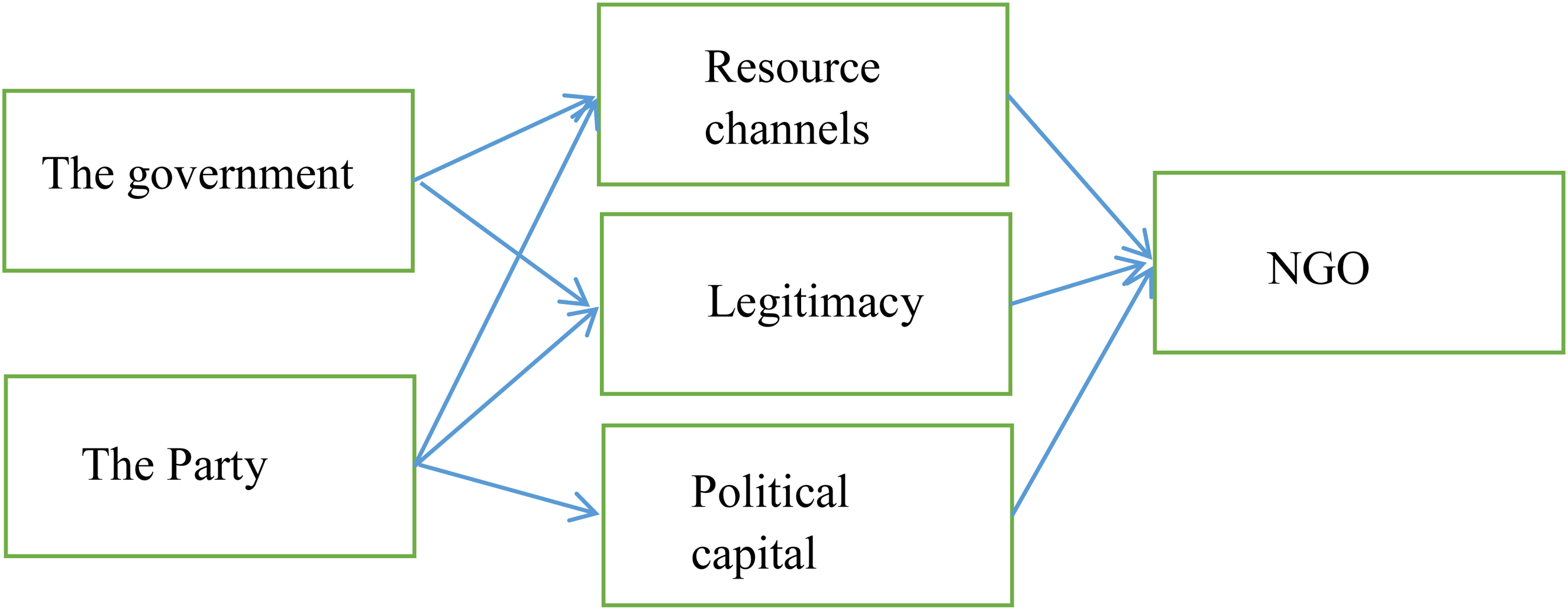
Influence mechanism of the government and Party on non-governmental organizations.
Figure 1 illustrates the significance of the Party for NGOs in greater depth. The traditional resource and legitimacy perspectives focus on the positive significance of the Party for NGOs at the organizational level, while neglecting the importance of the Party as a co-optation subject at the individual level. This paper argues that the unique influence mechanism whereby the Party can influence NGOs is the co-optation of NGO leaders, which in turn enhances their political capital and ultimately has a positive impact on NGOs’ development. It is worth noting that the NGO leaders can also gain additional political capital through developing good relations with specific government departments, but this differs from the Party in three ways. First, the working mechanism is different. The political capital gained through co-optation is based on the Party's ability to absorb individuals into the system by giving them a political identity, which is enhanced with the acquisition of political status. The political capital gained by maintaining good relations with the government is essentially based on personal relationships rather than political status, and the individual's identity cannot be changed from an outsider to an insider of the system. Second, the effect of influence is different. The co-optation of the Party, as the leader of political life, tends to help individuals to break through the constraints within and beyond the system to maximize the integration of resources, whereas being sheltered by a specific government department makes it difficult to transcend the limits of compartmentalization between Chinese departments. Finally, since the political capital generated by Party co-optation is rooted in institutionalized political identities, it differs most from political capital based on personal relationships in terms of reliability. While political capital maintained by personal relationships can easily change as people change, political capital derived from political identity is based on identity and status, which are strongly depersonalized and therefore rarely change despite changes of personnel. In the following part, this paper will use a multi-case comparison of two grassroots environmental NGOs in H City, Z Province, specifically to analyze how the Party has enhanced the political capital of an NGO leader to allow an NGO that was originally relatively vulnerable to rise to the top and gradually become influential both in the province and nationwide.
Research methodology and case selection
This paper has two objectives: first, to reveal the mechanism by which the Party influences the development of grassroots NGOs through individual co-optation; second, to compare this mechanism and its effects with those of the government on this basis. This paper adopts a research strategy of multi-case comparison. Under ideal conditions, a multi-case comparison not only enables causal inference through item-by-item replication and differential replication, but also sheds light on the causal mechanisms through process analysis and other methods (Yin, 1989), which is a more comprehensive research strategy. Some scholars have pointed out that multi-case studies tend to be more persuasive and generalizable than single-case ones. Wherever possible, a multi-case rather than single-case study design should be chosen to improve the research's intrinsic and extrinsic validity, when the necessary conditions and resources are available (Eisenhardt, 1991; Willis and Jost, 2007). Unlike large-sample inferential statistics, the selection of case study samples does not follow the principle of randomization, but is based on the range of values of the variables of interest for case selection (Seawright and Gerring, 2008). Gerring (2006) summarizes nine types and techniques of case studies, among which the multi-case comparative research strategy to which we often refer should follow the “most similar” or “most different” cases in terms of case selection. The former means that all of the variables are maximally similar except for a key core independent or dependent variable, while the latter is the opposite, where all variables differ except for the same specific independent and dependent variables. In essence, the core of both the “most similar case” and the “most different case” is to demonstrate (or reject) the effect of the core independent variable on the dependent variable while controlling for the variables of interest.
The key independent variable in this paper is “whether a given NGO is co-opted by the Party” and the dependent variable is “the development of NGO”, where the dependent variable is mainly measured by the size, fields of activity, and social influence of the organization. In order to demonstrate the influence of the core independent variable on the dependent variable, two grassroots environmental NGOs, namely H City Environmental Protection Volunteer Team (H City EPVT) and Green Water, were selected as the most similar cases. The two organizations are similar in terms of their spheres of activity and time of establishment, and share a similar political relationship with the local environment protection. In this paper, we examine the period from 2010 to 2016, and focus on the period after the establishment of the Party branch of Green Water in 2012, in order to observe the influence of the core independent variable of Party co-optation on the dependent variable.
To explain the causal mechanism, this paper adopts the process-tracing method. As a method commonly employed in comparative case studies, process tracing is considered an effective way to accurately identify the key variables that have an impact on the outcomes. This approach focuses on the causal mechanisms and examines whether our theories and hypotheses are validated by showing the interactions and working mechanisms of the factors. However, this does not mean that process tracing treats all details as equal; rather, it centers on capturing the key “evidence” that influences the outcomes, so that facts that are consistent (or inconsistent) with the theory can be found even in the context of a particular case (Thelen and Mahoney, 2015). This paper focuses on the development process of Green Water before and after the establishment of the Party branch, and adopts participant observation and in-depth interviews to document and analyze key events in its development, thereby revealing the working mechanism of the Party in enhancing the political capital of the NGO's leaders.
In terms of specific data acquisition, this paper mainly adopts participant observation and in-depth interview methods. The author conducted research on environmental NGOs in H City, Z Province in October 2015 and from February to April in 2016, for a period of nearly four months. The second study took longer, as the author worked as an intern for nearly three months at Green Water, interviewing the directors and staff of two grassroots NGOs and obtaining first-hand information. In the process of interviewing, the author used triangulation and, in addition to grassroots NGO practitioners, interviewed some relevant government officials to ensure the authenticity of the information. Table 1 lists the basic information about the interviews with the two NGOs.
Basic information about the interviews.
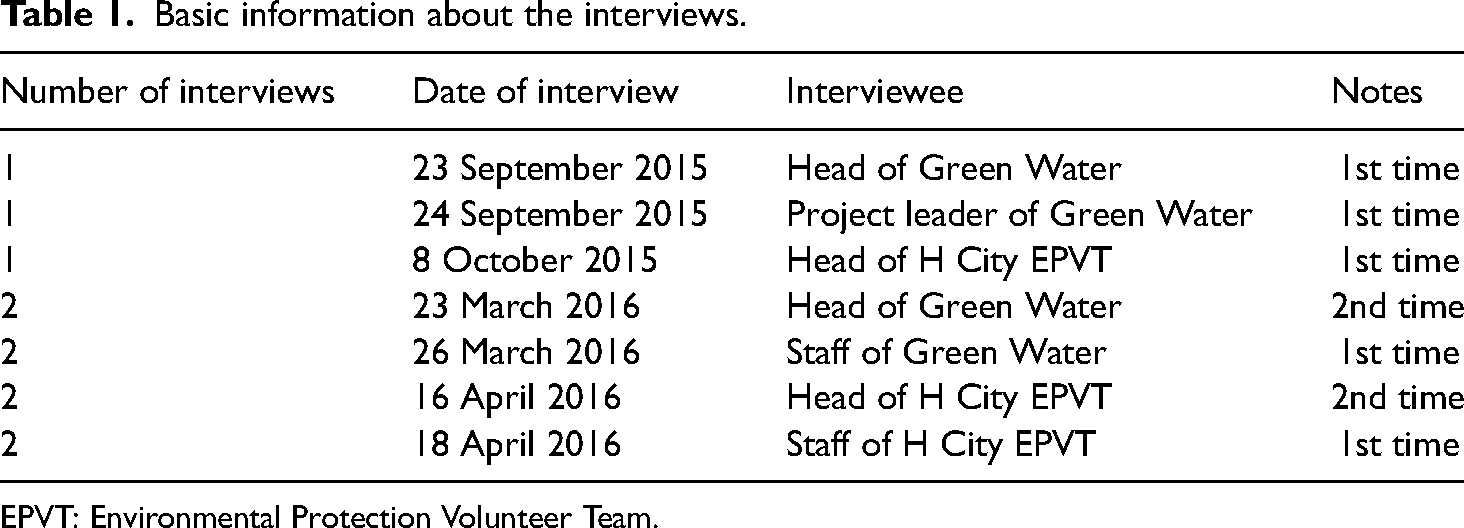
EPVT: Environmental Protection Volunteer Team.
Case presentation and analysis
Green Water and H City EPVT are both well-known grassroots NGOs in H City, Z Province, but their development histories differ greatly from each other. Although both are more or less connected to the municipal environment protection bureau in terms of their registration status, before Green Water established a Party affiliation, H City EPVT gained more support by virtue of its better relationship with the municipal environment protection bureau, so it was far stronger than Green Water in terms of its scale and influence. Although Green Water gained social attention by being active at some public events, its less well-developed relationship with the city's Environment Protection Bureau meant that it found it difficult to receive the same treatment as H City EPVT, which more or less limited the further development of Green Water.
The change occurred in 2015, when Mr Xin, the head of Green Water, received the 19th China Youth May Fourth Medal and was elected a member of the All-China Youth Federation (ACYF), one of the two youth-representative organizations in Z Province. This honor not only brought Mr Xin personal recognition, but also expanded the influence of his organization, Green Water. The influence of Green Water was previously limited to H City and some neighboring cities, but after Mr Xin received the May Fourth Medal it became a major environmental NGO both in Z Province and nationwide. Even The People's Daily reported his outstanding work. With the honor of the May Fourth Medal, Mr Xin, as secretary of the Party branch of Green Water, was also awarded the title of a “Thousand-Merit Party Branch Secretary” in Z Province and even became one of the 15 members of the province's Party members touring lecture team. These honors brought Green Water to the attention of senior leaders, and many leaders, including the secretary of the Provincial Party Committee of Z Province, visited Green Water, which greatly enhanced its visibility and influence. Through this opportunity, Green Water has expanded the depth and breadth of its cooperation with external parties, and some enterprises, foundations, and even government departments have approached it for cooperation. It has since taken the lead and gradually surpassed H City EPVT in terms of influence.
A careful analysis of the history of Green Water reveals that Mr Xin's success was no coincidence, but an inevitable result of his success in organizing and leading Party-building activities as the secretary of the Party branch of Green Water. The Party branch of Green Water was established in June 2012. After more than two years of effort, it became an excellent representative case of local NGO Party-building, and has become a model for success, attracting the attention of Party committees at all levels. Mr Xin, as the Party branch secretary, was also recommended as an outstanding youth representative. Using the establishment of the Party branch as a marker, the development of Green Water can be divided into three stages (see Table 2), and the next part of this paper will analyze the development of the two grassroots NGOs according to these three stages.
Three development stages of Green Water.
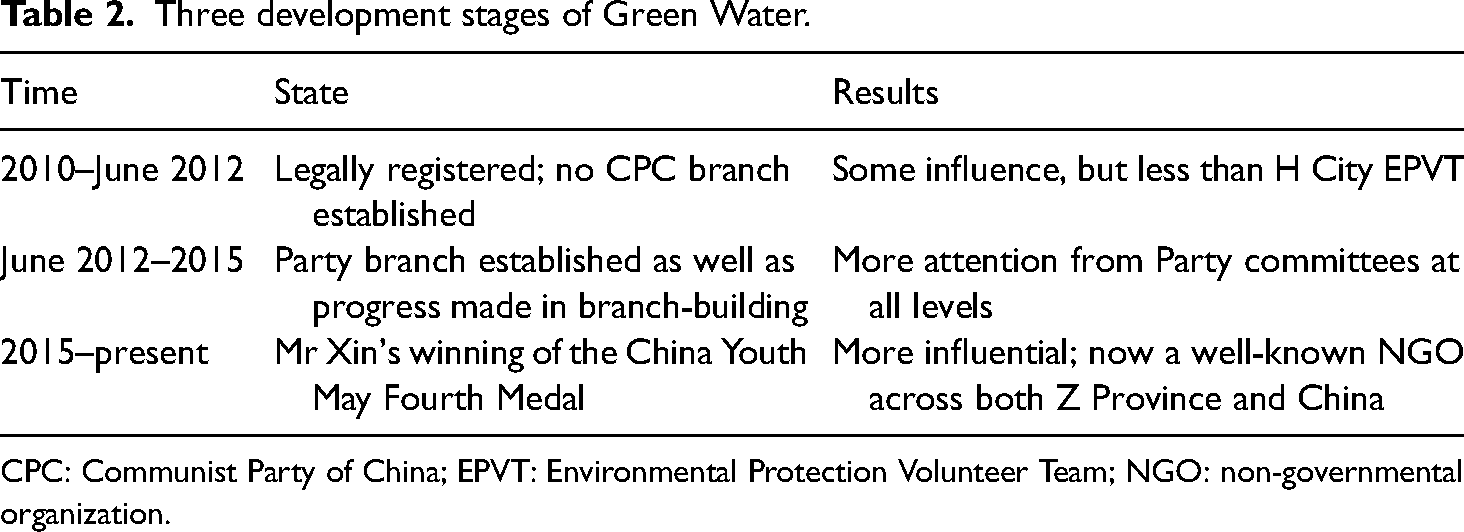
CPC: Communist Party of China; EPVT: Environmental Protection Volunteer Team; NGO: non-governmental organization.
Initial state: Same association, different results
As H City's first environmental protection NGO, H City EPVT has maintained its scale and influence across the city. As early as 2004, Mr Sun had the idea of establishing a professional environmental protection voluntary services team. He believes that, as a fairly successful local entrepreneur, he should use his spare time to contribute toward improving the environment in his hometown. After some preparations and contact, H City EPVT was set up by Mr Sun with several like-minded friends, but with no involvement from a responsible sectoral government body. In order to legitimize the NGO, Mr Sun began seeking support from relevant departments on the one hand, and actively carried out activities in society to enhance its visibility and influence on the other. Through his unremitting efforts, H City EPVT gradually got on the right track and attracted the attention of the H City Environment Protection Bureau, whose then leader believed that Mr Sun and H City EPVT could be a social force on which the bureau could depend, and hoped to support them to develop further. As the NGO's work is related to voluntary services and the bureau had misgivings about acting as the business guidance unit, H City EPVT, in the end, on the suggestion of the leader of the bureau, obtained legal status as a secondary association under the volunteer department of the H City Committee of the Communist Youth League (CYL), while in its daily work it receives more guidance directly from the bureau. Mr Sun commented that, although the bureau is not H City EPVT's business guidance unit, they have stayed in close touch and it has been supportive of them: Our relationship with the bureau is that of comrades in arms … The bureau is very supportive of us though it does not usually give us much financial support. This office is supported by the bureau, and it usually gets us involved in activities … We are in a close relationship. (Mr Sun, interview materials)
Although Mr Sun, a successful entrepreneur, and his NGO have no financial difficulties, the bureau's support is still essential for H City EPVT's development. In addition to a stable office area, more importantly, regarding many activities, the bureau endorses H City EPVT's venue applications and publicity. Moreover, in its daily work, the bureau fully respects Mr Sun as well as his cofounders’ decisions and gives them much room for independent decision-making, which brings their initiatives into full play. As a result, H City EPVT has made great breakthroughs in terms of both its scale and activity scope. Its members have grown from an original 10 or so members to over 1000, planned annual activities have significantly increased from the original one or two, and its brand has gradually taken shape. What's more, its image and influence are further enhanced after the media's publicity and coverage. Undoubtedly, the bureau's support has been essential for the NGO's achievements.
Another environmental protection NGO, Green Water, however, was less favored by the bureau. Mr Xin, due to his love for nature, founded Green Water in 2000 when he was an undergraduate. He initially did not regard it as his profession but, while studying in the USA and learning much about professional NGO management, he gradually realized that an NGO could be a rewarding undertaking. Thus, on returning to China, Mr Xin rejected offers from such robust companies as Pepsi and decided to devote himself to the cause of an environmental protection NGO. However, as a fresh graduate, he had neither work experience in the government system nor access to corporate donations, and the resources he could mobilize were rather limited. The only person to whom he could turn was his college teacher, Mr Ruan. Through his personal network, Green Water, which was struggling due to a dual lack of legitimacy and resources, contacted the H City Environment Protection Bureau as its responsible sectoral government body and successfully registered as an independent legal entity in 2010. Superficially, Green Water and H City EPVT shared the same organizational relationship with the H City Environment Protection Bureau; that is, they both received its guidance in their daily work. However, Green Water shared a less close relationship with the bureau than H City EPVT and, toward the two NGOs, the bureau's attitude was quite divergent. Green Water neither received material support including sites, nor did it often feature in the bureau's cooperation projects: To be honest, the office site, a long-term problem for us, was eventually provided by an entrepreneur through our personal network … Besides, beyond the funds from the Water-Keeper Alliance, in terms of cooperation with the government, our cooperation with the bureau was rather limited. Instead, we mainly cooperated with Qiantang River Administration Bureau, which yielded good results every year. (Mr Xin, interview materials)
In Mr Xin's opinion, the reasons for the different treatment of these two NGOs were twofold. One was that H City EPVT boasted a longer history of more stable cooperation with the bureau, which rendered the NGO more trustworthy to the bureau that regarded H City EPVT as its “own son”. The other reason arose from Green Water itself. Mr Xin hoped that his NGO would be relatively autonomous and did not want it to be absorbed as a consequence of the bureau's support. These two reasons led to the lukewarm relationship between Green Water and the bureau, making it difficult for the NGO to take advantage of the funding, publicity channels, and volunteer service system of the relevant departments to expand its network and enhance its influence, as H City EPVT was able to do. Although its core members increased from five to 15 after registration, there remained a significant gap in terms of scale when compared with H City EPVT, which consisted of over 1000 volunteers. Table 3 summarizes the basic conditions of the two NGOs.
Basic conditions of H City Environmental Protection Volunteer Team (EPVT) and Green Water.
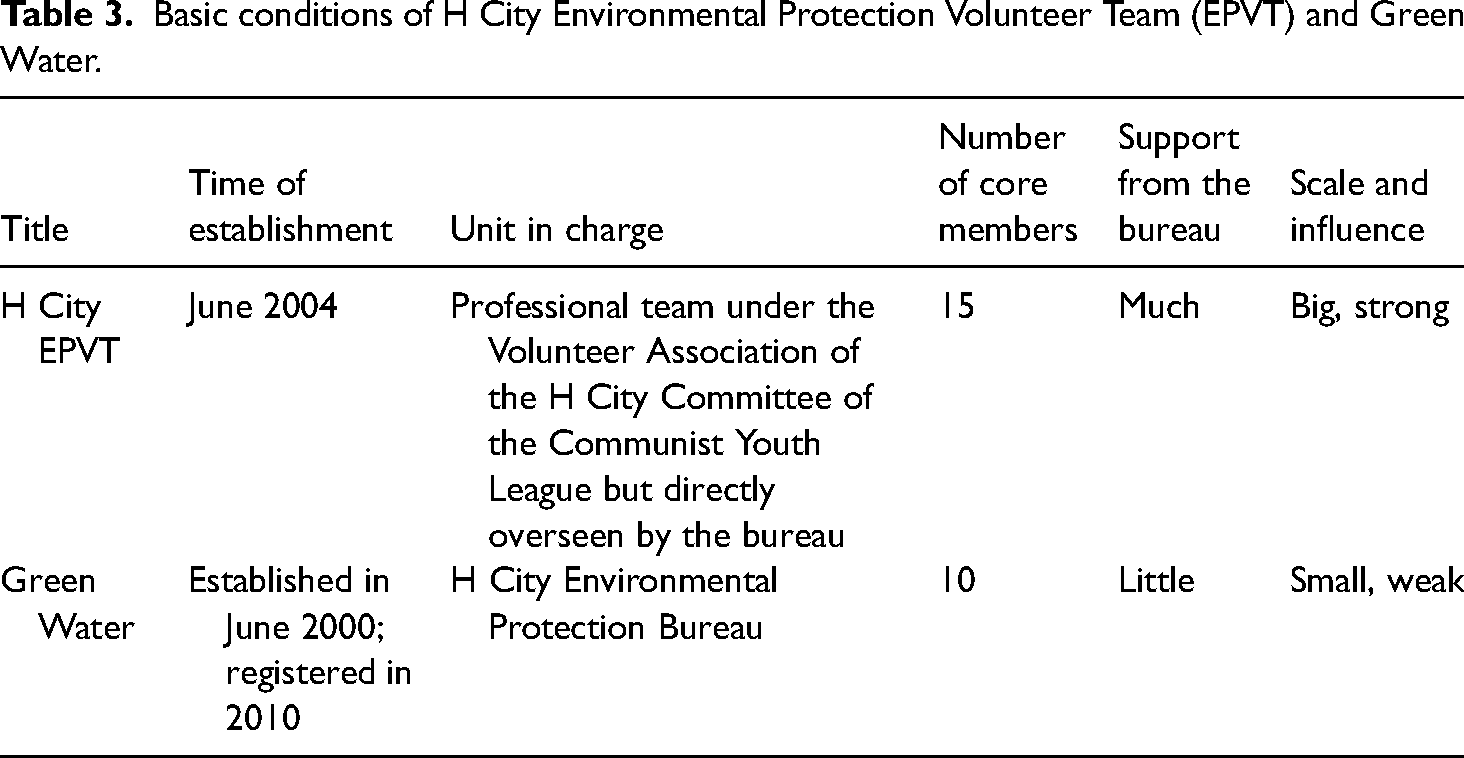
The analysis above shows that although the two NGOs shared a similar organizational association with the government, in terms of their actual operations, there were clear differences regarding the extent to which their association with the bureau was strong or weak. For a variety of reasons, compared with Green Water, H City EPVT has gained more trust from H City Environment Protection Bureau and received more support for its work, including both tangible resources such as funds and sites, and intangible ones such as social trust. This indicates that, for one thing, the government does impact NGOs through the mechanisms of resources and legitimacy, and for another, the effect of this impact is largely dependent on the closeness of association. It is because of a closer relationship with the bureau that H City EPVT outweighed Green Water in terms of both scale and influence.
Turning point: Establishment and building of the Party branch
In June 2012, with the approval of the higher Party organization, the Green Water Party branch was set up, with Mr Xin as its secretary. He expected that, as the first NGO Party branch in Z Province, it would be able to channel resources from and enhance the trust of government departments. In his view, as a result of the compartmentalization between Chinese government departments and the separation of the functions of the Party from those of the government, policies and resources from the higher authorities were not always communicated to the NGOs, while the Party branch certainly added up to another association with the system, which would greatly facilitate his NGO's development: There were many reasons for setting up the Party organization. One was that the higher authorities also had such needs. What's wrong with strengthening the Party's leadership in NGOs, after all? For another, I believed that it could bring us [Green Water] substantial benefits. (Mr Xin, interview materials)
However, matters did not run smoothly at first. The higher Party committee, W Street Party Committee, was relatively aloof and even slightly negative regarding Mr Xin's request. As NGO Party-building was not in the vision of the Party committees at that time, to the government it thus appeared to be unnecessary and even troublesome. Considering that there was already a responsible government body in charge of Green Water and there was no need to step in, W Street, taking the easy option, at first rejected its application: The Party secretary thought it unnecessary for NGOs to set up Party branches. Additionally, if Green Water did establish one, we might have to take responsibility for any problems. Having never heard of any such example, we did not want to be the first. (Clerk of W Street, interview materials)
Despite the rejection, Mr Xin did not give up easily. Through frequent communication and exchanges with W Street Party Committee, he finally convinced the committee and was granted permission to establish the Green Water Party branch, the first NGO Party branch in H City: It is an art to deal with the government, and we should learn to deal with both mighty and marginal figures. We started by contacting a clerk on the committee. It was through him, though a marginal figure, that we were able to gain access to the secretary and successfully set up the Party branch at last. (Mr Xin, interview materials)
Mr Xin was well aware that establishing the Party organization did not represent a direct advantage for the NGO. Although the government departments might trust Green Water more, it did not mean that they were willing to provide resources for cooperation. On account of this, Mr Xin decided to devote huge efforts to Party-building activities, making Z Province's first NGO Party branch into a leading one. He believed that successful Party-building would attract the higher Party organizations’ attention, which was crucial if his NGO were to gain the support of the higher authorities and open up new prospects. Mr Xin worked on various aspects to achieve this goal.
The first aspect is internal governance. Mr Xin has not only established a full-fledged Party branch structure but also, following the Red Army's tradition of appointing political commissars, purposefully appointed instructors in each department to understand and relieve the staff's ideological burden in a timely manner. At the monthly themed Party organizational life meetings, Mr Xin invites senior Party members from across society to share their experiences with the staff, in an effort to build the branch members’ ideology. In Mr Xin's terms, the fighting capacity of an organization firstly relies on its staff's determination to surmount difficulties, and Party members must play an exemplary and leading role, so an emphasis on ideological and political education is essential. Apart from ideological education, Mr Xin also encourages Green Water Party branch members to practice and implement the Party's goal of serving the people. Following his suggestion, every branch member sustains a one-to-one helping relationship with the needy households in H City. In their daily work, he requires the branch members to always consider the households they are helping and make use of activity resources to bring them practical benefits. For instance, Green Water, through its charity stores, provides free daily necessities to needy households at the end of every month, and the branch members send them the vegetables they grow in the nature school. These actions are not only in line with the Party's goal of serving the people, but also represent the NGO's public-welfare nature. More importantly, Mr Xin himself has actively participated in various Party-building competitions held by higher Party organizations in an attempt to attract their attention. He has won such prizes as the first prize in the H City Staff Speech Competition, first prize in the Z Province Staff Speech Competition, and first prize in the Z Province Party Mini-lecture Contest in succession, which has not only built his reputation but, more importantly, opened up opportunities for him to gain the acquaintance of officials in the system. As he often competes in Z Province representing the H City Party committee, he has enjoyed relatively in-depth exchanges with the committee. For example, as Mr Xin comments, the draft for the speech competition was hammered out with the committee member in charge of publicity work. By taking advantage of such opportunities, Mr Xin has not only made Green Water known to more officials in the system, but also greatly expanded his social network.
These moves have proved largely successful. Through over two years of efforts, the Green Water Party branch has become an outstanding example. Higher Party committees have thought highly of its various Party-building activities including the one-to-one helping initiative. The X District Party committee where the NGO is located has promoted it as a model Party branch, and some leaders of H City government departments have specifically inspected it. Through the media's coverage of Green Water and Mr Xin, the NGO has become increasingly influential, and Mr Xin, as secretary of the Party branch, has received increasing attention and affirmation from the higher Party committees.
Although Mr Xin found that more NGO Party-building was required by the higher Party committees after the establishment of the Party organization, which to some extent has affected the NGO's daily functions, he added that “[t]here are always losses and gains. If we want to obtain the higher authorities’ resource support, we need to spend more time on branch building, and it is sometimes rewarding to improve the staff's fighting capacity, after all.”
In contrast to Green Water's vibrant Party-building activities, Mr Sun, leader of H City EPVT, continued to carry forward its work steadily by virtue of his good relationship with the H City Environment Protection Bureau. Although Mr Sun, as a Party member, did not reject the idea of setting up a Party branch as well as related activities, he did not devote much time or energy to it like Mr Xin, for the higher authorities did not mandate it and Mr Sun believed that H City EPVT could function well even without a Party branch: The Party members’ progressiveness should be reflected in their daily life. The fact that we [the Volunteer Team] engage H City citizens in voluntary environmental protection services is itself a manifestation of the Party members’ progressiveness … If there is such a demand [for Party-building] by the higher authorities, I will not reject it, but at present everything is going well and we are in close cooperation with the bureau. (Mr Sun, interview materials)
In Mr Sun's view, despite the benefits that good Party-building work brings, it also means that the Volunteer Team must spend more time on tasks irrelevant to its functions. As an entrepreneur, Mr Sun need not worry about the finances of H City EPVT like Mr Xin does with Green Water, and the principle of “efficiency first” is deeply embedded in his way of thinking. Various reasons, including the great uncertainty of the effect of Party-building activities and the fact that the costs incurred may not result in proportional gains, made Mr Sun lay Party-building aside, saying that “it will not be too late to establish [a Party branch] if there is a need from the higher authorities”.
Excelling: Co-optation, political capital, and development by leaps and bounds
Party co-optation and political identities
As Mr Xin expected, through its successful Party-building work, the Green Water Party branch began to contact the higher Party organizations, and the latter rendered the NGO some resource support at the organizational level. For example, when X District was planning to build a batch of low-rent apartments for talented individuals and the NGO's staff were not on the list according to the district government's initial plan, the W Street Party committee helped Green Water, which was in pressing need of housing, to apply for two sets of low-rent houses.
For Mr Xin's part, however, the higher Party organizations’ support at the organizational level remains relatively limited, and its even greater support has consisted in helping him to improve his political capital. Since 2013 when the Green Water Party branch building took off, Mr Xin, secretary of the branch, has been successively elected a member of the H City Youth Federation and Z Province Youth Federation, emerging as a local political star and becoming increasingly bonded to the system. He has frequently appeared in public, with wide media coverage, and has been involved in many public events as an outstanding youth representative. In May 2015, Mr Xin won the China Youth May Fourth Medal and was elected a member of the ACYF and deputy secretary of the Working Committee on Social Organizations and Social Intermediaries of the ACYF, which constituted a major turning point for both Mr Xin and Green Water. Since then, as an outstanding youth representative, he has enjoyed frequent exposure via various public activities and the media. With the CPC Central Committee's issuing of the “Opinions on Strengthening Party-building in Social Organizations (Trial)” in September 2015, NGO Party-building has become a national-level policy and Green Water's achievements in Party-building have been publicized as an excellent example nationwide. Mr Xin first published an article in The People's Daily (Overseas Edition), the official newspaper of the CPC Central Committee, to share his vision and experience of NGO Party-building. He then became one of the 15 members of the Party members touring lecture team for Z Province, and won the title of the province's “Thousand-Merit Party Branch Secretary”. The secretary and the committee member in charge of organizational work of the Z Province Party committee inspected Green Water in succession and fully recognized and commended its Party-building work. In December 2016, Mr Xin was chosen as a delegate to the 12th H City X District Congress of the CPC.
Mr Xin believes that when it comes to his election as a member of ACYF and as the deputy secretary of the ACYF Working Committee on Social Organizations and Social Intermediaries, despite his efforts and the NGO's achievements, the key lay in obtaining sufficient political support from the Party organizations and relevant departments in the process, in which outstanding Party-building work played an essential role. He considers that although Party-building work is not directly related to Green Water's environment protection work and undertakings, it is conducive to the NGO winning political support and smoothly passing political scrutiny: You thought it easy for an NGO leader to be elected member of ACYF? Unlike GONGOs, we are a grassroots NGO, not the government's “own son”, and part of our funding comes from overseas. Without the higher Party committees’ support and promotion, such honors simply could not befall me … As far as I know, many relevant leaders are very supportive of me on this matter and they all think highly of my work in my position as Party branch secretary … My performance also merits their trust. (Mr Xin, interview materials)
Mr Xin has repeatedly stated that the Party is key to increasing his political capital and that the outstanding Party-building work and his service as a branch secretary render him a target of co-optation by the higher Party committees, as well as providing more opportunities. As the election of ACYF members is based on the opinions of Party committees at all levels and sometimes even political scrutiny, the title of “Thousand-merit Party Branch Secretary” is overwhelmingly convincing. Mr Xin noted that he passed the political scrutiny for the ACYF candidacy the moment the relevant departments saw the coverage of the Green Water Party Branch's deeds: The establishment of the Party branch as well as serving as the branch secretary, among other things, greatly helped me to be elected a member of ACYF … As far as I know, many people also contributed a lot to the process. The members of the organizing committee in our street especially said a lot of good words for me, basically reporting in detail each deed during my service as branch secretary, to help me to pass the political scrutiny. (Mr Xin, interview materials)
Development by leaps and bounds of Green Water
As Mr Xin's political status increased, especially after his election as a member of the ACYF, he began to integrate resources from within and beyond the system to support the rapid development of Green Water via his political platform and reputation. In order to compare with H City EPVT, we examine the changes that took place in the organization after Green Water was co-opted by the Party from the two aspects of organization scale and scope of activities.
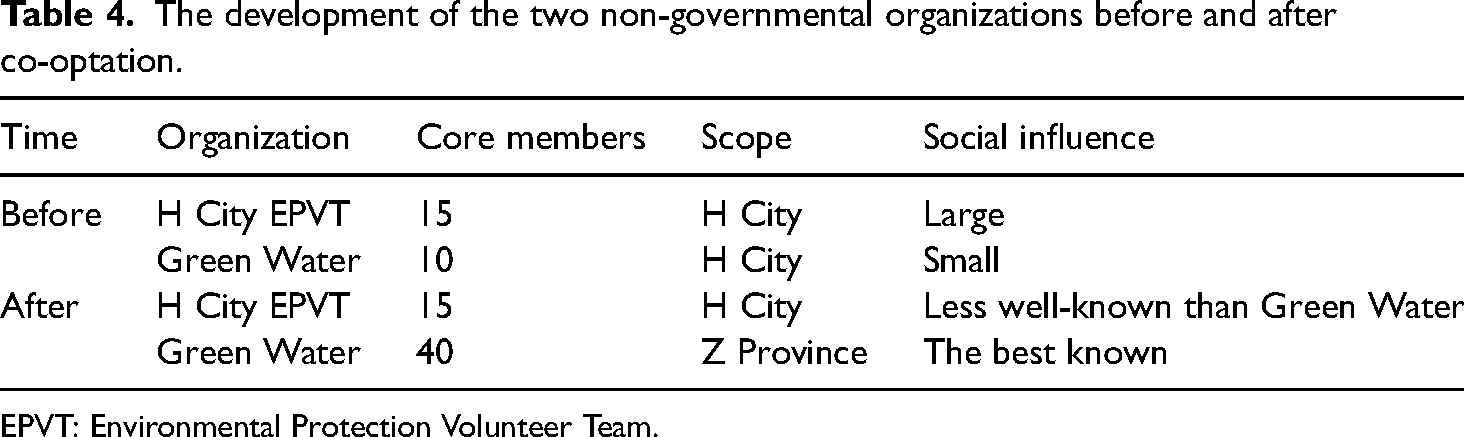
First, Green Water has grown from a core group of 10 people to a full-time team of over 40 people, with annual administrative expenses of over one million yuan, most of which come from its cooperation with companies and government support by purchasing its services. This reflects the NGO's enhanced ability to access resources. By virtue of his political status, Mr Xin has been able to provide a better institutional environment for the development of Green Water. For example, through his efforts, Green Water was authorized for tax-exempt status as a social organization, the only grassroots NGO of the kind in H city, which also put it on the list of organizations from which the municipal government could purchase services. According to Mr Xin, after obtaining the China May Fourth Youth Medal, he had become a distinguished alumnus of his alma mater. During an alumni event, he met another alumnus, an official from the finance bureau of H city, with whom he discussed many topics in which they had a shared interest, and from whom Mr Xin learned how social organizations may apply for tax-exempt status. The alumnus was very enthusiastic to tell him about the processes, materials, and precautions involved in application, and kept track of the matter after Green Water submitted the application, for which Mr Xin was very grateful: He cared greatly about this matter. After I won the May Fourth Youth Medal, I often went back to the school to host various sharing and exchange activities, and I met the alumnus at one of those events. We discussed a lot of topics in which we had a shared interest, and he helped us with the tax-exempt application. (Mr Xin, interview materials)
In addition to scaling up, the activity scope of Green Water has also gradually expanded from H city to other cities in Z Province, and it has become an important provincial force in environmental monitoring and protection. As of 2015, the NGO had established local working committees in nearly eight cities across Z Province to participate in local environmental governance. Mr Xin mentioned that there were ones which sought cooperation as well as ones which were pressured to cooperate. Those who took the initiative to cooperate with Green Water had generally heard Mr Xin's story when he was on tour as an outstanding Party member and decided to bring in the NGO to tackle environmental problems, while those who were pressured into cooperation did so in light of his political reputation. On the one hand, after Mr Xin became a political star, the media at the provincial level became a huge force for him in mobilization, and many key figures in the media became ambassadors or board members of Green Water. According to the employees of the NGO, municipalities which were willing to work with the NGO would inform their environmental protection bureaus before publicizing their environmental problems, so that negative news reports could be turned into positive ones about the government's investigation of polluters. On the other hand, as many local leaders followed Mr Xin on WeChat, as well as the official account of Green Water, and with the expansion of his personal network, many local environmental protection bureaus and publicity departments chose to cooperate with Mr Xin as they read the articles posted on the account to eliminate potential bad actors: Once, we exposed a pollution problem in a certain district, and their Party secretary saw the article and reported it to the environmental protection bureau, which was very nervous and asked us to delete it at first, to which we definitely didn't agree. Later, they explained that the area was not under their control, and we proposed to remove the article if they let us set up an environmental monitoring group, and they finally agreed to do so in order to eliminate the negative impact. (Mr Xin, interview materials)
In addition, by virtue of its close ties with the system, Green Water has also been given the opportunity to organize major government environmental events, such as the World Water Culture Forum, which has increased its impact and renown. According to a survey conducted in 2015 in H City, Green Water became the most well-known social organization in the city, with one in five people having heard of it. This fully demonstrates Mr Xin's capability to integrate resources after becoming a political celebrity.
Comparison with H City EPVT
At this time, Green Water has completely overtaken H City EPVT in terms of organization scale, fields of activity, and social influence (see Table 4). It is important to note that although Mr Sun has received praise from the Environment Protection Bureau many times, as well as such honors as “Distinguished Volunteer” and “Distinguished Volunteer Organization”, these only represent recognition rather than the promotion of his political status. The reasons for this are twofold. First, in China, the Party, as the leader of political life, is able to assign political authority and enhance political status by assigning such political identities as Party representatives or members of the Youth Federation, while specific government departments are not. As a result, the Party can absorb people outside the system into it by assigning them political authority, while specific government departments can only grant recognition and awards to them. Second, in terms of scope, the Party's leadership allows those who are co-opted to transcend departmental boundaries and play a role in resource integration, while those who are sheltered by a specific government department are largely unable to extend their influence to other departments. In addition, Mr Sun mentioned that changes in the leadership of the bureau often had a negative impact on their work, and that he needed to build up his contacts and relationships all over again following each change of personnel.
The development of the two non-governmental organizations before and after co-optation.
EPVT: Environmental Protection Volunteer Team.
The success of Green Water with regard to Party-building also gradually changed Mr Sun's mindset. The lack of political identity left Mr Sun wanting a platform to expand and integrate resources like Mr Xin, and his social network was limited to the voluntary services and environment protection system, as he was unable to expand beyond them. With the growing impact of Green Water, Mr Sun began to consider the possibility of establishing a Party branch: I don't have any political identity now, and my team members and I are considering setting up a Party branch, because Green Water has gained so many opportunities and resources through its branch. Although we won numerous honors this year, we feel that there are some bottlenecks to further development … Of course, we have to discuss this matter further, but I think it is possible that we will establish a Party branch. (Mr Sun, interview materials)
Summary
The above section has analyzed how an NGO leader enhanced his political capital through Party co-optation and thus promoted his NGO's development. Along with the above-mentioned framework of the respective influences of the Party and government on NGOs, Table 5 summarizes different developments of Green Water and H City EPVT.
The development of Green Water and H City Environmental Protection Volunteer Team (EPVT).
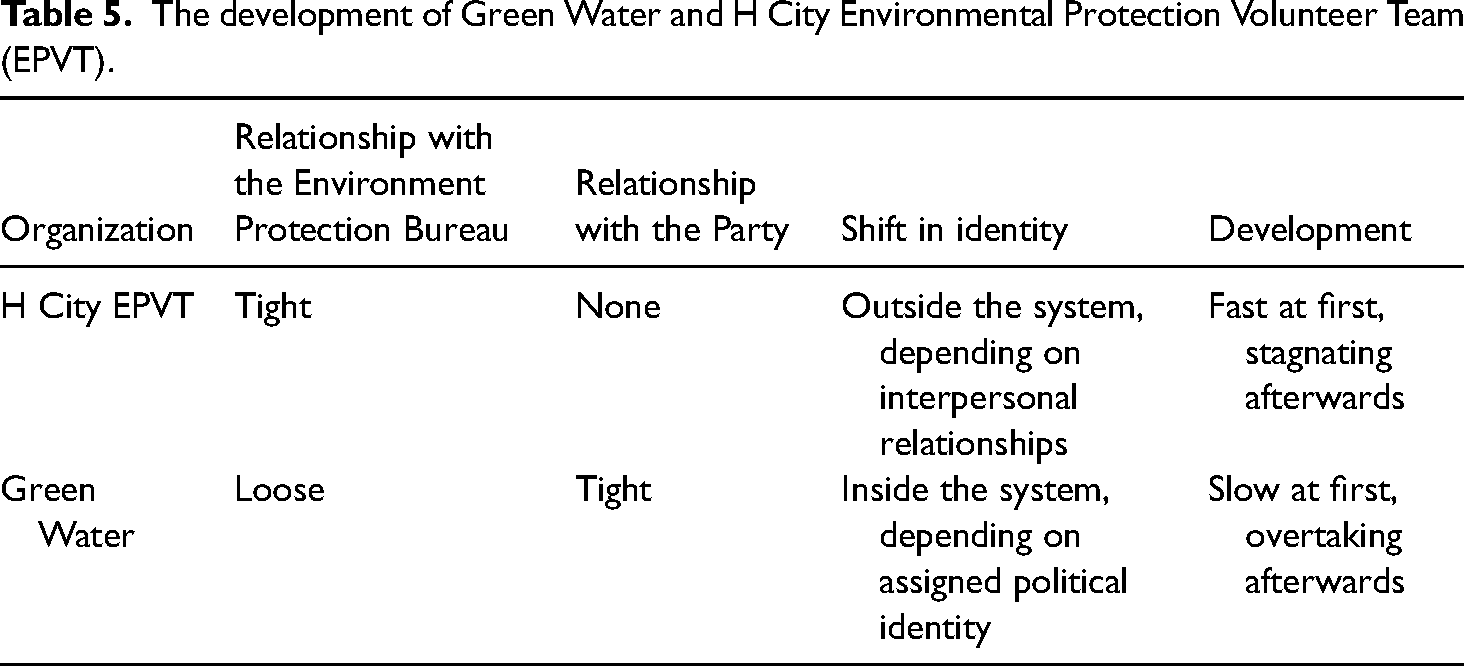
H City EPVT's close relationship with the H City Environment Protection Bureau contributed greatly to its early development. The bureau not only provided H City EPVT with offices, but also endorsed its activities and project applications, helping it to maximize the expansion of its volunteer network and social influence, which enabled the NGO to grow considerably in the short term. However, during its subsequent development, H City EPVT did not develop a new network as Mr Sun did not try to increase the connection with the Party by establishing a Party branch. Although he did reach out to some government officials in his day-to-day activities, without a political identity or platform this relationship was maintained at a more personal level, and thus it was hard to transform it into tangible benefits for the NGO's development. The single source of political support and limited social network became an insurmountable bottleneck for the NGO's later development.
In the case of Green Water, the initial loose relationship with the bureau offered no support apart from legal status, which rendered the NGO a more difficult environment during the early stages compared with H City EPVT. However, Green Water has since embarked on a different path by establishing a Party branch and actively engaging in Party-building activities to open up its prospects. The mechanism for this was that as Party-building enhanced Mr Xin's personal political capital and via outstanding Party-building activities, he became the target of the Party's co-optation as a social elite, thus successfully transforming him into an insider of the system. This formal political identity and the political platform has enhanced Mr Xin's personal political capital, and thereby helped to expand the cooperation network of Green Water. By integrating various resources within and beyond the system, Mr Xin succeeded in catching up from behind, and it can be said that Party co-optation played a key role in this process.
Conclusions and prospects
With more than 30 years of development, grassroots NGOs have gradually grown into a considerable force within China's public governance. By providing public services, fostering social capital, enhancing public participation, and promoting social innovation, the NGOs are quietly shaping a new pattern of state–society relations. This paper focuses on the relationship between the Party and NGOs, two important subjects of the state, and explores the impact of the Party's co-optation mechanism on NGOs through a multi-case comparison. This is of great theoretical and practical significance to our further understanding of state–society relations in the new situation when Party-building has been fully rolled out in NGOs.
The contributions of this paper are twofold. First, theoretically, the author seeks to introduce the perspective of co-optation and deepen the understanding of the Party's influence on NGOs. The findings suggest that, besides the two organizational-level perspectives of resource and legitimacy, there exists a third mechanism on the individual level, which makes up for the long-standing deficiencies of the two perspectives and helps to comprehensively understand the influence of the Party and the government on NGOs as different state subjects. Second, empirically, through a multi-case comparison, this paper demonstrates the unique influence mechanism of the Party on NGOs compared with the government. It is argued that the Party can influence an NGO by enhancing its leader's personal political capital. Since the Party leads political life and is decisive in assigning political authority, it can assign political identities to NGO leaders, absorb them from outside the system to inside it, and expand the NGOs’ as well as their leaders’ social networks while improving their political status, thus providing good conditions for NGOs to integrate resources and create a smoother institutional environment. In contrast, a single department cannot absorb people from outside the system, and can only facilitate the development of NGOs at the organizational level. Although NGOs can obtain resources by maintaining good relations with government departments, this kind of political support, based on personal relations, is difficult to extend beyond the barrier of compartmentalization. Therefore, there is no doubt that the unique co-optation mechanism of the Party has an important impact on the development of NGOs.
The results of this study not only help us to understand the complex relationship between the Party and NGOs at the theoretical level, but also enable us to explore in practice what role the Party should play in the future transformation of grassroots NGOs to promote the modernization of China's governance system. As China's reform deepens, the academic and practical circles have reached a consensus on the need to strengthen the role of NGOs, yet still lack one on such issues as how much autonomy and independence should be given to NGOs, with some believing that a too close relationship with the state will damage their autonomy. However, as some scholars have pointed out, a close relationship with the state does not mean that NGOs are tied to it and, in some cases, they can achieve their goals with the help of institutional resources (Chen and Xu, 2011; Gallagher, 2004). This study also suggests to a certain extent that Party co-optation has a very positive impact on expanding NGOs’ social networks and their space for action. Therefore, future research should address the close relationship between NGOs and the state from a more dialectical perspective, and focus on the actual impact of such a relationship on public governance rather than on the independence and autonomy of NGOs per se.
In addition, the results help to distinguish the influence mechanism of the Party on NGOs from that of the government, and to move away from the traditional mode of equating the “state” with the “government” to a more detailed discussion of the role that different agents play in state–society relations. This paper reveals the uniqueness of Party co-optation at the individual level compared with that of the government. Nevertheless, in actual political life, governance on the government side does not usually involve the internal operation of social organizations, while the Party does have an impact on them. The Party-building of NGOs pays special attention to the political status of the person in charge, but there will also be many other arrangements, such as requiring the organization to establish certain settings, a Party-building liaison, or the organization's agenda setting and even internal activities. All of these reflect the differences between the Party-building mechanisms and governmental governance mechanisms, which also deserve further attention in subsequent studies.
Due to the word limit and research conditions, there are some limitations to this study. First, as this is a multi-case comparative study, more verification is needed before the findings can be generalized; in particular, the better development environment after co-optation experienced by the two NGOs in this study can be empirically tested with large-sample data in the future. Second, due to the limited materials, it can only be demonstrated that the Party's co-optation works in the environmental field, while more verification is needed in other sectors, such as labor and education. Third, given that the Party-building has been fully rolled out in NGOs, it is important to consider why NGOs with Party branches perform differently. Finally, and most importantly, the factors that limit the Party's unique advantages over the government require further clarification. In the case of China's compartmentalization, apart from the Party, certain levels of government departments may also be eligible to provide institutional network positions for NGOs, and, in addition to environmental protection, some other departments such as justice and civil affairs may also be able to provide NGO leaders with institutional and political status. What's more, different types of Party organizations may play different roles in this context. This paper observes the Party working committees at the street level, but whether Party organizations at higher levels share the same capacity demands further observation and research. The clarification of these issues will help us to understand the significance of Party co-optation for NGOs and the future direction of state–society relations.
Footnotes
Declaration of conflicting interests
The author declared no potential conflicts of interest with respect to the research, authorship, and/or publication of this article.
Funding
The author received no financial support for the research, authorship, and/or publication of this article.