







Abstract
One important approach to studying emotional labor is to focus on its negative impact from the perspective of organizational psychology. Less attention is paid to the positive effect. This paper adopts a cultural sociology approach to study how “maternity helpers” use boundary work, such as “deep acting” and constructing symbolic boundaries, to produce positive experiences in the process of emotional labor. In deep acting, they actively distort the boundaries of the private space, introduce a family-oriented narrative, and participate in a certain amount of “philanthropic labor”. They are also engaged in constructing symbolic boundaries by promoting themselves as “childcare experts”, in order to get the upper hand when interacting and negotiating with clients. Both boundary work strategies constitute an attempt to challenge social boundaries by constructing symbolic boundaries. This paper argues that the concept of autonomy in emotional labor should adopt a relational approach, thus accounting for the ability for the laborers to autonomously choose strategies that can produce equal and meaningful social relations, rather than merely focusing on the independent self with clear boundaries or the ability to control the labor process. Nevertheless, autonomy in emotional labor is constrained by both institutional and cultural conditions.
Background
With the rise of the modern service sector, emotional labor is now a rather common form of labor in Chinese society. Emotional labor refers to a labor process during which the laborer manages or presents certain emotional states for public display with the aim of creating certain emotional states or feelings in others. Although emotional work has always existed in the private realm of daily life, emotional labor generates profit out of such emotional work as a form of commercial service (Hochschild, 2012). Companies and organizations often write scripts for interactions between the laborer and the client, and execute continuous monitoring of the labor process and the emotional management of the service providers, who have to follow a series of formal or informal “feeling rules” during continuous production, suppression, or alteration of their own emotional status in order to satisfy the emotional needs of the customers (Bulan et al., 1997). Workers in the service sector, such as flight attendants and bank tellers, as well as professionals such as doctors and lawyers, are typical practitioners of emotional labor (Hochschild, 2012; Wharton, 2009).
As China continues to urbanize, the service sector now amounts to 52.2% of China's economy (as of 2018). 1 An enormous population of service workers has emerged, and the majority of them practice a certain form of emotional labor. Thus, the characteristics of emotional labor and the impact of it on labor experiences carry great significance for the organization of social production, as well as the welfare of individual laborers. Many factors affect labor experiences, including personal factors (such as gender, age, educational level, length of employment), organizational characteristics (such as the remuneration system, labor intensity, personal network), and socio-structural factors (such as institutional segregation, labor mobility, work–life balance) (Gu, 2004; Locke and Henne, 1986; Xu and Qi, 2016; Zhang and Li, 2001; Zhang and Yang, 2018). As a form of labor, the working experiences of emotional laborers are affected by the above factors. Yet, as a form of labor centered around social relations, the interaction between both ends of the service, in particular the expression and management of emotions, has a great impact on the working experiences of emotional laborers (Wharton, 2009).
One of the most important arguments made in Hochschild's theory of emotional labor is that an attack on the worker's self will result in emotive dissonance (Hochschild, 2012). Emotional laborers are requested to repress their genuine emotions and present emotions that better comply with the needs of the clients. Thus, emotional labor threatens the identity of the laborers, and negatively affects their psychological well-being. Inspired by the groundbreaking work of Hochschild, a considerable literature is now devoted to examining the negative effect of emotional labor on workers’ psychological health. These studies reach the consensus that the intensive emotional management required by emotional labor, in particular the repression of negative feelings, is likely to cause psychological stress, burnout, and unsatisfactory working experiences (Bhave and Glomb, 2016; Bulan et al., 1997; Erickson and Ritter, 2001; Grandey, 2003; Grandey et al., 2012; Morris and Feldman, 1997). Research on emotional labor in China also tends to emphasize and caution against the potential negative consequences of emotional labor. For example, researchers have studied the inequality and exploitation faced by female emotional laborers (Ma, 2010; Wang, 2014).
However, among the growing body of studies, few have turned attention to positive experiences in emotional labor (e.g., Ashforth and Tomiuk, 2000; Côté, 2005). It is however a legitimate question to ask whether emotional labor can produce positive working experiences as a form of labor centered around social interaction. Based on a study of the interaction between maternity helpers and their clients, this article contributes to research on the working experiences of emotional laborers by paying specific attention to the positive experiences produced in the labor process.
Maternity helpers as emotional laborers
Maternity helpers comprise the fastest-growing group of emotional laborers in Chinese cities in recent years. In the past, new mothers were normally cared for by their closest family members, including their mother, mother-in-law, or other elderly female relatives, in private spaces. However, over the past decade, employing a “maternity helper” to help with postpartum recovery has become the new norm in urban areas. As the demand for maternity helpers surges, so do their monthly salaries. 2 The rising demand can be explained by several factors. Firstly, due to fertility delay, when most couples bring their first child into the family, the grandparents are less physically capable of providing intensive care to the newborn and new mother. Secondly, due to changes of parenting culture among the Chinese middle class (Chen, 2018) and the increasing incidence of the separation of residence between young couples and their parents (Ma et al., 2011), many new mothers worry that intergenerational grudges during cohabitation will intensify due to different styles of parenting. Thirdly, employing a maternity helper has become the new social norm. People increasingly accept the idea that it is worthwhile to have an experienced, well-informed helper to provide attentive and professional care to the newborn and new mother.
As the industry booms, a certain consensus on the job requirements of maternity helpers has gradually formed. 3 Their daily responsibilities mainly consist of providing intensive care for both the mother and the baby. When taking care of the baby, a maternity helper normally needs to feed the baby (or help the mother with breastfeeding), bathe the baby, change diapers, put the baby down for naps, etc. When taking care of the mother, a maternity helper is in charge of food preparation, postpartum recreation, etc. She is normally only responsible for housework directly related to the mother and the baby, for example, maintaining hygiene within the room of the mother and the newborn, as well as washing their clothes. Household chores related to other members of the family are not included in the job requirements. The maternity helper normally shares a room with the mother and the baby, so she can tend to their needs during the night. In some cases, the maternity helper may also take care of the baby in a separate room to allow the new mother to have better rest during the night.
The emotional labor carried out by the maternity helper is very intensive. In addition to bodily care, they have to attend to the emotional needs of both the mother and the baby. They not only cuddle the baby when he or she cries, but also watch out for symptoms of postpartum depression in and provide emotional support for the mother. Some maternity helpers even take on the job of a mediator in distressed family relationships. This requires maternity helpers to constantly present a positive, compliant, and understanding attitude toward the family that employs them. While engaged in the role, besides going out with the client's family (e.g., for the mother and baby's routine check-ups), the maternity helper cannot leave the residence for personal reasons. They normally do not have a private living space, and have to answer to the needs of the mother and the baby immediately throughout the day and night. According to the written contact, maternity helpers have one day off each week. Yet, in conformity with the implicit rules of the trade, they almost always choose to work continuously so they can complete the assignment earlier. That is, for those maternity helpers who are assigned a one-month contract, they work continuously for 26 days, and for those who are assigned a two-month contract, they work continuously for 52 days, etc. This means the maternity helpers normally work for a considerably long period of time without any days off.
If intensive and strict emotional management can cause attacks on the self and threaten self-identity, as indicated by previous studies of emotional labor, it is not difficult to imagine that the working experiences of maternity helpers will be negative. However, based on our research, a considerable proportion of maternity helpers do have positive experiences, despite the intensity of their emotional labor. Moreover, they are able to have positive experiences not because they try to protect “the self” by defending clearer and firmer boundaries, but through actively breaking existing boundaries of the private space within families, and reconstructing relational order between clients’ families and themselves. This causes us to reconsider the conditions under which positive experiences of emotional labor are possible, and the strategies chosen to realize these positive experiences.
Literature review and theoretical framework
Literature review
Current research on emotional labor has mostly focused on the negative effect on laborers. Two main factors contribute to the negative effect. Firstly, drawing on the theory of conservation of resources, researchers argue that stress related to emotional labor can be explained by the inadequacy of personal, social, and psychological resources of laborers. Frequent emotional management can induce cognitive fatigue, exhaust psychological resources, and cause burnout, thus threatening organizational efficiency and personal well-being (Brotheridge and Grandey, 2002; Grandey, 2000, 2003; Grandey et al., 2005, 2012; Hobfoll, 1989; Wharton, 1993, 1999). Secondly, taking the perspective of self-identification, experiences of inauthenticity during emotional management will cause alienation of the self. Emotional laborers feel frustrated and anxious due to loss of control over their “true self”, thus causing “emotive dissonance” (Abraham, 1998; Adelman, 1995; Hochschild, 2012; Morris and Feldman, 1997). Therefore, the more intensive emotional labor is, the more likely it is to attack the boundary of the self, threaten self-identity, and thus engender negative working experiences.
While studying the negative effect of emotional labor, researchers also find some important mediating factors. For example, the culture of a particular society can mediate the negative effect of emotional labor on the laborers. Grandey et al. (2005) find that the association between emotional management and job satisfaction is more significant in the USA than in France because the service culture in the USA places more emphasis on emotional management and “smile service”, compared to that of France. Moreover, different types of emotional labor have different effects on laborers. Compared to professionals, front-line service workers are more likely to be negatively affected by emotional management due to a lack of labor autonomy (Wharton, 2009). In general, a higher level of labor autonomy can effectively mediate the negative effect of emotional labor. So does the strategy of “deep acting”, in contrast to “surface acting” 4 (Brotheridge and Grandey, 2002; Grandey et al., 2005; Hülsheger and Schewe, 2011; Johnson and Spector, 2007; Lopez, 2010; Singh and Glavin, 2017; Troyer et al., 2000).
However, existing theories do a better job of explaining the negative effect of emotional labor than the positive effect. Firstly, the theory of resource conservation cannot explain certain empirical findings. For example, a study on flight attendants revealed that when management lowered the emotional labor requirements from flight attendants, that is, reducing the consumption of their personal, social, and psychological resources, their working satisfaction, however, did not increase. By contrast, some flight attendants saw this as an attack on their professionalism (Curley and Royle, 2013). Moreover, the theory of resource conservation cannot explain why surface acting causes higher levels of work-related stress and burnout, while deep acting does not have a significant effect in terms of negative experiences, and in fact sometimes strengthens feelings of reward and satisfaction. It is true that emotional labor will consume a great deal of resources when laborers switch between their “true” and “fake” selves, but it is also true that deep acting equally consumes a huge amount of psychological resources as it requires the worker to manage emotions based on the specific object and setting of the interaction. A study on doctors found that although deep acting raises the requirements for doctors’ emotional management, it improves doctor–patient communication, and help doctors to better empathize with patients, thus enhancing their job satisfaction (Larson and Yao, 2005).
Secondly, the theory of self-identity may be able to explain why a high level of labor autonomy can assuage the negative effect of emotional labor. That is, when laborers can independently decide the content and form of their emotional expression, they are able to experience a more authentic self during the labor process, thus lowering the risk of emotive dissonance and preventing negative consequences. However, the theory of self-identity is less effective in answering the question of how to improve the working experiences of emotional laborers. Informed by this particular theory, we may think that the laborers will be able to improve their working experiences by defending the boundary of the “self”. In a study on migrant domestic workers by Pei-Chia Lan (2003), part of her findings seem to confirm the above theory. For example, Lan finds that foreign domestic workers use a series of strategies to defend their private space. Some of them explicitly refuse extra work, including dining out with the employer's family, during which they are expected to watch the children. Others avoid conversations related to their own private life. They try to lower the intensity of emotional labor by reducing the frequency of contact with their employers, and defend their private space by drawing clear boundaries. Yet, at the same time Lan also finds that those domestic workers who take care of children and the elderly tend to build more intimate relationships with their employer, and thus in fact receive more emotional rewards (Lan, 2003).
Therefore, existing research based on theories of organizational psychology cannot provide a comprehensive framework for understanding the working experiences of emotional laborers. In particular, it fails to explain positive experiences of emotional labor. On the one hand, quantitative research prevails in the study of the job satisfaction of emotional labor (Wharton, 2009), while qualitative examinations of the labor process have been relatively scant. Yet, a qualitative approach to studying the labor process is critical in explaining why deep acting is more likely to bring about a positive experience than surface acting, or to examining the role of autonomy in the production of positive experiences. As the founder figure of the theory of emotional labor, Hochschild does not claim lineage with labor process theory, but in fact her concept of emotive dissonance resonates with the “separation of conception and execution” theorized by Braverman, only Hochschild extends the argument from control over the body to control over emotions (Braverman, 1979; Grandey et al., 2005; Hochschild, 2012; Zhuang, 2019). After Braverman, critics such as Burawoy pointed out the urgent need to bring worker autonomy back to the study of the labor process to investigate the work experiences and power relations during labor (Burawoy, 1979; Lee, 1998; Wen and Zhou, 2007). This approach informs most of the research on emotional labor in China. For example, Su (2011) uses the labor process theoretical framework to discuss the power struggles between domestic workers and their employers. Shi (2016) examines how workers in beauty salons use gendered strategies to build emotional relationships with clients. Li and Liu (2017) also use labor process theory to track how flight attendants deflect the panoramic surveillance of airlines by making use of the different needs of clients. Although these studies do not answer directly the question of job satisfaction, they demonstrate how qualitative research can provide useful insights into the working experiences of emotional laborers.
Moreover, current research fails to capture the fact that during interactions between laborers and clients, emotional experiences are produced alongside the consumption of psychological resources. In his study on an orphanage in China, Qian (2013) points out that the psychological stress and emotional reactions that come along with intensive emotional labor are not the result of the repression of the authentic self, but rather the reproduction of emotional labor. For carers at the orphanage, the critical factor that affects their daily working experiences is not their self-identity, but rather a new identity of the “nursery mom” constructed during emotional labor. They devote a large amount of physical as well as emotional energy to the work, and at the same time experience complicated emotions, including affection and frustration during daily interactions with the children, and sadness and attachment when parting. The interaction between the caregiver and care receiver dictates the working experiences of the emotional laborers (Qian, 2013). Exactly because the product of emotional labor is an invisible interactive experience, one cannot unilaterally produce good or bad emotional labor. Thus, we need to situate emotional labor in a framework of social interaction (Côté, 2005). A triangular “laborer–capital–consumer” relationship is involved in emotional labor (Li and Liu, 2017). That is, in addition to the labor–capital power relation examined in Hochschild's early works, the relation between laborers and consumers is also critical.
Theoretical framework
In order to capture positive experiences produced during emotional labor, this article focuses on the interactions and power relationships between emotional laborers and their clients. Dominant theories of the labor process normally define labor autonomy by the extent to which one can independently decide the content, progression, and intensity of one's own labor (Cai, 2014; Wheatley, 2017). However, if we understand autonomy as being freed from intervention or control from others, and use it as a precondition for determining positive experiences of emotional labor, we will inevitably find that this is not only practically impossible, but also inadequate for explaining the actual experiences of emotional labor.
Thus we propose to rethink the concept of self in the context of emotional labor. If we base the theory of emotion on the presumption that one needs to preserve an independent and authentic self with a clear boundary, then we will conclude that intensive emotional labor will inevitably threaten one's identity because it puts an incredible amount of pressure on the boundary of the self. Yet, if we see the negotiation of the boundary of one's self as being based on an interdependent relationship with others (Yang, 2015), we should no longer limit our understanding of the autonomy of emotional laborers to being freed of outward intervention, but rather base it on whether they are capable of independently choosing strategies to promote the production of meaningful social relationships.
How exactly do emotional laborers promote the production of meaningful social relationships? This article takes a look at how emotional laborers use boundary work to produce positive working experiences. In this paper, I refer to boundary work as the process of constructing symbolic boundaries to challenge social boundaries. Symbolic boundaries are social distinctions made at the conceptual level to help social actors identify differences between objects and people, and in time and space. Social boundaries, on the other hand, are consolidated social inequalities of resource access and distribution (Lamont and Molnar, 2002). While symbolic boundaries are a necessary precondition for the creation of social boundaries, only when they gain wide-ranging social recognition can they be objectified into social boundaries. The former manifest during interactions, whereas the latter exist as distinctions of social groups (Lamont, 1992; Lamont and Molnar, 2002; Pachucki et al., 2007; Sherman, 2006). Symbolic boundary work in this paper includes two sets of practices. The first set includes those practices that remold social distance by defining degrees of intimacy, in order to promote the production and flow of emotions. For example, maternity helpers use the strategy of deep acting during emotional labor. The second set involves those practices that redivide social groups by distinguishing “us” from “them”, in order to acquire status and resources. For example, maternity helpers actively construct symbolic orders among different carers within a family. Both strategies challenge existing social boundaries, and produce positive working experiences by constructing meaningful social relations.
Methods
The findings of this research are based on qualitative data collected from 26 semi-structured interviews carried out between January and July 2019. Among the interviewees, 13 were maternal helpers. They were between 31 and 53 years old and originally from Heilongjiang, Liaoning, Henan, Anhui, and Hebei provinces. Most of them had either a middle school or high school diploma, and all were working in Beijing when interviewed. The other 13 interviewees were new mothers who had employed a maternal helper during three years prior to the time of interview. The new mothers were aged between 30 and 38 and had all received an undergraduate or postgraduate education. All of them were living in Beijing at the time of interview. Among the 13 mothers, two were full-time homemakers, whereas the other 11 held job positions in administrative management, human resources, academic research, etc. In the following sections the prefix Y denotes maternity helpers and the prefix M denotes new mothers. 5 Beijing was chosen as the location of interviews as it has experienced particularly rapid growth in the care industry in the past decade.
Several aspects of the research design require some further explanation. Firstly, an important feature of this study is the intent to not only study the working experiences of emotional laborers, but to also bring the reception end of emotional labor into the dialogue. This is a rather novel attempt compared to existing studies. Considering the fact that emotional labor takes interaction as its main form, focusing on working and psychological conditions from a unilateral perspective falls short in explicating the emotional tensions during the labor process. In this study, we hope to stress the centrality of interaction to the working experiences of emotional laborers, by looking at the negotiation and conflict between the provision and reception of emotional labor.
Secondly, data collection takes three different forms in this research, namely face-to-face interviews, telephone interviews, and self-reporting through a social media app. Here I discuss in more detail the strength and weakness of the third form of data collection. Self-reporting through a social media app was a choice offered to the new mothers, who, especially the nursing mothers, normally found it very challenging to conduct an hour-long interview without being distracted by their children's needs for care and attention. As an alternative choice, I sent the interview guidelines to the interviewees and asked them to leave voice messages whenever they had free time. Although this method eased the time pressure of the interviewees, a few potential constraints also arose. For example, because each voice message lasted only 60s, some of the interviewees rushed through the time limit in order to finish a sentence or answer, possibly reducing the detail of their response to do so. In addition, because the researcher did not give instant feedback to the interviewees’ answers, and probed the interviewees for more details only after receiving the answers to all questions, each interview took two or three rounds of exchanges of messages to complete. Overall, interviews conducted with the assistance of the social media app did not come out as complete or work as smoothly as more traditional forms of interviewing. Yet, it provided an opportunity for interviewees who otherwise might have been reluctant to participate to complete the interviews in a more convenient and flexible manner. The suitability and implications of this method, however, call for further scholarly discussion.
Finally, this paper also draws on my personal experiences, having been employed as a maternity helper during April–May 2018. Some of the personal notes taken during this period as an “insider” were used to further the analysis of the qualitative materials used in the writing of this paper Table 1.
Interviewee profiles.
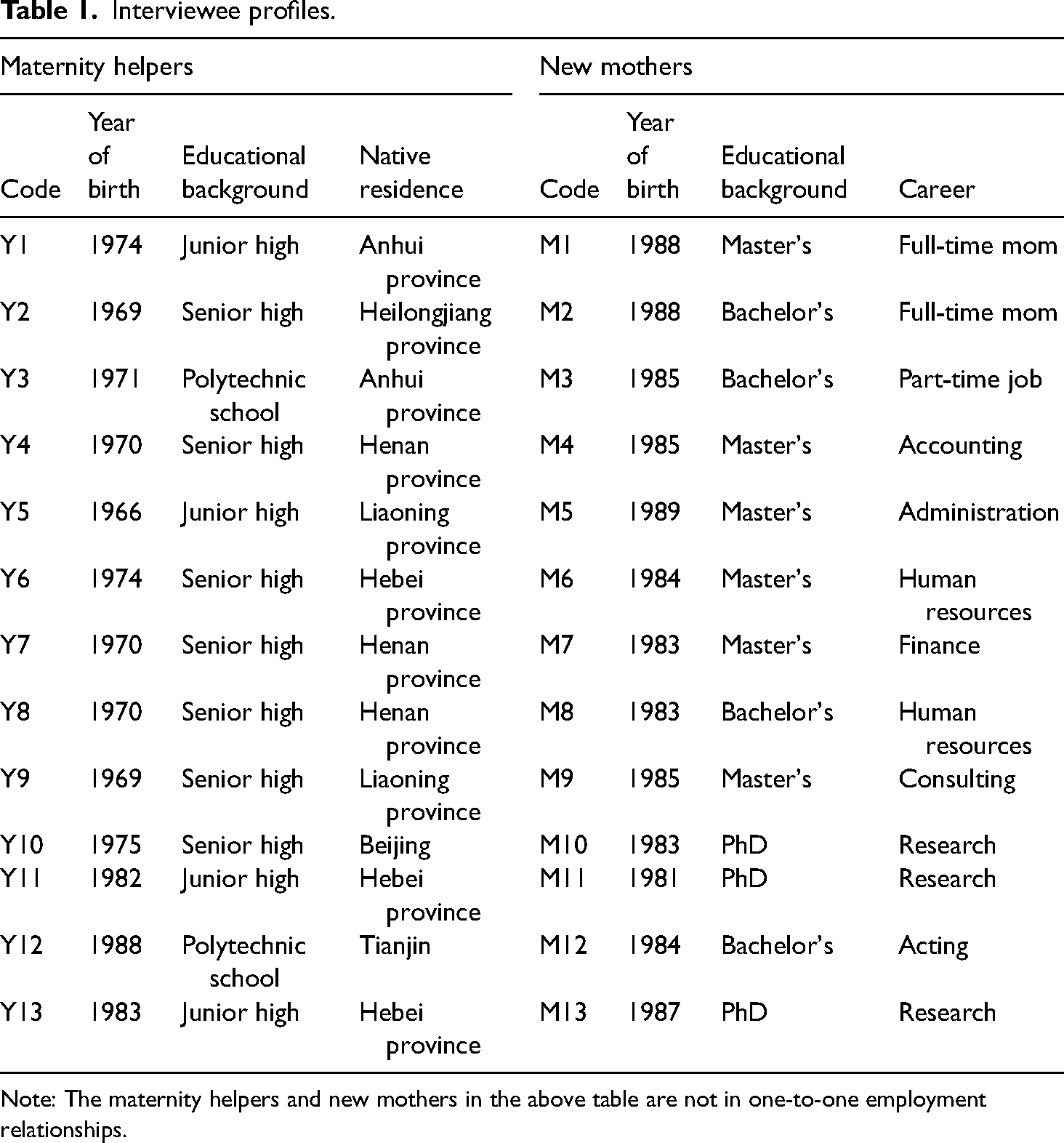
Note: The maternity helpers and new mothers in the above table are not in one-to-one employment relationships.
Boundary work for emotional laborers: Deep acting and the construction of symbolic orders
The work of a maternity helper is undoubtedly burdensome, considering the labor intensity of being on call day and night, as well as the psychological pressure of having to quickly adapt to diverse family settings and living under “watchful eyes” at all times with no personal space. Based on the theoretical assumptions and findings of previous studies, we should be able to deduce that the maternity helper will try to protect her “self” by defending the boundaries of her labor time and content and by making every effort to create her own private space. However, in this study, although a small proportion of the more experienced helpers did use their experience to control their workload (to the extent that they gave employers the impression that they had become “extremely shrewd after doing it for a long time” (M11, 22 March 2019), which could be interpreted as a form of surface acting), a significant proportion of maternity helpers nevertheless preferred the strategy of deep acting, especially those who perceived themselves as having positive emotional experiences. Their deep acting consisted of constructing a narrative of “being like a family”, thus blurring the boundaries of private space and volunteering to do extra “voluntary” work. The maternity helpers were able to have positive labor experience not by defending sharply demarcated boundaries, but exactly by breaking down those boundaries. In addition to the strategy of deep acting, the maternity helpers also differentiated themselves from the “outdated” childcare knowledge of the grandparental generation by portraying themselves as “childcare specialists”. Thus, by constructing a symbolic order among family members, the maternity helpers strove to gain a relatively equal status with their employers, if not an upper hand. Together, these two strategies enhanced the labor autonomy of the maternity helpers as emotional laborers, and promoted positive labor experiences.
Deep acting: When strangers become “family”
The difference between a maternity helper and a regular housekeeper is that the interaction between the maternity helper and the client is brief but intensive. Although it is possible for employers and employees in the setting of a household to build a kinship-like relationship after prolonged contact and interaction (Glenn, 1986), it is almost impossible for a complete stranger to establish such a close relationship with another within a month or two. However, the majority of maternity helpers interviewed in this project described themselves as treating their clients as “family” and were proud of the friendly and close relationships they built with them. The strategy of simulating a kinship-like relationship is, on the one hand, the result of training provided by employment agencies (Su and Ni, 2016) and, on the other hand, one of the most important positive emotional experiences of the maternity helpers during their services. The positive emotional experience of the maternity helpers comes firstly from the emotional connection established with the newborn baby. An experienced maternity helper is able to quickly establish rapport with a baby, caressing and caring for them, and in many cases becoming the person first sought after by the baby when in need. Through deep acting, the maternity helpers imagined themselves as the closest and most dependable person to the baby, thus relieving the exhaustion and stress caused by the trivial and burdensome care work. For them, the emotional connection developed with the newborns is one of the most rewarding aspects of their work, and the fact that they “truly love the babies” is a strong force keeping them in the business. I have been caring for the child since they were born, sparing no effort in meeting all kinds of their needs. When I had to leave them, it was so hard I couldn’t help crying. (Y2, 12 January 2019)
What I have given to these babies far exceeded the patience and love I gave my own daughter when she was born … What I gained in return was the first smile of the baby every morning. (Y9, 1 February 2019)
When I hold the baby and sing, there is nothing comparable and I leave behind all upsetting things. I’ve been working as a maternity helper for many years and I truly love children. (Y6, 11 January 2019)
The psychological stress and challenges of emotional labor came more frequently from other members of the family. Families came in all forms and sizes, with members of different personalities and dynamics. During the first month or two after the birth of a new child, which is already a sensitive period for family relationships, the maternity helper has to spend 24 h a day in the same space as her client's family, and has to be constantly on alert and demonstrate unbounded patience (Y8, 15 January 2019). However, in an environment where personal space can be extremely limited, experienced maternity helpers did not protect their “self” by drawing clear boundaries. For example, they could have requested regular breaks in a private space during the day, or, as in the case of the young Filipino maids in Taiwan portrayed in Pei-Chia Lan's book Global Cinderellas: Migrant Domestics and Newly Rich Employers (2006), tried to minimize conversations about their personal lives in order to prevent forming personal connections with their employers. Instead, the maternity helpers interviewed in this project tended to actively blur the boundaries between themselves and the clients, emphasizing the narrative of being a “family”. There are benefits to being professional and keeping clear boundaries, but I think that if you view it as a job you do for the sake of money, you won’t find your place in the family. If you treat each other like family, like sisters, or like friends, you will find it easier to get along. (Y7, 13 January 2019) When they [the client's family] treat the relationship with us as a mere employment relationship, I feel disappointed and feel like there is something missing. I have never viewed it as an employment relationship, and since fate has brought us together, we might as well act like a family during that time. (Y3, 12 January 2019) In the households we serve, we usually do more than what we are expected to do, because we’re in this together, like a family, so you cannot be too calculating and unwilling to make small sacrifices. We do not just do what's specified in the contract, and refuse to do anything more… To put it bluntly, we just want to get along, and being too calculating would make that a lot more difficult. (Y7, 13 January 2019) It was like she and I were the only ones there for each other… She later told me that she was very grateful and said I was closer to her than her own mother. But I was really just doing what I was expected to do. I love my job and feel that I can help a lot of people. Many families need us helpers to take care of them and to help them. Sometimes during that time, you are not only taking care of the new mother physically, but you are also a spiritual support and someone she can depend on. (Y6, 11 January 2019) Asking for my advice can be a sign of recognition and it feels great when I am able to help them. (Y3, 12 January 2019) For me, my clients are my friends. I will happily answer any questions they might have. When they have left me messages on WeChat, I patiently answer all of them. That's generally how I do it. (Y6, 11 January 2019)
In contrast to helpers who claim to treat their employer family as their own, most new mothers view the relationship with their helpers as an “employment relationship”.
7
In order to take better care of their newborns, new mothers maintain intensive and close interactions with their helpers, and many of them will choose to share rooms or even beds with the helpers. While the physical distance is greatly shortened, the psychological distance does not necessarily disappear to the same degree. Instead, most mothers deliberately maintain a psychological and social distance from their helpers. Generally speaking, the helpers tend to feel more comfortable talking about personal matters than the new mums, who mainly listen and try to minimize sharing details they consider private in the conversation. I consider my relationship with the maternity helper as purely employment. I pay for a professional to relieve my family the burden of taking care of the baby and to give me time to get used to having the baby around and learn how to take care of it. (M4, 15 January 2019) Sometimes during the service of the maternity helper, I had rather personal and deep conversations with her, which eventually made me feel uncomfortable so I stepped back. I tried not to get involved in her personal issues or speak of my own personal issues. I wouldn’t talk about my issues at all. (M6, 21 January 2019)
Constructing a symbolic order: Building the “childcare specialist” image
Personalism and asymmetry are two main characteristics of household employment (Glenn, 1986). Beneath the superficial status of living together like a family, there often exist inequalities in terms of the status and power relations. For example, while the client may ask about the maternity helper's family background during an interview and request a series of health check-ups, the helper has no knowledge of the employer's family background or health conditions, nor does she have the right to ask the employer such questions. Taking the relationship between young mothers and their helpers as an example, not only do mothers hold the power to terminate the contract at any given time, but they also have more power in shaping the employment relationship because of their higher socioeconomic status based on education and family background. For example, some helpers wish to build a closer connection with the client's family through casual chats, and they do not mind sharing their own family matters in daily conversations, such as their life experiences, their relationship with their own family, their children's education and marital status, and even trivialities of their relatives’ lives in their extended family. However, the success of such a strategy depends on the willingness of the interlocutor to join in the sharing. In fact, as mentioned above, many mothers have little interest in such sharing and tend to be more concerned with protecting the privacy of their families. Moreover, although the maternity helpers generally do not mind keeping in touch with the mothers and are willing to answer questions about childcare after leaving the households, the initiative to establish this contact is almost entirely in the hands of the mothers. Even if they miss the babies they have helped to take care of, the helpers can only look at photos or videos that mothers post on social media, if they have not been blocked or “defriended”. In only a very few cases, where the service has been long and a close bond has been built up with the employer, the helper may offer to visit the child, but whether she is allowed to visit depends on the attitude of the client's family.
Thus, it is quite obvious that clients often take the upper hand when negotiating the boundaries of everyday life (Lan, 2003). In an unequal relationship, the maternity helper is often on the weaker side of the power relationship (Su, 2011). As we have seen in the previous section, when a maternity helper adopts a deep acting strategy, it is limited by the client's awareness of and sensitivity to boundaries, even if the helper is willing to offer more labor and emotional investment on her own initiative.
Yet, when faced with structural inequalities in employment relationships and socioeconomic status, the maternity helpers did not simply surrender to fate or suffer in silence. In fact, many new mothers, when seeking a maternity helper, heard stories of how “overbearing maternity helpers crossed the line and made fragile new mothers cry”. Middle-aged maternity helpers, who generally come from rural areas or small towns in less developed areas with limited secondary school education (a significant number of maternity helpers have only received junior high school or even only a primary school education) often play the role of “childcare specialist” in their client's families, giving instructions to well-educated, well-paid “elite” women on how to be a competent mother. By constructing such a symbolic order, maternity helpers establish themselves as professionals with a more modern and scientific approach to childcare than the elder generation of the family, in particular the grandparents. This allows them to try to create a “united front” with the generation of young parents. This is yet another strategy for them to create positive labor experiences.
In recent years, a dramatic shift in middle-class attitudes and approaches to childcare has resulted in a loss of authority by the grandparents’ generation. Taking advantage of such social change, the first step for maternity helpers to gain a favorable position in the symbolic order is to distinguish themselves from elders who have outdated childcare knowledge. The second step is for the maternity helpers to try place themselves in the same camp with the young parents in the fight against outdated parenting knowledge. Some grandparents may insist that the traditional cloth diapers are better for the baby. But a newborn will pee a dozen times a day, so I will tell them that if we use a disposable diaper the urine can be absorbed in the diaper and the surface will remain dry, and the baby will be less likely to suffer from rashes. (Y2, 12 January 2019) I will explain my scientific philosophy to my clients with the experience I have gained over the years. Many grandmothers have their own set of outdated ideas and experiences from the past… The new parents are a younger generation. They are easy to communicate with and quick to accept new things. After I have explained the advantages and disadvantages of certain things to them, they usually accept my opinion. (Y4, 13 January 2019) My helper was very keen to emphasize her professionalism and experience. She would boast how many children she had taken care of and how many families she had helped over the years. When my child had eczema or any other problems, she would always tell me about her previous experiences, and by doing so, she established her expertise. (M10, 20 January 2019) One of the reasons for us to hire a maternity helper was that we and our parents had different views on what the mother and the baby should eat and how the baby should be taken care of. Hiring a maternity helper was a way to solve these conflicts and contradictions. For example, my mother thinks my meals are too light. She worries about whether I have a good appetite or sufficient nutrition, but my husband thinks that we should respect science and I should only have very light, less oily, and salt-free food in the first month after delivery. The helper is like a judge and everyone respects her opinions. If she tells me that she thinks I should eat light, then everyone would listen and follow her instruction. Her professionalism and experience are very important to us. (M11, 22 March 2019) Our helper had quite a few certificates and often emphasized her professionalism. She had been in the business for almost 20 years, so she had a very manipulative approach to her work, which made us feel stressed and uncomfortable. So we let go of her as soon as the contract ended. (M1, 16 January 2019) Our helper tended to emphasize her professionalism and experience during her time with us, and she would also mention how many children she had taken care of, and so forth. But I would still go and consult a doctor or a nurse while also referring to parenting books for verification. If the helper's advice was contradictory to that of the doctor or the nurse, I would correct my helper or simply ignore the advice she had given. (M6, 9 January 2019) The maternity helpers… in fact they are not very professional. Most of them are rural migrant workers, or laid-off female workers from factories. After receiving a very short period of training, they are ready to go. Many of their methods are not very scientific. I don’t think the role of maternity helpers should be exaggerated. We employed one mainly because we needed some help in the house so I didn’t have to do everything myself. But we were not completely dependent on her. (M7, 11 January 2019)
To summarize, maternity helpers use the strategy of constructing a symbolic order to challenge existing social boundaries. Through presenting themselves as “childcare specialists”, and emphasizing their professional knowledge, maternity helpers tried to reverse their disadvantaged position in terms of the employment relationship and socioeconomic status. However, in the process of emotional labor, the efforts of the helpers are also constantly challenged by the clients. Although they were able to actively create a positive working experience, the implementation of such a strategy was a process of constant negotiation of boundaries between the two interacting parties.
The fragility of symbolic boundaries: Money or dignity
When a maternity helper enters an unfamiliar household and spends time with the family on a daily basis, the intense physical and emotional workload puts a lot of pressure on her. During such emotionally intensive labor work, as shown in the previous sections, helpers used the strategies of deep acting and constructing a symbolic order to increase their labor autonomy in order to create a positive labor experience. That is, maternity helpers actively constructed symbolic boundaries to challenge social boundaries. They reshaped the proximity of social relations by redefining degrees of closeness and distance between themselves and the clients, thus initiating flows of emotions. They also redefined their own similarities and differences with “others” to reclassify social groups and to strive for higher status and more resources.
However, while symbolic boundaries are a necessary precondition for the creation of social boundaries, a symbolic boundary can only be transformed into a more permanent and institutional social boundary on the premise that the former is widely recognized. Therefore, efforts to challenge unequal and asymmetrical relationships in employment relationships by means of symbolic boundaries are rather fragile. This fragility is reflected in the fact that the labor autonomy of maternity helpers requires the fulfillment of a number of conditions, including institutional security and cultural environment. Once these conditions do not exist, labor autonomy is no longer guaranteed and it becomes difficult for these laborers to promote positive experiences in emotional labor. The following are just two examples of the necessary conditions for adopting the strategy of deep acting by maternity helpers.
Firstly, the most important prerequisite is the institutional security of economic rewards. Whether or not emotion is involved, maternity care is still a form of labor carried out primarily in exchange for pecuniary gain. Some researchers find that in care work, laborers sometimes become “prisoners of love” and lose the opportunity and ability to negotiate income with employers because of the personal attachment developed (England et al., 2002). Lan (2003) also found in her research that employers sometimes took advantage of caregivers’ feelings for care receivers in order to squeeze more labor out of them. For the maternity helpers in this study, their primary motivation for leaving home and taking up such a high-intensity job was the high income. Moreover, they believed that their expenditure in exchange for the salary from their care work was already very high, including sacrificing their health and family life. As a result, they were not willing to budge on the issue of money. “Treating the employers as their own family members” and “doing more than what's expected” were based on the fact that the salary was already negotiated and secured before the service started and that the helpers were generally satisfied with it and rarely needed to negotiate money issues further with the employers in the course of their work. Once this premise ceased to exist, the helpers stopped viewing their employers as the “same family”.
One new mother talked about an “epiphany” she had with the maternity helper. She extended the service contract with the helper for another five or six months because she was satisfied with the performance of the helper during the first contract. Afterwards, because she was temporarily relocated to another city, she wanted to take the baby and the maternity helper with her. Since they had spent so much time together, she believed that she had gotten on so well with the helper that they were almost “like a family member” (M6, 9 January 2019). The client's family also intervened to some extent in the helper's private life, such as pulling strings to help her with real estate purchase, and even personally negotiating the price with the real estate agent on her behalf. “We helped her save tens of thousands of yuan”, claimed the new mother. Therefore, when she sat down with her helper to talk about a new contract, she thought she would have the upper hand and that her helper would make certain concessions in consideration of personal feelings, but she was greatly disappointed. At that time, I thought there was room for bargaining, but after I talked to her about the salary, I found that she did not feel the same as we did, and she didn’t view us as friends or family. For the maternity helpers, it is just a job. When talking to her about salary and work arrangements, when personal interests are involved, I felt she let me down. (M6, 9 January 2019)
Secondly, to achieve labor autonomy requires a relatively equal and friendly cultural environment. Care work has long been undervalued and marginalized in social and cultural settings, which is certainly not helpful for emotional laborers trying to induce a positive, rewarding labor experience. Gaining basic respect in the interaction with the clients is also a prerequisite for maternity helpers to adopt a deep acting strategy.
One maternity helper still felt indignant, even after a long time, when recalling an “unbelievable” client she once encountered: There was a new mum who even asked me to wash her feet! I looked after the baby and cooked meals for her, but I had no time to wash her feet. I could help bring her a basin of water, but I shouldn’t have to kneel down and wash her feet, right? I thought that seriously crossed the line so I told her that if she expected her maternity helper to wash her feet, she would have to find someone else, I would go! (Y3, 12 January 2019)
Having the institutional security of a stable income and sufficient respect were prerequisites for practicing the deep acting strategy. This sheds light on the fact that although the choice of a labor strategy is an indication of labor autonomy, the implementation of these strategies is also constrained by the attitude and behavior of the recipients of the emotional labor. One-sided emotional commitment is not sufficient to bring about emotional rewards and positive labor experiences.
Based on the discussion above, this paper argues that autonomy in the context of emotional labor should not simply be defined as “control over the labor process”. In fact, this is difficult to achieve in emotional labor where labor takes the form of social interaction. If practitioners of emotional labor were unilaterally controlling the labor process, we would see more surface acting. Such autonomy will not lead to meaningful social interaction or increase job satisfaction. Therefore, this paper argues that a relational dimension should be added in defining the autonomy of emotional labor. That is, labor autonomy should include the ability of workers to choose their own strategies to facilitate equal and meaningful social relations.
Conclusion and discussion
Based on the qualitative data collected in this study, we find that maternity helpers who were employed to take care of newborn babies and new mothers were able to generate positive labor experiences under certain conditions. On the one hand, they used the strategy of deep acting, that is, blurring the boundaries of personal space by constructing a narrative of being like “a family”, and contributing a certain amount of “philanthropic labor” to establish an emotional connection and a sense of achievement in their work. On the other hand, they built a symbolic order by creating a professional image of a “childcare specialist” in order to gain leverage in their interactions with the clients. Both deep acting and the construction of a symbolic order were processes by which maternity helpers used “boundary work”, that is, the construction of symbolic boundaries to challenge social boundaries.
The practitioners of emotional labor are therefore not simply the exploited, but rather are “managers of emotions”. Discussion of labor autonomy in the context of emotional labor should therefore add a relational dimension, that is, the ability of laborers to choose their own strategies to construct equal and meaningful social relations, rather than protecting the independent self by establishing clearly defined boundaries or controlling the labor process, as is emphasized in Western theories. However, emotional laborers do not fully possess the “means of production”, as argued by Bolton and Boyd (2003). They have the autonomy to choose their emotional management strategy, but whether the strategy will work, and whether it will provide them with a positive labor experience, is also enabled and constrained by both the institutional environment of the care industry, including remuneration and job security, as well as social and cultural norms at the interactional level, such as boundary negotiations. The boundary work of maternity helpers, which challenges social boundaries by constructing symbolic boundaries, has its own vulnerabilities.
Based on the findings of this study, we can further expand and revise previous theoretical frameworks of emotional labor. From the perspective of resource conservation theory, emotional labor means that laborers have to “spend” their emotions on the people they serve, which consumes their emotional resources. Although material rewards are the main motivation for most laborers to take on the job, monetary rewards cannot offset the emotional resources consumed in the labor process and thus are unable to provide a sufficient sense of labor accomplishment. Therefore, to have a positive labor experience in emotional labor, laborers need to obtain reciprocal emotional rewards. In this way, we can explain why the strategy of deep acting can moderate the negative effects of emotional labor and even lead to positive labor experiences. Deep acting is one of the ways to create more positive and meaningful social relationships by mobilizing emotional resources. In reference to the theory of self-identity, the self in emotional labor should not be understood as an independent individual with clear boundaries, but rather as situated within relationships with others. Therefore, we should not consider emotional labor as a mere labor process that violates self-imposed boundaries and threatens self-identity. Under certain conditions, it creates opportunities for laborers to build mutual trust and respect with others and opportunities to generate meaningful emotional feelings. Thus, adding a relational perspective to the concept of autonomy provides new insights into how classical labor process theories can be better applied to explain emotional labor.
Footnotes
Declaration of conflicting interests
The author declared no potential conflicts of interest with respect to the research, authorship, and/or publication of this article.
Funding
The author disclosed receipt of the following financial support for the research, authorship, and/or publication of this article: This work was supported by the National Social Science Fund of China (17CSH047).