







Abstract
Status exchange in marriage refers to a marriage pattern in which one spouse compensates for his or her disadvantage in one status area relative to the other spouse with an advantage in another. Two prominent examples of marriage exchange discussed in the existing literature are race–status exchange and beauty–status exchange. Although the marriage exchange theory is well supported by early studies, in recent years, its applicability has been questioned by some scholars. Protracted debates on the topic in question were launched in two top sociological journals, the American Sociological Review and the American Journal of Sociology. This study reviews these debates and offers an in-depth theoretical investigation into the relationship between matching and exchange, and the premise of marriage exchange theory. In addition, we collect and analyze the data from the five waves of the China Family Panel Studies (2010–2018) on beauty–status exchanges and other forms of marriage exchanges in China. We found little evidence of beauty–status exchanges in Chinese marriages and even the well-assumed exchange of “woman's beauty for man's talent” lacks sound empirical support. However, there are ample evidences of exchanges among the four status factors of education, occupation, income, and family background. As indicators of socioeconomic status, these four variables are homogeneous in nature, and therefore can more easily substitute for one another. We argue that the validity of marriage exchange theory depends on the similarity or substitutability between the elements in exchange. Thus, we can neither completely accept nor reject the marriage exchange theory.
Introduction
Social exchange theory is one of the mainstream theories of contemporary sociology, which has been used to analyze every aspect of social life and human relations over recent decades (Blau, 1964; Homans, 1958). As the theory that applies social exchange theory to explain marital relations, marriage exchange theory suggests that marriage is an exchange of valuable resources between a male and a female for utility maximization. As Goode (1970) claims, “all courtship systems are market or exchange systems”. In specific empirical research, Davis (1941) and Merton (1941) first introduced marriage exchange theory in their studies. They report that black–white marriages occur more frequently between black males with higher status and white females with lower status, which seems to be a race–status exchange. Apart from that, the exchange between a male's work ability and a female's housework ability (Becker, 1991) as well as that between a male's socioeconomic status and a female's appearance (Elder, 1969) are also famous topics of marriage exchange in previous studies.
Although marriage exchange theory has been widely used to explain marriage patterns, some scholars recently began to suspect the applicability of this theory and started to debate in two top sociological journals, the American Sociological Review and the American Journal of Sociology. This paper also intends to discuss one of the controversial topics, that is, the beauty–status exchange in marriage. Beauty–status exchange was first proposed by Elder (1969) and further developed in subsequent research (Taylor and Glenn, 1976). Then, in 2014, McClintock raised different opinions in the American Sociological Review. McClintock argues that existing studies merely focus on the relationship between the appearance and status of a couple, while ignoring the strong correlation between these two factors of an individual, and thus such studies mistake a couple's beauty–beauty match and status–status match as a beauty–status exchange instead. Meanwhile in 2017, Gullickson, who supports beauty–status exchange theory, posted a criticism of McClintock's article in the American Sociological Review. Gullickson states that there are serious flaws in the conceptual definitions and analytical methods of McClintock's study and, as a result, such study is insufficient to disprove the beauty–status exchange theory. In response, McClintock (2017) published a further article in the American Sociological Review, in which she answers each of Gullickson's criticisms. Although all these three articles delve into the issue of beauty–status exchange in marriage from theory to methodology, there is still no unified answer. Academia remains divided on whether or not beauty–status exchange truly exists as well as whether social exchange theory can explain the beauty–status relationship in marriage.
In contrast with the heated debates on related issues among foreign scholars, marriage exchange theory has attracted limited attention in China. Although some Chinese scholars introduce foreign scholars’ debates on related issues in their research reviews (Ma et al., 2019), Chinese scholars’ studies on assortative mating still focus on the patterns and changes within homogeneous marriages (Li, 2011; Qi and Niu, 2012; Shi, 2019). Not only has beauty–status exchange in heterogeneous marriages received insufficient attention, but few studies discuss marriage exchange theory in general. This paper intends to make a breakthrough in this area, by exploring beauty–status exchange and other forms of exchange in Chinese marriages, in order to test the applicability of marriage exchange theory, and thus contribute to this global problem with the help of Chinese data.
In addition to the theoretical value above, the beauty–status exchange in marriage is also an important issue that is closely related to gender equality. In fact, most of the existing studies in support of beauty–status exchange theory concentrate on the phenomenon whereby women exchange their beauty for men's socioeconomic status (Elder, 1969; Taylor and Glenn, 1976), and the implicit assumption of this phenomenon is a deeply entrenched concept of gender inequality. In a gender-segregated labor system, in which men are expected to assume more economic obligations and women more domestic (and sexual) ones, it is relatively “reasonable” to assume that women's appearance (sexual attractiveness) will be exchanged for men's socioeconomic status. If so, China would provide an excellent example for testing this theory. It is well-known that there is a long-standing tradition of patriarchal families in China (Yang, 2017). The traditional gender role that “man goes out, while woman stays at home” has profoundly influenced Chinese perceptions and behavior, as well as individuals’ choice of marriage partner. As a result, we expect that the beauty–status exchange (especially the exchange of female beauty for male socioeconomic status) would be more pronounced in China. If such exchange cannot be found in China, then the applicability of this theory is doubtful.
Meanwhile, we notice that gender inequality in China is changing rapidly. In modern China, women have caught up with or even surpassed men in access to education (Wu, 2012; Ye and Wu, 2011), and they also assume an important role in terms of career development and economic contribution to their families (Wu and Zhou, 2015). In this context, whether Chinese women still exchange their beauty for men's socioeconomic status, and whether there will be a phenomenon whereby men exchange their handsomeness for women's socioeconomic status, is worthy of further study, and of great practical significance for exploring gender inequality in contemporary China.
Literature review
Assortative mating and homogeneous marriage
The study of assortative mating is about how people choose mates. Researchers have explored the assortative mating process by drawing on the patterns of correlations between couples based on dimensions such as age, region, ethnicity, religion, education, occupation, and family background (Blossfeld, 2009; Kalmijn, 1998; Ma et al., 2019; Schwartz, 2013). Numerous studies have found that, both in China and in other countries, homogeneous matching between couples on socioeconomic and demographic characteristics is the dominant type of assortative mating, which is called “homogeneous marriages” (Gao and Zhang, 2011; Li, 2011; Qi and Niu, 2012; Schwartz, 2013). In contrast, the marriage of a couple whose socioeconomic and demographic characteristics differ significantly is referred to as “heterogeneous marriage” (Kalmijn, 1998).
Since homogeneous marriage is the main type of assortative mating, Chinese and Western scholars have paid more attention to it. Many studies suggest that the formation of homogeneous marriage can be explained from the perspectives of preference and structure (Schwartz, 2013). Firstly, from the perspective of preference, individuals tend to seek marriage partners who share their values, tastes, interests, and lifestyle. This means that people who share similar social identities or belong to the same social class are more likely to marry each other (Ma, 2019). In addition, another theory of mate preference suggests that people prefer marriage partners who are superior to them with regard to every characteristic. However, the fierce competition in the marriage market eventually leads people, in general, to marry those with similar characteristics to themselves (Hitsch et al., 2010).
Secondly, from the perspective of structure, scholars have discussed many structural factors that influence homogeneous marriage (Ma et al., 2019). Some studies point out that structural factors, such as social interactions and residential isolation, greatly increase the communication opportunities for people who share similar characteristics, and thus increase the probability of homogeneous marriages (Kalmijn, 1998). In addition, the intervention of a third party is also widely discussed as an important structural factor for homogeneous marriage. In Western countries, many studies analyze the impact of religious group intervention on religious homogeneous marriage (Kalmijn, 1998). Meanwhile, in China, scholars focus more on the influence of family; for example, Tian and Davis (2019) find that marriages arranged by parents are more likely to exhibit homogeneous matching in various aspects, which validates the influence of a third party's intervention to some extent.
Apart from the causes of homogeneous marriage, existing studies also analyze the changing trends in homogeneous marriage from many perspectives. Taking China as an example, many scholars analyze the change in homogeneous marriage from perspectives including education (Li, 2008b; Shi, 2019), household registration (Qian and Qian, 2017; Wang and He, 2014), age (Mu and Xie, 2014), and family background (Li, 2011; Qi and Niu, 2012), and discuss the influence of such changes on social inequality and social openness. Besides, a number of studies also analyze the impact of homogeneous marriage on marital satisfaction (Wang and Li, 2021), divorce risk (Lu, 2009), intergenerational mobility (Xu et al., 2019), and income inequality (Li, 2017). These studies find that homogeneous marriages not only affect marital and family life at the micro level, but also have a sustained and extensive impact on social inequality at the macro level.
Marriage exchange in heterogeneous marriage
Compared with the various studies on homogeneous marriage, Chinese scholars have paid less attention to heterogeneous marriage. Several scholars have pointed out the phenomenon that women generally marry men of higher socioeconomic status than themselves. In other words, women's marriages are “upwardly mobile” relative to men's (Zhang, 2008). Among these “upwardly mobile marriages”, it is common for the man to be one rank higher than the woman in terms of socioeconomic characteristics, which is referred to as a “gradient marriage” by some scholars (Gao and Zhang, 2011). Scholars generally agree that the deeply rooted social structure in China, which is based on gender inequality, is the main cause of the phenomena of “upwardly mobile marriage” and “gradient marriage”. However, little research has examined the existence of marriage exchange, particularly the beauty–status exchange, in heterogeneous marriages across different social classes.
As mentioned above, marriage exchange theory is a kind of social exchange theory that seeks to explain the formation of heterogeneous marriages. The theory suggests that partners in a marriage informally exchange advantageous characteristics. Marriages formed through such an exchange are also referred to as “exchange marriages” (Gullickson and Torche, 2014).
Merton (1941) and Davis (1941) first proposed the marriage exchange theory in their seminal studies of interracial marriage in the USA. Based on intensive fieldwork, they concluded that intermarriage between whites and blacks in the USA is more likely to occur between blacks with higher education levels and whites with lower ones. They argued that this is because white racial status and higher educational attainment are both valued resources in the marriage market, and blacks must compromise on education in order to marry a higher-status white, which means that they are forced to accept a white spouse with a lower education level. Since then, many scholars have used more representative data and more sophisticated statistical models to test the race–status exchange theory proposed by Merton and Davis more rigorously. For example, Kalmijn (1993) and Qian (1997) used US marriage registration and census data, respectively, to find that white Americans are more likely to have a low education level and rarely a high education level when intermarrying with blacks. This finding directly verifies Merton and Davis's theory. Subsequently, Fu (2001) and Gullickson (2006) also found evidence of race–status exchanges in interracial marriage in the USA by using a rigorous log-linear model.
In addition to race–status exchange, marriage exchange theory has also been applied to the exchange between beauty and status, specifically the exchange of women's beauty for men's socioeconomic status. Elder (1969) found that beautiful women are more likely to marry men of higher professional status, confirming the existence of a beauty–status exchange in marriage. Since then, many scholars have tested this idea using other data and obtained findings consistent with those of Elder (Bjerk, 2009; Carmalt et al., 2008; Taylor and Glenn, 1976). Thus, the exchange between (female) beauty and (male) status has become another important piece of evidence that supports the marriage exchange theory.
The debate on marriage exchange theory
Although marriage exchange theory has been supported by several models, such as race–status exchange and beauty–status exchange, the theory has been criticized by several scholars in recent years. These criticisms have led to protracted academic debates in two of the top sociological journals, the American Journal of Sociology and the American Sociological Review.
Rosenfeld's challenging of race–status exchange. The first controversy arose when Rosenfeld (2005) challenged the notion of racial–status exchange. Rosenfeld disputes the idea that black individuals, through interracial marriages, trade their higher socioeconomic status for white racial status. Instead, he finds that in the majority of interracial marriages, blacks and whites share similar socioeconomic status. Rosenfeld further argues that researchers have misidentified race–status exchange in three key ways.
Firstly, they have mistaken educational homogeneity within interracial marriages for race–status exchange. Several studies compared the likelihood of highly educated black individuals marrying whites with the likelihood of less-educated black individuals marrying whites, concluding that the former group had a higher tendency to intermarry with whites. However, this creates an illusion of racial–status exchange, as the blacks who intermarry with whites tend to be the more educated among blacks, while the whites who intermarry with blacks tend to be the less educated among whites. However, they can have the same level of education.
Secondly, gender differences in marriage are mistakenly treated as exchanges. Several studies have compared the educational level of the black partner in an interracial marriage with that of the white partner, concluding that the former is always more educated than the latter, but ignoring the fact that interracial marriage almost always involves a black husband and a white wife. Because of the marriage gradient, husbands tend to be more educated than wives in general, and the difference in educational attainment between wives and husbands is no greater in an interracial marriage than in any other kind of marriage.
Thirdly, the existing research has always selectively reported the results of model analyses that seek to demonstrate the existence of exchange. Rosenfeld (2005) points out that, among the different combinations of the models, only a few specific models support the existence of exchange. With the help of computers, researchers can always select the most “desirable” one of the numerous model settings.
Gullickson and Fu (2010) and Kalmijn (2010) responded to the aforementioned article by Rosenfeld (2005). Gullickson and Fu point out that Rosenfeld incorrectly included a three-dimensional interaction term between race and a couple's educational attainment as a control variable in the model. In fact, the three-dimensional interaction term itself contained a race–status exchange component, and so Rosenfeld's setting and interpretation of the model were incorrect. They also point out that the exchange effect is far stronger between black men and white women than between white men and black women, and therefore should be measured separately (Gullickson and Fu, 2010). Kalmijn provides commentary on the evident disparities between the findings derived from the simple and complex models highlighted by Rosenfeld in his synthesis of previous research. Kalmijn noticed that racial and gender inequalities have an opposing impact on the distribution of education compared to the marriage exchange effect. Thus, the inability of simple columnar analysis to control the sample's marginal distribution leads to the insignificance of the exchange effect. Consequently, despite the increased complexity associated with log-linear models, they are better suited for measuring exchange due to their ability to control the marginal distribution of individuals based on gender and educational attainment (Kalmijn, 2010).
Rosenfeld (2010) promptly addressed these criticisms. He argued that the misspecification of the three-dimensional interaction terms, described by Gullickson and Fu (2010), was unproblematic, and that Kalmijn's (2010) model setting was also seriously flawed. He concluded that these two critical articles simply emphasized the potential for a social science researcher to obtain “more appropriate” results by selecting a “better-fitting” model, irrespective of the actual effect. Therefore, Rosenfeld argued that the aforementioned criticisms lacked a solid foundation.
McClintock's challenge to beauty–status exchange theory. While scholars were arguing over the existence of race–status exchange, another debate on marriage exchange quickly emerged in the American Sociological Review. As mentioned earlier, this debate began with McClintock's (2014) challenge to beauty–status exchange. She pointed out that previous studies supporting beauty–status exchange had ignored the strong intra-individual correlation between appearance and status, thus mistakenly treating a couple's beauty match and status match as beauty–status exchange. To address this problem, she reported the difference model, a multiple linear regression model with adequate statistical controls, and log-linear models with the control of marginal distributions. The data results revealed that, after accounting for the effects of matching, exchange was only significant in select measurements or among dating couples rather than married couples.
Gullickson (2017) provided a critique of McClintock's (2014) article. Firstly, he contrasted the difference model with a linear regression model, arguing that the former treated men and women's education and appearance, respectively, as being of equal value, which in fact misconstrues the concept of an “exchange”. Therefore, he proposed that exchange should consider relative differences rather than absolute differences, and thus the difference model should be specified while controlling for the attractiveness and status of both partners, making it equivalent to the linear regression model with all control variables included.
Secondly, he argued that McClintock's (2014) use of interaction terms to measure whether women are more likely to exchange their attractiveness for male status in the log-linear model was inappropriate. If separate terms for exchange effects for different genders are included in the log-linear model, it can be observed that only the coefficient for male attractiveness exchanged for female status is not significant, while the coefficient for female attractiveness exchanged for male status is significant, leading to results that are consistent with previous research.
McClintock (2017) responded to these critiques. Regarding the difference model, she argued that it simply reflects a different understanding of “exchange”, and she maintained that her definition of absolute exchange is easier to comprehend and more straightforward than Gullickson's (2017) notion of relative exchange. As for the log-linear model, she provided additional analyses using different measurement and model specifications. She emphasized that even if Gullickson's criticisms were valid, they do not undermine the original article's conclusion that beauty–status exchange in marriage is neither robust nor universal.
Matching and exchange: Further theoretical reflections
In conclusion, in the two academic debates regarding marital exchange, scholars extensively and deeply discussed the definition of marital exchange, measurement methods, and modeling strategies. Setting aside these technical details for now, it can be observed that these debates actually reflect different scholars’ varying understandings of the fundamental concepts of matching and exchange. Therefore, in order to quell these prolonged academic controversies, a deeper theoretical reflection on the relationship between matching and exchange is necessary.
The relationship between matching and exchange
The “matching” to be discussed in this section refers to a narrow matching, specifically the homogeneity matching or homogamous marriage described earlier. Homogamous marriage is the dominant pattern of marital matching, and it is on this basis that Rosenfeld and McClintock challenged the “marriage exchange theory”. Rosenfeld (2005) pointed out that even in interracial marriages, black and white individuals primarily engage in homogeneity matching based on socioeconomic indicators, and the theory of race–status exchange cannot explain this phenomenon. McClintock (2014) emphasized that behind the attractiveness–status exchange lies the homogeneity matching of individuals in terms of attractiveness and status. Previous studies mistakenly assumed the existence of an exchange between attractiveness and status because attractive individuals are often associated with higher social status. Thus, both Rosenfeld and McClintock criticize exchange from the standpoint of matching, and in their arguments, they view exchange as a competitive theory that is incompatible with matching.
This view of contrasting matching and exchange was also present in the early studies of the “marriage exchange theory”. However, in the latest developments of this theory, scholars have started to adopt a new perspective on the relationship between matching and exchange. Gullickson and Torche (2014) explicitly put forward two different understandings of marriage exchange. The first is a relatively traditional understanding, which suggests that some marriages are based on exchange, where individuals purposefully leverage their own advantages (such as attractiveness or White racial identity) to acquire advantageous traits (such as socioeconomic status) in their spouses. If we interpret marriage exchange from this perspective, then matching and exchange would naturally be seen as incompatible.
However, Gullickson and Torche (2014) also point out that marriage exchange can be understood from another perspective, where the foundation of marriage exchange remains rooted in matching. Specifically, this viewpoint suggests that individuals consider all the characteristics (such as race, appearance, socioeconomic status, etc.) of potential marriage partners comprehensively and derive a total score that reflects their overall attractiveness. Subsequently, individuals make marital choices based on this total score. Therefore, from this perspective, the matching of individuals’ overall attractiveness score still exists, while there may be mismatches in the individual components that contribute to the total score. Since the total score still adheres to the principle of matching, a higher score in one component implies a lower score in another component, which is manifested as exchange in practice. Thus, marriage exchange itself does not exclude matching; rather, it emphasizes the matching of overall attractiveness rather than the matching of specific characteristics. On the other hand, proponents of the matching theory mentioned earlier argue that marital partners must adhere to the principle of matching in each individual characteristic. Therefore, the focus of their debate lies not in recognizing matching but rather in the level of matching or whether both partners insist on precise matching in every socioeconomic and demographic characteristic separately.
The conditions for marriage exchange
If we adopt the contemporary interpretation of the “marriage exchange theory” proposed by Gullickson and Torche (2014), we can observe that the viability of this theory hinges on whether individuals actually assign values to various socioeconomic and demographic characteristics of potential marriage partners as envisioned by the theorists. In other words, the question is whether people can convert different attributes such as appearance, race, and socioeconomic status into a unified score. Exchange theorists believe that such conversion is feasible, while matching theorists argue that it is entirely impossible. We believe that providing a definitive answer that either affirms or denies the possibility of this conversion would be overly conclusive, as the difficulty and feasibility of this conversion largely depend on the specific characteristics involved. Based on the principle that the more homogeneous the characteristics, the more likely they are to be substitutable or convertible, we contend that marriage exchange is more likely to occur between similar characteristics and less likely to occur between completely dissimilar ones.
Taking beauty–status exchange, our current focus, as an example, beauty and status are two widely divergent attributes, with the former primarily satisfying sensory needs and the latter mainly satisfying material, cultural, and emotional-communication needs. As McClintock (2014) argues, socioeconomic status, which is mainly measured by indicators of education, occupation, and income, not only largely determines an individual's class affiliation, but also profoundly influences people's tastes, lifestyles, and values. Since modern marriage places great emphasis on the function of the spouse in economic and emotional communication, the matching of socioeconomic status plays an extremely important role in the marriage contracting process, while the loss caused by a status mismatch can hardly be compensated for by physical appearance. Based on this, we argue that the substitutability between appearance and status is weak, and thus the likelihood of beauty–status exchange is small.
However, if we focus on different characteristics within the socioeconomic status, the situation is quite different. According to Weber's theory of multiple stratification dimensions (Li, 2008a), sociologists typically measure status using various dimensions such as education, occupation, and income (Li, 2005; Tian, 2017; Xie, 2014). In addition, scholars have differentiated between ascribed and achieved status in terms of their sources (Blau and Duncan, 1967). Based on this perspective, we should also consider respondents’ family background characteristics when measuring status. Although education, occupation, income, and family background are all components of socioeconomic status, they also have important distinctions. Therefore, according to the perspective of matching theorists, it is necessary to examine the matching of couples on each specific dimension of status. This approach has been widely adopted in current research on marital matching in China. However, we argue that this research orientation overlooks the homogeneity or substitutability among education, occupation, income, and family background as measurement indicators of socioeconomic status. Consequently, it also neglects the possibility of marital exchange between spouses based on these indicators. Our study aims to address these gaps by analyzing the phenomenon of marital exchange in different dimensions of socioeconomic status among Chinese couples.
Hypotheses
Based on the previous discussion of the “marriage exchange theory” and its academic debates, as well as the theoretical considerations of the conditions for the validity of this theory, this study proposes four research hypotheses.
Firstly, the “marriage exchange theory” suggests that all characteristics that enhance an individual's attractiveness in the marriage market are interchangeable and can be exchanged for advantages in other aspects possessed by potential partners. Based on this theory, even dissimilar characteristics (e.g. beauty and status) are considered exchangeable. Therefore, the following research hypothesis is proposed:
Secondly, considering the deeply rooted gender inequality in China and the fact that most foreign studies have concluded that beauty–status exchange occurs primarily in situations where women trade their beauty for men's status, we propose the following research hypothesis:
Thirdly, based on matching theorists’ criticism of marriage exchange theory, that the main cause of beauty–status exchange is homogeneous matching in physical attractiveness and socioeconomic status between couples, as well as the strong correlation between appearance and status intrapersonally, we propose the following hypothesis, which contradicts Hypotheses 1 and 2:
Finally, based on the discussion of the conditions required for the validity of the marriage exchange theory, we argue that marriage exchange is more likely to occur between attributes that are more homogeneous (e.g. different status indicators) and less likely to occur between attributes that are not homogeneous (e.g. beauty and status). We therefore propose the following research hypothesis:
Data, variables and models
Data
This paper uses data drawn from the China Family Panel Studies (CFPS), which is a large-scale, comprehensive social survey designed and implemented by the Institute of Social Science Survey, Peking University. It adopts an implicitly stratified, multi-stage, probability-proportional-to-size (PPS) sampling method, and the sample covers the population of 25 provinces, municipalities, or autonomous regions, thus covering approximately 95% of the total population of the Chinese mainland. The CFPS was officially launched in 2010, and four rounds of follow-up surveys were conducted in 2012, 2014, 2016, and 2018 on the original sample. In this paper, we utilize the data from all five rounds of the survey starting from 2010.
In the case of this study, the CFPS has several advantages. Firstly, the survey provides detailed information on respondents’ status characteristics in dimensions such as education, occupation, income, and family background. In addition, respondents’ physical appearance is measured through interviewer evaluations, which fulfills the variable requirements of this study. Secondly, the survey includes interviews with all members in the same household, allowing us to obtain various indicators for both spouses through data matching.
Considering that both the status and appearance of couples change over time, in order to measure the couples’ status and appearance at the time of their marriage as accurately as possible, we only select couples who married after 2009 for the study and use the survey data of the round closest to the year of their marriage for the measurement. Specifically, the data on couples who married in 2009–2010 are taken from the 2010 survey, and the data on couples who married in 2011–2012 are taken from the 2012 survey, and so on. If a measure for the couple is missing, survey data from adjacent years are used to fill in these missing values. 1 After retaining all couples who were successfully matched and for whom we had complete data regarding all of the variables, the sample consisted of 2512 couples.
Variables
The core variables in the analysis are the couple's appearance and status. Referring to McClintock (2014) and Gullickson (2017), we use the interviewers’ ratings of the respondents’ physical attractiveness as the measure of appearance. Despite the inevitable subjectivity of this measure, many studies conducted worldwide have found it highly inter-rater reliable when evaluating physical attractiveness (Langlois et al., 2000). Therefore, it has been widely used in previous research on beauty–status exchange. The CFPS asked the interviewers to rate the respondents’ appearance on a scale of 1–7 on the questionnaires, with a higher rating indicating better physical attractiveness. For the linear regression analysis, we followed the original seven-category measure and used it as a continuous variable, while for the log-linear model analysis, we combined scores 1–4 to obtain a four-category measure of appearance.
To test whether the interviewer-rated appearances in the CFPS data are stable and consistent, we calculated the reliability coefficients of the same respondent's appearance measurements from different survey years. The results show that the Pearson correlation coefficient of different interviewers’ ratings of the same respondent's appearance was 0.60 between 2010 and 2012, 0.54 between 2012 and 2014, 0.61 between 2014 and 2016, and 0.61 between 2016 and 2018. These correlation coefficients all pass the statistical test at a significant level of 0.001. In addition, we also combined five rounds of CFPS data from 2010 to 2018 and calculated the overall reliability coefficients for the five rounds of appearance measurements. The results show that Cronbach's alpha for the five rounds of appearance scores was 0.84, which meets the requirements for general analysis. Taking all these into consideration, we hold that the measurements of the same respondent's appearance between different rounds are relatively robust.
Moreover, considering the inevitable subjectivity of interviewer-rated appearance, we also adopted two relatively objective indicators, namely body mass index (BMI) and age, as indirect measures of appearance. It turns out that the findings remain the same, regardless of whether interviewer-rated appearance or relatively objective indirect measurements are used. In the following, we will focus on the results based on interviewer-rated appearance and report the analysis based on BMI and age in the robustness testing section.
No uniform measurement for respondent status was found in the previous studies. Many studies employed education as a status indicator, and some scholars measured the respondents’ status in terms of their occupation or income. McClintock (2014) argues that if the beauty–status exchange is prevalent, then it should be reflected in all kinds of status indicators, so researchers should use a combination of measurements. This study adopted McClintock's suggestion that status is measured from three perspectives, education, occupation, and income, in order to adequately test the robustness of the findings.
Firstly, education can be measured both through the continuous variable of years of completed education and through the categorical variable of highest educational attainment. In this study, we employed different measures depending on the model's requirements: for linear regressions, the number of years of completed education with continuous values was used, while for log-linear models, the highest educational attainment was used. There are four categories of educational attainment: elementary school or below, middle school, high school/vocational school/technical school, and tertiary or above.
Secondly, as with education, occupation can be measured both continuously (occupational prestige scores) and categorically (occupational categories). Since the CFPS data fail to provide international occupational standard codes for certain years, which prevents us from obtaining occupational prestige scores, this study will measure occupation by using categorical variables. There are four specific categories: farmers and the jobless, production workers, business service workers and clerical workers, and professionals and managers. Among these four categories, farmers and the jobless have the lowest occupational status, while professionals and managers have the highest occupational status.
Finally, income includes both personal earnings from family businesses and employment. Following previous studies, we performed a logarithmic transformation on income in the linear regression analysis. In addition, considering the requirement of the log-linear model that all variables should be categorical, we recoded the income of both spouses into two four-category variables using the 25th, 50th, and 75th percentiles of the husband's income as cut-off points. It is worth noting that there are a considerable number of missing values in the CFPS data for income. Therefore, we employed multiple imputation to handle the missing values of income. The analysis results showed that the results remained consistent whether we used casewise deletion or the multiple imputation method. The subsequent sections will present the results based on both methods. 2
In addition to the above three status indicators commonly used in Western studies, the family background of the couple was also considered in this study. In China's context, “marriage between families of equal social rank” is a very important criterion when choosing a spouse (Li, 2011), and family background can be used as a measure of the respondents’ ascribed status to some extent. Specifically, this paper uses parents’ highest education attainment to measure family background, which is divided into four categories: illiterate, elementary school, junior high school, and high school or above. Furthermore, given the presence of some degree of missing values for parents’ education, we added a category to identify whether or not parents’ highest educational attainment was missing.
Finally, for the linear regression analysis, we also controlled for the birth year and marriage year, which were directly available from the data.
Models
In the existing studies, scholars have employed three methods to analyze marital exchange: linear regression, the difference model, and the log-linear model (McClintock, 2014). According to Gullickson (2017), the difference model can only analyze marital exchange based on absolute differences, yet cannot study marital exchange based on relative differences; therefore, instead of using the difference model, we adopt linear regression and the log-linear model, which are two relatively mature and more widely recognized analytical methods in the academic community.
Compared with the log-linear model, linear regression has the advantage of being able to incorporate many control variables very easily; its drawback is that the marginal distribution of the key variables (e.g. appearance and status) cannot be controlled as it is in the log-linear model. Given that linear regression is a more common statistical analysis method, we do not discuss it in detail here.
Compared with linear regression, the log-linear model provides better statistical control over the marginal distribution of each variable, but is more complex to set up and related studies are more divided regarding the optimum way to set up the model to validate marriage exchange. This study uses the model setting method recommended by Gullickson (2017). In fact, McClintock's (2014) and Gullickson's models are identical except for a slight difference in the gender-specific marriage exchange. 3 We also used McClintock's model and found the study findings to be unchanged.
As an example of beauty–status exchange, the log-linear model used in this study starts from the following benchmark model:

Among the parameters of the benchmark model,
The benchmark model allows couples to match on two dimensions of appearance and status, but no exchange is set. In other words, the benchmark model is a model without marital exchange. We can test beauty–status exchange by including a gender-symmetric exchange term on top of this (Gullickson, 2017), which yields the following expression:

The above marriage exchange model measures marriage exchange through a uniform parameter (

In addition to beauty–status exchange, this paper also analyzes whether there is marriage exchange between different status indicators using log-linear models, which were set up in a similar way to the beauty–status exchange and so that information is not repeated here.
Analysis of the results
Descriptive statistical analysis
Table 1 provides a statistical description of all the variables employed in this paper. The table shows that, on average, wives score slightly higher than husbands on physical appearance, but show different degrees of disadvantage on status indicators such as education, occupation, and income. The average year of birth of the husbands in the sample is 1985, and that of the wives is 1987, so “older husband and younger wife” is still an important characteristic of Chinese couples in terms of age matching. In addition, the average year of marriage in the sample is 2012, so using this sample is a good indicator of the current marital matching status of Chinese couples.
Descriptive statistics for all variables (N = 2512).
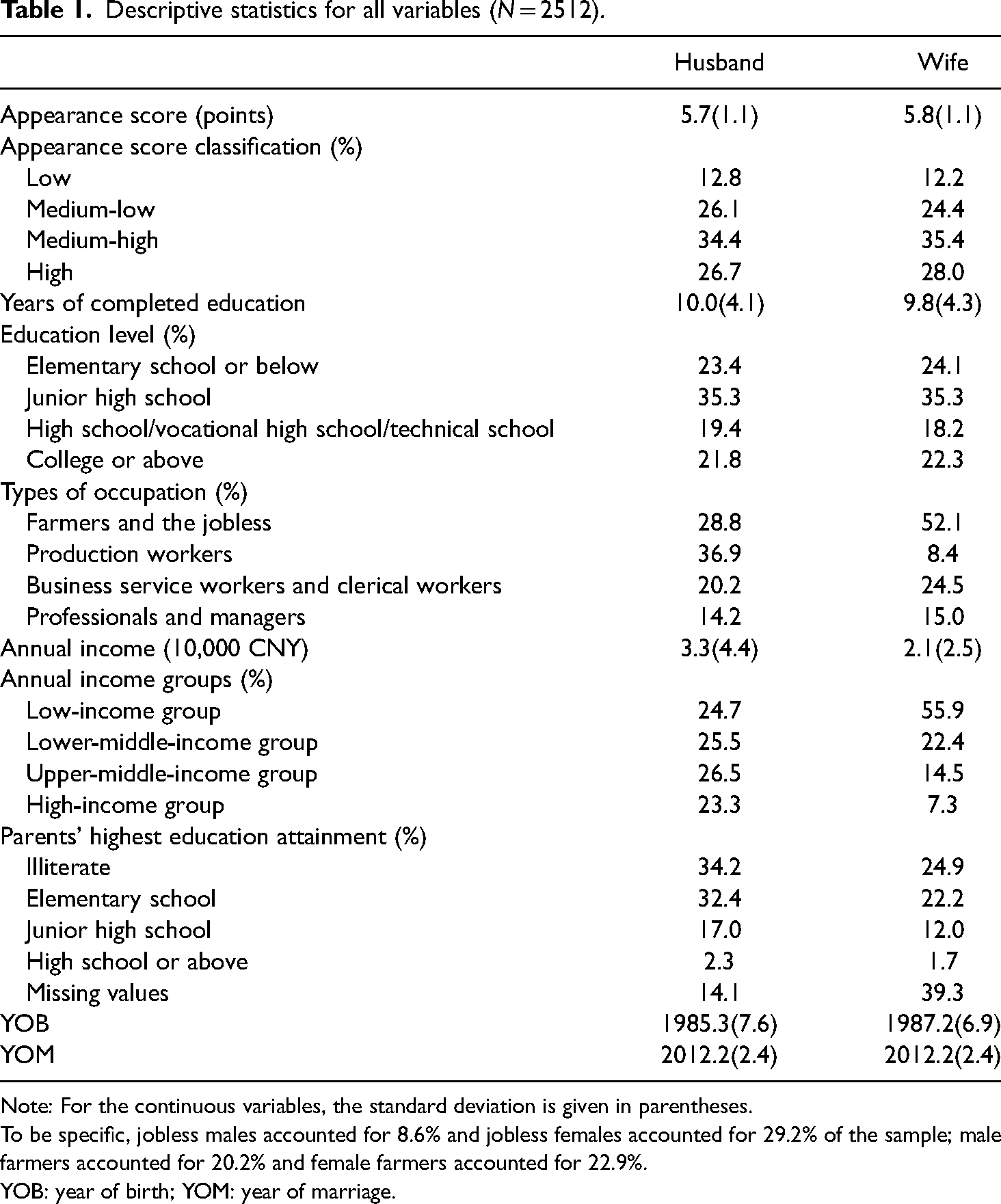
Note: For the continuous variables, the standard deviation is given in parentheses.
To be specific, jobless males accounted for 8.6% and jobless females accounted for 29.2% of the sample; male farmers accounted for 20.2% and female farmers accounted for 22.9%.
YOB: year of birth; YOM: year of marriage.
Table 2 describes the bivariate correlations between couples’ appearance and the three status indicators of education, occupation, and income. Based on cross-combinations of different variables between husbands and wives, we divided the table into four sub-tables. Among these, the sub-table located in the lower left corner (4*4) shows the correlation between the husband's and the wife's respective traits. It appears that the values on the diagonal of this sub-table are significantly greater than other values, which proves to some extent that there exists a strong correlation between the husband and wife with regard to the same traits, or a relatively clear homogeneous matching between the husband and wife with regard to each trait. In addition, this sub-table shows that there also exists a significant positive correlation between the husband's appearance and wife's status as well as the wife's appearance and husband's status. So, for both husband and wife, the better their appearance, the higher the status of their spouse, which supports beauty–status exchange theory to some extent. As the sub-tables located in the upper left and lower right corners show, however, there also exists a very significant positive correlation between the husband's appearance and his own status as well as between the wife's appearance and her own status. Thus, in light of the homogeneous matching of appearance with appearance and status with status, the beauty–status exchange we find through the bivariate analysis may be completely spurious, which is the main reason why McClintock (2014) criticizes beauty–status exchange.
Bivariate correlations between the couples’ physical appearance and status indicators.
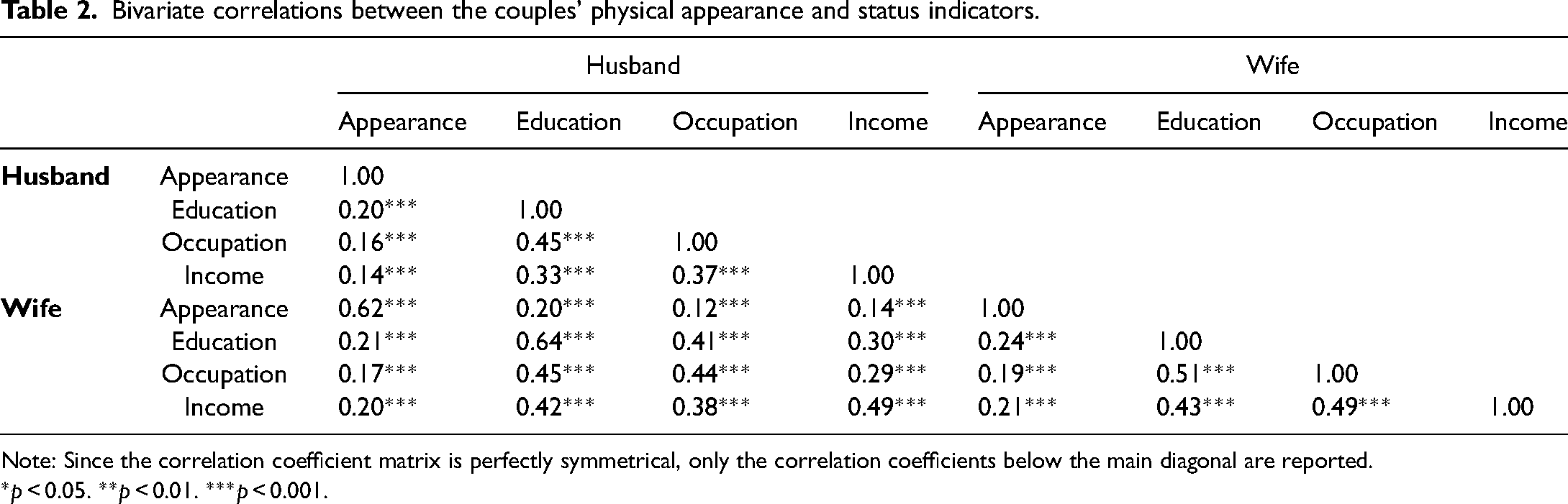
Note: Since the correlation coefficient matrix is perfectly symmetrical, only the correlation coefficients below the main diagonal are reported.
*p < 0.05. **p < 0.01. ***p < 0.001.
Results of the regression analysis
Considering the potential differences in the exchange between the wife's physical attractiveness and the husband's status and between the husband's physical attractiveness and the wife's status, a linear regression model 4 is fitted to carry out a detailed analysis. The results are shown in Tables 3 and 4.
Linear regression model analysis between the wife's physical attractiveness and the husband's status.
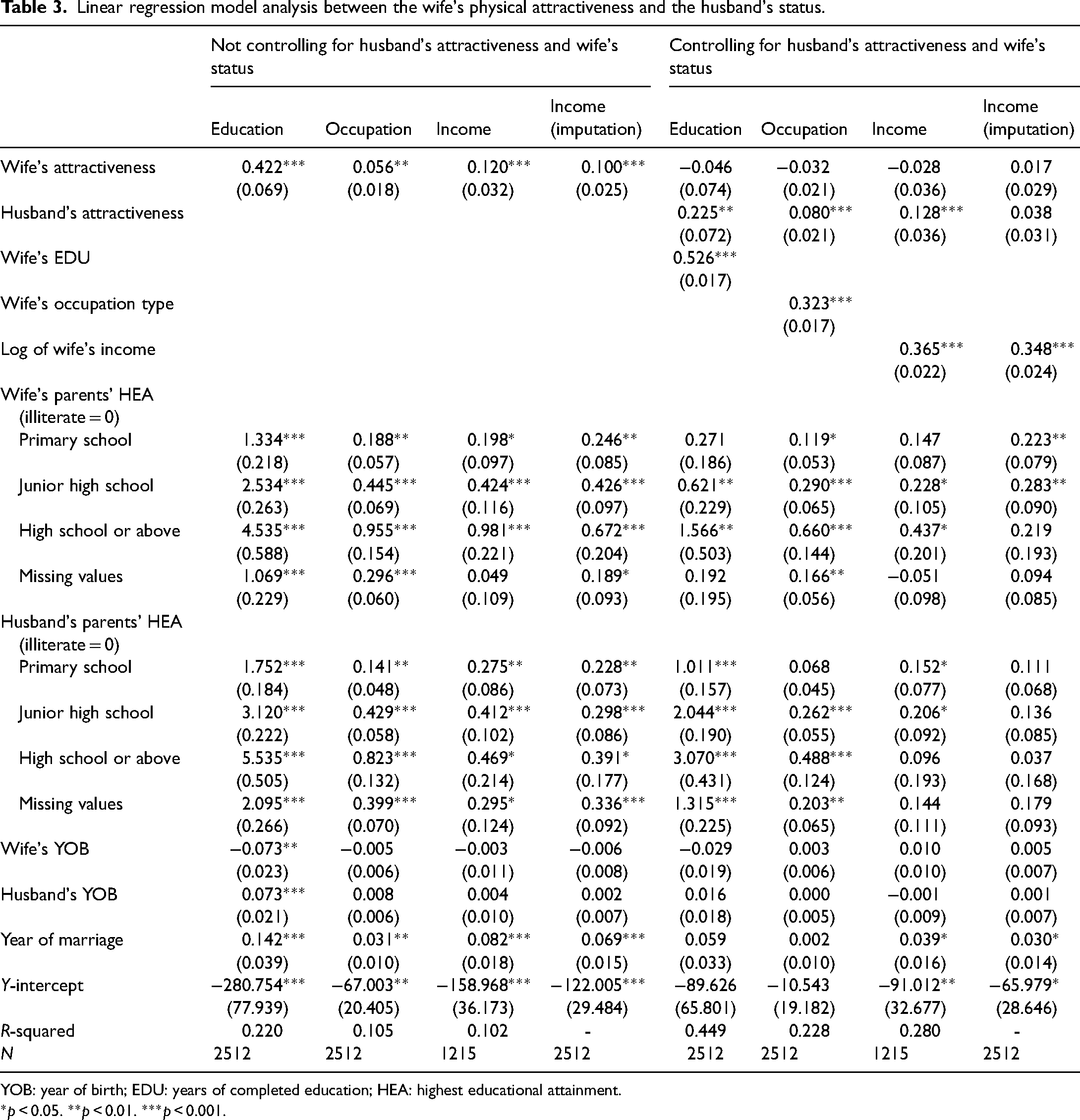
YOB: year of birth; EDU: years of completed education; HEA: highest educational attainment.
*p < 0.05. **p < 0.01. ***p < 0.001.
Linear regression model analysis between the wife's status and the husband's physical attractiveness.
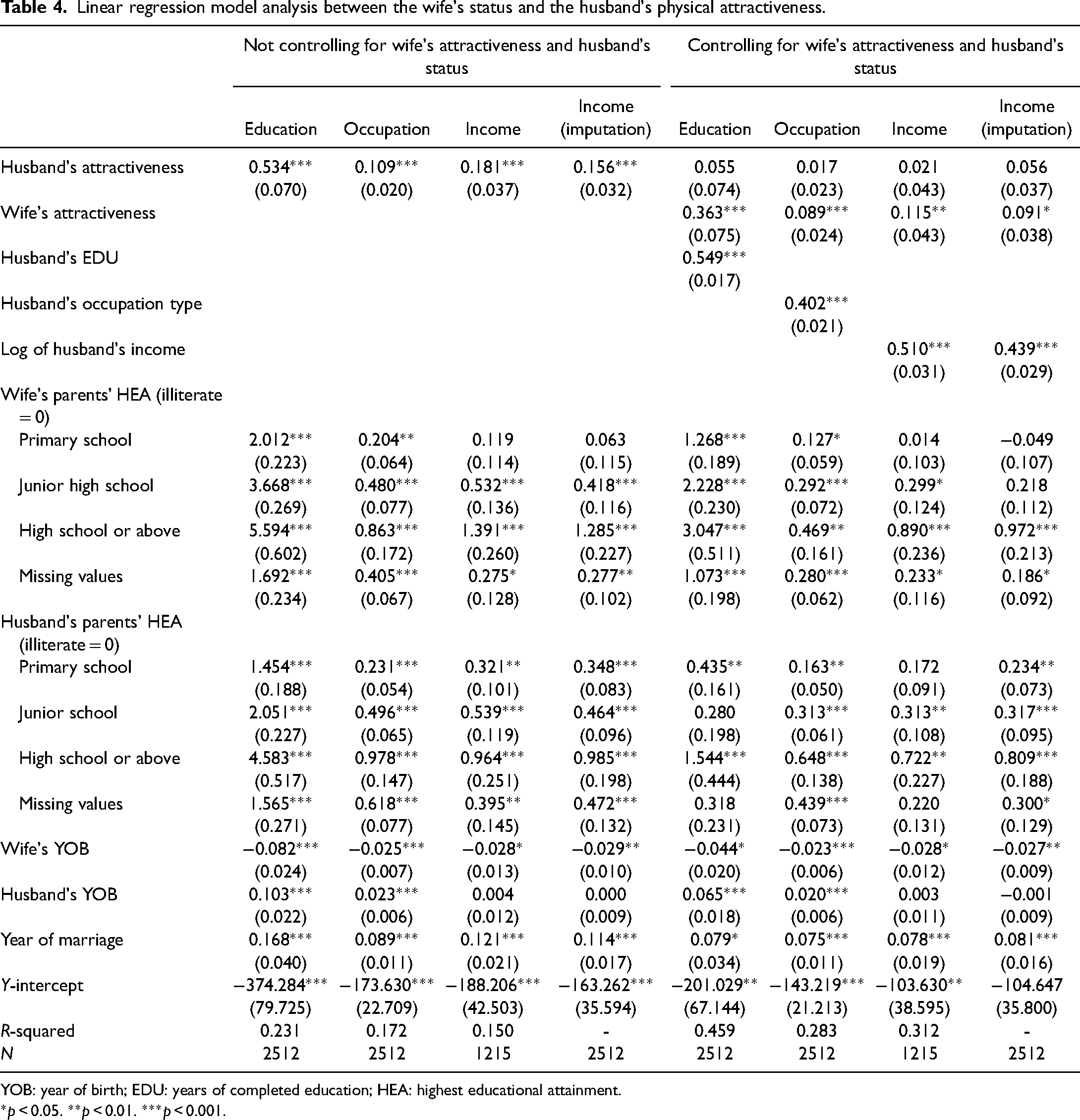
YOB: year of birth; EDU: years of completed education; HEA: highest educational attainment.
*p < 0.05. **p < 0.01. ***p < 0.001.
The exchange effect of women's beauty has been emphatically analyzed in previous studies on beauty–status exchange. Table 3 shows that the wife's physical attractiveness has a very significant positive correlation with her husband's education, occupation, and income, when no variables concerning his beauty or her status are controlled. This is fully consistent with the expectations of beauty–status exchange theory. Strangely, however, once the husband's physical attractiveness and the wife's status are included in the model, all of these effects disappear.
McClintock (2014) argues that the reasons for this are as follows: firstly, there are very significant homogeneous matches between couples on physical attractiveness and status indicators such as education, occupation, and income; secondly, there exists a significant positive correlation between status and beauty for both husbands and wives, which leads to the conclusion that couples may enjoy the same high level of beauty or status, and high-status wives and husbands usually have a high-scoring appearance as well. Thus, it appears that a beautiful wife marries a high-status husband. But, in essence, the exchange relationship is spurious once his physical attractiveness and her status are controlled in the model. The same conclusion can be reached based on an analysis of the exchange between the husband's physical attractiveness and the wife's status in Table 4. In summary, our analysis of the Chinese data again validates the findings of McClintock's study of the USA. Therefore, beauty–status exchange does not hold in China, and neither Hypothesis 1 nor Hypothesis 2 is supported by the data, while the contradictory hypothesis, Hypothesis 3, is more aligned with the Chinese context.
Although Tables 3 and 4 do not support beauty–status exchange, they suggest to some extent that exchange can occur between different status indicators. From Tables 3 and 4, it appears that, even after including all of the control variables, the highest educational attainment of the wife's parents still has a significant positive effect on the husband's education, occupation, and income (Table 3), and vice versa (Table 4), which shows that Hypothesis 4 is valid. Also, the result strongly suggests that ascribed status can be used in exchange for achieved status, since the parents’ highest educational attainment is an important indicator of individuals’ family background and ascribed status.
Log-linear model
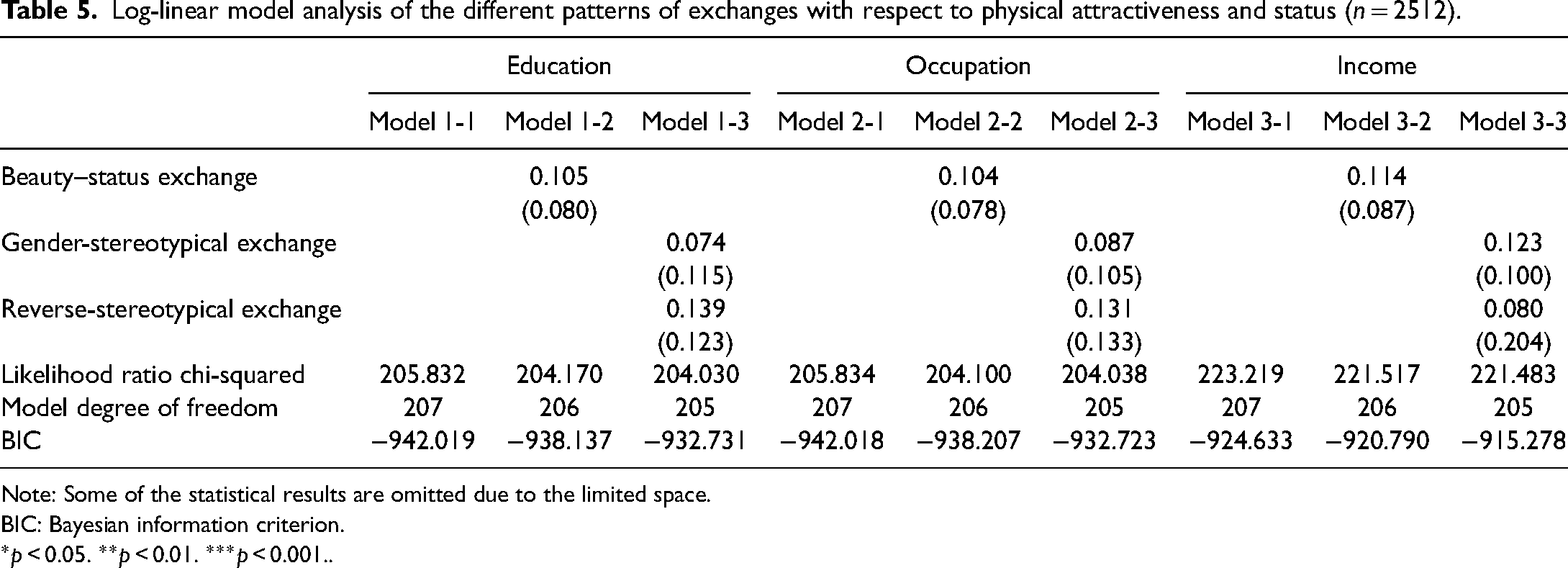
Log-linear models are applied in this part to test the findings of the previous study, and the results of the models are shown in Table 5. Table 5 fits three sets of models for the three status measures of education, occupation, and income. Models 1-1, 2-1, and 3-1 correspond to the benchmark model (1) mentioned earlier, which consider beauty and status homogeneous matching between couples and the correlation between both attributes of either spouse, irrespective of the exchange. The analysis results show that all three benchmark models have a good fit. Firstly, the likelihood ratio chi-square values of the three benchmark models are approximately equal to their respective degrees of freedom, and the chi-square test results show that the three chi-square values are not significant at the 0.05 level. Therefore, from the perspective of the likelihood ratio chi-square, there is no significant difference between the fit of these three benchmark models compared to the saturated model. Secondly, the Bayesian information criterion (BIC) also presents a good fit for the models. Theoretically, the saturated model has a BIC of 0, and the smaller the BIC, the better the model fit (Raftery, 1995). The BIC of all three benchmark models in Table 5 is significantly less than 0 and, as a consequence, it can be considered that these three benchmark models outperform the saturated model in terms of model fit. Next, we include a gender-symmetric exchange term. Models 1-2, 2-2, and 3-2 correspond to the model (2). The coefficients would be significantly positive if there was a beauty–status exchange. However, the statistical test results of the exchange term are not significant, indicating insufficient evidence for beauty–status exchange. In addition, neither the likelihood ratiochi-square nor the BIC is improved once the gender-symmetric exchange term is included. No significant decrease is detected in the chi-square value of the likelihood ratio, while BIC increases compared with the benchmarks. These results suggest that beauty–status exchange is not common in Chinese marriage, as the simple benchmark models outperform those with exchange variables.
Log-linear model analysis of the different patterns of exchanges with respect to physical attractiveness and status (n = 2512).
Note: Some of the statistical results are omitted due to the limited space.
BIC: Bayesian information criterion.
*p < 0.05. **p < 0.01. ***p < 0.001..
Finally, we further divide the gender-symmetric exchange term in two, a gender-stereotypical exchange term and a reverse-stereotypical exchange term, to test whether there exists a gender difference within beauty–status exchange. From Models 1-3, 2-3 and 3-3, it can be found that neither the exchange between the wife's physical attractiveness and the husband's status, nor the reverse, is statistically significantly different to zero. As a result, beauty–status exchange is not supported by the data, and even the commonly assumed exchange between “wife's beauty and husband's status” rarely occurs. Also, similar to the analysis results outlined in the previous step, no significant improvement appears in the models’ goodness of fit following the inclusion of gender-specific exchange terms. To conclude, therefore, the benchmark models are the best fitting ones.
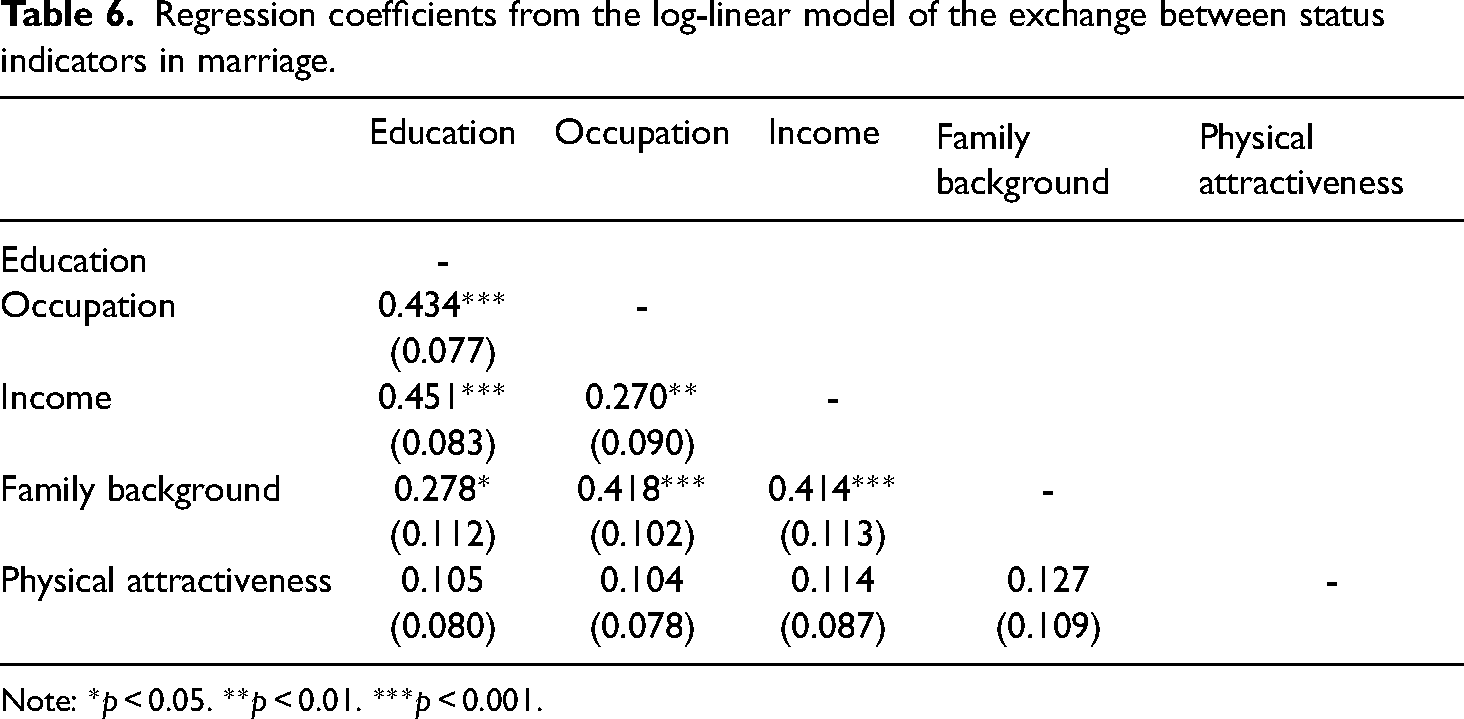
The results of the log-linear analysis clearly indicate that beauty–status exchange is not significant in China, mainly due to the fact that physical attractiveness and status are qualitatively different traits and thus not interchangeable. In contrast, status indicators have stronger substitutability, which leads to a greater possibility of exchange in marriage. To study further whether there is a marital exchange among status indicators, a log-linear model similar to the previous analysis of beauty–status exchange is established, with the coefficients listed in Table 6.
Regression coefficients from the log-linear model of the exchange between status indicators in marriage.
Note: *p < 0.05. **p < 0.01. ***p < 0.001.
It is evident from the table that exchange in marriage can occur between any two of the four status indicators—education, occupation, income, and family background—but that this does not apply with regard to physical attractiveness. Therefore, Table 6 strongly validates this study's view on the conditions for marriage exchange and supports Hypothesis 4.
Robustness test
To sum up, there is no significant beauty–status exchange in Chinese marriage. Considering that this discovery is inconsistent with common sense, further robustness tests are undertaken in this section.
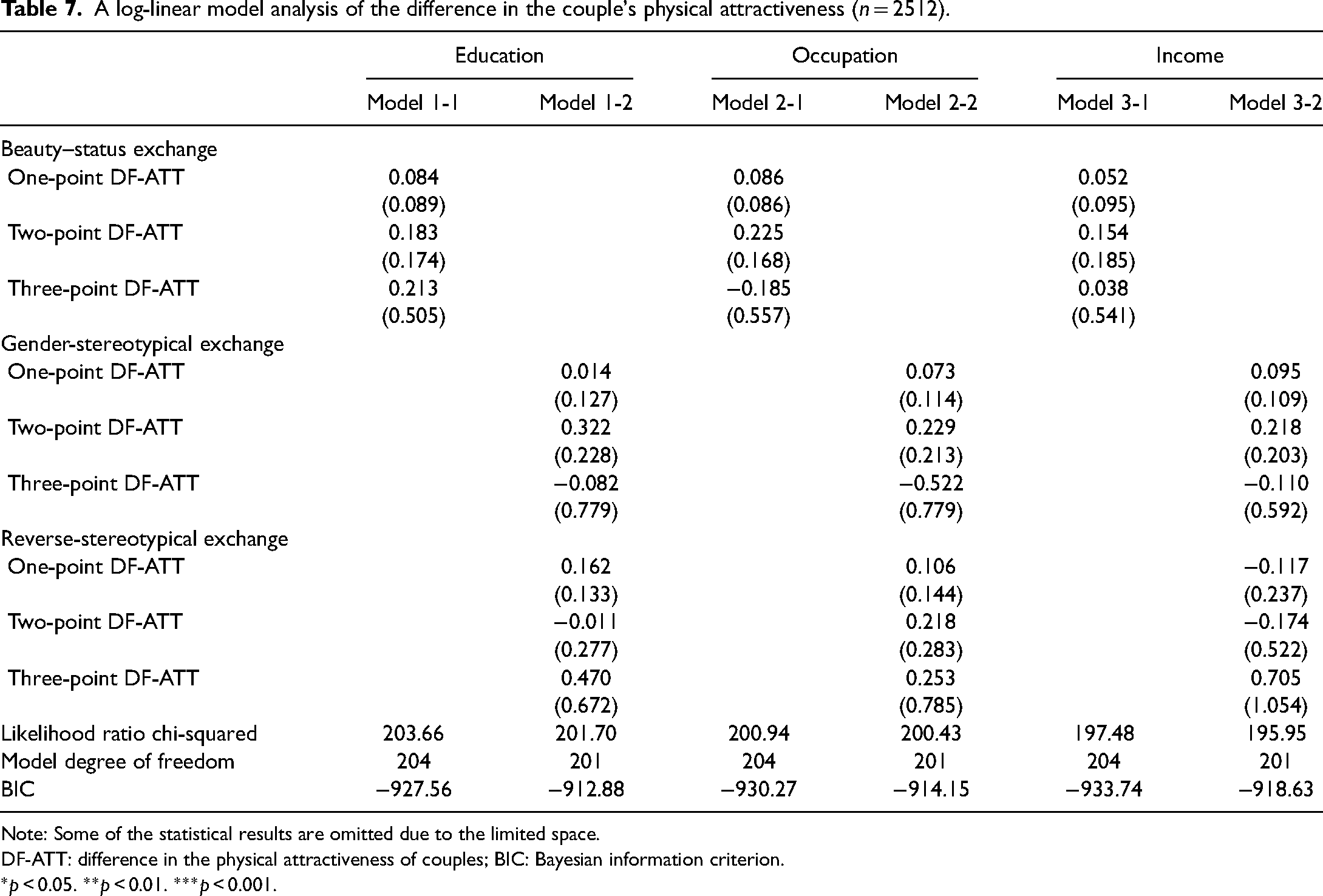
Firstly, with regard to the couple's difference in terms of physical attractiveness, given the fact that the greater the difference in physical attractiveness between a couple the more likely beauty–status exchange becomes, we include the difference between the partners’ attractiveness scores (a one-, two-, or three-point difference), a factor that is not taken into account in the log-linear models. The regression results presented in Table 7 show that there remains no solid evidence of beauty
A log-linear model analysis of the difference in the couple's physical attractiveness (n = 2512).
Note: Some of the statistical results are omitted due to the limited space.
DF-ATT: difference in the physical attractiveness of couples; BIC: Bayesian information criterion.
*p < 0.05. **p < 0.01. ***p < 0.001.
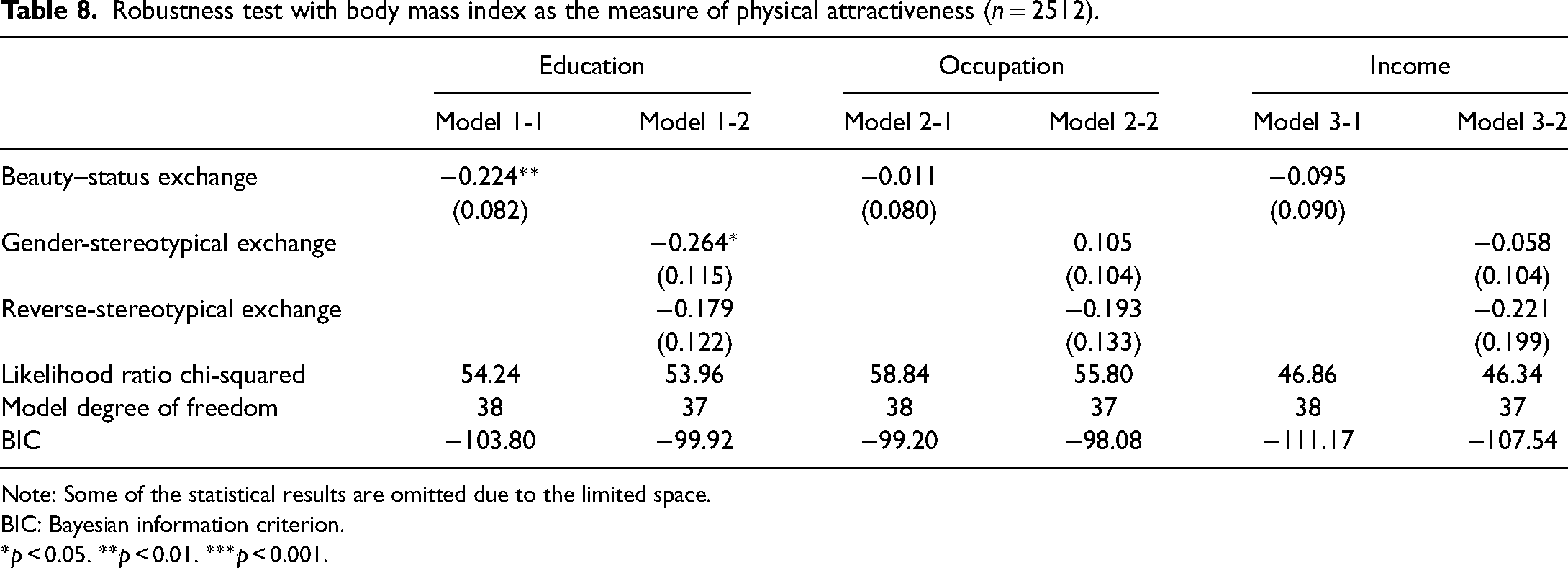
Secondly, because of the subjective bias related to the interviewer-rated physical attractiveness score of the respondents, BMI and age are used indirectly to evaluate physical attractiveness as two relatively objective measures. It is generally considered that a BMI between 18.5 and 24 indicates fitness. Although figures below 18.5 or above 24 are both regarded as disadvantaged characteristics in the marriage market, obesity sometimes leads to a less favorable position than excessive thinness. Therefore, we subdivide the BMI data in two different ways: firstly, into two groups: those between 18.5 and 24, and the rest; and secondly, into three groups: those between 18.5 and 24 (group 1), those below 18.5 (group 2), and those above 24 (group 3). Both approaches result in the same conclusion.
Table 8 shows the results for BMI, according to the two subdivisions outlined above. It is noticeable that neither gender-stereotypical nor reverse-stereotypical marriage exchange are significant positive based on any of the models. The exchanges are, however, statistically significant in the “Education” column, although its negative coefficients suggest that one spouse is more likely to marry a less fit partner when he or she enjoys a higher status, which is the exact opposite of the expectations of beauty–status exchange theory. Identifying the possible reasons for this lies beyond the scope of this study but, in any case, Table 8 shows that BMI, as a measure of physical attractiveness, does not validate beauty–status exchange.
Robustness test with body mass index as the measure of physical attractiveness (n = 2512).
Note: Some of the statistical results are omitted due to the limited space.
BIC: Bayesian information criterion.
*p < 0.05. **p < 0.01. ***p < 0.001.
In addition, this study also uses age as an indirect measure of physical attractiveness to test beauty–status exchange theory. To be specific, in this study, the age difference between married couples is obtained by subtracting the age of the wife from that of the husband, and then dividing them into three categories: 4 and above, −2 and below, and between −2 and 4. Considering that youth tends to correspond with beauty, if there is a beauty–status exchange, then when the status of the husband is higher than that of the wife, the age difference is more likely to fall in the 4 and above group category; and when the status of the wife is higher than that of the husband, it is more likely to fall in the −2 and below category. The analysis results shown in Table 9 indicate that no marriage exchange is significant, and therefore beauty–status exchange is invalid when physical attractiveness is measured by age difference.
Robustness test with age difference as the measure of physical attractiveness.
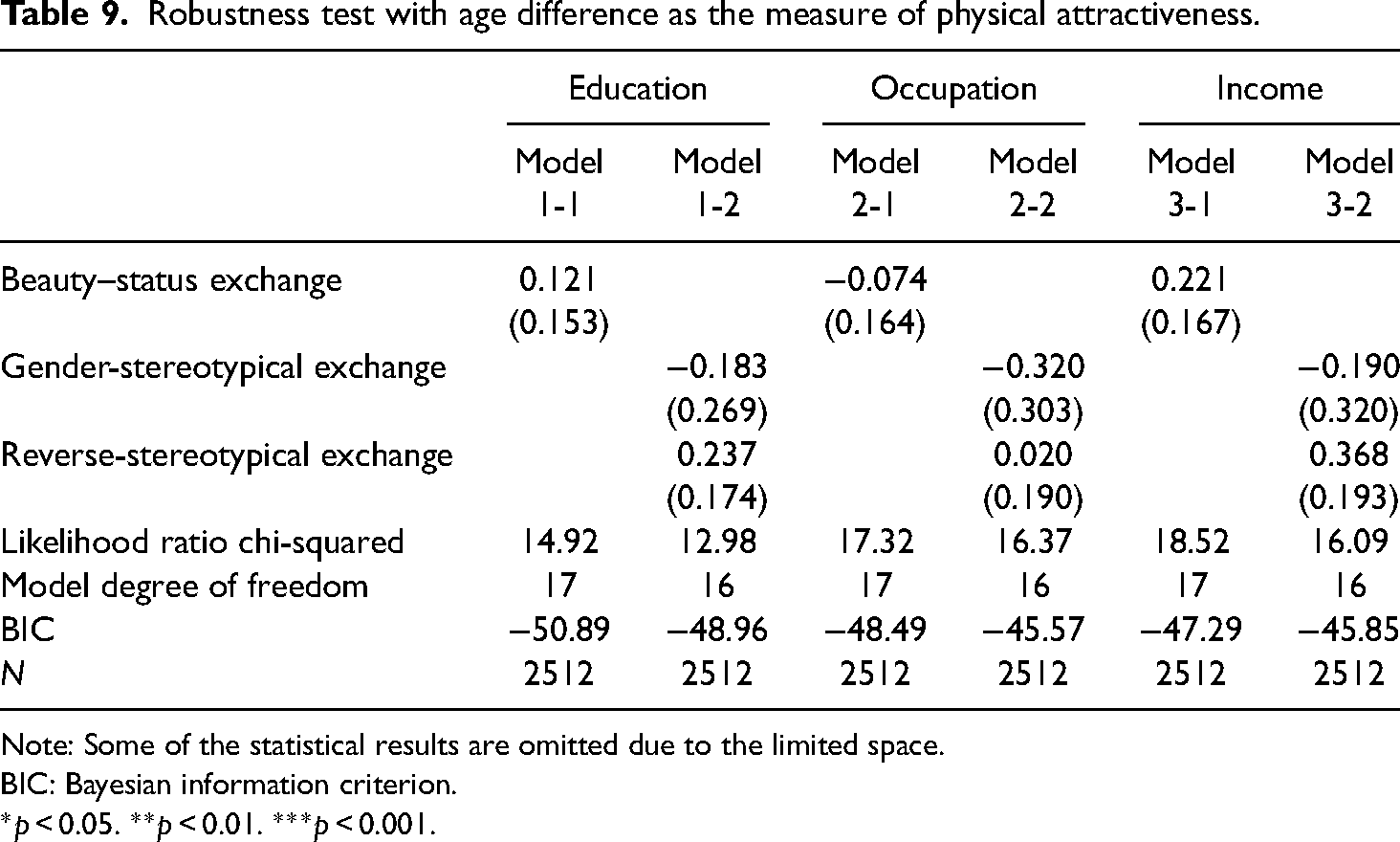
Note: Some of the statistical results are omitted due to the limited space.
BIC: Bayesian information criterion.
*p < 0.05. **p < 0.01. ***p < 0.001.
Conclusion and discussion
It has been widely debated in academia in recent years whether beauty–status exchange or any other more generalized forms of marital exchange exist. Building upon a review of the relevant literature, this study delves into a deep theoretical analysis of the relationship between matching and exchange as well as the conditions for the validity of the marriage exchange theory. Using the data from the CFPS from 2010 to 2018, this study examines the beauty–status exchange in Chinese marriages and the exchange between different status characteristics, yielding the following research findings.
Firstly, it is found that there is a positive correlation between the appearance of one partner and the status of the other in Chinese marital relationships. However, once we control for the appearance and socioeconomic status of both spouses, this simple correlation completely disappears. Regardless of the indicators used to measure appearance and status, whether through linear regression or log-linear models, the conclusions remain consistent. Therefore, in line with McClintock's (2014) perspective, we find that the main mechanism for forming marriages among Chinese individuals is matching, and there is no empirical support for the phenomenon of beauty–status exchange.
Secondly, gender-stereotypical exchange, namely the exchange between a wife's physical attractiveness and her husband's status, was not detected in this study. It is a misconception, resulting from gender stereotypes, that beautiful women tend to have wealthy husbands. This shows that, in contemporary China, both men and women value each other's socioeconomic status when choosing a spouse, or that there are converged perceptions of mate choice between men and women, and thus beauty alone is no longer a ladder to the upper class, which may indicate growing gender equality in marriage as the socioeconomic status of Chinese women rises.
Finally, although this study did not find evidence supporting beauty–status exchange in Chinese marriages, there is a clear exchange detected among the four socioeconomic status indicators: education, occupation, income, and family background. This is mainly because these four characteristics exhibit strong homogeneity, and the more homogeneous the characteristics, the more likely they are to be mutually substitutable and subject to exchange. Therefore, we argue that the validity of the marriage exchange theory largely depends on the similarity or substitutability among specific characteristics. It is incorrect to completely reject or accept this theory without considering the specific characteristics involved.
The findings of this study expand previous research in two aspects. Firstly, we extend the debate on marriage exchange, particularly the beauty–status exchange, to the context of China. Compared to Western countries, China has more traditional gender roles and is more likely, logically speaking, to exhibit the phenomenon of women exchanging their physical appearance for men's status, as suggested by the beauty–status exchange theory. However, our analysis of Chinese data did not confirm this phenomenon, providing us with more substantial reasons to question this theory. Secondly, this study delves deeper into the conditions under which the marriage exchange theory holds, thus greatly expanding our understanding of the theory.
It is important to note that this research builds upon the latest understanding of marriage exchange theory. Specifically, this study posits that a crucial premise for marriage exchange to occur is that individuals consider all potential spouse characteristics comprehensively, pursuing a match in overall attractiveness, while allowing for flexibility in the individual components of attractiveness. This flexibility leads to the exchange of characteristics that are convertible or substitutable. Apart from this type of marital exchange, previous research has also mentioned another form of exchange based on mutual give-and-take or reciprocal needs, such as the exchange between male's economic capability and female's housekeeping skills emphasized by Becker (1991). The conclusions of this study do not apply to such exchanges, and readers should keep this in mind while reading. In addition, this study does not aim to examine economic exchanges or social exchanges in a more general sense, as extensive research has already been conducted on these exchanges. In summary, the primary objective of this paper is to examine the specific phenomenon of beauty–status exchange and to supplement and expand upon the latest explanations put forward by proponents of marriage exchange theory.
In conclusion, marriage exchange theory is a promising research field, but unfortunately, it has been largely neglected by Chinese scholars. This study provides a comprehensive introduction to and analysis of marriage exchange theory, based on the context of China, but it remains deficient in the following aspects. Firstly, this study primarily used interviewer ratings to measure respondents’ physical attractiveness. Although this method has been widely used in previous research, and the inter-rater reliability of interviewer ratings among different survey waves in this study is high, it is important to acknowledge that this method is subjective and inherently has limitations in measuring physical attractiveness. Future research could incorporate more rigorous methods to validate the findings of this study. Secondly, the measure of occupation is also relatively crude due to the unavailability of International Socio-Economic Index (ISEI) in all five rounds of CFPS. With no alternative, occupation data are combined and categorized into four groups since the log-linear model requires a relatively large number of observations and rejects certain occupations with few participants, which leaves room for further improvement. Thirdly, with regard to the timeliness of the sample data, the couples analyzed in this paper are married after 2009, which can better reflex the marriage exchange in China nowadays. However, since marriage exchange may change over time, it would be more valuable to conduct a comparative study of marriages covering a longer period. Finally, the studies on marriage exchange in China remain inadequate compared with the international research, which delves into other types of intimate relationships, such as dating and cohabitation. For example, McClintock (2014) finds that beauty–status exchange is strongest among couples in romantic relationships, weaker in cohabitation, and weakest in marriage. She argues that whether or not an intimate relationship involves a long-term commitment is an important factor in influencing beauty–status exchange. It is more likely for beauty–status exchange to occur within a romantic relationship, where the degree of intimacy is relatively relaxed, while a homogeneous matching among socioeconomic status gains greater importance with regard to a long-term commitment in a marriage. This study, however, only focuses on beauty–status exchange in marital relationships, so a more in-depth, comprehensive analysis of the phenomenon in regard to dating or cohabitation relationships might be proven fruitful. All in all, marriage exchange theory is a frontier research area, and we sincerely hope that other Chinese scholars can build upon the study results outlined herein.
Footnotes
Acknowledgements
We are grateful to two anonymous reviewers of the Chinese Journal of Sociology (Chinese version). The authors take sole responsibilities for their views.
Contributorship
Qi Xu is primarily responsible for research design, data analysis, and paper writing, while Xiuming Pan carries out preliminary data cleaning and text proofreading.
Declaration of conflicting interests
The authors have no conflicts of interest to declare.
Contributorship
Qi Xu is primarily responsible for research design, data analysis, and paper writing, while Xiuming Pan carries out preliminary data cleaning and text proofreading.
Funding
The authors disclosed receipt of the following financial support for the research, authorship, and/or publication of this article: This work was supported by the National Social Science Fund of China (grant no. 20CRK025).