







Abstract
The father–son relationship has traditionally been regarded as the cornerstone of family dynamics and has been the focal point of research in both Western and Chinese contexts. Conversely, the mother–daughter relationship has either been overlooked or portrayed in a negative light. This study aims to shed light on this underrepresented relationship by bringing it to the forefront of academic inquiry. We conducted semi-structured interviews and participant observation with 18 singleton daughters and seven mothers in a second-tier city in inland China. Our findings revealed that within these families, the mother–daughter relationship is highly complex, intimate, and salient. It extends beyond the daughters’ marriages and persists through childbearing and, indeed, throughout their lifetime. Unlike in traditional Chinese families, this relationship is no longer truncated or heavily restricted by patrilineal power. Moreover, while mothers’ “thick love” is often accompanied by intimate control, the overarching pattern remains one of strong intimacy and solidarity. Mothers’ assistance with childcare also plays a crucial role in reconciling strained mother–daughter relationships. Modern mothers, who are both career-oriented and living a traditional marital life, often serve as dual role models for their singleton daughters in relation to economic independence and traditional gender roles. In summary, the modern mother–daughter relationship is complex and intense, characterized by thick love, caregiving, and strong mutuality. This contrasts with the traditional father–son relationship, which is often regulated by patriarchy, patrilineal power, lineage, and norms.
Keywords
Introduction
The mother–daughter relationship is frequently regarded as the most complex familial bond (Bojczyk et al., 2010). Across the life course, this bond is characterized by enduring intimacy and mutual dependence (Fischer, 1991). However, limited scholarly attention has been devoted to the mother–daughter relationship, which is often either overlooked or portrayed in a negative light. Stereotypically, the mother–daughter relationship is depicted as being marked by control, conflict, and negativity. For example, unlike the Oedipus complex in boys in the Freudian tradition—sexual attraction to the mother and rivalry with the father—the girl experiences attraction toward her father and hostility to her mother (Freud, 1933). In contrast to this line of Western narratives, the traditional patriarchal Chinese context places the father–son relationship at the singular core axis (Fei, 1998), characterized by father–son oneness (父子一体) (Hsu, 1948; Yan, 2023; Zhou, 2021). The father–son bond is thus entrusted with core familial privileges and responsibilities, including lineage continuation, cultural and moral transmission, and property inheritance (Fei, 1998; Freedman, 1958; Thornton and Lin, 1994; Whyte, 2003). By contrast, the mother–daughter relationship is often rendered invisible and marginalized. Traditionally, within her husband's family, a married woman typically lacked not only an individual identity, but also sometimes even a name of her own, while to her natal family a married daughter was likened to “water splashed out”mpa#rdquo;.
However, this traditional family pattern of marginalizing and overlooking women has undergone significant transformation in post-reform China, particularly with the gradual rise of a mosaic, bilateral family pattern in the twenty-first century (Ji, 2024, 2025, 2026). With rapid modernization, women have made substantial strides in higher education, and female enrollment in 4-year undergraduate programs surpassed that of males in 2011, reaching a peak of 53.99% in 2018 and standing at 52.9% by 2022 (Ministry of Education of the People's Republic of China, 2023). The social status of young women has significantly improved, both within families and in the workplace. Since the 1990s, although Chinese women's labor force participation has declined, it still reached 60% in 2024, comparable to that of a Nordic country such as Sweden (62%), and higher than Japan (55%), Korea (56%), and the US (57%) (World Bank Group, 2025). In mid-2023, a series of short essays about “Jiang-Zhe-Hu Singleton Daughters”—that is, singleton daughters pampered by well-to-do families in Jiangsu, Zhejiang, and Shanghai, located in China's prosperous Yangtze River Delta—went viral on Chinese social media platforms. Many netizens (a person actively involved in online communities or the Internet in general) joined this online frenzy by sharing numerous posts about these “princess-like” women with meticulously crafted elite personas. Behind this surge in online traffic lies an unprecedented focus on daughters and their families of origin, who used to be relatively invisible and marginal in Chinese history.
In recent years, topics such as gender, intergenerational relationships, and family issues have frequently trended on Chinese social media platforms. Amid this, topics such as “family of origin” and “cutting off contact with relatives”—breaking off ties with non-immediate family members—have become subjects of intense online debate among Chinese youth. As Lewis (1997) pointed out, individuals reinterpret their childhood through the lens of present experiences, shaping their adult identities. This focus on intergenerational relations reflects a shift from grand historical narratives to personal development and family life, underscoring the significance of family amid the intense pressures of overwork and competition in contemporary China (Ji, 2025). However, this apparent targeting of the family of origin differs from attacking the extended, patrilineal family as a symbol of patriarchy and feudalism during the May Fourth Movement a century ago (Yang, 2010, 2012), an era dominated by the grand narrative of a deep devotion to family and nation (家国情怀). Today, against the backdrop of China's ongoing modernization and demographic transition, the family is increasingly viewed as a vital space for intimacy and personal growth within the Chinese path toward individualization (Yan, 2009), vividly demonstrating an era shift from the grand narrative of family-and-nation devotion to the daily-life logic of individual-and-family devotion. Nonetheless, family relations are not without control and conflict.
It is within this post-reform, child-centered era—marked by unprecedented attention to intergenerational relationships (Fong, 2004; Ji, 2025; Yan, 2021; Yu and Xie, 2019)—that we bring the previously overlooked mother–daughter relationship into focus, situating it within the dynamic context of China's ongoing family reinstitutionalization and changing gender relations amid the broad societal transformation. Based on semi-structured interviews and participant observation with young women and their mothers, this study investigates how young women's life course unfolds through pivotal stages, including birth and infancy, childhood, marriage formation, childbirth and caregiving, and (prospective) elder care for their parents.
We argue that the strong, intimate mother–daughter relationship is evolving into a dynamic two-way exchange of strong emotional, caregiving, and financial support. It is remarkable that this strong mutuality continues after the daughter's marriage and lasts until the mother's late stage of life, greatly challenging the patriarchal tradition that regulates power, resources, and obligations, which flow along the patrilineal family line (and lacks any corresponding intimate expression). This shift transforms the patrilineal family, traditionally centered on the father–son core axis, into a bilateral and biaxial family network composed of multiple nuclear families, in which the lifelong mother–daughter bond becomes as important as, if not more important than, the traditional father–son axis.
Yet, mothers’ substantial investments in as well as sacrifices for daughters may lead to control, boundary blurring, and so on. Moreover, mothers’ assistance with childcare for their married daughters may entrench traditional gender norms and result in the feminization of domestic labor, further absolving men of caregiving responsibilities. Although married women today exercise greater voice and decision-making power within the household, they are also overburdened with unpaid care work together with their mothers. While the unfolding of the modern mother–daughter relationship has transformed the traditional patrilineal family into a bilateral one, this complex process of family reinstitutionalization and women's empowerment leads to a nonlinear, imbalanced path of gender revolution, with gender inequality progressing and regressing simultaneously in a zigzag, mosaic pattern, echoing the patchy, complex modernity in China specifically and East Asia more broadly (Chang, 2010; Evans, 2021; Ji, 2017).
Literature review
The evolution of the mother–daughter relationship through Chinese history
The traditional Chinese family—patriarchal, patrilineal, and patrilocal—is structured around a gendered generational hierarchy, in which the senior male wields power, controls financial resources, and upholds cultural and moral authority (Freedman, 1958; Whyte, 2003). The father–son relationship, encapsulated in the notion of “father–son oneness”, serves as the central axis of the family (Hsu, 1948; Yan, 2023; Zhou, 2021). A woman was expected to submit to different male authorities at different stages of her life. As recorded in the Book of Rites (礼记), a Confucian classic from the Han Dynasty, “When unmarried, she is subject to her father and elder brother; when married, to her husband; and when widowed, to her son” (幼从父兄,嫁从夫,夫死从子). Upon marriage, women became formal members of their husband's family, while ties to their natal family were strictly regulated under the patrilineal order; for instance, freely visiting their natal family was seen as a serious transgression (Diao, 2010). As outsiders in their husband's household and with constrained access to their natal family, married women tended to establish a “uterine family” centered on their own children within the extended patrilineal framework (Wolf, 1972, 1985). Through this maternal-centered unit, particularly via sons, women could acquire a degree of status, authority, and resources within the patriarchal society. This strategy corresponds with traditional Chinese idioms such as “a mother's status is lifted through her son's success” (母凭子贵) and “a married daughter is like water splashed out” (嫁出去的女儿泼出去的水). Consequently, the mother–daughter relationship, as an alliance between a familial outsider and a transient member, has long been marginalized and rendered invisible, subordinated to other dominant family relations.
In the late Qing Dynasty and early Republican era, the already marginalized mother–daughter relationship—long overshadowed by the patriarchal family—was further suppressed by the grand revolutionary discourse. The extended patriarchal and patrilineal family, with which the mother was perceived to be associated, became a symbol of feudalism, backwardness, and authoritarianism (Wang, 1999; Yang, 2010, 2012), in sharp contrast to the May Fourth Movement's slogan “Mister Democracy and Mister Science” (德先生和赛先生). Many young intellectual women rebelled against their families of origin and regarded the mother–daughter bond as a constraint on their pursuit of freedom and independence (Cong, 2016). Yet when these “motherless daughters” (Cong, 2016: 230) entered marriage and motherhood, they often experienced profound confusion and ambivalence about how to be mothers.
After the founding of the People's Republic of China in 1949, dominant political and economic discourses of socialist revolution and construction continued to obscure the mother–daughter relationship within families. According to Engels's theory (Engels, 2010), women were encouraged to engage in socialist production as a pathway to liberation, while their “self and private emotions” were simultaneously repressed (Meng, 1993). In the socialist era, urban women's employment in China significantly increased, and virtually all adult women entered full-time positions (Stockman, 1994), with the employment rate peaking at 93% for those aged 20–49 (Wolf, 1985). This high level of labor force participation was boosted by the state propaganda, with the iconic image of the “Iron Girls” and the resounding slogan “women can hold up half the sky” serving as key ideological tools (Jin, 2006). Meanwhile, rural women also shifted their focus from domestic responsibilities to collective agricultural labor, undertaking workloads virtually equivalent to those of men (Hershatter, 2011). However, with Chinese women's high participation in the labor force, their domestic responsibilities largely remained, and their gendered labor in both public and private spheres was well interwoven into the socialist production system (Andors, 1983; Ji et al., 2017; Song, 2011; Stacey, 1983), resonating with the stalled and uneven gender revolution in the Western hemisphere (England, 2010; Hochschild and Machung, 1989; Ji et al., 2017).
During this period, the public sphere was prioritized over private affairs (Song, 2012), and the identity of working mothers as laborers took precedence over their role as mothers (Jin, 2013). Simultaneously, children were described as the “flowers of the motherland” and “successors to the communist cause”, symbolizing the significant public responsibilities they were expected to bear. Consequently, both mother–daughter and father–son relationships were subsumed under the dominant rhetoric of socialist production. Furthermore, the All-China Women's Federation stepped in as a “social mother” to intervene in women's family lives (Cong, 2016: 237), aiming to emancipate them from traditional roles and integrate them into the new socialist society (Wang, 2005).
The post-reform mother–daughter relationship from an intergenerational perspective
In post-reform China, the state has gradually reduced its control over individuals’ private lives. Along the Chinese path toward individualization (Yan, 2009), the younger generation has gained greater autonomy and parental authority has correspondingly declined (Yan, 2003). Amid this broader transformation, Chinese families have undergone an intimate turn (Evans, 2008, 2010; Fong, 2002; Ji, 2025, 2026; Yan, 2016), marked by intergenerational relationships that are increasingly cordial, intimate, and egalitarian. Against this backdrop, intergenerational connections in contemporary China are increasingly significant and salient alongside the conjugal relationship, with both husbands and wives maintaining strong ties to their own parents; consequently, a bilateral, biaxial form of “mosaic familism” has gradually emerged (Ji, 2024, 2026).
In particular, the mother–daughter relationship has transformed, emerging as a particularly visible and salient site of intergenerational intimacy. As young daughters increasingly emphasize emotional exchange, individual understanding, and mutual respect, mothers have also become more attentive to their daughters’ emotional needs, fostering what Evans (2008, 2010) describes as “communicative intimacy” in mother–daughter relationships. At the same time, this close mother–daughter bond is not diminished by the daughter's marital status; even after marriage, daughters tend to maintain strong emotional ties with their mothers (Ji, 2020; Yan, 2016).
Traditionally, patrilineal family structures restricted married women from supporting or frequently visiting their natal families. With women's rising economic status, both urban and rural daughters are increasingly caring for their parents, challenging the patrilineal norm of raising sons for old-age support (养儿防老). In the post-reform era, rural women with greater economic resources are not only able to support their parents but also tend to maintain closer relationships with them and demonstrate greater filial piety compared to their brothers (Tang et al., 2009). Research even indicates that daughters often provide more support to their parents while receiving less in return, compared to sons (Hu, 2017; Lei, 2013; Li et al., 2024; Xie and Zhu, 2009; Xu, 2015).
Mother–daughter intimacy is particularly strong in families with singleton daughters. Benefiting from exclusive parental attention and investment, these daughters tend to achieve strong educational outcomes and are well positioned for future career development (Fong, 2002; Tsui and Rich, 2002). Meanwhile, emotional exchanges between mothers and daughters—such as sharing daily routines or mutual confiding—are increasingly frequent, as both actively seek “communicative intimacy” grounded in trust and mutual understanding (Evans, 2008, 2010). Having received intensive parental investment and developed a deep emotional bond with their mothers, singleton daughters tend to have a heightened sense of responsibility for elder care.
Overall, there is a notable lack of research exclusively focused on mother–daughter relationships in post-reform China. Two exceptions are Fong's (2002) and Evan's (2008, 2010) studies. Fong (2002) explored the educational attainment of singleton daughters, emphasizing mothers’ investment in their daughters’ education and their role as employment models. Evans (2008, 2010) further examined the two-way interactions between mothers and their (mainly adult) daughters, focusing on the emotional connection between young women and their mothers. Conducted more than a decade ago, these two studies primarily focus on the dimensions of schooling and communication in the mother–daughter relationship during certain life stages, and they also tend to emphasize the positive side of this intimate relationship. Two additional studies, though not directly centered on mother–daughter ties, reveal its ambivalent and negative sides and deserve attention here. Kuan (2015) identifies mothers’ ambivalence in parenting their elementary-school-age children, as they balance strict discipline with encouragement, especially as their children face serious psychological challenges. By investigating argumentative communication over mothering across two generations of women, Zhu (2010) vividly shows the other side of the intimate mother–daughter relationship—one marked by conflict and tensions.
During the post-reform marketization process, the danwei (work unit) system has gradually collapsed, rendering the public and private spheres increasingly differentiated (Ji et al., 2017). Reproductive responsibilities that used to be shared by the danwei system have now been shifted to individual families, especially onto women's shoulders, thereby intensifying women's work–family conflict (Cook and Dong, 2011; Du and Dong, 2013; Ji et al., 2017; Liu, 2007). Amid this rising structural care deficiency, private families, particularly working mothers, together with their mothers and mothers-in-law, have had to shoulder caregiving, pool resources, and provide emotional support to family members as a de facto welfare system (Ji, 2025, 2026). The structural care deficiency and the resulting family coping strategies have exerted a profound impact on family relations, reshaping women's roles and responsibilities and, in turn, significantly transforming mother–daughter relationships and producing tensions as well. The present study, therefore, investigates the mother–daughter relationship across a broader life course, encompassing critical stages such as birth and infancy, childhood, marriage formation, childbearing and rearing, and prospective elderly care for mothers. Building on this analysis, the study further explores the complexity and ambivalence of this mother–daughter relationship, and how mothers’ dual roles as both working women and mothers shape their daughters’ aspirations regarding work and family life.
Method and data
This study focuses on mother–daughter relationships in urban singleton-daughter families, based on fieldwork conducted between mid-2023 and mid-2025 in City Z, located in northwestern China. City Z hosts a relatively large number of state-owned enterprises, public universities, and various types of danwei. Given that danwei employees face substantial penalties for violating birth quotas (Cooney and Li, 1994), the one-child policy was implemented more smoothly here in City Z, leading to a higher prevalence of singleton-child families, including singleton-daughter families. At the same time, the tension between relatively traditional family values in northwestern China and increasingly modern, egalitarian gender beliefs among the younger generation offers a distinctive perspective for this study.
The second author conducted research with 18 singleton-daughter families through participant observation and semi-structured interviews. The sample included 18 daughters and 7 mothers. The second author herself is a local singleton daughter, which facilitated rapport-building during fieldwork. She adopted a snowball sampling strategy, initially contacting relatives and friends, who subsequently referred additional potential participants. Seven daughter informants, after completing their own interviews, introduced the interviewer to their mothers, who subsequently agreed to participate. All interviews with daughter participants were conducted without their mothers being present. Most interviews with the seven mothers were conducted at the participants’ homes. In five of these cases, the daughters were present, but the focus remained on the interview with the mother, with the daughters occasionally providing explanations or additional comments. Each interview lasted approximately 90 minutes, with some extending to 2 to 3 hours. In addition to formal interviews, the second author also engaged in immersive observation, including traveling with two mother–daughter pairs, staying for 2 to 3 days in the homes of two daughters, and attending a retirement celebration hosted by one daughter for her mother. These opportunities allowed the researcher to observe mother–daughter interactions in more natural settings, thereby enriching the contextual depth of the study.
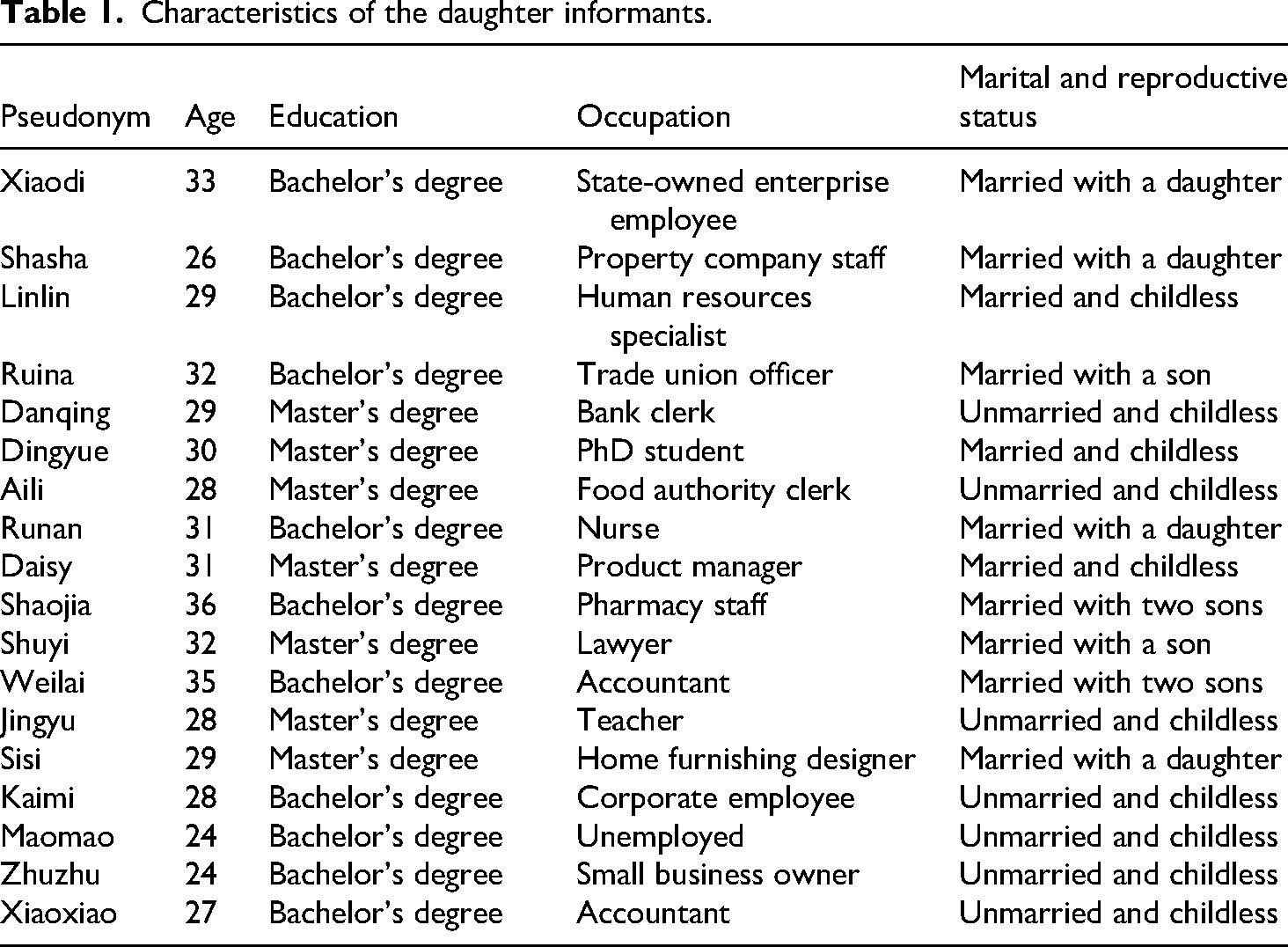
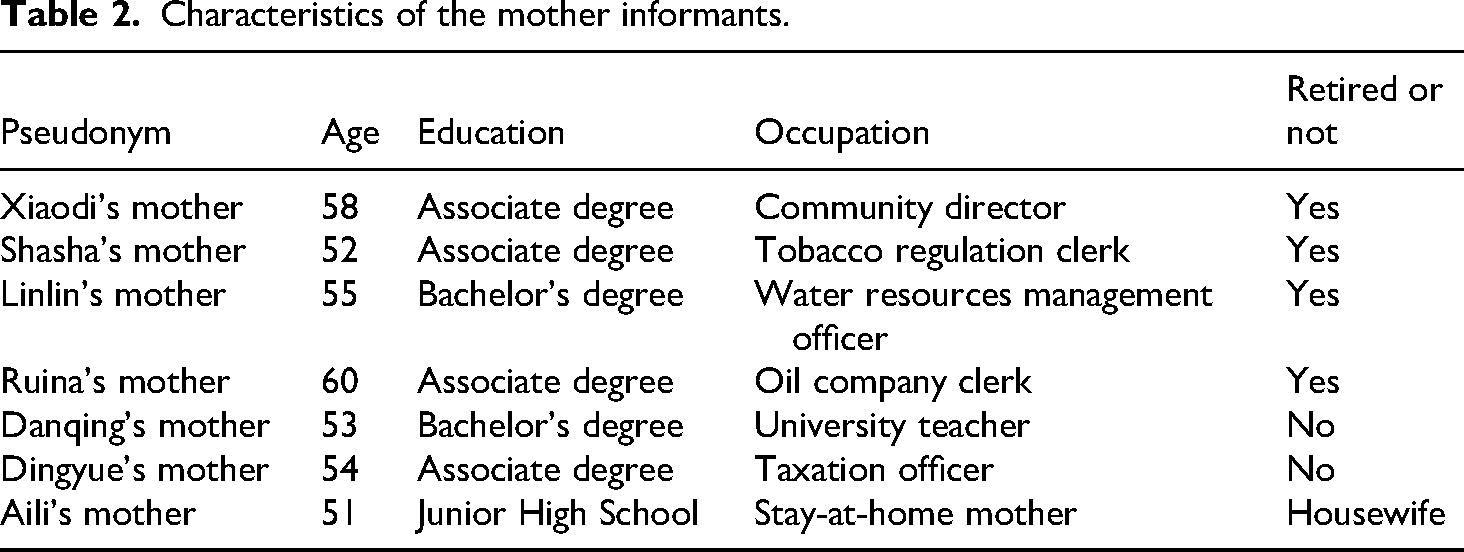
The majority of the daughter participants were born in the 1990s and, at the time of the interviews, were aged between 24 and 36, most commonly 28 or 29. Among them, 11 were married, of whom six had one child and two had two children. All held at least a bachelor's degree, and seven had obtained a master's degree. At the time of the interviews, most were formally employed. The interviewed mothers—seven in total—were born between the late 1960s and early 1970s. Two held bachelor's degrees, and four held vocational college degrees (equivalent to associate degrees). All but one had formal employment histories, primarily in government agencies, state-owned enterprises, or public universities. Most of the mothers were economically independent and exercised a certain degree of influence in household decision-making. Overall, the interviewed families were part of the urban middle-class with stable economic resources. Further demographic details are presented in Table 1 (daughters) and Table 2 (mothers).
Characteristics of the daughter informants.
Characteristics of the mother informants.
We analyzed the data following Braun and Clarke's (2006) thematic approach. After transcribing and thoroughly reading the interviews, we extracted segments related to mother–daughter interactions into a synthesized document. Initial codes included “daughter's birth”, “maternal sacrifice”, “importance of education”, “preparing dowries”, “mothers caring for grandchildren”, “working mothers,”, and “intergenerational conflict”, among others. As coding progressed, two analytical orientations emerged: a longitudinal lens on life-stage transitions, and a horizontal perspective highlighting emotional dynamics and the mutual influence between mothers and daughters. These orientations guided the refinement of five final themes presented in the findings section.
Findings
Evolution of the mother–daughter relationship through the life course
A mother's rebellion against son preference
Beginning in the late 1970s, China formally implemented the strict One-Child Policy, which stood in marked tension with the deeply entrenched cultural preference for sons. In the recollections of the seven mothers of singleton daughters in our sample, none expressed a strong personal preference for boys; nevertheless, they reported experiencing significant pressure to have a son, arising mostly from their husbands and parents-in-law.
Dingyue's mother worked in the local tax bureau. She recalled that during her pregnancy, her husband had tried to use his connections at the hospital to obtain an early ultrasound to determine the fetus's sex—an act strictly prohibited at the time. She firmly opposed the idea, reminding him that both of them were state employees and that exposure of such behavior could cost them their jobs. What worried her even more, she admitted, was that, If it was a girl, I knew he’d want to get rid of her and try again for a boy. Back then, so many people around us were doing things like that … It was too cruel! No matter if it was a boy or a girl, I could never bring myself to abort my baby. (Dingyue's mother)
Similarly, when Aili was just born, to secure a male heir to carry on the family line, her father and paternal grandmother conspired to adopt a baby boy from the countryside and register him as if he were a twin of their daughter. Having learned of the scheme, Aili's mother mounted fierce resistance, even threatening divorce and suicide, and the plan was ultimately abandoned.
All the mothers in our sample had borne varying degrees of pressure from the patriarchal son-preference norm, which was present before the birth of their daughters and throughout the daughters’ upbringing. The fact that these daughters remained only children was shaped not only by state policy but also by their mothers’ active defense and resistance—in which the latter played an indispensable role.
However, these mothers may also, whether consciously or unconsciously, project external gender pressures onto the way they treat their daughters to a degree. Runan, a 31-year-old nurse, bears a name that literally means “the same as men”—a typical Chinese girl's name that reflects the parents’ strong preference for a son. Her mother was particularly strict with her, especially in matters of study, hoping that Runan's academic achievements might compensate for the disappointment that she had brought to the family by being a girl. During Runan's childhood, the family lived with her grandparents. Her grandmother's preference for boys strained the relations with Runan's mother and placed her under great pressure. Whenever the two quarreled, Runan would watch her mother's mood closely and comfort her afterwards. They endured this oppressive environment for many years, until the grandmother's death.
Intensive mothering and educational investment while daughters are growing up
When recalling their childhoods, all the daughter participants described their mothers’ devotion, including physical care, emotional support, and educational investment. As Shuyi, a 32-year-old married woman with a son, recalled, her family lived in an old, unheated residential building when she was in elementary school 20 years ago. In the freezing winters, her mother would wake up around 4:30 a.m. to light a coal stove for breakfast and then warm Shuyi's clothes. Once everything was prepared, she would wake Shuyi for breakfast and always give her a hot-water bag to warm her hands on the way to school. As their economic situation improved alongside China's rapid socioeconomic growth, the family moved to a new apartment with heating, and Shuyi received an electronic hand warmer. There is one thing her mother did for Shuyi that she will never forget. One time she was charging my hand warmer and it broke down. She immediately went out to buy me a new one while I was napping before afternoon classes, even though it was snowing heavily outside. Every time I think about it, I feel like my mom really loves me. No matter what, she always puts me first. Even though she's afraid of the cold too, she wouldn’t let me freeze. And no matter what it is, she always puts me first—always. (Shuyi)
Dingyue, a 30-year-old married daughter, shared with the interviewer the story of how she began playing the keyboard. She first encountered the electric organ in kindergarten. Noticing her strong interest, Dingyue's mother enrolled her in a weekly course at a music training school. Her mother took the lessons with Dingyue so she could tutor her when necessary. Despite her father's objections, her mother decided to buy her a Yamaha electric organ imported from Japan, at a price that was 10 times her monthly salary. As her mother explained, She's our only child, so, of course, we want to give her the best we can. When we were kids, we didn’t have those opportunities. But now that she does, we’d like to support her for sure. I have a rule for spending on my daughter: if it's worth it, I’ll pay for it, and I don’t care if it's expensive or not. (Dingyue's mother)
For seven years, every day when Dingyue played the keyboard, her mother would accompany her, until she eventually gave up. Whenever she became exhausted from practicing, especially during the period leading up to the music grading exams, her mother was always there to console her. My mom would always put her hand on the back of my head and say, “Just go for it! No matter what score you get, you are always the best in my eyes.”. So, every time I had an exam and she was there, I’d feel calm. Eventually, I gave up playing the keyboard because I didn’t have the talent—haha. But my mom still respected my choice. To her, I am just as amazing as any professional pianist. (Dingyue)
Danqing, a 29-year-old singleton daughter who holds a master's degree from an elite university, felt both proud of and grateful to her mother. Danqing's mother, a graduate in mathematics from a prestigious university, returned to their small inland hometown for marriage. Her mother was meticulous about Danqing's education, thoroughly analyzing all her test papers to help her improve. Even when it came to high school math tests, her mother could always provide insightful feedback. Beyond her studies, Danqing's mother regularly took her on trips to various places, including large cities, to broaden her horizons. Similarly, in the realm of higher education, Daisy, 31 years old, had parents who lowered their living standards and sold their apartment to send her to an elite American university for postgraduate study. Meanwhile, Aili, with her mother's continued support and constant encouragement, eventually gained acceptance to graduate school after 3 years of diligent preparation.
Among our 18 daughter informants, 12 made it clear that their mothers were the primary caregivers and responsible for their education during their upbringing, while the fathers’ involvement was relatively limited. The remaining six informants expressed that their mothers were responsible for caregiving, while their fathers handled education. Mothers’ intensive caregiving, daily support, and educational devotion have not only facilitated their daughters’ educational development and personal growth but also fostered exceptionally close bonds with their singleton daughters during critical developmental stages. This strong support and deep connection continue as their daughters mature into adulthood and establish their own families.
Standing by one's daughter during marriage formation
Mothers’ financial support and affection continue even after their daughters reach adulthood, achieve economic independence, and establish their own families. This section examines the preparation of dowries and financial assistance during the marriage formation stage. In recent years, the dowry tradition has seen a resurgence, particularly among urban middle-class families, with both its monetary value and significance increasing substantially (Ji et al., 2024), reflecting a revival of tradition in modern China (Evans, 2021; Ji, 2017; Santos and Harrell, 2017). For all of our married (11) or soon-to-be-married (2) daughter informants, their mothers were entirely responsible for preparing the dowry, a process that typically took between 2 and 6 months. For instance, Xiaodi's mother spent 6 months preparing the dowry for her daughter.
Xiaodi and her mother shared how Xiaodi's mother prepared eight quilts and eight bed covers (八盖八铺) for the young couple, which were intended to meet their needs throughout the four seasons according to local customs. The mother went to various home textile markets for raw materials, including cotton freshly picked that same year, as well as fabrics for dragon-and-phoenix-patterned quilts. She stitched two 1-yuan coins into each quilt corner and specifically chose the peony pattern over the chrysanthemum pattern on the coins, because the former is regarded as the king of flowers (花中之王), symbolizing wealth and status in traditional Chinese culture. I’m not a superstitious person. But people say if the mother does not sew money inside her daughter's dowry quilts, she won’t have money to spend, or have the control over the family finances after she gets married. Well, for my daughter, I guess I can be a little superstitious. I just hope she’ll have a good life after marriage, living comfortably, and having money in her hands. (Xiaodi's mother)
Shasha's father runs a family business that has been facing a downturn in recent years alongside the global supply chain restructuring. Shasha's father and grandfather decided to keep the bride price sent by the in-laws, which was in line with traditional customs. However, Shasha's mother contended against the two men, using divorce as a threat. She successfully pressured them to return the money to Shasha and her groom as money for daily living (过日子钱). In addition, the mother melted down all her gold jewelry and made a giant bracelet for Shasha. Shasha was so touched that she and her husband decided to give her mother gold jewelry every year during the Spring Festival, gradually paying back the value of the gold her mother had given her.
Linlin's mother proposed to the father that they buy Linlin an apartment as a dowry. However, the father rejected the proposal, arguing that it is the future husband's responsibility to buy the wedding house, which is actually the tradition. She told the interviewer, I told my husband; I don’t have a “home”. Why? Because none of the property in the family is under my name. Sometimes I joked to him, what if we really get divorced? I wouldn’t even have a place to go. (Linlin's mother)
As a “homeless” woman, Linlin's mother truly understands the significance of a woman owning her own property and wants her daughter to be the woman she could never be. She provided the down payment to buy an apartment near where Linlin worked, which she put in Linlin's name. Linlin's father was still working in a small city, and Linlin's mother had already retired. The mother and daughter then lived together in the apartment that the mother had bought until Linlin got married. After marriage, Linlin would come for lunch but would go home after work. This apartment became a “secret garden” for the mother and daughter, a place where their husbands would never come, where they grew plants and had a pet together. Each month, when the mortgage was due, the mother and daughter would compete to pay.
We found that mothers played a pivotal role in both preparing dowries and providing financial and emotional support, as daughters usually experience anxiety during the process of their marriage preparation. On one hand, they adhere to traditional customs by preparing various dowries for their daughters, including everyday items, bedding, clothing, and more. The procurement, crafting, inventorying, and packing of these items demand considerable time, effort, and emotional investment. On the other hand, mothers also challenge traditional norms and patriarchal power that disadvantage their daughters, actively working to secure their rights and enhance their family status. The hybrid strategies employed by these mothers, which involve both adhering to and challenging traditional norms across various dimensions, reflect the mosaic temporality of transitional Chinese society (Ji, 2017).
Mothers helping with grandchild care and daughters providing for mothers’ old age
With childcare responsibilities, formerly provided for by the danwei system, becoming largely privatized in post-reform China (Cook and Dong, 2011; Du and Dong, 2013; Ji et al., 2017; Liu, 2007), families have responded with a gendered intergenerational strategy: bilateral grandmothers work together with mothers of young children, establishing a “familial relay race of caregiving” (Ji et al., 2020) to accomplish the childcare “mission impossible.”. In our study, parents continue to support their singleton daughters even after they have started their own families, with mothers often taking on the role of primary caregivers for their grandchildren. Among the eight daughters who have children, all of whom are working mothers, six primarily rely on their mothers for childcare, while the remaining two daughters share the responsibility between their mothers and mothers-in-law. As for the other singleton daughters, all of their mothers have expressed their intention to assist with childcare in the future.
Ruina's mother moved in to provide care from the third trimester of pregnancy through childbirth and the one-month confinement period (坐月子), continuing until today as Ruina's son nears his first birthday. According to Ruina's mother, she is the only one who truly understands her daughter's lifestyle and dietary preferences. Similarly, Ruina also heavily relies on her mother, When I see my mom, I just feel calm. Whether I’m a mom or not, she still treats me like her little girl. After the baby's fed and asleep, she takes care of me like when I was little—massaging me, washing my underwear. Only a mom would do this for her daughter … something a mother-in-law just can’t do. (Ruina)
For many daughter informants, mothers’ help with childcare is the peak of mother–daughter interactions, communication, and likely emotional connection. Some informants who had strained relationships with their mothers gradually reconciled with them during the period of maternal childcare support, although not without tension.
After Runan had a daughter, her mother-in-law came to help, which is quite common in China due to the patrilineal tradition and the normative role of grandparents in childcare in present Chinese society. Following a major argument over childrearing styles, her mother-in-law left abruptly. To Runan's surprise, her estranged mother volunteered to help right away. The two began their journey of reconciliation and eventually became much more intimate, Now I’m a mom and have a mother-in-law, I eventually got that my mom was also treated badly by her mother-in-law. She had it way harder than I did, and suddenly, I just made peace with it [the past tension in their relationship]. My mom and I still fight and argue sometimes, but we get over it pretty quickly, because, well, she's my mom. I can see how hard she works taking care of me and the baby, and honestly, it's tough! Our relationship is pretty good right now, probably because we’re with the baby all the time. Sometimes, we take the baby for a walk around the neighborhood, just looking out for each other. We even fight over who gets to hold the baby, not wanting the other to get too tired. It just makes me feel really lucky, you know? (Runan)
However, during mother–daughter childcare cooperation, the relationships were not without friction and conflict. In our sample, quarrels between daughters and their mothers were common. Bitter disputes between mothers and daughters-in-law can tear such relationships apart, but conflicts between mothers and daughters seldom destroy their bond, as Runan's case vividly demonstrates. Moreover, when arguments do arise, they are usually followed by prompt reconciliation and mutual forgiveness. Weilai, 35 and a mother of two, had her own mother deeply involved in childcare. As she put it: “Of course we quarrel, but before long my mom is up again, fussing over the kids or making something for me—how could I still pull a poker face then?” As Runan admitted, after falling out with her mother-in-law, she already felt more than fortunate to have her mother step in. So, her mother's occasional nagging was something she would never take to heart. Under patrilineal family norms, it is the husband's family's (typically the mother-in-law) responsibility to provide financial and caregiving support for childrearing. This is why married daughters in our sample unanimously expressed deep gratitude for their own mothers’ involvement.
As daughters grow up, particularly when they assume the roles of wife and mother that their mothers had once taken, they face predicaments related to childcare, motherhood, and discord with the patrilineal family, either with their husbands or parents-in-law. They begin to understand their mothers’ responsibilities and the oppression of traditional gender roles; this reinforces the mother–daughter emotional connection and deepens their gender empathy. Mothers’ help with childcare beyond the patrilineal scripts further wins daughters’ gratitude. The mother–daughter relationship thus not only continues but also strengthens with daughters’ marriage and childbearing, which were once truncated and strictly regulated by patrilineal power.
The strong emotional bond formed during mothers’ assistance with childcare seems to reinforce daughters’ plans to support their mothers in old age. This too diverges from the patriarchal and patrilineal tradition, where sons have the obligation and right to provide support for their parents in old age, as reflected in the custom of “raising sons for old age support”. All 18 daughters in our sample expressed a strong intention to provide for their parents in old age. Daughters whose mothers assisted with childcare demonstrated an especially strong sense of responsibility, both in reciprocating support at present and ensuring their mothers’ care in the future. For example, many daughters regularly give their mothers a childcare “salary”, buy gifts for them, and take them traveling. I really feel for my mom, honestly. She's always at home taking care of the baby. Anyone would get fed up with that. So, even though I don’t really want my mother-in-law to look after the baby, I still occasionally leave the kid with my in-laws, just so I can take my mom on a trip or a little vacation and give her a break. (Sisi)
In urban middle-class families with singleton daughters, maternal support extends into adulthood, throughout children's married lives, and especially during the challenging childbearing and rearing period. This continuity not only strengthens but also lengthens the mother–daughter relationship throughout the life course. Furthermore, it challenges patriarchal and patrilineal power structures and practices. Married daughters prefer their mothers to their parents-in-law for intergenerational childcare. Providing for elderly parents is no longer an exclusive obligation or right of sons. Additionally, patrilineal family norms no longer prevent mothers from assisting married daughters with grandchild care, nor do they stop daughters-in-law from supporting their own parents. The prevalence, intensity, and duration of mothers helping with childcare is thus a key mechanism transforming the mother–daughter relationship in contemporary Chinese society.
At the same time, while maternal support undoubtedly enables married women to better reconcile work and family responsibilities, it ultimately comes at the expense of grandmothers. This intergenerational support inadvertently reproduces gendered inequality within the household: it tacitly permits and even indulges men's absence from domestic responsibilities, thereby allowing them to continue enjoying a relatively carefree life. The gendered division of labor within the family has not undergone any fundamental transformation; on the contrary, it has been further entrenched through intergenerational interactions.
During our interview with Ruina's family, for instance, we observed that her mother was persistently absorbed in domestic chores and childcare. She soothed her grandson with unwavering patience, and when he finally fell asleep, she allowed herself a brief rest on the sofa. Yet moments later, she resumed her labor, deftly peeling fresh pomegranates and walnuts. She gave a shy smile and explained that it was for her daughter and son-in-law, so they could enjoy them after returning from work: “They’re really busy. When they get home, they want to eat, but peeling is just too much trouble for them”, adding, “I’ve got nothing but time now, and I can give it all to this family”.
Mother–daughter intimacy: “Thick love” and intimate control
From childhood through marriage and childbearing, mothers and daughters have maintained a deeply intimate relationship. All 18 daughters in our sample reported being closer to their mothers than to their fathers, except one who indicated that they were distant from both parents. Young women often described their relationship with their mothers using terms like “close” (亲), “love”, and “clingy” (黏). Zhuzhu and Aili even referred to themselves as “mama's girls” (妈宝女) in a highly proud tone.
Shasha has been very close with her mother since childhood. When newly married, she frequently visited her mother, staying over, having meals, chatting together, and so on. After having a baby, her mother moved in, and the two cared for the baby together. According to Shasha, the reason she feels closer to her mother than her father is due to what she describes as “mother–daughter mind-connected telepathy” (母女连心的心电感应), a connection she does not share with her father. She shared that, once, her eyes were swollen after crying her heart out for some forgotten reason. The next morning, before she went to work, her mother noticed immediately. Shasha then used the swelling as an excuse. My dad believed me right away. But my mom could clearly tell something was wrong. Later, when I came home, she made me some good food and said, “If there's something going on, you can talk to mama, okay?” With my dad, if I wanted to hide something, I could easily make it. But with my mom, I almost have no secrets. (Shasha)
Shasha's mother shared her version of the mother–daughter telepathy story, explaining that it was completely natural for a mother to sense her daughter's emotions. She's your flesh and blood. So it's only normal to be able to read her emotions. A child's world is rich and colorful, and she has many other things she focuses on. But as a mother, your life really revolves around your daughter, and you can observe every little thing she does. (Shasha's mother)
However, the majority of young women in our sample mentioned that intimacy also coexisted with maternal control, boundary blurring, and conflicts with their mothers. Seeing Kaimi tied up with a grueling “996” schedule (12-hour workdays, 6 days per week), her “snail mother” (田螺妈妈) frequently came to clean her apartment. Although Kaimi repeatedly insisted that her belongings should not be touched, everything, including her closet and figurine collection, always ended up arranged in her mother's way. Maomao and her mother had been like girlfriends, sharing everything and keeping no secrets from each other. However, when Maomao told her mother that her boyfriend had invited her to move with him to his hometown after college graduation, her mother secretly demanded that the boyfriend leave her daughter. The two then had a major argument. Although they reconciled afterward, their relationship was never the same.
Jingyu also had a complex relationship with her mother. Her mother was the headteacher of a key class at a reputable junior high school, and Jingyu was her student for 3 years. Jingyu recalled the suffocating period when she was under her mother's nose 24/7, when she was in charge of her life and study without a break. She shared a story of how her mother made her eat dumplings with radish filling, which she physically disliked. I really don’t like eating dumplings with radish filling. When I was younger, I thought they were disgusting. Then my mom brought this up in our class, saying I was unfilial and even made me a negative example in moral education class. I was so pissed off! I told her: “Don’t blur the lines between us like this. In school, I’d rather we just have a normal teacher–student relationship, and at home, we should be mother and daughter.” It really made me angry because I felt like there were no boundaries! (Jingyu) When I ate at home, it was always those dumplings. She knew I didn’t like them, but she kept cooking them. Once I finished eating, my mom would say, “You only ate how many today?” She would quietly count each one! That's why I have PTSD when it comes to dumplings. I swore to myself that I would never eat dumplings any more in my life! (Jingyu)
After Jingyu graduated with a master's degree and became a teacher, she began to understand how busy a head teacher can be in Chinese middle schools and came to appreciate that her mother still found time to make dumplings for her despite her demanding schedule. Meanwhile, her father, although also busy with work during her upbringing, was largely absent from both her life and studies.
With the intimacy turn in Chinese families, intergenerational relationships, particularly mother–daughter ties, have become closer (Evans, 2008; Ji et al., 2023). Previous research has discussed conflicts and ambivalence amid close intergenerational ties (Bengtson et al., 2002; Connidis, 2015; Lüscher and Pillemer, 1998), including mother–daughter relationships where love and anger and control and dependency can intertwine (Fingerman, 2001). Our findings also showed that the intimate mother–daughter relationship is inevitably marked by conflict, control, and suffocation. However, we need to put these dynamics in the historical context of the China in which our daughter informants were growing up in the 1990s and 2000s.
This was a critical period of China's marketization, particularly the reform of the danwei system and restructuring of state-owned enterprises, which resulted in millions of workers being laid off during the 1990s and early 2000s. With the privatization of reproductive responsibilities, women's work–family conflict greatly intensified. In addition, thanks to the prevalence of intensive motherhood ideologies and practices (Hanser and Li, 2017; Jin and Yang, 2015), mothering became highly exhausting, a development that was not compensated for by greater involvement from husbands, leading to what has been termed “widowed parenting” (Guo, 2019; Ji 2025). This, to some extent, exacerbates control, dependency, and conflict. In parallel with the ambivalence of the mother–daughter relationship, characterized by both “thick love” and intimate control, mothers can simultaneously serve as both positive and negative role models for their daughters.
Mothers as dual role models
All seven mothers of our daughter informants were career women, except for one, who was a stay-at-home mother and had not returned to work after her daughter became an adult. The six working mothers we interviewed expressed confidence and devotion when discussing their paid jobs. At the same time, they also dedicated themselves to their daughters’ education and personal achievements, becoming role models as these young women grew up. Yet, being career women and devoted mothers, these women all had traditional marriages following the pattern “women take charge of the inside and men take charge of the external affairs” (男主外女主内), whereby their husbands insisted on the traditional gendered role division and rarely engaged much in either housework or parenting.
Xiaoxiao's mother had a decent garment business, and Xiaoxiao spent a lot of time in the shop, helping out to earn some pocket money while growing up. She recalled that her mother once told her, “Good things are earned through hard work. If you want something better, you need to make money on your own when you grow up”. With pride, she told the interviewer, “My mother is an Alpha Female Heroine (大女主). There's no way I would be a pitiful little woman (小女人).”
Danqing has a rather complex relationship with her mother, who serves as both a positive role model for her educational and career achievements and a negative one in terms of intimacy and traditional gender roles. As an elite college graduate with a degree in mathematics, Danqing's mother could have secured a decent job in a first-tier city, as many of her classmates did during China's economic take-off. Danqing's mother had been dedicated to her education and career development, and Danqing has never disappointed her, consistently excelling as a top student throughout her academic career. At every parent–teacher conference, she would always want her mother to be present, so she could proudly showcase her extraordinary and brilliant mother to her friends.
However, Danqing's parents had a tumultuous marital life. In a small inland city where traditional marriage norms prevail, her father did not want his brilliant wife to pursue a successful career. As a result, her mother had to work at a nearby vocational school to better care for the family and was forced to decline numerous appealing job offers. After marriage and childbirth, Danqing's mother found herself trapped in “widowed parenting,” with little help from her husband, leading to frequent conflicts between the couple. To avoid negatively impacting Danqing's education, her mother did not separate from her father until after Danqing's National College Entrance Examination (高考). As a result, Danqing feels a profound sense of indebtedness to her mother. My mom's been through so much and gave up so many chances. She spent her whole life teaching at a vocational school. You can totally tell she was amazing at it—she's a Sun Yat-sen University graduate! All her friends are working in cool places like Shenzhen and Shanghai, but she just stayed in this tiny town her whole life. (Danqing) After I watched Hi, Mom [a 2021 Chinese comedy film], I sometimes just thought, if I could go back to when my mom was young, I’d make sure she stayed in Guangzhou and lived a completely different life, even if it meant I wasn’t born! (Danqing)
Danqing was proud of her mother's talent and educational achievements, but regretted that she had not stayed in a big city for better career opportunities and a happy, egalitarian marriage with a supportive spouse. She even fantasized about “traveling through time” (穿越) (as the protagonist in Hi, Mom does) to convince her mother to stay in Guangzhou and pursue a successful career instead of returning to a failed marriage with her father, with no career in a small, traditional inland city. As a result, she worked extremely hard to meet both her own and her mother's educational aspirations and secured a decent job in the provincial capital. In her view, it was a significant compensation for her mother's missed life opportunities. Meanwhile, she was resistant to intimacy in her personal life, having witnessed her parents’ marital life. She did not want to replicate her mother's life and feared ending up with a traditional man like her father. Ultimately, she decided to remain single for life. However, 2 years after the interview, we learned that Danqing was planning her wedding. She had met a young man at her company who was a feminist with egalitarian gender beliefs, the complete opposite of her father.
In our sample, almost all singleton daughters reflected on their mothers’ duality as role models (in line with the concept of “mosaic familism”; see Ji, 2017): a positive socialization toward growing into modern, independent women with admirable educational and career achievements, and a negative or reflective socialization regarding their mothers’ traditional marital lives and gender roles. These singleton daughters reflected not only on their mothers’ personal lives but also on traditional gender norms and marriage as a gendered institution. For example, Dingyue strongly disagreed with her mother's instruction that “a woman needs to be competent, but not more competent than her husband”. Her vow with her husband at their wedding was to be “egalitarian and supportive of each other throughout life.
Discussion and conclusion
Our research revealed that the relationship between young women and their mothers has become increasingly intimate, with mothers providing intensive care, educational investment, and emotional support during their daughters’ formative years, as well as continued support—both financial and caregiving—through their daughters’ family formation and childrearing. However, mothers’ thick love goes hand in hand with intimate control, boundary blurring, and suffocation, particularly during their daughters’ adolescence. Yet strong intimacy and solidarity remain the overall pattern, with many adult daughters reconciling with their mothers after having children of their own, particularly when mothers assist with grandchild care. Furthermore, caregiving by maternal grandmothers strengthens young women's intention to provide care to their mothers when they grow old. It merits attention here that both grandmothers helping with grandchild care and married daughters providing old-age support for mothers are contrary to patrilineal norms in China. That is why married daughters are deeply appreciative of their mothers’ help when facing the structured care deficiency during China's marketization, which further strengthens their bond in spite of disagreements and conflicts emerging from caregiving practices.
In these singleton-daughter families, the mother–daughter relationship is highly complex, intimate, salient, and somewhat ambivalent, while many fathers are more or less absent from their daughters’ lives and education. The economic independence of both mothers and daughters helps strengthen and extend the mother–daughter bond beyond daughters’ marriage formation. Mothers’ financial support and caregiving to married daughters, along with their daughters’ willingness and capacity to support their mothers in old age, present significant challenges to patriarchal and patrilineal power structures.
The mother–daughter relationship has transitioned from the invisible periphery to the center of family relationships, becoming as important and salient as the father–son relationship used to be in traditional Chinese families. Modern mother–daughter oneness can be more complex and intense, characterized by thick love, caregiving, financial support, and strong mutuality, compared to traditional father–son oneness, which is often regulated by patriarchy, patrilineal power, and norms. Moreover, it extends beyond daughters’ marriages and is likely to persist throughout their lives. As the Chinese family structure has evolved from a patriarchal, patrilineal model to a bilateral family system (Ji, 2020, 2025), the fundamental changes in the mother–daughter relationship are likely both a driving force in and a key dimension of the process of family reinstitutionalization.
It is worth noting that, influenced by mothers’ duality as role models, Chinese women will continue to achieve greater success in terms of education and economic independence. This will further enhance women's status within the family and in society and support the trend of bilateralization and biaxialization in Chinese family structures and relations. However, on the other hand, mothers’ traditional marital lives and gender role divisions are likely to negatively affect young women's motivation for family formation, which could have long-term implications for the declining marriage rates and persistent low fertility rate in contemporary Chinese society.
Footnotes

Ethical considerations and informed consent statements
This research was approved by the Ethics Committee of Shanghai University.
Author contributions
Yingchun Ji conceptualized the main framework of the article. Xuan Li conducted the fieldwork reported in the article. Both authors contributed to the writing and revision of the manuscript.
Funding
This study was supported by the Shanghai Municipal Education Commission; the Key Project of Social Science and Humanity (2021-01-07-00-09-E00133).
Declaration of conflicting interests
The authors declared no potential conflicts of interest with respect to the research, authorship, and/or publication of this article.