






Abstract
In nursing homes, function-focused care aims to support older people's functioning and activity by promoting participation in everyday life. Digital gaming is one potential tool within this approach, but little is known about its use in staff-led daily practice. This study aimed to describe staff's experiences of the benefits of digital gaming for older people's functioning and activity, as well as its suitability for nursing home settings. Eighteen staff members participated in semi-structured focus group interviews following a 3-month digital gaming intervention. The data were analysed using inductive content analysis. The study was reported according to Consolidated Criteria for Reporting Qualitative Research (COREQ) guidelines. According to staff, digital gaming was perceived to support older people's functioning and activity through both short- and long-term benefits. Digital gaming was perceived as a useful tool for supporting function-focused activities and meaningful daily life. To maximise benefits, attention should be paid to organisational support and to staff competence in using technology to comprehensively support the functioning of older people.
Introduction
Nursing homes providing 24-h care accommodate older people who require continuous support due to medical conditions or functional decline. Nursing homes typically include shared living and activity areas, while each older person has their own private accessible and safe room or apartment. In addition to nursing and personal care, these settings provide essential daily services, including meals, medication management and hygiene support. Alongside care, increasing attention has been paid to the need to offer meaningful activities that support older people's functioning, inclusion and social engagement as an integral part of daily life in nursing homes.1,2 However, life in this setting is frequently sedentary, offering limited opportunities for physical and social engagement, which may further accelerate functional decline and negatively affect mood and well-being. 3
Function-focused care (FFC) aims to maintain and enhance older people's functioning by encouraging participation in daily activities rather than completing tasks for them. 4 It is a resource-oriented approach that emphasises remaining physical, mental, cognitive and social abilities to support independence and social engagement.5–7 With the increasing digitalisation of care, technological solutions have become part of nursing practice and FFC.8,9 Digital gaming represents one such technological approach, and it has been introduced into nursing homes during the past decade. In this study, digital games refer to games played on digital devices. Findings from a Finnish survey indicate that staff working in older people's health and social services are generally interested in using technology in the care of older people; however, actual use remains limited. Only approximately 7% of staff reported using rehabilitation technology, and 10% used entertainment technology, including video games, suggesting that digital gaming is still relatively uncommon in nursing home practice. 10
Previous research on digital gaming in nursing homes has mainly focused on exergames, which are digital games that require physical movement to perform in-game actions, and their effects on older people's physical functioning.11,12 Moreover, existing intervention studies have often relied on external exercise or rehabilitation professionals to implement digital gaming. 13 As a result, there is limited qualitative knowledge of how digital gaming, beyond movement-focused applications, is experienced when implemented by staff themselves as part of everyday care. This highlights the need to explore staff-led digital gaming within the broader framework of function-focused care.
This study is part of a larger mixed-methods quasi-experimental project examining the effects of digital gaming on older people's multidimensional functioning and activity. The qualitative component reported here explores staff's experiences of using digital gaming with older people, focusing on its perceived benefits for functioning and activity, as well as its suitability for integration into everyday practice. The findings aim to inform about the use of digital methods to promote older people's wellbeing in nursing care and to support the practical implementation of digital gaming in this context.
Methods
Design
A qualitative descriptive design was employed to enable an in-depth exploration of staff members’ experiences and observations.14,15 Data were collected through semi-structured thematic interviews and analysed using inductive content analysis. 16 The study was grounded in a relativist ontology and an interpretivist–constructionist epistemological perspective. 17 The Consolidated Criteria for Reporting Qualitative Research (COREQ) checklist was used for reporting the study (Supplementary File 1). 18
Setting
The study was conducted in three Finnish nursing homes providing 24-h care. These nursing homes were part of the experimental group in a larger quasi-experimental study, and their staff had conducted a 12-week digital gaming intervention.
Intervention
A 65-inch Android-based touchscreen gaming device designed for care environments was provided to the nursing homes (Figure 1). The device was movable and had adjustable height and tilt options. It included gaming applications such as darts, bowling and trivia. Some games involved throwing a soft ball at the screen, whereas others were played by touching the display. The gaming activities involved approximately 50 older people across the three nursing homes.
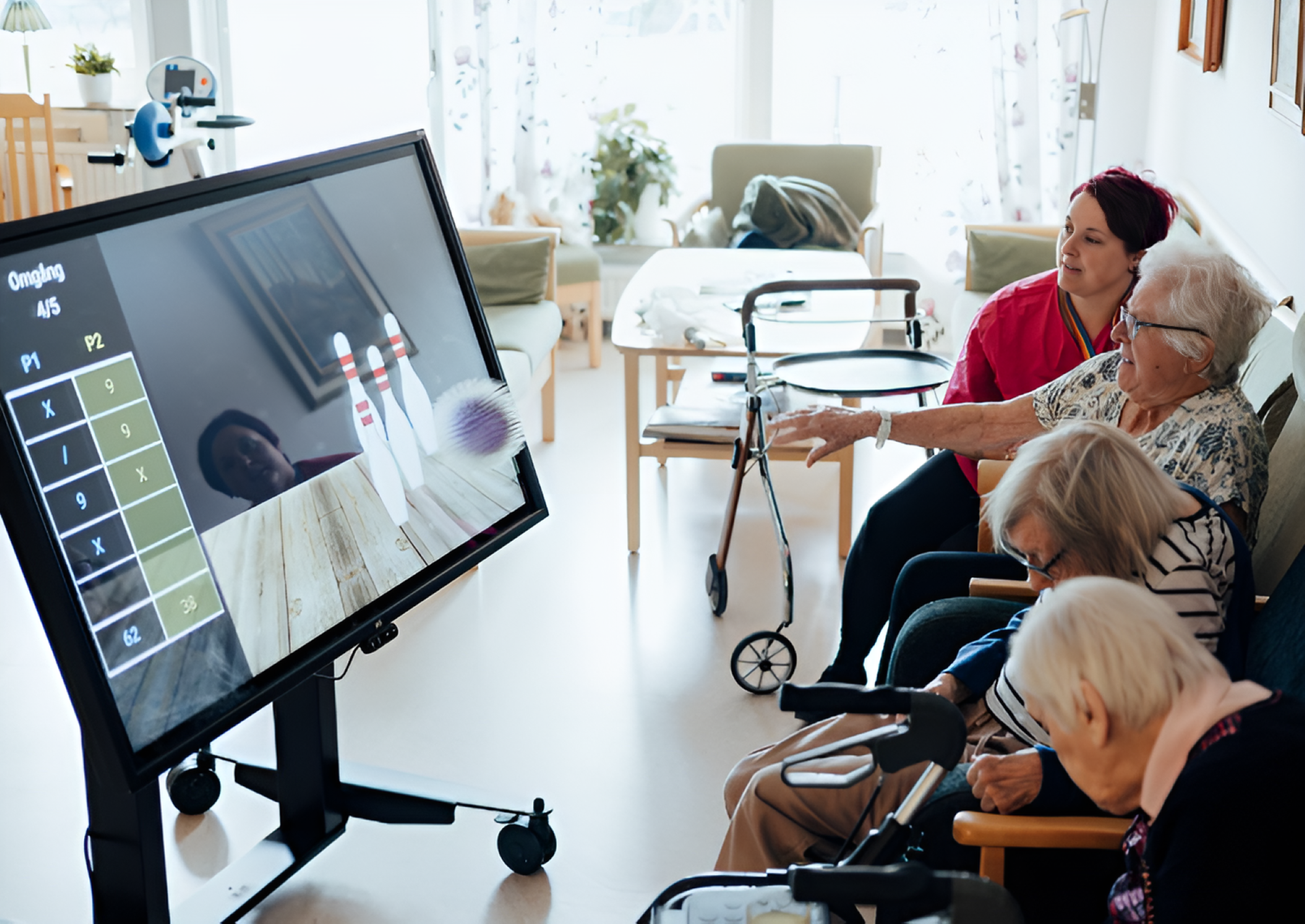
Bowling game (reproduced with the copyright holder K-IT Sweden AB’s permission).
Staff were responsible for organising and guiding the gaming sessions. They determined the frequency, duration and timing of the sessions. Staff and older people selected games together. According to the intervention protocol, staff were instructed to encourage older people to play in a standing position whenever possible and in groups of four to six participants.
Recruitment and participants
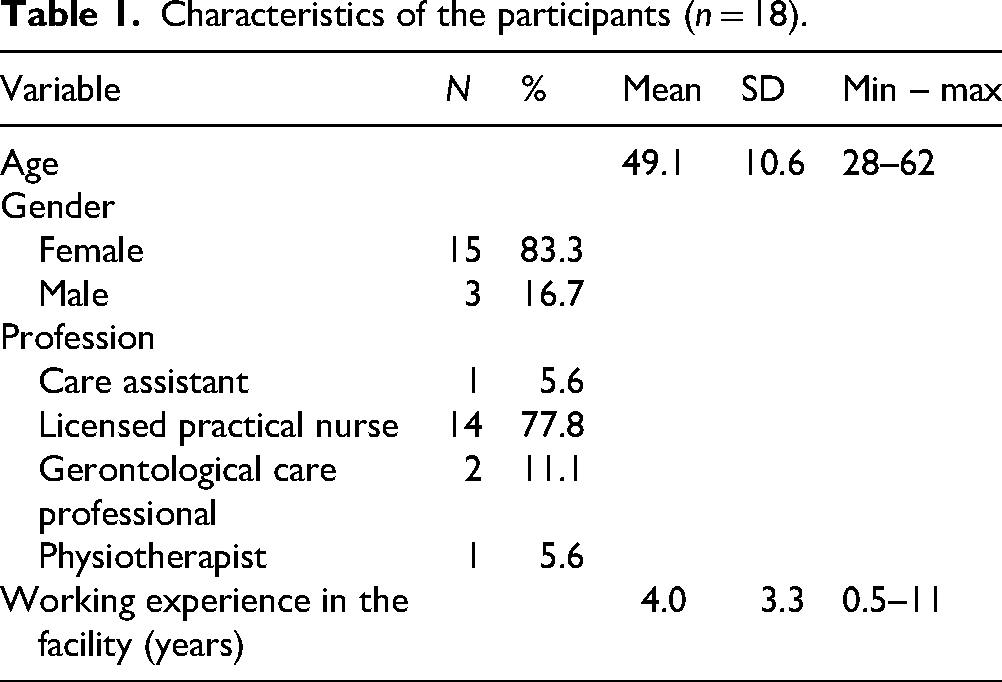
Purposive sampling was used to recruit staff members who could provide informed, relevant perspectives of the digital gaming intervention. 19 The inclusion criteria were that participants had practical experience of using the digital gaming device with older people or had sufficient insight into its perceived effects on older people's functioning and activity. Team leaders or staff members responsible for the intervention initially identified eligible staff members (n = 18), who were then invited to participate by the researcher. All eligible participants agreed to take part, resulting in a final sample of 18, including 14 licensed practical nurses, two gerontological care professionals, one care assistant and one physiotherapist. Participant characteristics are described in Table 1.
Characteristics of the participants (n = 18).
Data collection
Data were collected in December 2023 and January 2024 through semi-structured focus group interviews conducted after the 3-month intervention period. Semi-structured interviews were chosen to enable dialogue between the interviewer and the interviewees, allowing clarification and additional questions, and thus yielding answers related to the desired issues. It is also suitable for group interviews. 20 Focus groups were chosen to encourage interaction among participants and to elicit rich, reflective discussions. 21
Interviews were conducted face-to-face at the participants’ workplaces by the first researcher (SK). Group sizes ranged from three to five participants; one interview was conducted individually due to a scheduling conflict. Every staff member was interviewed once. With one exception, interviews took place in a private room with only the interviewer and participants present. One interview was held in a quiet lobby. Interviews lasted on average 25 min and were recorded with participants’ permission. No field notes were taken.
The interview guide focused on staff perceptions of the benefits of digital gaming for older people's functioning and activity, and on experiences of implementing digital gaming in daily practice. Subthemes concerning functioning were based on the domains of the International Classification of Functioning, Disability and Health (ICF), 22 whereas those relating to staff's experiences were guided by the intervention implementation instructions.
Data analysis
The data were analysed using inductive content analysis. 23 All interviews were transcribed verbatim, resulting in 27 pages of text (Times New Roman, 12 pt, single spacing). Transcripts were read repeatedly to gain a comprehensive understanding. Meaning units relevant to the research questions were identified, extracted, and simplified (n = 251). Expressions meaning the same thing were grouped into subcategories (n = 67) and named according to their content. Subcategories were combined into categories (n = 20) and further into five main categories. An example of how the categories were formed is presented in the Supplementary material (File S2) and the categories and main categories are illustrated in Figures 2 and 3, respectively, according to the research question. All categories were translated from Finnish to English.

Benefits of playing digital games for older people's functioning and activity, according to staff.

The staff's experiences of digital gaming and its suitability for nursing home practice.
The first researcher prepared the initial analytical framework and presented it to the research team (HS, SL, SE). Subsequently, the class hierarchy and class naming were discussed and modified together. After this, the first researcher continued refining the analysis in line with the group's shared vision. The group consisted of experts in content analysis and gerontological nursing and rehabilitation.
Ethical considerations
The study was conducted in accordance with the ethical principles of the WMA Declaration of Helsinki. 24 The study was approved by the regional medical research ethics committee of North Ostrobothnia Wellbeing Services County (reference number: 49/2021) and permission to conduct the research was requested from the facilities. Nursing homes were provided with research information and a data protection notice in advance, and these were reviewed with the research participants before the interviews. Participation in the study was voluntary, and the subjects provided their informed written consent. Participants’ privacy and data protection were ensured in accordance with the Data Protection Act and the General Data Protection Regulation (GDPR). 25 The collected data were stored on a locked computer in a protected folder. The interviews were transcribed and analysed anonymously.
Results
Benefits of playing digital games for older people's functioning and activity
The following two main categories described staff's experiences: short-term benefits and long-term benefits. Short-term benefits referred to immediate responses observed during or directly after gaming sessions. Long-term benefits, in contrast, reflected more sustained changes observed in older people's daily functioning and activity extending beyond the gaming moments. Figure 2 presents the main categories, categories and subcategories.
Short-term benefits for functioning and activity
Staff reported that playing revealed previously unrecognised abilities of older people, enhancing their self-esteem. Staff were often surprised by older people's skills and knowledge, realising that some were more capable than they had assumed. The skills were particularly evident in intelligence games such as quizzes, word grids and word guessing games. Playing was found to provide experiences of success for older people; at first, they said they could not play the games, but eventually they succeeded. Success in the game and the praise older people received from others seemed to encourage them to keep going and to try again. Playing revealed new characteristics in the residents, definitely. In a way, we tend to underestimate them a little. In situations like this, you can see how sharp they are. (Interviewee 5)
Older people's mood and alertness appeared to improve during gameplay. Staff described that receiving praise during gameplay brought older people pleasure and that the activity was fun for them. Playing and competing appeared to generate enthusiasm and further enhance alertness. Individuals who were often sleepy and passive appeared more alert and responsive while playing digital games.
Playing was perceived as a form of physical exercise because players stood up, sat down, and walked between the digital gaming device and their chairs. Staff described how playing encouraged older people to stand because balls thrown from a standing position were more likely to hit the target. Gameplay appeared to be associated with reduced fear of falling and increased time spent standing. Staff observed enhanced upper-body and upper-limb movement because interacting with a large touchscreen required lifting the upper limbs and moving them in multiple directions. They wondered how hard it would be to play. It was interesting that it could be a sweaty workout, but still pleasant for them. (Interviewee 8)
Staff perceived that playing was associated with increased social interaction and communication among older people, enabling them to engage with individuals in their own ward and those from other wards. Players conversed with one another about the game progress, and staff observed that they interacted more during gameplay than during their usual daily activities. Staff described how players also cheered and helped each other; for example, they offered advice on how to play and encouraged others to try again. They interacted with each other. The older women talked about how it works, how to use it and what was going on. (Interviewee 8)
Digital gaming was found to promote social participation and active engagement. Staff reported that older people participated willingly, and that even usually reluctant individuals joined the gaming sessions. They observed that gameplay encouraged active involvement in group activities, and older people who were often passive became functionally engaged, taking an active role rather than merely observing.
Staff perceived that playing also appeared to enable and strengthen the sense of belonging to a community. They noted that older people who could not actively participate in the games remained involved by watching others, thereby maintaining their engagement in communal activities. Playing together was perceived to enhance community spirit by bringing together older people, staff and even visiting family members. I think it gave a feeling of community. (Interviewee 5)
Long-term benefits for functioning and activity
Staff reported that playing digital games was associated with supporting and strengthening older people's cognitive abilities because they showed improvement in gameplay over the course of the intervention. In some cases, staff members only needed to start the game and then gave older people the opportunity to play independently, providing occasional guidance, because some learned to progress through the game on their own. Staff described that older people learned how to use the touchscreen, and some learned how to start a new game themselves. Staff perceived that playing was associated with supporting memory and cognitive functioning because the games required concentration and recall; for example, during the memory game. They also observed that older people appeared to remember gaming over time. Although many older people had impaired short-term memory and difficulty learning new tasks, staff reported that they became able to recall how to engage with the digital games. Grandmas, when you bring them here for some stimulation and they see it, they say, ‘Oh, we're going to play on this gaming device’. (Interviewee 7)
Staff described improved daily mood as one of the most significant benefits of playing and noted that this was often sustained throughout the day. Stimulating the brain through gameplay was observed to enhance daily alertness, which persisted into later daily activities, as demonstrated by increased engagement in other daily tasks.
Staff also reported that the intervention was associated with increased daily physical activity because gameplay appeared to reduce the amount of time older people spent in bed and to encourage them to walk more during the day. Some older people were described as spending long periods in bed, but playing appeared to motivate them to get up and remain in the nursing home's shared spaces afterwards. Because the digital gaming device was usually kept in a designated area, older people had to walk to it to play. Staff perceived that this was associated with increased daily walking because older people would otherwise have remained sedentary during that time. One resident, for example, was much more upright when she came to play games. She spends a lot of time in bed in her room, but she was quite happy to join the games. (Interviewee 1)
While staff did not observe improvements in balance or lower-limb strength, they did report enhancements in upper-limb mobility, strength and motor skills. Interacting with the large touchscreen required older people to fully extend their arms and reach in various directions, and throwing-based games required exertion that appeared to be associated with strengthening of the upper body. Staff also described improvements in hand-eye coordination, particularly in games where accurate throwing was required. They observed that bilateral upper-limb use developed over time: many older people initially played with only one hand but gradually began using both. Playing speed also increased; for example, in a game involving popping soap bubbles, older people burst more bubbles over time. For one individual, these changes were described by staff as appearing to extend to daily functioning, including better wheelchair manoeuvring, more effective transfers from wheelchair to bed, and improved ability to put on socks independently.
Staff perceived that the intervention was associated with increased everyday social activity. Gameplay appeared to reduce the time older people spent alone, which staff believed was associated with reduced feelings of loneliness. Individuals who often remained in their rooms were observed spending more time with others. Watching others play also appeared to encourage participation in communal activities. After playing, many older people chose to remain nearby to watch others, and some always came to observe whenever something was happening around the digital gaming device. Staff described an increase in the amount of daily social activities. Then upstairs, there's one lady who used to stay in bed day after day, but somehow her desire to be with the others has increased (Interviewee 17)
The staff's experiences of digital gaming and its suitability for nursing home practice
Three main categories described staff's experiences of digital gaming and its suitability for nursing home practice: a supporting tool for organising function-focused activities, a supporting tool for a meaningful and active life for older people, and an accepting attitude towards using new technology. The main, upper, and subcategories are shown in Figure 3.
A supporting tool for organising function-focused activities
The digital gaming device was perceived as supporting and expanding the organisation of diverse activities. Staff described using it to organise recreation sessions and felt that it added variety and versatility to these activities. We also had different kinds of nice activities on weekends. (Interviewee 3).
They further indicated that a wide range of gaming applications enabled varied use of the device. The intervention also appeared to increase staff awareness of the importance of providing regular activities for older people’s wellbeing.
The device further supported staff in facilitating group activities. According to staff, gameplay was commonly guided in groups of approximately three to ten older people. Larger group sessions were also organised, occasionally involving all older people living in the nursing home. The device was therefore perceived as a useful tool for supporting group activities. It seemed that many nurses were more likely to guide group activities when there was a selection of games available. (Interviewee 2)
Staff emphasised that it was possible to consider the individual needs of older people during gameplay. Playing in small groups enabled tailored guidance, and some older people were offered opportunities for individual play; for example, when group participation was challenging for them.
Staff implemented digital gaming into daily practice. However, the implementation of physical training was inconsistent, despite the intervention guidelines recommending that older people be encouraged to play in a standing position to promote physical functioning. In some nursing homes, staff reported that older people played both standing and sitting, whereas in others, gameplay occurred solely while sitting. But they’re in such poor condition that they can't do anything standing. (Interviewee 5)
Most staff members used the device regularly, and in one nursing home, all staff members engaged with it. The device was used at least two to three times per week, and in some cases daily, or several times per day. A typical gaming session lasted between 30 and 60 min.
The staff emphasised satisfaction with the device, describing it as easy to use and versatile. Overall, they considered it an excellent tool and felt that its implementation in the nursing homes had been successful.
A supporting tool for a meaningful and active life for older people
Staff perceived that digital gaming motivated older people to participate in activities. They were observed to show interest in the device from the beginning, and its visual appeal appeared to encourage engagement. The games were considered suitable by the staff and were described as inspiring older people to compete and play. She didn’t join the baking group one day because she preferred to play. (Interviewee 1)
The device's technical features supported active engagement. Staff particularly felt that the large screen supported its usage, allowing multiple players to play simultaneously. Adjustable difficulty levels, adjustable height and tilt, and the device's ease of movement were regarded as beneficial features that supported older people's active involvement in gameplay. If a player is in a wheelchair and can't reach the top row, the height can be adjusted so they can play. (Interviewee 14)
Attitudes towards technology
Staff reported that older people showed a positive attitude towards digital gaming, with acceptance unexpectedly high. They observed that older people, even those nearly a 100 years old, were open-minded and adaptable to new technology.
Staff themselves also had a positive attitude towards digital gaming. They shared positive experiences and expressed a desire to keep the device permanently because they felt it would be a welcome addition to their work. Staff enthusiasm for the device was evident from the start. My first reaction was, ‘Wow, I have to try that right away and get the residents involved’. (Interviewee 14)
Discussion
This study explored staff's experiences of staff-led digital gaming and its perceived benefits for older people's functioning and activity in the nursing home environment. In terms of physical functioning, staff observed improvements primarily in the function and use of the upper extremities, while no clear effects on balance or lower-limb strength were noted. These findings align with previous research suggesting that digital gaming should complement, rather than replace, traditional physical exercise. 26 Studies have shown that exergaming can have a positive effect on older people's balance and mobility, and therefore similar findings were anticipated in this study.13,27 The limited physical benefits observed in this study were partly explained by the fact that gameplay often occurred in a seated position, which does not sufficiently challenge standing balance or lower limb muscle strength. This finding highlights the importance of staff competence in supporting older people's physical functioning using technology.
Similarly, in an earlier study, older people reported improvements in their mental health after digital gaming. 28 Digital gaming appeared to provide opportunities for older people to demonstrate abilities that were previously unrecognised. Such recognition may support self-esteem and person-centred care, aligning with the core principles of FFC. 7
Cognitive benefits were another important finding reported by staff. A previous study on Xbox Kinect (Microsoft Corp.) among older people with dementia found that players learned new skills and built upon those already acquired. 29 In the present study, staff observed that older people learned to use the device and improved their gameplay over time, especially when staff adopted a facilitative rather than directive role. This approach reflects FFC's emphasis on supporting independence and allowing older people to use their remaining abilities themselves. 4
An important finding of this study was, from the staff's perspective, increased social interaction and participation, which has also been emphasised in previous research on older people's experiences of digital gaming. 30 Staff described how group-based gameplay supported communication and shared experiences, which align with key principles of FFC. 6 While previous studies have reported potential anxiety related to group gaming,30,31 such concerns did not emerge in this study, although it should be considered in future implementations.
From the implementation perspective, staff reported that digital gaming was integrated into regular use in nursing homes and incorporated into recreational activities organised for older people. This contrasts with a prior feasibility study that reported challenges related to staff commitment. 31 Similarly, earlier studies have reported that staff considered the need for their active participation and guidance to be a barrier to implementing digital gaming.28,30 In the present study, staff did not experience this as a challenge because digital gaming sessions were organised several times a week and nearly all staff members used the device in their daily work. When implementing digital gaming, it may be beneficial to identify staff members with a particular interest in digital games. These individuals can guide their colleagues and act as facilitators in the adoption of new practices. 32
Finally, attitudes towards technology appeared to influence implementation success. Previous studies have identified several barriers to adoption, including negative staff attitudes, older people's perceptions of digital games as childish, and insufficient technical competence.26,31 In contrast, both staff and older people in this study were described as open-minded towards digital gaming. This may be explained by several factors. First, training of the staff focused on providing practical gaming experience, and older people were immediately involved in gameplay, allowing staff to observe directly how well they could participate. In addition, organisational culture may have played an important role in facilitating implementation. The nursing homes included in this study had already demonstrated an interest in adopting digital gaming because they voluntarily participated in the study, which may have contributed to the generally positive attitudes observed among staff.
Strengths and limitations
The validity of this study was assessed based on dependability, credibility, transferability and authenticity. 15 The interview structure was not pre-tested, which may have led to some difficult-to-understand sections and to important questions being left unasked. However, the interview structure was reviewed by the entire research team and modified based on their feedback. The interviewees did not receive the interview questions in advance, and not all their observations necessarily came to mind during the interview. The participants did not review the interview transcript.
The person in charge of the study identified individuals with the best understanding of the implementation of digital gaming and its benefits, and all agreed to participate in the interview, which strengthens the credibility of this study. Although the study included a reasonable number of participants, the data came from staff working only in the homes involved in the larger intervention study, and some participants largely reiterated points already raised by others, resulting in relatively little unique data and preventing full saturation. Nevertheless, the data were sufficient to address the research questions.23,33
Group interviews further supported credibility: participants frequently confirmed one another's viewpoints, indicating that multiple staff members had made similar observations. 15 One participant was interviewed individually due to a work assignment that unexpectedly overlapped with the interview time. The person interviewed alone might provide more personal insights than those interviewed in a group, who tended to express more shared views. 21
Some of the interviewees (approximately six persons) had become familiar with the interviewer, as the interviewer trained the staff in intervention implementation, conducted functional capacity tests as part of the quasi-experimental research, and served as a contact person between the nursing homes and the research group. This may have led to a social desirability bias because participants might have been inclined to provide favourable responses. 34 Although this may have limited the expression of negative views, participants appeared to speak openly, as indicated by their willingness to report limited physical benefits despite being asked directly.
The digital gaming intervention was implemented by staff as part of older people's routine daily activities, which is a strength of this study. The benefits observed by staff are therefore transferable to other nursing home settings, as the findings reflect the advantages achievable through the use of digital gaming devices in everyday practice. In addition, descriptions of the context, selection and participant characteristics were reported to ensure transferability. 33
The research topic originated from the first researcher's clinical experiences working as a physiotherapist. The researcher sought to set aside her preconceptions during the analysis and ensure that the results were based solely on the interview data.15,35 The first researcher was mainly responsible for the data analysis, but, to ensure the consistency of the analysis, other research group members carefully followed the whole analysis and categorisation process. To increase the trustworthiness of the qualitative content analysis, the reader can assess the progress and dependability of the analysis through the example table (see Supplementary material, File S2) and the figures, which demonstrate the results and the original statements made by the interviewees. 15 Original statements were translated from Finnish to English, and some nuanced meanings expressed by staff may have been lost in translation.
Implications for practice
Digital gaming may be a useful tool for supporting activity, social participation and function-focused care in nursing home settings. To maximise potential benefits, staff should adapt gameplay to individual abilities and encourage standing participation when appropriate. Successful implementation may require organisational support, staff training and opportunities to develop digital competence.
Conclusions
Based on staff experiences, digital gaming was perceived as more than entertainment and as a meaningful component of function-focused care in nursing home settings. The findings suggest that digital gaming may support activity, engagement and participation among older people in nursing homes. From the staff perspective, integrating digital gaming into everyday care practices may thus contribute to more person-centred care that supports psychosocial wellbeing and functioning of older people.
Supplemental Material
sj-docx-1-njn-10.1177_20571585261460608 - Supplemental material for Staff experiences of digital gaming in nursing homes: A qualitative study
Supplemental material, sj-docx-1-njn-10.1177_20571585261460608 for Staff experiences of digital gaming in nursing homes: A qualitative study by Saara Kukkohovi, Heidi Siira, Sinikka Lotvonen and Satu Elo in Nordic Journal of Nursing Research
Footnotes
Acknowledgements
We gratefully acknowledge the participating nursing homes and their staff for their valuable contributions, and we thank the company that provided the device used in the intervention. We would also like to thank Raija Latva-Karjanmaa for language editing.

Ethical considerations
This study received ethical approval from the regional medical research ethics committee of the Wellbeing services county of North Ostrobothnia (reference number: 49/2021) on 23 June 2021.
Consent to participate
Respondents gave written consent for review and signature before starting interviews.
Consent for publication
Not applicable
Author contributions
SK, HS and SE were responsible for conceptualisation. SK, HS and SE were responsible for methodology. SK, HS, SL and SE were responsible for data curation. SK was responsible for writing the original draft. HS, SL and SE were responsible for reviewing and editing. SE and HS were responsible for supervision.
Funding
The authors received no financial support for the research, authorship and/or publication of this article.
Declaration of conflicting interests
The authors declared no potential conflicts of interest with respect to the research, authorship and/or publication of this article.
Data availability
The deidentified data that support the findings of this study are available from the corresponding author upon reasonable request.
AI generated content disclosure
Grammarly and M365 Copilot were used for language review and translation.
Supplemental material
Supplemental material for this article is available online.
References
Supplementary Material
Please find the following supplemental material available below.
For Open Access articles published under a Creative Commons License, all supplemental material carries the same license as the article it is associated with.
For non-Open Access articles published, all supplemental material carries a non-exclusive license, and permission requests for re-use of supplemental material or any part of supplemental material shall be sent directly to the copyright owner as specified in the copyright notice associated with the article.
