







Abstract
The aim of this article is to review the development of political science, as an academic discipline, in Mongolia. The article is composed of the following parts: The first part provides an overview of Mongolia’s de jure recognition as an Inner Asian “buffer state” in the early Cold War era. The second part describes the Communist ideological disciplines (such as scientific socialism) that were used to study politics and political systems in Mongolia during the Cold War era. The third part presents the process of democratization in post-1990 Mongolia, and its impact on the development of political science. The fourth part examines the focus points of contemporary Mongolian political science, presents the profiles of pioneering scholars, and describes the institutional changes, academic departments, professional associations, and doctoral degree councils in this field. Finally, the fifth part introduces the currently active Mongolian political scientists, their social environment, and their research fields. The conclusion of the article examines the prospects of political science development in Mongolia.
Background of the political science discipline in Mongolia
The Cold War and a “buffer state”
At the Yalta summit (February 1945), Franklin D Roosevelt, Winston Churchill, and Josef Stalin did not just draw the map of new Europe but also made decisions about how to end World War II in Asia. Anxious not to prolong the struggle against Japan, the USA greatly needed the Soviet Union’s participation in the Pacific War. This situation enabled the USSR to achieve many of its political and military aims in East Asia. One condition that the Kremlin set during the Soviet-American military cooperation against Japan was the preservation of the status quo in Outer Mongolia, which in turn implied the recognition of the Mongolian People’s Republic as an independent state (Clubb, 1971: 337–338).
In October 1945, the Mongolian People’s Republic’s de facto independence was approved by a referendum organized by the Mongolian authorities, after which the Republic of China (which had previously regarded Outer Mongolia as a part of Chinese territory) also de jure recognized it as an independent state. Thus Mongolia’s international status reflected the political interests of the main players of the Cold War who were able to regulate world politics. It constituted a new balance of power in Asia. In effect, the implementation of the Westphalian principle of sovereignty in Mongolia transformed the Mongolian People’s Republic into a buffer state for the USSR.
During the Cold War, it was obvious that the creation of such a buffer state was in accordance with the Soviet Union’s efforts to reinforce its influence in Asia, as it enabled the USSR to gain political advantages vis-à-vis Japan and China, the two powers that had traditionally enjoyed military, economic, and cultural dominance in East Asia. Still, Mongolia, whose international status reflected the relations between the Great Powers, managed to gain its de jure independence on the crossroads of global politics (Baabar, 2009: 723–734).
An ideology-dominated science of politics: The doctrine of scientific communism
The recognition of the social nature of science implies that society and its dynamics make a certain impact upon academic activity, the style of scientific reasoning, the form of presenting scientific results, and the objectives of scientific inquiry. Nevertheless, this recognition does not contradict the claim that the development of science is, to a large extent, an autonomous process. Totalitarian regimes prevent the autonomous development of science, as the central ideology of the state (class struggle in Marxism-Leninism, religion in Islamic fundamentalism, and racism in Nazism) is superimposed on the spontaneously emerging academic views (Bazhanov, 2005: 43).
During the Cold War, Mongolia, a Soviet-controlled buffer state, was similar to the other Communist countries in creating an ideology-dominated political system. Marxist-Leninist ideology spread all around the country and its intellectual life, and became the official methodological basis of the social sciences. Social sciences were focused on such political topics as revolution, the state, political systems, political parties, political ideology, political consciousness, public organizations, and class struggle. In other words, the theory of socialism occupied the place of political science, which was widely regarded as a capitalist science by the Marxist ideologues.
In this period, politics and political systems were analyzed solely through the lenses of Marxism-Leninism. The sole legitimate political doctrine was outlined in the theory of scientific socialism, which constituted a basic element of Marxism. The conceptions of schools of Western political science were evaluated from the perspective of class struggle. Under such conditions, it was virtually impossible to study political science by modern academic means.
Scientific communism was taught at Mongolian institutions of higher education, and studied in the party-controlled research institutes. Before the 1990s, no research or education was conducted under the name of political science. Instead, the disciplines of historical materialism (a materialist conception of history and philosophy) and scientific socialism were incorporated into the university curriculum. Marxist-Leninist philosophy was subdivided into dialectical materialism and historical materialism. This philosophy emphasized that the antagonistic relationship of the ruling classes and the exploited classes (such as the struggle between the working class and the capitalist class) constituted the prime mover of history, and the struggle between the two sides was bound to lead to a socialist revolution in the end.
The discipline known as political economy was also thoroughly dominated by Marxist-Leninist ideology. According to the theory of class struggle, it was divided into two subfields: the political economy of capitalism and the political economy of socialism. Producers who created material wealth were classified into two main classes: capitalists and proletarians. The major objective of this discipline was to show how the capitalist property-owners exploited their employees, forcing them to produce surplus value. Private ownership of the means of production was considered as the primary source of exploitation. Mongolian historiography also reflected the influence of these political doctrines.
Still, the studies conducted within the framework of Marxist philosophy, the theory of socialism, Mongolian history, and the history of the ruling Mongolian People’s Revolutionary Party (MPRP) did constitute a certain form of political science. For instance, Mongolian scholars and researchers wrote many books about such issues as class struggle, revolution, the state, the political system, the ruling party, elections, political history, political ideology, and political consciousness. These works, heavily influenced as they were by ideology, lacked a proper methodology, and were aimed at legitimizing the one-party system and its institutions, but they also included some factual information about the described phenomena and events. Several of the scholars who had specialized in those research fields and produced these publications would later play an active role in establishing the basis of modern political science in Mongolia.
Concerning the formative conditions of political science, it is interesting that there was a phenomenon in Mongolia that was similar to that in some of the former Communist countries. This may relate to the fact that this type of socialist state, which Mongolian society had had in its medieval period at the start of the 20th century, reached historical achievement by conjuring up a modern image during the period of socialism, and could supply people’s life even if their standard of living was low. The achievement of socialism in the frame of the economy and society can be considered to have been a compensation for the domination of political non-democratic regimes, a lack of civil rights, and a limited level of liberty.
Democratization and the birth of political science in Mongolia
The democratization of post-communist countries, which happened mainly in Central and Eastern Europe, constituted a part of the so-called third wave of democracy, as described by Samuel Huntington (1991). Fortunately, Mongolia, a landlocked Inner Asian country, was not bypassed by the third wave of democratization. In 1990, Mongolian politics and society started to develop in a new form when the political leadership carried out a democratic transition, and actively promoted free market policies. Since then, the issues of political, social, and economic development (above all, free marketization and political democracy) have assumed considerable significance in contemporary Mongolian politics.
In 1990, the success of democratization created the necessary preconditions for the formation of political science in the country. The concept of using scientific knowledge to administer and renovate society was given a new, democratic content. The emergence of a multi-party system, the first democratic parliamentary elections, the creation of a democratic presidency, and the introduction of human rights legislation could not be explained on the basis of Marxist philosophy and the theory of scientific socialism. Obviously, a new type of political science had to be created.
By the end of 1991, the disintegration of the Soviet Union rendered it impossible to maintain a world socialist system, even though one-party rule survived in certain individual states (like China, North Korea, and Vietnam). As a result, the theory of socialism lost its former significance and influence. Nevertheless, socialist views did not wholly disappear.
The year 1992 is an important landmark in the history of Mongolia’s democratic development, as this is when the Parliament adopted the new Constitution of the country. A new political system was established based on the principle of the separation of powers, and the inviolability of fundamental human rights and freedoms was acknowledged.
Measuring the development of political science
Compared to other social sciences, political science is particularly closely connected to politics, political regimes, government systems, and political ideologies. Therefore, the successful development of political science requires academic freedom, which in turn is interrelated with political democracy.
The formation process and institutionalization of political science may require the following:
Political thoughts and knowledge should be specialized; Individual studies and investigations should be well organized, and integrated disciplines should be created; Following these individual initiatives, independent research centers and academic institutes should be established; Departments of political science should be created at universities and other institutes of higher education, for the training of political science specialists both at the undergraduate and graduate level; Independent academic councils (like doctoral degree commissions) should be established for political science; Journals and academic series specializing in political science should be published on a regular basis; National political science associations or academic communities should be created.
These markers can be used to gauge the progress that Mongolia has made in the field of political science since the end of the Cold War.
In general, academic disciplines may develop in a top-down fashion (that is, under the aegis of government institutions) or as a bottom-up process driven by the initiatives of the scholars active in that field. In pre-1990 Mongolia, the establishment of social science disciplines like Marxist philosophy were initiated, supported, and controlled by the government and the ruling MPRP, in a typical top-down fashion. In contrast, the post-1990 development of Mongolian political science was more a bottom-up process, initiated by individual scholars but also supported by government institutions during the period of democratic transition in the early 1990s.
Formation of the discipline
Primary stage of the formation of contemporary political science in Mongolia
Before April 1991, there had been no articles or publications specifically about political science and the study of politics, though thematically related articles occasionally appeared in the press in 1990–1991. As examples, one may mention the Manai Inder (Our Podium) journal, the Unen (Truth) newspaper, and the newspapers launched by the new political parties. In April 1991, however, A Tsanjid published an article titled “On Political Study” in Manai Inder (Tsanjid, 1991). This article was the first scholarly publication focused exclusively on political science. The author examined such issues as the formation of political science, its structure, methodology, and research trends. He emphasized the necessity of developing this science in Mongolia, and discussed the difficulties of creating such a new discipline. The article adhered to the rules of scientific methodology, both in its structure and in its content. It played a crucial role in launching political science in Mongolia, and in highlighting its significance.
Somewhat later, J Boldbaatar, A Tsanjid, B Otgonnasan, and D Gankhuyag published a total of eight article series about political science in the category of “Party Studies,” starting from the 5th issue of Manai Inder. Mongolian scholars also published several interesting articles related to various aspects of political science in the Bodrol Byasalgal (Thoughts and Meditations) journal. Those articles addressed the questions of social and political systems, democracy, the legal state, political ideology, and political consciousness. In 1991, this journal also published translated articles and excerpts from Western authors, including Alexis de Tocqueville.
A Jambal, a Mongolian political science scholar, pointed out that these articles were already directly connected to the field of political science: As for the theory, doctrine, and paradigm of Mongolian socio-political thought, the entire year of 1990 and the early part of 1991 was the period that constituted a significant starting point for the shift from the theory of Marxist historical materialism, scientific socialism, and the theory of Marxist state into political science. That is, political science was formed by that logic in our country. (Jambal, 2006a: 12)
Profiles of the pioneering political scientists in Mongolia
Having mentioned the individual scholars’ initiatives, I would like to draw attention to a few Mongolian scholars who made a great contribution to the establishment of political science as a newly emerging academic discipline.
Professor D Sodnomgombo, commonly known as Professor SO (1926–2013), was one of the scholars who laid the foundations of the Department of Political Science at the National University of Mongolia (NUM). He played a crucial role in developing political science in Mongolia. Having been the head of the Department of the Theory of Scientific Socialism before 1990, he became the first head of the Department of Political Science after its establishment. Thanks to his initiatives and supervision, the Department of Political Science successfully implemented its first large-scale project, titled “20th Century Mongolia’s Political Culture.” In the early phase of the Department’s development, D Sodnomgombo produced significant publications on the questions of democracy and political science (Sodnomgombo, 1995). In the community of Mongolian social science scholars, he is regarded as the founder of contemporary Mongolian political science.
Professor SH Sodnom (1953–2009) was specialized in political parties and the democratic transition. At NUM, he served as dean of the School of Social Sciences for nearly two decades, from 1991 to 2009.
Similarly, Professor TS Ganbold worked as head of the Department of Political Science for almost two decades, between 1992 and 2010. Therefore, the achievements and experiences of the Department are inseparably linked to him. His research was focused on democratic elections, public opinion, political traditions, and patriotism. Professor TS Ganbold produced a book, From Theory of Scientific Communism to Political Studies (Ganbold, 2012), which was a significant work on the historic development of the political science field and institutionalization in Mongolia.
Professor A Yundendorj was a faculty member of the Department and a senior researcher of the Mongolian State Great Hural (parliament), who defended his doctoral degree in Political Science at the Moscow State University in 1996. One of his monographs covers the social and political theories and doctrines of both eastern and western scholars (Yundendorj, 2003).
In addition to the aforementioned scholars, there are some other important representatives of political science in Mongolia. For instance, special attention is to be paid to A Tsanjid. Having received a doctorate in political science, Tsanjid was one of the authors who wrote The Basis of Political Science (Tsanjid and Gombosuren, 1992). Written partly based on the author’s personal research experiences, this work became the first comprehensive textbook on political science in Mongolia. A Jambal is another well-known political scientist in Mongolia. Many of his famous works on political thought (Jambal, 2006b) constitute a principal source of knowledge for young scholars who seek to conduct research or to gain insight into this academic field.
Finally, I would like to mention that S Zorig (1962–1998), the most popular leader of Mongolia’s 1990 democratic revolution and later a prominent politician, had been a lecturer at NUM’s Department of Theory of Scientific Communism before he started his political career.
Institutional development
Academic departments
Accommodating to the requirements of democratic changes, in 1991 the president of NUM issued a resolution to disband the Department of the Theory of Scientific Socialism, and to establish the Department of Political Science, with the aim of preparing deep knowledge of political theory and practice. In addition, the discipline named “The Basis of Political Science” was introduced in every studying field at NUM as a general discipline, replacing such disciplines as Marxism-Leninism, the history of the Communist Party of the Soviet Union, and the history of the MPRP (Janar, 2006: 107).
In the academic year of 1993–1994, the Department of Political Science began to recruit students, offering a bachelor’s degree. In 1997, a total of 13 students graduated, for the first time, as “political science researcher and teacher of social science.” Since then, the Department of Political Science has continued to provide undergraduate and graduate training. It has been generally regarded as the country’s main center for research and education in political science, on the level of bachelor’s, master’s, and doctoral degrees. Currently, in 2015, there are 10 tenure-track faculty members at the Department, of whom three are professors, five are associate professors, and two are lecturers.
Thanks to the financial support of international and national organizations, in 2002 the Department started to publish a political science journal. Since then, the journal Political Studies has been published twice a year. The journal was initially published only in Mongolian, but in 2012 it evolved into a multi-language journal, carrying articles mainly in Mongolian, Russian, and English.
The Department and its individual members have made a great contribution to the development of political science in Mongolia by publishing textbooks, monographs, handouts, and other scholarly works. For instance, in 2001 Department members jointly wrote and published a book on Political Science (Ganbold et al., 2001), which now serves as a basic training material in the entire country.
Since the Department of Political Science was established, many of its graduates have found jobs in political and public institutions, public administration organizations, and at universities and colleges. From 1999 on, the Mongolian University of Education has also been training specialists in the fields of political philosophy and political science. Its curriculum was generally developed in coordination with the curriculum of NUM’s Department of Political Science. A section of political science operates in the Institute of Philosophy, Sociology, and Law, which belongs to the Mongolian Academy of Sciences. At the Mongolian University of Science and Technology, the Department of Political Studies and Public Relations has provided training on political and public relations since 2011.
Professional organizations and associations
In the sphere of professional organizations and associations, Mongolian political science is still in a relatively early stage of development. For instance, the Mongolian Political Science Association was founded as a voluntary scientific organization in June 2003 by the first graduates of NUM’s Department of Political Science, six years after their graduation. At the time when the association came into existence, its founders were employees of universities or of political and government organizations.
The founders intended to create a voluntary society and cooperative organization, and this objective has remained unchanged ever since. At the time of its creation, the Mongolian Political Science Association had four main aims: First, to promote research activities in the field of political science, both in Mongolia and abroad; Second, to support academic cooperation among its activists, including scholars and practitioners; Third, to serve the public as a professional and united organization of political science; Fourth, to develop and popularize political science in Mongolia.
To achieve the aforesaid aims, the founders of the association planned various activities, such as annual academic conferences, other meetings, nationwide and international research projects, and regularly published periodicals. Nevertheless, the promising start was followed by certain difficulties. At that time, political science as a discipline was not yet widely known, and the young age and inferior academic position of the association’s founders posed a serious obstacle, not the least because the young scholars could not raise sufficient funds for such complex academic tasks. Actually, most of the founding members, particularly those who worked as scholars, sought to continue their studies and research activities abroad.
Half a year after this first initiative to create a professional association in the field of political science, other groups took similar steps. The first association officially registered by the Ministry of Justice (according to the Law on NGOs, any kind of academic association is required to define itself as an NGO, and obtain registration from the Ministry of Justice) was the Mongolian Political Studies Association.
On September 18, 2003, an official meeting of graduates from NUM’s Department of Political Science was held on the initiative of the 6th Graduates (those who graduated in 2002 as the sixth graduated bachelor’s holders since 1997) of the Department. Although the meeting was organized by the 6th Graduates, they invited the 1st Graduates (those who graduated in 1997 as the first graduated bachelor’s degree holders) of the Department to persuade them to reorganize the Mongolian Political Science Association. The two groups reached agreement in creating a jointly led association, and thus the meeting was successful.
Due to the conditions set by the registration office of the Ministry of Justice, the new organization was registered as the Mongolian Political Studies Association (in Mongolian, Mongolyn Uls Tör Sudlalyn Kholboo), rather than the Mongolian Political Science Association (Mongolyn Uls Töriin Shinjlekh Ukhaany Kholboo). At the time when the Mongolian Political Studies Association was established, both the 6th Graduates and the 1st Graduates usually worked as university lecturers and independent researchers, or found positions as political party leaders and activists or as state officials.
Seven years later, some of the pioneering Mongolian political scientists made yet another initiative. These scholars had two advantages: First, they enjoyed popularity both in the academic communities and in the public and political institutions. Second, the Mongolian culture of teacher-student ties reinforced their position and social prestige. Their former students, including the 1st Graduates and the 6th Graduates who had founded the first two associations, promptly attended the organization meeting held by the pioneering scholars and senior political scientists.
The meeting, held in April 2010, announced the creation of a new professional organization named the Mongolian Political Science Association. In September 2010, it was duly registered by the Ministry of Justice. Soon after, the Mongolian Political Science Association and the Mongolian Political Studies Association were merged into a single organization, under a new name: Unified Association for Mongolian Political Scientists (UAMPS; Mongolyn Uls Tör Sudlaachdyn Negdsen Kholboo). Since then, UAMPS has represented Mongolia’s political science communities. Despite the recurrent disputes between the various groups, the establishment of this association constituted a very significant step in the development of Mongolian political science. Until the 2010s, there had been many good initiatives, but these initiatives were usually made in an uncoordinated and inexperienced way, and thus they did not yield the desired results.
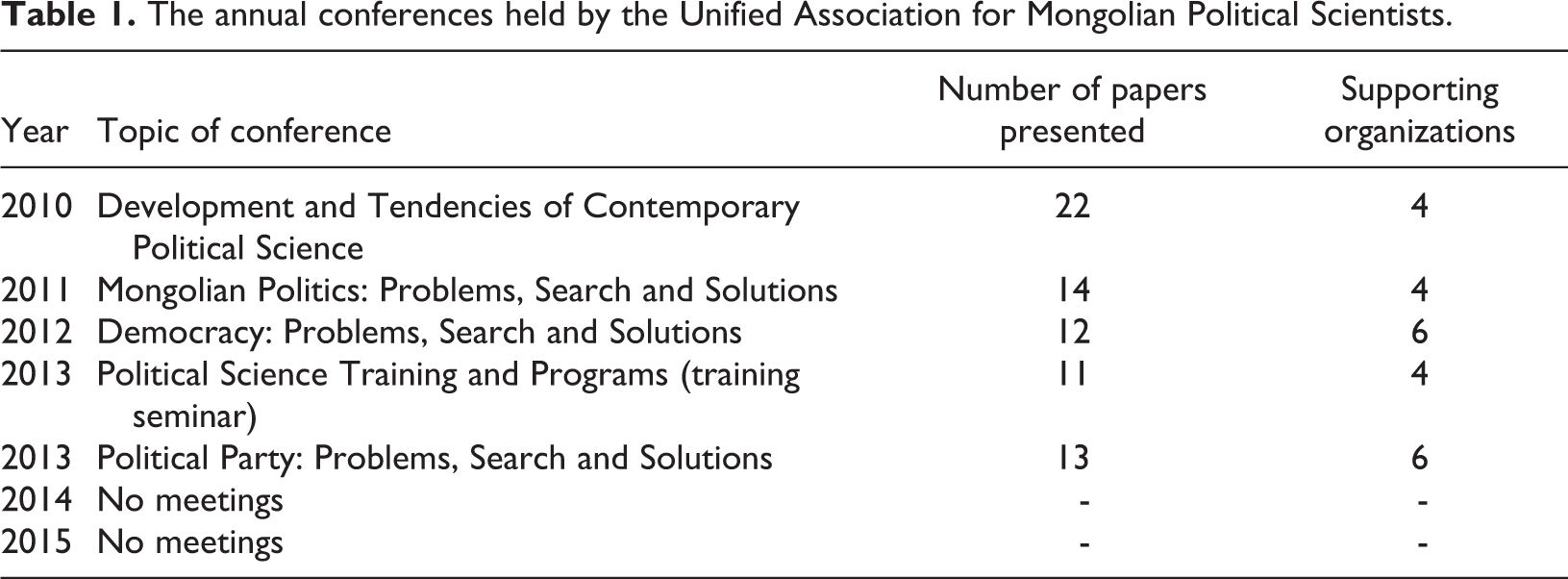
Since 2010, the UAMPS held annual academic conferences (see Table 1). These meetings covered the most important issues of political science research in contemporary Mongolia. Nevertheless, the number of presented papers has undergone a gradual decline, partly because of the growing competition among experienced and young scholars.
The annual conferences held by the Unified Association for Mongolian Political Scientists.
Doctoral degree councils
In order to institutionalize political science, independent doctoral degree defense councils should be established. This formation process has been facing many challenges. In the academic year of 1997–1998, the Dissertation Council for Philosophy, Sociology, and Political Studies was established at the Institute for Philosophy, Sociology, and Law of the Mongolian Academy of Sciences. In this council, which included the political studies field of study, four PhD students defended their degrees. However, the council was composed of scholars of philosophy, sociology, and law (Ganbold, 2012: 67).
In 2002, the National Council for Political Science Doctoral Degree Defense was established by decree of the Minister of Education, Culture, and Sciences of Mongolia. As the first political science concentrated council, this establishment was a significant step towards the institutionalization of political science in Mongolia. In this national council, three PhD students defended their degrees.
Between 2003 and 2014, the composition of the Council for Political Science Doctoral Degree Defense changed several times. The number of its members has usually been between about nine and 14. However, the Council was never composed 100% of political scientists. In this regard, discussions and defense of political science dissertation have always depended on other fields, such as philosophy and sociology.
In 2014, the Council for Political Science was replaced by a new Council for Sociology, Social Work, and Political Studies as established by decree of the Minister of Education and Sciences in Mongolia. In this sense, the status of political science as a field of knowledge has become as an annex to the fields of Sociology and Social Work. However, in 2014 and 2015, only one PhD thesis was defended in Sociology whilst five were defended in Political Science; yet the Council is chaired by a Sociologist and there are no political scientists in the committees.
The social background of contemporary Mongolian political scientists
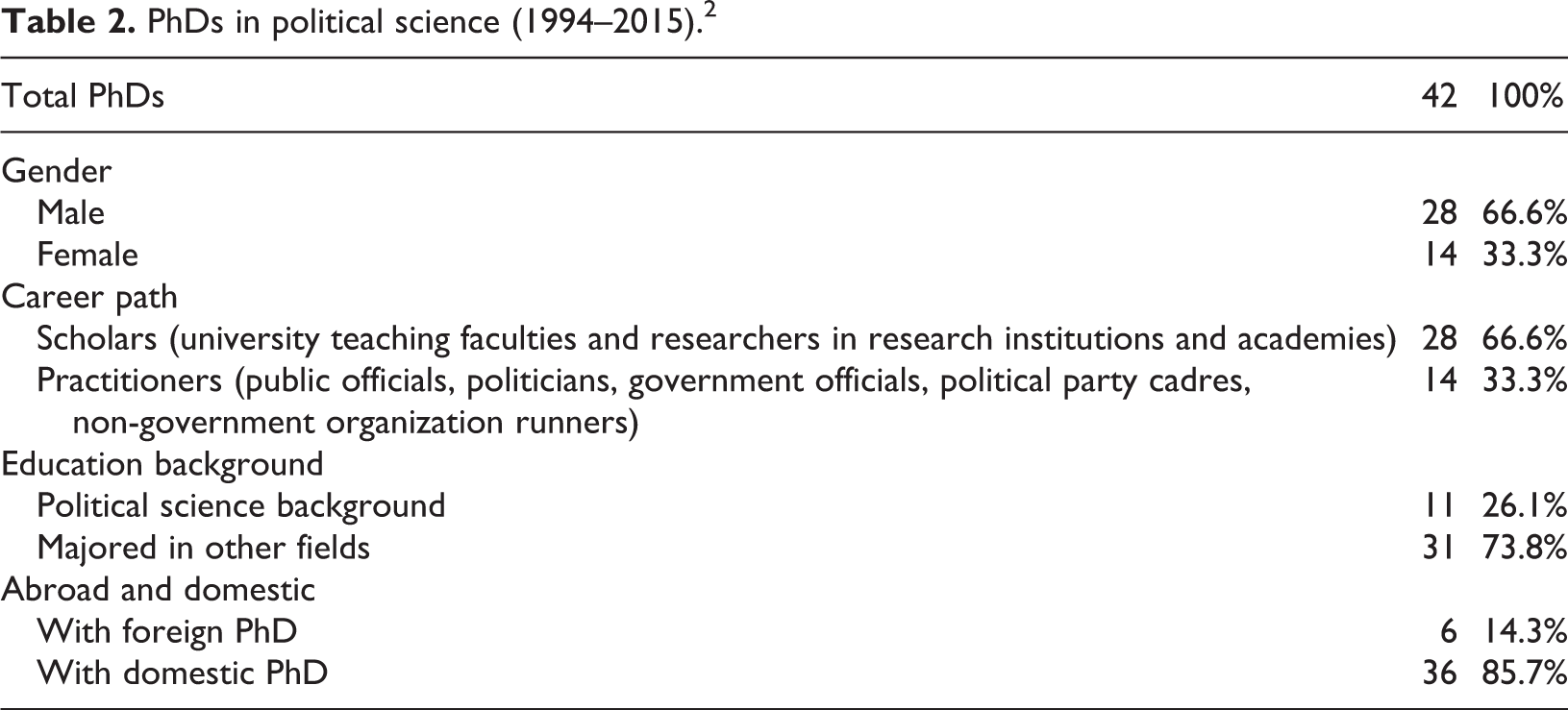
As shown in Table 2, at present (between 1994 and 2015), there have been 42 Mongolian PhD students 1 who defended their doctoral dissertations in Political Science, either in Mongolia or abroad. They found positions either as scholars (28) or as practitioners (14). They received their earlier degrees (BA and MA) either in political science (11) or in other disciplines like history, philosophy, history, sociology, geography, engineering, diplomacy, economics, pedagogy, language teaching, public management, and public administration (31).
PhDs in political science (1994–2015). 2
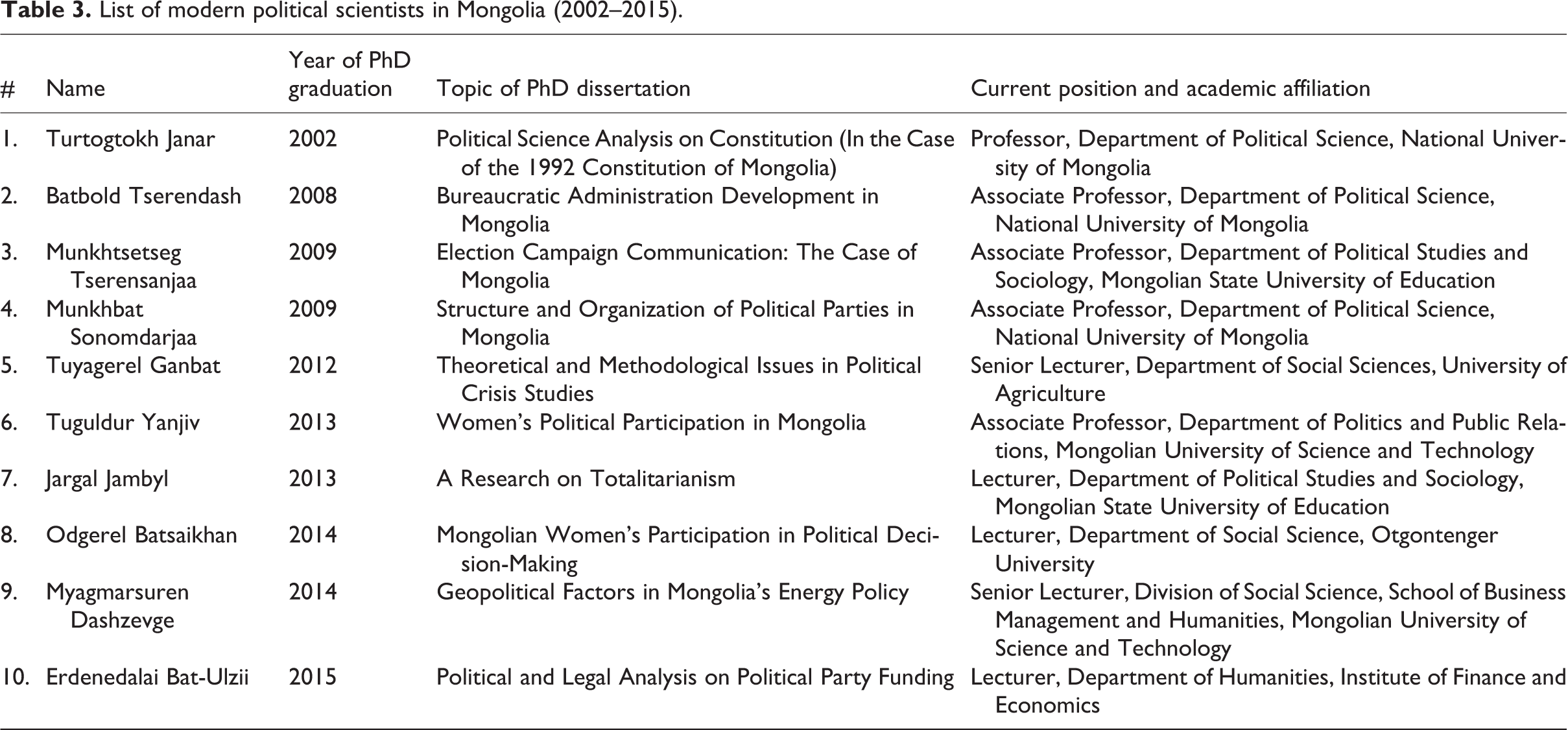
However, there have been only 10 scholars who received each of their degrees in political science between 2002 and 2015, and who worked as political science scholars at universities and research organizations. They were graduates of NUM’s Department of Political Science, rather than pioneers or founding fathers of Mongolian political science. In other words, they have been products of the efforts that the pioneers had made for the development of political science in Mongolia. Table 3 shows those 10 scholars’ current positions, academic affiliations, and the topics of their PhD dissertations.
List of modern political scientists in Mongolia (2002–2015).
These PhDs have been working at the leading universities of Mongolia as professors and associate professors. The following are brief overviews of their academic profiles:
Turtogtokh Janar was one of the first graduates from the Department of Political Science, and the first doctoral degree recipient since the creation of the department. He defended his PhD degree with a dissertation titled “Political Science Analysis on Constitution (In the Case of the 1992 Constitution of Mongolia)” in 2002. He produced works on legislatures and constitutionalism (Janar, 2009, 2010, 2012a), and published a number of articles in national and international academic journals (Janar, 2008, 2012b; Janar and Dashzevge, 2015).
T Batbold has specialized in the important questions of public administration and bureaucracy in Mongolia. He produced a monograph (Batbold, 2013) based on his dissertation topic, as well as important articles on bureaucratic administration in Mongolia. TS Munkhtsetseg’s research fields were various aspects of political communication and entertainment in Mongolia. Following her PhD graduation, she published a monograph about political entertainment (Munkhtsetseg, 2010). Since his graduation and the start of his academic career as political science lecturer at the Department of Political Science, Munkhbat Sonomdarjaa has been doing research on the political party system and organization issues in Mongolia.
Tuyagerel Ganbat has been specializing in political crises and political theories. She has been working for the Mongolian State University of Agriculture. Tuguldur Yanjiv has produced numerous books and articles on women’s political participation and political feminism. Jargal Jambyl is one of the latest rising scholars who has been interested in issues of political ideology, with particular attention to totalitarianism.
Odgerel Batsaikhan has been working for Otgontenger University, one of the first private universities in Mongolia, and specializing in gender politics and women’s political participation. Myagmarsuren Dashzevge works as a political science lecturer for the Mongolian University of Science and Technology. He has produced numerous articles on energy politics and the role of natural resources in Mongolian and Northeast Asian politics (Dashzevge, 2013; Janar and Dashzevge, 2015). Erdenedalai Bat-Ulzii has been working for the Institute of Finance and Economics, and specializing in political party funding issues.
Conclusion: Further strives for political science development
Since the beginning, the formation and development of political science have faced many obstacles in Mongolia. Although as many as 25 years have already passed since Mongolia’s democratic transition, Mongolian politicians and political scientists still search for the optimal way of development. The number of Mongolian publications on political science has increased, and the training of political scientists has expanded in recent years. Nonetheless, works on the history of political thought and on contemporary political theory are still fairly rare. Most research on political theory has been concentrated on translating and reviewing relevant foreign publications.
The political science communities have focused their attention on the different processes in political life, governmental changes, parliamentarian and presidential elections, the functions of political parties and movements, and so on. Academic institutions, agencies, and NGOs have surveyed public opinion, the rating of political parties, and the political participation of citizens. The latter surveys were also of considerable significance, both methodologically and scientifically. Nevertheless, it must be taken into consideration that these institutions operate partly under the influence of the political parties.
There are many issues that political science research will have to examine in the future. The development of Mongolian political science is still in a relatively early phase. There are still relatively few detailed research works on political thought, certain political systems, and political culture. At present, researchers and scholars concentrate their attention to the political, social, and economical systems, political thought, the population’s participation in the political processes, political culture, the formation and development of political parties, and the special political events of those countries with which Mongolia maintains close relations (the US, Russia, the EU, Japan, China, and South Korea).
Political science in Mongolia has been in a process of development. An important step toward the institutionalization of political science development in Mongolia was the establishment of NUM’s Center for Contemporary Political Research in May 2006 – a step taken on the initiative of the young faculty members of NUM’s School of Social Sciences. Moreover, Mongolian political scientists launched Contemporary Political Society, an international peer-reviewed journal focused on contemporary political science. This journal reflects the cooperation between Mongolian and foreign political scientists, political historians, and political sociologists.
In sum, Mongolian political science is in the stage of institutionalization. It is crucial to provide the new generations of scholars with advanced training in developed countries, and to expand international cooperation. Over two-thirds of Mongolian political scientists are professors at universities or researchers in academic institutions. However, it is still necessary to make further efforts to induce Mongolian political scientists to conduct comparative field work, undertake research surveys abroad, and participate in international academic meetings held abroad. This will be a new step in the development of Mongolian political science.
Footnotes
Acknowledgements
An earlier draft of this article was presented at a conference of the Asian Consortium for Political Research, held at the University of Tokyo in 2014. I thank Professor Takashi Inoguchi, an organizer, and participants of the conference for their feedback. My special thanks go to Professor Balazs Szalontai for his help in improving the article.
Declaration of conflicting interests
The author(s) declared no potential conflicts of interest with respect to the research, authorship, and/or publication of this article.
Funding
The author(s) received no financial support for the research, authorship, and/or publication of this article.