







Abstract
Opinion polls suggested that Australia’s Coalition (Liberal and National Party) government was likely to be replaced by a Labor government at the 2019 election. However, in fact the government was returned. Key issues in the 2019 election centred around managing the economy, including levels of taxation and issues of inequality; around spending on government services such as health and education; and around issues of climate change. There were elements of populism in both major parties’ campaigns, and two minor populist parties played a significant role in preference distribution. There were also some simmering issues that reflect the broader geopolitical and geo-economic changes that are impacting upon Australia. These include not only challenges for Australia’s economy and identity in the ‘Asian Century’, but also issues of Australia’s relationship with China.
Given the predominantly western nature of Australia’s society and political system, it is common to analyse Australian elections within a British, European or North American context. Such an analysis might note the prevalence of common ‘western’ political issues such as rising inequality, the legacies of neoliberalism, the role of conservative religious belief, the rise of populism and the resulting challenges facing centre-left parties in particular. However, Australia is also situated in the Asia-Pacific, albeit with a somewhat ambiguous relationship to its region and not always fully accepted by its neighbours (see e.g. Blackburn, 2002; Pearlman, 2019). Australia’s economy is increasingly integrated into that rapidly growing region. Like its neighbours, Australia is facing both opportunities and challenges related to the rise of China, exacerbated in Australia’s case by the dilemmas posed by Australia’s significant reliance on the Chinese economy (Thorpe, 2019) combined with its close strategic alliance with the United States. Furthermore, political issues such as populism, that are often treated in western literature as predominantly western ones, are also issues in the broader Asian region (Chacko and Jayasuriya, 2018). It is not just longstanding western centre-left parties that are facing challenges (Manwaring and Kennedy, 2018). Venerable parties such as the Indian National Congress are also facing new difficulties in winning elections. Religion has played a significant role in elections ranging from Indonesia to India.
A comparative analysis of the Australian election with others is beyond the scope of this present article and clearly factors such as populism or religion take significantly different forms in diverse countries. However, this article will argue that both common ‘western’ political issues, such as the difficulties of centre-left parties in challenging the legacies of neoliberalism, along with issues related to Australia’s integration in the Asian region, played a role in the 2019 election campaign – and so did a range of domestic political factors. Australia is therefore an interesting example to include in a journal special issue on the 2019 Asian elections. The analysis below will begin with a brief account of the political background and nature of the Australian electoral system, before proceeding to an analysis of the key political parties’ election campaigns. It will be argued that the Liberal party campaign played a major role in its election victory by neutralising Labor’s arguments for gaining office while mounting a successful anti-Labor scare campaign.
Brief background to Australia’s political and electoral system
The major parties of government in Australia since the 1940s have been the Liberal Party of Australia (a centre-right party) and the Australian Labor Party (a centre-left social democratic party). The Australian Prime Minister is the leader of the party that commands a majority in the lower house, the House of Representatives. Until recently, both major parties had relatively simple rules for removing a leader which contributed to repeated leadership/Prime Ministerial changes in the last decade. Scott Morrison, the incumbent Liberal Prime Minister (PM) at the time of the 2019 election, had replaced Liberal PM Malcolm Turnbull who in turn had replaced Liberal PM Tony Abbott. The Liberal Party (in long-term Coalition with a minor party the National Party) had held office in Australia since defeating the Rudd Labor government in 2013. Voting in Australia is compulsory. The lower, House of Representatives, level uses a preferential rather than first-past-the-post system (AEC, 2019a), and the allocation of preference votes from independent candidates or minor parties to major parties regularly decides the election outcome. Voting for the upper house of review, the Senate, combines forms of preferential voting and proportional representation (AEC, 2019a) because multiple Senators are elected to represent each State or Territory in Australia’s federal system.
Labor’s campaign: Economic inequality and industrial relations
Labor’s case for election highlighted the disunity in Coalition ranks that had contributed to it having three Prime Ministers since 2013. However, Labor also put forward an ambitious and extensive election policy agenda for gaining government which focused on countering rising economic inequality, including wage stagnation (ACOSS and UNSW, 2018; Shorten, 2017). These are issues common to many western economies (IMF, 2017: 121; OECD, 2015: 20), as well as Japan (OECD, 2018). Some other parts of Asia have experienced relative increases in incomes (Mahbubani, 2019: 26–29), despite ongoing problems of poverty which centre–left parties such as the Indian Congress Party have consistently attempted to address (Bardhan, 2013). Indeed, the rise in inequality and relative stagnation in western incomes may be partly related to the geo-economic changes resulting from globalisation, as jobs have moved from western countries to other parts of the world, including Asia (Mahbubani, 2019: 4–5, 23). While many sectors of the Australian economy, especially mining, have benefitted greatly from Australia’s engagement with Asia, other sectors, such as manufacturing, have not fared so well given increasing Asian competition (see further Johnson, 2019: 173–195, 203–204). Furthermore, while globalisation originally facilitated the loss of less-skilled Australian jobs in areas such as manufacturing and call centres, more-skilled jobs in areas ranging from graphic design to law and accounting are now also being offshored to countries such as India and the Philippines where there are highly skilled English speakers (Johnson, 2019: 173–189).
In addition, Australia has not been immune to the major influence of neoliberalism in the Anglophone world (and elsewhere). The introduction of previous neoliberal industrial relations policies by both Coalition and right-wing Labor governments undermined the previous Australian wage fixation system which had kept Australian wages relatively high. Such policies have placed constraints on unions and reduced the bargaining power of employees (Johnson, 2019: 19–122, 126–128; Stanford, 2018: 26). Labor has now shifted from some previous neoliberal positions and acknowledged that inequality is rising. Bill Shorten, Labor’s leader at the time of the election, argued that Australia had seen a major redistribution from wages to profits (quoted in Hartcher, 2019). Consequently, Labor promised to reform Australia’s industrial relations system to increase the bargaining power of employees and unions and improve wages and conditions (ALP, 2019h), claiming that this would also benefit the economy by increasing consumption levels.
Shorten also argued that the taxation system under the Liberals was benefitting big business and the well-off (Shorten, 2019b). Consequently, Labor promised to generate increased taxation revenue that would both reduce the Australian government’s deficit and fund new government initiatives. In particular, Labor would remove tax concessions in areas ranging from share dividend imputation (ALP, 2019l) to negative gearing of investment properties, generating billions of dollars in revenue (ALP, 2019m). Labor also pledged to increase capital gains tax on investment properties (ALP, 2019m). Greater tax revenue would then fund increases in health services (ALP, 2019d, 2019j), dental services (ALP, 2019k) and childcare subsidies (ALP, 2019g), amongst others. Labor pledged to stand up for working- and middle-class Australians against the so-called ‘top end of town’ (Shorten, 2019a). Consequently, there were elements of populism in Labor’s agenda in which the people (we) were being mobilised against a predatory elite (them).
Many of Labor’s proposed tax changes were related to the economics of Australia’s position in the Asia-Pacific region. The advent of the 21st century had seen a major mining boom, largely driven by Australia providing raw materials to the rising economic powers of Asia, especially China, that initially substantially increased government revenue. Liberal Prime Minister John Howard (1996–2007) used the increased revenue to subsidise a range of tax concessions that Labor now wanted to revise. For example, originally if companies had already paid tax on franking dividends on shares, taxpayers who owned those shares were given a tax concession to avoid paying taxes twice. However, as Shorten put it: ‘Howard said that: “Actually we’ve got so much money coming in from mining, what we’ll do is…even if you don’t pay any income tax, we’re going to give you an income tax refund in the same year”’ (Morrison and Shorten, 2019b).
Consequently, Labor argued that they would manage the Australian government’s finances better in more challenging times, while improving government benefits and services for ordinary Australians. Shorten argued that Labor’s policies for doing so were diametrically opposed to those of the Government, whose policies had resulted in stagnant wages, increased national debt, a proposed AUD$80 billion in tax cuts to big business, a million people having to hold down two jobs, a million underemployed and four million in labour hire or casual jobs. Profits had increased 39 per cent as opposed to a wage increase of 5–6 per cent since the previous election. Shorten argued that while ‘this economy, may be strong for some, it’s just not strong for the pensioners, it’s just not strong for a lot of the millions of wage earners’ (Morrison and Shorten, 2019b).
In general, Labor’s case for election was that its economic and industrial relations policies would improve services and standards of living for a broad range of voters, in line with ‘the Labor motto, a fair go for all’ (Shorten, in Morrison and Shorten, 2019a). However, it will be argued below that the campaign of the Liberal Party of Australia, the major party in the Coalition government, succeeded in convincing sufficient voters that electing Labor was a major risk for the economy and for ordinary Australians.
Liberal campaign on economic issues
The Liberal Party campaign systematically countered Labor’s arguments. The Liberals had already backtracked on proposed corporate tax cuts that had reinforced Labor’s narrative that Liberals supported the ‘top end of town’ and instead brought forward tax cuts for ordinary Australians that matched Labor’s own. Prime Minister Morrison portrayed himself as ‘Scomo’, an ordinary suburban Dad to counteract the more elite image of his predecessor, Malcolm Turnbull, a wealthy former lawyer and banker. The Liberals claimed they, rather than Labor, were the party of the so-called ‘fair go’, believing in: ‘An Australia where, if you have a go, you get a go. Where you’re rewarded and respected for your efforts and contribution’ (Morrison, 2019a). Labor was thereby depicted as being unfair in two respects – funding people who didn’t deserve it and taking money from hard-working taxpayers who deserved to keep it. Meanwhile, Liberal party election material suggested that Labor’s tax changes would reduce rather than improve ordinary Australian’s standard of living. For example, it was suggested that Labor’s changes to capital gains tax and negative gearing on investment properties would not only lead to a fall in house and apartment prices for those Australians who owned them but would also contribute to a rise in rents for those Australians who didn’t (Liberal Party of Australia, 2019b). As well as contentiously rebranding Labor’s existing tax policies, for example as a ‘retiree tax’ and a ‘housing tax’, Liberal Party advertisements (Liberal Party of Australia, 2019e) also erroneously suggested that Labor was supporting an inheritance death tax.
The Liberal campaign also evoked both fear and resentment with populist arguments mobilising the people against big government. There were clear neoliberal influences in Morrison’s arguments against big taxing and big spending governments allegedly ripping off ordinary taxpayers’ money. Labor believed ‘that they know better than’ taxpayers about how to spend their money and would be funding a big government experiment that would be disastrous for the economy overall (Morrison, 2019a). However, Morrison’s belief in the ‘fair go for those who have a go’ also reflected his Pentecostal religious belief in an American-style prosperity gospel, namely that the faithful who had wealth were being divinely rewarded while those who were poor similarly deserved it (Almond, 2019). Morrison argued that his government’s good economic management would create 1.25 million more jobs, including better paid jobs, and produce budget surpluses while still sensibly increasing funding for services such as schools and hospitals. By contrast, Labor ‘will hit you and weaken our economy which impacts all 25 million Australians with $387 billion in new and higher taxes’ (Morrison, 2019a).
Much of the Liberals’ campaign therefore revolved around arguments that it was the Coalition government rather than Labor that could best manage the economy and improve standards of living for all Australians. The answer was depicted as lying in lower taxes, rather than industrial relations changes or funding increased benefits and services by taxing the wealthy. By contrast, Labor’s policies were depicted as posing a major economic risk. The Liberals were helped in making their case by the low approval rates of the Labor leader Bill Shorten (Cameron and McAllister, 2019) who had been implicated in earlier coups against Labor prime ministers and appears to have been both disliked and distrusted by many voters. The Liberals damagingly branded Bill Shorten as ‘the Bill Australia can’t afford’ (Liberal Party of Australia, 2019a).
In short, the Liberals succeeded in running a very effective economic scare campaign against Labor, that also countered Labor’s key arguments for election. However, there were other issues, some also related to the economy, that will be discussed in the sections that follow.
Climate change
Morrison claimed that Australia had adequate climate change policies that would see an increase in the uptake of renewable energy and surpassed Australia’s Kyoto targets on emissions (Morrison and Shorten, 2019b). By contrast, Labor argued that Australia’s carbon pollution had been going up under the Coalition. Labor had a target of 50% of the energy mix coming from renewables by 2030 and had a 45 per cent emissions reduction target by 2030 compared with the Coalition’s target of 26 per cent (Morrison and Shorten, 2019b). Labor claimed that it would provide cheaper power and more renewable energy with its schemes paid for ‘by making multinationals pay their fair share and closing tax loopholes used by the top end of town’ (ALP, 2019i). However, the Liberals mounted an additional scare campaign, arguing that Labor’s climate change policies would be costly and damaging to the economy, including by putting jobs in the coal industry at risk, an accusation that particularly hurt Labor in the state of Queensland (Livingston and Osbourne, 2019).
Culture war and social equality issues
Labor’s promise that a Labor government would establish a ‘fair go for all’ was a very broad one (see Johnson, 2019) that ranged from women (ALP, 2019b) and LGBTIQ (ALP, 2019e) citizens to Indigenous Australians (ALP, 2019a). However, the Liberals attempted to neutralise any Labor criticisms of them; for example, by appointing more women to cabinet to distract from the low number of women Liberal MPs (Norman, 2019a). The Liberals did not endorse Labor’s explicit support for a constitutionally recognised Indigenous voice to parliament (ALP, 2019a; Liberal Party of Australia, 2019d); however, Morrison (2019a) argued that the Liberals did support Indigenous peoples’ equality of opportunity. Morrison (2019a) also argued that the ‘promise’ of equality of opportunity was ‘why all the peoples of the world have come here to call Australia home and make us the most successful immigration country and multicultural nation in the world today’. Indeed, Morrison (2019a) affirmed ‘an Australia where you are accepted and acknowledged, regardless of your age, your ethnicity, your religion, your gender, your sexuality, your level of ability, or your wealth or your income’.
Socially conservative ‘culture war’ issues over questions of Australian identity (mainly Muslim), asylum seekers and minority rights had been prominent in some previous election campaigns. ‘Border protection’ against asylum seekers arriving by boat remained significant (Morrison, 2019a), although partly neutralised by Labor’s acquiescence on key issues. However, in general, Morrison tried to evade ‘culture war’ issues during the campaign period, perhaps partly to avoid previously damaging internal divisions over social issues in the Liberal party but also because of sensitivities resulting from a far right, white supremacist massacre of 51 Muslim worshippers in Christchurch, New Zealand just a couple of months before the election. For example, Morrison largely sidestepped questions regarding gender identity on state birth certificates (Norman, 2019b) or issues of whether a fundamentalist Christian Rugby League star should be sacked for suggesting gays went to hell (Morrison and Shorten, 2019c).Yet Morrison’s Pentecostalism had influenced his own opposition to same-sex marriage. He had previously complained about the role of ‘gender whisperers’ addressing transgender issues in schools (Morrison, 2018) and had claimed there was discrimination against Christians (Johnson, 2016: 69). He had supported an expensive commemoration of Captain Cook (AAP, 2019; Morrison et al., 2019), the 18th-century English explorer, at a time of considerable debate about national identity and Cook’s role in Australia’s colonial-settler history (Ireland, 2019). In short, Morrison was attempting to appeal to more socially progressive potential Liberal voters, while relying on his record (and images of himself worshipping with arm raised at a Pentecostal religious service) to appeal to more socially conservative ones.
The anti-Labor campaigning on socially conservative issues during the campaign period tended to be carried out by conservative groups (and News Corporation media) or minor parties, rather than explicitly by the Liberals. For example, some religious leaders claimed that their campaigns over fears that the ‘religious freedom’ of conservative Christians opposed to gay rights would be curtailed by the election of a Labor government had influenced the election outcome in crucial seats (Kelly and Shanahan, 2019).
Asian engagement and foreign policy
Labor accused the Coalition government of having neglected Australia’s relationship with Asia (Plibersek et al., 2019), and put forward an ambitious plan for economic, educational and cultural engagement (ALP, 2019f). The Liberals, by contrast, argued that Labor was using its numbers in the Senate to prevent the Government honouring free-trade agreements negotiated with Indonesia and Hong Kong (Liberal Party of Australia, 2019c), given that Labor had reservations over issues such as migrant workers’ rights and investor state dispute settlement clauses (ALP, 2019c). Shadow Foreign Minister Penny Wong (2019a) emphasised the different perspectives she’d bring given that ‘Southeast Asia is not just our region, it is where I was born’, and emphasised regional cooperation to deal with the rise of China. She noted that in her childhood, ‘China’s rise and its future place in the world was far more likely a topic of discussion than nostalgia over the Anglosphere’ (Wong, 2019a).
However, the issue of China rose more forcefully when former Labor Prime Minister Paul Keating (1991–1996) gave an interview at Labor’s policy launch. Keating criticised the Australian security agencies’ attitudes to China, arguing that China was a ‘great state’ of crucial economic importance, and that ‘the nutters’ were now ‘in charge’ of Australia’s China policy and Shorten should ‘clear them out’ if Labor won government (Green and Sweeney, 2019). Morrison called Keating’s comments ‘incredibly reckless’ and ‘completely outrageous’, and Shorten later distanced himself from them (Green and Sweeney, 2019). Nonetheless, Trade Minister Simon Birmingham generated an angry response from Penny Wong when he stated during an election debate that: ‘I note Labor have distanced themselves from the remarks but Paul Keating is not an isolated figure in terms of…Bob Carr and others who sit within the (Labor) ranks’ (Packham, 2019). Wong (2019b) pointedly refused to shake Birmingham’s hand after the debate, arguing that she had pursued a bipartisan approach to foreign policy but that Birmingham had been ‘playing domestic partisan politics with the relationship with China’ (Wong, 2019b). She also argued that Morrison had unfairly questioned Labor’s commitment to the US alliance. Labor had pledged to have an independent foreign policy ‘with a clear Australian accent’ that both valued the US alliance and dealt with China respectfully (Shorten, 2018). However, Shorten (2018) had expressed reservations regarding Trump’s America First policy while noting the economic importance of China to Australia and that more than one million Australians now claim some Chinese identity. Labor remained concerned by the US/China trade war and stated that both they and the government were hoping the matter could be resolved (Shorten and Wong, 2019).
Scott Morrison did reaffirm that China’s ‘prosperity and its economy is a good thing for Australia’ and noted that ‘the 1.2 millions of Australians with Chinese heritage have deep connections with China’ (Morrison, 2019b) [sic]. He also reaffirmed the importance of Australia’s strategic relationship with America (Morrison, 2019b). Nonetheless, Morrison had previously antagonised some Chinese Australians by his characterisation of Australia’s US and Chinese relations in terms of friendship versus trade: ‘You stand by your friends and you stand by your customers as well’ (Zhao et al., 2019). Both major political parties were making huge efforts to win the votes of Chinese Australians, though Labor complained of disinformation-based fear campaigns about their policies, including over sex education in schools and LGBTIQ rights (Hollingsworth, 2019). Meanwhile, the Liberals had suggested that Labor was too soft on China.
Populist minor parties
The Coalition had also fostered relations with two minor populist parties that had negative attitudes towards China – the United Australia Party (UAP) and Pauline Hanson’s One Nation (PHON). While the previous analysis has identified populist tendencies in both Labor and Liberal rhetoric, both the UAP and PHON revealed more full-blown populism, by advocating ‘an ideology that considers society to be ultimately separated into two homogenous and antagonistic groups, the “pure people” and “the corrupt elite”’ (Mudde, 2017: 4). Yet, the Coalition arranged voting preference deals with the UAP and did not prevent some Queensland Coalition MPs from arranging preference deals with PHON. Morrison justified the preference deals with the UAP on the grounds that the Greens, whose preferences normally favoured Labor, were a much greater threat to the Australian economy (because of their ‘extreme’ views on environmental policies) and to security (because of their opposition to the US alliance) than the UAP (Shanahan and Kelly, 2019).
The UAP, largely funded by the eccentric mining magnate Clive Palmer, spent approximately AUD$60 million on election campaigning. Palmer particularly campaigned against Labor’s increased taxes, with a powerful anti-Bill Shorten slogan: ‘Tell shifty he’s dreamin’ (UAP, 2019b). The UAP also argued that Australian politicians had been selling out to communist Chinese interests and suggested that China might use its Australian-owned assets, such as airports, to take over Australia (Loomes, 2019; UAP, 2019a). In populist style, the UAP pledged that it would represent the people against self-interested politicians, who could not be trusted (Palmer, 2019).
Pauline Hanson similarly expressed concern that the Chinese were buying up Australian assets such as ports and other infrastructure; that successive governments had allowed China to slowly take over and Australians had ‘lost control’ of their own country (Sky News Australia, 2019). Hanson also had a long history of anti-immigration statements that had originally focused on targeting Asians and then shifted to predominantly targeting Muslims (PHON, n.d.).
Preferences from the United Australia Party and One Nation did assist the Coalition in crucial seats. Labor’s Penny Wong (2019a) was amongst those arguing that such preference deals involved ‘supporting figures whose views hark back to the White Australia policy – harming the perception of our nation in the region’. Both minor parties were also mobilising nationalist identity issues related to new insecurities arising from the changing geopolitical and geo-economic circumstances of the Asian century.
Election results
Many commentators (see e.g. Creagh and Gwinner, 2019) had been predicting a Labor victory, given that Labor had been consistently ahead of the Coalition government in the opinion polls and that an electoral redistribution (under the auspices of Australia’s independent Electoral Commission) also seemed to favour Labor. However, the final result of the federal election in the House of Representatives (where governments are formed) was Liberal National Coalition 77 (winning one more seat than in the previous election); Australian Labor Party 68 (one less seat than in the previous election); the Greens one seat; Katter’s Australian Party one seat; Centre Alliance one seat; and three Independents (AEC, 2009c). Given there are 151 seats, this meant that the Coalition had won a majority in their own right. Labor had won only 33.34% of the primary (first preference) vote, a swing of –1.39% against it (AEC, 2019b). On the two-party-preferred vote (i.e. after preferences had been distributed), the Liberal National Party won with 51.3% (a 1.17% increase) and Labor achieved 48.47% (a 1.17% decrease) (AEC, 2019b). The first preference vote for Pauline Hanson’s One Nation was 3.08%, up 1.79%, and the first preference vote for the new United Australia Party was 3.43% (AEC, 2019b). Despite their assistance with preferences for the Coalition Government, neither the UAP nor PHON won a seat in the House of Representatives.
Misled by positive polling, that is now widely accepted to have been deeply flawed (Maiden, 2019), Labor put resources into seats it could not win and failed to adequately defend other seats which it went on to lose. Fears over jobs and the economy are widely considered by Tasmanian Labor sources to have contributed to Labor’s poor showing in that economically vulnerable state (Humphries, 2019). As already mentioned, fears over risks that Labor’s climate change policies posed to coal mining jobs in Queensland contributed to the poor result in that state, particularly when combined with PHON and UAP preferences. However, climate change issues did contribute to an Independent defeating the former Liberal Prime Minister, and climate change sceptic, Tony Abbott, in the prosperous Sydney seat of Warringah. Labor won two seats in the Labor-leaning state of Victoria but these weren’t sufficient to counter its losses in Queensland and Tasmania, while its winning of one seat in New South Wales was countered by the loss of another seat. The percentage swings in the seats that changed hands is set out in Table 1.
Only half of the Senate normally faces election, so, allowing for already sitting senators, the final composition of the 76-member Senate was the Coalition 35, Labor 26, the Greens 9, Centre Alliance 2, PHON 2, Jacqui Lambie network 1 and Independents 1. The Coalition (government) had increased its numbers by four, while Labor, the Greens and PHON retained their existing numbers and the UAP lost its only seat. The new composition of the Senate has made it easier for the Government to get sufficient crossbench support to pass its legislation.
Conclusion
The outcome of the Australian election was largely decided by ostensibly domestic issues. The Liberals managed to neutralise Labor’s narrative and reframe the debate in a way that favoured them, arguing that they were the true party of fairness, rising standards of living and good economic management. Their successful scare campaigns depicted Labor as the party of high taxes, big spending, costly climate change polices and a risk to jobs and the economy. Labor’s focus on reducing inequality didn’t succeed sufficiently in countering neoliberal-influenced arguments against increasing taxing and spending. In particular, it was suggested that those taxes would impact not only Labor’s so-called ‘top end of town’ but also ordinary Australians, from retirees to renters. Labor’s detailed policies were too numerous and complex to cut through, while the Liberals had simple messages that often drew on the Labor leader’s unpopularity, e.g. Bill Shorten as ‘the Bill Australia can’t afford’ . Meanwhile, Scott Morrison undermined Labor’s narrative that the Liberals supported the ‘top end of town’ by cultivating his image as Scomo the suburban Dad. Similarly, Labor’s own attempts at populism (utilising inequality to mobilise the people against the top end of town) didn’t adequately counter the populism of the Liberals (the people against economically risky and rapacious big government) and that of key minor parties (the people against elite politicians who have sold out to foreign interests). Conservative religious values may also have had a role to play. As well as its failures in messaging, Labor also failed to allocate campaign resources appropriately.
However, this article has argued that the 2019 Australian election also had a broader significance. Various campaign issues, from improving standards of living to tax policy and foreign investment, need to be understood in the context of Australia’s integration with the economies of the Asian region. Similarly, foreign relations issues reflected concerns and dilemmas that are compounded by Australia’s geographic location and its western alliances, particularly with the United States. These geopolitical and geo-economic issues seem likely to become even more significant in coming years.
House of Representative seats that changed hands in the 2019 Australian federal election.
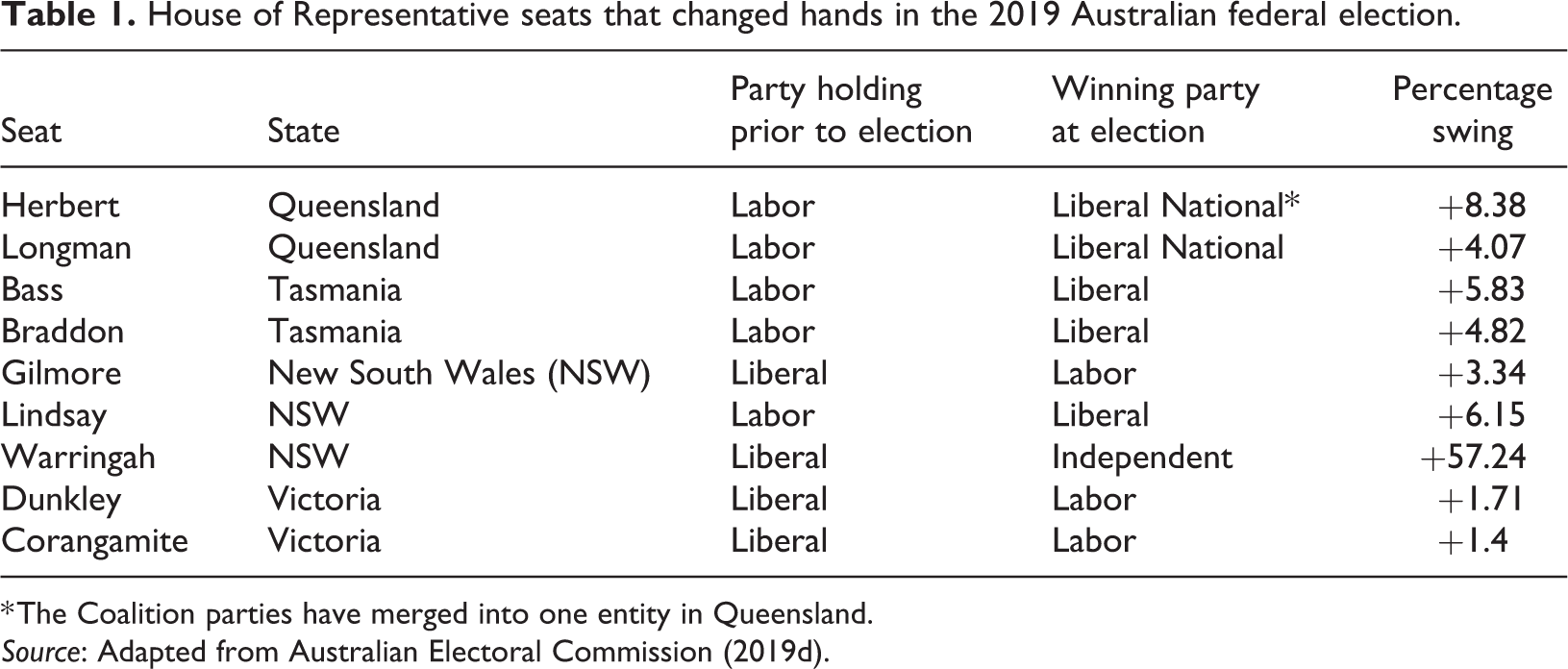
* The Coalition parties have merged into one entity in Queensland.
Source: Adapted from Australian Electoral Commission (2019d).
Footnotes
Declaration of conflicting interests
The author(s) declared no potential conflicts of interest with respect to the research, authorship, and/or publication of this article.
Funding
The author(s) disclosed receipt of the following financial support for the research, authorship, and/or publication of this article: This article draws on some material from an Australian Research Council-funded project DP140100168.
