







Abstract
Populist voting behavior is a relatively new research area with most studies concentrated on European and American voters, despite electoral successes of populist parties in illiberal and hybrid democracies of Asia. The research fills this gap by outlining the determinants of populist voting in Pakistan through constituency-based analysis of electoral data of the 2018 general elections when a Pakistani populist party, Pakistan Tahreek-e-Insaaf, won the elections. The research compares the ideational framework with the strategic framework of populism, examining whether voting for a populist party is determined by the political ideology or attitude of the voters or the mobilization strategy of the party built upon the sociopolitical realities of the region. The focus is on constituencies where PTI was successful for the first time. Based on the analysis of eight such constituencies, both rural and urban, the study concludes that neither the PTI voters’ profile matches the sociodemographic profile of the populist voter mentioned in literature nor their voting decisions seem to be guided by anti-elitist attitude common among European or Latin American populist voters. The research outlines two major factors that can explain the victory of PTI: the politics of electables and the mobilization of non-voters, indicating that the strategic lens of populism better explains voting for PTI.
Introduction
While the last decade saw an upswing in research on populism, most efforts to understand the causes and consequences of populism remained concentrated in Europe and the Americas. Meanwhile, populism did not restrict itself to the West and many countries in Asia saw the proliferation and success of populist political parties. Despite the electoral successes of populist leaders in illiberal or hybrid democracies of Asia, such as Imran Khan in Pakistan, Modi in India and Erdogan in Turkey, we have limited knowledge of what made people in these countries choose relatively new faces over traditional mainstream parties.
Although Western scholars cite the hegemony of minority rights over majority rights (Mouffe, 2005) and uneven capitalist development and globalization as being behind the rise of populism (Jessop, 2018), a few studies conducted on populist political parties and leaders in Asian countries, i.e. India, Turkey and Pakistan, found these factors to be irrelevant (Batool, 2023; Kumral, 2022). Since the social, political and economic realities of Asia differ notably from those of Europe and Latin America, where most studies on factors explaining the success of populist parties have been conducted, it is expected that the demographic profile and behavior of populist voters in the region would diverge from the ones reported in the available literature. The research on populist voting patterns and behavior in unstable democracies like Pakistan is also necessary to understand why populist parties, with their rhetoric centered on the democratic principle of majority rule, are successful in gaining power in countries struggling to uphold democracy.
The current paper discusses the determinants of populist voting in Pakistan by outlining the factors leading to the success of a populist political party—Pakistan Tahreek-e-Insaaf (PTI)—in the 2018 parliamentary elections (Yilmaz and Shakil 2021). Pakistan presents a typical case of an unstable democracy with a history of several military coups and decade-long dictatorships (Cohen, 2004, 2011). Of the 75 years of its existence, the country has been directly ruled by the military for over 30 years. However, since 2008, the country has seen some democratic stability and three consecutive elections have since been held without any military coup. Yet the country is far from being a democratic ideal and is best be described as a weak hybrid democracy having imbalanced civil–military relations, controversial electoral laws and poor conditions of civil liberties (Shafqat, 2011).
The weak democratic structure and disparaging state of constitutional liberalism in Pakistan hinder the conduction of “free and fair” elections in the country, which expectedly influences voter behavior (Wolf, 2013; Khan and Akhter, 2016). Research has reported frustration and mistrust toward the ruling elite among Pakistanis, causing voting absenteeismt (Mahmood et al., 2014; Akramov et al., 2008). Among those who vote, the choice of candidate is influenced by the caste, family or “status” of the candidate (Ahmed, 2012; Khan, 2021; Khan, 2021, Shah, 2019) and the prior performance of the candidate or party in local development projects (Mahar and Malik, 2021).
Populism surfaced in Pakistan with the very first competitive elections in the 1970s, as Zulfiqar Ali Bhutto challenged the political elite as well as the ruling military and called for the revival of democracy to return the rule to the ghareeb awam (poor public) of Pakistan (Batool, 2023; Paracha, 2022). However, after Bhutto's government was overthrown by a military dictator and he was executed by hanging, no significant populist movement or party appeared on the Pakistani political landscape for more than a decade. Even the political party Bhutto founded, the Pakistan Peoples Party (PPP), transformed into a liberal party implementing neoliberal economic policies and advocating for pluralism and minority rights.
It was only during the late 2000s that a a newly founded political party, PTI, gradually adopted a populist style, attaching its populist slogans to Islamic nationalism (Shakil and Yilmaz, 2021; Paracha, 2022). This right-wing populist party presented itself as a third force, declaring the two mainstream political parties as a corrupt mafia. The party held massive rallies in urban centers of Pakistan, mobilizing the inactive segments of society such as educated females and youth. In 2018, the PTI was finally able to convert its growing popularity to electoral success and formed a government in the center and two major provinces, Punjab and Khyber Pakhtunkhwa (KP).
The current study looks at the factors that led to the victory of PTI in the 2018 elections, examining whether these factors match with the causes of populist voting in other countries. Hence, the prime question of the present research is what factors can determine voting for a Pakistani populist party, Pakistan Tahreek-e-Insaaf, in the 2018 General Elections. The paper begins with a conceptual discussion on populist voting comparing two frameworks: populism as a thin ideology and populism as a mobilization strategy. The paper then gives a summarized review of recent empirical works on determinants of populist voting, most of which have been conducted through the lens of thin-centered ideology. This is followed by a critical review of the literature on voting behavior in Pakistan, where the emphasis is mostly on the strategy employed by political parties. The paper then explains the current research method of using the first-win constituencies of PTI to determine the change in voting patterns between the 2018 and 2013 elections. After discussing the voter data of each selected constituency, the paper gives out the details of the possible determinants of populist voting in Pakistan.
Conceptual framework: ideational versus strategic view of populism
Although the concept of populism is still widely contested, most contemporary research on populism has been conducted with the ideational framework (Mudde and Kaltwasser 2012; Akkerman et al., 2014; Hawkins et al., 2020). The ideational framework of populism defines populism as “a thin-centered ideology” that views society as composed of two antagonistic groups: the pure people and the corrupt elite, and regards “politics as an expression of the general will of the people” (Mudde, 2004: 543).
Voter research using the ideational framework is built on the premise that individuals having populist ideology are more likely to vote for a populist party/leader. Survey instruments of populist voting, using this framework (Figure 01), include measures of anti-elitisms, people-centrism (Canovan, 1981) and Manicheanism (Akkerman et al., 2014; Hawkins et al., 2020). Anti-elitism refers to the view that a small elite group is exploiting the democratic system to keep politics and policy matters in their hands. Elite is portrayed as corrupt and evil. People-centrism emphasizes the supremacy of the will of “the people”—the majority who hold the real power under democracy but have been sidelined by the elite. Finally, Manicheanism means that the people view politics as a struggle between good and evil. Manicheans overlook the diversity in political views of public.
Critics of the ideational framework of populism, however, point out the gap between the populist ideology of voters and their actual voting behavior (Stanley 2008; Neuner and Wratil, 2020). Also, the ideational framework does not consider the differences in social and political circumstances around an election. A popular alternative is to define populism as a political strategy (Levitsky and Roberts (2011). The strategic framework focuses more on the mobilization strategies of the party instead of the populist ideology of the voter (Kenny 2017). The determinants of populist voting, using a strategic framework, will be different for different countries, different political parties and different elections.
Determinants of populist voting
The last decade saw a rise in the number of studies focusing on factors that can explain electoral success of populists in the world. Studies that developed the sociodemographic profiles of voters of populist parties reported that less privileged and less educated men are more likely to cast a vote for a populist party (Spierings and Zaslove, 2017; Bovens and Wille, 2010). The logic was that populist parties mobilize the have-nots of a system.
However, the most extensive research on populist voting has found the political ideology of the voter to be the main determinant of voting for a populist leader or party. A large body of research uses populist attitude surveys to predict voting preference for a populist party (Akkerman et al., 2014; Hawkins et al., 2020). Anti-elitism, rooted in discontent and distrust with the political elite is identified in the literature as one prime cause of populist voting (Rooduijn et al., 2016; Schumacher and Rooduijn, 2013).
Critically examining the role of populist attitude on voting decisions, Andreadis and colleagues noted that these latent anti-elitist or moral views cannot directly cause populist voting and they must be activated by populist parties and should be supported by ground realities. Hence, they held that “populist appeals will only win support from citizens to the extent that there is evidence that a conspiring elite exists, and the system is not fully responsive to the popular will” (Andreadis et al., 2018: 240). The sociopolitical dynamics of the country, hence, play a vital role in convincing a voter to caste vote for a populist party and their ideology alone cannot explain voting for a populist party.
Of the few studies that used the mobilization framework for populism (Učeň, 2004; Betz, 2018), the most relevant is by Kenny (2017), who analyzed the success of Modi in India and noted that he targeted unorganized voters and won their support through a mass media campaign, marked by the extensive use of social media and public rallies. Interestingly, he reported a strong relationship between patronage-based voting and populist voting in India, claiming that in a patronage-based political system, populists have a higher likelihood of winning elections by employing direct linkages with the voter.
Voting behavior in Pakistan
While research on voting behavior in Pakistan is currently expanding, no research was found to specifically examine the populist voting behavior in Pakistan. Yet findings of the studies reporting the determinants of voting behavior in Pakistan can shed light on some contextual reasons behind people choosing PTI over other parties.
Ahmed (2012, 2009) has reported a strong role of the biradari system on voter choice in rural Punjab and the ethnic or sectarian identity of the party in urban Punjab. Bano, Kokab and Mohabbat (2021) have also reported a strong role of biradari in the electoral political of Faisalabad—a city in Punjab. They relate this caste-based politics to the larger politics of electables. Electables refers to the candidates who regularly win elections from certain constituencies owing to the support of their biradari or their powerful religious–cultural position, such as Pir (mystics) or Gaddi Nasheen (holders of a position of spiritual leadership), As, electables regularly switch their party loyalties, voting decision is usually determined through their relative power rather than through the party politics. However, these studies are relatively older. Bano and colleagues (2021) analyzed the electoral results of Faisalabad up to the 1997 elections. Ahmed (2012, 2009) conducted most studies during the government of General Pervaiz Musharraf—a military dictator—collecting data from local government elections. A lot has changed since 2002, with the onset of democracy in the country, and new research studies are needed to explore voter behavior in Pakistan.
This knowledge gap has recently been filled by new doctoral studies on voter behavior in Pakistan. Many of these doctoral studies have focused on KP—the province where PTI formed provincial governments after the 2013 and 2018 elections. Muhammad Rashid (2022) focused on the determinants of voting in the district of Dir and found a significant role of the religious and sociological affiliations. However, he found that in KP, party affiliation is still important. In another doctoral dissertation on Dir, Najib Khan (2021) also reported the strong influence of party affiliation in addition to biradari and the religious position of the candidate. Similar results are reported by Hassan Shah (2019), who compared the electoral results of selected constituencies in three consecutive elections in 2002, 2008 and 2013 and connected it with a survey of voters with a particular focus on floating voters. Taken together, Biradari and religions and other sociological factors are a common determinant of voting behavior in Pakistan.
Iltaf Khan (2021) comprehensively analyzed the elections conducted in Pakistan during 2008–2018. Analyzing the 2018 elections that led to the success of PTI, he reported several factors such as corruption charges against established parties, the poor performance of the last government, the rise in the voter turnout of young and female voters, and the social media campaigning by PTI. Like other scholars, he also reported the politics of electables to be pivotal. According to him, in the 2018 elections, PTI awarded “more than hundred tickets to the so called electables” (Khan, 2021: 156).
Among the research reports on elections, the most notable is by Mahar and Malik (2021), who explored the influence of changing social and political dynamics in Pakistan, such as the increase in literacy rates, urbanization, technological advancement and normative change with regard to gender roles, etc., on the outcome of the 2018 elections in four local constituencies. They found “performance” at local level, particularly the prior involvement in local development work of the candidate or party, to be the key determinant of populist voting in Pakistan. Similarly, they noted that patronage played a vital role in influencing voter choice, again linked to the perceived ability of the candidate to “deliver.” They noted that literacy or urbanization might not be a good determinant of voting in Pakistan, citing the example of Karachi—the main urban center of Pakistan with relatively high literacy rates—where the voter turnout in 2018 elections was much lower than the average voter turnout. Their findings concord with those of another study on voter types in Pakistan where development seekers and patron seekers were the most prominent voter types in the 2018 elections (Gallup Pakistan 2018). The research also showed a decline in caste-based or ideological voting in the country in the 2018 elections.
Interestingly, the sociodemographic factors that explain populist voting in European studies have a different result in Pakistan. While studies on Europe reported the uneducated and males to be more populist, the voter profile developed through the Exit Poll Survey by Gallup Pakistan (2018) showed that PTI voters are usually females, highly educated and belong to the high income group. Almost half of those who claimed to have voted for PTI in 2018 elections were educated females. The present research will try to confirm these results through constitutional-level research.
Research method
Unlike voter attitude surveys that operationalize voter inclination toward populist beliefs but do not necessarily indicate their decision to cast vote for a populist party, the focus of the current research was factors behind voting for a populist party. To achieve this purpose, the study employs a different methodology collecting data about voters from the national assembly constituencies where PTI won for the first time. The focus is on the 2018 elections, when PTI was able to form a government, winning 116 constituencies. In the prior elections held in 2013, the party had won only 26 seats. There were important shifts in the constituency maps after the 2018 delimitation and, hence, care was taken to compare each constituency with the one in the 2013 election having the highest geographical overlap. In some cases, where a new constituency was formed through the merger of two old constituencies, the 2018 constituency was compared with two respective constituencies of the 2013 elections.
The electoral and voting behavior research on each constituency was studied using secondary resources such as research papers and news articles. To study the shift in voter profile of these constituencies, the data were collected mainly from the reports produced by Free and Fair Election Network (FAFEN, 2013, 2018) and Election Commission of Pakistan (ECP, 2013, 2018).
Voting behavior in PTI first-win constituencies
After removing the constituencies where PTI won consecutively, a total of 90 constituencies were found where the party won for the first time in the 2018 general elections. The list of these constituencies was used as a sampling frame, listed in ascending order of the number of constituencies. Every tenth entry in the list formed the study sample. The eight constituencies in the sample comprise NA-38 (Dera Ismail Khan-I), NA-55 (Attock-I), NA-87 (Hafizabad), NA-110 (Faisalabad-X), NA-135 (Lahore-XIII), NA-170 (Bahawalpur-I), NA-192 (Dera Ghazi Khan-IV) and NA-244 (Karachi East-III).
NA-38 (Dera Ismail Khan-I)
Comprising the northern areas of the city of Dera Ismail Khan (D.I. Khan), NA-38 had a voting population of around 390,000 voters in the 2018 elections. In the 2013 election, it was part of the NA-24 constituency of the entire city of D. I. Khan, some areas of which were included in NA-39 during the 2018 delimitation. However, most areas of NA-24 remained in NA-38 and the two can be compared. In the 2013 elections, the main leader of Jamiat Ulema Islam–Fazlur Rehman Group (JUI-F), Maulana Fazlur Rahman, won. In the 2018 elections, PTI candidate Ali Amin Khan Gandapur defeated Maulana Rahman with a strong margin. Ali Amin received over 81,000 votes (39%) while the runner-up Maulana Rehman could only win 45,796 votes (22%). In 2013, he had secured around 92,000 votes (42%).
The constituency is very important as the PTI victory in D. I. Khan was called a major breakthrough since it is the home constituency of Rahman, where his family has been politically active since 1960s. Rahman's father Mufti Mehmood was a very popular religious and political figure of the region and was the founder of Jamiat Ulema Islam (JUI)—a mainstream religious political party. He also served as a Chief Minister of Pakistan. Rehman himself has served important cabinet positions and is the main leader of a faction of JUI. The PPP also had strong presence in the city. In the 2013 election, Waqar Ahmed Khan of PPP was the main runner-up and PTI's candidate came third.
Even though the defeat of Maulana Rehman in his home constituency was termed a success of PTI in defeating the traditional political actors, it is important to note that the PTI candidate, Ali Amin, belongs to a political family having a strong presence in the region for a long time. His relatives used to be associated with the PPP and won elections on the PPP seat in the 1970s. Some of his relatives such as Israrullah and Inammullah Gandapur were also members of PTI and had served as provincial ministers. Hence, it would be wrong to see Gandapur's success against Rehman as entirely a result of voter rejection of the political elite. It is best viewed as a shift from one political elite to the other.
In 2013, D. I. Khan had seen a significant rise in voter turnout (56.4%). In 2018, however, there was a slight decline in voter turnout (55%). There was also a very small decrease in the gender gap: the male to female voter ratio changed from 1.29 in 2013 election to 1.3 in 2018 elections, indicating that, although the voter turnout of both male (63.4 to 61) and female (49 to 47) voters decreased in the 2018 elections, female voters were less affected than male voters.
NA-55 (Attock-I)
NA-55 is a rural constituency composed of several towns and villages around the city of Attock. Before the 2018 delimitation, the constituency was called NA-57. The number of registered voters in the constituency was 353,571 in the 2013 elections but it almost doubled to 571,804 in the 2018 elections. The constituency was a stronghold of the Pakistan Muslim League, 1 whose two variants PML-N and PML-Q are the main contestants here. However, a close analysis shows that the voting in this region is strongly caste-based with voter preferring Maliks and Sheikhs over parties.
In 2013 elections, PML-N candidate Sheikh Aftab Ahmed won elections while the main runner up was Malik Amin, who contested polls on a PTI ticket. Malik Amin was previously associated with PML-Q and had joined PTI just before the 2013 elections. Being a member of a powerful political family, Malik Amin was able to receive almost 30% of votes while the winner candidate of PML-N received around a 32% vote share, showing that the contest was very close. PTI had no significant presence in this region before the 2013 elections and the election results show that it was gradually gaining ground in this constituency through its choice of candidates already having a strong political influence in the region.
In 2018, PTI chose another “electable” Major (R) Tahir Sadiq Khan, who was an ex-member of PML-Q and had family affiliations with the PML-Q leadership, being married to the sister of Chaudhry Pervaiz Elahi. Major Sadiq had contested independently the 2013 elections as he was unhappy with the PML-Q alliance with PPP in the region and was able to secure a 27.4% vote share. In 2018, he received around a 49% vote share. This notable rise in his vote share can be attributed to the support of Malik Amin, who did not contest the 2018 elections and was later awarded a reserved seat by PTI. Hence, instead of bringing any change in the political landscape, as populists usually claim, PTI's success in Attock is because of the politics of electables.
In the 2013 elections, the voter turnout in the constituency was 53%, which remained same in the 2018 elections as well. However, in terms of gender ratio, the percentage of female registered voters saw some rise from 45.3% in 2013 elections to 47% in 2018 elections, indicating stronger support of female voters for PTI candidates.
NA-87 (Hafizabad)
With more than 680,000 registered voters, the constituency of NA-87 comprises the entire Hafizabad district. In the 2013 election, there were two separate constituencies of Hafizabad, coded NA-102 and NA-103, which were merged into one constituency in the 2018 delimitation. The number of registered voters of the two constituencies combined was around 540,000. The constituency is another stronghold of the Pakistan Muslim League, and the contest is between two parties: PML-N and PML-Q.
Like Attock, the voting pattern shows the strong influence of political families instead of parties. The two most influential political families in Hafizabad are the Bhattis and the Tarars. In the 2013 elections, PML-N awarded the ticket to Saira Afzal Tarar for NA-102 and Shahid Hussain Khan Bhatti for NA-103. Hence, PML-N was able to secure the support of both influential political groups and, not surprisingly, won the elections in both constituencies. Saira Afzal Tarar was a clear winner from NA-102, receiving close to 54% of the vote while the runner up could only secure a 39% vote share. In contrast, the contest was very close between the two members of the Bhatti group in NA-103. PML-N candidate Shahid Bhatti received a 54% vote share and the PTI candidate Ch. Shokat Ali Bhatti received a 45% vote share.
In the 2018 elections, as the constituency was merged, PML-N awarded the ticket to Tarar while PTI chose Bhatti. The latter received around 42% of the votes while Saira Tarar received close to 40% of the votes. Hence, the contest was very close and mainly influenced by the caste-based voting for Bhatti versus Tarar families. As the number of invalid votes was close to 10,000, higher than the margin of victory, the discrepancies in the electoral management also influenced the election results.
Owing to this high competition, the voter turnout in NA-87 was the highest of all constituencies but still lower than the turnout in the 2013 elections when it was above 62%. Yet the gender gap has declined. In the 2013 elections, the percentage of female voters was 43%, which rose to 44% in the 2018 elections, indicating a rise in the number of female voters.
NA-110 (Faisalabad-X)
The constituency is predominantly urban, consisting mainly of areas inside the city of Faisalabad. Since the constituencies of Faisalabad underwent important changes during the 2018 delimitation, it is hard to find a comparable constituency in the 2013 elections but the closest ones are NA-85 and NA-82. The city of Faisalabad was a stronghold of PML-N, where it had been securing consecutive victories since 2002 elections (FAFEN, 2013: 355). However, in the 2018 elections, PTI was able to make a major breakthrough, with its candidate Raja Riaz Ahmed winning 45% of the votes.
Just like other constituencies of Punjab where PTI secured victories, there is a limited role of party politics and the choice of candidate was the main winning factor. In this constituency, the important political families include the Ansaris and Maliks. In the 2013 elections, the PML-N candidate Akram Ansari secured 62.2% of the polled votes in NA-85, followed by the PTI candidate Brigadier Mumtaz Iqbal Kahlon with 27.6% of the votes. Similarly, in NA-82, the PML-N candidate Rana Muhammad Afzal Khan received up to 63% of the polled votes and won with a high margin. The PTI candidate Nisar Akbar Khan could only receive an 18% vote share.
In the 2018 elections, however, PTI awarded the ticket to Raja Riaz Ahmed, who was a senior politician from the PPP. The contest was very close and the PTI candidate won the election with only a small margin. He received 45% of the polled votes while the PML-N candidate Muhammad Afzal Khan received more than 43% of the votes. Hence, while PTI was able to secure victory, it was not through the slogan of change but rather through an electable having a strong presence in the region.
In the 2018 elections, the voter turnout in the constituency was close to 57%. However, in the 2013 elections, both NA-82 and NA-85 saw voter turnout close to 60% and hence, the voter turnout declined by 3 points in the 2018 elections. Yet, as is noted in other constituencies, the percentage of female registered voters increased from around 43% in the 2013 elections to 45% in the 2018 elections.
NA-135 (Lahore-XIII)
This constituency of the city of Lahore is a new constituency formed in the 2018 delimitation considering the increasing population density in Lahore. The constituency is predominantly urban with most areas in the Lahore city Tehsil. The constituency has been formed through a merger of some areas of old constituency NA-128 and some areas of NA-127. However, it is hard to compare it with any older constituency. Taken together, however, the city of the Lahore and the two older constituencies were the voter hub of PML-N and the victory of a PTI candidate from this area for the first time marks a major shift in voter behavior.
Interestingly, the candidate who secured a first-time victory for PTI was an old member of PPP but had had limited political success prior to joining PTI. He could not be termed as a new face to Pakistani politics and caste-based voting must have played some role but his success in securing a vote share of over 50% can best be explained by the acceptance of populist slogans of PTI. Owing to the inability of comparing this constituency with any older one, caution must be applied before drawing any conclusive analysis about populist voting from this constituency.
NA-170 (Bahawalpur-I)
NA-170 is an urban constituency mainly composed of the Municipal Corporation of Bahawalpur and Bahawalpur Cantonment. These areas were under NA-185 in the 2013 elections along with some areas of Bahawalpur Saddar and Tehsil city. The number of registered voters in NA-185 during the 2013 elections was around 334,000 but since some areas were removed during the 2018 delimitation, the NA-170 had an almost similar voting population size of 360,000 registered voters in 2018.
According to FAFEN (2013: 753), the constituency has a swing vote. PML-N candidate Baleeghur Rehman secured consecutive victories in the 2008 and 2013 elections with over 50% of the vote. However, the runner up, Farooq Azam Malik, also showed his strength in the constituency from where he had been contesting elections from different political parties’ tickets and was able to secure a vote share of almost 38%. In the 2018 elections, when Farooq Azam Malik contested elections from the PTI ticket, his victory should be seen as his personal influence in the constituency amplified through the PTI ticket.
The voter turnout in the constituency remained stable in the two elections at 52%. However, the percentage of female registered voters increased from 45.2 to 46%, showing that female voters played a significant role in making the PTI win in this constituency.
NA-192 (Dera Ghazi Khan-Iv)
With a population density of 600/km2, NA-192 is a predominantly rural constituency composed of the municipal committee of Kot Chutta and some of the circles in Kot Chutta Tehsil (ECP, 2018). The area was initially part of NA-172 but was later formed into a new constituency during the 2018 elections. The two powerful political families in the area are Lagharis and Khosas (FAFEN, 2013). In the 2018 elections, the number of registered voters in the constituency was 302,437 (FAFEN, 2018).
In the 2013 elections, the constituency saw close competition among the candidates of PML-N and PTI and an independent candidate of the Leghari family. The PML-N candidate Hafiz Abul Karim, who was victorious with 30% of the polled votes, was a religious leaders having several seminaries in the area and, hence, used his own personal influence to secure votes. Muhammad Jamal Khan Leghari, being the son of former President Farooq Leghari, also held political sway in this area and was the main runner up with 24% votes. In contrast, the PTI candidate Zartaj Gul was a new face in Pakistani politics and yet could secure close to 23.6% of the vote share, showing the success of PTI in bringing the political change.
In the 2018 elections, however, PTI chose to score victory through its politics of electables. As the area of Kot Chutta was removed from the city of D.G. Khan and a new rural constituency was formed having political dominance of Leghari, PTI awarded the ticket to Sardar Muhammad Khan Leghari, who received 50% of the vote and was victorious. This was an important constituency as the main leader of PML-N, Mian Shahbaz Sharif, contested elections against Lagharis but lost while receiving 42% of the votes. The success of PTI against such a strong candidate was made possible through the choice of a candidate from a powerful political elitist family.
This new constituency saw a major rise in voter turnout. In 2013 the voter turnout in NA-172 was almost 47%. In the 2018 elections, it rose to 55%. Interestingly, while the new constituency of NA-192 was composed of rural areas of NA-172, the gender ratio in registered votes remained stable with 43% women voters.
NA-244 (Karachi East-III)
NA-244 is a new urban constituency of Karachi formed after exclusion of Malir cantonment areas from the old constituency of NA-256. The new constituency is composed mainly of the Faisal cantonment and some areas of Firozabad, such as Baloch colony, Manzoor colony and Azam town. While Urdu-speaking migrants from India form the main ethnic group in this area, it is also the main residential site of Gujrati-speaking and Punjabi-speaking industrialists.
Like all other areas of Karachi, the ethnic political party Muttahida Qaumi Movement (MQM) had been winning seats from this area without much competition. In the 2013 elections, however, PTI emerged as a second strongest party in the city and the MQM candidate received 60% of the vote—a decline from almost 75% of the vote in the 2008 elections. The PTI candidate received 27% of the polled vote, which holds importance because it shows a gradually closer contest in the area.
In the 2018 elections, as MQM suffered from factionalism and the state-imposed ban on media coverage of its main leader Altaf Hussain, Muhammad Abdul Rauf Siddiqui of MQM-Pakistan could only receive 23% of the polled votes while the PTI candidate Ali Zaidi had a clear victory with almost 47% of the votes.
Karachi, hence, become an important city where PTI was able to bring the promised change. It was able to successfully challenge the main political elite in the city through young and new political actors. However, experts believe that the change was impossible without the support of the security establishment that is alleged to play a part in creating factions within MQM. In addition, the decline in voter turnout from 55% in the 2013 elections to 42% in the 2018 elections shows that the MQM voter chose to stay at home instead of changing their loyalty.
Unlike Punjab, where PTI replaced PML-N—a center-right political party popular among the conservative voters—in Karachi, it had to challenge a liberal political party that claims to be the voice of the middle class and uses anti-elitist plus ethnic slogans. Unlike other constituencies, this constituency saw a major decline in the turnout of female voters, who seem to prefer MQM over PTI. In 2013, the percentage of registered female voters was 48.1%, which declined to 46% in the 2018 elections.
Determinants of populist voting in Pakistan
Based on the analysis of eight first-win constituencies of PTI in the 2018 elections, the research could outline two major factors that can explain the victory of PTI: the politics of electables and the mobilization of non-voters. Interestingly, both factors have never been discussed in the literature on determinants of populist voting but are frequently reported in studies on voter behavior in Pakistan.
Politics of electable
One prime feature of populist politics is its anti-elitism—blaming the political elite for not securing the interests of the people (Staykova et al., 2016). Populist parties present themselves as the true representatives of the people and an alternative to the mainstream political actors. Hence, one test developed to determine if a particular party is populist or not is to examine the anti-elitism in the discourse of its leadership. Critical discourse analysis of Imran Khan's public speeches shows his extensive use of words like mujrim (culprit), fraud, chori (theft) and barbaad (destroyed) while talking about other political parties (Nusrat et al., 2020). The prime features of populist discourse of Imran Khan and of his party are anti-Americanism, Islamism and post-truth politics, calling “anyone disfavoring Imran Khan as a traitor regardless of their background or party affiliation” (Naseer, 2022, “The Consequence”).
One can expect a strong anti-elitism in voters of populist parties with a desire to reject traditional political actors. However, the voting patterns in constituencies where PTI secured victory for the first time show no particular shift from traditional politics. In fact, most candidates that secured victory on PTI tickets in these constituencies belonged to influential political families that had secured electoral victories for several generations. Many candidates had left other political parties to join PTI and were not “new” political actors as such. This contrasts with the anti-elitism observed in European voters where distrust with the political elite serves as a main factor convincing the public to cast votes for populists (Rooduijn et al., 2016; Schumacher and Rooduijn, 2013).
This study is not the first to discuss the role of electables in making PTI win. Several studies on the 2018 elections have attributed to the “politics of electables” a significant part in enabling PTI to defeat powerful mainstream parties in the constituencies perceived to be their main wining grounds (Islam et al., 2019; Khan, 2021; Yilmaz and Shakil, 2021). Furthermore, Javid and Mufti (2022) pointed out the involvement of the establishment as well as the capitalist class in making these electables change their loyalties and defect to the PTI. Khan et al. (2020) confirmed that these electables are part of Pakistan's new power structure and are aligned with the very elite that PTI allege to be evil and corrupt. Since most prior studies on voters of PTI have not defined PTI as a populist party whose voter was expected to be anti-elitist, this is the first study to question the link between voting for electables and populist voting.
Mobilizing non-voters
While research on populist voting in other countries shows that male voters are more prone to populist voting than females, the current study shows that PTI has a stronger voter base among female voters. In most constituencies where PTI won for the first time, there is a notable increase in the number of female registered voters. Even in the few constituencies, where the number of female registered voters declined, the gender ratio showed that the decline in male voters was notably higher than that in female voters; most of those who decided to not cast a vote in 2018 were male. The findings correlate with prior studies on the voter profile of PTI voters that showed the female and educated classes to be far more likely to cast votes for PTI (Gallup Pakistan, 2018; Khan, 2021). The popularity of PTI among female voters can be partially explained by its campaigning strategy, targeting underrepresented voting segments including educated urban youth and females (Ali et al., 2021). Research on females attending PTI rallies in 2018 elections shows that patriotism or nationalism, merged with hope for change, was prominent among female voters for PTI (Batool, 2019).
Since ECP does not collect data of voters with respect to age and education, the current study cannot report the change in sociodemographic profile of voters with respect to these factors. Exit poll surveys by Gallup Pakistan (2018), however, reported that PTI was the most popular party among all age groups in 2018 elections. While they noted that in the 2018 elections, PTI was the most popular choice among new voters (18–24 years old), the highest shift in voter percentage between the 2013 and the 2018 elections was among older voters of 30+, indicating that the victory of PTI is caused by keeping its main voter base, i.e. the youth, intact while expanding its campaign to older voters too (Table 1).
Voter profile of mainstream Pakistani parties in the 2013 and 2018 general elections (source: Gallup Pakistan, 2018: 17).
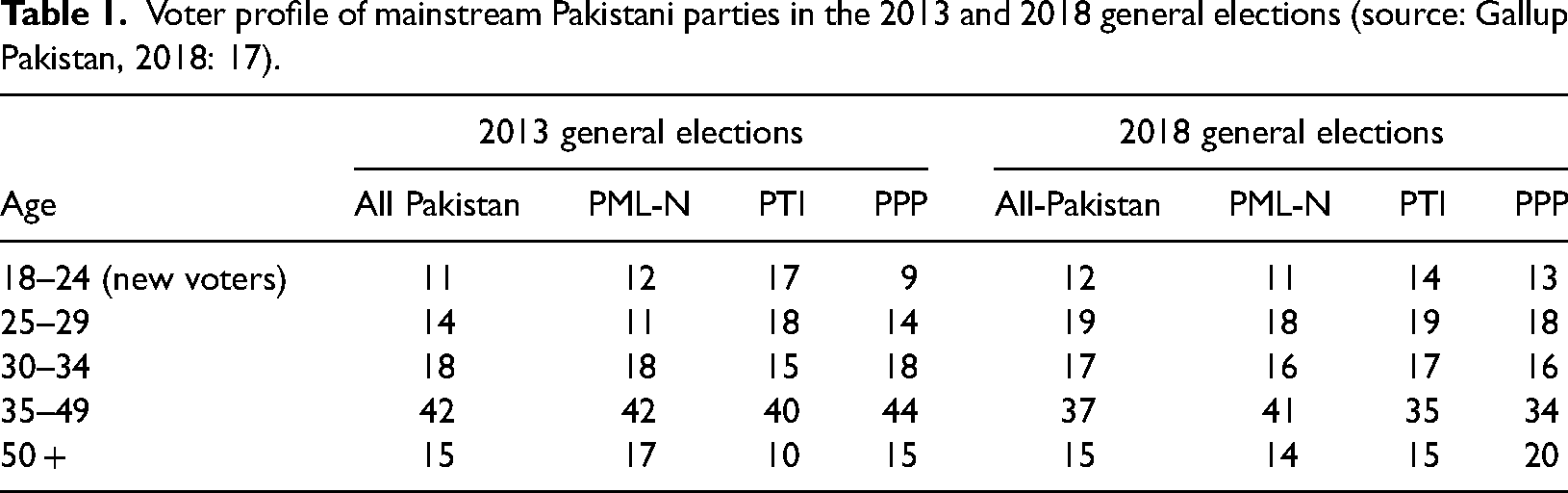
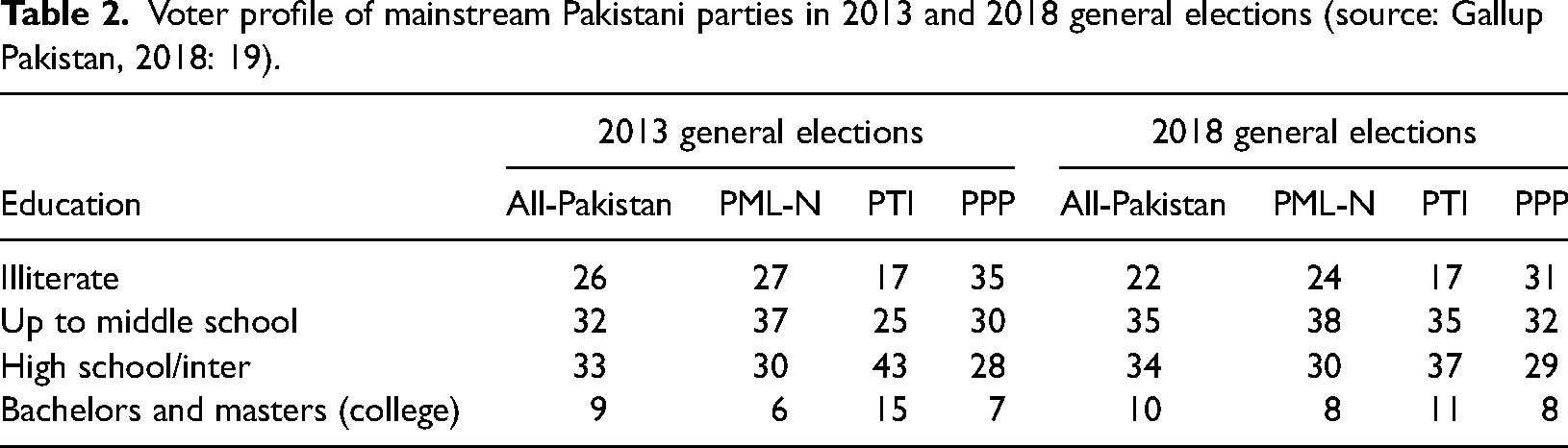
The same can be said about the education status where PTI retained a high percentage among voters with minimum college education but saw a notable rise of voters with school education up to eighth grade. Among illiterate voters, however, PTI remains the least popular party in both elections (Table 2). Taken together, it seems that the populist party in Pakistan did not mobilize the “have nots” but rather the non-voters—the ones who were indifferent to the political process for several different reasons—and PTI made politics relevant and interesting for them. Again, the factor has not been studied much in the literature and is recommended for future studies.
Voter profile of mainstream Pakistani parties in 2013 and 2018 general elections (source: Gallup Pakistan, 2018: 19).
Conclusion
The current research on constituency-based voter behavior and profile shows that the victory of the PTI in 2018 elections cannot be explained by ideological determinants of populist voting in the literature as their voting decisions seem not to be guided by anti-elitist attitudes. Some studies on populist voting in Asian democracies such as Turkey (Aytaç and Elçi, 2019) and India (Kenny 2017) have similarly shown an insignificant role of anti-elitist ideology and more prominent role of the strategic mobilization by populist parties (Yilmaz and Bashirov, 2018; Jaffrelot and Verniers, 2020; Kenny 2017), showing that populist voting in non-Western democracies cannot be fully determined by attitudinal or ideological factors reported in studies on Western democracies.
In comparison, the strategic framework focused on party mobilization can provide some insights into why PTI won elections in 2018. PTI's mobilizational strategy in 2018 was a mix of two tactics. First, it expanded its voter base, adding traditional voters who cast votes to electables only. Second, it kept its main voter class of educated young and female voters by using catchy slogans. Similar to what was reported by Kenny (2017) for India, PTI emerges as a party utilizing a mix of patronage and populist strategies to win support.
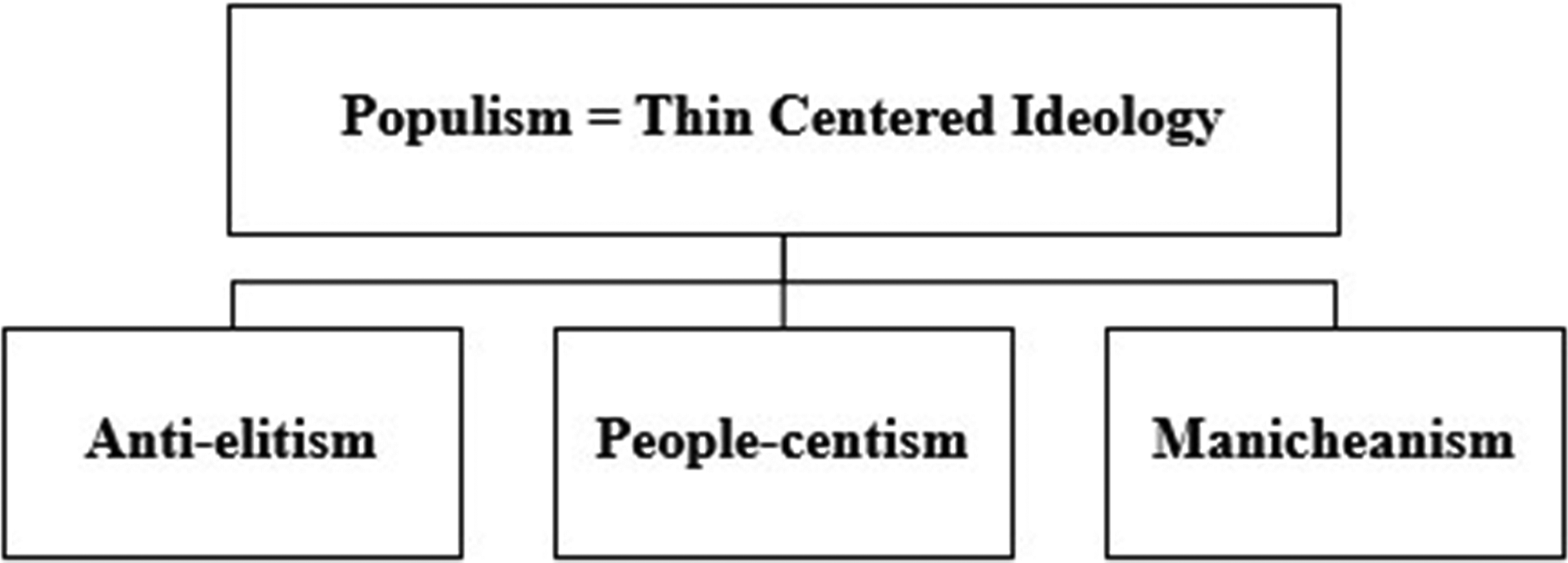
Ideational framework of populism (based on Akkerman et al., 2014).
Footnotes
Declaration of conflicting interests
The author declared no potential conflicts of interest with respect to the research, authorship, and/or publication of this article.
Funding
The author received no financial support for the research, authorship, and/or publication of this article
