






Abstract
Polytempo music – where multiple, simultaneous tempi are performed – poses unique challenges for ensemble coordination, yet empirical research on its performance remains scarce. This exploratory study investigates how expert musicians execute different forms of polytempo, comparing temporal stratification (distant tempi) and phasing-like configurations (close tempi) to both a simple polyrhythm condition and a baseline condition (in which all musicians played at the same tempo). Six highly experienced performers completed 32 trials in which they played isochronous pulses at individually assigned tempi while hearing individualized click tracks that either continued or disappeared early in the trial. We analyzed temporal regularity, tempo change, and group-level success in maintaining prescribed tempo ratios. Across measures, polytempo configurations elicited greater difficulty than the polyrhythm condition, which did not clearly differ from unison tempi, suggesting that expert performers may spontaneously assimilate simple tempo ratios into a shared rhythmic framework. Performances at distant tempi produced significantly more tempo change and markedly lower success in reproducing target ratios than either close tempi or polyrhythms, indicating that temporal stratification is more challenging than phasing when performed without shared structural cues. Individual click tracks had limited influence on stability or coordination, though they did reduce tempo change in both polytempo conditions. These findings provide the first empirical comparison of various types of polytempo performance in an ecologically valid, multi-instrumental context, offering insight into the coordinative demands of contemporary polytempo practice, suggesting new considerations for composers and performers working with complex temporal structures, and shedding new light on the broader cognitive mechanisms involved in resisting the seemingly inescapable tendency to synchronize with one another.
Introduction
Conlon Nancarrow – who composed a remarkable set of Études for player piano featuring unprecedented rhythmic complexity – once claimed that “time is the last frontier of music” (quoted in Garland, 1982, p. 185). It is indeed fair to say that many 20th-century composers from the Western art music tradition have sought to explore and manipulate time with a level of systematicity and complexity comparable to that which their predecessors applied to pitch and harmony (Kozak, 2019). One of the devices employed in such explorations is polytempo writing. Polytempo music refers to music in which two or more tempi occur simultaneously. In standard notation, this often involves assigning different performers (or groups of performers) distinct tempo markings (e.g., “Allegro con spirito” for one orchestral group and “Molto Adagio” for another), or distinct metronome indications (e.g., MM quarter note = 60 bpm for one performer and MM quarter note = 62 bpm for another). Naturally, the boundaries between polytempo and polyrhythm can be somewhat ambiguous (see Poudrier & Repp, 2012, as well as Nijhuis et al., 2026, for a discussion). But generally, a given music can be thought of as being in polytempo when the various musical voices cannot be easily integrated into a common pulse or when the various musical voices do not share any obvious common subdivision (in contrast with Nijhuis et al.'s (2026) definition of a polyrhythm as “the superposition of two or more non-harmonically related pulses that share a common cycle/bar”).
Another important distinction between polyrhythmic and polytempo music lies in their prevalence across musical traditions worldwide. Polyrhythms are found in a wide range of musical practices (see Arom, 2010, or Agawu, 2016 on African music; Reina, 2016, on Indian Karnatic music; Manuel, 2020, on Latin American and Caribbean music). By contrast, it remains unclear whether polytempo performance – understood as musical contexts in which performers intentionally maintain different tempi or rates without reference to a shared global tempo – exist beyond 20th-century Western classical music. Interestingly, some of the songs documented by ethnomusicologist Frances Densmore in her Teton Sioux Music and Culture, originally published in 1918 (Densmore, 2001), are notated in a polytemporal manner (e.g., the voice at 104 bpm and the drum at 96 bpm). However, it is uncertain whether this reflects an actual performance practice or merely a notational strategy intended to capture rhythmic structures and/or microtiming nuances that were not fully understood at the time. In the present article, we therefore situate polytempo primarily within the context of 20th- and 21st-century Western musical works. Indeed, examples of polytemporal writing span a wide range of such repertoire – from Charles Ives's Central Park in the Dark for orchestra (1906) to Karl Naegelen's Cartographie de Rythme for two percussionists (2021). Many major avant-garde composers have written polytempo music at some point in their careers, including Pierre Boulez (Rituel: In Memoriam Maderna, 1975), György Ligeti (Magyar Etüdök for mixed a cappella choir, 1983), Steve Reich (Piano Phase, 1967), Karlheinz Stockhausen (Gruppen for three orchestras, 1957), and Iannis Xenakis (Persephassa for six percussionists, 1969).
But despite employing similar notational strategies, these works often pursue distinct expressive goals. On one hand, polytempo may be used to create hyper-polyphonic textures – distinct layers of musical material that move independently, evoking a kind of “temporal stratification” (Poudrier, 2017). This is often achieved by superimposing layers moving at markedly different speeds and featuring contrasting rhythmic patterns. Stockhausen's Gruppen is a prime example of this approach. On the other hand, polytempo may be used to create phasing processes – emergent melodic and/or rhythmic patterns arising from gradual phase shifts (Nyman, 1999). This effect typically results from layering nearly identical rhythms moving at slightly different tempi, as exemplified by Reich's Piano Phase (Schwarz, 1981).
Now, both types of polytempo present considerable performance challenges. As percussionist Russel Hartenberger – who has long performed Reich's music – describes: “As I moved out of phase with the person across the bongos from me, I felt as though I was leaving Earth's atmosphere and all that was comfortable and secure. In the most irrational part of the phase, I had no idea whose hands were making which sounds, and I did not know where my pattern was in relation to the other part” (Hartenberger, 2016, p. 94).
A central difficulty in performing polytempo music lies in maintaining one's own pulse while resisting the influence of others’ tempi. However, numerous studies have shown that resisting such rhythmic influence is in fact nearly impossible, owing to mechanisms like entrainment (Clayton, 2012) and phase correction (Repp & Keller, 2004). For example, Schmidt and O’Brien (1997) asked pairs of participants to swing a pendulum at their own comfortable tempo. In the first half of the trial, participants performed the task without seeing each other, allowing them to establish their preferred tempo. In the second half, they were able to see each other but were instructed to maintain their original tempo. Despite these instructions, the participants’ pendulum movements became attracted to either in-phase or anti-phase patterns, even though these patterns were not stable in this context. Similarly, Rosso et al. (2021) designed a joint tapping task in which participants were either visually coupled (able to see each other's hands) or auditorily coupled (able to hear each other's tapping). Each participant was instructed to synchronize their tapping with a metronome set at a slightly different frequency from their partner's, and to ignore any visual or auditory cues from the partner. Nonetheless, the study found that when participants were coupled – either visually or auditorily – their tapping rhythms were drawn toward each other. This suggests the spontaneous emergence of entrainment at the dyadic level, despite explicit instructions to the contrary.
Such involuntary musical entrainment is also observed in more naturalistic settings. In an analysis of a Congado performance in Brazil – in which independent groups of performers, each with its own rhythmic identity, participate in a joint ritual – Lucas et al. (2011) found that when groups performed in close proximity, they tended to entrain to one another (either in phase or anti-phase) and to converge in tempo. Similarly, Clayton (2007) documented instances of unintentional entrainment among tanpura players in performances of Indian classical music. Taken together, these findings highlight the difficulty of intentionally resisting entrainment, a core challenge in any polytempo performance.
Interestingly, in one of his numerous synchronization-continuation tapping studies, Bruno Repp (2006) asked his participants to tap against distractor sequences playing at different tempi. Crucially, when the distractor's tempo was close (within 5% of the participant's tempo), participants were drawn into its orbit. When the difference was greater (around 10%), participants showed increased inter-tap variability, but no entrainment. These findings suggest that small tempo differences promote spontaneous coordination, whereas larger differences may disrupt stability without necessarily leading to entrainment.
This also suggests that the two forms of polytempo discussed above – temporal stratification and phasing – may pose distinct challenges to performers. Unfortunately, relatively few empirical studies have systematically investigated interpersonal polyrhythm production, let alone polytempo performance. Although polyrhythm has been the focus of numerous experimental studies, most have examined either its perception – for example, the effects of tempo (Handel & Oshinsky, 1981), ratio complexity (Deutsch, 1983), pitch (Møller et al., 2021), or musical expertise (Stupacher et al., 2026) – or its intrapersonal production, such as in research on integrated motor organization (Summers et al., 1993) or bimanual coordination (Klapp et al., 1998). Strikingly, there are very few laboratory studies involving actual interpersonal polyrhythm production. Van Kerrebroeck et al. (2023) investigated the effects of visual coupling in dyads instructed to jointly perform a 2:3 rhythm, but found no clear effect of visual information on performance accuracy. In another study, Heggli et al. (2019) did not require participants to jointly produce a polyrhythm; instead, they manipulated how participants represented their own output (i.e., either tapping isochronously at 120 bpm or performing a 3:4 polyrhythm at 160 bpm). Crucially, these two framings should theoretically yield identical tapping rates. However, by varying whether the two participants shared the same representation, the authors showed that participants experienced greater difficulty synchronizing when their metrical representations were incongruent, although they were able to recover over the course of the trial. This finding is highly relevant for polytempo performance, as it suggests that successful ensemble coordination in such context may depend on the performers’ ability to form a shared mental representation of their joint output – an ability that may vary depending on the type of polytempo structure involved.
As for empirical studies on polytempo production, the field remains largely unexplored. To date, only a handful of experiments can be cited, beyond Michael Schutz’s pioneering – albeit purely observational – study of Steve Reich's Drumming, which showed that individual tempo dynamics were far from linear in such phasing performance (Schutz, 2019). As for the extant experiments on the topic (Hall et al., 2023; Rosso et al., 2021, 2023 – also discussed in Kim, 2023), they only focus on the phasing paradigm. Thus, little is known about how phasing compares to temporal stratification in practice. Moreover, these studies investigate phasing performance by relying on a tapping paradigm – a situation that is far removed, both from the cognitive and the motor standpoints, from a typical instrumental performance of polytempo music.
The exploratory study reported here thus aimed to assess whether Repp's findings extend to a more ecologically valid musical context involving skilled performers playing their own instruments. To this end, we initiated a research collaboration with six expert musicians and improvisers (on drums, piano, cello, clarinet, saxophone, and accordion) who perform together as MilesDavisQuintetOrchestra. 1 Albeit the musicians were asked to perform a simple task at the individual level (i.e., playing isochronous pulses), far from the rhythmical complexity of the individual layers that can be encountered in some of the works mentioned above, they did so while relying on their rich and diverse instrumental vocabulary (including many extended techniques), thus creating the kind of multi-layered, complex sonic tapestry found in many polytempo works. Having the musicians play their instruments also meant that their bodies would be more fully involved in the sonic production and that they would have to produce the kind of complex motor gestures involved in a typical music performance.
The high expertise of these musicians in rhythmically independent behaviors resulting from the shared performance practice they built over the years allowed us to contrast in a relevant way how well they would do under various polytempo conditions: Are some polytempo configurations easier to perform than others? Dynamical systems theory (Harding et al., 2025) predicts that performance stability should increase as the integer ratios involved become simpler. But does this prediction still hold when entering the domain of polytempo, rather than the more extensively studied case of polyrhythm?
We were also interested in assessing the extent to which polytempo and polyrhythm performances actually differ from one another: To what extent are polytempi more challenging to perform than polyrhythms? Previous research has shown that producing complex rhythms increases cognitive load, and that even tapping outside one's preferred tempo is cognitively more demanding (Spiech et al., 2025). Such findings would predict a clear effect of complexity, with performance deteriorating progressively as musicians move from playing at the same tempo, to performing a polyrhythm, and finally to maintaining a polytempo configuration.
A final, more practical question was whether using individual click tracks – a common strategy in the performance of polytempo works of Western contemporary music 2 – would aid execution or hinder performers’ ability to regulate tempo relationships at the ensemble level: To what extent is the presence of an individual click track for each musician actually helpful? On the one hand, click tracks should reduce the musicians’ cognitive load, thereby supporting more stable and accurate performance. On the other hand, they may diminish performers’ sensitivity to one another, ultimately making group coordination more difficult to achieve.
Overall, our aim was thus to gather sufficient preliminary insights into the cognitive and performative dimensions of polytempo music to shed new light on this fascinating yet understudied aspect of contemporary musical practice.
Methods
Participants
Six highly expert musicians (4 men and 2 women) participated in our two studies (mean age = 42.5, SD = 6.833). Each one of them has been involved in many professional recordings in the fields of jazz, free improvisation, experimental music, or contemporary music (mean number of published recordings = 34.5, SD = 26.182). Their instruments were accordion, cello, clarinet, drums, piano, and saxophone.
Procedure
Our experiment took place in a spacious rehearsing studio. The session was recorded by a professional sound engineer, with several individual microphones for each instrument, allowing for the extraction of each musician's onsets from the individual audio tracks and the analysis of each musician's acoustical signal.
The musicians were asked to play short, repeated sounds on their instruments along with a click track they heard through an earpiece. Each musician heard only a single click track – the one corresponding to their own part. The earpiece functioned much like an open-back headphone, allowing the musicians to hear both the metronome click and the other performers. In other words, musicians simply had to “sonify” the tempo that was prescribed to them, by playing the same single sound on each beat. Musicians had to start playing starting on the fifth beat of their click track. In half of the trials, the click track disappeared after five beats of playing. In the other half, the click track remained for the entire duration of the trial. Each trial lasted roughly 45 s. Additionally, the individual tempi received by the musicians varied along four different conditions:
- Identical: 80 bpm for all musicians - Polyrhythm: 40 bpm, 60 bpm, 80 bpm, 120 bpm, 160 bpm, 240 bpm (which amounts to a 2:3:4:6:8:12 polyrhythm) - Distant: 42 bpm, 70 bpm, 98 bpm, 154 bpm, 182 bpm, 238 bpm - Close: 75, 77, 79, 81, 83, and 85 bpm
Note that the tempi were randomly distributed to the musicians at the start of each trial.
Our experiment thus followed a 2 × 4 within-participant design, with Click Track (yes/no) and Tempo Relationship (identical/polyrhythm/distant/close) as its two factors. It was divided into 4 blocks of 8 trials, with the trials within each block being presented in randomized order, resulting in a total of 32 trials. 3
Variables
Onsets were semiautomatically detected using the Sonic Visualizer 3.0 software. For each musician multiple tracks were recorded. Some crosstalk between the musicians could not be prevented. In a first stage all tracks of one musician for a given trial were loaded into the software Audacity (version 3.5.1). There, the track or tracks with the best signal-to-noise ratio was identified. If necessary, filters and/or noise reduction was applied to the chosen tracks to increase the signal-to-noise ratio.
Then onsets were extracted by the Vamp plugin, checked manually, and exported as csv files. These files were read into R (version 2024.04.1+748) and three variables were calculated. All these variables are entirely relational: They do not depend on the absolute timing of perceived event locations, but rather on the temporal relationships among events, both between performers and within each performer's sequence. Our three variables are the following:
- Coefficient of Variation of Inter-Onset Intervals (CV of IOIs): Mean and standard deviation were calculated per musician for each trial. To compute CV of IOIs, we divided the standard deviation by the mean. This results in a measure of variability which is normalized to the tempo. - Absolute Tempo Change: To calculate the Absolute Tempo Change, we first found the average interval between taps (IOI) during the first 12 s after the initial synchronization with the metronome (this is the starting tempo). Next, we found the average IOI for the last 12 s of each trial (this is the ending tempo). To measure the change between the starting and ending tempos, regardless of the overall tempo or whether it sped up or slowed down, we divided the ending tempo by the starting tempo, subtracted one, and then took the absolute value of that result. - Group Success Rate: To assess how accurately the group maintained the intended tempo relationships, we compared the target tempo ratios with the performed tempo ratios in each trial. Target tempo ratios were calculated by expressing all target tempos relative to the slowest tempo in a given condition. For example, the polyrhythm condition had target tempos of 40, 60, 80, 120, 160, and 240 BPM, corresponding to a ratio of 1:1.5:2:3:4:6. The identical condition corresponded to 1:1:1:1:1:1, the distant condition to approximately 1:1.7:2.3:3.7:4.3:5.7, and the close condition to approximately 1:1.03:1.05:1.08:1.11:1.13. For each trial, we calculated the corresponding performed ratios using the drummer's mean inter-onset interval as the reference. Each other musician's mean inter-onset interval was expressed relative to the drummer's value. We then computed how far each performed ratio deviated from its target ratio and averaged these deviations across musicians. The resulting measure ranges from 0 to 1, with 1 indicating perfect realization of the target tempo ratios. As a concrete example, consider a trial in the identical-tempo condition in which the six musicians performed at mean tempi of 72, 74, 81, 85, 86, and 88 BPM, with the drummer performing at 81 BPM. Because the drummer served as the reference, each musician's tempo was divided by the drummer's tempo. This yielded the performed ratios (72/81):(74/81):(81/81):(85/81):(86/81):(88/81), or approximately 0.89:0.91:1.00:1.05:1.06:1.09. In the identical-tempo condition, the target ratio was 1:1:1:1:1:1. We therefore compared each performed ratio with 1. In this example, the musicians deviated from the target ratio to the extent that their performed ratios differed from 1. These deviations were then averaged across musicians to obtain a trial-level measure of ratio accuracy.
Statistical Analyses
Each one of the aforementioned variables was entered as the dependent variable in a linear mixed effects model with the fixed factors Click Track and Tempo Relationship, alongside the interaction term. The intercept of musician ID was entered as a random effect for models with Coefficient of Variation of Inter-Onset Intervals and Absolute Tempo Change as dependent variables. For the model with Group Success Rate – which is group variable – only the trial number was included in the random structure. We performed pairwise post-hoc tests using estimated marginal means to address all possible comparisons between the two predictors. All models were fitted using the glmmTMB package in R, and the pairwise tests were performed using the emmeans package in R, using estimated marginal means with the Benjamini and Hochberg (1995) correction for multiple comparisons.
Results
Musicians Were Less Regular When They Had to Play at Different Individual Tempi
A linear mixed-effects model was fitted to examine the effects of the factors Tempo Relationship and Click Track on the variability of inter-tap intervals, measured by the coefficient of variation of inter-tap intervals. The model included musician as a random intercept. The post-hoc Type II ANOVA test from the fitted model revealed a significant main effect of Tempo Relationship (F(3, 178) = 13.70, p < .001, partial η2 = .19), indicating that the Coefficients of Variations differed across tempo conditions. In contrast, there was no significant main effect of Click Track (F(1, 178) = 0.36, p = .550, partial η2 = .002), indicating that the presence of a click track did not significantly influence temporal stability, and no significant interaction between our two factors (F(3, 178) = 0.61, p = .610, partial η2 = .01).
As shown in Figure 1, post-hoc pairwise comparisons revealed that the distant tempo condition consistently showed the largest increase in variability relative to the identical baseline condition, whereas the polyrhythm and close conditions also differed from the baseline but to a smaller extent (see Table S1 in the Supplementary Material for the complete list of comparisons). There were no significant differences between the close and the distant tempi conditions (although, when the musicians had a click track, there was a marginally significant difference between close and distant, with distant tempi leading to a slightly greater variability than close tempi). Interestingly, when the musicians could not rely on a click track, there were no more differences between the identical and polyrhythm conditions; but such differences remained between the identical condition on the one hand and the distant and close conditions on the other hand. Polyrhythms also tended to yield lower variability than distant tempi, both with and without a click track. However, no differences in variability were observed between polyrhythms and close tempi, regardless of whether a click track was present. Comparisons between click and no-click conditions within the same tempo levels were generally not significant, consistent with the non-significant interactions.
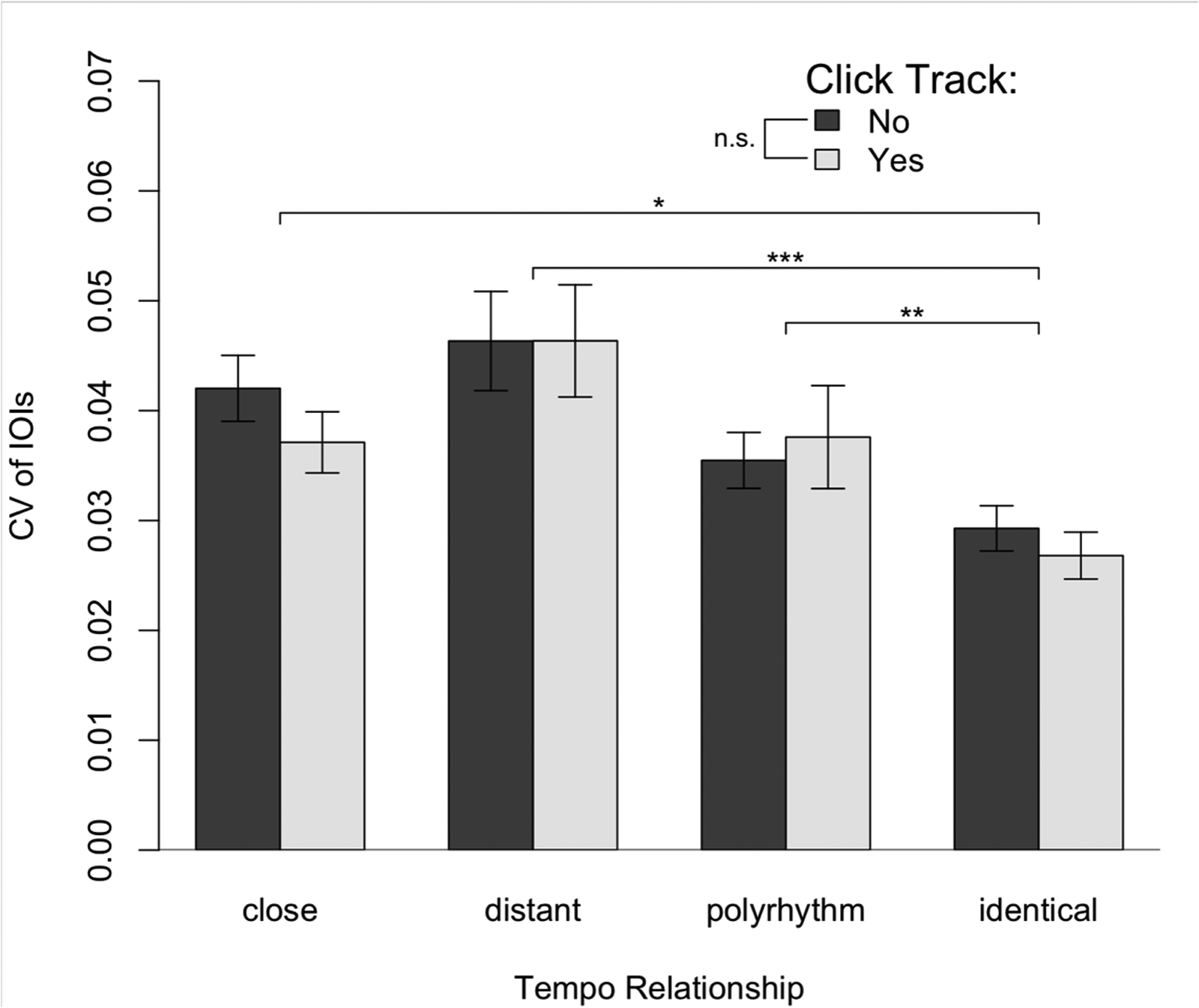
Effects of tempo relationship and click track on coefficient of variation of inter-onset-intervals. Error bars show the standard error. Black asterisks show significant differences (with * for p < .05; ** for p < .01; *** for p < .001).
Distant Tempi Induced More Tempo Change Than Close Tempi
We examined the effect of Tempo Relationship (identical, polyrhythm, distant, close) and Click Track (yes, no) on Absolute Tempo Change using a linear mixed-effects model with random intercepts for each musician.
The post-hoc Type II ANOVA test from the fitted model revealed significant main effects of Tempo Relationship (F(3, 178) = 5.14, p = .002, partial η2 = .08), and Click Track (F(1, 178) = 31.48, p < .001, partial η2 = .15), indicating that Absolute Tempo Change varied as a function of both factors. These main effects were however qualified by a significant interaction between our two factors (F(3, 178) = 3.82, p = .011, partial η2 = .06).
As shown in Figure 2, post-hoc pairwise comparisons revealed that, on the one hand, when they could not rely on a click track, musicians underwent more tempo change in the distant and close conditions as compared to the identical condition, and significantly more in the distant condition than in the close condition (see Table S2 in the Supplementary Material for the complete list of comparisons). Interestingly, no such difference was found between the polyrhythm condition and the identical condition. On the other hand, while the presence of the click track did not change the extent to which musicians underwent tempo change in the identical and polyrhythm conditions, it did make a difference in the close and distant conditions, allowing the musicians to remain closer to their initial tempo.
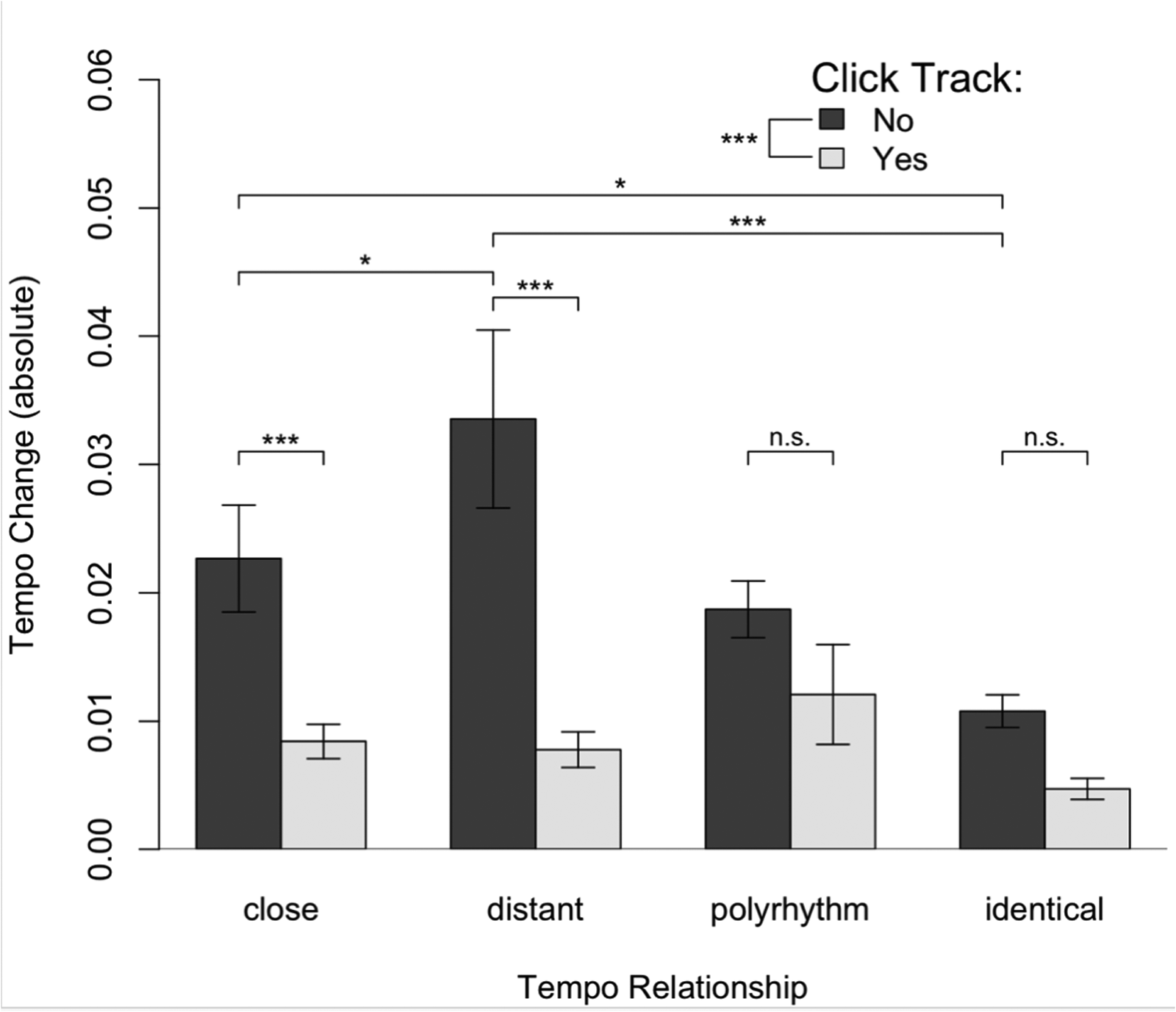
Effects of tempo relationship and click track on absolute tempo change. Error bars show the standard error. Black asterisks show significant differences (with * for p < .05; *** for p < .001).
The Ensemble Had More Trouble at Instantiating the Correct Tempo Relationships When the Musicians Performed at Distant Tempi
To assess how accurately musicians maintained the target tempo ratios as a group, we analyzed the Group Success Rate using a linear mixed-effects model with Tempo Relationship (identical, polyrhythm, distant, close) and Click Track (yes, no) as fixed factors, and trial as a random intercept. The post-hoc Type II ANOVA test from the fitted model revealed a significant main effect of Tempo Relationship (F(3,24) = 80.57, p < .001, partial η2 = .91), indicating that the group success differed substantially across tempo conditions. In contrast, there was no significant main effect of Click Track (F(1,24) = 0.17, p = .682, partial η2 = .007), and no significant interaction between our two factors (F(3,24) = 1.07, p = .379, partial η2 = .12).
As shown in Figure 3, post-hoc pairwise comparisons confirmed that the Distant tempo condition consistently resulted in lower Group Success Rates relative to all other tempo configurations (all p < .001, see Table S3 in the Supplementary Material for the complete list of comparisons). The Polyrhythm and Close conditions did not differ significantly from each other or from the Identical condition (all p > .31). The presence or absence of a click track did not significantly alter group performance within any tempo condition. Overall, these findings indicate that group accuracy in reproducing the intended tempo ratios was high across all conditions, but performance deteriorated substantially in the Distant tempo relationship condition, despite the intended tempo ratios being arguably less extreme than in the Close tempo relationship condition.
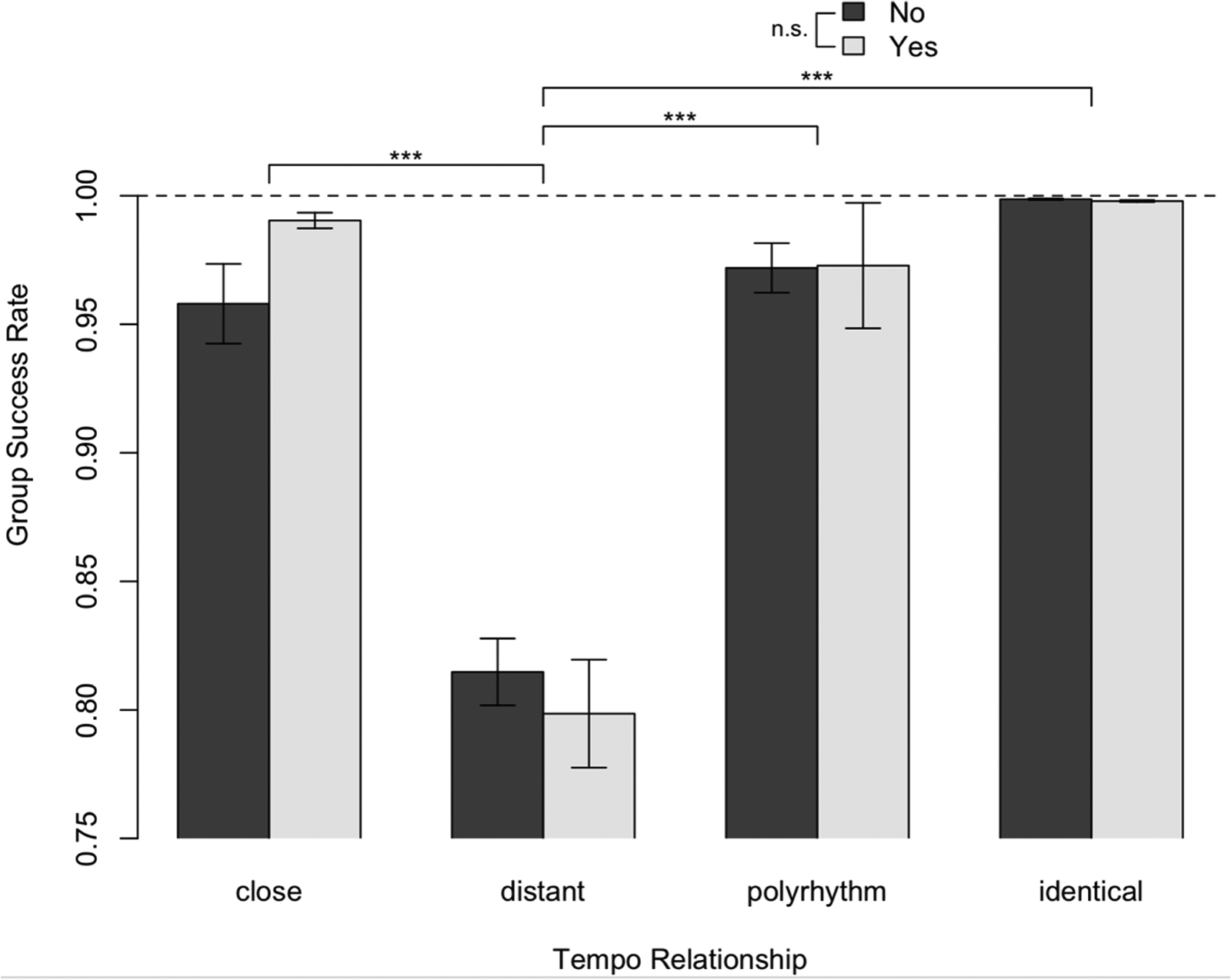
Effects of tempo relationship and click track on group success rate. Error bars show the standard error. Black asterisks show significant differences (with *** for p < .001).
Discussion
Polytempo music is arguably a highly demanding performance practice, as it requires musicians to intentionally desynchronize despite a strong and pervasive tendency to synchronize with one another. This challenge persists even for experienced performers (see Hartenberger, 2016; see also Hall et al., 2023, who found that performing a phasing task proved nearly impossible for some non-expert participants). To what extent, and under what conditions, can one maintain one’s own tempo without being drawn toward the tempi of the other musicians?
In this study, we focused on three main questions: First, to what extent are polytempi more challenging to perform than polyrhythms? Second, are some polytempo configurations easier to perform than others? Third, to what extent is the presence of an individual click track for each musician actually helpful?
Regarding the first question, our results show a consistent difference between polytempi and polyrhythms across our various metrics, particularly when performers could not rely on a click track. While there was often a difference between the identical condition (in which performers simply had to play at the same tempo) and at least one of the two polytempo conditions, there was never a difference between the polyrhythm and identical conditions. This suggests that, without a click track, performing a (relatively simple) polyrhythm is not significantly more challenging for expert performers than playing together isochronously. However, these results should be interpreted with caution, as the absence of a significant difference may also reflect limited statistical power.
Interestingly, in the polyrhythm condition, the tempi were never explicitly presented to the performers as forming a polyrhythm: They were simply instructed to maintain their own individual tempo, as in all the other conditions. However, given the simplicity of the ratios involved, it is likely that the musicians ultimately conceptualized their collective performance as a polyrhythm, effectively integrating their individual contributions into a shared pulse. This may explain the lack of observable difference between the identical and polyrhythm conditions.
That said, it remains an open question whether the differences in performers’ behaviors between the polyrhythm and polytempo conditions arise solely from differences in ratio complexity, or whether they also reflect higher-level processes – such as the emergence of a shared representation (e.g., a shared metrical framework) in one case but not the other. The latter possibility is especially plausible given the ubiquity of 2:3 and 3:4 polyrhythms (around which our polyrhythm condition was built), which are found across many musical traditions and genres. By contrast, the more complex ratios that often underlie polytempo performances are far less common. Future experiments that manipulate both the complexity of polyrhythms (e.g., by contrasting simple ratios such as 2:3 or 3:4 with more complex ones such as 5:3 or 7:5) and their framing (either as independent tempi or as subdivisions of a shared tempo) should help clarify this issue further.
Regarding the second question, we found that the “temporal stratification” paradigm – where individual tempi differ substantially – posed greater difficulties for performers than the “phasing process” paradigm, where tempi are close but not identical. Without click tracks, the musicians exhibited significantly more tempo change in the distant polytempo condition compared to the identical tempi condition. In contrast, the close polytempo condition did not produce significantly more change than the identical condition. As a group, the performers were also significantly less successful at instantiating the intended tempo relationship in the distant condition compared to all others, while their performance in the close condition did not differ significantly from the identical one.
These results contrast somewhat with findings by Repp (2006), who observed that participants had more difficulty maintaining their tapping tempo when exposed to metronomes playing at tempos very close to their own. Two factors may explain this discrepancy. First, our experiments involved six musicians playing simultaneously, unlike the pseudo-dyadic setups used by Repp. In the close condition, some participants had tempi that were not extremely close (e.g., 75 bpm vs. 85 bpm), exceeding Repp's identified 5% threshold for interference. This may have been sufficient to reduce mutual attraction effects. Second, the poorer performance observed in the distant condition (with increased tempo change and reduced success at performing the correct tempo relationship) may not reflect greater entrainment with others’ tempi but rather a more erratic and uncoordinated rhythmic behavior. However, our design makes it difficult to determine this, given the competing and potentially contradictory attraction forces potentially present in a six-person ensemble, as opposed to a dyad (in which one can only be influenced by a single other individual).
Still, why did the distant polytempo condition prove more difficult than the close one? This is particularly striking given that dynamical systems theory predicts synchronization in simple integer ratios to be more stable than synchronization in complex integer ratios (see Kim & Large, 2019, for a mathematical model; see also Treffner & Turvey, 1993, for experimental evidence showing that auditory–motor synchronization is more stable for lower-order polyrhythmic relationships). In our case, the integer ratios underlying the Distant condition were clearly simpler than those underlying the Close condition, and yet performance was poorer in the former than in the latter. One possibility is that the level of complexity was already so high in both cases – with ratios too complex to be mentally or perceptually integrated into a common metrical cycle – that the difference in ratio complexity no longer played a decisive role. This, in turn, suggests that polytempo performance may differ fundamentally from polyrhythm production, where simpler integer ratios are typically associated with greater performance stability. It also implies that some other mechanism may underlie the observed difference between the two polytemporal conditions.
A plausible mechanism is that, in the close condition, musicians could form a mental representation of the intended collective result (i.e., a gradual phasing effect), as well as of their own tempo's relationship to the others’ (i.e., nearly but not exactly the same). This representation may have served as a heuristic, allowing performers to regulate their actions at the group level and improve individual period correction – a process known to be highly intentional (Repp & Keller, 2004). It could also have facilitated the accurate prediction of the unfolding polytempo structure, thus making the perceptual processing of the situation less demanding (see Vuust et al., 2022). In contrast, such a heuristic was likely absent in the distant condition – for which no representation of the overall result was readily available; nor could the musicians have even a rough idea of how their own individual tempo was supposed to relate to that of their co-performers. Future studies could explore this by manipulating whether musicians are given a prior representation of the performance structure (e.g., via a score) and whether this representation is shared across the ensemble.
Another intriguing possibility is that, in the close-tempi condition, musicians’ onsets often fell sufficiently close in time to be perceptually grouped into the same “beat-bin” (Danielsen et al., 2023). Given our participants’ expertise in jazz and improvised music more generally, they may have interpreted such small asynchronies as instances of microtiming flexibility – something they routinely engage with and manipulate in their everyday musical practice, beyond the specific context of polytempo performance. Although this could, in principle, have reinforced a tendency toward mutual entrainment and led performers to become “locked” into a shared pulse, this is clearly not what occurred here. On the contrary, such a flexible conception of what constitutes a beat may have been advantageous, enabling the musicians to better navigate moments when their individual onsets became progressively closer in time.
As for the third question, we found that click tracks did not strongly affect the musicians’ overall performance. With click tracks, individual performers were not significantly more stable, nor were ensembles significantly better at establishing the prescribed tempo relationships. The only area where click tracks proved beneficial was in reducing tempo change, which was significantly lower in both polytempo conditions when musicians had access to them. Strikingly, the absence of a click track did not significantly reduce group success, although it led to greater change in the musicians’ individual tempi. This may suggest that the performers drifted in a coordinated manner, thereby preserving the initial tempo relationship. Conversely, the fact that the click track did not improve group success could indicate that, while it enhanced individual stability, it did so at the cost of reducing the musicians’ sensitivity to one another, yielding no overall benefit for maintaining the initial tempo relationship.
These findings may have practical implications for composers interested in exploring polytempo writing. Although click tracks are often the default solution, they can negatively impact both comfort and musicality – for instance, by limiting performers’ ability to hear and respond to each other's nuances in timbre, phrasing, and dynamics. Based on our results, click tracks may be most appropriate when absolute tempo precision is critical – such as when synchronizing with an external source. However, in situations where some tempo drift is musically tolerable, omitting click tracks might lead to a more natural and expressive performance. That said, it is possible that we did not observe a stronger effect of click tracks because the musicians were asked to perform only simple pulse patterns. Future studies should explore more complex rhythmic material at varying tempi, and more systematically manipulate both the internal rhythmic organization of the individual layers (e.g., isochronous pulses vs. repeated patterns) and the degree of homogeneity between parts (e.g., identical vs. distinct patterns).
This study has only begun to uncover the complex dynamics of polytempo performance. Much remains to be done to better understand how these dynamics interact not only with temporal and rhythmic parameters, but also with timbre, register, and ensemble coordination. Identifying the factors that shape performers’ ability to navigate polytempo music would be valuable not only for making this practice more technically accessible and encouraging further creative exploration by composers and performers alike, but also for shedding light on the broader cognitive mechanisms involved in resisting the seemingly inescapable tendency to synchronize with one another.
Supplemental Material
sj-docx-1-mns-10.1177_20592043261461470 - Supplemental material for An Exploratory Study of Polytempo Music Performance with Expert Musicians
Supplemental material, sj-docx-1-mns-10.1177_20592043261461470 for An Exploratory Study of Polytempo Music Performance with Expert Musicians by Clément Canonne, Arthur Faraco, Haron Dauvet-Diakhaté, Frédéric Bevilacqua and Thomas Wolf in Music & Science
Footnotes
Acknowledgments
We wish to thank the six wonderful musicians of the MilesDavisQuintetOrchestra!!! for their inspiration and their willingness to engage in our experiments.

Ethical Approval
Ethical approval for this study was obtained from the Psychological Research Ethics Board (PREBO) at CEU, Vienna, Austria All methods were carried out in accordance with their guidelines and regulations.
The experiment reported in this study was conducted in accordance with the Declaration of Helsinki and approved by the Psychological Research Ethics Board of Central European University (2023-39).
Informed Consent
All participants gave their informed written consent for the collection, use, and publication of data (audio files).
Authors Contributions
C.C. and T.W. designed the study. C.C., T.W., and F.B. collected the data. T.W., A.F., C.C., and H.D.-D. analyzed the data. C.C. and T.W. interpreted the results. C.C. wrote the manuscript. All authors reviewed the manuscript.
Funding
The authors received financial support from CNRS-MITI for the research, authorship, and/or publication of this article.
Declaration of Conflicting Interests
The authors declared no potential conflicts of interest with respect to the research, authorship, and/or publication of this article.
Data Availability Statement
Data and code are available here: https://researchbox.org/4873&PEER_REVIEW_passcode=WWHCOD.
Action Editor
Jessica Grahn, Western University, Brain and Mind Institute & Department of Psychology.
Peer Review
Rainer Polak, University of Oslo, RITMO Centre for Interdisciplinary Studies in Rhythm, Time and Motion.
Valentin Begel, Paris Cité University, Institut des Sciences du Sport Santé de Paris.
Supplemental Material
Supplemental material for this article is available online.
Notes
References
Supplementary Material
Please find the following supplemental material available below.
For Open Access articles published under a Creative Commons License, all supplemental material carries the same license as the article it is associated with.
For non-Open Access articles published, all supplemental material carries a non-exclusive license, and permission requests for re-use of supplemental material or any part of supplemental material shall be sent directly to the copyright owner as specified in the copyright notice associated with the article.
