







Abstract
Adopting primarily content analysis, the paper collected, through sampling, a total of 1088 articles on Beijing from 18 English-based mainstream Western media between 1 January 2004 and 31 December 2014. The analysis covered article number, subject, style and report direction. Extending on such basis, in-depth semi-structured interviews were conducted with nine foreign correspondents stationed in Beijing, who come from the United States, the United Kingdom, France, Germany, the Netherland, Italy, Japan, Malaysia and Brazil. A survey was also carried out among foreign correspondents based in Beijing, so as to obtain a general view of the international image of Beijing and its evolution as shaped by foreign media. The mechanisms adopted by foreign media in shaping the image of Beijing and the influencing factors were also analysed.
Introduction
Following the continuously rising national power and international influence of China in recent years, the number of coverage of China by Western mainstream media is gradually on the rise, and the Chinese capital, Beijing, also features with greater frequency in foreign media. Fortune China published the latest Fortune 500 1 list on the evening of 20 July 2016 (Beijing Time); among them 58 of the corporations have their headquarters in Beijing, far exceeding the 25 and 6 in New York and Hong Kong. According to the latest statistics of Hurun Report, 2 compare to only 95 in New York, about 100 billionaires (in USD) currently reside in Beijing, which offers a glimpse of the international economic status of Beijing. Nevertheless, despite its economic development and achievements along with its profound history and culture, Beijing remains the ‘fastest-growing giant with deep-rooted complex of cultural inferiority and mechanistic problems’. 3 Does the wealth advancement of a city lead to an improved image among the media? As the capital of the People’s Republic of China and the state’s political and cultural centre, how has the foreign media changed in terms of intensity, width and depth over the past decade when they see Beijing? How have the economic, political and cultural images of Beijing, as portrayed by Western mainstream media over the last decade evolved? What are the influencing factors behind them? What mechanisms are at work as foreign media shape the images of Beijing? Such are the issues discussed in this article.
To a great extent, the knowledge the public has towards the outside world comes from public media, particularly for unfamiliar international topics. Doubtlessly, as a ‘relayer’, foreign media plays a critical role in communicating the international image of a city (Bai, 2013). In addition to experiencing at first hand or through social communication, the perception a foreigner has for Beijing mostly comes from the image as described and constructed by the local media. Urban image is the sub-system of the national image (He, 2010), and, as a component of a nation, is a part of the overall national image. Since Beijing is often regarded as the synonym for China among foreign media, any opinion that the international community has towards Beijing ultimately affects the shaping of China’s international image, the formation of international opinions and the development of diplomatic relations.
Literature review
Media can ‘produce’ a city; mass media reflects, constructs or reproduces a city (Huang, 2015). During the shaping of the image of a city, as the fourth estate of society, mass media is an agent and bridge that communicates such image. It provides the public with an information communication channel and an image feedback vessel to understand the image of a city. Reviewing existing literature, recent academic studies in urban image may primarily be divided into the following three perspectives.
First is the business marketing theory as found in economic studies, whereby business theory is combined with the construction and communication of the urban image. The image is promoted through commercial means using business brand and regional marketing (Chen, 2011; Li, 2010). Second is the study of the relationship between media and urban image from the perspective of journalism and communication. The first principally focuses on the exploration of the basic theory in urban image communication (Chen, 2009; He, 2010). Some studies believe that as the imaginary industry of society, mass media plays a pivotal role in healing a ‘fractured’ city and cultivating cultural identification (Yuan, 2013). The second explores the communication of an urban image through major events. For example, Feng (2012) organised ‘urban media events’ based on factors such as internal factors of the urban image, events of media relations, uncontrollable media, media logics and daily media relation events. In response to these factors, he offered corresponding operative recommendations to effectively communicate the urban image (Feng, 2012).
Currently, fewer studies dedicated to the urban image of Beijing are conducted from the perspective of journalism and communication. Among existing research, one adopts the angle of cultural study to explore the old Beijing in contrast to the ‘modern Shanghai’, such as Beijing’s ‘image as an ancient capital’ (Zhang, 2007). After going through the image of Beijing in the old days and following the reform in the mass media, Zeng (2013a, 2013b) believes media debate remains rife, whether it is the disappearance of the ‘old Beijing’, the building of a ‘new Beijing’, the cheering and criticism for Beijing’s modernisation, the country-like or modern Beijing or the urban preservation or renovation of Beijing. Some scholars research the image of Beijing from a Western perspective and discuss the image of Beijing from a historical and cultural angle from a Western perspective. As the Western superpowers open up the gate of China and foreigners flood Beijing, works observing, touring and studying Beijing continue to be produced to become ‘international Beijing studies’ (Ouyang, 2008). Some scholars even focus on cultural symbols such as hutongs of Beijing (Zhang, 2015), while others explore the culture of the city through film and television subjects (Zhang, 2016). Another adopts empirical research, whereby the communication channels that international audience came across and used as they learn the image of Beijing are studied, such as the English Audience-Based Research and Analysis on Media Choice and Use Behaviour during the International Communication of the Urban Image of Beijing (Zhao & Li, 2015). The third adopts the angle of the brand image of Beijing and explores, for instance, the interaction between the brand image of Beijing and its communication (Yang, 2014).
Literature analysis reveals the majority of current research in the external communication of urban image to be qualitative. Among a few of quantitative research, the focus is mostly on a particular foreign media and lacks an overall diachronic analysis on national media from different countries, and here is where the article therefore sets itself apart.
Research methods and results analysis
English is no doubt the most common and influential language in the West. Adopting primarily content analysis, the paper collected, through sampling, a total of 1088 articles on Beijing from 18 English-based foreign media between 1 January 2004 and 31 December 2014. In terms of media selection, the Roster of Foreign News Agencies in China, issued by the Department of Press Relations of the Ministry of Foreign Affairs of the People’s Republic of China, was used as the sampling frame and non-probability sampling adopted. The sampling standards for media include print media in English, have correspondents based in Beijing, wield a certain influence and being representative in China. Meanwhile, the sampling covered media from different areas in the world, media from developed and developing countries and different media types, such as newspapers and magazines, major general newspapers, financial newspapers and tabloids. In all, 18 media from 7 countries were eventually selected including the United Kingdom, the United States, Australia, Canada, India, Singapore and Malaysia. Among the selected media, their reports on Beijing as found on their English official website between the period 1 January 2004 and 31 December 2014 were collected. During sampling, reports using Beijing to refer to China or the central government instead of focusing on the city itself were eliminated, thus giving rise to the research sample of 1088 articles. Attention must be drawn to the fact that some media websites perform database updates, and as a result fewer older reports in general remain while more recent reports may be found, which may in turn have a certain impact on sampling. Nevertheless, upon comparing to other sampling methods, such as sampling based on full newspaper texts in a database, the error had little impact on the overall effectiveness of the samples. The basic data of the article was compiled by three researchers, and the intercoder reliability was 0.93 based on the Holsti formula, which satisfied the requirement of content analysis.
To observe the mechanisms adopted by foreign media in shaping the image of Beijing, the article conducted in-depth semi-structured interviews between October and November 2015 with nine foreign correspondents stationed in Beijing from the United States, the United Kingdom, France, Germany, the Netherland, Italy, Japan, Malaysia and Brazil. The content of the interviews covered three areas: background information, news practice and occupational understanding. Each interview lasted between 30 minutes and 1 hour, and some were recorded. Among the interviewed foreign correspondents, four work for newspapers, three for television stations, one for a magazine and one for a news agency. These reporters have relatively extensive experience in the industry with the average years of working being 17.8. Some have only being in Beijing for under a year, while others have been in Beijing for over two decades. It may therefore be said that our samples cover quite an extensive scope to cover reporters from different countries and media, and our conclusion drawn is therefore comparatively more representative. In addition to the in-depth interviews, we conducted survey among Beijing-based foreign correspondents. Due to the small number of foreign correspondents based in Beijing and their high turnover, the mailed survey had a low response rate. Only 10 valid surveys were collected, which were not enough samples to carry out independent analysis. Nonetheless, the design of the survey and the interviews share a certain similarity and proved to be of a certain value, when supplementing and contrasting with the interview results.
Analysis of change in the number of reports on Beijing by foreign media between 2004 and 2014
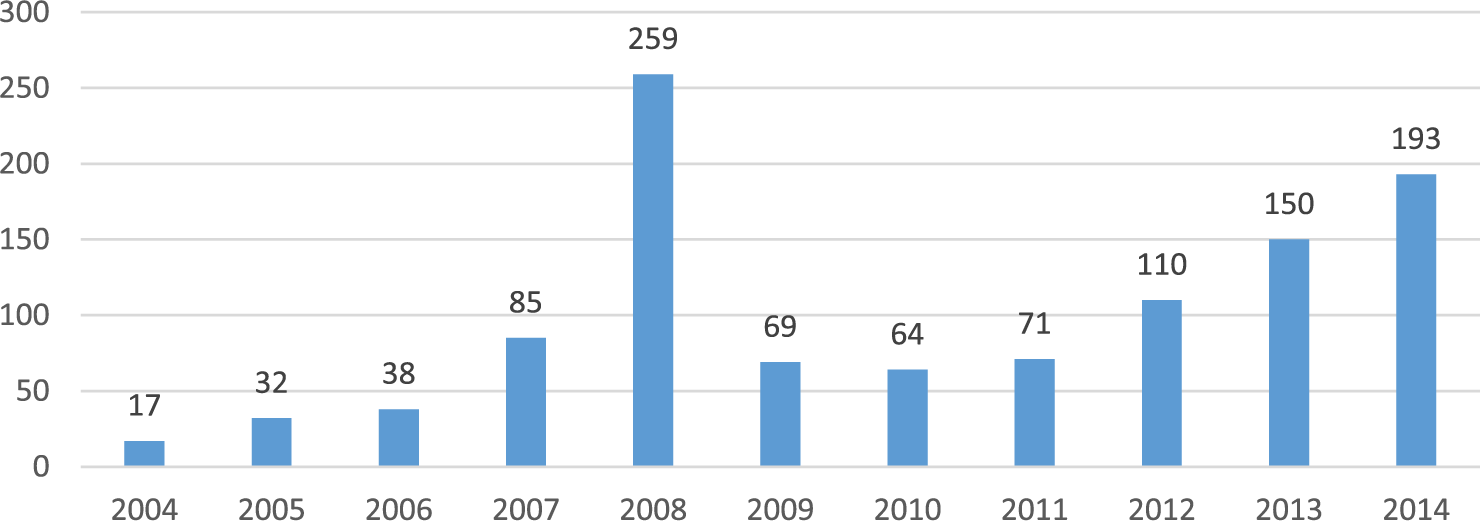
Figure 1 demonstrates that only 17 articles from 2004 were found among sampled media, and the figure increased significantly in 2007. The amount of coverage soared drastically in 2008 and then nosedived in 2009. The figure remained stable for the next 2 years until 2012, when it rose noticeably. In terms of the overall figure, the coverage of Beijing by foreign media may be divided into three phases: 2004–2008, 2009–2011 and 2012–2014, each of which had their characteristics. The two visible inflection points in 2008 and 2012, which saw soaring coverage, corresponded to the political, economic and cultural events that happened in Beijing at the same time.
Coverage of Beijing by foreign media between 2004 and 2014.
The first phase (2004–2008): Following the continuing greater extent of China’s opening up, its capital in turn attracted greater international media attention and began to enter international spotlight. Figure 1 illustrates that although the number of foreign media coverage between 2004 and 2006 remained low, it was nevertheless on the rise. A significant increase in coverage was noted in 2007. This was partly due to the impending Beijing 2008 Olympic Games, whose venue maintenance and construction and safety checks were the focus of media coverage. Another reason being that with the hosting of the Olympics, a more open policy for foreign media management was introduced in 2007, and the direct result was the rising number of media coverage. The foreign media attention on Beijing reached its peak in 2008. That was, on the one hand, due to the staging of the Games, while, on the other hand, due to the Tibet unrest on 14 March and Wenchuan Earthquake on 12 May, which drew extensive international coverage. Although Beijing was not the place where the above incidents took place, as the national capital, the political and cultural centre and the Olympic host city, it nevertheless drew attention due to heightened overall national exposure among foreign media.
The second phase (2009–2011): The number of coverage of Beijing among foreign media dropped, but the total number was still higher than the earlier years during the first phase. This meant an overall increase in attention on Beijing by the foreign media following Beijing 2008 Olympic Games.
The third phase (2012–2014): A significant and consistent increase in the number of coverage of Beijing by foreign media was noted during this period. That is, foreign media coverage of Beijing was rising stably over the years. 2012 might be regarded as yet another inflection point in the image of Beijing and even China: The staging of the 18th National Congress of the Communist Party of China and the 21 July 2012 Beijing flood, which generated wide coverage from media both at home and abroad. Moreover, following the rapid development of the country, environmental issues are becoming more pronounced. The smog and sandstorm in Beijing in recent years have become yet another extensively discussed topic among foreign media.
In general, foreign media’s coverage of Beijing showed a rising trend between 2004 and 2014, and the number of articles may broadly be divided into three stages. The drastic increase in the amount of coverage in 2008 and 2012 was closely related to major events and hot topics in Beijing in recent years, not to mention having to do with changes in policy managing foreign media and the context in which the news occur. The overall increase in the amount of coverage of Beijing by foreign media may be attributed to contemporary factors such as China’s enhanced overall national and international status.
Topic preference analysis of foreign media
The fundamental function of media is agenda setting (McCombs & Shaw, 1972). It does not tell people ‘how’ to think but rather ‘what’ to think most of the time. Analysis of main topics covered by foreign media revealed ‘what’ of Beijing they talked about and which aspects they focused on or overlooked when shaping the image of Beijing. The article explored the subject preference of foreign media when they covered Beijing from three dimensions, namely the intensity, depth and width of the topics, which were measures using three indices: Intensity is measured in the number of articles on any topic of Beijing; depth is measured in coverage format of the topics and width is measured in frequency analysis to explore whether the scope of topics covered foreign media was broad, comprehensive and diverse.
Topic intensity analysis
We have categorised the subject of all 1088 articles when analysing the topic preference of foreign media when covering Beijing, which included politics, economy, society, sport and culture, ecology and others. Among them, the political and economic topics covered only issues in Beijing and not the macro-political and economic issues of China. Social topics included education, safety, transportation, urban construction and social security. Sports and cultural topics comprised all types of cultural events, with the majority being related to Beijing Olympic Games, while ecological topics related mainly to air and water quality.
Table 1 demonstrates that with a total percentage of 30, social topics occupy a significant percentage among the subjects covered by foreign media, followed by ecological subject at 23%, sports and cultural subject at 19%, political subject at 14% and economic subject at 10%.
The number of different subjects.
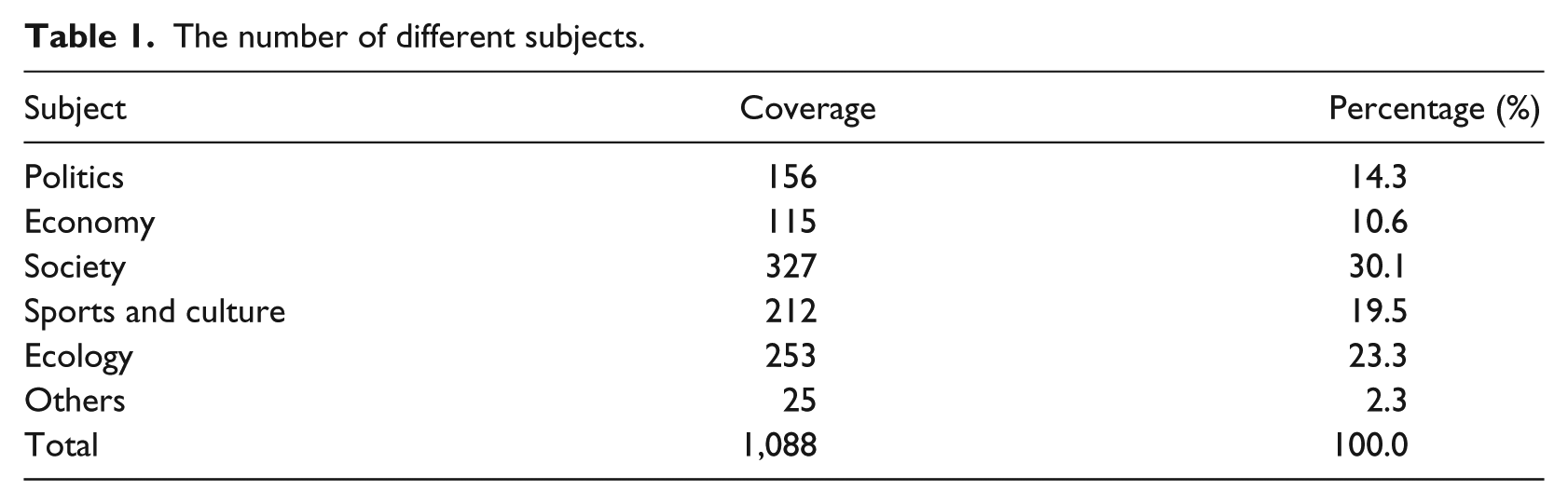
One of the reasons that social subject occupied a significant percentage is because it covers a wide range of topics. Moreover, it is closest and most directly related to the life of foreign correspondents based in China. Most of the foreign reporters mentioned during their interviews that the press release system in China was inadequate, and the news published often had little value. Consequently, they preferred to select topics that they discovered during their stay in Beijing. Many foreign reporters based their observation and coverage of the Chinese society on Beijing. As the capital and cultural and political centre of China, the overall appearance and social incidents of Beijing affect the perception that foreign media has for the image of China.
It is worth noting that among the topics favoured by foreign media ecology occupied a second place, and for a topic with such a narrow scope it should not generate so much attention under normal circumstances. The focus of foreign media in the ecological topic is Beijing’s air pollution. The problem emerged during 2008 when the Olympics took place in Beijing. Back then, foreign media doubted whether the city was able to provide athletes with good air. PM2.5 and fog haze become the topics extensively covered by foreign media after 2012. How the foreign media favours the ecological topic indicates, on the one hand, that ecological and environmental issues in Beijing have reached a critical stage, while, on the other hand, they are problems that directly impact the life of these Beijing-based foreign reporters. Furthermore, a sort of a connotation exists behind such issues. That is, China is suffering from the reckless growth at breakneck speed, which is partly why foreign media focuses on Beijing’s ecological issues.
Occupying the third position is the coverage of sports and cultural topics by foreign media. Foreigners have always perceived China as a country with profound history and culture. As the ancient historical city and cultural centre of China, the cultural connotation of Beijing has come to become its key image. The attention on the cultural topics of Beijing by foreign media should inspire us to exploit the cultural connotation in shaping the image of Beijing. Of course, many of the reports from the sports and cultural topic were related to Beijing Olympic Games, whose boost to city’s international image is evident. Regardless, sports and culture is an advantage and resource that may be exploited in communicating the image of Beijing.
At fourth and fifth positions, political and economic topics received relatively less coverage among foreign media. This may be due to that foreign media are more interested in the macro-political and economic issues of China as a country, and consequently reporting less frequently on the municipal level, which has lower news value anyway. When covering the political and economic issues in Beijing, foreign media tend to revert to the social aspect, which makes the coverage more appealing, and may also be attributed to their coverage preference.
Topic depth analysis
The format and size of an article often reflect the depth of the coverage. News is often short, concise and timeous, and its adoption reflects the time significance of the story. Correspondence, in comparison, as a key format of coverage breathes life into a story. Features and interviews cover the story in greater depth compare to the first two formats, and are relatively weaker in terms of immediacy. We have divided the sampled reports into six formats, namely news, correspondence, features, interview, review and others. The comparison of the choice of different formats further illustrates the means of how foreign media construct the image of Beijing.
Table 2 demonstrates that, at a total of 39%, correspondence was the most commonly adopted format in the coverage of Beijing. This indicates that instead of the simple communication of a news story, foreign media preferred more comprehensive and in-depth coverage.
The number of different story formats.
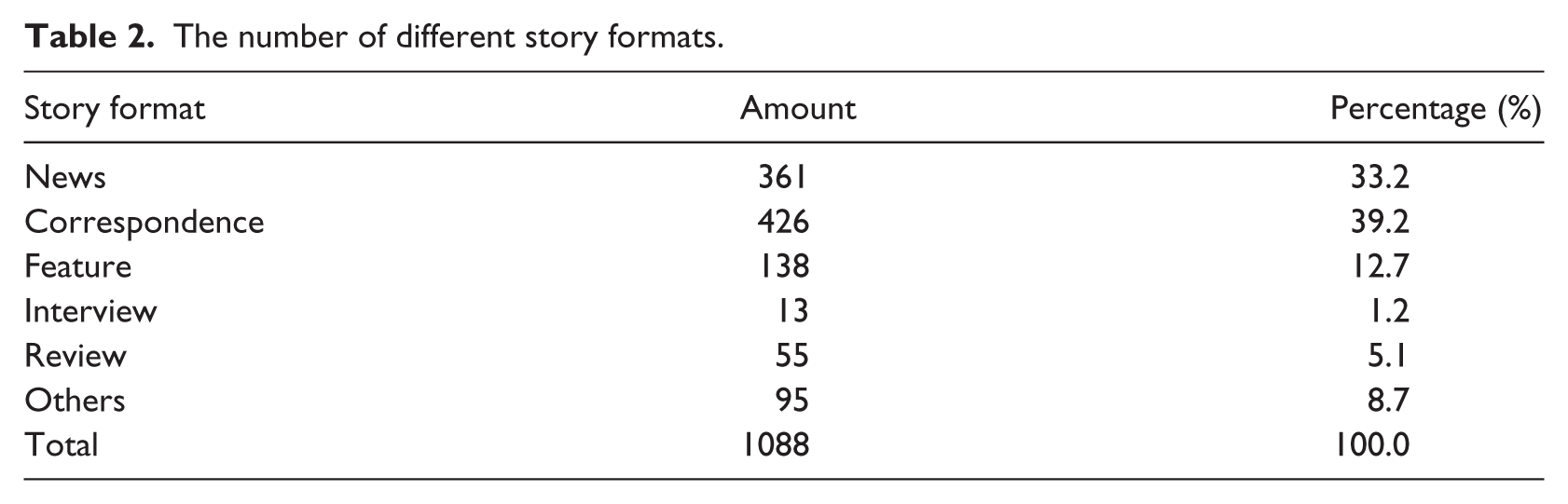
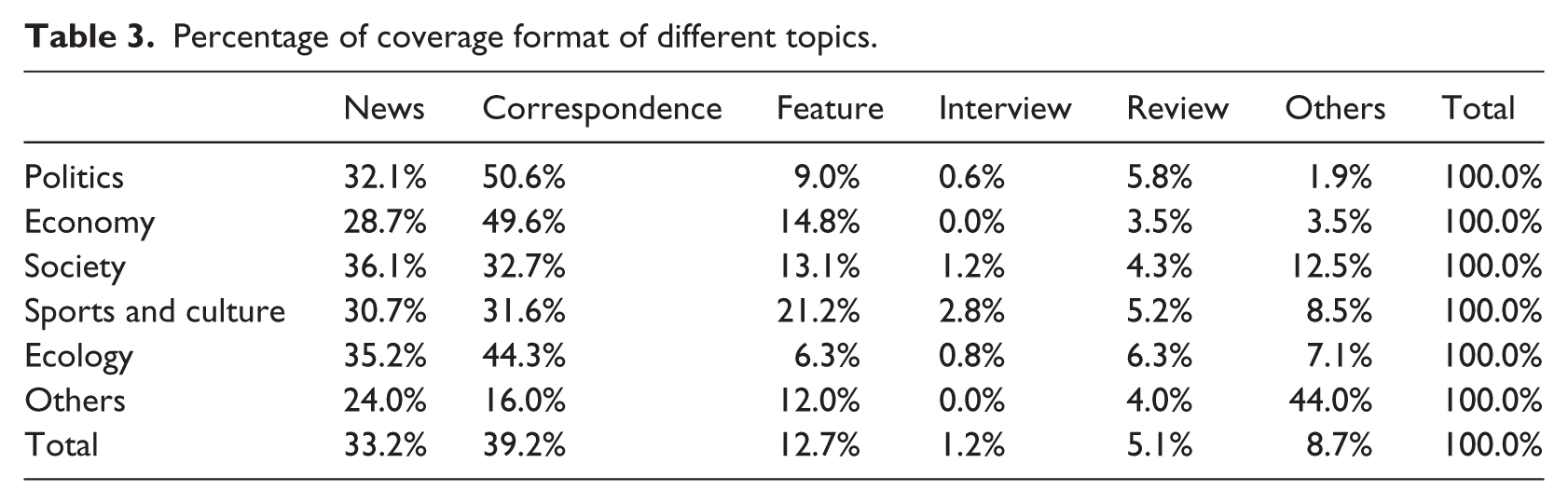
Table 3 illustrates that among coverage of political and economic topics, the format of correspondence occupied 50.64% and 49.57%, making it the key coverage format. Despite the amount of coverage of social topic, the main format adopted is that of short and concise news, which occupied 36.1%. Although social topic of Beijing may be widely covered by foreign media compare to political and economic topics, the latter two stood out in terms of coverage depth. It may therefore be said that political and economic topics occupy greater importance than that of social, particularly when communicating to elite. In-depth correspondence reports are more likely to influence the image of Beijing. In terms of the ecological topic, the format of correspondence reached 44.27%, signifying the relatively in-depth exploration in the issue in China by foreign media. In addition to the great intensity, ecological topic enjoyed in-depth in coverage, which has produced critical influence on the image of Beijing. In comparison to other topics, the coverage of sports and cultural topic adopted mostly the feature format. The characteristics of such format are primarily description, which extracts the parts, sections or details most able to reflect the uniqueness or essence of the story. It is therefore more detailed and vivid compare to other formats, and can achieve better results when covering sports and cultural topic.
Percentage of coverage format of different topics.
Topic width analysis
The width of the topic refers to its scope of coverage. In analysing the width of topic in foreign media’s coverage of Beijing, we wanted to examine whether the image of Beijing created was diverse and whether stereotypes or shortcomings existed. While uncovering ‘what’ the foreign media covered, it is more import to reveal ‘what was left out’.
Frequency analysis of sample reports (Table 4) revealed that foreign media demonstrated great consistency in frequently used words in their coverage of Beijing, which means homogenisation was happening in their coverage. Words such as air, pollution, government, people and Olympics appeared with the highest frequency, and may almost be considered the top 10 words used by the media. They also reflect the three core topics involved in foreign media’s coverage of Beijing: air pollution, government–people relations (or the role played by the government) and the Olympics. The three topics were interrelated to form a basic structure involving a series of related reports. While covering the preparation for Beijing Olympic Games, air quality was a major topic, which remains so even today. As the haze problem continues to plague the nation, they have escalated to become a key topic. When reporting the topic, how the government handles the air pollution, what role it plays and what government–people relations is being reflected evolve into new core topics, which link to issues of transportation and public health control by the government.
Top 10 words used by six mainstream media in their coverage of Beijing between 2004 and 2014.
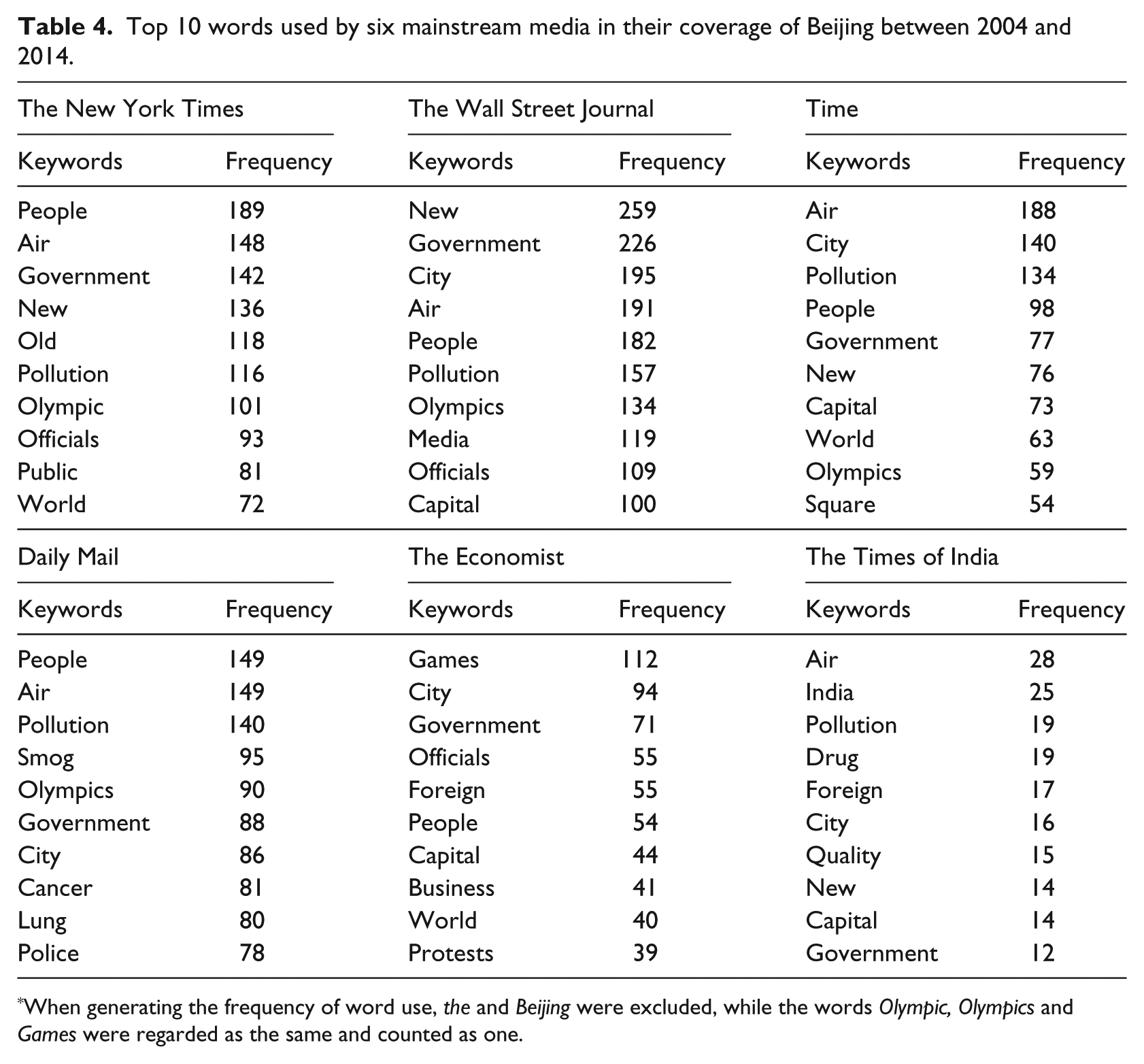
When generating the frequency of word use, the and Beijing were excluded, while the words Olympic, Olympics and Games were regarded as the same and counted as one.
Apart from the three major topics, other high-frequency words included city, capital, new and world, which illustrate the great attention from foreign media on the development of Beijing as an emerging internationalised city. The word ‘new’, in particular, means the development trend of Beijing is on the rise and ever changing. Moreover, the frequently used word ‘officials’ reveals that officials are one of the key sources of news for foreign correspondents based in Beijing. When Beijing wants to speak out to the world it needs to first speak to foreign media, and to do so the officials need to speak first. It is therefore necessary to optimise the handling of media by these officials. They need to learn how to speak to foreign reporters instead of simply being evasive or waffling. In fact, research and interviews with foreign correspondents stationed in China confirmed the above point. These reporters remarked that Chinese officials remained a highly desirable new source. However, in handling interview requests these officials were very bureaucratic and reluctant to speak. Consequently, the reporters had to resort to ‘interviews with those outside of the system and they often have something to complain about’.
A certain discrepancy actually emerged in the frequently used words in the coverage of Beijing by some media. For example, as a more business-oriented media, the word ‘business’ appeared The Economist’s coverage. The Daily Mail, as a tabloid, used frequently the words lungs and cancer and often link air pollution to lung cancer. For a serious broadsheet, the New York Times adopted even more sensational coverage and words to draw readers’ attention. Times of India, in comparison to international mainstream media from the United Kingdom and the United States, often connects issues in Beijing in its coverage with those at home, thus ‘localising’ international news and winning over Indian readers. The word ‘India’ therefore was its most frequently used word.
Subtopic analysis
To examine subtopics concerning Beijing in greater detail as reported in foreign media, we have selected articles from Time magazine and conducted cloud analysis on the words used to uncover the subtopics. The results are visualised as below. Greater font size represents higher use frequency in the reports.
Figure 2 demonstrates that the Olympics and air pollution were two of the key topics in Time’s coverage of Beijing, which to a great extent cause foreign readers to connect both the Olympics and air pollution with Beijing, thus forming stereotypes. Furthermore, in terms of politics, ‘protest’ was a key subtopic. It is thus evident that the vocabulary of Time actually highlighted the aspect of political conflict in Beijing. Economically, factories and development were key subtopics. They show Times striving to maintain the stereotype of Beijing and China’s growth being secondary sector-dependent and reckless, while remaining inadequate in subtopics concerning the tertiary service sector such as emerging and financial industries. Socially, key subtopics included police, security, houses, road and cars. Vigorously, attempts were made to shape an image of Beijing as full of social conflicts and crammed roads and houses, while its public infrastructure, health and medical treatment, social welfare and people and customs remain inadequate. In terms of sports and culture, apart from the Olympics, some popular subtopics were schools, art and music. The international image of Beijing as a cultural city is clearly recognised. However, a huge gap exists in the science and technological innovation scene.
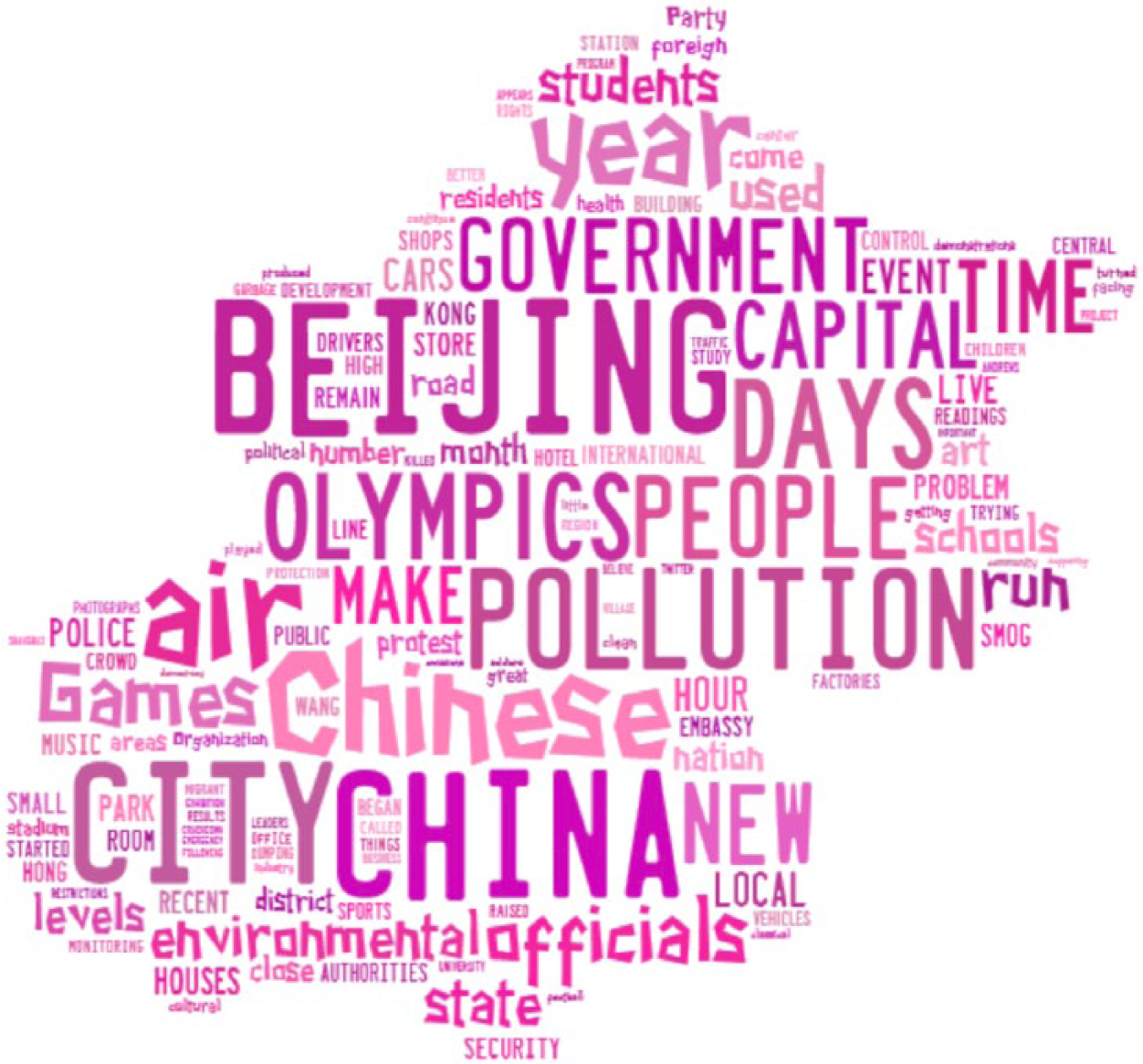
Cloud analysis of words used in Time’s coverage of Beijing.
In summary, the width of topics of foreign media’s coverage of Beijing remains limited and shows strong signs of homogenisation. Some topics were over-covered, such as ecological and environmental topics, while others remain under-covered, including the economic topic. An agenda must be actively set up to shape a more multidimensional and diverse image of Beijing, while pointing some of the blind spots in the coverage by foreign media to eliminate stereotypes (Figures 3 and 4).
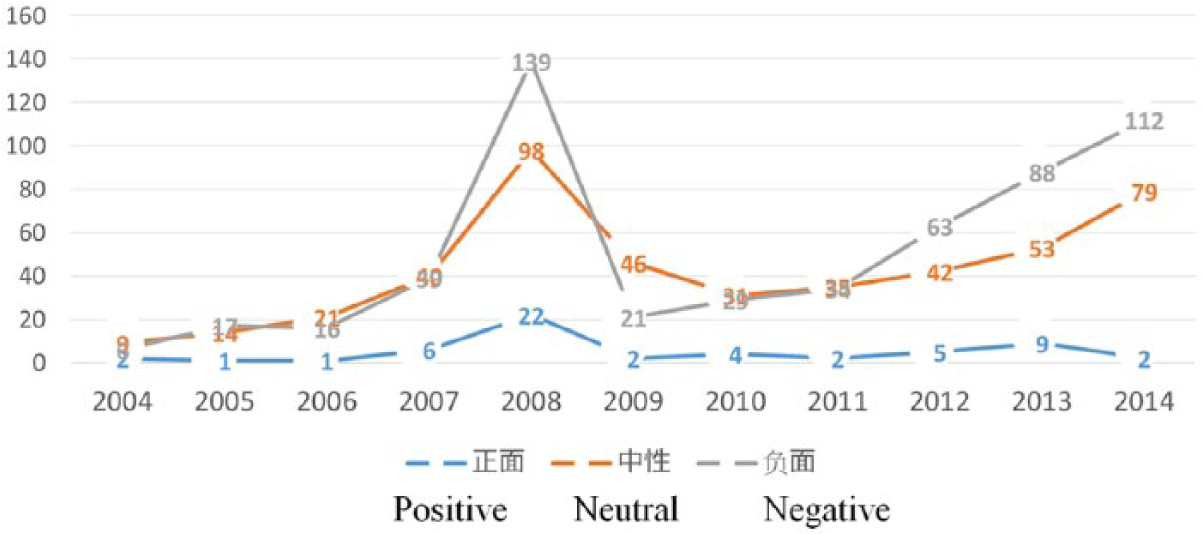
Coverage direction from 2004 to 2014.
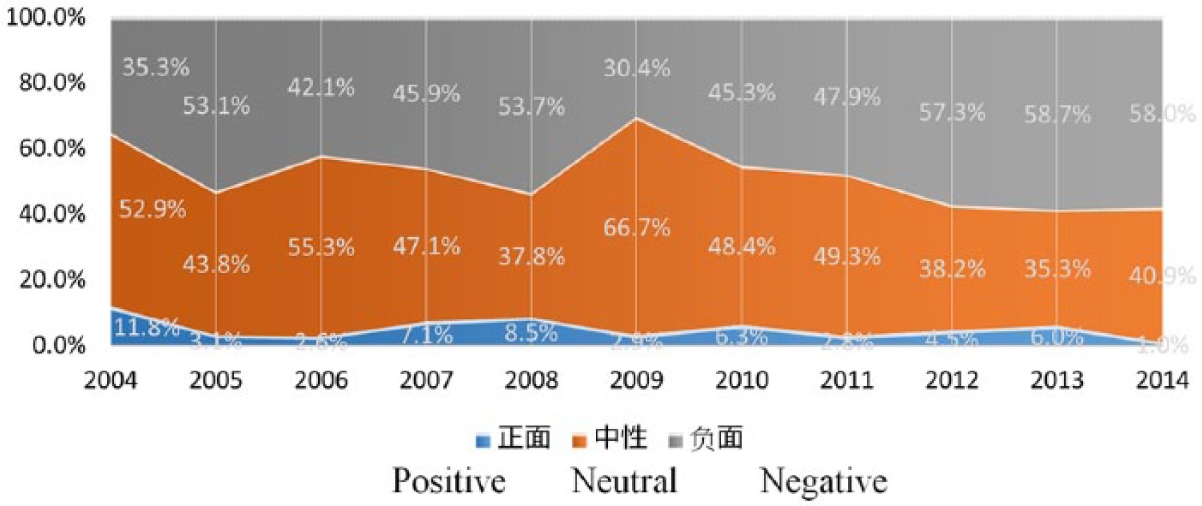
Percentage of different coverage direction from 2004 to 2014.
Coverage direction analysis
The analysis of the direction of foreign media’s coverage of Beijing offers a glimpse of the change in Beijing’s image and the constructed image. A general classification shows foreign media’s coverage to have included every aspect, be it politics, economy, culture and society, which basically covered every aspects of China. In terms of coverage direction, it is mostly negative and neutral. Considering the neutral coverage by foreign media is mostly based on negative materials, it may therefore be concluded that their coverage of Beijing is more negative than positive.
The number of coverage by foreign media rose steadily between 2004 and 2008, whereby the percentage of neutral and negative coverage remained more or less unchanged, while positive coverage were few and far between. The number of neutral and negative coverage grew rapidly after 2011, with the latter rising higher to 1.5 times more than the former. Positive coverage, in comparison, remained relatively low and showed no sign of going up. As Mikhail Gorbachev once said, ‘Any event, be it the pain of today or a tragic historical incident, can all become analysis subject of the newspaper’. The smog and ecological issues of Beijing since 2012 and a series of control measures for culture and ideology have all become the focus of negative coverage by both domestic and foreign media.
Summarising the above analysis, we are able to establish the norm found in the vocabulary that foreign media used to describe Beijing. Although referred to as the norm, it is not completely static and stable. It fluctuates through the progress of time and is affected by factors such as changes in China’s conditions and international status and changes in the environment in which the stories take place. The vocabulary also differs among foreign media. The occurrence of major events often becomes a critical point in which the norm that is the image of Beijing changes. Among the changes and differences, the following characteristics may be summarised:
Generally speaking, as the international status of China rises, so does foreign media’s attention on Beijing. This is particularly evident when some major international events take place in Beijing, then the city comes under international spotlight. Beijing 2008 Olympic Games marks a classic time point, at which the attention of foreign media on Beijing peaked. Exploiting such opportunity for external communication will amplify the effect in shaping the image of Beijing.
In the vocabulary of foreign media, the image of Beijing has become one-sided. Too much focus on the ecological topic and too little attention on the economic topic, which lead to a one-dimensional and one-directional image of Beijing. The partial image will easily lead the audience to produce a skewed connection that in turn becomes a stereotype.
Homogenisation exists in the image of Beijing shaped by foreign media. Although nuances were found among the images produced by media from different regions and countries, they remain highly consistent in general. That is, an ever-changing city developing at breakneck speed, which in turn gives rise to issues such as congestion and environmental pollution.
Among the different aspects of the image of Beijing, its cultural image has to be the most successful. Within the vocabulary of foreign media, Beijing is recognised as a cultural capital. Moreover, the focus has extended from the unique oriental tradition and culture to some modern and international cultural phenomena. News of the clash and integration of Western and Eastern civilisations is of particular interest to foreign media. Nevertheless, inadequacies exist in the shaping of the cultural image, where a large gap is found in science and technological innovation.
Among the different image aspects of Beijing, that of the economy fades almost into the background. Beijing has failed to appear as an economic centre among the descriptions of foreign media, which has well with its current positioning to do. The lack of attention on the economic topic may not be taken lightly, as this has led to the other topics from coming back as an attack on the economic topic. For instance, ecological topic has been placed at the top and the cause of environmental pollution has been attributed to the reckless economic growth. Consequently, development of Beijing’s tertiary service sector such as the high-tech and cultural and creative industries has overshadowed, while the reality of an economic structural transformation overlooked.
Analysis of the mechanisms and factors involved in shaping the image of Beijing by foreign media
We shall further discuss why the image of Beijing is as it is as described by foreign media after having analysed their vocabulary. Which factors influenced the shaping of such image? And how? What mechanisms did foreign media adopt in shaping the image? We have adopted comparative analysis in the exploration of the influencing factors and mechanisms. Obviously, the image of Beijing shaped is entirely different among different reporters, media and countries. We believe that international relations, media attributes and the personal news practice and ideals of Beijing-based foreign correspondents are influencing factors in shaping such an image. Analysis of the mechanisms was therefore carried out from these three aspects. Moreover, China’s policy controlling foreign media, environment in which the stories take place and information offices all are influential in the generation of the image of Beijing among foreign media.
The national factor
Differences in degree of attention
The influence of national factor on the image of Beijing foremost reflected on the degree of attention. Table 5 shows that, overall speaking, British and American media placed greater attention on Beijing. The average number of articles on Beijing published by British media was 92.7, which is higher than the 70.2 of the American media. That means as two of the most influential media of the West, that of the British had greater coverage of Beijing than its American counterpart. In comparison to the British and American counterparts, the coverage by Australian media dropped drastically, with an average number of 27.5 articles. Media from Malaysia, Singapore, India and Canada all showed relatively low interest in Beijing and similarly low amount of coverage.
Coverage of Beijing by media in different countries.
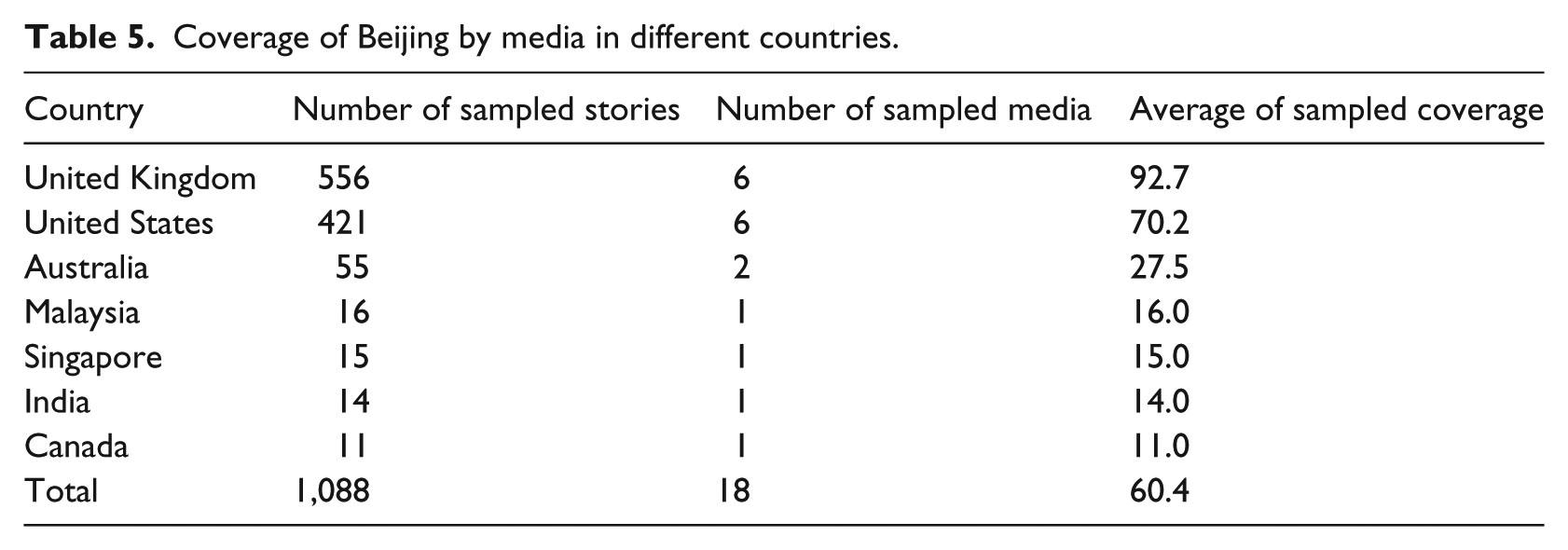
The difference in the degree of attention on Beijing by media from different countries was fundamentally determined by the national status and international relations. As the world superpower, the descriptions of UK and the US media naturally occupy top global positions. The two countries pay far greater attention to international affairs compare to the others, and it is only natural that they notice the emerging power that is Beijing in the international scene. The British media placed greater emphasis on Beijing compare to that of the United States may, on the one hand, be due to the all-round strategic partnership between the United Kingdom and China, while, on the other hand, American citizens traditionally pay little attention to international affairs, which led to rather localised report practice. The extent of attention from Australia, Malaysia, Singapore, India and Canada was determined by the following factors: first is trade relations. Australia and China have always maintained a close economic partnership, and China has since then become Australia’s biggest trade partner and main investor. It is only therefore normal that Australia is interested in China and Beijing. Second is cultural distance. Both Malaysia and Singapore have a large Chinese-speaking population and are closely knitted to the Chinese culture. As a result, they have an interest in China. Third is geographical closeness. Comparatively speaking, Malaysia, Singapore and India are countries neighbouring China and therefore geographically close to China. Canada may have a huge Chinese-speaking population, but is farther from China and thus has lower than expected interest in China.
Differences in coverage direction
In terms of coverage direction (Figure 5), media from Malaysia, Canada and Singapore tended to publish more positive stories. These countries have a higher number of Chinese-speaking population who can identify better with Chinese culture, the reports were more positive. Due to the sense of competition that always exists between India and China, coverage by Indian media tended to be more negative. Coverage of Beijing by British and American media tended to be more negative than neutral or positive. The former, in comparison, tended to be more negative, which may have to do with the attributes of the media sampled. Among the sampled British media is the tabloid Daily Mail, whose reports tend to be more sensational to attract readers.
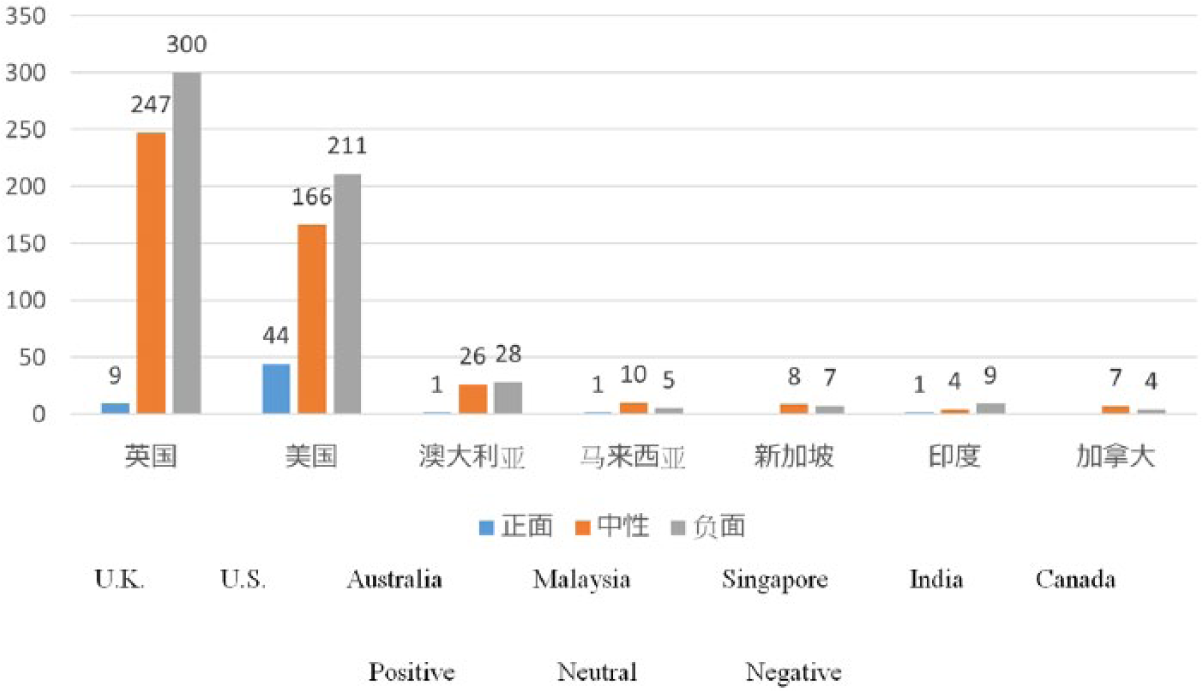
Coverage direction of media from different countries.
News generated discrepancies
Obvious discrepancies exist in the image of Beijing shaped by foreign reporters from different countries. For example, a reporter from an America paper explained during the interview that Americans were not interested in affairs outside the United States. However, those who were would be interested in China, so he only had to add the word ‘Beijing’ in the introduction of his report to guarantee its popularity. That may have to do with the power struggle between the United States and China. Both he and another reporter from a UK media mentioned that among the British and American audience, a strong-rooted stereotype of China existed. On the one hand, they believed China is a rising threatening power; on the other hand, they regarded China as a police state controlled by a higher authority. Such a stereotype, to a great extent, arose from the enormous gap between Western and Chinese ideology, while the rise of China is threatening the status of the United Kingdom and the United States as the traditional superpower. Such status quo led British and American reporters to interpret events based on the relations among the superpower as they shape the image of Beijing. Moreover, that caused their audience to understand the reports based on existing ideological frame of mind. As the American reporter remarked, most readers were single-minded. It would be very difficult to change their stereotypes of China and Beijing. However, non-Western countries have very different impressions of China. For instance, a Japanese reporter commented that his impression China is strong nationalism, which was determined by Sino-Japanese relations. When Japanese reporters come across terms such as the Chinese dream and China on the rise, they automatically interpret them as an expression of nationalism. Developing countries such as Brazil and Malaysia share better impressions of China and emphasise more on the collaboration with China instead of the differences in ideology. The Malaysian reporter said she often covered topics of Chinese and Malaysian collaboration, such as the ‘One Belt, One Road’, communication between China and Malaysia in education and the high-speed railway of China. She hoped to benefit both parties through such reports.
Organisational factor
Topic differences
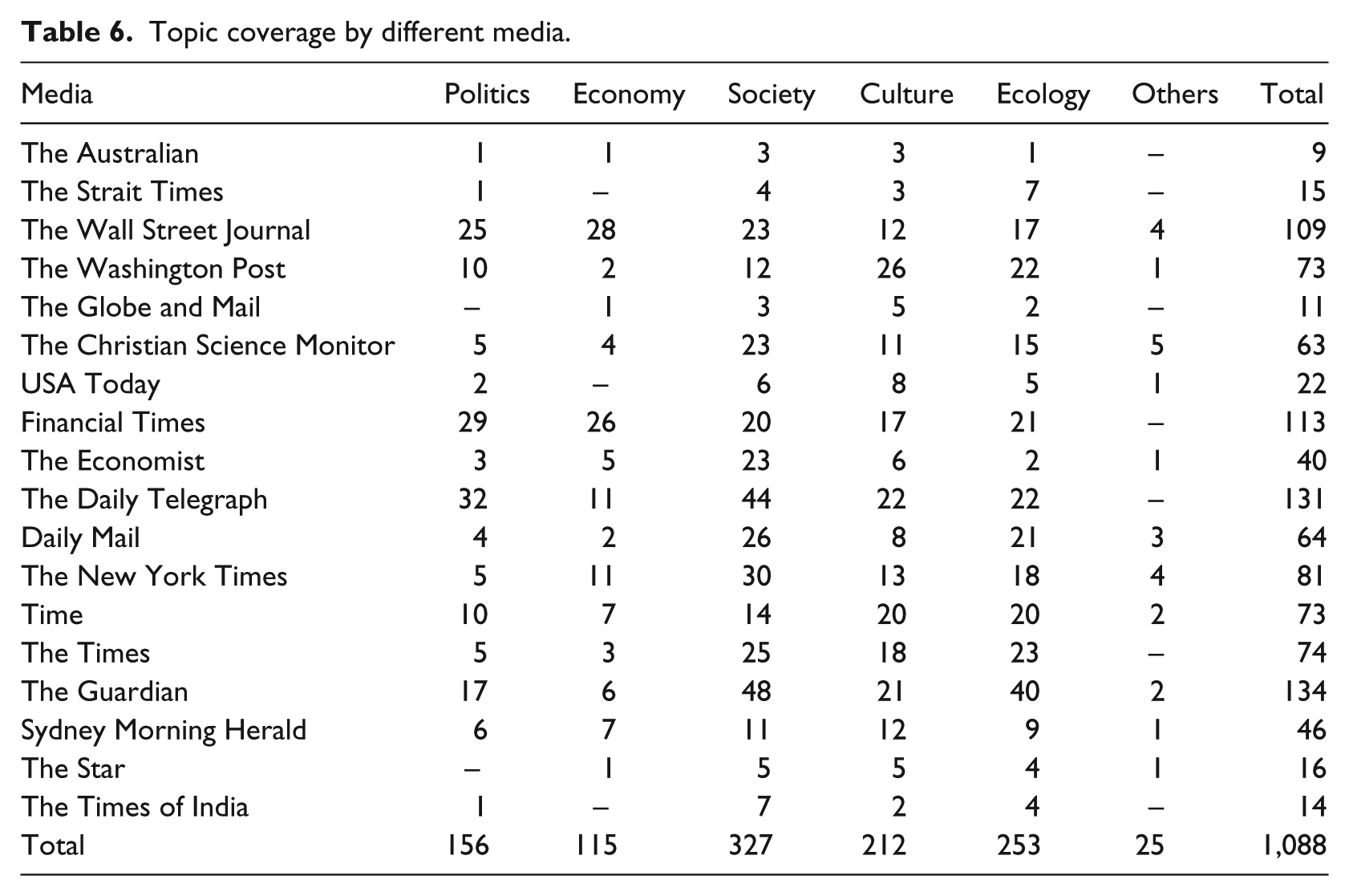
Different media organisations place different emphasis on their choice of topics when covering Beijing. Table 6 illustrates that the Wall Street Journal and Financial Times, the financial media, are most interested in the economic topic, while The Guardian, the noted liberal media from the United Kingdom, has a far greater interest in social and ecological topics compare to other media and topics. Comparing the serious broadsheet the Wall Street Journal and the typical tabloid Daily Mail, it is clear that the former has a better distributed number of topics, while 70% of the coverage from the latter concerned social and ecological topics and touched little on serious topics such as the politics and the economy.
Topic coverage by different media.
Discrepancies in news production
Among the countless studies of ‘newsroom observational research’, the standardisation and normalisation of the process of news production were explored (Gans, 1979; Tuchman, 1978). Organisational discrepancies may also be glimpsed from during the interviews and research, as foreign correspondents shaped the image of Beijing, which primarily arose during the process of news production. In terms of topic selection, correspondents stationed in Beijing possessed greater decision-making power. The process often involved the Beijing-based correspondents submitting a list of topics to their headquarters, but the final decision-making lay in the hands of the reporters. Although the headquarters might draw the attention of their Beijing-based correspondents on certain newsworthy topics, the final decision still lay in the hands of the reporters. Television reporters, in comparison, possessed relatively less power in decision-making. A television reporter told us during the interview that he recommended most of the topics of his coverage to the headquarters, which then determined if the topics would be adopted. Most of the time his job involved persuading the headquarters of the newsworthiness and competitiveness of the stories on China, and hoping that the stories would be chosen. Another television reporter told us that 70% of the topics covered were determined by him, while the other 30% were assigned by the headquarters. In contrast, topic selection by Beijing-based correspondents was primary and bottom-up. Media organisations bestowing the power of decision-making to its correspondents stationed in Beijing demonstrate greater originality in their coverage of Beijing, which is closer to the situation on the ground and has a more unique perspective. As the judgement of topics by headquarters were often not onsite, the interviewed reporters told us, the topics proposed were mostly those of certain appeal and came from other channels, such as other media. When the decision on topics lies in the hands of the headquarters, their coverage of Beijing may conform more to the agenda of mainstream international media. Such cross-reference among international media results in the homogenisation of their coverage of Beijing. This also serves as a reminder that when we want to actively communicate to international media, we must pay more attention to setting up an agenda that is similar to mainstream international media such as The New York Times and CNN. These mainstream international media are able to set up the agenda of other international media, which could as a result magnify the agenda.
Another organisation discrepancy in the coverage of Beijing among foreign media is the coverage tempo. Two major factors influence news: one is socio-political power, and another is the emphasis of news organisations on efficiency (Gans, 1979). With only a limited amount of time allowed to cover a story, reporters can only resort to the ‘most accessible’ and the ‘most usable’ information sources. To a certain extent, information sources define news content. Official information sources set up the agenda for reporters, while interviews with scholars and experts often become a part of the expected coverage. A foreign correspondent working in a daily paper repeatedly stressed the issue of timeliness. He complained about the slow process of the Chinese government departments in dealing with interview requests, which very often led to timeliness being lost by the time he received an answer. As a result, instead of depending on official foreign information sources, China-based reporters more often conducted the interviews based on their writing assumptions and received relatively little influence from the Chinese government. Among our interviewees, one is a professional sports correspondent, who enjoyed greater collaboration with the external publicity departments of China than with other foreign correspondents. This is not only due to the topics of his coverage are mostly not politically sensitive, but also because the press release and interview invitation from the publicity departments to him are targeted and provide the exact information he seeks. Furthermore, regular and consistent communication with government departments allows a mutual relationship of trust to be easily formed.
The individual factor
We have discovered during our interviews that foreign correspondents displayed high consistency in their positioning. That is, they tended to see themselves as an interpreter or explainer. They believed their audience had little understanding of China and were steeped in stereotypes. It was therefore their professional role to explain and illustrate China to their audience. All of them emphasised the objectivity of their coverage but at the same time admitted that they were no robots and could not achieve absolute objectivity. Evidently, Beijing appears differently for different reporters. It may not be said they all see it through tinted spectacles as they shape its image, but it is inevitable that they bring their personal mark. Such mark stems from their cultural backgrounds, personal experience and value, which consequently results in individual discrepancies in their coverage of Beijing.
The correspondents stationed in Beijing form a rather complex and diverse group that may at least be divided into two types of people: one has already learned Chinese and about the country before travelling to China, or has already lived in China for a couple of decades and speaks fluent Chinese and may almost be regarded as half Chinese. The other knew little about China and observes and covers China relying on the professional sensitivity comes with being a reporter. The former is able to acquire more first-hand information due to the language advantage and discover more unique and primary topics. These people also have a better understanding of China, and are able to provide a better context and see things from the Chinese perspective when covering China. The observation and understanding of China of the latter often relies on an interpreter. During our interviews with them, they mentioned that they often depended on English media for topics. That means, their agenda is more than often being set up by other media, such as China Daily and other mainstream international media.
Another critical individual discrepancy among foreign reporters is reflected in cultural background and ideology. Most of the Beijing-based correspondents admitted during their interviews that cultural backgrounds affected a reporter’s coverage of Beijing. However, they stressed they eliminated the ideological bias when reporting. ‘Although ideological discrepancies exist between the West and the East, but we (foreign reporters) are not here to judge the Communist Party, rather we try to explain the differences’. Nevertheless, some foreign reporters remarked that the coverage of certain reporters was indeed affected ideology, leading them to actively look for negative stories instead of the positive. ‘They have a sense of mission to change China’. Some foreign reporters have Chinese background, such as being a quarter or half Chinese. Given their cultural background, these reporters are more likely to accept Beijing and Chinese culture. We have also discovered through the interviews that they have a more positive impression of Beijing, which is reflected in their coverage.
Huge discrepancies also exist among the personal experience of these Beijing-based correspondents. Personal experience here refers to these reporters’ professional experience. Some of whom started off as freelancers and have spent a relatively longer period in China. They have a better understanding of the country and usually write in-depth reports. When China comes under international spotlight, and China-based reporters have limited resources, these freelancers become the much sought-after first-hand perspective providers. Some Beijing-based correspondents have extensive professional experience in being based abroad and were previously based on the Americas, Europe and the Middle East. They often become the opinion leaders among the reporters stationed in Beijing and possess extensive contacts and resources. With their experience, they also are better able to deal with foreign governments. Some reporters, before being assigned to Beijing, had never been based abroad, and would adopt the advice given by their peers upon arrival. For instances, a reporter commented that when he first arrived in Beijing, a peer told him that ‘letter of introduction’ was the secret weapon for reporting in China. He had not come across any obstacles during his coverage in Beijing but had heard of complaints from reporters from other countries. Such information did, to a certain extent, affect his perception of the news environment of China.
Overall speaking, Beijing-based correspondents form a complex group that may not be generalised. We have discovered, during our research and interviews, that most Beijing-based foreign correspondents demonstrate relatively higher journalistic professionalism. Instead of ‘turning China upside down’ through their own value and standards, they place great emphasis on objectively explaining China and Beijing. They are no enemies of China, on the contrary, as mentioned by more than one foreign reporter, if it was not for their love for China, they would not have stayed on for so long. Most foreign reporters demonstrate profound interest and feeling for China, and some already have their families in China and become half Chinese.
Shortcomings of the study
As an exploratory research and primarily the adoption of descriptive statistics, the study analysed the basic characteristics and development trend of the coverage of Beijing by mainstream foreign media between 2004 and 2014. Further studies may combine statistics of word-use frequency, text analysis and framing. Analysis may be conducted on text source, page position and topic framework, while exploring in-depth issues such as ‘taking whose side’ and ‘the burden of interpretation’. In addition, the arrival of the Internet age has brought tremendous changes to the external communication of image. The international image of a city is created through multiple means apart from media. The observation of the communication of Beijing’s image among foreign interpersonal networks and organisations is also a critical component in the construction of its international image.
Footnotes
Funding
The author(s) received no financial support for the research, authorship and/or publication of this article.