







Abstract
Contrasting existing scholarship in ‘socialism with Chinese characteristics’, this article builds on the theorisation of infrastructural capitalism as an emerging global-capitalist project entangled with both China’s state-socialist ideology and the latest nationalistic revitalisation agenda, serving both political and commercial goals, yet also rendering discontent and resistance in daily business and employment practices. Through participant observation across 13 Alibaba departments or subsidiaries, semi-structured interviews with workers in Alibaba and other Chinese platform companies, and the analysis of corporate documentation and media reports, our ethnographic study highlights the ‘physical and digital (phygital)’ nature of infrastructure, and theorises how discursive, symbolic, and sensorial techniques are adopted to direct and sustain infrastructural capitalism in daily organisational setting through three unique mechanisms: public-private partnerships, corporate prosumption networks (CPN) and imagineered global competition. This article’s key contributions are threefold: to dissect the intertwined discursive, symbolic and affective mechanisms through which the ‘invisible’ infrastructures of capitalism are made ‘visible’ and ‘sensible’; unpack the variegated impacts and inherent dilemmas of infrastructural capitalism; and reimagine the possibility of individual resistance and systemic transgression.
Keywords
Introduction
While the nature, mechanism and impacts of capitalism have been widely discussed since it became a dominant global system in the 19th century (e.g. Arvidsson, 2020; Baran & Sweezy, 1966; Foster & Clark, 2020; Harvey, 2010, 2018; Li, 2016; Mandel, 1978; Polanyi, 1957), this article particularly looks into how
But infrastructures do not just become (hyper)visible through media propaganda. In this article, we demonstrate the discursive, symbolic and affective mechanisms through which the ‘invisible’ infrastructures of capitalism are made ‘visible’ and ‘sensible’, manifesting their political power within an organisational setting: the material objects, symbolic icons, cartographic scales, or even (pre-)cognitive sensations that further reinforce President Xi’s state-socialist ideology and fuel infrastructural capitalism in China’s platform economy. Rather than essentialising a Chinese capitalist model with its exclusive characteristics, we foresee these hybrid modes of infrastructural control and the counter-infrastructural resistance of workers in today’s China are also relevant for comparative studies in other developed or developing countries.
‘Because the basic object of infrastructure is so diverse and can be analysed in so many different ways, the choice of methodology is a theoretical question’ (Larkin, 2013, p. 338). An ethnographic study of how Alibaba – debatably the most powerful and exemplary tech giant in China – enables us to theorise infrastructure not only as ‘things’ but also ‘the relation between things’. Amid the ongoing US–China rivalry, Belt and Road Initiatives (BRI), and global technological competition, Alibaba – as a monopolising capital – is both operated under a capitalist logic and discursively regulated by the state under a new political logic (Tse & Li, 2023). The platform giant synchronises discursive, symbolic and sensorial techniques in its business, employment and corporate training practices to render the capitalist infrastructures visible, sensible and affectual, with its ultimate goal of achieving capital accumulation, labour extraction/exploitation and reiteration of state-power, and reproducing capitalist social relations and inequalities. By tracing how various types of infrastructural power are formed, enacted and sustained through material objects, symbols and sensorial experiences, we elucidate its
Of infrastructural capitalism: physical, digital, human
Complementing the concept of ‘state capitalism’ (Hung, 2015; Peck & Zhang, 2013), ‘party-state capitalism’ (Pearson et al., 2021) and ‘petty capitalism’ (Zhang, 2019) which analyse the transformation of the Chinese economy, infrastructural capitalism encapsulates the more intricate processes sustaining the rapid and ongoing expansion and reproduction of capitalism in China in specific sector or industry. Infrastructures can be both physical and digital (the term ‘phygital’ was first used in describing interactive/immersion marketing techniques; for details, see: Wang, 2023), tangible and intangible, ‘hard and soft’, ‘lightweight and portable as well as heavy and fixed’, accelerating new logics of capitalist production and consumption (Peters, 2015: 32–33). Comprising material, digital and human infrastructures, infrastructural capitalism emphasises how the global upswing of digital capitalism (Arvidsson, 2020; Fuchs and Mosco, 2015; Plantin & De Seta, 2019; Schwarz, 2019) and an unprecedented development of database economy structures for ‘monetis [ing] the Internet’ (Cubitt, 2014: 188), still largely base on the vast, complex, and costly material infrastructure, often ‘backed by states or public-private partnerships that alone process the capital, legal, or political force and megalomania to push them through’ (Peters, 2015, p. 31), with its power enacted and further reinforced by and through social interactions.
Within the Western academic discourse, various notions of digital capitalism exist. For instance, Cubitt (2014) argues in the age of ‘database economy’, social media has become an ideal medium for exploiting unpaid affective labour among ordinary users. The originally decentralised structure of digital space – from Yahoo!, Amazon, Google and Facebook has now become hypercentralised making sociality profitable (Plantin et al., 2018; Romele & Severo, 2016, p. 48). Using Facebook as a case, Schwarz (2019) further conceptualises a shift in forms of capitalist accumulation in the digital production of social life itself, in which ‘the economic, the political, and the cultural increasingly overlap’ (Hardt & Negri, 2000: p. xiii). He discerns an increased governability of online interaction across firms in digital capitalism, a new capacity to extract surplus value from such social interactions as a ‘generalised social capital’. Traditionally not monitored by corporations, the online social interactions are now translated into content and data to simultaneously attract audiences and be sold to advertisers, adding to 98.3 percent of the tech giant’s revenues in 2017, totalling 15.9 billion US dollar (Schwarz, 2019, p. 121).
Another specific form of digital capitalism amid the global ‘platformisation’ of work has also been widely investigated (Van Dijck et al., 2018). In specific industries such as ride-hailing, food delivery and gig work (Vallas & Schor, 2020; Veen et al., 2020; Wood et al., 2019), various digital platforms are strategically adopted by major capitalist corporations to take advantage of the massive amount of worker and user data collected for work performance surveillance and capital exploitation, exemplifying macro-structural shifts towards ‘platform capitalism’ (Srnicek, 2016) or ‘platform capitalisms' across different geocultural contexts (Steinberg et al., 2024). In the case of China, Zhang and Chen emphasise the importance of paying attention to the historical and geographical specificities of platform capitalism (Zhang & Chen, 2022). Cao (2019) also describes the rise of interactive streaming platforms, distinct from the North American model of digital capitalism or platform capitalism, disguises its exploitation of intellectual and technological labour of online platforms as the oxymoronic ‘free labour’ – the extremely active Chinese online users ‘who depend on social networks for “leisure”’ (2019: 11). However, none of these studies clearly showcase (i) the state-corporate relations, (ii) the technical interfaces between the two (or more) infrastructural systems, and (iii) their discursive, symbolic and affective intersections with a context-specific approach. The electrical power grids erected across the continent facilitating internet access, the underground and submarine broadband fibre cables enabling transnational digital data transmissions, or the remote supercomputer terminals and server rooms that support the cloud storage ‘in the air’, are both infrastructural ‘things’ and ‘relations between things’ playing a pivotal role in conditioning digital or platform capitalism.
The upsurge of infrastructural capitalism in China is intertwined with its own historical trajectories and changing logic of political power and national security, and has a strong nationalistic disposition. China’s infrastructural capitalism is increasingly built on the production of both physical and digital infrastructures either spearheaded by or aided significantly by the Chinese state, aiming to produce short-term profits as well as long-term conditions of capital accumulation inside and outside the country. In 2013, the Chinese government introduced the contested BRI, initially promoted as a revival of ancient trade routes including 140 countries all over the world. Over the past decade, we witnessed a frenzy of BRI-related, highly visible Chinese infrastructure and construction projects across various Asian and African continents. Since 2020, there are also signs of further Chinese dominance of global manufacturing during the pandemic (Hessler, 2021).
Other exemplary examples of China’s infrastructural-capitalist expansion comprise the emerging China-Russia ‘Internet sovereignty agenda’ in opposition to the technological hegemony of the United States (e.g. the East-East cyber-alliance in the case of China’s Baidu and Russia’s Yandex, see Budnitsky & Jia, 2018), or the ‘techno-nationalist’ infrastructuralisation of digital platforms as a counter-Western-capitalist strategy (e.g. the case of WeChat [Tencent], see Plantin & De Seta, 2019). It can also be understood as a response to the ‘ethno-nationalist’ cultural logic of late capitalism in the world of Trump and Brexit (Rasmussen, 2018). Michael Mann argues that the modern state ‘penetrates everyday life more than any historical state, and that the state’s infrastructural power has increased enormously’ (Mann, 1984, p. 189). Underlying these ‘progressive’ infrastructural projects, there are discursive dynamics synching nationalistic sentiments and neoliberal market values together – a blend of political power and economic force in the making of global infrastructural capitalism, as also exemplified in other capitalist and post-socialist societies (Biao and Lindquist, 2014; Larkin, 2013; Rao, 2023). Multi-scalar and multi-faceted operation of capitals notwithstanding, as a mode of production, infrastructural capitalism serves a totality encompassing both the concrete infrastructures of roads, cities, plants and buildings, electrical grids, high-speed railways, logistics transportation, computer servers and cabled telecommunications networks (Cubitt, 2014) – with itself linked to extractive capital in China and overseas, and their intersections with digital infrastructures of E-commerce, banking and financial systems, social and digital platform economy, and internal communication that increasingly take advantage of the physical as well as human infrastructures, discursively control the economic, social and affective lives of individuals, families and communities.
Methodology
Alibaba’s 13 units participating in the AGD program in 2018.
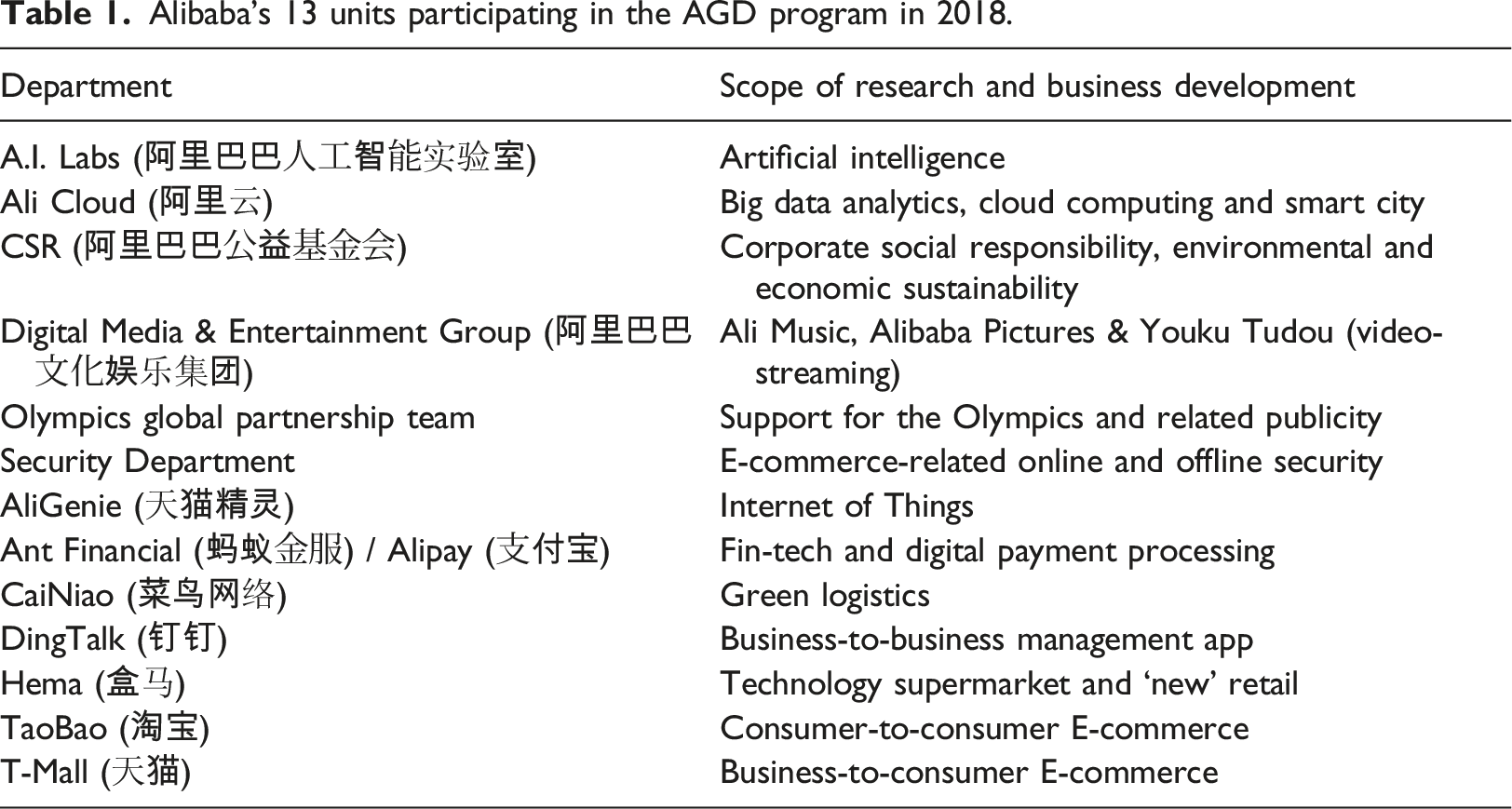
With the rapport developed through the AGD training, the researcher subsequently revisited Alibaba’s headquarters in Hangzhou in 2018 and 2019, conducted semi-structured interviews with 15 workers in Alibaba and other technology companies, in addition to further informal conversations with Alibaba workers in their natural environment. On those visits he participated in workers’ work and leisure activities, witnessing how the workplace culture was constituted and contested through encounters and interactions with specific digital and physical infrastructures and through organisational norms and work practices.
Field notes were written up daily during the AGD program’s corporate talks and training sessions and 426 photographs were taken to comprehensively record site visits. All of the subsequent interviews (n = 15) were recorded and transcribed in full. To ensure anonymity, all informants were given pseudonyms with their personal identifiers altered or removed. In developing this article, selected quotes were translated into English and all of the interview responses and field notes were coded. The first round of open coding was a spontaneous process during which various themes and keywords were generated. In the second round of axial coding, existing themes were reorganised into selective codes to serve the discussion of this paper: (1) Senior managers’ and workers’ responses on the role of state, corporate finance and corporate governance in conditioning and consolidating public-private partnerships for infrastructural development, (2) Alibaba’s creation of a ‘seamless’ corporate prosumption network within China, and (3) a paradoxical entanglement of peer and global competition as part of the ‘national revitalisation project’ and as the gamified aspirations and moral obligations of employees. The visual and textual content of all of the photos was captioned and classified based on a list of recurring, organically-generated themes.
Three mechanisms of infrastructural capitalism
Public-private partnerships: The role of state, corporate finance and corporate governance
In 1995, Jack Ma, founder of Alibaba, first engaged in his Internet-related entrepreneurial project ‘China Pages’, an online directory for Chinese companies particularly interested in attracting foreign clients and entering the global market. Following its gradual success, Ma founded Taobao.com (a consumer-to-consumer E-commerce platform) in 2003 and set up Alipay (a third-party mobile and online payment platform) and Ant Financial (a digital financial services company) in 2004, which made E-tailing and E-shopping technologically and financially more viable across China. In 2020, the E-commerce giant has 960 million active users globally, amounting US$1 trillion of gross merchandise transactions. Alibaba has also expanded its business to artificial intelligence and Internet of things, cloud computing, digital media and entertainment, financial technology, ‘new retails’ (online-and-offline commerce through the digitisation of retail value chains), ‘smart’ logistics and other business services (Alibaba Group, 2020). Being one of the most powerful billionaire entrepreneurs in the world, the success of Jack Ma and his high-tech empire exemplifies an oxymoronic nationalistic-capitalist logic – how infrastructural capitalism in China can achieve both political and commercial goals. How does it work?
Think like China, act like Alibaba
(Ferguson, 2012) argues that a simplistic conceptual divide between market capitalism and state capitalism cannot fully explain the political and economic systems in most countries lying on a continuum between the two, especially in China. Existing studies on ‘capitalism with Chinese characteristics’ mainly explains how the existence of private capital ownership and financial markets in China defies its self-proclaimed status as a socialist market economy (Huang, 2015). In our study, we witnessed how major private high-tech enterprises constantly tried to find new ways to synchronise their profit-maximisation goal with the country’s evolving ‘socialist’ ideologies, regulatory framework and global ambitions, co-configuring new modes of industrial and infrastructural control, business operation and labour exploitation. These companies in China owned their means of production and were not directly controlled by the state in their daily business operations. However, more intricate public-private partnerships and negotiations were going on, injecting new visions and practices into their corporate governance and infrastructural expansion. Its goal was neither just about economic capital accumulation nor serving a single political goal of protecting state economy from the global market and cultural forces, but to become a global dreamer, who aspires to a collective fantasy of society: building alliance across other emerging economies in the global South, controlling advanced market economies in the North and reversing the global economic order via new means of production. Under these new, intertwined political and economic goals, strategic accumulation and development of divergent forms of infrastructural capital became vital.
In Alibaba’s case, numerous senior personnel were cherry-picked by Ma, especially those who had prior work experience and strong guanxi within the government. Used to work in the Beijing Municipal Public Security Bureau, Wang – Ma’s long-term friend – was invited to join the corporation in 2005. Within five years, he became the Alibaba Group General Secretary overseeing all business operations as well as profit and non-profit partnerships. Amid the welcoming applause by the organising team members and 30 Alibaba Global Dreamers (including the researcher himself), one AGD participant, a Taiwanese E-commerce startupper, questioned how Alipay and Ant Financial survived and thrived amid a clearly conflicting state-corporate relationship: between Alibaba’s online financial business and cashless transactions model and the traditional one adopted by the state-owned People’s Bank of China (PBoC). Wang answered in a solemn, affirmative tone, ‘I originally thought China has an extremely strict control of financial systems too. But now I realise that China’s financial environment is in fact the most open one’. He elucidated the ‘right way’ of business thinking, or how a progressive high-tech firm like Alibaba (or Tencent) should work with the State: state monitoring and business innovation are always symbiotic, rather than antagonistic, in China. Wang further illustrated: “It is a continual running-in process…, for example, from the early stage of Didi Chuxing’s [China’s leading mobile transportation platform] business development to Uber’s subsequent entrance of the Chinese market, all governmental monitoring departments upheld their disapproving voices…because they clashed with the existing taxi market systems, triggered taxi drivers’ protests, and The Ministry of Transport’s rightfully accused them of engaging in illegal transportation.”
Surprisingly, Wang made an explicit comment about the state and its regulations as ‘always lagging behind’ and ‘innovation is always ahead of the game’. He insisted it is rather normal for a ‘genuinely innovative’ corporate like Alibaba to think from the government’s standpoint, rather than expecting the abolition of all state regulations, which one should not perceive as ‘oppositional’ but ‘mutually-facilitating’. This mutual facilitation indicates Chinese capitalists’ active role in observing, anticipating and remapping the state’s shifting boundaries of regulatory framework and political-economic outlook. A continual realignment with the state’s ‘standpoint’ is essential to ensure how the corporate’s economic goals and infrastructural expansion can serve the state’s political agenda and ambitions (at least on a rhetorical level). Wang’s responses revealed Alibaba’s active negotiations with the State and provincial governments, ‘…you have to communicate, interact, and facilitate mutual understanding with them’. One way to achieve this was to ensure the new digital financial systems (Alipay and Ant Financial) would not disrupt the traditional banking structure and be well monitored by the central government: ‘Make sure that the state can rest assured and understand your goal… when you are a mighty corporation, you have no choice but to lean into this process, or you should not enter this field’.
While many understand public-private partnerships as a common feature of Chinese capitalism that span over four decades (Tan & Zhao, 2019), in the case of Alibaba, this logic manifested differently. Alibaba constantly sought authorisation from the PRC government by recoupling its corporate narratives and commercial business practices with a nationalistic or political agenda in order to justify its righteousness (Tse & Li, 2023). These include how Alibaba’s development of cloud computing (and its material base) can show China’s economic independence from and counter-power against the ‘cunning’ advanced capitalists in the West (e.g. IBM, Oracles and EMC); how the triumph of Alipay and Taobao/T-Mall platforms advances the corporate’s goal to rebuild social trust between people in post-socialist China through its platformisation and quantification of ‘social credibility’; or how the adoption of DingTalk by the Ministry of Public Security and provincial governments facilitates the monitoring and policing of corruption, fraudulent activities, and the flow and use of public money. The development of infrastructural capital is discursively legitimised by the rhetoric of its nationalistic intentions before truly being converted into economic capital.
Serving or surveilling the people?
In the talks of senior managers and corporate promotion videos during the AGD program, the tech giant’s collaboration with the government’s public services was frequently emphasised. DingTalk, branded as a state-of-the-art corporate management software with more than 200 million users, was adopted in many governmental departments in China to ‘make the civil service smarter and more efficient’, as its managers described. While highlighting the political-neutrality of Alibaba’s technology, the corporate narratives underlined the phygital-infrastructural role Alibaba played in facilitating the state governance and public administration, in line with China’s national revitalisation project. DingTalk was positioned as an effective tool to help the entire China to achieve ‘a simpler, more transparent, and more equal way of working’. It was used, for example, in policing child trafficking and in poverty alleviation work to facilitate communications in rural areas. ‘…the Hainan Provincial Government, Hebei Provincial Government, Shaanxi Provincial Government, all their poverty alleviation cadres, party members…are nailed down’. Jing, DingTalk’s co-founder, elucidated why and how the provincial governments increasingly used DingTalk in their day-to-day businesses, “Many government officials are currently using it, the entire 300,000 civil servants in Zhejiang provincial government use it daily… to achieve its ‘precise poverty alleviation’… leveraging the power of technology in optimising its administrative process…For example, when it comes to poverty alleviation…the lower or village level, the destinations of these financial funds are often unknown or unclear […] did [this responsible government official] actually go to that village to do the poverty alleviation work?”
With the implementation of DingTalk, new infrastructures are produced to serve as part of the base of Chinese socialist-capitalist framework, with their unique dispositions enabling and disabling people’s actions in their daily lives. Every party member/civil servant is now obliged to report his work progress by logging in the digital platform’s approval system. The data of each public fund retention and transaction are transparent and can be fully exported. The responsible governor can oversee the complete picture in his office by just one click. ‘It is clear at a glance where his 80,000 party members and cadres are, who they are helping, and what they have actually done’. Jing explained with a splendid zest to the nation, ‘When such changes happen to all companies, including us, and all the government officials, I believe that China will get better and better’.
Described as a powerful infrastructure in supporting the government’s national anti-corruption agenda, DingTalk also afforded institutionalised governance, tracking individual activities and movements, and networked digital surveillance. Following Jing’s rhetoric, both civil servants and corporate workers are closely monitored by the mandatory use of the DingTalk app in their daily online and offline activities, whether within and without the office. The very design of the app conditioned a sensorial infrastructural control and feedback circuit: to fill employees’ minds with the ‘beep’ sound of work-related incoming messages, even when they are off work, undermining the work-life boundaries. The infrastructural dispositions of Alibaba technology have reconfigured its users’ perceptions, sensations, emotions and rhythms of life, and made it harder for employees to switch off from work: the incessant online interactions effectively kept most workers in the work mode. Their work duration and intensity were thus significantly extended.
Corporate prosumption networks
As a new epoch of capitalism, global capitalism emphasises how Western capitalists expand across national borders, monetise cheap labour and resources in developing countries, and create consumption needs among them to form a full cycle. Indeed, Alibaba demonstrates its strong ambition to go global and expand its markets to the world, a sophisticated corporate ‘prosumption’ network (an interdependent ecosystem of production and consumption) is simultaneously created within the corporation (Ritzer, 2015). Rather than outsourcing its production to other developing countries, Alibaba creates its multi-scalar domestic production networks as well as internal supply chains. The creation of domestic, independent cloud computing services becomes an essential infrastructure of its E-commerce and digital payment systems; the monetisation of massive consumer datasets on different Alibaba platforms (E-commerce, digital payment, entertainment) for cross-product category consumer insights; the infrastructural expansion to rural villages (what Alibaba described as ‘ruralisation’ [xiāng cūn huà]) to ensure steady, exclusive supply of low-priced fresh produces for their technology supermarkets (Hema Fresh); or the launch of ‘smart’ logistics to significantly lower (physical) transportation and delivery costs through big data analytics (digital). Alibaba workers are also encouraged to integrate a wide variety of Alibaba services into their everyday lives, through the process they become more and more reliant on such infrastructures. This new model of corporate prosumption networks echoes what Wu, manager of CaiNiao (smart logistic services), portrayed as China’s future business infrastructure – the mighty ‘Alibaba circle’ as the ultimate symbol of the nation’s infrastructural dream (see Figure 1). Wu explained, “Three major business segments constitute the core of Alibaba and its entire economy: e-commerce, finance, and logistics…the cloud computing…is fundamental in supporting all three businesses. Then the left and right parts are our two strategies. One is globalisation, and then the second part is ruralisation, which is to go farther and deeper into remote areas to help them take advantage of our financial inclusiveness and use us [our services]…this so-called healthiness and happiness is actually our Alibaba culture.” The ‘Alibaba circle’.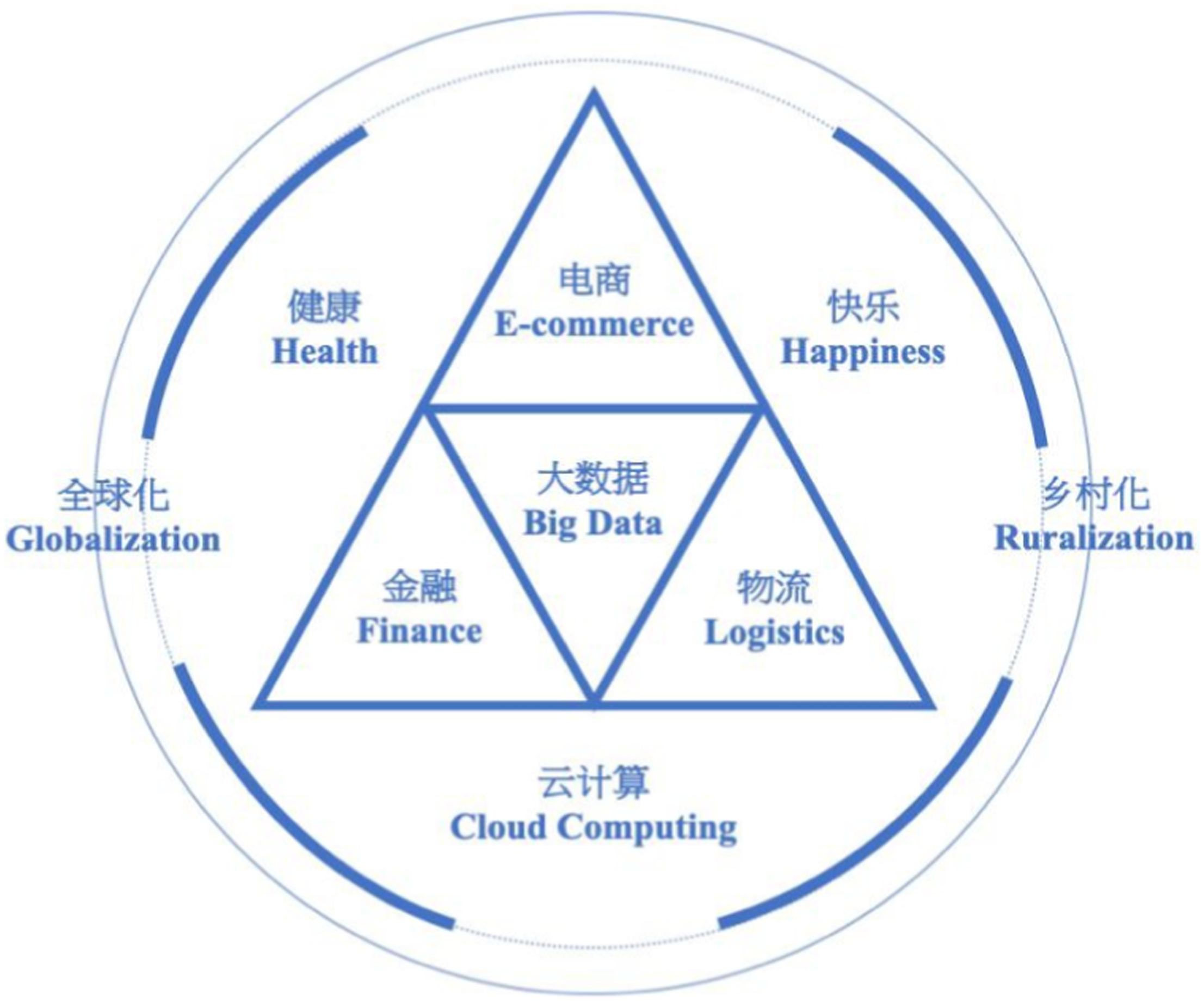
In an apparent neoliberal tone, Wu further illustrated that CaiNiao, first established on May 28, 2013, is not simply a traditional logistics company. ‘Unlike Shentong, Yuantong, or the foreign companies like UPS or FedEx… ours is more about empowering these participants in the logistics industry…improving the services of the entire industry for consumers and businesses’. In 2013, CaiNiao created vast phygital infrastructures to support Alibaba’s first ‘Double Eleven’ E-commerce sales event. On that day, Cainiao took about 156 million RMB logistics orders and provided corresponding data support and services to its business partners.
Alibaba’s core strategy is ‘one horizontal, two vertical’ (yī héng èr zòng). With an ambitious aim of building the database infrastructure and ‘total online connection’ for the logistics industry in China, Cainiao is positioned to become the core engine for the entire industry to make its digital transformation. With Cainiao’s existing global logistics distribution networks spreading over 224 countries, Wu also proudly stated Alibaba’s next step to construct a global prosumption network – as a Chinese-centric process of globalisation – through exporting its interlocked infrastructure of E-commerce, finance and logistics. Wang, Alibaba Group General Secretary, gave an even more vivid portrayal of Cainiao’s infrastructural functions – the ‘Skynet’ versus the ‘Earthnet’: “[…] The Earthnet refers to…a network of physical warehouses across the country, open to all express companies and logistics companies…[in China] most logistics companies are unable to build these infrastructures. Second, [we need to] build a Skynet…to compile all relevant information from manufacturers, logistics companies, consumers, and sales into an integrated information network to coordinate and let all information flow between all links.”
Exploiting the database coal mines/oil fields
Alibaba’s empire of commerce-logistics networks was capitalised on building a database infrastructural economy. Wu revealed Alibaba’s dream plan to build a database system to collect every detail of consumers’ buying behaviours, dispositions and tendency. Rendering the ‘invisible’ visible and intelligible, he said, “As Master [Jack] Ma pointed out, now we’re no longer in the IT era, but the DT era…‘D’ is data…these data are just like coal mines and oil fields […] In the Internet era, in fact, the core energy and resources are data…descriptions of the behaviours of consumers and businesses...What kind of websites do you often browse, what products do you often put in your shopping cart, what payment method do you use to buy these items, and where are your delivery addresses...These items are actually very stable, very objective, even some of your behavioural habits are unknown to you.”
The political technology of the database infrastructure over consumers achieves a state of meticulousness unimaginable in previous forms of capitalism. User data, being continuously accumulated, analysed and monetised, ‘becomes the raw material that is extracted for profit by platform owners’ (Tan, 2021, p. 1867). Objectively recording and analysing consumers’ personal behaviorial information and creating effective and precise trading, Wu praised the effectiveness of Alibaba’s infrastructure in identifying precise business targets, “When you open the Taobao homepage, you will see our ‘thousand people thousand faces’ strategy…different people see different merchandises displayed on the platform…because I know what kind of products you have seen before, what kind of products you have bought, and what products may be needed, so you will get the corresponding pushes. This is how we digitize the offline phenomenon, and then turn such data behaviour into a service… During Double Eleven… we may advise a merchant to place 80% of his goods in the Northeast, and then put 20% of them in the Southwest. Because there is a high demand for such products in the Northeast, but very little in the Southwest… We provide our [logistic] merchants such smart logistics suggestions.”
Creating alibaba’s own ‘platform ecology’
Building upon the success of its E-commerce shopping platform – Taobao, Alibaba developed prosumption content sites to work with and curate its own wanghong (social influencers), mobilising the so-called ‘camgirls’ (nǚ zhǔ bō) to further boost its E-commerce sector as well as package themselves as an active intermediary between stores, influencers, and customers (Wang, 2021).
Taobao Live was first introduced to the public in 2016 by a team led by Daisy, Project Manager of this user-generated live-streaming app. Highlighting the ‘content is king’ logic, Daisy elaborated on Taobao’s ‘platform ecology’: “In this content ecosystem, we began with only business owners, and then we had consumers, and then gradually we have a lot of KOL, influencers, even television stations joined us […] they are becoming participants of the entire Alibaba’s content ecology. Apart from providing content, they cultivate their own personalities on our platforms and become an important part of our ecosystem.”
Alibaba’s Diantao (formerly known as Taobao Live) is the leader of live-stream shopping app in China. After 2016, Alibaba organised a nation-wide competition with L’Oréal China to identify cosmetics shop assistants as potential influencers of live-streaming shopping. Austin Li, the top live-streaming influencer on Taobao Live who sold USD1.7 billion gross merchandise in a 12-h kick-off live-streaming for the 2021s Double Eleven Festival (Tan, 2021), won the competition and was offered a contract with a shanghai-based MCN, starting her live-streaming career as a college student. While Li’s success is an extreme case, it does show how Alibaba in creates its own wanghong through seamless infrastructural settings.
In the same talk, Daisy differentiated content on Taobao Live from traditional shopping guides by emphasising its ‘problem-orientation’: Taobao streamers are solving their fans’ problems on live. This strategy was reflected on their evaluation of streamer-fan interactions but also various fan activity options offered on the complementary app. By acquiring a large corpus of user data, Alibaba was able to instruct and create online influencers, whose content fed back to the consumer-end E-commerce platform. Overall, Alibaba aimed to construct and infrastructuralise an internal supply chain and a corporate prosumption network to ensure the seamless working of a capitalist system. In doing so, Alibaba guide their users into their capitalist ‘ecosystem’ and take care of all their daily consumption needs and leisure life within the Alibaba ecosystem
2
(see Figure 2). ‘Business overview’, Alibaba annual report 2020, P. 27.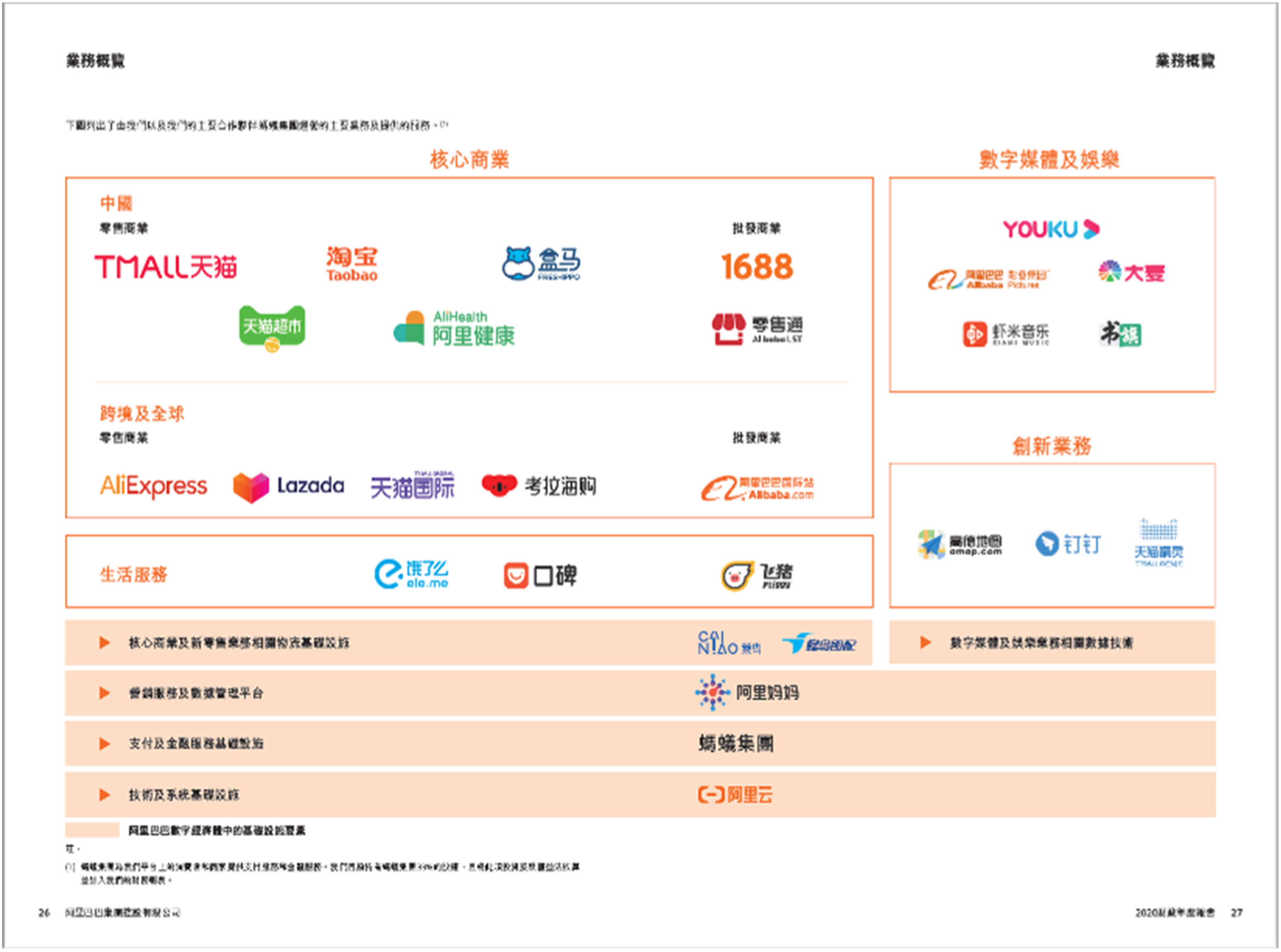
Imagineered global competition: The sensorial infrastructure
The last operational mechanism of infrastructural capitalism is exemplified by how Alibaba reconfigured online and offline capital-labour relations. To justify its employees’ overwork commitment as ‘altruistic’ or self-sacrificial for the nation’s technological progressivism (Li, 2023), a paradoxical entanglement of internal and global competition as the moral obligation and gamified aspirations of Alibaba workers – to achieve the ‘Chinese Dream’ 3 – was repeatedly promoted within the company. Indeed, such politicised aspirations and emotive work commitment serve as the ‘infrastructural affects’ (Parks, 2016) which support the continuous online-and-offline sensorial control of infrastructural capitalism.
Alibaba’s Dream
The organisational culture of Alibaba, more or less similar to other tech titans, for example, Tencent, Baidu and ByteDance (Liang, 2019), is characterised by its openness, autonomy enjoyed by workers and a ‘flat’ hierarchy. But this autonomy also came with huge responsibility and heavy workload motivated by the gamified aspirations and moral obligations to achieve the ‘Alibaba dream’. Jokes like ‘I never see daylight when I leave work’ and ‘I don’t need work-life balance because my work is all of my life’ were widespread. One interviewee from the HR department told us there was an anecdotal saying: ‘if one can leave work before 7 pm, it only indicates the company has given up on him’. The pace of work was intense. Lid, with three-year experience in the DingTalk team, said that Alibaba workers were expected to ‘optimise [work] every day, get new results and ideas every day’. Nevertheless, devotion of time and energy in itself did not guarantee success. One slogan of Alibaba was repeatedly mentioned, ‘applaud the process and get paid for the results’. Their performance must be quantifiable and evaluated by numbers.
Another significant feature of Alibaba work life was its resemblance to university life – an analogy frequently used by management and workers. Employees were fed well in internal canteens, welcomed to join various interest clubs and be entertained by lots of activities on ‘campus’. Colleagues called each other ‘classmates’, which aimed to harmonise the workplace and minimise office politics. What was most intriguing in this campus metaphor, nevertheless, is the ‘learning opportunities’ the company provides for its employees. There were hundreds of online lectures, workshops, seminars as well as various work-related digital resources available on the intranet for workers’ self-improvement. On top of their prolonged work hours, workers were also encouraged to constantly take part in these online training sessions during their non-work time. An open ranking system was created tracking and showcasing the numbers of training sessions each Alibaba worker has contributed to and completed.
The capitalist logic of Alibaba dream constructed a marketplace characterised by its fairness and efficiency for the employees. As Lid believed, even though the work pace was fast, it pushed people to progress and rendered demanding work ‘an opportunity of fast learning’, offering them ‘an opportunity to pursue individual dreams’. The formal organisational rules demanded workers’ rapid upskilling. One example was the work performance evaluation system included an explicit criterion of ‘learning and self-improvement’. While promoted as voluntary, the intranet and training resource platform became a hypervisible, frequently discoursed digital infrastructure which gamified workers’ unpaid work as an aspirational form of continuous self-improvement, mutual-monitoring and peer competition, as they worried about themselves (and Alibaba) being ousted by the intense, formalised internal (and global) competition anytime.
Workers’ dreams?
Echoing Parks’s notion of infrastructural affects which refer to ‘the various dispositions, feelings, or sensations people experience during encounters with infrastructure sites, facilities, and process’ (Parks, 2016, p. 107), we argue that workers’ encounters with Alibaba’s infrastructures generate differential sensorial experiences, which significantly orient their moods, emotions, aspirations and action – often unknown to themselves – at work and in life. The continual functioning and growth of such infrastructures are also highly dependent on an intensifying demand for Alibaba workers’ affective and aspirational labour. There was an intricate relationship between workers’ borderless career aspirations and their affective commitment to the national and organisational dream discourses, repeatedly triggered by their encounters with the infrastructures. The countless aspirational slogans, banners, flags and billboards inside and outside the office buildings, or those regularly updated ranking charts of top Alibaba employee and overwhelming e-alerts of new online training courses served such purpose. On the one hand, workers incorporated certain national and organisational visions in their own pursuits. On the other hand, revitalising the nation or achieving the corporate dream did not always ensure workers a happy, healthy and abundant life as it claimed, nor did it guarantee workers’ a fair share in their rewards, job security, income growth and meaningful work. Rather, the imposed big dreams often create anxiety, stress, social segregation and a continual sense of lack – the negative outcome of infrastructural capitalism. Alibaba’s normalised work ethic and affective demands also deprived workers of their personal and social lives.
Ben, Senior Product Manager who had been working for T-Mall for seven years, recited Master Ma’s motto, ‘The company does not need you if it’s no hard work’. He told the AGD participants an insider’s story. In order to prepare for the World’s largest online shopping festival ‘Double Eleven’ 4 , they stayed inside the company days and nights since August. The entire team had to work daily for 15–16 hours, for continuously 4 months, Starting from midnight of 11th November, they were also required to attentively monitor all the e-transactions second by second, and they barely could have time to eat or go to the toilet. ‘I held my laptop with one hand – very heavy, and the other held a loaf of bread. That’s life’. Ben expressed in a grudging tone.
While Alibaba’s phygital infrastructures became the basis of an ‘imagineered’ global dream, such a dream also continuously fueled the infrastructural expansion, forming a feedback loop. The global competition discourses in Alibaba successfully embedded company visions into the national dream narrative, which accelerated a sentiment of self-actualisation among many Alibaba workers – that their self-sacrifice helped change ways of life in China. Ben shared a great sense of pride along with many of his T-Mall colleagues, for achieving China’s globalising dream. In Ben’s words, they created a ‘modern Spring Festival’ for Chinese businessmen and consumers to ‘attain ultimate happiness together’.
A disjuncture of infrastructure
Stressful work and remote office location deprived many workers of their social life, rendering their more ambivalent view to Alibaba’s entrepreneurial narratives. Born and raised in Chongqing, Ada, Global Talent Acquisitions Executive who joined the company a year ago, hosted us for dinner during our second visit in 2019. ‘So sorry for being late – there are always traffic jams on weekends!’ Ada said she cherished this over-an-hour trip from her rental apartment adjacent to Alibaba campus to the city centre as both a ‘physical and mental getaway from work’. Due to long work hours on-site, on average she only went out of the Alibaba campus twice a month.
During dinner, Ada confessed the difficulties she encountered in recruiting talents: suitable candidates from top-tier universities and companies in Beijing or Guangzhou were not willing to work in this isolated city and be separated from family, friends and community. Although being branded as a top company with a global vision, Ada said Alibaba was still ‘very local’ in many ways and not the first priority of top candidates. There, a disjuncture of Alibaba’s infrastructures loomed – workers could finally verbalise the problems when not surrounded by the aspirational and affective infrastructures in the workplace. Ada talked about her countless anxious, sleepless nights when finished work late. For her, work was all she could dream of, and the mandatory use of DingTalk in the office filled her mind with the imaginary and incessant ‘beep’ sound of the App. ‘Sometimes I feel like I’m trapped in Hangzhou…I don’t think I’m living my life like an ordinary young person’. She got no time for browsing content in xiǎo hóng shū (‘Little Red Book’) or watching funny videos on other digital platforms which would ease her mind, and make her happy. These embodied experiences epitomise the techno-positivist logics of Alibaba’s business operations, but also reveal the multi-dimensional infrastructural control of ‘24/7 capitalism’ under which workers were unrealistically expected ‘to go without sleep and to function productively and efficiently (like machines)’, which eradicate their right to live their lives and exhaust humans like natural resources. (Crary, 2013: 2, 17)
Cindy, Alibaba’s Marketing Executive, also confessed she was just not as ambitious as other ‘Ālǐ rén’ at work, as ‘big dreams’ came with a great deal of stress. ‘I just want to do nothing and read some books that I like’. She spoke of an enigmatic understanding of work-life balance, revealing an often-unnoticed, ever-expanding sensorial infrastructure Alibaba produced in its workers’ minds, ‘Most of the time you’re engaged in work, and now even the time when you’re out of work, you think of Alibaba all the time. Isn’t it also a work-life balance in which work is inseparable from life, and there is nothing to balance?’
As the Alibaba logic did not squarely fit into their own dreams, we observed that some young workers in the industry actively ‘disoriented’ themselves from the infrastructural affects. During the researcher’s participant observation, it was not uncommon to hear how the young participants vigorously talked about their differing aspirations – from being a social entrepreneur to an online game designer, from a magician-wanghong to an animal rights activist. In the matrix of the Chinese Dream, they dreamt of different dreams. Many of these aspirations on the ground did not intertwine with the rhetoric of the nationalistic ‘Chinese Dream’ or the neoliberal ‘Alibaba Dream’. A young Ali-worker secretly told the researcher, ‘I don’t have any dreams at all. Too stressful to have even just one’. For a genuine pursuit of ultimate happiness, living a ‘dreamless’ life and getting more sleep were his only sensible dream, perhaps also the last resort for resisting the affective manipulation of infrastructural capitalism.
Conclusion
The changing global order of international relations, especially the rise of China and its Belt and Road Initiative (BRI), makes it imperative to move beyond a Eurocentric view in understanding the complexity of social and cultural dynamics within China and across the global South (Li et al., 2023). Contrasting existing scholarship on state capitalism (Hung, 2015; Peck & Zhang, 2013), ‘socialism with Chinese characteristics’ (Dirlik, 1989), database economy (Cubitt, 2014), digital capitalism (Schwarz, 2019) and platform capitalism (Srnicek, 2016), we adopt the concept of infrastructural capitalism (Pun & Chen, 2023) to break through the existing Western-centric or Sino-centric epistemological cases for capitalism, and showcase an emerging global-capitalist project entangled with both China’s reformist ‘socialist’ ideology and latest nationalistic revitalization agenda. Highlighting the phygital nature of infrastructure, we demonstrate how China’s emerging capitalist infrastructuralism serves both political and commercial goals, also renders juxtaposed modes of control, exploitation and resistance in the business and employment practices of its booming and globalising platform economy. Through an ethnographic study of Alibaba, we theorise three unique mechanisms: public-private partnerships, corporate prosumption networks and imagineered global competition, which support the continuous online-and-offline operations of infrastructural capitalism. These mechanisms intersect with the physical, digital, discursive, human and sensorial infrastructures, as elucidated in our data analysis. Cloud-computing, ‘smart’ logistics, corporate management software, E-commerce, financial technology and digital payment systems, social and digital platform economy, and internal communication intersect and facilitate sophisticated monetization of user data, corporate governance and labour exploitation. Various human infrastructures including individuals, families and communities are established, whose overwork and self-exploitation become virtuous, and whose visions are now reoriented towards divergent moralised nationalistic goals (e.g. to become a global dreamer, accelerate a Chinese-centric process of globalisation, reverse the global economic order and improve living conditions in China), with their derived infrastructural affects continually sustaining the expansion of infrastructural capitalism and sensorial control of workers. The major contribution of this article lies on its provision of a ‘provincialized’ (Chakrabarty, 2000), non-essentialist conceptual lens for understanding the variegated cultural, economic, political and social impacts of infrastructural capitalism in China; for unpacking its inherent dilemmas; and for reimagining the possibility of individual resistance and systemic transgression of both China’s and global capitalism. Despite being characterised as ‘socialism with Chinese characteristics’, a critical distinction in the Chinese state’s logic of infrastructural capitalism is its aim to counter the crisis of the deregulated market – exacerbated by decades of global neoliberalism – within rather than beyond capitalism (Pun & Chen, 2023). As a variegated form of global neoliberal capitalism, infrastructural capitalism shows juxtaposed forms of infrastructural and labour control, creates new ways of monetisation and capital accumulation (online and offline), accelerates consensual, aspirational and affective forms of labour exploitation, yet also reproduces inherently contradictory capitalist social relations. There were moments when the infrastructural capitalist logic did not squarely fit into individual aspirations dreams, as we observed the occasional disjuncture of various infrastructures – when Alibaba workers actively disoriented themselves from the discursive, symbolic and sensorial infrastructural control, and reminisced their different dreams, aspirations and possibilities beyond the ever-expanding contours of infrastructural capitalism. This also echoes the arguments made by de Seta (2023) and his colleagues about pushing ‘discussions of China’s digital infrastructure beyond the reduction to authoritarian control and the triumphal rhetorics of governmental imaginaries’ (245–246).
Footnotes
Acknowledgements
The author would like to thank the GMAC editors and anonymous reviewers for their insightful comments and suggestions throughout the review process. He is also thankful to Darren Carter, Jenny Chan, Yiu-Fai Chow, Jeroen de Kloet, Anthony Fung, Kun He, Misha Kavka, Xiaotian Li, Jori Snels, Bo Wang and June Wang for their critical comments on an earlier version of this article.
Declaration of Conflicting Interests
The author(s) declared no potential conflicts of interest with respect to the research, authorship, and/or publication of this article.
Funding
The author(s) disclosed receipt of the following financial support for the research, authorship, and/or publication of this article: This study was supported by The University of Hong Kong’s Seed Funding Programme for Basic Research (project no. 2014 104005118) and by HKU Faculty of Social Sciences’ Strategic Research Clusters Seed Funding. It was also, in part, supported by the European Research Council Consolidator Grant 2021 Research and Innovation Programme, under the project ‘China Fashion Power: Fashioning Power through South-South Interaction: Re-thinking Creativity, Authenticity, Cultural Mediation and Consumer Agency along China-Africa Fashion Value Chains’ (Grant agreement No. 101044619).
Notes
Author biographies
 ). His work has appeared in European Journal of Cultural Studies; Information, Communication and Society; Journal of Consumer Culture; Journal of Cultural Economy; New Media and Society; Sociology and Work, Employment and Society among others. He has worked in various media and creative companies, and also taught at the University of Hong Kong’s Department of Sociology and Hong Kong Baptist University’s School of Communication.