







Abstract

Back to the Future: The Internet
Remember the euphoria in the early days of the Internet? Finally, we can meet people around the world. With the click of the mouse, everybody can watch any music videos, meet new people, trade, date, and fall in love. This optimism resonated with the zeitgeist of the 1990s, during which the boundaries of nation-states were believed to be dissolving into a new world. New technologies, be they the telephone, the car, or the television, were often heralded similarly. Simultaneously, more concerned voices would arise, announcing a techno-dystopia. The telephone would reduce “real” human contact; the television might lead to more violence in real life; we were amusing ourselves to death (Postman, 1985); and the Internet would further isolate us (Turkle, 2011). The utopian dreams of Rheingold's (2000) internet communities have long evaporated, to be replaced by stories of surveillance capitalism (Zuboff, 2019) alongside platform capitalism (Srnicek, 2017). As Stikker (2019) argues in her book, the internet is broken. Lovink (2022) claims we are stuck on the platform.
Next to this cacophony of dystopian voices lamenting the death or decline of the internet cum platform, studies also show what platforms enable, or afford. For example, in my own work with Lin, we show how Kuaishou turns farmers and migrants in China into unlikely creative producers (Lin & de Kloet, 2019) and how TikTok propels new creative forms (Lin & de Kloet, 2023). In a study with Poell, we show how WeChat provides a space to express political feelings despite the platform’s apparent control (de Kloet & Poell, 2025). It is not all doom and gloom. A similar binary between dystopian and utopian narratives is currently proliferating in debates around AI, leading to bold statements like “[AI] is going to change the world more than anything in the history of mankind” and “it is more profound than even electricity or fire” (Clifford as cited in Toosi et al., 2022, p. 2). Or, conversely, it will take away our job as “AI [is] impacting the labor market ‘like a Tsunami’ as layoff fears mount” (Bhaimiya, 2026) and a “takeover of all media by artificial intelligence is coming” (Ferguson, 2026; see Celis Bueno et al., 2025, for a thoughtful reflection on AI and creativity). The reference to natural forces like fires and tsunamis smacks of technological determinism, black-boxing technology as an outside natural force we can at best respond to. This determinism urgently needs to be countered. Indeed, like the internet, AI is here to stay, but what it is, what it will become, and what we do with it remain open.
It seems fair to arrive at two rather obvious conclusions: first, technologies are both potentially good and potentially bad, or, in the words of Kranzberg: “Technology is neither good nor bad, nor is it neutral” (Kranzberg, 1986, p. 6 as cited in Wyatt, forthcoming). And because technologies—including AI—are not neutral, we ought to be extra alert. This also brings to mind Foucault (1983), whose response to the critique that he is too gloomy always stays with me: “My point is not that everything is bad, but that everything is dangerous, which is not exactly the same as bad. If everything is dangerous, then we always have something to do” (pp. 231–232). Second, technologies are not things out there; their making, development, evolution, design, and obsolescence are profoundly entangled with human and non-human actors—making technologies unstable assemblages with shifting meanings and implications—an insight developed by Actor Network Theory (Latour, 2005). Correspondingly, Wyatt introduces the notion of technological innocence in the field of STS, foregrounding people’s naivety about the biases, harms, and inequalities that technologies produce. It also refers to a certain nonchalance with which people approach technology and to the “innocent” belief that technology is developed outside political, social, economic, and cultural forces. This makes Wyatt claim that “Ignorance is not an acceptable excuse, not for taking technologies for granted in everyday life and in academic work, nor for being oblivious to their biases and harms” (forthcoming).
These are important starting points to think about AI in relation to academic work, including media studies, and society at large. When we witness all the buzz around AI today, it seems we, or at least the media sphere, once again fall back into a utopian-versus-dystopian framing, both of which are drenched in a toxic mix of technological determinism and technological innocence. Interestingly, the so-called Global South seems to gravitate towards the celebratory end, whereas in the Global North pessimistic voices dominate. According to Arora (2024), this is related to privilege; the Global South cannot afford pessimism: it needs to make ends meet, and if AI can help, let’s embrace it. Indeed, when I raise concerns about AI in mainland China, I am often met with surprise, as the utopian, future-oriented narrative saturates public discourse. This resonates with China’s self-image as, what Lindtner (2020) calls, a prototype nation, “a nation that is newly emboldened asserts itself as an alternative model of future-making” (p. 22).
To celebrate AI as the new fix is as problematic as denouncing it as the biggest evil. How to hover away from such an unproductive binary? In the following, I will explore a seasonal history of AI, analyze the current media framings of AI, reflect on meritocracy, and end with a plea to focus more on the process rather than on the outcome of academic (or cultural) work.
AI Seasons and Hypes
This is not the first time that AI has made headlines. In the literature, we can find discussions of two earlier periods, one around the 1950s and 1960s, and the other around 1980s and 1990s (see figure 1). Each period had a summer, when AI was introduced as a technological revolution, and a winter, a period of disillusionment. I am aware that metaphors can be dangerous in framing technologies (Wyatt, 2021). Like the earlier-mentioned fire and Tsunami, seasonal metaphors also evoke a sense of inevitability and predictability, and this may limit rather than broaden our understanding. “The trouble with seasonal metaphors is that they are cyclical. If you say that artificial intelligence (AI) got through a bad winter, you must also remember that winter will return, and you better be ready” (Floridi, 2020, p. 1). And they do have real-world, particularly economic, implications, as “the announcement of future visions has been central to the bolstering and guiding of public confidence and financial investments in AI research and development” (Vrabič Dežman, 2024, p. 744). AI seasons (image is taken from Schuchmann, 2019)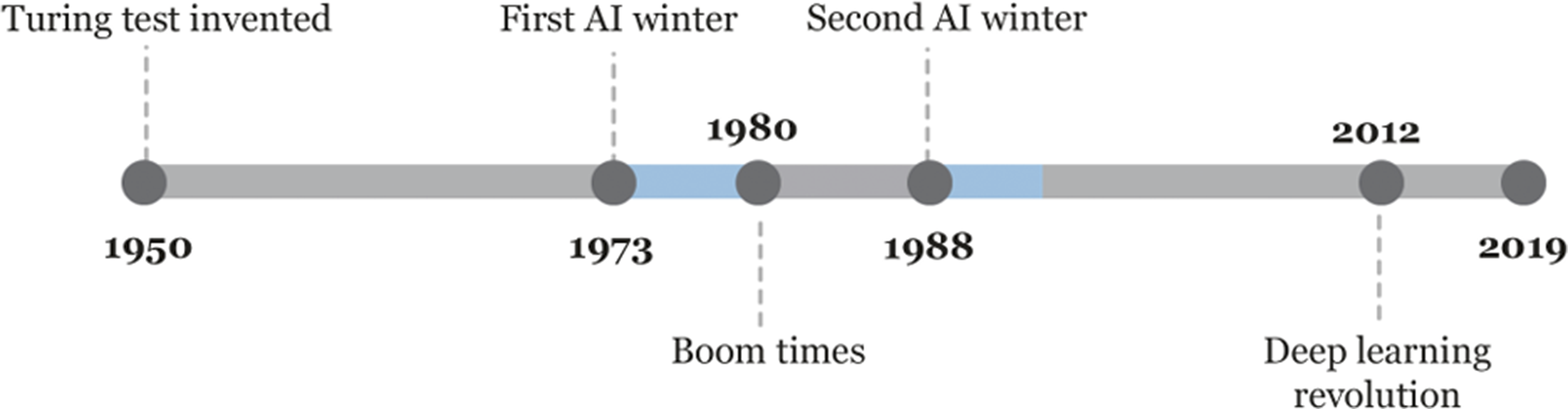
Allow me, despite this disclaimer, to continue using this metaphor, given that, amidst all the heat surrounding AI today, I am indeed longing for a period of cooling down, as I will explain.
During the first AI summer there was a strong belief about the computer as a thinking machine, potentially smarter than people; “During the early years of the digital revolution, primarily in the 1950s and early 1960s, a large segment of public opinion came to see the emergent computers as ‘intelligent’ brains, smarter than people, unlimited, fast, mysterious, and frightening” (Natale & Ballatore, 2020, p. 6). With the computer slowly moving into households, this assertion gradually lost its appeal (Natale & Ballatore, 2020). As Toosi et al. (2022) write, “The hype and high expectations caused by the media and the public from one side, and the false predictions and exaggerations by the experts in the field about their outcome from the other side, led to major funding cuts in AI research in the late 1960s” (p. 8). The 1980s witnessed a revival of interest and investment in AI, especially neural networks. Using a so-called “expert system,” which utilizes “domain-specific information for stronger reasoning but in narrower areas of expertise” (Toosi et al., 2022, p. 9). However, many companies failed to fulfill their promises, and a second AI winter started at the end of the 1980s. “This second period of so-called ‘winter’ in the history of AI had been so harsh that AI researchers subsequently tended to avoid even the term ‘AI’ by choosing other titles such as ‘informatics’ or ‘analytics’” (Toosi et al., 2022, p. 9), and in the 2010s, “Big Data.” With the emergence of Large Language Models, we are now experiencing another AI summer. Indeed, what AI is today seems to be restricted to a single dominant paradigm, that of LLMs, in which more computational power is considered necessary to produce better models. The flatness of AI output may well be due to the model’s underlying logic, which relies on probability distributions. 1
My point in this brief and incomplete history is simple: we should learn from the past to understand the present and imagine the future (differently) (Wyatt, 2008, 2025). Some works discuss the current AI summer as a myth, for example, Natale and Ballatore (2020) argue that the use of ideas from other fields and contexts, an eagerness to predict the future, and continuing controversies all feed into the myth of AI. They write, “[r]ather than framing controversies within a rise-and-fall narrative, we might therefore interrogate if and to what extent they were a functional and integral component to the construction of the AI myth” (p. 12). Another way of looking at AI is framing it as hype. 2 As Kotliar rightly argues (2025), “[w]hile AI-driven technologies undoubtedly stem from genuine technological breakthroughs and may indeed bring about significant transformations in the social fabric, much of our understanding of these AI revolutions is shaped by media sensationalism, advertising clamor, or, in short – AI hype” (p. 1). Kotliar (2025) defines a hype as an “exaggerated attention and noticeable enthusiasm around a particular phenomenon and the promotion of that phenomenon in an extravagant manner” (p. 2).
According to Markelius et al. (2024), different mechanisms fuel the hype, these include “anthropomorphism, the proliferation of self-proclaimed AI ‘experts’, the geopolitical and private sector ‘fear of missing out’ trends and the overuse and misappropriation of the term ‘AI’ in emerging technologies” (p. 727). This list omits the influence of finance. When simply google-imaging the term AI, the results are surprisingly monotonous: AI is a blue monochrome, female, and represented in a sci-fi way as an anthropomorphized robot (Vrabič Dežman, 2024). It is also often represented as a disembodied head (a “brain in the vat”). Like metaphors, visual and discursive representations of AI are part of the AI-assemblage, and they do not only represent but also construct it. Here, I want to insert a cautionary note. According to Schneider and Yu (2025), such representations or imaginaries are different in Asia: “Asian perspectives value relational ethics, moral governance, and social harmony. AI is seen as embedded in interconnected systems – spanning nature and machine – and hence resulting in a less binary distinction between human and machine intelligence” (p. 19). Hui’s (2019) notion of cosmotechnics also gestures towards the possibility of different technological epistemes and argues against technological universalism. Indeed, the analyses of AI seasons as described above are very US-centric; aside from the importance of historicizing AI, this points to the importance of pluralizing it.
Decentering Meritocracy, Reclaiming the Personal
Out of curiosity, I recently asked ChatGPT how Beijing University would look 50 years from now. The image produced was an unimaginative mix of futuristic, Zaha Hadid-like buildings, a “traditional” pagoda with a fluid shape, the famous gate left intact, and people using Minority Report-like screens (see figure 2). A ChatGPT-produced image of Beijing University in 2075
The accompanying text did not help to improve that impression: “Despite all the technology, the Confucian ideal of learning for moral cultivation remains central. Students still recite lines from the Analects, but they do so in digital courtyards surrounded by glowing calligraphy projected into the air.”
However, this experiment falls into a problematic trap: how do I measure AI-generated outcomes? The assumed “success” of AI is usually measured against its ability to be authentic, convincing, simply, to deliver: it can produce a song we can’t distinguish from a “real” song, it produces the image of the pope in a down jacket that seems so real, and its Francis Bacon artworks may even outperform those of Francis Bacon himself. My experiment disappointed me precisely because, to me, it failed in delivering. The fallacy of this line of thinking lies in its focus on the outcome, the final product, and the simultaneous neglect of the process. This, in my view, resonates with a meritocratic gaze. Meritocracy refers to “the idea that whatever our social position at birth, society ought to offer enough opportunity and mobility for ‘talent’ to combine with ‘effort’ in order to ‘rise to the top’” (Littler, 2013, p. 52). For Littler, the term has been appropriated in the UK by neoliberal governments, it marketizes a rhetoric of equality that produced in practice a plutocracy, a society supporting the wealthy. It is a system supported by metrics, exams, qualifications, and the like, with outcomes and deliverables as KPIs. A journal’s citation index and impact factor are considered markers of quality and success and thus constitute the holy grail for academic journals. Universities and academic journals are examples of a modernist, meritocratic institution. As Foster writes (2023), “Modernist institutions love objective, quantitative schemes of evaluation and classification: SAT scores, h-indices, cost-benefit analysis, and so on. These schemes are antipolitical devices (Scott, 2012). They seek to translate questions of judgment, debate, and disagreement into (apparently) judgment-free, unbiased procedures: expertise, crystallized” (p. 423). 3
In the focus on what AI achieves, we are complicit with this meritocratic gaze, and worldview. Is there any alternative? Allow me one more personal example: In 2025, Helen Hok-sze Leung, Yiu Fai Chow, and I prepared an academic complaint song for a conference titled Rehearsing Futures, organized by Daisy Tam in Hong Kong. Inspired by the Complaints Choir Project initiated by Finnish artists Tellervo Kalleinen and Oliver Kochta-Kalleinen, we gathered complaints about academic life from 30 colleagues and turned them into a song. We rehearsed the song during the conference and performed it. 4
We could ask ChatGPT to do the same. However good or bad the outcome would be, it would totally miss the point. The value of the project does not so much lie in its end product; it is about the process: the process of asking friends and colleagues what to them makes academic life miserable, the madness of rehearsing the song in the heat on Peng Chau island in Hong Kong, the joy of singing together, the pleasure of asking a friend to film us, the fun of editing the film... These are ephemeral experiences; they cannot be counted or ranked, nor do they do anything to any index—and yet, they may well be the most cherished. In her critique against meritocracy, Littler (2013) ends with an appeal that we should look for “mutual and co-operative forms of social reproduction which create greater parity in wealth, opportunity, care and provision” (p. 69). Refocusing from what we produce, make, and write, towards the process and collaborations needed to come to that end, may well be one step toward that direction.
Conclusion: Sincerity After Innocence
How to resist, twist, or ignore the workings of AI and its impact? We cannot afford technological innocence; while AI may not be inherently bad, it seems fair to assume it is dangerous. When reading a student paper, or indeed a journal submission, the first question that haunts me now is: Is this written by AI? Or with ample use of AI? Words like “tapestry” raise my suspicion, just as very long hyphens do. I now get to read texts that are grammatically flawless but lack substance and imagination. This mode of reading with suspicion distresses me; I do not want to mistrust the author, but I do. And unlike an earlier cheerful embracement of poststructuralist theories surrounding the death of the author, the fluidity of truth, and the social construction of reality, I am now haunted by a desire for sincerity. I prefer broken English to flawless English, and rhizomatic arguments to bullet-point lists. My desire for a cooling-down period for AI comes alongside a wish for a new kind of academic writing. The problem is: in its continued specialization over the past decades, resulting in ever more subfields within, for example, media studies (television studies, film studies, new media studies, platform studies, critical software studies, infrastructure studies, and so on), each with its specialized journals, academic disciplines have become so “professional” that many articles do follow a rather strict format and rules that are, indeed, often repetitive and quite AI-able (see also Kaltenbrunner et al., 2022). Simpler put: We started writing like AI before AI arrived.
What to do? Queer American-Vietnamese novelist and poet Ocean Vuong is commenting on the increased urgency to find one’s own voice, he writes (2025): “I began my career just 15 years ago exploring how the sentence could be a political object – and now we face the terrible urgency to prove humanity inside the sentence. But this well perhaps lead us to reconsider our relationship to error, strangeness, the absurd and the subconscious, making our work more and more idiosyncratic until, one day, the machine catches up to this, too” (p. 10).
This essay is thus a call to steer away from meritocracy, from rankings, from lists, from prizes, from deliverables and outcomes—instead, we value the process of reading, writing, and working together. And this process results in a quest to deprofessionalize academic disciplines, a search for lines of flight out of established ways of doing research and writing. In the words of Foster (2023): “there is a wealth of alternative social worlds on offer, in history, at the present, and in our imaginations. Such alternatives begin to populate the space of possible social worlds, and by exploring those sites — empirically and formally — we can begin to see more of this mundus imaginalis. We can turn to other scholarly, literary, and prophetic traditions for further examples” (p. 428).
This resonates with Wyatt’s appeal to explore different ways of writing, and use different metaphors, an appeal I like to reframe towards a context of resisting the soulless blurb of texts produced by AI. In Wyatt’s words (2021), “Metaphors, science fiction, speculation and imaginaries can reveal new thoughts or feelings to ourselves and to others and may open up new lines of theoretical enquiry, empirical investigation, technological design and political action” (p. 413). And a cooling of the AI hype may well provide a better climate to slow down, focus on the collaborative process of doing research and writing, and explore different modes of academic work.
Footnotes
Acknowledgments
I would like to thank Yiu Fai Chow, Fabian Ferrari, Anthony Fung, and Sally Wyatt for their encouraging feedback, and Liu Jindong for inviting me to talk about AI at The Education University of Hong Kong.

Funding
The authors disclosed receipt of the following financial support for the research, authorship, and/or publication of this article: This work was Funded by the European Union (ERC-2022-Advanced, Resilient Cultures – Music, Art, and Cinema in Mainland China and Hong Kong (RESCUE), ERC grant agreement no 101097553). Views and opinions expressed are however those of the author(s) only and do not necessarily reflect those of the European Union or the European Research Council Executive Agency. Neither the European Union nor the granting authority can be held responsible for them.
Declaration of Conflicting Interests
The authors declared no potential conflicts of interest with respect to the research, authorship, and/or publication of this article.