







Abstract
This article develops a space-centered theoretical framework that integrates the assemblage theory, critical spatial analysis, and political economy to analyze platform development. We conceptualize a digital platform as the “platform multiple” constituted by encompassing, parallel, and intersecting assemblages that are empirically and analytically visible. As shifting constellations of heterogeneous constituting elements, each of these assemblages operates within and across socially enacted and power-laden spaces. Platform companies deploy spatial strategies, one common form of which is scaling-up, to form and transform assemblages within and across spaces to achieve the spatial fix of capital. The execution of spatial strategies triggers spatial frictions with existing structural power relations, giving shape to the path and configuration of platform development. We illustrate this framework by examining Didi, China’s largest ride-hailing platform. Using mixed methods to collect empirical information in Xi’an, Guangzhou and beyond, we employ a process-tracing strategy to analyze Didi’s expansion and transformation, the spatial frictions it encountered within, across, and between local and national scales, and the corresponding spatial frictions it encountered on the global scale in the capital’s attempts to achieve spatial fix via IPO. The study debunks spatial imaginaries of platforms’ smooth scaling-up by demonstrating all kinds of spatial frictions they encounter within and across spaces. It extends the discussion of spatial fix by highlighting the capitalization of scale itself, widely seen in the platform economy and among tech firms. It further offers a transferable analytical toolkit for approaching platforms as contingently and practically enacted spatial processes.
“Whether the business is profitable is not that important. The key is to assert that the business model can easily scale up and obtain global influence.” —An employee of Didi’s financing team, 2020
Digital platforms and their business models are imagined as being able to expand easily and smoothly across spaces and scales. The comment above given by an employee of Didi, a ride-hailing platform, is yet another example. However, critical social science scholarship on platforms has been debunking such imaginaries. Many have started theorizing regional and historical factors in platform development (Zhang, 2022; Zhang & Xing, 2025; Zhang & Chen, 2022). Some further focused on how the platform technological architecture, fueled by global capital, have sometimes utilized and sometimes conflicted with the diverse and stubborn local material and social realities (Popiel & Vasudevan, 2024) including regulations (Chan & Kwok, 2021; Li, 2024), labor (Shapiro, 2018; Van Doorn & Vijay, 2024), and market relations (Scholz & Schneider, 2017).
Building on and pushing forward these dialogues, this article develops a space-centered framework to analyze platform development as a spatial process full of spatial friction. To do so, we integrate concepts such as “assemblage,” “spaces,” and “spatial fix” from assemblage theory, spatial analysis, and political economy. As will be discussed later, we view a platform as the platform multiple that is comprised of multiple assemblages—encompassing, parallel, overlapping, or mutually exclusive—operating in various spaces and scales, and view platform development as the emergence and transformation of various assemblages that are shaped by, and shaping, the dynamic among various elements in the assemblages as well as in the larger social relations and power structure. As one of the many forms of platform development, the so-called “scaling-up” thus involves transforming existing assemblages in existing spaces, forming new assemblages in new or existing spaces, or making the platform recognized as being on higher-order scales (e.g., from local to global). Scaling-up is a spatial strategy that platform companies deploy to achieve a spatial fix, a process and result of capital accumulation (Harvey, 2001; Jessop, 2006; Schoenberger, 2004). Scaling-up leads to spatial frictions, that is, tensions and conflicts between newly formed or transformed assemblages and existing, structural patterns of association and interactions in and across variegated spaces. Spatial frictions can also shape the assemblages or the platform multiple, sometimes resulting in setbacks or even failures of spatial fix.
To illustrate this framework, this article zooms in on Didi, the largest ride-hailing platform in China and one of the tech startups supported by global capital seeking to achieve spatial fix by cultivating “the next unicorn.” We examine three interrelated stages of Didi’s scaling-up, focusing on the spatial strategies and frictions. The first stage can be traced back to its nascent years during which Didi took root in a city. The second stage happened as Didi sought to expand nationwide with the central government’s endorsement and local governments’ ambivalence. The third appeared during Didi’s attempt at financialization through an initial public offering (IPO), first on the Hong Kong Stock Exchange (HKEX), then on the New York Stock Exchange (NYSE), amidst geopolitical tensions. We show in each stage how the scaling-up efforts by Did as a platform multiple mobilized elements of various scales, how such mobilization led to spatial frictions, and how the corresponding spaces and scales were remade.
This article makes three contributions. First, it shows that platform expansion is not a uniform or frictionless process but unfolds through differentiated spatial dynamics that generate uneven impacts and conflicts across spaces. Second, it extends the critical political-economic concept of spatial fix to the platform economy, arguing that spatial fix of the capital can be provisionally achieved not only through geographic expansion or material transformation, but also through the recognition and capitalization of scale itself. These two contributions are made possible through a third contribution, that is, a spatially grounded theoretical framework that bridges assemblage theory and spatial political economy, enabling platform development to be analyzed as a spatial process. It emphasizes how platforms and their scaling-up efforts are contingently, processually, and practically enacted rather than planned. The framework can be methodologically transferable in examining how different platforms form, transform, and rearticulate spatial relations in diverse contexts.
The Platform Multiple: Assemblage, Scaling-Up, and Spatial Fix
The question why and how platforms have come to easily scale up attracts lots of scholarly attention. A classic body of literature holds that a platform consists of a core, stable component, and a complementary set of components that can easily evolve (Baldwin & Woodard, 2008). Such modularity and programmability allow the platform to expand to various sectors and societies without developing whole new systems. Meanwhile, later developments in these sectors and societies are increasingly subject to the logic and mode of the platform creator (Helmond, 2015; Plantin et al., 2018). Therefore, a platform (firm) can continuously engage with and bind various external businesses in a decentralized way, while external businesses (operators) connect their data to the platform, a process named “platformization” (Helmond, 2015; van Dijck et al., 2018).
This understanding of smooth scaling-up unintentionally resonates with the Silicon Valley-originated idea of friction-free capitalism (Popiel & Vasudevan, 2024). It has been critiqued by many scholars who called for analytical attention to the development of platforms outside the Euro-American contexts (Jia et al., 2022; Plantin & de Seta, 2019), and broadly, theorization of how local realities and historical specificities configure platforms in vastly different ways (Edwards, 2021; Hobbis & Hobbis, 2023; Zhang, 2022; Zhang & Xing, 2025; Zhang & Chen, 2022).
This calling points to the issue of platform friction, as summarized by Popiel and Vasudevan (2024), whereby universalizing forces of platform capital, manifested as scaling projects, meet diverse and stubborn local realities. There are three broad types of friction. The first is political, whereby platform operations meet different local regulations (Chan & Kwok, 2021; Culpepper & Thelen, 2020; Li, 2024; Thelen, 2018). The second lies in design and labor, whereby platforms’ standardization and control over labor were reinforced by utilizing workers’ spatial vulnerability (e.g., exploiting migrant workers, see Van Doorn & Vijay, 2024; Sun et al., 2021; Zhou, 2024) or resisted by local workers (Chen et al., 2018; Shapiro, 2018). The third lies in market relations, whereby platforms’ businesses with universalizing logic utilize the network effect to lock-in and extract user values (Barreneche & Wilken, 2015; Zhang & Xing, 2025), but are also confronted by local market players like platform cooperatives (Scholz & Schneider, 2017).
While these existing studies highlight the spatial differences in shaping platform configurations and practices, they often assume a dichotomy of global/universal versus local and implicitly produce a narrative in which the systematic and coherent top-down master plans and strategies by platform companies (the universal force) are imposed on, reinforced by, or confronted by local realities. Yet emerging studies show how platform development is often not informed by master plans but depends on a series of changing factors beyond the control of the platform companies. 1 Building on and transcending these insightful platform friction discussions, we thus bring to the forefront the spatial dimension that is inherent but not fully explored in existing studies, and propose a space-centered theoretical framework.
We first mobilize the concept of assemblage. An assemblage refers to the arrangement, layout, and piece-together of heterogeneous elements into a plastic, ever-changing, and fragmentary whole, in which elements can be contingently added, subtracted, and recombined to transform but not destroy either the element or the whole. 2 More specifically, a platform assemblage may include, besides the software structure, the hardware (such as smartphones and computers), people (such as programmers and gig workers), tech firms that develop and maintain the platform, and resources that enable the platform’s operation (such as financial investment and restaurants that participate in the food delivery platform). There are also “softer” elements, such as policies, regulations, and discourses (such as discourses that frame the meaning of participating as “individual entrepreneurs” in the platform economy) (Xing et al., 2025; Zhang & Xing, 2025). When the various elements properly align, the specific platform functions to operate the business in a planned or unplanned manner. Yet, such alignment or association is plastic, as changes of one or some of the elements may lead to the reconfiguration, or even failure, of the platform assemblage. For example, Airbnb would not function in a locale if there were no listed apartments.
This leads to two interrelated conceptualization. First, what is conventionally considered to be one platform may in fact be “the platform multiple.” Drawing on Mol’s (2002) work on “the body multiple,” 3 the concept “the platform multiple” suggests that a platform can be seen as constituted by multiple partially incommensurable assemblages each having its own configuration. The relationship among the assemblages can be encompassing, parallel, overlapping, or mutually exclusive. The shapes or contents of elements of an assemblage is partly determined empirically by elements such as the platform firm’s operations or regulatory boundaries and partly determined by the purpose of analysis. For example, the Airbnb assemblage in Paris may differ a lot from that in Lisbon or Tokyo. To understand the differences between the Airbnb assemblages in Paris and Tokyo, one needs to explore the Airbnb assemblage locally (the conditions of the listed apartments, municipal regulations, sociocultural conditions, and so on). Yet, to invest in Airbnb in the stock market, one may look at a different set of elements, such as overall profitability or user size.
In relation to the platform multiple is the concept of space, as the assemblages in the platform multiple are spatially organized, recognized, analyzed, and related to one another. Space here is not static built environment or a bounded territory. Rather, space is constantly being produced through the interactions of cultural imaginations, social relations, and political structure (Ferguson & Gupta, 2002; Lefebvre, 1991; Massey, 2005; MacKinnon, 2011). Integrating this concept of space into the platform multiple helps overcome one drawback of the assemblage concept, that is, the overlook of structures and power relations that shape elements’ participation, withdrawal, and associations (Elder-Vass, 2008, 2015; Klein & Kleinman, 2002). Thus, we see space as a site in which elements encounter, intersect, and form or transform assemblages. As the production of space is a continuous process of confrontation and negotiations of diverse social relations and power structure, the formation and transformation of the assemblages in the platform multiple are subject to and reshape the dynamic of such spatial production process.
Platform firms deploy spatial strategies to form or transform specific assemblages within and across spaces by adding or subtracting elements, or altering the associations among elements in those spaces and scales. One common spatial strategy by platform companies is scaling-up. Analytically, scaling-up can be seen in three distinct but interrelated forms. The first is the transformation of existing assemblages within spaces where the platform already operates. This may include increase of users in a given locale. The second is the formation of new assemblages into spaces previously outside the reach of the existing platform multiple. This form expands the platform’s spatial presence without necessarily altering how the platform is recognized regarding scales. The third, typically resulting from the first and second, lies in that the platform multiple is socially, institutionally, or analytically recognized as operating on a higher-order scale, such that the platform is increasingly governed, valued, or contested as a national or global entity. Taking the Airbnb case again, when Airbnb boosts its business in Paris by moving beyond private apartments and incorporating hotel rooms, it engages in the first form of scaling-up. When it starts businesses in a new French city, it engages in the second form. When it operates in many different countries (typically understood as on the national scale), it can portray itself, or will be recognized by analysts, as a global platform.
Scaling-up efforts are not merely to extend, to borrow the phrase by Xiang (2013, p. 284), “the spatial reach of actions.” They also constitute pathways through which capital pursues spatial fix, that is, to “productively soak up capital by transforming the geography of capitalism” (Schoenberger, 2004, p. 428). In traditional capitalism, spatial fix can take place in two manifestations. The first involves capital transforming existing spatial landscapes in material and social senses (Harvey, 2001, p. 247; Schoenberger, 2004). The second manifestation involves geographic expansion, through which consumption and/or resource extraction are extended to new spaces. The common result of these two manifestations, if successful, is the realization of capital return from profitability through cost-cutting or productivity improvement.
The platform capitalism (Srnicek, 2016), or broadly, the capitalism of hi-tech digital innovation, foregrounds a third manifestation, in which capital can help the platform be recognized as operating on higher-order scales—such as from local to national or global. Higher-order scalar recognition typically means a higher value in the financial market, which enables existing investors to get a financial return by attracting the next round of investors. For example, Airbnb, if understood by investors as operating or having the potential to operate on the global scale, would be much more valuable than one recognized as a local business.
The distinction between the two traditional and the third manifestations lies in that while the former takes place as the profit rate drops and enables cost-cutting or productivity improvement, the latter takes place before profit is realized and is even assumed as the prerequisite for profit (Bear, 2020; Feng et al., 2001; Shapiro, 2023). In other words, while the capital return—the spatial fix—in the two traditional manifestations is realized via profitability, that in the third is realized via financial gain based on investors’ recognition and valuation of the potentiality of the business. As later sections will show, the expansion of the platform multiple to new spaces are not necessarily intended to raise profitability, but are often pathways to construct the potentiality that makes the platform worth investing in. Of course, the two traditional manifestations are still possible in platform capitalism.
The scaling-up efforts, as well as the execution of spatial strategies, is rarely smooth since they strive to re-organize existing patterns of association among elements in specific spaces, which are shaped by structural forces and power relations. The resulting tensions and conflicts—whether anticipated or contingent—constitute spatial frictions (Tsing, 2005, 2015). Spatial frictions can be obstacles in the workings of the platform multiple. They can also be the driving force of the changes of platforms when further spatial strategies are deployed to address them. Spatial frictions and strategies, in turn, produce the inherent instability or uncertainty of the platform multiple.
This space-centered framework integrates platform studies and spatial political economy with assemblage-related concepts (see Figure 1) and offers a transferable method of understanding and analyzing platform development as a spatial process, which can be applied to different kinds of platform cases in diverse socio-institutional settings. This transferable method help researchers identify various spatial frictions that may or may not fit in or be visible through the categorical lens of regulation, design and labor, and market relation. In the following sections, we apply this theoretical framework to the case of development and setbacks of Didi in China and the globe. Theoretical framework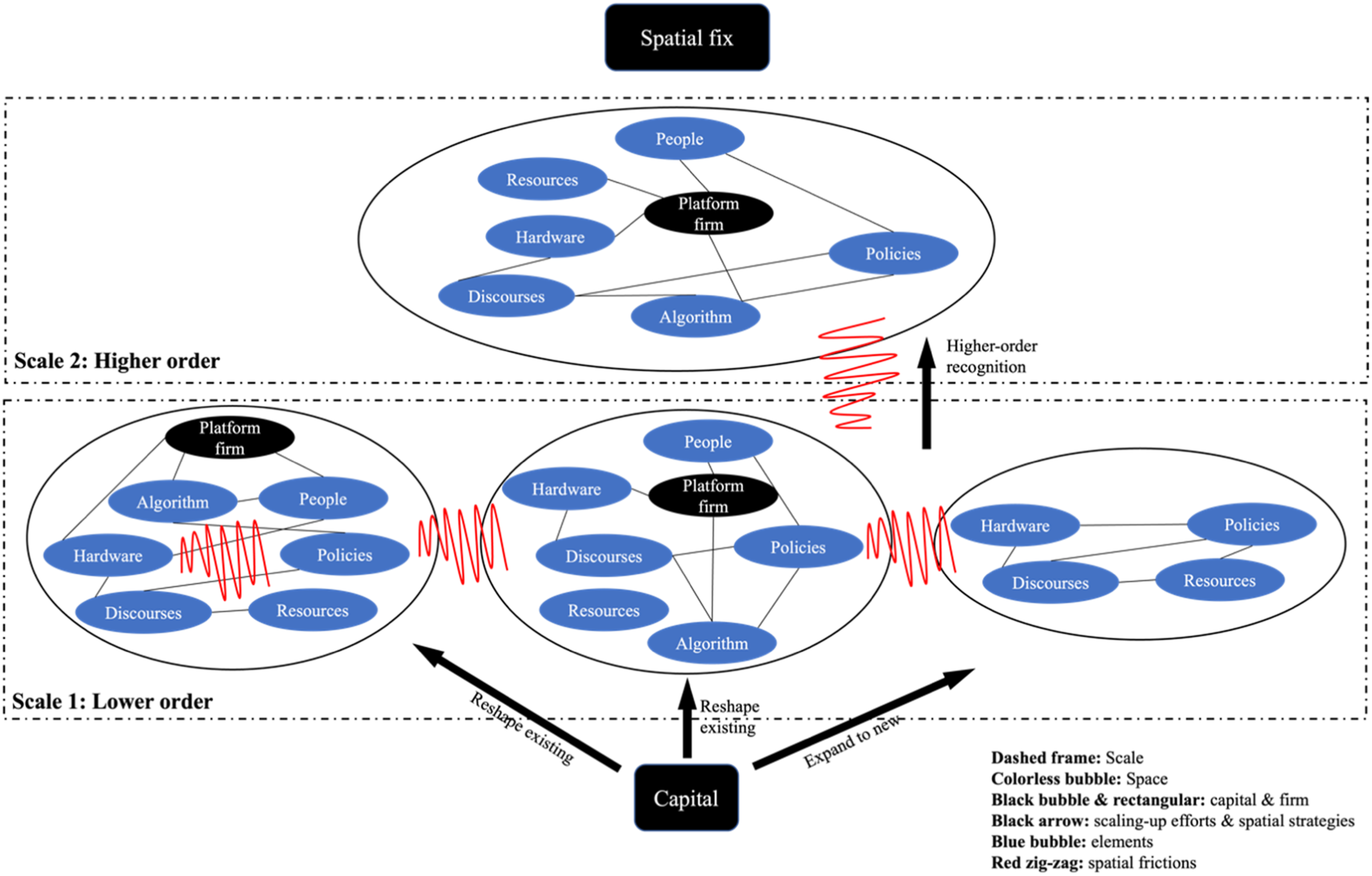
Case, Methodology, and Data Collection
Didi is selected as a revelatory case (Yin, 2017) that provides a precious opportunity to examine platform development as a spatial process. As a leading platform that expanded across diverse spaces and experienced multiple ups and downs, Didi’s trajectory vividly reveals how platform development entails and is shaped by spatial dynamics full of frictions. Combining data from interviews, participant observation, and documentary sources, we adopt a theoretically guided process-tracing strategy to reconstruct key moments in the development of Didi as the platform multiple.
For spatial dynamics in specific locales, we conducted research in Xi’an and Guangzhou. Xi’an is close to what Jennifer Robinson (2006) would call an “ordinary city.” As the capital of Shaanxi Province, Xi’an has considerable regional economic influence and is a migrant hub of Northwestern China, an economically less developed area in the country. This inland city has a vibrant tourist industry thanks to its famous historical sites. In comparison, Guangzhou is the capital of Guangdong Province and a core city in the Pearl River Delta region, one of two highly developed industrial hubs in China. It is one of the wealthiest megacities and a major national migration hub in the country, with the automobile industry as one main source of revenue. Guangzhou is more densely populated than Xi’an. As of 2021, the permanent population in Xi’an was 13.16 million over a total area of 10,097 square kilometers (Xi’an Bureau of Statistics, 2022), and Guangzhou’s population of 18.81 million lived within 7,434 square kilometers (Guangzhou Bureau of Statistics, 2022). The differences between the two cities have alerted us to how spatial frictions are locally shaped in the ride-hailing platform’s operation.
Empirical materials for our analysis were collected via a mix of methods within and beyond Xi’an and Guangzhou. On the one hand, we conducted long-term ethnographic fieldwork and semi-structured interviews in and beyond Xi’an and Guangzhou. The data in Xi’an and Guangzhou were collected during Xing’s research on ride-hailing in Xi’an from 2016 to 2022, and Zhang’s research on automobility in Guangzhou since the mid-2000s. Combining random and snowball sampling, we engaged in informal interactions and conducted semi-structured interviews with over 100 informants, including taxi drivers, ride-hailing drivers, local taxi firm managers, Didi’s regional team members and government affairs specialists, and Didi users. We also observed participants during work (in the car), breaks (at the restaurant, gas station, repair shop, etc.), and off hours (colleague gatherings), and joined their WeChat groups for virtual observation. Beyond Xi’an and Guangzhou, we conducted semi-structured interviews with ten headquarters staff of Didi in charge of (central) government affairs and finance, five investment bank employees involved in Didi’s IPO project, and nine civil servants and lawyers with experience in taxation and legal matters of urban transportation, recruited through snowball sampling based on personal connections. Given the long-term ethnographic nature of the fieldwork, the number of interlocutors is reported in approximate terms to reflect sustained engagement rather than discrete one-off interviews. The interviews and ethnographic interactions focused on how platform assemblages were organized, negotiated, and transformed across different cities over time.
We also conducted documentary analysis focusing on three sets of documents, which were about Didi’s operation and impacts within and beyond Xi’an and Guangzhou. First, we examined industry reports, financial disclosures, and corporate materials—including Didi’s IPO prospectus—issued by Didi and major consulting agencies about the ride-hailing sector, covering Didi’s consolidation of the market from 2015 through the post-IPO investigation in 2021. Second, we analyzed media coverage and public discourse from major domestic and international news outlets, specialized business and technology media, and discussions on leading Chinese online platforms, spanning from Didi’s founding in 2012 to the ongoing post-IPO investigation in 2022. Third, we examined policy and regulatory documents issued by Xi’an, Guangzhou, the Chinese central and the U.S. federal authorities concerning ride-hailing, data governance, and platform regulation that span the period from 2016 (when the State Council initially released and implemented the Interim Measures for the Management of Online Ride-Hailing Operations and Services) to 2021 (post-IPO investigation).
Local Spatial Strategies: Reconfiguring Urban Transport Landscapes
Unlike Uber, which aimed at mobilizing private cars for public transportation from the beginning, Didi, launched in 2012 in Beijing and soon expanded to other major Chinese cities, was initially a platform that matched taxi drivers with passengers. In this sense, Didi could be seen as a digital substitute for the radio- and telephone-based taxi dispatch centers, albeit breaking down the boundaries set by taxi firms.
Dispatch centers had their own assemblages, each constituted by specific networks of taxicabs, taxi owners, and taxi firms. For example, in Guangzhou in the 1990s and 2000s and Xi’an in the 2000s, the taxi industry was largely dominated by several state-owned taxi firms, each having its own on-call service. Some small firms may share one call center.
Unlike dispatch centers, Didi was not inherently a part of any such existing assemblages. According to our interlocutors, Didi seemed to have no particular appeal to taxi drivers or passengers when it was initially launched. While taxi drivers were used to utilizing their accumulated skills to seek potential passengers (see Xing, 2021, 2022; Xing & Sharif, 2025), passengers were used to hailing a taxicab in the street or calling a taxicab in advance when they needed planned trips.
To transform these historically anchored user habits and industrial structures, Didi needed to form its local assemblages. To develop networks of taxi drivers and passengers at a speed that could outgrow its competitor Kuaidi, another emerging taxi-based ride-hailing platform, the Didi firm deployed massive subsidies backed by investment. Specifically, Didi received multiple rounds of investments from all kinds of angel investors, tech firms, venture capital firms, investment banks, insurance companies, and sovereign wealth funds, ranging from domestic state-owned and private entities to foreign state-owned and private entities. It thus provided aggressive subsidies to taxi drivers and passengers for them to register on and use the platform. Didi’s subsidies per ride and bonuses for registration and referral were paid through individual users’ WeChat Pay accounts (Zhang & Xing, 2025).
Massive subsidies are commonly used by ride-hailing platforms around the world. While this strategy worked equally for Didi, it is usually overlooked that it was deployed as a spatial strategy in the Chinese context. Our fieldwork shows that Didi relied on foot-soldier-style mobilization on the ground to introduce Didi’s matching service to potential users, particularly taxi drivers. It sent promotional teams to locations where taxi drivers usually gathered, such as restaurants and gas stations. In these places, promotion team members preached the advantages of the Didi app, taught taxi drivers how to install and use it, and explained to drivers about how to get the incentive money by installing, using, or sharing the download link of the Didi app with other drivers. 4 Monetary rewards were also given to operators of gas stations and restaurants, and sometimes taxi companies, where the face-to-face interactions took place. Such foot-soldier-style mobilization required sophisticated local spatial knowledge regarding where and when taxi drivers usually hung out in a city. It is also interwoven with the local spatial flows of labor, as Didi’s promotion teams recruited temporary workers as the grassroots promoters, and these workers often came from local labor dispatching intermediaries with their own migrant networks.
The massive subsidy enabled Didi to rapidly accumulate users and even acquire its major competitor Kuaidi. In the mid-2010s, Didi achieved an over 90% share of the taxi-based ride-hailing market in China (Bigdata Research, 2014). Didi’s assemblages started to reshape local spaces. Taxi dispatch centers started to disappear, and younger generations of passengers started to get used to ride-hailing platforms instead of stopping taxicabs in the street.
Further reshaping of local spaces was on the way as Didi reconstituted its local assemblage, shifting focus from taxi-based to private-car ride-hailing in 2015. This shift was accompanied by a new round of massive subsidies—again through the spatial strategy involving investment and food-solder-style mobilization—against a more experienced competitor, Uber. The result of this round of subsidy war ended with Didi acquiring Uber China and dominating the private-car ride-hailing market (Xing & Sharif, 2020).
Didi moved into private-car ride-hailing to allegedly mobilize lay drivers and otherwise idle private cars for transportation services, which is attested in our fieldwork in Guangzhou and Xi’an, where some drivers indeed joined Didi outside their regular working hours with their idle private cars. However, this move transformed urban transport landscapes much more. Regarding drivers, a substantial number of Didi drivers became full-time, especially after the subsidy period ended; some drivers quit driving taxicabs and started to drive private cars (Xing & Sharif, 2020). Regarding cars, new cars were bought to be used specifically for ride-hailing, and car rental firms started to rent cars specially for ride-hailing. While it is hard to gauge the extent to which newly added ride-hailing cars have aggravated China’s already severe road congestion (Zhang, 2016, 2019), cars with badges of Didi or other ride-hailing platforms—let alone the countless cars for hire without badges—have been increasingly visible in cities. Regarding passengers, Didi’s emergence helped them deal with an important issue in their daily lives, that is, the shortage of taxicabs, which was caused by rapid urban territory and population expansion for three decades and the stagnated number of taxicabs restricted by local governments (Zhang, 2016). As our interlocutors in Xi’an and Guangzhou told us, Didi’s involvement in private-car ride-hailing thus at least temporarily addressed a critical issue in public transportation.
In summary, in the early stage, the Didi firm actively adopted spatial strategies featuring massive subsidies and foot-soldier style mobilization. Such strategies challenge the conventional imaginary of platforms being able to cross spaces easily. They resulted in the scaling-up of the platform multiple in three forms. First, they transformed existing assemblages in cities where Didi already operates. By having Didi’s basic technological and business architecture associated and/or disassociated with taxi drivers, lay drivers, private cars, car rental firms, passengers, etc., such strategies deeply embedded Didi in urban transport landscapes in these cities. Second, they enabled new assemblages to be established in more cities. The first and second together led to the platform being recognized no longer as a local innovation but a nationally influential business.
These forms of scaling-up were fueled by capital, which intended to and succeeded in achieving the spatial fix. Notably, Didi and the capital behind it indeed reshaped the material and social spaces in existing cities and expanded into other cities, but these were not the intended purpose of the capital, nor did they alone help the capital achieve spatial fix via rising Didi’s profitability. Rather, the spatial fix is achieved predominantly by helping Didi demonstrate its development potential and be recognized on the national and even global scale. Specifically, capital intended to achieve spatial fix by speculating on tech startups, with the hope that the chosen startup would be the next Google or Tencent that would bring the windfall kind of return in the capital market. Therefore, it is more the platform startup’s potential and efforts in scaling-up—and less its specific impact on transportation or any sector where it operates—that were key to the spatial fix.
As Didi scaled up, its assemblages in various spaces and scales also encountered a series of spatial frictions produced by the structural forces and existing power relations that further shape the platform multiple.
Spatial Frictions on National and Local Scales: Central Endorsement, Local Ambivalence
Platforms have been an intriguing subject for governments of various levels and functions. On the one hand, platforms are seen as potential hazards to social stability, in aspects ranging from financial security to local strikes and protests (Rao, 2021), thus requiring strict surveillance. On the other hand, they can be seen as embodiments of technological advancement, a crucial driving force for improving China’s international standing and people’s lives since the Reform era (Greenhalgh & Zhang, 2020).
When ride-hailing platforms emerged, the central government maintained a “strategic ambiguity” (Information Society 50 Forum, 2015) and refrained from either encouraging or restricting ride-hailing. However, faced with slowing economic growth, a weakening export manufacturing sector, and unemployment issues resulting from “supply-side reforms” in traditional industries since 2010, the central government came to see entrepreneurship and innovation as important remedies (Yuan, 2016). The central government started to welcome the convenience, connectivity, employment, and the “advanced” way of living that platforms claimed to bring. In 2014, Premier Li Keqiang officially proposed the slogan “Mass Entrepreneurship and Innovation.” In 2015, the State Council explicitly called for the development of the sharing economy (platform economy). 5 After Didi’s strategic shift from taxi-based to private-car-based ride-hailing, the central government decided to legalize the latter. Consequently, the final draft of Temporary Administrative Measures for Ride-hailing Service was promulgated in July 2016, offering broad latitude for the operation of ride-hailing businesses, while granting local governments considerable autonomy in implementing their own detailed regulations (Sharif & Xing, 2019).
However, spatial frictions arose across what is recognized as the national and local scales when the grand vision regarding Didi met local concerns. While all could understand platforms like Didi as technological innovations for individual entrepreneurship, the local governments had to address a series of issues ranging from traffic regulations and social stability to taxation and local economic development. Correspondingly, compared to the central government, the local governments demonstrated more caution toward ride-hailing. Such frictions led to the different configurations of Didi’s assemblages at different local spaces.
Didi’s emergence, especially with its strategic shift from taxis to private cars, has reshaped local transport landscapes, especially by disrupting the conventional taxi industry. This means that Didi attempted to disrupt the political-economic structures of these local spaces. As part of the public transportation system, the taxi industry is subject to strict local regulations. Local authorities determine the number of taxi licenses, insurance regulations, time before scrap for taxicabs, etc. These regulations aim to provide safe traveling conditions and allow the governments to control traffic volumes (Zhang, 2016). Meanwhile, the taxi industry is controlled by local government officials via both administrative organizations and informal personal networks. It is also a source of tax and other revenue for the government and individual local officials. Such relationships between the government and the taxi industry, in many cities like Guangzhou and Xi’an, led to the general domination of several taxi firms closely connected with the local government or officials. That said, the dynamic is not uniform. Compared to Guangzhou, Xi’an had a taxi network that was more dispersed among individual taxi owners and smaller taxi firms.
By introducing non-professional private-car drivers into ride-hailing, Didi became a direct competitor of the taxi industry. This led to taxi drivers’ grievances and local governments’ anxiety. According to our fieldwork, many taxi drivers, especially the experienced ones, often showed varying degrees of disdain for non-taxi Didi drivers. Many saw the latter as amateurs who knew little about the local road network and had to rely on digital navigation systems. More importantly, while the residents’ demand for ride-hailing has been growing with rapid urbanization, taxi drivers’ income has been more or less stagnant, leading to a de facto decrease given the general increase of income per capita in cities like Guangzhou (Zhang, 2016; Xing, 2021). Many taxi drivers thus felt that their income was eaten away by the amateurs. Taxi drivers’ anger was further exacerbated by the fact that Didi once facilitated rather than disrupted their business before its shift to private-car-based ride-hailing, which made them see Didi as a traitor. All these led to widespread taxi driver protests in many Chinese cities, including Xi’an and Guangzhou. Local governments were unhappy, too. The difficult situation of the taxi industry, a government-controlled business with lots of personal connections with officials, meant the jeopardization of an important source of local tax and gray income. In addition, taxi driver protests generated significant social stability concerns, which harmed local officials’ political credibility. Besides, local governments faced practical regulatory challenges, such as how to ensure Didi drivers have proper insurance policies in case of traffic accidents, or the uncontrollable congestion caused by ride-hailing vehicles.
Therefore, most municipal governments adopted hesitant and sometimes even hostile attitudes to ride-hailing, as shown in the local regulations they promulgated. Local rules regarding platform-based, private-car ride-hailing were rolled out mostly in 2017 and 2018, focusing primarily on three aspects: the platforms’ eligibility for operation, individual drivers’ eligibility for operation, and vehicles’ technical eligibility to serve in the business. These specific requirements have been changing, but the overall stringency of different cities has been constant.
Xi’an and Guangzhou’s Ride-Hailing Regulations in 2017
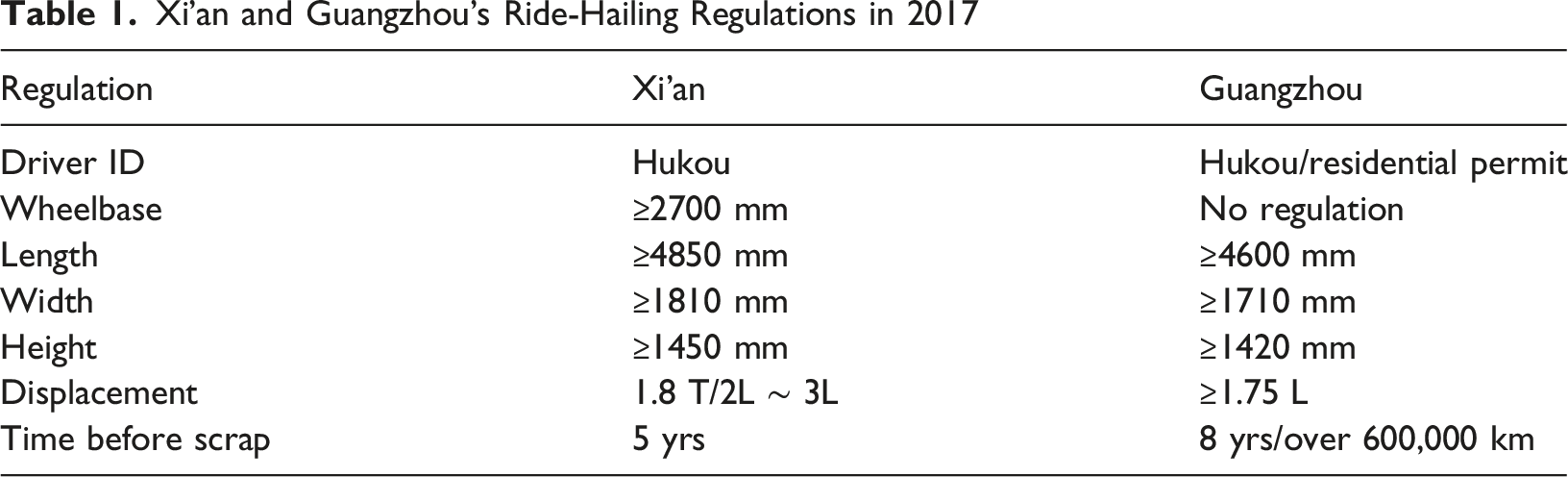
Enforcement on the ground was even more complicated than regulations. Didi’s business was in a gray area in many cities. At the firm level, until 2019, Didi had only obtained operation licenses in one-third of all cities, including Guangzhou, but excluding Xi’an (Cui, 2019). As of 2021, just before Didi’s IPO, half of the driver interlocutors and their vehicles in Xi’an we encountered still had not obtained ride-hailing licenses. Meanwhile, street-level officials in Xi’an also harassed drivers during their daily operation. Among our Didi driver interlocutors, half have experienced administrative harassment in three major forms. The first was inspections conducted by transportation administration officials, during which they chose key routes, randomly stopping and questioning vehicles that appeared to be ride-hailing cars. Fines ranged from RMB 10,000 to 30,000. The situation even forced Didi to partially reimburse the drivers on those fines. Second, ride-hailing operations were effectively banned at key locations such as Xianyang Airport and Xi’an North Railway Station. Any driver caught operating there would be fined. Third, in some areas, undercover transportation administration officials disguised as ride-hailing passengers were deployed. In comparison, driver interlocutors in Guangzhou did not report as many similar cases of harassment.
The different spatial frictions encountered by Didi’s assemblage in Xi’an and Guangzhou were due to the different elements and their associations in different local spaces, rooted in the unequal socioeconomic and industrial structures of different localities. As noted at methodology section, Xi’an and Guangzhou vary significantly in terms of residents’ average income, population density, and labor migration patterns. As a supplement to other more affordable forms of public transportation, such as buses and subways, ride-hailing is a relatively expensive mode of moving around. Compared to that in Xi’an, the shortage of taxicabs in Guangzhou before the rise of ride-hailing was urgent enough that the municipal government held four public hearings on releasing more taxi licenses—not a must in local governing practices—between 2007 and 2012. The 3,500 new taxi licenses in total, however, were dwarfed by the population of nearly 20 million that was continuously growing (Zhang, 2016).
Another important yet often overlooked set of local elements is about the automobile industry. The automobile industry is one of Xi’an’s six officially designated pillar industries but is relatively less crucial to the city’s economy compared to other local pillar industries or the auto industry in Guangzhou. The auto industry took off in the 2010s after the private automobile giants BYD and Geely, headquartered in Shenzhen and Hangzhou, respectively, decided to allocate a significant portion of new energy vehicle production to Xi’an (Song & Song, 2017; Shidai, 2023). As of 2021, the total production value of the auto industry in Xi’an was RMB 139.2 billion (Shidai, 2023) compared to its GDP of RMB 1,068.8 billion (Xi’an Bureau of Statistics, 2022).
In comparison, the auto industry is a central pillar industry in Guangzhou’s economy, with a total production value of RMB 611.8 billion compared to its GDP of RMB 2,823.3 billion as of 2021 (Guangzhou Bureau of Statistics, 2022). The city was one of three sites in the count that welcomed the first batch of auto joint-ventures (Guangzhou-Peugeot) in the 1980s and continued to be a base for various joint-ventures and their suppliers for decades. It is also home to Guangdong Automobile Group, one of the largest state-owned automobile manufacturers in China and partner of many major auto joint-ventures. The total production volume of automobiles in Guangzhou ranked first in China for many years (Southern Metropolis Daily, 2023). Guangdong Automobile Group, as a state-owned enterprise, has a close relationship with the governments of Guangzhou city and Guangdong province. Guangzhou’s city government has been actively pushing the development of the auto industry. In the 1990s, as the Guangzhou-Peugeot joint-venture faced difficulties, the government intervened by ordering cars produced by Guangzhou-Peugeot be used as taxicabs (Zhang, 2019). Recently, Guangzhou Automobile Group and its joint-ventures have been actively producing and promoting their electric vehicles. Some ride-hailing drivers in Guangzhou told us that the Guangzhou city government actively supported its local enterprises by “encouraging” taxi firms and ride-hailing-focused car rental firms to purchase locally produced electric vehicles.
We did not find official documentation of such encouragement, but as our interlocutors working in the government affairs team in Didi remarked, ride-hailing was much more tolerated by the Guangzhou government to promote cars produced by Guangdong Automobile Group than by the Xi’an government. After all, BYD’s and Geely’s relationships with Xi’an were like, as our interlocutors put it, “children raised by their stepmothers,” which alluded to a not-so-close affiliation.
Besides various frictions encountered by each of Didi’s local assemblages in each local space, Didi’s taxation assemblage encountered spatial frictions across local spaces. Taxation concerning the taxi industry is relatively clear. In both Xi’an and Guangzhou, local governments collect taxes from taxi firms, which are mostly generated from taxi owners’ and/or drivers’ management fees paid to taxi firms. 6 Therefore, taxi firms pay the tax on behalf of all of their drivers in a lump sum.
Taxation in ride-hailing is much more complex. Didi’s headquarters is in Beijing, and the firm maintains subsidiaries (with independent accounting) or branches (without independent accounting) in different localities across China. At the firm level, if Didi operates through a subsidiary in a given city, it is required to pay local taxes there. By contrast, if Didi operates only through a branch, tax payments are made to the Beijing government. This is further complicated by the heterogeneous relationships between drivers and the platform. For drivers who use their own cars, Didi pays a lump-sum tax on behalf of these drivers to the relevant tax authority each month. This payment is collected by Didi from drivers when it charges commissions for drivers’ orders. However, for drivers who rent cars from local rental firms or are employed by labor contract firms, their taxation is handled by these firms, which may or may not be registered in the same localities where ride-hailing services are actually performed. While our civil servant and lawyer interlocutors, interviewed in 2025, understood the tax principles in general, many admitted that they were unclear about how Didi’s taxes were handled in practice. From passengers’ perspective, passenger-interlocutors told us that on the invoices they received after a Didi ride, the location of the firm issuing the invoice often varied, sometimes being thousands of miles away from where the ride had taken place. 7
This complex tax status becomes a source of tension between localities. One civil servant from a local tax authority in Guangzhou once commented on local governments’ attitude to Didi paying tax elsewhere than the place where the service is provided: “It’s like I borrow your kitchen to cook my dinner every day. I bring dinner home to eat without paying you anything. Are you happy with it?” While local governments have tried many solutions to ensure that Didi pays tax to them instead of the Beijing government, including but not limited to forcing Didi to set up subsidiaries, tax arrangements remain opaque and complicated.
As shown by the case of Didi’s operations in Xi’an and Guangzhou, at this stage, Didi, as a platform multiple, has encountered three major types of spatial frictions due to its spatial strategies mentioned in the last section. The first type arose across what is recognized as the national and local scales. Didi’s national-scale assemblage was facilitated by the active participation of the central government elements due to its benefit as a technological innovation for entrepreneurship, while its local-scale assemblages failed to operate smoothly because of the incoordination of local government elements, due to taxi-related troubles and other practical administrative concerns. The second type arose within local spaces. Didi’s various local assemblages in various local spaces were reframed into different configurations due to different concerns of government elements in various local spaces, ranging from economic development and public transportation supply to the role of the automobile industry. The third type arose across different local spaces. The boundaries of Didi’s tax-related assemblages do not perfectly match the boundaries of commonly recognized—jurisdictional—local spaces, thus creating tensions between different localities. Notably, different from regulatory arbitrage, which is platform firms’ deliberate strategies to utilize differences and tensions between different localities (Chan & Kwok, 2021; Thelen, 2018), all three types of frictions, manifested as regulatory differences and tensions, arose because of Didi’s spatial strategies.
Looking beyond the local and national scales, the spatial frictions in Didi’s attempt to cash out in the stock market further challenge the narrative of frictionless scaling-up of platforms.
Frictions in Border-Crossing and Global Spatial Fix
Usually recognized as a Chinese platform, Didi has been deeply entangled in the global capital flow and changing geopolitical dynamics. China is famous for its techno-nationalist policy on the development of digital technologies, setting all kinds of boundaries and bans for foreign digital products and services entering the domestic market (Zhang, 2022; Greenhalgh & Zhang, 2020). However, the Chinese state has long allowed and encouraged foreign investment in domestic digital technologies. In the first two decades of the twenty-first century, the prevalent neoliberal-oriented policies towards trade and investments had contributed to a relatively stable and collaborative geopolitical order, characterized overall by friendly and vibrant socioeconomic exchanges across national borders.
As mentioned in previous sections, Didi’s growth was fueled by globally active capital seeking higher returns in tech startups. Just like other tech firms, to attract globally active capital that seeks spatial fix, Didi’s spatial strategies—scaling-up efforts—have been focusing on constructing itself as having the potentiality of operating on higher-order scales. Ever since it achieved limited success in a few cities through angel investment in 2013, it has focused on portraying itself to investors as having the potentiality in operating in whole country and eventually around the globe, rather than finding a viable and profitable business model. One of our interlocutors working in Didi’s financing teams remarked that most of their jobs are to “draw a cake” about Didi’s global future: We draw a big, big cake, a global one, that might come true in the future. Even when we just got some progress in a couple of cities, say Beijing and Hangzhou, we started talking about how we would utilize the investments to dominate the domestic market as a whole and become a strong international player.
An interlocutor working in investment banking echoed the above comment from the Didi staff: The logic of investing in tech firms is that you see its potential to achieve a certain scale, national or better global, so that it looks good in the next round of investors, and the previous round of investors can get capital gain in the next round of investment. Profitability is far from the central concern—you can always find ways to get profit later when you dominate the market with a large enough scale, or it is okay if you never get it—we already get the capital gain before that.
Just as discussed in the theoretical framework section, unlike in many traditional industries, the return of tech startups often comes from the capital market rather than operational profit (see also, Feng et al., 2001). Therefore, the ultimate scaling-up effort, and the key to ultimate spatial fix, is to go for IPO, thus making the shares of the tech startup tradable in the stock market and gaining a huge final return. Didi was no exception.
While global capital seemed to be able to flow into China effortlessly and the global financial market seemed highly open in Didi’s previous trajectory, spatial boundaries were proven robust and hard to cross when it came to Didi’s IPO. Spatial strategies for this ultimate scaling-up effort mattered greatly, as the structure of global financial market is highly unequal. Given the amount of investment, Didi was looking for trading markets that could make it recognized as operating on the global scale. Mainland Chinese exchanges were not on Didi’s agenda due to their low influence in and poor connection to the global financial market. Didi had two options: HKEX and NYSE. Didi ultimately chose the NYSE, partly due to strategic considerations: platforms like Uber, Lyft, and Airbnb were all listed on the NYSE or Nasdaq. Therefore, U.S. exchanges were familiar with the technology and business logic of platforms and their spatial strategies mentioned in the last two sections. Brokerage firms, including the investment bank where several of our interlocutors work, generally believed that listing on the NYSE rather than HKEX could increase Didi’s market value by $20 billion (see also Dow Jones News Wires, 2021).
However, this choice was as much a necessity as a preference because spatial frictions arose between Didi as a global financial assemblage and HKEX. Didi could not meet the requirements of listing on HKEX around 2020 and 2021, due to three reasons, according to investment bank employee interlocutors. First, HKEX required firms to have a total profit of at least HK$30 million (US$3.9 million) each year for the 2 years before listing (HKEX, 2020). Didi, which had long relied on financing for loss-leading expansion, had never been profitable before 2021 (Didi Global Inc, 2021). Second, given the varied, hesitant, and generally hostile attitudes of different local governments to Didi, mentioned in the last section, Didi had not obtained operating licenses in many cities and was not able to claim its stable operation across the Chinese market. These raised compliance-related concerns of HKEX and hindered Didi’s attraction to investors. Third, the diverse sources of global capital resulted in a complex equity structure and raised more compliance concerns among Hong Kong regulators (Huang, 2021). In contrast, the U.S. Securities and Exchange Commission (SEC) simply required disclosure of compliance risks instead of addressing them (see Didi Global Inc, 2021). Listing in the U.S. became the only option in the short term. In short, the spatial frictions between Didi’s financial assemblage and HKEX, on the commonly recognized global scale, arose due to the previous spatial frictions that the Didi platform multiple encountered on the national and local scales.
Unfortunately, the choice of NYSE raised another spatial friction, this time across the national and global scales, given that the global financial market, seemingly free, is still constrained by national and geopolitical power structures. Since the late 2010s, the economic and technological relationship between China and the U.S. has gradually shifted from cooperation to competition and conflict. The U.S.-China trade war in 2018 and the subsequent COVID-19 pandemic have further intensified this trend, leading to continued deterioration in U.S.-China relations. This geopolitical shift led both countries to curb the border-crossing attempts of Chinese tech firms. China enacted the Cybersecurity Law as early as 2016, which in principle prohibits domestic tech firms from sharing data with foreign entities. In the U.S., Chinese tech firms faced stringent scrutiny. In 2020, the U.S. Congress passed the Holding Foreign Companies Accountable Act, which requires foreign companies listed in the U.S. to submit audit documents, and the SEC stated that it would implement this requirement as soon as possible (SEC, 2020).
According to investment bank employee interlocutors, before Didi’s IPO, the Cyberspace Administration of China (CAC) had “advised” Didi to postpone its listing, but Didi, under pressure from investors, “pressed ahead” and quietly went public on the NYSE on June 30, 2021. However, two days later, the CAC announced that it would launch an investigation into Didi with the Ministry of Public Security and the Ministry of State Security, and suspend the registration of new passengers and drivers, as well as remove the app from app stores. In July 2022, the CAC (2022) fined Didi RMB 8.026 billion, citing illegal collection and use of user information, as well as putting key national information infrastructure and data security at risk. The IPO crisis was undoubtedly the biggest setback in Didi’s history. 8
In summary, the attempt to IPO is the Didi firm’s ultimate scaling-up effort in financing. Through this effort, the globally active capital attempted to achieve a spatial fix not via profitability—the traditional manifestation—but via helping the platform be recognized as operating on the global scale and realizing the corresponding capital gain based on stock trading. However, such scaling-up efforts and spatial fix failed due to two spatial frictions arising across the national and global scales.
The first was the conflict between two elements in the global financial space, that is, the Chinese central government and the U.S. government, shaped by the global geopolitical structure. The Chinese central government’s earlier tolerance of Didi, largely based on techno-nationalist concerns over international standing and innovation capability, was radically reversed during Didi’s IPO based on the same concerns. Similarly, the U.S. government acted hostile to Didi and other Chinese tech firms. In other words, Didi’s financial assemblage at the global scale failed to be effectively associated with the Chinese central government and the U.S. government.
The second spatial friction was that Didi’s financial assemblage failed to be effectively associated with HKEX, another element in the global financial space. One factor behind this spatial friction was Didi’s national- and local-scale spatial frictions mentioned in the previous section, including the inconsistent and sometimes outright hostile attitudes of local governments toward Didi. Another factor was that the capital behind Didi has always been intending to achieve spatial fix via financial gain based on investors’ recognition and valuation of Didi’s potentiality rather than Didi’s profitability, which led to the loss-leading expansion. Both factors resulted in HKEX’s compliance concern and Hong Kong investors’ lack of confidence, forcing Didi to choose the U.S.
Conclusion: A Transferable Space-Centered Approach to Platform Development
This article develops a space-centered theoretical framework and use it to reinterpret the development of Didi—a representative digital platform, an interpretation that challenges the common spatial imaginary of frictionless scaling-up of platforms. A platform is conceptualized as a platform multiple composed of multiple assemblages operating within and across different spaces. The configurations of these assemblages, the relationship between them, and the spaces and scales in which they operate are shaped, empirically, by the contingent, unstable, and unequal connections and interactions of various elements informed by material environments and power relations, and, analytically, by the focus of inquiry. Platform companies deploy spatial strategies, including scaling-up of all kinds, to transform its assemblages in existing spaces, forming new assemblages in new spaces, and making itself recognized as operating at a higher spatial order. The scaling-up efforts are often fueled by capital to achieve a spatial fix. However, spatial strategies have been triggering all kinds of spatial frictions, resulted from encounters of various elements in and beyond specific locales in the platform multiple, which destabilize the scaling-up efforts and the process of spatial fix.
Examined under this space-centered framework, Didi’s emergence of the platform multiple is not a product of the grand design or planning by the platform company. The lens lent by the concepts of assemblage and space makes visible dimensions of Didi’s development that have not been fully accounted for. For instance, in the formation process of Didi assemblages, many core elements—such as algorithmic architecture and hardware devices—and their associations are shaped by China’s spatio-temporal and socio-material environment: the country’s leapfrogging to the mobile Internet era and the lack of PC-based Internet experience, which jointly shaped netizens’ user habits (Zhang & Xing, 2025). The foot-soldiers-style promotions to drivers and passengers, which enabled Didi’s scaling-up, was enabled by the labor market structure and fueled by globally active capital. Meanwhile, ever since the beginning, Didi as a platform multiple was a product of the unique spatial politics in China: stringent geographical and sociopolitical boundaries were imposed on Internet infrastructures, which protected Didi from international competitors but were relatively open toward foreign investment. This unique politico-spatial structure made Didi attractive to global capital.
The idea of spatial friction directs researchers to look beyond the seemingly universalizing technological architecture of a platform and pay close attention to a range of factors on the ground that shape the pathway of platform development. In the case of Didi, central governments’ embrace of innovation and entrepreneurship clashed with local governments’ practical governance challenges. In each local space, local governments treated Didi with different but generally hostile attitudes informed by socioeconomic and industry structures. Between local spaces, local governments restricted Didi’s operation due to concerns centered on cross-jurisdictional taxation. These spatial frictions further contributed to the global-scale frictions occurring when Didi intended to go for IPO. Joined by the misalignment of different elements—the Chinese central government, the U.S. government, HKEX, and NYSE, Didi’s global financial assemblage as well as the platform multiple as a whole experienced the biggest setback in Didi’s development.
While our analysis stops at Didi’s IPO frustration, Didi the platform multiple continuously evolves as the capital behind it continued to seek spatial fix via scaling-up efforts of various kinds. In China, the Didi assemblage on the national level was adjusted as the company accepted all the disciplines imposed by the central government. The platform multiple was also reshaped as its assemblages in different cities were re-assembled. Those re-assembling efforts included promoting smart-city-related collaborations with local governments, enforcing local government compliance requirements on drivers and vehicles, and accepting ad hoc local government requirements on transport capacity dispatching (e.g., directing drivers and vehicles to tourist sites during vacations with algorithms; see Xing, 2025). While more can be said, it is sufficient here to acknowledge that these scaling-up efforts strongly reshaped local landscapes of transport and labor, resulting in enhanced government surveillance over individual drivers, the dominance of full-time drivers renting standardized cars from car rental firms (Frost et al., 2026), the increasing uncertainty of drivers’ work practices due to various ad hoc algorithmic changes, and, overall, the centrality of ride-hailing in the local socioeconomic order. All these efforts preserved the Didi platform multiple from government intervention and interference, enabling it to finally become profitable in 2023 (Xiaoxi, 2025).
Outside China, the company continued to create and transform new assemblages in other national spaces in the Global South, predominantly Latin America. Yet, elements and their associations essential to form new assemblages differ significantly from those in China. Such differences include but are not limited to those in technical-financial infrastructures, car ownership structures, labor practices, and user habits, thus creating endless new spatial frictions, involving market access, innovation, labor classification, environment, algorithmic transparency, and data security (Sáenz-Leandro, 2025). Assemblages of the Didi platform multiple in various spaces in Latin America therefore are significantly different from those in China, often characterized by a sophisticated financial system (Manky & Mogollón, 2024).
In short, this reinterpretation of Didi’s development as a spatial process offers a sophisticated analysis that contests the imaginaries of digital platforms as territorially borderless and culturally odorless techno-economic practices. It demonstrates that platform development is far from uniform or frictionless but unfolds through highly differentiated spatial dynamics and endless tensions, largely shaped by existing structures and power relations within and between spaces and scales.
This article also enriched the studies of spatial political economy by extending the concept of spatial fix in the context of the platform economy. Beyond geographic expansion and material transformation, we argue that spatial fix of capital can also be achieved through the recognition, narration, and capitalization of scale. In platform capitalism, scale itself becomes an object of strategic construction and financial valuation. This reconceptualization brings studies of digital platforms into dialogue with Marxian human geography while refining the concept of spatial fix for contemporary high-tech capitalism.
Moreover, this article offers a space-centered theoretical framework that bridges platform studies and spatial political economy. Such theoretical integration enables us to develop an analytical toolkit with concepts of assemblage, the platform multiple, spatial fix and friction to approach platform development as an uneven and uncertain spatial process of de-territorialization (by bringing the same technical platform to various spaces) and territorialization (by reshaping what is commonly understood as global, national, and local spaces), considering both platform firms’ and other elements’ agencies and structures and power relations. This framework emphasizes how platforms and their scaling-up efforts are contingently, processually, and practically enacted via various on-the-ground moves that renegotiates the boundaries and inner configurations of various spaces and scales, instead of informed by a universal master-plan.
While this article focuses on Didi for its empirical analysis, the proposed theoretical framework does not aim to generate empirically generalizable claims about how certain types of platforms necessarily develop in China or elsewhere. Rather than offering a model of typical trajectories, it provides a methodologically transferable way of analyzing platform development as a spatial process. This approach can be applied to different kinds of platform cases, whether in digital finance, mobility, delivery, accommodation, or other sectors, and across diverse socio-institutional settings. We hold that this methodological and analytical tool is fundamental for an alternative spatial imaginary of different kinds of platforms.
Footnotes
Acknowledgment
The authors are grateful for the comments by the special issue editors Drs Julia Tomasset and June Wang and the anonymous reviewers.

Ethical Considerations
Research conducted in the article has obtained ethical approval from the authors’ affiliated institutions.
Consent to Participate
Part of the informed consent to participate was written and the rest was verbal, and the informed consent in all cases was obtained according to the affiliated institutions’ ethical guidelines.
Funding
The authors disclosed receipt of the following financial support for the research, authorship, and/or publication of this article: The research described in this article was substantially supported by the General Research Grants from the Research Grants Council of the Hong Kong Special Administrative Region, China (Project No: CityU 17636016 and 11600724).
Declaration of Conflicting Interests
The authors declared no potential conflicts of interest with respect to the research, authorship, and/or publication of this article.