







Abstract
AI application development platforms incorporating generative artificial intelligence into their technology stack are reconstructing software development paradigms. Drawing on the convergence of platform studies and infrastructure studies and engaging materially attentive political-economic critique, this study combines theoretical literature review with hands-on experience in building AI agents on the Coze platform to propose the concept of “Level 4 platforms,” exploring how agent platforms function as weak emergence structures in technological programming practice, generating differentiated functionalities and possibilities for action through user operations. Drawing on Gilbert Simondon’s theory of individuation, this study further proposes the analytical framework of “Human-Media Co-individuation,” employing the concept of “intraface” to analyze how users achieve dynamic element-network configuration through visual programming interfaces. Through a case illustration of building a research literature assistant agent, this paper demonstrates the four-stage operational chain—from goal definition, component configuration, and workflow construction to testing and iteration—revealing how users and technical elements achieve co-individuation through mutual adjustment. However, this study simultaneously identifies the structural limits of platform-based empowerment: commercial logic constraining user creativity, new forms of digital divide arising from unequal digital literacy, precarity stemming from platform dependency, and fundamental reliance on existing infrastructure platforms. Whether this transformation represents genuine change or a reconfiguration of existing power asymmetries remains contingent upon the ongoing unfolding of technological development, commercial strategies, regulatory interventions, and user practices.
Introduction
“Programmability” has been not only the original and primary form of user-computer interaction since the invention of computers by humanity, but also an inherent right of users. However, with the proliferation of Graphical User Interfaces (GUI) and the emergence of Silicon Valley social media platform culture, while bringing “user-friendly” interactions, the human-computer relationship has also become alienated. Its prominent characteristic is the restriction and deprivation of users’ programming rights. This constitutes what Simondon (2017, p. 117–133) identifies as a psycho-physiological alienation in the technical dimension—distinct from, though entangled with, the political-economic alienation that Marxist critique foregrounds. For Simondon, alongside the economic alienation of workers from their means of production lies a more fundamental severing of the human-machine relationship, in which technical objects no longer extend human existence but instead turn toward control and exploitation. Platform culture exemplifies this technical-dimensional alienation, manifesting as the “de-technicization” and “de-individuation” of users.
AI agent development platforms driven by generative AI are opening up possibilities for the return and reconstruction of users’ programming rights through natural language programming approaches. Unlike the Level 1, Level 2, and Level 3 platforms of Access API, Plug-In API, and Runtime Environment (Andreessen, 2007), AI agent development platforms function like laboratory spaces that connect individual inner imagination with external technological infrastructure, supporting users in experimenting with new alternative media forms beyond commercial logic—platform-based personal dynamic media.
Therefore, this study draws on Gilbert Simondon’s theory of individuation as a framework to reveal the operational logic of AI agent development platforms, examine the interactive mechanisms between individuals and platforms in development practices, and thereby explore new dimensions of human-media relationships in the intelligent platform era. Through analyzing Coze as a representative case, this study argues that Level 4 platforms, as a form of generative AI-driven “open machines,” create new conditions for reciprocal coupling between human individuals and media technology—though this coupling operates within, not outside of, commercial platform infrastructures. The analysis reveals both the potential for “human-media co-individuation” and the structural limits that constrain this potential.
Methodologically, this study positions itself within the convergence of platform studies and infrastructure studies, an approach that foregrounds the material and computational substrates through which platforms operate (Bogost & Montfort, 2009; Plantin et al., 2018). This perspective is not opposed to political-economic critique but extends it: by attending to programmable architectures, APIs, and the layered material conditions of platform operation, scholars have shown how the political economy of platforms is concretely instantiated in technical decisions about openness, modularity, and access (Gerlitz et al., 2019; Helmond, 2015; van der Vlist et al., 2022). Building on this materially attentive yet politically alert tradition, the present study analyzes Level 4 platforms as a new computational stratum whose specific affordances and constraints reconfigure—without dissolving—the asymmetries that critical platform scholarship has long documented (Srnicek, 2017; Zuboff, 2019).
The Evolution of User Programmability
The concept of platforms has been proven to be an effective means for researching and critiquing software and networks (McKelvey, 2011). However, since platforms have been accepted by academia, industry, and the public as the core concept for describing internet forms, they have primarily been interpreted from a metaphorical perspective. Under the metaphorical perspective, “Platforms are platforms not necessarily because they allow code to be written or run, but because they afford an opportunity to communicate, interact, or sell” (Gillespie, 2010). The distinction between platforms and non-platforms lies in that “They make possible further media, or user experiences, or exchanges of value (social, informational, monetary) that rely upon and are channeled through them” (Reynolds, 2018, p. 98). Consequently, all digital media seem to have become platform media, making their signification vacuous. Understanding of platforms no longer proceeds from the specific technical foundations of digital media operations, but is limited to the production, distribution, and consumption of platform information, obscuring the deep technological connections between users and digital media (Bogost & Montfort, 2009). Computational dimension platform research is characterized primarily by discussing platforms’ “programmability, affordances and constraints, connection of heterogeneous actors, and accessibility of data and logic through application programming interfaces (APIs)” (Plantin et al., 2018). This dimension has gained increasing recognition from media scholars, management and organizational researchers, and technology industry practitioners.
In the computational dimension of platforms, the key term is “programmable.” “If you can program it, then it’s a platform. If you can’t, then it’s not” (Andreessen, 2007). Therefore, platforms typically adopt a triadic technical architecture: core components with low variability, complementary components with high variability, and interfaces for modularity between core and complementary components (Baldwin & Woodard, 2009). Using Adobe Photoshop as an example, its low-variability core components include the image rendering engine, layer and mask systems, color management, and basic UI framework, forming the stable operational foundation of the software; high-variability complementary components are manifested in various third-party plugins and presets—such as Camera Raw filters, Nik Collection, various brushes, Actions, and scripts, which can be added, updated, or removed at any time to meet different creative needs; while Adobe’s modular interfaces (including CEP/ExtendScript, Photoshop SDK, and the new UXP plugin platform) precisely decouple these two elements, enabling developers to invoke Photoshop functions, register panels, and extend toolbars without touching the core engine, thus rapidly customizing and expanding the entire platform’s capabilities.
From this perspective, a platform constitutes a programmable system that enables customization by external developers. This programmability permits adaptation to emergent use cases and niche demands beyond the scope of the platform’s initial design or capacity constraints of its original architects. However, the reality is that programmable platforms often only take effect for developers who master non-natural language interaction methods and possess corresponding permissions. Ordinary users, lacking underlying technical literacy, are excluded from deep programmable practices, and their so-called “hackable” behaviors are sometimes even considered illegal by platforms and subject to API access restrictions (Jamieson et al., 2022). More importantly, all programmable operations are subject to platform API governance—APIs are not only technical interfaces for data access, but also key means for platforms to execute policies and strategies and shape ecosystem evolution (Van der Vlist et al., 2022).
Reviewing the history of computer development, we find that user-oriented programmability is its foundational architecture and basic operational mode. Starting from the first general-purpose computer “ENIAC,” the first batch of computer users needed to accomplish programming by manually replacing punch cards and plugging and unplugging modular vacuum tubes and cables to implement program changes. Therefore, programmability is also users’ inherent right. The computers that launched the PC era—Commodore PET, Apple II, and Radio Shack TRS-80—all adopted open architectures and modular designs, making compatibility and expandability their selling points (Cheng, 2024). The IBM PC, which once became synonymous with personal computers, even proclaimed: “The definition of a personal computer is third-party hardware and software,” recognizing that the prosperity of the personal computer market depended on maintaining open design (Zussman, 1982). They opened up support for peripherals such as music synthesizers, printers, lighting controllers, and game controllers (Cheng, 2024). Peripherals are units that work with computers but do not belong to the computer itself; they can be directly plugged into the expansion card slots reserved in these PC models, achieving functions that were not provided at PC launch but were needed by users. Thanks to open design and extensible operations, general-purpose computers began to become potentially omnipotent machines and spread throughout social scenarios (Lemmons, 1984).
Computers’ support for programmable operations established interfaces with human senses, thereby becoming a medium (Hansen, 2010, p. 184). Media archaeologist Jussi Parikka argues that “Computers, after the ‘revolution’ of the 1980s, were increasingly ‘plug-in’ systems designed to suit the needs of people without professional understanding. In a sense, at the core of this turn is a new cultural perception and understanding of computers” (Parikka, 2016, p. 28). In other words, through “user-friendly” programming methods such as peripherals and plug-ins, humans and computers established cybernetic loops that allowed information flow, making personal computers into “personal dynamic medium” (Kay & Goldberg, 1977). Human-computer interaction became a new communicative modality in social relations, with computers serving as new media that extend human perception. From this level, computer programmability refers to programmable media and the resulting regulation of user subjectivity. The advent of the PC era was users programming personal computing platforms to achieve their exclusive mediatized transformation. This explains why “programmability” is considered the most fundamental attribute of new media and the true distinction from old media (Chun, 2011; Manovich, 2002).
However, with the proliferation of Graphical User Interfaces (GUI) and the emergence of Silicon Valley social media platform culture, the former concealed the actual operational logic of machines, while the latter subjected users to “voluntary slavery,” trapping them in a state of technological “ignorance” (Bolz, 1998). For users without programming skills, their programmable operations, if they can still be considered programming at all, are limited to personal homepage settings on platform media and multimedia product creation. With machine learning-driven personalization, applications promising to reveal self-mysteries can demand even more data “sharing”—contacts, photos, locations, likes, etc. (Fourcade & Kluttz, 2020). Users have become mere technical users, also losing the authority and opportunity to transform media. They linger on the visible interfaces of platforms, neither caring about nor being able to care about their internal operational mechanisms. User-friendliness ultimately evolved into so-called personalized settings and personalized recommendations, but this personalization comes at the cost of users’ individuality. As scholars have pointed out, “the individual, whom it ostensibly lauds, is merely figured as a nexus of contracts and flows of credit units and data” (Fuller, 2017, p. 4). Or as Deleuze put it, “Individuals have become ‘dividuals’, and masses, samples, data, markets, or ‘banks’” (Deleuze, 2017). Based on this, professional developers or third-party service providers who obtain programmable rights, when extending platforms, often think like the capital behind platforms about how to exploit the value of user data for their own commercial interests (Helmond, 2015).
This reveals what Simondon terms the “psycho-physiological” alienation of human individuals (Simondon et al., 2017, p. 133)—a technical-dimensional alienation that operates alongside, but is irreducible to, the political-economic alienation that Marxist scholarship has long examined. Users are gradually “de-technicized” and “de-individuated,” as “their technical knowledge, which indicates their affinity to machines, will be reduced to the most superficial level” (Hui, 2016, p. 57).
That is to say, they lose knowledge of how to act upon machines, and consequently lose knowledge of how to live, thus being “transformed into machines incapable of improvisation, becoming connected ‘proletarianized netizens’” (Stiegler, 2016, p. 10). Human agency at both individual and collective levels is thoroughly stripped away; so-called personalized recommendations and social connection are merely technical means of distraction—“catalysts for the disintegration of individual internal structures, rather than incubators for new modes of empowerment” (Hui, 2015).
In fact, the field of computing technology has never lacked individual “tactical” practices that counter the commercialized “strategies” of platforms (De Certeau, 1984). In the realm of media activities, “tactical media” typically refers to a way of “talking back to the media”—a pathway for creative/destructive dialogue with the activities and products of industrial media culture (Huhtamo, 1999). Particularly with the proliferation of media production software (such as Adobe’s software suite), ordinary users can also possess “tactical creativity,” processing various media materials themselves to make them their own and constructing cultural narratives different from mainstream media platforms (Manovich, 2009). Media production software has transformed users from mere content consumers into “prosumers.” AI application development platforms, from another dimension, provide conditions for users to engage in new tactical practices—they flatten the functions and services of applications into operable materials, prompting ordinary users to develop new imaginings about software. Platforms also convert this combination and connection of technical elements into a democratized technical narrative—“everyone can become a developer.”
Therefore, the core question this paper aims to explore is: With the advent of large language models, the rise of AI application development platforms, and the popularization of natural language programming methods such as node-based visual programming and vibe coding—these means of democratizing technological development—can they reverse the de-individuation process that human individuals have experienced in the technological dimension? Furthermore, can they transform technical labor into technical activity, enabling human individuals to realize the creation of their own lives while extending inventions upon technical objects, and construct a technical world with new structures?
Platform-Based Personal Dynamic Media Based on Level 4 Platforms
With the rapid maturation of generative artificial intelligence technology, a programming paradigm centered on natural language is gradually emerging (Burkhardt & Rieder, 2024). Under this paradigm, developers or end users need not master traditional programming syntax; they need only converse or issue instructions to complete the entire process from code generation to interface design to application publishing (Baidu, 2024; Gates, 2023). Based on this, AI development platforms with programmability as their operational syntax are reconstructing the relationship between users and technology: on one hand, they restore users’ programming rights to media technology, enabling more users to develop and extend media themselves rather than completely relying on professional developers; on the other hand, platforms provide modular, plugin-based development environments, opening new fields for diverse needs and innovative practices. Thus, users are no longer passive recipients of existing platform functions, but can generate, customize, and even publish their own digital media through natural language interaction, marking the return and reconstruction of individuality.
Four Levels of Platforms
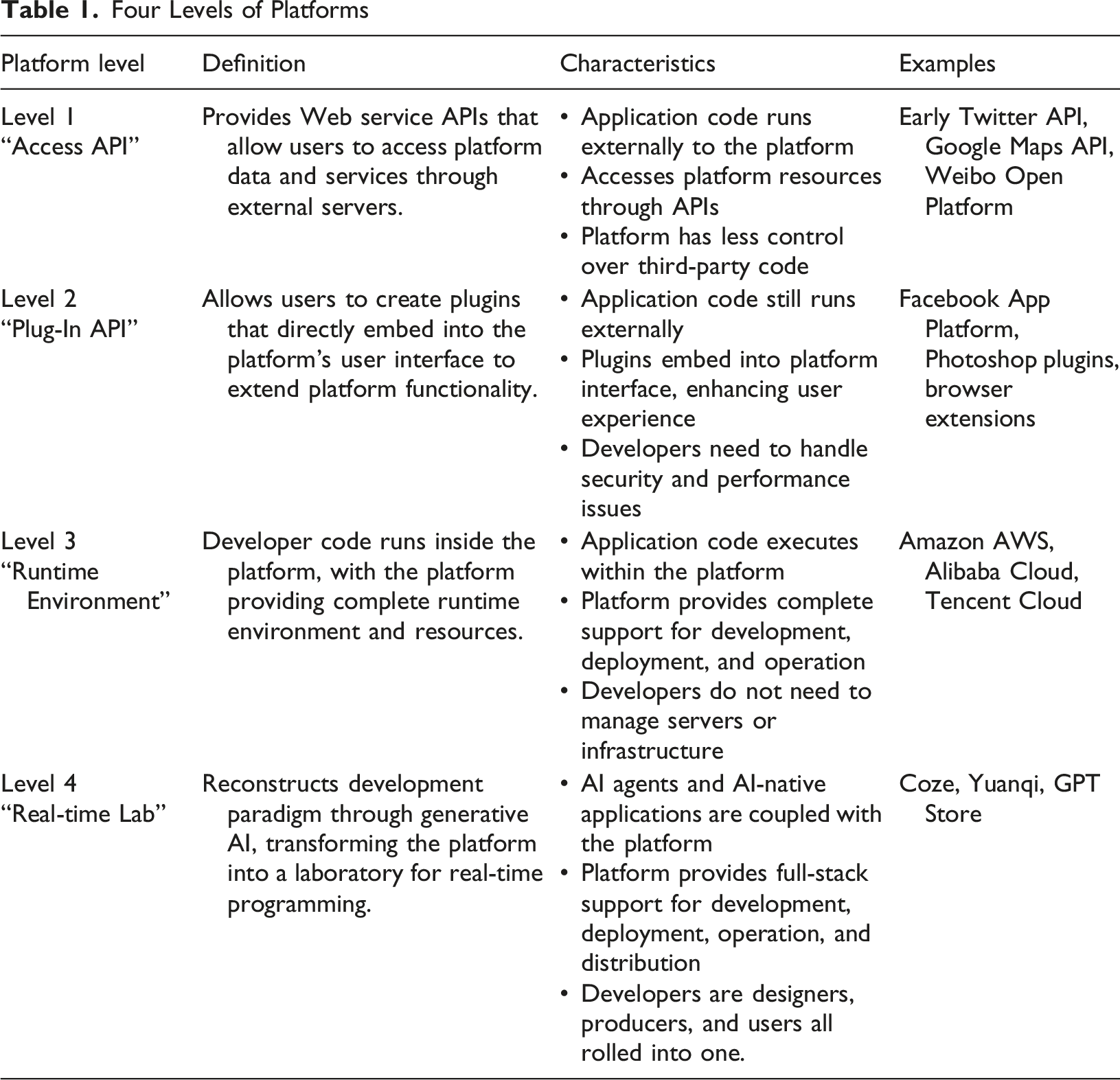
Level 4 platforms provide support for ordinary users to program their personal dynamic media. In Alan Kay’s earliest vision of computers as personal dynamic mediums, he required that personal computing devices must be “a general medium of communication,” “provide exceptional freedom,” and have enough ready-made universal tools so that everyone (regardless of age, profession, or gender) could program them according to their own needs. Its dynamism refers to the fact that personal computing media can be shaped into “a wide range of already-existing and not-yet-invented media.” This way, everyone can configure their own personalized media, “which is owned by its user and responds instantly and consistently to its owner’s wishes” (Kay & Goldberg, 1977). For AI application development, large language models constitute the general-purpose engine of AI applications, while Level 4 platforms provide ready-made universal development tools. Particularly with their visual, modular programming paradigm, any individual can easily get started inventing media. Moreover, most Level 4 platforms are open-source; even an AI application development platform like Coze, backed by a platform giant (ByteDance), has released its own open-source version. Therefore, individual developers need not enter into the control relationships that accompany accepting Level 1–3 platform services.
AI agents, as platform-based personal dynamic media, are no longer mere program containers but exhibit new characteristics—because Level 4 platforms not only influence users’ development processes but also intervene in the operation of the agents themselves, whose fundamental significance lies in becoming the technological grounding for individuals to construct their own world. On one hand, the creation of AI agents is accomplished jointly by users and Level 4 platforms, rather than merely providing extended interfaces or serving as program runtime environments. As platform functions, large model capabilities, and user preferences continue to evolve, agents will also update synchronously, growing together with both technical and individual aspects. On the other hand, under the premise of generative AI as a driving engine and highly customized functional configurations, agents can rely on the MCP protocol (Multi-Channel Protocol, a standardized API calling mechanism) to integrate resources from multiple domains including healthcare, education, productivity, entertainment, and e-commerce, providing users with truly “hyper-personalized” services (Sun & Cheng, 2024). As Bill Gates said, “[AI] Agents will be the next platform” (Gates, 2023). Based on this, platform-based personal dynamic media might be more accurately called personal platform media, to emphasize their dual attributes: they are both dynamic projections of subjective individuality and new platform-based application paradigms.
Human-Media “Co-Individuation”
Scholars have proposed that “a fruitful new direction for internet and media researchers is to discover how individuals found a place in their lives for the changes that technology brings. As a result, we would know more of individual users’ agency in their own historicity, understanding how their own self-histories interweave with the history of technology” (Allen, 2013).
Understanding Level 4 platforms and personal platform media requires a new analytical framework. The individuation theory of technology philosopher Gilbert Simondon can help us understand this individual-oriented platformization of AI agents. Simondon’s philosophy begins with a fundamental question: “What is an individual?” He points out that traditional philosophy has mainly provided two answers: first, substantialism derived from Plato, which views individuals as manifestations of transcendental essence; second, hylomorphism from Aristotle, which understands individuals as combinations of form and matter, both of which exist prior to the individual. For these two viewpoints, the individuation process is often regarded as an accidental “black box,” assuming individuals as already formed and static entities. Both approaches tend to focus on substantial, determinate, and bounded individuals, namely “accords ontological privilege to the already constituted individual” (Simondon, 1992), assuming that “individuals” exist first, followed by “individuation.” Simondon reverses this orientation, arguing that “we would try to grasp ontogenesis in the whole unfolding of its reality and to know the individual through individuation rather than individuation starting from the individual” (Simondon, 2009, p. 3).
Through his critique of Aristotle’s hylomorphism and the brick-making example, Simondon explains his ontological position. For Simondon, Aristotle’s description of brick-making only focuses on structure: the visible, realized elements that constitute the brick—clay, mold—while all the processes that facilitate the fusion of form and matter are not explained. It can be said that hylomorphism first laid the groundwork for discussions about the technological black box—“this obscure zone between form and matter.” This “obscure central zone” conceals the true mediator connecting matter and form, namely the operation of individuation (Simondon et al., 2017: 250, 254), which constitutes what “makes a structure appear or what modifies a structure” (Simondon and Adkins, 2020, p. 661), where “structure” refers to individuated beings (such as bricks, machines, humans). Individual structures continuously fold and unfold during the operational process, realizing the transformation from one structure to another, completing individuation.
To illustrate this point, Simondon retells the brick-making process by decomposing the “operational chain” of preparing clay and the mold itself (see Figure). Bricks are not directly generated by abstract forms imposed on raw matter, but through the preparation of clay and the creation of molds, gradually constructing the coupling relationship between matter and form. The operation of preparing clay transforms marsh mud into plastic matter, while the crafting of molds converts the assemblage of wood and nails into tools of concrete form. Thus, Simondon points out that the principle of individuation is inherent neither in form nor in matter, but exists in the operational process that relates the two: “The veritable principle of individuation is genesis itself in the course of being carried out, i.e. the system in the course of becoming while energy is actualized… the principle of individuation is the operation that realizes an energetic exchange between the form and the matter” (Simondon and Adkins, 2020, p. 32). In short, individuation is a dynamically realized interactive process.
Technical objects are not simply the addition of their elements, but the totality of their production, including all necessary steps, work, potentials, and incompatibilities (Benabdallah & Peek, 2024). By critiquing Aristotelian hylomorphism and emphasizing “operation” in technical activities, Simondon simultaneously explains how to study the mode of existence of technical objects and how to develop relationships between humans and technical objects. “It would be necessary to be able to enter the mold with the clay, to be both mold and clay at once, to live and feel their common operation in order to be able to think the process of taking form in itself” (Simondon et al., 2017, p. 248–249). This means that human individuals need to intervene in technical activities simultaneously as both operator and object of operation, deeply entangling with technical objects at the transindividual level. In the individuation paradigm, individuals are only relative, staged results of individuation, always containing unindividuated potentials and virtualities—preindividual reality (Simondon and Adkins, 2020, p. 3), while transindividuation connects the preindividual reality of different individuals, promoting the emergence of new individual structures (Simondon et al., 2017, p. 253). The transindividuation process between humans and technical objects is actually a process of invention, in which human individuals engage deeply in technical design, manufacturing, debugging and other operational stages, using their imagination and creativity to modulate preindividual reality into visible structures and functions of technical objects, ultimately achieving the transformation of both humans and technical objects. Brian Massumi describes this invention process as follows: “The moment of invention is the instant when two potential possibilities mutually correspond and fuse into a continuous system… a “threshold” has been crossed, leaping like a quantum jump into an entirely new operational level” (Massumi et al., 2009). Therefore, the true essence of humanity in Simondon’s sense lies in becoming inventors of technical objects, maintaining continuous attention to the becoming of technical objects in human-machine relationships. But this does not mean that human individuals become servo mechanisms of technical objects; rather, humans need to use the invention of technical objects to reconcile incompatibility problems that may arise between self and self, and between self and world (e.g., in social interaction and understanding the world, technical invention can provide new ways and approaches to resolve contradictions and conflicts), achieving their own individuation. When McLuhan said “man’s technology is the most human thing about him” (McLuhan, 2003, p. 290), he precisely meant that human individuals organize their own experiences and explore potentials, deeply inscribing individuality in the invention process of technical objects. They use newly invented technical objects as media to express and extend themselves, seeking to establish new individuation circuits. Therefore, human-machine transindividuation is simultaneously human-media co-individuation, where technical operations are always “means to individuate, to invent, to create, to think, to transform the world” (Stiegler, 2015b, p. 19).
The current technological reality in platform society indicates that the original central obscurity left by hylomorphism has not dissolved, but has instead transferred to the level of media use—“it is now the functioning of the machine, the provenance of the machine, the signification of what the machine does and the way in which it is made that is the obscure zone” (Simondon et al., 2017, p. 254), and even if individuals can enter this obscure zone, they must face highly fragmented production processes: design, manufacturing, debugging, operational learning and use are all undertaken by different subjects, lacking organic overall balance (Simondon, 2010, p. 7–8). For Simondon, current platform owners, developers, and users are all in states of alienation. User alienation has been mentioned earlier; platform owner alienation manifests in only being able to serve as external coordinators of technical ensembles, not being familiar with the internal operational mechanisms of platforms themselves, unable to extend invention (Simondon et al., 2017, p. 80). Developer alienation actually appears simultaneously with user alienation, “the former being the opposite type of the latter, yet arising from the same causes” (Simondon, 2010, p. 7–8). They are constrained by utilitarian demands, imprisoned in fragmented technical innovation (platforms only allow marginalized technical extensions that conform to their own commercial interests), unable to orient toward self-realization, so that “industrial technology continues to innovate, but life’s inventions become increasingly rare” (Stiegler, 2016). In Simondon’s thought, “innovation” mostly refers to metaphysical development that serves preset utilitarian needs, while true “invention” is a non-metaphysical becoming that transforms thought and action along unforeseeable trajectories (Lapworth, 2020). As Latour says, “They (technologies) are far from primarily realizing a certain purpose, but begin by exploring heterogeneous universes that no one could have foreseen before, and behind these universes new functions will appear” (Latour & Venn, 2002). However, under the logic dominated by market and consumerism, technical objects are still defined by their “sellability” and “usability” (Hui, 2017). Ordinary users cannot intervene in the invention process of platforms, and thus cannot use this to open new individuation circuits for themselves (Stiegler, 2010).
In response, Simondon calls for the technical form of “open machine.” Open machines would consist of two parts: “a layer that is as stable and permanent as possible, which adheres to the user and is made to last, and a layer that can be perpetually replaced, changed, renewed, because it is made up of elements that are all similar, impersonal, mass-produced by industry and distributed by all the networks of exchange” (Simondon, 2010: 13). This essentially aligns with Alan Kay’s personal dynamic media and the current foundational architecture of platforms. The parts that can be replaced, chosen, and updated constitute the open machine’s “margin of indeterminacy” (Simondon et al., 2017, p. 17), which is the preindividual field reserved for individuality. But for humans and open machines to achieve co-individuation, there is still a prerequisite condition: human natural memory and machine artificial memory must be able to achieve mutual conversion, namely “The coupling of man to machine begins to exist from the very moment when a coding common to both of these memories can be discovered, in order for a partial convertibility of one into the other to be realized, so that a synergy can become possible” (Simondon et al., 2017, p. 138). In Simondon’s era, he viewed electronic computers with extensive circuit switching possibilities as prototypes of open machines. Since then, humans and machines could achieve open “transcoding” dialogue (Manovich, 2002, p. 47), forming “an ensemble in process of becoming” (Simondon, 2010). Individuals could translate their cognitive schemas and imagination into machine operating syntax through various programming operations, achieving human-machine co-individuation.
However, from electronic computers to current platform media, the threshold of technical knowledge has always blocked the comprehensive diffusion of human-media co-individuation circuits: those who can truly use open machines as mediators to rebuild individuation generation are often limited to elite groups such as engineers, programmers, hackers, and artists, who master operational knowledge in non-natural language forms and are able to freely experiment with and recombine technical potentials. The ordinary masses, constrained by user-friendly culture, lack necessary underlying technical literacy and find it difficult to understand the operational logic behind media technology, falling into a kind of “systemic stupidity,” only able to survive within the framework of unidirectional media use and consumption, unable to participate in deep media reconstruction. Although personal computers, smartphones, and various platform media continue to evolve toward individuation, the programming rights they grant to users remain limited, making it difficult for the masses’ marginalized attempts within this limited scope to truly achieve symbiotic generation with platforms. Furthermore, this also results in users being more passively subjected to situations of weakened or even lost agency.
From the perspective of technical architecture, large language models formally constitute a new form of open machines: pre-trained model weights, underlying computational infrastructure, and inference frameworks form a relatively stable core layer, while mechanisms such as parameter-efficient fine-tuning (e.g., adapters, LoRA), retrieval-augmented generation (RAG), plugin systems, and external tool invocation form a replaceable, pluggable functional layer. This modular structure preserves a certain operational margin for users or developers at the engineering level, enabling model behavior to achieve localized personalized modulation without altering core weights, thereby realizing the “openness” that Simondon describes in the technical sense.
The emergence of Level 4 platforms presents the openness of large language models—that is, their margins of indeterminacy—to ordinary individuals, providing them with effective development means such as node-based visual programming and vibe coding. From this perspective, Level 4 platforms can be incorporated into the “associated milieu” within which AI applications are generated and operate. The so-called associated milieu is not a static external background, but rather a circular causal mechanism that is generated synchronously with technical individuals and supports their autonomous operation. In other words, the development of AI applications is essentially the construction of an associated milieu for the range of indeterminacy of large language models as open machines, directionally triggering and constraining the internal potentials of models, causing the originally statistically distributed capability field to differentiate into domain-specific, reusable functional roles. In the era of handicrafts, the associated milieu of technical objects was the craftsman who relied on bodily skills to ensure their operation, capable of using “human individuality functionally as the basis of technical individuality,” with both jointly completing a complete function (Simondon et al., 2017, p. 77). It can be said that the associated milieu is the field where human individuals and technical individuals establish communicative and energy exchange relationships, providing an inexhaustible supply of preindividual reality for their coupling and ensuring the continuous unfolding of the human-machine co-individuation process (Hansen, 2012).
Level 4 platforms, as a new type of operating platform for constructing and constituting associated milieus, greatly lower the threshold for individuals to exercise programming rights. “The practice of programming has moved from the macropolitical spaces patronized by kings of industry, the fortified ivory towers of academia, and the cubicle farms of IT warehouses, to the daily activities of micropolitical spaces” (Truscello, 2003). Everyone can conduct programming experiments on large language models as open machines through Level 4 platforms, seeking possibilities for opening new individuation processes. Based on the foundation that everyone can achieve human-media co-individuation, Level 4 platforms have the potential to transform their technical-level progress into driving forces for human social development.
Programmable Internal Interface: Element-Network of Media Individuation
As one of the representatives of Level 4 platforms, Coze is a new generation AI agent development platform launched by ByteDance, a Chinese internet technology company. Based on Coze, two main types of AI projects can be developed: AI agents and applications. This paper primarily uses the development operations of AI agents as an example to discuss the human-media co-individuation process.
AI Agents
AI agents are dialogue-based AI projects that receive user input through conversational methods. They use large language models to automatically invoke plugins or workflows to execute user-specified business processes and generate final responses. Intelligent customer service, virtual companions, personal assistants, and English tutors are typical application scenarios for AI agents.
Applications
Applications refer to application programs developed using large language model technology. AI applications built in Coze possess complete business logic and visual user interfaces, constituting independent AI projects. AI applications developed through Coze have clear inputs and outputs and can complete a series of simple or complex tasks according to established business logic and processes, such as AI search, translation tools, and dietary recording.
AI agent projects, through providing visual design and orchestration tools, support users in building various AI agents based on large language models with zero-code or low-code approaches, using only simple conversational forms (Figure 1). The “Create Agent” dialogue on Coze, offering Standard and AI-based configuration modes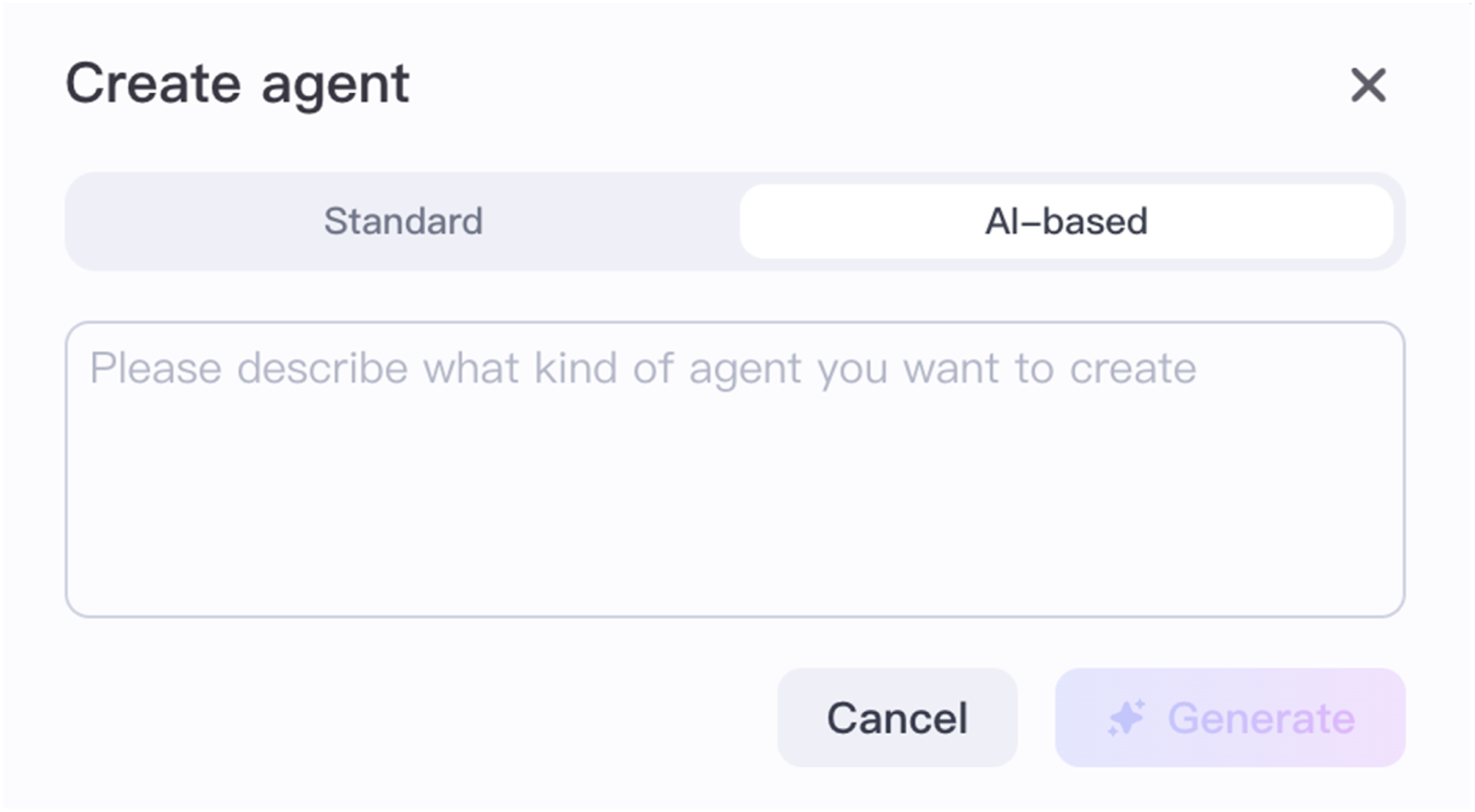
Besides this, users can also publish AI projects to social platforms and communication software through Coze for broader use, or integrate AI applications into their own business systems via API or SDK. This enables users to independently establish communication channels with other level platforms and acquire more individuation resources (Figure 2). Multi-channel publishing interface for AI agents on Coze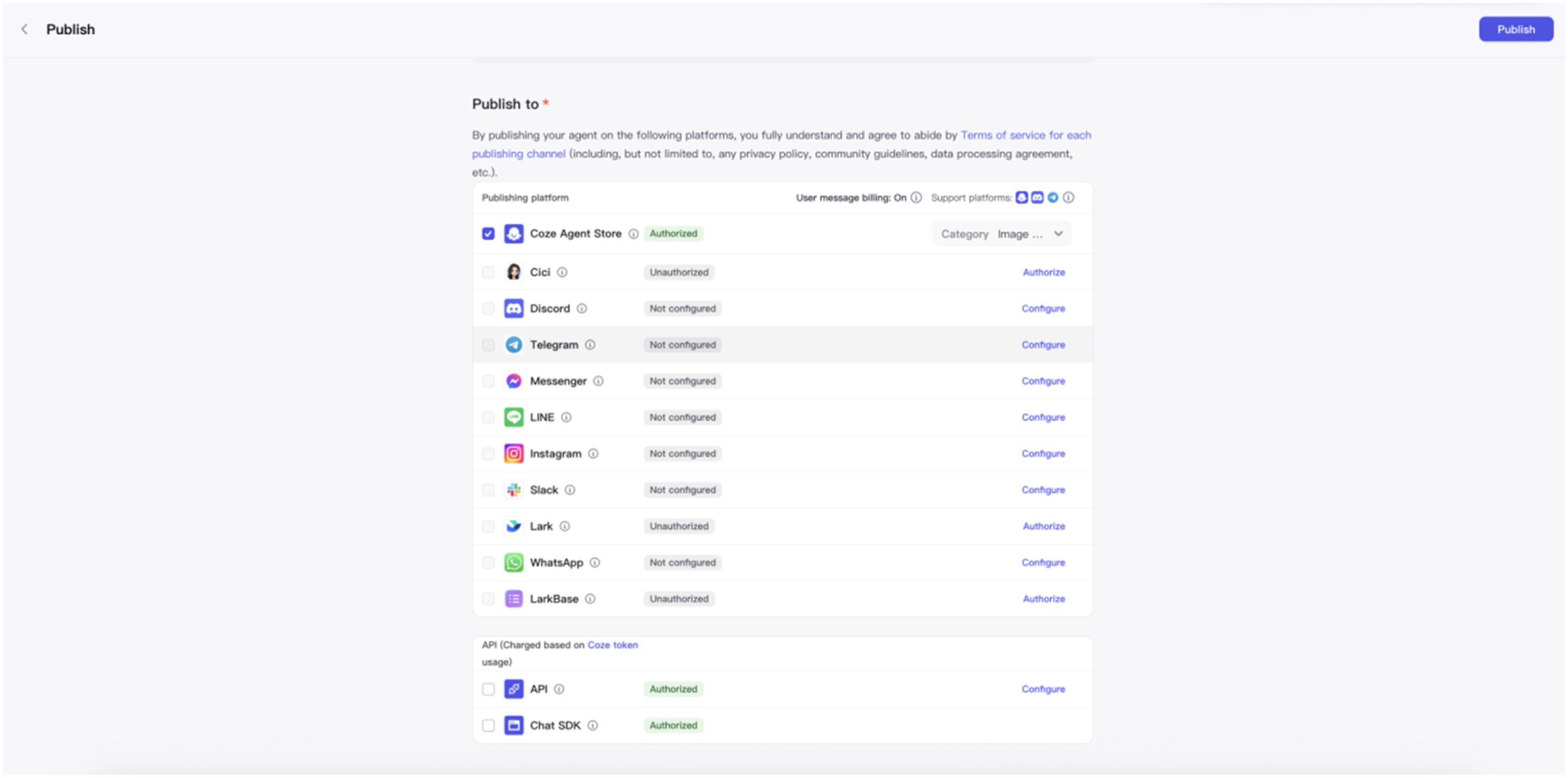
Coze designs AI agent project development as flexible node workflows. If previous free or open-source software decomposed source code into modular objects or functions, then Coze modularizes software structure and functional components, including large language models, prompts, plugins, knowledge bases, and triggers. These modules can be freely combined into new workflows through node connections, enabling AI projects to operate with specific logic and processes. The free configuration of workflows allows users to complete task operations in ways that differ from the action grammar of mainstream platform media. Being a platform, Coze not only reconstructs the programming development process but also provides a rich collection of modules for development (Figure 3). The agent configuration workspace on Coze, integrating persona, skills, knowledge, and memory modules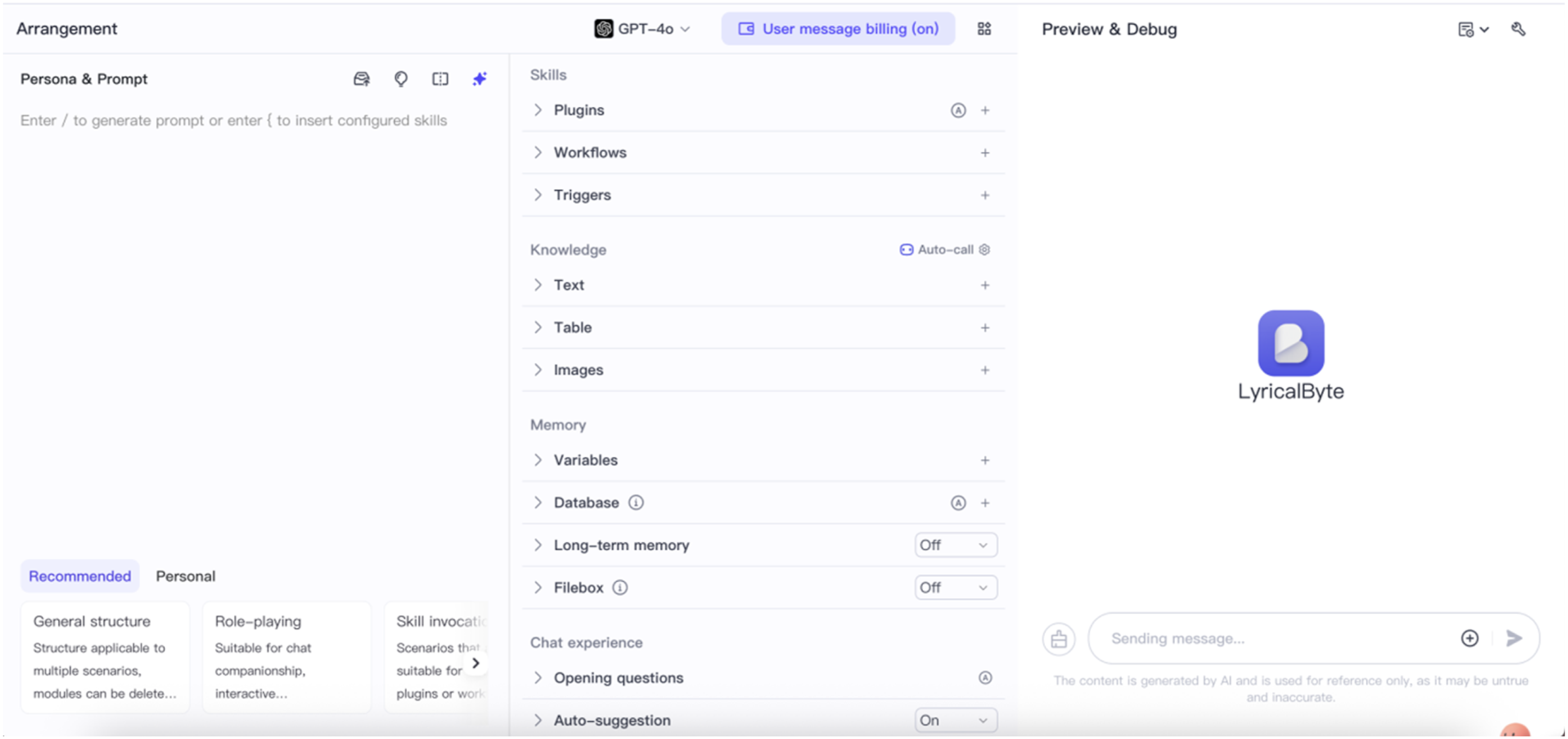
“Finally, the opening of the technical object through the concretization of spare parts……There can be no deployment of a genuine opening of technical objects without the creation of a network of technicality” (Simondon, 2014, p. 69). In Coze, the “plugins” and “workflows” built by users and embedded in AI agent operating programs, as well as the “store” (Figure 4) and “templates” (Figure 5) that can be directly used by users, constitute what Simondon calls the “technical network.” Users can achieve a programmable “bricolage” within this network, namely “to collect pre-existing ‘elements’ and perform a ‘reorganization’ that leads to a ‘contingent’ and uncertain result” (Ferrarato, 2020, p. 100). The App Store on Coze, displaying user-created agents and applications The Template gallery on Coze, providing reusable workflow templates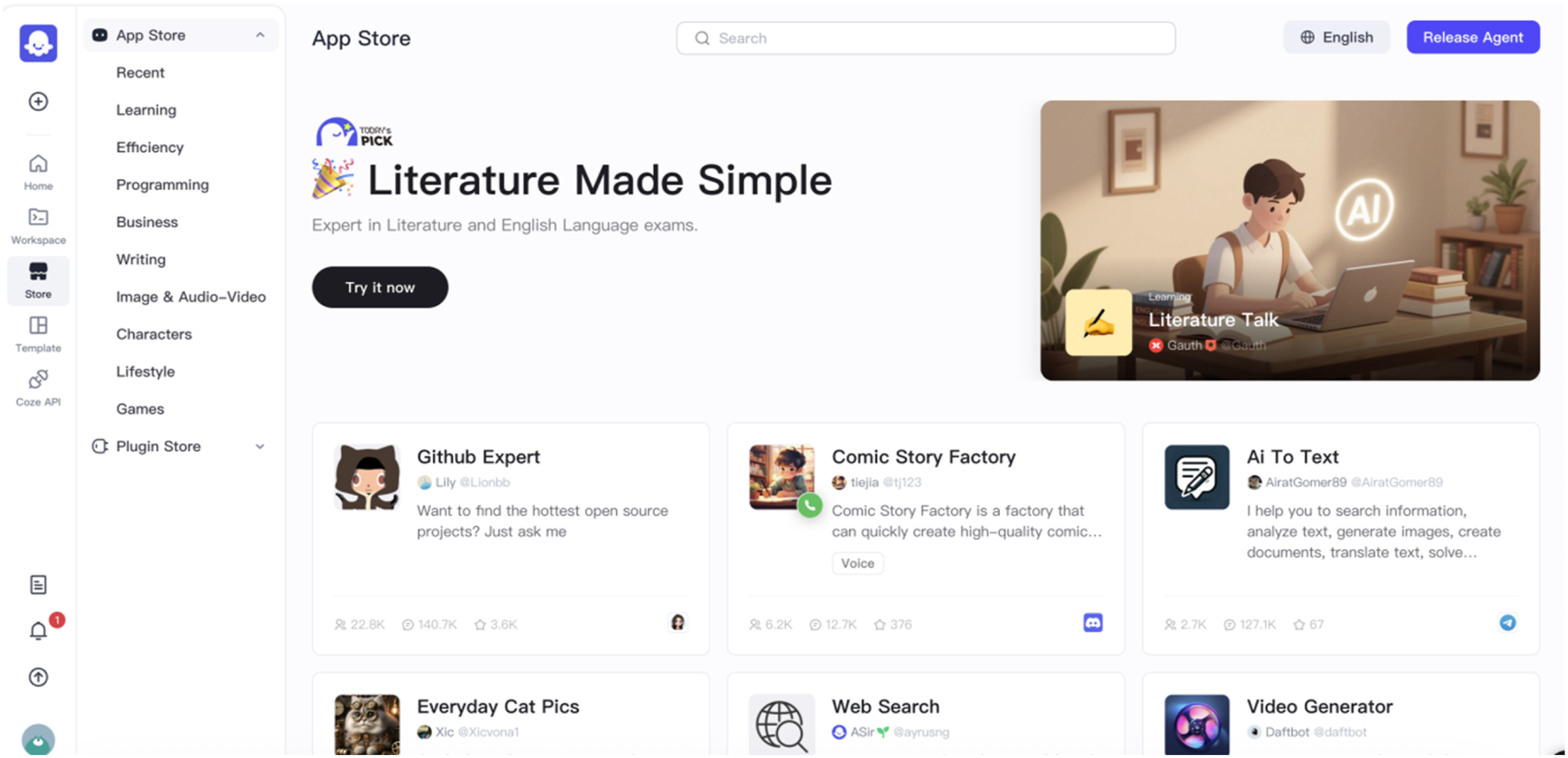
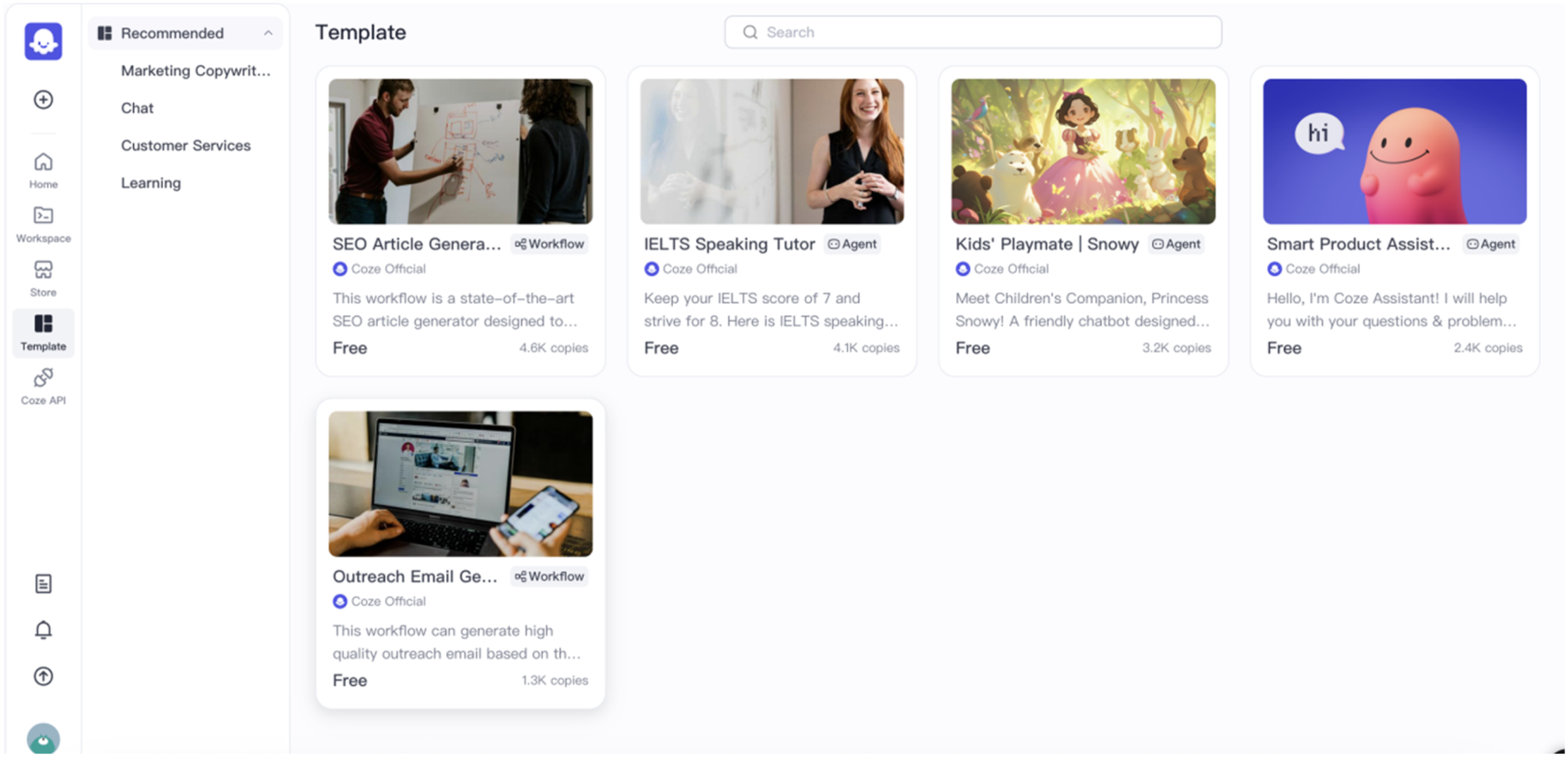
Although programming operations have been visualized, what Coze presents is no longer a user interface, but an “intraface,” an interface internal to the interface (Galloway, 2008). “The intraface may be defined as an internal interface between the edge and the center but one that is now entirely subsumed and contained within the image” (Galloway, 2012, pp. 40–41). Its core difference from the user graphical interface is that the former is a protocol for communication and data exchange between different modules—a visualization of interactive protocols; while the latter is the way users interact with operating systems, applications, or websites—a visualization of interactive methods. In Coze, users can design an interactive protocol by working with the intraface.
Since “interface” was accepted as a keyword in software studies, it typically refers to “any point of contact between two complex systems that governs the conditions of exchange between those systems” (Bratton, 2016, p. 220), “designs that combine - and translate - signs and signals” (Andersen & Pold, 2011, p. 9), or “the place at which independent and often unrelated systems meet and act on or communicate with each other” (de Waal, 2014, p. 20). That is to say, interfaces are operational, dynamic, and processual existences that gather systems, elements, and data external to themselves within their interior, achieving a kind of “‘agitation’ or generative friction” and emerging as new system wholes (Galloway, 2008). For digital technology, interfaces are actually computational and programmable concepts, like APIs. However, when user graphical interfaces became the general form and dominant cultural form of interfaces as the site where digital media and users interact, the intrafaces that actually execute the “interface effect” were obscured. More precisely, internal interface operations were flattened into explicit user interfaces as static entities, playing the role of transparent mediators that regulate between humans and machines, culture and data. But interfaces at this point are precisely in an “unworkable” state, with no place to accommodate users’ programming operations. The operability of intrafaces ultimately engenders the inoperability of interfaces (Galloway, 2008). Users are inevitably deprived of the right to program media by the alienated user-friendly culture.
Coze re-presents the operational capacity of interfaces through visual programming methods (Figure 6). Each operational node element in Coze constitutes an intraface, allowing instructions, data, or information to pass from one node to another. Nodes couple with each other and ultimately form a complete workflow. This architecture makes the project itself become a dynamic operational whole—user additions, deletions, and modifications at any node can instantly affect the entire system, presenting a decentralized distributed form. This distributed project is supported by the platform’s technical network, where elements are independent and interfaces are open, yet can be recombined at any time driven by user needs, supporting cross-domain and cross-technical-stack collaboration and innovation. This decentralized distributed form and the flexible recombination characteristics of network elements make intrafaces exhibit more prominent experimental features compared to common interface definitions in software studies. Precisely because of this, AI projects can both enjoy the flexibility brought by modularity and continuously evolve in networking, with their boundaries and functions not pre-solidified but continuously generated through use and contribution. The AI App Development IDE on Coze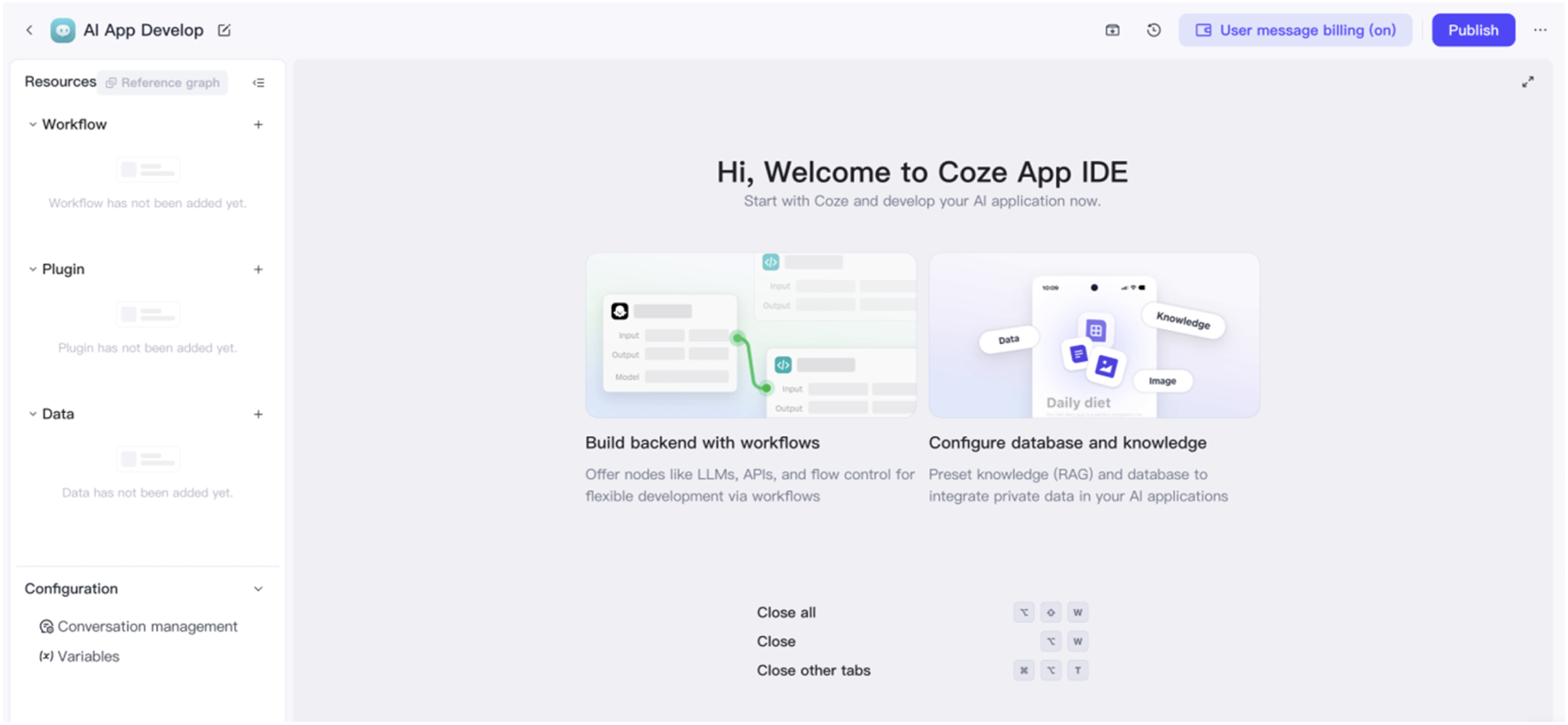
This is also because both the generative nature of large language model technology itself and the infinite possibilities of freely combining technical elements make AI project development carry evident contingency and unpredictability. Limiting this uncertainty requires individuals to intervene in the interrelationships between technical elements composing AI projects with the dual identity of operator and object of operation (Simondon et al., 2017, p. 157). Humans have always possessed two capacities: “the capacity to understand the functioning of the machine, on the one hand, and the capacity to live, on the other” (Simondon et al., 2017, p. 140). Human subjects can connect these capacities, using their life experience, thinking patterns, and imagination as sources of machine innovation. 1 Specifically, while user subjects focus on programming intraface effects, they must also play a regulatory role as wetware intrafaces, establishing extensive continuity between themselves and technical objects. This ensures that the workflow being configured contains both individual experience, data, thinking patterns, and sociocultural background, as well as every round of dialogue between the individual and the AI project under trial operation. At this point, users, as intraface nodes that transmit and process preindividual resources, connect into the workflow, achieving the transformation of individual subjectivity and subjective activity into the mediality of AI projects.
It is particularly worth noting that the individuation stages of specific technical objects discussed by Simondon often span decades or even centuries in time scale. However, in the intelligent era, the time required for the individuations of new open machines has been shortened to weeks, days, or even faster. In the process of human-media co-individuation, user subjects’ bricolage activities continuously create and adjust the forms and conditions of human-machine dialogue, requiring sustained attention to project developments. High-frequency interactions enable this holistic system to accumulate supersaturated internal tensions in a short time, leading to phase transitions and advancement into new individuation stages. Therefore, compared to previous inventive operations, the current human-machine coupling mode immediately valorizes the process of human-computer interaction. Technical activity always “means to individuate, to invent, to create, to think, to transform the world” (Stiegler, 2015b, p. 19). “Every operation and every relation within an operation is an individuation that splits and phase-shifts pre-individual being” (Simondon and Adkins, 2020, p. 6–7). Programmable logic is materialized as real-time updates of personal platform media.
Therefore, the media development mode supported by Level 4 platforms significantly differs from the programming logic and architectural forms relied upon by mainstream platform media. This difference can be understood through the concepts of “strong emergence” and “weak emergence” proposed by Reynolds (2018). Platform media often embody strong emergent structures: they are endowed with autonomous existence as stable, closed, and ontologically irreducible systems. The structural boundaries of such platforms exclude users, components, and processes, only allowing marginalized modifications to high-variability components (such as UI layers or data calls) through preset API interfaces, while the platform’s core logic and institutional power (low-variability components) maintain high closure. This design architecture results in development behaviors, even when innovative, often being absorbed, regulated, or eliminated by platforms (Gerlitz et al., 2019). As Simondon even sees it, “The path of minor improvements is one of detours, which may be useful in some cases for practical use, but they hardly make the technical object evolve” (Simondon et al., 2017, p. 43). That is to say, third-party extensions to platform media or their own short-term version iterations do not signify individuation.
In contrast, personal platform media development through Level 4 platforms embodies a weak emergence logic. Under this logic, media is not a “container” or “foundation” with substantial attributes, but rather a continuously generated dynamic relational network whose manifestation cannot be viewed as existing a priori in a stable manner (Reynolds, 2018, p. 99). Mediality is the result of the interweaving and generation of multiple elements—Level 4 platforms, users, components, instructions, processes, etc.—in specific practices, exhibiting processuality, continuity, and recursivity. By opening intraface structures and blurring the boundaries between high and low variability components, such media weaken the ontological rift between themselves and users, instead demonstrating efforts of co-individuation between the two. It is precisely in this weak emergent technological context that media performance is no longer the result of preset systems, but rather the synchronous evolution of human and non-human actors within intrafaces, until internal interactions tend toward critical thresholds at some moment, thus achieving individuation performance breakthroughs. Their “intra-action” ultimately “constitutes their (contingent) individuality, and that of the objects with which they act, always in the context of their inescapable entanglement and continuity with one another and with their environments” (Reynolds, 2018, p. 133). Therefore, practices such as “communicate, interact, or sell” are not merely users’ external behaviors through the surface interfaces of platform media, but begin as an internal coupling process within media as weak emergent dynamics. The intrafaces of personal platform media are no longer abstract access points to platform ontology, but generative spaces in which individuality, mediality, and situationality are co-generated and co-defined.
A Case Illustration: Building a Research Literature Agent
To illustrate the co-individuation process concretely, consider the development of a research literature assistant agent on Coze. The operational chain unfolds through several phases that mirror Simondon’s analysis of brick-making. First, the user configures the agent’s persona and capabilities through natural language prompts, specifying its role as a research assistant and defining behavioral parameters. This involves resolving tensions between desired comprehensiveness and practical constraints—the agent cannot access all databases, so the user must specify which sources to prioritize.
Second, the user designs a workflow incorporating multiple nodes: a search node that queries specified databases, a processing node that extracts key information from retrieved papers, a synthesis node that identifies themes, and an output node that formats results. Each node presents choices that require the user to develop clearer understanding of their own research needs. Third, the user integrates plugins from the platform’s ecosystem. The available plugins do not perfectly match the user’s vision, requiring adaptation and workaround. Through this friction, the user develops practical knowledge of the platform’s possibilities and limitations.
Fourth, the user tests the agent with sample queries, encountering unexpected behaviors that prompt refinement. Each iteration involves mutual adjustment: the user clarifies their specifications while developing better understanding of how the model interprets natural language; the agent’s configuration evolves toward better alignment with user needs. What emerges is neither the simple realization of the user’s initial intention nor a product wholly determined by platform constraints, but a genuine individuation—a novel entity reflecting the resolution of multiple tensions. Simultaneously, the user has undergone transformation, developing new capacities for articulating research needs and thinking through workflow logic.
AI development platforms thus become “an experimental ground for a pluralistic, accessible and empowering individuation” (Aires, 2025). Coze provides users with visual observation capabilities for the full-chain execution process, fully recording each processing step from user input to AI output. This includes key nodes such as prompt parsing, model invocation, and tool execution, while automatically capturing intermediate results and abnormal states. Users can rely on their technical operations to immediately see the impact of debugging different nodes on agent performance, thus observing and testing how agents respond to changes in subsequent usage behaviors. This high-frequency operation continuously introduces tensions within agents—that is, differences accumulated through continuous configuration input, interactive feedback, and functional optimization—pushing agents to undergo phase transitions at critical thresholds and enter new individuation stages. For instance, when agents suddenly achieve truly contextually coherent dialogue, error rates drop dramatically, and user experience significantly improves. Therefore, compared to previous inventive operations, the current human-machine coupling mode immediately valorizes the process of human-computer interaction. “Every operation and every relation within an operation is an individuation that splits and phase-shifts pre-individual being” (Simondon and Adkins, 2020, p. 6–7). Programmable logic is materialized as real-time updates of personal platform media.
Discussion and Conclusion—Individual, Multitude, and Platform
If platform media is characterized by concentrated power, then Level 4 platforms re-endow users with pathways to influence the operation of technological power. Through constructing personal platform media rather than purely using media platforms, individuals acquire “the right to reappropriation” in programmable operations initiated by themselves—this is a “right to self-control and autonomous self-production” (Hardt & Negri, 2001, p. 406–407). The power of reappropriation embodies a new teleology: “it consists in the possibility of directing technologies and production toward its own joy and its own increase of power” (Hardt & Negri, 2001, p. 396). Through the power of reappropriation, proletarians become individuals possessing singularity. These individuals compose the political subject that Michael Hardt, Antonio Negri, and Paolo Virno call the “multitude.” They are productive, creative, and antagonistic, constructing “a new socioeconomic landscape, one in which flexibility, play, creativity, and immaterial labor—call it ludic capitalism—have taken over from the old concepts of discipline, hierarchy, bureaucracy, and muscle” (Galloway, 2008).
The individuals composing the multitude follow the principle of individuation (Virno, 2003, p. 76). The multitude takes what Marx called the “general intellect” as preindividual reality. “General intellect,” also called “general social knowledge” or “public intellect,” is a general, objective, external intellect, such as language and the internet. General intelligence refers not only to the sum of knowledge humans have acquired, but more to a generative force associated with subjects’ communication, abstract thinking, and self-reflection. Today, generative AI, which transduces thousands of years of human civilization accumulation and massive data from the digital age into its own parameters in the hundreds of millions and bears the name “Artificial General Intelligence,” has become a new form of “general intellect,” constituting a knowledge-spiritual world and latent space shared by multiple subjects. It “allow [s] for invention, to respond to the unexpected, to transform the world, that is to say, to produce it as a world” (Stiegler, 2015b, p. 30). On one hand, user subjects singularize the formless, abstract general intelligence through immaterial labor as technical activity. On the other hand, human preindividual potential is also awakened by technical activity and transformed into new self-existence and social reality. In this sense, users with sufficient time, motivation, and digital literacy may explore and construct a new world of the self through coupling with general intelligence. Therefore, in the laboratory space of Level 4 platforms, as Latour said, “Give Me a Laboratory and I Will Raise the World” (Latour, 1983). This singularized world construction is oriented toward and undertaken as co-individuation together with user subjects, with its degree of evolution depending on the level of user subject participation.
The digital traces of individuals’ lifeworlds and social interactions have become raw materials for production and reproduction. With the deepening of digital existence, individuals have gradually lost ownership and control over raw materials and products, becoming “pronétaires” (Stiegler, 2015b, p. 10). As “dividuals,” they passively contribute individual data, gaining opportunities to participate in the production and reproduction processes of algorithmic machines. The emergence of Level 4 platforms has created new conditions that may partially reconfigure this situation. To construct personal media, technical invention requires the reintroduction of a unity—establishing continuity among individuals’ life experiences, private storage, technical knowledge, technical imagination, as well as social culture and social relations. Users, as active subjects, use the self as an anchor point to synthesize world experiences, actively intervene in and collaborate in production and reproduction processes, and invest as many individuation resources as possible to generate deeper coupling and more complex causal relationships with production objects.
The Limits of Platform-Based Empowerment
However, several significant limitations temper these optimistic possibilities and require acknowledgment. The performance iteration of large language models, which serve as the core engine of agents, can only be controlled by technology giants such as OpenAI and Google; they control access to large model APIs and possess pricing power over tokens. Furthermore, although open-source AI application development platforms exist, commercial Level 4 platforms remain a better choice for ordinary individuals. Yet the sustainability of these platforms depends on business models that may include data collection, API usage fees, premium subscriptions, and ecosystem lock-in. Users creating agents on these platforms contribute to the platform’s value proposition and ecosystem development. The relationship between user creativity and platform accumulation is not oppositional but symbiotic and potentially exploitative. Users do not simply “transcend” commercial logic; rather, they operate within commercial infrastructures whose logics shape what kinds of agents are feasible, visible, and sustainable (Srnicek, 2017; Zuboff, 2019).
Second, regarding unequal empowerment: The lowered technical threshold does not eliminate all barriers to participation. Creating effective AI agents still requires digital literacy, time, access to devices and connectivity, and the capacity to articulate needs in ways that translate into functional specifications. These capacities are unequally distributed across populations. Level 4 platforms may thus generate new forms of digital divide—not between those who can and cannot code, but between those who can and cannot effectively leverage natural language programming interfaces (Hargittai, 2002).
Third, regarding platform dependency: The agents users create remain fundamentally dependent on platform infrastructures. Changes to underlying models, plugin availability, pricing structures, or terms of service can render user-created agents non-functional. This dependency represents a new form of precarity. Fourth, regarding the infrastructure question: Personal platform media, however, sophisticated, cannot easily substitute for infrastructuralized major platforms. A research assistant agent does not replace Google Scholar; a social media management agent does not replace the social networks it posts to. Users remain dependent on established infrastructures even as they create personalized tools for navigating them.
Although Level 4 platforms are ultimately still commercial technological infrastructures operated by capital subjects, as they increasingly depend on general intellect, technical activity will constitute the fundamental basis of new production modes. “Everyone is a developer” and “Everyone is a super-individual” are the latest slogans shouted by tech companies. They co-opt the individual cultural tactics previously exclusive to hackers, artists, and similar groups as their own business strategies to expand their user base and application boundaries (Manovich, 2009). However, users can equally tactically transform these business strategies into their own individuation resources for self-development. Therefore, even if AI projects may ultimately still be used for commercial purposes, this cannot eliminate the impact of individuation events that have already occurred. Furthermore, even under conditions of economic crisis and rampant consumerism, technical activity still allows individuals to continue individuation outside the framework of any social function or norm (Mackenzie, 2006), seeking new possibilities of reality.
Therefore, the transformation of programmable rights through user practice into the power of reappropriation enables user subjects not only to utilize production means from capital but also gives rise to a new mode of wealth accumulation and sharing, that is, a new type of production relation. On one hand, user subjects can compensate for deficiencies in their knowledge base, writing abilities, language and expression capabilities by developing and configuring personal platform media matrices (coupling with multiple agents simultaneously or sequentially), forming an AI-enhanced “super-individual” or “one-person company.” They can independently complete commercial monetization while breaking free from traditional corporate employment relationships. On the other hand, under the continuous influence of free software and open-source culture, users create an “economy of contribution” by publicly sharing AI projects (Stiegler, 2016). In this sense, Level 4 platforms become infrastructure that allows ordinary individuals to actively participate in knowledge creation and sharing. The surplus value generated by technical activity can be used to drive a contribution process, rather than merely belonging to developers. In this process, each participant contributes to the collective wealth of media innovation, developing socially valuable media forms and realizing their respective preindividual potential. Individuals thus no longer sell their labor and time around wages, but advocate for the redistribution of time as an individuation resource. Through the power of reappropriation and human-media co-individuation, individuals may develop new forms of agency—though this agency operates within, not against, the broader structures of platform capitalism.
The emergence of Level 4 platforms has also given us a new understanding of the saying, “AI has hacked the operating system of human civilisation” (Harari, 2023). Level 4 platforms, as a new form of technological inclusivity, provide possibilities for open and equal coupling between humans and media technology at the social scale, promoting the transformation of AI progress into human progress, and new social subjects and social organizations will emerge from this. As Hardt & Negri describe, “the hybridization of human and machine is no longer a process that takes place only on the margins of society; rather, it is a fundamental episode at the center of the constitution of the multitude and its power” (Hardt & Negri, 2001, p. 405). The multitude interacting with Level 4 platforms “sense on into their interaction with other forces arrayed as fields and intensities at the scales of the social, the aesthetic, the ideational or economic,” thereby creating processes that transcend social, economic, and cultural boundaries and “provide the grounds of individuation” for humans (Fuller, 2017, pp. 1–2).
If “the multitude is a by-product of the technological mutation of the productive process just as the consumer class was a by-product of the metamorphosis of commodities from objects (les choses) to signs” (Virno, 2003, p. 13), then personal platform media will also produce new social formation by-products, just as personal computers did for the “information society.” User subjects, through configuring personal platform media, extend eyes and ears, hands and feet to AI, enabling it to advance into various scenarios of life applications. As Simondon states, true technical progress is “transforming all the conditions of human life, augmenting the exchange of causality between what man produces and what he is” (Simondon, 2010).
Whether this represents a genuine transformation or a reconfiguration of existing power asymmetries remains contingent on technical developments, commercial strategies, regulatory interventions, and user practices that continue to unfold. What we can say is that Level 4 platforms have opened a space of possibility—one whose ultimate significance remains to be determined through ongoing processes of collective individuation. The problem facing new social formations is that the physical devices, computing resources, and other infrastructures that development depends on are still owned and distributed by Level 4 platforms and governments. Whether users can avoid falling into excessive dependence on them and move toward symbiotic and equal relationships urgently requires further research.
Footnotes

Funding
The authors disclosed receipt of the following financial support for the research, authorship, and/or publication of this article: This work was supported by the Shanghai Municipal Foundation for Philosophy and Social Science [grant number 2025BXW006]; and the National Social Science Fund of China [grant number 25AZD037].
Declaration of Conflicting Interests
The authors declared no potential conflicts of interest with respect to the research, authorship, and/or publication of this article.