






Abstract
Probation has been an historically important option for sanctioning criminal offending since the mid 1800s. Originally grounded in notions of volunteerism and community engagement to support rehabilitation of less serious offenders ‘through understanding, kindness, and sustained moral suasion’, probation was quickly institutionalized around the world as a major component of the criminal justice system. But modern probation practice is now struggling to define its proper aim, priorities and ways of working. Probation varies considerably across jurisdictions in how it is structured and organized, how well it is resourced, and how commonly it is used. But clearly what modern probation practice is ‘able’ to do in many jurisdictions does not match with what it ‘should’ do. The article will highlight some key challenges faced by probation and suggest some ways forward for it to get closer to what it ‘should’ do – in adopting a well- integrated and evidence informed model of practice.
(Ohayou Gozaimasu) 1 A good morning to all and a very special thank you to the organizers of this Third World Congress for giving me a ‘second chance’ to address so many community corrections professionals from around the world. I was honored to speak as well at the First World Congress in London and I’m not quite sure what might have qualified me for a second invite other than being Canadian, a country that still celebrates its diversity, tolerance and political sanity with a rather handsome millennial Prime Minister with a nice smile. I am certainly neither millennial nor handsome and my wife tells me I smile much too infrequently – and if I have any valid credentials to comment on the challenges facing probation practice they come not from a steady and distinguished track record as a scholar of community corrections, like several of your other plenary speakers, but instead from a somewhat checkered career where I have mostly deliberately avoided the day-to-day grinding work of corrections and chosen instead to observe, involved but at a distance, as a researcher, advisor, programme developer, trainer or general Mr. Fix-It consultant, where I’ve had the privilege of interacting personally with thousands of correctional colleagues from some 20 odd countries. And my perspective has had another profound influence, coming out of my rather feeble efforts to support my partner in life, a wonderfully dedicated professional, as she endured the unceasing pressures of working in community corrections her entire career, in the front-lines and then as a manager of a community district in Canada. So, my views are colored and they tend to crystalize around the sentiment that we can do and should do more if we genuinely want to create circumstances for exerting positive, pro-social influence, rather than circumstances that often interfere with or block those efforts. More resources and new policies or programs may help, but I have always believed that corrections is ultimately about people working to influence other people, and our overarching aim should be to create circumstances for doing that as well as possible.
When I spoke in London, the mood of the world was a little different than it is today. Public services were under the grip of austerity measures – something that will no doubt persist. But what seems more prominent today is a rather nasty mood of protectionism, insularity, divisiveness, and a spreading self-centered ideology that shows little compassion for the less fortunate other, and even blames the marginalized and the disadvantaged for their own problems. In perhaps only partly jocular fashion, an offender who blogs regularly in the John Jay College Crime Report, remarked recently that:
Acceptance that one’s future is bleak—and that there is little that offenders can do to change their destiny—can go a long way towards mitigating the risk of reoffending, I believe. It inoculates against feelings of relative deprivation and you forgo chasing pipe dreams.
He goes on to suggest that perhaps we should develop Cognitive Behavioral Treatment (CBT) Programs designed simply to convince offenders that they can still enjoy life – ‘even if most of it is spent scrambling to make ends meet’.
The world I believe is getting meaner. But it is in that world that we have to continue supporting, innovating and expanding the use of community supervision – and none of us would disagree that community corrections is preferable to carceral expansion. We keep promoting the concept with some success – though most convincingly not because we argue from values of liberal benevolence or social justice but from the pragmatism of cost-effectiveness. Community corrections is embraced in many instances because it is a cheaper alternative to imprisonment. But too commonly it is then forced to do its work as cheaply and cautiously as possible – rather than as well as possible. When we try to do it that way, it can turn easily into just further expansion of criminal justice control and even become a well-oiled feeder mechanism for greater use of imprisonment.
Here are a few things I have kept observing over the years:
We short change offenders in the scope and quality of services we should provide, ask them to get resigned to the myriad of structural barriers in their way (e.g. to access decent employment or affordable housing), surround them with ever present surveillance, conditions, restrictions and rules of engagement that can set them up for failure, but then nonetheless expect them to ‘make good’.
Our community corrections staff feel over extended, exhausted and unappreciated and there is evidence that the longer their tenure in the job, the worse it gets (Rhineberger-Dunn et al., 2017). Many have also become suspicious of the value of so-called evidence informed strategies, especially when those strategies are imposed rather than allowed to germinate and grow into acceptance.
We rush too often to change ‘work practices’ and risk de-motivating and de-professionalizing our core line staff – often turning them into technocrats. Connections with the client is paid lip service but is not what garners organizational recognition, and working with the community, if it happens at all, is relegated to doing it if you can find time ‘in the course of all your other duties’.
I am perhaps being a bit hyperbolic but what I would like to argue today is that changing the way we do community corrections at the margins, in baby steps, introducing a new evidence-informed practice there or a new practice-informed improvement here, will not suffice and will not sustain, especially not in the new reality of ‘mass probation’ and ‘mass supervision’ where ever growing caseloads are becoming essentially unmanageable and unserviceable.
Globally, the message of the UN Tokyo Rules 2 supporting community-based ways of dealing with offenders has not penetrated similarly. Community corrections is yet virtually untried in most countries in Latin and South America, only beginning to be accepted and implemented in many Eastern European countries, and it struggles to expand with only limited resources in a number of African countries. China is now developing their community supervision options (Jiang et al., 2014), and here in the Asean region, with tremendous leadership support from Japan, a rather unique volunteer-driven model of community supervision – which I wish I had more time to discuss – is spreading quickly to other Asean countries (Porporino, 2017). Slowly, but more and more, the spirit and principles of the UN Tokyo Rules are being embraced.
Community corrections and probation, of course, are well embedded in western parts of the world. Research looking at ways to improve practice is flourishing, new interventions and programs are being evaluated, and the sharing and replication of best practice internationally is growing (Rhine and Taxman, 2017). In some ways, we could say we are in a golden age of focus on community supervision. Ironically, trying to get a full picture view of differences in how probation and parole services are delivered is challenging, and even basic statistics on the size and characteristics of probation caseloads internationally is lacking (there is, for example, no comparable World Prison Brief for community corrections). Trying to keep up with the changes in how these services are organized and delivered – and the where, why and how the change is occurring – is overwhelming. My friend and colleague from the UK, Professor Peter Raynor, once described community supervision as a ‘slippery fish’. Interesting to me, of course, is that if scholars see community supervision this way, then how is it seen by our service users, the staff who do it, the judges and courts who dispense it, the families who have to support it, and our communities who have to accept it. Community supervision has no walls, bars and fences to describe it – even if only symbolically – and it remains rather elusive, ill-defined and variant not just from country to country, but even within any one jurisdiction or agency, from one supervisor to the next, where service users typically have no clear idea of what to expect.
Mark Carney, a Canadian who became Governor of the Bank of England, remarked recently that: ‘. . . to restore trust in banks and in the broader financial system, global financial institutions need to rediscover their values … Employees need a sense of broader purpose, grounded in strong connections to their clients and their communities’ (Carney, 2013).
He could easily have been talking about community corrections.
I believe it is time to reflect on how we can restructure, refocus and reinforce what community corrections can do so that it gets closer to what it should do – and realize its original intent to assist ‘through understanding, kindness, and sustained moral suasion.’ Encouragingly, I am not the only or original voice to suggest this. We have decades of research that can help guide the transformation, but perhaps even more important as a turning point is the growing consensus about what we should do among some of the most respected, informed and experienced experts in the field.
The chart (Figure 1) shows two columns. On the left is the 13-point ‘paradigm shift’ that grew out of the deliberations of a recent unique Executive Session on Community Corrections at the Harvard Kennedy School. 3 On the right, I have tried to outline the comparable shifts in thinking coming from a very innovative ‘Desistance Knowledge Exchange’ project funded a few years ago by the UK Economic and Social Research Council, that aimed at coalescing the views of a broad-based group of stakeholders, practitioners, researchers and service-users into a set of ‘provocative propositions’ to re-envisage how to help people stop offending. 4
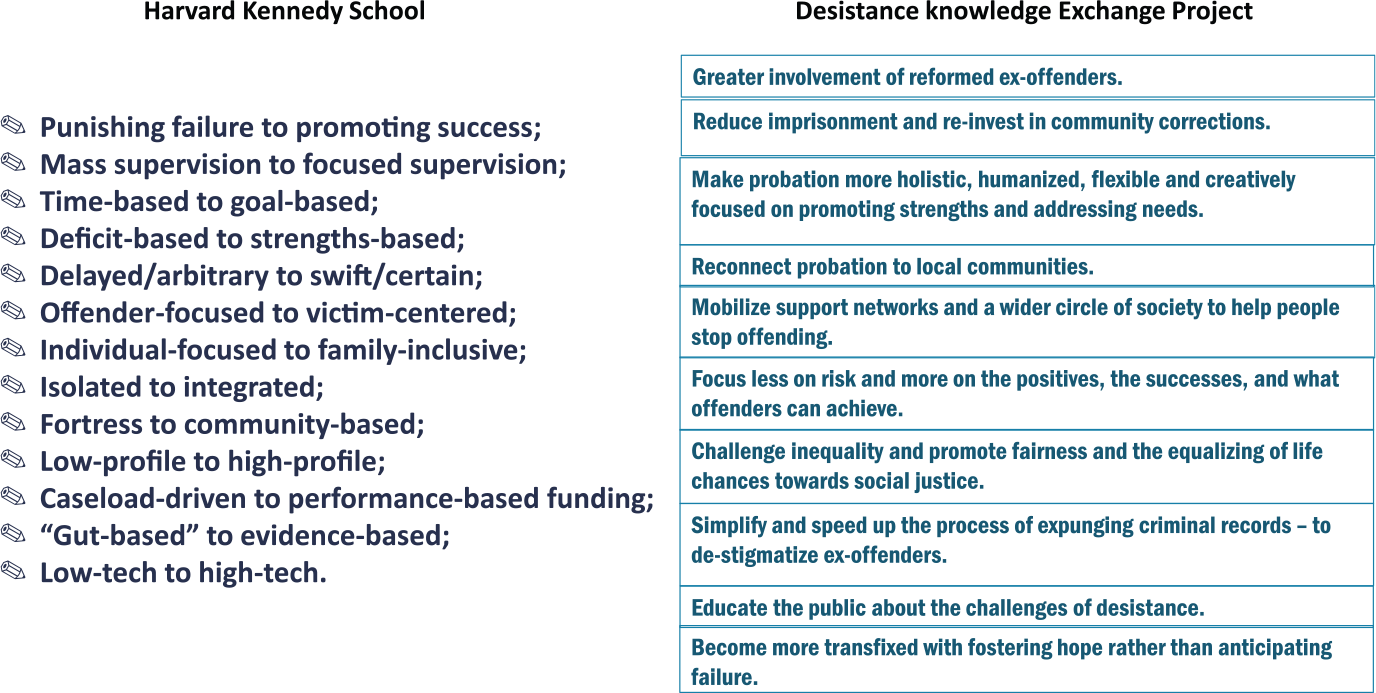
Paradigm shift for community corrections.
There is not a perfect match. In contrast to the propositions coming out of the Desistance Knowledge Exchange project, for example, the paradigm shift suggested by the Harvard Kennedy School does not emphasize the quicker and easier expungement of criminal records to de-stigmatize ex-offenders. It also does not speak to the greater involvement of ex-offenders not just in the delivery of services (e.g. through greater use of peer-to-peer mentoring schemes) but in their design and evaluation through local service user councils, for example, and even ways to be heard at the policy making level. We think narrowly in my view, when we ignore leveraging the potential of ex-offenders to work alongside us as justice professionals in their own right – but perhaps North America is not yet ready to fully embrace this mindset.
Looking at the areas of communality, however, the agreement on some key points is striking:
That we should work more deliberately in engaging communities and widening the circle of support for ex-offenders (e.g. working more closely with families);
Focus more on goal achievement and strengths – rather than just targeting deficits;
Imbue the system with core values of justice, fairness and respect for individual differences;
Work to create a truly integrated, evidence-informed model of practice – and not accept the piecemeal, token and segmented.
Overall, the call seems to be for a reorientation towards building our clients up rather than watching and waiting for them to fall down – looking for strengths to strengthen instead of just deficits to correct. I would encourage all of you to delve deeper into the thinking behind these consensuses building exercises but I want to highlight five areas in particular today that I believe we should take especially seriously if we want to begin changing the circumstances under which we try to exert positive influence. Each of these areas of focus have been discussed quite extensively in the research literature on community supervision. I present them not as novel but as worthy of re-emphasis.
Challenging the trend of mass probation
The concern that community options could serve to ‘widen the net’ of criminal justice control became a hot topic for scholarly discourse after Stanley Cohen first introduced the possibility in the late 1970s: ‘. . . alternatives [can] become not alternatives at all but new programs which supplement the existing system or else expand it by attracting new populations’ (Cohen, 1979: 347).
Focus on this ‘dispersal of discipline’ concern dissipated over time but it is ascending again with the era of ‘mass probation’.
In the last several decades, the number of offenders under ‘community sanctions and measures’ in Europe has risen considerably – in some European countries because of particular changes in legislation, but since 1990 the number of persons under community supervision has steadily increased throughout Europe so that by 2010, 17 out of the 29 countries included in a recent comparative analysis by the Council of Europe SPACE initiative had more probationers than prisoners (see Figure 2). Some interesting observations come out of that analysis (Aebi et al., 2015):
There has been an increase in both prison and probation population rates in most countries despite a fall in the overall crime rate.
Among the 10 countries with the highest prison population rates (the ones shown on the right of Figure 2), seven also showed the highest probation population rates (England and Wales, Estonia, Georgia, Hungary, Latvia, Poland and Spain). Belgium, France and the Netherlands have maintained relatively lower prison population rates but now show a rather high ratio of roughly three probationers per prisoner.
On the other hand, among the 10 countries with the lowest prison population rates, three also show the lowest probation population rates (Finland, Norway and Switzerland). The situation in these countries suggests that prison populations can be kept low even with only moderate use of community alternatives.

Total prison and probation population rates per 100,000 inhabitants in 2010.
Levels of crime obviously explain some of the rate differences from country to country, but the overall conclusion is clear. There seem to be two very different ways of dealing with crime, and maybe especially low-level crime or crime committed by individuals with considerable mental health or other social problems and barriers. While some countries resort mostly to control that can be exerted by the criminal justice system – either in prison or through community sanctions and measures – other countries (most notably Finland, Norway and Switzerland) may be prioritizing other avenues of socialization and support in the community.
The comparisons are even starker in the US. Some recent analyses of trends in probation and incarceration in the United States from 1980 to 2010 have concluded that expanding the reach of probation has led, if anything, to slightly higher rather than lower rates of incarceration where probation has acted sometimes as an alternative but often also as a net-widener (Phelps, 2013, 2017).
Figure 3 borrowed from the US Prison Policy Initiative shows overall rates of ‘correctional control’ (number per 100,000) across US States. 5 Overall, 57% of the population under correctional control is on probation, and another 13% on parole – totaling to more than two-thirds of the correctional pie. The variation across states is dramatic, both in the level and type of correctional control, and much of this variation is difficult to explain. For example, Pennsylvania imposes more than twice as much correctional control as Massachusetts despite the fact that these two northeastern states show similar crime rates. America is known most notably for its mass incarceration, but when we look at correctional control more broadly it is clear that ‘mass supervision’ in the US is the new reality – and disproportionally more so, for example, than in Europe or Canada (see Figure 4). The US has a combined probation/parole rate five times that of Canada, four times that of England and Wales and a whopping 48 times that of Norway! Incidentally, we are meeting in a country (i.e. Japan) that has one of the lowest incarceration rates in the world (at about 45 per 100,000) and still maintains a probation/parole rate that is even lower than Norway’s.

Rates of correctional control by state in the US.

Probation/parole rates per 100,000 population by country.
If we want to re-direct community corrections and restore its original intent as an effective alternative to imprisonment, then a first priority has to be to challenge the trend of ever-expanding control through the net of the criminal justice system. We need to begin promoting not just community corrections alternatives but other community alternatives, infrastructure, services and networks that can help us arrive at a broader social justice. We should never get resigned to the notion of ‘sacrifice communities’ that have deteriorated so terribly that they cannot be rescued. If we do so, then peace and security will fade as an ideal for us all.
Busting the myth of intensive supervision
My second theme relates to busting of a particularly pernicious and persisting myth, once and for all, that there is any value in intensive supervision and surveillance, in and of themselves, in giving us some level of increased public safety. In a recent gold standard, random assignment study in Philadelphia, high risk probationers were randomly assigned to either Intensive Supervision Probation (ISP) (n = 447) or standard probation (n = 385), where the ISP protocol provided for the usual more restrictive supervision, more office contacts, home visitations, and drug screenings (Hyatt and Barnes, 2017). After 12 months, the survival analyses conducted for each group were almost identical and there was no difference in offending across multiple types of crimes, including violent, non-violent, property, and drug offenses – with the ISP group actually showing a bit more offending rather than less (see Figure 5). What was different, however, is that ISP probationers absconded more from supervision, were charged with more technical violations, and were incarcerated at significantly higher rates. In essence, no increase in public safety but increased use of law enforcement and correctional resources to locate these offenders, detain them on arrest, hold violation hearings, and in many cases, either incarcerate them as now even higher-risk or give them new (often longer) terms of probationary supervision.

Mean number of charges, by offense, within 12 months.
As good academics not wishing to overstate, the authors cautiously concluded that the results: ‘. . . may simply signal that, even with the increased consequences, the regularity of reporting and the intensity of control are too much for some high-risk offenders to bear’ (Hyatt and Barnes 2017: 6).
Despite an accumulation of evidence that supervision and surveillance alone provide no increased public safety, the predominant ethos for much of community corrections, particularly for those offenders we designate as high-risk, is still to ‘watch them, catch them, nail them and jail them’. We pursue a strategy that does not work except to further drain scarce community corrections resources.
The Risk Principle that flows from our still most prevailing and most empirically tested theory for designing service delivery implores us to enhance levels of service for those offenders at highest risk of reoffending. But the principle has now been perverted and distorted, transposed to demand more from the offender rather than more from correctional services. We label offenders ‘high risk’ as if it is only a personal characteristic – ignoring the fact that risk of reoffending is often more situational and contextual. We purport to manage risk but often only by asking offenders to jump willingly through all of our hoops and frustrating them towards becoming even higher risk. Agency and supervisor exhortations to not take chances with these offenders is not the only culprit. There is evidence, for example, that probation staff, even when they have been well trained in application of evidence-based practices (EBP), will retreat easily into a purely surveillance mode, especially for certain classes of offenders, arguing that EBP is not working, or cannot work, and therefore the surveillance gauntlet is justified as the only option (Viglione, 2017).
My argument is simple. We have to turn the risk-targeted approach on its head. Intensity of supervision should be a by-product of the intensity of support we can provide, not the other way around. We should work towards reducing (what Ioan Durnescu has coined) the ‘pains of probation’ by offering an enhanced scope of services that offenders can take up – obviously with some nudging and encouragement on our part – but making the attractiveness of the services the ‘hook’ for greater contact and for realizing greater pro-social involvements. Motivational theory tells us that compliance that is voluntary and self-imposed is a much more powerful force for change than the kind of ritualized compliance we force on offenders, where contacts are seen more as invasive than helpful, and more as punitive than as a source of some personal gain. What seems to spark the persistence towards ‘making good’ is when offenders can say they are more satisfied with their lives, more emotionally at ease and experiencing fewer problems and worries (Zamble and Quinsey, 1997). Some recent looks at supervision outcomes from a ‘positive psychology’ perspective has shown that above and beyond criminogenic risk, the emergence of certain positive psychological states among offenders (optimism, hope, self-efficacy and psychological flexibility) can be strongly predictive of reduced re-offending (e.g. in one study, with offenders who reported more of these heightened states being almost one third less likely to be reconvicted for new offences over a 12-month follow up period) (Woldgabreal et al., 2016).
Figure 6 shows another set of outcomes from a classic study of the ‘supervision orientation’ of community corrections staff – something that unfortunately has not been studied anywhere nearly as much as intensity (Paparozzi and Gendreau, 2005). Staff working with high-risk offenders were categorized as having either a law enforcement, traditional social casework, or balanced professional orientation. Not surprisingly, a law enforcement bent resulted in the greatest percentage of technical violations, with social casework the least, reflecting the relatively hard approach of the one and softer of the other. In revocation for a new conviction, however, it was the balanced orientation that showed the best outcomes – and by a wide margin.
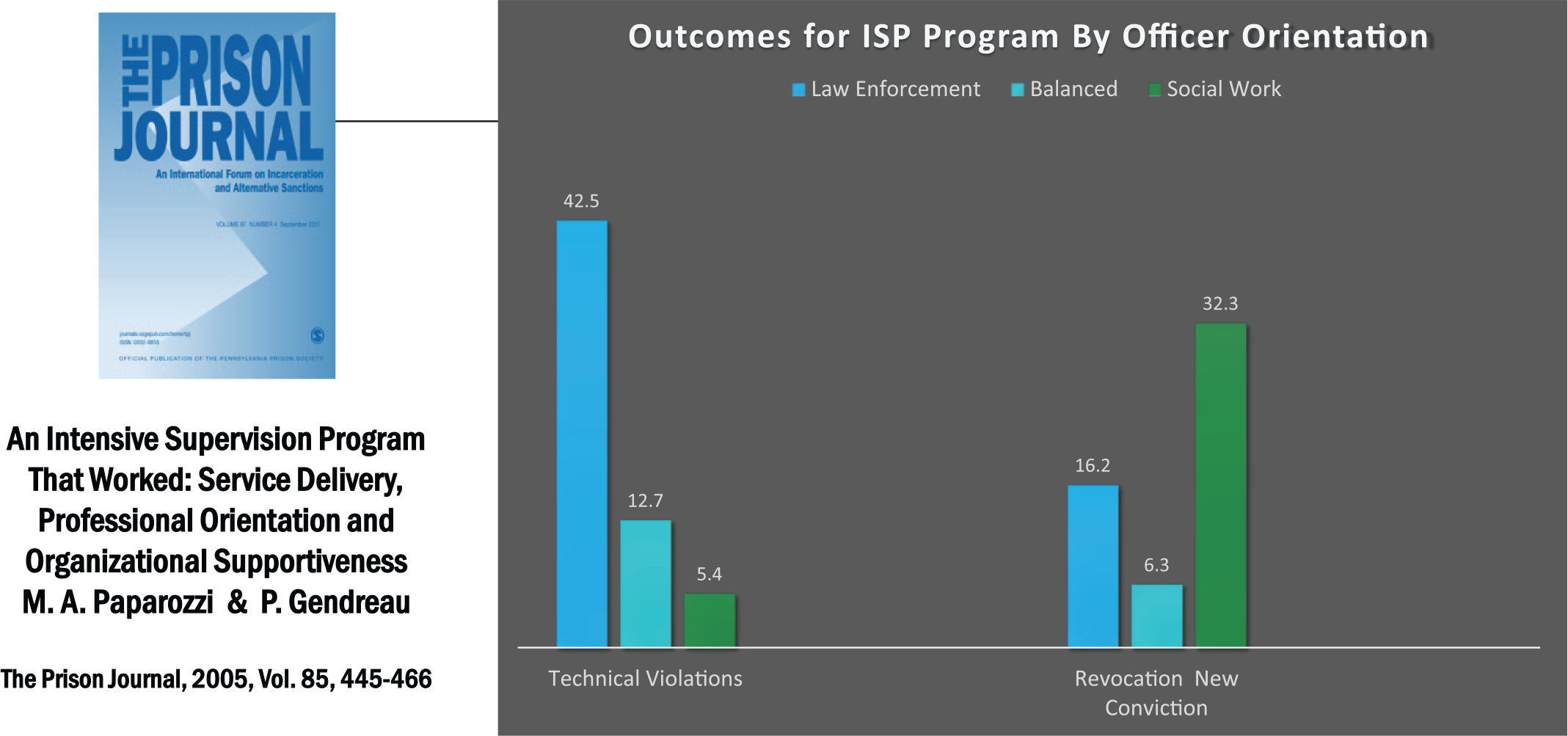
Supervision outcomes by officer orientation.
Intensity of supervision may be necessary to satisfy public and political demands for monitoring our clientele – but it behooves us to imbue that supervision as much as possible with a balanced orientation – biased in various ways towards giving support, whenever and however it begins to be welcomed. We need to challenge probation staff perceptions of their roles as playing some version of ‘good cop, bad cop’ and articulate examples of balanced approaches, alert to clear signs and cues of deterioration and unravelling back into offending, but alert as well to emerging ‘desistance’ motives and attitudes. Probation work is not about enforcing compliance but eliciting it. That may require supervision to be varied and mixed over time, pulled back and pulled in as circumstances suggest, rather than dictated only by risk-based frequency of contact rules. The challenge is to find a measured level and sequencing of contacts to help orchestrate desistance. Doing less than this fundamentally de-professionalizes probation – but I will address that issue more a little later. But let me turn to another aspect of how we exercise authority in community supervision – our tendency to create unintended consequences because of the way we respond to breaches.
Exercising authority through procedural justice
A number of years ago, a judiciary-led innovation in America dubbed project HOPE, from the small island of Oahu in Hawaii, quickly became the darling of media reporting of a new, more effective future for probation. HOPE advocates argued that if offenders perceived swift and certain consequences for their behavior, that were consistent and fair, they would ‘rationally’ decide that the cost of misbehavior would outweigh the benefits. In other words, simply changing the rules to make them fairer and just would have a knock off effect on offender’s decisions and behavior. It would change probation practice that was riddled with arbitrariness and the extremes of either too harsh or too lenient response to probationer misconduct. Early findings reported dramatic reductions in re-offending (Hawken, 2010), but as is often the case, attempts at replication were less than successful. A recent multi-site randomized control evaluation concluded that project ‘HOPE seems unlikely to offer better outcomes or lower costs for broad classes of moderate-to-high–risk probationers’ (Lattimore et al., 2016: 30).
A related but much more sophisticated theoretical framework might explain why project HOPE has not been able to show impact – simply by consistently enforcing the rules. Procedural justice is now discussed and researched extensively in criminology, especially in law enforcement, but also increasingly for the design of prison regimes to improve staff-prisoner relations, and lower conflict, tension and violence. The ideas from Procedural Justice theory should receive more attention within probation practice.
Essentially, the theory argues that procedurally just treatment leads individuals to see authority figures as legitimate, and garners greater cooperation, respect for, compliance with, and commitment to follow rules or laws. And the benefits of procedurally just treatment seem to extend even further. In prison research, for example, there is evidence that offenders who perceive their treatment by the prison to be procedurally just, report fewer mental health concerns, receive fewer disciplinary infractions and even reoffend at significantly lower rates (Beijersbergen et al., 2016).
Importantly, however, is the fact that Procedural Justice emphasizes not simply the rules, but the importance of the process – namely, how authority is exercised. Four components of that process are distinguished: voice, neutrality, respect and trustworthiness (Tyler, 2001). Individuals need to have a chance to tell their side of the story and feel that authority figures will listen and consider their views before making a decision. They need to see authority figures as neutral and principled decision-makers, who apply rules consistently and transparently rather than out of personal opinion or bias. They need to feel respected and treated courteously. Finally, individuals need to see authority figures as people with trustworthy motives, who are sincere, authentic and caring and who will try to do what is right for everyone involved.
For decades now, since Andrews and Kiessling (1980) first introduced the notion of core correctional practice principles, we have known that the ‘effective use of authority’ is something we should take seriously in our interactions with offenders. Procedural Justice theory unpacks what that could mean and offers, in my view, a powerful framework for how community corrections agencies and staff should interact with offenders, particularly in dealing with violations and/or breaches of supervision conditions. Studies of the breach process have pointed to the problems and the challenges across jurisdictions (Boone and Maguire, 2017). More widespread and disciplined adoption of a Procedural Justice framework in practice can be a solution. And this brings me to my fourth theme of a return to a meaningful professionalism in probation, defined by professionals rather than the organization, and revolving around the unique, difficult to master and combined sets of expertise needed to help influence enduring pro-social change with offenders.
Returning to ‘occupational’ professionalism in community corrections
The ‘Some Things Do Work’ movement, originating in Canada and then spreading quickly to the UK and elsewhere, was initially a practitioner and researcher-driven phenomenon. It was soon co-opted by policy makers and government corrections officials, who undertook to manage system-level implementation, in the community most notably in the then English Probation Service, where many observers have noted that change was introduced too quickly, with too narrow a focus on structured programs, and too much managerialism. England and Wales is now pursuing a radical Transforming Rehabilitation Agenda, quite different incidentally than how practice is being transformed in Scotland and Ireland, and with particular optimism about how the creativity and greater efficiency of the private sector can contribute to reducing re-offending – another grand experiment we are all waiting to see evaluated. Major policy shifts in community corrections, of course, are not at all unusual. Regardless, however, what seems to be taken for granted consistently in these restructurings of service delivery is that the professionals will get on board!
A large literature on the sociology of work delves into the consequences over the last few decades of a change in the definition of professionalism – where it is now more ‘organizationally’ rather than ‘occupationally’ defined. The shift has moved us away from notions of shared identity (based on competencies and educational training), partnership, collegiality, discretion and trust to increasing levels of managerialism, bureaucracy, standardization, assessment and performance review.
The net effect of the new ‘organizational’ professionalism is that organizational objectives (sometimes political) will typically constrain the role professionals can play in how to rationalize, reorganize, contain and control their work – making the new professionalism less appealing, especially to those looking for a more creative, innovative and inspirational professional identity.
This trend of a new organizationally defined professionalism is deeply affecting most professional occupations and I would be naïve to suggest that it can be reversed so dramatically within probation/parole. But I believe some effort to regain a semblance of ‘occupational’ professionalism in community corrections is desperately needed and I believe this can be done in at least two ways.
You will hear from Professor Raynor and other speakers at this conference that we are witnessing a ‘relational revolution’ in offender supervision. Numerous early and more recent ethnographic studies of probation practice (Bailey and Ward, 1992; Ditton and Ford, 1994; Rex, 1999; Robinson et al., 2014) have all pointed to a particular blending of style and skills as core in importance in working effectively with offenders. More contemporary notions of ‘motivational’ practice point to the same qualities (Miller and Rollnick, 2002; McMurran, 2002; Porporino and Fabiano, 2007; Porporino, 2010; Stinson and Clark, 2017) and we now have a significant evidence-base that shows how much these ‘relational qualities’ can actually impact on re-offending, in the order of magnitude as much as or even more than structured offending-behaviour programs. I would direct those of you who may be interested to an insightful analysis of Therapeutic Correctional Relationships by Sarah Lewis (2016) from the UK, who narrows in on five key dimensions – acceptance, respect, support, empathy and belief. It is this adroitness in enabling a positive relational climate with the offender, and avoiding ruptures as resistance inevitably pops back in, that should be at the core of defining professionalism in probation practice.
But defining professionalism for probation/parole practice should go further – and incorporate as well the skills needed for community activism and community development. This has to mean much more than simply serving as an informed ‘broker’ of existing community services for offenders – and move towards active community participation. Imagine probation departments with dedicated budgets to support community development, to help co-create and enrich the scope of services available not just for offenders but for the community at large – more vocational training and employment opportunities, easier access to continuing education, personal development and general interest learning, affordable housing, family support services, more options for the mentally unwell, the addicted, the elderly … etc. Imagine probation/parole staff leaving the sanctuary and formality of their offices and working instead in the community, in multi-agency or one-stop-shopping support centres, for example, like what has been happening more in gender-responsive service delivery for women. Imagine a greater focus on organizing community improvement projects, helping to direct the ‘redemption’ motives of many ex-offenders towards working to improve parks, recreation centres, schools, retirement homes. And imagine probation/parole staff working to orchestrate neighbourhood mini-campaigns, modeled on the now well-known Singapore Yellow Ribbon Project, to highlight the ways that ex-offenders are giving back to their communities, not just taking away. There is infinite possibility in my view in unleashing the creativity of community corrections professionals to find ways to not just ‘interface’ with the community, but to become part of the community and assume some joined-up responsibility to improve their community (McNeill, 2006; McNeill et al., 2010).
I believe these two areas, relational skills and community development skills, can become the core of a new occupational professionalism for probation/parole – where education, training and apprenticeships, hiring practices, licensing, work culture, promotional opportunities, and the sharing of knowledge and expertise – all begin to revolve around mastery of the relational and community development aspects of probation/parole work. So finally, let me turn to a related but slightly different fifth theme.
Leader character for driving change
Leading community corrections, whether in government, NGOs, or the growing private-for-profit sector means facing an incredible array of challenges and conflicting pressures, where success or failure can hinge on a not-always-found-together set of competences and a well-honed appreciation for the nature and complexities of the work of front-line professionals. Competence and commitment matter, but contemporary management literature is now emphasizing a third dimension – namely Leader Character.
I am going to suggest that we have not paid adequate attention to the recent transition from Boomer generation leaders in community corrections, many of them pioneers and strong advocates for the effectiveness of community-based corrections, to Millennial and Generation-X leaders who bring a different set of priorities and perspectives to their work. I do not mean to suggest that the values and character of these new leaders may be necessarily less supportive of the rehabilitative ideal, but my feeling is that they may have less of that pioneering spirit of innovation, the courage to challenge and the stick-to-itiveness to get things done. Harking back to my point of how ‘professionalism’ has been redefined by organizations, what is preferred in ‘leaders’ by organizations may have undergone an even more drastic redefinition. My wife is fond of recollecting that the last several years of her tenure as a district director were her most rewarding because at that point she was in her pre-retirement ‘screw-you’ years. Good leaders create collaborative work cultures, they keep boosting morale, preserve the integrity of service-oriented work practices, try to make new evidence-informed things happen, take calculated risks, and fundamentally keep moving things forward. A growing focus on Implementation Science highlights leadership drivers for change and we have considerable data in our own field of corrections that ‘organizational supportiveness’ is key to successful implementation of new practice. So, what does all this imply?
A new management literature argues that it is Leader Character that underpins broad based and enduring organizational success (see Figure 7). With the core characteristic of judgment at the centre (decisive, intuitive, insightful, pragmatic), the qualities that come to the forefront are personal attributes like drive, collaboration, humanity, humility, integrity, temperance, justice, accountability, courage and transcendence (referring to individuals who are inspired, purposive and future-oriented). The qualities can be measured, and incorporated into HR practices, but more to the point, they are qualities that can be nurtured and developed. Clearly, in any social service field, we would have more penetrating success with leaders of this kind. In community corrections, however, it is perhaps exactly these kinds of individuals who may shy away from leadership positions – preferring instead to work with the client to make their bit of difference. We need to change this attitude and encourage more of the right people to step up to lead. Interestingly, it is perhaps the private and non-governmental sector that can move more deliberately this way. But professional associations and university training also have to play a role. Germany, for example, has incorporated management training in Masters-level programmes for social workers to qualify them for leadership positions in social services departments and NGOs, increasing the standing, reputation and respect for social work as a multi-layered professional occupation.

Dimensions of leader character.
Concluding remarks
How we might get to a sustainable practice framework for probation/parole begs the question of whether an essentially coercive system can accommodate, or claim to be supporting, a non-coercive paradigm. Community corrections will always be challenging. We need exceptional staff with the ‘milk of human kindness’ at their core, inspirational leaders willing to go to the wall when it is necessary, and a profusion of joined-up creativity to co-create responsive and responsible communities. What will always underpin effectiveness is the circumstances we create for ‘relating’ with offenders, and how we leverage those relationships to influence change. When we get this right then magic happens. We can help transform others’ lives. This is what makes corrections a noble profession and this is what makes probation/parole worth sustaining. After 45 years, I remain optimistic.
Footnotes
Funding
The author(s) received no financial support for the research, authorship, and/or publication of this article.