







Abstract
At least 1,900 Dutch detainees are detained abroad yearly. They are housed in foreign detention because they are accused of having committed a criminal offence in a country that is not their country of residence. This study used data regarding Dutch detainees who were supervised by the International Office of the Dutch Probation Service to examine detainees’ background characteristics and their offending behaviour after returning to the Netherlands. The findings show that 23% of the Dutch detainees reoffended within 2 years of release from foreign detention. Furthermore, several background characteristics, such as their age at release from foreign detention, are related to reoffending behaviour.
Introduction
About 10 million people are held in penal institutions worldwide (Walmsley, 2018). This group includes foreign national prisoners: people who are detained due to a criminal offence in a country that is not their home country or their country of residence, and to whom another country is entitled to provide consular assistance. The overall number of foreign national prisoners is largely unknown. It is, however, likely that this group is considerable and that the number will increase due to globalisation (Hofstee-Van Der Meulen, 2015; Van Kalmthout et al., 2007).
Yearly, approximately 1900 Dutch detainees are incarcerated in foreign detention because they are suspected or convicted of a criminal offence (Ministry of Foreign Affairs, 2019). Dutch detainees are people who are in possession of a Dutch passport or identity card and who have the right to receive consular assistance from Dutch embassies. Numbers from the Dutch Ministry of Foreign Affairs are usually based on a reference date (e.g. 1 April 2020). Therefore, detainees incarcerated for less than 1 year after the reference date are not counted. This indicates that the group of Dutch detainees in foreign countries per year is actually larger (Ministry of Foreign Affairs, 2019). Compared with other European countries, the Netherlands has – relative to the total population – a high number of detainees who are held in foreign detention (Miedema and Stolz, 2008; Van Kalmthout et al., 2007; Vogelvang et al., 2015).
While approximately 800 Dutch detainees return to the Netherlands yearly (Hofstee-Van Der Meulen, 2015; Vogelvang et al., 2015), knowledge of their background characteristics and particularly their offending behaviour after returning to the Netherlands is limited. As far as can be determined, only three studies have considered Dutch detainees in foreign detention (Hofstee-Van Der Meulen, 2015; Miedema and Stolz, 2008; Vogelvang et al., 2015). Their results indicated that the majority of Dutch detainees in foreign detention are male, are 30–45 years old and have a history of offending behaviour. However, there are no recent studies on this topic, and several questions concerning this group of Dutch detainees remain unanswered. First, it is unknown how detainees return to the Netherlands after being released from foreign detention. Second, the reoffending behaviour of this group has not been investigated. Since reoffending by former detainees is undesirable, harmful and expensive for society and victims, more attention is warranted to reduce it (Koning et al., 2016; Newton et al., 2019). Third, little is known about the background characteristics of Dutch citizens detained aboard that may predict reoffending. Examining the reoffending rates – and understanding how background characteristics relate to offending behaviour – of Dutch detainees can provide valuable information for all organisations that deal with these detainees, including the Dutch Ministry of Foreign Affairs and the International Office which is part of the Dutch Probation, so that they can work even more efficiently to reduce reoffending.
This study examines Dutch detainees’ background characteristics and reoffending rates in the Netherlands after being detained abroad. Three research questions have been answered:
Research question 1. What are the background characteristics of Dutch detainees who are detained abroad?
Research question 2. What is the reoffending behaviour of Dutch detainees who are released from foreign detention?
Research question 3. To what extent are the background characteristics of Dutch detainees related to their reoffending after release from foreign detention?
To address these questions, data from the International Office (part of the Dutch Probation Service) and the Research and Documentation Centre (part of the Dutch Ministry of Justice and Security) were combined. Data regarding detainees’ gender, age at arrival in detention, country of birth, number of prior convictions and detention spells, age at first arrest, country of detention, way of return and length of imprisonment were available. The final sample consisted of 690 Dutch detainees.
Prior research
Background characteristics of Dutch detainees in foreign detention
Previous research has provided a description of Dutch detainees who have been detained abroad. At the beginning of this century, the number of Dutch detainees in foreign detention increased. This, in turn, led to a few number of studies conducted among this group of detainees (Hofstee-Van Der Meulen, 2015; Miedema and Stolz, 2008; Van Kalmthout et al., 2007; Vogelvang et al., 2015). Prior research showed that Dutch detainees were mainly detained in Germany, France, Spain and the United Kingdom. The majority of these detainees in foreign detention were found to be male with a mean age of 41 years. A large proportion of Dutch detainees who were detained abroad were arrested for a drug-related offence (83%). Before their incarceration in foreign detention, most Dutch detainees had already been convicted in the Netherlands (70%), had debts (70%), had not followed vocational education or achieved a diploma (65%) and were born outside the Netherlands (57%). In general, approximately 800 Dutch detainees returned to the Netherlands after serving their sentence yearly. However, a similar number of detainees were arrested and incarcerated in foreign correctional facilities. Thus, the total number of Dutch detainees remained stable in the last years. Furthermore, Dutch detainees in foreign detention often served longer prison sentences than detainees incarcerated in the Netherlands. One-third of Dutch detainees in foreign detention were detained for up to 1 year, one-third had a sentence of 1–3 years and one-third had a sentence of more than 3 years. In comparison, the majority (73%) of detainees in the Netherlands were incarcerated for 3 months or less (Dutch Prison Service, 2019).
In addition, previous research also examined the situation of Dutch detainees in foreign detention (Hofstee-Van Der Meulen, 2015; Vermeulen et al., 2011; Vogelvang et al., 2015). The language barrier between prison staff and Dutch detainees was found to be a problem. Detention conditions varied from country to country and were dependent on social, economic, political and cultural factors. Inadequate sanitation, poor hygiene, overcrowded cells and limited medical healthcare were often reported as problematic. The range of labour, educational and sports activities in detention varied between countries. Given the situation, far away from family and friends, Dutch detainees struggled to stay in contact with the outside world.
Some studies specifically investigated how Dutch detainees in English detention centres perceive their conditions of confinement and how English detainees perceive their conditions in Dutch correctional facilities (Dirkzwager and Kruttschnitt, 2012; Kruttschnitt and Dirkzwager, 2011; Kruttschnitt et al., 2013). It became clear from the results of such studies that Dutch detainees were dissatisfied with the treatment by the correctional staff in English detention centres. In their opinion, English correctional officers seem to be less responsive and more inclined to discipline and punish. Some detainees had negative experiences and felt treated disrespectfully and unfairly by the English correctional officers. In general, detainees had a more positive judgement about the behaviour of Dutch correctional officers than about English correctional officers (Dirkzwager and Kruttschnitt, 2012; Kruttschnitt and Dirkzwager, 2011). When examining the extent to which Dutch detainees in foreign detention are racialised and discriminated against, it was found that detainees who were visible minorities often experienced disadvantages and received racial comments in English correctional facilities (Kruttschnitt et al., 2013).
Reoffending behaviour after release from foreign detention
Although previous research has improved our understanding of the group of Dutch detainees and their situation in foreign detention, questions concerning their criminal offending behaviour after release remain unanswered. Only one study by Hofstee-Van Der Meulen (2015) examined detainees’ expectations about their future offending behaviour after foreign detention. The vast majority of Dutch detainees did not expect to come into contact with the criminal justice system again (85%), versus a small proportion of Dutch detainees who thought that they would commit a crime in the future (15%). Most detainees said, during their period in foreign detention, that their experiences in foreign detention formed an important reason not to offend again (Hofstee-Van Der Meulen, 2015), but to what extent did they reoffend after returning to the Netherlands? To date, no study has investigated the extent to which Dutch detainees reoffend after their return to the Netherlands.
Predictors of reoffending behaviour after release from foreign detention
As noted above, relationships between several background characteristics of Dutch detainees and their criminal offending behaviour post-release will be examined. Due to limitations in previous research on, for example, the role of country of detention, hypotheses will be formulated for a limited number of well-known background characteristics.
There is strong evidence about some of the predictors of criminal offending behaviour, such as sex, age and past criminal history (Cottle et al., 2001; Gendreau et al., 1996; Piquero et al., 2015). Previous research has consistently reported that men are more likely to commit (serious) offences compared to women (Jennings et al., 2010). Regarding age, it is well known that, in general, crime increases during early adolescence, peaks in late adolescence, and decreases in early adulthood (Farrington et al., 2013; Piquero et al., 2007; Sweeten et al., 2013). Thus, those who are older are usually less likely to be reconvicted (Gendreau et al., 1996; Wartna and Nijssen, 2006). Individuals’ criminal history is also a robust predictor for future offending behaviour (Bonta et al., 1998; Gendreau et al., 1996; Phillips et al., 2005). In this respect, young people who came into contact with the criminal justice system at an early age have a greater risk of reoffending than young people whose first contact with the criminal justice system was at a later age (Cottle et al., 2001). Applying these insights to the situation of Dutch detainees who are detained abroad, one may assume that (a) men are more likely to be reconvicted than women, (b) young people are more likely to be reconvicted than older people, (c) people who have more frequently been convicted or detained before are more likely to be reconvicted and (d) people who have been arrested at a younger age are more likely to be reconvicted than those who have been arrested at a later age.
In addition, criminal justice systems – including detention centres in which foreign national prisoners are housed – are mainly focused on deterrence-based strategies. According to the deterrence theory, sentences perceived as more severe will deter individuals to reengage in criminal activities (Chalfin and McCrary, 2017; Nagin et al., 2009). The theory is rooted in the notion that offenders are rational actors who balance the costs and benefits of their behaviour and, subsequently, make a rational choice regarding their future behaviour (Becker, 1968; Chalfin and McCrary, 2017). Translated to the situation of Dutch detainees, those who have longer prison sentences will probably perceive the punishment as more severe, which may lead to regulation of their behaviour towards a lower probability of reengaging in criminal behaviour. However, it should be noted that limited support has been found in the literature for a deterrent effect of more severe punishments, like detention (Loughran et al., 2009; Meade et al., 2013; Raaijmakers et al., 2016; Snodgrass et al., 2011; Wermink et al., 2018).
In sum, this study contributes to the literature on foreign national prisoners in roughly three ways. This study examines foreign national prisoners’ (in our study, Dutch detainees) background characteristics, with a specific focus on criminal history. To date, research is scarce on Dutch detainees’ criminal history and the way they return to the Netherlands based on official statistics. However, knowing more about these topics provides further insights into the specific characteristics of detainees detained abroad. In addition, this is the first study, to our knowledge, that examines foreign national prisoners’ (in our study, Dutch detainees) reoffending behaviour after release from foreign detention. Extending the analyses to criminal behaviour enhances our understanding about the resocialisation of foreign national prisoners after being detained abroad. This attempt is not trivial, as one out of five detainees in European prisons is a foreign national prisoner (Aebi et al., 2017). Finally, this study also examines relationships between several background characteristics and reoffending behaviour after release. No prior study examined reoffending after release from foreign detention. Therefore, research investigating associations between background characteristics and reoffending behaviour after release from foreign detention is also currently lacking. The intention of this study is not to elaborate on or test several theories extensively. Nevertheless, previous work on criminological theories is used to enhance our understanding about possible relationships between background characteristics and reoffending behaviour in the context of foreign national prisoners, for example, between length of imprisonment and criminal offending behaviour post-release.
Research context
Various organisations are involved in the support and guidance of Dutch detainees. For example, embassy staff, who work on behalf of the Dutch Ministry of Foreign Affairs, are responsible for providing consular assistance to individuals who are detained abroad. In addition, the International Transfer of Criminal Judgments Department, part of the Dutch Prison Service (DJI), is involved with Dutch detainees who return through a transfer of sentences. There are also organisations that provide legal assistance to detainees: PrisonLaw, Dutch & Detained and Lawyers Across Borders. The Epafras Foundation offers mental health support to Dutch detainees. Finally, the International Office is also involved (Vogelvang et al., 2015).
In this study, specific attention is paid to Dutch detainees who are guided by the International Office (Vogelvang et al., 2015). The guidance of the International Office occurs in a voluntary framework, which means that the detainees themselves must give permission for the guidance. After arrival in foreign detention, Dutch detainees have the opportunity to register themselves for voluntary International Office guidance, which is provided by embassy staff. Detainees are eligible for guidance if they have a Dutch passport or residence permit.
The guidance of the International Office is aimed at counteracting the (harmful) effects of foreign detention and preparing the Dutch detainees for their return to Dutch society (Pape and Brok, 2020; Vogelvang et al., 2015). On the one hand, the core task of the International Office is based on humanitarian motives, giving attention to the needs of detainees during their stay in foreign detention. On the other hand, the core task is based on rehabilitation motives, aiming to reduce reoffending after release from foreign detention. A condition for the guidance of Dutch detainees who are detained within Europe is that they intend to return to the Netherlands. There is also limited support for Dutch detainees who do not intend to return to the Netherlands in non-European countries, where detention conditions are generally poor. Regional coordinators (working at the International Office in Utrecht, the Netherlands) manage, train and coach the volunteers who live in countries of detention.
Volunteers visit Dutch detainees every 6–8 weeks (Pape and Brok, 2020). During the visits, volunteers empathise with the detainees but also try to increase the self-awareness and self-reliance of the Dutch detainees in foreign detention. For example, detainees are asked to reflect on the period prior to foreign detention or to identify areas of life that must be managed immediately when returning to the Netherlands to build a life without crime. The International Office maintains contact with the social network (family, friends) of the Dutch detainee during detention to inform and advise them as needed. Dutch detainees are supervised by the International Office regardless of how they plan to return to the Netherlands after serving their prison sentence in the country of detention.
In this study, three ways of return to the Netherlands are distinguished. The first is to return by means of sentence transfer. Since 1986, it has been possible to qualify to (partially) serve a foreign sentence in a Dutch prison, depending on the country where the detainee is located and under the conditions formulated in the law. When detainees return through a sentence transfer, they are eligible for regular aftercare programmes, just as are detainees in the Netherlands. The guidance of the International Office stops when detainees are placed in a Dutch correctional facility.
The second way is to return by means of a transfer from the International Office to municipal aftercare (hereafter referred to as ‘transfer by IO’). The transfer is to the municipality where the detainee was last registered. This Dutch municipality is legally obliged to design the aftercare process for ex-detainees. The aftercare is aimed at acquiring housing, work, income, (health) care and a prosocial network (Weijters and More, 2010).
The third way to return to the Netherlands is to travel without any help (hereafter referred to as ‘own strength’). For this group, there are no transfers or other methods of assistance from organisations. Returned Dutch detainees can, if they so desire, register themselves at the aftercare department of their municipality, but this is not automatic.
Method
Sample
This study combined data from the International Office of the Dutch Probation Service and the Research and Policy Database for Judicial Documentation (OBJD) of the Research and Documentation Centre (WODC) of the Dutch Ministry of Justice and Security. The International Office holds files on Dutch detainees who have volunteered for guidance by the International Office during their incarceration in foreign detention. Employees of the International Office register information on detainees’ background characteristics, situation in foreign detention and needs on return to the Netherlands. The OBJD contains information on all persons (both suspects and convicts) who came into contact with the Dutch criminal justice system (for details, see Wartna et al., 2011). Integrating both sources of data led to a relevant dataset that included information on Dutch detainees’ periods in foreign detention as registered by the International Office and on their offending behaviour, registered in the OBJD.
The sample consisted of people who (a) were known by the International Office, (b) planned to return to the Netherlands after release from foreign detention and (c) had their digital file closed at the International Office in 2016 or in the first 2 months of 2017. As soon as someone was no longer held in foreign detention, the digital file was closed. The International Office was informed of the release by the volunteer in the country of detention, by a Dutch embassy employee or by an employee of the International Transfer of Criminal Judgments Department of the Dutch Ministry of Justice and Security (DJI). Most Dutch detainees included in the study returned to the Netherlands in 2016. However, a small group of detainees whose file was closed in 2016 due to late reporting from volunteers or organisations had returned in 2015. This group was included because it was expected that some detainees returning in 2016 will have their files closed in 2017.
From the files of the International Office, a total of 968 Dutch detainees were selected. The WODC provided information with regard to detainees’ criminal history and offending behaviour after release from foreign detention. Files of the International Office and the WODC were merged.
A total of 278 detainees were excluded because of either their date of return or lack of data in the OBJD. First, detainees who returned before 2015 or after 2016 were removed from the sample, although their file was closed in 2016 (N = 144). Sometimes detainees’ files were not directly closed after their release either due to uncertainty about the moment of release or due to International Office employees’ contact with a relevant organisation in the Netherlands, as part an aftercare programme. For example, some detainees were released in 2014, but their file was open until 2016 because of an aftercare programme in the Netherlands. As a result, differences concerning the period of return appeared which may affect criminal offending behaviour. Dissimilarities between detainees concerned, for instance, available aftercare or quality of aftercare in the year of arrival in the Netherlands. To avoid large differences regarding the year of return, this group of detainees was removed.
Second, detainees were excluded from the sample because of a lack of data in the OBJD (N = 134). Apparently, official statistics about Dutch detainees were not available. This was possibly due to several reasons: administrative errors, criminal cases ending in a total acquittal or dismissal, or criminal offences only being committed abroad. Other potential explanations for the lack of data in the OBJD are that Dutch detainees whose data are missing had lived abroad for a long time before their arrest and incarceration in foreign detention, or they were detained for a long period in foreign detention, or both. Because of these long periods, they were probably not registered in municipalities in the Netherlands. Consequently, they were untraceable in the OBJD database. When Dutch detainees had a Dutch passport and intended to return to the Netherlands, they were still able to apply for guidance by the International Office and were thus included in our initial sample. Another additional potential explanation is that those detainees with missing data in the OBJD were first offenders and, therefore, did not appear in official OBJD statistics. This would be questionable when studying offending behaviour. However, it was not possible to further investigate all these potential explanations based on available data. After excluding all these cases, the final sample consisted of 690 detainees.
Variables
The dependent variable was reoffending, namely, the first offence that resulted in a new conviction by a public prosecutor or judge in the Netherlands. Reoffending was measured as a binary variable: no reconviction (score = 0) or reconviction (score = 1). Acquittals, dismissals because of the unlikelihood of conviction, cases in which charges were cleared by the court, minor offences – in most cases, these were traffic offences – and cases that had not yet been settled were excluded. The dataset contained criminal cases up to July 2019, resulting in a follow-up period or period at risk of about, on average, 3 years (with a minimum of 30 months and a maximum of 55 months).
To measure reoffending, a distinction was made regarding the start date of the follow-up period. Dutch detainees who were incarcerated in European countries had the release date from foreign detention as the start date for their follow-up period. Regional coordinators of the International Office often found that Dutch detainees who were detained in European countries returned to the Netherlands shortly after their release. Returned detainees who were incarcerated outside Europe had the closing date of their file as the start date of their follow-up period. The International Office has seen in recent decades that detainees from countries outside Europe cannot always return to the Netherlands immediately. This may be due to lack of money for an aeroplane ticket or an obligation to stay in the country of detention for a certain period.
Independent variables were added to enhance our understanding of factors that relate to detainees’ offending behaviour after release from foreign detention. Some demographic characteristics were entered, such as gender, age at the start of the follow-up period and country of birth. In addition, information regarding detainees’ criminal history in the Netherlands was included: prior convictions, prior incarcerations and age at first arrest. Finally, characteristics regarding the period in foreign detention were added: country of detention, way of return and length of imprisonment (in months). Length of imprisonment did not concern the sentence, but the number of months in detention, based simply on the start and end date of detention in the International Office’s file.
Regarding the way of return variable, the International Transfer of Criminal Judgments Department provided a list of detainees who returned to the Netherlands in 2016 through the transfer of sentences. To determine how many returned detainees were transferred by the International Office to a Dutch municipality, the study relied on registration data in the files of the International Office. However, the registration data were not completely accurate, so a digital screening and a file investigation were performed to determine whether a transfer between the International Office and a Dutch municipality occurred in reality. Dutch detainees who returned on their own formed a group that did not appear in the registrations of the International Transfer of Criminal Judgements Department, and they likewise did not have a transfer from the International Office to a Dutch municipality.
Analytic approach
To answer all the research questions, several analyses were performed. First, descriptive statistics of the Dutch detainees were examined. Second, the overall reoffending rate was determined. The number of Dutch detainees who reoffended in the Netherlands was calculated for every 6 months up to 30 months after release. That number was divided by the total number of the sample (690 detainees). Third, to examine to what extent detainees’ background characteristics were related to reconviction after release from foreign detention, a logistic regression analysis was performed (Field, 2013). Logistic regression analysis was used because the dependent variable was measured dichotomously, reflecting whether a particular event occurred (reoffending) or not. This analysis reflected an accurate estimation of associations between variables and reoffending after release. A parameter – Exp(B) – greater than 1 means a higher chance of reoffending, while a parameter smaller than 1 means a lower chance of reoffending. The more the value of a parameter deviates from 1, the greater the association with this background characteristic. Finally, four logistic regression analyses were performed so that the associations between background characteristics and four types of reoffending could be evaluated (i.e. violent, property, drug-related or other) (see Table 4 in Appendix 1).
Results
Background characteristics of Dutch detainees
Table 1 shows the background characteristics of Dutch individuals who were detained abroad. Dutch detainees are often male (91%) and, on average, are 41 years old. They are often not first offenders. Only 8% of all Dutch detainees has no prior convictions in the Netherlands, while 92% of the Dutch detainees has one or more prior convictions. On average, Dutch detainees have seven prior convictions. Half of the Dutch detainees have been held in Dutch correctional facilities at least once (52%). Dutch detainees have been incarcerated one or two times in Dutch correctional facilities. Dutch detainees have started committing crimes at an average age of 25 years. Most of them are held in European countries close to the Netherlands, particularly in Germany. They usually have returned on their own strength (69%). This means that they presumably returned to the Netherlands after sentencing and their period in detention without any help. Other detainees have returned via a sentence transfer (22.5%) or a transfer by the International Office to a Dutch municipality (8.5%). The period in foreign detention differs between Dutch detainees. One-third of all detainees are incarcerated for up to 12 months, one-third are incarcerated from 12 months to 24 months and one-third are incarcerated for more than 24 months. On average, Dutch detainees are incarcerated for 27 months.
Background characteristics of Dutch detainees (N = 690).
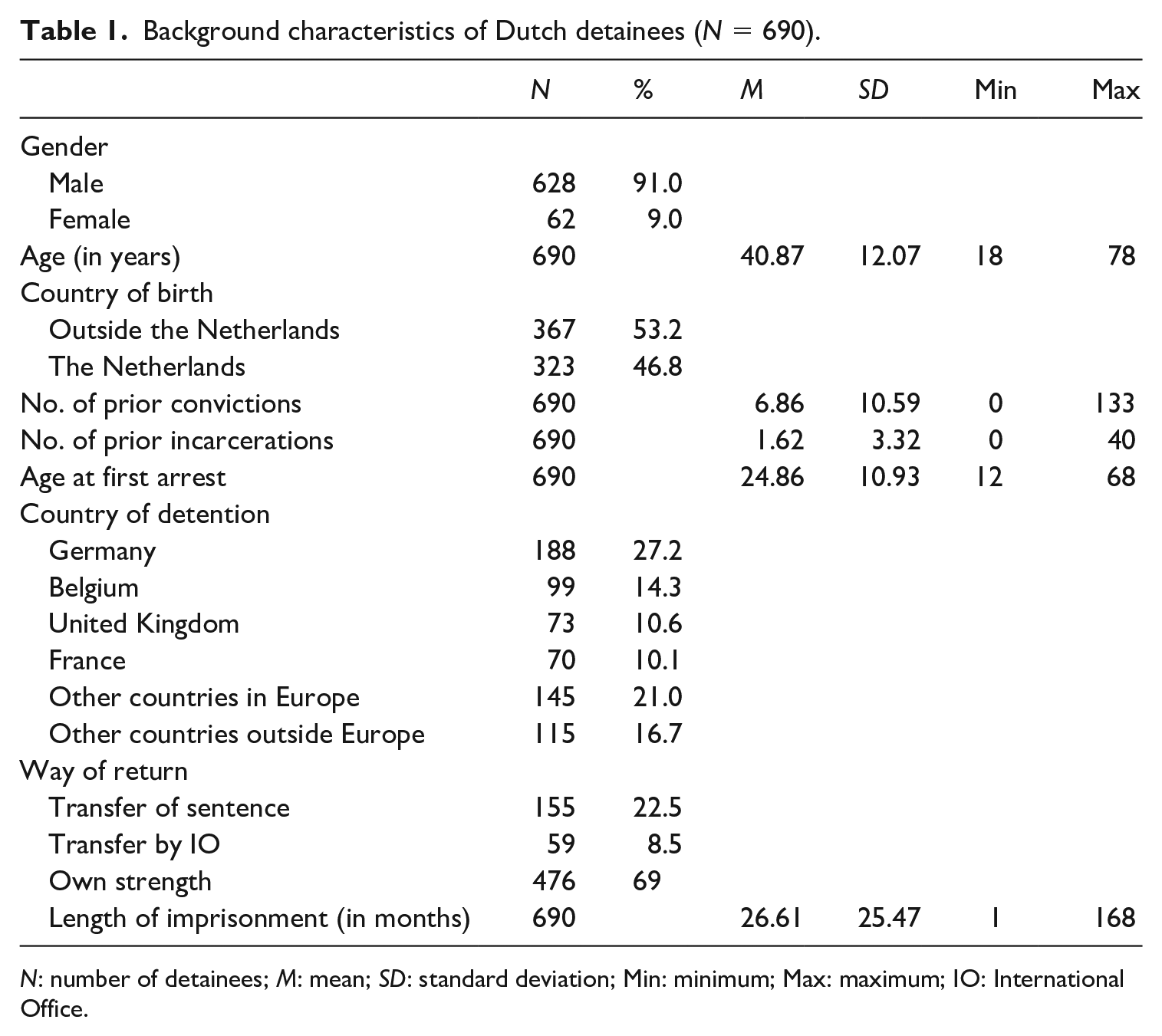
N: number of detainees; M: mean; SD: standard deviation; Min: minimum; Max: maximum; IO: International Office.
Reoffending among returning Dutch detainees
Table 2 presents the reoffending rates within periods after release from foreign detention. Almost 10% of the Dutch detainees have reoffended within 6 months (N = 66). Two years after release, more than 23% of the Dutch detainees have recidivated (N = 162). During the entire follow-up period (more than 3 years), the reoffending rate is 29% (N = 203).
Reoffending rates after release from foreign detention (N = 690).
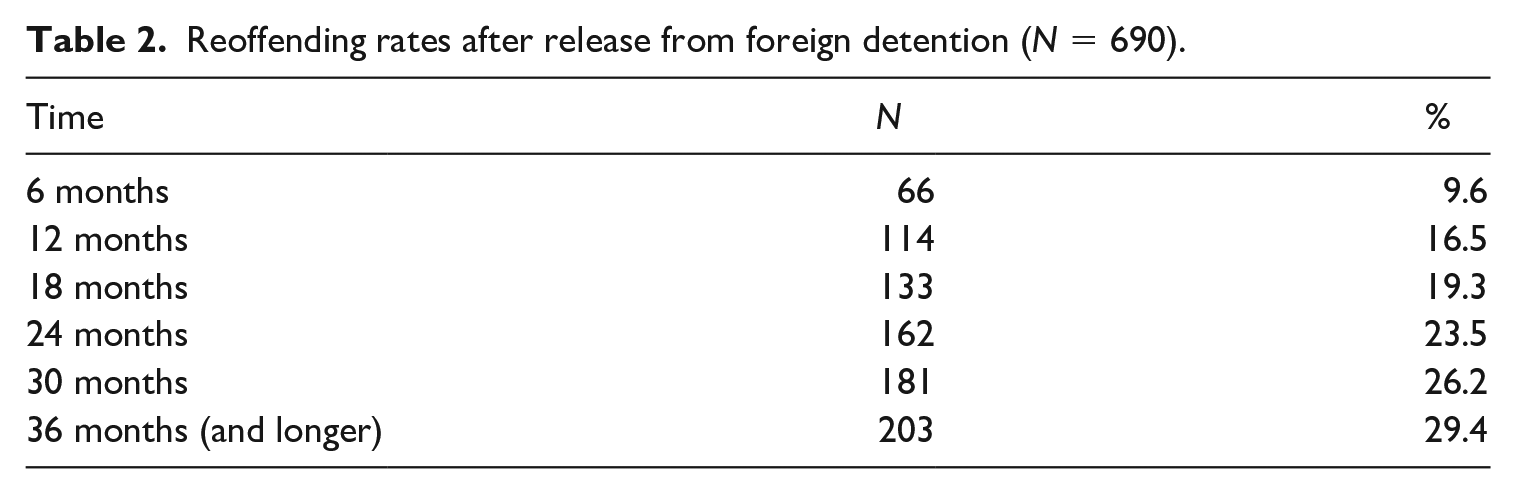
The Dutch detainees have been convicted of various crimes. Two years after release, detainees have been convicted for a violent offence (7.1%; N = 49), for a property offence (10%; N = 69), for a drug offence (9.4%; N = 65) and for other offences (11.3%; N = 78). Other offences can include anything from public order offences to sexual offences. A small group of detainees are convicted for multiple offences, and, therefore, the total number of convictions is higher than the number of detainees who reoffended.
The relationship between detainees’ background characteristics and reoffending
Table 3 displays the results of a logistic regression analysis showing associations between several background characteristics and reoffending after being released from foreign detention. The parameter – Exp(B) – shows an isolated relationship between an individual characteristic and criminal offending behaviour after release from foreign detention, while all other characteristics are considered in the analysis.
Logistic regression analysis on reoffending (N = 690).
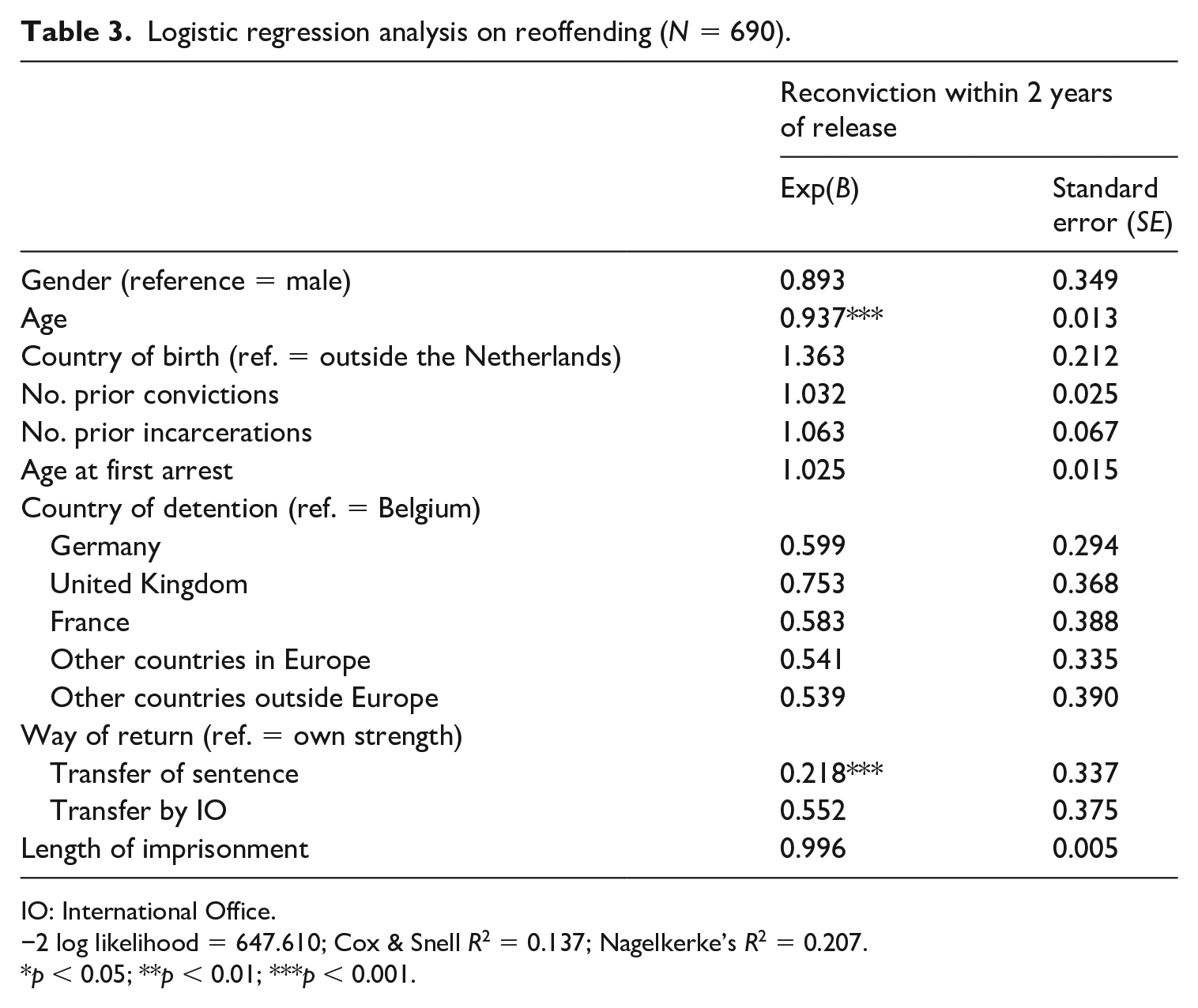
IO: International Office.
−2 log likelihood = 647.610; Cox & Snell R2 = 0.137; Nagelkerke’s R2 = 0.207.
p < 0.05; **p < 0.01; ***p < 0.001.
The results reveal that the Dutch detainees who are older are less likely to be reconvicted in the 24 months after release (odds ratio (OR) = 0.937, p < 0.001). In other words, when Dutch detainees are older, the risk of reoffending diminishes. This finding supports the hypothesis stating that older people are less likely to be reconvicted than young(er) people. In addition, the Dutch detainees who have returned through a sentence transfer have a lower risk of reoffending compared to detainees who have returned without any help (OR = 0.218, p < 0.001).
Other background characteristics, such as gender, criminal history, length of imprisonment and age at first arrest or country of detention, are not associated with the Dutch detainees’ offending behaviour within 2 years after release from foreign detention. These results do not support hypotheses assuming that men are more likely to be reconvicted than women or presuming a relationship between criminal history and reoffending among Dutch detainees who returned from foreign detention. In addition, the results do not provide support for hypotheses suggesting that longer sentences and being first arrested at a younger age are related to reconviction.
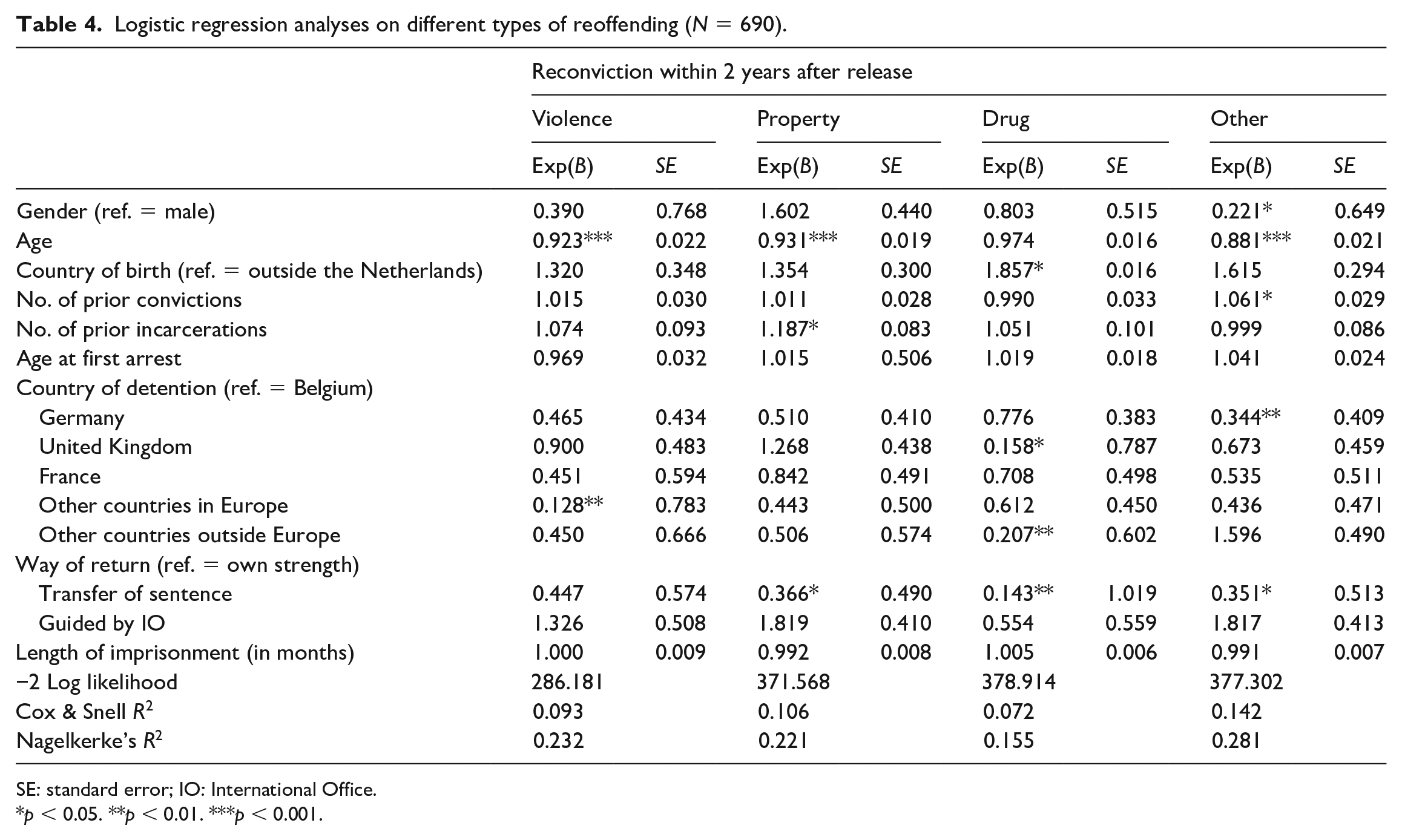
Furthermore, little differences have been found among predictors of different types of offending behaviour after release. The results of these additional analyses are presented in Table 4 (see Appendix 1). Dutch detainees’ age at release from foreign detention is related to several types of reoffending, excluding drug-related offences. The way of return is also associated with various types of reoffending, but not with a violent offence after release. In addition, some background characteristics are related to a specific type of offending after release from foreign detention (see Table 4 in Appendix 1).
Discussion
This study has attempted to increase knowledge on reoffending among Dutch detainees who were incarcerated in foreign detention by examining (a) what their background characteristics are, (b) to what extent returning detainees have reoffended after returning to the Netherlands and (c) to what extent background characteristics are related to their reoffending after release from foreign detention. Dutch detainees are individuals who possess a Dutch passport or identity card, who have a right to receive consular assistance and who are incarcerated due to a criminal offence in a country that is not their home country or their country of residence. Data from the International Office – part of the Dutch Probation Service – and the registered conviction data of 690 Dutch detainees have been used to examine these questions.
This study shows that the Dutch individuals who were detained abroad are often male and, on average, are 41 years old. Most have been born outside the Netherlands. The Dutch detainees are often incarcerated in European countries relatively close to the Netherlands, such as Germany, Belgium and the United Kingdom. The Dutch detainees are mostly not first offenders: a substantial portion of this group has previously been convicted (90%) and incarcerated (52%) in the Netherlands. One-third of all the Dutch detainees have been incarcerated for up to 12 months, one-third had a prison sentence of 12–24 months and one-third had a prison sentence of more than 24 months. This description of characteristics largely aligns with previous research conducted among Dutch detainees in foreign detention (Hofstee-Van Der Meulen, 2015; Miedema and Stolz, 2008; Vogelvang et al., 2015). It seems that some background characteristics are similar to detainees in Dutch correctional facilities, like the proportion of detainees who have previously been convicted (about 90%) (Weijters et al., 2019). However, other characteristics appear to be specific for Dutch detainees in foreign detention, such as their age and the length of their imprisonment.
Furthermore, this study shows that 23% of the Dutch detainees reoffended within 2 years after release from foreign detention. The reoffending rate steadily increased up to 30 months after release from foreign detention. In total, 203 Dutch detainees have been reconvicted, resulting in an overall reoffending rate of 29%. Most reconvicted detainees have committed a property or drug offence. Compared to the 2-year reoffending rate among ex-detainees who have been released from Dutch correctional facilities, the reoffending rate within 2 years is far lower among Dutch detainees released from foreign detention (47% vs 23%) (Weijters et al., 2019).
The finding that 23% of all Dutch detainees released from foreign detention reoffends – while 92% of all Dutch detainees has one or more prior convictions – is quite remarkable and demands an explanation. Interpreting this result, one may consider roughly four explanations. First, the Dutch detainees in this study are, on average, 41 years old at the time of their release from foreign detention, and, therefore, they are older than the average detainee in the Netherlands (37 years in 2017; De Looff et al., 2018). The age–crime curve shows that the number of convictions increases during adolescence and peaks in the mid-20s, after which the number gradually diminishes (Farrington et al., 2013; Hirschi and Gottfredson, 1983; Sweeten et al., 2013). Second, guidance by the International Office may influence Dutch detainees’ reoffending rates after foreign detention. During their stay in foreign detention, detainees actively engage their social network. Existing studies demonstrate in many cases that detainees revert to their (prosocial) network (La Vigne et al., 2005; Weijters and More, 2010) and that a prosocial network can reduce the risk of reoffending after release (Cochran, 2014; Cullen, 2011).
Two other explanations relate to the potential deterrent effect of foreign detention and Dutch detainees’ involvement in drug-related crimes. Third, it is possible that detention abroad has a (stronger) deterrent effect on detainees due to the often less pleasant conditions in foreign detention compared with the conditions in Dutch correctional facilities (Van Kalmthout et al., 2007; Vermeulen et al., 2011). Previous research on Dutch detainees has indicated that the experience of detention abroad is an important reason not to commit crimes anymore (Hofstee-Van Der Meulen, 2015). While this argument mainly relates to conditions in foreign detention, it may be a side effect of detention in general. However, the criminological literature has so far found little support for a deterrent effect of more severe sanctions (Loughran et al., 2009; Snodgrass et al., 2011; Wermink et al., 2018). Fourth, it is well known that foreign national prisoners – and Dutch detainees in particular – are often detained because of a drug-related offence (Hofstee-Van Der Meulen, 2015; Miedema and Stolz, 2008; United Nations Office on Drugs and Crime (UNODC), 2006). Drug-related offences committed abroad can be regarded as transnational drug crimes and may imply involvement in organised crime (Kleemans, 2007; Kleemans and De Poot, 2008). Previous research has shown that the Netherlands can serve as a country of production – particularly in the case of synthetic drugs – as well as a destination country or a transit country (Kleemans, 2007; Kleemans et al., 2002). Prior studies have also demonstrated that offenders involved in organised crimes sometimes manage to escape the sight of detection by law enforcement agencies in the Netherlands for a certain period of time (Kruisbergen et al., 2012, 2019). If Dutch detainees resume to commit drug-related offences within transnational organised crime environments again, a low reoffending percentage among Dutch detainees can be explained by (a) the type of crimes committed in the Netherlands after release from foreign detention and (b) crimes committed abroad which is obviously not registered in Dutch official statistics regarding (re-)convictions.
Finally, several background characteristics of Dutch detainees are related to their reoffending behaviour after returning to the Netherlands. Those who are older at the time of release from foreign detention are less likely to be reconvicted. This finding aligns with research about the age–crime curve (Piquero et al., 2007; Sweeten et al., 2013) and corresponds with existing research (Gendreau et al., 1996; Wartna and Nijssen, 2006). Furthermore, Dutch detainees who returned through a sentence transfer to the Netherlands are less likely to reoffend within 2 years after release from foreign detention compared with those who returned on their own. A sentence transfer means that detainees serve the last part of their foreign prison sentence in a Dutch prison instead of in foreign detention. Therefore, perhaps these detainees are better able to access regular care, creating a final impetus to follow a course of action without criminal offending. However, aftercare by a Dutch municipality has not directly been available for returning detainees who returned without any help.
In addition to these significant relationships, Dutch detainees’ criminal history and their length of imprisonment are not related to their subsequent involvement in crime after release from foreign detention. Regarding criminal history, Dutch detainees who had more prior criminal records had no higher chance to reoffend after release from foreign detention compared with those with less prior criminal records. Moreover, no relationship with reoffending behaviour was found on the basis of Dutch detainees’ prior detention spells and their age at first arrest. These results do not align with prior studies proposing criminal history as a predictor for reoffending behaviour (Bonta et al., 1998; Gendreau et al., 1996; Phillips et al., 2005). In addition, we did not find a significant relationship between Dutch detainees’ length of imprisonment and reoffending behaviour. This finding is not in line with deterrence theory, but it is convergent with previous research on this topic (Loughran et al., 2009; Meade et al., 2013; Nagin et al., 2009; Raaijmakers et al., 2016; Wermink et al., 2018).
As with all research, this study has several limitations which should be highlighted. A first concern refers to the generalisability of these results. The total number of Dutch detainees in foreign detention remains unclear because the Dutch Ministry of Foreign Affairs solely counts those receiving consular assistance (Ministry of Foreign Affairs, 2019). The International Office is largely dependent on information from the Ministry and does not provide guidance to all Dutch detainees who are detained abroad. The International Office reaches an estimated 60% of all Dutch individuals who are detained abroad (Hofstee-Van Der Meulen, 2015). One assumption may be that only motivated detainees apply for guidance by the International Office, and if so, they may also be more willing to cooperate with authorities and build up a conventional lifestyle without committing crimes. At the same time, detainees who are not willing to be guided by the International Office may reoffend more frequently, but they are not included in our sample. This would imply that we underestimated the reoffending rate among Dutch detainees returning from foreign detention.
A second concern relates to the follow-up period for Dutch detainees who returned through a sentence transfer. The observation period of these detainees was probably shorter because they returned in 2016 and, subsequently, served a part of their foreign sentence in Dutch penal institutions. There is uncertainty about the start of the follow-up period due to (a) the unknown duration of the remaining sentence and (b) the early release of detainees, who qualify for this under certain conditions. These circumstances would produce an underestimation of the reoffending rate because Dutch detainees returning via a sentence transfer may have had a short observation period to reoffend than those returning in other ways.
A third concern pertains to the limited measurement of reoffending. Dutch detainees may also be incarcerated in foreign detention for a long time on suspicion of a crime. If the criminal proceedings lead to an acquittal or a dismissal and an individual has not previously come into contact with the judicial authorities in the Netherlands, there is, strictly speaking, no reoffending but only a first conviction. Moreover, reoffending is measured on the basis of official data, as in existing (re)offending research (Durose et al., 2014; Weijters et al., 2019). Therefore, it only relates to crimes that come to the attention of the police and the public prosecution service and that lead to a criminal case. When Dutch detainees committed offences, which were not detected by Dutch law enforcement agencies, there is no registration of reoffending. Thus, this again suggests the possibility of underestimating the reoffending rate.
A fourth concern relates to the return of Dutch detainees after foreign detention. If one has not returned, the lack of reoffending can logically be explained. The reoffending rate may be underestimated when fewer detainees return to the Netherlands. Unfortunately, it was not possible to check or use the administrative data of municipalities to determine whether the detainees returned. However, Dutch detainees must plan to return to the Netherlands to receive guidance from the International Office. Moreover, previous research has shown that 90% of Dutch detainees expected to return to the Netherlands (Hofstee-Van Der Meulen, 2015).
Conclusion
Despite the above-mentioned limitations, this study provides insight into the reoffending rates of a unique group of detainees, whose reoffending rate has been unknown until now. It seems that no study has conducted empirical research into this group of detainees and their (re)offending behaviour after release from foreign detention. Access to reconviction data made it possible to examine Dutch detainees’ reoffending rates after return from foreign detention. Moreover, the data of the International Office and the reconviction data of the WODC were merged. This approach produced exclusive information that provided the opportunity to investigate whether the background characteristics of Dutch detainees are related to their offending behaviour after release from foreign detention.
Although these insights have yielded an important initial description of reoffending among these detainees, it raises questions for follow-up research. For example, what is the reoffending behaviour of German or Belgium detainees who are released from foreign detention? Which other background characteristics – such as the subjectively experienced severity of foreign detention or having a partner or a job – are related to reoffending among these detainees? To what extent are the reoffending rates of Dutch detainees comparable to those of control groups, Dutch detainees incarcerated in Dutch correctional facilities with relatively long prison sentences? In addition, these findings require exploration via a further qualitative approach. How do Dutch detainees experience their period in foreign detention and their return to the Netherlands? Their stories and experiences may offer a valuable addition to the explanations and nuances of the results. In this way, future research can contribute to the aim of reducing reoffending among detainees who return to their home country after being detained abroad.
Footnotes
Appendix 1
Logistic regression analyses on different types of reoffending (N = 690).
| Reconviction within 2 years after release | ||||||||
|---|---|---|---|---|---|---|---|---|
| Violence | Property | Drug | Other | |||||
| Exp(B) | SE | Exp(B) | SE | Exp(B) | SE | Exp(B) | SE | |
| Gender (ref. = male) | 0.390 | 0.768 | 1.602 | 0.440 | 0.803 | 0.515 | 0.221* | 0.649 |
| Age | 0.923*** | 0.022 | 0.931*** | 0.019 | 0.974 | 0.016 | 0.881*** | 0.021 |
| Country of birth (ref. = outside the Netherlands) | 1.320 | 0.348 | 1.354 | 0.300 | 1.857* | 0.016 | 1.615 | 0.294 |
| No. of prior convictions | 1.015 | 0.030 | 1.011 | 0.028 | 0.990 | 0.033 | 1.061* | 0.029 |
| No. of prior incarcerations | 1.074 | 0.093 | 1.187* | 0.083 | 1.051 | 0.101 | 0.999 | 0.086 |
| Age at first arrest | 0.969 | 0.032 | 1.015 | 0.506 | 1.019 | 0.018 | 1.041 | 0.024 |
| Country of detention (ref. = Belgium) | ||||||||
| Germany | 0.465 | 0.434 | 0.510 | 0.410 | 0.776 | 0.383 | 0.344** | 0.409 |
| United Kingdom | 0.900 | 0.483 | 1.268 | 0.438 | 0.158* | 0.787 | 0.673 | 0.459 |
| France | 0.451 | 0.594 | 0.842 | 0.491 | 0.708 | 0.498 | 0.535 | 0.511 |
| Other countries in Europe | 0.128** | 0.783 | 0.443 | 0.500 | 0.612 | 0.450 | 0.436 | 0.471 |
| Other countries outside Europe | 0.450 | 0.666 | 0.506 | 0.574 | 0.207** | 0.602 | 1.596 | 0.490 |
| Way of return (ref. = own strength) | ||||||||
| Transfer of sentence | 0.447 | 0.574 | 0.366* | 0.490 | 0.143** | 1.019 | 0.351* | 0.513 |
| Guided by IO | 1.326 | 0.508 | 1.819 | 0.410 | 0.554 | 0.559 | 1.817 | 0.413 |
| Length of imprisonment (in months) | 1.000 | 0.009 | 0.992 | 0.008 | 1.005 | 0.006 | 0.991 | 0.007 |
| −2 Log likelihood | 286.181 | 371.568 | 378.914 | 377.302 | ||||
| Cox & Snell R2 | 0.093 | 0.106 | 0.072 | 0.142 | ||||
| Nagelkerke’s R2 | 0.232 | 0.221 | 0.155 | 0.281 | ||||
SE: standard error; IO: International Office.
p < 0.05. **p < 0.01. ***p < 0.001.
Acknowledgements
This article was originally published in Dutch as Recidive na verblijf in buitenlandse detentie: Een studie onder teruggekeerde gedetineerden in Nederland. The original article can be retrieved in the Dutch journal PROCES (Van Hall & Cleofa-Van der Zwet, 2020, volume 99, issue 5, p. 318–330). We have introduced some changes to adapt the article to a broader international audience.
Declaration of conflicting interests
The author(s) declared no potential conflicts of interest with respect to the research, authorship, and/or publication of this article.
Funding
The author(s) received no financial support for the research, authorship, and/or publication of this article.
