







Abstract
Purpose
Amid heated global discourses on the benefits, challenges, and propositions of adopting AI in educational leadership, this study elucidates the global impacts of AI on educational leadership and how educational leaders should approach it.
Design/Approach/Method
Using the Responsible AI framework, this study systematically reviews literature on AI and educational leadership from 2015 to 2024.
Findings
AI empowers educational leadership but also brings potential costs and risks. It has been approached and applied differently in educational leadership globally, without a consensus on how to leverage it. A human-centered, symbiotic relationship between AI and educational leaders could be a future trend if leaders reconstrue, change, and adapt educational leadership through the responsible use of AI.
Originality/Value
This study contributes to presenting and analyzing global opinions of AI and educational leadership amid systematic differences and regional diversities in technology adoption. It advances international scholarship on the disciplinary application of AI in educational leadership and the evolving discourses surrounding educational leadership.
Introduction
Artificial intelligence (AI) is advancing rapidly, exerting widespread influence on educational leadership that is pivotal to the effectiveness and improvement of educational institutions (Bush, 2008; Sammons, 1999) when leaders mobilize and guide people to reach educational goals through changes (Cuban, 1988). Having begun to profoundly change the key leadership areas of teaching (Feng & Law, 2021), learning (Luckin & Holmes, 2016), and educational philosophies (Senior & Gyarmathy, 2021), this new wave of technological growth has triggered heated debates worldwide about its implications and relationships with educational leadership. It is tacitly accepted that “the question is not anymore whether AI will play a role in leadership, the question is whether we will still play a role. And if so, what role that might be. It is high time to start that debate” (Quaquebeke & Gerpott, 2023, p. 272).
There are studies examining or reviewing the integration of AI into educational leadership and management (Arar et al., 2025), the managerial applications and benefits of AI in schools (Adams & Thompson, 2025), and the impacts of AI on school cultures that affect leadership practices and organizational dynamics (Kesim et al., 2025), to name just a few. However, these studies are single-dimensional in examining AI's extensive, socio-educational impacts on educational leadership beyond its pedagogical, intellectual, and professional influences (Taguma et al., 2018). They also fall short of comprehensively investigating how AI is approached and practiced differently by educational leaders from education systems worldwide. An even more worrying trend is the neglect to navigate AI as an opportunity to adapt leadership philosophy and mindset to the changing global education.
To elucidate the landscape of the current global discourses on AI and educational leadership, push forward the frontier knowledge of AI in educational leadership, and promote changes in educational leadership, this study examines three research questions through the theoretical framework of Responsible AI (RAI):
What changes and challenges does AI bring to educational leadership? How have global education systems approached the application of AI in educational leadership? What are the implications of RAI for future educational leaders?
This study broadens the technical and legal understanding of AI in educational leadership by stressing innovation and sustainability regarding the development and change of educational leadership itself. It enriches the discussion of AI and educational leadership by extending the organizational and local understandings to an up-to-date global landscape. Through the complexities, systematic differences, and regional diversities in approaching and applying AI globally, this study points out the strategies, principles, and mechanisms for future educational leaders to conceptualize and utilize AI in leadership practices. In the following section, a literature review will articulate what AI is and how it impacts education.
Review of Literature
What is AI?
In 1955, John McCarthy and his colleagues coined the term “artificial intelligence” and defined it as “the science and engineering of making intelligent machines” (McCarthy et al., 2006), targeting ambitiously to achieve “General AI (AGI)”—an advanced form of AI that is capable of performing any intellectual task that a human being can (Wang, 2019). Although this vision set the foundations for creating rule-based AI systems that could learn, reason, and adapt in ways that mimicked human intelligence (e.g., General Problem Solver), the early attempts faltered due to technical limitations and funding cuts in the period of “AI winter” from the late 1970s to the early 2000s (Toosi et al., 2021).
Compared with general AI, narrow AI reignited the field after the 2010s, which was fueled by breakthroughs in deep learning and neural networks, and advancements in computing power and large-scale data infrastructures. Since then, narrow AI systems usually interweave with other scientific domains, achieving high levels of performance in specialized tasks such as facial recognition, natural language interactions, etc. (Wang, 2019). The European Commission's High-Level Expert Group on AI (HLEG) defines AI as “systems that display intelligent behaviors by analyzing their environment and taking actions—with some degree of autonomy—to achieve specific goals” (HLEG, 2018, p. 3). The widespread use of AI applications in various areas has empowered the “Fourth Industrial Revolution” over the past decade (Schwab, 2017).
Most recently, the rise of generative AI (GenAI), powered by large language models (LLMs), was marked by the launch of ChatGPT 3.5 by OpenAI in 2022 (OpenAI, 2023a). Generative AI refers to systems that can create new content—such as text, images, or music—by learning patterns from existing data, enabling them to generate outputs that are coherent and contextually relevant (Sætra, 2023). This development has taken the world by storm due to its strong performance in multiple areas (Lim et al., 2023). As GenAI can mimic human creativity in many tasks, OpenAI (2023b) postulated that the advancement of GenAI and LLMs has the potential to achieve general AI in the near future. While it is still hard to predict the future of AI now, it is widely accepted that AI will transform human society in an unprecedented way.
To capture AI's vast and evolving nature, we adopt a nuanced definition in this study by defining AI as “the theoretical and applied interdisciplinary approaches for executing tasks to yield outcomes that usually mimic the outcomes of human cognitive processes.” It encompasses a range of narrow, task-focused applications to the pursuit of human-like intelligence and versatility.
AI's Impacts on Education and Educational Leadership
Today, AI tremendously impacts education in three aspects: (a) applying AI to solve educational problems, (b) educating people about AI, and (c) prioritizing human intelligence to reshape educational systems (Taguma et al., 2018).
First, AI can be leveraged to enhance education in different contexts. Luckin and Holmes (2016) proposed that AI in Education (AIEd) applications can foster both individualized and collaborative learning through intelligent, adaptive support. By tailoring content to students’ unique learning needs and styles, AI-driven learning systems facilitate a more personalized approach to education that can improve engagement and learning outcomes (Feng & Law, 2021). Moreover, they highlighted AI's potential to disrupt traditional “stop-and-test” assessment models by enabling just-in-time assessments. Through continuous monitoring and real-time feedback, AIEd tools can assess students’ progress in a more seamless, embedded manner, which allows adaptive interventions and reduces the emphasis on standardized testing (Luckin & Holmes, 2016). With these advancements, the roles and responsibilities of teachers are also likely to transform in the AI era (Luckin et al., 2022).
Secondly, as AI disrupts the global job market (World Economic Forum, 2020), it is crucial to equip people with the knowledge and skills needed to understand and use AI technologies. This need has prompted many countries to incorporate AI education into their national curriculum standards, recognizing that foundational AI literacy is essential for future generations (Song et al., 2023). For instance, in 2017, China mandated AI education in all high schools, covering topics such as machine learning, neural networks, and ethical considerations. Similarly, countries like the United States, Canada, Japan, South Korea, and the United Kingdom are developing curricula that introduce students to core AI concepts, aiming to build their AI literacy so that individuals are not only technologically proficient but also capable of making informed decisions about AI's role in society (Miao & Shiohira, 2022). By embedding AI into education from an early age, these initiatives seek to prepare students for the evolving workforce and empower them as critical thinkers and ethical users of AI.
Lastly, in an era dominated by AI, it is essential to prioritize and cultivate unique human qualities—such as critical thinking, creativity, empathy, and ethical reasoning—in educational systems (Luckin & Cukurova, 2019). Rather than focusing solely on technical skills, which AI can often perform, education should emphasize the development of human intelligence to complement and counterbalance AI's capabilities. For example, Senior and Gyarmathy (2021) defined a new learning landscape by exploring human curiosity and creativity, as well as the changing nature of employment. This shift involves reshaping curricula to promote problem-solving, interdisciplinary thinking, and social-emotional learning, preparing students for roles that require adaptive, human-centered skills.
The abovementioned impacts of AI on education carry significant implications for educational leadership. As AI reshapes how we teach, learn, and manage educational environments, leaders must develop a nuanced understanding of AI's influence on their roles and responsibilities. Therefore, it becomes increasingly important to explore how educational leadership can be transformed through AI technologies and practices. This requires an in-depth examination of how educational leaders can adapt to and guide AI-driven changes, ensuring they are aligned with human-centered goals and foster ethical, effective educational practices.
Theoretical Framework
To make sense of AI's multifaceted impacts on educational leadership (Fullan et al., 2024) in educational and socioeconomic domains for short-term and long-term considerations, we adopted the conceptualizations of RAI (see Figure 1). The integrative theoretical framework of RAI was proposed by Haidar (2024). RAI claims that the solutions to AI's technical challenges shall address accountability, fairness, safety, transparency, privacy, and autonomy. The legal dimension of RAI emphasizes regional and global legislation to regulate the application of artificial intelligence and ensure its safety. Its core lies in regulatory actions and policy formulation in terms of regulations, laws, standards, and frameworks. RAI's sustainability dimension stresses that the application and development of AI should align with the Sustainable Development Goals (SDGs) and cause no harm to society, the economy, or the environment. The innovation management dimension of RAI highlights the principles for managing AI-related innovations. It calls for consideration of potential technological impacts, evaluation of innovation, the inclusion of multi-stakeholders, responsiveness to consequences, and the generation of knowledge to fill the gaps between the processes and outcomes of innovation.
RAI brings a multi-dimensional perspective that broadens the discussion of AI and educational leadership. There are cross-disciplinary challenges to AI's governance due to its opaque nature, unpredictability, potential risks, and fast technological advancements (Schneider, 2022). Such challenges accentuate organizational awareness of AI's complexity in digital transformation (Plekhanov et al., 2023). Due to a discipline-oriented perspective, educational leadership discourses focus more on AI's educational implications (Fullan et al., 2024; Senior & Gyarmathy, 2021) that capture only part of AI's broad influences. In addition to overlapping sociotechnical concerns around issues such as safety, fairness, and privacy, RAI can expand the discussions of educational leadership and AI to other areas that are also critical to leveraging AI. Its legal considerations require a comprehensive assessment of AI's manifold policy influence that may trigger changes in the school. Its sustainability concerns resonate with schools’ communal and social responsibilities. Its emphasis on responsible innovation management challenges educational leaders’ metacognitive capabilities in integrating AI with administrative and managerial responsibilities.
Practically, the specific focuses of RAI's four dimensions challenge the orientation of educational leadership, while also providing a reference for leadership goals in the AI age. Educational leadership traditionally tends to focus on organizational changes (English, 2002) to address socio-political needs (Brad, 2016). However, AI requires educational leaders to re-imagine both the purpose and the management of their practices (Griffiths et al., 2024), which may be the key to understanding educational leadership's new roles, principles, and relationships with AI. Through RAI, educational leaders need to look beyond the school walls to the community and society (Baum, 2004), as delving into these technical, legal, sustainable, and innovative aspects of AI “is crucial to navigating AI challenges and ensures that organizations remain committed to fairness, accountability, transparency, and security as they innovate and scale” (Haidar, 2024, p. 14).
Methods
The systematic review adopted a narrative review strategy (Davies, 2000) for a descriptive content analysis (Mertkan & Gümüş, 2024) over articles examining AI's impacts on educational leadership and educational leaders globally. The selection of papers was based on three criteria used by Guarino et al. (2006): relevance, scholarship, and quality. The review focused on empirical or theoretical studies that examine AI's educational leadership influence to ensure relevance. The search period started from 2015, the middle of the 2010s, when AI's educational application became more ubiquitous, 1 and ended in 2024, covering 10 years. For scholarship, only peer-reviewed journal articles published in English were considered because English is the lingua franca of international publication, and peer review plays an important role in ensuring the scholarship of research. To ensure quality, the review adopted six criteria from the “JBI Critical Appraisal Checklist for Qualitative Research” from the Joanna Briggs Institution (see Table 1). Based on the above concerns, three inclusion criteria were set: (a) peer-reviewed journal papers published in English, (b) empirical (quantitative and qualitative) and theoretical studies that examine AI's applications in educational leadership, and (c) studies meeting the adopted JBI quality appraisal criteria. Papers that met the three inclusion criteria were included, whereas those that failed any of the criteria were excluded.
The JBI Appraisal Checklist and the Selected Criteria to Ensure Research Quality.

Identifying Studies for the Review
The review accessed three databases. Educational Resources Information Centre (ERIC) was chosen first because it is a database specific to the field of education, and it covers a wide range of free educational resources. To complement ERIC, two multidisciplinary databases, Web of Science (WoS) and Scopus, were chosen for a wider, more relevant search of resources in the social sciences. While WoS offers robust bibliometric tools and high-quality journal articles, Scopus is famous for its comprehensive resource and extensive coverage. The literature search was based on the search string “(‘Artificial intelligence’ OR ‘AI’) AND (‘educational leadership’ OR ‘educational leader*’).” This string resulted from multiple rounds of test searches that removed terms making the articles too technical or yielding colossal or too few results for a feasible review.
To search for sources meeting the inclusion criteria, the search string was applied in three databases as Boolean strings with restrictions to limit or filter irrelevant sources. In ERIC, the search was filtered by timeframe (2015–2024) and document type (journal articles) after restricting the search to “peer-reviewed only” and “full text available on ERIC.” In Scopus, the same timeframe was used, the subject area was set to social science, the document type was limited to articles, the language was restricted to English, and the source type was set to journals. In WoS, the timeframe remained the same, the language was limited to English, and the document type was restricted to articles. The search yielded 1,205 sources in ERIC, 1,351 in Scopus, and 24 in WoS. The 2,580 sources were then screened first by title, keywords, and abstract, followed by full text review according to the inclusion and exclusion criteria (see Table 2).
The Decision Matrix Template and Some Examples.
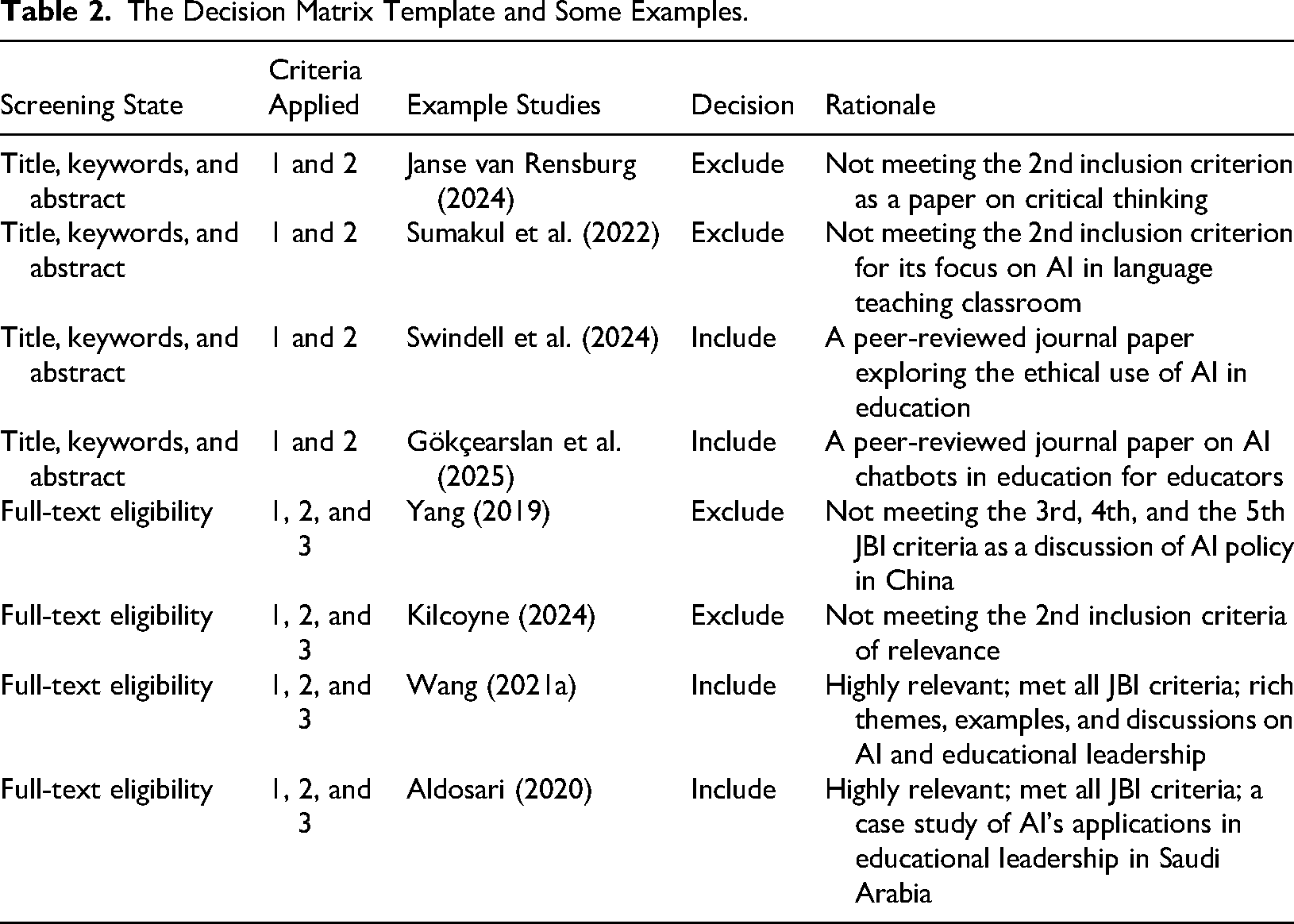
The screening of title, keywords, and abstract included 11 articles in WoS, 13 in Scopus, and 40 in ERIC. The articles were cross-checked for duplication, which narrowed down the scope of full-text screening to 60 articles. While 34 sources were excluded for not meeting the first or second inclusion criterion, six were excluded for not meeting the JBI checklist. Borderline studies that met five JBI criteria went through a double check. In the end, 20 articles were included (see Figure 2). The screening process was first conducted by the first author and then cross-checked by the second author. The second author participated in the full-text eligibility assessment of 10% of the randomly selected articles, achieving 88.7% of agreement. Disagreements were resolved through discussions, and the remaining articles were screened by the first author.

The four dimensions of Responsible AI.

The PRISMA review process.
Data Extraction and Analysis
The authors employed a qualitative thematic analysis (Braun & Clarke, 2012) within a discourse analysis for the descriptive data extracted from the included studies. Guided by interpretive and critical epistemological perspectives (Merriam & Tisdell, 2016), they began with index coding (Brewer, 2000) to manage data and gain a macro understanding of the articles by categorizing demographic, theoretical, and methodological information. Next, through line-by-line open coding (Charmaz, 2006), they performed content analysis (Merriam, 2001), exhausting the articles with information relevant to the research questions (Cohen et al., 2018). Provisional, descriptive codes (Grønmo, 2020) were developed to explore properties, dimensions, and categories of data (Strauss & Corbin, 1998). Axial coding was then conducted to develop themes by comparing and summarizing initial codes. Interpretive and explanatory codes (Strauss & Corbin, 1998) were created using Excel. Finally, an NVivo project was established for all included articles, with a codebook applied and 257 excerpts generated. The authors further conceptualized the data to summarize categories and themes, linking them to overarching categories that were linked to codes and excerpts. Using theoretical coding, the authors synthesized and integrated the categories, themes, and evidence to address the research questions (Mirhosseini, 2020; Saldaña, 2013).
Limitations
This review is limited in the following aspects. The choice of only three databases could lead to a database coverage constraint, as studies from other major academic or regional databases could have been omitted. The English-only inclusion criteria may bring potential language bias and the neglect of qualified papers in other languages. Publication bias is another limitation, as gray literature may also have brought valuable insights. The last two limitations are related to the inclusion and review of source papers. Due to funding limits, only papers that were directly retrievable were included in the databases. Besides, snowballing to exhaust the potential studies from the reference lists of papers included was not used, which could have limited the number of included papers.
Findings
Based on the themes (see Table 3), this systematic review reveals three findings: AI influences educational leadership with promising benefits but also potential costs and risks. The differing approaches and applications of AI indicate a lack of consensus on how to leverage AI in educational leadership worldwide. A human-centered, symbiotic relationship between AI and educational leaders could represent the future of educational leadership, as leaders reconstrue, change, and adapt educational practices through RAI.
Distribution of Themes.

Note. The frequency was calculated automatically on NVivo each time a subtheme generated an excerpt. The subtotal frequency of a theme was the sum of the subtheme frequencies.
Changes and Challenges Brought by AI
AI brings promising benefits to educational leadership. Scholars believe AI can leverage educational leadership in facilitating learning and teaching, improving decision-making, and enhancing administration and intervention. AI technologies have generated “unprecedented capacity” to serve students’ and teachers’ needs globally (Karakose & Tülübaş, 2024). They can be used to improve and manage instruction, assessment, and feedback given to students (Karakose & Tülübaş, 2023). They can also help educational leaders optimize students’ learning experience (Lowe, 2024), promote cognitive and affective development in learning (Karakose & Tülübaş, 2023), boost deep learning (Wang, 2021a), and prepare for an AI-driven future job market (Vashista et al., 2023). On decision-making, AI frees educational leaders from time- and resource-intensive duties (Alghamdi, 2024), particularly those mundane and repetitious managerial chores, to make informed decisions with “actionable insights into student learning activities, instructional effectiveness, and institutional performance” (Meng & Sermsri, 2024, p. 51). As Wang (2021a, 2021b) argued, AI's superior analytical capability and data richness can increase decision-making efficiency and accuracy and assist in tackling uncertainties and complexities. These AI potentials strengthen organizational administration and management through optimized internal communication (Hou et al., 2024), budgeting and resource allocation (Meng & Sermsri, 2024), and staff employment and inspection (Wang, 2021b). With AI-supported early warning systems (Adiguzel et al., 2023), educational leaders can take precautionary measures to “intervene with students at risk of drop-out” (Karakose, 2024, p. 9), “identify learners facing academic challenges, and implement targeted interventions designed to enhance student success” (Meng & Sermsri, 2024, p. 51). AI has a wide variety of potential uses in education. ... Intelligent tutoring systems, automated rating systems, and tailored learning platforms are just a few of the educational applications where AI is already being applied. (Adiguzel et al., 2023, p. 1)
However, “leaders face intricate complications and ethical issues embedded in the technology” (Meng & Sermsri, 2024, p. 52) as AI also brings costs and risks. Technically and ethically, Lowe (2024) questions the transparency of integrating AI into educational practices and criticizes AI's deficiency to “address and navigate the complex intellectual, emotional, psychological, and social elements that influence learning” (p. 33). Besides the worries of academic integrity and plagiarism (Halaweh, 2023), AI exhibits gender, race, and social status bias created by humans who may not even be aware of their unconscious biases (Wang, 2021b, p. 5). Its educational uses raise issues in inequality, discrimination, privacy, security, and intellectual property rights (Adiguzel et al., 2023; Dieterle et al., 2024; Dignum, 2021). Socioeconomically, Leaton Gray (2020) expressed concerns about ensuring “appropriate levels of democratic accountability, trust and fairness when it comes to introducing artificially intelligent systems into schools” (p. 165) under the commercial propaganda of AI companies. AI may bias against students from minorities and from low socioeconomic families and students with special needs. ... Even worse, the biases, in turn, could exacerbate education inequities, generating a vicious circle that entrenches people as the victims of biases. (Wang, 2021a, p. 264)
Professionally, changes in educational leadership are inevitable (Aldosari, 2020; Griffiths et al., 2024) as “school managers and leaders need to evolve in line with the changing realities of the new age of AI” (Karakose, 2024, p. 11). On the one hand, educational leaders are tested by the strategies and decisions they adopt to tackle the side effects, controversies, and bans in some systems regarding the use of AI (Halaweh, 2023). On the other hand, they are urged to learn the quick evolution of educational AI technologies (Vashista et al., 2023). AI requires educational leadership to rethink education and how it should be promoted and managed (Griffiths et al., 2024). It also promulgates the evolution of education “through challenging the traditional methods and approaches” (Karakose & Tülübaş, 2023, p. 11). While proponents call for enforcing educational leadership with digital leadership, arguing that such a shift “necessitates digital transformation and the integration of AI-based applications into management and leadership practices to improve organizational efficiency” (Meng & Sermsri, 2024, p. 50), conflicts between traditional educational leadership and its AI-supported counterparts may arise: “Value-based moral decision-making may run against AI-assisted decision-making” (Wang, 2021a, p. 261), and educational leaders may become “data-rich but information-poor” (Wang, 2021b, p. 4).
Global Trends in Approaching and Applying AI
AI has been approached and applied in different ways in educational leadership globally. Eight studies in the review identified four trends in applying AI technologies in educational leadership practices across different education systems worldwide (see Table 4). Due to limited data, these trends cannot represent entire national or regional landscapes, but they highlight some key points about integrating AI into educational leadership.
Global Trends in AI and Educational Leadership.

The first trend signals the active application of AI in educational leadership practices. Gellai's (2023) study found that some in the UK support the use of AI for political competition as a solution to retain teachers and reduce stress in their profession. Wang's (2021a, 2021b) studies show that AI has great significance in assisting teachers and students, especially those with special psychological or health needs in basic education. Her two studies examined the initiatives in Denmark and the United States, where some schools have begun to enhance their monitoring and intervention capabilities to assist students using comprehensive socioeconomic and demographic indicators supported by AI, and to use AI to enhance leadership with data literacy, decision-making simulation capabilities, and expertise to overcome irrational leadership decisions.
Another trend highlights educational leaders’ support for piloting AI in educational leadership practices. Vashista et al. (2023) conducted their study in India, and participants from management institutes and schools voiced their support for using AI in educational management. Similarly, Aldosari (2020) and Alghamdi (2024) interviewed educational leaders and scholars from primary and tertiary education in Saudi Arabia. Their participants suggested that AI can extensively strengthen leadership capability in improving the individual performance and team development of teachers and students. By contrast, a more cautious attitude is articulated through the study conducted in Peru by Garcia Castro et al. (2024). More than 110 education practitioners urged educational administrators to ensure AI technologies are used ethically and responsibly to address their negative impacts on learning and teaching. At the same time, Halaweh (2023) alluded that AI has been controversially banned due to ethical concerns in some parts of the larger and more complex educational settings in the European Union and China, indicating a more prohibitive stance toward AI.
Differences in the aforementioned trends signal that a consensus has yet to be reached on how AI should be leveraged. For example, Lowe (2024) pointed out that while some believe AI threatens academic integrity, others say it promotes academic integrity. She extended the issue to the thin line between using AI properly and using AI to circumvent one's professional duties. Dignum (2021) approached this issue by focusing on AI ethics, demanding more responsibility and accountability for AI applications and those who use them. The present lack of consensus on how GenAI could or should be used in education, and whether its use is constructive or destructive, suggests that this understanding remains problematic. (Griffiths et al., 2024, p. 15)
Implications of RAI
A human-centered, symbiotic relationship between AI and educational leaders could be a future trend if educational leadership is reconstrued, changed, and adapted through RAI. AI technologies are believed to function as a complement or an advisor in educational leadership as they “are not motivated by compassion- or empathy-motivated altruism” (Wang, 2021b, p. 5). Thus, it should be educational leaders, rather than AI, who “take the helm of caring for students and teachers, pour our heart out and empower teaching and learning in schools” (Wang, 2021a, p. 265). Meng and Sermsri (2024) and Griffiths et al. (2024) expressed support for the symbiosis in their articles, acknowledging the tremendous power of AI but indicating that educational leaders play a decisive role in leading schools and institutions. Against pessimists’ gloomy prediction that educational leaders will one day be replaced by AI technologies, Karakose and Tülübaş (2023) voiced the growing importance of educational leaders in the human–AI symbiosis. They believe schools are for people, and the better the people, the better the schools. If school leaders allow the value of data to override the value of the people whom the leaders serve, then the leaders justify replacing themselves with robot leaders who endow AI with all decision-making power. (Wang, 2021a, p. 266)
On the other hand, leadership development can be a necessary preparation for RAI. Karakose and Tülübaş (2023) alleged that educational leaders must navigate the benefits and pitfalls of AI with rationality and appropriate assessment. Since “it has become necessary for university academic leaders to educate themselves in AI applications” (Alghamdi, 2024, p. 8) for better decision-making and efficiency in practicing leadership, educational leaders are suggested to develop their AI literacy and capability through more exposure to AI applications in leadership practices. They need to have extensive experience in AI, understand the logic and philosophy of AI, and link AI to solve real-world problems in daily life (Ayyıldız & Yılmaz, 2023). They must be technologically and culturally visionary to bridge AI with educational traditions and values (Hou et al., 2024). They “must adopt a proactive stance toward integrating AI into educational tools, rather than reacting to its developments” (Meng & Sermsri, 2024, p. 59), which is essential to translate advances in AI into organizational improvements. An educational leader's job is less about being a bureaucrat who carries out box-checking evaluations and uses them as a punitive tool. Instead, it is more about building people up and providing performance feedback for professional growth. (Wang, 2021b, p. 5)
Systematically, educational leaders are strongly advised to establish guidelines and mechanisms to regulate the use of AI. AI and its applications do not bear the responsibility of ethics or trustworthiness; rather, “it is the people and organizations that create, develop or use these systems that should take responsibility and act in consideration of human values and ethical principles” (Dignum, 2021, p. 3). It is emphasized that strong leadership and transparency are the priorities (Dieterle et al., 2024) “to ensure that AI is employed ethically, equitably, responsibly, and appropriately, and not just for the sake of novelty, pressure, or budgetary reasons” (Lowe, 2024, p. 29). Regarding efficiency in using AI, collaboration mechanisms involving educators, policymakers, and academics are needed (Adiguzel et al., 2023). Teacher training and open governance can be adopted to “involve the whole school community, including students, in working out how technology can be best integrated into education” (Karakose & Tülübaş̧, 2024, p. 10). Co-leadership can be fostered as it “not only facilitates the successful implementation of AI technologies in education but also enhances student learning and development” (Meng & Sermsri, 2024, p. 51). Reflection and sharing frameworks are also vital for exchanging experiences with AI applications across societies (Wang, 2021b). In order to navigate this potential, explore opportunities and mediate challenges, it is essential to integrate humanities and social sciences into the conversation on law, economics, ethics and the impact of AI and digital technology. (Dignum, 2021, p. 5)
Regarding an updated conceptualization of educational leadership through RAI, educational leaders are suggested to reconstrue leadership in the AI age as “the introduction of AI not only heralds changes in teaching and management styles but also touches on deeper changes in educational philosophies and values” (Hou et al., 2024, p. 129). To echo the socio-technological impact of AI, digital leadership is gaining support from academics (Karakose & Tülübaş, 2023). This digital transformation of educational leadership emphasizes educational leaders’ digital literacy as a leadership competency. Alghamdi (2024) argued that digital literacy is essential for digital leadership as it can help university leaders advance leadership with AI applications, create new prospects for students and academics, and improve institutional performance and productivity. The possession of digital literacy within higher education, particularly for academic leaders, supports individuals in their leadership work responsibilities and helps to develop the educational process. (Alghamdi, 2024, p. 6)
Discussion
The global discourses on educational leadership and AI revealed in this review, from the RAI perspective, focus more on AI's technical and legal dimensions rather than its sustainability and innovation management. AI has triggered changes and challenges that test educational leadership in its means and ends, leading to distinct global trends in approaching and applying AI in leadership praxis around the world. However, the discussion of the aforementioned issues is limited to technical and legal implications. While the theoretical possibilities of AI applications in educational leadership have yet to be realized through a consensus on large-scale applications of AI in different educational systems, the responsible management of AI innovations in educational leadership to ensure their sustainability deserves equal attention. The technical and legal discussions on RAI may be transformed into empirical reflections that encourage AI's greater exposure in leadership practices, thereby generating practical evidence and feedback that inspire educational leaders to use AI creatively. However, such initiatives may not be effective if they fail to address security, privacy, and ethical concerns (Griffiths et al., 2024; Quaquebeke & Gerpott, 2023) that are closely connected to sustainable and innovative management of AI's educational and socio-economic impacts (Haidar, 2024).
The responsible adoption of AI in educational leadership demands changes in educational leadership. Although scholars have proposed a symbiotic relationship between AI and educational leaders based on suggested principles, mechanisms, and updated conceptualization of leadership, AI and its applications in educational leadership are still nascent, with their full potential yet to be achieved (Gellai, 2023). Educational leaders need to be more transformative (Shields, 2018) to oversee not only AI's ethical and educational impacts but also its social, economic, and environmental influences on sustainability (Haidar, 2024). The collegial, regional, or international collaborations on AI and educational leadership (Meng & Sermsri, 2024) can be strengthened through responsible innovation management by (a) fostering, reflecting on, and sharing experiences, (b) being inclusive and responsive to AI innovations worldwide, and (c) establishing knowledge management exchange mechanisms. Since technological innovation and educational practices complement and promote each other (Sun et al., 2024), educational leaders and leadership models can be oriented toward a sustainable and reciprocal relationship with AI.
To initiate such changes, navigating AI as an opportunity for theoretical and practical development of educational leadership cannot be overlooked. Among the 20 articles, most academics focus on incorporating AI into educational leadership and the ramifications attached. Only Hou et al. (2024) voiced changing educational philosophies and values through AI. However, many of the leadership issues concerning technological advancements have already existed before AI (Lowe, 2024). The question is, are we applying the same mindset to solving new technological problems without advancing the conceptualization and practice of educational leadership? Academics and educational leaders need to be more critical of technology (Selwyn, 2015) to learn from both the past and the present for developing better leadership theories and practices. In this context, transformational and transformative leadership (Hewitt et al., 2014; Shields, 2018) may be preferred since change is valued in leadership mindsets and knowledge.
Meanwhile, the wider adoption of RAI in global education leadership practices requires development on two fronts. The first front is the socio-cultural and developmental differences enacted in contemporary, pluralistic education systems. These differences may permeate the four dimensions of RAI, affecting how it may be perceived, practiced, or sidelined. The other front involves humanistic considerations for individuals affected by technology, which is an essential end of educational leadership practices. Even in a future society of highly advanced technologies, educational leaders will still need to remain deeply committed to humanity and to their moral duties in serving and leading students and teachers (Fullan et al., 2024).
Conclusion
This systematic review has examined global perspectives on AI and educational leadership. It revealed how AI has been approached or practiced in educational leadership globally. AI is believed to empower educational leadership to facilitate learning and teaching, improve decision-making, enhance organizational administration and development, and support the development of students, teachers, and leaders themselves. Meanwhile, AI also brings intricate complications and ethical issues in tackling the transformation of learning and teaching, keeping up with leadership changes, and reaching a consensus on the proper application of AI in leading global educational organizations and institutions. Since academics are inclined to accept a human-centered symbiotic relationship between AI and educational leaders in the future, developing changes in educational leadership and regulating the use of AI are emphasized.
Based on the framework of RAI, we argue that current global discourses on AI and educational leadership should give more attention to sustainability and innovation management, rather than technical and legal implications. We also contend that stakeholders must learn from the past and present of technological progress to adapt their educational leadership philosophy and mindset to the changes brought by the AI era. For the wider adoption of RAI in global educational leadership practices, the theoretical framework needs to address socio-cultural differences and value humanism amid technological progress. Future research could focus on empirical studies of AI applications in educational leadership, AI-driven innovations in leadership practices worldwide, and historical studies of AI's impacts on leadership philosophies and ethics to promote humanity.
Supplemental Material
sj-docx-1-roe-10.1177_20965311261446186 - Supplemental material for Leading in the AI Age: A Systematic Review of Global Perspectives on AI and Educational Leadership
Supplemental material, sj-docx-1-roe-10.1177_20965311261446186 for Leading in the AI Age: A Systematic Review of Global Perspectives on AI and Educational Leadership by Li Huan Chen (陈礼欢) and Ming Ma (马鸣) in ECNU Review of Education
Footnotes

Author Contributions
Li Huan Chen contributed to the outlining, data collection and analysis, drafting, and revising of the manuscript. Ming Ma contributed to writing the literature review, data collection and analysis, and critically appraising and improving the manuscript.
Funding
The authors received no financial support for the research, authorship, and/or publication of this article.
Declaration of Conflicting Interests
The authors declared no potential conflicts of interest with respect to the research, authorship, and/or publication of this article.
Supplemental Material
Supplemental material for this article is available online.
Notes
References
Supplementary Material
Please find the following supplemental material available below.
For Open Access articles published under a Creative Commons License, all supplemental material carries the same license as the article it is associated with.
For non-Open Access articles published, all supplemental material carries a non-exclusive license, and permission requests for re-use of supplemental material or any part of supplemental material shall be sent directly to the copyright owner as specified in the copyright notice associated with the article.
