







Abstract
Purpose
This article aims to explore how teachers perceive their relationship with the environment and how this perception shapes their professional identity within the Kindergarten of the Lagoon project.
Design/Approach/Method
Emotional textual analysis (ETA) and hermeneutic phenomenological analysis (HPA) were used to examine transformations in affective symbolization processes related to both the project and the lagoon environment. Data were collected through three focus groups with teachers, designed as reflective spaces for discussing their educational practices and professional roles.
Findings
The findings highlight the transformative potential of combining outdoor education and learning with structured reflective practices. Teachers reported significant changes in their connection to the environment (place-based education) and in their sense of professional identity. These shifts underscore how promoting early childhood education for sustainability (ECEfS) can reshape teaching approaches and strengthen teachers’ sense of purpose.
Originality/Value
The research offers new insights into the role of outdoor education in fostering both ocean literacy and teachers’ professional development.
Keywords
Introduction
In response to growing environmental urgency and the global call to educate for sustainability, both scientific and educational communities are increasingly rethinking the relationship between childhood, citizenship, and the natural world. Even if we live on a predominantly blue planet, over 70% of Earth's surface is covered by water, yet for many people, especially young children, the marine environment remains distant and abstract (Guest et al., 2015; Jefferson et al., 2021; Kelly et al., 2022). This disconnection, a metaphorical “ocean blindness,” reflects a lack of cognitive, emotional, and sensory awareness of the ocean and our connection to it (Jefferson et al., 2021; Kelly et al., 2022). It also reveals a broader cultural and educational gap that impedes the development of deep, participatory ecological and marine citizenship (Buchan et al., 2023): a citizenship rooted in meaningful, embodied relationships with marine ecosystems from early childhood.
Over the past decade, a growing number of ocean literacy (OL) initiatives have been integrated into both formal and non-formal education settings, especially in primary and secondary schools (Santoro et al., 2017). These programs aim to cultivate what Cava et al. (2005) describe as “an understanding of the ocean's influence on you and your influence on the ocean,” thereby promoting a bidirectional and relational perspective of our interconnectedness with marine environments. Despite increasing recognition of the importance of early experiences in nature for shaping environmental awareness and behavior to educate for sustainability (Davis & Elliott, 2024; Elliott & Davis, 2009), ocean literacy remains largely absent in early childhood education. Scholars have emphasized the need to address this gap by promoting an emergent ocean literacy (Ødegaard et al., 2024) from early childhood, activating connections and experiences between the “oceanic” dimension and educational and teaching designs in educational services. Neuroscience shows that the early years of life are the stage when children have the greatest cognitive plasticity and the highest learning capacity (Fox et al., 2010). Numerous studies also show that early experiences of contact with nature promote well-being, curiosity, autonomy, and pro-environmental behaviors, useful for future environmental activism (Chawla, 1998; Wells & Lekies, 2006): Children are already able to perceive sustainability issues (Spiteri, 2022) and have the skills to address them (Engdahl, 2015).
Although numerous studies have explored the quality of human relationships with places, research specifically focused on the ocean remains limited (McKinley et al., 2023). Nevertheless, some authors have emphasized the need to further investigate the psychological and emotional dimensions of the human–ocean relationship (Caputo, Tomai, Lai, et al., 2022; Caputo, Tomai, Pomoni, et al., 2022) and more generally, how psychoanalysis can contribute to the care of places and communities (Langher, 2025).
To address this critical gap, it is essential to develop educational proposals that are co-constructed with children, their educators, and embedded within early childhood services. These proposals must foreground the connection between children and marine ecosystems, beginning with immersive, relational, and place-based experiences that prioritize direct and sensorial contact with nature. In this context, ocean literacy can become a transformative educational paradigm, allowing one to know, feel, and experience the blue spaces through meaningful, first-hand engagement (Santoro & Schenetti, 2025). Direct contact with water is essential to truly understand and connect with the marine environment: It is through sensory experience, touching, smelling, even tasting the sea, that one can grasp its depth and power. This embodied interaction nurtures what some scholars call marine identity and can foster thalassophilia, a deep emotional affinity for the ocean rooted in direct, lived experience (Buchan et al., 2024).
However, OL alone is methodologically insufficient: It requires pedagogical approaches that foster embodied and experiential learning, supporting the transmission of content more closely related to OL, and therefore centered on the relationship between the human species and the ocean, in terms of ecosystemic interdependence, physical and psychological well-being, the value and wealth of biodiversity, and much more.
Outdoor education (OE) offers a solid framework to achieve this goal. It acknowledges nature as a co-constructor of knowledge and a privileged context for holistic development, while promoting an experiential approach capable of fostering vivid and authentic learning, even when addressing complex contents such as those related to OL. Scientific literature highlights a wide range of benefits linked to contact with nature, not only for children but also for adults (Bowler et al., 2010; Mannion & Lynch, 2016; Schenetti et al., 2023). These include improved well-being, attentional restoration, and reduced psychological stress (Zhang et al., 2024), as well as a deeper sense of ecological belonging and identity (Wilson, 1993). Nature also supports cognitive and emotional development, fostering confidence, healthy risk-taking, and emotional resilience (Brussoni et al., 2015; Johnstone et al., 2022; Prins et al., 2022), making it a valuable resource for lifelong learning and well-being.
Supporting children's experiences in nature with awareness and intentionality requires educators to engage in reflective and transformative processes. As Wattchow and Brown (2020) suggest, educators must critically reconsider their own ways of inhabiting the world and relating to the environment. Adults cannot meaningfully support children in creating meaningful connections with nature unless they themselves have cultivated these relationships. Outdoor education offers a framework for this kind of personal and professional rethinking, often catalyzing what Bateson (1979) refers to as a noological revolution: one that re-examines one's relationship with the environment through an educational lens. Within the complex and dynamic context of early childhood services, this transformation involves a continuous integration of knowing, doing, and being, positioning educators as active witnesses and role models in the shared construction of meaning and experience.
In this light, ocean literacy and outdoor education emerge as complementary paradigms capable of jointly addressing contemporary educational and ecological challenges. OL offers rich content to understand the ocean's role in sustaining life and our responsibilities toward it, while OE provides the methodological grounding for turning this understanding into embodied, place-based practice.
The Kindergarten of the Lagoon
It is precisely from the convergence of these two paradigms that the Kindergarten of the Lagoon UNESCO Ocean Literacy, n.d. project was born. Launched in 2021 within the framework of the United Nations Decade of Ocean Science for Sustainable Development (2021–2030), the project was promoted by UNESCO-IOC (Intergovernmental Oceanographic Commission) with the aim of cultivating early and affective bonds between children aged 3–6 and the ecosystem of the Venice Lagoon. It involved early childhood services across the Venetian territory and adopted an interdisciplinary model integrating the epistemological foundations of ocean literacy with the methodological principles of outdoor education and place-based education (Smith, 2002; Sobel, 2008).
Each week, children and teachers explored the islands of the lagoon, coming into direct contact with the local natural environment, accompanied by a team of interdisciplinary educators (psychologists, pedagogists, marine scientists) who supported their processes. The project was accompanied by a research-oriented monitoring process conducted by researcher-writers affiliated with the Department of Educational Sciences and the Department of Psychology. Throughout the entire trajectory of design and implementation, researchers operated in accordance with the theoretical framework of action research (Lewin, 1946), thereby configuring the research environment as an integral and constitutive dimension of the project itself.
This article presents the results of a qualitative research study conducted within the project, focusing on the lived and narrated experiences of the participating teachers. The study analyzes how sustained and intentional engagement with the lagoon environment influenced the educators’ professional identity and educational practices, highlighting how the relationship with “wild,” uncertain, and ever-changing outdoor spaces can become a powerful catalyst for both personal and professional transformation.
Methodology
The research presented in this article focuses on the experiences of the 10 teachers involved in the second year of the Kindergarten of the Lagoon project, specifically in two preschools: one on Venice Island and one in mainland Mestre. The schools came from different landscapes: The island of Venice and the mainland facing the island. The mainland group explored the lagoon in Forte Marghera Park, while the island group did so on Vignole Island. The research was submitted to the UNESCO ethics committee and received approval. All participants were asked to fill out a consent form in order to take part in the study.
Focus Group: A Tool for Thinking
Central to the qualitative component of the research were three focus groups, designed and facilitated according to the principles of action research (Lewin, 1946). The focus group is one of the most widely used qualitative research techniques, particularly valuable in psychological, sociological, and educational research for uncovering shared perceptions and lived experiences within a group (Kitzinger, 1995). This instrument was chosen to create intentional spaces for collective dialogue, reflective thinking, and shared sense-making. These sessions were designed to allow teachers to pause, listen to one another, recall and articulate their emotional and perceptual experiences, and reflect on how the repeated contact with natural environments was affecting their ways of seeing, feeling, and acting.
To comprehend the experience lived, three open-ended guiding questions were developed to allow reflection on the transposition, replicability, and meaning of the experience itself, with a view to acting in a transformative way. The questions aimed to explore self-perception from both professional and personal perspectives, in relation to their broader connection with the lagoon environment explored in the project.
Focus Group 1: What would you like the Kindergarten of the Lagoon to be? This focus group was conducted prior to the start of the project, with the aim of exploring teachers’ aspirations and expectations. Focus Group 2: What does the Kindergarten of the Lagoon represent for you as teachers today? This focus group was conducted midway through the project, with the aim of deepening the understanding of teachers’ lived experiences. Focus Group 3: What does the lagoon mean to you? This focus group was conducted in the post-project phase, with the objective of investigating the relationship that teachers had established with the lagoon ecosystem.
Analysis Methodology
The entire corpus of focus groups was transcribed from the recordings, and the transcripts were analyzed independently by two separate research groups, each consisting of two researchers, adopting distinct analytical lenses—psychological and pedagogical—and employing different qualitative methodologies: emotional text analysis and hermeneutic phenomenological analysis. After the independent analysis, researchers converged, compared, and discussed the results. This specific analytical methodology was designed and developed in accordance with the scientific backgrounds of the researchers, who are affiliated with Clinical Psychology and Education and Special Pedagogy.
This intentional methodological duality served to both minimize researcher bias and enrich the interpretative depth of the study: The two analyses supported and validated each other, fostering a more holistic understanding of the participants’ experiences.
Emotional text analysis (ETA) (Carli & Paniccia, 2002) is a psychological tool that aims at exploring people's emotional symbolizations (Carli et al., 2016) and is grounded in Matte Blanco's psychoanalytical bi-logic theory (Matte Blanco, 1975). Using T-Lab software, we conducted a co-occurrence analysis of dense words (frequent, polysemic terms), excluding function words. The software identifies clusters of terms that reveal shared emotional repertoires, which are then interpreted within a factorial space to map unconscious relational dynamics. Rather than testing hypotheses, this approach supports the exploration of context-specific emotional structures and cultural patterns.
Hermeneutic phenomenological analysis (HPA) (Van Manen, 1990) is a qualitative method that explores the meaning of lived experience through the interpretation of language. Applied in the field of educational research, it investigates how individuals make sense of their experiences within cultural and relational contexts. Language is understood as co-constitutive and co-emergent with experience, and interpretation as a pedagogical act that facilitates and promotes the co-construction of meaning. The transcribed materials were analyzed through an iterative process of reading, reflection, and interpretation, thus distinguishing participants’ experiential meanings from the researchers’ interpretive analysis. To substantiate and anchor the interpretive process, selected statements and reflections from teachers, drawn directly from the reference text corpus, were included to support the HPA analysis.
The two approaches are epistemologically aligned, as both attend to real-world phenomena by foregrounding the lived experiences of those who engage with them. In both methodologies, analysis proceeds through an interpretative phase of the transcripts, with focused attention to language. In the former approach, this attention is articulated through the etymological examination of words, whereas in the latter it is oriented toward the meanings that participants attribute to their own experiences. This dual analytical lens becomes particularly evident in the section “Thematic Integration,” where the two interpretative perspectives are brought into dialogue to achieve a more focalized understanding of teachers’ lived experiences in relation to their context, as well as the professional and identity-related meanings they construct.
Results
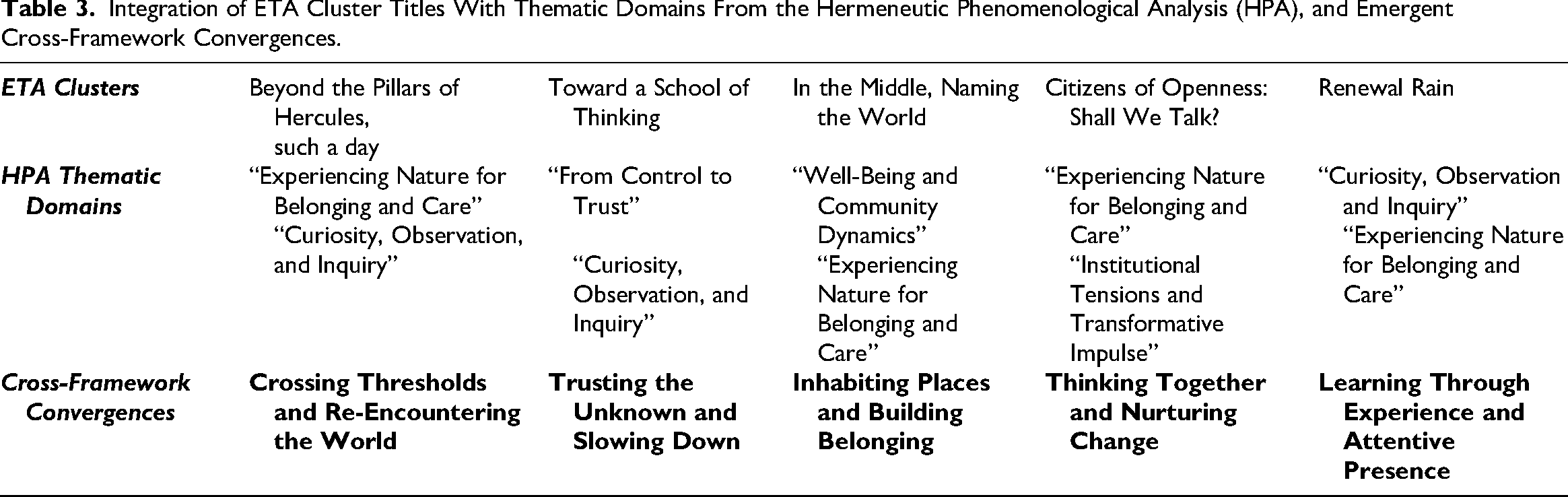
In this section, we first present the ETA clusters (Table 1), followed by the HPA thematic domains (Table 2), and finally an integrative synthesis that relates clusters and domains from each different analysis (Table 3).
ETA Clusters, Percentage of the Text Corpus Each Cluster Is Composed of, and a List of the Most Characteristic Lemmas (Keywords).

The Thematic Domains That Emerged From the Hermeneutic Phenomenological Analysis (HPA).

Integration of ETA Cluster Titles With Thematic Domains From the Hermeneutic Phenomenological Analysis (HPA), and Emergent Cross-Framework Convergences.
Emotional Text Analysis Results
The cluster analysis carried out from the ETA identified five thematic domains, as outlined in Table 1. These clusters represent distinct semantic categories, reflecting symbolic meanings that emerged among the focus groups. While each interview may reflect these clusters to varying degrees, the associated emotional symbolizations coexist and interact within the discourse of all participants.
The whole text corpus is of small to medium size (Bolasco, 1999): The total number of linguistic units ranges between 15,000 and 45,000 occurrences (N = 19.436). The indices of lexical richness show a relationship between the number of distinct graphic forms (V = 2.933) and the total number of occurrences (type/token ratio) equal to 15%. The share of hapaxes (i.e., terms that appear only once in the total amount of distinct graphic forms) is 52% (N = 1.536). Even if the admissibility criteria provided in the literature (percentage of hapax <50% and type/token ratio <20%) were not completely satisfied, we proceeded with a statistical analysis of the text corpus in light of the group's homogeneity and the limited amount of text: The sample corresponds to the entire population, while the limited amount of text accounts for the 52% hapax percentage.
Hermeneutic Phenomenological Analysis Results
In presenting the results of the HPA analysis, the titles assigned to the five thematic domains listed in Table 2 are offered as open labels, emerging from an interpretive process that intentionally remains grounded in the participants’ own language. In line with phenomenological inquiry, these designations do not seek to establish fixed or exhaustive categories; rather, they function as orienting gestures that invite the reader into the textures, nuances, and multiplicity of the lived experiences expressed. The titles thus operate as descriptive, rather than prescriptive, entry points to the experiential meanings that surfaced in the transcripts, without imposing rigid interpretive frames. This choice allows the analysis to remain faithful to the original narratives, preserving its exploratory nature and the generative quality of the interpretive movements it enables.
Discussion
Thematic Integration of ETA Clusters and HPA Domains: An Emergent Interpretive Framework
Table 3, together with the subsequent discussion of the results, presents an integrated interpretive reading that connects the ETA clusters with the thematic domains derived from the hermeneutic phenomenological analysis (HPA). By aligning these two analytical layers, the table shows how each ETA cluster resonates with specific HPA domains, revealing points of convergence, complementarity, and mutual reinforcement. This cross-framework integration provides an interpretive lens that uncovers shared meanings across the two analyses.
Crossing Thresholds and Re-Encountering the World
Beyond the Pillars of Hercules, Such a Day
This cluster (representing 16.93% of the textual corpus) opens with the word day: day, a term referring to the span of time “between dawn and sunset, considered in relation to the conditions in which it unfolds and the events that occur within it.” This word evokes the exceptionality of a specific event and conveys a sense of value attributed to this time frame; it typically denotes a period charged with emotional significance. The subsequent words: emotion, to move (to move, to stir), freedom, and free (both derived from libertum), seem to point toward a dimension of liberated pleasure, unbound from a condition of slavery—libertus being, in fact, the term for one who had been freed from enslavement.
The possibility of movement—of shifting “from a state of stillness” to a newly stirred or emotional state—appears to involve a passage (to pass, to go through), both symbolically and literally tied to the canals and the boat that allows one to navigate them: the vaporetto. The word canale (canal), etymologically, refers to a cut, an incision, or a rupture. From rupture and passage, a space for experimentation can emerge: an operation aimed at verifying or discovering something. In this sense, the body might represent, as in certain philosophical traditions, the medium through which knowledge of the world becomes possible.
This cluster seems to speak of the discovery of a new world that lasts from dawn to dusk: a world of pleasure and of sensations of openness, accompanied by the attempt to enter into contact with it.
Cluster 1 opens with the word day, which becomes more than a time marker: a metaphor for transformation. It evokes the exceptionality of experience, suggesting a phenomenological concept of “lived time” imbued with emotional and existential intensity. Rather than isolated moments, these days form a prolonged educational journey, rooted in recursive and intentional contact with nature, co-constructed through the active participation of educators in planning, training, and reflective dialogue; a space of passage and redefinition of the personal and professional self of the teachers involved. This echoes the phenomenological notion of a “conversion of the gaze,” a shift from ordinary perception to a deeper consciousness of self and world (Husserl, 1965).
Emotion emerges as a central interpretive key. The emotional impact of the experience allowed teachers to look at the natural environment through new, often evocative, lenses (Schenetti & Guerra, 2018). For me, the lagoon is memories, it is life and lived mine. (s7) Seeing them so free made me think back to when I was a child running in the fields, without anyone telling me where to go. (s7) This experience made me rethink how I teach even inside the classroom. (s2) Teaching outdoors means taking a back seat and giving the children the opportunity to advance their growth by supporting them. Give them the opportunity to relate in an empathetic way to everything around them. (s8) Learning took place precisely in the field, on research, on the body, on touch, on experience, and therefore knowledge was more easily internalized. (s3)
Trusting the Unknown and Slowing Down
Toward a School of Thinking
This cluster (20.54% of the textual corpus) is about reflectiveness: the ability to thoughtfully ponder what surrounds us (to think) in a dynamic mode (journey), involving a process of crossing from one place to another. The three verbs that follow (to wait, to teach, and to question) describe a way of teaching where a period of waiting is needed, a time in which questions can be asked, placing trust in another by offering one's attention and openness to their response.
The word objective pertains to the process of observing both oneself and the object of one's thought: the objective, in the sense of a lens or optical device, requires the act of looking and of focusing—an operation that demands time and thought. This reflective process appears to require a kind of pleasurable slowness, evocative of a contemplative dimension.
Teaching thus seems to be characterized as pleasure, as recreation—understood as the possibility of self-renewal for both teachers and children. The term “safe” then appears to refer to an act of trust, an absence of hesitation or doubt.
One of the most significant shifts observed in Cluster 2 concerns the transition from an educational approach based on control to one founded on trust in children's competencies. The teachers described how, through outdoor experiences, they gradually learned to “let go,” recognizing children's self-regulation, autonomy, and responsibility. At first we had to say: Don’t Touch! Don’t go there! ... Then we realized that we had to let go, be with them, but without blocking them from experimenting. (s4) We were afraid of many things, of some dangers that usually do not exist in school, but then it is true that they know how to stop, how to self-regulate, so then this relaxed us. (s4)
Alongside trust, another key aspect of this educational transformation is the emergence of a pedagogy of slowness (Clark, 2023). Teachers observed a gradual adjustment of themselves and the children to the slower, cyclical rhythms of nature: a “slowing down” that fostered greater attention, concentration, observation, and sensory engagement. It's like having a breath of oxygen. Everything slows down, everything is in tune with the times and colors of nature, which are what we will probably need physiologically. (s8) Children now ask real questions. They no longer just ask simple questions, but they want much deeper and more accurate answers. (s11) I realized that it is not always necessary to give answers … sometimes it is enough to listen better to their questions. (s4) I have observed how the children have progressively really acquired the clothes of researchers. I understood that such a young child used this experience, as a vehicle, as a tool, to learn, to ask questions, to learn to be a researcher, and I carry this thing inside me because I too have lived it observing our children. (s8)
Inhabiting Places and Building Belonging
In the Middle: Naming the World
This cluster (14% of the textual corpus) begins with those who dwell in the middle (“middles”), positioned between the large and the small. This being in-between, both concretely and symbolically, is connected to the act of storytelling (to narrate), intended as a medium to transmit culture and narratives. What is told is the territory and its places: the bypass, the suburb, the island, Le Vignole, Sant’Elena, Sant’Erasmo. This cluster seems to speak of (or to narrate) a school in itinere, a school in motion, moving through the space of a territory composed of many places that can be named. The act of naming, of giving something a name, qualifies, distinguishes, and brings it into focus. The possibility of giving the school different names opens up the space of learning (school, a word that etymologically refers to otium, leisure, and the intellectual recreation it allows) to other places—places that can be narrated to the ones who rely in the middle and by them: The older ones already know how to name, while the younger ones can be accompanied by those who are in between.
Cluster 3 reveals a deep relationship between school, territory, and identity, where the act of naming emerges as a foundational educational gesture, deeply rooted in phenomenological and place-responsive perspectives. To name a place is not merely to assign a label, but to engage in a generative act that allows the subject to experience that place as meaningful and personal. As Van Manen (1990) argues, through language, experience takes shape, becoming recognizable, communicable, and livable. Naming, in this sense, constitutes a first step toward inhabiting, creating bonds, and nurturing a sense of belonging (Heidegger, 1971; Jørgensen, 2017).
For both children and teachers, the lagoon was not perceived as an external space, but as a familiar, intimate environment, a shared home and site of care. A lot of kids talked about places by name, as if they were them, as if they had grown up there. (s1) The lagoon has become a bit of our home. (s8) When the children were outside, they felt good, they helped each other more, they looked at each other, they expected each other. (s4)
Ultimately, this cluster narrates the story of a school on the move: a school that navigates the territory with educational intentionality, cultivates rooted ecological citizenship (Latour, 2018), and rethinks education as an embedded, relational, and participatory process from early childhood onward. To truly learn, it suggests, one must not simply be in a place, but feel it, name it, and co-inhabit it in community. This is a school capable of dwelling in the in-between—between land and water, children and adults—and from this liminal space, discovering new ways to educate through presence, care, and co-belonging.
Thinking Together and Nurturing Change
Citizens of Openness: Shall We Talk?
This cluster (23.35% of the total corpus) correlates with certain variables, all related to the facilitators. The word promise comes from the Latin pro-mittere (to put forward) and opens up the notion of relationship: to promise what, and to whom? The focus group becomes a place of hunger, which etymologically refers to the absence of satiation and the desire for something. The word parabola, from Latin, meaning both simile and teaching, suggests that this cluster speaks both of the desire for speech, perhaps in a secular sense and of comparison (simile) or dialogue.
The focus group, “inhabited” by the facilitators, takes on this function, where it is possible to put into words some aspects of lived experience in relation to the project: responsibility (being guarantors of something toward someone) and commitment (the act of giving something as a pledge in order to receive something else). The word key comes from Latin clavē and claudere, which refer to the ability to open and close. The act of turning a key in a lock evokes the passage from closedness to openness, to fresh air; in this case, it could symbolize the transition from an indoor school to an outdoor school, where the key becomes the opening instrument.
This transition requires responsibility and commitment, aspects that call for someone who can receive (the focus group, the facilitator) the words of the citizens, promising participation in a space. The dimension of citizenship is significant here, as it speaks to a system of belonging to a human group and to a territory.
Cluster 4 invites reflections on educational responsibility and the role of reflective, transformative dialogue. Responsibility and commitment emerge as central pillars, especially in relation to the teacher's role as an ethical and professional agent tasked with fostering environments attuned to children's needs and relationships with nature. In this context, responsibility becomes a daily, embodied practice rooted in care and relational ethics (Noddings, 1984). The lagoon is no longer perceived as a detached “outside” to visit, but as a living, relational ecosystem to inhabit and protect: At the beginning I saw it as a place to visit once in a while … now I feel it as part of me. (s8) They made a promise to care for this place, for life. (s4) This experience has enriched me and allowed me to have even more ideas regarding the connection between the inside and the outside. Right now, I’m trying to bring even more green into the classroom. (s1) It would be nice to go out more often, but each time we need to fill out so many forms. (s5) We don’t want to be left alone in this. We need support to reflect, to change. (s5) I hope that we can be supported by the administration and families so that this can be repeated, then in the future. (s4)
Learning Through Experience and Attentive Presence
Renewal Rain
This cluster (25.28% of the textual corpus) begins with the verb to see, which relates to the sense of sight: to see, “to perceive reality with the eyes, to read, to examine,” or also “to receive images of objects through the sense of sight.” It is followed by the verb to re-exit or succeed (in Italian, “riuscire,” a homograph), “to go out again,” which seems to speak not only to the possibility of re-going out and seeing something with new (renewed) eyes, but also to the possibility of achieving something desired, to succeed in something.
The experience (and thus the experiential and experimental dimension, which is precisely the nature of the project) of re-exiting appears capable of making visible and testable (to try) different possibilities. The word possibility (from the Latin possum) refers to feasibility, the becoming-possible of something, while the word different speaks to the nature of this possibility, which in some way diverts (diverse) and thus moves in a different direction.
To listen and to live describe the mode of engagement in this project, which requires being present, and thus living with both sight (to see) and hearing (to listen), participating with the senses in this new experience.
This cluster evokes the theme of learning from experience, which gathers together multiple open codes related to using the senses, observing, and exploring for knowledge. At the heart of these narratives lies a direct and personal relationship with nature, one that is less about planned educational strategies and more about embodied, affective encounters.
The verb to see, which opens the cluster, suggests more than visual perception: It signals the beginning of an educational process rooted in observation and discovery. Outdoor contexts support a different kind of gaze: slower, more conscious, and capable of noticing nuances and relations that often go unseen indoors. I experienced with them even more the emotion of searching, of observing … (s8) When they’re outside, they’re different. They’re more alive. They have a very satisfied, happy gaze. The children were nourished by experience, experimentation, and research. (s8) Outside we’re more alike. They learn from us, and we learn from them. […] Every time they found out something new, I felt like I found out too. (s1) This brings them into the context of the environment, finding, searching for things, and surprising … this research that leads them to be curious. And through this, they learn. (s3)
Conclusions
The first motif emerging from this research regards the lived experience of educational time. The spatial shift to the outdoors ruffles previous patterns of functioning and opens up the possibility of a “lived time” in the present moment (Minkowski, 1933). Notably, the spatial transition seems to influence the temporal dimension. As highlighted in Bergson's phenomenology (1889), time has often been conceptualized with the same characteristics as space, such as duration and length, and described as “time assimilated to space” (Minkowski, ibid.). This parallel between the two dimensions appears evident here: As one changes, the other transforms itself. Yet Minkowski also identifies a stance of being truly in lived time, acting intentionally in the world; what he terms élan vital, a generative force through which time is created and experienced actively and in a participatory way. This alternative way of inhabiting time, integrated and embodied, can be reinterpreted as a recovery of fullness and horizontality in experiential time lived and inhabited in a pedagogical–phenomenological perspective (Tarozzi, 2016). Within this framework, a second reflection arises: The nature of lived experience transforms the educational gaze and, with it, the posture of the teacher. Through two distinct methodologies, we found recurring categories of emotions expressed by teachers regarding educational places. These emotions, in their depth and diversity, reminiscent and transformative, became the lens through which participants’ professional and personal perspectives shifted. On one hand, well-being, pleasure, and reconnection with the environment accompanied outdoor education experiences, framed by intentional pedagogical meaning, in which relationships with children and places gained renewed significance. On the other hand, teachers expressed frustration and discouragement related to the rigidity of bureaucratic school systems and the limitations of daily indoor practices. Outdoor education enabled a rediscovery of the body as central to educational relationships, as phenomenologically lived experience and as a tool for knowledge and mediation. Teachers’ words reveal the bodily reappropriation experienced not only by children but also by the educators themselves. The body returned to inhabit educational space not just through movement, but through gaze, gesture, and new spatial and relational positioning. In the phenomenological view, lived space is always also emotional and relational space: What matters is not only where one is, but how one inhabits that place (with body, mind, others, and self) within the intersubjectivity at the heart of all educational encounters.
The third emerging theme centers on the symbolic transformation and reappropriation of space through the act of naming educational places. Naming holds a powerful symbolic force as the school appropriates the water, identifying itself through names like “Le Isole,” “Sant’Elena,” “Sant’Erasmo,” and “Le Vignole.” Naming lived places is not a neutral act but a potent pedagogical practice that accompanies those who live and traverse these places in rethinking their stance within them, constructing memories, connections, and relationships that transform the environment into a lived, inhabited, and felt space (Iori, 1996). The vaporetto becomes the means by which this lagoon-based educational map is constructed, enabling the school to move beyond its walls and come alive in new, diverse spaces.
Water acts as the holding space for this archipelago-school, which is newly perceived as it becomes a place of learning. The lagoon, a threshold between land and sea, becomes a place of pleasure and discovery, bearing the unique identities of its named places. Notably, it is the solid, walkable spaces—the islands and boats—that are named. As scholars have observed, the very nature of water, dark, fluid, and seemingly uniform, poses challenges for educational practices within ocean literacy frameworks. Looking beneath the surface becomes an essential educational act in constructing representations of the marine environment as emotionally and symbolically meaningful, rather than as a nameless expanse (Stedman, 2003).
A fourth key dimension highlighted is the value of creating reflective spaces—places where questions arise, connections form, and new embodied, grounded transformations take shape. In line with Kolb's (1984) definition of experiential learning and Lewin's (1946) action research model, meaning-making is possible only where experience can be spoken, shared, and narrated. From this perspective, nature-based education not only prompts reflection on childhood contexts but also on the training needs of those who accompany children. The teacher is not a mere facilitator but an embodied subject acting intentionally within complex, shifting relationships. Exploring lagoon territories reveals how external environments catalyze transformative processes in adults—their self-perception, emotions, and relational ways of being. The teacher's body, presence, and emotions are never neutral. Rediscovering these elements through outdoor education means recovering the human and transformative horizon of education itself, envisioning new horizons for early childhood education, where blue spaces become integral to daily learning, care, and citizenship. This study highlights and supports the value of practices such as naming the world and its places, conceiving teacher education as a transformative and embodied rather than merely cognitive experience, and promoting activities that invite learners to “look beneath the surface” in order to develop symbolic and affective representations of the sea and the lagoon. In this perspective, the Kindergarten of the Lagoon becomes not only a site of outdoor learning, but a generative space where teachers renegotiate their ways of inhabiting time, space, and professional identity. These findings invite the continued development of pedagogical practices that value embodied experience, ecological belonging, and reflective dialogue as foundations for early childhood education in blue and green environments.
Limitations and Further Research
While this study draws on a very small yet distinctive sample, which offers a meaningfully situated perspective on the phenomenon, its interpretive scope remains necessarily circumscribed. Future research with larger and more diverse participant groups would be valuable to probe the robustness and transferability of these insights. It would also be fruitful to integrate additional qualitative and quantitative approaches, alongside focus groups, to deepen understanding of the professional transformations described by teachers. We therefore offer this contribution as an invitation to extend inquiry in this field through interdisciplinary designs capable of holding together experiential, pedagogical, and psychological dimensions.
Footnotes
Acknowledgments
The authors acknowledge the contribution of OceanLab Venice's educators for their collaboration and support in implementing the project activities. The authors also thank the teachers who participated in the project and shared their experiences as part of the research. We thank Davide Riccardi for his participation as an observer during the focus groups.

Ethical Considerations
The research was submitted to the UNESCO Ethics Committee and received approval. All participants were required to complete a consent form prior to taking part in the study.
Author Contributions
Authorship contributions followed a collaborative and iterative design. Alessia Tombolini led the study, participated in conceptualization, data curation, methodology, and analysis, and drafted the manuscript. Viviana Langher and Michela Schenetti contributed to conceptualization, methodology, formal analysis, supervision, validation, and manuscript writing (original draft and review). Nina Cerneka contributed to data analysis, and manuscript writing and revision. Francesca Santoro contributed to funding acquisition and supervision.
Funding
The authors disclosed receipt of the following financial support for the research, authorship, and/or publication of this article: This work was supported by the PradaGroup within the Sea Beyond programme.
Declaration of Conflicting Interests
The authors declared no potential conflicts of interest with respect to the research, authorship, and/or publication of this article.