






Abstract
Introduction: The Centers for Disease Control and Prevention report that the number of individuals with asthma in the United States has increased by 4.3 million, or 12.3%, between 2001 and 2009, creating an increasing burden on our health care system. Effective patient education is a key component of asthma management. The National Asthma Educator Certification Board (NAECB) promotes “optimal asthma management and quality of life by advancing excellence in asthma education through the Certified Asthma Educator process.” Methods: Following completion of the asthma educator certification examination, applicants were invited to participate in a voluntary, anonymous Web-based survey. The survey was developed and approved by the Executive and Research Committees of the NAECB, with the objective of reviewing the experience of applicants seeking initial certification and of those seeking recertification. Results: Completed surveys were obtained from 988 applicants. Seventy-six percent of respondents were first-time test takers; the remaining respondents were repeat test takers. Eighty percent reported having passed the examination. Approximately 85% felt that the time allotted for the examination was “just right”; the level of difficulty was “ just right” for 65% of the respondents, and the clarity of the examination questions was rated as “good” or “excellent” by 72% of the respondents. Seventy-two percent responded that the examination reflected the role of the asthma educator and 88.1% would recommend the examination to others interested in asthma education. Open-ended responses highlighted benefits and barriers. Discussion: The asthma educator certification examination is reflective of the professional responsibilities of the asthma educator. Benefits and barriers are discussed in the context of published literature.
Education to improve health literacy and communication is a key component for facilitating a therapeutic partnership between patients and their providers. This is particularly important in asthma because clinical symptoms can be modified and underlying inflammation addressed with appropriate treatment. With a 12.3% increase in prevalence rates (7.3% in 2001 vs 8.2% in 2009) 1 in the United States, asthma poses a significant burden on health care expenditures. Poverty, low literacy, and lack of insurance have been associated with high costs and poor outcomes in individuals with asthma.1,2 These factors contribute to the challenges that must be met to address the critical need for effective interventions and self-management strategies.
Certified asthma educators (AE-Cs) are health care professionals and educators who have been identified, by virtue of a voluntary, national examination process, as “experts in teaching, educating and counseling individuals with asthma and their families in the knowledge and skills necessary to minimize the burden of asthma on their quality of life.” 3 Documentation of proficiency in asthma-related science, clinical care, and skills, through the certification process, provides patients, families, health care organizations, and other health care professionals with the National Asthma Educator Certification Board’s (NAECB) assurance that the certificant has successfully completed the requirements necessary to provide relevant asthma education services. The need for standardization of information and skills necessary for self-management of asthma was formally addressed during a conference of stakeholders in 1999, following which the NAECB was created as a voluntary, not-for-profit credentialing board.
Asthma educators come to the credentialing process through 1 of 2 pathways. They may be a licensed or credentialed health care worker (ie, physician, nurse, respiratory therapist pharmacist, social worker, health educator, physical or occupational therapist, physician’s assistant) or may demonstrate significant clinical work experience, consisting of a minimum of 1000 hours of documented asthma education, counseling, and/or coordinating asthma-related services. Individuals who take the examination may be selected for random audits of eligibility. The credentialing examination is administered electronically at multiple testing sites throughout the United States. Examinees are allowed a maximum of 3½ hours to answer 175 questions compiled from a bank of questions, developed in cooperation with Applied Management Professionals certification and licensure services. 3
Four major content areas are tested: The Asthma Condition, Patient and Family Assessment, Asthma Management, and Organizational Issues. These areas are described fully in the Detailed Content Outline that appears on http://www.naecb.org in the AE-C Candidate handbook.
Within each area, questions are formatted to address recall, application, or analysis of required content. The passing score is determined using a modified Angoff method, which is a common strategy for psychometric examinations. The AE-C credential is valid for a period of 7 years, after which recertification by examination is required. At present, there are approximately 3000 certified asthma educators in the United States. 3
The purpose of this article is to review the feedback of applicants who completed the credentialing examination and to review the process of credentialing certified asthma educators, both alone and in comparison with related health care fields.
Methods
The 2 surveys used in this study are presented as pilot studies, designed to serve as descriptive tools to assist the Board of Directors to attain the objectives described above.
Survey Tools
Survey 1, consisting of 13 questions (with the 8 selected questions included in this study shown in Table 1), was initially posted online in August 2007. To reach as large a pool of respondents as possible, e-mail solicitations were sent to all test takers, beginning with those who took the examinations between 2002 and 2007 and then in monthly e-mail messages to current applicants. Each certificant received a one-time solicitation to visit an independent Web site to participate in an anonymous survey. There were no incentives or follow-up requests. As of November 2010, 988 responses were obtained, yielding an overall response rate of 53%. A second survey (Survey 2) was introduced in September 2010 and was sent only to AE-Cs who had taken the examination for recertification purposes. The results from Survey 2 involved 65 respondents 4 and were recently published in its entirety in Pediatric Allergy, Immunology and Pulmonology. The open-ended responses from Survey 2 were included in this report to complement the open-ended responses from the first survey and to further address the benefits and challenges of certification within the framework of published experiences in other health care fields. Both surveys were developed and approved by the Board of Directors of the NAECB.
Selected AE-C Survey Questions From Survey 1
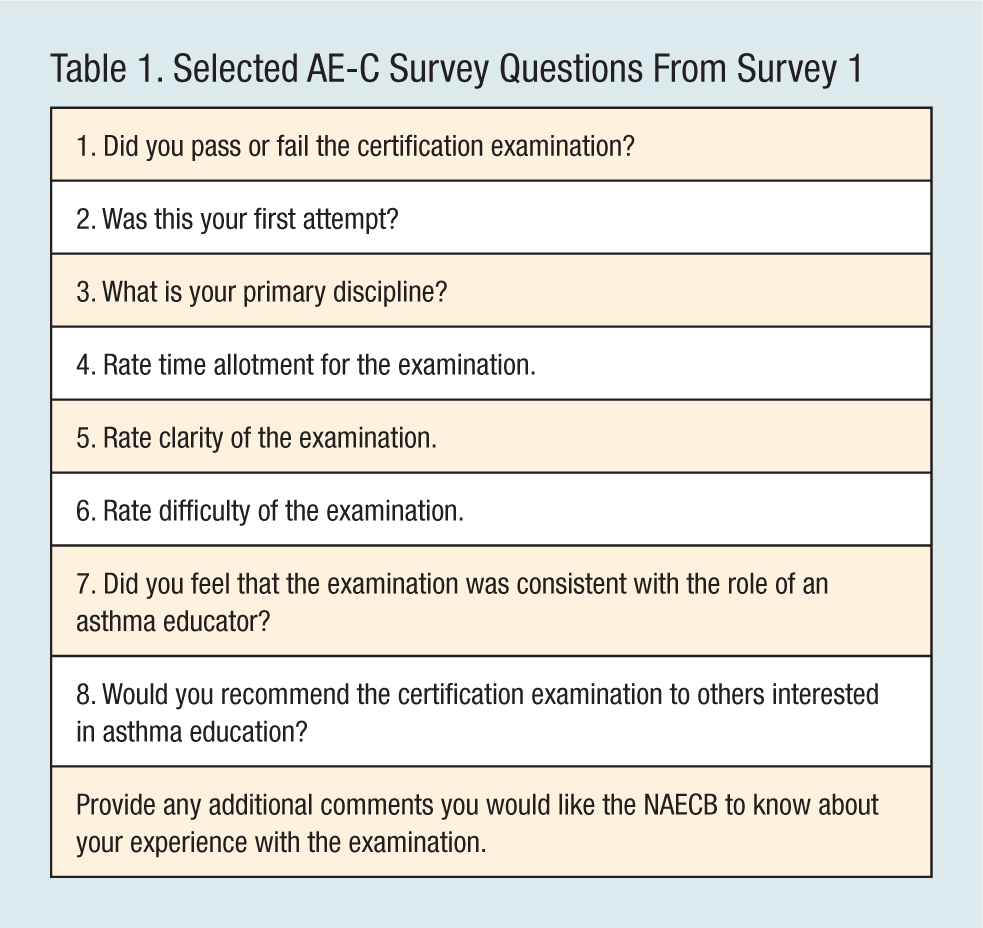
Survey data and comments from respondents were analyzed using descriptive statistics.
Results
A total of 988 responses were received from Survey 1, yielding a response rate of 53%. First-time test takers comprised 73.6% of the respondents; the remaining respondents were repeat test takers, including individuals who had not successfully passed the examination. Eighty percent of the total reported having passed the examination. The major disciplines represented were respiratory care (64%) and nursing (28.4%). Physicians, pharmacists, social workers, physician assistants, and 1000-hour candidates were represented in much smaller numbers.
Quality and Features of the Certifying Examination
Approximately 85% of the respondents to Survey 1 (n = 988) felt that the time allotted for the exam was “just right” (10% “too short” and 6% “too long”); the level of difficulty was “just right” for 65% of the respondents (“too difficult” for 36%; none responded that it was “too easy”); and the clarity of examination questions was rated as “good or excellent” by 72% of the test takers.
Relevance to Practice
Respondents were asked whether they felt the examination was consistent with the role of asthma educators and whether they would recommend the examination to others interested in asthma education. Seventy-two percent of respondents to Survey 1 felt that the examination adequately reflected the role of the AE-C, and 88.1% responded that they would recommend the examination to others interested in asthma education. At the present time, the examination is the only route to national certification as an asthma educator.
Benefits and Barriers to Certification
Comments compiled from both surveys identified the following benefits of certification as an asthma educator: increased credibility, identification as an asthma resource, respect of patient and health care team, and increased personal confidence and trust in their asthma knowledge and expertise. In some cases the AE-C credential was a job requirement or was used to establish a benchmark to assure employers, colleagues, and patients of an educator’s proficiency in asthma education.
While barriers were not specifically solicited, Survey 1 included opportunities for respondents to add comments relevant to the examination and certification process, as well as the opportunity to share additional concerns with the NAECB. Among a total of 86 comments, we identified concerns about examination cost and lack of financial benefit or reward following certification in some of the responses. Results from both surveys indicated that variable reimbursement of examination cost, lack of acknowledgement from employers, lack of salary adjustment on passing, and variable reimbursement from providers were additional candidate concerns.
Discussion
Our results demonstrate that the majority of certified asthma educators feel that the current credentialing examination reflects the professional role and responsibilities of asthma educators and that the examination was appropriate in both length and level of difficulty. The credentialing process exists in a variety of forms within health care professions with the intent to ensure that providers demonstrate current, evidenced-based knowledge and skills with the ultimate goal of improving patient outcomes. In a climate that is driving both patients and providers to seek value and transparency in health care, the credentialing process helps assure the public that AE-Cs have successfully met the standards of excellence necessary to practice in the field of asthma education. Credentialing has been associated with improved self-esteem, peer recognition, 5 and improved job satisfaction.6-9 Public and physician perceptions of board certification are recognized as important factors both in selecting a personal physician 10 and for physicians making referrals. 11
A recent paper by Grimes and Mercure 12 described the results of a survey of 60 asthma educators (92% current AE-Cs; 8% with lapsed certificates). They found that 42% of their sample (n = 25) did not intend to recertify as AE-Cs, and they summarized 5 major reasons for this decision from among 29 responses provided by respondents. The most commonly cited reasons to not seek recertification included retirement or not working in the field (n = 9), no benefit or advantage to recertification (n = 7), the expense/cost of recertification (n = 7), and the perceived lack of value of recertification in the workplace (n = 4). Two responses cited the testing process for recertification as a barrier. These findings bear some similarities to both the NAECB and other workforce studies, although the percentages do not.13-15 These inconsistencies may be related to the small number of responses included in these surveys as compared with state or nationwide studies of larger health care–related workforce groups. For the sake of comparison we will address these barriers in order.
Attrition rates due to stress, burnout, and poor job satisfaction have been well described in health care. Matthews et al 14 found the attrition rate in respiratory care to be relatively stable at 35.2 ± 1.7-3.1% when comparing 2004 versus 2002. Neff et al 15 conducted a survey of 10 951 nurses in a single state and found that approximately 25% intended to leave their job within the next year. Our group previously reported on the initial impact of the AE-C credential, which included an increase in salary in 9.4% and additional job responsibilities in 20% of the respondents, who had just completed the recertification process. 4 Following recertification, this group of educators reported that while only 1.6% had an increase in salary as a result of the recredentialing process, 12.3% of this same group reported that they were now able to bill for asthma education services as compared with 7.8% after the initial certification. 4 The NAECB is working to promote the value of the AE-C credential—to increase public visibility and promote the value of certified service providers. Managed care organizations are encouraged to explore systems-based interventions to incorporate AE-Cs into their asthma education programs to improve care from a population-based perspective and to explore innovative methods to restructure the traditional system of reimbursement to align with the changing landscape of health care needs and delivery. The real costs of the examination to test takers is similar to that of certified diabetes educators 16 and certified health educators. 17 Since examination content is derived from a common pool of questions, the level of difficulty can be assumed to be comparable across NAECB examinations. The cost of preparing for the examination, both financially and in terms of time, is expected to vary by applicant. Limited opportunities for scholarship funds for eligible candidates are available through the NAECB Web site. 3 Given multiple pathways for recertification adopted by other multidisciplinary specialty boards, the NAECB is currently evaluating options for recertification.
There are several limitations to the current survey that should be noted. The survey response rate was 53%, which is an acceptable rate; however, the majority of respondents had successfully passed the exam. Feedback from asthma educators who did not take the exam as well as an increased response rate from unsuccessful applicants might have provided additional insights. While both these surveys are limited by virtue of their scope and numbers, we believe they highlight the importance of credentialing in health care education. Additional research is needed to demonstrate the value of certified asthma educators on patient outcomes, including quality of life and markers of asthma control, as well as on overall health care cost.
In summary, we believe that the credentialing process is an important factor not only in providing patients and providers with assurances that asthma educators have met the standards to provide up-to-date, evidence-based asthma education but also ensures that AE-Cs continue to keep their knowledge and skills current.
Footnotes
The authors are either current or past members of the Board of Directors of the National Asthma Educator Certification Board.