







Abstract
During a night in October 2024, several patients contacted an Out-of-Hours Primary Care (OOH-PC) team reporting “burning eyes.” As a pattern emerged, the team was required to manage an uncertain situation without an existing protocol. This case study of an OOH-PC triage team is based on a semi-structured focus group interview with employees who were on duty during the incident. The study explores how a co-located team adapted to an unforeseen clinical situation, with particular attention to team processes and emergent states that supported coordination under uncertainty. A thematic analysis identified three themes: (1) informal communication that demands attention; (2) a new situation without a protocol; and (3) dynamics between physicians and nurses. While planning and coordination were primarily handled by physicians, mutual respect and established communication patterns enabled nurses to remain informed and contribute actively. The findings suggest that pre-existing team characteristics can facilitate adaptive responses during critical events. The case highlights the value of flexible and dynamic teamwork when triage teams manage unexpected situations without relevant protocols.
Keywords
Introduction
During the night between October 21 and 22, 2024, the Out-of-Hours Primary Care (OOH-PC) night service detected several patients reporting burning eyes – without any obvious explanation for the symptoms. After a few calls, the team identified a pattern. The patients were all students at Aarhus University and had been at the same location at the university the previous day. The staff now faced a task they had not encountered before, and for which no protocol existed. The team had to adapt to this new situation and change its work structure accordingly.
Teamwork plays a significant role in the management and unfolding of critical incidents. 1 Teamwork in telemedicine has previously been studied, but these studies have typically focused on factors such as the physical distance between employees. 2 The type of collaboration described in these studies thus differs markedly from the triage team setup in the OOH-PC night service in the Central Denmark Region, where team members are co-located and structured as a team following the reorganization of this service, which took effect on 1 March 2024.
The OOH-PC night service team in the Central Denmark Region is characterized by relatively stable patterns of teamwork behavior. This is shown by predictable demands, co-location, overlapping competencies, and simultaneous task execution. 3 These qualities are well suited to solve the usual tasks in OOH-PC. However, multiple simultaneous calls from university students made the team aware of a potentially critical situation, although this only became apparent gradually. Although patients’ symptoms were not considered severe, uncertainty about their cause, combined with the evacuation of Aarhus University, led to extensive media coverage. 4 The incident was considered critical both because the OOH-PC night service team faced an unfamiliar situation outside their usual scope and because of the way it was managed in the absence of protocols, prompting internal reflection and public attention.
This case study aimed to explore how teamwork behaviors within an OOH-PC triage team influenced the management of an unforeseen critical incident, particularly how both prior and situation-specific teamwork behaviors were crucial for cooperation during the incident. Rather than evaluating the effectiveness of the team’s response, the study focuses on how the team navigated the situation.
Methods
This organizational case study (see Supplemental File 1 for adherence to appropriate reporting guideline) is based on a focus group interview following a semi-structured interview protocol with two (of five) employees (one nurse, one physician) in the OOH-PC night service in the Central Denmark Region who were on duty during the critical incident between October 21 and 22, 2024. The interview lasted 1 hour and took place on 18th December 2024. During the incident, twenty-three students developed symptoms of burning eyes after accidental UV exposure from a malfunctioning university disinfection system, initially suspected as chemical or biological contamination, prompting campus evacuation and a multi-agency response. The interview was audio recorded and subsequently transcribed verbatim, anonymized, and the audio recordings were deleted. The interview guide is available in Supplemental File 2. The first author conducted a theory-driven thematic analysis using deductive coding focused on teamwork. 5 After several readings of the interview, the coding process began. The codes were grouped into three themes.
Results
Three themes were apparent in the employees’ experience of the critical incident and their interpretation of teamwork during the shift. Each theme is unfolded below, and teamwork literature is applied to elaborate the analysis.
Informal Communication That Demands Attention
During the incident, employees had to coordinate the response and share information with each other, while the tasks continuously changed as the team gained an understanding of the situation. The OOH-PC night service received the usual number of calls during the shift, which challenged the situation, as not all employees were available at the same time.
One of the employees highlights that being seated together is the most crucial factor for effective collaboration. Another employee responds: “And even though you’re on a call sometimes, you just can’t help but listen to what someone else …. I mean… Sometimes you just pick up on something… And you think… Uh-oh…”
The overhearing of each other’s conversations, which the employees “just can’t help but do”, is implicit communication, where information is conveyed less intentionally. Teams that communicate effectively can switch between direct communication and implicit communication, which can reduce errors and increase individuals’ adaptation to the task. 6
Furthermore, the interviewees describe a culture without perceived hierarchy, which is known to allow individuals to express concerns and considerations.
7
One employee is asked about the collaboration between physicians and nurses:
“Yes, and that’s true, there are some protocols for [consulting a physician]. But otherwise, we really use each other a lot, also just generally beyond situations like this, so I think that dynamic was already established before this even happened.”
The quote reflects a perceived dynamic in which employees “really use each other a lot”, which precedes the situation. The culture in the OOH-PC night service accepts listening in on calls and a dynamic of less formal consultation about patients. These conditions allow for the formation of team situational awareness. 8 Together, this contributes to an enhanced overview of the situation and adaptation through shared understanding.
A New Situation Without a Protocol
The incident is a new situation the OOH-PC night service has not faced before, and for which no protocol exists. After a few calls, a pattern is identified: the patients are students at Aarhus University with symptoms resembling welder’s flash.
The first calls are handled as individual cases, where the symptoms are not assessed as severe and calls are ended on the phone with advice. At the same time, the seriousness of the overall situation is being discussed. Although there have been no severe symptoms, none of the staff “dares to put their head on the block and say it’s nothing. […] there is some kind of situation here, something has happened since it has affected so many.” This reflects uncertainty about the cause and caution not to underestimate the situation.
In consultation with the regional Emergency Medical Coordination Center (EMCC), it is decided to establish an emergency response for the incident. One employee assesses the handling of the situation as “… pretty good considering there probably wasn’t really anyone… [who]… expects to be involved in emergency management [during OOH-PC shifts].”
However, one of the employees wished for a more coordinated approach to the patients: “But then it would have been nice if our coordinator, for example, had just announced: Okay. When these people call in and ask about it, then we inform them in this and that way.”
Another employee adds that it would have been helpful to be better prepared with a manual—and that the incident might be a reason to create one (Participants were specifically asked what could have been done differently in this incident. Therefore, the statements are not viewed as blame, but as constructive feedback). Thus, improvements could be made both during the shift and in preparation for similar situations.
Dynamics Between Physicians and Nurses
The triage team in the OOH-PC night service in the Central Denmark Region consists of both physicians and nurses. One of the physicians serves as the coordinating on-call physician, responsible for managing the shift and communication with the EMCC.
The interviewees describe a flat structure in the team without hierarchy:
“The only difference is that we have these special lines sometimes, where the police call in, which go to the physicians […]. But otherwise, we deal with exactly the same issues, and I think that just makes it all very flat, there’s no hierarchy in that sense…”
Aside from a few exceptions (e.g., special lines, protocols for consulting with a physician), the staff members have the same tasks. Through the job description, physicians hold a higher formal position than nurses. However, there is a respect for the nurses’ competencies, which for one employee means: “…that you can get some of those more practical tips [from the nurses]… and that also creates a mutual professional respect.”
The converging symptoms from calls lead to new tasks, and requires a strategy for handling the situation. One of the employees responds to the question of which professional competencies were involved in this task:
“… I would probably say that it's primarily the physicians who take over there in terms of gathering and discussing. And how the approach should be, and how we should carry out the data collection, and how we set the tone.”
Planning is, of course, part of the coordinating physician’s responsibility, and it is also natural that the EMCC physician is involved as the link to emergency preparedness. Nevertheless, the quote gives the impression that physicians naturally take over this task without involving the nurses. Hence, the team’s flat structure is challenged by the potentially critical incident. The equalizing effect of having the same tasks disappears in this situation, where a more traditional division between the professions occurs instead.
Although there is no procedure for such incidents in the team, the employees do not express any concern about this particular shift. In fact, there is even a request for a statement from the coordinator regarding standardized communication to the patients.
Discussion
The following discussion examines teamwork during the critical incident, with a focus on both the dynamic and established professional roles. A model of team adaptation is used to illuminate how preexisting team characteristics may have influenced the team’s response.
As the incident unfolds, decision-making is handed over to the physicians following the procedure of delegation in situations that fall outside the nurses’ typical area of responsibility. When assessing the shared symptoms across patients and determining how to manage the situation, physicians assume clinical responsibility in line with their role. The incident therefore does not so much alter the team’s work structure as make the existing hierarchical role structure more pronounced. Physicians take primary responsibility for assessment and decision-making, while nurses continue to manage ongoing calls and other operational tasks. This contrasts with employees’ description of the OOH-PC night service as usually operating with a relatively flat structure.
Collaboration in the OOH-PC night service is characterized by predictable demands, co-location, overlapping competencies, and simultaneous task execution. 3 These characteristics are well suited for handling the usual tasks. The handling of this incident can be viewed as a ‘project’, which shifts the team’s structure from being ‘service-oriented’ to ‘project-oriented’. 9 The shift in task changes the team’s characteristics, where there are no longer predictable demands or overlapping competencies. The hierarchical structure becomes more pronounced, and the employees become more dependent on each other, as the task places greater demands on coordination. 3 Leadership in a challenging situation has been found to create insight into and correct issues. 7 Hence, the division of labor during the critical incident is not necessarily problematic but can be seen as a sign of a dynamic team capable of adapting to new tasks.
Hierarchical division of work promotes role clarity but is, in theory, limiting the conditions that support teamwork.
8
In the OOH-PC night service, the experience of team competence or collective efficacy
7
may be maintained through close communication, existing mutual professional respect, and knowledge of other employees’ competencies. Burke et al
10
model for team adaptation highlights how these characteristics can be prerequisites for adaptation (Figure 1). Simplified model inspired by Burke et al (2006), combining key teamwork constructs with findings from the present study. It illustrates how team inputs relate to a simplified adaptive cycle and how emergent states such as team situation awareness, shared mental models, and psychological safety develop across phases and support coordination under uncertainty. Left side depicts prior characteristics of the teamwork. Right side depicts the adaptive cycle of team adaptation after occurrence of the coincident calls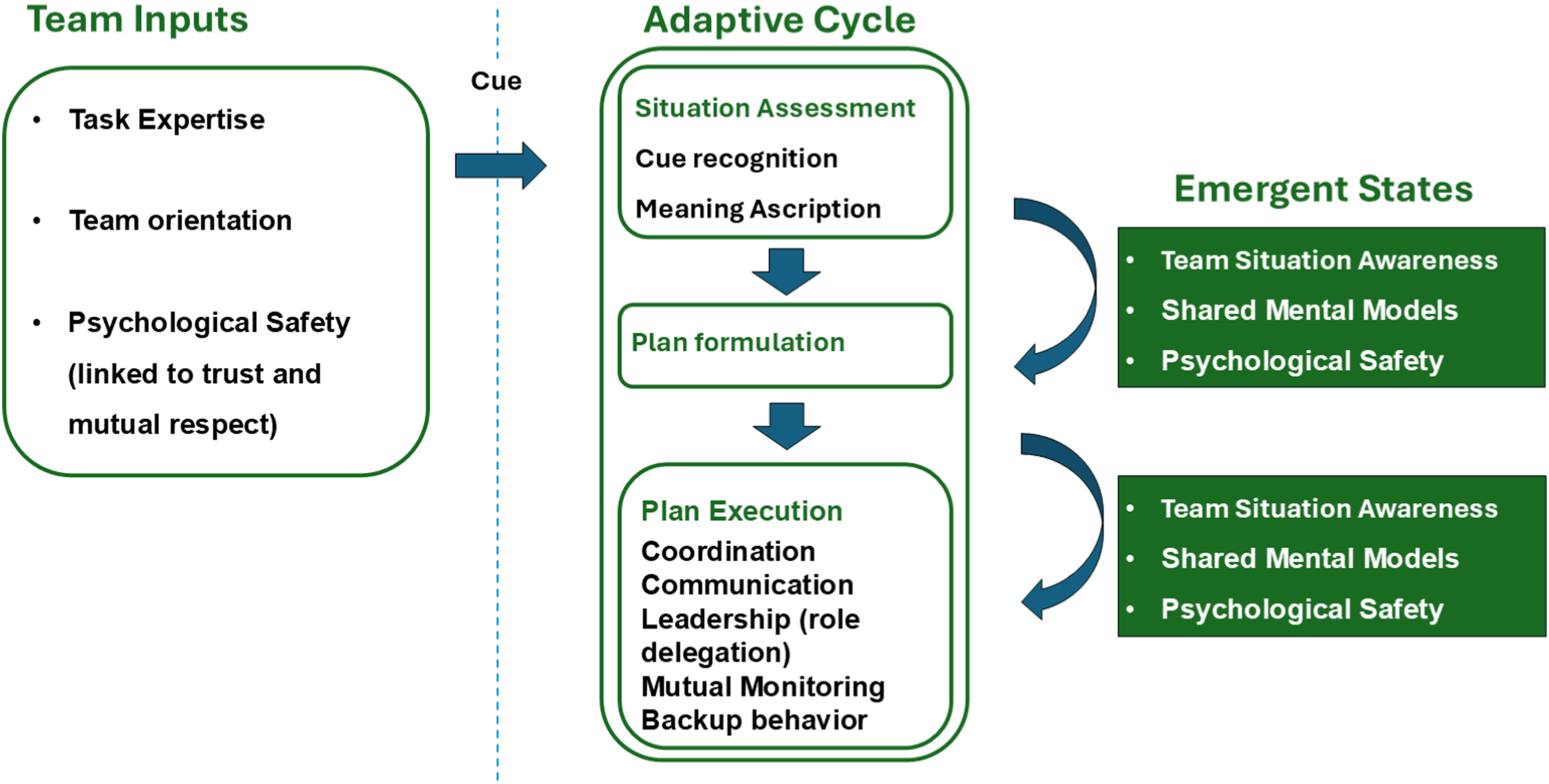
The team’s characteristics are positively related to the first phase of team adaptation in the model: situation assessment. 10 This phase begins when an employee picks up on a cue. The model explains a progression from situation assessment to plan formulation to plan execution. However, the essential aspect of the model is the emergent states that arise within each phase and are crucial for the next stage. During situation assessment, meaning is ascribed to the event, which creates shared mental models and team situational awareness among the involved employees.
Of relevance to the critical incident analyzed in this study is the delegation of plan formulation to the physicians. Involving staff provides the best foundation for adaptation, as it maintains a shared understanding of the situation throughout. 10 The successful handling of the situation can be explained by the existing communication patterns in the team, where employees – despite the division of labor – still gain insight into decisions and could be heard. The prioritization during the incident may be attributed to the workload from the concurrent “normal” calls, which the team still had to handle.
The seemingly contradictory perception of a flat work structure coexisting with a traditional division of labor between professions must be understood in the context of the team’s workload in terms of managing incoming calls and responding to an unfamiliar situation. From a theoretical standpoint, it might have been more optimal to involve all staff members in the planning phase. The team nonetheless maintained situational awareness and shared understanding. This was achieved through communication patterns facilitated by co-location, mutual professional respect, and a shared team identity. These teamwork characteristics appear to emerge organically from the employees themselves, shaped by team composition, task demands, physical context, and the nature of their roles. 10 This study highlights that these characteristics form the foundation for a dynamic handling of an unfamiliar event. Supporting these characteristics will improve the ability of similar teams to respond to situations for which no protocols exist.
Some limitations of the present study should be noted. First, the study is based on a focus group interview with two employees who were on duty during the incident. Although the participants had direct experience with the event, the limited number of participants may restrict the breadth of experiences represented. Still, the interviewed employees represent 40% of the employees on duty during the event. Second, direct observations of teamwork during the incident might have yielded different results. Hence, the present study might reflect how participants interpreted the event afterwards rather than an objective account of the incident. However, direct observation during an unforeseen critical event might be difficult to capture. Despite these limitations, qualitative methods were appropriate for the aim of the study. The case study design and semi-structured interview enabled in-depth examination of contextual factors, communication patterns, and professional dynamics that would be difficult to capture using quantitative approaches. However, the findings should be understood as context-specific and exploratory rather than generalizable, but they may serve to generate insights and hypotheses for future research on teamwork in OOH-PC triage settings.
Conclusion
This case study highlights how teamwork behaviors within an OOH-PC triage team influenced the management of an unforeseen critical incident. Rather than assessing performance, the analysis shows how both enabling and constraining aspects of teamwork shaped the team’s response. The findings suggest that features such as informal communication structures, co-location, and mutual professional respect may support adaptive capacity in OOH-PC settings characterized by high task interdependence, time pressure, and the need for real-time coordination in the absence of established protocols. The study contributes to the literature by describing team collaboration in an OOH-PC triage team and its implications for handling the event. By identifying essential aspects of teamwork, other teams can prepare not only for similar situations but also for unforeseen incidents.
Supplemental Material
Supplemental Material - A Night With Red Eyes Reveals How Teamwork Unfolds in Out-Of-Hours Primary Care
Supplemental material for A Night With Red Eyes Reveals How Teamwork Unfolds in Out-Of-Hours Primary Care by Bastian Benjamin Kruse, Peter Musaeus, Tine Bennedsen Gehrt in Journal of Primary Care & Community Health.
Supplemental Material
Supplemental Material - A Night With Red Eyes Reveals How Teamwork Unfolds in Out-Of-Hours Primary Care
Supplemental material for A Night With Red Eyes Reveals How Teamwork Unfolds in Out-Of-Hours Primary Care by Bastian Benjamin Kruse, Peter Musaeus, Tine Bennedsen Gehrt in Journal of Primary Care & Community Health.
Footnotes
Acknowledgements
The authors thank Anh Nhi Huynh, chief consultant in the Out-of-Hours Primary Care night service, Prehospital Emergency Medical Services, Central Denmark Region, for her support in carrying out this study.
Ethical Considerations
This study is based on a focus group interview of members of the Out-of-Hours Primary Care, Central Denmark Region. Participants gave verbal consent to be recorded and for the anonymized data to be published in research journals. The participants were informed about their rights to gain insight in the research data, the option of correction and/or withdrawal of personal information as well as the right to submit a complaint to the Danish Data Protection Agency (Datatilsynet). No ethical committee approval was necessary, since interview-based qualitative research in Denmark falls outside the scope of mandatory ethical review under Danish regulations.
Consent to Participate
Participants received written and verbal information about the purpose of the study. Informed consent was obtained verbally from all participants prior to the interview. The interview was recorded, transcribed verbatim, and anonymized before analysis.
Author Contributions
Bastian Benjamin Kruse: Conceptualization, Formal analysis, Methodology, Visualization, Writing – original draft. Peter Musaeus: Conceptualization, Investigation, Methodology, Writing – review & editing. Tine Bennedsen Gehrt: Conceptualization, Investigation, Methodology, Project administration, Resources, Supervision, Writing – review & editing.
Funding
The authors received no financial support for the research, authorship, and/or publication of this article.
Declaration of Conflicting Interests
The authors declared no potential conflicts of interest with respect to the research, authorship, and/or publication of this article.
Data Availability Statement
The data has not been made available on a permanent third-party archive given the nature of the data and the small number of participants, as well as General Data Protection Regulations (GDPR). However, access to the data (in anonymized form) will be granted from the corresponding author upon request, but may require the completion of a formal data sharing agreement, in compliance with GDPR and Aarhus University rules.
Generative AI declaration statement
ChatGPT was used to translate the original Danish draft for this manuscript into English. The translation has been critically reviewed and since heavily edited by the authors. The authors take full responsibility for the manuscript.
Supplemental Material
Supplemental material for this article is available online.
References
Supplementary Material
Please find the following supplemental material available below.
For Open Access articles published under a Creative Commons License, all supplemental material carries the same license as the article it is associated with.
For non-Open Access articles published, all supplemental material carries a non-exclusive license, and permission requests for re-use of supplemental material or any part of supplemental material shall be sent directly to the copyright owner as specified in the copyright notice associated with the article.
