






Abstract

The 19th International Conference on Pediatric Mechanical Circulatory Support Systems and Pediatric Cardiopulmonary Perfusion took place on May 16 and 17, 2025, at the InRad Events Center of the Institute of Radiology at Hospital das Clínicas—FMUSP of the University of Sao Paulo Medical School in Sao Paulo, Brazil. Co-organized by Luiz F. Caneo, Desiree Machado, Fernando Antoniali, Beatriz Furlanetto, Carolina Campos, Larissa Gondim, and Akif Ündar, this landmark event marked the first time it was hosted in South America, creating a unique opportunity to engage with colleagues globally (Figure 1).
Our primary objective was to unite multidisciplinary teams—including congenital heart surgeons, biomedical engineers, pediatric cardiologists, pediatric intensivists, anesthesiologists, basic scientists, nurses, and pediatric perfusionists—to advance the treatment paradigms for pediatric patients requiring acute or chronic mechanical circulatory support (MCS). By promoting open dialogue in a collaborative environment, we aimed to unlock groundbreaking solutions that could dramatically improve patient care across South America. This sold-out event attracted leading investigators and practitioners from Argentina, Brazil, Canada, Colombia, Costa Rica, Germany, Italy, Mexico, Paraguay, and the United States.
Nineteenth International Conference Details
The scientific program, detailed in Supplemental Table 1, featured an impressive lineup that included five keynote lectures, 33 invited talks, 12 slide presentations, and 16 poster presentations, all selected from a competitive pool of submitted abstracts.
The 19th conference marked a groundbreaking milestone with the introduction of simultaneous translations from Portuguese and Spanish to English—and vice versa—in every single session. This transformative innovation not only significantly enhanced accessibility but also cultivated an environment of genuine inclusivity, enabling participants to engage in meaningful dialogue like never before.
Preconference Workshop: May 15, 2025
As part of the preconference program, a hands-on workshop was held at the Heart Institute (InCor), School of Medicine, University of São Paulo, bringing together 20 participants from across Brazil, along with a team of instructors from Brazil, the United States, and Argentina. The workshop featured four interactive stations designed to enhance practical skills in advanced pediatric MCS. The first station focused on advanced hemodynamics, utilizing the Harvi® simulation software (https://harvi.online/site/welcome/) to explore cardiovascular physiology and perfusion management. The second station offered clinical simulation in pediatric extracorporeal cardiopulmonary resuscitation, addressing protocols and team-based approaches to extracorporeal cardiopulmonary resuscitation in children. The third station demonstrated the applicability of virtual reality technologies in pediatric ventricular assist device (VAD) implantation, showcasing innovative tools for surgical planning and training. Finally, the fourth station provided mechanical simulation for hands-on management of VADs, including the Berlin Heart EXCOR and HeartMate 3, with practical exercises in device operation and troubleshooting. The workshop created an engaging, multidisciplinary learning environment and fostered collaborative discussions on emerging technologies in pediatric MCS.
Scientific Program Day 1: May 16, 2025
The first day of the 19th International Conference on Pediatric Mechanical Circulatory Support Systems & Pediatric Cardiopulmonary Perfusion opened with welcoming remarks by Akif Ündar and Luiz F. Caneo, setting the stage for a dynamic day of scientific exchange. The morning began with Plenary Session 1 on the future of pediatric MCS and transplantation. Speakers addressed acute heart failure management (Robert Niebler), pretransplant optimization strategies (Shriprasad Deshpande), advances in ABO-incompatible transplantation (Simon Urschel), current practices in anticoagulation for MCS (Desiree Machado), and emerging technologies in pediatric cardiac support. The Keynote Lectures featured two highlights: Michael McMullan (Supplemental Figure 1A) presented the evolution and prospects of ventricular VADs in children, and David Peng (Supplemental Figure 1B) provided a global perspective on heart failure management in congenital heart disease, emphasizing regional challenges and innovations. Oral abstract presentations followed, showcasing novel research on device performance and flow dynamics. In the afternoon, Plenary Session 2 focused on establishing sustainable pediatric MCS programs in emerging healthcare systems, with experiences from Marcelo Jatene (Brazil), Alexandre Cauduro (Brazil), Guillermo Moreno (Argentina), Fernando Antoniali (Brazil), and Ignacio Berra (Argentina). The Mini-Symposium on Extracorporeal Membrane Oxygenation (ECMO) emphasized the multidisciplinary approach, with contributions from Gisela Ponce (Argentina), Jessica Cornman (USA), José Henrique de Moura Quirino, and Gabriela Bezerra de Oliveira Carvalho. The day concluded with Plenary Session 3 on organ donation, preservation, and research. Topics included innovations in organ recovery and transportation, xenotransplantation in Brazil (Tadeu Thome), optimization of biomarkers for organ selection (Samuel Padovani Steffen), experiences with donation after circulatory death (DCD) in heart transplantation (Giovanni Battista Luciani), and challenges in implementing the DCD protocol, as presented by Tiago Machuca. An extended discussion closed this highly productive and collaborative first day.
Scientific Program Day 2: May 17, 2025
The second day opened with Plenary Session 4, which focused on “Approaches to patients with single ventricle physiology,” which proved to be one of the most dynamic and insightful sessions of the conference. Moderated by Leonardo Miana and Isabela Guersoni Menna Barreto, the session featured presentations on translational research in single ventricle physiology (Giovanni Battista Luciani), MCS strategies for patients with Glenn circulation, circulatory support for failing Fontan physiology (Carolina Vieira de Campos), and preliminary results from the EXCOR® REVIVE trial, presented by Jan-Philipp Minol. The session was distinguished by an exceptionally high level of audience engagement and expert debate, underscoring the growing interest and collaborative spirit in advancing care for single ventricle patients.
This session was followed by Oral Abstract Competition III, moderated by Jose Cicero Stocco Guilhen and Vitor Salvatore Barzilai, and a poster viewing session in the Expo Hall.
The morning continued with the Keynote Lectures session, moderated by Estela Azeka and Alexandra Barufi, featuring distinguished speakers addressing cutting-edge topics in pediatric cardiac care. Simon Urschel (Supplemental Figure 1C) delivered an in-depth lecture on the complex management of human leukocyte antigen (HLA) antibodies in pediatric heart transplantation, focusing on both pre- and posttransplant strategies. This was followed by Renata Shih (Supplemental Figure 1D), who presented a keynote lecture on cardiomyopathies related to neuromuscular diseases, offering new insights into diagnosis, disease progression, and emerging therapeutic approaches for this challenging patient population. The keynote series underscored critical advancements shaping the future of pediatric cardiology and transplantation.
After a lunch break and further poster viewing, the afternoon program featured Mini-Symposium 2 on ECMO in children, moderated by Larissa Gondim and Marcello Gomide. Presentations included strategies for achieving high-quality cardiac ECMO (Shriprasad Deshpande), anticoagulation challenges in developing countries (Heidi Dalton), palliative care in pediatric MCS (Desiree Machado), ECMO system development (Heidi Dalton), carotid artery patency and neurodevelopmental outcomes after decannulation (Michael McMullan), and the role of hemoadsorption in ECMO (Catalina Corrales).
Plenary Session 5 focused on optimizing cardiopulmonary bypass (CPB) strategies to improve patient outcomes. Moderated by Denoel Marcelino de Oliveira and Fernando Antoniali, this session featured presentations on minimizing inflammatory responses during CPB (Robert Niebler), goal-directed perfusion and advanced monitoring (Javier Segura Román), transition from CPB to ECMO (Rene Gomez), combined neuromonitoring strategies during congenital heart surgery—Penn State approach (Akif Ündar), and blood conservation strategies in neonatal open-heart surgery (Michael McMullan).
The day concluded with Keynote Lecture 5, “Inequities in Access to MCS and Potential Solutions,” presented by Luiz F. Caneo (Supplemental Figure 1E), followed by final announcements, the presentation of the Best Abstract Award, and closing remarks delivered by Luiz Caneo and Akif Ündar.
Conference Awards
In addition to the scientific program, several conference awards were presented to recognize outstanding contributions. The Young Investigator Award was granted based on full manuscripts submitted to the conference committee before the event. André Kim Chan received this award for his manuscript entitled “Visualization and analysis of flow behavior inside a pulsatile pediatric VAD with biological valves.” André Kim Chan is currently a Fellow at the Bioengineering Laboratory of the Heart Institute (InCor), School of Medicine, University of São Paulo (HCFMUSP).
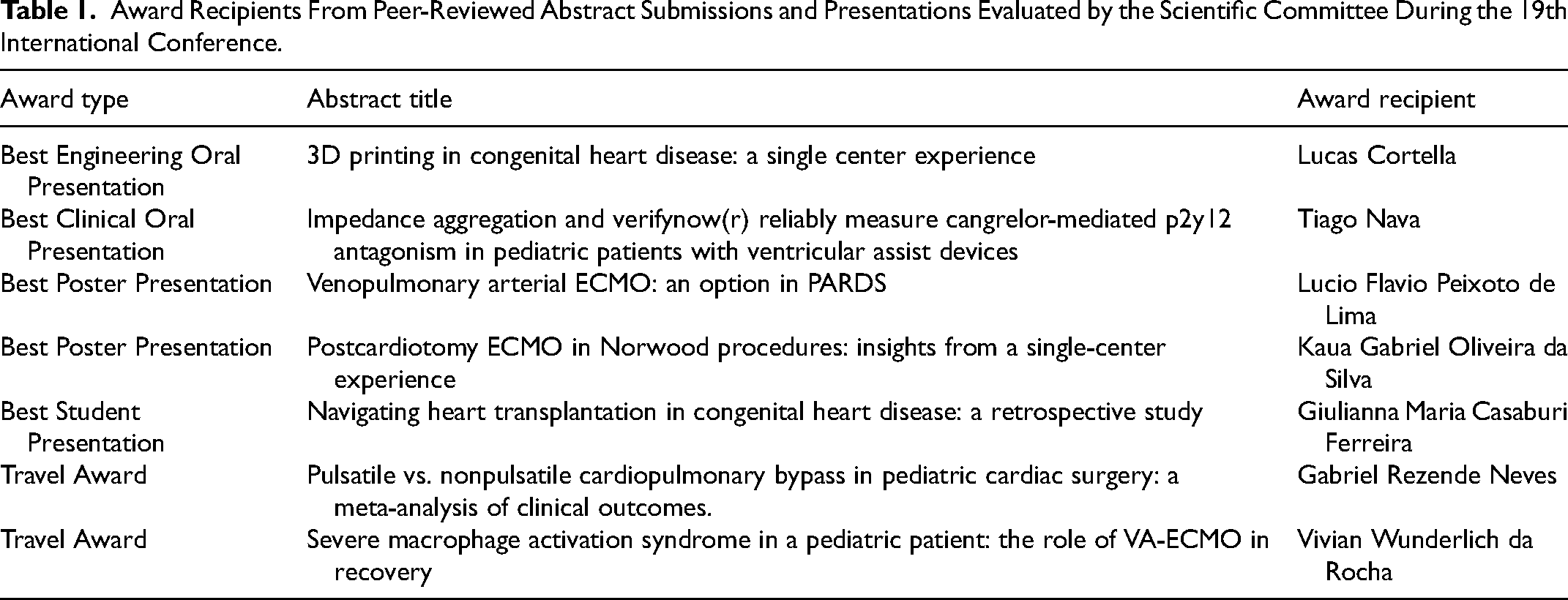
Additional awards included the Best Engineering Oral Abstract Award, the Best Clinical Oral Abstract Award, the Best Student Oral Abstract Presentation Award, the Best Poster Award, and the Travel Award. The full list of award recipients is provided in Table 1.
Award Recipients From Peer-Reviewed Abstract Submissions and Presentations Evaluated by the Scientific Committee During the 19th International Conference.
In conclusion, the 19th International Conference on Pediatric Mechanical Circulatory Support Systems and Pediatric Cardiopulmonary Perfusion successfully fulfilled its mission by fostering numerous new clinical collaborations among global experts dedicated to advancing care for underserved congenital heart surgery and heart failure patients in South America. Our guiding principle remains steadfast: “If we can enhance the life of even one child through this event, we have achieved our purpose.”
Conference co-organizers (left-to-right—Fernando Antoniali, Akif Ündar, Beatriz Furlanetto, Carolina Campos, Larissa Gondim, Desiree Machado, Luiz F. Caneo).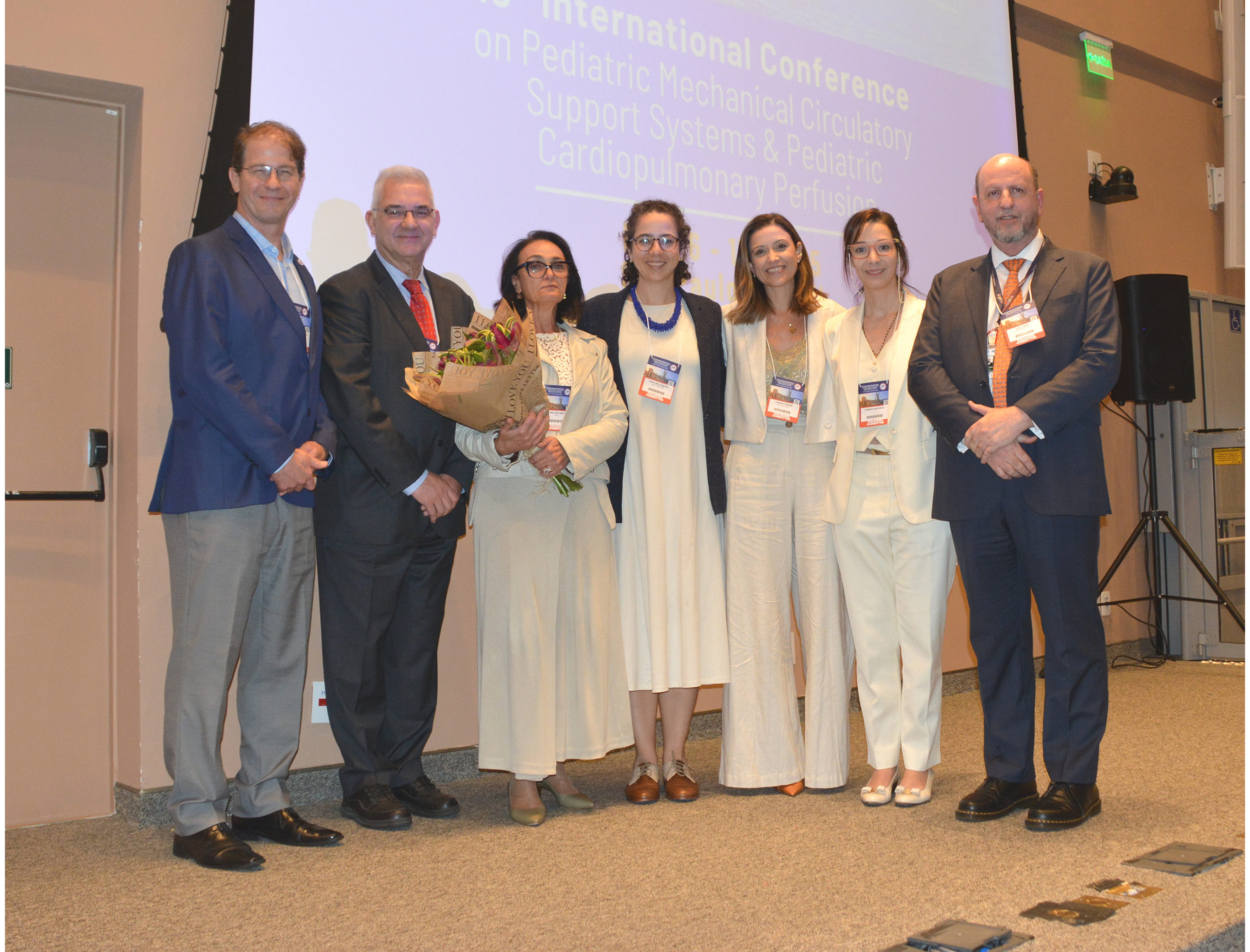
Supplemental Material
sj-docx-1-pch-10.1177_21501351251397319 - Supplemental material for Highlights of the Nineteenth International Conference on Pediatric Mechanical Circulatory Support Systems and Pediatric Cardiopulmonary Perfusion
Supplemental material, sj-docx-1-pch-10.1177_21501351251397319 for Highlights of the Nineteenth International Conference on Pediatric Mechanical Circulatory Support Systems and Pediatric Cardiopulmonary Perfusion by Luiz F. Caneo, Desiree Machado, Fernando Antoniali, Beatriz Furlanetto, Carolina Campos, Larissa Gondim and Akif Ündar in World Journal for Pediatric and Congenital Heart Surgery
Supplemental Material
sj-docx-2-pch-10.1177_21501351251397319 - Supplemental material for Highlights of the Nineteenth International Conference on Pediatric Mechanical Circulatory Support Systems and Pediatric Cardiopulmonary Perfusion
Supplemental material, sj-docx-2-pch-10.1177_21501351251397319 for Highlights of the Nineteenth International Conference on Pediatric Mechanical Circulatory Support Systems and Pediatric Cardiopulmonary Perfusion by Luiz F. Caneo, Desiree Machado, Fernando Antoniali, Beatriz Furlanetto, Carolina Campos, Larissa Gondim and Akif Ündar in World Journal for Pediatric and Congenital Heart Surgery
Footnotes
Acknowledgments
The authors would like to express our profound gratitude to the numerous supporters and sponsors whose commitment and generosity were instrumental in the success of this event. Their unwavering support has been nothing short of invaluable. The authors extend our heartfelt thanks to the Advanced Cardiac Therapies Improving Outcomes Network (ACTION), ELSO Latam, Sociedade Brasileira de Cirurgia Cardiovascular (SBCCV), ECMO Argentina (EA), and Sociedade Brasileira de ECMO (SOBECMO) for their significant contributions. Additionally, the authors are immensely grateful to our esteemed organizations and industry partners, whose generous financial support was pivotal in bringing the 19th ISPMCS conference to life: Abbott, Biocath, Cardiovent, CBM Lifemotion, Contatti Medical, LivaNova, Sepaco, Rede D’Or, Beneficiencia Portuguesa, Instituto Furlanetto, Sabara Hospital Infantil, Instituto do Coração da Faculdade de Medicina da Universidade de Sao Paulo, and SOBECMO. Their vital contributions ensured that our conference budget was not only balanced but also enabled us to deliver a high-quality experience. The authors deeply appreciate the exceptional quality of the simultaneous translations provided throughout the event, recognizing the talented translators whose efforts made the 19th conference accessible and enriching for all attendees.
Data Accessibility Statement
We are pleased to announce that all manuscripts submitted for the 19th event will undergo a thorough peer-review process and, upon acceptance, will be published in the esteemed World Journal for Pediatric and Congenital Heart Surgery. We are committed to making all accepted articles freely accessible to a global audience. Furthermore, these articles will be prominently featured in the list of publications on the following website:  .
.
Declaration of Conflicting Interests
The author(s) declared no potential conflicts of interest with respect to the research, authorship, and/or publication of this article.
Funding
We extend our heartfelt gratitude to our respected organizations and industry partners whose generous financial contributions were instrumental in realizing the 19th ISPMCS conference. The authors would like to acknowledge Abbott, Biocath, Cardiovent, CBM Lifemotion, Contatti Medical, LivaNova, Sepaco, Rede D’Or, Beneficiencia Portuguesa, Instituto Furlanetto, Sabara Hospital Infantil, Instituto do Coração da Faculdade de Medicina da Universidade de Sao Paulo, and SOBECMO for their vital support.
Supplemental Material
Supplemental material for this article is available online.
Supplementary Material
Please find the following supplemental material available below.
For Open Access articles published under a Creative Commons License, all supplemental material carries the same license as the article it is associated with.
For non-Open Access articles published, all supplemental material carries a non-exclusive license, and permission requests for re-use of supplemental material or any part of supplemental material shall be sent directly to the copyright owner as specified in the copyright notice associated with the article.
