







Abstract
Social media addiction (SMA) has become a global public issue in recent decades. Considering the increasing use of social media in the workplace as a communication and productivity tool, workers may suffer a higher risk of SMA. Workers are also a notable population susceptible to work addiction (WA) due to the fierce competition in the labor market. By analyzing temporal associations between WA and SMA as well as their symptoms (e.g., salience), our study advances knowledge regarding comorbidity between these behavioral addictions and relationships among their specific symptoms. In a sample of 1,100 workers (Mage = 32.69, standard deviation [SDage] = 7.76, female = 60.5 percent), we conducted a two-wave, longitudinal survey to examine the relationship(s) between WA and SMA (i.e., construct level) and the association(s) between their specific symptoms (i.e., symptom level) by modeling a cross-lagged panel model and a cross-lagged panel network (CLPN). Both a high prevalence of SMA (7.3 percent) and WA (16.9 percent), as well as their co-occurrence, were found. Results of the cross-lagged panel model and CLPN consistently showed the reciprocal predictions between SMA and WA. Results of CLPN analysis also identified the stronger positive prospective effects of WA on SMA and highlighted the most influential roles of WA-tolerance in predicting SMA, especially SMA-relapse. Besides, mutual but negative predictions between their salience and relapse symptoms were noted in CLPN. Our findings extend the knowledge of the bidirectionality of behavioral addictions and provide practical implications regarding cost-effective interventions for workers’ co-occurring behavioral addictions.
Introduction
Popular social media such as WeChat, Facebook, and TikTok have facilitated people’s daily work, social communication, and entertainment; at the same time, their popularity has also aroused increasing public concern about excessive or even addictive social media use. 1 Social media addiction (SMA), an emerging type of behavioral addiction, is defined as an individual’s maladaptive and compulsive pattern of social media use resulting in significant impairments in his/her important life areas. 2 SMA has become a worldwide public issue as indicated by both its high global prevalence (i.e., 24 percent) 3 and various adverse consequences, including psychological distress, interpersonal problems, and life dissatisfaction. 4 The worker population, who have a high reliance on social media to deal with job demands and personal communication, 5 might have higher risks of developing SMA. Only one study has analyzed the longitudinal relationship between SMA and work addiction (WA) at the construct level. 6 Both SMA and WA are commonly classified as behavioral addiction3,7 in which rewarding behaviors/activities rather than the intake of physical substances are involved in the addiction mechanism. 8 Despite their distinct behavioral focuses (i.e., social media use vs. work), both SMA and WA share six common core symptoms (i.e., salience, conflict, mood modification, tolerance, withdrawal, and relapse). 9 Understanding how their symptoms interact with each other and underlying their bidirectional associations, can help explain the maintenance and comorbidity between behavioral addictions. This longitudinal study thus aims to examine the cross-lagged relationship(s) between SMA and WA (i.e., at the construct level) as well as among their symptoms (i.e., at the symptom level) in a worker sample. Doing so not only facilitates a deeper understanding of the bidirectionality between these behavioral addictions but also provides useful practical implications for cost-effective interventions to minimize the reciprocal exacerbation between addictive behaviors among workers.
WA is prevalent in the worker populations, 10 reaching 8.3–20.6 percent. 11 It is defined as individuals’ uncontrollable and compulsive motive to work that overconsumes their energy and impairs other important parts of life (e.g., family, leisure, and relationships).7,9 WA is found to be closely related to workers’ physical, psychological, and social problems (e.g., cardiovascular disease, depression, insomnia, and interpersonal maladjustment).12,13 Its high prevalence is not only due to the competitive labor market with increasing job requirements14,15 but also the extensive use of modern communication technology (e.g., social media). 16
Social media has facilitated various areas of individuals’ personal lives, such as social interaction, entertainment, and consumption. 17 Social media’s provision of convenient access to recreational activities, social networks, and everyday life services reduces the time and cognitive load associated with these tasks, potentially freeing up resources for work-related activities. 18 Particularly for those workers with a higher tendency of WA, they are more inclined to allocate little time and attention to leisure and social relationships and prefer easily accessible means for recreation and social connection, 19 such as scrolling through social media. Although social media is typically used for leisure and recreation, 17 due to its convenience, it is worth noting that there is an increasing use of social media in the work domain as a communication and productivity tool. 20 For example, some workers rely on social media to communicate with their colleagues and clients to address job tasks and messages, even beyond working hours.21,22 Given the prevalence and characteristics of social media, some workers, particularly those compulsively driven to work whenever and wherever they are (e.g., work even during nonwork hours outside the office), may thus be vulnerable to SMA. 5 Indeed, a few studies found a positive association between WA and social media use.23,24 Horváth et al. provided support for the bidirectionality between SMA and WA among workers in Hungary. 6 Given that Chinese workers suffer longer work hours and heavier workloads than those in Western countries, 25 as well as the particular popularity of social media use in the Chinese workplace, 26 our study focused on workers in China. Evaluating bidirectionality between WA and SMA is important for promoting the well-being of Chinese workers and informing policy formulation.
Despite the extant evidence noting the construct-level associations between SMA and WA, 6 no study has examined the (bi)directionality between any two behavioral addictions at a symptom level. To better inform the workers, organizations, and clinicians of the associated risk, this study aims to address the knowledge gap on the symptom-level WA–SMA link, which has not yet been empirically tested in the literature. Using the advanced approach of network analysis, researchers are able to detect symptom-level relationships between different psychological constructs or disorders.27,28 Network analysis is developed based on the network theory of mental disorders, which suggests that mental disorders, as well as their comorbidities, are results of the interactions among individual symptoms.29,30 As this theory elaborates, symptoms can spread across mental disorders; for instance, the sleep disturbance symptom of post-traumatic stress disorder may increase the sleep difficulties in depression.31,32 Network analysis, rooted in the network theory, has been used to reveal complex associations between both psychological distress and behavioral addictions 33 by graphically representing the associations (i.e., edges) between symptoms (i.e., nodes).34,35
Based on network analysis, previous studies have shown the comorbid network of either SMA or WA to associate with that of psychological distress (e.g., depression and anxiety).27,36 In the literature on behavioral addictions, only one study 37 has examined the symptom-level associations between two behavioral addictions (i.e., sexual addiction [SA] and gambling disorder [GD] in their case), and the authors have identified a consistent link between SA-conflict and GD-borrow money for gambling across gender. While Hunt et al.’s study 37 is among the first to show the comorbidity between two types of behavioral addictions from a symptom-level perspective, their approach is cross-sectional. Other scholars, such as Wysocki et al., 38 have adopted the longitudinal approach to understand symptom-level bidirectional relations between mental disorders using cross-lagged panel network (CLPN) analysis. This approach has also been used to reveal the temporal relationships among symptoms of Internet addiction and depression, 39 but not yet between any behavioral addictions. Analyzing the longitudinal interaction between specific symptoms of behavioral addictions will thus advance understanding of their high comorbidity and the underlying mechanism(s). Practically, by identifying symptom(s) that have the strongest connections with another disorder (i.e., bridge symptom), this approach can also help select actionable targets for more efficient interventions.29,30
To examine the longitudinal relationship(s) between SMA and WA at both construct and symptom levels, this study aims to adopt both cross-lagged panel analysis and CLPN analysis to evaluate their bidirectional relationship(s) at both construct and symptom levels. In so doing, our findings will promote a better understanding of the psychopathological mechanism(s) underlying the bidirectionality between behavioral addictions (e.g., SMA and WA in our case) and, in turn, may also provide empirical evidence in the design of cost-effective interventions for multiple behavioral addictions.
Method
Participants and procedure
This study involved two waves of anonymous online surveys and was conducted via a professional data platform, Credamo, which has over 3 million registered users. For the two surveys, the eligible participants, that is, Chinese full-time workers who are 18 years or above, received the questionnaires distributed by Credamo in November 2022 (Wave 1 [W1]) and May 2023 (Wave 2 [W2]). This time frame was determined with reference to the practice in previous longitudinal studies on Internet and related addictions,40–42 as well as with the consideration of the public holiday calendar in China to minimize associated bias (if any).
After excluding those who did not pass attention check, which referred to correct responses to two specific questions (e.g., “Please select ‘2 = rarely’ if you are reading this question”) at both two waves, Credamo provided two datasets, that is, (a) 1,100 participants at W1 (aged 20–60, Mage = 32.69, standard deviation [SD] = 7.76, female = 60.5 percent) and (b) 650 participants (age ranges between 21 and 57, Mage = 33.09, SD = 7.90, female = 58.5 percent) who resampled the questionnaire at W2. Attrition analysis found no significant group differences in gender, work hours, SMA, and WA (p > 0.05), except age, t(1,098) = 2.050, p = 0.041; Mage = 33.09 (retained) and 32.11 (dropout) (Supplementary Data S1).
Measures
Social media addiction
The Chinese version 43 of the Bergen Social Media Addiction Scale (BSMAS 44 ) was used to assess participants’ symptoms of SMA. This scale contains six items rating on a five-point Likert scale (1 = very rarely to 5 = very often) and has been used for network analysis in previous research. 45 Two sample items are “Tried to cut down on the use of social media without success?” and “Felt an urge to use social media more and more?” A higher total score indicated a higher risk of SMA. The Cronbach’s alpha of this scale was 0.841 (W1) and 0.847 (W2) in this study. A total score of 24 was considered the optimal cutoff score for the Chinese population. 46
Work addiction
The Chinese version 27 of Andreassen et al.’s Bergen Work Addiction Scale (BWAS 7 ) was used to measure participants’ symptoms of WA. This scale consists of seven items rating on a five-point Likert scale from 1 = never to 5 = always and has been used for network analysis in previous research. 27 A higher total score suggested a higher trend of WA. In this study, the Cronbach’s alpha of this scale was 0.764 and 0.729 at W1 and W2, respectively. Scoring “4 = often” or “5 = always” on four or more items suggests a high risk of WA. 7
Demographic information
All the participants were asked to provide their gender (1 = male, 2 = female), age (year), and weekly work hours at W1. The participants reported an average work hour of 44.66 (SD = 6.40) per week.
Data analysis
Preliminary analyses
Data from a total of 1,100 participants were included in the final data analysis. Given that we have missing data in our sample, we used full information maximum likelihood to estimate model parameters 47 as it is an appropriate and commonly used method in handling missing data.48,49 Preliminary analyses, including attrition analysis, descriptive statistics, reliability tests, bivariate correlations, and t tests, were conducted using SPSS 29.0.
Cross-lagged panel analysis at the level
The cross-lagged panel analysis was conducted in R (version 4.3.2) using the lavaan package 50 to test the construct-level bidirectional relationship. In this model, both the covariance between W1-WA and W1-SMA and the residual covariance between W2-WA and W2-SMA were free to be estimated. A satisfactory model fit is indicated by the chi-square test (p > 0.05), CFI > 0.95, TFI > 0.95, SRMR < 0.05, and RMSEA < 0.05. 51
CLPN analysis at the symptom level
In addition to examining the bidirectional relationship between SMA and WA at the construct level, we also estimate their longitudinal symptom-level associations using CLPN analysis. This statistical tool can identify central symptoms and show the bridge symptoms between two addictions as evidence of their comorbidity or co-occurrence.29,30 We used R (version 4.3.2) and specific packages, with each item (i.e., symptom) of the scales for SMA and WA included in the network as a node. The glmnet package 52 was used to conduct the LASSO regression to penalize the small regression path to zero, and then the lavaan package 50 was used to reestimate the non-regularized regression coefficients for the remaining paths in the network. According to those non-regularized regression coefficients, CLPN can be visualized using the qgraph package. 53 Two crucial indices for identifying the most important predictive and predicted nodes in this network will be calculated. One is the out-prediction index, which reflects the extent to which a specific node predicts other nodes, and another is the in-prediction index, which represents the extent to which a specific node is predicted by other nodes. Moreover, we calculated the SD of each node’s out- and in-prediction indices using 1,000 bootstrapping samples from the original dataset to further test the stability of CLPN. Nodes with smaller SD have more reliable predictions. 38
Ethics
This study was approved by the ethics committee of the Department of Psychology at the corresponding author’s affiliation. All the participants provided their consent for participation before they started the survey and received an estimated reward of <4 USD as compensation for completing the survey.
Results
Preliminary analysis
Among the 1,100 participants at W1, 7.3 percent of them reported a high risk of SMA (i.e., total score of BSMAS ≥ 24 44 ), while 16.9 percent of them were at a high risk of WA (i.e., scored “4 = often” or “5 = always” on four or more items of BWAS 7 ). Notably, a high co-occurrence (22.6 percent) of SMA and WA was initially observed in this study, that is, among 186 participants who were at high risk of WA, 22.6 percent of them (n = 42) also suffered from a high risk of SMA (see Table 1 for the detailed prevalence of each symptom of WA and SMA).
Prevalence of Social Media Addiction, Work Addiction, and Their Co-occurrence
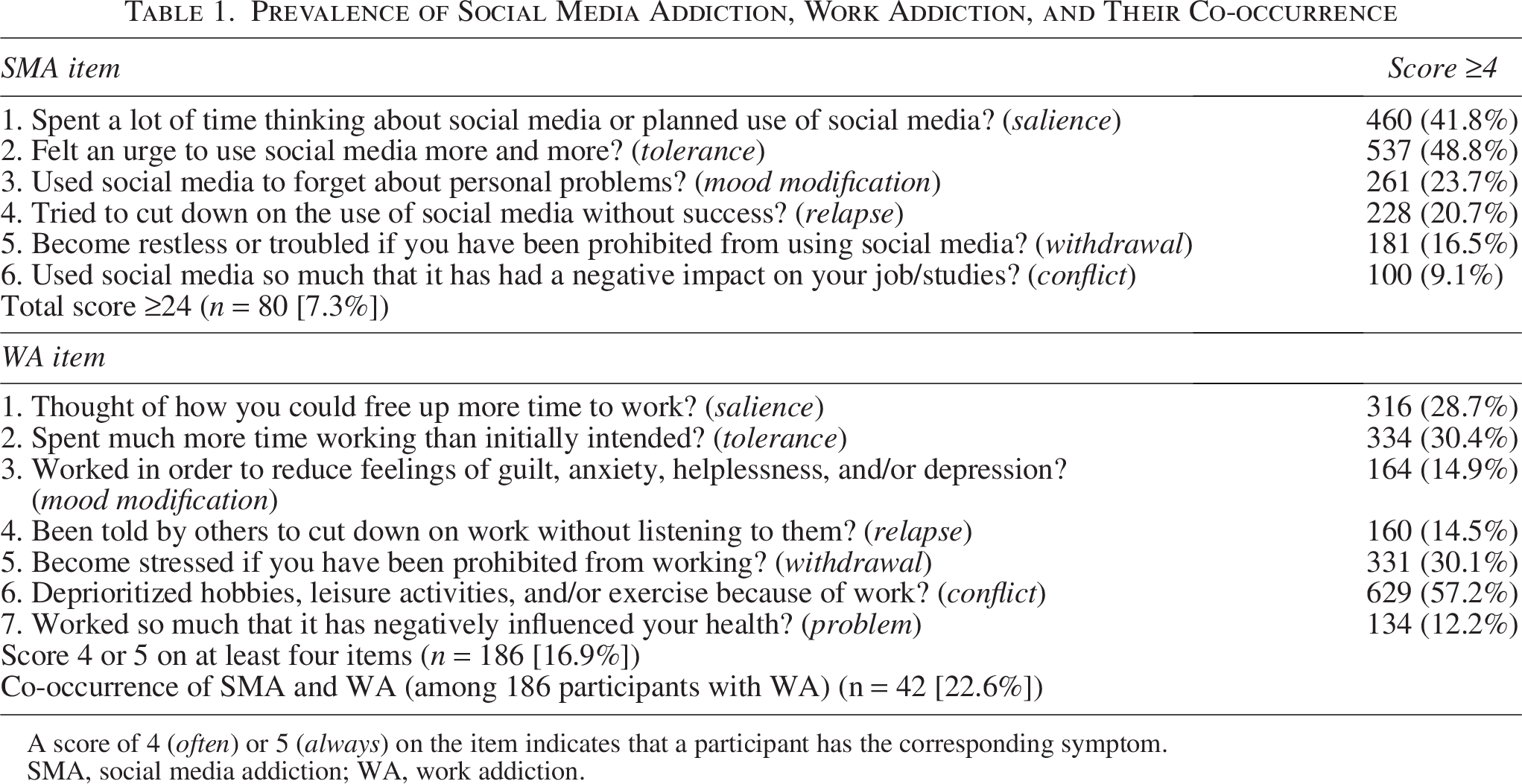
A score of 4 (often) or 5 (always) on the item indicates that a participant has the corresponding symptom.
SMA, social media addiction; WA, work addiction.
Table 2 shows that WA and SMA at W1 were significantly correlated with their corresponding values at W2. At each time point, WA consistently showed a positive correlation with SMA (W1: r = 0.468, p < 0.001; W2: r = 0.459, p < 0.001). WA at two waves showed consistently positive correlations with weekly work hours (W1: r = 0.201, p < 0.001; W2: r = 0.200, p < 0.001) while showing no significant correlations with age and gender. SMA at two waves was negatively correlated with age (W1: r = −0.157, p < 0.001; W2: r = −0.160, p < 0.001) while positively correlated with weekly work hours (W1: r = 0.138, p < 0.001; W2: r = 0.160, p < 0.001). Female participants reported higher risks of SMA (W1: r = 0.073, p = 0.15; W2: r = 0.096, p = 0.14).
Descriptive Statistics and Correlations Among Major Variables
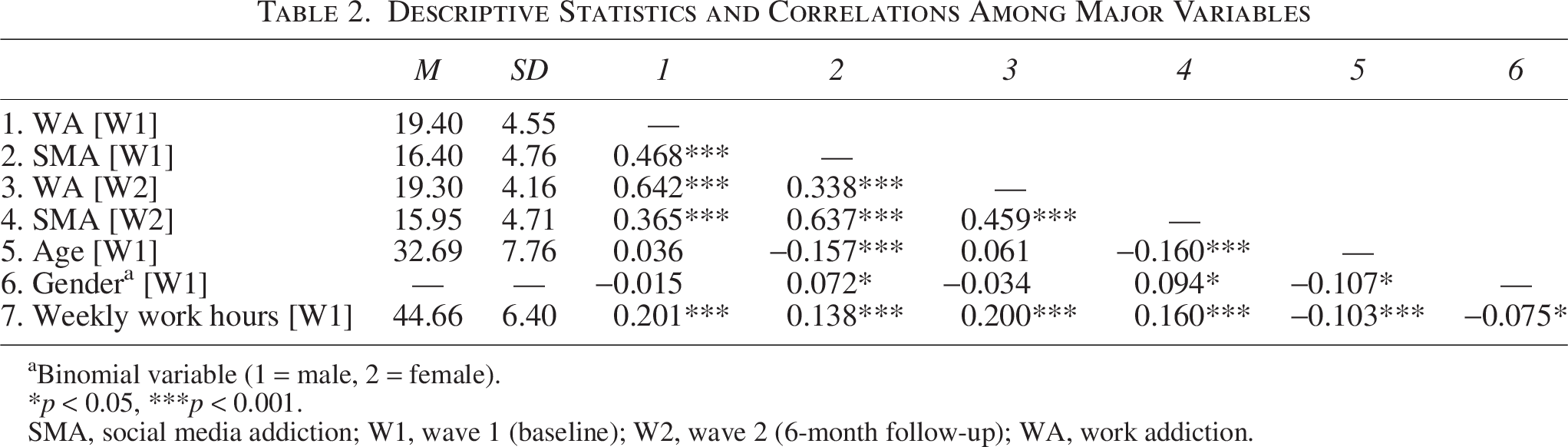
Binomial variable (1 = male, 2 = female).
*p < 0.05, ***p < 0.001.
SMA, social media addiction; W1, wave 1 (baseline); W2, wave 2 (6-month follow-up); WA, work addiction.
Cross-lagged panel analysis at the construct level
The model fit indices were not reported, given that the model was saturated. As shown in Figure 1, the results of cross-lagged panel analysis indicated reciprocal predictions between WA and SMA, that is, the positively prospective effect of WA on SMA (β = 0.124, p < 0.001) as well as that of SMA on WA (β = 0.068, p = 0.044), after controlling for the autoregressive effect of W1-SMA on W2-SMA (β = 0.602, p < 0.001) as well as that of W1-WA on W2-WA (β = 0.625, p < 0.001). As a sensitivity test, we reran the CLPN analysis with gender and age controlled for as covariates and obtained similar results (Supplementary Data S2).
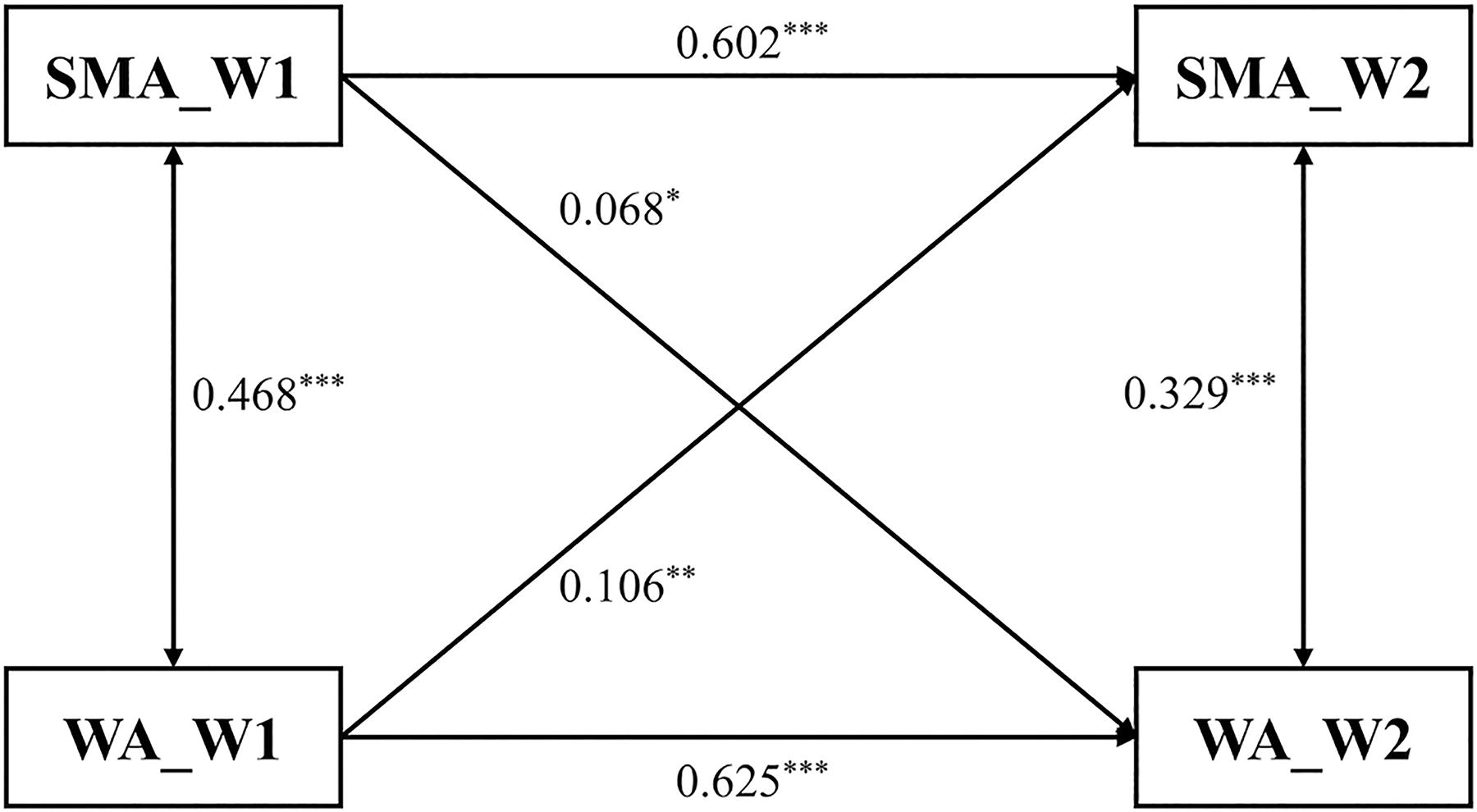
The cross-lagged panel model of social media addiction (SMA) and work addiction (WA). W1, assessed at baseline; W2, assessed at 6-month follow-up.
CLPN analysis at the symptom level
As we can clearly see in Figure 2, most arrows in the network point from the WA construct to the SMA construct, suggesting that WA showed a significant and positive prediction on SMA. Moreover, the out-prediction and in-prediction indices and their corresponding SD, as illustrated in Figure 3, indicated that WA2 (tolerance: spend much more time working than initially intended) exerted the strongest predictive effect on the SMA construct with the highest cross-construct out-prediction (0.0078) and an SD of 0.0029. Similarly, SMA4 (relapse: fail to cut down on social media use) showed the highest cross-construct in-prediction (0.0407, with an SD of 0.0128) and thus is most susceptible to the WA construct (Supplementary Data S3).
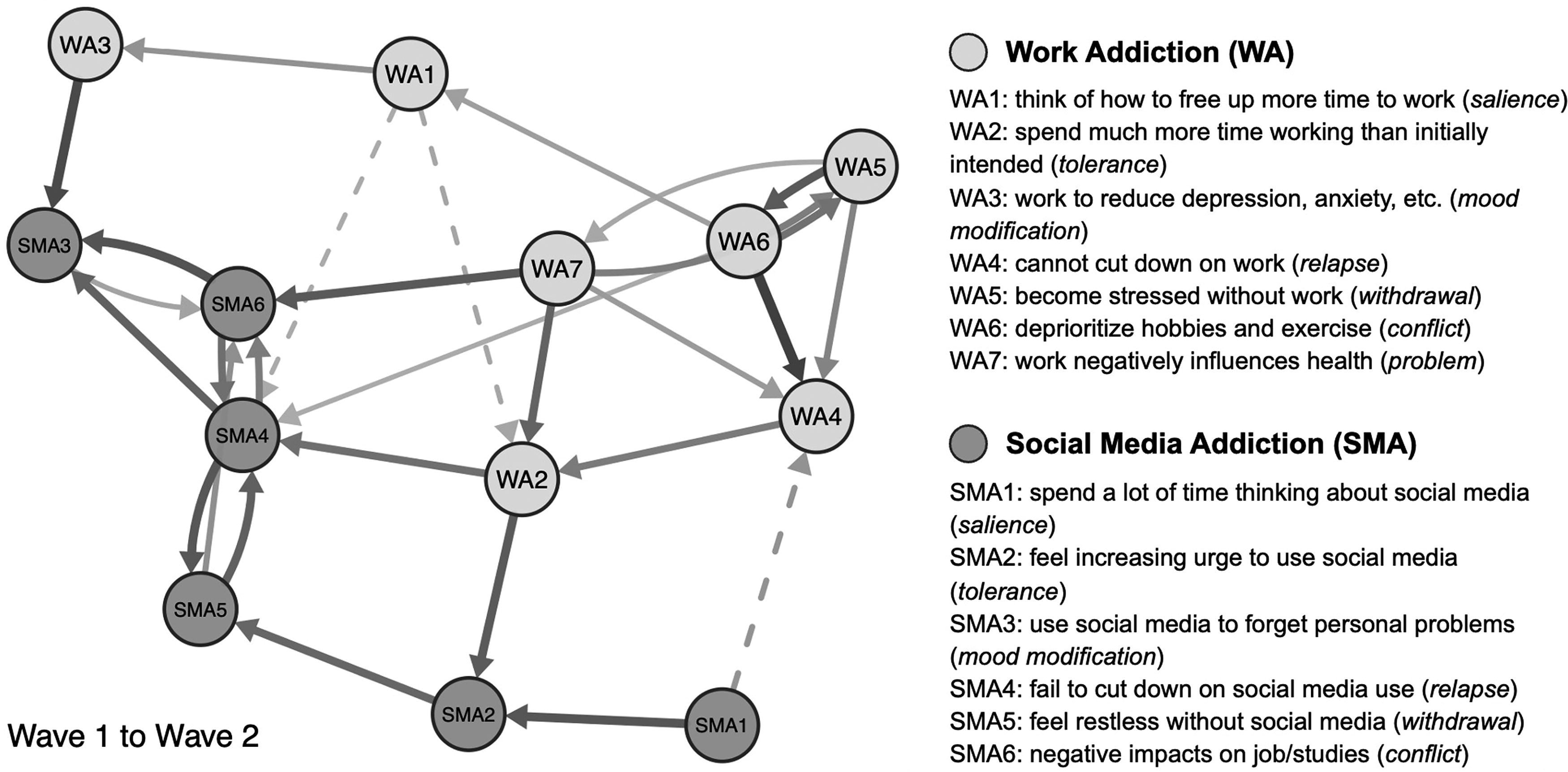
The cross-lagged panel network model of work addiction (WA) and social media addiction (SMA) from Wave 1 to Wave 2. Arrows represent the predictive effects. Solid arrows represent the positive predictive effect, while dotted arrows represent the negative effect. The thicker and darker arrows indicate the stronger predictive effects.
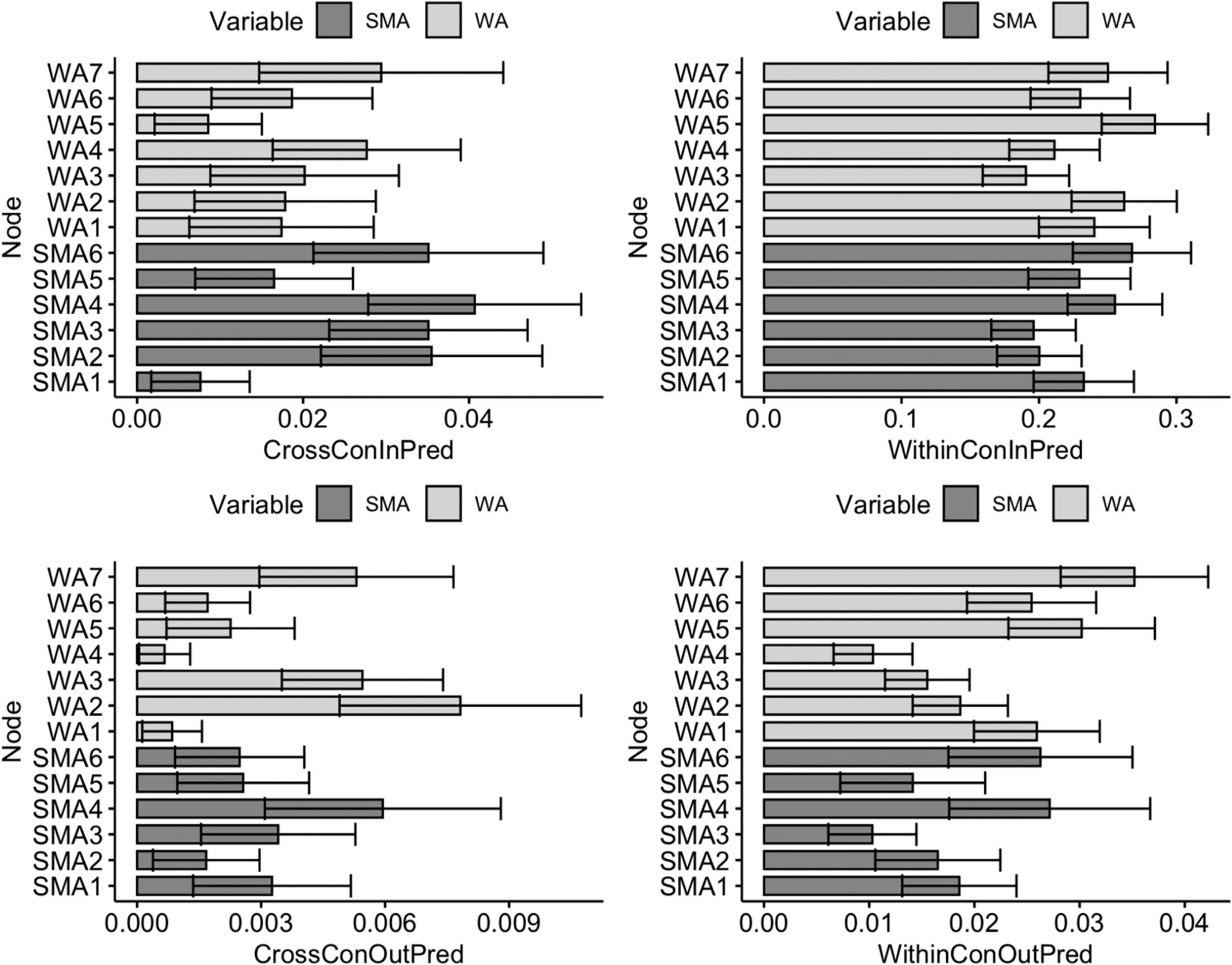
The prediction indices of each node in the network. The SD of the prediction indices for each node is shown using error bars. Note: CrossConInPre: cross-construct in-prediction (the extent to which node is predicted by all nodes belonging to a different construct); WithinConInPred: within-construct in-prediction (the extent to which node is predicted by all other nodes within the same construct); CrossConOutPre: cross-construct out-prediction (averaged predictive effects on all nodes belonging to different constructs); WithinConInPred: within-construct out-prediction (averaged predictive effects on all other nodes within the same construct).
According to the regression coefficients among symptoms in the connected WA–SMA network, there are two strongest predictive paths from WA2 to SMA2 (tolerance: feel increasing urge to use social media) (β = 0.150) and from WA2 to SMA4 (β = 0.128) (see Supplementary Data S4). Additionally, we observed only one significant predictive path from the SMA construct to the WA construct, that is, SMA1 (salience: spend a lot of time thinking about social media) → WA4 (relapse: cannot cut down on work), and it is unexpectedly negative (β = −0.102). A corresponding negative path (β = −0.063) of WA1 (salience: think of how to free up more time to work) → SMA4 was also identified, which suggested the mutually negative prediction between the salience and relapse symptoms of behavioral addictions (i.e., WA and SMA in our case).
Discussion
This study empirically examined the longitudinal association between WA and SMA at symptom levels. In a sample of workers recruited in China, we observed high prevalences of SMA (7.3 percent), WA (16.9 percent), and their co-occurrence (22.6 percent, among 186 participants who were at high risk of WA). In addition to bidirectional prediction effects between SMA and WA in the cross-lagged panel path analysis, results of CLPN analysis further revealed the specific symptom-level connections between these two behavioral addictions. Specifically, the comorbid network highlighted that WA-tolerance (i.e., spend much more time working than initially intended) was the most influential symptom that exacerbated SMA, while SMA-relapse (i.e., fail to cut down on social media use) was the most susceptible one to WA. Our findings could also provide implications for designing cost-effective intervention programs that aim to alleviate the comorbid addictions of SMA and WA among workers. These findings also highlight the importance and the need for regulating the use of social media in the workplace in China, where workers may suffer longer work hours 25 and the use of social media for work purposes. 26 In the meantime, local government and organizations may consider formulating policies to promote workers’ work–life balance and well-being. 54
In addition to the anticipated predictive path from WA to SMA, the predictive path from SMA to WA was also observed in Chinese workers. These bidirectional predictions between WA and SMA corroborated and extended previous findings on the mutually predictive effects of addictive behaviors, such as those between gambling and Internet use found in two independent cross-sectional studies.55,56 Some scholars such as Shaffer and colleagues 57 suggest that different addictive disorders are multiple expressions of the same underlying addictive syndrome (i.e., syndrome model of addiction), and thus two (or more) addictive behaviors may mutually exacerbate.58,59 Indeed, our results, together with previous evidence about the reciprocal cycle of addiction, 57 provided empirical support for such a model. Further exploration of the reciprocal relationship(s) among WA, SMA, and other substance or behavioral addictions is warranted in future studies to foster a deeper understanding of whether and how addictive disorders worsen each other. Moreover, based on this reciprocal WA–SMA link among workers, therapeutic interventions for SMA and/or WA should take a broader focus; for example, we not only should consider the sole target behavioral addiction but also notice other potentially co-occurring addictive behaviors in order to diminish the reciprocal exacerbation between addictive behaviors. 60
The symptom-level reciprocal connections between SMA and WA were found to be strengthened by specific symptoms. The tolerance symptom of WA, as the most influential predictor of the SMA construct, showed prominent inducing effects on the tolerance and relapse symptoms of SMA, with SMA-relapse also being the most vulnerable to WA. The crucial role of tolerance has been documented by the literature on comorbidity with other mental disorders. For example, the tolerance of Internet-related addiction (e.g., short video addiction) was captured to be the bridge symptom in the relationship with depression. 61 Together with prior evidence, our findings highlighted the significance of the tolerance symptom in the comorbidities of behavioral addictions with mental disorders. Although some scholars regard tolerance as a less important symptom of behavioral addictions (e.g., problematic pornography use), 62 our findings provided support that tolerance can be a promising target for interventions of WA and SMA in Chinese workers.
Regarding the positive prediction effect of WA-tolerance on SMA-relapse, literature has found a positive connection between these two symptoms within one addictive disorder (i.e., SMA). 63 That is, the increasing urge to social media use was related to less abstinence time and a higher risk of relapse (i.e., failing to abstain from using social media). In addition to extending existing evidence, 63 our findings also discerned that the impacts between symptoms not only exist within one specific addiction but also may spread across behavioral addictions. Drawing from the conversation of resource theory, 64 one possible explanation is that workers may resort to more readily accessible approaches for conserving/acquiring resources (e.g., using social media for entertainment and social support), particularly among those at risk of WA and thus have limited energy and time after long work hours (exceeding their intended time). Besides, a plausible psychobiological mechanism can be implied by the cross-reinforcement, widely found in the substance use field (e.g., alcohol and nicotine), which demonstrated that addictive objects may influence each other’s addictive symptoms by interfering with the related biological processes (e.g., activities of the mesolimbic dopamine system).65,66 Future studies could center around potential internal mechanism(s) underlying the association between tolerance and relapse of behavioral addictions.
In this network connecting WA and SMA, we identified the bidirectional but negative predictions between the salience and relapse symptoms of the two behavioral addictions. It is plausible that one’s limited resources of time, energy, and vigor might be allocated to the obsession with one behavior and thus unavoidably distract individuals from other behavior(s).67,68 In this way, this finding may provide implications for the relapse prevention of behavioral addictions. For example, developing alternative pursuits or leisure activities, such as exercising, would help lower one’s preoccupation and even craving of one specific behavior or activity, such as social media use or working. 69
Some limitations of this study should also be noted. First, the results are based on the data from a convenience adult worker sample in China, which may weaken the generalizability of the findings to other cultural contexts. Owing to the various work policies in different cultural contexts, workers in Asian regions generally face longer and more inflexible working hours as well as higher work stress, 70 which may impact their risk of WA and its comorbidity. Researchers, thus, may want to investigate if our results can be replicated in other cultural contexts and explore plausible boundary conditions of our reported relationships (e.g., flexibility of work arrangement). Second, we only focused on two behavioral addictions (i.e., SMA and WA) in our study, without examining possible reasons why individuals would suffer from both. Distinct from other addictive behaviors (e.g., gambling, gaming), working is argued as a nurturance type of addictive behavior with relatively high social acceptance. 71 Researchers, thus, may further investigate what predictors may jointly influence WA and SMA. They may also explore the association between other behavioral addictions to get a more comprehensive view of the comorbidity. Furthermore, it is important to point out that models used in the current study cannot partition between-person and within-person effects. Further studies could use more sophisticated statistical methods, such as the random-intercept cross-lagged panel model with multiple-wave design, 72 to provide more precise estimates of associations between behavioral addictions. Last, psychological mechanisms underlying the temporal relationship between SMA and WA should be revealed in future research to inform the preventive intervention of WA and its associated SMA and other technological addictions, such as smartphone addiction.
Conclusions
Despite these limitations, this study holds considerable contributions, as our findings reveal the nuanced and bidirectional relationships between two behavioral addictions among workers. In addition to showing relationships between SMA and WA at the construct level, this study unveiled the symptom-level mechanisms underlying the bidirectionality between SMA and WA. Our results of cross-lagged panel analysis at the construct level suggested that the relationship between SMA and WA is reciprocal, although there is also evidence of mutually negative predictions between their salience and relapse symptoms at the symptom level. In the WA–SMA network, the influential role of WA in the development and maintenance of SMA was also revealed. More specifically, our results suggested that tolerance was the strongest symptom of WA in predicting SMA. Our findings enhanced the knowledge of the high co-occurrence and bidirectionality among addictions, with inspirations for facilitating future research on potential psychological mechanisms underlying the mutual worsening between behavioral addictions. They also offer practical implications for reducing addictive behaviors among workers. For example, targeting workers’ WA, particularly its core symptoms such as tolerance, would be helpful to reduce their susceptibility to SMA.
Authors’ Contributions
J.Z.: Conceptualization, methodology, formal analysis, writing—original draft, and writing—review and editing. R.S.: Investigation and writing—review and editing. L.W.L., C.C.S.K., and R.C.: Writing—review and editing. A.M.S.W.: Conceptualization, writing—review and editing, supervision, and funding acquisition.
Footnotes
Author Disclosure Statement
The authors declare no conflicts of interest.
Funding Information
This study is supported by the research grants of the University of Macau (grant numbers: CRG2020-00001-ICI, MYRG-CRG2022-00003-FSS-ICI, and MYRG-GRG2023-00074-FSS).
Supplemental Material
References
Supplementary Material
Please find the following supplemental material available below.
For Open Access articles published under a Creative Commons License, all supplemental material carries the same license as the article it is associated with.
For non-Open Access articles published, all supplemental material carries a non-exclusive license, and permission requests for re-use of supplemental material or any part of supplemental material shall be sent directly to the copyright owner as specified in the copyright notice associated with the article.
