







Abstract
Social media (SM) use has been associated with increased body image dissatisfaction and body checking behaviors. Repetitive exposure to idealized images and interaction with appearance-related content may be the cause of this relationship. The present study used a cross-sectional survey to examine the associations between body checking behaviors and SM use, emotional eating, perceived stress, and self-esteem among adults (n = 423; aged 18–50 years, 71.9 percent female). Results showed that the number of online friends/followers, emotional eating, perceived stress, and general SM use significantly correlated with higher body checking scores. Conversely, self-esteem was negatively correlated with these scores. In multivariate regression analyses, perceived stress (B = 0.94, p < 0.001), emotional eating (B = 0.60, p < 0.001), general SM use (B = 0.18, p = 0.002), and lower educational level (B = −2.17, p = 0.011) independently predicted higher body checking scores, explaining 31.7 percent of the variance. These findings indicate that interventions focusing on media literacy and the management of stress and emotional eating may help mitigate the adverse effects of SM on body image and body-checking behaviors.
Introduction
Social media (SM) platforms have become deeply embedded in daily life, particularly among young and middle-aged adults. While SM offers opportunities for connection and self-expression, a growing body of research links SM exposure to adverse body image outcomes, including body dissatisfaction and disordered eating behaviors.1–3 Experimental and contextual work further suggests that exposure to appearance-focused, “social media–style” images can influence body satisfaction and body size estimation, supporting concerns about the impact of highly curated visual content. 4
Behavioral manifestations of body image disturbance are clinically meaningful. Body checking refers to repetitive behaviors aimed at monitoring body size, shape, or appearance (e.g., mirror checking, comparing body parts, or assessing body areas through clothing fit). 5 These behaviors are central to eating disorder psychopathology and may maintain body dissatisfaction by reinforcing appearance-based self-monitoring and negative self-evaluation.6,7
Social comparison theory provides a useful framework for understanding how SM may amplify body checking. 8 Unlike traditional media, SM delivers continuous peer and influencer content, often optimized for engagement and appearance salience, potentially intensifying upward appearance comparisons and self-surveillance. However, SM exposure alone may be insufficient to explain body checking; psychological vulnerability factors likely shape how users interpret and respond to content.
Perceived stress has been associated with body dissatisfaction and maladaptive reassurance-seeking behaviors, including body checking. 9 Emotional eating—eating in response to negative emotions rather than physiological hunger—may function as a coping strategy during distress and is frequently linked with body image concerns. 10 These processes may be further embedded within weight-related stigma experiences: perceived or internalized weight stigma is associated with psychological distress and dysregulated eating, and recent evidence links SM addiction and psychological distress with food-related addictive patterns.11–13 Together, these findings suggest a pathway whereby distress and maladaptive coping (including emotional eating) may heighten self-focused appearance monitoring and checking behaviors.
Despite high SM penetration and ongoing sociocultural and economic stressors in Lebanon, limited research has examined body checking behaviors in this context while jointly considering SM use, perceived stress, emotional eating, and self-esteem. The present study examined these associations among Lebanese adults. We hypothesized that higher SM use, perceived stress, and emotional eating would be associated with greater body checking, whereas self-esteem would be inversely related. We further hypothesized that psychological variables would remain significant predictors after adjusting for sociodemographic factors.
Methods
A cross-sectional online survey was conducted among adults aged 18–50 years residing in Lebanon. Inclusion criteria were age ≥18 years, residence in Lebanon, and active use of at least one SM platform. The upper age limit was selected to capture adult SM users while limiting confounding related to older-age body composition changes and SM use patterns. Ethical approval was obtained from the Lebanese American University Institutional Review Board, and informed consent was obtained electronically.
Participants completed validated measures: the Body Checking Questionnaire (BCQ); 5 the Perceived Stress Scale–10 (PSS-10); 14 the Emotional Eating subscale of the Dutch Eating Behavior Questionnaire; 15 the Rosenberg Self-Esteem Scale; 16 and SM use subscales from the Media and Technology Usage and Attitudes Scale (MTUAS). 17 Validated Arabic versions were used when available; otherwise, forward–back translation procedures were applied with item review for cultural and linguistic equivalence. English versions were administered to bilingual participants who preferred English. Eating disorder diagnosis was self-reported. Perceived stress levels were categorized as low (0–13), moderate (14–26), and high (27–40), in accordance with established cutoffs for the PSS-10 reported in previous literature. 14
Descriptive statistics summarized sample characteristics. Pearson correlations examined associations between continuous variables. Hierarchical linear regression models assessed predictors of body checking. All scale scores were treated as continuous variables, and regression assumptions (linearity, homoscedasticity, normality of residuals, and multicollinearity) were evaluated prior to interpretation. Independent samples t-tests were used to compare body checking scores across binary categorical variables (e.g., gender, eating disorder diagnosis, and self-esteem categories) when assumptions of normality were met. When BCQ scores were compared across variables with more than two categories or when normality assumptions were violated, nonparametric Kruskal–Wallis tests were applied. Sensitivity analyses excluding participants who reported an eating disorder diagnosis yielded comparable patterns of association and effect sizes.
Results
Participant characteristics of the 423 respondents included in the final analysis are shown in Table 1.
Participant Characteristics
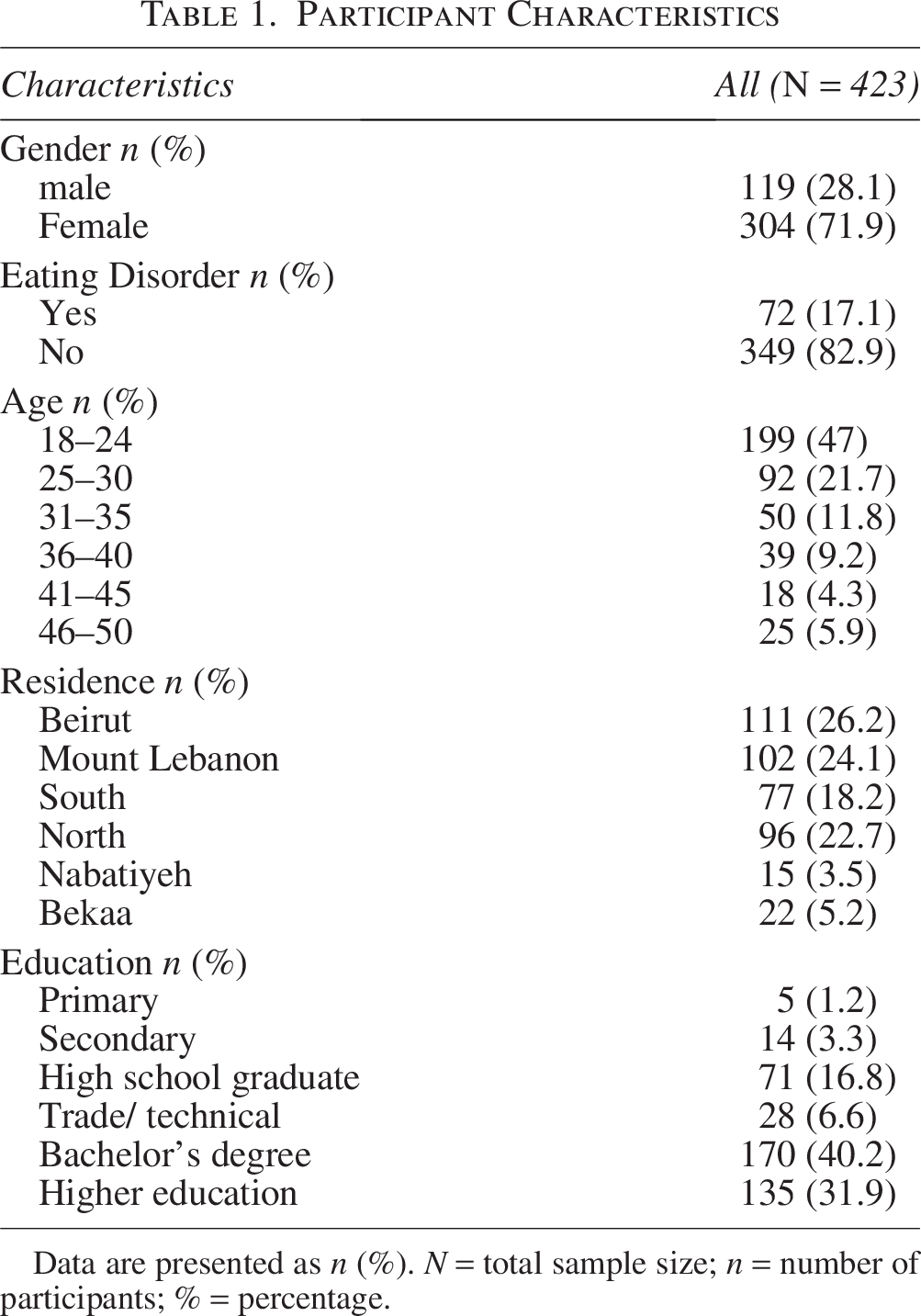
Data are presented as n (%). N = total sample size; n = number of participants; % = percentage.
The three body checking subscale scores—overall appearance (r = 0.354; p < 0.001), specific body parts (r = 0.29; p < 0.001), and idiosyncratic checks (r = 0.248; p < 0.001)—were positively correlated with general SM usage. Body checking was also positively correlated with perceived stress (r = 0.361; p < 0.001), emotional eating (r = 0.45; p < 0.001), and the MTUAS friends score subscale (r = 0.13; p = 0.008); and negatively correlated with self-esteem (r = −0.103; p = 0.035). Participants who reported an eating disorder diagnosis had higher body checking scores compared with those without such a diagnosis.
Independent samples t-tests indicated that participants who reported a diagnosed eating disorder had significantly higher body checking scores than those without an eating disorder (p = 0.01; Figure 1A). No significant differences in body checking were observed by gender (p = 0.20) or age group (p = 0.10). Participants with low self-esteem reported significantly higher body checking than those with normal self-esteem (p = 0.049; Figure 1B). In addition, body checking scores differed significantly across perceived stress categories, with progressively higher body checking observed at higher levels of perceived stress (p < 0.001; Figure 1C).
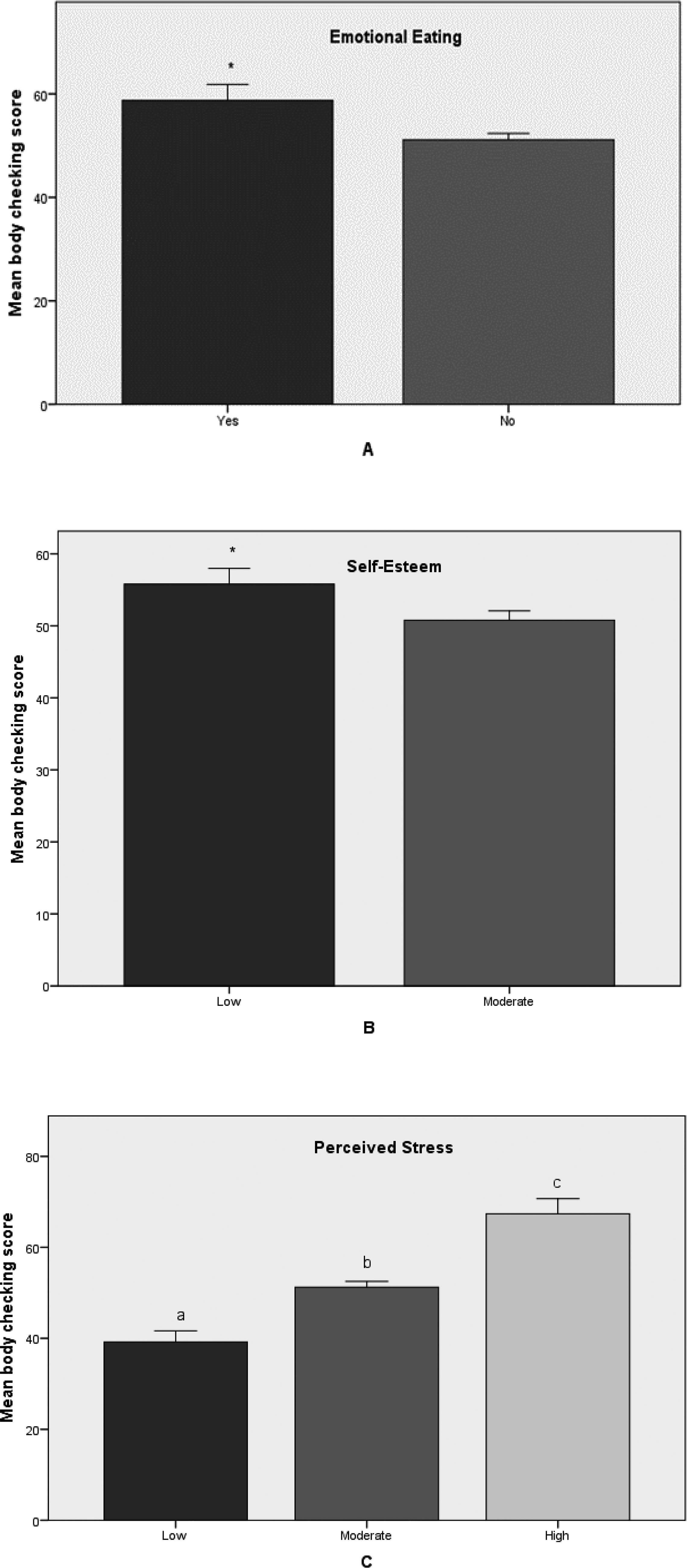
Variation in Body Checking Scores by Emotional Eating, Self-Esteem, and Perceived Stress Categories.
In hierarchical regression analyses (Table 2), sociodemographic variables entered in Model 1 explained a modest proportion of variance in body checking. Female gender and lower educational level were associated with higher body checking scores in this initial model.
Hierarchical Linear Regression Predicting Body Checking Scores
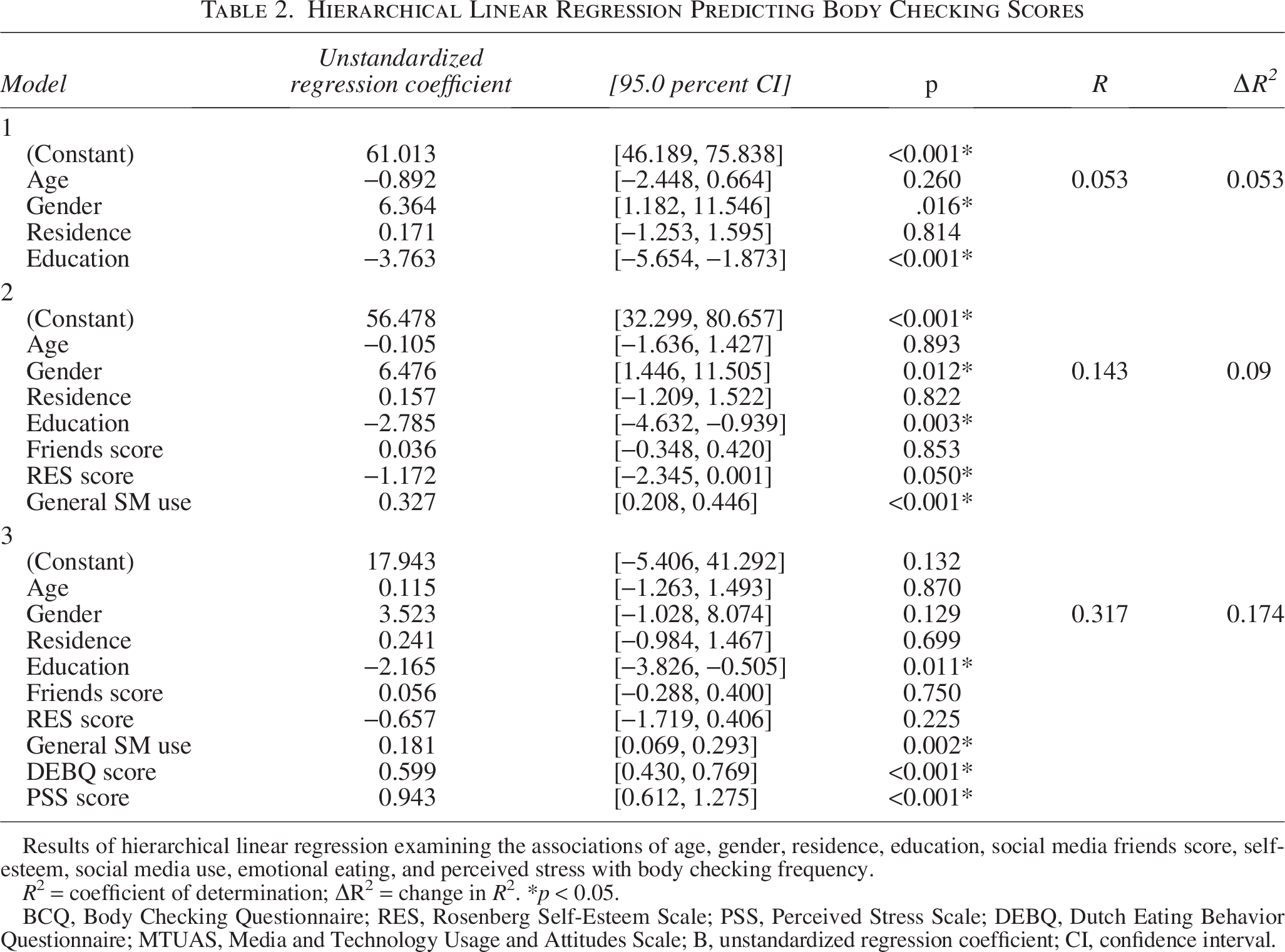
Results of hierarchical linear regression examining the associations of age, gender, residence, education, social media friends score, self-esteem, social media use, emotional eating, and perceived stress with body checking frequency.
R2 = coefficient of determination; ΔR 2 = change in R2. *p < 0.05.
BCQ, Body Checking Questionnaire; RES, Rosenberg Self-Esteem Scale; PSS, Perceived Stress Scale; DEBQ, Dutch Eating Behavior Questionnaire; MTUAS, Media and Technology Usage and Attitudes Scale; B, unstandardized regression coefficient; CI, confidence interval.
In Model 2, adding self-esteem and number of online friends/followers increased explained variance, and lower self-esteem was associated with higher body checking. In the final model (Model 3), adding perceived stress, emotional eating, and general SM use substantially improved model fit (ΔR 2 = 0.17), yielding a total R2 of 0.32. Perceived stress (B = 0.94, p < 0.001) and emotional eating (B = 0.60, p < 0.001) were the strongest predictors. General SM use remained a significant predictor (B = 0.18, p = 0.002), while educational level retained an inverse association (B = −2.17, p = 0.011). Gender and self-esteem were no longer significant in the final model, suggesting their effects were accounted for by psychological and behavioral variables.
Discussion
This study indicates that body checking behaviors among Lebanese adults are more strongly associated with psychological distress and coping-related eating behaviors than with SM use alone. Perceived stress and emotional eating emerged as the most robust predictors in the final model, consistent with conceptualizations of body checking as a maladaptive response to negative affect and uncertainty, serving reassurance-seeking and short-term affect regulation.9,10
Although general SM use independently predicted body checking, its effect size was modest relative to perceived stress and emotional eating. This pattern aligns with evidence that digital environments may interact with vulnerability factors—such as distress, low self-regulation, and stigma-related processes—rather than exerting uniform effects across users.1–4,11–13
The observed links between emotional eating, stress, and body checking may reflect a cyclical pathway: stress increases body-related concerns and negative affect, which may promote emotional eating as a coping strategy; subsequent body-related guilt or dissatisfaction may then heighten appearance monitoring and checking. Future longitudinal designs are needed to test temporal ordering and potential bidirectionality.
Strengths of the present study include the use of validated instruments, sensitivity analyses excluding eating disorder cases, and examination of multiple psychological predictors within a Middle Eastern context. On the contrary, self-reported data may introduce recall or social desirability bias, particularly for eating- and body-related behaviors. Other limitations include the cross-sectional design and sampling constraints that may limit generalizability beyond Lebanese young and middle-aged adults who actively use SM.
Future work may benefit from incorporating newly developed measures capturing stigma exposure in digital contexts. For example, the recently developed Weight Stigma Exposure Inventory (WeSEI) includes SM-related stigma elements and has been developed and validated across multiple contexts, potentially improving assessment of how weight stigma exposures intersect with distress, eating behaviors, and body image outcomes.18–23
Conclusion
Body checking behaviors among Lebanese adults are primarily associated with perceived stress, emotional eating, and SM use. Interventions targeting stress management, adaptive coping strategies, and critical engagement with SM content may help reduce maladaptive body monitoring behaviors.
Footnotes
Acknowledgment
The authors would like to thank Mrs. Claire El Jor for her valuable input that greatly helped improve the article. The authors do not have any conflicts of interest to report.
Authors’ Contributions
A.K.: Conceptualization; data curation; formal analysis; methodology; project administration; resources; software; validation; visualization; roles/writing-original draft; writing—review and editing. N.Z.: Conceptualization; methodology; supervision; writing—review and editing. S.J.: Article edit M.H.: Article editing.