







Abstract
Emojis, as emerging paralinguistic cues in computer-mediated communication, are increasingly integrated into daily digital interactions and are known to be efficiently stored as targets in working memory (WM). Despite their pervasive use, the cognitive mechanisms underlying the filtering of emojis as distractors remains unclear. The present study combined behavioral measures and event-related potentials to investigate how emojis are filtered in WM. Participants performed a WM task in which emojis served as distractors. The results showed that emojis, compared with other types of distractors, could be efficiently filtered, as evidenced by reduced unnecessary storage (US) and lower contralateral delay activity (CDA) amplitudes. Moreover, a positive correlation between US and CDA emerged only in the emoji distractor condition, especially among high-frequency emoji users (r = 0.517, p = 0.023), suggesting that prior experience with emojis modulates the link between behavioral and neural indices of filtering. These findings provide preliminary evidence that emojis can be effectively filtered in WM and underscore the modulatory role of usage experience in shaping cognitive processing during digital communication.
Introduction
With the advent of digital communication, reduced paralinguistic cues have prompted the use of digital symbols as compensatory tools. 1 Emojis, in particular, serve as visual strategies to restore these cues in computer-mediated communication (CMC). 2 They are vertical, human-like icons that convey emotions through exaggerated facial features.3–6 Emojis convey affective states, enhance communicative effectiveness,7,8 and can even elicit social orienting, 9 reflecting individuals’ inherent sensitivity to social cues. 10 In 2017, WeChat users sent over 600 million emojis daily, 11 and globally, >70 billion are exchanged each day, 12 reflecting their widespread role in digital communication.
Given their prominence in online communication, 8 research on emojis has grown rapidly since 2015. 13 However, they also pose challenges. Emojis’ generalized emotional functions and inherent ambiguity can hinder understanding,14,15 whereas inappropriate or excessive use may reduce message credibility in formal contexts 16 or amplify negative emotions. 17 Misinterpretations of negative content may even spark public disputes. 18 In this context, understanding how emojis are processed becomes particularly important.
Derived from basic facial features, emojis function like human faces7,8 but are recognized more accurately and processed more rapidly. 19 Individuals prioritize attention to social stimuli, which is described and explained by Social Motivation Theory as “social orienting.”10,20 In our previous study, participants’ working memory (WM) for emojis was better than for faces and comparable to simple shapes across 200, 1,000, and 2,000 ms. 9 It indicates that emojis are regarded as social cues that evoke social orienting. From a cognitive perspective, examining emojis via WM is appropriate, as WM is a fundamental, continuously active cognitive function. 21
WM is specialized for the short-term maintenance and storage of information, forming the basis of human thought. 22 However, it has limited capacity. 23 Distractors that are irrelevant to the task, such as differently colored squares or faces, can impair WM performance.24–26 For example, repeating an irrelevant sound (e.g., the word “the”) reduces task performance by interfering with WM. 27 When WM is disrupted, individuals experience greater difficulty performing cognitive activities that depend on it, including thinking, reasoning, learning, and comprehension. 22 Environmental information far exceeds processing capacity, making distractors almost inevitable. 26 Therefore, the filtering ability of irrelevant information is critical,28,29 because it determines whether WM capacity is allocated to targets. 24 Activating filtering via cues reduces distractor intrusion, improving performance without extra attentional load, 30 indicating that enhancing filtering efficiency can improve WM independently of capacity. Neural substrates differ: filtering relies on the bilateral insula, right occipital cortex, right brainstem, and right cerebellum, whereas storage engages the bilateral posterior parietal cortex, left ventromedial prefrontal cortex, and right precuneus. 31 These findings highlight a functional dissociation; however, filtering efficiency has received far less attention than storage in previous research. 32
Colored squares and geometric shapes, which are commonly used as distractors in WM filtering studies, help isolate and quantify core cognitive processes such as storage and attentional allocation. 33 Individual differences in filtering were observed by manipulating the spatial locations of shapes. 24 However, such stimuli have limited ecological validity because real-world distractors, such as human faces, convey rich social information and evolutionary significance. 34 Although some studies have used facial stimuli,25,26 related research remains scarce. With social interactions increasingly occurring in digital environments, emojis offer suitable experimental stimuli. When used as WM targets with simple shapes, emojis receive processing priority. 9 However, it is unclear whether emojis, as distractors, are actively filtered, a key question for understanding WM.
This question can be examined within a theoretical framework. Within this framework, WM is shaped by the interaction between top-down and bottom-up attentional processes.
35
It suggests that top-down attention is guided by task demands or internal goals and is supported by WM.35–38 Accordingly, we previously enhanced the mnemonic priority of emojis by directing goal-oriented attention toward them.
9
Bottom-up attention, in contrast, is driven by the salience of stimuli.35–37,39,40 However, attentional capture can be attenuated when salient but task-irrelevant information is suppressed at the encoding stage.
40
In the present study, emojis were presented as distractors rather than targets, which may promote their suppression during the encoding stage. Thus, we hypothesized the following: Emoji distractors can be effectively filtered and excluded from WM maintenance.
In the real world, individuals selectively attend to socially relevant stimuli, interpret cues, and adjust their behavior based on experience. 41 Experience profoundly shapes social face recognition, 42 as in infancy, where exposure refines recognition toward frequently encountered face types, 43 adults exhibit a heightened capacity for automatic recognition of familiar faces. Emojis, as digital paralinguistic cues, share the social and emotional properties of human faces,9,44,45 and individuals vary in their exposure to them. 46 However, whether such experiences shape cognitive processing, particularly WM filtering, remains unclear. Therefore, our study examined the role of emoji usage frequency in this process.
Filtering influences WM capacity by allowing unnecessary storage (US) of irrelevant items.47,48 Therefore, US is commonly used as a behavioral index of filtering efficiency.29,49,50 In this study, US served as the behavioral measure of individual filtering ability. At the neural level, the contralateral delay activity (CDA) is a well-established electrophysiological marker of distractor filtering in WM.24,25,28,51 CDA is a negative slow-wave event-related potential (ERP) component reflecting visual WM maintenance, emerging around 200 ms after memory array onset and persisting throughout the retention interval. It represents the number of items retained in WM during the delay period.23,25,52–56 Larger CDA amplitudes have been observed in individuals with lower WM capacity when filtering socially neutral or angry face distractors. 25 The present study therefore examined whether and how emoji distractors presented during the maintenance phase similarly elicit this component.
Despite growing interest, the cognitive mechanisms of WM filtering remain unclear, 32 particularly regarding how individuals suppress distracting or negative stimuli in digital rather than face-to-face communication. Using emojis as digital distractors provides a novel means to examine WM filtering in online contexts, thereby extending existing findings to computer-mediated settings. This approach advances the mechanistic understanding of filtering efficiency and offers a theoretical basis for WM research in digital communication.
Materials and Methods
Experimental design and participants
The experiment used a single-factor, within-subjects design with six conditions. Two conditions had no distractors: one with two targets (T2D0) and one with four targets (T4D0). The other four conditions included two targets and two distractors (T2D2), which differed by distractor type: emoji, scrambled emoji (Semoji), face, and shape. Trials from all conditions were randomly mixed within each block. The dependent variables included multiple behavioral and neural measures assessed across the six levels of the independent variable.
An a priori power analysis was conducted to estimate the required sample size using G*Power 3.1.9.7. 57 Assuming a medium effect size (f = 0.25) for a one-way repeated-measures analysis of variance (ANOVA) (α = 0.05), a minimum of 28 participants was required to achieve 0.95 power. Ultimately, 50 healthy participants (28 females; mean age = 20.64 ± 2.35 years; range = 18–29 years) participated. All participants were Han Chinese from Chengdu, China, had normal or corrected-to-normal vision, and reported no color blindness or neurological disorders. None reported using psychotropic medication. Sex was recorded by self-report. The study was conducted in accordance with the Declaration of Helsinki and was approved by the Research Ethics Committee of Nanjing University. Written informed consent was obtained from all participants, who were fully debriefed after the experiment.
Materials
Four types of distractors from a previous study were used, 9 including emojis, scrambled emojis, human faces, and yellow simple shapes. Emoji distractors were taken from WeChat, a popular Chinese social media platform. Scrambled emojis were created by disrupting the facial features of these emojis. Human face distractors were selected from the Chinese Facial Affective Picture System 58 and standardized to circular shapes with restored original colors to approximate the physical characteristics of emojis. 9 Simple yellow shapes contained no social information but matched the emojis in color. Blue geometric shapes served as targets, providing a clear color contrast with the distractors. All stimuli were standardized in size (Figure 1 (a)).
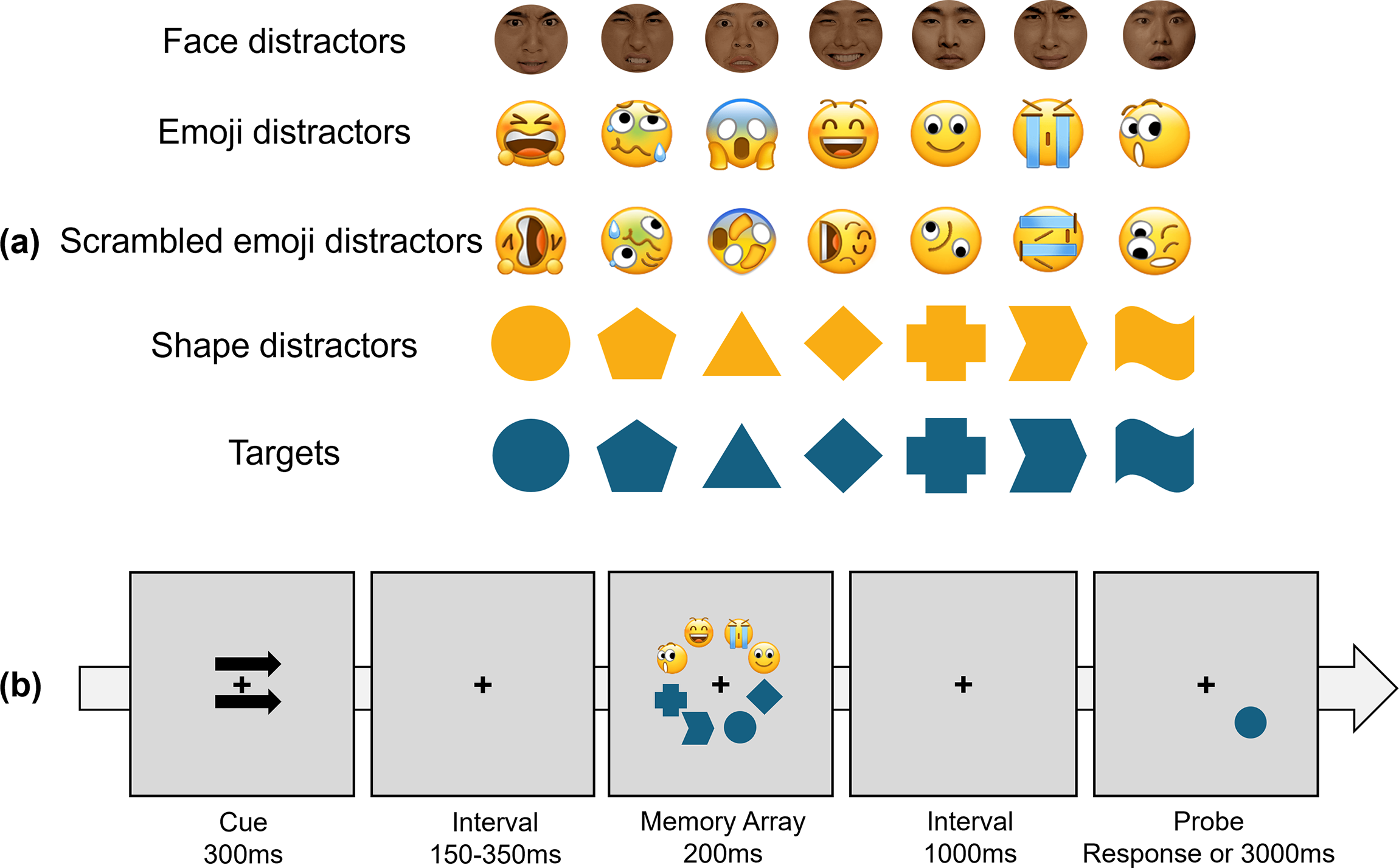
Stimuli used in the current study
Procedure
Working memory task
A one-sided change-detection task was used to assess WM performance. 23 Participants viewed a memory array and memorized the stimuli indicated by an arrow cue. Before the task, they reported their emoji usage frequency by answering two questions: (a) “How often do you encounter emojis online and in daily life?” and (b) “How often do you use emojis online and in daily life?” 46
Participants received task instructions and confirmed their understanding. Each trial began with a double-arrow cue presented for 300 ms on a 1,920 × 1,080 display, indicating the side of the memory array to be memorized. After a blank interval of 150–350 ms, the memory array appeared for 200 ms, with items arranged along an invisible ellipse centered on the screen. Stimuli presented on the opposite side of the arrow were of the same type to ensure correspondence. Following a 1,000 ms retention interval, a probe stimulus was presented. Participants were asked to press F if the probe was absent or J if it was present, within 3 seconds. They were instructed to fixate on the central cross throughout the task (Figure 1(b)).
Participants completed six blocks of 192 trials each, for a total of 1,152 trials. After each block, participants could rest before proceeding at their own pace. To ensure task comprehension, they first completed 24 practice trials and were required to reach at least 80 percent accuracy. The full session lasted ∼2 hours.
EEG recording, Behavioral analysis, EEG preprocessing, EEG analysis, and EEG–behavior correlation analysis
See Supplementary Data for details.
Results
Behavioral results
The descriptive statistics for K across various conditions are presented in Table 1. For the T2D2 conditions, US showed a statistically significant main effect of condition, F (3, 117) = 118.874, p < 0.001, ηp2 = 0.753. The Face distractor condition (M = 0.734 ± 0.239) was significantly higher than the Emoji distractor condition (M = 0.076 ± 0.222, 95 percent confidence interval [CI]: 0.551–0.766), the Semoji distractor condition (M = 0.047 ± 0.214, 95 percent CI: 0.578–0.796), and the Shape distractor condition (M = 0.183 ± 0.310, 95 percent CI: 0.401–0.702), all with p < 0.001 (Figure 2).
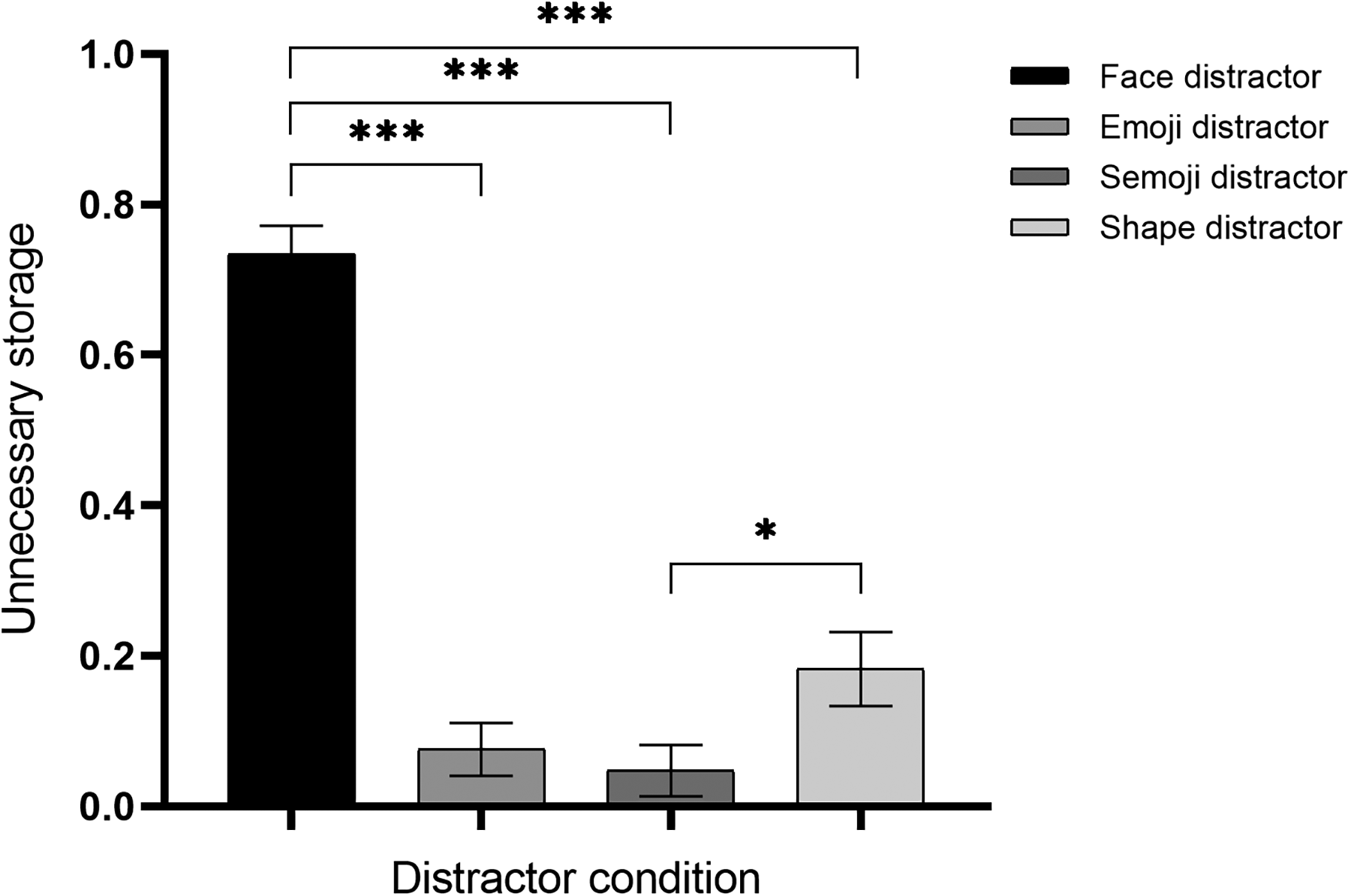
Results of a one-way repeated-measures ANOVA for unnecessary storage across the four distractor conditions. The X-axis represents the four distractor conditions, and the Y-axis indicates the magnitude of unnecessary storage for each condition. Error bars represent standard errors. “Semoji” refers to scrambled emojis. ***p < 0.001, **p < 0.01. ANOVA, analysis of variance.
Results of Descriptive Statistics for K in This Study
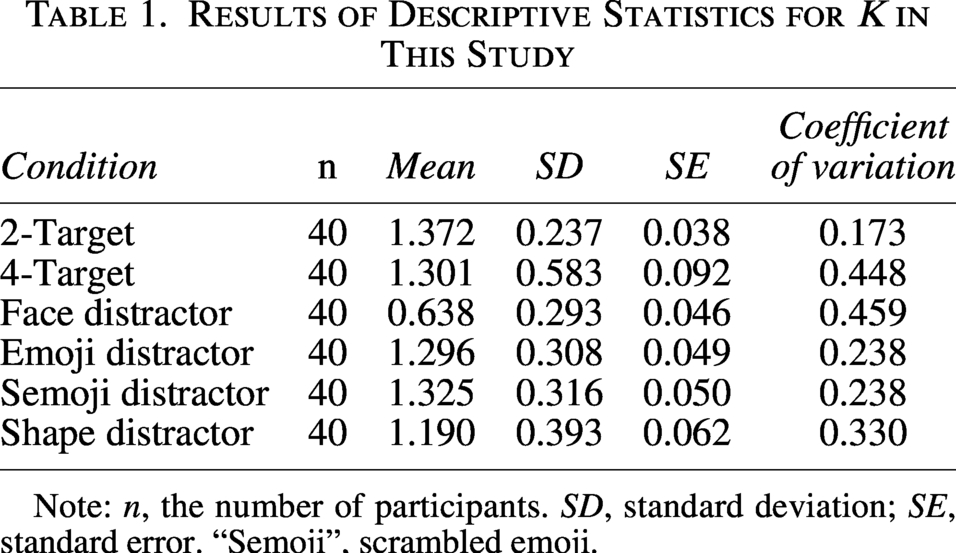
Note: n, the number of participants. SD, standard deviation; SE, standard error. “Semoji”, scrambled emoji.
The Face distractor condition (r = −0.618, 95 percent CI: −0.780to −0.380), Emoji distractor condition (r = −0.643, 95 percent CI: −0.796 to −0.415), Semoji distractor condition (r = −0.660, 95 percent CI: −0.806 to −0.439), and Shape distractor condition (r = −0.797, 95 percent CI: −0.888 to −0.645) were all significantly correlated with K within their respective conditions (all p < 0.001).
EEG results
Contralateral delay activity
There was a statistically significant main effect of condition for CDA, F(5, 195) = 5.907, p < 0.001, ηp2 = 0.132. The T2D0 condition (M = −0.392 ± 0.853) was significantly different from the T4D0 condition (M = −0.870 ± 0.708, 95 percent CI: 0.034–0.923, p = 0.026), the Face distractor condition (M = −0.851 ± 0.845, 95 percent CI: 0.101–0.818, p = 0.004), the Semoji distractor condition (M = −0.966 ± 0.646, 95 percent CI: 0.219–0.929, p < 0.001), and the Shape distractor condition (M = −0.893 ± 0.759, 95 percent CI: 0.101–0.901, p = 0.005). No significant difference was found between the T2D0 condition and the Emoji distractor condition (M = −0.747 ± 0.799, 95 percent CI: 0.101–0.901, p = 0.180), as shown in Figures 3 and 4.
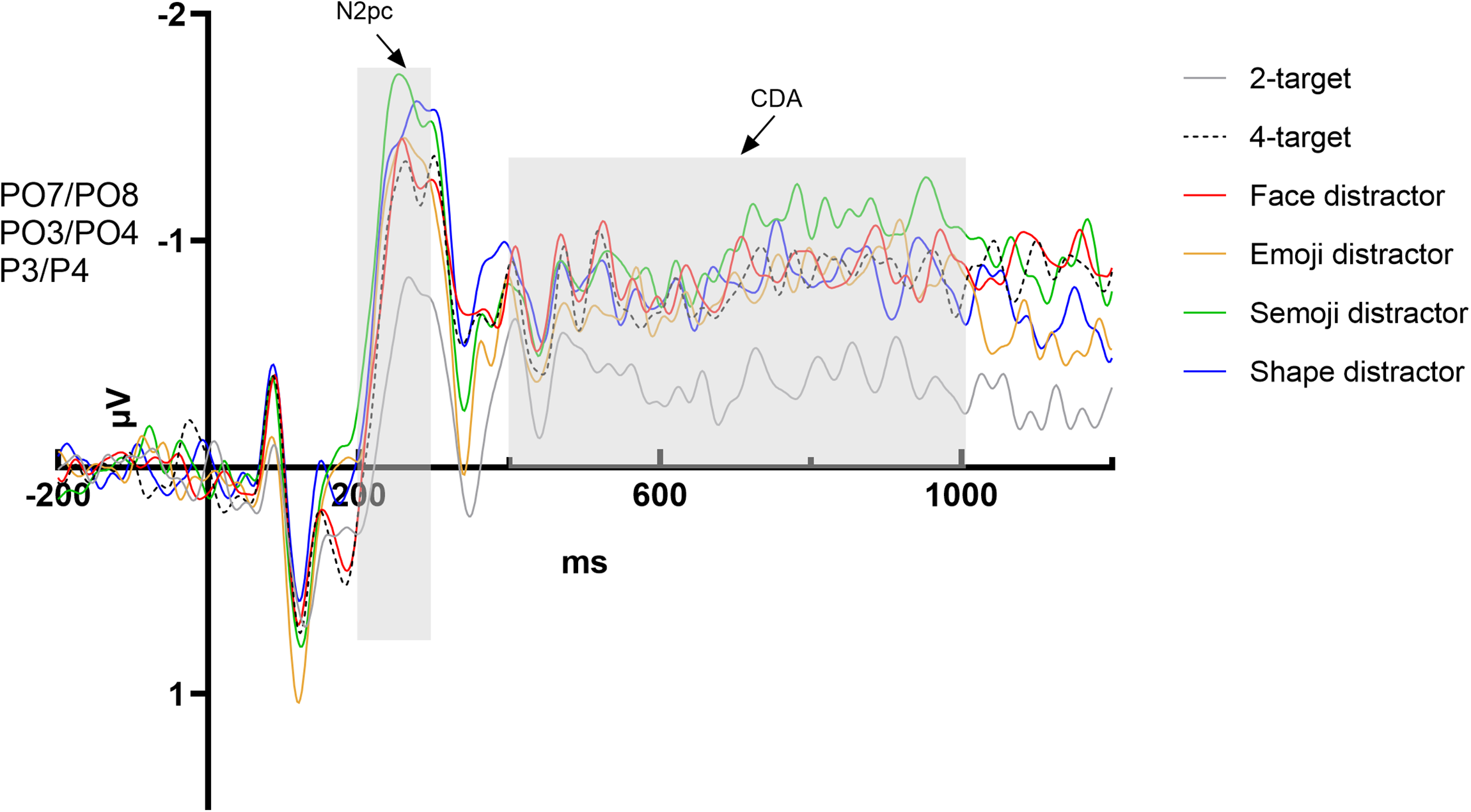
N2pc and CDA waveforms (in μV) across all conditions. The first translucent gray rectangle indicates the time window used to calculate the mean N2pc amplitude for each condition (200–300 ms). The second rectangle indicates the time window used to calculate the mean CDA amplitude for each condition (400–1,000 ms). Both ERP components were calculated as the difference between contralateral and ipsilateral amplitudes at parietal (P3/P4) and parietal–occipital (PO7/PO8, PO3/PO4) electrodes. The X-axis represents time, and the Y-axis represents amplitude. The gray solid line represents the 2-target condition, and the gray dashed line represents the 4-target condition. Red, yellow, green, and blue solid lines represent the face, emoji, scrambled emoji, and shape distractor conditions, respectively. “Semoji” refers to scrambled emoji. CDA, contralateral delay activity; ERP, event-related potential.
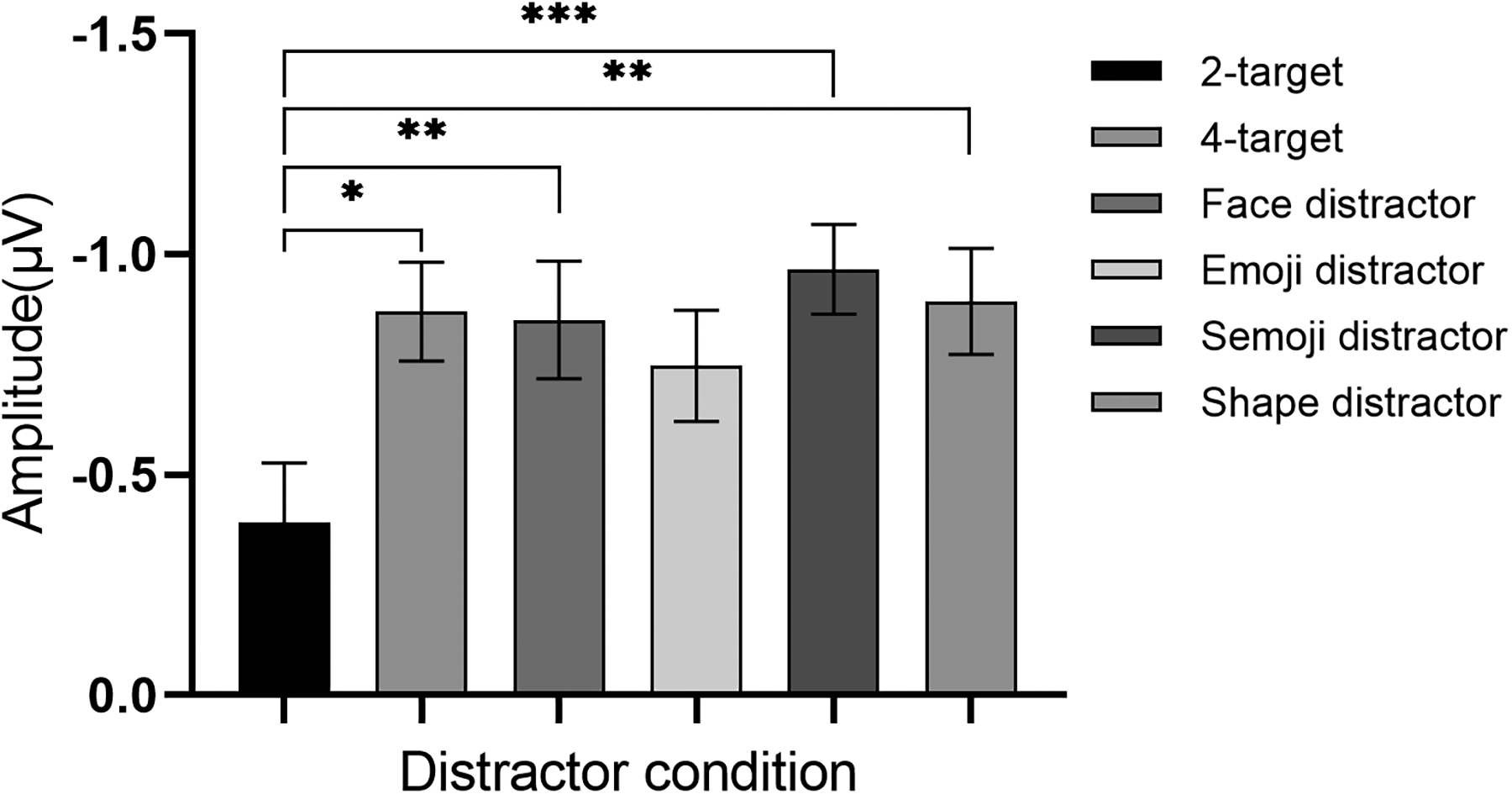
Results of a one-way repeated-measures ANOVA on CDA amplitude across all conditions. The X-axis represents six conditions, and the Y-axis indicates the CDA amplitude for each condition. Error bars represent standard errors. “Semoji” refers to scrambled emoji. ***p < 0.001, **p < 0.01, *p < 0.05.
N2-posterior-contralateral
A significant main effect of condition was observed for N2-posterior-contralateral (N2pc), F(5, 195) = 17.04, p < 0.001, ηp2 = 0.304 (Table 2).
Results of N2pc Across All Conditions in This Study
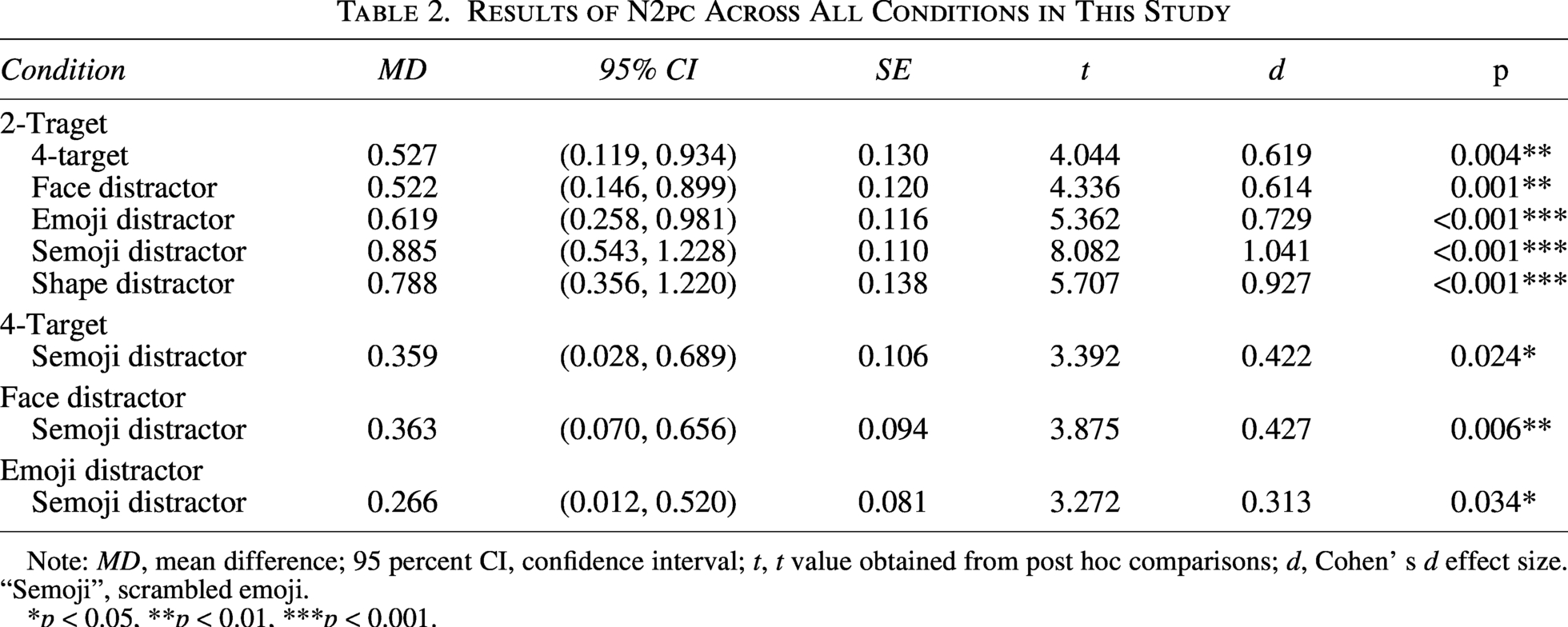
Note: MD, mean difference; 95 percent CI, confidence interval; t, t value obtained from post hoc comparisons; d, Cohen’ s d effect size. “Semoji”, scrambled emoji.
*p < 0.05, **p < 0.01, ***p < 0.001.
EEG–behavior correlations
Only the CDA amplitude in the Emoji distractor condition was significantly correlated with US (r = 0.419, 95 percent CI: 0.124–0.646, p = 0.007). After dividing participants based on the frequency of emoji usage, a significant correlation between CDA amplitude under the Emoji distractor condition and US was only found in the high-frequency group of emoji usage (r = 0.517, 95 percent CI: 0.082–0.787, p = 0.023).
Discussion
This study examined whether emojis, as distractors, are filtered in WM. Both behavioral (US) and neural (CDA) results indicated effective filtering, supporting our hypothesis. A positive correlation emerged only in the emoji condition and was driven by individuals with higher emoji use. These findings highlight the unique nature of emojis as digital symbols.
Higher US values indicate lower filtering efficiency. Face distractors showed the highest US, reflecting greater cognitive demands and lowest filtering efficiency. Prior research has established that faces are special stimuli that selectively engaging regions such as the occipital face area, superior temporal sulcus, and fusiform face area compared to other objects.59–61 In contrast, emojis elicited lower US values, indicating that they were efficiently filtered despite conveying emotional content similar to that of faces. 45 Furthermore, despite being physically more complex than simple shapes, their filtering efficiency did not differ significantly. Overall, these findings align with previous evidence indicating that emojis consume relatively few cognitive resources in WM. 9
Both capacity and filtering are fundamental for assessing the functional integrity of WM.32,62 In this study, filtering efficiency, indexed by US, correlated negatively with K across the four T2D2 conditions, indicating that higher filtering efficiency was associated with greater WM capacity. This replicates prior findings47,50,56 and underscores the role of filtering efficiency in individual WM difference.63,64
Analysis of the CDA revealed significantly stronger negative amplitudes in the T4D0, Face, Semoji, and Shape distractor conditions than in the T2D0 condition, indicating that these distractors were encoded and maintained in WM. Notably, CDA amplitude in the Emoji distractor condition did not differ significantly from that in the T2D0 condition and was the weakest among all T2D2 conditions, suggesting that emojis required minimal suppression and elicited reduced neural activity. 62 Stimuli that initially capture attention are not necessarily obligatorily maintained in WM when task goals require suppression. Previous research has shown that highly discriminable features are automatically encoded into WM, whereas irrelevant fine-grained features are filtered out. 65 To some extent, emojis convey emotions in a relatively coarse and generalized manner, 66 making it difficult to infer individuating identity characteristics. 67 Moreover, emojis within the same category share highly similar visual features and lack discriminability, which may reduce their likelihood of being prioritized and maintained in WM.
N2pc was initially interpreted as reflecting the suppression of surrounding irrelevant information, 68 but it was later considered as a marker of selective attention. 69 It corresponds to the beginning of target localization in the ventral visual pathway. 70 In this study, participants were required to focus on targets while ignoring distractors; thus, the emergence of N2pc was expected. Across both the T4D0 condition and the four T2D2 conditions, N2pc amplitudes were significantly stronger than those in the T2D0 condition. Interestingly, the N2pc amplitude in the Semoji distractor condition exceeded that in the T4D0, Face distractor, and Emoji distractor conditions. Because the N2pc analysis was conducted subsequent to the CDA analysis, these results should be interpreted with caution.
A positive correlation was found between US and CDA amplitude in the Emoji distractor condition, indicating that stronger negative CDA waves were associated with lower US values. This relationship emerged only among high-frequency emoji users. As WM represents a form of explicit memory 71 and CDA indexes the active suppression of distractors, the results indicate that extensive emoji experience may strengthen inhibitory control over emoji interference during WM maintenance. 62 Such experience-dependent modulation aligns with evidence linking object familiarity to improved discrimination. 72 These findings may explain the reduced cognitive resource demands associated with emojis, evident at both neural and behavioral levels.
Limitations
This study investigated the filtering mechanisms of emoji distractors in this study. Although demographic variables such as gender and age are known to influence emoji use and comprehension,3,46,73,74 the present study did not examine these factors in depth. Future research should address this limitation. Cross-cultural studies should be adopted in the future to account for potential cultural differences. 75 Although the sample size was statistically adequate a priori, future research should employ larger cross-sectional samples to validate the findings.
Moreover, personality traits may influence emoji use and perception. For example, individuals high in neuroticism tend to use emojis more frequently to manage social interactions, 76 whereas trait anxiety may impair inhibitory control in WM.77,78 These variables should be considered in future research, as they may jointly affect emoji processing and filtering efficiency.
We only used EEG technology to examine the temporal resolution of the filtering process. Future research could employ other neuroimaging techniques, such as functional magnetic resonance imaging, to assess brain activity and functional connectivity with higher spatial resolution. Because distractor filtering represents a dynamic, multi-stage process that engages distinct brain regions.32,64,79,80
Frequent switching of filtering settings can reduce efficiency, causing more irrelevant information to enter WM. 81 In this study, the randomized presentation of target positions and distractor types may have lowered filtering efficiency, suggesting stricter control in future work.
Significance
Previous work quantified the storage capacity for emojis. 9 Here, we assessed their filtering efficiency in WM, highlighting another key aspect of this cognitive function. It highlights the fundamental importance of filtering irrelevant distractors for WM performance, offering robust empirical support for the WM filtering model. 24 By including emojis rather than traditional stimuli such as shapes and colors, 33 the paradigm gains ecological validity. This approach advances the understanding of WM in social contexts and provides a basis for future studies on attention, 82 executive functions, 83 and related cognitive processes in digital communication.
The present study adopts the theoretical framework of top-down and bottom-up attentional interactions in WM to investigate the cognitive mechanisms underlying the processing of social cues, specifically emojis. The findings demonstrate that emojis do not inevitably penetrate attentional filters to gain access to WM. Instead, such distractors can be effectively suppressed under the constraints of explicit task goals. These results support the theoretical position that WM representations are not purely driven by bottom-up stimulus salience; rather, they are jointly modulated by goal-directed top-down control and stimulus-driven bottom-up processes.35–37,39 It also provides a comprehensive account of how emojis function in CMC. 1
The present study revisits this isolated approach in basic cognitive research, addressing a theoretical gap and enabling broader applications. Beyond semiotics, 2 emojis are increasingly applied in medicine, 84 biology, 85 and so on. For instance, they can facilitate communication of scientific health information, supporting public health initiatives. 86
Training programs targeting both WM capacity and filtering efficiency can enhance overall performance. 49 Such approaches could be applied into future WM interventions to improve the filtering of irrelevant information and support cognitive function. 87 This perspective deepens our understanding of the interplay between storage and processing in WM 62 and informs the design of more effective memory-training and cognitive-enhancement strategies.
Individuals with autism spectrum disorder (ASD) often show difficulties in perceiving social cues, 88 such as faces. 89 Interestingly, children with ASD may attend more to cartoon faces, particularly focusing on the eyes, 90 in contrast to the “eye avoidance” commonly observed with real faces. 91 Given their semiotic and pictorial nature, 2 emojis may attract attention in individuals with ASD and facilitate engagement with social cues. Studying emoji use could therefore provide valuable insights into social cognition in ASD and inform strategies to improve daily interactions and quality of life.
Conclusions
This study demonstrates that emojis, as a distinct class of stimuli, are efficiently filtered in WM. Compared with other distractors, emojis elicited smaller US and the lowest CDA amplitudes, reflecting reduced cognitive demands. A positive correlation between US and CDA was observed and was subsequently found only among high-frequency emoji users, highlighting the modulatory role of experience in shaping filtering performance. These findings clarify experience-dependent mechanisms in social information processing and inform future research on cognitive functioning in digital contexts.
Authors’ Contributions
D.Z.: Data acquisition, formal analysis, data interpretation, and writing—original draft. D.G.: Conceptualization, methodology, and funding acquisition. R.T.: Review, supervision, and overall responsibility.
Ethical Statement
The study was conducted in accordance with the Declaration of Helsinki and approved by the Research Ethics Committee of Nanjing University.
Footnotes
Acknowledgments
The authors thank Ruyi Liu for assistance with programming, as well as Lin Luo and Jing Wang for assistance with data collection. The authors also thank Tinghao Tang and acknowledge the use of artificial intelligence (AI) tools (ChatGPT, OpenAI) for grammar correction and language refinement during article preparation. All content was reviewed and verified by the authors.
Author Disclosure Statement
No competing financial interests exist.
Funding Information
This research is supported by the National Natural Science Foundation of China (Grant Nos.: 31571131 to R.T.).
Supplemental Material
References
Supplementary Material
Please find the following supplemental material available below.
For Open Access articles published under a Creative Commons License, all supplemental material carries the same license as the article it is associated with.
For non-Open Access articles published, all supplemental material carries a non-exclusive license, and permission requests for re-use of supplemental material or any part of supplemental material shall be sent directly to the copyright owner as specified in the copyright notice associated with the article.
