







Abstract
Short video platforms have become immensely popular among adolescents. Adolescence is a crucial developmental period with distinct stages (early, middle, late); each stage is influenced by unique psychological, physiological, and social dynamics. While prior studies primarily focus on negative impacts of problematic short video use (PSVU) on adolescents, the age-specific characteristics of PSVU remain obscure, which is important for effective prevention and intervention. This study utilized network analysis to investigate the central symptoms and network structure of PSVU across early, middle, and late adolescence. The data were collected from a large sample of 48,489 adolescents using a modified 6-item Facebook addiction scale. Results indicated that tolerance and withdrawal were consistently among the most central symptoms across all adolescent stages, with tolerance showing the highest centrality overall. Furthermore, a distinct third central symptom emerged for each stage: salience in early, mood change in middle, and conflict in late adolescence. Global network strength increased from early to middle adolescence and again from middle to late adolescence, suggesting a deepening of addictive patterns with age. The significant age-specific differences in symptom connectivity were also identified. This study provides the first network analysis of PSVU across distinct adolescent developmental stages. The tolerance and withdrawal emerged as the common top two central symptoms across the distinct adolescent developmental stages, indicating that PSVU operates consistently within existing behavioral addiction frameworks, functioning as a specific and highly immersive manifestation of problematic Internet use. Meanwhile, unique age-specific characteristics throughout adolescence underscore the necessity of tailoring prevention and intervention strategies for the specific developmental phase of adolescents.
Keywords
Introduction
Internet use is frequently distinguished into generalized use (e.g., information overload) and specific application-based behaviors (e.g., social media or Internet gaming). 1 As a highly engaging specific application, short video platforms have rapidly emerged as a dominant medium for digital communication and entertainment. In contrast to the mixed-format and actively navigated designs of traditional social media (e.g., Instagram, YouTube, Facebook), short video platforms drive continuous user engagement by coupling a frictionless, infinite-scroll interface devoid of stopping cues with personalized recommendation algorithms that deliver brief, highly salient stimuli.2–4 From the perspective of the Stimulus–Organism–Response (SOR) framework, these defining characteristics of short videos 5 act as potent environmental stimuli (Stimuli). How users internalize and process these stimuli is profoundly influenced by their specific developmental stages (Organism). During adolescence, the organismic state could be characterized by the Dual Systems Model. 6 According to this model, the developmental imbalance between adolescents’ early-maturing socioemotional system (heightened reward seeking, novelty seeking, and need for social connection) and their later-maturing cognitive control system (responsible for impulse control) renders them highly susceptible to the novel and intense stimuli of short videos. This unique neurodevelopmental vulnerability amplifies the impact of the algorithmic stimuli, ultimately heightening the risk of problematic short video use (PSVU) (Response). PSVU is characterized by excessive time spent on short video platforms and continued engagement despite encountering adverse outcomes.7–9
Network analysis provides a methodological framework for visualizing and quantifying associations among symptoms of a disorder. 10 To date, this method has primarily been applied to some digital addictions (e.g., generalized problematic Internet use), frequently identifying tolerance and withdrawal as the central symptoms driving the problematic use.11,12 Recently, a few pioneering network studies have begun to explore the symptom structure of PSVU. However, these studies have predominantly focused on young adults and primarily investigated the comorbidity between PSVU and external psychological distress, such as depressive symptoms 8 or boredom. 13 There remains a substantial lack of research exploring the internal symptom-to-symptom interactions of PSVU itself. Furthermore, adolescence is a rapid and dynamic period of development that can be categorized into early, middle, and late stages, 14 each marked by unique biological, cognitive, and social changes. 15 Consequently, it remains largely unclear how the internal symptom interactions of PSVU evolve across these stages.
The present study addresses these critical gaps by estimating and contrasting stage-specific PSVU symptom networks in a large-scale adolescent sample. Applied to PSVU in adolescents, this approach enables the identification of central symptoms as well as the examination of age-specific symptom manifestations. Therefore, this study is guided by two main research questions: (1) Are there shared central symptoms of PSVU across different stages? We hypothesize that the central symptoms of PSVU remain consistent across these stages, as these symptoms represent the core psychopathological components of PSVU. (2) How do specific symptom manifestations and network structures (e.g., symptom connectivity and global strength) differ across developmental stages? We hypothesize that the specific manifestations and network structures may differ across stages, reflecting the unique socioemotional and cognitive characteristics of early, middle, and late adolescence.
Methods
Participants
Data were drawn from a large-scale survey of 48,489 adolescents in Hunan province, China, conducted in March 2024. A random sampling method was employed to select participating schools, with 61.61 percent of the participants residing in urban areas and 38.39 percent in rural areas. This survey was administered through an online platform during regular class hours, under standardized supervision by trained teachers and research assistants. To ensure the reliability of the data, attention-check items (e.g., please select “Always” for this question) were embedded within the questionnaire. Responses that failed these attention checks, or those completed in an impossibly short duration, were excluded from the final dataset. Participants were categorized into three developmental stages based on their grade level: early adolescents (grades 4–6; n = 17,016), middle adolescents (middle school; n = 21,731), and late adolescents (high school; n = 9,742). The mean age, gender ratio, and PSVU total scores of early, middle, and late adolescence are presented in Table 1. All participants or their parents were informed about the content and aims of the study, and informed consent was obtained from all participants. Furthermore, our research team proactively collaborated with the participating schools to deliver educational lectures focused on mental health and healthy electronic device usage. This initiative aimed to equip adolescents with the necessary knowledge to foster adaptive digital habits. This study was approved by the Ethics Committee of the Institute of the University of Guangzhou (2024080).
Demographic Information and Each Problematic Short Video Use Item Scores for Different Groups
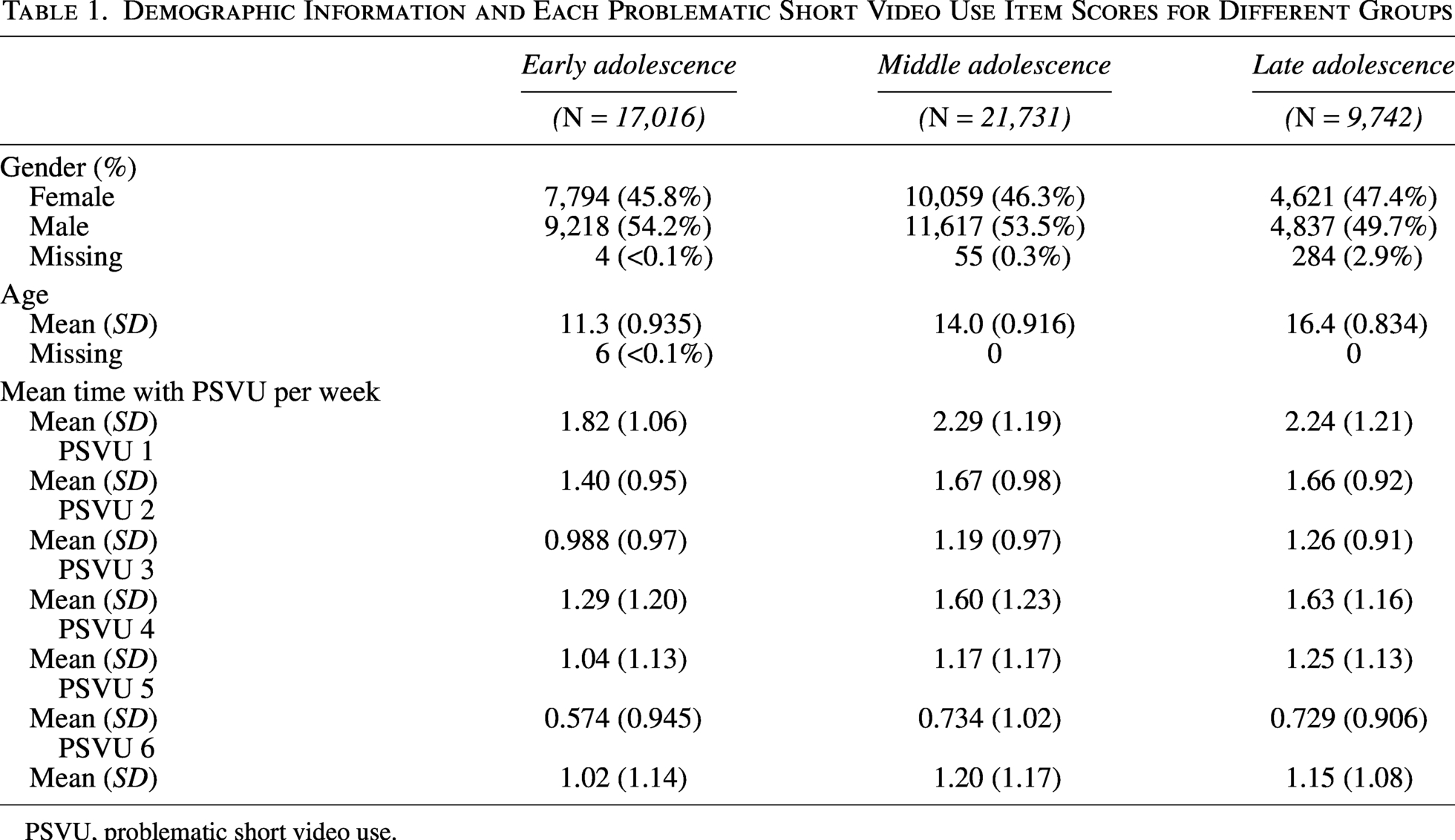
PSVU, problematic short video use.
Measures
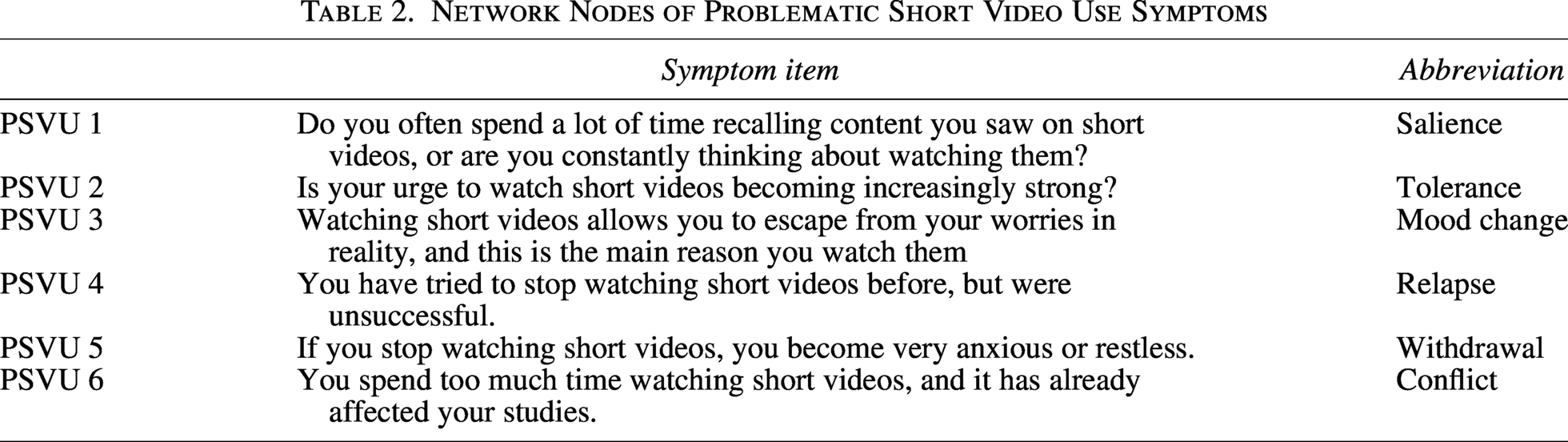
PSVU was measured by the modified version of the Facebook Addiction Scale. 16 This instrument was selected because it is strictly grounded in the components model of behavioral addiction, 17 providing an efficient assessment of six distinct and core psychopathological symptoms. Notably, this scale has been increasingly recognized and widely adopted in recent network analyses of PSVU among Chinese youth populations, demonstrating good reliability and validity.8,18 This scale includes six items: salience, mood change, tolerance, withdrawal, conflict, and relapse, and each item is rated on a 0 to 4 scale (0 = “never” to 4 = “always”). Scores range from 0 to 24, with higher scores indicating a greater severity of PSVU. In the current study, this scale demonstrated good internal consistency in early (α = 0.81), middle (α = 0.82), and late adolescents (α = 0.82), as well as in overall participants (α = 0.82). The detailed descriptions of each PSVU symptom are shown in Table 2.
Network Nodes of Problematic Short Video Use Symptoms
Guided by the Dual Systems Model framework and to empirically characterize the distinct developmental profiles across early, middle, and late adolescence, we also assessed adolescents’ depression, anxiety, and behavioral activation system (BAS) as indicators of the socioemotional system, alongside the behavioral inhibition system (BIS) and emotion regulation strategies to reflect the cognitive control system. Detailed measures are provided in Supplementary Data (Supplementary Text S1).
Data analysis
Network structure estimation
The symptom network of PSVU for each age group was estimated using the estimateNetwork function in the R package bootnet. 19 Specifically, the network structures were estimated via Gaussian graphical models (GGMs) using the default “ggmModSelect” (GGM structure selection) approach. Associations were computed using a nonparanormal transformation (corMethod = “npn”) alongside Spearman rank correlations (corArgs = list [method = “spearman”]). Identical estimation procedures were applied across all developmental groups. The adjacency matrices for each network were also estimated. Detailed results are provided in Supplementary Data (Supplementary Text S5).
In the resulting networks, each symptom was represented as a node, and the connections between nodes were defined as edges. Thus, the reported edges represent conditional dependence (partial correlation) relations in the selected GGMs. The networks were visualized using the qgraph package, 20 where thicker edges reflected stronger relationships between nodes. Finally, we used the bootnet package to test the accuracy and stability of the network indices through nonparametric bootstrapping and case-dropping subset bootstrapping (n = 1,000). 21
Centrality estimation
We used strength and expected influence, which are two commonly used centrality indices in network analysis, to identify central symptoms.22,23
Network comparison estimation
Prior to network comparison, we performed additional multi-group CFA measurement invariance across different age groups using the cfa function to test for configural, metric, and scalar invariance. The Network Comparison Test package was used to assess the differences between networks in different age groups. We examined three tests: network structure invariance test, global strength invariance test, and edge strength invariance test. 24
Results
Network centrality estimation in different adolescent stages
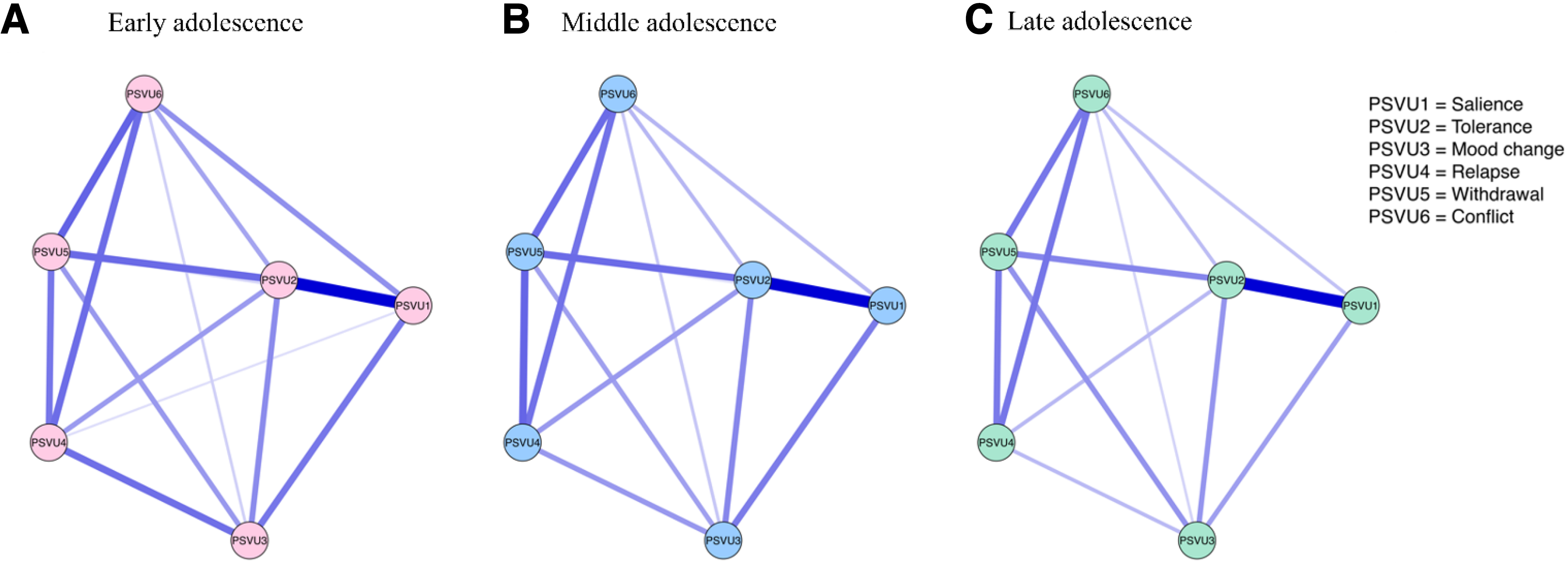
The estimated symptom networks of PSVU for early, middle, and late adolescence are presented in Figure 1. For the 6-node PSVU network, the total potential edges were 15, calculated using the formula N × (N − 1)/2. Following the network estimation, the number of nonzero edges retained was 15 (edge retention rate = 100 percent) in early adolescence, 14 (93.3 percent) in middle adolescence, and 13 (86.7 percent) in late adolescence. The centrality nodes were identified based on strength and expected influence (Figure 2). Specifically, tolerance and withdrawal were identified as having the highest strength and expected influence symptom across all three age groups (z-score >1). The adjacency matrices for each network were presented in the Supplementary Data (Table S1). The third symptom is characterized by distinct manifestations specific to each stage of adolescence: salience in early adolescence, mood change in middle adolescence, and conflict in late adolescence.
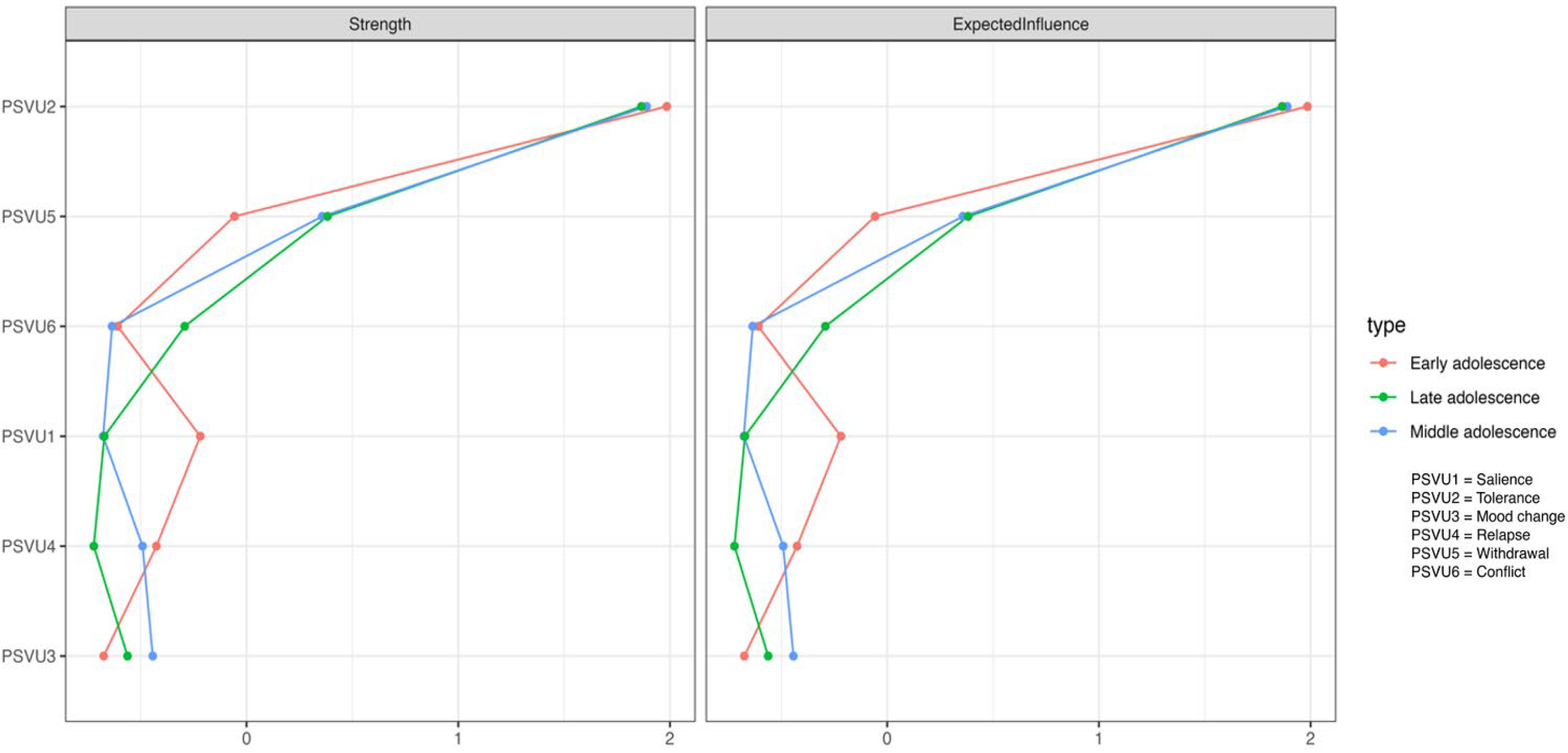
Standardized estimates of strength and expected influence for PSVU symptoms. The red line represents middle adolescents, the green line represents early adolescents, the blue line represents late adolescents. Detailed descriptions of the items are presented in Table 2.
We used nonparametric bootstrapping to assess the accuracy of the symptom network for each stage (Supplementary Figures S1, S2, and S3 for early, middle, and late adolescence, respectively) and case-dropping subset bootstrapping to examine the stability of centrality indices for each stage (Supplementary Figures S4, S5, and S6 for early, middle, and late adolescence, respectively).
Network global and local connectivity in different adolescent stages
The network structure invariance test indicated significant differences in node connections among age groups (ps < 0.05). The global strength invariance test revealed a significant increase in network strength from early to middle adolescence (p = 0.04) and a further increase from middle to late adolescence (p = 0.03). The edge invariance test showed that the edge between salience and tolerance was significantly stronger in middle adolescence compared with early adolescence and stronger still in late adolescence compared with middle adolescence. The edges between salience and relapse, as well as between salience and conflict, were stronger in middle adolescence compared with early adolescence (ps < 0.05). The edges between relapse and mood change, as well as between relapse and withdrawal, were also stronger in middle adolescence compared with early adolescence (ps < 0.05). Furthermore, the edge between mood change and withdrawal was stronger in late adolescence compared with middle adolescence (ps < 0.05). The results of multi-group CFA measurement invariance across early, middle, and late adolescence are shown in the Supplementary Data (Supplementary Text S2). In addition, the detailed pairwise edge difference plots and centrality difference plots comparing the networks across early, middle, and late adolescence are provided in the Supplementary Data (Supplementary Figures S7 and S8).
Empirically supporting the Dual Systems Model, our results showed that PSVU was significantly correlated with depression, anxiety, BAS/BIS, and emotion regulation (all ps < 0.001). Furthermore, ANOVA revealed a developmental gap: while cognitive control and reward sensitivity remained stable across stages, emotional distress (depression and anxiety) progressively escalated, peaking in late adolescence. Detailed results are provided in the Supplementary Data (Supplementary Texts S3 and S4).
Discussion
To our knowledge, this is the first study to compare PSVU symptom networks across early, middle, and late adolescence using a large-scale sample. Our results revealed three main findings that (1) tolerance and withdrawal were consistently identified as the most central symptoms across all stages; (2) the third most central symptom demonstrated stage-specific variation, manifesting as salience in early adolescence, mood change in middle adolescence, and conflict in late adolescence; (3) global network strength increased monotonically across stages, with several edges (e.g., salience–tolerance) strengthening with age.
Shared central symptoms across early, middle, and late adolescence
The consistent centrality of tolerance and withdrawal across all stages suggests that PSVU shares fundamental psychopathological mechanisms with established behavioral addictions. These findings closely align with previous network analyses of generalized problematic Internet use, which identified tolerance and withdrawal as central nodes maintaining the addiction network.11,12 However, a distinct contrast emerges when comparing PSVU with Internet gaming disorder (IGD). In IGD, the role of tolerance is highly debated and often functions as a peripheral symptom, as gamers typically increase playtime to achieve specific in-game goals or social rewards rather than purely out of an addictive compulsion. 25 Conversely, our findings highlight tolerance as a robust and highly prominent central symptom in PSVU. Unlike video games, short videos lack complex long-term goals; instead, they deliver continuous, immediate gratification through rapid, algorithm-driven, personalized content. 26 Given that adolescents possess a highly reactive socioemotional system that naturally prioritizes immediate rewards, 6 they are exceptionally vulnerable to such rapid stimuli. Consequently, this high-frequency stimulation may rapidly lead to reward adaptation and habituation, which may compel adolescent users to progressively escalate their screen time to achieve the initial level of psychological reinforcement. 9
Withdrawal refers to the anxiety or restlessness that arises when short video viewing is discontinued. For adolescents, alleviating such negative affect by resuming usage is particularly problematic; it not only hinders the development of healthy emotion-regulation strategies but also perpetuates a cycle of negative reinforcement, thereby increasing vulnerability to PSVU and heightening the risk of relapse, 27 making the management of withdrawal a critical factor in addiction treatment. Underlying this behavioral pattern may be a developmental mechanism described by the Dual Systems Model. 6 According to this model, the protracted maturation of prefrontal cognitive control across adolescence leads to comparatively underdeveloped emotion-regulation capacities. This developmental asymmetry exacerbates withdrawal-related affective responses and, in turn, reinforces the continued use of short videos. Crucially, our supplementary analyses (see Supplementary Text S1) empirically validate this framework: PSVU was negatively correlated with cognitive control indicators (e.g., BIS, cognitive reappraisal) and positively correlated with socioemotional distress (e.g., depression, anxiety), confirming that the dual-system imbalance exacerbates adolescent vulnerability to PSVU. Alongside the previously discussed effects of tolerance, the concurrent presence of withdrawal—both being common indicators of substance-related and other behavioral addictions 28 —suggests the possibility of viewing PSVU as a specific manifestation of problematic Internet use.
Age-specific symptom manifestation across early, middle, and late adolescence
In addition to the two central symptoms, early adolescence is characterized by a third age-specific salience symptom. Salience means that an activity comes to dominate an individual’s thoughts (preoccupation) and behaviors (compulsive use). 29 The adolescent brain’s early-maturing socioemotional system drives a search for novel, intense, and rewarding experiences, 30 a need that is readily fulfilled by the immersive and algorithmically tailored features of short videos. Drawing on the SOR framework, 31 we can better elucidate this mechanism. The frictionless, algorithm-driven delivery of novel and intense content acts as a highly engaging environmental trigger (Stimulus). For early adolescents, whose developing socioemotional systems are exceptionally primed for sensation-seeking and reward reactivity, 30 these algorithmic stimuli elicit intense psychological arousal and instant gratification (Organism). Consequently, this profound emotional and cognitive captivation monopolizes their attentional resources, causing short video content to dominate their thoughts and daily behaviors even when offline. These excessive cognitive preoccupation and behavioral engagement directly manifest as the prominent emergence of salience (Response).
For middle adolescence, the third age-specific symptom is mood change. The Supplementary Data empirically captured a critical developmental vulnerability gap: While middle adolescents’ cognitive emotion regulation capacities remained stagnant compared with early adolescents, their emotional distress surged significantly. This developmental stage is marked by intensified parent–adolescent conflicts (often arising from the pursuit of autonomy) and strengthened peer identification and susceptibility to peer pressure, which collectively contribute to negative affective states, such as boredom, anxiety, and stress.32,33 Middle adolescents experiencing such emotional distress may frequently turn to digital media as a coping mechanism for temporary relief and escapism.34,35 Short video platforms effectively exploit these specific developmental vulnerabilities by offering rapid, low-effort emotional gratification and continuous virtual peer interaction.3,36,37Consequently, middle adolescents increasingly rely on the algorithmic stimuli of short videos to alleviate negative emotions and regulate their fluctuating moods. This maladaptive emotion regulation strategy—driven by a hyper-reactive socioemotional system 38 —ultimately cements mood change as the central mechanism propelling addictive behaviors during this stage.
Finally, the age-specific symptom of conflict becomes particularly prominent in late adolescence. This developmental stage is often characterized by heightened academic expectations (e.g., college entrance examinations), which can impose substantial psychosocial burdens. Crucially, the Supplementary Data revealed that depression and anxiety reached their absolute peak in late adolescence, and these negative emotional states were significantly correlated with PSVU. From the perspective of the compensatory Internet use theory, late adolescents experiencing elevated distress may use short video platforms as a coping mechanism for temporary emotional relief and escapism. 35 While the immediate, effortless gratification provided by these platforms may momentarily soothe an overactive socioemotional system, chronic reliance on such external stimuli for emotion regulation can ultimately become maladaptive.37,39 Facilitated by frictionless interfaces and precision recommendation algorithms, this compensatory behavior may progressively escalate into excessive engagement. Consequently, the considerable time and cognitive resources allocated to short video consumption may compete with the sustained attention and robust cognitive control required for academic pursuits, potentially resulting in negative impacts on academic performance.40,41 Therefore, PSVU at this stage is largely characterized by a pronounced real-world conflict—a friction between the tendency to seek immediate emotional relief through algorithms and the rigorous demands of long-term academic goals.
Age-specific network structure across early, middle, and late adolescence
Our findings indicate that global network strength, as well as local connectivity between salience and tolerance, increased progressively across early, middle, and late adolescence. Additional edges also exhibited enhanced strength during the transition from early to middle adolescence. Such increasing network connectivity indicates a progressive consolidation of PSVU throughout adolescent development. We propose that this symptom consolidation is driven by several converging factors. Psychosocially, the transition from early to middle adolescence is characterized by heightened peer pressure and the pursuit of autonomy, 42 while middle to late adolescence introduces intensified academic burdens and college admission competition. 43 Short video consumption may serve as a compensatory coping mechanism for these stressors, mitigating negative affect by delivering immediate emotional gratification and psychological reinforcement. 32 Meanwhile, adolescents’ increasing digital autonomy may facilitate the strengthening of the symptom network. With increasing age, adolescents typically acquire greater access to smartphones, personal device ownership, and unmediated control over media consumption.3,12 This unrestricted access practically reinforces symptom connectivity; for instance, increased time spent on platforms (tolerance) may translate more readily into subsequent sleep deprivation or interpersonal friction (conflict), creating a compounding effect. Over time, the interplay between escalating psychosocial stress and expanding digital autonomy transforms transient engagement into habitual reliance, thereby exacerbating the risk of PSVU.
Implications for platforms and policy
Beyond individual therapies and school-based interventions, mitigating PSVU requires systemic, macro-level action. First, technology platforms should take proactive responsibility by implementing robust youth modes that disable highly immersive features (e.g., autoplay and infinite scroll) and by instituting mandatory time-use caps and nighttime sleep locks for adolescents. Second, stronger legal and regulatory frameworks are urgently needed. Consistent with established prevention guidelines for digital addiction, 44 policymakers should mandate algorithmic transparency and strictly limit the delivery of hyperpersonalized, algorithmically curated feeds to adolescents. Establishing such legally grounded public-health standards would not only strengthen corporate accountability but also provide parents and educators with the structural support necessary to safeguard adolescents’ digital well-being.
Limitations and future directions
This study has two primary limitations. First, by employing a cross-sectional rather than a longitudinal design, it offers limited insight into how the central symptoms and network structure of PSVU evolve over time. Second, because the research relies solely on self-report behavioral data, our explanations are predominantly constrained to psychological and developmental levels, meaning we cannot directly infer the underlying biological mechanisms. Future studies incorporating multi-method approaches (e.g., neuroimaging or behavioral tasks) are needed to validate the neurocognitive pathways driving these symptom networks.
Conclusion
This study provides a comprehensive, developmentally nuanced framework for understanding PSVU among adolescents by synthesizing both shared and stage-specific network features. On the one hand, the persistent centrality of tolerance and withdrawal across all early, middle, and late adolescence indicates that PSVU shares universal, core psychopathological mechanisms driven by general adolescent vulnerabilities. On the other hand, the emergence of unique age-specific symptoms alongside escalating global network connectivity demonstrates the profound impact of distinct psychosocial stressors, cognitive maturation, and increasing environmental digital autonomy unique to each developmental stage. Together, these integrated findings not only support the conceptualization of PSVU as a specific manifestation of PIU but also strongly underscore the necessity of developing both universal and stage-tailored prevention strategies for adolescent digital well-being.
Authors’ Contributions
L.J. participated in the project conceptualization and writing—original draft. D.L. participated in formal analysis and methodology and writing—review and editing. X.W. participated in data curation and methodology. Y.W. participated in the conceptualization. S.H. and B.Z. participated in the project conceptualization, supervision, and writing—review and editing.
Footnotes
Acknowledgments
The authors appreciate every participant in this study.
Author Disclosure Statement
No interest conflict.
Funding Information
This study was supported by the Guangdong Provincial Philosophy and Social Sciences Planning Project (grant numbers GD25YJY28), the Research and Practice Project on Promoting High-quality Development of Basic Education through “New Normal Education” Construction in Guangdong Province (grant numbers 57), and the Guangzhou Social Science Youth Project for Higher Education Institutions (grant numbers 2024312389).
Supplemental Material
References
Supplementary Material
Please find the following supplemental material available below.
For Open Access articles published under a Creative Commons License, all supplemental material carries the same license as the article it is associated with.
For non-Open Access articles published, all supplemental material carries a non-exclusive license, and permission requests for re-use of supplemental material or any part of supplemental material shall be sent directly to the copyright owner as specified in the copyright notice associated with the article.
