







Abstract
Virtual influencers (VIs) are increasingly deployed in prosocial campaigns, yet evidence regarding their effectiveness relative to human influencers (HIs) remains limited. This study examines how influencer type (VI vs. HI), emotional expression (happy vs. sad), and language style (formal vs. informal) shape perceived authenticity and subsequent donation intention. Using a 2 × 2 × 2 between-subjects experiment (N = 400, U.S. adults), we demonstrate that authenticity perceptions for HIs and VIs depend on different combinations of emotional and linguistic cues. Although HIs generally maintain an authenticity advantage, pairing happy emotion with informal language decreases perceived authenticity for HIs while enhancing perceived authenticity for VIs. Under this condition, VIs effectively reverse the typical human authenticity advantage, generating higher perceived authenticity and a favorable indirect effect on donation intention. The findings extend behavioral realism theory by showing that emotional expression and language style jointly shape authenticity perceptions of VIs while revealing distinct authenticity mechanisms for VIs and HIs.
Introduction
The rapid advancement of artificial intelligence (AI) has positioned virtual influencers (VIs) as a significant force in digital marketing. Although VIs initially emerged within commercial contexts, they are increasingly participating in prosocial and nonprofit initiatives.1,2 For instance, the prominent VI Lil Miquela recently promoted a campaign encouraging blood stem cell and bone marrow donation. Despite this growing presence, the effectiveness of VIs in this sector remains unclear. Unlike product endorsements, donation appeals rely heavily on the perceived authenticity of the messenger.3–5 This raises an important theoretical question: Can a digitally constructed entity convey the authenticity necessary to motivate altruistic behavior?
Existing literature suggests a theoretical asymmetry: whereas human influencers (HIs) benefit from a “baseline” level of perceived authenticity derived from their human identity, authenticity perceptions for VIs appear to be more contingent on “performing” the right combination of contextual cues.6,7 To investigate this, the current research examines how emotional framing (happy vs. sad) and language style (formal vs. informal) shape authenticity perceptions across influencer types. Using a 2 (influencer type) × 2 (emotion) × 2 (language style) between-subjects experimental design, we propose that the effect of influencer type on donation intention is mediated by perceived authenticity, with this indirect effect contingent on the joint configuration of emotion and language style. Specifically, we posit that while HIs hold a baseline authenticity advantage across most emotion-language style combinations, authenticity perceptions for VIs are more sensitive to the alignment of these cues. Crucially, we propose that under the optimal condition pairing positive emotion with informal language, VIs can substantially attenuate the presumed authenticity advantage of HIs.
Theoretical Background and Hypothesis
The authenticity gap in human versus virtual influencers
Perceived authenticity refers to the extent to which an influencer is viewed as sincere, genuine, and true to themselves. 8 In influencer marketing, authenticity is a critical resource because audiences are more likely to trust and follow recommendations from influencers perceived as authentic. 9 This construct is particularly important in a charitable giving context. Unlike commercial persuasion, which can rely on product utility, aesthetics, or novelty, donation campaigns lack these tangible drivers. 10 Consequently, donors must believe the source genuinely cares about the cause.3,4
The rise of VIs raises the question of whether authenticity can be attributed to inherently artificial agents. Recent research suggests that audiences do perceive VIs as authentic, but such perceptions are highly dependent on contextual cues. Comparative studies present mixed findings: VIs can sometimes elicit stronger authenticity perceptions than HIs, particularly when HIs are viewed as self-interested 11 or when VIs exhibit strong brand congruence.6,12 However, VIs are generally perceived as less authentic than HIs in empathy-driven contexts.6,11
We argue that this baseline difference stems from the type of authenticity each influencer embodies. HIs possess “indexical authenticity” 13 grounded in their biological existence and presumed lived experience. As a result, expressions of empathy, even in sponsored charity, are more readily interpreted as genuine. In contrast, VIs possess “iconic authenticity” as symbolic representations rather than real individuals.13,14 Because a VI’s “life” is scripted, its connection to a charitable cause may appear less experientially grounded, resulting in lower baseline perceptions of authenticity.
Joint configuration of VI authenticity with emotion and language style
Overcoming this baseline authenticity difference may require VIs to exhibit high behavioral realism to avoid triggering the “uncanny valley.”15,16 Because VI authenticity is more performative, emotional expression plays an important role. Happiness is generally congruent with the idealized nature of CGI-generated characters, making VIs appear friendly and approachable.17,18 In contrast, sadness is a complex emotion closely tied to lived experience. When a machine expresses sadness, audiences may question the sincerity of the emotion, perceiving the expression as “eerie” or calculated rather than genuinely empathetic.19,20
HIs are situated differently. As real people embedded within social and moral norms, they benefit from a broader “latitude of acceptance” in emotional expression. Audiences generally assume that humans possess real experiences, making both happy and sad expressions appear inherently legitimate. In charitable contexts, an HI’s sadness is therefore more likely to be interpreted as a genuine moral response to others’ suffering. 21 Accordingly, prior literature suggests a structural asymmetry: HIs may retain a baseline authenticity advantage, whereas authenticity perceptions of VIs are likely to be more vulnerable to negative emotional displays.
However, we argue that this disadvantage is not fixed. Because VI authenticity is constructed through communicative performance, it may be strengthened under favorable contextual conditions. We propose that language style (formal vs. informal) serves as an additional moderator.
Language style is central to social media communication. Informal language (e.g., conversational tone, slang, emojis) signals warmth and social presence. 22 For VIs, such cues may enhance behavioral realism—the extent to which an influencer’s behavior resembles that of a real person. 5 Avatar marketing research suggests that a highly human-like appearance (high form realism) should be matched with natural behavioral cues (high behavioral realism) to avoid perceptions of eeriness. 7 Because HIs are unambiguously perceived as “real people,” audiences tend to interpret their communication styles as personal preferences rather than evidence of authenticity. In contrast, VIs lack this ontological certainty, causing their expressive cues to be scrutinized more closely as signals of “realness.”
We therefore propose that informal language provides social scaffolding that enhances perceived authenticity for VIs. When a VI delivers a happy appeal using informal language, the conversational tone aligns with positive emotion and prevailing social media norms, fostering a more relatable and authentic impression. By contrast, formal language may heighten perceptions of scripting and artificiality. This effect may be particularly pronounced when a VI expresses sadness in a formal tone, as the combination can appear calculated and emotionally detached.
Accordingly, we expect that the alignment of positive emotion and informal language will enhance authenticity perceptions for VIs and attenuate the perceived authenticity gap between HIs and VIs observed under other cue configurations. Specifically, we propose a conditional indirect effect where the pathway from influencer type to donation intention through perceived authenticity jointly depends on emotion and language style.
The indirect effect of influencer type on donation intention through perceived authenticity will be jointly moderated by emotional expression (happy vs. sad) and language style (formal vs. informal). Specifically, although HIs will maintain an authenticity advantage across most emotion-language style combinations, VIs will achieve the highest perceived authenticity—effectively attenuating the human authenticity advantage—when happy emotional appeals are paired with an informal language style.
The proposed conceptual model is presented in Figure 1.
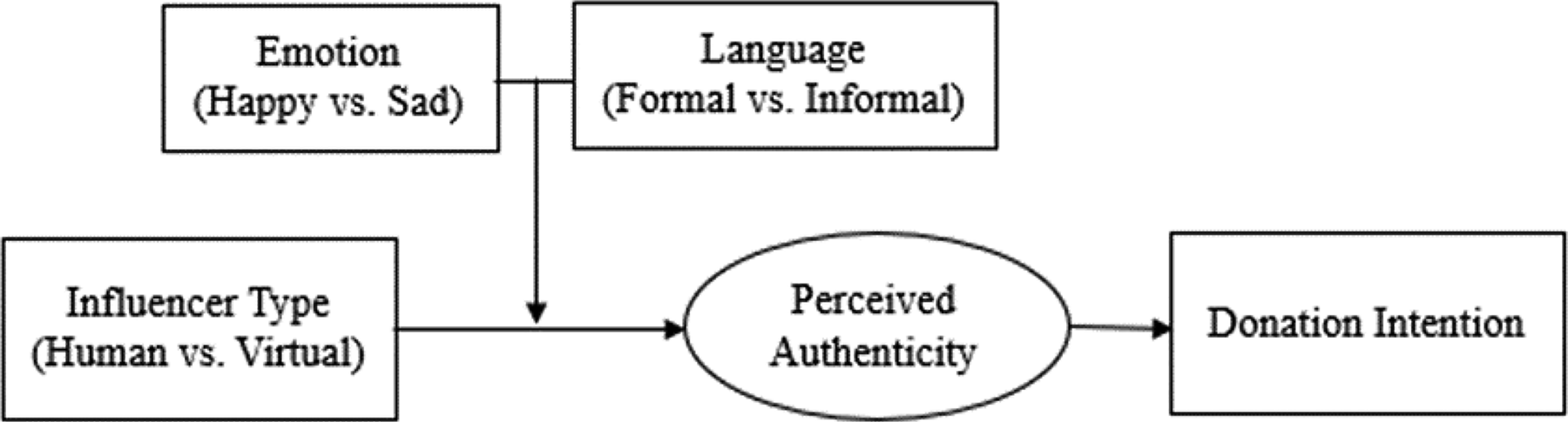
Conceptual model of the proposed moderated moderated mediation framework. The model depicts the indirect effect of influencer type on donation intention through perceived authenticity, jointly moderated by emotional expression and language style.
Methods
Design and participants
We employed a 2 (influencer type: VI vs. HI) × 2 (emotion: happy vs. sad) × 2 (language style: formal vs. informal) between-subjects experimental design. We recruited 400 U.S. adults (native English speakers, ages 18–34) via Prolific. This demographic purposefully aligns with Instagram’s core user base. 23 Participants were randomly assigned to one of the eight conditions (N = 50 per condition).
Stimuli
Stimuli were mock Instagram posts for a children’s welfare charity campaign (see Appendix). To isolate effects, the focal image (children viewed from behind) and beneficiary description detailing urgent aid needs remained constant.
Influencer type
In the VI condition, the influencer was a 25-year-old female CGI character, mirroring prominent real-world VIs (e.g., Lil Miquela, Rozy). In the HI condition, the influencer was a HI matched on gender, age, and general appearance.
Emotion manipulation
Visually, following Kohler et al., 24 the sad influencer featured a bowed head, downward gaze, and downturned mouth, whereas the happy influencer displayed raised eyebrows and a smile. VI expressions were generated via MetaHuman Creator; HI expressions were sourced from a stock image and a stock video. Textually, the sad condition included words like sorrow, distress, and heartbreak; the happy condition used relief, cheer, and zest. 25
Language style manipulation
Adapting protocols from Pfeiffer et al., 22 the formal posts employed standard grammar, an objective tone, and zero slang or contractions. Informal posts utilized colloquialisms (e.g., “legit”), contractions, emotive punctuation (e.g., “!!!”), and interjections (e.g., “OMG”).
Procedure and measures
After providing informed consent, participants were informed that they would view a virtual (or human) influencer’s post. Participants then viewed their assigned stimulus and completed a questionnaire. All measures used 7-point Likert scales (1 = strongly disagree, 7 = strongly agree).
Perceived Authenticity was measured with three items adapted from Lee et al. 12 : “The influencer is genuine,” “The influencer is authentic,” and “The influencer seems real to me” (α = .96). Donation intention was assessed with three items from Ye et al. 26 : “I am willing to make a donation to support these children,” “I intend on making a donation to support these children,” and “I am very likely to make a donation to support these children” (α = .96).
Participants were then debriefed, thanked, and compensated.
Results
Manipulation checks
Because participants were explicitly informed of the influencer’s identity (VI vs. HI) prior to exposure, influencer type was treated as a categorical assignment rather than a psychological manipulation requiring validation. To test if the remaining manipulations were successful, we submitted the manipulation check items to a 2 (emotion: happy vs. sad) × 2 (language style: formal vs. informal) ANOVA.
Confirming the effectiveness of the manipulations, participants in the happy condition reported higher perceived happiness (M = 5.95) than those in the sad condition (M = 1.96), whereas participants in the sad condition reported higher perceived sadness (M = 5.71) than those in the happy condition (M = 1.86), yielding significant main effects on perceived happiness, F(1, 396) = 1171.02, p < 0.001, and perceived sadness, F(1, 396) = 1036.20, p < 0.001. Likewise, participants perceived the formal language condition as more formal (M = 4.55) than the informal condition (M = 2.16), confirming the language style manipulation, F(1, 396) = 310.80, p < 0.001. No emotion × language style interaction effects emerged for happiness, sadness, or formality perceptions (happiness: F(1, 396) = 0.66, p = 0.416; sadness: F(1, 396) = 0.00, p = 1.000; formality: F(1, 396) = 0.85, p = 0.356), indicating successful manipulations without unintended interaction effects.
Descriptive statistics and ANOVA
Table 1 presents descriptive statistics for perceived authenticity and donation intention across conditions. Figure 2 illustrates the three-way interaction pattern for perceived authenticity.
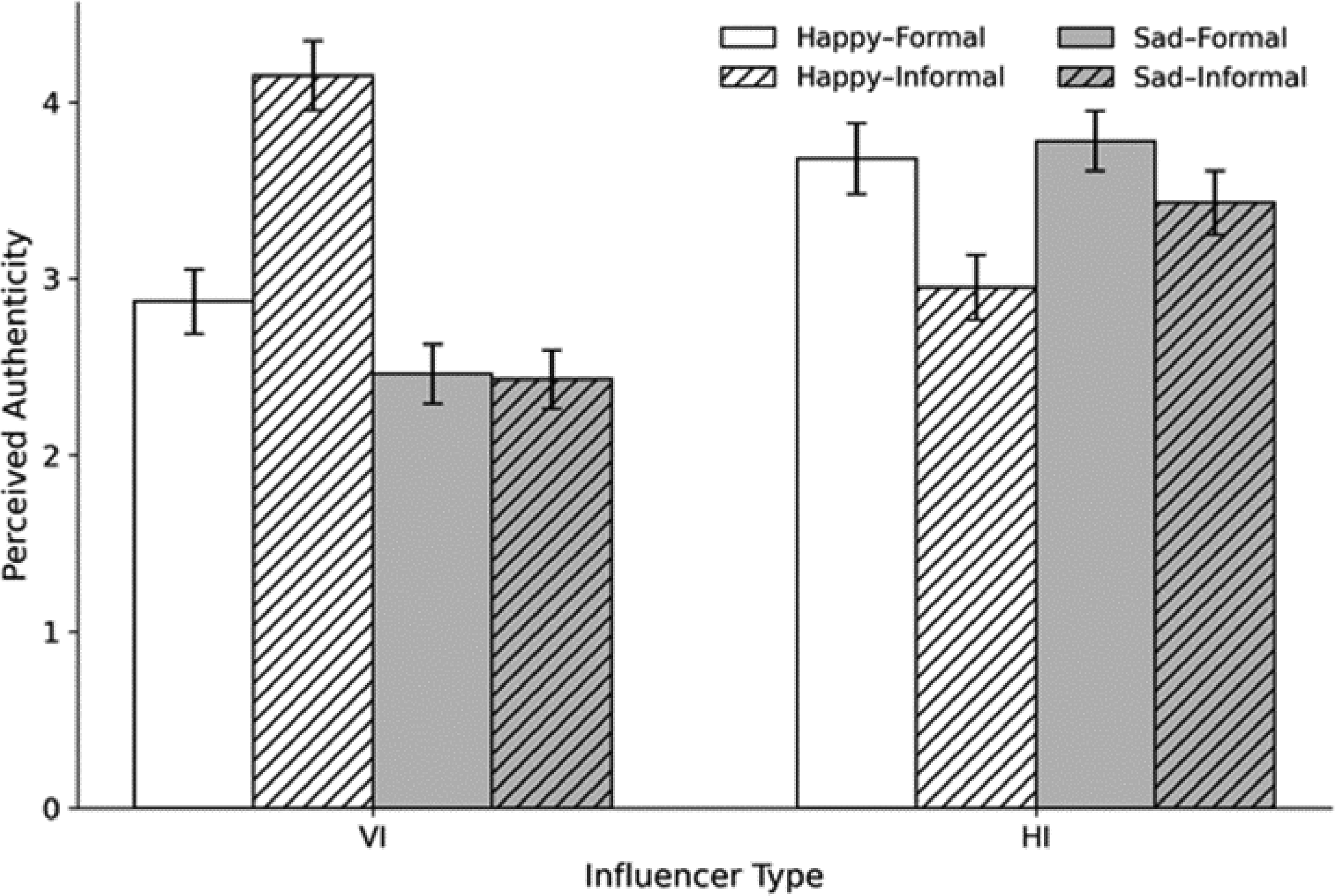
Perceived authenticity as a function of influencer type, emotion, and language style. The figure illustrates the three-way Interaction among influencer type, emotional expression, and language style on perceived authenticity. Error bars represent ± 1 standard error (SE).
Means and Standard Deviations for Perceived Authenticity and Donation Intention by Condition
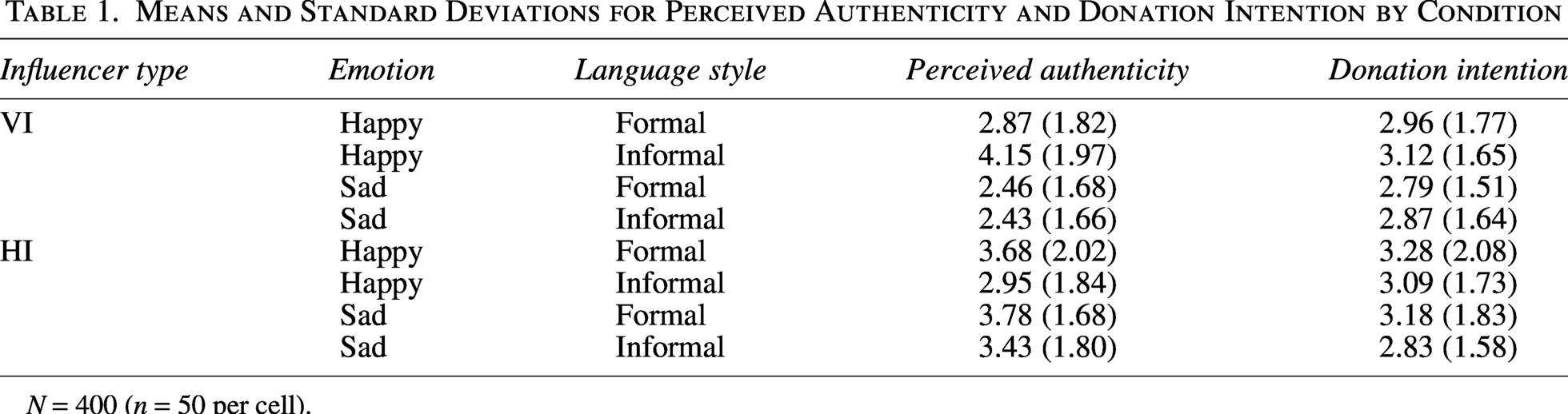
N = 400 (n = 50 per cell).
A 2 (influencer type) × 2 (emotion) × 2 (language style) ANOVA on perceived authenticity revealed significant main effects of influencer type, F(1,392) = 6.97, p = 0.009, ηp2 = 0.017, and emotion, F(1,392) = 4.59, p = 0.033, ηp2 = 0.012, but not language style, F(1,392) = 0.05, p = 0.818, ηp2 = 0.000. HIs were perceived as more authentic (Mhuman = 3.46) than VIs (Mvirtual = 2.98), and happy appeals elicited higher authenticity perceptions (Mhappy = 3.41) than sad appeals (Msad = 3.02). These main effects were qualified by significant influencer type × emotion, F(1,392) = 14.02, p < 0.001, ηp2 = 0.035, and influencer type × language style interactions, F(1,392) = 10.42, p = 0.001, ηp2 = 0.026. Most importantly, the three-way interaction among influencer type, emotion, and language style was also significant, F(1,392) = 5.42, p = 0.020, ηp2 = 0.014
Analysis of Variance Results for Perceived Authenticity
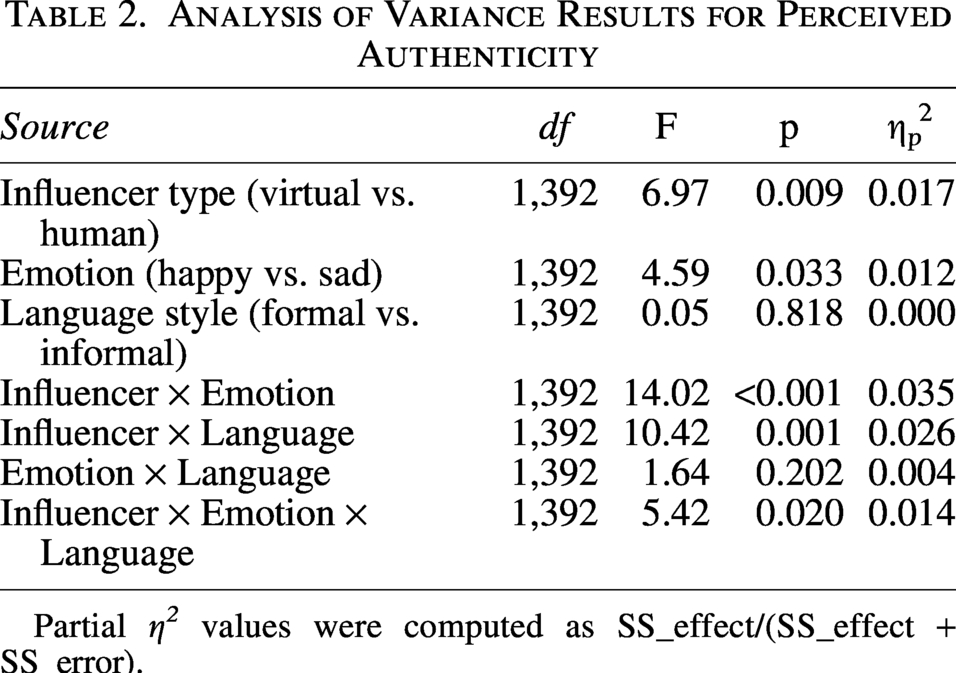
Partial η2 values were computed as SS_effect/(SS_effect + SS_error).
A parallel ANOVA on donation intention yielded no significant main or interactions effects (all ps > 0.26), suggesting that the experimental manipulations did not exert a direct influence on donation intention.
Testing the moderated moderated mediation
Given the significant three-way interaction observed in the ANOVA, testing main effects or partial models risks masking critical contextual heterogeneity. To test the hypothesized conditional indirect effect, we estimated a moderated moderated mediation model (PROCESS Model 11; 5,000 bootstrap samples). 27 Influencer type (1 = VI, 2 = HI) was specified as the independent variable, perceived authenticity as the mediator, donation intention as the dependent variable, emotion (1 = happy, 2 = sad) as the primary moderator, and language style (1 = formal, 2 = informal) as the secondary moderator.
Results confirmed a significant three-way interaction among influencer type, emotion, and language style in predicting perceived authenticity (b = 1.68, p = 0.020). In the outcome model, perceived authenticity positively predicted donation intention (b = 0.46, p < 0.001), whereas the direct effect of influencer type on donation intention was not significant (b = −0.06, p = 0.670).
Importantly, the index of moderated moderated mediation was significant (Index = 0.78, BootSE = 0.34, 95 percent BootCI: [0.12, 1.47]), indicating that the indirect effect of influencer type on donation intention via perceived authenticity depends on the joint configuration of emotion and language style.
Decomposing the conditional indirect effects (see Table 3) reveals a notable perceived authenticity reversal that supports our hypothesis. Consistent with the baseline human authenticity advantage, in three conditions—happy/formal (Effect = 0.37), sad/formal (Effect = 0.61), and sad/informal (Effect = 0.46)—the indirect effects were significantly positive, indicating higher donation intention for HIs than VIs through perceived authenticity. However, this pattern reversed in the Happy/Informal condition, where the indirect effect became significantly negative (Effect = −0.56, 95 percent BootCI: [−0.92, −0.21]), indicating higher donation intention for VIs than HIs via perceived authenticity.
Conditional Indirect Effects of Influencer Type on Donation Intention Through Perceived Authenticity (PROCESS Model 11)
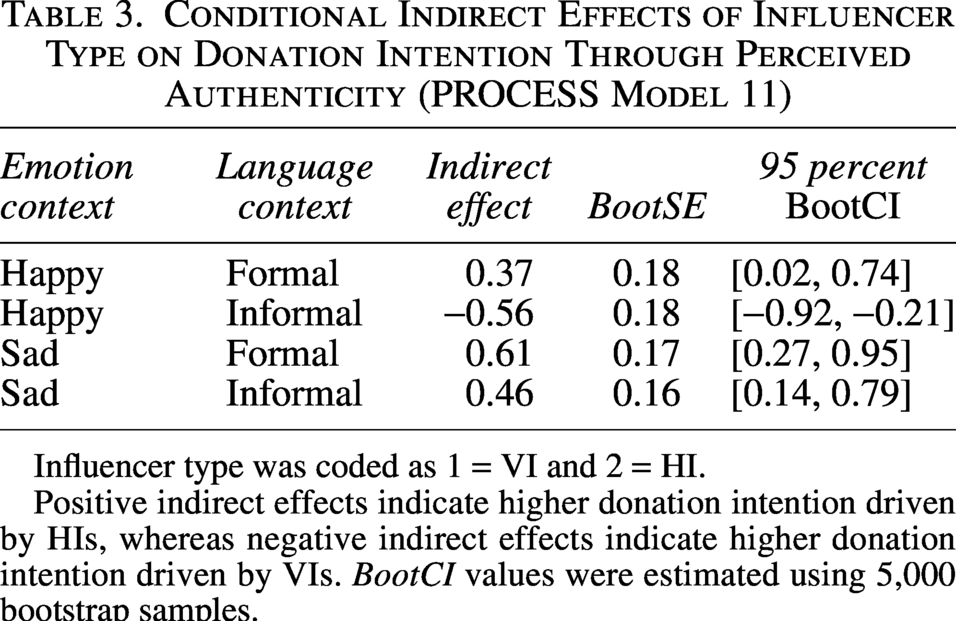
Influencer type was coded as 1 = VI and 2 = HI.
Positive indirect effects indicate higher donation intention driven by HIs, whereas negative indirect effects indicate higher donation intention driven by VIs. BootCI values were estimated using 5,000 bootstrap samples.
Together, these findings support the hypothesis that while HIs maintain a baseline authenticity advantage across most conditions, the happy/informal condition enhances authenticity perceptions for VIs while simultaneously diminishing them for HIs. Under this specific configuration, VIs effectively reverse the typical human advantage, generating higher perceived authenticity, which in turn exerts a favorable indirect effect on donation intention.
General Discussion
This research examined how emotion (happy vs. sad) and language style (formal vs. informal) jointly shape the effect of influencer type on perceived authenticity and donation intention. Our findings reveal a critical asymmetry between HIs and VIs in how these cues influence authenticity perceptions. Consistent with our predictions, HIs generally maintained a baseline authenticity advantage across most emotional–language style conditions, which indirectly increased donation intention. Importantly, however, this advantage was not fixed. When charitable appeals combined happy emotion with informal language, authenticity perceptions shifted in opposite directions across influencer types. For HIs, this highly casual configuration reduced perceived authenticity, likely by undermining the seriousness and sincerity expected in prosocial contexts. For VIs, by contrast, the same configuration enhanced perceived authenticity, ultimately reversing the typical human advantage and producing a favorable indirect effect on donation intention.
Theoretical contributions
This research contributes to two streams of literature.
First, it extends research on emotional appeals in charitable advertising by shifting attention from the beneficiaries’ emotions to the messenger’s emotional expression. Prior studies have largely focused on how victims’ emotion evoke empathy and prosocial response. 17 Our findings demonstrate that influencer-centered emotional appeals constitute a distinct persuasive mechanism in which the messenger’s expressive performance shapes perceived authenticity and downstream donation intentions.
Second, this research advances the emerging VI literature by clarifying how behavioral realism shapes authenticity perceptions for VIs. 5 We found that happy appeals enhanced perceived authenticity and indirectly increased donation intention for VIs only when paired with informal language. When paired with formal language, the positive effect of happiness disappeared. This suggests that informal language functions as behavioral alignment that reduces ontological uncertainty surrounding VIs. More broadly, the findings reveal a structural difference in how authenticity is evaluated for VIs versus HIs. For VIs, authenticity depends heavily on cue congruence and behavioral realism, such that mismatches between human-like appearance and rigid language can trigger perceptions of artificiality. For HIs, however, authenticity appears to depend more on conformity to normative social expectations. Consequently, the same happy-informal configuration that enhanced authenticity perceptions for VIs reduced authenticity perception for HIs in a charitable context.
Practical implications
These findings offer strategic guidance for nonprofit organizations.
For VIs, the path to persuasion is narrow but potent when executed correctly. VIs are most effective when maximizing “social presence” cues—specifically, combining happy emotional framing with an informal, conversational language style. This alignment mitigates perceptions of artificiality and can even allow VIs to outperform HIs in perceived authenticity. In contrast, pairing VIs with sad or highly formal messaging may heighten perceptions of artificiality and indirectly reduce donation intention.
For HIs, authenticity appears more closely tied to normative expectations. Although HIs generally maintain an authenticity advantage in traditional, formal, or emotionally serious appeals, overly casual communication may undermine perceived sincerity in charitable contexts.
Accordingly, organizations should avoid treating VIs and HIs as interchangeable endorsers. HIs may be more effective for serious, formal campaigns such as disaster relief, whereas VIs may be particularly effective for optimistic, community-oriented campaigns that rely on informal platform norms.
Limitations
This study has several limitations that present opportunities for future research. First, the study measured self-reported donation intentions in a hypothetical setting; future research should examine actual donation behavior in field settings. Second, we used a single female influencer to control for extraneous variation. Future research should test whether these effects vary across influencer demographics and types of virtual entities (e.g., anime-style avatars vs. hyper-realistic virtual humans). Third, our stimuli consisted of static Instagram posts. Future research should investigate whether dynamic cues in video content (e.g., Reels, TikToks) alter authenticity perceptions. Fourth, although the study compared virtual and human endorsers, influencer status itself was not directly manipulated through cues such as follower count or reputation. Future research should examine whether these explicit metrics alter the authenticity perceptions or persuasive dynamics observed here. Finally, because the sample consisted of U.S. participants, cross-cultural research is needed to assess the generalizability of these findings.
Conclusion
This research demonstrates that although VIs and HIs can both promote prosocial behavior, they do so through distinct authenticity pathways. HIs generally benefit from a baseline authenticity advantage but may become vulnerable to normative expectation violations when their messaging appears overly casual in charitable contexts. In contrast, the authenticity perception of VIs depends heavily on the alignment of emotional and linguistic cues that enhance behavioral realism. By identifying happy emotion paired with informal language as the condition under which VIs can reverse the typical human authenticity advantage, this study offers both theoretical insight and practical guidance for the use of VIs in digital philanthropy.
Footnotes
Author Disclosure Statement
The authors declare no competing financial interests.
Funding Information
No funding was received for this research.