







Abstract
Parasocial relationships (PRs), one-sided imaginary relationships with media personae, have only recently been explored in the video gaming context, where they appear to influence players’ thoughts and behaviors. They are often assumed to arise from less connection and greater social frustrations in day-to-day life, but this hypothesis has not been empirically tested. Furthermore, no study has considered potential differences in interpersonal difficulties that players with PRs may have compared to those without PRs. The present study addresses these gaps using online data from 584 video gamers (Mage = 24.98, SD = 5.70; 81.6 percent male) recruited from various Reddit gaming communities. Participants completed measures assessing interpersonal difficulties (e.g., vindictiveness, social avoidance, exploitableness, nonassertiveness), satisfaction and frustration needs for competence, autonomy, and relatedness, as well as problematic video gaming (PVG) and video gaming motivations. Results did not support the relatedness frustration stereotype in that players with and without PRs did not differ in connection to others or feeling rejected in their day-to-day life. However, compared to players without PRs, players with PRs report greater interpersonal difficulties. Thus, PRs do not appear to compensate for relatedness frustration. Rather, it may be that individuals with PRs may experience interpersonal difficulties leading them to turn to PRs to fulfill social needs. Additional findings include players with PRs reporting greater hours of video gaming as well as more severe PVG and stronger fantasy gaming motives. These findings are discussed within the context of broader literature, and avenues for further study are provided.
Keywords
Introduction
Videogames have evolved to appeal to a broader, more mainstream audience. By becoming increasingly immersive, and featuring characters with appealing and relatable qualities that also interact with the player, they foster the potential for parasocial relationships (PRs) to develop.1–5 These bonds are central to an engaging and immersive player experience, prompting developers to design believable and responsive characters that players will perceive as friends or romantic partners rather than game mechanics.6,7
Succinctly, PRs are one-sided imaginary relationships (amicable or romantic) that one has with media personae (real or fictional). 8 This phenomenon aligns with the Panksepp-Jakobson hypothesis, which argues that human evolution has not had enough time to adapt to modern media, leading people to respond to media characters with the same affective and behavioral responses as they would to real-life relationships.9–11 Although PRs are not “real,” as long as the individual perceives a meaningful interaction, they will experience the same satisfaction as they would from a “real” relationship. 12 Moreover, PRs can be more influential than weak two-sided relationships, as they are always available and there are no risks involved, such as being rejected. 13 This dynamic may help explain the growing prevalence of romantic relationships with AI programs. 14 While PRs have been studied in various contexts, few studies have explored video game players who report having PRs with video game characters. Research is needed in this specific sample, as studies show that some video game developers specifically craft appealing characters that show romantic interest toward the player,1,3 which may facilitate the development of the PR compared to other forms of traditional media.
Through the stereotype of the “lonely gamer,” it is often assumed that loneliness and lack of social skills are associated with video gaming, which is frequently portrayed as a solitary or escapist activity. 3 This is despite studies having found that socializing with others, either with friends or strangers, is a strong motivator for playing video games. 15 More importantly, although often considered solitary, single-player games can elicit meaningful social responses, as interactions with in-game characters may trigger the same psychological processes akin to real social interactions, 16 suggesting that socialization can occur via PRs.
Having PRs are similarly associated with experiencing social frustrations, as they are assumed to exist as a coping mechanism for unmet social needs. 3 This is despite studies suggesting that PRs are not associated with reduced social interactions but are instead more associated with immediate social needs. 11 Due to the complexity of social variables,17,18 research on this topic is wanting, particularly regarding PRs with fictional characters rather than real-life personae. Overall, research suggests that PRs are not a coping mechanism for individuals lacking social skills or networks to compensate for unsatisfied social needs.12,18–20 Instead, PRs play a complementary role, offering the satisfaction of social needs without the risk associated with relationships.20–22 Nevertheless, research focusing on interpersonal problems rather than loneliness is needed to have a better understanding of the social dynamics of people with PRs with fictional characters. Since studies have found that some individuals resort to gaming to socialize, 15 understanding PRs with fictional characters may require examining not only interpersonal difficulties but also the underlying motivational processes for satisfying social needs.
Findings suggest that the motivations for playing video games and developing PRs may relate to the basic psychological needs (autonomy, competence, and relatedness) from the Self-Determination Theory.23,24 According to this theory, individuals may be drawn to video games because they satisfy these needs by offering players choices, challenges, and social interactions, leading to experiencing wellbeing. 25 Similar psychological need-satisfying motivations may also underlie in-game purchasing behaviors, particularly in games where purchasable content is tied to progression and character engagement. Some games allow the player to spend money to acquire characters they want to use, offering competitive advantages, and allowing the player to interact with them.23,24 In the context of this study, PRs with fictional characters may represent one of the mechanisms through which these gaming-related behaviors become psychologically rewarding. This is based on the fact that studies have linked PRs to longer play sessions and purchase intentions, suggesting that these relationships with fictional characters may drive these behaviors, particularly in games where characters are sold via microtransaction.2,5,26 This is further supported by studies finding that individuals may engage in media consumption as a way to “interact” with the PR, and therefore satisfy their social needs.27,28
Overall, existing research suggests that PRs could influence gaming-related behaviors, such as time spent playing 5 and microtransaction spending. 26 From a social need-seeking perspective, these relationships with fictional characters may represent a psychologically rewarding component of gaming, potentially influencing both interpersonal and gaming-related behaviors. However, little is known regarding whether individuals who develop PRs with video game characters differ from those without a PR in terms of interpersonal problems, gaming motivations, and gaming-related behaviors. This gap is particularly relevant in the context of potentially harmful gaming-related behaviors, such as gaming disorder and in-game gambling through microtransactions like “loot box” and “gacha,” where players pay for a chance to acquire randomized items or characters, 29 particularly in relation to PRs with video game characters.
The exploratory aim of this study is to compare individuals with and without PRs facilitated via gaming across measures of autonomy, competence, relatedness satisfaction and frustration, interpersonal problems, and video gaming motivations and behaviors. By doing so, it seeks to provide evidence-based insights into PRs, challenging existing social biases surrounding them. It is hypothesized that individuals with PRs may report higher relatedness need frustration, higher interpersonal problems, stronger social and fantasy motivations, and higher gaming-related behaviors.
Materials and Methods
Participants and procedure
The Institutional Review Board approved this study prior to data collection. The survey was shared on multiple subreddits from Reddit.com, focusing on mobile games listed in the Sensor Tower Monthly Revenues Report of 2024 for global gacha games. 30 Posting was limited to subreddits where moderators granted approval. This specific sample was selected because it was expected to have a higher prevalence of individuals with PRs with videogame characters while also engaging in gaming and in-game purchases. The survey ended up being posted in 13 subreddits. Data collection occurred from February 6th to February 15th, 2024. Participants received full information about the study before starting the survey and were incentivized with a 1-in-20 chance of winning a one of 15 $10 Amazon gift cards.
A power analysis with G*Power 3.1. indicated a minimum for 428 participants for small-to-moderate (d =.35) effect sizes. Out of 736 initial participants, 37 were excluded for failing attentional checks, 54 for not completing the survey, and 23 for not being older than 18 years old. In addition, 38 participants were excluded because their PR was not with a video game character, therefore not fitting the scope of this study. The final sample included 584 participants (Mage = 24.98, SD = 5.70, 81.6 percent male). Participants reported video gaming an average of 31.53 hours per week (SD = 18.90). Among them, 337 (57.7 percent) spent money on gacha games, and 88 (15.1 percent) spent money on loot boxes within the past year.
Measures
Sociodemographic
Variables such as age, biological sex, hours of gaming per week, and separate questions on whether they have spent money on loot boxes or gacha (0: No; 1:Yes) on the last year were included.
Parasocial relationship
Participants indicated whether or not they had a PR with a fictional character (“It is common for people to have experienced seeing a fictional character as a friend or confidant. Similarly, others have the experience of having a crush, falling in love, or developing romantic interest in a fictional character. Would you say that you currently experience one of these relationships with a fictional character?”). While some scales assess PRs, none focus exclusively on fictional characters, which could have caveats compared to PRs with real personae.8,18 Moreover, social relationships are complex, and using a unidimensional scale to assess its intensity can omit important nuances of PRs. 8 For these reasons, and to create a clearer distinction between those who have a PR and those who do not, a dichotomous approach (0: No; 1:Yes) was adopted.
Interpersonal problems
To assess interpersonal problems, the Inventory of Interpersonal Problems Circumplex scale-Short Form (IIP-SC) 31 was used. This 5-point scale with 32 items consist of 8 independent subscales assessing different types of interpersonal difficulties (Vindictive, Domineering, Cold, Socially Avoidant, Nonassertive, Exploitable, Overly Nurturant, Intrusive). For this study, Cronbach’s alphas were between 0.66 and 0.83.
Basic psychological needs satisfaction and frustration
To assess the satisfaction or frustration of autonomy, competence, and relatedness, the Basic Psychological Need Satisfaction and Frustration scale 32 was used. This 5-point scale with 24 items consists of 6 dimensions assessing the satisfaction and frustration for each of the three psychological needs. Cronbach’s alpha was between 0.78 and 0.88.
Problematic video gaming
The Internet Gaming Disorder 9 Short Form 33 was utilized to measure problematic video gaming (PVG). This 5-point scale with 9 items assesses gaming disorder symptoms. Cronbach’s alpha was 0.84.
Gaming motivations
To assess the possible motivations for gaming, the Videogaming Motives Questionnaire 34 was used. This 5-point scale with 24 items consist of 8 subscales (i.e., Fantasy, Social Interaction, Competition, Violent Reward, Cognitive Development, Customization, Coping, Recreation). Cronbach’s alphas were between 0.71 and 0.82.
Statistical analysis
Data preparations and analyses were conducted in SPSS.29. Comparisons between individuals with and without PRs with a video game character were assessed via a series of independent t-tests with an adjusted alpha using the Bonferroni correction for 27 t-tests, resulting in a corrected threshold (p < 0.00185). Three logistic regression models were then conducted, with Model 1 including non-gaming-related variables, Model 2 including gaming-related variables, and Model 3 including both sets of variables.
Results
Within the present sample, 194 players (33.2 percent) reported having a PR (“PR players”), and 390 players (66.8 percent) reported not having one (“No PR players”). Sex differences between PR players (77.3 percent male) and No PR players (83.3 percent male) were non-significant. Mean ages and scores to interpersonal problems and psychological needs are present in Table 1. Results indicate that PR players experience greater competence frustration, vindictiveness, social avoidant, non-assertiveness, and exploitableness compared to No PR players. No significant differences were found regarding relatedness.
t-Tests for Sociodemographic Characteristics and Non-Video Game Related Variables (Model 1)
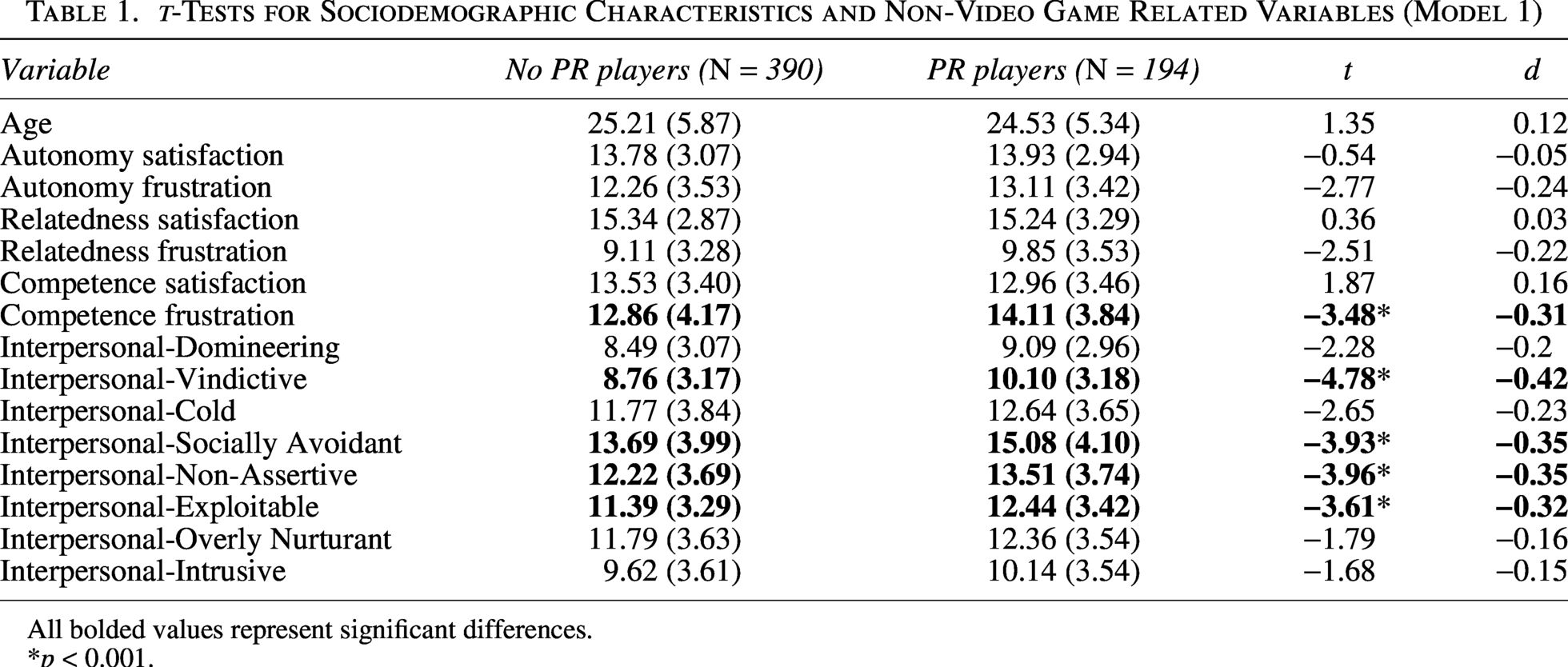
All bolded values represent significant differences.
*p < 0.001.
t-Tests for Video Game Related Variables (Model 2)
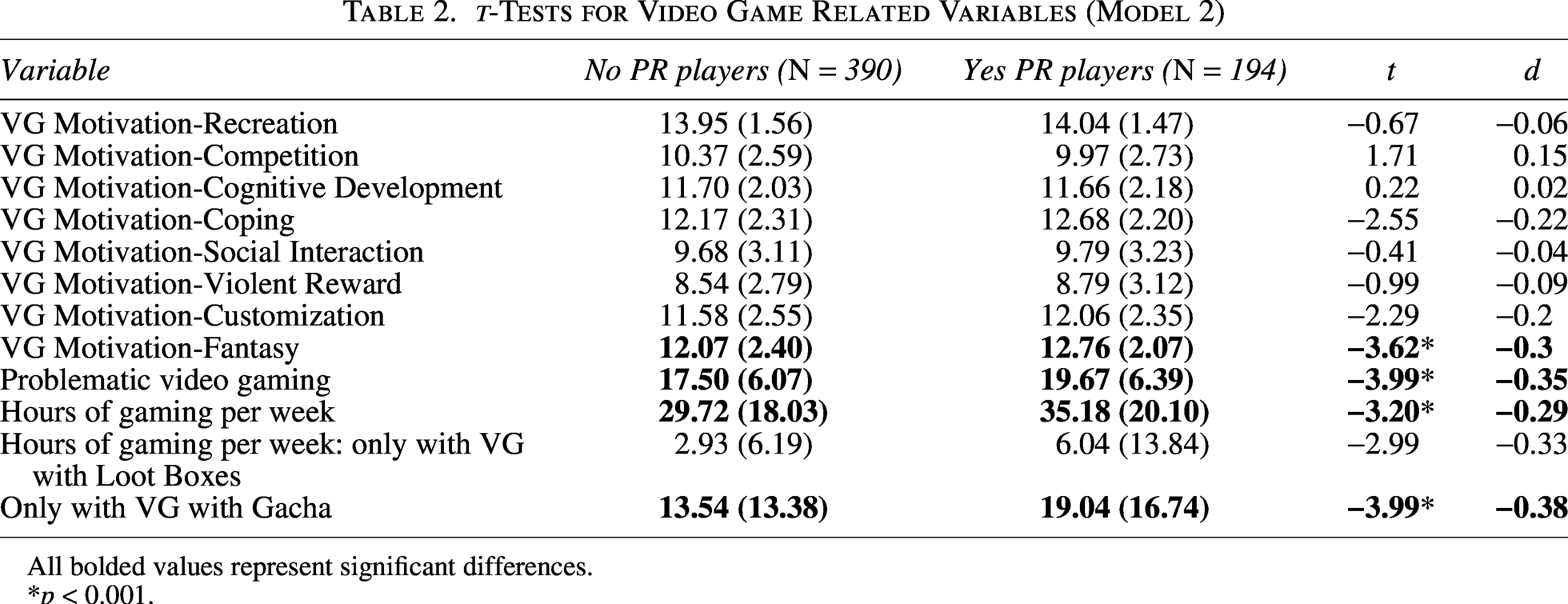
All bolded values represent significant differences.
*p < 0.001.
Regarding video gaming differences (Table 2), PR players reported significantly higher fantasy motivation, hours of gaming per week, both overall and with gacha games, and PVG. No significant differences were found regarding having spent on loot boxes (no PR players: 13.6 percent; PR players: 18.0 percent) and gacha (no PR players: 55.6 percent; PR players: 61.9 percent).
Logistic regression was conducted to examine predictors of having a PR. All three models demonstrated good fit (Table 3). As shown in Table 4, only vindictiveness was significant when only using non-gaming variables. When controlling gaming-related variables, fantasy motivation, PVG, and hours spent playing gacha games were significant. Notably, when using both sets, PVG was no longer significant, while socially avoidant became significant.
Hosmer-Lemeshow Test Fit Indices and R-Squared of Models

M1: Non-gaming variables; M2: Gaming variables; M3: Both variables.
Logistic Regression Results Using No Parasocial Relationship as Reference
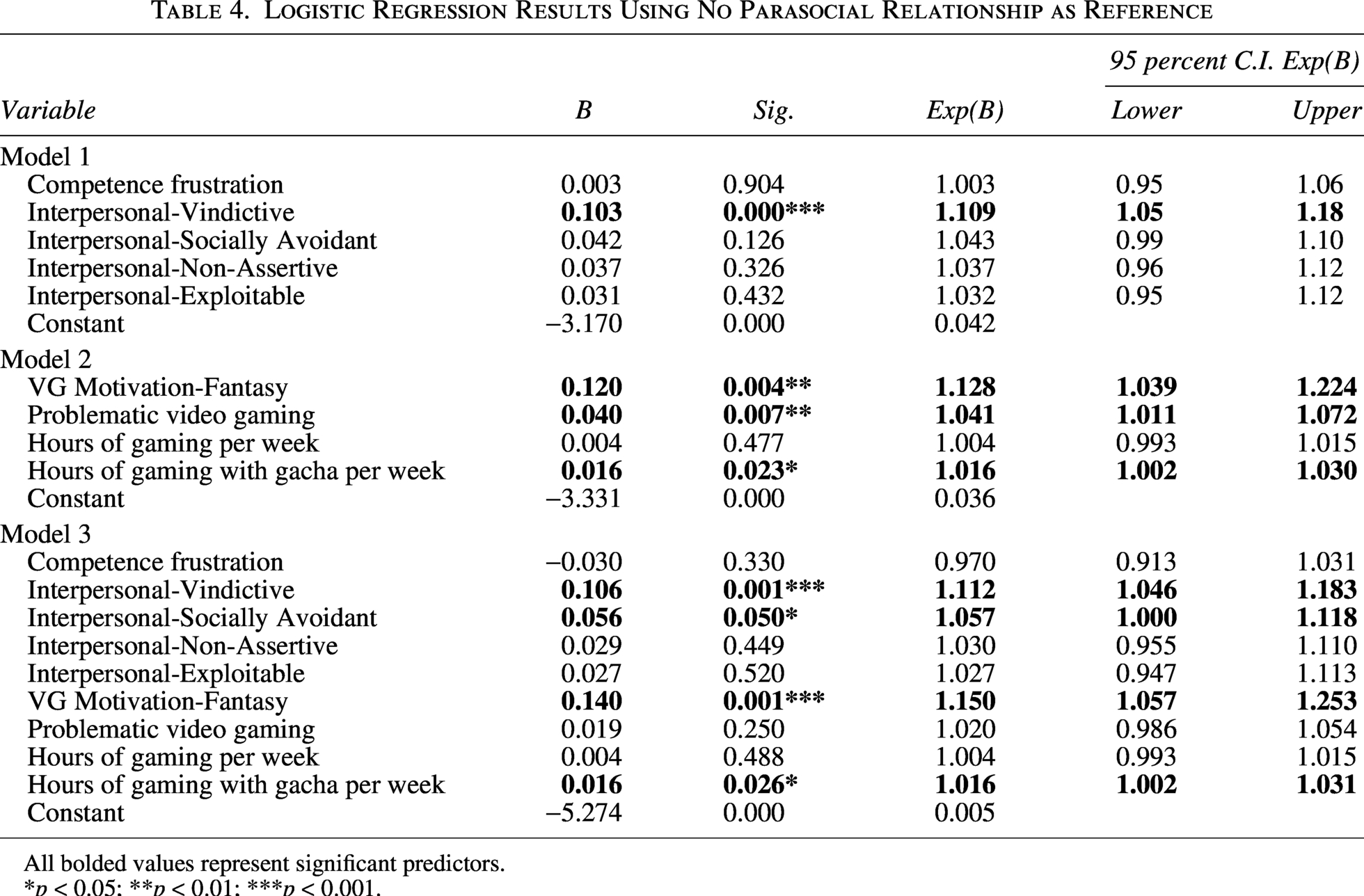
All bolded values represent significant predictors.
*p < 0.05; **p < 0.01; ***p < 0.001.
Discussion
The immersive nature of video games can foster the development of psychologically meaningful PRs with fictional characters. However, this remains an underexplored area of research, as its relationships with gaming-related behaviors and interpersonal behaviors remain unclear. While stereotypes portray gamers or individuals with PRs as having lower social satisfaction, studies generally do not support this perspective. The current exploratory study is the first to compare individuals with and without PRs with video game characters in terms of psychological needs, interpersonal problems, and gaming behaviors.
Regarding the sociodemographic variables, there were no differences between those who have and do not have a PR regarding age or sex. For the latter, this may have been influenced for the significantly higher proportion of male participants in each subsample. Likewise, the significantly higher proportion of individuals without a PR may have also affected the other results.
Regarding the satisfaction/frustration of psychological needs (autonomy, competence, relatedness), only competence frustration was significantly higher for the PR players, whereas none of the satisfactions were significantly different between the groups. This may be due to individuals with PRs perceiving their environment as undermining their abilities, partly due to the stereotype of people with PRs of not being productive members of society. 35 Furthermore, PRs can provide a sense of vicarious achievement when the character they are attached to succeeds, offering a way to compensate personal frustrations with success.3,36 Notably, neither relatedness satisfaction or frustration was significantly different between the two subsamples, despite stereotypes suggesting that those with a PR have fewer social connections or higher social frustrations, facilitating the development of PRs. 11 This suggests that individuals with PR do not necessarily experience higher social frustrations. Rather, the stereotype that they lack social ties may stem from social interaction difficulties, which does not necessarily imply relatedness frustration, and could explain why they may prefer PRs when socializing is difficult.
Regarding interpersonal problems, vindictive behaviors were significantly higher in the PR group and were also predictive of having PRs. One possible explanation is that individuals prone to vindictiveness struggle with trust, harbor resentment, and have difficulty offering emotional support. These difficulties can hinder social interactions, which may lead to resort to PRs as they offer an idealized relationship they can control.13,37
As for being socially avoidant, which found similar results, this may be linked to traits like social anxiety, a known predictor for engaging in PRs.2,12,38 The fear of social rejection and discomfort in social situations can make it challenging to form relationships in the real world, which could motivate individuals to engage with PRs as a safer alternative.18,39
While nonassertive and exploitable traits were not predictive of having a PR, participants who reported having one reported higher scores. These traits may reflect negative self-perceptions, low self-esteem, and perceiving oneself as unworthy of love and attention, leading to codependent tendencies driven by fear of abandonment.13,40 Therefore, they may resort to PRs, which offer a secure relationship with minimal risk of abandonment.
For the gaming-related variables, PR players reported significantly higher gaming frequencies, particularly with gacha games, as well as PVG, both of which were also predictors. As previously mentioned, video games can foster emotional relationships with fictional characters through immersive experiences and virtual interactions specifically designed to facilitate these bonds by making characters attractive, relatable and directly interactive with the player.2,3,5 Furthermore, and as studies suggest,27,28 video gaming and in-game purchases can be perceived as a way to “interact,” or socialize, with the character of the PR, which in turn may increase playtime, potentially reaching harmful levels. However, PVG was no longer significant when accounting for interpersonal factors. These findings may suggest that PVG is not inherently characteristic of individuals with PRs but may instead be better explained by broader interpersonal factors.
Notably, gaming frequency was only significant if they involved gacha games, which include in-game purchases. This suggest that these microtransaction may be more strongly associated with having a PR as a psychologically motivated behavior compared to video gaming, as developers focus on socioemotional aspects for monetization models. 41 This may be because gacha is typically implemented in games that focus on players forming emotional bonds with fictional characters.27,42 Of note, different results also emerged for gacha and loot boxes despite being almost identical microtransaction mechanics. However, this also may be a consequence of participants being recruited from forums about games featuring gacha, which could indicate a higher engagement with this microtransaction in comparison to loot boxes. Future studies could explore if there are significant differences between these two microtransactions.
Lastly, the fantasy motivation, defined as playing for the immersion in the gaming world and its characters, was the only gaming motivation that significantly differed between groups, being higher for the PR group. This aligns with the nature of PRs, which are one-sided relationships that consist of imaginary interactions with media personae.9,20,43 Therefore, individuals with higher levels of fantasy may experience stronger emotional engagement with fictional characters through video gaming, which in turn can facilitate the development, or strengthen, the PR. 40
Conclusion
These findings challenge the common stereotype that individuals with PRs with video game characters have higher social frustrations. Instead, having a PR appears to be associated with specific interpersonal difficulties in navigating social interactions rather than general loneliness or social frustration. By offering a controlled and emotionally engaging way to interact with fictional characters, PRs may act as a complement for social interactions, and also influence gaming behaviors, including playtime and in-game spending, without reflecting deficits in social networks. However, this may also drive gaming-related behaviors to harmful levels, suggesting the double-edged nature of PRs. These findings also suggest that PRs may be more closely related to broader interpersonal and motivational processes, particularly in gaming contexts where emotional engagement with characters is intertwined with gameplay and monetization systems. These insights underscore the importance of considering social dynamics and psychological traits, rather than relying on oversimplified stereotypes, when examining PRs in the video gaming context.
The limitations of the study include a low sample of people who report having a PR, the survey being shared in forums that focus on video games that feature gacha, and the use of self-report measures, so bias can be expected. Likewise, the study was cross-sectional, and the sample was predominantly male (81.6 percent), which warrants caution in the generalizability of the findings. Measuring PRs dichotomously may have limited detection of nuanced effects, underscoring the need for a scale specifically designed for parasocial relationship with fictional characters with a multifactor structure that distinguished the different types of PRs, which may yield more nuanced results. Future studies should focus on studying more the associations between PRs and in-game spending and other social variables (e.g., social anxiety). Likewise, future studies could analyze if individuals resort to PRs to satisfy social needs due to difficulties in engaging in social interactions.
Authors’ Contributions
All authors confirm they have met the criteria for authorship and have approved the final version of the article.
Footnotes
Author Disclosure Statement
No competing financial interests exist.
Funding Information
No funding was received for this article.