






Abstract
The rise of generative artificial intelligence (GAI) has expanded the landscape of cyberbullying, necessitating an examination of the psychological and demographic factors underlying these behaviors. This two-wave longitudinal study (N = 1,019) investigated the associations between Dark Tetrad, gender, age, and GAI-involved cyberbullying (GAICB) over a 6-month interval. Hierarchical linear regressions indicated that psychopathy and male gender were longitudinal predictors of GAICB at Time 2, even after controlling for baseline behaviors at Time 1. While sadism was significant in the baseline model, its effect became nonsignificant after accounting for prior GAICB. Machiavellianism, narcissism, and age showed no significant effects. These results suggest that psychopathy and gender may be associated with AI-driven aggression, warranting further research into targeted prevention strategies.
Introduction
Generative artificial intelligence as a facilitator of cyberbullying
Cyberbullying has emerged as a critical issue that increasingly attracts the attention of educators and mental health professionals. 1 Victims of cyberbullying often suffer severe emotional and psychological consequences, including anxiety, depression, and diminished self-esteem. Olweus 2 defines cyberbullying as bullying behavior carried out through electronic means such as email, instant messaging, chat rooms, websites, or mobile text messaging. Typically regarded as an unacceptable form of aggression, cyberbullying involves perpetrators intentionally causing harm to others via social media platforms, instant messaging, online games, and other digital communication technologies.3,4 Historically, the scale of such cyberbullying was often constrained by the perpetrator’s cognitive bandwidth, temporal resources, and technical proficiency. Traditional cyberbullying relies heavily on the active engagement of the perpetrator, who sets conversational traps and monitors the victim’s emotional responses to derive sadistic pleasure.5,6
However, the growing accessibility of modern generative artificial intelligence (GAI) tools—such as ChatGPT, Claude, Midjourney, and Sora—appears to lower many of these conventional barriers, potentially transforming this emerging form of aggression from a primarily manual endeavor into a more scalable and automated risk. 7 In the past, specific forms of cyberbullying (e.g., fabricating hyper-realistic forged images) required specialized technical skills. 8 GAI can substantially reduce these prerequisites, enabling perpetrators to generate deceptive or harmful content more rapidly and efficiently. 8 For instance, individuals can now employ deepfake technologies to fabricate compromising media to shame or defame victims, or utilize conversational AI to mass-produce harmful rumors. 7
This shift in technological accessibility may present new opportunities for malicious actors. A comprehensive qualitative study involving 43 Trust and Safety experts across domains such as child safety, hate and harassment, and violent extremism identified this lowered barrier to entry as one of the mechanisms of AI empowerment for perpetrators. 9 The widespread availability and intuitive, conversational interfaces of GAI tools allow users with limited technical proficiency to potentially create and propagate harmful material. This phenomenon is highlighted by research examining the capabilities of publicly available large language models. Studies have demonstrated that models such as GPT-4o, Gemini, Claude, and DeepSeek can be manipulated to assist individuals with minimal experience in engaging in sophisticated cyberbullying. 10
Consequently, GAI empowers perpetrators by facilitating cyberbullying with reduced manual effort and increased scalability. To address this emerging threat, it is essential to understand how aversive personality traits drive individuals to engage in GAI-involved cyberbullying (GAICB).
Dark Tetrad
Barlett et al. 5 conducted a meta-analysis of 211 studies, finding that after controlling for traditional bullying, dark personality traits were uniquely associated with cyberbullying perpetration rather than victimization. The Dark Tetrad comprises Machiavellianism, narcissism, psychopathy, and sadism. 11 Prior research has consistently demonstrated strong associations between these traits and various forms of cyberbullying.12–14 Although these traits share antisocial tendencies and beliefs, they differ in expression and mechanisms, prompting many researchers to examine them separately.15,16 Individuals high in psychopathy are particularly prone to cyberbullying due to deficits in empathy and impulse control. 17 Narcissists may retaliate against perceived ego threats by attacking others, while Machiavellians tend to strategically manipulate others to serve personal interests. 14 Sadistic individuals derive pleasure from inflicting pain and have been identified as robust predictors of antisocial behaviors in online settings.18,19 In particular, sadists often exploit the anonymity and psychological distance of digital environments to inflict verbal and behavioral harm without remorse. 20
Demographic variables
Beyond personality traits, this study examines demographic variables due to their practical utility. Unlike psychological constructs, demographics are easily accessible through institutional records, making them invaluable for educators and practitioners to identify at-risk individuals without extensive psychometric testing.
The first variable of interest is gender. Research on face-to-face bullying has consistently shown that boys tend to engage in bullying behaviors more frequently than girls, 21 with male aggression more often taking a direct form, while girls are more likely to employ indirect forms of aggression. 22 Because cyberbullying can involve indirect, relational, or technologically mediated aggression, some studies have reported higher involvement among girls.6,23 Although certain studies support this hypothesis (e.g., Kowalski and Limber 23 ) other research has found no significant gender differences in cyberbullying involvement (e.g., Smith and colleagues24–26). Therefore, gender was included as a demographic predictor in the present study since prior research suggests that gender may be associated with cyberbullying involvement in complex and context-dependent ways.
The second variable is age. Research on traditional bullying shows that prevalence rates tend to peak during middle school, as youth strive to establish their place within the social hierarchy. 27 Similarly, cyberbullying is particularly common among minors, especially children and adolescents. 28 A meta-analysis of 131 studies, most of which involved participants between the ages of 10 and 18, found that the likelihood of engaging in cyberbullying increases with age. 6
Present study
While the link between Dark Tetrad and traditional cyberbullying is well-established, research on GAICB remains scarce. It is unclear whether these personality traits retain their predictive validity within this novel technological landscape. To address this gap, we employed a two-wave longitudinal design with a 6-month interval. At Time 1 (T1), we assessed demographics (gender and age) and Dark Tetrad; GAICB was measured at both T1 and T2 to account for behavioral stability. Using hierarchical regression, we first identified predictors of T2 GAICB and subsequently controlled for T1 GAICB to evaluate their incremental predictive power. Specifically, this study addresses the following research question: After accounting for longitudinal stability, do demographics and Dark Tetrad uniquely predict GAICB at Time 2?
Methods
Participants and procedure
Data were collected via a convenience sampling method through the Chinese social media platform WeChat from participants in Mainland China. Individuals were invited to complete two identical online surveys administered through Tencent Questionnaire, a professional survey platform. This anonymous online survey format provided participants with a private environment that reduces the interpersonal pressure to provide socially acceptable answers compared to face-to-face settings. Prior to participating, all individuals provided informed consent, which explicitly guaranteed the confidentiality of their responses and clarified that the data would be used strictly for academic research purposes. These procedural safeguards could reduce social desirability bias when assessing sensitive antisocial behaviors. The first wave of data collection occurred between December 6 and December 30, 2024. The second wave was administered 6 months later, between June 6 and June 30, 2025. At the end of the first wave, participants were asked to provide their mobile phone numbers for follow-up contact. The second-wave survey was distributed via text message. Participation in both surveys was voluntary and compensated. The study received approval from the University Research Ethics Committee for Human Subject Protection and was conducted in accordance with ethical research guidelines.
A total of 1,019 participants completed the first wave of the survey, including 744 females (73.0 percent) and 275 males (27.0 percent). Participants ranged in age from 16 to 52 years, with a mean age of 23.58 years (SD = 4.06). Regarding educational background, most participants were undergraduates (n = 734, 72.0 percent), followed by those with a graduate degree or higher (n = 159, 15.6 percent), junior college education (n = 103, 10.1 percent), and high school or below (n = 23, 2.3 percent).
Of the original 1,019 participants, 514 (50.4 percent) completed the second wave of the survey. This longitudinal sample consisted of 116 males (22.6 percent) and 398 females (77.4 percent), with ages ranging from 16 to 43 years (M = 23.59, SD = 3.77). The educational distribution—comprising high school or below (0.4 percent), junior college (7.8 percent), undergraduate (72.8 percent), and graduate degrees or higher (19.1 percent)—demonstrates that the follow-up sample remained demographically consistent with the baseline population. Although a follow-up rate of 50 percent is generally considered adequate, with 60 percent regarded as good, 29 achieving such retention levels is often challenging in longitudinal cohort studies. 30 For example, the Malaysian Cohort study reported a follow-up rate of only 42.7 percent, illustrating that substantial attrition is not uncommon in long-term follow-up research. 30
To address missing data due to attrition, we used missForest, a nonparametric imputation method based on the Random Forest algorithm. This approach can accommodate nonlinear relationships and interactions among variables and has been shown to perform competitively with other modern imputation techniques. In the present study, missForest was used to retain the full baseline sample and reduce information loss associated with listwise deletion. However, given the substantial attrition from Time 1 to Time 2, imputation should be viewed as a sensitivity-enhancing strategy rather than a complete remedy for missing data. Comparative evaluations have demonstrated that missForest performs competitively with other modern imputation techniques. 31 Meanwhile, the validity of imputed values depends on the extent to which missingness can be explained by observed variables, and the possibility of attrition-related bias cannot be ruled out.
Data analysis
Data analysis was conducted in R (version 4.4.2). We performed confirmatory factor analysis (CFA) to assess model fit based on several indices recommended by Hair et al. 32 : Comparative Fit Index (CFI; ≥0.90), Root Mean Square Error of Approximation (RMSEA; ≤0.07), and Standardized Root Mean Square Residual (SRMR; <0.08). Internal reliability was examined via Cronbach’s alpha. Hierarchical linear regression was then employed to test the research hypotheses. To address potential multicollinearity, we monitored the variance inflation factor (VIF), with values below 10 indicating no serious multicollinearity issues. 32
Measures
Dark Tetrad
The Dark Tetrad was assessed using the Super-Short Dark Tetrad Scale (SSD4), a 16-item instrument measuring Machiavellianism, narcissism, psychopathy, and sadism, with four items per subscale. 33 Participants responded to a series of self-descriptive statements using a 5-point Likert scale ranging from 1 (strongly disagree) to 5 (strongly agree). The 5-point response format was retained because both the original Short Dark Tetrad and the validated Chinese SSD4 used this format. Maintaining the original response structure helped preserve consistency with prior validation evidence and avoided introducing an unvalidated modification to the instrument. CFA supported the four-factor structure. The fit indices were acceptable: χ2(98) = 581.644, p < 0.001, χ2/df = 5.93, CFI = 0.901, RMSEA = 0.070, SRMR = 0.071. Internal consistencies (Cronbach’s α) were 0.664 (Machiavellianism), 0.788 (narcissism), 0.821 (psychopathy), 0.715 (sadism), and 0.786 (overall), respectively.
GAI-involved cyberbullying
GAICB was assessed using an adapted version of the Cyberbullying Offending Scale developed by Hinduja and Patchin. 34 The adaptation did not alter the core behavioral content of the original items; instead, each item was revised to explicitly incorporate the use of GAI. For example, the original item “I posted a mean or hurtful picture online of someone” was modified to reflect the involvement of GAI tools. The revised version read: “I used GAI (e.g., Sora, DeepBrain Fusion, Runway) to create or modify a mean or hurtful picture of someone and post it online.”
The adaptation process was carried out through collaborative discussions among a panel of three doctoral students and two doctoral-level researchers in education and psychology, all with prior experience in GAI applications. The goal was to preserve conceptual fidelity to the original scale while integrating realistic scenarios reflecting current technological trends. The final scale consisted of eight items, each describing a specific cyberbullying behavior involving high-tech tools—such as using DeepSeek to generate automated rumors, Midjourney or Sora to create deepfakes, and Claude to architect defamatory web pages. These scenarios highlight how GAI lowers the technical barriers for producing deceptive and harmful content.
Participants were asked to report how often they had engaged in each behavior over the past 30 days, using a 4-point Likert scale ranging from 0 (never) to 3 (many times). Sample items included “I used GAI to generate and post insulting or hurtful comments about someone,” “I created or modified images using GAI to humiliate someone,” and “I spread false or malicious rumors about someone using GAI-generated content.” Together, the items capture a range of GAI-related cyberbullying behaviors, including the generation of harmful text, images, videos, and webpages intended to damage others’ reputations or induce fear and psychological distress. CFA supported a one-factor structure. Although some indices were marginal, the overall model fit was considered acceptable: χ2(14) = 120.881, p < 0.001, χ2/df = 8.63, CFI = 0.980, RMSEA = 0.087, SRMR = 0.021. The Cronbach’s alpha was 0.935.
Results
Descriptive statistics
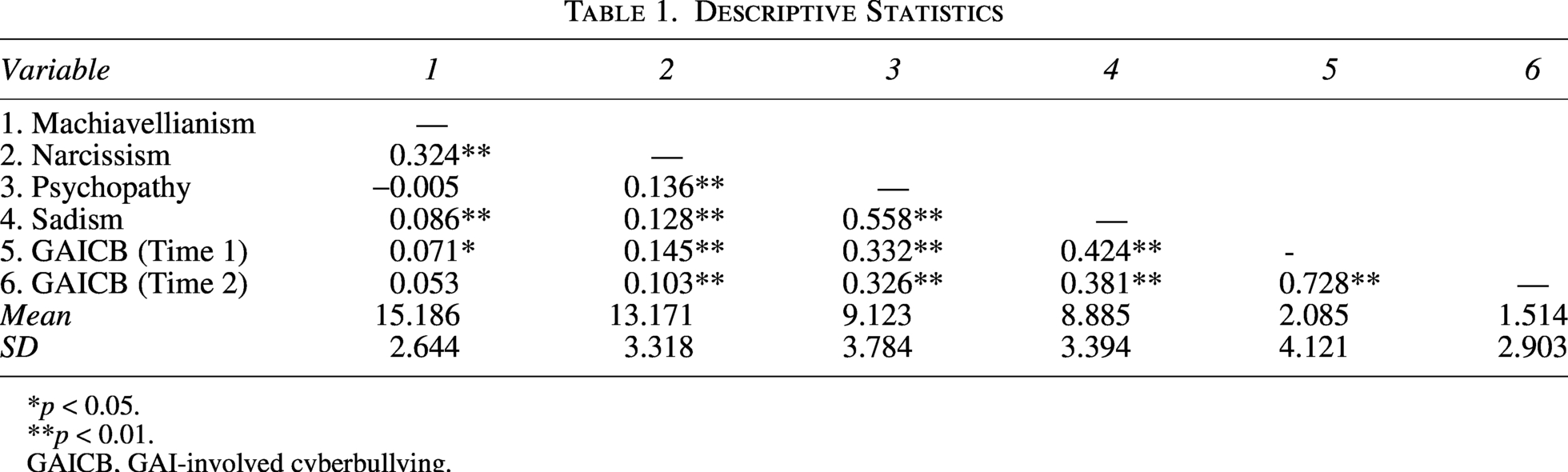
Table 1 presents the correlations among the study variables. Machiavellianism was significantly and positively correlated with narcissism (r = 0.324, p < 0.001) and sadism (r = 0.086, p < 0.01), but showed no significant association with GAICB at Time 2 (r = 0.053, p = 0.088). Narcissism was significantly related to psychopathy (r = 0.136, p < 0.001), sadism (r = 0.128, p < 0.001), GAICB at Time 1 (r = 0.145, p < 0.001), and GAICB at Time 2 (r = 0.103, p < 0.01). Psychopathy showed strong positive correlations with sadism (r = 0.558, p < 0.001) and was significantly associated with GAICB at both Time 1 (r = 0.332, p < 0.001) and Time 2 (r = 0.326, p < 0.001). Similarly, sadism was significantly correlated with GAICB at Time 1 (r = 0.424, p < 0.001) and Time 2 (r = 0.381, p < 0.001). Finally, GAICB at Time 1 was strongly associated with GAICB at Time 2 (r = 0.728, p < 0.001), indicating good test–retest reliability of the measure over the 6-month interval.
Descriptive Statistics
*p < 0.05.
**p < 0.01.
GAICB, GAI-involved cyberbullying.
Hierarchical linear regression
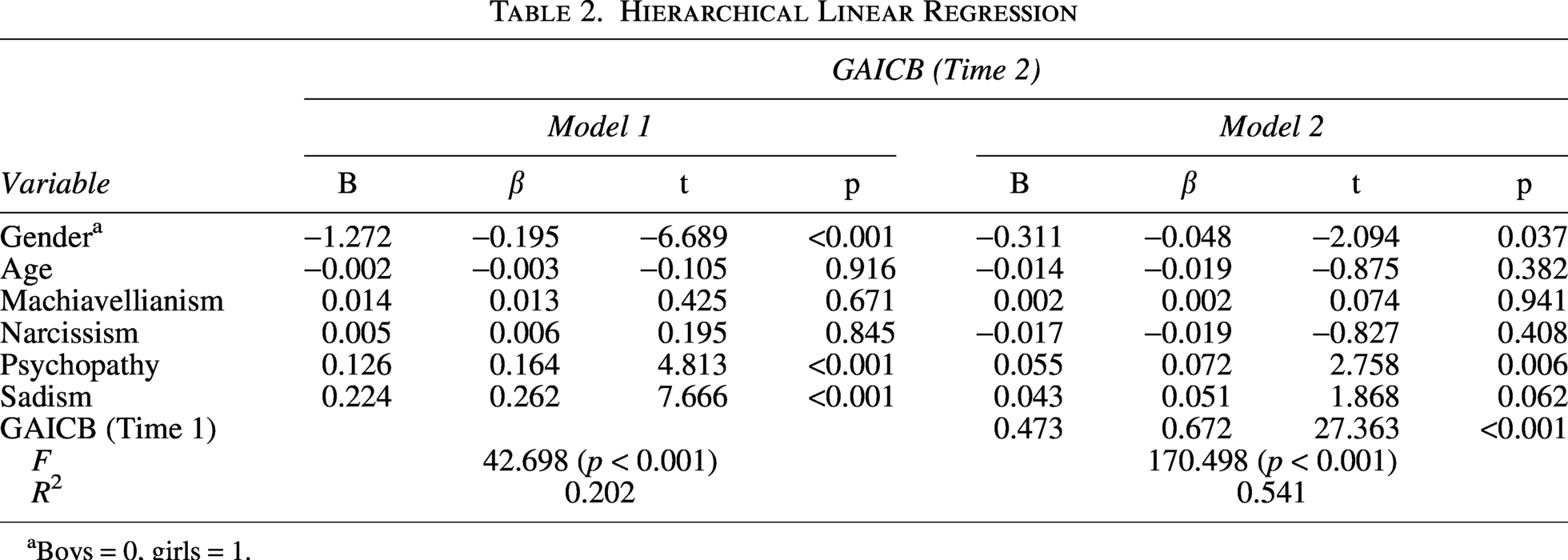
As shown in Table 2, the hierarchical linear regression analyses were conducted to examine the predictors of GAICB at Time 2.
Hierarchical Linear Regression
aBoys = 0, girls = 1.
Model 1 included demographic variables (gender and age) as well as the four Dark Tetrad. The model was statistically significant (F = 42.698, p < 0.001), accounting for 20.2 percent of the variance in GAICB (R2 = 0.202, adjusted R2 = 0.197). VIF values ranged from 1.057 to 1.618, all well below the conventional threshold of 10, indicating no concerns regarding multicollinearity.
Within Model 1, gender emerged as a significant predictor (B = −1.272, β = −0.195, p < 0.001), suggesting that males were more likely to engage in GAICB than females. Regarding the Dark Tetrad, psychopathy (B = 0.126, β = 0.164, p < 0.001) and sadism (B = 0.224, β = 0.262, p < 0.001) were both significant positive predictors of GAICB. In contrast, Machiavellianism (B = 0.014, β = 0.013, p = 0.671), narcissism (B = 0.005, β = 0.006, p = 0.845), and age (B = −0.002, β = −0.003, p = 0.916) were not significant predictors.
Model 2 further incorporated GAICB at Time 1 as a control variable. The inclusion of this autoregressive predictor substantially increased the explanatory power of the model (F = 170.498, p < 0.001), with R2 rising to 0.541 (adjusted R2 = 0.537). Consistent with expectations, GAICB at Time 1 strongly predicted GAICB at Time 2 (B = 0.473, β = 0.672, p < 0.001). After controlling for prior GAICB, the effects of gender (B = −0.311, β = −0.048, p = 0.037) and psychopathy (B = 0.055, β = 0.072, p = 0.006) remained statistically significant, albeit weaker than in Model 1. Sadism (B = 0.043, β = 0.051, p = 0.062) no longer reached conventional levels of statistical significance, although it approached the 0.05 threshold in the presence of the autoregressive control. Machiavellianism, narcissism, and age continued to show no significant effects. VIF values for Model 2 ranged from 1.057 to 1.618, again confirming that multicollinearity was not a concern.
Together, these findings highlight that while psychopathy and sadism were initially strong predictors of GAICB at Time 2, the stability of GAICB over time accounted for the majority of the variance, attenuating the predictive power of sadism but leaving psychopathy and gender as significant predictors.
Discussion
This longitudinal study aimed to investigate the associations between Dark Tetrad, demographic factors, and engagement in GAICB. As GAI technologies become increasingly accessible, understanding the psychosocial factors underlying their misuse for cyberbullying is both timely and necessary. The findings offer valuable insights into how specific Dark Tetrad contribute to GAI-facilitated online aggression.
Dark Tetrad and GAICB
Our findings reveal that not all Dark Tetrad are equally implicated in GAICB. Specifically, psychopathy consistently emerged as a significant predictor across models, whereas sadism showed a strong effect initially but lost its significance once prior levels of GAICB were taken into account. These findings contribute to the literature by showing that established predictors of cyberbullying do not operate uniformly in the emerging context of GAI-facilitated aggression.
Individuals high in psychopathy—marked by impulsivity, emotional detachment, and lack of empathy 11 —were especially relevant in GAICB because GAI lowers the behavioral friction involved in producing harmful content. Compared with traditional cyberbullying, which often requires the perpetrator to manually craft messages or repeatedly interact with victims, GAI can rapidly generate insulting comments, defamatory rumors, humiliating images, or other harmful content. This accessibility may make it easier for individuals high in psychopathy to convert aggressive impulses into online behavior. Moreover, GAI-mediated content creation may increase psychological distance from the victim, further reducing the empathic inhibition that might otherwise discourage harmful behavior.
By contrast, sadism, characterized by deriving pleasure from others’ suffering, 20 was a strong predictor of GAICB in the baseline model but became only marginally nonsignificant (p = 0.062) after accounting for prior GAICB. One interpretation is that sadism may be more closely associated with initial involvement in GAICB than with changes or maintenance over time. This possibility is theoretically plausible because GAI tools can intensify the victim’s humiliation or distress through realistic synthetic media, impersonation, or scalable defamatory content. Such affordances may be attractive to individuals who derive pleasure from others’ suffering. However, once prior GAICB was included in the model, sadism no longer explained unique variance beyond behavioral stability.
The nonsignificant effects of Machiavellianism and narcissism should also be interpreted in relation to the affordances of GAI. Theoretically, Machiavellianism may be relevant to strategic forms of GAI misuse, such as impersonation, coordinated rumor-spreading, or reputation manipulation. Narcissism may be relevant when GAI-assisted cyberbullying is used to retaliate against perceived ego threats or restore threatened self-image. However, the present measure captured overall GAICB rather than distinguishing among specific behavioral subtypes. It is therefore possible that Machiavellianism and narcissism are more strongly related to particular forms of GAICB than to general involvement. Whether different Dark Tetrad traits predict different modes of GAI-facilitated aggression, such as deepfake humiliation, automated harassment, and impersonation, remains to be seen.
Demographic variables and GAICB
Among demographic variables, gender consistently emerged as a significant predictor across models, with males more likely than females to engage in GAICB. Notably, the effect size decreased once prior GAICB was controlled for; however, gender remained significant in the longitudinal model, underscoring its role as a robust demographic correlate of GAICB. This finding aligns with longstanding research on traditional bullying, which shows that males typically display higher levels of direct aggression. 21 Although cyberbullying is sometimes conceptualized as a form of indirect aggression—leading to expectations of greater female involvement6,23—our results did not support this notion. A more nuanced interpretation by Smith et al. 24 suggests that although cyberbullying lacks face-to-face confrontation, its technological aspects may particularly appeal to males. Given the technical skills often required to manipulate GAI tools, this explanation may partly account for the observed gender disparity. However, this result should be interpreted cautiously because the present sample was female-skewed at both waves. Therefore, although gender remained statistically significant after controlling for baseline GAICB, the magnitude and stability of this effect should be tested in future studies with more gender-balanced samples. The present finding should be understood as preliminary evidence that gender may be associated with GAICB involvement, rather than as a definitive estimate of gender differences in the broader population.
By contrast, age was not a significant predictor in either model. However, this null effect should be interpreted with caution. It does not necessarily imply that age is irrelevant; rather, it may reflect the characteristics of our sample, which ranged from 16 to 52 years and thus potentially masked developmental trends. Bullying behaviors are known to peak during early adolescence, a period marked by heightened social competition and identity exploration. 27 Aggregating across such a broad age range may have obscured these developmental patterns. Future research should therefore consider age-specific sampling strategies to better capture developmental nuances in GAICB involvement.
Contributions
This study contributes to the cyberbullying literature in the following ways. Although prior research has mainly examined traditional cyberbullying or general antisocial online behavior,5,6,12,14 the present study shows that psychopathy remains a significant longitudinal predictor of GAICB after accounting for its prior level, 17 whereas sadism—identified in earlier work as one of the most robust predictors of cyberaggression and online trolling18–20—did not retain a significant effect in the longitudinal model. These findings suggest that the contribution of the present study lies not simply in applying the Dark Tetrad framework to another technological tool, but in examining whether aversive traits retain predictive relevance when cyberbullying is enabled by the distinctive affordances of GAI. The results indicate that GAI reduces effort, increases psychological distance, and enables rapid production of harmful content.7–9 However, because the present study did not directly compare traditional cyberbullying with GAICB, future comparative studies are needed to determine whether the strength or pattern of Dark Tetrad associations differs across these contexts. Methodologically, the two-wave longitudinal design strengthens the study beyond cross-sectional research. 16 Cross-sectional data can only show concurrent associations, whereas the present design provides a stricter test of whether Dark Tetrad traits explain later GAICB beyond behavioral stability. The findings therefore offer stronger evidence of temporal precedence than would be possible with cross-sectional data.
These findings also had practical implications for online platforms and AI service providers. As GAI tools increasingly enable users to produce harmful text, images, videos, and other synthetic content at scale,7,9 platforms should strengthen detection and moderation systems for GAI-generated cyberbullying. For example, platforms may need reporting categories and detection tools specifically designed for GAI-assisted cyberbullying, such as deepfake humiliation, automated rumor generation, defamatory synthetic content, and GAI-assisted impersonation. In addition to content moderation, schools, online communities, and AI developers should promote digital literacy interventions that emphasize ethical GAI use, empathy, and accountability. Such interventions may help reduce the misuse of GAI tools for scalable and psychologically harmful online aggression.
Limitations
Despite its contributions, this study is subject to several limitations. First, it did not distinguish between direct and indirect forms of GAICB. Prior research suggests that specific traits—such as Machiavellianism and narcissism—as well as gender may differentially predict direct versus indirect aggression. While our findings reflect overall involvement, they do not preclude the significance of indirect behaviors; thus, future studies should adopt a more granular approach to behavioral categorization.
Second, the use of convenience sampling via WeChat and Tencent Questionnaire resulted in a sample predominantly composed of young, female undergraduates. Specifically, the sample’s gender imbalance (73.0 percent female at Wave 1; 77.4 percent at Wave 2) and restricted age range (M = 23.58 years) limit the generalizability of findings regarding gender- and age-specific patterns of GAICB. The underrepresentation of males restricts the precision of effect size estimates, while the narrow age distribution may have masked the early-adolescence peak in bullying involvement frequently documented in the traditional bullying literature (e.g., Kowalski et al. 6 ). To address these limitations, future studies should employ more representative or stratified sampling strategies to ensure more balanced samples of both genders and a more comprehensive age range.
Third, the reliance on self-report measures and Likert scales may be subject to social desirability bias, potentially affecting the accuracy of responses regarding sensitive antisocial behaviors. As highlighted in previous longitudinal research, 14 participants may underreport negative traits or behaviors to present themselves more favorably, a limitation inherent in self-report methodologies that necessitates a cautious interpretation of the results. Also, although 5-point Likert scale was consistent with the original SSD4, a 7-point Likert scale may provide greater response variability in some contexts. Future studies could compare alternative response formats to determine whether greater response granularity improves sensitivity when assessing socially aversive personality traits and their associations with GAICB.
Finally, this study did not include a direct comparison between traditional and GAICB. Therefore, although the theoretical framework suggests that GAI may alter cyberbullying through affordances such as scalability, automation, synthetic realism, personalization, and reduced technical barriers, the present data cannot determine whether the associations between Dark Tetrad traits and cyberbullying are stronger, weaker, or qualitatively different when GAI is involved. Future studies should measure both traditional and GAICB in the same sample. Such designs would allow researchers to test whether GAI-specific affordances moderate the relationship between aversive personality traits and cyberbullying behavior and whether particular traits are more strongly associated with specific forms of GAI-enabled harm.
Declaration of Generative AI in the Writing Process
During the preparation of this work, the authors used ChatGPT to revise and refine the article to ensure that the sentences flow smoothly and are free from grammatical errors. After using this tool, the authors reviewed and edited the content as needed and take full responsibility for the content of the publication.
Authors’ Contributions
R.S.: Conceptualization, methodology, and writing—original draft preparation; C.-Y.W.: conceptualization, methodology, and writing—reviewing and editing.
Declaration of Publication Ethics
Informed consent was obtained from all individual participants included in the study. All procedures involving human participants were approved by and carried out in accordance with the ethical standards of the Research Ethics Committee for Human Subject Protection at Sichuan Normal University (2025LS0017).
Footnotes
Data Availability Statement
Data available on request due to privacy restrictions.
Author Disclosure Statement
The authors declare no conflict of interest regarding the publication of this research article. The study was conducted with no financial or personal relationships that could inappropriately influence or bias the authors’ work. This research was entirely self-funded by the authors. No acknowledgments are included in this study.