







Abstract
A large body of research indicates that both geography and race influence juvenile justice outcomes, with the exact magnitude and direction of the relationships still under dispute. In either case, differential outcomes likely stem from the varying influence of legal and extralegal factors. This study uses the spirit of the liberation hypothesis to explore how legal and extralegal factors contribute to geographic and racial disparities in juvenile court outcomes. Logistic and multinomial logistic regression are used to examine factors that influence preadjudication and disposition outcomes between an urban and suburban county, with the data partitioned by race within each county. Contrary to predictions, the analyses found more varying effects of legal and extralegal factors across race in the urban county than in the suburban county. Explanations of these findings and suggestions for future research are discussed.
Keywords
Introduction
In 1967, the Supreme Court expanded the due process rights of youths in juvenile court through the Gault decision. This decision applied requirements that are essential to due process and fair treatment but do not supplant the “unique benefits” derived from the juvenile proceeding (Melton, 1989; Nesburg, 1971). As part of protecting the interests of children, the juvenile court is challenged with ensuring fair and equitable treatment in its proceedings through due process guarantees. However, the twin interests of juvenile justice administration—the provision of specialized treatment for wayward youth and adhering to the rules of justice—create a gap that can allow for unwarranted inconsistency in outcomes. Past research evidence indicates that juvenile court outcomes are heavily influenced by seemingly irrelevant factors. Two such areas that have captured research interest are disparities related to geography and to race. Where a juvenile resides can affect his or her fate at multiple decision points in the system: intake, charging, adjudication, and disposition (Feld, 1991). Additionally, a large body of research indicates that race influences juvenile justice, with the exact magnitude and direction of the relationship still under dispute. Whether the concern is about geography or race, differential treatment stems from the varying influence of legal and extralegal factors on juvenile court outcomes. This study attempts to add additional clarity to the examination of disparate outcomes using the liberation hypothesis as a lens to explore how legal and extralegal factors contribute to geographic and racial disparities in juvenile court outcomes. This perspective, while not originally used in the juvenile justice context, may help illuminate the findings of previous studies and provide guidance for future research.
Justice by Geography
Juvenile justice processing can vary by geographical location. Specifically, youth who are similarly situated yet reside in different locations can experience different outcomes from their interactions within the system. The vast majority of past research in this area has compared urban to rural locations, finding generally that urban courts sentence youths more severely than rural ones. However, other research has found contrasting results. Specifically, DeJong and Jackson (1998) and Kempf-Leonard, Decker, and Bing (1990) found more severe sentences given in rural counties. One recent work (Bray, Semple, & Kempf-Leonard, 2005) found no difference in placement outcomes between urban and rural courts. Finally, one study which included suburban courts (Kempf-Leonard & Sontheimer, 1995) found that they engaged in more formal processing that did urban courts.
Feld (1991) posits that one source of geographical disparity is courtroom philosophy. That is, different courts may have different philosophies regarding the processing of juvenile offenders. Further, because juvenile court systems are county-based, variations in courtroom philosophy may manifest as geographic disparities in treatment. Feld theorizes that juvenile courts can have either a due process or traditional orientation. So-called “due process” courts emphasize procedural rights and court functions that serve to protect these rights (Bray et al., 2005; Cohen & Klugel, 1978, 1979a, 1979b; Stapleton, Aday, & Ito, 1982; Tracy, 2002). Outcomes in these courts would be consistent with the formal rationality perspective (Dixon, 1995) in that decision making is determined by legally relevant factors. In contrast, “traditional” courts stress informal procedures, with decision making that places the best interests of the juvenile at the center (Bray et al., 2005; Cohen & Klugel, 1978, 1979a, 1979b; Stapleton et al., 1982; Tracy, 2002). Outcomes in these courts would be consistent with the bounded rationality, focal concerns, and attributional theories, which emphasize the various ways that legally irrelevant factors can affect decision making.
According to Feld (1991), the greater diversity of urban courts results in greater emphasis on formal, bureaucratized social control with a resulting due process orientation. The emphasis on procedural formality, for instance, the presence of legal counsel (Feld, 1988, 1993; Guevara, Herz, & Spohn, 2008), can be associated with more severe dispositions (Cohen & Klugel, 1978, 1979a, 1979b; Feld, 1991; Sampson & Laub, 1993; Sanborn, 1996). In contrast, nonurban courts are more likely to be homogeneous and to rely on methods of informal social control with a resulting traditional orientation. This emphasis can be associated with more lenient dispositions (Cohen & Klugel, 1978, 1979a, 1979b; Feld, 1995; Sanborn, 1996). Overall, research examining the influence of court location has revealed that the differing court philosophies result in varying outcomes for juvenile offenders across jurisdictions. Most research has found that urban or due process counties were more likely to file formal petitions, predetain youth, and give more severe dispositions (Aday, 1986; Bishop, 2005; Feld, 1991; Sampson & Laub, 1993; Sanborn, 1996).
As in the case of geographical disparities, research on racial disparities in juvenile justice has shown a similarly diverse pattern. Previous research has consistently found that minorities are overrepresented in the juvenile justice system (Bishop, 2005; Hsia, Bridges, & McHale, 2004; Kempf-Leonard, 2007). Compared to White youth, minority youth have greater chances of falling into police custody, getting predetained, receiving a formal petition to juvenile court, and facing more severe outcomes postconviction. Overall, findings have shown that the juvenile justice system is neither completely free of racial bias nor systematically racially biased. One helpful perspective for viewing the juvenile justice system, provided by Walker, Spohn, and DeLone (2004), asserts that the juvenile justice system falls somewhere between systematic bias and pure justice and is characterized by what they term contextual discrimination. According to this perspective, “the treatment accorded minority youth is more punitive than that accorded whites in some regions or jurisdictions but is no different than that accorded whites in other regions or jurisdictions” (Walker, Spohn, & DeLone, 2004, p. 357).
Research that has examined the intersection between geographical and racial disparities has shown intriguing findings. Some research (Kempf-Leonard & Sontheimer, 1995; Lockhart, Kurtz, Sutphen, & Gauger, 1991) has found that in urban courts, non-White youths are more likely than White youths to receive an out-of-home placement. On the other hand, Bray, Semple, and Kempf-Leonard (2005) found that the likelihood of an out-of-home placement varied by jurisdiction with number of prior court referrals and predetention status influencing the outcome. In addition, this study found that cases involving non-White youth had an increased chance of an out-of home placement, regardless of court type. Research has also examined whether the effect of legal counsel on juvenile court outcomes varied by race, gender, and jurisdiction (Guevara et al., 2008). This study found that White females in both counties were the most likely to receive an out-of-home placement—in one county if they were represented by a private attorney and in the other county if they were represented by a public defender. Finally, White males with a private attorney had a high likelihood of receiving probation in both counties.
Using the Liberation Hypothesis to Explore the Role of Geography
One way to potentially shed light on geographic variations in juvenile court outcomes is to explore it through the lens of the liberation hypothesis. The liberation hypothesis was proposed by Kalven and Zeisel (1966) in their study of jury decision making involving sexual assault cases. They suggested that serious crimes with strong evidence may reduce discretion on the part of jurors, while less serious crimes with weak evidence may result in jurors exercising more discretion. Specifically, Kalven and Zeisel (1966) stated, “The closeness of the evidence makes it possible for the jury to respond to sentiment by liberating it from a discipline of the evidence” (p. 165). Under such circumstances, the jury “sometimes takes a merciful view of the facts” (p. 165). In other words, for serious crimes, jurors are less likely to be liberated to follow their own sentiments and are restricted to follow the law in making their decision. As a result, dispositions will closely track with the seriousness of the offense, with harsher outcomes occurring for more serious offenses. However, for nonserious crimes, jurors are more likely to be influenced by their personal feelings. While Kalven and Zeisel wrote of jurors taking a “merciful view” of the facts, it is also likely that jurors may then use extralegal factors, including racial bias, to decide the outcomes.
While Kalven and Zeisel’s model was developed to examine activities in the standard criminal justice system, it can be used to explore geographic disparities in the juvenile justice system. Although the juvenile justice system differs markedly from the adult system (the lack of juries in the juvenile system being one notable distinction), the concepts and ideas from the liberation hypothesis model can serve as a template for ways to explore the effects of greater or lesser constraints on juvenile justice decision makers, and the resulting influence on court processing outcomes.
Using the liberation hypothesis as a conceptual framework to explore the sources of disparities in juvenile justice, we argue that, in juvenile justice court outcomes, discretion is affected not just by the evidence that is present in a case but also the broader environment surrounding the decision-making process. Specifically, if the environment is formal and focused on adhering to the rules of justice, decision makers within may feel constrained to focus on the evidence, that is, largely on legal factors, in their judgments. Consequently, there is less room for consideration of legally irrelevant elements, such as race or sex, in decision making. In informal settings, however, there is less external pressure to toe the line, and more emphasis on applying justice on an individualized basis. This in turn gives decision makers more freedom (i.e., liberation) to base their decisions on factors beyond the legal elements of cases.
Using this template, the contours of outcomes in the juvenile justice context would look the following way. In settings featuring a due process orientation, one would expect to see more severe outcomes at two points: predetention and final disposition. Alternately, in traditional juvenile court environments, lenient outcomes will be par for the course. This is not the entire story, however. When race is added to the mix, paradoxical effects should occur. As expected, in due process juvenile courts (i.e., in urban locations), legal factors, such as seriousness of offense and prior record, should predict severity of outcome. However, racial differences in outcome severity should disappear after legal factors have been controlled. Conversely, in courts featuring more informal, individualized processing (rural or suburban locations), extralegal factors such as race should have a stronger influence on court outcomes.
While the liberation hypothesis has been used to examine different decision-making points in the adult criminal justice system (see Baldus, Woodworth, & Pulaski, 1985; Barnett, 1985; Paternoster, 1984; Reskin & Visher, 1986; Smith & Damphousse, 1998; Spohn & Cederblom, 1991), only one study has used it to explore actions in the juvenile justice system (Guevara, Boyd, Taylor, & Brown, 2011). This study used the liberation hypothesis as framework for looking at racial disparities in juvenile court outcomes. The findings were mixed, with some results consistent with the liberation hypothesis, while others were less so. For the predetention outcome, race did not play a role once the legal variables, severity of offense and presence of prior offenses, were considered. Similar findings were achieved when comparing two disposition outcomes: probation versus out-of-home placement. However, race did have an effect for dismissals. Specifically, White youth were less likely to have their charges dismissed (as opposed to obtaining out-of-home placement) compared to non-White youth, net of legal variables.
The findings of mixed effects of legal and extralegal factors in juvenile justice processing is consistent with prior research. On one hand, legal factors such as prior criminal history and the seriousness of the current charge have been the best predictor of court outcomes in research that includes demographic and other extralegal variables. Indeed, in some research, controlling for legal factors eliminates the effect of extralegal factors (Belknap, 2001; Carter, 1979; Clarke & Koch, 1980; Dannefer & Schutt, 1982; Fenwick, 1982; Kempf-Leonard & Sontheimer, 1995; Phillips & Dinitz, 1982; Teilmann & Landry, 1981). In contrast, other research has revealed that extralegal factors continue to influence juvenile court outcomes even when legal factors are included (Bishop, 2005; Bishop & Frazier, 1996; Bortner, Sunderland, & Winn, 1985; Bray et al., 2005; Leiber, 1994; Pope & Feyerherm, 1990). As stated earlier, minority youth can face more severe treatment after legal factors are controlled. Females generally face less severe treatment in the system, although this appears less true for minority girls (Leiber & Blowers, 2003; Miller, 1994; Visher, 1983). Older youth are more likely to face severe dispositions; this also interacts with race (Leiber & Johnson, 2008).
In this article, we argue that mixed findings on the influence of legal and extralegal factors on juvenile court outcomes may partially reflect geographical differences in juvenile justice administration. As previously mentioned, one source of geographic difference could be variations in court philosophy; that is, in the difference in constraints placed on decision makers who operate under due process versus traditional orientations. Specifically, in some courts, court personnel (judges, etc.) are freer (liberated) to make decisions beyond the legal evidence, while in others, they are more constrained. These, in turn, will lead to varying effects on the ultimate outcomes faced by juvenile offenders. It is in this vein that we use the liberation hypothesis as a conceptual guide for outlining the likely effects of geography on juvenile court processing outcomes.
Accordingly, the following hypotheses will be tested in this study:
Hypothesis 1: In urban counties, legal factors will predict severity of outcome.
Hypothesis 2: In urban counties, the influence of legal factors on severity of outcome will not vary by race.
Hypothesis 3: In suburban counties, both legal and extralegal factors will predict severity of outcome.
Hypothesis 4: In suburban counties, the influence of legal and extralegal factors on severity of outcome will vary by race.
Data and Method
This study used 1990–1994 data from case files from two Midwestern juvenile courts. The first county (urban) was the largest in the state with a total population of 416,444 and included a large metropolitan area. The second county (suburban) was the second largest county in the state with a total population of 203,013 and included a moderately sized metropolitan area (U.S. Census Bureau, 1990). In the urban county, the cases were stratified by race and gender and then chosen at random with a resulting sample of 1,500. Cases that did not have a court file or that were transferred to another jurisdiction were dropped for a final sample of 1,388. 1 In the suburban county, all cases involving non-White youth were selected. In addition, a random sample of 16% of cases involving White youth was selected. This procedure resulted in an initial sample of 1,181. Removal of cases that did not have a court file or that were transferred to another jurisdiction produced a final sample of 1,047.
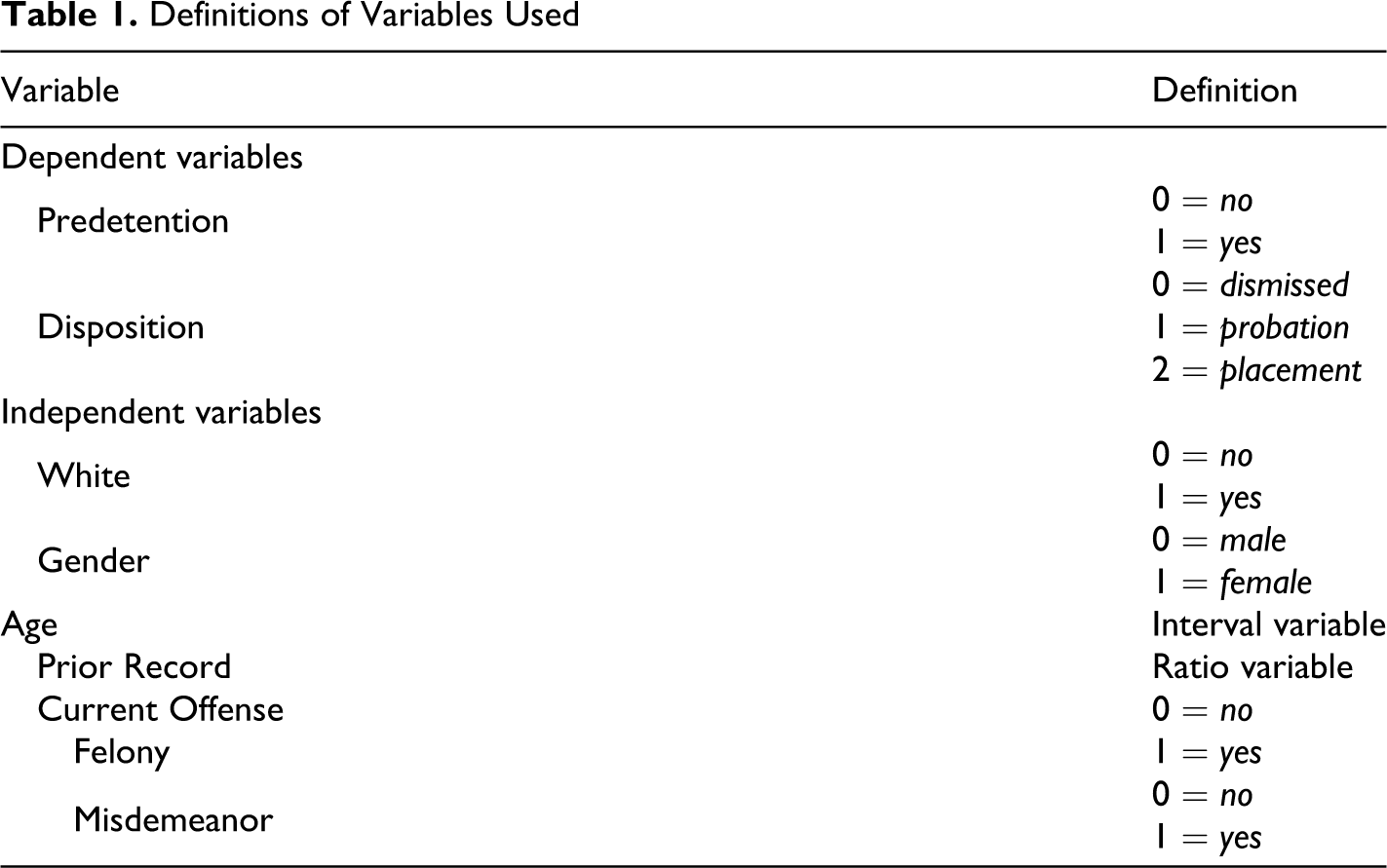
The sampling procedures used in the two counties resulted in an undersampling of White youth and an oversampling of non-White youth relative to their percentages in the total case population. These data and analyses were weighted to reflect each racial category’s representation in the total case population. 2 For the urban county, the weighted N is 5,926 and for the suburban county, the weighted N is 2,599. The variables used in this study are presented in Table 1.
Definitions of Variables Used
Dependent Variables
This study included two juvenile court outcomes—preadjudication detention and disposition—as separate dependent variables. Preadjudication detention is coded as “1” for predetained or “0” for not predetained. Disposition is coded as “0” for dismissal of the charges, “1” for probation, or “2” for out-of-home placement. For the analyses, the final category (placement) was the reference category. 3
Independent Variables
Both legal and extralegal factors are included in the analyses. Legal factors include offense seriousness and prior record. Extralegal factors include race, age, gender, and preadjudication detention status. Offense seriousness is coded as felony or misdemeanor. Prior record is the youth’s number of prior court referrals. Race is coded “1” for White and “0” for non-White youths. Because of the small number of Latinos, Native Americans, and Asian Americans in the sample, these cases were combined with those involving African Americans into a “non-White” category. 4 Age is the youth’s age at the time of arrest and gender is coded “1” for female and “0” for male. Preadjudication detention (yes = 1, no = 0) is also included as a control variable in the disposition analyses.
Analysis Procedures
Examining the effects of geography on juvenile court processing would ideally be done using hierarchical linear modeling (HLM; see Bray et al., 2005, for a recent example). However, the data used for the current study come from only two counties; this sample size is too small to sustain an HLM analysis (Raudenbush & Bryk, 2002). Accordingly, several binary and multinomial logistic regressions were used in order to assess the influence that legal and extralegal variables have on preadjudication detention and disposition outcomes. Binary logistic regression was used for the preadjudication outcome since it is dichotomous. For the three-category disposition variable, multinomial logistic regression was used. 5 This technique estimates the effects of explanatory variables on a dependent variable with unordered response categories (Aldrich & Nelson, 1984; Liao, 1994; Menard, 1995). For this study, the probability of being dismissed or receiving probation was compared to the probability of receiving an out-of-home placement.
The focus of this study is the influence of legal and extralegal factors across county on juvenile court outcomes. Additionally, it is expected that the influence of legal factors across county may vary by race of the juvenile. Accordingly, these data were partitioned by county and subsequently by race for each county in order to produce separate estimates for the urban and suburban county, permitting a comparison of the coefficients for each group (Albonetti, 1987; Myers, 1985). The equality of the coefficients across models was tested using the z test (Paternoster, Brame, Mazerolle, & Piquero, 1998). Comparing these estimates for the two outcomes (preadjudication detention and disposition) helped uncover the underpinnings of geographical differences in factors linked to juvenile court outcomes.
Results
Descriptive Statistics
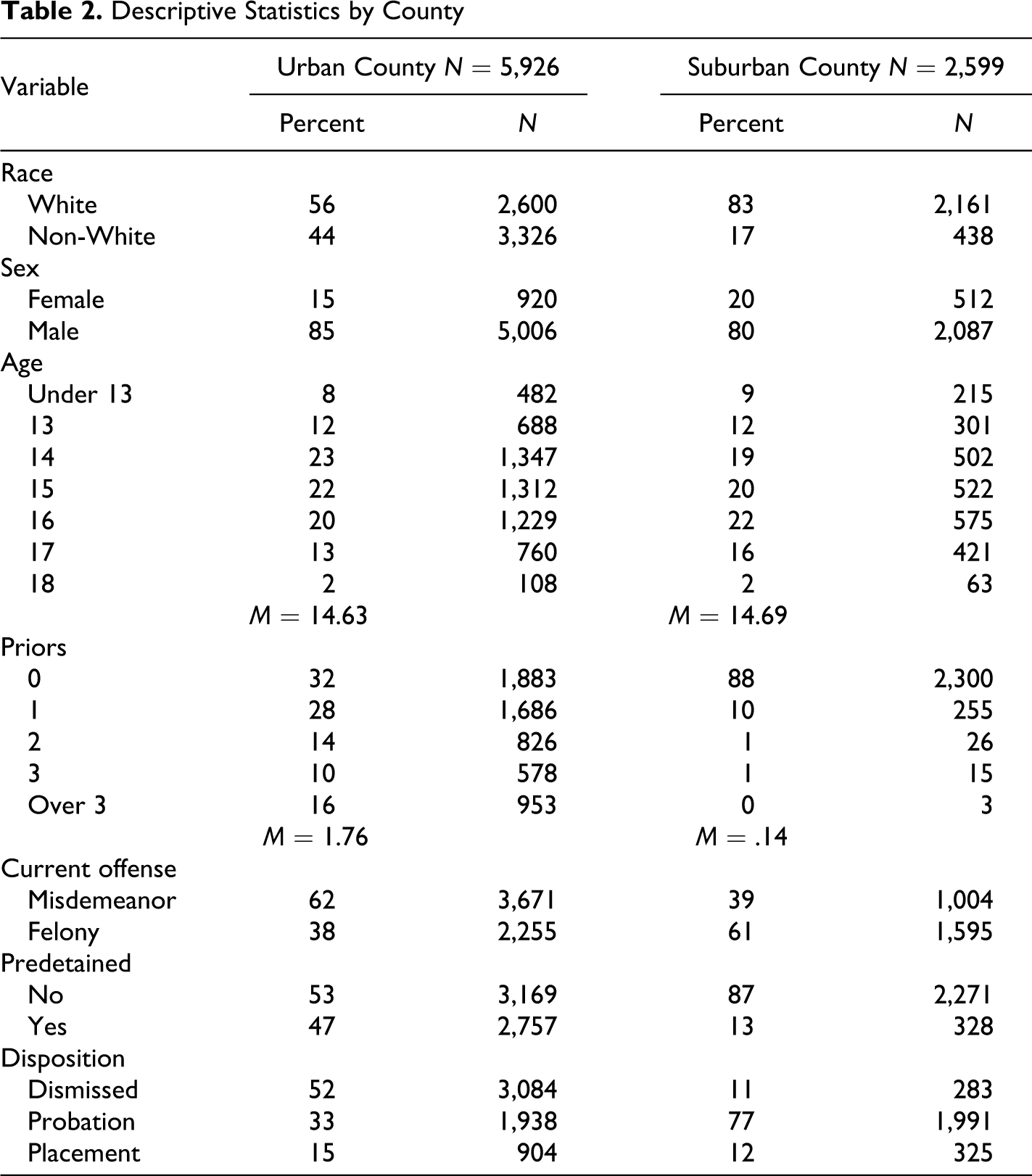
Table 2 provides descriptive statistics for each county. In the urban county, a slight majority of the youth were White (56%) and a majority were male (85%). The average age for youth processed in this county was 14.63 and most of the youth had no prior record (32%). A majority of the youth in this county was charged with a misdemeanor (62%) and was not predetained (53%). In addition, a majority of the youth had the charges dismissed at disposition (52%). In the suburban county, a majority of the youth were White (83%) and male (80%). The average age for youth processed in this county was 14.69 and an overwhelming majority of the youth had no prior record (88%). Most of the youth in this county were charged with a felony (61%) but were not predetained (87%). A large majority of the youth in this county received probation at the disposition outcome (77%). In summary, there are some obvious similarities between the youth processed in these two counties. In both counties, a majority of the youth was White, male and the average age was similar. There are also some obvious differences between the youth processed in these two counties. The urban county youth were more likely to have prior offenses, be charged with a misdemeanor, be predetained, and have the charges dismissed. In contrast, the suburban county youth were more likely to be charged with a felony, less likely to be predetained, and more likely to receive probation at disposition. These descriptive statistics indicate a potential geographical effect in the outcomes for youth processed in these two juvenile courts. These potential effects were tested using the following multivariate analyses.
Descriptive Statistics by County
Preadjudication Detention Outcome
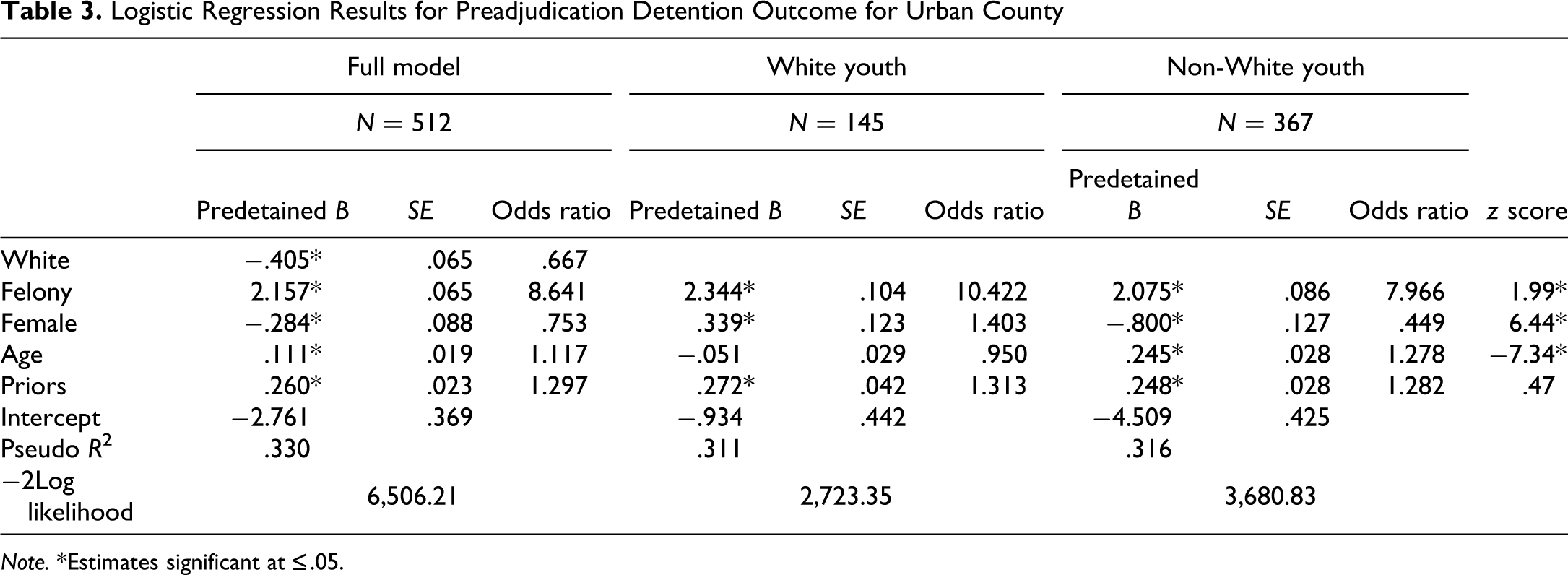
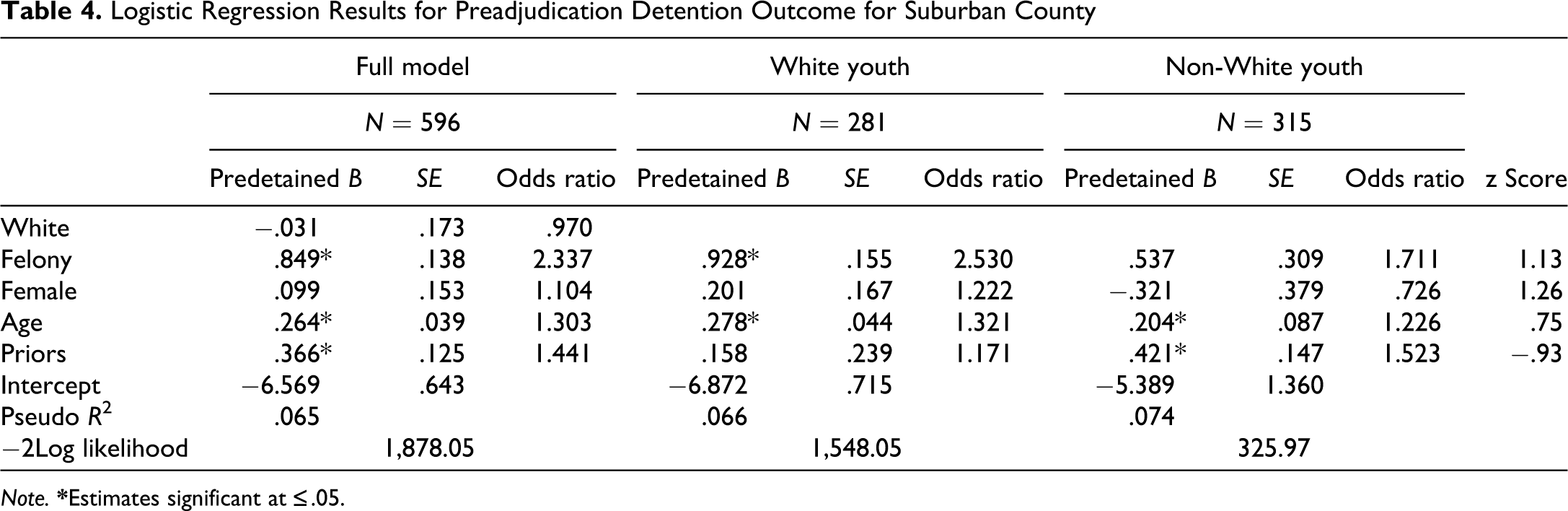
Tables 3 and 4 present the results of the logistic regression analyses and these results indicate that legal and extralegal variables influenced the preadjudication detention outcome differently in the two counties. In the urban county, both the legal variables (felony and priors) and the extralegal variables (race, gender, and age) influenced the predetention outcome. Specifically, White youth and females were less likely to be predetained and youth charged with a felony, older youth, and those with priors were more likely to be predetained in the urban county. In the suburban county, the legal variables (felony and priors) influenced the outcome in that youth charged with a felony and those with priors were more likely to be predetained. However, only one extralegal variable—age—influenced the outcome in this county. Specifically, older youth were more likely to be predetained. Therefore, the legal variables of felony and priors had a significant influence on the preadjudication detention outcome in both counties, whereas the influence of extralegal variables varied by county.
Logistic Regression Results for Preadjudication Detention Outcome for Urban County
Note. *Estimates significant at ≤.05.
Logistic Regression Results for Preadjudication Detention Outcome for Suburban County
Note. *Estimates significant at ≤.05.
The next step is to determine whether the influence of the legal and extralegal variables on preadjudication detention varied across race in each county using the z test. In the urban county, one legal variable (felony) had a differential effect across race and this effect was more pronounced for White youth. Specifically, White youth charged with a felony were 10 times more likely to be predetained, whereas non-White youth charged with a felony were 8 times more likely to be predetained. In addition, gender and age had differential effects across race but the effects were inconsistent. Specifically, the influence of gender was more pronounced for White youth and the influence of age was more pronounced for non-White youth. In the suburban county, the z test results indicate that there was no differential effect by race for any of the legal or extralegal variables on the preadjudication detention outcome in this county.
These results do not support the hypothesis that in urban counties legal factors will predict severity of outcome because extralegal factors also predicted severity of outcome. These results provide mixed support for the hypothesis that in urban counties the influence of legal factors on severity of outcome will not vary by race. The legal factor of prior offenses did not have a varying effect by race. However, the other legal factor—offense seriousness—did have a varying effect on the preadjudication detention outcome and the effect was more pronounced for White youth charged with a felony.
The results also support the hypothesis that in suburban counties both legal and extralegal factors will predict severity of outcome in that offense seriousness, age, and priors influenced preadjudication detention. These results do not support the hypothesis that in suburban counties the influence of legal and extralegal factors on severity of outcome will vary by race as there was no variability by race.
Disposition Outcome
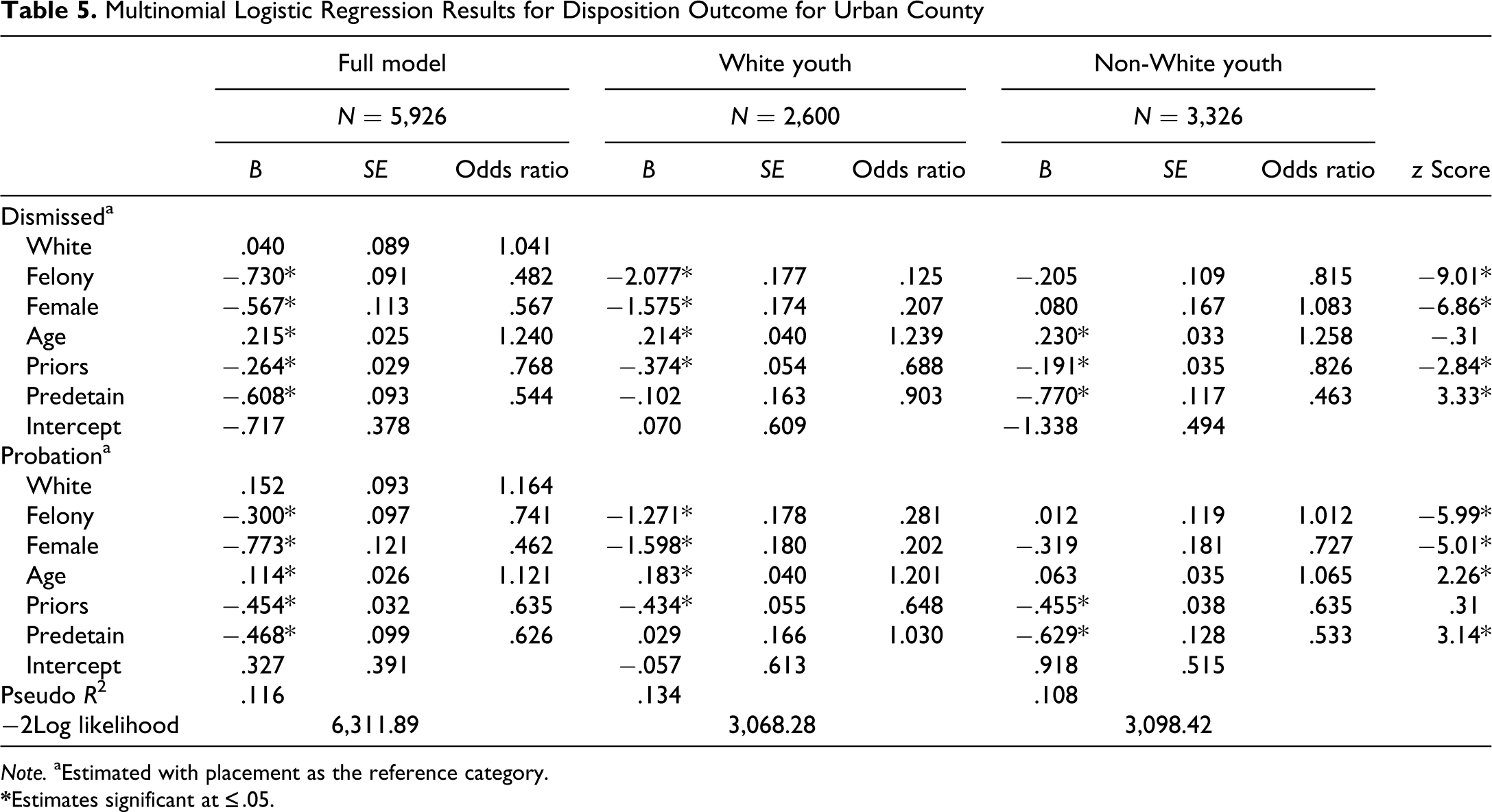
Tables 5 and 6 present the results of the multinomial logistic regression analyses and these results indicate that legal and extralegal variables influenced the disposition outcome differently in the two counties. In the urban county, race was not a significant predictor of outcome. All other legal and extralegal variables were significant predictors of disposition outcome. Youth who were charged with a felony, had priors, and were predetained were less likely to have the charges dismissed or receive probation so they were more likely to receive a placement. In addition, female youth were less likely to have the charges dismissed or receive probation and were therefore more likely to receive placement. Finally, older youth were more likely to receive dismissal of charges or probation so therefore less likely to receive a placement.
Multinomial Logistic Regression Results for Disposition Outcome for Urban County
Note. aEstimated with placement as the reference category.
*Estimates significant at ≤.05.
Multinomial Logistic Regression Results for Disposition Outcome for Suburban County
Note. aEstimated with placement as the reference category.
*Estimates significant at ≤.05.
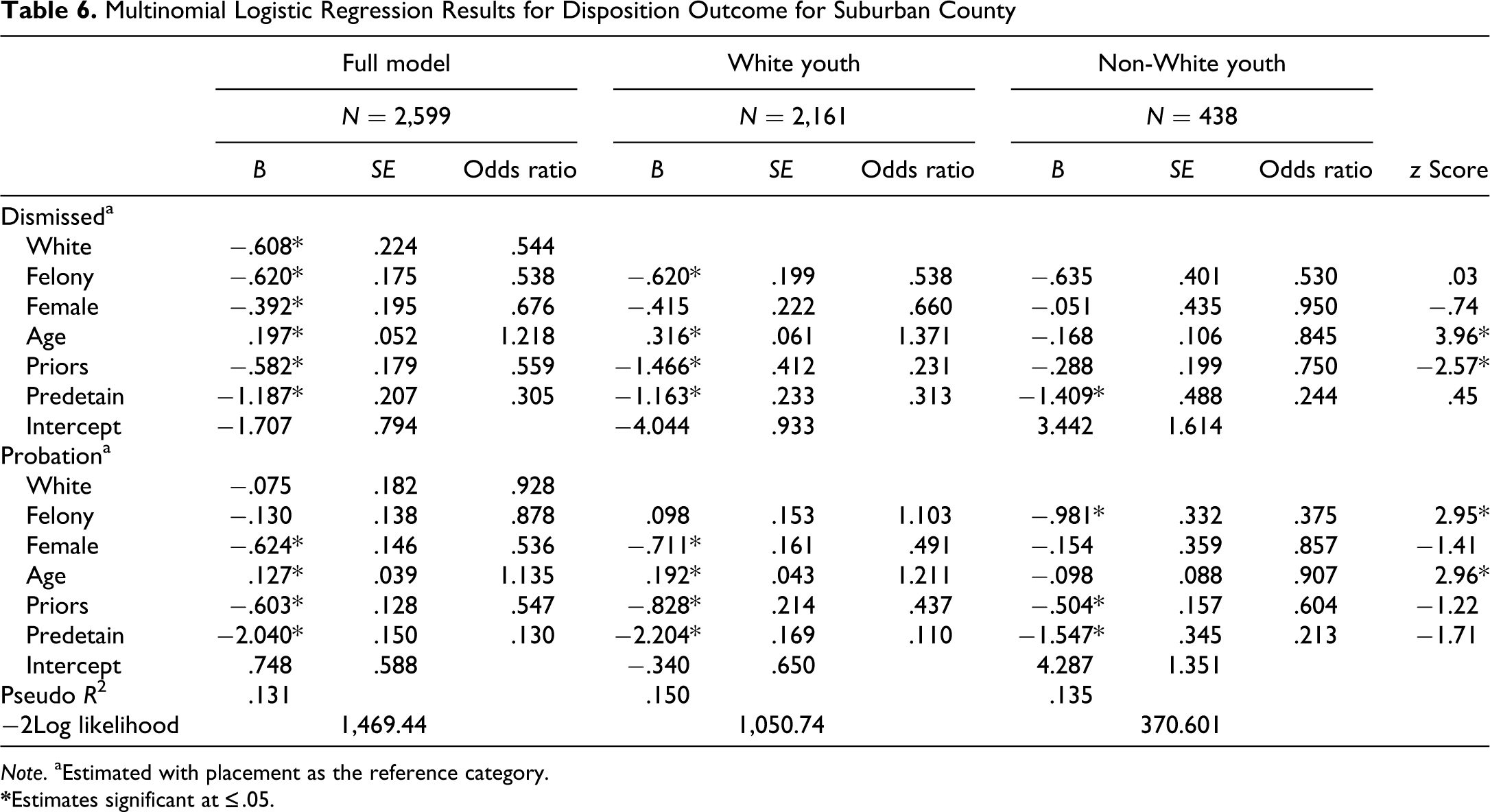
In the suburban county, race was a significant predictor for only the dismissal of charges outcome in that White youth were less likely to have the charges dismissed so more likely to receive placement. Race was not a significant predictor for the probation outcome. The legal variable of offense seriousness was also significant for only the dismissal of charges outcome. Specifically, youth charged with a felony were less likely to have the charges dismissed and therefore more likely to receive a placement. Seriousness of offense was not a significant predictor for the probation outcome. Similar to the urban county, youth in the suburban county who were female, had prior offenses, and were predetained were less likely to have the charges dismissed or receive probation and were more likely to receive placement. In addition, older youth in this county were more likely to have the charges dismissed or receive probation which means they were less likely to receive a placement.
The next step is to determine whether the influence of the legal and extralegal variables on disposition outcome varied across race in each county using the z test. In the urban county, one legal variable (felony) had a differential effect across race and this effect was more pronounced for White youth. Specifically, White youth charged with a felony were significantly less likely than White youth charged with a misdemeanor to have the charges dismissed or receive probation so were more likely to receive a placement. There was no difference in likelihood of dismissal or probation for non-White youth charged with a felony and non-White youth charged with a misdemeanor. Prior offenses also had a differential effect across race but only for the dismissal outcome; again, the effect was more evident for White youth. White youth who had prior offenses were less likely to have the charges dismissed and were more likely to receive placement. There was no varying effect of priors by race for the probation outcome. Extralegal variables also had varying effects across race. Specifically, gender had a differential effect across race for both the dismissal and the probation outcome in that White females were less likely to have the charges dismissed or receive probation so therefore more likely to receive a placement. Age had an inconsistent effect across race in that this effect was found for the probation outcome but not the dismissal of charges outcome. Older White youth were more likely to receive probation and less likely to receive placement. Finally predetention had a varying effect across race and this effect was more pronounced for non-White youth. Non-White youth who were predetained were less likely to receive dismissal of charges or probation and were therefore more likely to receive a placement.
In the suburban county, the legal variables—felony and priors—had varying effects across race but not for all disposition outcomes. In particular, non-White youth charged with a felony were less likely to receive probation so more likely to receive placement. There was no significant effect of seriousness of offense for White youth for the probation decision. In addition, there was no varying effect of offense seriousness by race for the dismissal outcome. There was also a varying effect across race when examining the influence of priors. Specifically, White youth with priors were less likely to have the charges dismissed and more likely to receive a placement. There was no significant effect of prior offenses for non-White youth for the dismissal outcome. In addition, there was no varying effect of priors by race for the probation outcome. Only one extralegal variable had a differential effect across race in this county and this effect was more pronounced for White youth. Specifically, White youth who were older were more likely to have the charges dismissed or receive probation so therefore less likely to receive a placement.
These results do not support the hypothesis that in urban counties, legal factors will predict severity of outcome because extralegal factors also predicted severity of outcome. While race was not a significant predictor, all other legal variables were significant for both the dismissal and the probation outcomes. These results also do not support the hypothesis that in urban counties, the influence of legal factors on severity of outcome will not vary by race. The legal factor of offense seriousness (felony) had a significant effect across race for both the dismissal and the probation outcomes. The legal factor of prior offenses did not have a varying effect by race on the probation outcome, but it did have an effect by race for the dismissal outcome. In addition, the varying effect of legal factors (priors and felony) was more pronounced for White youth for the probation outcome.
The results also support the hypothesis that in suburban counties both legal and extralegal factors will predict severity of outcome in that race, offense seriousness, age, gender, priors, and predetention all influenced the dismissal outcome. However, for the probation outcome, race and offense seriousness did not influence the outcome. These results provide mixed support the hypothesis that in suburban counties the influence of legal and extralegal factors on severity of outcome will vary by race. There was variability across race for the influence of priors but only for the dismissal outcome. Specifically, White youth with priors are less likely than non-White ones to receive a dismissal. Also, while the effect of priors was significant for both White and non-White youth, the impact was stronger for the former. Also, among White youth, older age was associated with a greater chance for dismissal. Being female, being predetained or having a felony charge showed no effect across race. With the probation outcome, the effects of being female, having priors and predetention did not differ by race. However, there was a race effect of offense seriousness. Specifically, non-White youth with felonies were less likely to receive probation. Finally, older non-White youth were less likely to receive probation than were their White counterparts.
Discussion and Conclusion
The purpose of this study was to examine geographic and racial disparities in juvenile court outcomes through the lens of the liberation hypothesis. The study predicted that legal factors would predict severity of outcome in urban counties and that the influence of these factors would not vary by race. It was also predicted that in suburban counties, both legal and extralegal factors would predict severity of outcome and that the influence of these factors would vary by race. The results do not support all of these predictions. In the urban county, both legal and extralegal variables influenced both the predetention and the disposition outcome and the influence of these factors sometimes varied by race. In the suburban county, legal factors and one extralegal factor (age) influenced the predetention outcome and the influence of these factors did not vary by race. For the disposition outcome in the suburban county, the influence of the legal factors (priors and seriousness) had mixed variation by race (i.e., for one disposition outcome but not for the other). In addition, the only extralegal factor that varied by race was age. In summary, the results of the multivariate analyses are the reverse of what was predicted. Specifically, there were more varying effects of legal and extralegal factors across race in the urban county than in the suburban county.
These findings diverge from the previous research and from expectations of outcomes by urban (due process) and suburban (traditional) courts. This complicates efforts to understand the nature of urban versus suburban/rural differences in juvenile justice outcomes.
Other theoretical perspectives that view court outcomes in terms of the connection between legal and extralegal factors may account for the findings of this study. One view, “bounded rationality” (Albonetti, 1987, p. 294), posits that “court officials attempt to achieve rational outcomes in the face of incomplete knowledge by relying on stereotypes that differentially link defendant groups to recidivism and dangerousness” (Albonetti, 1987, p. 294). A related perspective, attributional theory, asserts that decision makers make attributions, based on legal and extralegal factors, about a youth’s attitudes and motivation. These individual judgments, in turn, affect the final outcome (Bridges & Steen, 1998).
A third perspective, focal concerns (Steffensmeier, Kramer, & Streifel, 1993; Steffensmeier, Ulmer, & Kramer, 1998), may provide the most fitting explanation for the current findings. This view argues that decision makers are influenced by three specific focal concerns. The first, desert, is based on the culpability of the youth and the level of damage done by the offense. The second, community safety, involves choosing actions that will best thwart future harm to society. The third addresses concerns of practicality; that is, determining the most realistic outcome given resource constraints, the response of the public, and the impact on the individual offender. For both counties, legal factors (felony and priors) are associated with more severe outcomes; that is, greater likelihood of preadjudication detention and reduced likelihood of dismissal or probation. This points to considerations of desert and public safety in judicial decision making. That is, youth are treated based on the assessment of their guilt and/or threat to the public.
The extralegal factors are more difficult to interpret because they are so inconsistent. Focusing on race by county results, it is clear that, in urban counties, White youth with felonies, priors, and who are female are more likely to experience severe outcomes (preadjudication, no dismissal, or no probation). It also seems evident that age in non-White youth is associated with harsher treatment. These results are present to a lesser degree in the suburban county, where White youth with priors, compared to non-Whites, were less likely to get dismissal. However, older non-Whites were less likely to receive either a dismissal or probation, and non-Whites with a felony were less likely to receive probation. Thus, it could be that, for both counties, White youth with a criminal history may, compared to their non-White counterparts, be perceived as guiltier or as being a greater public safety threat. Or, with regard to disposition, it is not seen as impractical to treat such youth more severely.
More severe outcomes for White female juveniles could reflect the operation of a reverse chivalry effect (Chesney-Lind, 1973, Chesney-Lind & Shelden, 2004). Namely, women who act in ways contrary to traditional female behavior are subject to greater sanction in the justice system. The finding that older, non-White youth from both counties experience more severe outcomes may demonstrate a belief that such youth are incorrigible and are unworthy of less punitive responses (Leiber & Johnson, 2008). The fact that this effect is stronger in the urban county could indicate a stronger sense of symbolic, racial threat, generated by the larger minority presence in that area. (Hawkins, 1987; Leiber & Mack, 2005). However, without additional information, these interpretations are only suggestive.
Regarding the geographic results, it is clear that there is less difference between the two counties than was supposed. The two courts in this study may not be completely opposite of each other but instead may represent points on a “continuum from formal to informal with corresponding procedural and substantive differences” (Feld, 1991, p. 161). In fact, it is a fair question is whether the urban county in the current study is “truly” urban. Given its small size and location in the Midwest, it may be more homogeneous than urban counties examined in prior research. As such, it may contain features of the suburban court environment (increased informality, traditional orientation), which leaves room for the influence of extralegal factors. The uncertainty around this issue points to the need for future research on geographical disparity to gather more data on the contextual nature of county courts, from both macro- and micro-level standpoints.
As Feld (1991) describes, county courts are affected by macro-level factors, including the social–structural environment, the crime rate, and the amount of resources devoted to crime fighting. These features may color court operations in a particular geographical region. Micro-contextual features of courts, in particular the interactions between the court actors (police, probation, defense counsel, prosecution) are also important to examine (Bishop, Leiber, & Johnson 2010). These factors reflect the day-to-day activities of the court, and thus have an immediate impact on offender outcomes. Further examination of the macro and micro contexts of county courts would help better identify the elements of urban, suburban, or rural courts that leads to particular outcomes. This can, in turn, help better explain variations between urban courts and other types of courts.
The findings of this study should be interpreted with caution, due to several limitations of the research. First, other legally relevant factors that were not examined here (type of offense, composition of priors, among others), may have impacted preadjudication and disposition outcomes. To the extent that these factors differ by race, gender, or age, they could account for the disparate treatment linked to those variables. Second, the extralegal factor race combined all non-Whites into a single category. As a result, comparisons of the treatment of White youth versus Black, Hispanic, or Asian youth cannot be made. Further, any differences in treatment that exist among nonwhite youth cannot be examined. Third, these data are close to 20 years old. Changes in the two counties since that time period (for instance, the demographic composition of juvenile offenders, the crime rate, in court personnel and polices, to name a few) could affect the results of a similar study conducted in the present day.
Finally, this project compared two counties in a Midwestern state, which limits generalizability. It is likely that urban and suburban courts operate differently in other regions of the country. The same is true for rural courts, which were not examined in this study. Research using data from a larger sample of counties, including urban, suburban, and rural types, would provide a clearer and stable picture of the presence and direction of geographical effects. A larger sample would also enable the use of more robust analytical techniques (for instance, HLM) than was used for this study.
Future research on geographic and racial disparities in juvenile court outcomes should be directed toward the following areas. As mentioned above, studying data from a greater range of counties could provide a consistent picture of geographical effects on juvenile justice outcomes. Examining the contexts of the courts is a must. This includes obtaining information on both the macro- and the micro-level environments in which the courts operate. The greater use of qualitative research methods would be especially helpful in examining the local activities of a juvenile court. Future research should also explore the effects of processing at different stages (see work by Bishop, Leiber, Rodriguez, etc.) as the consideration of legal and extralegal factors may vary based on the stage examined. In addition, the loosely or tightly coupled nature of the interactions of entities such as police, probation, and so on that are involved in juvenile justice administration should be explored.
Footnotes
This article has not been published elsewhere and that it has not been submitted simultaneously for publication elsewhere.
The author(s) declared no potential conflicts of interest with respect to the research, authorship, and/or publication of this article.
The author(s) received no financial support for the research, authorship, and/or publication of this article.