







Abstract
Race and racial stereotypes have long been recognized as influencing the formal social control of youth. Recent analyses have moved beyond identifying disproportionate minority contact (DMC) and toward assessing the contingencies under which race has a lesser or greater impact on juvenile court outcomes. While often confounded, the racial threat and symbolic threat perspectives offer conceptually distinct explanations for DMC. The racial threat perspective proposes that racial disparities in sanctioning are at least partly the result of perceptions among Whites that the minority group threatens their economic and political hegemony. Alternatively, the symbolic threat perspective proposes that intergroup inequality fosters perceptions that minorities are a threat to middle class norms, values, and standards motivating Whites to discriminate. The current study employs hierarchical generalized linear modeling to discern the salience of these two perspectives to understanding racial bias in preadjudication detention. To do this, we merge county-level Census data with data on nearly a decade’s worth of delinquency cases in one Southeastern state. Our results offer limited support for the racial threat perspective but strongly support the symbolic threat perspective in indicating that the impact of race on detention is contingent upon interracial socioeconomic inequality in the community at large.
Keywords
Race and racial stereotypes have long been recognized as influencing the application of formal and informal social control mechanisms (Bridges & Steen, 1998; Tittle & Curran, 1988). One venue in which disproportionate minority contact (DMC) is especially critical is within the juvenile justice system, particularly front-end decision points, such as detention. 1 Detention is an important point to examine DMC, because it represents the entry point to the juvenile justice system. Detention occurs after the juvenile has been taken into custody but before an adjudication decision has been reached. The wide discretion used at this point in the process allows youth to be detained with very few checks and balances. Youth who are detained for long periods often do not have the opportunity to participate in programming designed to further their educational or developmental needs. While youth are in detention, long-term educational and mental health needs are put on hold. Accordingly, time spent in detention is essentially wasted time and widens the gulf between positive relationships to family and school (Austin, Johnson, & Weitzer, 2005).
Guided by the principle of parens patria, juvenile court practitioners have wide discretion in reaching a detention decision. Decisions are influenced by both legal (e.g., prior record and offense severity) and extra legal (e.g., age and race) factors (Guevara, Herz, & Spohn, 2006; Leiber & Stairs, 1999; Tomkins, 1990). To complicate matters, many states, including the subject state, do not use a uniform instrument among all detention centers or juvenile courts to determine whether a juvenile should be released or detained (Author & Roche, 2008). Thus, detention decisions are made with little guidance as to which juveniles pose a risk to themselves or the community. Such decision making is disturbing as studies have found that long detention stays are linked to negative outcomes as youth proceed through the system, including out-of-home placement at disposition; the most restrictive placement for a juvenile (Austin et al., 2005; Frazier & Cochran, 1986; Guevara et al., 2006).
In recognition of the impact juvenile justice processing has on youth, particularly minorities, the Office of Juvenile Justice and Delinquency Prevention made DMC a core requirement of the Juvenile Justice and Delinquency Prevention Act (JJDPA) in 1992. The Act challenges States to identify, assess, and address the causes and potential remedies for DMC. Because of the negative impact that early detention has on future outcomes, examination of the influence of race on detention decisions marks an important step toward understanding DMC throughout the juvenile justice system. Although addressing such requirements has been a part of federal and state efforts since 1992, relatively little progress has been made in understanding the factors that contribute to DMC (Leiber & Rodriquez, 2011; Piquero, 2008). Between 1983 and 1997, 4 of 5 new detainees were minority youth (Justice Policy Institute, 2002). Further, between 1990 and 1999, delinquency cases involving detention increased by 11%, and Black juveniles were more likely to be detained during every year across all offense categories (Harms, 2003). In 2005, 19% of all referrals for juvenile delinquency resulted in detention, and Black youth accounted for 40% of detainees (Puzzanchera & Adams, 2012). Other studies examining juvenile court processes have found similar results: minority youth are disproportionately represented at critical decision points in the juvenile justice system (Bishop, 2005; Leiber & Fox, 2005; Pope & Leiber, 2005; Puzzanchera & Adams, 2012; Rodriguez, 2010). These studies highlight the importance of understanding DMC at the point of detention.
Many studies focusing on DMC lack theoretically driven tests designed to better understand the phenomena. In studies that have provided theoretical guidance, two theories have emerged offering conceptually distinct explanations for the overrepresentation of minorities in the juvenile justice system. The racial or minority threat thesis offered by Blalock (1967) proposes that the encroachment of minorities along with perceptions of economic and political competition motivate Whites to discriminate against minorities through the disproportionate use of formal and informal control mechanisms. The symbolic threat perspective, on the other hand, highlights perceptions of threat to middle class norms, attitudes, values, and standards, often generated through intergroup socioeconomic inequality (Sampson & Laub, 1993; Tittle & Curran, 1988). Inequality and social distance amplify perceived group differences, leading to the increased use of formal and informal control mechanisms against minorities.
Many prior analyses of DMC focus on case- or offender-specific factors but neglect to consider indirect or interactive effects of race. Studies that have considered structural contingencies often suffer from sampling or methodological flaws or neglect to assess statistical interactions between race and community characteristics (Armstrong & Rodriquez, 2005; Leiber & Jamieson, 1995). The current study contributes to the growing body of literature examining structural contingencies by attempting to discern the salience of the racial and symbolic threat perspectives to understanding racial bias in detention. To accomplish this, we merge Census data on county characteristics with data on nearly a decade’s worth of delinquency cases in one Southeastern State. Below, we outline two threat-based perspectives, review the relevant literature linking racial and symbolic threat to DMC in the juvenile justice system, and describe our hypotheses. This is followed by a description of the data, measures, and methods we employ. Finally, we discuss the implications of our findings and suggestions for future research.
Racial Threat and Symbolic Threat as Structural Contingencies
The extant literature indicates that Blacks are less likely to be referred to diversionary programs and more likely to be detained, formally petitioned, adjudicated delinquent, and sentenced to out-of-home placement (Bishop & Frazier, 1996; Bortner, 1982; Bortner & Reed, 1985; Harms, 2003; Leiber & Johnson, 2008; Leiber & Mack, 2003; Secret & Johnson, 1997). Analyses of the relative rate index from 1990 to 2005 indicate that, compared to Whites, arrest rates for Black youth are 70–140% higher, detention rates are 40–70% higher, and formal petition rates are 20–30% greater (Puzzanchera & Adams, 2012). While identifying such disparities is critical, it is not sufficient. The JJDPA places particular emphasis on assessing the causes of DMC, a core objective of which is to move beyond descriptive analyses toward specifying the mechanisms, individual and structural, that contribute to these disparities.
An influential advancement to our understanding of racial bias in juvenile justice systems is the identification of structural characteristics or contingencies that condition the influence of race on decision making. Tittle and Curran (1988, p. 23) noted that “differential sanctioning is not a pervasive phenomenon but rather . . . is contingent on whether the individual is a member of an aggregate which poses a threat to elites.” This underscores the importance of social context in understanding racial disparities in formal control, which is rooted in notions of intergroup resource inequality highlighted in conflict theories. Those with power and authority have a vested interest in maintaining their cultural, social, economic, and political hegemony. Moreover, they are capable of using the economic system, social institutions, and formal control mechanisms to exploit less powerful groups and protect their ascendant position from perceived threats (Albonetti, 1991; Quinney, 1970). To the extent minorities are perceived as threats to the economic, political, cultural, or social dominance of Whites they are likely to face discrimination, including increased formal control (e.g., arrest, detention, and confinement). The fundamental distinction between race-based threat perspectives concerns the social processes that engender fear and perceptions of threat rather than the response to such perceptions.
Racial Threat
A theoretical discussion of perceived interracial threat begins with the racial threat thesis offered by Blalock (1967) and rooted in the conflict perspective. Blalock (1967) posited that Whites perceive racial minorities, particularly Blacks, as potential competitors in the labor market and political landscapes. The encroachment of minorities into the social space of the majority group may be perceived as a direct threat to White economic, political, and social hegemony. This perceived threat to their ascendant position in society motivates Whites to protect the status quo through the mobilization of resources, concerted discrimination, residential segregation, and the deployment of formal control mechanisms against minorities. However, Blalock suggested the association between the relative prevalence of minorities and the deployment of social control mechanisms should be curvilinear rather than linear. Moreover, he developed a rationale outlining divergent forms of curvilinear relationships between the social control of minorities and perceptions of economic as opposed to political competition. Blalock contended that increases in the political power of Blacks leads to an exponential intensification in the use of formal social control mechanism to quell the threat to the political hegemony of Whites. This suggests a nonlinear association with a positive and accelerating slope. 2 Concerning the economic threat posed by Blacks, Blalock described a positive yet decelerating association between intergroup economic competition and social control. That is, after reaching a certain threshold, further increases in the economic threat posed by Blacks produces smaller magnitude increases in race based disparities in formal social control. This positive yet decelerating slope occurs as Whites begin to amplify alternative nonstate-based strategies to quell the economic threat posed by Blacks (e.g., workplace discrimination, segregation, and violence).
The traditional minority threat perspective has generated a considerable body of research with the bulk of studies operationalizing racial threat with an indicator of the relative size of the minority population. A significant association between minority population size and racial disparities in levels of social control is considered evidence of threat-inspired discrimination. While this has a certain intuitive appeal, the literature is rife with disparate findings. There is some evidence linking minority population size to perceptions of economic threat, personal safety, and punitive attitudes among Whites (King & Wheelock, 2007). Significantly more analyses of the association between minority populations and the use of a litany of formal social controls have been conducted. These include police supervision (Kent & Jacobs, 2004, 2005; Liska, Lawrence, & Benson, 1981), arrest rates (Liska & Chamlin, 1984; Ousey & Lee, 2008; Parker, Stults, & Rice, 2005), police use of deadly force (Chamlin, 1989), incarceration rates (Myers & Talarico, 1987; Weidner, Frase, & Schultz, 2005), sentencing decisions (Feldmeyer & Ulmer, 2011; Ulmer & Johnson, 2004; Wang & Mears, 2010), and capital punishment (Jacobs & Carmichael, 2004; Jacobs, Carmichael, & Kent, 2005). These analyses have produced disparate results, with some strongly supporting the racial threat perspective (Jacobs & Helms, 1999; Kent & Jacobs, 2005; Sampson & Raudenbush, 2004; Stults & Baumer, 2006) and others reporting no or limited evidence supporting the perspective (Eitle, D’Alessio, & Stolzenberg, 2002; Ousey & Lee, 2008; Parker et al., 2005; Wang & Mears, 2010). Overall, minority population size has emerged as a stronger predictor of the institutional capacity for social control rather than racial disparities in sanctioning (Ousey & Lee, 2008, p. 347).
Recently, analysts have attempted to develop empirical assessments that more accurately capture the essence of political and economic competition as articulated by Blalock (1967). Such analyses operationalize minority threat with measures such as minority voter turnout, minority political leadership, and the ratio of White to Black unemployment. While such indicators likely provide a more accurate assessment of Blalock’s hypotheses, the results largely fail to support the traditional racial threat perspective. An additional limitation in the extant literature is that few analyses explore potential nonlinear effects. This is particularly problematic as Blalock expressly argued that perceived political threat should have an accelerating positive effect on social control, while minority economic threat should exhibit a positive yet decelerating slope. That said, studies that have considered this curvilinear effect often fail to support either an accelerating or decelerating effect as described by Blalock (Eitle et al., 2002; King & Wheelock, 2007; Rodriguez, 2007; Stolzenberg, D’Alessio, & Eitle, 2004; but see Reed, 1972, and Wang & Mears, 2010, for evidence of nonlinear effects).
Symbolic Threat
Rather than focusing on perceived minority threat generated through economic and political competition, some scholars have turned their attention to the symbolic aspects of racial threat, particularly perceptions of group differences. Blau and Blau (1982, p. 119) noted that “Ascriptive socioeconomic inequalities undermine the social integration of a community by creating multiple parallel social differences which widen the separation between ethnic groups and between social classes, and it creates a situation characterized by much social disorganization and prevalent latent animosity.” The underlying causal mechanism linking inequality, interracial tension, perceived threat, and social control is therefore attenuated intergroup social integration and the resulting anomic social climate, which amplifies racial stereotypes, beliefs in dramatic race-based cultural differences, anti-Black sentiment, and fear (Blau, 1977; Ellison & Powers, 1994; Oliver & Wong, 2003).
Massey and Denton (1993) argue persuasively that purposeful institutional racism and social isolation have undermined Black communities leaving them socially disorganized and primed for exaggerated levels of violence. This purposeful racism, discrimination, and isolation have spawned oppositional cultures in some underclass Black communities in which mainstream norms, values, and beliefs are viewed as unrealistic or unattainable. This culture fosters idleness, an aversion to mainstream work and goals, minimizes the benefits of education and marriage, and emphasizes violence and bravado as means of attaining status and respect (Anderson, 1999). Such cultural differences, real or imagined, increase perceptions among Whites that Blacks pose a threat to mainstream culture and the normative social order. In support of this contention, Bridges and Crutchfield (1988) found Blacks are more likely to be sentenced to prison in communities with high levels of concentrated disadvantage among minorities. That said, the ability of interracial socioeconomic inequality to account for race differences in crime as opposed to social control is debatable, with some supporting the link (Blau & Golden, 1986; Messner & Golden, 1992; Parker & McCall, 1999) and others finding no such evidence (Harer & Steffensmeier, 1992; Peterson & Krivo, 1993; Shihadeh & Flynn, 1996).
Tittle and Curran (1988) were early proponents of applying the symbolic threat perspective to racial disparities in formal sanctioning. They proffered that such disparities are not pervasive but rather contingent upon certain community-level factors, mainly perceptions of threat. They proposed that, in the face of deeply entrenched inequality and amplified perceptions of group differences, social psychological reactions lead officials to stereotype minority youth as unable to abide by middle-class standards. That is, Whites perceive minorities and their culture as a threat to middle-class values and the normative social order. Black youth are viewed as undisciplined, aggressive, sexually promiscuous, belonging to dysfunctional families, residing in communities that are incapable of instilling social norms, and prone to delinquency and drug offenses (Tittle & Curran, 1988). Such stereotypes bring about emotions of envy, jealousy, and fear within the majority group and public officials either because they identify or fail to identify with the youthful behaviors. Such emotions and perceptions of blameworthiness and risk of recidivism manifest in the belief that minority youth pose a greater threat to public standards and safety (Bridges & Steen, 1998; Leiber & Fox, 2005). In an attempt to quell this threat, the behavior of Blacks is more likely to be defined as criminal, and public officials are pressured to use formal control mechanisms to legally enforce community values and morality and protect the interests of the majority group (Liska, 1992; Stolzenberg et al., 2004).
Sampson and Laub (1993) extended the work of Tittle and Curran (1988) in developing a macrostructural integrated conflict perspective emphasizing the role of community levels of poverty and inequality in determining perceptions of threat linked to delinquent minority youth. They argued that the context in which a court exists influences perceptions of juveniles and their behaviors, which, in turn, promote stereotypes influencing the treatment of minorities within the juvenile justice system. Delinquent minority youth are perceived to be a greater threat to community standards and public safety in contextual environments characterized by racial inequality and concentrated disadvantage and are thus subjected to greater levels of formal social control. Although the threat may be more symbolic than real, stereotypes have a very real influence on officials’ perceptions and thus lead to racial disparities in the use of formal control mechanisms (Feld, 1999; Leiber & Fox, 2005; Tittle & Curran, 1988).
While minority threat is operationalized with minority population size and, more recently, political and economic competition, the central tenet of the symbolic threat perspective can be operationalized with indicators of interracial socioeconomic inequality (Sampson & Laub, 1993). Communities suffering from high levels of interracial inequality offer few opportunities for intergroup social integration. As a result, a growing body of research suggests interracial inequality attenuates residential propinquity and intergroup contact, while augmenting racial stereotypes, perceived group differences, social distance, and intergroup antagonism and conflict (Allport, 1954; Ellison & Powers, 1994; Oliver & Wong, 2003; Sigelman & Welch, 1993). Inequality is thus linked to racial disparities in social control to the extent that decision makers and majority group members perceive Blacks as unable to abide by middle-class standards and thus a threat to the normative social order of mainstream society (Sampson & Laub, 1993).
Empirical Assessments of the Contingent Effect of Race in Juvenile Court Decisions
As outlined in the previous section, the racial and symbolic threat perspectives offer conceptually distinct explanations for the overrepresentation of minorities in the juvenile justice system, including preadjudication detention. Early research on preadjudication detention suggested detention decisions are often arbitrary and related more to membership in certain groups perceived to be less amenable to juvenile court interventions than to offender traits (Frazier & Cochran, 1986). Since that time, many studies have examined the influence of race along with legal and extralegal factors on preadjudication detention (Armstrong & Rodriguez, 2005; Bishop & Frazier, 1996; Guevara, Herz & Spohn, 2006; Leiber, 2013). Most studies report that legal and extralegal factors alone do not account for race differences in decision making. Accordingly, theoretical testing is an important step in adding to this body of research.
Both racial and symbolic threat offer potential explanations of disparate treatment of minority youth. Minority population size (racial threat) and socioeconomic racial inequality (symbolic threat) are often highlighted as strong predictors of crime and arrest rates. Assessments of the impact of such factors on DMC are considerably less developed; however, a growing body of research has begun to investigate whether racial disparities in the juvenile justice system are shaped by such contextual factors. The racial threat perspective proposes that Blacks experience greater social control when they are perceived to pose a greater threat to the economic and political hegemony of Whites. This perceived threat is often operationalized as an increase in minority population size, minority political leadership or voter turnout, unemployment comparisons, and interracial contact. Alternatively, the symbolic threat perspective contends that racial disparities in social control will be more pronounced in jurisdictions characterized by greater levels of interracial socioeconomic inequality as a result of perceptions that Blacks pose a threat to mainstream culture and the normative social order.
Early examinations of whether DMC is contingent on structural characteristics were undertaken by Tittle and Curran (1988) and Sampson and Laub (1993). Analyzing 31 Florida counties, Tittle and Curran found that a juvenile’s race has a strong positive association with the severity of their disposition. These effects were exacerbated in communities with larger minority populations 3 ; however, they found no evidence that racial disparities were contingent upon community socioeconomic factors or urban location. Sampson and Laub examined a nationwide sample of juvenile case outcomes at the petition, detention, and disposition phases and found increased juvenile case processing and racial disparities in outcomes (i.e., detention and out-of-home placement) to be linked to community levels of racial inequality and poverty. They posited that inequality and poverty moderate the role of race in juvenile case processing by influencing perceptions of the threat such groups pose to community standards and public safety. Specifically, Sampson and Laub identified decision makers’ perceptions that minorities are unable to abide by middle-class standards as the primary intervening mechanism linking community-level characteristics to DMC. Leiber and Stairs (1999) significantly advanced the literature by developing an empirical test of the thesis offered by Sampson and Laub. Specifically, Leiber and Stairs developed indicators of perceived racial differences and retribution among juvenile justice personnel, which allowed them to assess the impact of racial stereotypes and inequality on intake decisions across three Iowa jurisdictions. They found that contextual factors, particularly racial inequality, indirectly influence racial disparities in juvenile case outcomes by intensifying racial stereotypes among juvenile justice personnel.
While a small number of studies have theoretically and empirically underscored the importance of contextual contingencies (Leiber & Jamieson, 1995; Leiber & Stairs, 1999; Sampson & Laub, 1993; Tittle & Curran, 1988), others have discounted the importance of community dynamics in understanding racial disparities in the formal control of youth. Instead, the bulk of the extant literature is comprised of individual-level analyses focused on case- or offender-specific factors (e.g., prior record and offense severity). Moreover, many studies that have considered structural contingencies suffer from sampling or methodological flaws, such as the analysis of only a handful of communities, the inclusion of aggregate and incident-level measures in the same equation, and the failure to assess interactive effects between race and community characteristics (Armstrong & Rodriquez, 2005; Leiber & Jamieson, 1995).
Some recent analyses of DMC have examined the role of community characteristics, such as minority population size, inequality, socioeconomic deprivation, and urban location, in moderating the association between race and the probability of being detained. In a multilevel analysis of detention across 65 counties, Armstrong and Rodriquez (2005) found that minorities have a greater probability of being detained. Their findings support the racial threat perspective, with ethnically heterogeneous urbanized counties having higher detention rates. However, contrary to the symbolic threat model, levels of interracial inequality were not associated with rates of detention. In another multilevel analysis, Rodriguez (2007) examined the role of perceived internal and external racial and ethnic attributions or stereotypes on the court processing of youth. She reports that certain external attributes, mainly community-level economic conditions (e.g., unemployment and poverty), moderate the association between ethnicity and detention. Specifically, the probability that Black youth will be detained varies in a curvilinear fashion by community levels of unemployment and poverty. These findings offer support for our conceptualization of the symbolic threat perspective in that minority youth are disproportionately sanctioned when the minority group is perceived to pose a threat to mainstream culture and the normative social order. Evidence supporting the symbolic threat perspective has also emerged from analyses of alternative forms of social control. Freiburger and Jordan (2011), in an analysis of decisions to petition a case to juvenile court, uncovered evidence of an interaction between poverty rates and offender race. Controlling for legal and extralegal factors, Black youth from impoverished communities faced a greater probability of being formally petitioned than similarly situated Whites or Blacks from affluent communities.
Current Study and Hypotheses
The current study adds to the growing body of literature assessing DMC by clarifying the social mechanisms that moderate the impact of race on juvenile justice decisions, particularly detention decisions. Specifically, we take a multilevel approach to investigating the salience of racial threat and symbolic threat to racial bias in preadjudication detention. Controlling for offender and offense characteristics, we explore whether racial disparities in the likelihood of being detained are contingent upon the relative size of the minority population, economic competition, and/or interracial socioeconomic inequality. Both threat perspectives have garnered support in the extant literature and offer intuitive assessments of the potential moderating effects that community characteristics may have on racial bias in the application of formal social control. Prior analyses, however, have largely neglected to consider these perspectives simultaneously or have misaligned conceptual arguments and primary explanatory measures.
Because of the broad discretion afforded to judges coupled with the absence of prosecutorial review, detention decisions are a critical juncture during which community sentiment, particularly perceptions of threat, are likely to impact social control. While all racial biases are problematic, they are particularly consequential in front-end process points due to the cumulative nature of processing disparities. Given that prior studies have found evidence of racial disparity in detention, our first hypothesis is:
Hypothesis 1: Black youth will have a greater probability of being detained.
While identifying racial disparities in detention is critical, the primary contribution of this research centers on improving the conceptual clarity of contextual factors that moderate the impact of race on decision outcomes. The racial and symbolic threat perspectives offer conceptually distinct rationales of how and why community characteristics impact DMC. The racial threat perspective proposes that perceptions of threat generated through the encroachment of minorities into a community as well as interracial economic and political competition result in increasingly punitive sanctions for minorities. Hypotheses 2 and 3 test these propositions.
Hypothesis 2: Minority threat, as measured by the relative size of the minority population, will nonlinearly exacerbate the association between offender race and the likelihood of detention (i.e., positive and accelerating slope).
Hypothesis 3: Interracial economic competition will nonlinearly exacerbate the association between offender race and the likelihood of detention (i.e., positive and decelerating slope).
The symbolic threat perspective, on the other hand, suggests that inequality and social distance amplify perceived group differences and perceptions that minorities are a threat to mainstream norms and culture (Tittle & Curran, 1988). Such perceptions may, in turn, exacerbate sanctioning disparities across race groups. As such, our fourth hypothesis tests this prediction.
Hypothesis 4: Interracial socioeconomic inequality will exacerbate the association between offender race and detention.
Data, Measures, and Methods
The first-level units of analysis for this study are criminal incidents perpetrated by Black and White juveniles in one Southeastern state between 2000 and 2008 in which an offender was apprehended. Data for approximately 75,000 incidents were provided by 14 juvenile detention centers; however, missing information reduced our sample size to 63,958 incidents. The contextual-level units are the counties in which the incidents occurred. Counties afford several advantages, such as greater data availability, more degrees of freedom, more comprehensive population coverage, and conceptually comparable spatial units. Moreover, from a conceptual standpoint, units of analysis were needed that allowed for meaningful variation across a region. To ensure the reliability of our results, we used two selection criteria that resulted in 34 of the 75 counties being selected for analysis. We selected only counties with (1) at least 25 juvenile crimes and (2) at least 50 Black residents.
Individual-Level Measures
The dependent variable in this study was a dichotomous indicator of whether a juvenile was detained prior to adjudication, with 1 representing detention. Case files provided the exact time each youth was logged into and released from a facility; and 72 hr was selected as a logical cut point. This time frame was chosen because juveniles cannot be detained longer without a detention hearing, meaning that youth detained beyond 72 hr are officially detained rather than simply awaiting a detention hearing. A total of 29,049 youth (45.4%) were detained beyond 72 hr. 4 Again, detention is a critical juncture in the juvenile justice process, and racial disparities at this early process point often result in cumulative disadvantages (Rodriguez, 2010). Additionally, due to the wide latitude afforded to system authorities to make detention decisions in the best interest of the youth and the community, such decisions have a greater likelihood of being influenced by the processes underlying racial and/or symbolic threat.
The primary individual-level explanatory variable in this study was offender race. A dichotomous measure of race was coded 0 for Whites and 1 for Blacks. Based on prior literature, we expected Black youth to be detained for longer periods than their White counterparts. Previous research indicates that several legal and extralegal factors may influence detention decisions. These include offender age (Bridges, Conley, Beretta, & Engen, 1993; Leiber & Mack, 2003), offender gender (Harms, 2003), offense severity (Bishop & Frazier, 1988), and whether the offense was a drug-related crime (Sampson & Laub, 1993). Indictors for each of these factors were included in the analyses that follow. Preliminary analyses indicated that offender age has a curvilinear association with detention, and a quadratic transformation of age increased the overall fit of the model. We thus include both age and age 2 in our analyses.
Age is measured in years, while gender (0 = female/1 = male), offense severity (0 = misdemeanor/1 = felony), 5 and drug crimes (0 = no/1 = yes) are dichotomous indicators. The descriptive statistics presented in Table 1 indicate that 74% of offenders were female, 10% were charged with drug offenses, 26% were charged with a felony, and the mean age of offenders was 15.41 years. A comparison of means across incidents and counties suggests age, gender, and drug charges are relatively consistent across counties and incidents. On the other hand, while only 26% of offenders were charged with felonies, the considerably higher between-county mean (48%) is an indicator of considerable variation across counties in the proportion of youth who have committed felonies. Unfortunately, detention records do not provide information on a number of measures highlighted in previous studies such as the offender’s family structure, prior record, prior sentences, or number of charges. To the extent that these or other omitted measures influence the length of preadjudication detention, our results suffer from omitted variable bias.
Descriptive Statistics.
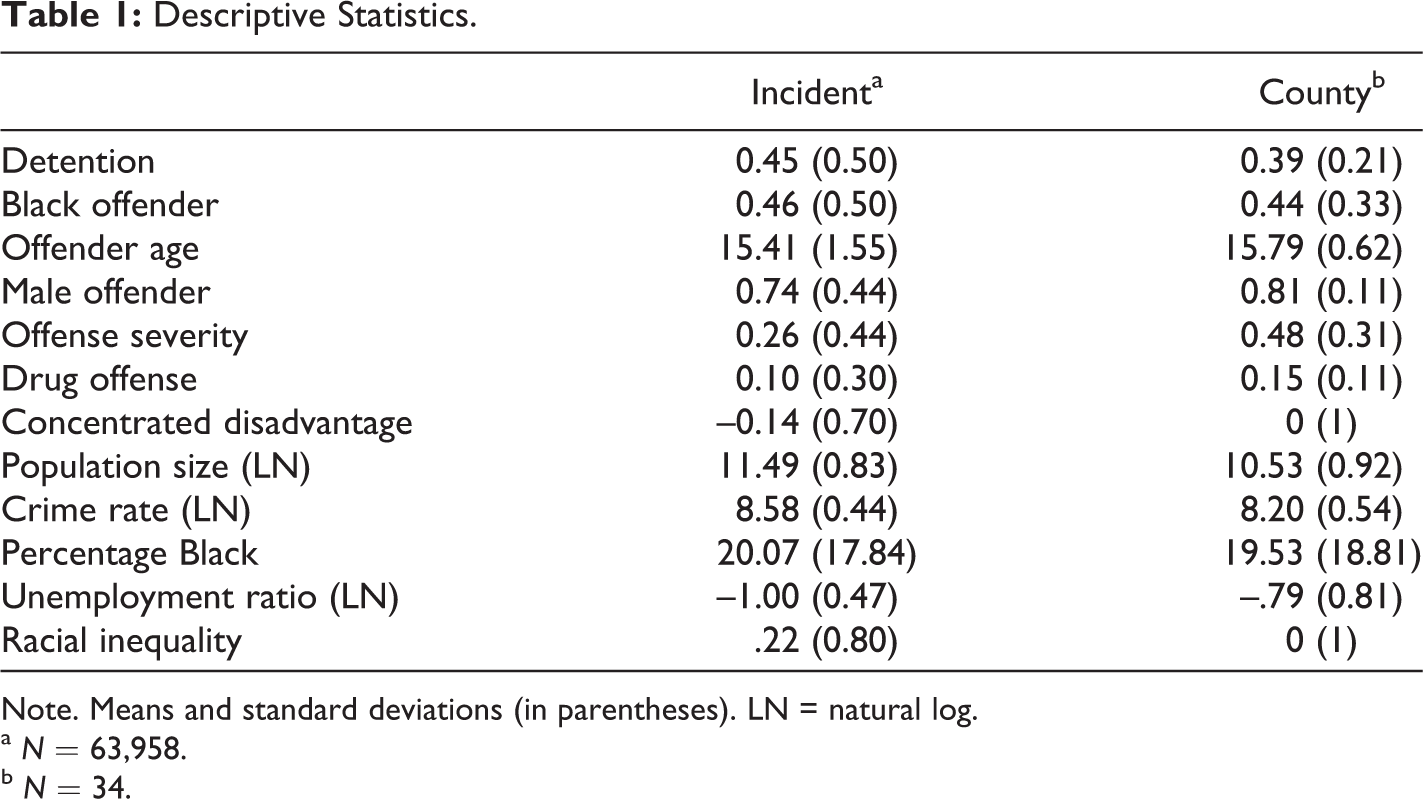
Note. Means and standard deviations (in parentheses). LN = natural log.
a N = 63,958.
b N = 34.
Contextual-Level Measures
County-level characteristics that serve as proxies of racial and symbolic threat are the primary contextual-level predictors in this analysis. We use three measures to investigate the salience of the traditional racial threat perspective to racial disparities in detention. The first measure is the relative size of the county-level Black population, the most commonly used indicator of racial threat (Kent & Jacobs, 2005; Stults & Baumer, 2006; Wang & Mears, 2010). To examine the nonlinear effects predicted by Blalock (1967), we also include the squared version of the racial composition measure. Our final measure of racial threat taps levels of economic threat posed by Blacks with an indicator of the ratio of White to Black unemployment rates. Greater values are indicative of higher levels of White unemployment in comparison to Blacks 6 (Jacobs & Wood, 1999; Ousey & Lee, 2008; Wang & Mears, 2010). Blacks comprise between 0.5% and 58% of county residents, with a between-county average of 19.5%. The county-level ratio of White to Black unemployment rates varies between 0.14 and 6.7, with an average of 0.78. The White unemployment rate exceeded that for Blacks in only three counties leading to an excessive right-hand skew.
In developing indicators of aggregate levels of symbolic threat, we sought measures that tap the likelihood that Whites perceive Blacks to be a threat to middle class norms, values, and standards. The extant literature has linked such perceptions to intergroup socioeconomic inequality (Sampson & Laub, 1993). As such, we capture levels of symbolic threat with a standardized index comprising ratios of Black to White poverty, female-headed households with children, and the failure of those 25 years and older to graduate high school. The measures were created with data from the 2000 Census and higher values on each measure as well as the combined index indicate greater socioeconomic disadvantage among Blacks relative to Whites. For each of the inequality measures, there were few instances in which Blacks fared better than Whites. Black poverty rates were 2.7 times greater, there are 4.3 times as many Black female-headed households, and approximately 1.4 times as many Blacks failed to graduate high school.
Our measures of symbolic threat are well suited to capturing levels of socioeconomic interracial inequality, yet are similar to our indicator of interracial economic competition, the White to Black unemployment ratio. The racial and symbolic threat perspectives offer differing expectations regarding the influence of socioeconomic inequality on racial disparities in the social control of youth. Blalock (1967) clearly predicted that economic threat or equality would lead to the increased formal social control of minorities. Following this logic, racial socioeconomic inequality should have no effect or possibly an attenuating effect on DMC because minorities will not be viewed as a threat to the economic or political hegemony of Whites. Conversely, the symbolic threat perspective posits that socioeconomic inequality amplifies perceived group differences, leading to greater intergroup sanctioning disparities as Whites attempt to quell a threat to mainstream culture.
In addition to indicators of racial and symbolic threat, we control for a series of county characteristics that may influence detention. Prior studies have found that youth in disadvantaged urban counties with high crime rates are disproportionately subjected to greater levels of social control (Armstrong & Rodriguez, 2005; Bridges & Steen, 1998; Feld, 1991; Leiber & Stairs, 1999). As such, we include aggregate measures of poverty, unemployment, single parent households, the index crime rate, and urbanization drawn from Census estimates and the Uniform Crime Reports. Specifically we include percentage of residents in poverty in 1999, percentage of residents unemployed in 2000, percentage of households headed by single females with children in 2000, the 2004 index crime rate, and 2000 population size. County poverty rates varied between 9.5% and 28.7%, with a between-county average of 18.2%. Female-headed households comprised between 5.1% and 16.9% of households, with a mean of 8.5%. Rates of unemployment were more consistent, varying between 1.6% and 5.5% with an average of 3.2%. Crime rates varied between 1,431 and 8,595 crimes per 100,000 residents, with an average rate of 4,488 crimes. The sample counties also varied greatly in their population sizes, ranging from 8,741 to 361,474 with an average of 54,727 residents.
In line with the extant literature (Land, McCall, & Cohen, 1990), an analysis of the correlations between certain county-level control measures highlighted excessive levels of multicollinearity. A principle components factor analysis of all control measures suggested indicators of poverty, unemployment, and female-headed households could be condensed into a structural disadvantage index. We created this index by first standardizing each measure and then averaging the standardized values. Indicators of population size and the index crime rate were converted into their natural logarithm and entered as stand-alone measures.
Analytical Strategy
A two-level hierarchical generalized linear model (HGLM) was used to explore incident- and county-level predictors of detention. Two separate equations, within and between county, were simultaneously estimated using full maximum likelihood estimation (Raudenbush & Bryk, 2002). In the Level 1 or individual-level model, we examined the ability of offender- and incident-specific characteristics to predict variability in the likelihood of being detained within counties. To reduce estimation bias, incident-level predictors were group-mean centered. In the Level 2 or contextual-level model, the characteristics of counties were used to predict variation in the average rate of detention or proportion of youth detained between counties. Multilevel models offer a number of advantages in that they highlight the separate contributions of individual and contextual effects and address the clustering of individuals within contextual environments. Additionally, estimates are adjusted for covariates at multiple levels, allowing the estimation of cross-level interaction effects. 7 While the direct effects of county-level indicators of racial and symbolic threat on overall detention rates is important, we are primarily concerned with assessing the impact that such contextual characteristics may have on the association between offender race and the likelihood of detention. As such, we explore cross-level interactions between race and Black population size, economic competition, and inequality.
Results
County and incident-level means for our detention measure, which are presented in Table 1, indicate that 45% (29,049) of youth were detained and that, across counties, approximately 40% of youth are detained (e.g., the average of the county-specific means). While only 17.3% of the population of the sample counties is Black, 46% of juvenile offenders in this analysis are Black. This disparity in formal contact with the system confirms that DMC is an issue in the juvenile justice system of this state (Puzzanchera & Adams, 2012) and provides an initial layer of support for our prediction that Black youth will have a greater probability of being detained. Across counties, approximately 44% of offenders are Black, however, the relatively large standard deviation (.33) highlights considerable between-county variability. 8
Before examining the association between incident- and county-level predictors of the likelihood of detention, we first explored whether the average probability of detention varied across counties. To do this, we constructed an unconditional model (not shown) to obtain the intraclass correlation coefficient (ICC), which gauges the proportion of variance in detention that is between counties (Luke, 2004). The ICC for this model was .38, indicating that county characteristics account for 38% of the variability in detention among juveniles suggesting a multilevel model incorporating county characteristics is valid and useful.
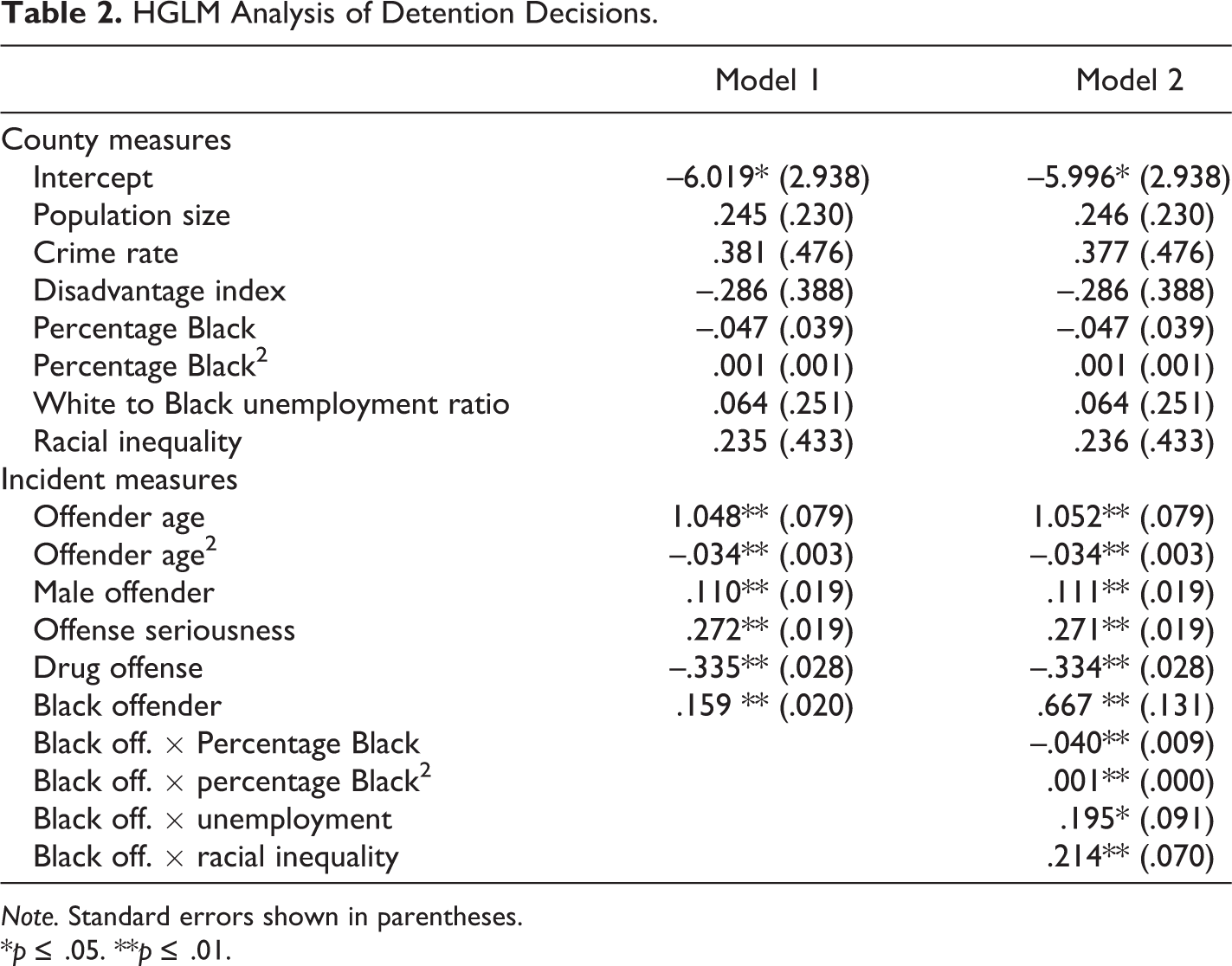
Table 2 presents the HGLM estimates predicting variation in the likelihood of detention both within and across counties. Model 1 presents the main fixed effects of each of the incident and county-level measures. All the legal and extra legal incident-level factors are significantly associated with the likelihood that a youth will be detained. The significant and positive estimate of the effect of race on detention (.159) supports our first hypothesis indicating that, net of control measures, Black youth experience a greater probability of being detained than their White counterparts. Specifically, Black youth are 1.17 times (exp [.159]) more likely than White juveniles to be detained. Males, those charged with a felony, and older youth also face a greater relative likelihood of detention. The quadratic transformation of age (age 2 ) has a significant negative effect on detention, indicating that the positive association between age and detention weakens as youth grow older. Contrary to some prior analyses, youth facing drug charges were only .72 times as likely to be detained compared to youth facing nondrug charges. Rather than indicating leniency this likely suggests many youthful drug offenders face minor possession or paraphernalia charges. Such youth are likely perceived to pose little danger to themselves or to the community and thus experience a reduced probability of detention.
HGLM Analysis of Detention Decisions.
Note. Standard errors shown in parentheses.
*p ≤ .05. **p≤ .01.
While the incident-level measures predict variation in the relative likelihood of detention for a specific type of youth or incident, the county-level measures in Model 1 are entered as predictors of between-county variation in the average rate of detention (i.e., the proportion of youth detained). Results indicate the main effects of the community-level indicators did not significantly influence variation in the rate of detention between counties. These findings do not however address the cross-level interactions outlined in Hypotheses 2–4 but rather indicate that, within these data, indicators of racial and symbolic threat do not significantly impact the overall rates of detention. Some prior studies have found various forms of threat to have a diffuse effect on levels of social control (Liska & Chamlin, 1984) that does not appear to be the case within the current sample. Residing in communities with a larger Black population, more pronounced levels of interracial economic competition or socioeconomic inequality does not increase the probability that a youth will be detained.
In Model 2 of Table 2, we examine the cross-level interactions between offender race and each of our county-level indicators of racial and symbolic threat. These interactions allow us to discern the salience of racial threat and symbolic threat to understanding racial bias in the relative likelihood that a youth will be detained. Specifically, we assess whether observed racial disparities in the probability of being detained are contingent upon the relative size of the Black population, economic competition, and/or the symbolic threat engendered by interracial socioeconomic inequality. Grounded in prior literature, we expected to uncover significant cross-level interactions between offender race and percentage Black, a quadratic transformation of percentage Black (e.g., accelerating slope), economic competition, a quadratic transformation of economic competition (e.g., decelerating slope), 9 and interracial inequality. If all cross-level interactions were significant, this would support both the racial and symbolic threat perspectives indicating that racial disparities in detention are nonlinearly exacerbated by potential threats to the economic and political hegemony of Whites and linearly exacerbated by perceived threats to middle class norms, values, and standards generated through intergroup inequality.
The findings fail to support Hypothesis 2, indicating that the relative size of the Black population significantly conditions the impact of an offender’s race on the likelihood of detention but in a negative fashion. Moreover, the significant and positive interaction between race and percentage Black 2 indicates a decelerating negative slope. That is, contrary to the racial threat perspective, racial disparities in formal social control are not exacerbated in communities facing greater minority threat as measured by Black composition. Partially supporting Hypothesis 3, the cross-level interaction between county-level economic competition and offender race is positive and significant. This finding suggests that the racial disparities in the likelihood of detention are exacerbated in contextual environments in which Blacks pose a greater threat to the economic predominance of Whites. However, these data provide no evidence that this effect is nonlinear (e.g., decelerating slope) as predicted by Blalock (1967).
While the data partially support the racial threat perspective, we find strong support for the symbolic threat perspective. As predicted in Hypothesis 4, the cross-level interaction between race and interracial socioeconomic inequality is positive and significant indicating that, net of the effects of individual and contextual-level controls, racial disparities in detention are exacerbated in counties in which the ratio of Black to White socioeconomic disadvantage is greater. Black youth in counties with more pronounced interracial socioeconomic inequality are more likely to be detained than similarly situated White youth or Black juveniles in communities in which minorities are relatively more affluent. This conditioning effect is consistent with the symbolic threat perspective which proffers that inequality amplifies perceptions of normative and cultural differences across race groups and, in turn, race-based sanctioning disparities.
To illustrate these effects, the predicted probability of detention for White and Black youth across levels of minority population size, economic competition, and socioeconomic inequality was plotted in Figures 1–3. 10 The x axis corresponds to the range of observed levels for each of the county-level threat measures, and the y axis represents the predicted probability of detention. Figure 1 illustrates that increases in the relative size of the Black population are associated with a reduction in the probability that a Black youth will be detained. This effect tapers off (e.g., declining slope) when Blacks comprise approximately 25% of the total population. This finding conflicts with Blalock’s prediction that the size of the minority population will be positively associated with formal sanctioning with an accelerating slope. Figure 2 illustrates the conditioning effect of economic threat. We find no support for the curvilinear effect (e.g., decelerating slope) predicted by Blalock, yet the positive linear association between the White to Black unemployment ratio and the probability of detention for Black youth supports the racial threat perspective. The probability of detention for both groups converges in communities with low levels of economic competition; however, Black youth in communities with high levels of economic competition were 1.5 times more likely to be detained than similarly situated White juveniles. Figure 3 illustrates the impact of socioeconomic inequality on racial disparities in detention. In support of the symbolic threat perspective, the probability that Black youth will be detained is greatest in contextual environments rife with inequality. While Blacks have a lower probability of detention than Whites in the most equitable environments, they are 1.3 times more likely to be detained in communities with high levels of inequality.
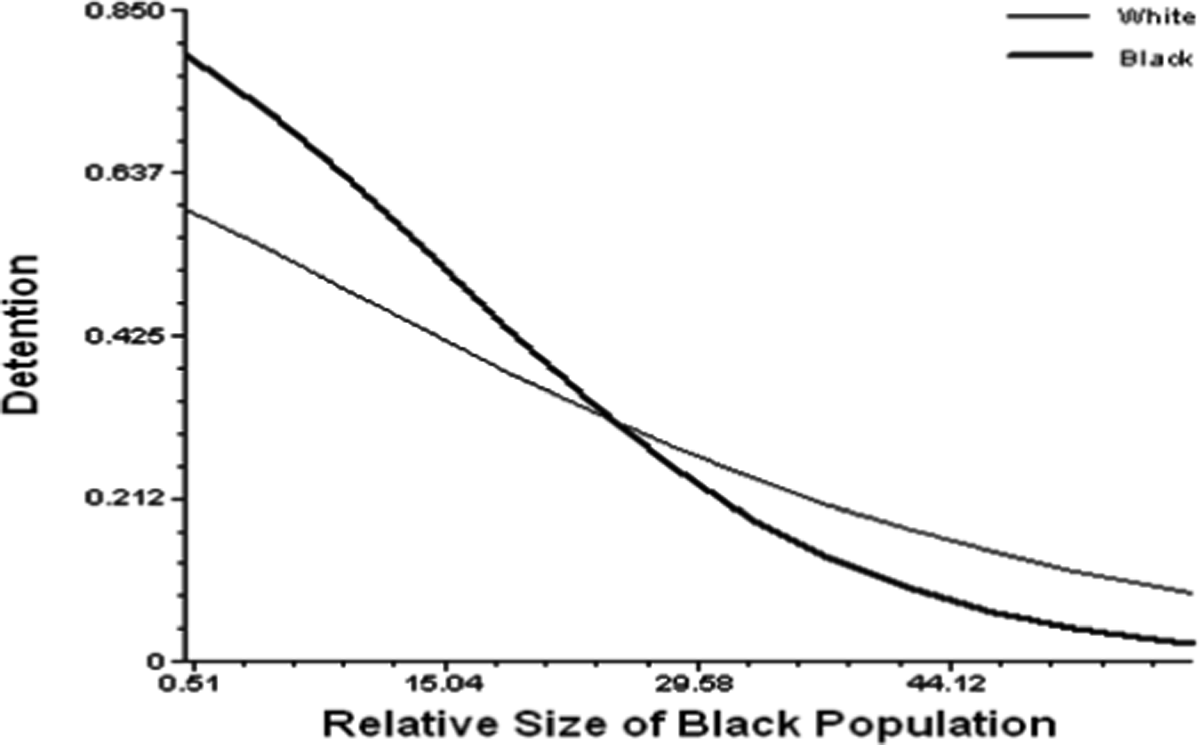
Predicted probability of detention by relative size of Black population.
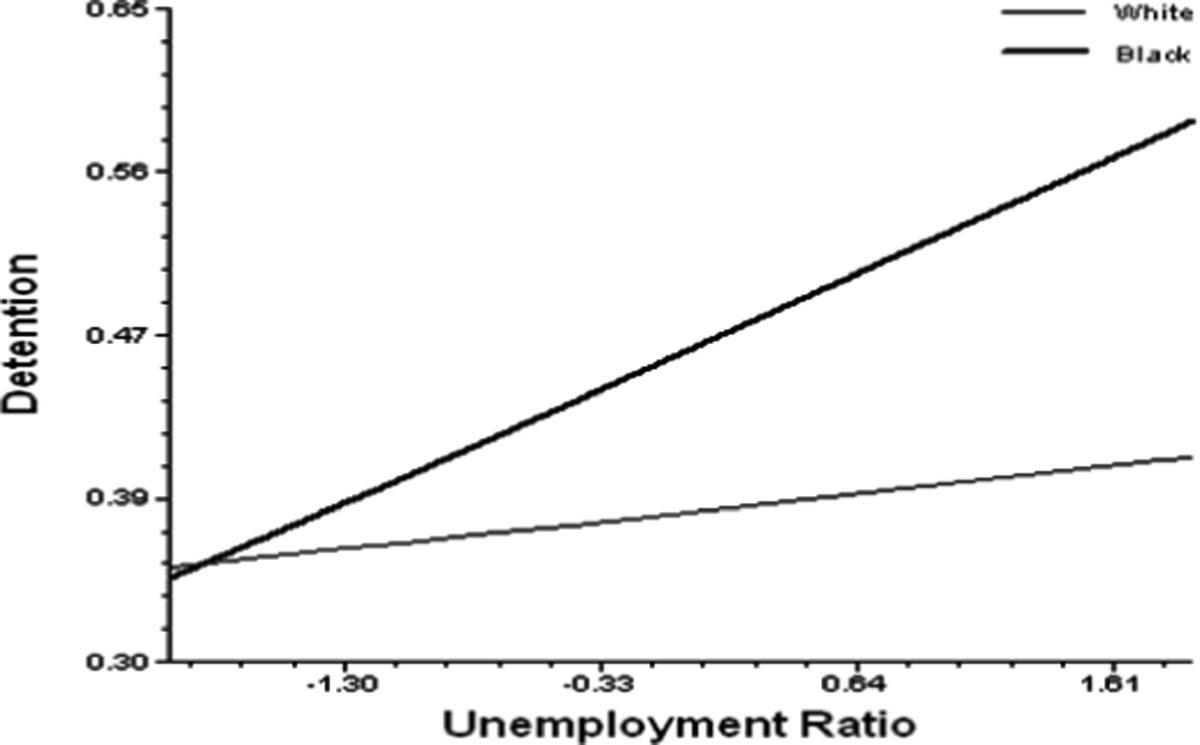
Predicted probability of detention by White to Black unemployment ratio.
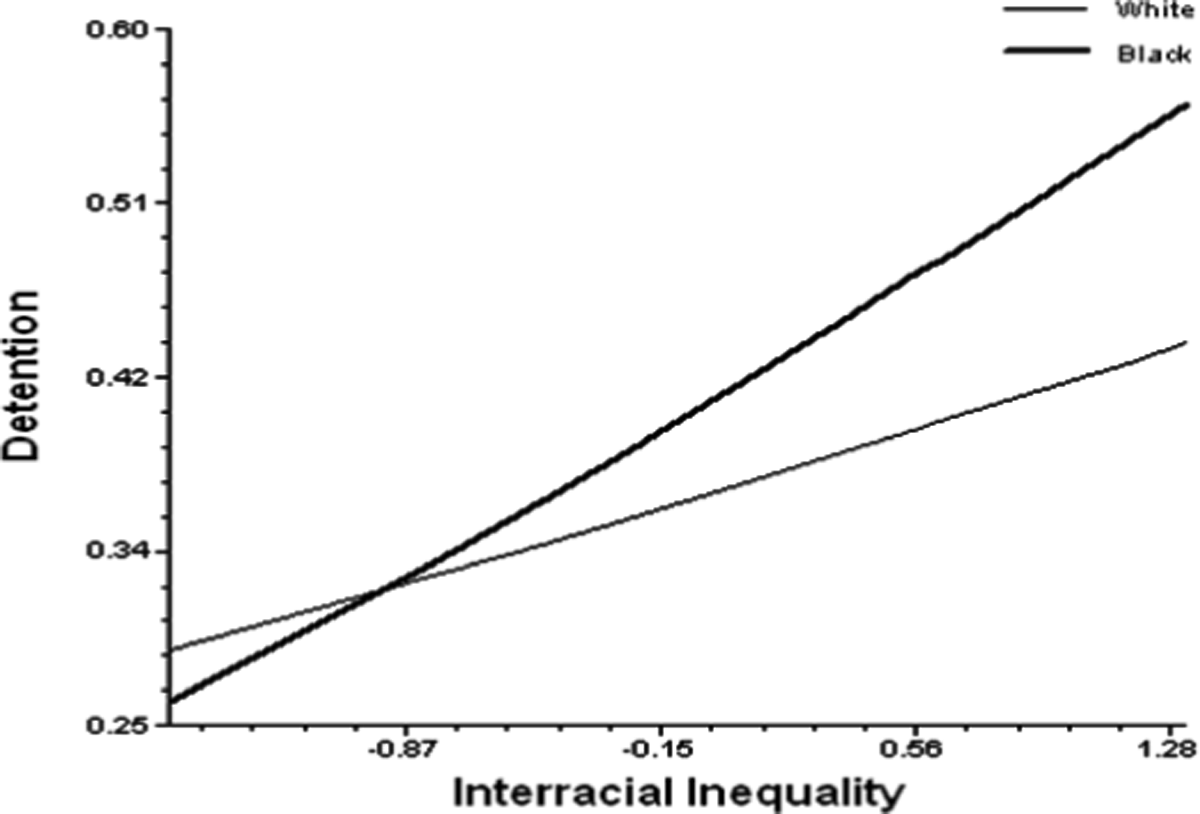
Predicted probability of detention by interracial socioeconomic inequality.
Conclusion
It is well documented that minority youth are disproportionately represented at a number of critical decision points in the juvenile justice system (Puzzanchera & Adams, 2012). Many contend that racial disparities in juvenile court case processing are rooted in race-based stereotypes coupled with the broad discretion afforded to system authorities (Bridges & Steen, 1998; Leiber & Stairs, 1999). This discretion and certain racial disparities in formal social control are likely contingent upon community characteristics that influence residents’ attitudes and values pertaining to intergroup relations. Prior literature has provided both a theoretical rationale and certain empirical evidence of how and why the disproportionate sanctioning of minority youth is rooted in structural-level intergroup threat.
The racial threat and symbolic threat perspectives offer intuitive and conceptually distinct explanations of the community characteristics likely to influence racial bias in the application of formal social control. From the racial threat perspective, increases in the relative prevalence of minorities as well as economic and political competition may lead Whites to perceive minorities as a threat to their economic and political hegemony (Blalock, 1967). This perceived threat motivates community leaders and system authorities to increase the formal sanctioning of minorities. The symbolic threat perspective attributes racial disparities in sanctioning to cultural as opposed to racial heterogeneity. Race-based socioeconomic inequality fosters the perpetuation of negative stereotypes and perceptions that Blacks are a threat to middle-class norms, attitudes, values, and standards (Tittle & Curran, 1988). Within contextual environments rife with interracial inequality, decisions of social control are often grounded in stereotypes of Black youth as less disciplined, a risk to public safety, from unstable families and communities, and thus less amenable to treatment and more likely to reoffend. In such environments, racial disparities in the application of formal social control mechanisms are likely to be exacerbated. Both threat perspectives have garnered support in the extant literature, however, prior analyses have neglected to consider both theoretical models simultaneously.
A primary contribution of this study to the extant literature centers on the simultaneous examination of whether racial disparities in the likelihood of preadjudication detention are contingent upon county-level indicators of racial or symbolic threat. To accomplish this, we analyzed 9 years of data covering 63,958 juvenile cases nested within 34 counties of a single state. The data confirmed our expectation of minority overrepresentation in the juvenile justice system, with Black youth comprising 45% of those arrested. Net of control measures, multilevel analyses indicate that Black youth are 1.17 times more likely as similarly situated White youth to be detained. Our results also indicated that older males arrested for felonies are more likely to be detained but that drug offenders have a lower probability of detention.
All of the community-level indicators failed to significantly impact variation in mean detention rates, which is at least partly attributable to a lack of variation in the proportion of youth detained. However, the impact of community characteristics on mean detention rates does not assess the structural contingencies under which race has a lesser or greater impact on juvenile court outcomes. To test our hypotheses that observed racial disparities in the probability of being detained are contingent upon racial and/or symbolic threat, we developed cross-level interactions between offender race and county-level indictors of the Black population size, the ratio of White to Black unemployment rates, and interracial inequality.
Drawing on the racial threat perspective, we expected to find a positive and accelerating association between minority population size and detention. We also expected interracial economic competition to have a positive but decelerating effect on detention. The interaction terms between race and both percentage Black and percentage Black 2 were significant but not in the expected direction. Increases in the size of the Black population have a negative and decelerating effect on the probability that Black youth will be detained. Although contrary to Blalock’s racial threat perspective, these findings are consistent with the benign neglect hypothesis (Liska & Chamlin, 1984). The benign neglect hypothesis predicts an alternative process by which increases in Black composition are expected to be inversely associated with the formal social control of minorities. As the minority population size increases, the racial composition of crimes committed by Black offenders also changes such that intraracial crimes become more prevalent. Because Black-on-Black crime may be viewed as less threatening to the majority group, Black offenders are likely to receive less severe sanctions. While the benign neglect hypothesis is not often applied to racial sanctioning disparities, a number of analyses of race-specific arrest rates support this perspective (Chamlin & Liska, 1992; Liska & Chamlin, 1984; Parker et al., 2005)
In support of the racial threat perspective, interracial economic competition moderated the effect of race on detention. Black youth have a significantly greater probability of being detained in communities in which Blacks are perceived to pose a greater threat to the economic predominance of Whites. However, these data provide no evidence supporting the deceleration of the moderating effect of economic competition on racial disparities in formal social control as proposed by Blalock (1967). While the effect of economic threat supports the racial threat perspective, the results are not conclusive. While the 95% confidence level is standard, this may not be sufficient as the analyses included 63,958 incidents. Overall, the pattern of results provides only partial and weak evidence supporting the racial threat perspective.
The symbolic threat perspective contends that intergroup socioeconomic inequality amplifies perceptions of normative and cultural differences across race groups and, in turn, race-based sanctioning disparities. That is, socioeconomic inequality increases intergroup social and cultural divisions fostering perceptions that Blacks pose a threat to mainstream society and middle-class norms, values, and standards. As such, residents, community leaders, and system officials are likely to favor the imposition of greater levels of formal social control against Black youth. The positive and significant cross-level interaction between offender race and interracial socioeconomic inequality provides strong support for the symbolic threat perspective. Racial disparities in detention are at least partly contingent upon the ratio of Black to White socioeconomic disadvantage in the community at large. In fact, Black youth have a lower probability of detention than Whites in the most equitable environments but are 1.3 times more likely than Whites to be detained in communities with high levels of socioeconomic inequality. These results provide an additional layer of evidence contrary to the racial threat perspective. Blalock proposed that socioeconomic equality would intensify perceptions of intergroup competition and thus threat. As such, interracial socioeconomic inequality should allay perceptions of economic competition and thus have no or an attenuating effect on the formal control of minority youth. Contrary to this proposition, results indicate that interracial socioeconomic inequality exacerbates racial disparities in the formal social control of youth, thus providing an additional layer of evidence in contention with the racial threat perspective.
While our results consistently support an association between the symbolic aspects of intergroup threat and racial disparities in detention, our interpretations must remain tentative until future research has addressed certain limitations of the current study. Unfortunately, detention records do not provide information on a number of factors prior analyses have linked to detention decisions such as the offender’s family structure, prior record, prior sentences, and number of charges. To the extent these or other omitted measures influence detention, our results suffer from omitted variable bias. In addition, while detention is a critical front-end decision point, our results do not speak toward racial disparities in arrest, pretrail diversion, or confinement. Our test of the racial threat perspective is also limited by the fact that we were unable to examine the influence of interracial political competition on racial disparities in detention as race-specific voting data are not available for the counties included in the analysis.
A goal of this article was to address one of the JJDPA’s core requirements, that states identify the causes of DMC. Our results suggest states must move beyond identifying individual-level factors that impact DMC and begin focusing on community characteristics that impact racial biases in the juvenile justice system. Our results suggest DMC is contingent upon levels of racial inequality in the community at large because such factors impact community sentiment and the decision-making process of system officials. Future studies should thus focus on symbolic threat as a theoretical framework for understanding the causes of DMC. Specifically, future research should attempt to uncover the true nature of racial stereotypes and how they impact perceptions of intergroup threat. Future studies should also investigate the link between race-based stereotypes, perceived racial threat, and the use of discretion by system officials.
Footnotes
Declaration of Conflicting Interests
The author(s) declared no potential conflicts of interest with respect to the research, authorship, and/or publication of this article.
Funding
The author(s) disclosed receipt of the following financial support for the research, authorship, and/or publication of this article : This research was supported by grants funded by the U.S. Department of Justice, Office of Juvenile Justice and Delinquency Prevention (No. 2010-JL-FX0459). Points of view expressed herein are those of the authors and do not necessarily represent the official position of the U.S. Department of Justice or the Office of Juvenile Justice and Delinquency Prevention.