







Abstract
Prior research regarding the relationship between officer race and job satisfaction in correctional environments has revealed mixed findings. Additionally, the link between perceptions of the promotional process and how such perceptions may vary by race has received little empirical attention. Therefore, the present study examined racial differences in perceptions of promotional criteria using a sample of sworn deputies in a large jail located in the South-Central United States. Results indicated few racial differences in perceptions of promotional indicators and workplace environment, suggesting that racial discrimination among staff in correctional settings may not be as prevalent in this location compared to findings from earlier studies that suggest differing perceptions and discrimination patterned by race. Implications for the findings in terms of understanding the role that race plays among correctional staff for guiding future research, programming, and policy are discussed.
Introduction
Race relations among employees in the corrections workplace have been a source of concern for many years (Camp, Steiger, Wright, Saylor, & Gilman, 1997; Griffin, Armstrong, & Hepburn, 2005; Owen, 1985). In the earliest days of the introduction of minorities into prison and jail work, discriminatory hiring and promotional practices, the use of racial slurs, and unfair treatment and task delegation were chronic problems (Jacobs & Grear, 1977; Owen, 1985; Toch & Klofas, 1982). While racial tensions between individual White and minority officers lessened in the 1980s and 1990s (Wright & Saylor, 1992), the increase in affirmative action hiring practices led to a shift in perceptions of inequitable treatment (Camp et al., 1997; Camp & Langan, 2005). Even though the effects of differential treatment due to race are difficult to officially estimate in correctional settings, a number of studies have revealed troubling trends such as feelings of alienation by White staff (e.g., Camp, Saylor, & Wright, 2001) and job dissatisfaction in minority staff (e.g., Britton, 1997; Cullen, Link, Wolfe, & Frank, 1985; Van Voorhis, Cullen, Link, & Wolfe, 1991).
One particular component of job satisfaction in the correctional workplace pertains to promotional opportunities of staff. Promotional opportunities are factors that are correlated with overall satisfaction in correctional settings (Armstrong & Griffin, 2004; Kiekbusch, Price, & Theis, 2010) and may be perceived differently across racial lines. Prior research has revealed that many White officers reported their promotional aspirations were stifled due to policies that required the promotion of minorities to higher paying positions (Camp et al., 1997; Camp & Langan, 2005), yet we do not currently know if perceptions of more detailed aspects of the promotional process differ for White and minority staff. Further, many of these studies were conducted over 10 years ago where one could argue that perceptions among staff may have changed in a positive manner since then (Dobrin, Smith, Peck, & Mascara, 2016). Others may reasonably assume that the present-day racial tensions in the United States (see Neville, Gallardo, & Sue, 2016; Woodson, 2017) still infiltrate the correctional environment.
Outlooks about promotional fairness, eligibility, awareness, and formality of procedures are only a select number of facets surrounding opportunities for occupational advancement in the field of corrections and are important in understanding the overall workplace culture among staff. If minimal race differences are found in the perceptions of promotional opportunities and staff is confident in these processes, the result is a positive and more race inclusive jail environment. If disparities across White and minority staff are found (where one group has more negative perceptions compared to the other), the ultimate result for these employees could be occupational burnout due to harboring feelings such as cynicism and dissatisfaction (Bhui & Fossi, 2013; Finney, Stergiopoulos, Hensel, Bonato, & Dewa, 2013; Lambert, Hogan, Griffin, & Kelley, 2015).
As some studies have reported that up to 45% of correctional staff have been discriminated against by their coworkers based on their race (see Prison Reform Trust, 2006), the current study investigates the extent to which perceptions of the promotional process and workplace environment emerge across correctional staff of different racial backgrounds. Using data from a 2014 survey of sworn officers employed in a Sheriff-run jail in a South-Central state, the purpose of the current study is to explore the viewpoints and experiences of White and minority correctional staff in regard to promotional opportunities and a race inclusive or exclusive workplace environment. The results have the potential to provide a better understanding of how perceptions of racial prejudice and discrimination are impacted by opportunities for promotion, other crucial job functions, and overall morale within the organization.
Theoretical Background
A number of different theoretical perspectives have been offered to explain the presence of prejudicial attitudes and discriminatory actions by correctional staff in prisons and jails. Although the purpose of the current study is not to explicitly test correctional theory, a discussion of these frameworks may provide more detail as to the explanations for the presence of racial bias and discrimination in workplace environments. The three theoretical orientations considered are the importation-differential experiences model, the work-role prisonization model, and denial of personal advantages perspective (Castle, 2008; Crosby, 1984; Lambert, Hogan, Altheimer, & Wareham, 2010; Van Voorhis et al., 1991).
The importation-differential experiences framework posits that individual demographic characteristics such as race, gender, age, and education level will impact an individual’s perceptions of and orientation to their job. In other words, experiences external to the work environment shape attitudes about the job itself (Castle, 2008; Lambert et al., 2010; Van Voorhis et al., 1991). This perspective suggests that even though correctional staff share the same occupation, there will be differences in perceptions and attitudes across these demographic factors. Differences in perception will be discernable by influences, such as the race of the employee. Therefore, if discriminatory actions occur within a jail environment, these actions resulted from prejudicial views harbored by individuals who acquired such beliefs outside their employment and imported them into the correctional environment.
Conversely, the work-role prisonization model suggests that internal organizational characteristics influence the attitudes and beliefs of the employees. Organizational- and occupational-related issues such as role conflict, administrative support, peer support, salary, and promotional opportunities play a more important role in shaping the attitudes and beliefs of employees compared to individual internal differences (Castle, 2008; Feldberg & Glenn, 1979; Lambert et al., 2010; Van Voorhis et al., 1991). Such a perspective suggests that all staff members regardless of race, gender, age, or education level will have generally the same attitudes and beliefs once integrated into the workplace. If discrimination against minorities were to occur in a jail environment, this perspective would dictate that the source was due to an organizational attribute.
A third framework for conceptualizing perceptions of discrimination in a correctional environment is the denial of personal advantages perspective (Camp et al., 1997; Crosby, 1984; Crosby, Pufall, Snyder, O’Connell, & Whalen, 1989). Rooted in psychology, this model suggests that male, female, majority, and minority survey respondents will answer questions about discrimination differently. The framework has two key interrelated hypotheses. First, the denial of minority opportunities hypothesis suggests that racial minorities and females are more likely to report on surveys that they are members of a disadvantaged group. Despite this acknowledgment, most will simultaneously report that they have not personally experienced discriminatory treatment (Camp et al., 1997; Crosby, 1984; Crosby et al., 1989). The second interrelated assertion is the denial of majority opportunity hypothesis. This hypothesis suggests that when surveyed about economic and employment options, Whites and males will overestimate the opportunities afforded to race and gender minority groups while simultaneously underestimating their own opportunities.
All of the abovementioned theoretical frameworks can assist in contextualizing the presence or absence of racial differences in the perceptions of promotional opportunities and the workplace environment. For example, the importation-differential experiences model and the work-role prisonization model can provide context for the source of prejudicial beliefs and discriminatory actions. In addition, following the denial of personal disadvantage perspective, one could expect that Whites will overestimate the promotional opportunities of minority correctional staff. Conversely, minorities may acknowledge that they are at a disadvantage compared to the majority group, while at the same time not report personally experiencing discriminatory actions directed against them.
Literature Review
Any discussion of prejudice and discrimination in correctional settings must start with a thorough definition of both terms. According to Quillian (2006), prejudice is an incorrect attitude or belief about an individual based on their membership to a particular group. Discrimination is a direct negative action (such as mistreatment of a person) based on a prejudiced attitude (Quillian, 2006). For an action to be truly discriminatory, it would have to be rooted in prejudice, so discriminatory actions cannot exist without prejudice. Conversely, an individual can hold prejudicial attitudes, yet not act on them (Quilian, 2006).
Dabady, Blank, and Citro (2004) argue that measuring perceptions of prejudice and discrimination are difficult for several reasons. First, respondents are often unwilling to admit to holding any prejudicial beliefs. Second, because some acts of discrimination are individually defined and subjective in nature, it is possible that a person may witness an act that they thought constituted discrimination and erroneously made this conclusion without knowing further detail. Lastly, even when acts are labeled as discrimination, it is often difficult to rule out alternative explanations (Dabady, Blank, & Citro, 2004).
Minority Staff in Corrections
The hiring of minorities to work in correctional environments has been a slow process (Owen, 1985; Toch & Klofas, 1982; Van Voorhis et al., 1991). Historically, jails and prisons were staffed by White males whom provided service to a much more racially diverse and heterogeneous inmate population (Owen, 1985; Wright & Saylor, 1992). Amid prison riots, widespread corruption, racism, and abuses of authority, a number of government-driven initiatives sought to diversify the corrections workplace. The 1967 Task Force on Corrections and the 1973 National Advisory Commission on Criminal Justice Standards and Goals suggested a change toward professionalization and the hiring of minorities to mitigate racial tensions within institutions (Van Voorhis et al., 1991; Wright & Saylor, 1992). In 1972, amendments to Title VII of the Civil Rights Act of 1964 banned discriminatory hiring practices in the public sector and enabled previously disadvantaged groups, such as minorities and females, to work in correctional institutions (Bernat & Zupan, 1989; Crouch, 1985; Van Voorhis et al., 1991; Wright & Saylor, 1992). Affirmative action hiring policies enacted throughout the 1980s also ensured that more minorities would be hired to work in the field of corrections (Camp, et al., 1997; Owen, 1985).
The transition of minority officers into the correctional workplace was hampered by a number of problems. In an early qualitative study of San Quentin prison, Owen (1985) found that minority correctional officers were subjected to harassment and teasing and that crucial information about their jobs was frequently withheld. These instances of discrimination made it difficult for minority officers to perform their assigned tasks effectively. At the time of Owen’s study, the prison administration was hiring more Black officers and had instituted formal rules against the use of racial and ethnic slurs by officers. However, many White officers subsequently reported a reverse discrimination effect, specifically with regard to the use of slurs. White officers were disciplined for this action against inmates and officers of other races, yet nothing was done if a Black officer or inmate used a slur against a White officer (Owen, 1985).
More recent studies suggest that a shift in perceptions of discrimination and advantage has taken place in some correctional institutions. Using longitudinal data from the Bureau of Prisons of promotion trends over time, Camp and colleagues (1997) discovered an increase in the hiring and promotion of minorities and females in corrections. Further analyses also indicated that males were more likely to rate promotional opportunities for minorities and females as higher than their own. The findings were attributed to affirmative action laws enacted by the legislature throughout the 1980s and 1990s (Camp et al., 1997). Another study of perceptions of promotional opportunities by Camp and Langan (2005) reached similar conclusions with White male officers reporting they were at a disadvantage compared to female and minorities. Camp, Saylor, and Wright (2001) found further evidence of racial tension in that White correctional officers had lower levels of organizational commitment to prisons with more heterogeneous staff. Conversely, Griffin and colleagues (2005) reported that White correctional officers who viewed management as supportive of equitable treatment policies had higher levels of job satisfaction compared to similarly situated Blacks.
Overall, while few studies have attempted to link racial tensions in correctional environments to specific outcomes, a number of possible correlates to strained race relations have been documented in the literature. One crucial element is job satisfaction. Psychologists have defined job satisfaction as the degree to which an individual likes their job (Spector, 1996). In the correctional literature, high levels of job satisfaction are thought to be associated with positive outcomes, such as organizational commitment, support for the rehabilitation of inmates, and personal satisfaction. Conversely, low levels of job satisfaction are hypothesized to lead to negative outcomes, such as absenteeism, burnout, and turnover intent or actual turnover.
Thus far, a number of studies have examined the direct and indirect relationships among race and job satisfaction in correctional settings. For example, Cullen and colleagues (1985) discovered that Black correctional staff had lower levels of job satisfaction. Van Voorhis, Cullen, Link, and Wolfe (1991) found that Black correctional officers were more likely to report being dissatisfied with their jobs and perceive their work as dangerous. Yet, the magnitude of dissatisfaction and perceptions of danger were decreased if staff reported that they had supervisory and peer support (Van Voorhis et al., 1991). Similarly, some studies indicate that minority correctional officers are more likely to harbor negative feelings toward administration (Griffin et al., 2005; Jacobs & Grear, 1977; Jurik & Winn, 1987), yet have higher levels of job satisfaction when they perceive supervisory support (Auerbach, Quick, & Pegg, 2003). In a recent study, Lambert, Hogan, and Paoline (2016) discovered that Black and White staff reported higher levels of job satisfaction when they perceived greater supervisory support and input into decision-making.
Some studies have linked race and dissatisfaction to specific occupational outcomes. In their study of turnover at Stateville Penitentiary, Jacobs and Grear (1977) discovered that Black correctional officers had the highest rates of resignation and termination and cited problems with prison administration as the rationale for their departure. Jurik and Winn (1987) found the highest rates of dissatisfaction and turnover existed among Black correctional officers. Recently, Wells, Minor, Lambert, and Tilley (2016) surveyed officers in juvenile correctional settings and found similar higher rates of turnover among Black staff.
Other findings are more mixed and suggest different possible associations. Utilizing data from the Prison Social Climate Survey, Wright and Saylor (1992) found that White, Black, and Hispanic correctional officers had similar levels of job satisfaction and that Black and Hispanic officers were more likely to report enjoyment and efficacy in working with inmates. Further, Black officers had the lowest levels of stress (Wright & Saylor, 1992). A few years later, Britton (1997) discovered that Black correctional officers were more likely to report being dissatisfied with their jobs but (perhaps surprisingly) also reported less stress and that they enjoyed working with inmates. Most recently, Lambert and colleagues (2010) found that Black correctional officers had higher levels of job satisfaction compared to their White counterparts.
The Present Study
Based on findings from prior research that indicate mixed, and sometimes contradictory results about the presence of race disparities in attitudes and experiences of various aspects of correctional employment (Britton, 1997; Bhui & Fossi, 2008; Wright & Saylor, 1992), two general research questions guide the present study. The first research question asks, “To what extent are there racial differences in perceptions of the promotional process by White and minority correctional staff in a jail facility?” The second research question is “Do White and minority correctional staff report similar or different perceptions and experiences of race-specific aspects of the jail workplace environment?”
For the present study, data were collected in 2014 from a large Sheriff-run jail in a South-Central state. Based on prior research (Griffin et al., 2005; Hemmens, Stohr, Schoeler, & Miller, 2002; Jurik, 1985; Pogrebin & Poole, 1998; Van Voorhis et al., 1991; Zimmer, 1987), a survey instrument was developed that contained questions about demographic characteristics, duties and assignments, whether the respondents had ever perceived unfair or biased treatment while on the job, job satisfaction, promotional opportunities and aspirations, as well as other factors. Employees were notified of the study via an e-mail sent by the commanding Lieutenant of the jail. The e-mail contained a consent waiver and a link to take the survey. Reminder e-mails were sent by the Lieutenant to motivate employees to complete the instrument. Survey Monkey software was utilized to construct and administer the survey. All responses were anonymous.
Data and Sample
The initial sample was comprised of 818 sworn deputies who worked in the detention facility who were the rank of Sergeant and below. To ensure confidentiality, correctional officers who were of higher rank were excluded from data collection because they had a high likelihood of being identified through demographic and job-related factors. We also excluded individuals who were ranked higher than a Sergeant because they had already been promoted, and the key questions of this study would be interpreted differently among this group compared to Sergeants and lower ranks. The final sample size is 362 respondents, with a response rate of 44.25%. Respondents with missing data were removed only from the specific analysis affected using listwise deletion.
Variables
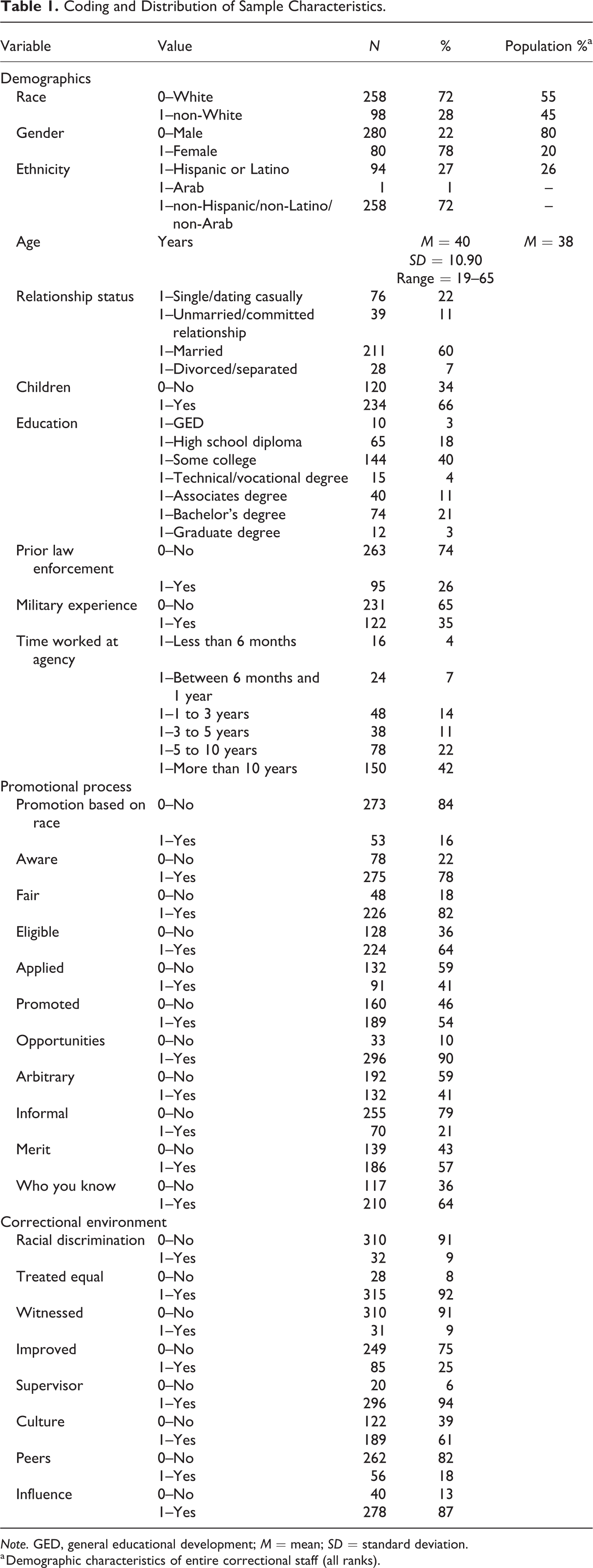
Table 1 presents the coding and distribution of all sample characteristics, as well as demographic characteristics for the jail staff across all ranks. In regard to demographic factors, 72% of the sample is White, and 28% is non-White. This distribution has a larger proportion of White officers compared to those who are publicly reported for correctional staff of all ranks (White = 55%, non-White = 45%) within the jail. Respondent race was originally coded as White (n = 258), Black or African American (n = 48), American Indian or Alaskan Native (n = 7), Asian (n = 2), Other (n = 19), or two or more races (n = 22) and collapsed into White (n = 258) and non-White (n = 98). Aggregating racial groups into two categories provides a large enough number of non-White respondents to allow for comparisons across racial groups in perceptions of the promotional process and correctional environment.
Coding and Distribution of Sample Characteristics.
Note. GED, general educational development; M = mean; SD = standard deviation.
a Demographic characteristics of entire correctional staff (all ranks).
The distribution of respondents across gender, ethnicity, and age also approximates the correctional officer population. Eighty percent of the sample is male (20% female), are not Hispanic/Latino/Arab (74%), and on average are 40 years old. Concerning other related demographic characteristics, respondents were married (60%), had children (66%), had some college experience (40%), no prior law enforcement experience (74%), no military experience (65%), and worked at the agency for more than 10 years (42%).
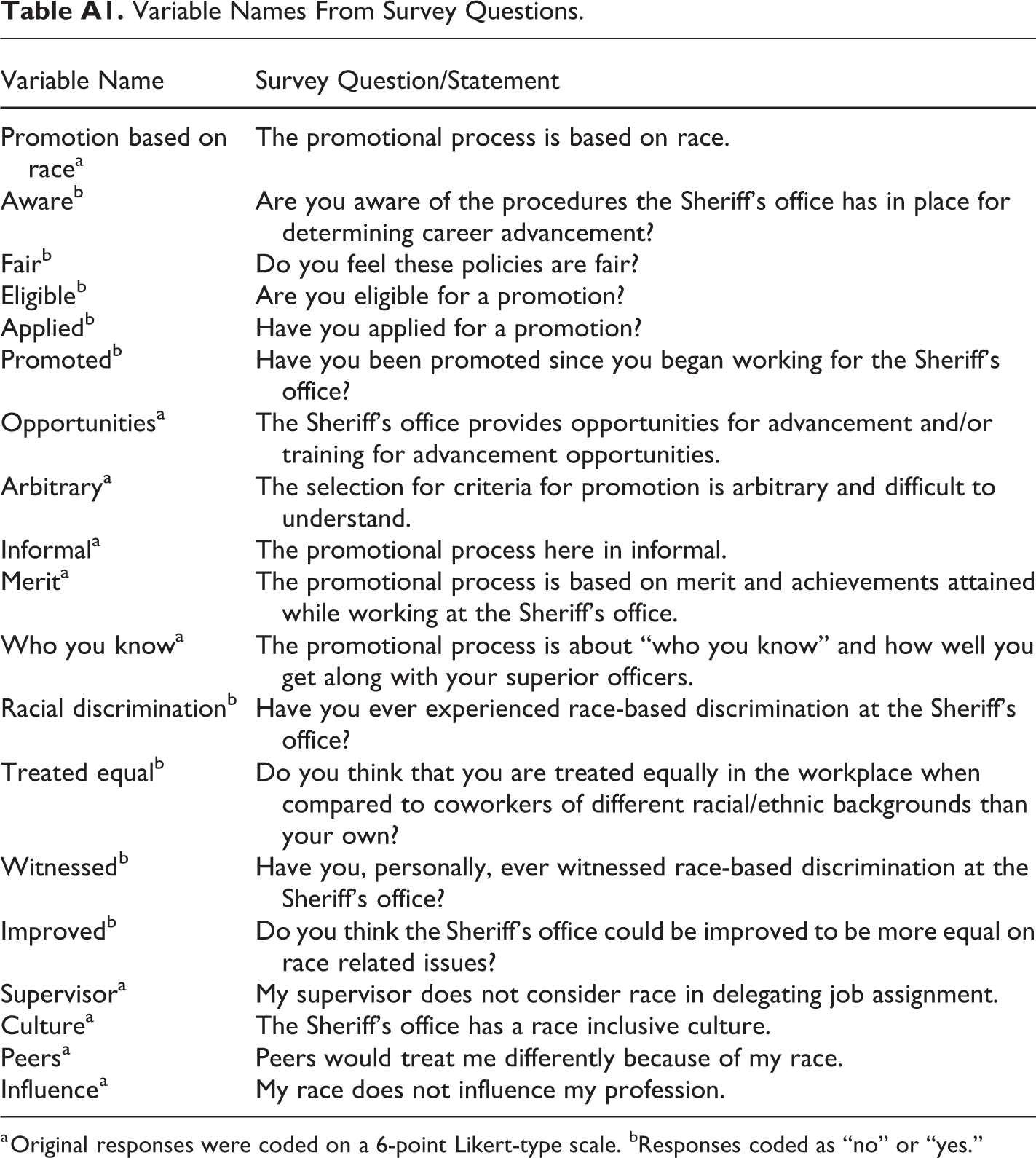
Appendix 1 presents the specific survey items and corresponding variable names that measure respondent perceptions and were based on theory and prior research relating to the views of staff in correctional settings (Griffin et al., 2005; Hemmens et al., 2002; Jurik, 1985; Pogrebin & Poole, 1998; Van Voorhis et al., 1991; Zimmer, 1987). Correctional staff were asked 11 survey questions relating to perceptions of the promotional process. Of the 11 questions, 6 were statements with a Likert-type scale that required the respondents to rate their level of their agreement. For example, one such statement was “The promotional process is based on race.” The following response options were provided: 1 = disagree very much, 2 = disagree moderately, 3 = disagree slightly, 4 = agree slightly, 5 = agree moderately, 6 = agree very much. Due to a lack of variation across the six potential responses for each question, the scales were collapsed in to a dichotomy (0 = no, 1 = yes) with the Likert-type response choices disagree very much, disagree moderately, and disagree slightly recoded to “no” and responses agree slightly, agree moderately, and agree very much recoded to “yes.” The remaining promotional questions were originally operationalized as a “no” or “yes” response and did not require further manipulation.
Across the entire sample (n = 362), 16% perceived that the promotional process is based on race. Seventy-eight percent of respondents were aware of promotional procedures at their agency, 82% believed the promotional policies are fair, and 64% were eligible for a promotion. Approximately 41% of the sample have applied for a promotion, while over half (54%) have been promoted while working for the Sheriff’s office. Further, 90% of respondents stated that the Sheriff’s office provides opportunities for advancement. However, 41% believed the selection process for promotions are arbitrary, while 21% perceived the process to be informal in nature. More than half of the sample agreed that the promotional process is based on merit (57%), yet others reported that promotions are based on “who you know” (64%).
Eight survey questions pertained to perceptions of the overall correctional environment. Of the eight questions, four were statements that included the same 6-option Likert-type scale responses discussed earlier. These responses required the respondent to rate their level of agreement with each statement. As with the promotional process variables described earlier, a lack of variation in responses forced us to similarly collapse the scales into a binary outcome (0 = no, 1 = yes). Four of the eight questions already required dichotomous responses (“no” or “yes”) and did not require further modification. For the entire sample (n = 362), respondents reported experiencing race-based discrimination (9%), were not treated equally (8%), or witnessed discrimination based on race (9%) in the workplace. Twenty-five percent believe that the Sheriff’s office could be improved to be more equal on race-related issues, that supervisors do consider race in delegating job assignments (6%), perceive that the Sherriff’s office does not have a race inclusive culture (39%), that peers treat respondents differently because of their racial background (18%), and that race influences respondents’ profession (13%).
Results
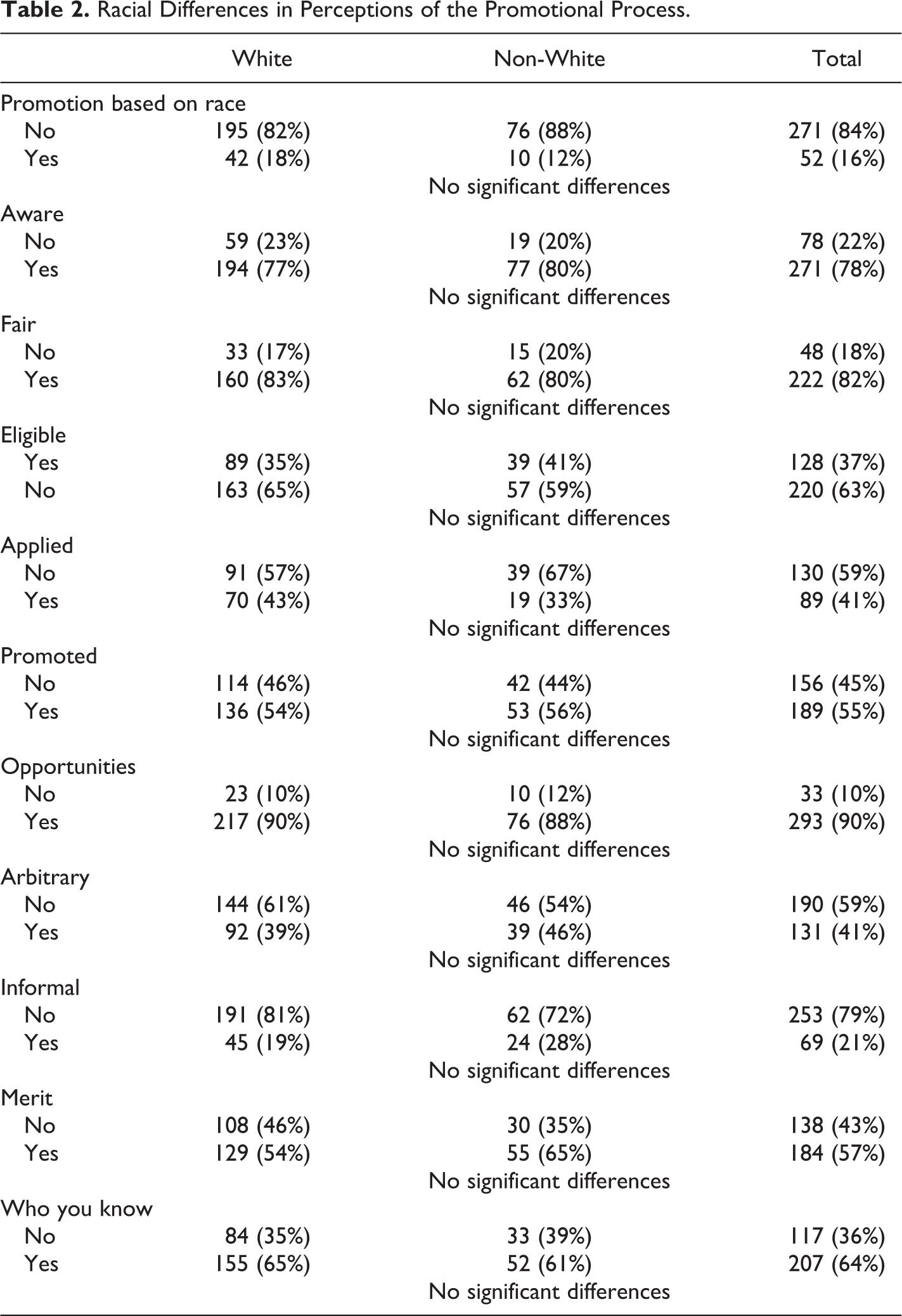
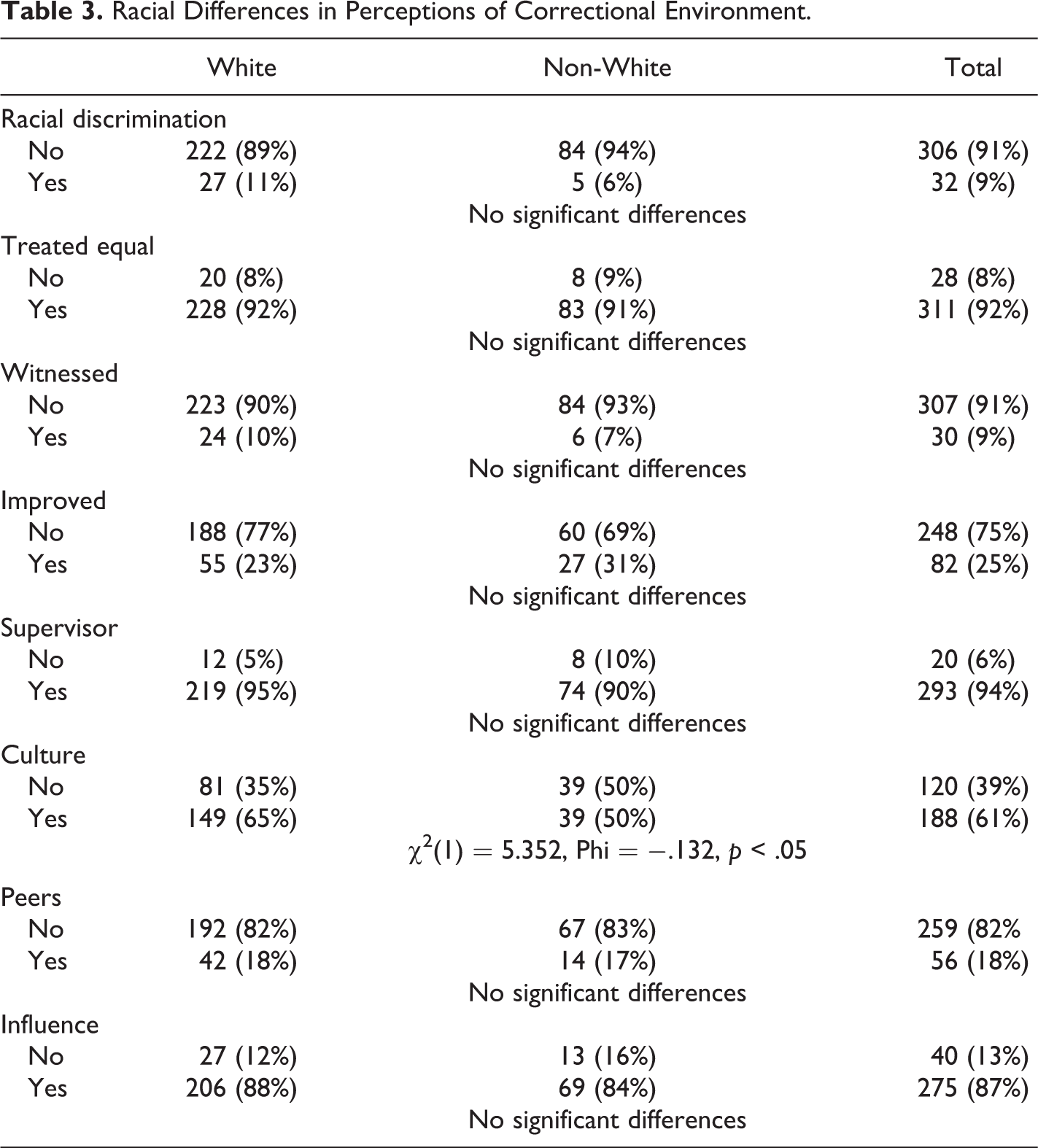
In order to examine the role that race plays in the perceptions of the promotional process and overall environment of jail employees, chi-square various analyses were performed to test for significant differences across racial groups. The significance level was set at .05, and Phi statistics were included due to the nominal nature of the variables. The Phi values were considered small (.2), moderate (.5), or strong (.8; Ferguson, 2009). The results are presented in Tables 2 and 3. For both tables, raw figures and column percentages are provided for Whites (column 1), non-Whites (column 2), and the entire sample (column 3).
Racial Differences in Perceptions of the Promotional Process.
Racial Differences in Perceptions of Correctional Environment.
As shown in Table 2, across all 11 variables that measured perceptions of the promotional process, no significant differences emerged when examined within racial categories of White and non-White correctional staff. Although unexpected, results indicate that regardless of race, White and non-White staff perceive various aspects of the promotional process in a similar manner. These findings held across perceptions of race-based decision-making, awareness, fairness, eligibility, actually being promoted, knowledge of opportunities for advancement, degree of formality in procedures, understanding of promotion criteria, amount of merit, and “who you know” in deciding promotions. For example, for those respondents who did not apply for a promotion, further details were provided through qualitative responses, including justifications for not applying. Explanations included “I am happy where I am. I do not want to start over with seniority. Money is not everything”; “(I) have not had the desire (to seek promotion) at the present time”; “I like my current position, and it is family friendly”; “(I) like the hours and job location where I am currently assigned”; and “My family comes first.”
As our study was exploratory in nature, our goal was not to use respondent demographic and employment characteristics (e.g., race, gender, age, relationship status, prior military experience, law enforcement history, education, parental status) to predict perceptions of the promotional process or correctional environment. However, to confirm the results that emerged from our bivariate analyses, we estimated logistic regression equations (not provided, but available upon request) to examine whether respondent characteristics significantly influenced the perceptions of the promotional process. The models supported our findings of no statistically significant relationships between the demographic and employment factors indicated above and the perception that the promotional process is based on race. In other words, a respondent’s race, gender, age, years on the force, level of education, prior law enforcement or military experience, relationship status, or parental status were not significantly associated with the likelihood of reporting that the promotions in their agency are based on the race of correctional staff. At this point in the analyses, even though a lack of significant differences were discovered across racial groups in perceptions of the promotional processes and additional details provided context to these findings in the respondents open-ended comments in the survey, we further examined whether there were similarities in the beliefs of White and non-White correctional staff that pertained to observations of the overall correctional workplace environment. 1
As presented in Table 3, both White and non-White staff perceived various aspects of the workplace environment in a similar manner. With one exception, the findings across racial groups mirrored the proportions represented in the entire sample. Specifically, respondents reported not experiencing racial discrimination, were treated equal in the workplace, did not witness race-based discrimination, did not believe that the Sheriff’s office needed to improve to be more equal on race-related issues, supervisors do not consider race in delegating job assignments, peers do not treat respondents differently based on their race, and race does not influence their profession. One significant racial difference was found between White and non-White correctional staff in regard to perceptions that the Sheriff’s office has a race inclusive culture (Phi = −.132), yet the effect was small to moderate. Whites were significantly more likely than non-Whites to report working in a race inclusive culture (65% yes for White vs. 50% yes for non-White).
Although quantitatively minimal significant differences arose across jail staff, qualitative responses to race-specific questions pertaining to the workplace environment provided some additional context to the findings. Of those respondents who reported experiencing race-based discrimination at work, details emerged about resolving the situation: “I reported the problem to another supervisor and he fixed everything”; “It was resolved. That female went to a different shift”; and “The situation resolved itself. The attitude of the said officer pretty much stopped her from being promoted.” Furthermore, respondents discussed details about what could be improved to make this specific Sherriff’s office more equal on race-related issues. Responses included “There is always room for improvement. However, [Sherriff’s Office] is very progressive compared to other agencies. We can continue to train our staff and bring awareness of these issues”; “[Sherriff’s Office] is very diverse. But we may need to offer more training in this area [race relations?]”; and “[Sherriff’s Office] is pro-active on race relations but as society changes our county must as well.”
Discussion
This research examined officer perceptions of promotional opportunities in a large Sheriff-run jail in the South-Central United States using a survey that was administered to all staff ranked Sergeant and below. Responses were compared across White and non-White racial groups to determine whether race was correlated with perceptions of promotional fairness, a finding that has historically emerged in prior research (e.g., Camp et al., 1997; Camp et al., 2001; Camp & Langan, 2005). Tied to this objective, we also extended prior research by examining the potential for race differences in various aspects of the correctional work environment. The overall findings revealed that, with a single exception, there were no differences in responses discernable by race.
Most obvious, these results are overwhelmingly unique when compared to earlier studies of staff within correctional settings. Broadly reflecting on earlier work, it appears that there are two sets of findings from two separate periods of time in the history of correctional research. Early studies dating from the time when minorities were first introduced in to correctional settings (i.e., 1970s) documented many examples of perceptions of unfair treatment and discrimination directed at them by White officers and administrators (Jacobs & Grear, 1977; Owen, 1985; Toch & Klofas, 1982). Later studies, from the mid- to late-90s onward, showed the presence of a reverse discrimination effect in that White officers reported being at a disadvantage compared to minorities so far as hiring and promotional opportunities were concerned (Camp et al., 1997, 2001; Camp & Langan, 2005). On the contrary, our findings show that minority and White officers have largely similar views regarding promotional policies, fairness of treatment, and the existence of discriminatory practices within this particular institution. Thus, it would appear that perceptions of promotional fairness are stable across all racial groups which no longer comport with either trend documented in earlier correctional research.
Although this study did not attempt to directly test theory, we can perhaps better contextualize these divergent findings through the theoretical frameworks outlined earlier, specifically the importation-differential experiences model, the work-role prisonization model, and denial of personal advantages perspective. As the importation-differential experiences model suggests that individuals of different genders, racial backgrounds, ages, and educational attainment should carry different perceptions regardless of the work environment (Castle, 2008; Lambert et al., 2010; Van Voorhis et al., 1991), our findings are in direct contrast to this perspective. Under this model, we would reasonably expect to find differences patterned by race, but we did not.
Similarly, the denial of personnel advantages perspective predicts differences in perceptions of treatment across gender and racial groups, yet intragroup similarity. Under this perspective, we would expect to find that minority correctional staff would acknowledge they are members of a disadvantaged group, yet would not report having personally experienced discriminatory treatment. On the other hand, their White counterparts would report that minorities had an advantage when it came to promotion, while simultaneously undermining the possibility of achieving similar ends (Camp et al., 1997; Crosby, 1984; Crosby et al., 1989). Although we did not have questions on our survey specific to this theory, it would seem that our findings, on the surface, do not comport with either perspective. Again, we do find that White and minority officers have very similar things to say with regard to issues of promotional fairness and discriminatory treatment.
Lastly, the work-role prisonization model suggests that the socialization aspects of the correctional environment, particularly the shared experiences of staff, should wash away any individual held perceptions. In other words, perceptions among staff should be largely homogeneous (Castle, 2008; Feldberg & Glenn, 1979; Lambert et al., 2010; Van Voorhis et al., 1991). Our findings best fit this perspective. Out of the three theoretical frameworks, this is perhaps the most promising in terms of deriving policy implications. Due to the fact that institutional-level variables influence perceptions, such are much more easily manipulable by jail administrators as opposed to individual preconceptions that are imported in to the environment from external sources that are impossible to control.
Policy Implications
Given that our findings are indicative of agreement across racial groups about favorable conditions and treatment at this institution and that the work-role prisonization model suggests that homogenization of outlooks is a result of organizational socialization, these results are very encouraging. We speculate that this agency is “doing something right” so far as ensuring that promotional criteria are fair and unbiased and not based on prejudicial factors such as race. It would also appear that the agency handles complaints regarding discrimination in a manner that is deemed appropriate across majority and minority racial groups.
Unfortunately, getting inside the “black box” of organizational culture and socialization processes in a context such as this is difficult. Although our survey produced evidence of positive perceptions among staff across racial groups, we are left without insight as to why or what possible organization-level variables and mechanisms lead to such positive and homogeneous outlooks from the staff. This is an area that could greatly benefit from future research. Specifically, future research is necessary to uncover what organizational attributes are behind these homogeneous positive perceptions. If, for instance, in-service cultural and racial diversity training is a part of the experience or employees receive education regarding reporting mechanisms for issuing formalized complaints of unfair treatment and are encouraged to use them without repercussion, such exposure may lead to similar outlooks among staff irrespective of race. We do find evidence for the latter in some of the qualitative responses in which staff indicated that problems relating to unfair treatment were addressed and resolved by the administrators of the institution.
Limitations and Future Research
In light of our results and conclusions, there are multiple limitations to be wary of. First, the possibility of self-selection bias in survey respondents must be acknowledged. We created an advertisement about our research and disseminated it on a listserv utilized by jail and prison administrators. The agency we eventually selected for study contacted us and expressed interest in our project and survey. Thus, we cannot definitively say how this jail differs from others that were not investigated.
Specifically, the agency’s motivations for participation are not known. Considering the sensitive and controversial nature of this research, the operating practices of other agencies may not wish to acknowledge they have problems pertaining to racial discrimination and therefore would not be open to subjecting themselves to this type of scrutiny. In the early phases of this project, we actually had two agencies reject our research proposal, one on the grounds that they did not appreciate the nature of the questions concerning discrimination. Even though responses would be anonymous, one agency felt they would be obligated to investigate and resolve any complaints that may be uncovered by our study. The second agency was undergoing investigation at the time of our solicitation for matters pertaining to discriminatory practices and declined participation on those grounds. Thus, we find a cautionary lesson in these early attempts at recruiting in that not all agencies are amenable to or accepting of outside evaluation and could lead to biased findings.
Additional limitations apply to the nature of the survey itself. Our survey-based study design is cross sectional, with our survey instrument being administered at only one point in time. Therefore, we cannot reach any conclusions about causality. Our survey response rate is also low at 44.25%. However, other studies in correctional settings have had a variety of different response rates with a low of 18% as reported by Castle (2008) and a high of 86.9% as reported by Camp and colleagues (1997). The response rate achieved in our study falls within those parameters. Additionally, due to the need to maintain the anonymity of our respondents, our survey software did not have any means for recording or documenting IP addresses. It is, therefore, possible that a single respondent may have taken the Internet-based survey repeatedly, but we believe this to be unlikely.
Lastly, there is a limitation within our methodological and analytical strategy. In order to achieve adequate estimates and statistical power, we were forced to collapse multiple racial groups into a dichotomy of White and non-White staff. The original sample was 72% White, 13% Black, 1% American Indian or Alaskan Native, 0.5% Asian, 6% two or more races, and in terms of ethnicity, 26% self-identified as Hispanic or Latino. Given the ever-increasing racial heterogeneity of the U.S. population and the simultaneous increase in the diversity of correctional staff, there is a need to go beyond this simple dichotomization. It is also conceivable that members of different ethnic groups, such as Latinos, may hold very different perceptions from not only Whites but from Blacks as well. However, utilizing race as a dichotomous unit of analysis masks much of this variation (Lambert et al., 2016).
Future researchers could improve upon the design described here by conducting a similar survey at more than one agency. Since the current study was only conducted in one location, we cannot make any definitive statements about how these findings may be generalizable to other correctional environments. Replication and the use of multiple locations could improve generalizability and thus strengthen external validity. Further, while it is difficult to escape the cross-sectional nature of surveys, conducting follow-up surveys over time and at multiple locations could elucidate changes in perceptions and further understanding of the reasons for those changes. Identifying sources of change significantly helps future research efforts. For example, if it is discovered through surveying that an agency is engaging in a specific type of cultural diversity training which results in positive perceptions of treatment, it provides stronger evidence to implement the same program in other correctional settings to evaluate its effectiveness with more advanced methodological approaches, such as randomized controlled or quasi-experimental designs.
We also recommend that future researchers attempt to improve response rates on surveys. One viable means for doing so is by offering some concession to participants, such as cash prizes or entrance into a raffle. In addition, the delivery method of surveys can be improved. Our surveys were administered via e-mail and e-mails can be easily ignored or deleted. Utilizing mandatory and naturally occurring agency meetings such as roll calls and staff briefings could be used as opportunities to disseminate paper surveys and thus achieve higher response rates.
Finally, future researchers may consider using qualitative methods to contextualize quantitative findings. For instance, as noted, we were unable to identify what factors may be at work within this particular agency that led to such homogeneous reporting of perceptions that transcend racial divides among the staff. While it is difficult for a survey to illuminate the processes that lead to the homogenization of perceptions, in-depth interviews with administrators, staff, and focus group discussions can suggest possible worthwhile directions. Qualitative methods may also be a way of reaching racial/ethnic minority staff members whose voices are seldom heard, such as Latinos or Asians. Such opportunities could move research in to a more fruitful direction given the increased diversity in the correctional workplace.
Conclusion
While this study is exploratory in nature, it is an important first step in updating the literature with regard to the perceptions of promotional opportunities and fairness across race in a correctional setting. As noted, our findings suggest that perceptions have changed in the decade since many of the earlier studies were conducted. In light of this, it would be naive to assume that perceptions of issues such as fairness in hiring, promotions, and equitable treatment are static and not subject to change. Therefore, we hope that others will continue research into this area. Gaining better understanding of why such differing, and, in this case, positive perceptions exist can lead to opportunities for better training, reporting, and more equitable treatment of staff, regardless of factors such as race.
Footnotes
Appendix 1
Variable Names From Survey Questions.
| Variable Name | Survey Question/Statement |
|---|---|
| Promotion based on racea | The promotional process is based on race. |
| Awareb | Are you aware of the procedures the Sheriff’s office has in place for determining career advancement? |
| Fairb | Do you feel these policies are fair? |
| Eligibleb | Are you eligible for a promotion? |
| Appliedb | Have you applied for a promotion? |
| Promotedb | Have you been promoted since you began working for the Sheriff’s office? |
| Opportunitiesa | The Sheriff’s office provides opportunities for advancement and/or training for advancement opportunities. |
| Arbitrarya | The selection for criteria for promotion is arbitrary and difficult to understand. |
| Informala | The promotional process here in informal. |
| Merita | The promotional process is based on merit and achievements attained while working at the Sheriff’s office. |
| Who you knowa | The promotional process is about “who you know” and how well you get along with your superior officers. |
| Racial discriminationb | Have you ever experienced race-based discrimination at the Sheriff’s office? |
| Treated equalb | Do you think that you are treated equally in the workplace when compared to coworkers of different racial/ethnic backgrounds than your own? |
| Witnessedb | Have you, personally, ever witnessed race-based discrimination at the Sheriff’s office? |
| Improvedb | Do you think the Sheriff’s office could be improved to be more equal on race related issues? |
| Supervisora | My supervisor does not consider race in delegating job assignment. |
| Culturea | The Sheriff’s office has a race inclusive culture. |
| Peersa | Peers would treat me differently because of my race. |
| Influencea | My race does not influence my profession. |
a Original responses were coded on a 6-point Likert-type scale. bResponses coded as “no” or “yes.”
Declaration of Conflicting Interests
The authors declared no potential conflicts of interest with respect to the research, authorship, and/or publication of this article.
Funding
The authors received no financial support for the research, authorship, and/or publication of this article.