







Abstract
As the population of children of immigrants increases within the United States, the importance of ensuring the safety, while understanding and addressing adverse experiences with victimization and perpetration, of this segment of the youth population has become paramount. Segmented assimilation theory, which postulates that discrimination, prejudice, and adverse life experiences could place the children of immigrants on a path towards detrimental outcomes, guides this study. In this research, data is drawn from the Children of Immigrant Longitudinal Study to explore if prior detrimental experiences of the children of immigrants, such as discrimination and perceptions of racial/ethnic prejudice, are associated with more frequent reports of being victimized and getting into fights at school, as well as feeling unsafe. Findings suggest racial/ethnic distinctions and nuances regarding how discrimination and prejudice contribute to these school outcomes for the children of immigrants. The implications of these findings are discussed.
Introduction
Over eighteen million children, approximately twenty-five percent of all children in the United States (US), have at least one immigrant parent and that percentage is expected to increase to thirty-three percent by 2050 (US Census Bureau, 2022). Considering that safety could facilitate, while adverse experiences with victimization and perpetration could derail, healthy childhood and adolescent development, understanding how these connections occur for a vulnerable segment of the youth population (i.e., the children of immigrants) is paramount as the US becomes more diverse. Interest in the relationships between immigration and violence has expanded since the 1990s, commensurate with growth in the share of foreign-born residents in the US (for reviews, see Ousey & Kubrin, 2018; Zatz & Smith, 2012). Contrary to negative popular and partisan rhetoric that immigrants are crime prone, criminologists frequently observe that immigration is inversely correlated with violence (Kubrin & Ousey, 2009; Martinez & Lee, 2000; Martinez et al., 2008; Olsen et al., 2009; Sampson & Bean, 2006). Studies at the individual level also confirm that first generation immigrant youth report less delinquent behavior than their second, and third-plus generation immigrant counterparts (Bersani, 2014; Bersani et al., 2014; Bersani & Piquero, 2017; Peguero, 2011). Findings such as these compel some scholars to attribute a portion of the 1990s nationwide violence and crime decline to growth in immigration (Sampson, 2008; Stowell et al., 2009; Wadsworth, 2010) as well as to the complex relationships between assimilation and adverse experiences such as violence and victimization for the children of immigrants (Peguero & Bondy, 2021; Portes & Rumbaut, 2014; Rendón, 2014).
There is also growing evidence concerning the phenomenon of “downward assimilation” to further understand the relationship between immigration and violence (Peguero & Bondy, 2021; Portes & Rumbaut, 2014; Rendón, 2014). Even though immigrants and their children, especially racial/ethnic minorities, are coming to the US with high levels of optimism about educational opportunities and belief in socioeconomic upward mobility, scholars argue that discrimination and prejudicial treatment are placing immigrants and their children towards a “downward” trajectory of educational failure, criminal or delinquent behavior, and exposure to violence (Peguero & Bondy, 2021; Portes & Rumbaut, 2014; Rendón, 2014). With a downward assimilation conceptual lens, the children of immigrants are experiencing adverse experiences such as violence and victimization which in turn be contributing to detrimental educational, health, and developmental outcomes.
This current study therefore has two objectives. First, it will examine the correlation between the children of immigrants’ reports of their adverse experiences, such as discrimination and perceptions of racial/ethnic prejudice, with being victimized and getting into fights at school, as well as with perceptions of safety at school. Second, this study will investigate if there are racial/ethnic distinctions in these correlations. Data are drawn from the Children of Immigrants Longitudinal Study, which is a longitudinal study designed to study the adaptation process for the children of immigrants. Although the first round of data was collected in 1992, now 30 years ago and thus of questionable relevance to assimilation today, it includes more diverse measures of immigrant assimilation experiences than are available in many other data sources. Findings indicate, in general, that discrimination and to a lesser extent, prejudice, are correlated with being victimized and getting into fights at school, although there are nuanced racial/ethnic differences in these relationships. Finally, this study discusses the implications for future safety and adverse experience research and policy implementation in a nation with a rapidly growing population of children of immigrants.
Segmented Assimilation Theory
For decades, the conventional way to understand assimilation in the US was through a classical or “straight-line” assimilation lens. Classical or straight-line assimilation theory is viewed as a “natural” process and once this process starts, it follows a straight-line trajectory with steady progress toward preferable and beneficial socioeconomic outcomes across succeeding generations (Lopez & Miller, 2011: 29; Morenoff & Astor, 2006; Gordon, 1964; Peguero, 2011: 697). Furthermore, the assimilation process commences only when complete assimilation and integration into the dominant society and culture has been achieved and old-world traditions and cultural norms have been relinquished (Bui & Thongniramol, 2005; Gordon, 1964). Under a straight-line assimilation conceptual lens, immigrants and the children of immigrants are expected to resign their distinct cultural values and beliefs as well as relocate out of ethnic enclaves in order earn improved economic and educational opportunities that will result in higher achievement and attainment over time and across immigrant generations (Alba & Foner, 2015; Alba & Nee, 2005; Glazer & Moynihan, 1970; Kasinitz et al., 2010). There is some research, however, that suggests a classical or straight-line assimilation process is not the only form of assimilation in the US.
Some assimilationist theorists contend the process of straight-line assimilation no longer depicts the opportunities for, and access to, social mobility that immigrants and their children currently have in the US. Segmented assimilation theorists describe a process of assimilation that results in various social, economic, and educational outcomes, which may reflect a path of upward or downward mobility (Lee & Zhou, 2015; Portes & Rumbaut, 2014; Suárez-Orozco et al., 2009; Waters, 1999; Waters et al., 2014). Segmented assimilationists propose that assimilation into either upward or downward pathways are influenced by how easily immigrants and their children assimilate into specific segments of society (e.g., assimilating into disadvantaged neighborhoods or into middle class white society) as well as the amount of economic and human capital available to immigrants (Alvarez-Rivera et al., 2014; Bui & Thongniramol, 2005; Portes & Zhou, 1993). It is this concept of downward assimilation that has raised many policy, research, and social concerns about the social, cultural, and educational experiences of immigrants and their children, especially for racial/ethnic minorities.
The role of racial/ethnic inequality, as well as the associated discrimination and prejudice evident in the US, is argued to be an important factor toward immigrants and their children being placed on a downward assimilation path. The race or “color” of the majority of contemporary immigrants sets them apart from the historical trend of White European immigrants. Approximately eighty-five percent of contemporary immigrants in the US migrate from Latin America, Asia, Africa, the Middle East, or the Caribbean (Portes & Rumbaut, 2014; Suárez-Orozco et al., 2009; Waters, 1999; Waters et al., 2014). In the midst of this demographic shift, it is important to point out that immigrants and their children enter US social and educational systems with a persistent history of racial/ethnic inequality, discrimination, and prejudice. As a result, downward assimilation theorists contend that racial/ethnic minority immigrants and their children are at increased risk of economic and educational disadvantage or failure because of racial/ethnic discrimination, xenophobia, racism, and nativist ideologies (Bondy et al., 2019; Disha, 2019; Lee & Zhou, 2015; Peguero & Bondy, 2021; Peguero & Hong, 2020; Portes & Rumbaut, 2014; Waldinger & Feliciano, 2004; Waters, 1999; Waters et al., 2014; Morenoff & Astor, 2006).
Immigration, Crime, and Violence
Immigration and the children of immigrants’ experience with crime, violence, and victimization have gained a great deal of theoretical and empirical interest in criminology, with microlevel studies comparing the offending risk of first and second generation immigrant youth with their third-plus generation immigrant counterparts (Bersani, 2014; Bersani et al., 2014; Bersani & Piquero, 2017; Desmond & Kubrin, 2009, 2015; Dinovitzer et al., 2009; Hagan & Palloni, 1999; Peguero, 2011; Sampson et al., 2005). The most common finding in this tradition is known as the immigrant paradox, whereby first- and second-generation immigrants tend to exhibit less frequent involvement in delinquent and criminal behavior than their third-plus generation immigrant counterparts. What makes this finding paradoxical is that the children of immigrants also tend to be younger and more economically disadvantaged than third-plus generation immigrants, and age and economic disadvantage are commonly believed to be risk factors for offending behavior (Desmond & Kubrin, 2009; Lopez & Ventura Miller, 2011; Vaughn et al., 2014).
Research about the children of immigrants’ experiences with victimization is sparse and has produced a number of contradictory findings. For example, some report that first-generation immigrants are more frequent targets of victimization (Fussell, 2011; Sulkowski et al., 2014), while others find that first-generation immigrants are less frequent targets of victimization (Peguero, 2008, 2009, 2013; Walsh et al., 2016). To complicate matters further, Peguero (2008, 2009) finds in the Educational Longitudinal Study of 2002 that first-generation (and to a lesser extent second-generation) immigrant youth are less likely to be victimized in school, but paradoxically report feeling less safe in school.
A shortcoming of many studies on the children of immigrants’ safety and adverse experiences are the frequent lack of information about immigrant experiences, other than the fact of being a first or second generation. For example, the children of immigrants are likely to differ considerably in their proficiency with the English language, their experiences with discrimination, and their sentiments about American culture, among other characteristics of the immigrant experience. A notable exception is Peguero (2008), who reports that English proficiency is inversely correlated with property victimization but positively correlated with violent victimization in school. As suggested below, variation in the children of immigrants’ safety and adverse experiences along these lines is likely to have relevance for the prediction and prevention of being victimized and getting into fights at school.
English Proficiency and Bilingualism
English language proficiency is regarded as a measure of success because it is at the core of assimilation and relevant for human capital accumulation of immigrants (see Lueck & Wilson, 2010). Recognizing that the children of immigrants spend a large part of their time in schools, Peguero (2010) argues that lack of language proficiency creates persistent barriers to successful school participation, including extracurricular activities. Brittain (2005), in a small qualitative study of Chinese and Mexican first-generation immigrants in California and Massachusetts, finds that first-generation immigrant students feel ostracized by their English-speaking peers because of their proficiency level and heavy accents, and experience some degree of humiliation by teachers and students alike. Lee and Koro-Ljungberg (2007) report further that language proficiency cushions first-generation immigrant students from incidents of bullying.
Lack of English proficiency is correlated with a variety of maladaptive behaviors among immigrant youth, in a way that cuts across ethnic groups (Zhang et al., 2012). For example, it is associated with high-risk behaviors such as substance abuse, conduct problems, depression, and eating disorder (see Fox et al., 2004; Pumariega et al., 2005; Bui & Thongniramol, 2005; Alvarez-Rivera et al., 2014). It might contribute to mental and emotional instability, withdrawn attitudes, heightened loneliness, and aggressive behaviors (Kirkpatrick et al., 2002). It also affects the ability to find and keep friends (Lindsay et al., 2008), and consequently, inhibits the identification of social cues affecting peer interaction (Buhrmester, 1996; Lindsay et al., 2008).
The question of whether dual language or bilingualism enhances or undermines academic success among the children of immigrants is not yet settled. Some studies suggest bilingualism is closely linked to immigrant identity formation, family dynamics, and overall assimilation and acculturation (Portes et al., 2009; Portes & Zhou, 1993; Portes & Rumbaut, 2001; Suarez-Orozco et al., 2009; Portes et al., 2009; Gordon, 1964). In general, compared to first-generation immigrants, second-generation immigrants tend to embrace the host country's language and are more comfortable speaking English at home (Rohani et al., 2006). This often results in second-generation immigrants acting as “language brokers” or interpreters for their parents or other family members, which is correlated with several benefits with respect to social and behavioral adjustments (Orellana et al., 2003; Weisskirch, 2005) as well as standardized test scores (Dorner et al., 2007). On the other hand, Weisskirch and Alva (2002) caution that children frequently feel uncomfortable as language brokers, and the role can be disruptive for parent-child dynamics, which may result in an array of negative impacts for the children of immigrants (Morales & Hanson, 2005; Padilla, 2006).
Discrimination and Prejudice
Rumbaut (1985, 1989) asserts that the psychological impact associated with discrimination, prejudice, or acceptance are more profound within the first three years of immigration for immigrants and their children. Healthy and accepting social relationships also provide protective barriers to mediate acculturative stress and feelings of anxiety (Sirin et al., 2012). Positive relations may increase feelings of safety and acceptance, and language proficiency might play a vital role in forming and sustaining peer relations, with implications for social, educational, and behavioral development (Asher & Gazelle, 1999; Conti-Ramsden & Botting, 2004). On the other hand, discrimination, perceptions of prejudice, and/or negative treatment from social relationships may lower confidence and a sense of belonging (see Stepick & Stepick, 2009). Indeed, some studies find the racial/ethnic power dynamic that exists in the classroom may lead to peer victimization (Graham et al., 2006; Juvonen et al., 2006; Peguero & Bondy, 2021; Peguero & Hong, 2020;). Shin et al. (2011) finds that a higher proportion of white students in school is correlated with a higher likelihood of peer victimization and discrimination among Korean American high school students.
As part of a minority in the host country, the newly arrived immigrant experiences heightened levels of discrimination (Morrison & Bryan, 2014; Tamer, 2014). Numerous studies suggest that both language proficiency and immigrant generation status form the basis of discriminatory experiences and prejudicial interactions (Fisher et al., 2000; Rosenbloom & Way, 2004), and such experiences can put the children of immigrants at risk of dropping out of school (Wayman, 2002). Discrimination is experienced as early as elementary school, as Brown and Chu (2012) report that Mexican first-generation immigrant children in schools with more Latino representation perceive more peer and teacher discrimination than their counterparts in schools with less Latino representation. Some studies suggest the negative effects of discrimination can be explained, in part, by cultural distrust and feelings of school belonging (Cooper & Sanchez, 2016; Hood et al., 2017). In light of findings that perceived discrimination and prejudice negatively impact wellbeing among non-immigrant groups (Priest et al., 2013; Schmitt et al., 2014), including severe depression (Simons et al., 2002), substance abuse (Gibbons et al., 2014), educational outcomes (Neblett et al., 2006), and health (Mays et al., 2007), immigrant experiences with discrimination are likely to have similar cascading effects.
Current Study
Studies of the children of immigrants as victims and offenders frequently lack information about the immigrant experience itself, aside from first- or second-generation immigrant status. This is a regrettable shortcoming in light of the heterogeneity of the immigrant population. As reviewed in this study's conceptual argument and research literature review, there are abundant examples of how racial/ethnic discrimination and perceptions of prejudice could derail the progress and success of the children of immigrants, especially in regards to safety and adverse experiences such as violence, crime, and victimization. In the current study, we measure variation in the immigrant experiences from a large, longitudinal study of school-going children of immigrants. We seek to investigate whether detrimental experiences such as discrimination and perceptions of racial/ethnic prejudice are associated with a higher likelihood of being victimized and getting into fights at school, as well as their perceptions of safety at school. We also explore whether there are racial/ethnic distinctions in these correlations.
Data and Method
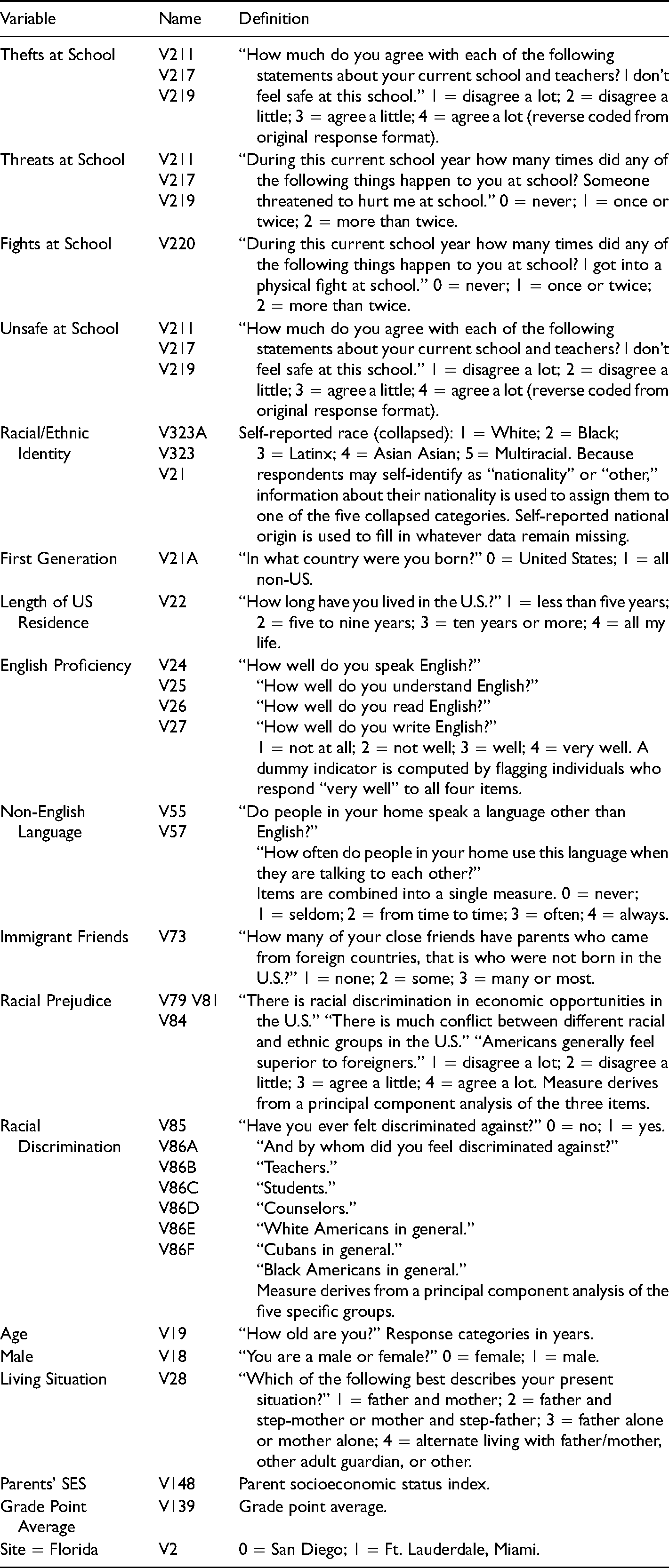
The data for this study come from the Children of Immigrants Longitudinal Study (Portes & Rumbaut, 2001; Rumbaut & Portes, 2001), retrieved from the Inter-University Consortium for Political and Social Research. The sample comprises 5,262 students in the 8th and 9th grades, interviewed in 1992 in schools in the metropolitan areas of Miami/Ft. Lauderdale, and San Diego. The second round of the survey was fielded in 1995, and encompasses 4,288 respondents, or 81% of the original sample. Information from both rounds is used. Descriptive statistics for the sample are provided in Table 1 and the appendix provides more detailed descriptions of the variables.
Descriptive Statistics.
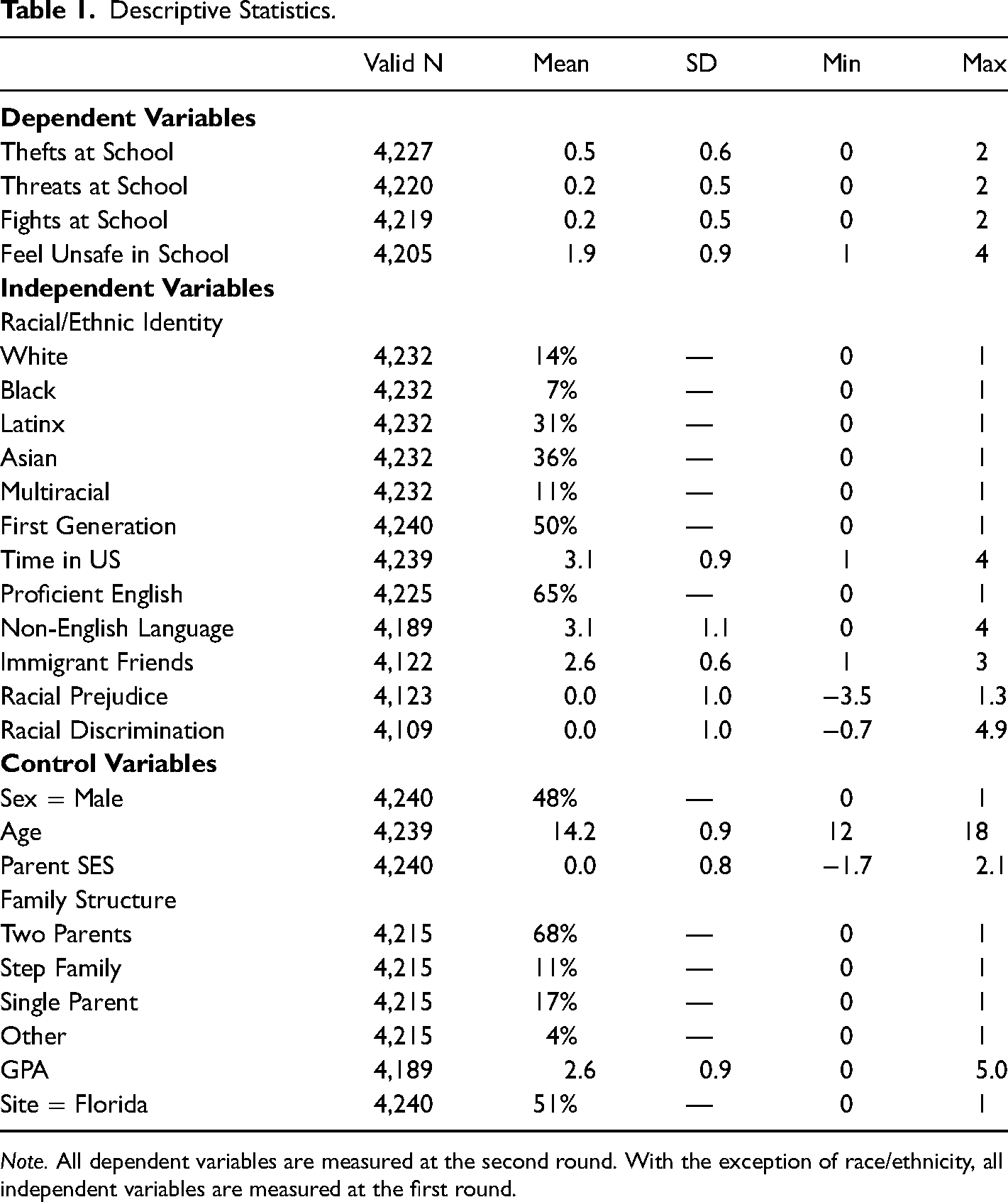
Note. All dependent variables are measured at the second round. With the exception of race/ethnicity, all independent variables are measured at the first round.
The dependent variables are school-based measures of peer victimization, getting into fights, and safety perceptions—all are taken from the second round of the survey. The first three outcomes measure frequency of occurrence at school during the current school year (0 = never; 1 = once or twice; 2 = more than twice), and include whether the respondent had something stolen (thefts at school), whether someone threatened to hurt the respondent (threats at school), and whether the respondent got into a physical fight (fights at school). The fourth outcome, feel unsafe in school, measures a respondent's level of agreement with the statement, “I don’t feel safe at this school” (1 = disagree a lot; 2 = disagree a little; 3 = agree a little; 4 =agree a lot).
One key independent variable is racial/ethnic identity (White vs. Black vs. Asian vs. Latinx vs. Multiracial), obtained from the second round of the survey when respondents are asked to self-identify their race. Because 19% of respondents opted to report a nationality (e.g., “Cuban,” “Haitian”) or “other,” their nationality is used to classify them into one of the five categories. In instances where it remains unclear, the respondent's national origin as reported in the first round is used to classify their race/ethnicity.
Additional independent variables of interest are obtained from the first round of the survey and measure facets of a respondent's experience as an immigrant youth. First generation is dummy coded to flag respondents who were not born in the US. Time in US is an ordinal measure of length of US residence (1 = less than five years; 2 = five to nine years; 3 = ten years or more; 4 = all my life). English proficiency is a dummy indicator for whether the respondent speaks, understand, reads, and writes English “very well” (1 = does all four very well; 0 = does not do all four very well). Non-English language is an ordinal measure of the frequency with which a language other than English is spoken in the respondent's home (0 = never; 1 = seldom; 2 = from time to time; 3 = often; 4 = always). Immigrant friends is an ordinal measure of the number of the respondent's close friends whose parents were not born in the US (1 = none; 2 = some; 3 = many or most).
Adverse experiences as an immigrant are also measured at the first round. Racial prejudice is the principal component of three ordinal items expressing agreement that life in the United States is characterized by racial discrimination in economic opportunities, conflict between racial/ethnic groups, and American feelings of superiority toward foreigners (1 = disagree a lot; 2 = disagree a little; 3 = agree a little; 4 = agree a lot). Racial discrimination is the principal component of six dichotomous indicators for whether the respondent felt discriminated against by teachers, students, counselors, white Americans in general, Cubans in general, and Black Americans in general.
The control variables are all retrieved from the first round of the survey. These include age, sex category (male vs. female), family structure (two parents vs. step family vs. single parent vs. other situation), an index of parental socioeconomic status, grade point average, and study site (Miami or Ft. Lauderdale vs. San Diego). A school identifier is additionally used to cluster the standard errors in the statistical models.
Because the dependent variables all have ordinal metric, ordered logit models are reported throughout. Coefficients in an ordered logit model are interpreted as the log-odds of crossing thresholds which partition a continuous (latent) response variable into discrete (observed) categories. The first set of models is estimated for the full sample, where the focus in these models is the coefficients for racial/ethnic identity and youth immigrant experiences, especially adverse immigrant experiences. The second set of models is estimated separately for each of the five racial/ethnic categories, allowing us to study whether racial/ethnic identity interacts in meaningful ways with youth immigrant experiences. The results from group-specific models are consolidated via seemingly unrelated regression in order to compare coefficients across groups. Although the groups are mutually exclusive, direct comparison of ordered logit coefficients is not possible because the logistic estimator scales coefficients by the standard deviation of the latent response variable (see Allison, 1999). This scaling does not create a problem unless interest lies in cross-group comparisons, in which case the standard tests can be distorted when groups differ in their latent standard deviation. The solution adopted here is to directly adjust coefficients by the estimate of the latent standard deviation of their respective models prior to performing cross-model tests.
Results
We begin with Figure 1, which provides the adjusted means for each of the outcomes by racial/ethnic identity. These are from least squares regression models adjusting for the control variables only (sex, age, parent SES, family structure, GPA, site), and the coefficients are mean contrasts relative to White respondents. A consistent result is that Black, Latinx, and Multiracial youth report significantly higher incidence of thefts, threats, and getting into fights, and report significantly more agreement with feeling unsafe in school, than their White peers (p < 0.05 in all instances, as revealed by confidence intervals that exclude zero). Asian youth mostly resemble their White peers, with the notable exception of getting into fights, in which Asian youth report significantly higher involvement. Furthermore, relative to Asian youth, Black, Latinx, and Multiracial youth report at least marginally higher incidence of thefts and threats, and greater concern about safety (results are not shown, but p < 0.10 in all instances).
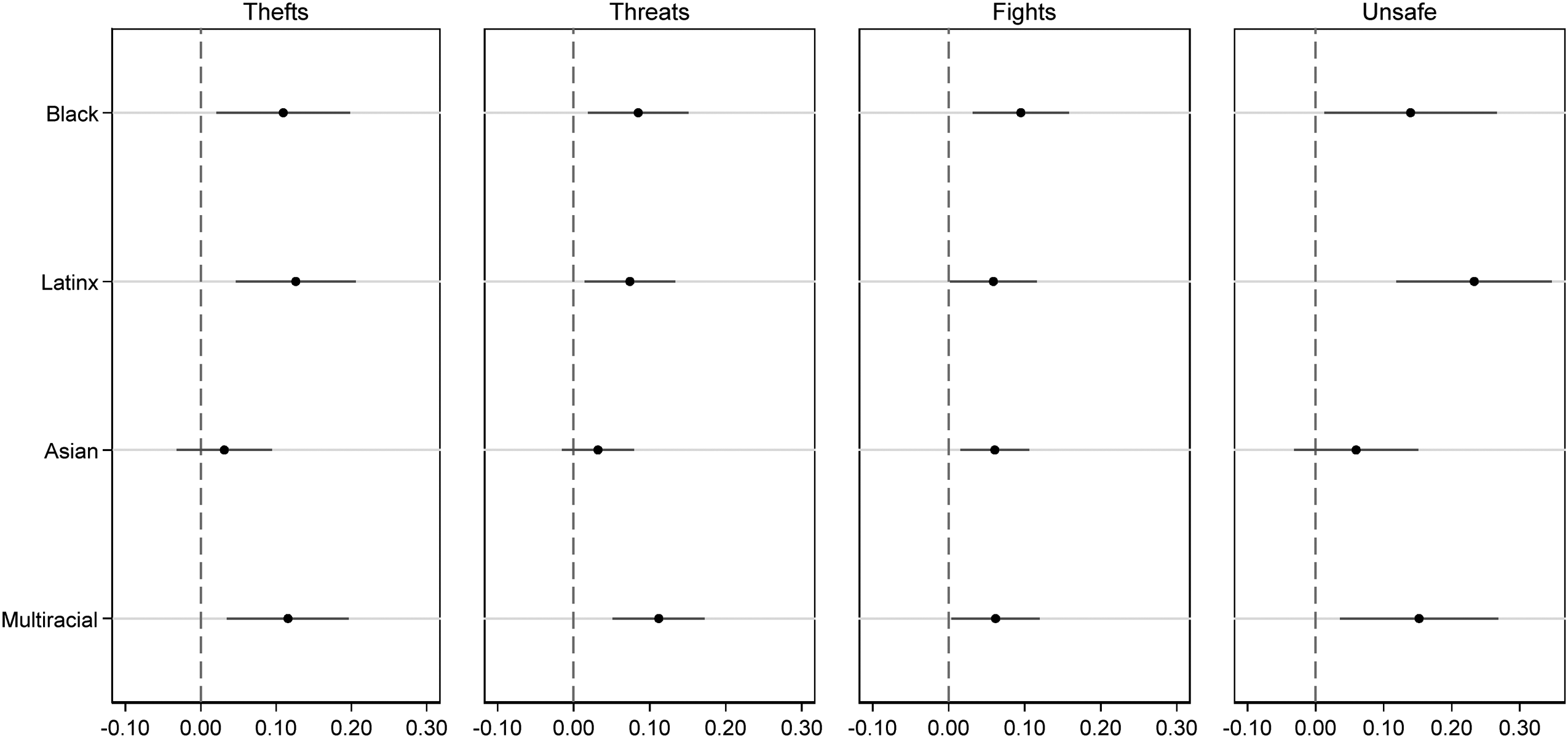
Baseline outcome differences by racial/ethnic identity. Note. Dependent variables are all measured at the second round. The coefficients and confidence intervals are contrasts relative to a reference group comprising White respondents, and are obtained using least squares regression. Basic control variables are included but not shown (sex, age, parent SES, family structure, GPA, site; see Table 1).
Coefficients and standard errors from ordered logit models of the four outcomes are provided in Table 2. These are log-odds ratios and are interpreted accordingly. For example, the coefficient for racial discrimination in Model 1 indicates that when youth report more racial discrimination (by one unit) in the first round, in the second round they report higher log-odds of more frequent thefts in school by 0.200 relative to their peers subjected to less discrimination. 1 Exponentiating the log-odds ratio yields the odds ratio, meaning the odds of more frequent theft following discrimination are 1.22 times as high (e0.200 = 1.22)—in other words, the odds are 22% higher.
Ordered Logit Models of All Outcomes.
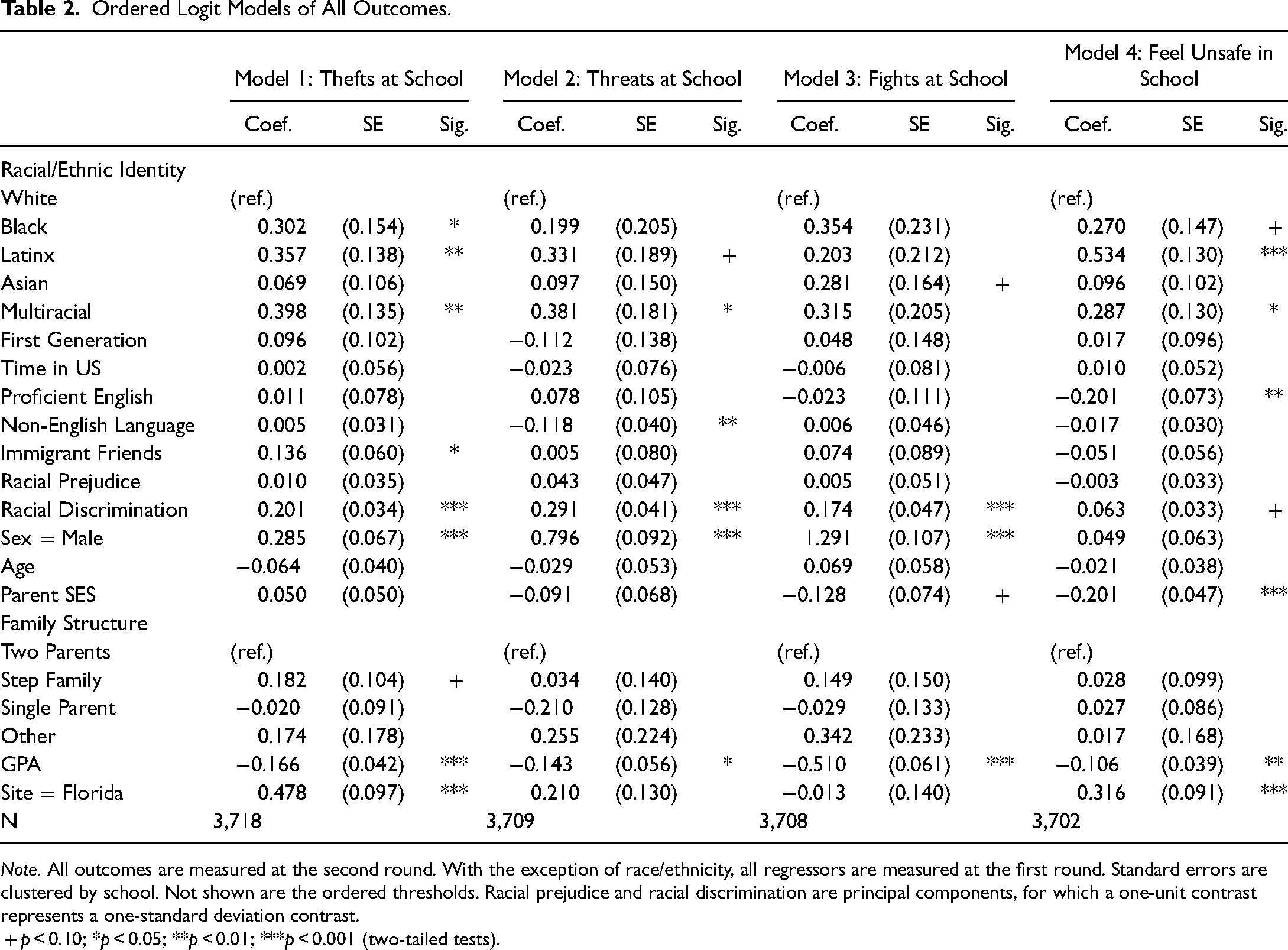
Note. All outcomes are measured at the second round. With the exception of race/ethnicity, all regressors are measured at the first round. Standard errors are clustered by school. Not shown are the ordered thresholds. Racial prejudice and racial discrimination are principal components, for which a one-unit contrast represents a one-standard deviation contrast.
+ p < 0.10; *p < 0.05; **p < 0.01; ***p < 0.001 (two-tailed tests).
Because we are most interested in the coefficients for racial/ethnic identity and immigrant experiences, we do not comment on the control variables. A number of immigrant experiences are not correlated with any of the outcomes for the full sample, including first generation status, length of time in the US, and racial prejudice. 2 Other immigrant experiences are inconsistently correlated with the outcomes. For example, youth with more immigrant friends report significantly higher incidence of thefts (model 1), youth who speak a non-English language at home report significantly lower incidence of threats (model 2), and youth with better English proficiency report feeling significantly safer in school (model 4). However, these immigrant experiences are each correlated with one and only one outcome. In results that are not shown, we enter the immigrant experiences in the models one at a time, and the pattern is unchanged. This suggests weak and inconsistent correlations with the outcomes are not an artifact of high collinearity among the different measures of immigrant experiences. Indeed, the largest variance inflation factor is 2.5.
Compared to the scattered results with respect to most immigrant experiences, racial discrimination is significantly correlated in a positive direction with three of the four outcomes (and marginally significant for the fourth outcome). It is especially strongly correlated with thefts, threats, and getting into fights, as judged by its z-test—it is second only to study site in the model for thefts, second only to sex category in the model for threats, and third following sex category and GPA in the model for fights. When the individual racial discrimination items are included in the model in place of the principal component, the item measuring racial discrimination from teachers is consistently correlated with the four outcomes, followed by racial discrimination from students. While we retain racial discrimination as a principal component for analyses below, it suggests that experiences of school-based discrimination are more consistently correlated with the school-related outcomes than experiences of societal discrimination.
In a model that is not shown, we re-estimate model 4 but add thefts, threats, and getting into fights as additional regressors, since feelings of being unsafe in school reference perceptions at the time of the interview, whereas the behavioral measures reference experiences prior to the interview and within the reference period. In this model, thefts and threats are the strongest correlates of feelings of safety, indicating that youth with recent peer victimization experiences are significantly more likely to agree that school is unsafe. The implication of this finding is that the weak correlation between racial discrimination and feeling unsafe in school (seen in Table 2) masks a much stronger indirect influence through peer victimization.
In Table 3, the sample is stratified by racial/ethnic identity, and the models are re-estimated. We are particularly interested in coefficients which differ significantly in magnitude across groups, and these are indicated by shading. Note that these tests multiply the coefficients by the estimated standard deviation of the latent variable in the respective models. This is obtained using the linear predictor from each model, estimating the sample variance of the linear predictor, adding to this quantity
Ordered Logit Models of All Outcomes, by Racial/Ethnic Identity.
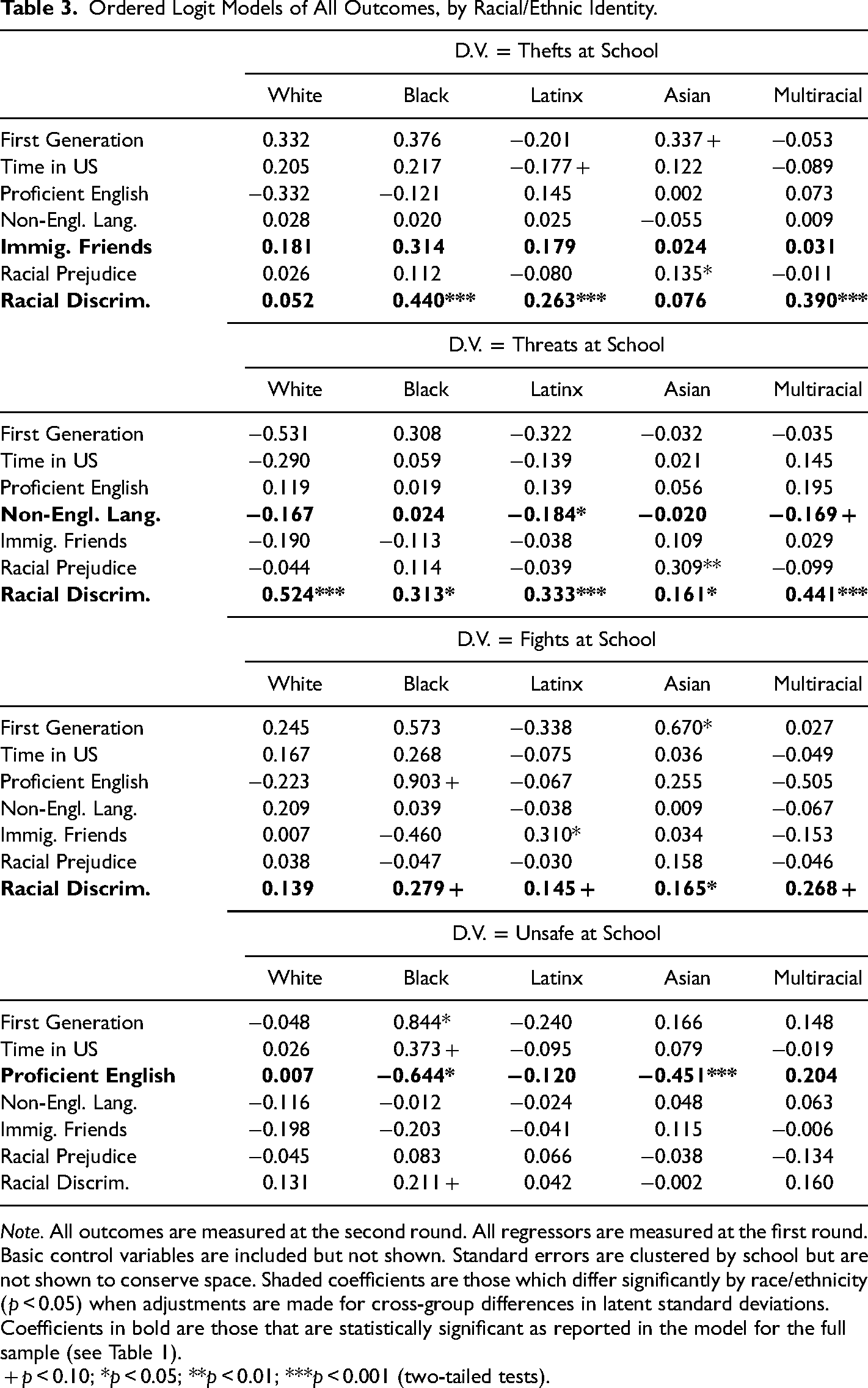
Note. All outcomes are measured at the second round. All regressors are measured at the first round. Basic control variables are included but not shown. Standard errors are clustered by school but are not shown to conserve space. Shaded coefficients are those which differ significantly by race/ethnicity (p < 0.05) when adjustments are made for cross-group differences in latent standard deviations. Coefficients in bold are those that are statistically significant as reported in the model for the full sample (see Table 1).
+ p < 0.10; *p < 0.05; **p < 0.01; ***p < 0.001 (two-tailed tests).
In the previous results, the only immigrant experience consistently associated with the outcomes was racial discrimination. When results are broken out by racial/ethnic identity, in the models for thefts and threats at school, tests of cross-group equality indicate heterogeneity in the coefficient for racial discrimination (this is indicated by shading). In the model for thefts, pairwise testing suggests it tends to be largest for Black and Multiracial youth but smallest for White and Asian youth. Indeed, it is not a significant correlate of thefts at all for Whites and Asians. In the model for threats, the coefficient for racial discrimination is smallest for Asian youth (but still statistically significant), and of statistically equal magnitude for the other racial/ethnic groups.
Although racial prejudice was not correlated with any outcome in the full sample, we find evidence of heterogeneity when considered separately by racial/ethnic identity. In particular, pairwise testing points to the coefficient for Asian youth as being qualitatively (and statistically) larger and positive in the model predicting threats in school. Namely, Asian youth who report higher levels of racial prejudice in American society experience more frequent threats in school.
Finally, first generation status exhibits cross-group heterogeneity in the magnitude of the coefficient in the model for getting into fights in school. The coefficient is largest (and statistically significant) in the model for Asian youth, indicating that first generation Asian youth report higher incidence of getting into fights compared to their second-generation counterparts. Pairwise testing indicates it only differs qualitatively from the model for Latinx youth, but not other groups of youth. Thus, it is the Asian-Latinx contrast that underlies the joint test of equality.
Discussion
The current study aimed to investigate if adverse experiences such as discrimination and perceptions of racial/ethnic prejudice are associated with being victimized and getting into fights, and consequently feeling less safe in school, for the children of immigrants. The results indicate that discrimination is a robust correlate of these school experiences in the full sample, although perceptions of racial/ethnic prejudice are not related. Other measures of immigrant experiences are also correlated with school outcomes, but inconsistently so, including the number of immigrant friends (predicting more thefts in school), speaking a non-English language at home (predicting fewer threats in school), and English proficiency (predicting feeling safer in school). In addition to establishing these correlations for the full sample, we explore potential differences by racial/ethnic identity. Findings suggest there are indeed differences in these patterns. For example, Black and Multiracial children of immigrants who experience discrimination report more thefts in school than their immigrant peers, whereas White and Asian children of immigrants who experience more discrimination do not differ in their experiences of theft. All children of immigrants who experience racial discrimination report more threats at school, although the correlation is weakest for Asian youth. Perceptions of racial prejudice, which was not significantly correlated with school outcomes in the full sample, is positively and significant correlated with getting into fights at school among Asian children of immigrants.
Prior research has suggested that racial/ethnic discrimination, xenophobia, racism, and nativist ideologies are detrimental for the children of immigrants’ developmental and educational outcomes (Bondy et al., 2019; Disha, 2019; Lee & Zhou, 2015; Portes & Rumbaut, 2014; Waldinger & Feliciano, 2004; Waters, 1999; Waters et al., 2014). This study's results align with how discrimination and prejudice have harmful consequences for the children of immigrants’ victimization by school peers, getting into fights at school, and feelings of safety in school. The experience of discrimination, especially when it is felt at the hands of school personnel (e.g., students and teachers), is correlated with peer victimization and getting into fights at school. Additionally, discrimination is correlated with feeling unsafe at school in a way that is fully explained by student experiences as victims of thefts and threats. This points to the importance of efforts on behalf of school officials to curb student bullying and victimization and to more generally devote attention to improving school climate in a way that prioritizes equal treatment of those who are different. This study also aligns with prior research (Huang & Cornell, 2019; Peguero & Bondy, 2021; Peguero & Hong, 2020; Portes & Rumbaut, 2014; Waters, 1999; Waters et al., 2014) demonstrating that schools with racial/ethnic discriminatory climate and interactions contribute to bullying, aggression, harassment, and overall tension within schools and associated communities.
It is evident from our data that Black, Latinx, and Multiracial children of immigrants are confronted with disproportionate rates of peer victimization and perceptions of lack of school safety (from Figure 1). Black children of immigrants, in particular, have the most adverse experiences with discrimination and racial prejudice than other children of immigrants (not shown but confirmed from mean comparisons). The children of Black immigrants are isolated, marginalized, and disenfranchised from other racial/ethnic minority groups. Moreover, the children of Black immigrant students are at risk of being victimized and harassed at school as well as attending schools with increased disorder (Kumi-Yeboah et al., 2020; Peguero & Bondy, 2021; Peguero & Hong, 2020; Waters, 1999; Waters et al., 2014). It is also important to note that this study found distinct patterns of victimization to occur among Black children of immigrants highlighted in prior work that focuses on Miami, Florida. Stepick and Stepick (2009) provide qualitative support for this finding explaining that compared to Latino immigrants and White youth, Haitian immigrant youth were found to experience violent victimization in school from native-born African American youth; however, as time has gone on the tensions between African American and Haitian immigrant youth has eased.
Implications
The findings highlight three broadly important facets of the children of immigrants’ experiences for consideration by stakeholders, policymakers, and school administrators to promote safe learning environments. First, linguistic ability (lack of English proficiency, other language spoken at home) might be one area of focus to reduce vulnerability to violence and adverse experiences in their communities and schools. Second, discrimination from staff, teachers, administration, and other students could undermine school safety and make the children of immigrants feel more vulnerable. Understanding the facets of the immigrant experience that make some youth more vulnerable in school settings is of significant importance. Third, the children of immigrants’ safety and adverse experiences are complex and deserve further attention, especially in the current social and political climate of immigration in the US. This study not only reveals that safety and adverse experiences matter for the children of immigrants but also their safety and experiences with violence are also racialized. As a result, juvenile justice agents and representatives, healthcare providers, school administrators, educators, and policymakers should acknowledge and consider the importance of immigrant status with the intersection of race/ethnicity in regards to addressing the needs, safety, and care for this marginalized population.
Limitations and Future Directions
Although this study did find significant connections between discrimination, prejudice, victimization, and violence for the children of immigrants, this study is not without limitations which in turn guide future research questions. First, qualitative research would better depict the social, cultural, and contextual factors that influence this study's quantitative examination of discrimination, prejudice, victimization, and violence for the children of immigrants. For example, prior qualitative research reveals that some teachers view the children of immigrants as problems within their classrooms, burdened by their lacking capabilities, and argue that the children of immigrants diminish the teacher's ability to teach all students effectively and efficiently which often disseminates down to other students, other teachers, and parents in regards to the children of immigrants as deficient (Gonzales, 2011, 2016; Lowenhaupt et al., 2021; Peguero & Bondy, 2021; Rosenbloom & Way, 2004).
Second, it is well established that gender plays a significant role in the relationship between race/ethnicity, victimization, and violence for the children of immigrants (Peguero & Bondy, 2021; Ray, 2022; Yang et al., 2021). These studies also indicate that discrimination and prejudice manifest differently and have distinct consequences for racial/ethnic minority boys versus girls. Future research should explore how the intersection of race/ethnicity, gender, and immigration matter in regard to how both discrimination and prejudice are racialized and gendered as well as the consequences in terms of victimization and violence for male and female children of immigrants.
Third, it is important to note that readers should be cautious interpreting the findings in this study as causal. The study design does not allow causal inferences, and although it enforces temporal ordering between the children of immigrants’ (measured in the first round), being victimized and getting into fights (measured in the second round and referencing experiences during the school year), and school safety perceptions (measured in the second round and referencing current attitudes), the estimates are nevertheless correlational in nature. Despite this limitation, we believe the results are worthy of exploration in future research using additional data sources. This also means any confident assertions concerning school policies would be premature, although we speculate on some possibilities, aware that they await future research for confirmation.
Fourth, to better understand the relationship between immigration, discrimination, prejudice, and victimization, capturing the social, political, and economic environment of immigration for analyses should be considered. For example, the “threat” of a growing immigrant population and the associated discourse of anti-immigrant sentiment has been found to contribute to unwelcoming school climate for the children of immigrants. Studies have suggested that the fear of a growing immigrant population is translating into pervasive harassment and victimization of the children of immigrants (Huang & Cornell, 2019; Lowenhaupt et al., 2021; Peguero & Bondy, 2021). Although there are many studies that reveal the detrimental effects of biased treatment for youth, understanding the source of discrimination and prejudicial treatment that the children of immigrants are enduring warrants investigation. Despite the limitations associated with this study, this study does provide evidence to set forth an agenda for the continued exploration of the roles that discrimination and prejudice can have for the children of immigrants’ experiences with victimization and violence.
Finally, there are limitations with respect to the dataset. The Children of Immigrants Longitudinal Survey was fielded in 1992, now a full 30 years ago. This is a disadvantage from the perspective of understanding the population of children of immigrants in today's world, as the share and composition of the immigrant population in the US has changed substantially during that time. However, we believe this limitation is outweighed by the ability to obtain unusually detailed measures about adverse immigrant experiences (discrimination, prejudice) along with school-based measures of peer victimization, getting into fights, and perceptions of safety. Additionally, the survey includes a combined measure of racial/ethnic identity that does not allow clear distinctions between the two. While we wish to speak more definitively to racial and ethnic differences in the correlations reported in this study, we are regrettably limited by this aspect of the survey. As noted by Vélez and Peguero (2023), although the US is becoming a country that will be represented by non-Whites, collecting more juvenile and criminal justice data that captures the nuances and complexities linked with race, ethnicity, and colorism are fundamental to addressing historic US structural and systemic inequities with violence, victimization, and justice.
Conclusion
Studies of the children of immigrants’ safety and adverse experiences frequently lack detailed information about the immigrant experience itself, aside from first- or second-generation immigrant status. This is a regrettable shortcoming in light of the heterogeneity within the children of immigrant population. In the current study, results suggest that discrimination and, to a lesser extent, prejudice can have detrimental consequences for the children of immigrants’ experiences with being victimized, getting into fights, and feeling safe in school. These detrimental consequences could also steer the children of immigrants on a downward path towards increased vulnerability of victimization and engagement in violence.
The fact that many racial/ethnic minority youth, including the children of immigrants, face and endure discrimination as well have perceptions of racial/ethnic prejudice of the society they live that can contribute to increased victimization, vulnerability, and violence is a serious social problem that needs to be addressed. It is also plausible the children of immigrants are assimilating or being taught the “wrong lessons” of discrimination, racism, xenophobia, prejudice, and nativism from US social institutions such as schools. The children of immigrants are the fastest growing segment of the US population, which has clear implications for the US society, economy, education, and justice system.
Footnotes
Appendix. Variable Definitions
| Variable | Name | Definition |
|---|---|---|
| Thefts at School | V211 V217 V219 |
“How much do you agree with each of the following statements about your current school and teachers? I don’t feel safe at this school.” 1 = disagree a lot; 2 = disagree a little; 3 = agree a little; 4 = agree a lot (reverse coded from original response format). |
| Threats at School | V211 V217 V219 |
“During this current school year how many times did any of the following things happen to you at school? Someone threatened to hurt me at school.” 0 = never; 1 = once or twice; 2 = more than twice. |
| Fights at School | V220 | “During this current school year how many times did any of the following things happen to you at school? I got into a physical fight at school.” 0 = never; 1 = once or twice; 2 = more than twice. |
| Unsafe at School | V211 V217 V219 |
“How much do you agree with each of the following statements about your current school and teachers? I don’t feel safe at this school.” 1 = disagree a lot; 2 = disagree a little; 3 = agree a little; 4 = agree a lot (reverse coded from original response format). |
| Racial/Ethnic Identity | V323A V323 V21 |
Self-reported race (collapsed): 1 = White; 2 = Black; 3 = Latinx; 4 = Asian Asian; 5 = Multiracial. Because respondents may self-identify as “nationality” or “other,” information about their nationality is used to assign them to one of the five collapsed categories. Self-reported national origin is used to fill in whatever data remain missing. |
| First Generation | V21A | “In what country were you born?” 0 = United States; 1 = all non-US. |
| Length of US Residence | V22 | “How long have you lived in the U.S.?” 1 = less than five years; 2 = five to nine years; 3 = ten years or more; 4 = all my life. |
| English Proficiency | V24 V25 V26 V27 |
“How well do you speak English?” “How well do you understand English?” “How well do you read English?” “How well do you write English?” 1 = not at all; 2 = not well; 3 = well; 4 = very well. A dummy indicator is computed by flagging individuals who respond “very well” to all four items. |
| Non-English Language | V55 V57 |
“Do people in your home speak a language other than English?” “How often do people in your home use this language when they are talking to each other?” Items are combined into a single measure. 0 = never; 1 = seldom; 2 = from time to time; 3 = often; 4 = always. |
| Immigrant Friends | V73 | “How many of your close friends have parents who came from foreign countries, that is who were not born in the U.S.?” 1 = none; 2 = some; 3 = many or most. |
| Racial Prejudice | V79 V81 V84 | “There is racial discrimination in economic opportunities in the U.S.” “There is much conflict between different racial and ethnic groups in the U.S.” “Americans generally feel superior to foreigners.” 1 = disagree a lot; 2 = disagree a little; 3 = agree a little; 4 = agree a lot. Measure derives from a principal component analysis of the three items. |
| Racial Discrimination | V85 V86A V86B V86C V86D V86E V86F |
“Have you ever felt discriminated against?” 0 = no; 1 = yes. “And by whom did you feel discriminated against?” “Teachers.” “Students.” “Counselors.” “White Americans in general.” “Cubans in general.” “Black Americans in general.” Measure derives from a principal component analysis of the five specific groups. |
| Age | V19 | “How old are you?” Response categories in years. |
| Male | V18 | “You are a male or female?” 0 = female; 1 = male. |
| Living Situation | V28 | “Which of the following best describes your present situation?” 1 = father and mother; 2 = father and step-mother or mother and step-father; 3 = father alone or mother alone; 4 = alternate living with father/mother, other adult guardian, or other. |
| Parents’ SES | V148 | Parent socioeconomic status index. |
| Grade Point Average | V139 | Grade point average. |
| Site = Florida | V2 | 0 = San Diego; 1 = Ft. Lauderdale, Miami. |
Declaration of Conflicting Interests
The author(s) declared no potential conflicts of interest with respect to the research, authorship, and/or publication of this article.
Funding
The author(s) received no financial support for the research, authorship, and/or publication of this article.
