







Abstract
While there has been research on the cultural products of white power groups, this project qualitatively examines one piece of the contemporary far right ecosystem—white power music album covers. More specifically, we examine 99 album covers featuring “Moon Man,” an imaginary character developed by anonymous music artists to better understand the symbols and ideas of this movement. The study finds that Moon Man was present on 84.8% of record covers, along with depictions of firearms, Nazi symbolism, and pro-Confederate images as well as anti-Semitic and anti-Black imagery and examples of political violence. The album art of the Moon Man project serves as a potent tool for intimidation, as it actively advocates for white supremacy and racially motivated violence. Further research is needed to evaluate the content and musical elements of the album's lyrics, analyze consumer engagement, and develop effective approaches to counteract the increasing incidents of hate crimes.
Introduction
White power movements have remained stubbornly relevant to politics and policing over the past decade. What once were fringe ideological fragments—such as “great replacement theory”—have become mainstream beliefs in the far-right wings of many Western democracies. Compounding these political successes, white power movements have also succeeded in inspiring acts of terrorism ranging from targeted attacks on houses of worship (most notoriously on the Emanuel African Methodist Episcopal Church in Charleston, South Carolina, and the Tree of Life synagogue in Pittsburgh, Pennsylvania) to vehicular rampages against protestors (at the Unite the Right rally in Charlottesville, Virginia), and even in the organization and promulgation of riots and would-be pogroms (as seen in the anti-immigrant riots in England this August).
This increase in white supremacist violence has not gone unnoticed by the Federal Bureau of Investigation, who, in a June 2023 report emphasized that extremists motivated by such ideology “remained among the FBI's highest priority threats…[continuing] to pose the most consistent threat of lethal and non-lethal violence against religious, cultural, and government targets” (FBI, 2023, p. 6). White power movements have established themselves as ideological incubators for hitherto unseen modes of violent rhetoric and action. As such, understanding the culture of these movements will prove useful in understanding their motivations, methods, and goals—in the hopes, perhaps, of disrupting them in the future.
To date, much of the prevailing literature on white power organizations has focused on a consistent set of topics: the formative historical moments of the white power movement (e.g., Ruby Ridge, Waco, the Oklahoma City Bombing), the strategies and tactics of these groups, the ways in which they instrumentalize violence, how they carve out online spaces for the purpose of recruitment, and how they interact amongst themselves and with those whom they regard as the “outgroup” (Blee et al., 2024; Hoffman & Ware, 2024; Miller-Idriss, 2022; Mudde, 2018; Toobin, 2024). Amidst all of this, however, one thing stands out: the time that white power groups and individuals spend on the production and dissemination of cultural products—that is, they spend a large amount of time writing and singing songs, creating art and images, exploring ancient myths and legends, choreographing dance, and writing novels. Much of the overtly racist propaganda spread through online forums and which sometimes also glorifies violence, does not take on the form of terse ideological tracts, but rather are cultural products, which are easier to digest and share multiple times across various platforms (Askanius & Keller, 2021; Hagen, 2011; Katz, 2020; Olson, 2012; Schlatter, 2006).
Among those cultural products, music has tended to be the most important for fostering a collective identity and expressing a shared sense of purpose and motivation. The centrality of music—and of the music scene (e.g., the physical spaces of concerts, the administrative and productive capabilities of extremist music labels, the personal charisma of band members, etc.)—has proven a fruitful avenue of research for understanding extremist groups in general. We believe our research productively differs from many other valuable examinations of white power cultural products—especially research into white power music—in that it highlights the increasing degree of digitization and anonymization in the white power music scene. The use of the internet and social media as a medium for the music permits a wider degree of engagement with these cultural products than would otherwise be possible, as would-be listeners no longer need to find and order from a white power music label or attend a white power music concert to hear like-minded perspectives. This greatly expands the audience of such content: rather than actively seeking out white power spaces, individuals (both those sympathetic to white power ideology and those who are simply curious) can access such material at the click of a mouse, or the tap of a finger. Digital engagement is thus shallower, but broader, as the content can be spread and reposted far beyond the confines of a taboo sect of ingroup true believers.
This digital engagement contrasts with the focus of more traditional research into white power cultural products—especially music—which tends to emphasize the importance of the physical dimensions of the music scene (e.g., the spaces of concerts and meetups), as well as the lyrics and messages communicated in the lyrics of the songs. While both of these are undoubtedly influential, and research into such topics is extremely valuable (see, for example, Corte & Edwards, 2008; Grosholz & Pieri, 2023; Hegghammer, 2017; Pieri & Grosholz, 2023; Pieslak, 2015; Spracklen, 2013; Törnberg & Törnberg, 2022; Van Doorne, 2022), this paper focuses specifically on one piece of the contemporary white power ecosystem that has yet to be explored: the symbols and themes expressed in 99 pieces of album art (i.e., album covers) from a decentralized group of anonymous music makers behind the character known as “Moon Man.”
Album art represents the ultimate extension of the distribution and anonymization of white power culture—the artwork, being a static image, can be consumed literally at a glance, and reposted practically anywhere online. Within this paper, we explore the emergence of a new trend of white power music expressed through the fictional Moon Man character. In doing so, we identify several areas of continuity between earlier and contemporary white power music—especially concerning types and expressions of grievance as expressed in album art—while simultaneously highlighting areas of development and change such as aesthetic style, methods of music production, and the use of pop culture and memes to appeal to a wider online audience.
In what follows, we first define and discuss what the character known as “Moon Man” is, and how it came to be, highlighting the aspects which render it a useful object of study. From that point, we take a moment to outline our theoretical approach to understanding album art, and how it should be understood relative to other images and the music which it frames. After giving a broad theoretical background, we discuss the specific methodology used to collect, code, and analyze 99 pieces of Moon Man album art. We then present and discuss the findings of this analysis, with a particular focus on the relationship between the thematic trends identified in the album art and its potential to glorify or incite violence.
Who is Moon Man?
Moon Man is a fictional character associated with a particular subgenre of white supremacist music which is distinguished by its digital distribution, especially on imageboards such as 4chan, as well as its decentralized and anonymized group of creators. Moon Man essentially stands in as an avatar and pseudonym for whoever wishes to produce content in line with the wider corpus of white supremacist music attributed to him—it affords the possibility of anonymous authorship, allowing different creators from different geographic locations and backgrounds to contribute to the discography of the fictional “artist.” His appearance is appropriated from the McDonald's 1980s advertising mascot Mac Tonight, a crescent-moon-headed jazz piano player intended to advertise the food chain's late-night menu (Anti-Defamation League [ADL], 2023). Moon Man is given a distinctive artificial voice by a digital text-to-speech software, which allows for a variety of content creators to write lyrics that can be “sung” in a monotone cadence from the output of that software. This synthesized voice can then either be pitch-shifted or placed over music to form a song. The audio file is paired with an image or video and distributed on imageboards (such as 4chan) and other social media sites as a simplified form of music video. Often, the image chosen for the video file is taken from the album art of a Moon Man release, allowing a viewer to listen to the song and view the album art of the associated track at the same time. An example of Moon Man on the cover of an album can be seen below—Figure 1, The Lunatic—in this instance his image is lifted directly from Saint Pepsi's (nonracist, vaporwave) album Late Night Delight (Figure 2).
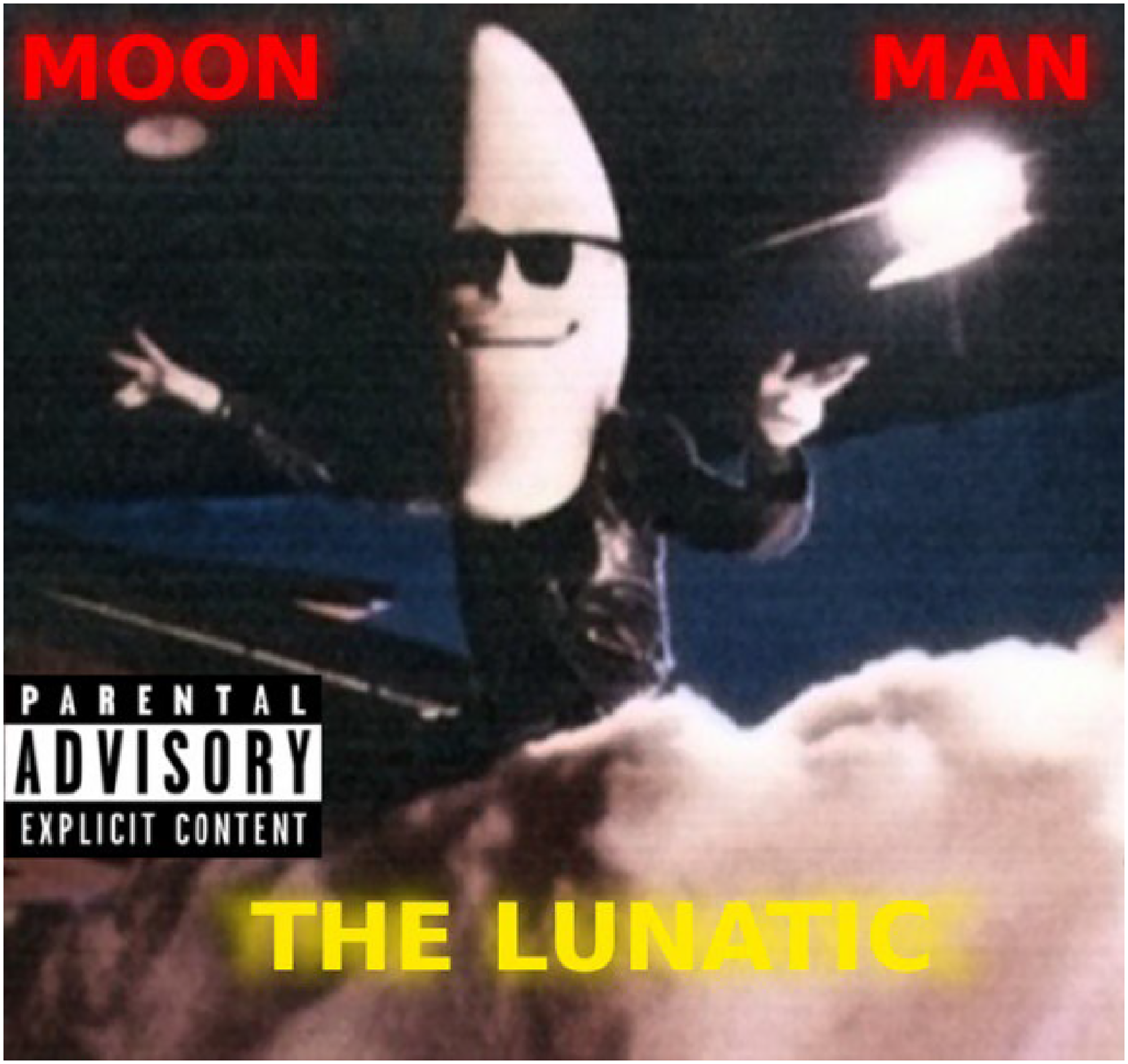
The Lunatic album cover.
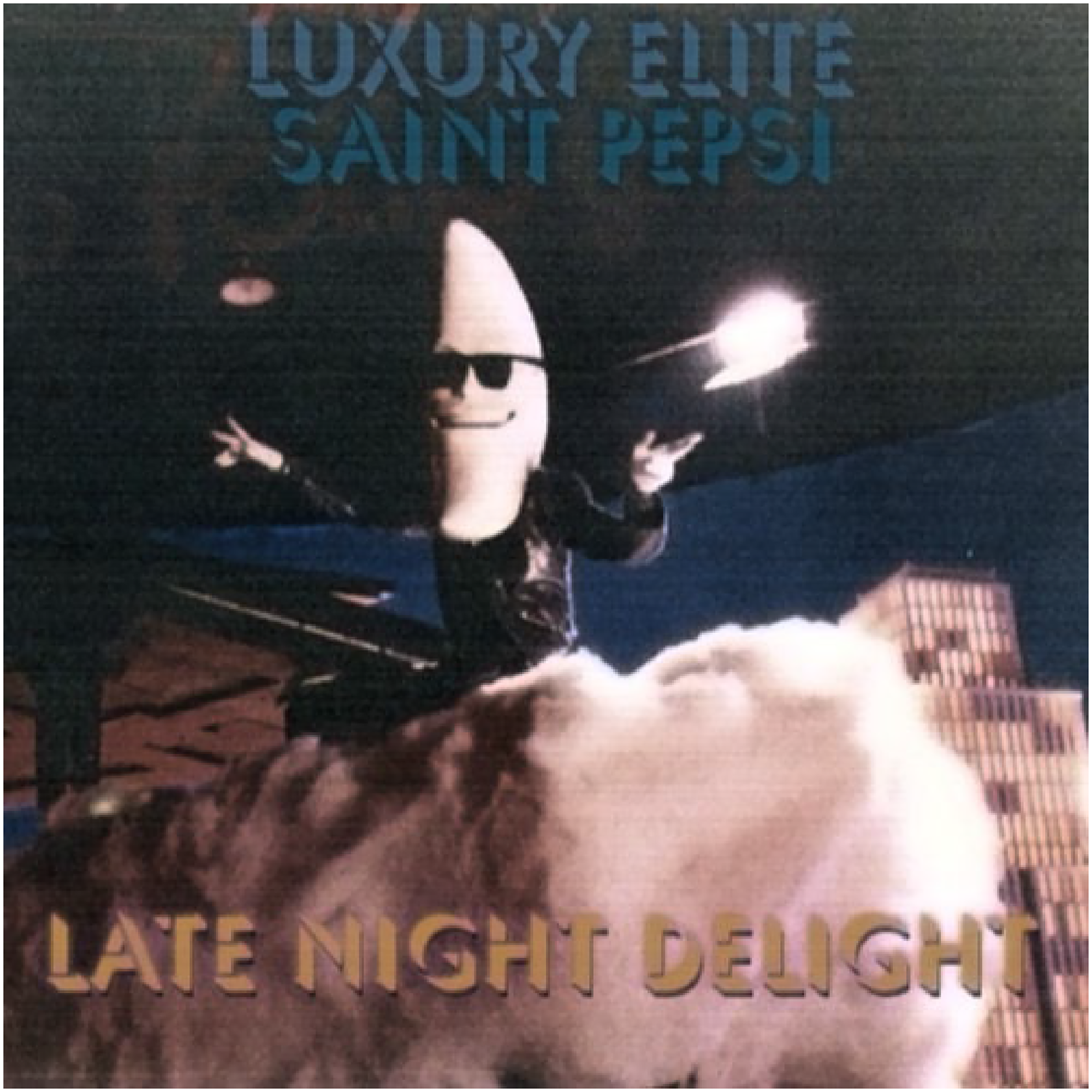
Late Night Delight album cover.
Curiously, Moon Man was not the only modern appropriation of Mac Tonight in the fringes of contemporary pop culture and music. Vaporwave music artist Saint Pepsi's, 2014 single “Enjoy Yourself” also used footage of Mac Tonight commercials in a YouTube upload accruing over 17 million views (Saint Pepsi, 2014). The widespread popularity of the Saint Pepsi video ensures that, much like Pepe the Frog, imagery appropriated from Mac Tonight is not necessarily always employed in a racist capacity. However, the symbol has taken on a “meme” status for the alt-right, and the number of racist permutations of the Mac Tonight imagery tend to overshadow the benign use of the mascot as a symbol of 80's nostalgia (Sheffield, 2016). 1 In contrast with the visual imagery of Mac Tonight, the synthesized “voice” of Moon Man is almost never seen outside a racist context.
The first Moon Man videos were uploaded by the user Farkle on the website YTMND (an acronym of “You’re the Man Now Dog”—a very early video hosting site preceding YouTube) in 2007 (YTMND Wiki, n.d.). From there, additional content creators and artists also used the same imagery (videos or images of the Mac Tonight character) and voice (specifically, the AT&T Mike text-to-speech generator) to expand the discography of the fictional Moon Man character. Moon Man's creation places him among the very earliest fringe of the Web 2.0 social media-driven environment, though the videos would find a much wider audience on the early and mid-2010 imageboards (especially the /pol/—or “politically incorrect”—board on 4chan) and their overlapping digital milieu.
Our decision to study the album art of Moon Man music was motivated by a relative lack of research into the topic and the unique nature of its digital distribution. While there have been a handful of articles written in the press covering the topic, an Anti-Defamation League webpage identifying Moon Man as a hate symbol, and several online encyclopedia entries covering some aspect of the Moon Man phenomena and its history, to this point there has not been an attempt to systematically collect and analyze elements of the corpus as a whole (ADL, 2023; Encyclopedia, 2023; Sheffield, 2016). However, there are several obstacles to such an approach. Owing to the offensive nature of the material contained within Moon Man videos, they are regularly taken down from more stable video hosting sites and social media platforms and are often relegated either to aforementioned imageboards (which, by design, cycle through old threads as new ones are created), or amassed in collections which are shared and distributed via peer-to-peer torrents, alternative video hosting sites designed to evade copyright enforcement and moderation, or small communities on newer, often invitational social media platforms such as Discord or Telegram.
This presents a dual challenge of both finding material in the first place and of attempting to ensure the completeness of any collection. To that end, we found a “Moonipedia”: a wiki-style website distributed as an offline HTML file (rather than hosted on a specific website) available on a freely accessible website dedicated to hosting white supremacist content. The distributed wiki contained 99 albums and their associated album art and metadata ranging from 2015 to 2022. The album art depicted in the distributed wiki matched up with several observed postings of Moon Man videos seen uploaded onto 4chan's /wsg/ (work-safe gif) board in Moon Man threads, as well as the album art included in the metadata of .mp3 files collected via a peer-to-peer downloaded Moon Man archive (unrelated to the “Moonipedia”), substantiating the validity of our source as reflecting the real artistic products of that community.
Research into the nature of Moon Man music is also important insofar as it represents a break from more traditional forms of white power music such as Oi!, Rock Against Communism, and White Power Metal. More specifically, the creation of a Moon Man song does not require original songwriting aside from an overdub of lyrics, and there is no band to play or record instruments. We have also found no evidence that the creators of Moon Man music go on tour, or otherwise interact with a physical music scene—something which traditionally acts as a major factor in the establishment of a culture of extremism and a pipeline for new members (Cresap, 2021; Eyerman & Jamison, 2000; Fisher, 2021; Rosenthal, 2001).
At the same time, there is evidence that the material regularly posted on certain internet spaces creates an atmosphere capable of radicalizing individuals not only into taking up extreme political positions but also to committing acts of violence. Brenton Tarrant, perpetrator of the Christchurch Mosque attack, exhorted readers of his manifesto to “create memes, post memes, spread memes…memes have done more for the ethnonationalist movement than any manifesto” (Humphreys, 2019; Macklin, 2019). Tarrant himself would later be lionized in a Moon Man album titled “KKKhristchurch,” which utilized edited images of his livestreamed attack as album art (see Figure 3, KKKhristchurch Vol. 1, and Figure 4, KKKhristchurch, Vol. 2 below). Other perpetrators of antisemitic, anti-Black, and anti-Muslim attacks feature prominently in the album art analyzed, such as Dylann Roof and Robert Bowers. (Roof can also be seen featured in Figure 5, Jailbreakkk.).
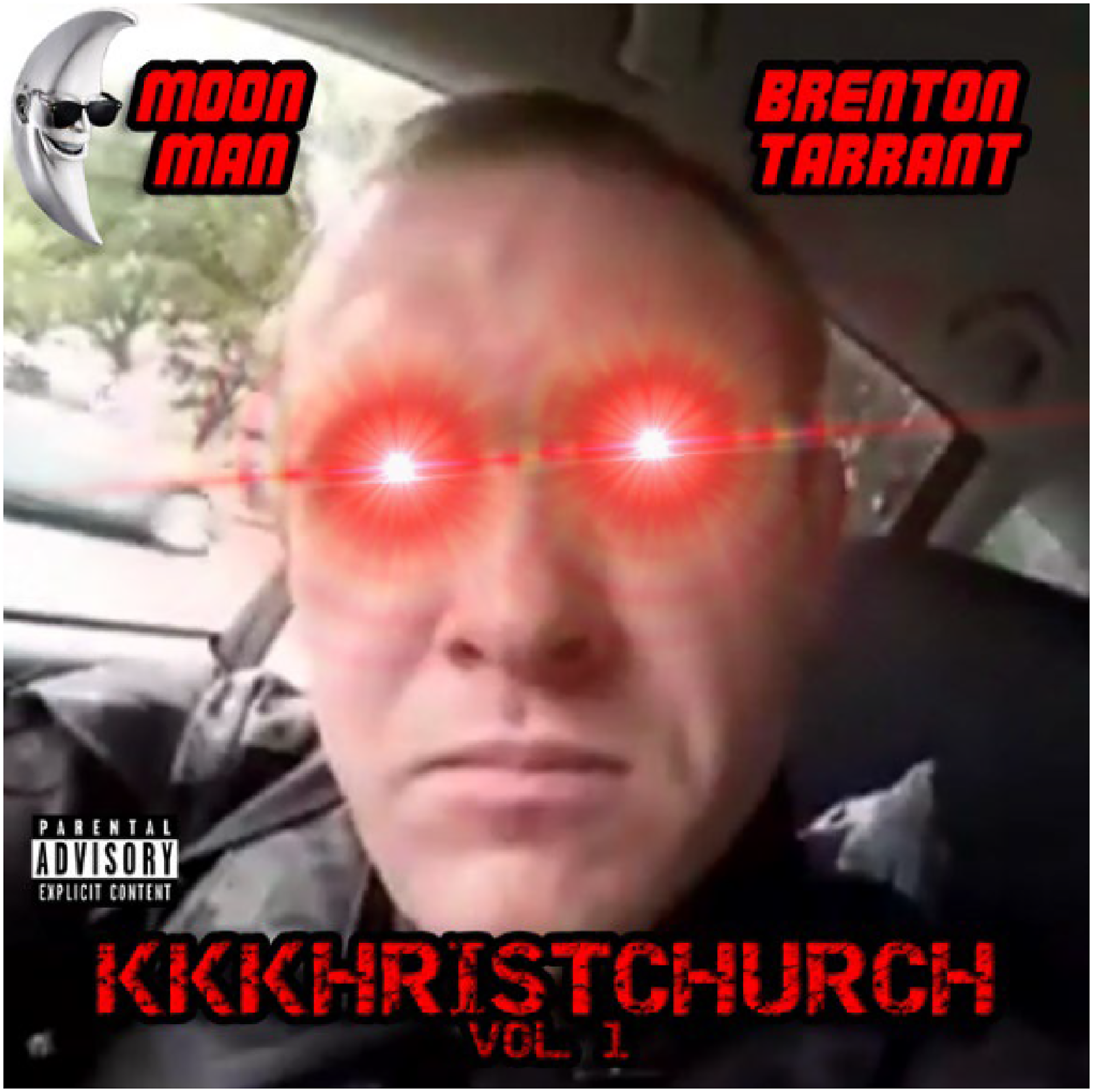
KKKhristchurch Vol. 1 album cover.
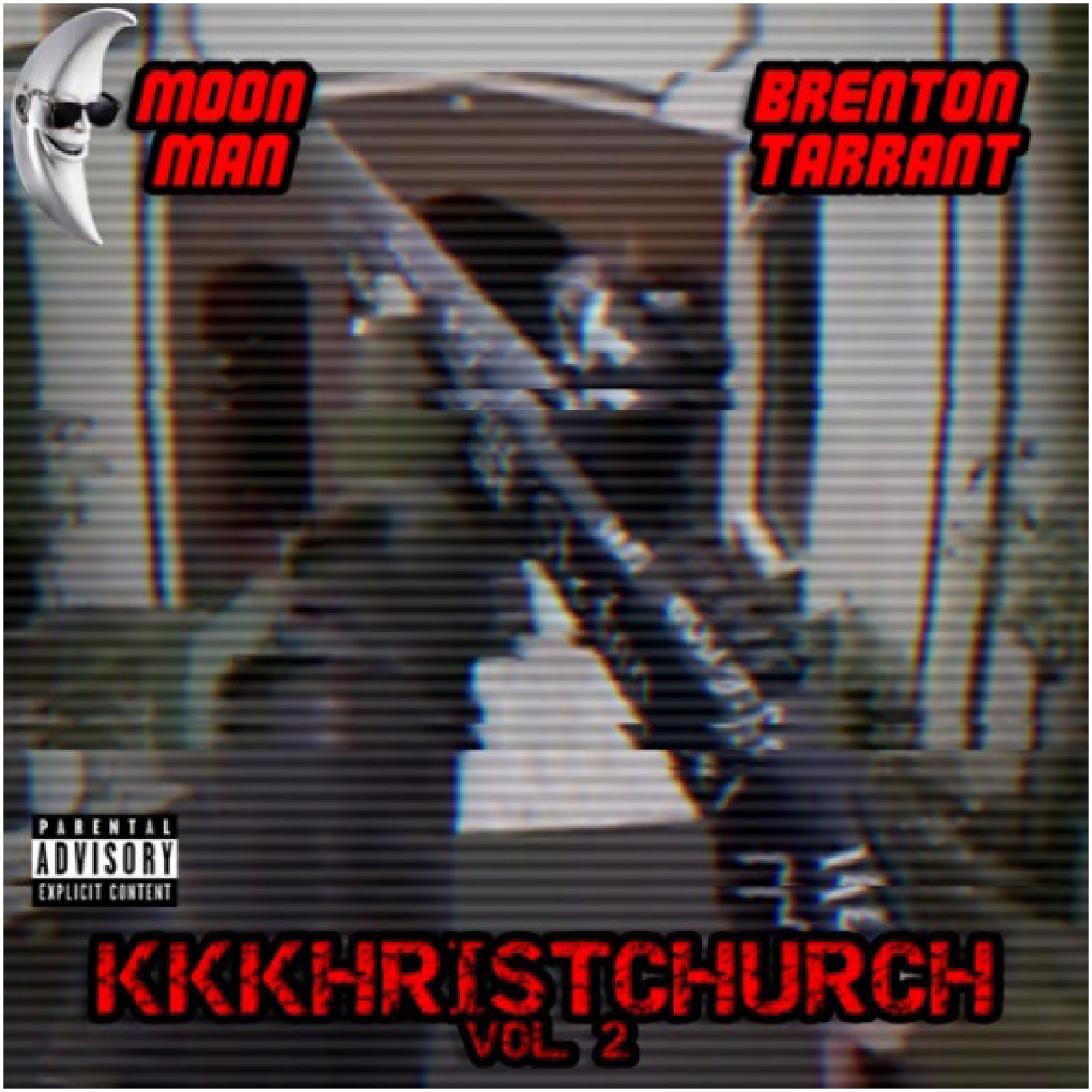
KKKhristchurch Vol. 2 album cover.
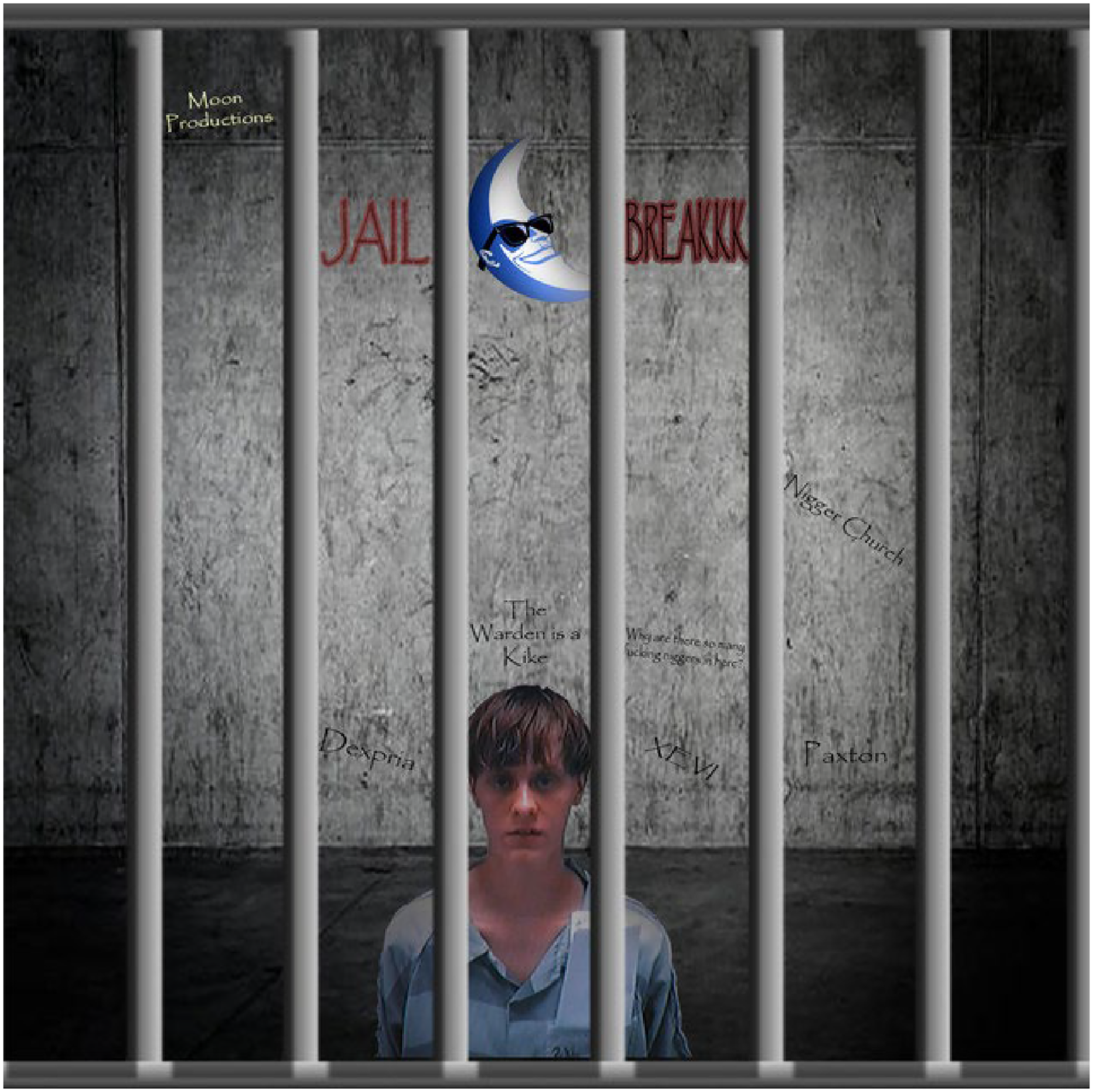
Jailbreakkk album cover.
All of this leads us to believe that an exploratory qualitative investigation into the nature of the album art of Moon Man music is warranted. We know that it is widespread in the fringe online communities that foster extremism; we know that the production of this music and its art represents a meaningful break from traditional forms of white power music; we know that it has been understudied in comparison to other elements of the white power music scene such as bands like Skrewdriver; and perhaps most importantly, we know that persons who have carried out hateful attacks have listened to and seen these images and this music as part of their descent into extremism.
Conceptualizing Album Art
Focusing an analysis exclusively on the album art of extremist music has few exact analogs in contemporary academic literature, though many closely related threads. Generally, the degree of proximity of any of those threads depends on how the album art is conceptualized in the analysis: is it reductively taken as one image among many, equivalent to the production of a propaganda leaflet or distributed meme image? Or, alternatively, is it inseparable from the music to which it is connected to—and perhaps must necessarily be taken to represent? Does album art constitute a unique type of image, possessing more than its mere visual content would suggest, yet standing far enough apart from its musical content to justify close examination?
If we treat album art as an image, bracketing the musical and lyrical attributes of its associated content, we can connect to a rich vein of research on the cultural products of extremist movements, especially Islamic extremism. Ostovar (2017) offers a straightforward analysis of the emblems, flags, and artwork created by jihadist groups, identifying key themes that appear in those images. Interestingly enough, Ostovar (2017, p. 84) notes a tendency for certain jihadist groups to tailor their images and artwork to achieve stylistic continuity, ostensibly as a means of establishing a clear brand identity—a parallel to one of the key objectives of a piece of album art: the establishment of some sort of tonal or thematic preview of the music contained within (Alleyne, 2014). 2
Another scholar of Islamic extremism, Charlie Winter, offers a more theoretically rigorous approach to the analysis of propaganda images in several of his writings. He draws upon French philosopher Jacques Ellul to establish that one of the key goals of Islamic extremist propaganda is the reinforcement of a mobilizing narrative through varied forms of media and myriad thematic tools (Alleyne, 2014, pp. 15–17; Ellul, 1965). In more recent work, Winter also employs a theoretic framework of semiotics: the systematic analysis of the meanings encoded in symbols (Winter, 2022). Of particular interest is his engagement with Roland Barthes whose early and influential work is often cited by scholars engaging with album art as a medium (Barthes & Heath, 1977). 3 Taking these strands together, the album art images that we intend to analyze are both products of an extremist movement—and thus are attempting to establish a message of mobilization and reiterate a slanted worldview—and are also acting in the traditional capacity of a piece of album art—establishing a brand, providing a thematic anticipation for the music to be heard, and perhaps most importantly, mediating the experience of listening which follows the image. As such, in our own exploratory analysis of the Moon Man album art, we draw on a few different theoretical sources, including the works of Roland Barthes (following Charlie Winter)—especially his Image—Music—Text, Susan Sontag's On Photography, and elements from Clifford Geertz's Interpretation of Cultures. 4 This theoretical pedigree belies a simple research objective: we would like to treat the album art as an image, determine what the contents of the image are, and interpret what the image might be communicating to its audience.
Simple objectives can require complicated approaches, however. Mirroring issues found in the wider body of literature, we first must decide whether or not to treat the album cover as a primarily visual image, or—as some authors have argued—as something possessing an entangled visual and audio component. Within this article, we decided upon the former: album art is already an understudied subject existing between several fields, and at this stage, we believe it better to minimize the distance from other scholars in the contemporary literature, rather than attempt to forge the tools for a combined audio-visual analysis whole cloth. Here, we care only about the visual component.
Keeping focused on our task of understanding the contents and meaning of a visual image, we draw from scholarly work in semiotics. An image can be divided into its rote factual content (a “thin description” for Geertz, a “denoted” image for Barthes), in addition to a richer subtextual content—its meaning (a “thick description” or “connoted” image, respectively) (Barthes & Heath, 1977; Geertz, 1973). In addition to a bifurcation into denotation and connotation, Barthes also argues for a textual layer—some sort of anchorage between an image and presented text (in the literal sense of “text as script”), either in the form of a caption, an associated article, etc. (Barthes & Heath, 1977, pp. 37–38). This “linguistic message” helps the viewer to understand what it is he is looking at, to arrive at the correct “scope” of interpretation of what is being seen. Barthes (1977, p. 39) believes that images are open-ended in what they signify, with several possible meanings being narrowed down by the alignment of the textual, connotative, and denotative aspects of the image.
Applying Barthes’ approach is perhaps simpler in practice than it sounds in theory: one particularly mild album cover we collected features a depiction of a car's speedometer holding at maximum. As shown in Figure 6, there is a faint, translucent image of the Moon Man visible in the central dial. The album title reads “Accelerate the Hate.” With this textual information we know the meaning of the image is not related to any sort of automotive hobby, nor is it trying to feature or depict the speedometer in any sort of purely artistic light—it indicates the image is an album cover. We can interpret it, along with the presence of the Moon Man, as denoting some sort of message in line with the other plethora of Moon Man images we have seen—and suddenly, the connotation emerges from the denotation: the meaning of the image is a reference to an attack like the Charlottesville “Unite the Right” rally, which saw a white supremacist terrorist attack a crowd by driving a car through it (Benner & Spencer, 2018). The meaning comes through once the textual, denotative, and connotative aspects are aligned. We have moved from a “thin description” (speedometer) to a “thick description” (celebration of a terror attack).
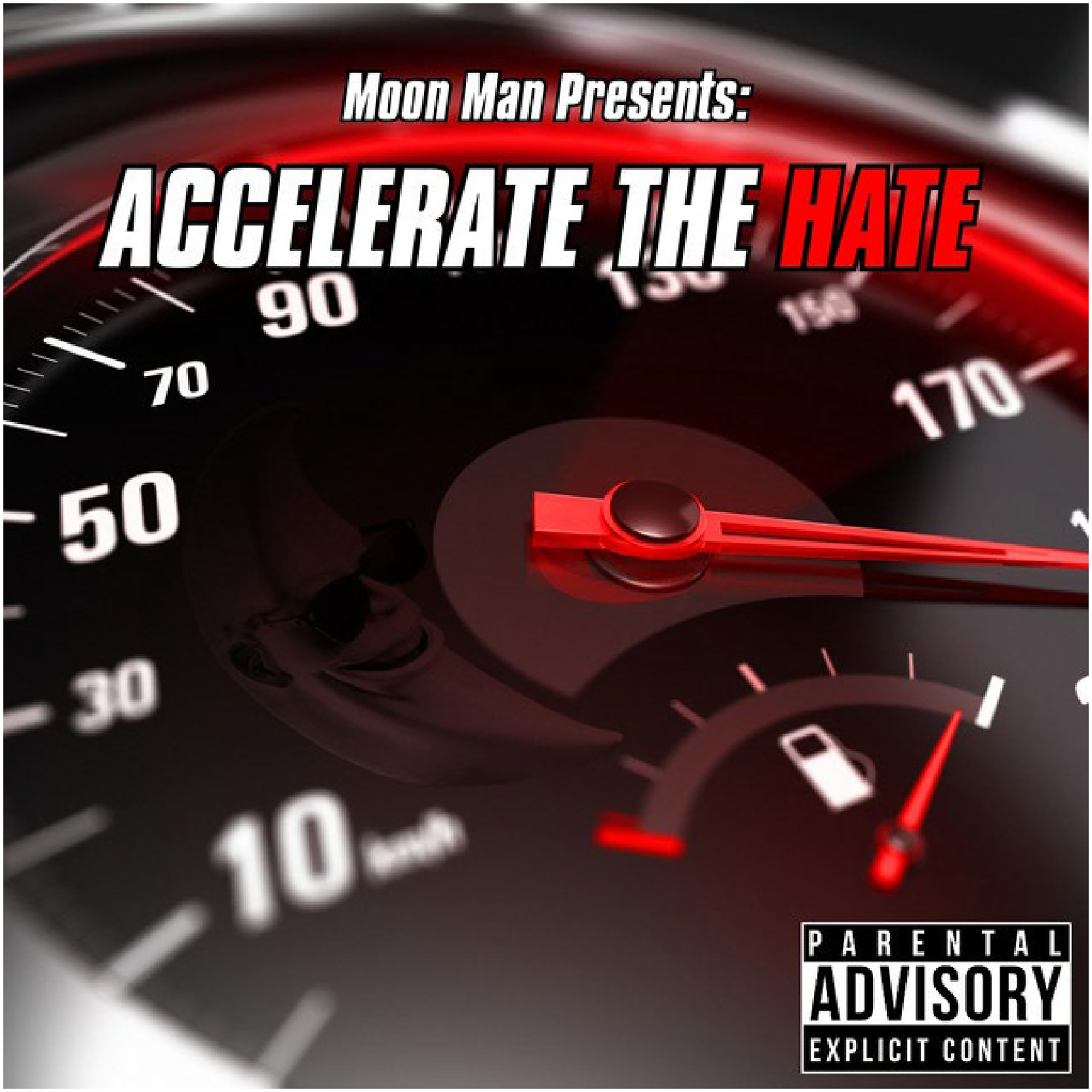
Accelerate the Hate album cover.
The album art of Moon Man also differs from traditional album art in that it has decentralized authorship not only at the initial time of creation, but even after the album has been made. 5 Owing to the way imageboards like 4chan work, anyone with access to the sound files from an album can choose to photoshop an image and associate it with a particular track to be re-uploaded to the website. Sometimes the music files are seen uploaded with their associated album art as “originally” released, and other times new images may be uploaded instead. This may serve to increase the longevity and topicality of the artwork associated with each track as a user might adapt songs to more relevant current events or cultural touchstones.
For a tangible example, consider this Moon Man video as seen “in the wild” on the /wsg/ (worksafe gif) board of 4chan, featured in Figure 7. Clicking on a thumbnail (such as the pepe visible in the bottom half of Figure 7) while on the 4chan website expands out the image and plays an associated audio track—commonly, but not necessarily, a song. In this instance, the album art does not match the audio track as released on the album White Collar Rhymes. It is clearly borrowing from Macklemore's “Thrift Shop” music video, however. (Compare Figure 7 to Figure 8, noticing how the creator of the image appropriated Macklemore's work.)
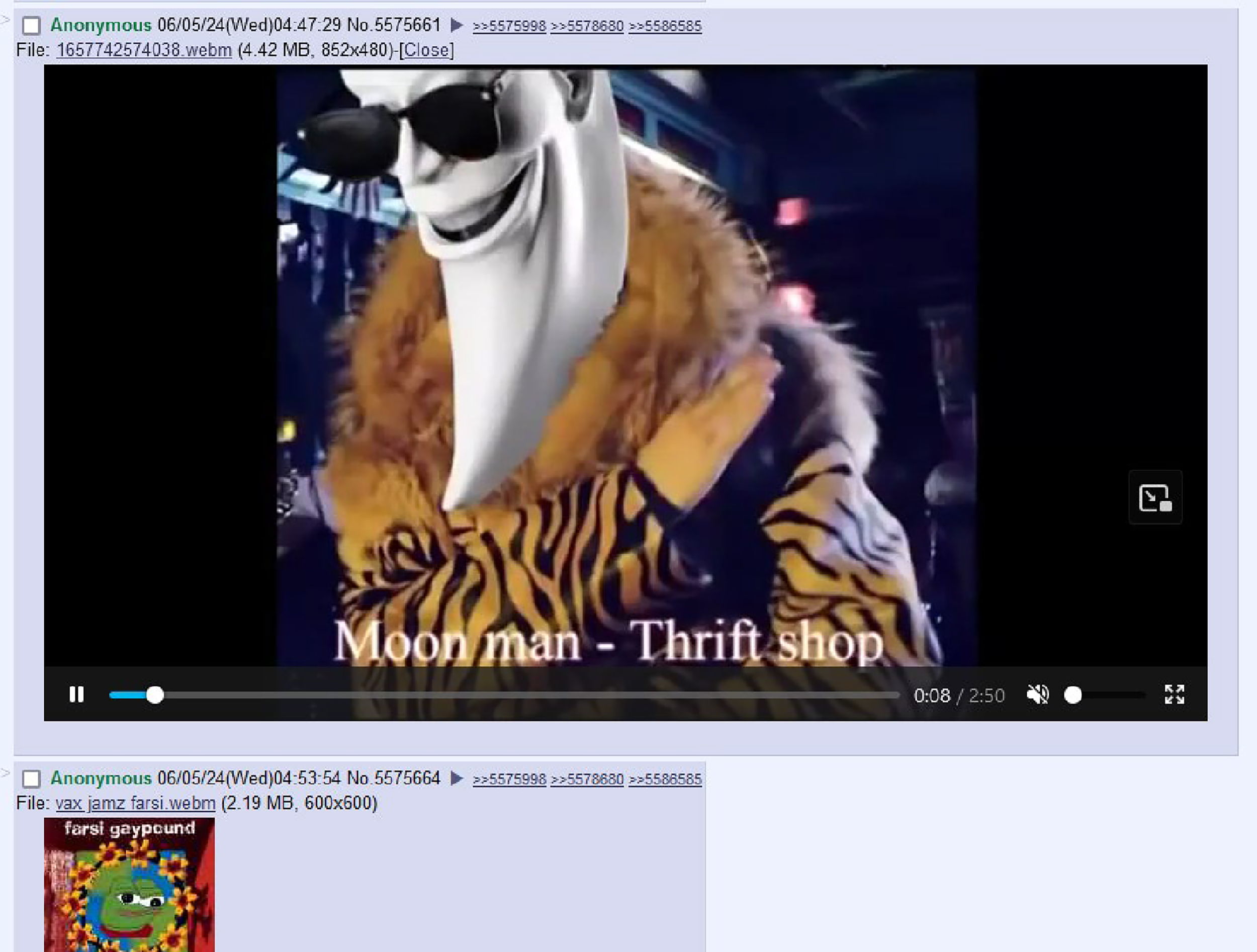
A screenshot of the /wsg/ board of 4chan, featuring Moon Man's “Thrift Shop” track.
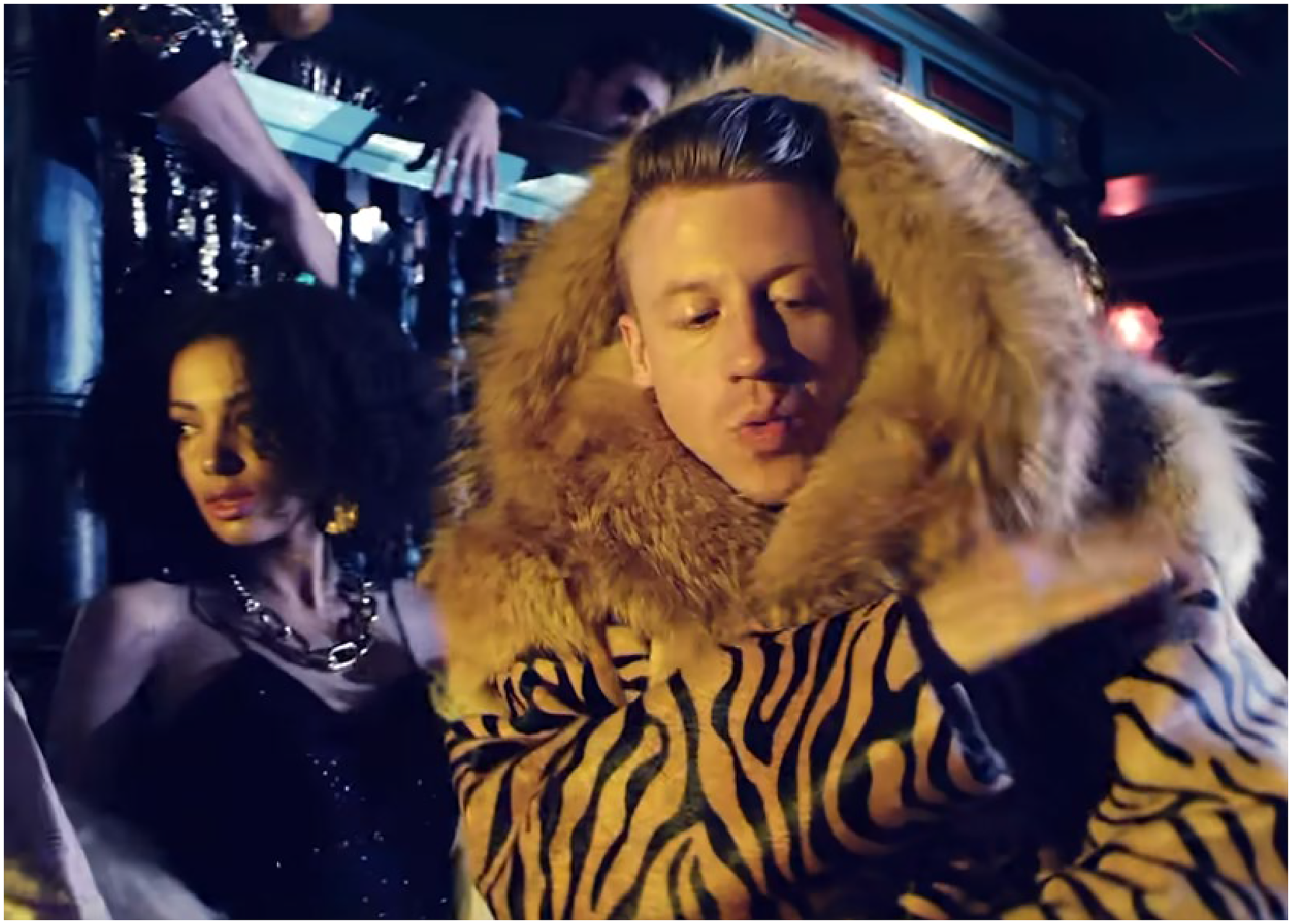
A screenshot of Macklemore's “Thrift Shop” music video.
In any case, the visual element remains the center of our analysis. Sontag (1977, p. 6) writes that a photograph can both “certify” and “refuse” lived experience—it can assert and verify the truth of a particular condition or state of the world, and it can also deform experience to only seek or expect the “photogenic.” In addition to this imbued veracity, photography has another critically important relationship with its content—photographs can anesthetize. Recounting her experiences of seeing photographic images of Bergen-Belsen and Dachau, Sontag (1977, p. 15) remarks, “An event known through photographs certainly becomes more real than it would have been if one had never seen the photographs…but after repeated exposure to images it also becomes less real.” Once a horror has been seen repeatedly, it can be rendered aesthetically cliché and morally inert.
This assertion—that there is a morally corrosive effect of repetitious viewings of horrifying or hate-filled imagery—dovetails neatly with the claim made by Corte and Edwards (2008, p. 9) that extremist music, if listened to regularly and repetitively, can “penetrate lives more deeply and steadily” than other forms of extremist incitement. In the case of extremist album art, the images might weaken and trivialize horrors of the recent or far past, while the lyrics of the songs within incubate future atrocities.
Methodology
Data Collection
The album art used in this analysis was collected from the data embedded within a distributed HTML file called “Moonipedia v10707,” first accessed in June 2023. These HTML files are opened with web browsers to display a website—they can contain text, images, and sometimes audio files, all navigable as if using a traditional web page hosted on a server. The Moonipedia appears in the same format as a “wiki”-style site, much like Wikipedia: there are numerous entries for different topics, each with a description and background of the topic in question, as well as a relevant image. However, by distributing Moonipedia as an offline HTML file, the creator(s) can avoid some of the issues associated with hosting controversial subject matter on more mainstream, online wiki-style websites such as frequent takedowns precipitated by violations of terms of service, or hostile “editing wars” which see individuals or groups attempting to delete or replace large parts of the content of pages to shape or enforce a narrative.
The link to the Moonipedia HTML file was discovered on a popular white supremacist website and was distributed in the comments of a page of streamable Moon Man music. Upon accessing and exploring the file, we found that there was a complete listing of Moon Man albums, including their associated album art, from 2015 to 2022. 6 There were a total of 99 albums in this timespan, each including their own album art. We then began the process of scraping the HTML file for the album art images (often extractable as PNG or other image file formats) and documenting them along with several other pieces of metadata in the Trophy software according to the Dublin Core Metadata Schema.
In logging each album, we included the album title, date of publication, creator, publisher, and (where applicable) the label. The source for this metadata information was found in the entries associated with each album in the Moonipedia. As such, while it has generally been accurate (e.g., the information in Moonipedia was corroborated with the information included with other postings of the same album on other websites), it cannot be said to be a perfectly accurate and exhaustive source. However, considering the anonymous and decentralized nature of the production of this music, and the turbulent history of the file hosting due to frequent takedowns on account of violating website policies, we believe the data is sufficient and accurate enough for developing a first sketch of an elusive and difficult to analyze research subject. Put more plainly—we are confident this content reflects the real products of a particular online community, but we are less sure of its consistent authorship over time.
Coding
After collecting the album art from Moonipedia and assigning each image its relevant metadata, we used an abductive coding process to develop a robust set of codes that helped us analyze the content of each image of album art. Abductive coding refers to the “iterative process between theoretically surprising cases and tentative explanations” (Vila-Henninger et al., 2024, p. 974; see also Deterding & Waters, 2021; Tavory & Timmermans, 2014; Timmermans & Tavory, 2012). Because two of the authors are well-versed in the white power music literature, abductive coding allowed for both deductive (i.e., expected codes and themes) and inductive codes (i.e., unexpected codes and themes). In line with the work of Miles et al. (2020), we began with holistic coding, which allowed us to initially identify the main theme(s) or concept(s) present in each piece of album art. Following this first-cycle coding method, we turned to attribute coding, concept coding, and simultaneous coding. 7 In the end, because this is an exploratory study, we decided as a team that every code would be categorical to reduce ambiguity and ensure consistency across different albums. Table 1 details our final codebook.
Codes and Descriptions.
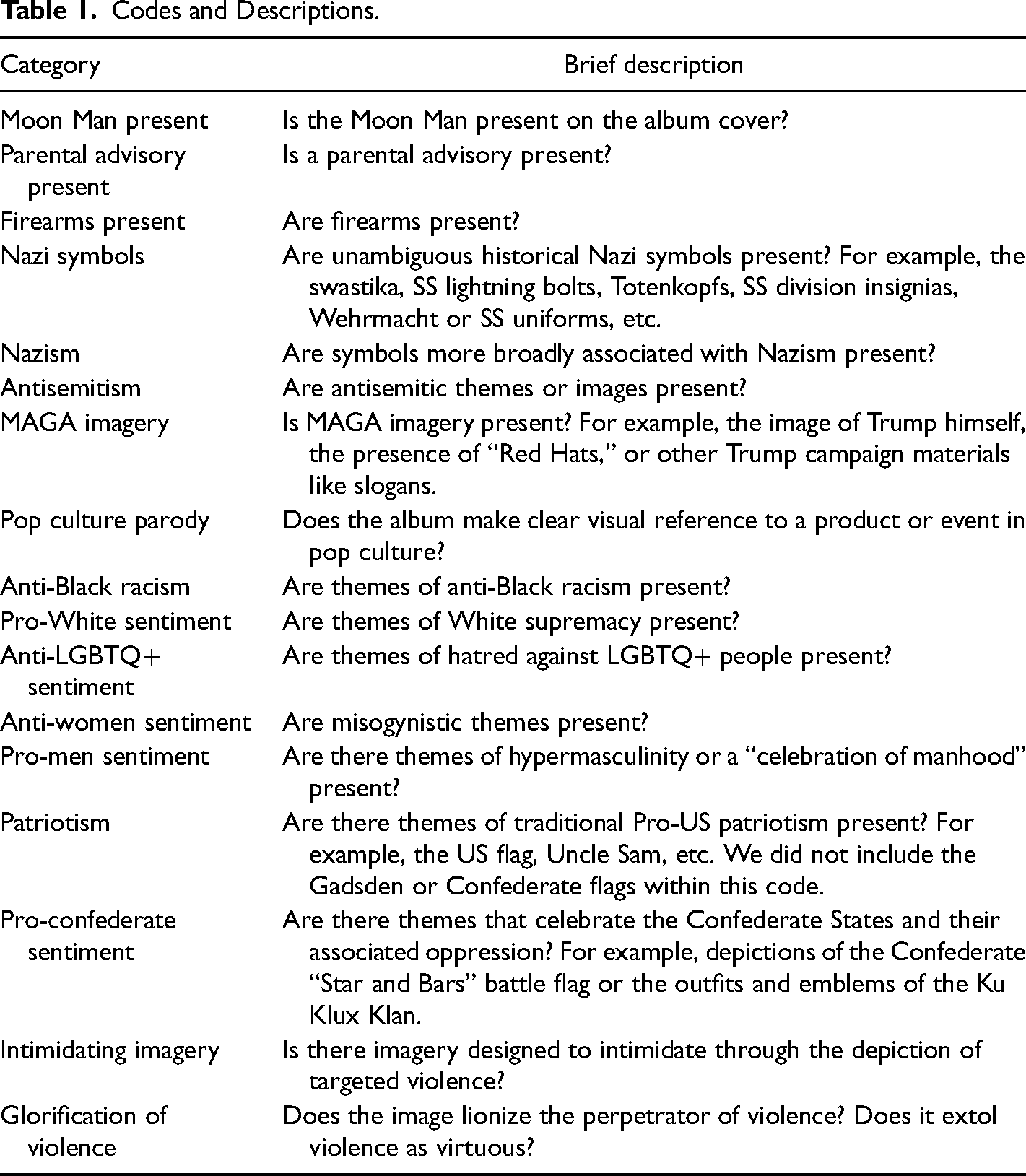
As this is an exploratory study, many of our final codes are straightforward and, as such, do not require a deep or rich description here. However, a few need further explanation.
Nazism and Antisemitism
First, the code Nazism was used to denote references and symbols which alluded to aspects of Nazi or Neo-Nazi ideology beyond the historical Third Reich. This included the usage of symbolic numbers (such as “1488”), the presence of the “14 words,” the presence of the black sun symbol, and other neo-Nazi imagery or thematic content which may be said to be connotative, rather than denotative of Nazism. Additionally, we coded for antisemitic content, such as depictions of the “happy merchant” (a racist character emphasizing negative Semitic stereotypes) or other demeaning caricatures of Jewish people, as well as depictions or glorifications of acts of violence against Jewish persons or institutions (e.g., Holocaust imagery).
Pro-Confederate Sentiment
Pro-Confederate Sentiment was coded as imagery that was associated either with the historical Confederate States or their successor movements of associated white supremacy such as the Ku Klux Klan—though the specific initialism “KKK” was not coded as Pro-Confederate owing to its wider use as a trope in the Moon Man genre.
Discriminations of Identity: Anti-Black Racism and Others
We additionally coded for various degrees of identity and discrimination. We included codes for anti-Black, Anti-LGBTQ+, and anti-Women sentiments. All three focused on dismissing, demeaning, or insulting these identities, including any depictions of violence or threats of violence. We also included codes for pro-White and pro-Men sentiments. These two codes highlighted imagery celebrating or emphasizing the positive attributes of these identities like white racial purity and hegemonic masculinity.
Violence and Intimidation
Finally, we coded for whether there was intimidating imagery or glorification of violence. While the intimidating imagery is clear, we interpreted the glorification of violence as imagery that, irrespective of its degree of targeted menace, sought to depict violence in a positive light, or could otherwise be interpreted as a call to action. Images that blended violence with heroic or positive depictions of the perpetrators—or perhaps identified violence with desirable, hypermasculine energy—often fell into this category.
Analysis
After coding all 99 albums, the Moon Man character was featured in 84.8% of album covers, while the ersatz “Parental Advisory” label was present in 49.5%. Firearms were prominently featured in 24.2% of albums, Nazi symbols in 27.3%, Anti-Semitic imagery in 14.1%, broader Neo-Nazi imagery in 33.3%, and pro-Confederate imagery in 16.1%. MAGA imagery was relatively rare, appearing in only 6% of albums covers, while patriotic imagery appeared in just 4%. Identifiable pop culture references were present in 19.1% of albums. Anti-Black imagery was present in 31.6% of album covers, while pro-white imagery was found in 28.3%. Anti-LGBTQ + imagery was found in 2% of albums, anti-woman imagery in 1%, and pro-men imagery in 2%. Intimidating imagery was found in 50% of albums coded, while glorification of violence was present in 25.3%.
While coding, two clusters of characteristics became particularly apparent: the ubiquity of Antisemitic and Anti-Black imagery, and the widespread use of images of violence and intimidation to further a political message. These attributes also display the greatest continuity with more traditional forms of white power music as well as the research on white power music (see, e.g., Grosholz & Pieri, 2023), wherein the “othered” groups overwhelmingly tend to be Black or Jewish persons who are vilified for their perceived threats to a white-majority population.
Forty of the albums coded contained either antisemitic or anti-black imagery, often taking the form of violence depicted against those groups or the minstrelization of those groups by way of racist tropes, symbols, and images. Generally, the albums only targeted Black or Jewish identities individually—only five albums displayed Antisemitic and Anti-Black imagery simultaneously. This may be seen as somewhat surprising as traditional white supremacist rhetoric often places the two groups in cooperation to “replace” the “white race” (NPR, 2021; Wilson & Flanagan, 2022). Across all albums, the use of memetic caricatures was extremely common—both the “smiling merchant” and the “Tyrone” image (a racist depiction emphasizing negative Black stereotypes) regularly found their way into various album covers.
This sort of derogatory depiction can be seen in Figure 9, the album cover of “A KKKristmas KKKarol: Volume 3”: in place of Ebeneezer, a cartoon depiction of a Jewish person (with exaggerated nose and full beard) cowers in front of a tombstone bearing a Star of David and the inscription “Shoah Shekelstein / He Was A Humble Merchant.” Over him stands Moon Man in the place of the Ghost of Christmas Future, gesturing at the grave. Antisemitic imagery generally took the form of either these sorts of racist caricatures or, alternatively, referenced imagery associated with the Holocaust. This can be seen in Figure 10, the album “Annuda Shoah,” which depicts the “Smiling Merchant” locked in a gas chamber while a Moon Man dressed in a Wehrmacht outfit operates a control panel.
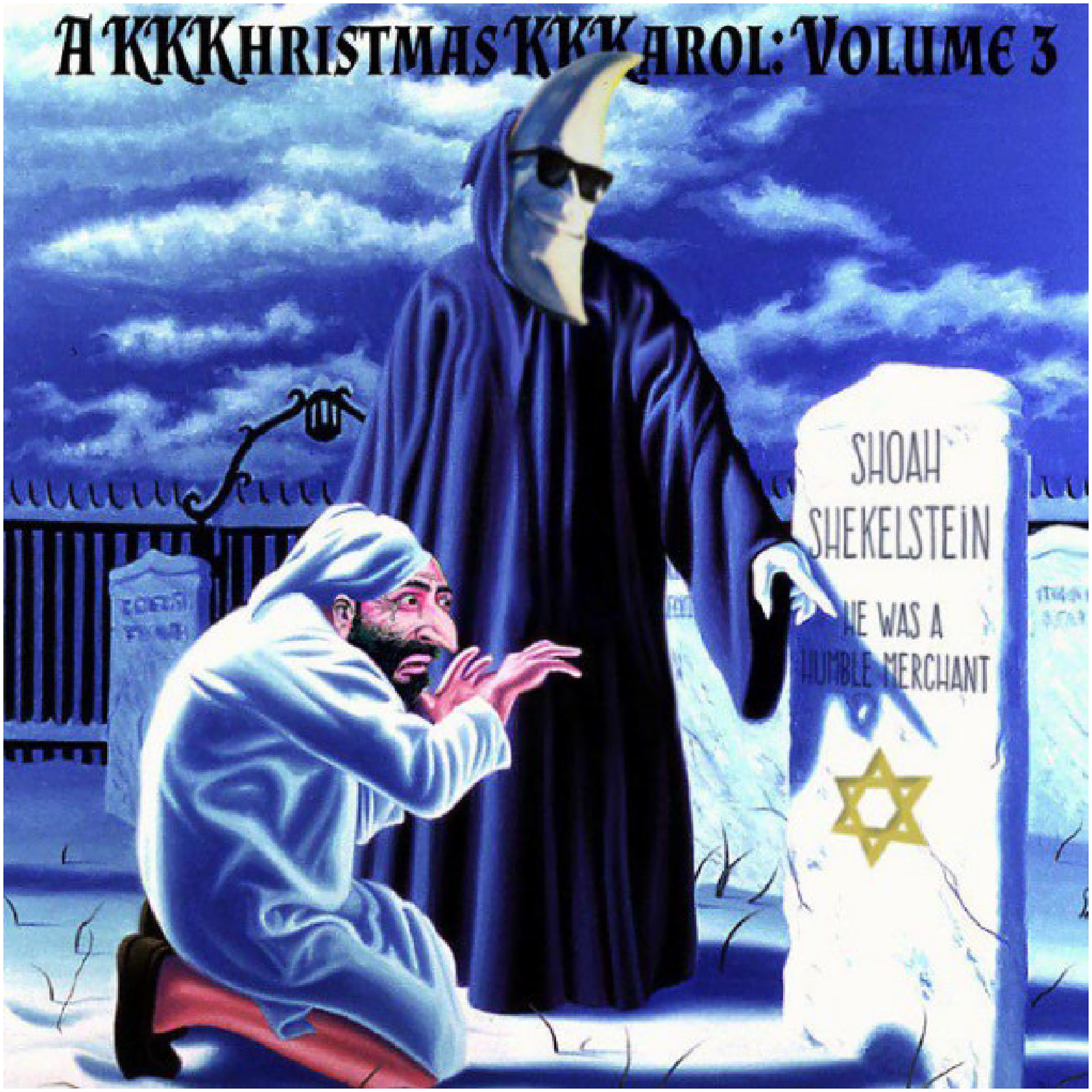
A KKKristmas KKKarol: Volume 3 album art.
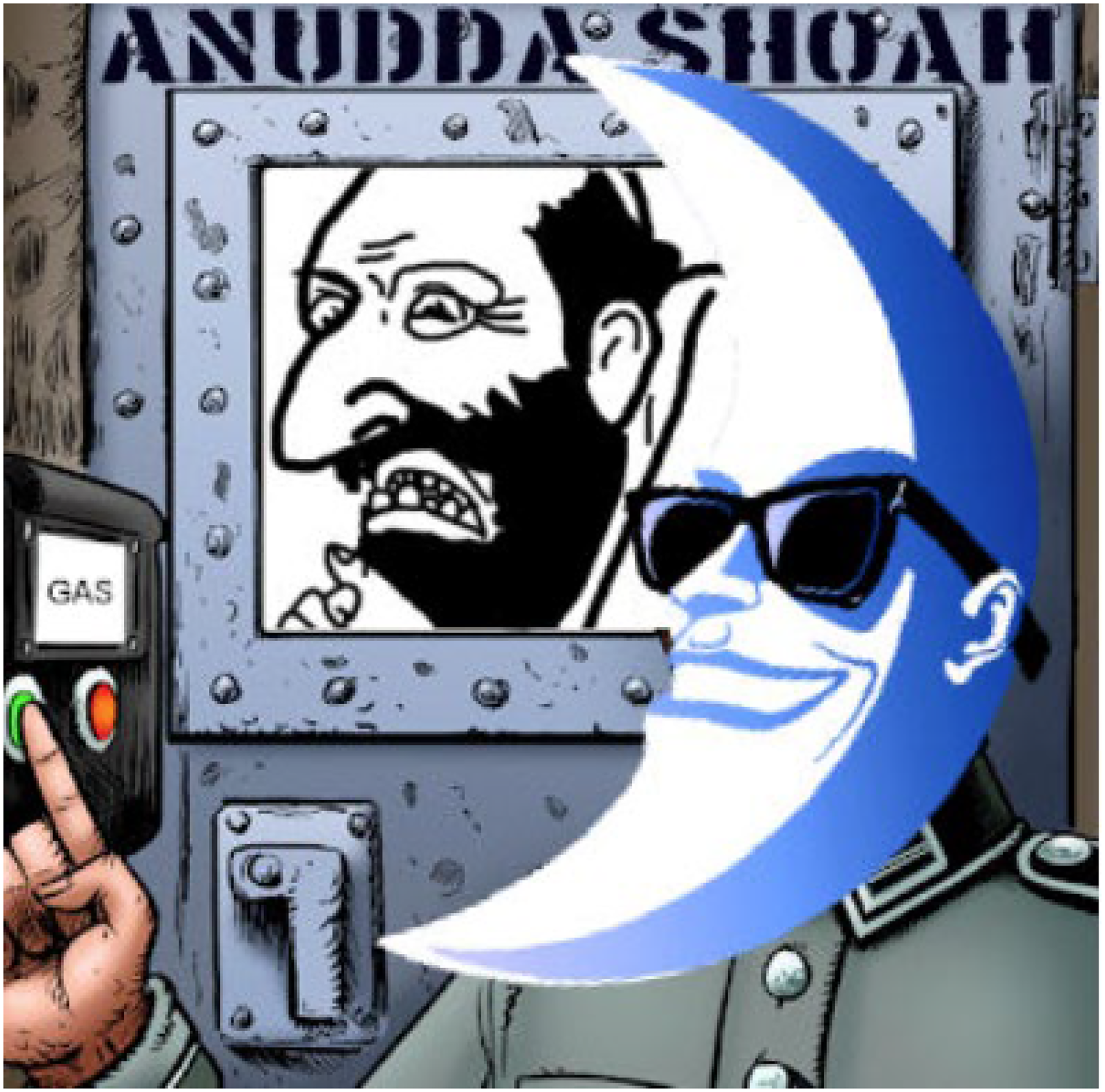
Anudda Shoah album art.
Several other albums also depict images of concentration camps or crematoriums in combination with Nazi imagery. The album “[K-slur] KKKremator” (Figure 11) depicts the Moon Man standing in the foreground, photoshopped flames jetting from his hands. Behind him is a black-and-white photograph of a bleak industrial landscape, with a locomotive prominently featured in the background. Another album, “Moonman: Straight Outta Auschwitz” (Figure 12) features a Moon Man head photoshopped in the foreground wearing a Stahlhelm (a WWI/II German helmet); behind him is the iconic photo of the rail line and front gate to the eponymous death camp. The title is an “homage” to N.W.A's Straight Outta Compton (Figure 13)—and a good example of the sardonic humor and incongruent influences of musical style which often undergird the more racist and hateful content. A later Moon Man album, “Straight Outta Ferguson” (Figure 14) stays even closer to N.W.A's artistic influence: the album art (like N.W.A's original) features a circle of members of the “Moon Crew” standing above the viewer, guns in hand. (Of particular note, we can see Moon Man (first from right), as well as other memetic alt-right characters such as Ben Garrison (second from right, clockwise), and Dylann Roof (fifth from right, clockwise).
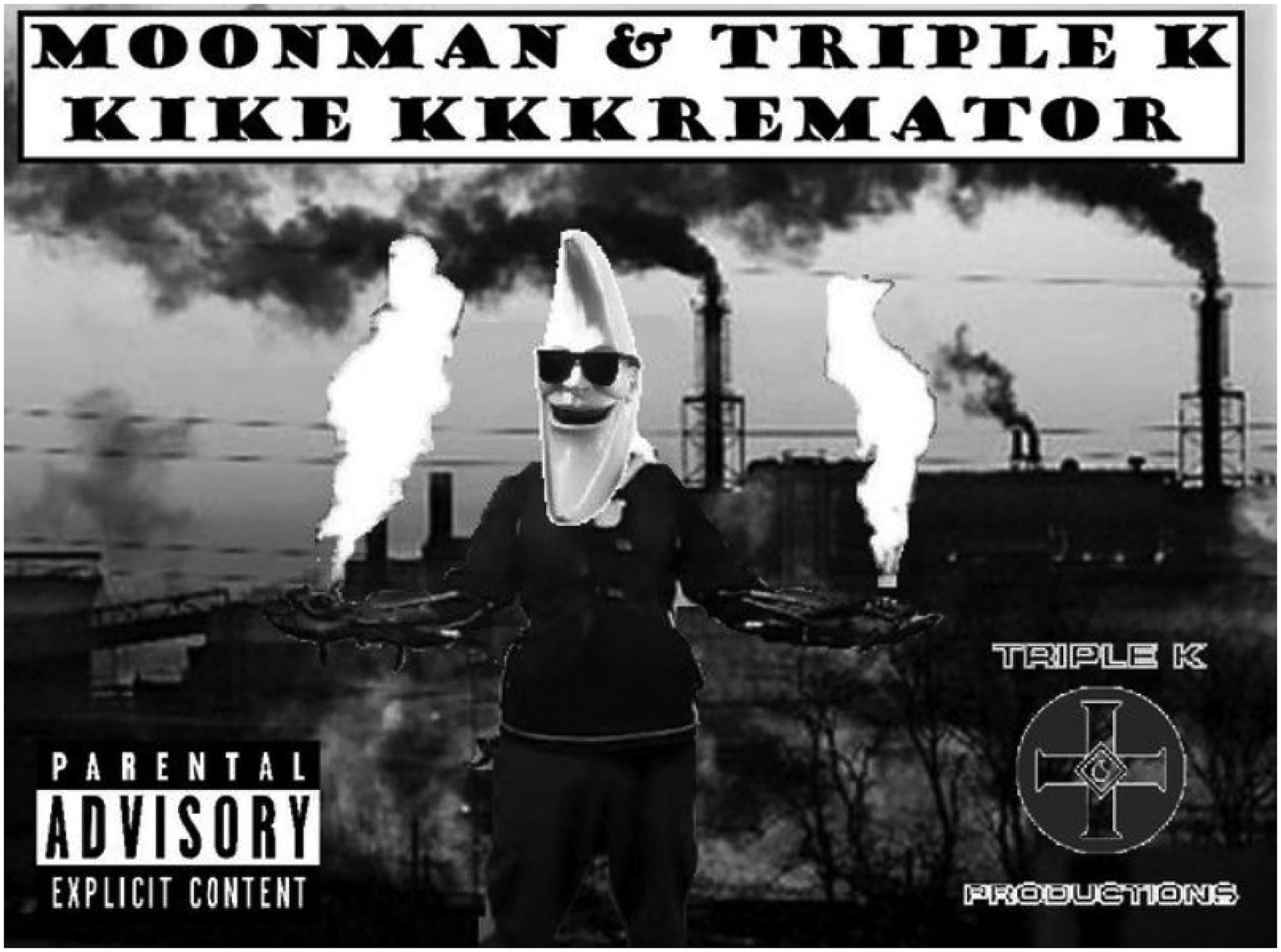
[K-Slur] KKKremator album art.
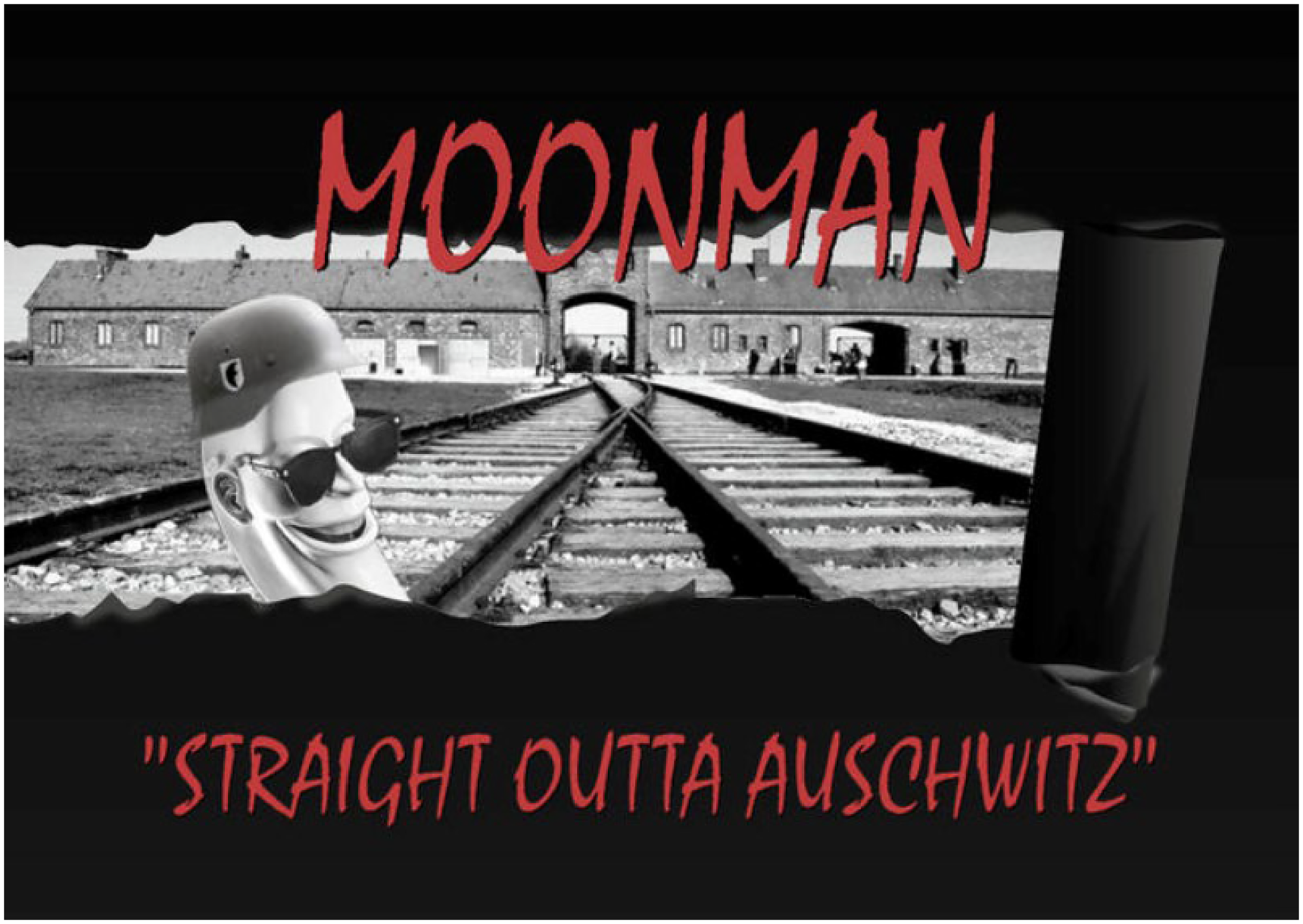
Moonman Straight Outta Auschwitz album art.
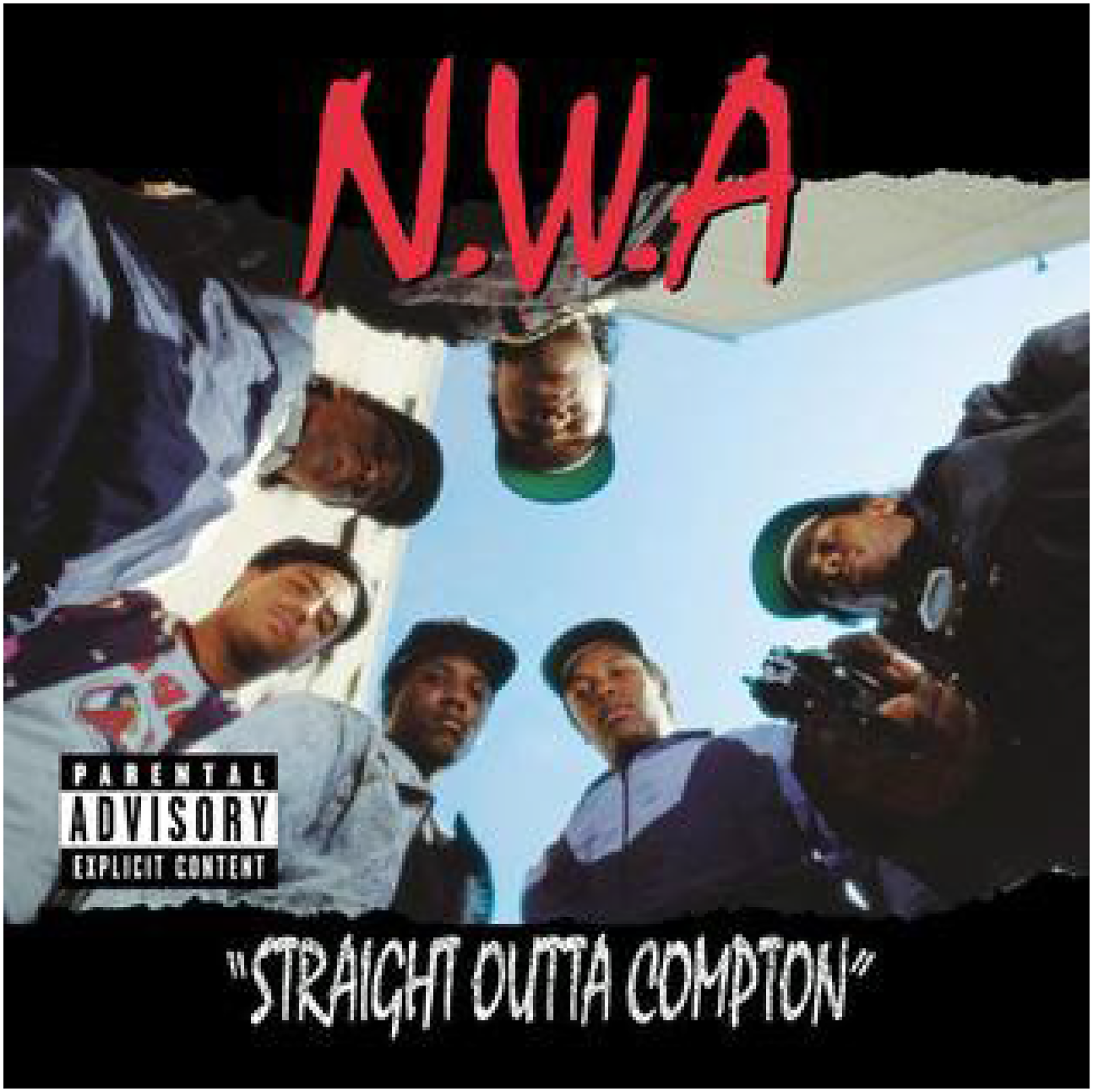
N.W.A.'s Straight Outta Compton album art.
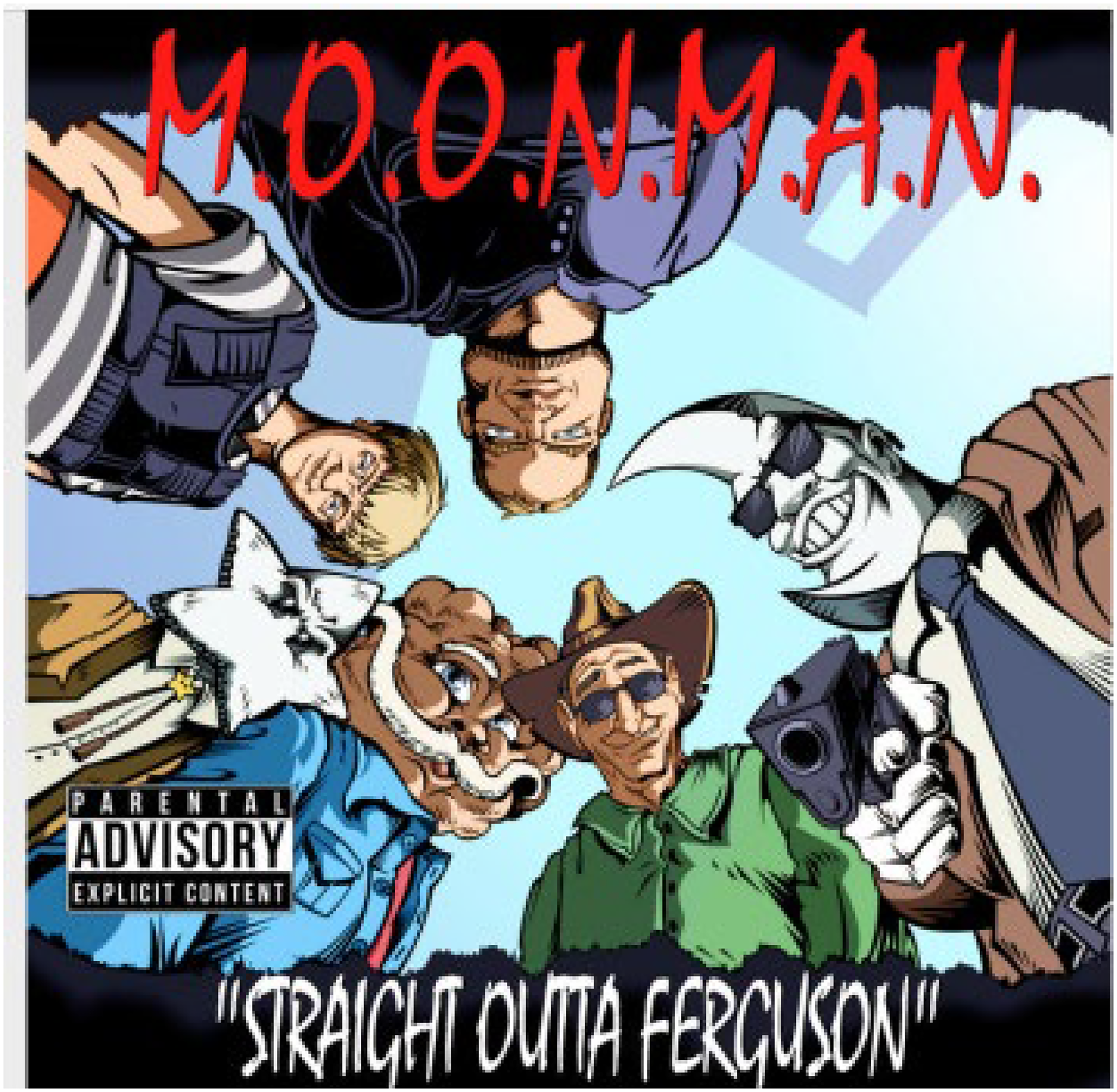
Straight Outta Ferguson album art.
Anti-Black racism generally took the form of minstrelization, direct depictions of violence, or reference to symbols of lynchings and white supremacist movements of the American South, especially the KKK. In the case of minstrelization, images of Black persons tended to show exaggerated features conforming to negative racial stereotypes, and where images of Black persons (rather than cartoon drawings) were photoshopped into album art, the creators generally depicted them as either oblivious to their surroundings or victims of violence. When Black women were included, it was often in the form of the racist trope of the “welfare queen” (Hancock, 2004). Depictions of violence were common, both in the form of drawn cartoons, as well as photo references to historical examples of anti-black violence ranging from lynchings to the murder of George Floyd.
One particularly representative example of Anti-Black Racism seen in the album art analyzed comes from (Figure 15) “Make America Great Again 3”: the foreground features a blood-covered Moon Man armed with a pistol; to his right can be seen a red MAGA hat and what appear to be shell casings. In the background is a city street filled with protestors, a “Black Lives Matter” banner that has been photoshopped to read “Black Lives Don’t Matter,” and the protestors themselves defaced with overlayed identical, derogatory cartoon heads—the racist “Tyrone” caricature commonly seen on 4chan. Other members of the “Moon Crew” can be seen edited into balconies and overhangs, all armed and aiming at the crowd. The image plays thematic reference to any number of the violent confrontations between BLM protestors and counter-protesters that took place before the September 2018 publication of the album—and gives some evidence as to the way the creators of these albums frame contemporary politics. The depiction of armed white militias standing ready to attack and break up “unrest” brought about by persons of color acts as a useful myth for an extremist political movement wishing to support the primacy of racial identity as a means of organizing contemporary politics.
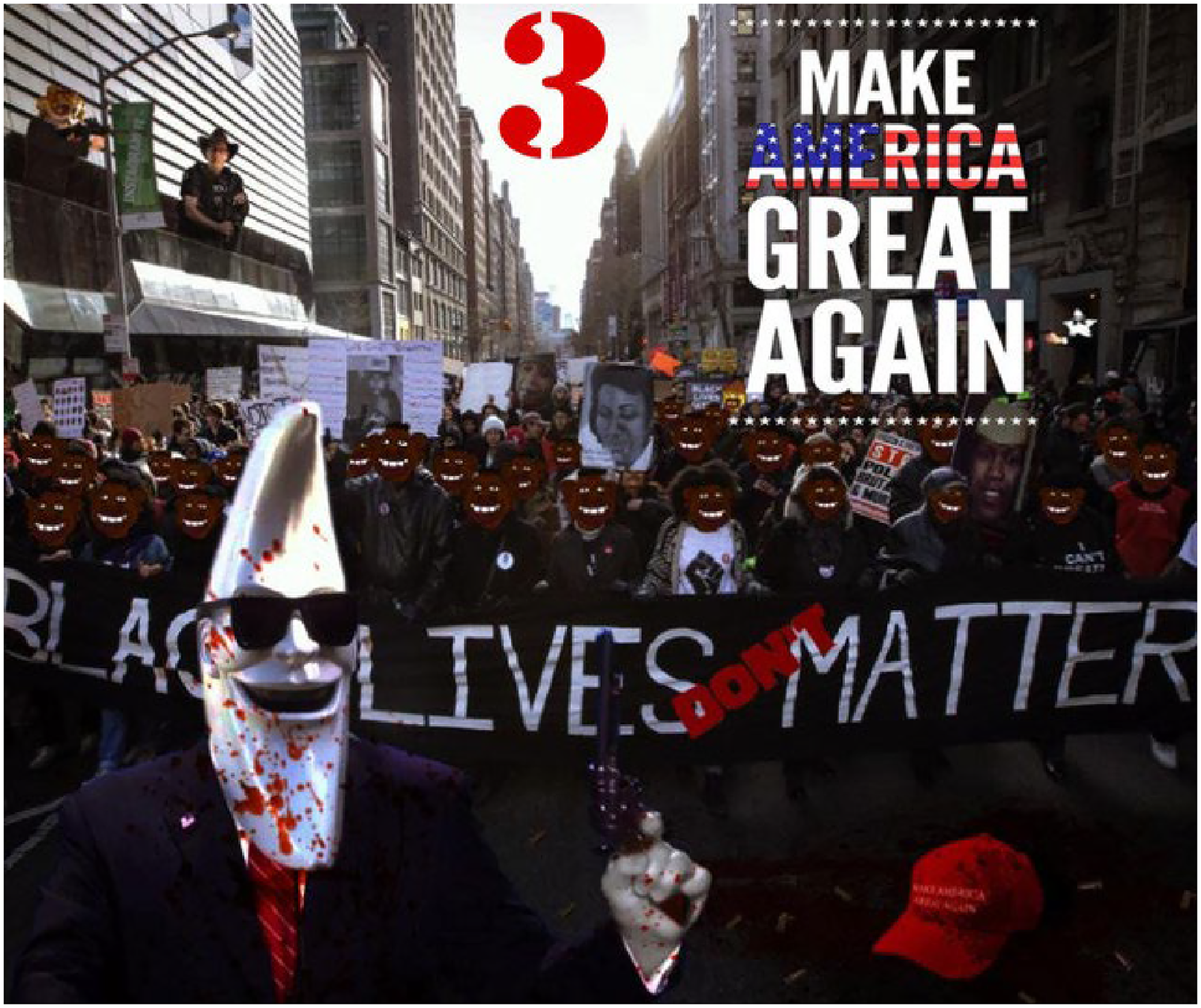
Make America Great Again 3 album art.
Forty-eight of the albums featured imagery which was either meant to intimidate or which glorified violence. Often in the case of intimidating imagery, this took the form of depictions of violence against targeted groups, especially Black or Jewish persons, as discussed prior. In general, the forms of violence depicted tended to conform to historical modes of persecution directed against those groups—e.g., album art targeting Black persons featured imagery of lynchings, nooses, burning crosses, and hooded figures in the image of Klansmen; album art targeting Jewish persons tended to utilize images and symbols associated with Nazis and the Holocaust.
However, perhaps the most dangerous mode of glorification of violence comes about from several albums that seek to lionize perpetrators of lethal hate crimes such as Dylann Roof, Brenton Tarrant, and Robert Bowers. In particular, the albums “Jail Breakkk” (Figure 5, previously shown) and “KKKhristchurch” (Figures 3 and 4, previously shown) feature imagery designed to pay homage to the actions of these individuals: the former features Roof behind bars as the target of the titular “jailbreak,” while the latter uses images of Tarrant's livestreamed attack as cover art for both of its two volumes.
There is a reciprocal effect produced from this martyrization of white supremacist terrorists in extremist media: as individuals become radicalized by exposure to extreme viewpoints and the actions of others, they perpetrate attacks which then become fodder for future albums, memes, and other media depictions. Socially isolated or unstable individuals can find a sense of purpose and value in being remembered and celebrated as a soldier for a cause, rather than taking violent action against themselves or others in a more inchoate form. As was discussed earlier in this article, Tarrant himself emphasized the importance of memes as a means of propagating his ideology of racial hatred—his decision to livestream his attacks was also likely motivated by a wish to immortalize them in the common culture of extremist online spaces.
Discussion
How are we to make sense of the posting of these Moon Man videos in the context of their online communities? How do people interpret and understand these videos? It is likely that not all users on social media websites who repost these videos endorse their political or social viewpoints—this is where the decision by creators to employ humor, pop music, and parodies of popular culture prove the most valuable in disseminating the message. For some users, the content may be seen as parody—as essentially Dadaistic, vulgar, and consequently possessing countercultural legitimacy. Watching the image of an ‘80 s fast food mascot promulgate racially charged hate speech with a computer-generated monotone voice to the beat of Eminem's “The Real Slim Shady” or Coolio's “Gangsta's Paradise” possesses an undeniably surreal quality which some might take to be humorous. There may be a “double effect” in communities where the material is regularly posted, with two audiences both taking completely different messages from the art and music—the first in line with the creator's intentions, the second participating in an ironic engagement which might normalize—but not legitimize—the views expressed in the art.
This sort of complicated dual-engagement with the material is especially noticeable in the treatment of political cartoonist Ben Garrison (who is also depicted in some of the album art we analyzed)—his ideology and works contain a strong right-wing, libertarian perspective, but are regularly edited on websites like 4chan to exaggerate his perspectives from libertarianism to outright national socialism. An emblematic episode occurred in 2011, where Garrison directly addressed this phenomenon with a comic titled “Web Gnatzis…trying to bug Ben,” which was promptly edited by users on 4chan to read “Web Holomoths…trying to bug Ben” (see https://knowyourmeme.com/photos/956843-ben-garrison). The intention of the persons who edited the comic, much like the posters of Moon Man albums, can be hard to discern: are they supporting the explicit racially motivated anti-Semitic message? Are they finding humor in the vandalization of the original artworks? Are they lambasting a libertarian position by taking it to its “logical extreme”? Or is it a combination of many different motivations? All of this has the effect of normalizing the posting of extreme viewpoints and shaping the discourse of current events in the online spaces where the content is found. Even in the case of “two channels” of users—the true believers and the ironic participators—extreme content and extreme language are able to flourish, and mainstream views on politics or events are seen as gauche: either the user pointing out the racism is considered a political enemy, or hopelessly out of the loop on the joke. Within such spaces, those “true believers” may be the ones on the path to radicalization and violent action, perhaps destined to play the part of both current laughingstock and future “martyr” for the cause.
It should not be forgotten that a connection between cultural product (in terms of text, music, or even the collective forum culture of an online community) and violent action has been observed before, in both the context of white power movements, and on fringe online platforms such as 4chan/8chan, Gab, and others. The most lethal act of domestic terrorism in U.S. history—the Oklahoma City Bombing by Timothy McVeigh—was directly presaged by and inspired both thematically and tactically by the most influential of all white supremacist texts, The Turner Diaries (Wright, 2007, p. 166, 186). Dylann Roof, whose radicalization was primarily a result of his engagement with online white supremacist content, noted ominously in his manifesto “Someone has to have the bravery to take it to the real world” (Collins, 2017). Looking for a moment beyond white supremacy, but retaining our focus on fringe online communities, we can also observe the power of culture in the case of the “incel” (or “involuntarily celibate”) movement and the dualistic tongue-in-cheek martyrization of Elliot Rogers—dubbed by 4chan as the “Supreme Gentleman.” His 2014 Isla Vista killings and following internet infamy directly influenced Alek Minassian's 2018 Toronto van attack. 8 What these people encountered online (or by published text in the case of McVeigh) shaped both their attitude toward the use of violence, as well as their understanding of who should be targeted.
Conclusion
As we have demonstrated throughout this paper, the album art of the Moon Man project depicts extreme, racially charged images designed to intimidate Black and Jewish persons, express white supremacist views, and celebrate and lionize perpetrators of racially motivated violence. While the content of the album art broadly aligns with earlier forms of white supremacist music, the nature of its production—photoshops and drawings that appropriate elements of pop culture and ‘80 s nostalgia—represent a radical break from earlier, more artistically original white supremacist bands.
The album art of the Moon Man project serves a dual role. First, like all album art, it provides a preview of the music that is on the album. While we did not analyze the music on these 99 albums, future research should examine the content included in the lyrics to see how it compares to prior research on white power music (see, e.g., Corte & Edwards, 2008; Cotter, 2007; Dyck, 2017; Futrell et al., 2006; Grosholz & Pieri, 2023). Second, the album art also has the potential to mobilize individuals by depicting an extreme and slanted worldview. This last function is particularly important as white supremacist violence has been increasing in the United States and remains one of the “highest priority threats” according to the FBI (2023). Future research, then, must begin to explore the connection between consumption of the propaganda, like Moon Man, that is spread through online spaces and active engagement in extremist actions.
This research project carried with it some limitations common to any investigation focused primarily on anonymous, fringe online spaces—in particular, the degree of anonymity of the authors of these images made it impossible in most instances to identify who, exactly, was creating them, and to what degree the creation of these albums was centered around specific networks of creators. Additionally, this research is limited by the rapidly changing nature of online culture—while Moon Man albums have spanned a number of years, our most recently observed album was created in 2022, 2 years behind what may now be circulating in these same online spaces. Another final challenge, in general, to understanding online white supremacist spaces is the increasing trend toward “invitational” social media platforms which cannot be freely accessed, and which require membership to observe.
Ultimately, though, the research presented here represents an important initial step in understanding this new form of white supremacist music—moving forward, as mentioned, it will be necessary to analyze the lyrics and sounds of the music contained within these albums, as well as the deeper meanings and themes featured in the selected artwork. Additionally, a critical piece of the puzzle lies in how individuals interact with these albums and songs as they are posted to online forums and social media—do most users engage with these directly, ironically, or somewhere in-between? Does the more pop-focused aesthetic represent a different sort of author and audience from earlier white supremacist music? Until the art and music can be contextualized in their online communities, we will not have a full view of the picture, and will we not be able to develop effective counter-extremism measures and messaging, which is fundamental to curbing the rise in racially and ethnically motivated violence.
Footnotes
Declaration of Conflicting Interests
The authors declared no potential conflicts of interest with respect to the research, authorship, and/or publication of this article.
Funding
The authors received no financial support for the research, authorship, and/or publication of this article.
