







Abstract
Prison visitation has been studied as a mechanism to strengthen incarcerated people's social ties to the outside world, decrease disciplinary infractions inside prison, and reduce recidivism upon release from confinement. At the same time, family members who enter prisons for visits experience dehumanization, bureaucratic hurdles, and an emotional toll adversely affecting their well-being. Important questions therefore remain about how incarcerated people and their family members navigate the dualities of visiting in an oppressive setting—prison. Analyzing in-depth interviews with men incarcerated in the Northeastern United States, we contextualize visits within Du Boisian concepts such as double consciousness, the veil, and second sight. Our analysis reveals that familial interactions provide respite and reprieve from the daily harshness of prison, fostering a sense of belonging and visibility in the family and connections to society at large. However, some incarcerated men must navigate the veil by detaching themselves from outside connections. Building on the Du Boisian tradition, this study underscores the complexities of and potentially deeply human dimensions of prison visits, offering nuanced and critical insights on the interplay between visibility, perception, emotional toll, and identity.
Introduction
Prison visitation has been widely studied as a mechanism to strengthen incarcerated people's social ties to the outside world, decrease disciplinary infractions inside prison, and reduce recidivism upon release from confinement (Cochran et al., 2020; Nur, 2024; Turanovic & Tasca, 2022). Further, there is growing recognition of the heterogeneity of visitation experiences and outcomes (de Jong et al., 2024; Pappas et al., 2024). Scholars have examined how family members who enter prisons for visits experience dehumanization, bureaucratic hurdles, and an emotional toll adversely affecting their well-being (Boppre et al., 2022; Comfort, 2008; Durante et al., 2024). Yet, critical gaps remain in our understanding of the nature and content of visits, including how the incarcerated person and family member interact with each other, and the potential for visits to shape and reinforce identities beyond the confines of incarceration, serving as a form of social support (Crewe et al., 2014; Cullen, 1994; Turanovic & Tasca, 2019).
Incarcerated people are disproportionately members of racial and ethnic minoritized groups (Carson & Kluckow, 2023), and connections to incarcerated people are highly stratified; a nationally representative survey found that 12% of White women had a family member incarcerated in a state or federal prison, but 44% of Black women did (Lee et al., 2015). A more recent analysis found that Black people are more likely than White people to have a family member who has been incarcerated (held in jail or prison one night or longer) and to have more family members who have been incarcerated (Yi, 2023). The pervasiveness of carceral contact for communities of color, and Black people, specifically, has devastating consequences for individuals, families, and communities, reinforcing White supremacy and social exclusion (Bell, 2019; Hinton & Cook, 2021). Analysis of the experience of prison visitation for incarcerated people and their visitors calls for new applications of theoretical frameworks that shed light on how people of color navigate intersectional, marginalized identities when examining the impacts of incarceration on family life (Miller, 2021; Potter, 2015; Rodriguez, 2016).
In recent decades, scholars have centered the work of scholar and activist W. E. B. Du Bois, noting that he was not given proper recognition in his time, but that his theories and empirical analyses are foundational to sociology, criminology, and a broad range of academic disciplines (Gabbidon, 2007; Itzigsohn & Brown, 2020; Morris, 2017). Drawing from Du Bois's work, we situate prison visitation within the broader framework of conditions of confinement which shape incarcerated men's day-to-day lives and sense of identity in relation to the prison and the outside world. In so doing, we analyze how Du Bois's (1903/2018, p. 7) concept of double consciousness, “always looking at one's self through the eyes of others,” is negotiated within the prison at large and in the context of visitation.
Analyzing in-depth interviews with men incarcerated in the Northeastern United States, we contextualize visits within Du Boisian concepts such as double consciousness and the veil, “the color line [which] structures the subjectivity of racialized modernity” (Itzigsohn & Brown, 2020, p. 28). Our analysis reveals that familial interactions provide respite and reprieve from the daily harshness of prison, fostering a sense of belonging and visibility in the family and connections to society-at-large. Building on the Du Boisian tradition, this study underscores the complexities and precarity, and potentially deeply human, dimensions of prison visits, offering nuanced and critical insights on the interplay between visibility, perception, emotional toll, and identity.
Literature Review
Classical theorists have described prisons as places set apart from the broader society, total institutions in which people conduct all aspects of their lives and become accustomed to the routines, norms, and identities that are central to the prison environment (Goffman, 1961; Sykes, 1958/2007). Sykes (1958/2007) described the prison as a society in which incarcerated people adopt roles and adapt to the pains of imprisonment. One pain, the deprivation of liberty entails not only a loss of freedom but also separation from family, friends, and the free society, which Sykes argues is particularly painful because it represents moral condemnation of the incarcerated person. Understanding how people adapt to the prison environment and merge and reshape their identities as free and captive people has influenced decades of prison research.
These conceptualizations of confinement, however, often neglected the broader ecological context of the incarcerated person's life as a member of a family and community (Arditti, 2012; Comfort, 2008; Lee et al., 2015). For example, Thomas et al. (2022) found that Black fathers incarcerated in jails embraced their roles as nurturer, protector, and provider, even as they were constrained from enacting these roles. Further, a study of father's self-efficacy found that contact with children through in-person visits during incarceration had the most positive relationship with self-efficacy, compared to contact through phone calls and letters (McLeod et al., 2024). Thus, a growing body of literature has expanded our focus to the ways that incarcerated people also enact roles as partners, parents, and friends. The research often takes a dual focus, examining the symbiotic harms for the family members of incarcerated people as their lives are directly impacted by and intertwined with the correctional system (Condry & Minson, 2020) as well as the challenges the person inside prison encounters when trying to connect to family and maintain multiple, often conflicting identities (Durante et al., 2024; Turanovic & Tasca, 2019).
Families’ lives can become intimately connected with the carceral system as they try to maintain contact with incarcerated individuals through phone calls, letters, and visits (Arditti, 2003; Christian, 2005). New technologies have presented different modalities for contact, including e-mail messaging systems and video visitation, though research about how incarcerated people, and their family members, feel about these approaches is limited (Duwe & McNeeley, 2021; McLeod & Bonsu, 2018). Comfort's (2008) vivid and poignant account demonstrates the secondary prisonization of family members, a process analogous to the prisonization of their incarcerated family members. Through secondary prisonization and the structured surveillance of visitation, the visiting room operates as what Comfort (2002) termed a domestic satellite. It is a space that evokes the intimacy of home yet remains embedded within carceral control—where familial bonds are both fostered and constrained and where personal relationships unfold under institutional oversight. The pervasiveness of incarceration therefore translates to a web of involvement for the people, primarily women of color, who are linked to those in the system (Braman, 2004; Christian, 2005; Lee et al., 2015).
Developing research around visitation highlights the heterogeneity in outcomes related to visitation, depending on who visits, the timing of visits, and whether the effects are shorter or longer term. Studies analyzing administrative records often explore visits’ impacts on incarcerated people's disciplinary infractions, which sheds light on the potential for visits to improve individual's behavior and thereby improve the overall prison environment. There is also potential for visits to increase infractions, though understanding of the mechanisms behind this outcome is not clear. Siennick et al. (2013) found support for the relevance of the timing of visits, with decreases in infractions in the weeks before visits, but increases immediately after, which they explain as a separation effect, possibly signaling despair in the aftermath of visits. Applying a novel methodology focusing on within-person differences in receiving visits and infractions in Dutch prisons, Berghuis et al. (2024) found that rates of infractions for having contraband increased in the weeks immediately following visits, pointing to the need for more in-depth study of the potential benefits of visits, but also implications for institutional security.
Several contextual factors influence whether people receive visits including the distance from the incarcerated person's home community to the carceral facility (Clark & Duwe, 2017) and the frequency of incarcerations (Cochran et al., 2017). Features of the prison environment and visitation experience influence the nature of the visit for both the incarcerated person and family members (Arditti, 2003; Comfort, 2008; Turanovic & Tasca, 2022). For example, Pleggenkuhle et al. (2018) found variation in the frequency of visits incarcerated men received, primarily due to visitors’ lack of human, economic, and social capital. Further, some men in their study took a proactive role in managing visits by discouraging family from visiting them because of strain on the visitor and strain on the incarcerated man's identity management.
In a similar vein, Umeh (2025) analyzed how incarcerated mothers weigh the costs and benefits to their children of visiting them in prison, often deciding to protect their children from the stigma and trauma of visiting. Studying visits as one aspect of the conditions of confinement, Crewe et al. (2014) note that visitation rooms serve as an emotion zone in which men can show vulnerability without fear of physical repercussions of appearing weak. Bachar and Guetzkow (2023) found that incarcerated men in Israel experienced a decrease in negative emotions immediately before and after visits, though there was no change in positive emotions, possibly because positive emotions were relatively high the day before visits. Research thus highlights the double bind that incarcerated people, and their visitors, often face as visits bring both comfort, joy, and a reprieve from the pains of imprisonment but can also serve as reminders of separation and the toll on family members.
In addition, extant research demonstrates the need for greater insights about how incarcerated people themselves view the process of visitation and how occupying a dual status as an incarcerated person, and a member of a family, unfolds in the context of visitation. For example, Turanovic and Tasca (2019) found that visits bring incarcerated people predominantly positive feelings such as comfort and support, but also negative emotions like guilt and stress. In a recent study of visitation in Dutch prisons, de Jong et al. (2024) found that during visitation, incarcerated people are more likely to experience positive feelings than visitors, and that the topics of conversation during visits influenced how people felt about the visit. One of the reasons visits are so impactful for incarcerated men is that they provide for a sense of connection and emotions such as feeling loved (Turanovic & Tasca, 2019). Depending upon the configuration of visitation rooms and administrative rules, the spaces may allow touching, hugging, and eye-to-eye contact (Pappas et al., 2024). The visual aspects of visitation are important as family reports the need to see their incarcerated loved one, to ensure their well-being (Christian, 2005). For incarcerated people, the physical removal from the prison cell provides a literal change of scenery, but also an emotional and spiritual shift. Hence, visits have the potential to shape an identity that is counter to the dehumanizing carceral environment.
Theoretical Framework
Prison Visitation Through a Du Boisian Lens
Du Bois's (1903/2018, p. 7) concept of double consciousness, “a sense of always looking at oneself through the eyes of others, of measuring one's soul by the tape of a world that looks on in amused contempt and pity,” is aptly applied to incarcerated people's lives. The double consciousness reveals a veil in which Black people are looking out through a filter and are seen through the perspective of others. The obscurity of the veil makes it difficult to know who one truly is and requires the constant negotiation of identities imposed by others. However, Black people are “born with a veil, and gifted with second-sight in this American world” (Du Bois, 1903/2018, p. 7). In their interpretation, Itzigsohn and Brown (2020, p. 29) contend that second sight “forces Black people to wrestle with constant dehumanization but, on the other hand, allows them to glance into the white world.” Hence, second sight also serves as a pathway for knowing and resistance to oppression (Itzigsohn & Brown, 2020).
Du Bois's contributions to sociology and criminology are increasingly recognized, though he was not given proper respect and recognition as a scholar in his own time (Gabbidon, 2007; Itzigsohn & Brown, 2020; Morris, 2017; Werth, 2024). The Philadelphia Negro was a groundbreaking, comprehensive, mixed-methods study of Black life in Philadelphia, including analyses of the causes and consequences of crime and observations about the overrepresentation of African Americans in a prison, as well as longer average sentences compared to White people (Gabbidon, 2007). Du Bois challenged the exploitation of the convict lease system, an extension of slavery in which the state profited from the labor of Black people often convicted of petty crimes. Mamet (2023) analyzes the passage in The Souls of Black Folk in which Du Bois recounts his first experience of rejection because he is Black, “shut out from their world by a vast veil,” which Du Bois compares to being in a prison house. Mamet (2023, p. 395) argues that the prison-house analogy is a poignant metaphor for being othered and separated, “the institution of prison-house marks a profound inequality in sentiment between those outside and those caged inside.”
Scholars have applied Du Bois's work in a range of contemporary contexts related to racialization and criminalization, pointing to the need to analyze implications in varied settings (Clair, 2021; Couloute, 2024; Joseph & Golash-Boza, 2021). For example, Clair (2021, p. 297) asserts, “The veil metaphor underscores the distance between criminalized and non-criminalized people. The boundary between the groups has both material and symbolic dimensions.” Hence, prison creates literal physical barriers between incarcerated people and their family members, but they also undergo shifts in arranging the meaning of family and connection. Davis (2018) analyzes how incarcerated Black men undergo a “double-double consciousness” as they navigate both racial and carceral subjugation. Couloute (2024) extends Clair's (2021) analysis of criminalized subjectivity, through in-depth interviews with formerly incarcerated Black men, whose lived experiences offer critical insights about how to enhance justice and equity in the criminal legal system. The men shared their perspectives that people who are not incarcerated have no idea what it is like, and urged that prison conditions should be improved, and barriers to reentry addressed.
By analyzing the relationship between the double consciousness of incarcerated men and visits from their family members on the outside, we demonstrate that prison visitation is a meaningful process of identity negotiation and resistance as incarcerated men actively use visits to assert their personhood and agency. In addition, double consciousness is particularly salient for incarcerated Black men, who experience the duality of being both highly visible under the constant surveillance and oppression of the carceral system, and invisible to the broader society. The men report that their family members approach visitation as a means of witnessing the carceral system that serves to partially lift the veil. Drawing from extant research about visitation and Du Bois's work, we analyze the visitation room as a site of agency, and second sight for incarcerated men and their family members. The current research thus provides a framework for connecting Du Bois's work to the experience of prison visitation by centering the experiences and insights of incarcerated men, and how they navigate multiple, often competing identities as an incarcerated person and member of a family.
Methods
The current research draws from an analysis of 25 in-depth, semi-structured interviews with incarcerated men at various stages of their sentence, 12 hours of observations at prison visitation sessions, and a focus group with incarcerated men, conducted at a prison in the Northeastern region of the United States in 2006 and 2007. To choose men for possible participation in the study, a random sample of general population incarcerated men was drawn, excluding those in special units of the prison, such as the gang units, administrative segregation, and the psychiatric stabilization units, because conducting interviews with these men was considered a security risk. Random sampling was used as the basis for participant selection to ensure variation in the visiting experience, including men who did not receive visits.
Potential participants met with the second author in private rooms within the prison where the study was explained and the consent process completed. Both the University and the Department of Corrections Institutional Review Boards with oversight approved the procedures. Interviews lasted an average of an hour. Because prison officials did not permit audio recording in the facility, handwritten notes were taken during the interview, and then a detailed account of each participant's responses was written immediately after the researcher left the setting. The focus group was held in a classroom without prison staff present. The researcher was permitted to observe visitation sessions and wrote detailed field notes after each session.
Participant Characteristics
Demographic factors including race and ethnicity, age, time served, sentence length, length of time at the prison, prior criminal history, and visiting patterns were self-reported. Data pertaining to the current conviction were obtained from the department of corrections (Table 1). Twenty-one of the participants were Black men (84%). The mean age of the men was 38 years old, ranging from 29 to 62 years; the average participant age at the beginning of the current incarceration was 27 years old. Fourteen of the interview participants were age 25 and under at the time of their current incarceration, and five of these 14 participants were age 18 and under at the time their incarceration began. The participants had a wide range of time served, from 18 months to 27 years. On average, the men served 11 years in prison and faced sentences ranging from 5 years to 35 years. At the time of the interview, the men spent about 4 years at the specific correctional facility under study. More than half of the men had been previously incarcerated at least one time. The majority (88%) of the men were serving a mandatory minimum sentence. According to the data provided by the department of corrections, 56% of the men were convicted of a violent offense, 28% of a drug-related crime, and 12% of a property crime.
Sample Characteristics.
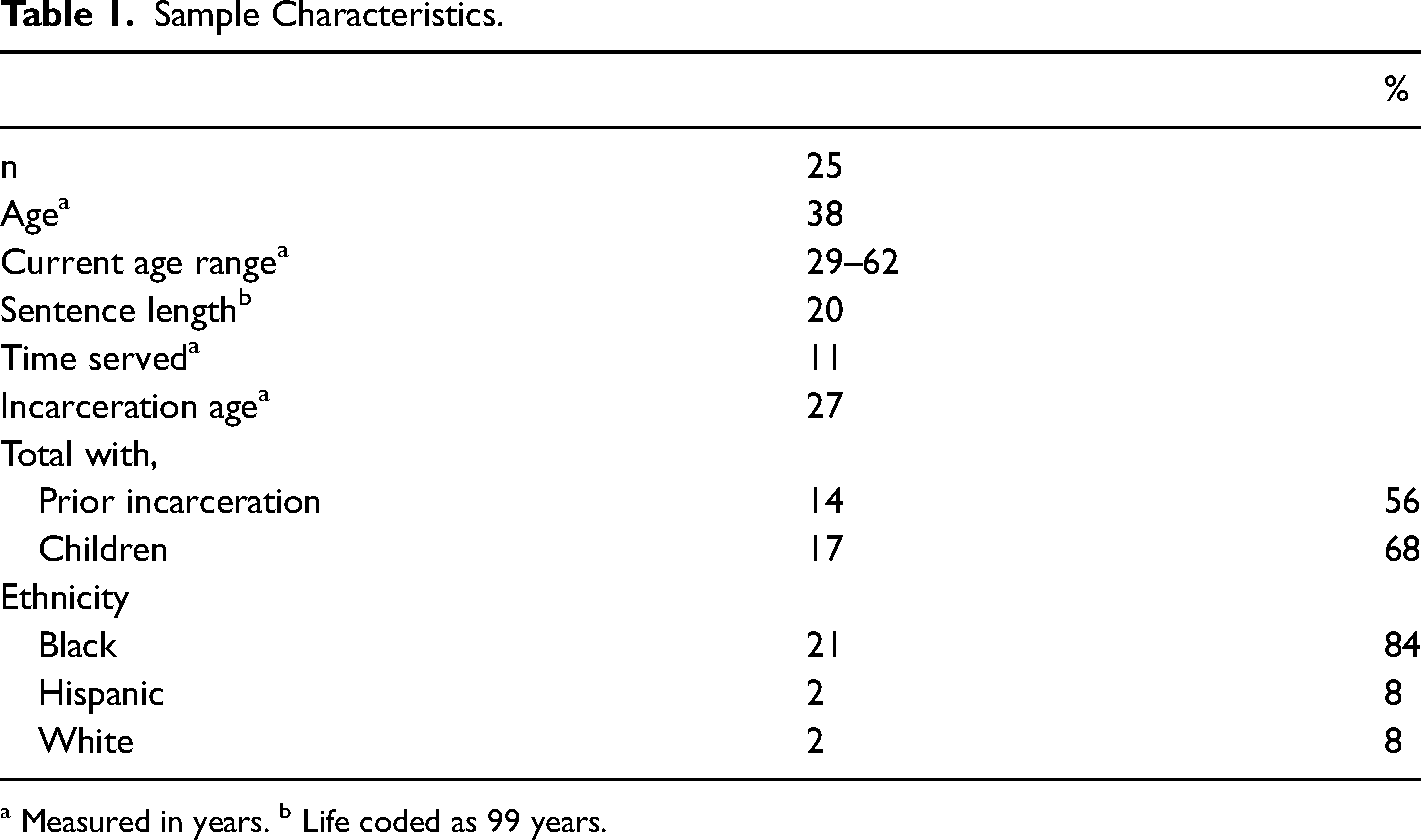
a Measured in years. b Life coded as 99 years.
Table 2 outlines the demographic and carceral characteristics of the study interview participants, along with the frequency of their visits and the identity of their visitors. Participants range in age from 29 to 62, with sentence lengths spanning from 5 years to life and varying amounts of time served. Regarding visitors to the prison, the table shows that the most consistent visitors included mothers, sisters, daughters, and fiancées. Male visitors primarily include fathers, brothers, sons, and cousins. Some participants also received visits from friends or extended family, and several reported visits from children who are not biologically their own. These patterns suggest that incarcerated men maintain a range of familial and social ties that reflect their pre-incarceration roles and their ongoing efforts to remain connected to life beyond prison walls.
Participant Characteristics, Visiting Frequency, and Visitor(s) (n = 25).
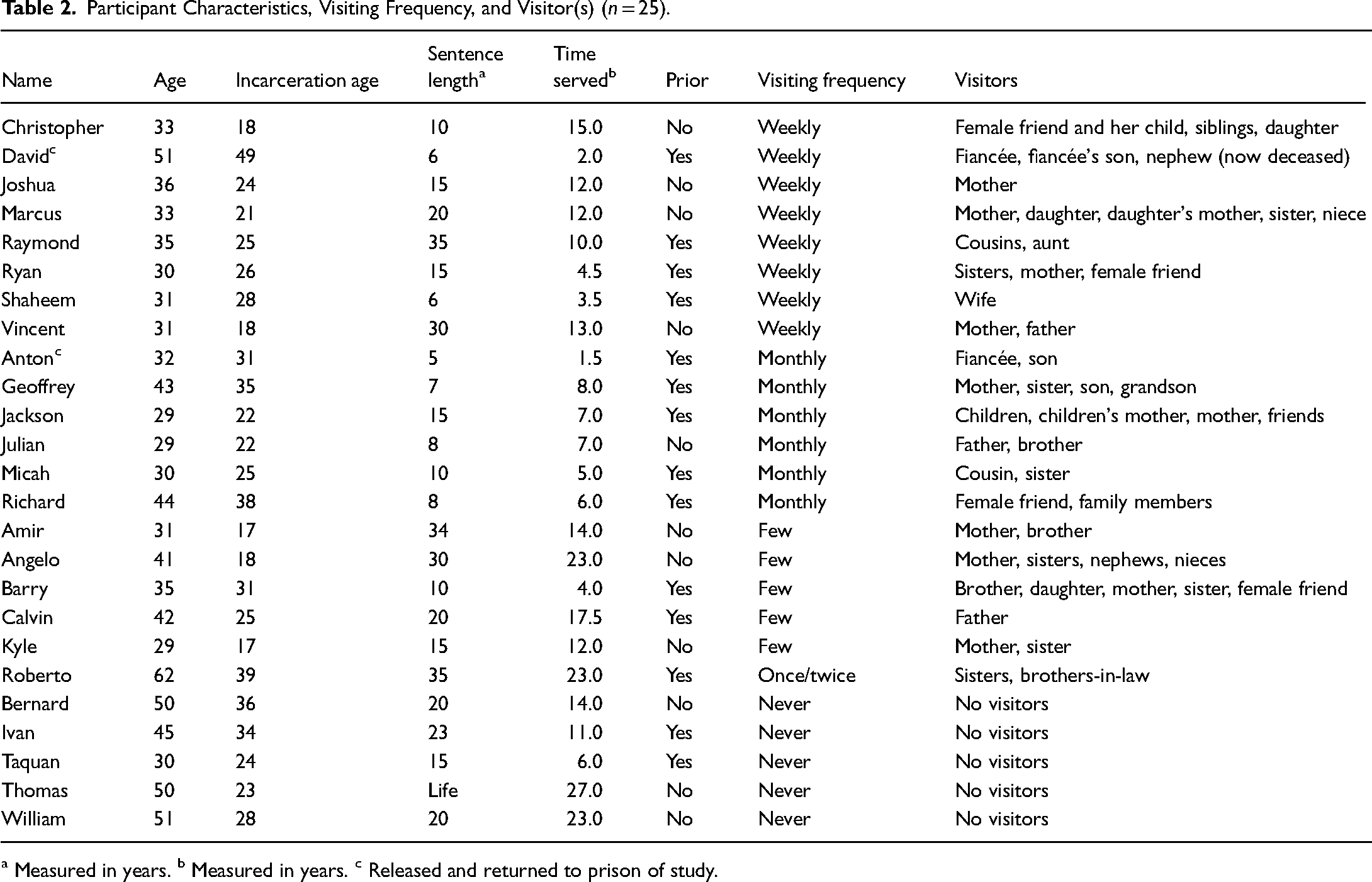
a Measured in years. b Measured in years. c Released and returned to prison of study.
Data Analysis
The current analysis is based on a broader study about men's social roles during incarceration, particularly regarding family relationships. Interview questions focused on prison experiences, life prior to incarceration, strengths and deficits in family relationships, men's concept of their roles within the family, and experiences with family contact through phone, letters, and visits. Given the focus on visitation experiences from the perspective of family members in prior research, we were interested in how men described visitation, with special attention to the positive and negative aspects of visits. This focus allowed us to advance beyond utilitarian aspects of visits such as whether they decrease disciplinary infraction rates or recidivism after release, to explore the depth, content, nature, and meaning of these interactions, to capture men's thick descriptions of what visits mean to them. Several questions in the interview guide elicited responses related to men's experience of visitation such as frequency of family visits, preferences for different modes of contact such as calls, mail, or visits, and what the men liked most and least about visitation. In addition, questions that were not explicitly about visitation often elicited relevant information, such as when a man talked about how officers interact with prisoners or in discussing reasons for lack of contact from family.
Analysis thus begun with line-by-line coding to identify information relevant to visitation and men's experiences of the prison environment (including positive and negative aspects of the environment). From there, a coding scheme was developed in which each researcher independently coded around the topics that became the focus of analysis. In assigning codes to units of text, data analysis followed processes for open and axial coding (Creswell & Poth, 2023).
Examples of open codes identified included harshness of the prison environment, degrading aspects of incarceration, and visits as relief. Axial coding involved a deeper level of analysis, mapping connections between open codes to construct a more in-depth analytical framework and to tease out multiple dimensions of the codes. For example, the code harshness noted experiences both directly in the context of visitation and in the broader environment, with details about experiences of harshness and adaptations to these experiences.
Further, we mapped these codes onto key concepts from Du Bois's work, including double consciousness as the overarching theme, and the veil and second sight as related sub-themes. Through this analysis, we identified two categories of adaptations to the prison environment which demonstrate how men navigate double consciousness as incarcerated men and members of a family. Some men transcend their status as incarcerated men, lifting and gazing through the veil to embrace their roles as members of a family. In contrast, others decide they are better served by limiting contact with family members and adapting to their roles as incarcerated people. Our findings illustrate these modes of adaptation. We support the use of person-first language when describing people who are incarcerated. In the following findings section, the term inmate is used to convey the way participants described their experiences in prison.
Findings
Prison as the Veil: Navigating Identity, Connection, and Resistance
Incarcerated men's experiences with visitation reveal complex negotiations of identity, connection, and resistance that reflect Du Bois's concept of the veil. Du Bois (1903/2018) theorized the veil as a barrier that separates Black Americans from full societal recognition, shaping both how they see themselves and how others perceive them. Within the carceral context, this symbolic and metaphorical boundary takes on heightened meaning, manifesting as physical constraint (confinement) and a social constraint (exclusion, stigma, and the erasure of personhood).
The prison's gaze renders these men socially invisible (as fully realized individuals), isolated, and yet hypervisible (as objects of control and discipline). They are seen only through the narrow lens of incarceration, reduced to their inmate status, and stripped of the social roles and identities they once occupied as fathers, sons, siblings, and partners. The veil of incarceration obscures and defines, hiding their full humanity while simultaneously marking them as criminalized subjects.
Within this constrained reality, prison visits become a liminal space where the veil is momentarily blurred and lifted. During visits, the rigid boundaries of incarceration and freedom become less distinct, offering fleeting reprieves from social invisibility. These encounters allow incarcerated men to be seen not only through the controlling gaze of the prison system but also through the affirming eyes of their families reasserting their personhood. Men can temporarily step outside of their institutional identity to maintain and reinforce their roles as fathers, partners, sons, and community members. Yet, these moments of recognition are also reminders of the very constraints they temporarily escape, in turn, amplifying the tension between belonging and exclusion, connection and confinement.
In these encounters, incarcerated men experience an emotional duality: the longing to engage deeply with loved ones, juxtaposed against the stark reminders of their carceral status. This duality reflects their ongoing navigation of the veil, which can be conceptualized as a process in which their familial identities intersect with the institutional forces that seek to diminish their autonomy, social visibility, and humanity. Some men develop a refined second sight: (1) a dual awareness of themselves as they are defined by the prison and (2) as they are recognized by their families. Their keen awareness shapes their ability to either maintain or in some cases, relinquish and abandon their identities outside the carceral environment.
Through the analysis of observations and interviews, two primary modalities emerge in how incarcerated men navigate the complex and complicated domain of prison visits. Some people who are incarcerated engage in a process of transcending their carceral identity, embodying Du Bois's concept of “double consciousness” in its most resistant form. These individuals strategically leverage prison visits as sites of identity reclamation and resistance against erasure and “mortification of self” (Goffman, 1961). Rather than succumbing to the totalizing effects of the carceral veil, they actively work to keep it permeable, ensuring that their institutional status does not dominate or subsume their identities.
Others engage in a process of adapting to the institutional environment, experiencing the weight of Du Bois's veil more acutely, finding themselves wrestling between full adaptation of their institutional identity and sustaining their roles beyond prison walls. These individuals experience visits primarily as a site of psychological strain, where the stark contrast between their carceral reality and familial roles creates an emotional and cognitive dissonance. In response, these men employ strategic adaptation strategies and work to inhabit and adapt to the carceral environment. The adaptive process, while often necessary for survival and self-preservation, has the potential of hardening or solidifying the veil, reinforcing their institutional identity and limiting their interactions outside the carceral walls.
However, these responses and modes are not rigid or mutually exclusive. The strategies men employ to navigate incarceration are fluid and adaptive, often shifting in response to changing family dynamics, institutional constraints, or personal growth over time. While many men primarily rely on one strategy, some adopt hybrid approaches as their needs and circumstances evolve and they navigate the complexities of incarceration. A man who initially struggles to assert his identity beyond confinement may later develop strategies to resist carceral erasure, while another who actively transcends prison constraints may, at times, retreat from those efforts due to external pressures, emotional exhaustion, or other reasons. We structure the findings around the strategies and approaches men used to navigate the veil and reconcile their carceral identity with their multifaceted sense of self.
Transcending the Carceral Identity
People who engage in the process of transcending their carceral identity actively resist and work to supplant the dehumanizing effects of incarceration by sustaining an identity that exists outside the confines of prison. Their second sight (Du Bois, 1903/2018) enables them to recognize and counter the prison system's attempts to reduce them solely to “inmates” while simultaneously affirming their sense of self as fathers, partners, and community members. Rather than allowing incarceration to define them entirely, these individuals develop a dual consciousness, navigating the harsh realities of confinement while nurturing connections that affirm their worth. Though incarceration imposes significant limitations, they resist identity erasure by cultivating a mindset and sense of self that transcends confinement. These individuals remain mentally and emotionally anchored to the communities that recognize them as more than “prisoners.” As Roberto (62 years old, served 23 of 35-year sentence who rarely received visits) explained, “In general, they help to keep the family unit together, to build ties, not only for the incarcerated, but a mutual give and take support system.”
Although visitation fosters connections, it also introduces tension. Men grapple with conflicts between their self-image and the prison's imposed identity while balancing their families’ emotional needs against the emotional detachment required for survival in a carceral environment (Crewe et al., 2014). To resolve these conflicts, individuals engaged in the transcending process develop adaptive strategies that assert their humanity and agency through acts of resistance and persistence, reaffirming their identities as individuals capable of love, guidance, and meaningful contribution—defying the carceral system's attempts to diminish their autonomy, presence, and connection.
For individuals actively resisting institutional erasure, prison visitation temporarily blurs the institutional boundaries, offering a liminal space where they can momentarily step beyond their carceral status, albeit under strict institutional control (Comfort, 2008). During prison visits, men become simultaneously visible and invisible, autonomous yet confined, connected yet surveilled. These interactions with loved ones challenge the institutional erasure of their personhood and humanity, presenting opportunities for men to briefly exist as people who matter, even within the carceral gaze.
Yet, this “transcendence” is never complete. The constraints of incarceration linger even in these intimate moments. David (51 years old, served two of his 6-year sentence) describes visits with his fiancée, whom he met during a rare period between incarcerations. As some additional context, David has been in and out of detention centers, jails, and prison since he was 13 years old. Looking into her eyes, holding her, and then when after you leave, after I wish I could walk out the visit with her. You just have to hold it in your mind in your memory. When the door close, my doors close … like to heaven, we go back to the visiting hall, but not in person.
Sustaining “Identity” Through the Prison Veil
For Christopher, who served 15 years of his 10- to 30-year sentence, visitation provides an opportunity for physical connection, but more importantly, it serves as a vessel to maintain communication and sustain familial ties and reaffirm his familial identity. He emphasizes the importance of regular interaction through calls, letters, and visits, recognizing that these exchanges have strengthened his relationships. When asked, “What role do visits play in your family relationships?” Christopher shares, “Big role! Not main, but one main thing. Nothing like physical hugs and kisses. They don’t have to come so I respect them for doing that.”
Vincent, a 31-year-old man who has served 13 years of a 30-year sentence, was only 18 when he began his incarceration. At the time of his arrest, he was a high school senior and the only child of a two-parent household. His parents remained actively involved in his life, often visiting separately so they could each spend meaningful time with him. Reflecting on the impact of these visits, Vincent emphasized that visitation “keeps me connected [and] strengthened my family relationship.” In the visiting room, “all you can do is talk, no other things to divert your attention,” he remarked, which encouraged deep, honest conversations. “I get to talk about how I feel and how the other person feels. It has strengthened all of the relationships that I have.” When asked about the main aspect of visits that is most important, Christopher clarifies, Communication, period. Letters, phone calls, being able to talk freely. You can tell them what it really is … if I mess up, they tell me. If they mess up, I tell them. I never had this before because I was always on the street.
For Marcus, a 33-year-old man who completed 12 years of his 20-year sentence, the contradictions of second sight are deeply personal. Marcus shares, “I just got caught up at an early age, 13.” Before his own incarceration, he regularly visited his older brother in prison, witnessing the veil operate from the outside. He recalls telling himself when his brother and close relatives were being pulled into the carceral system: “I can’t see myself doing time.” I’ve visited my brother. My older brother was doing time. He's deceased now … died in motorcycle accident. I would visit the prison once every 2 months. I was about 19 years old. I would just say to myself, “I can’t see myself doing time…”
Now experiencing the veil from inside, Marcus's past understanding of incarceration meets his present reality, requiring him to navigate both perspectives simultaneously. During visits with his daughter and niece, he sees himself as a father, an uncle, an authority figure, and a guide—yet remains hyperaware of his confined status: I wish I was able to be there for my daughter. That's what bothers me the most, like a father is supposed to be there. I mean I do ask how she is doing, if anyone is treating her wrong, but since I’ve been locked up, I only see her every other weekend. See them leave and not being able to leave with them, I feel the hurt. My daughter said that she is sad… I wanna leave with them, how do you prepare for that? It just happens … everybody thinks the same thing, but we all know we ain’t going nowhere.
Temporary Freedom, Escape, and Return
For many negotiating their presence beyond incarceration, visits offer a temporary reprieve from carceral life and a semblance of home. These moments provide connection and a fleeting sense of normalcy and autonomy, allowing them to experience what Roberto called “a touch of freedom.” Barry described, Visits take you out of here. It also depends on the person coming to visit. If it's female company, I like to kick it, be eye-to-eye. Visits are important, some guys need a visit, and they are cursing their girl out if they don’t come. Upbeat emotion can’t describe the feeling … it just takes you away from jail, just for that moment … you feel like you are part of the outside. When we talk on a visit, I get mushy, but you wanna be loved and miss em so much, I get that, “I wanna be home” feeling every time. I try not to change that too much, cause if it changes or I do something different, they gonna wonder what's going on. A man ain’t supposed to cry, that's a lie, but I cried … so many, too many times. Feel good as hell … when some of my friends come up, I like talking to them, when I see them … we were all similar in characteristics growing up, so now I like getting visits cause I could imagine how I would be if I was home. They all have jobs … I could see me outside on the streets. It makes me feel good.
For David, who has spent more time in prison than in the “free” society, visitation serves as an unsettling confrontation with the veil. Unlike Marcus, David lacks a substantial pre-incarceration self to maintain, making his navigation of double consciousness even more complex. Having spent, “all of [his] adult life” in prison, not speaking to his father for nearly three decades, and losing his mother while serving the current sentence, David's experiences of visitation are shaped by disconnection and loss. Through visits with his fiancée, he is introduced to a sense of emotional intimacy that challenges the isolating effects of imprisonment. His words illustrate both the fragility and significance of this process: Looking into her eyes, holding her … It makes me feel real good, like a warm summer breeze.
Extending Influence/Identities Beyond Prison Walls
Visitation serves as a critical site where incarcerated men negotiate and redefine their familial roles, particularly fathers, mentors, and authority figures. Through these encounters, they maintain a presence in their families despite physical absence. Anton, 32 years old, who had only served 1.5 years of his 5-year sentence, described his shock and emotion-inducing response when his young son recognized him during a visit. I was shocked … when I got arrested, he was still in changing pampers, and taking milk, I was thinking he wasn’t gonna know me …. he held his hands up to me and called me “Dada,” he still knew my voice …. it shocked me. When my son came to see me, in [prison name], he was having problems, with working … he wanted to sell drugs, said he wanted to self-employ himself. I told him, you see where I’m at? Thank God he hasn’t been locked up; he is on the right track now. My daughter. We are very close. She can get anything from me. We talk, we talk about the man she messes around with, tell me what's bad with him, tell her what I used to do. Sometimes he smacks her, I tell her to leave him, it ain’t worth it. Tell her sometimes men make promises but don’t give…
Visitation offers a temporary disruption of the veil, creating a space where these men can exercise agency, maintain a sense of authority, and assert an identity shaped by self-definition, familial, and community recognition. For Angelo, visits function as a platform to assert influence, reaffirming his status within the family while also using his experience as a cautionary tool. However, his attempts to mentor younger relatives reveal a contradiction of visibility—even as he tries to deter them from following his path, prison remains a normalized aspect of their reality. Angelo expressed, I try to mentor and direct my nephews and nieces. I try to play an integral role in their life. My one niece is fucking up, one niece is married, one nephew in college, getting a BA in Business, the other is in [school name] … I tell them, look at me, where I’m at, how I destroyed my life. I’m suffering every day and have been for the past 20 years.
Beyond his family, Angelo cultivates a public identity, refusing to be defined solely by imprisonment. Through “Lifers,” a program where incarcerated men speak to high school and college students, he leverages his carceral experience as a form of social engagement. Through this work, Angelo ensures that his influence extends beyond prison visits, creating opportunities to remain seen, valued, and relevant in the broader community. His role as a mentor allows him to negotiate his dual consciousness, transforming his carceral identity into a site of wisdom rather than failure.
By engaging in both familial mentorship and community outreach, Angelo sustains an identity that is not confined to the prison system. Through deliberate actions, he maintains his social relevance and agency—both within his family and in external contexts. For many individuals asserting agency over their self-definition, this intentional identity-building extends beyond direct family ties, as programs like Lifers enable them to contribute to broader community contexts, using their experiences to discourage young people from engaging in criminal activity.
The Emotional Burden of Being Seen
While visitation offers moments of self-reclamation, it also introduces emotional challenges and burdens as men struggle with the expectations placed upon them, and the expectation they place on their families. As Raymond shared, “I don’t wanna be a burden, it's a true privilege that they take time out to come up here.” For Jackson, second sight takes the form of family surveillance and expectation. His evangelist parents visit monthly, using these encounters to monitor his well-being, evaluate his spiritual growth, and remind him that he is their son, not confined to the institutional label of inmate: Sometimes I get out there and pray, but it doesn’t seem right and don’t sit right with me. And once your family see something different about you, they may check on it. If they hear something different in your voice and they know that you were growing and progressing … they will sense it, they will know if you’re crazy.
Prison visits force Jackson to inhabit multiple selves concurrently—the imprisoned person navigating institutional control and the son expected to demonstrate spiritual growth and transformation (Crewe et al., 2014).
For Ryan, visitation comes with frustration and obligation, as family members place demands on him that his confinement prevents him from meeting. The expectation that he will resume his role as provider and protector creates considerable internal conflict: Now, they come up here, dumping their problems on me. “Oh, we’re struggling, the economy is bad…” It's crazy. They are waiting for me to come and save them! I gotta save myself first! Especially my one sister, she's 25. She's waiting on me…
Prison visitation therefore creates a unique social space where, for a couple of hours, imprisoned men could see themselves through the loving eyes of family rather than through the judgmental gaze of the carceral system. Their own self-image improved as a result: they felt like husbands, fathers, brothers, and friends again, roles that the prison had obscured yet had not extinguished. By offering a space of belonging and visibility within their familial and social networks, even when those connections involved tensions, visitation helped counteract the erasure and dehumanization inherent in incarceration. It gave the men proof that, despite being behind the veil of prison, they still mattered to people who cared about them. In sustaining these ties and asserting alternative identities, these men demonstrate resilience and agency within a system designed to diminish and, more so, abolish personal autonomy. Their stories highlight the necessity of visitation not as a privilege or comfort but as a necessary mechanism through which incarcerated individuals preserve their full humanity and resist the dehumanization of mass incarceration. The experiences of those seeking to sustain their pre-incarceration selves reveal how prison visits, despite their institutional constraints, control, and constant surveillance, function as critical sites of identity negotiation and preservation.
Prison-Defined Self: Internalizing the Carceral Identity
In contrast to those who described visits as a way to transcend the identities imposed on them by the prison, some incarcerated men accept their carceral status as their primary reality and identity. These individuals, having internalized the prison-defined self, negotiate and acclimate to the prison's restrictions, finding it increasingly difficult to maintain a meaningful connections to their external identities. Through a gradual process, they experience a shift in how they understand themselves and their place in the world. Unlike men who challenge and actively resist the totalizing effects of incarceration, these men find themselves absorbed into the carceral environment. Over time, they relinquish external roles either by choice, necessity, or resignation to the institutional forces that shape their daily reality. This adaptation represents, in some respects, a passive acceptance and, in others, a strategic response to the psychological demands of confinement, specifically long-term imprisonment.
Through the lens of double consciousness, these men face an internal cognitive dissonance between the way they see themselves and how they are seen by the carceral system, their families, and even society-at-large. This group of men finds it stressful, laborious, emotionally draining, and unattainable to maintain a dual identity. Instead, they opt for a singular definition of self—the one provided by the carceral system and environment. These men accept, acclimate, and surrender to the prison-defined self and expectations of prison life, allowing the veil to fully separate by severing ties with a world that no longer seems accessible to them.
The adaptation process for men who internalize carceral identities fundamentally reorients their relationship to the outside world, particularly family members and friends. Their prison identity becomes most prominent, and as a result, their pre-prison identities and roles weaken. For those who relinquish external identities, the carceral environment is their physical location and “conceptual home,” and the carceral walls are where they find themselves being most clearly defined and understood.
“Closing My Shit Off”: Surrendering and Disengagement
When navigating double consciousness involves the process of assimilating into the prison identity, the prison veil, rather than being momentarily lifted during visits, remains intact, rendering outside relationships fragile beyond the institutional walls. External relationships, once central to incarcerated men's identity, become challenging to maintain, reinforcing retreat and further immersion into the carceral world. Thomas, 50 years old and serving a life sentence without ever receiving a visit, expounded on his rationale for maintaining emotional distance from loved ones and the outside world: Confronted visits, they give you false hope. Pain in the ass … in here you can close shit off. Close my shit off. In visits you can’t do that. In family structure, you can’t do that. If you’re upset …. you, imagine what it does to me? I use my time by myself. Every time I pick up the phone you will hear something bad. Every time you write a letter, they write something that they shouldn’t that comes from 10 years ago. Do your time on your own. No other way to do it. If you do it from the outside in, you will lose your mind. Can’t do nothing out there. Why put yourself or another person in that space?
Prison visits reinforce their sense of isolation and disconnection, underscoring the vast distance between themselves and their visitors while reminding them of relationships they can no longer fully participate in and identities they can no longer enact. Due to this discomfort, they forgo, limit, or discourage visits altogether, preferring the emotional protection of complete separation rather than the pain of temporary connection followed by inevitable departure. This retreat from prison visits represents a self-protective strategy and a means of managing the psychological distress that comes from straddling two distinct and disparate worlds.
Hence, some incarcerated men find stability in aligning with their carceral identity as they work to adapt to carceral requirements and restrictions. Their adaptation is a form of psychological and emotional preservation, creating space for them to function within the constraints of their environment without the continuous emotional labor associated with negotiating dual identities. Anthony, a focus group participant, who is serving a 70-year sentence, focuses on self-reliance, self-preservation, detachment, and independence from family ties. He suggested, “In prison, it's about individual maintenance. You have to be independent from your family.” Often, individuals who have completely adapted to the carceral identity describe initial efforts to maintain external relationships, only to experience an imbalance or lack of reciprocity. They perceive their pre-incarceration investments/contributions to family relationships as overlooked or undervalued. Barry, who previously provided financial and emotional support to his family, expressed frustration when this support was not reciprocated during his incarceration, resulting in resentment: I can get upset and say, I did this and that for you, but in the same token, don’t nobody owe me shit. These are the same people that kicked down my door asking for things when I was out there. Now, when I’m down, who was there for me?
Muhammad, a 56-year-old focus group participant serving two consecutive life sentences, describes withdrawing from family to prevent emotional burden: Don’t want to place a burden upon people. Parents come. Mom passes away. I pushed everyone else away.
For those serving long sentences, holding onto an identity beyond prison walls can feel futile, as the life they once knew continues to move forward without them. Family dynamics evolve, society changes, and the passage of time often leaves incarcerated men feeling emotionally displaced from their own communities. Thomas reflects on how prolonged incarceration alters familial bonds: Different cause after time you don’t know each other. Technically they don’t know you. They know who left, they don’t know who came back. The family structure is a chain, once you go and leave and go wherever, they close the rank on the chain to survive.
Incarceration does more than obscure identity; it fundamentally reshapes it. These men stop struggling to preserve their external identities, resigning themselves instead to an identity defined by imprisonment. For some, isolation is compounded by external barriers such as maternal gatekeeping, logistical difficulties, or emotional exhaustion. Taquan, a 30-year-old father, who had no physical contact with his 8-year-old daughter in six years (since she was two years old), describes how incarceration eroded his parental role: “The minute I got locked up, she (child's mother) never had the nerve to tell me. Just left … just left and got tired.” He speaks with his daughter by phone a few times a year with their most recent conversation taking place a year prior to the research interview. Taquan says of the relationship, “I feel like I accomplish what I can from here….”
For 51-year-old William, family ties fractured permanently after the death of his mother. He learned of her passing through a prison social worker rather than directly from his sisters—a perceived slight that intensified his sense of isolation and resentment. William describes this experience as extremely hurtful: Worst part of a visit … is when they bring you bad news. Social worker informed me of when my moms passed. I would have rather my family told me. I found out two days later … that's why I haven’t talked to my sisters. My mom was the one to keep the family together; when she passed, it went [he points downward].
The loss of his mother severed his primary familial connection, leaving William feeling disenfranchized, powerless, and insignificant within his family structure. His mother's role as the familial anchor was irreplaceable, and her absence led to William withdrawing entirely from relationships with his sisters. He has since maintained only minimal contact with his two children, reflecting a broader disengagement from external family roles and obligations.
Such severed ties and deprivation of connection reinforce their “inmate” identity, pulling them deeper into the carceral world. In contrast to the men who resist the carceral definition of self, who manage a dual consciousness by sustaining external relationships and resisting full assimilation, those embodying the institutional persona find comfort in the certainty of confinement, where roles and expectations are clear-cut. They anchor their identities within the prison—rather than resisting institutional life, they invest in roles and relationships that give structure and purpose to their existence behind bars. Bernard, who no longer had surviving family members, finds meaning in moments of institutional solidarity: I have to say, the most memorable visit is when another inmate wanted to see visitors, so he could see his cousin … but he wasn’t on his visiting list, so I sat there for the visit so he could see his cousin.
Men engaging in this adaptive process remain cognizant that the veil of prison cannot be altogether removed and therefore completely inhabit the prison's social structure. The veil is not an obstacle to overcome but a permanent barrier reinforcing their inmate identity. For some, embracing this identity is a conscious choice—a protective strategy to shield themselves from emotional pain, disappointment, and relational conflict. For others, adaptation emerges from external factors: a lack of familial support, traumatic histories, or the slow erosion of external bonds. As one participant remarked, People move away from you while you are in … it's difficult to form a relationship. You are now second in their life, the outside and what's going on outside takes precedence.
Deprived of social visibility, many of the incarcerated men engaged in behaviors during visits aimed at resurrecting their pre-prison identities and roles. Through Du Bois's theoretical lens, the prison can be seen as a veil that renders incarcerated people invisible to society; visitation became a way to pierce that veil. Men spoke of visits as times when they felt seen, heard, and valued by those who love them—a direct contrast to the constant othering and neglect experienced within prison. As Jackson, 29 years old (7 years served), aptly noted, visitation served as a mechanism of inclusion in a world that otherwise tells him he doesn’t belong: during visits, he was noticed and cared about to the extent that his family “[will] sense it” if something is wrong or different about him. In other words, when family members observe him closely, checking his well-being, noticing changes in his mood or appearance, it signals that he still matters to someone, counteracting the prison's message of disposability.
Discussion
In the book Prison Landscapes, visual artist Aiyse Emdur presents photographs of incarcerated men and women standing in front of painted backgrounds in prison visitation areas. Emdur (2012) is interested in these backgrounds as both a form of art within prison (many of them were painted by incarcerated people) and as a representation of visitation as a means of transporting oneself beyond the confines of the prison. For a moment, the visit is a world beyond the bars, lifting the veil of incarceration as loved ones connect and preserve visual mementos of their time together (Fleetwood, 2015). The photos are precious to incarcerated people and their family members though they also represent the multiple layers of degradation, pain, separation, and exclusion they experience.
Through our analysis of prison visitation in the context of W. E. B. Du Bois's concepts of double consciousness, the veil, and second sight, we aim to highlight the dualities of visitation; it potentially promises connection and belonging, but also might amplify strained relationships and the harms of the prison (Pierce, 2015; Tasca et al., 2016). Our findings reveal that prison visitation, even as a liminal space, played a profound role in mediating the tension between invisibility and reclaimed identity for incarcerated men (Comfort, 2008). Participants described emotions of validation, legitimacy, and belonging flooding back during and after visits, which mitigated their prior sense of being “disposable” or forgotten (de Jong et al., 2024). Engaging in normal familial interactions during visits had measurable emotional benefits, as men who engaged in the process of transcendence reported that visits reduced their anxiety and loneliness, replacing those feelings with comfort and hope. The dignity and respect transmitted in these encounters helped sustain “an identity beyond ‘prisoner.’” The visits allowed the men to briefly reconcile the two halves of their double consciousness.
At the same time, however, participants were keenly aware that after each visit, they had to return to the prison's lock and key, with some describing their “emotional mask” and “prison persona” as a necessary shield for survival (Crewe et al., 2014). The constant shift between two worlds—the feelings of belonging in a family and the harshness of the carceral system—created tension that the men navigated through transcending and adapting, fluid modalities that may overlap. The same individual could transcend the prison environment in one period and adapt to it in the next year. Through our application of Du Bois's central concepts, we aim to contribute to prior research about prison visitation by centering incarcerated men's lived experiences and sense of self.
Our findings must be contextualized by acknowledging the limitations of our study. Visits cannot alleviate the pains of the prison environment, and there is a great deal of heterogeneity in experiences of visitation for both incarcerated people and those who visit them (Cochran & Mears, 2013; Comfort, 2008; Holligan, 2016). Visits have a limited duration and are highly controlled by prison officials, and in the aftermath of the COVID-19 pandemic modalities such as video visitation are increasingly used by correctional agencies (Pappas et al., 2024). Our data were collected when video visitation was in use, but on a more limited basis, highlighting the need for future studies to analyze differences between in-person and video visits. Moreover, visits tend to be more frequent at earlier stages of the incarceration period and taper off over time, which is particularly salient in the United States, where average sentence lengths surpass those in other parts of the world (Cochran et al., 2017). Paradoxically, visits are further restricted for those who likely need them the most, individuals in solitary confinement or restrictive housing units (Turanovic & Tasca, 2022). Incarcerated people and their family members have different perspectives about some aspects of their relationships, so family members’ perspectives would be a valuable addition in future research.
In line with Du Bois's work as an activist, we want to highlight the work of non-profit organizations such as the Ella Baker Center for Human in Oakland, California, and the Osborne Association in New York. They provide direct assistance to incarcerated and formerly incarcerated people and their family members, educate the broader public about the human toll of mass incarceration, and advocate for policy reform and abolition. In addition, the organization Girls for a Change, in North Chesterfield, VA, organizes the Date with Dad Weekend to help girls connect with their fathers during a dance in carceral facilities. The evocative, award-winning documentary Daughters depicts the love, joy, and humanity of the dances, as they also bring pain and eventual separation for the girls and their fathers. Given the current political climate in which policies have been swiftly enacted to prohibit efforts advancing justice and equity, the work of these groups will be essential, and their expertise about the harms of the carceral system is invaluable.
Conclusion
The insights gained by applying a Du Boisian lens to our research reveal how visitation serves as a critical portal through the carceral veil, one that allows incarcerated individuals to maintain their full humanity despite institutional constraints. Du Bois's framework urges us to see the people behind the veil—to ensure that those behind bars are not rendered invisible or irredeemable. When we recognize prison visitation as a potential space for preserving identity, promoting psychological well-being, and fostering social connections—factors consistently linked to improved post-release outcomes (Baker et al., 2022; Turanovic & Tasca, 2022)—we must reconceptualize visitation not as a privilege to be restricted but as a fundamental component of preserving human dignity as a condition of confinement. By reforming visitation policies to be more humane, accessible, and supportive, we effectively thin the veil: we allow incarcerated people to continue seeing themselves as members of society with loved ones who care, and we allow families and communities to see the person—not just the prisoner—throughout the sentence. A justice-oriented approach to visitation policy should actively work to maximize the associated benefits of prison visits and dismantle barriers to contact, to make certain that the carceral veil remains permeable in ways that serve individual, familial, and societal interests. If we truly aim for incarceration to restore individuals to society, as whole and contributing members, then nurturing these familial and social bonds should not be peripheral or ancillary but central to rehabilitation and restoration, a necessary investment in public safety and social justice.
Footnotes
Declaration of Conflicting Interests
The authors declared no potential conflicts of interest with respect to the research, authorship, and/or publication of this article.
Funding
The authors received no financial support for the research, authorship, and/or publication of this article.
