







Abstract
Currently, more than 250 public schools in the United States are named after Confederate leaders who actively fought to preserve slavery in America. This history, however, is implicitly omitted when their names are emblazoned over the entryway to a school. The current research considers how the use of Confederate names at the school level impacts how individuals construct and interpret both the Confederacy and the history of white racist violence in the South more generally, by linking Confederate naming to racialized punishment outcomes. To do so, we combine data from 65,820 schools in the US Department of Education's Civil Rights Data Collection for 2017–2018 with data on Confederate naming of schools from the Southern Poverty Law Center and use both bivariate and multivariate analyses to examine school characteristics associated with Confederate naming, as well as the impact of Confederate naming on racialized punishment. Results reveal that Confederate-named schools (1) have larger Black populations and (2) are more punitive, especially toward Black students, than non-Confederate schools. These findings suggest the need for Confederate-named schools to be renamed, at the very least, as a preliminary step toward addressing the structural disadvantages producing negative racialized outcomes for Black students.
Introduction
Hundreds of schools across the United States, which are collectively tasked with educating thousands of children, are named after Confederate leaders and “heroes” who actively fought to preserve slavery in America. Indeed, according to estimates from the Southern Poverty Law Center (SPLC, 2019), there are currently more than 250 educational institutions in the United States that bear the name of Confederate leaders and, while empirical research on these schools is limited, there is reason to believe that many serve predominantly non-white populations. Confederate memorialization, in the form of building names, monuments, and other memorials, is often justified using traditional “Lost Cause” narratives which ostensibly argue that the Civil War was not about slavery, but rather was a noble fight for states’ rights. This very argument, however, is undermined by the timing of many such school name changes, some of which occurred as a direct response to the Brown v. Board of Education decision in 1954 and the racial integration of schools that followed. 1 As such, scholars have argued that Confederate memorialization sends symbolic messages of intimidation to the Black community, while also perpetuating false narratives of benevolent interracial relations (Cox, 2021; Domby, 2020; Lantz et al., 2024; Strother, 2021).
This history, however, is implicitly (and likely explicitly) omitted when their names are emblazoned over a school entryway (see Ferguson, 2019); put simply, it is impossible to glorify these men while also explicitly engaging with the full weight of their history, including the white supremacist hierarchies they actively sought to uphold. This omission of historical white-perpetrated racial violence would be dangerous and consequential in any prominent social institution, but is likely especially consequential in schools, given that they are the primary institution tasked with educating youth. Schools serve as primary creators and purveyors of collective memory—or shared group-based memories, knowledge, and information—wherein historical narratives are framed and reframed, most often to align with existing power relations and social hierarchies. Collective memory, in other words, plays an important role in establishing and maintaining group position, both by upholding certain social groups, and by denying and minimizing the plights of other social groups (see Gur-Ze’ev & Pappé, 2003).
Indeed, perhaps no other institution occupies a more central place in current debates and the establishment of collective memory than the American public school. The widely publicized debate over critical race theory in schools (and textbooks) is, for example, a debate over collective memory, in that it is a debate over which racialized experiences are emphasized and thus legitimized. Schools also represent one of the primary institutional sources of social control for youth, formal, or otherwise. Yet, despite the importance of the school as an arena for defining collective memory and an institutional source of social control, research on the implications of schools named after Confederate leaders has been limited. Following this, the current research presents an empirical analysis linking Confederate naming to punitive practices using a collective memory theoretical perspective to highlight the likely omission of authentic historical narratives in such schools. In doing so, we do not necessarily contend that school names cause inequality themselves—although we note that the possibility of historically embedded causal processes stemming from the social movements that inspired these names should not necessarily be dismissed either (McVeigh et al., 2014)—but rather that such names have the potential to serve as symbolic proxies for historical contexts which are linked to white supremacy and historically antagonistic intergroup relations.
Theoretical Framework
According to a critical race perspective, the state is founded in and structured by white supremacy, and serves as an instrument for the maintenance of white dominance (Bell, 1991; Bracey, 2015). This context facilitates the production of “white institutional space,” a label Moore (2008) applies to elite law schools but which likely applies to other educational spaces as well, including Confederate-named schools. White institutional spaces are those spaces that reproduce and maintain white privilege by “distributing institutional power along racial lines, normalizing whiteness, and installing organizational and cultural practices that justify white dominance (often tacitly)” (Bracey, 2015, p. 561). Importantly, this means that white institutional space can even apply to spaces not otherwise predominantly occupied by white people, including predominantly Black schools. When named for Confederate figures and former white supremacists, these spaces likely facilitate the learning of racial schemas centered around racial subordination (Ray, 2019; Sewell, 1992); when also tasked with the explicit education of youth, as is the case for schools, the consequences of this learning are likely substantial.
Schools and the Production of Collective Memory
Schools, as a domain, have been centrally linked to the persistent perpetuation and production of systemic disparity and inequality. Prior to the Brown v. Board of Education decision, Black students could legally be intentionally excluded from certain schools. 2 And, while racial integration efforts eventually followed the decision, segregation did not disappear; instead, “segregation via exclusion was replaced by segregation through unequal incorporation” (Ray, 2019, p. 34). Indeed, informal policies and institutionalized racism marginalize Black students, even in predominantly Black schools, through various mechanisms, including insufficient funding, inadequate resources, and the well-documented school-to-prison pipeline.
These links are especially problematic because of the role that schools play in producing collective memory. By its very nature, collective memory is selective and fluid (Schwartz, 1982; Simko, 2021), constantly undergoing negotiation, construction, and reconstruction to produce meanings and interpretations consistent with existing power structures and social contexts (Adams, 2022; Griffin, 2004). By their nature, schools play a critical role in shaping collective memory and local historical identities. This role is accomplished, in part, through the curriculum, but also through indirect activities, including employing commemorative symbols and languages associated with the school. Leaders within these schools, including administrators and teachers, act as “carrier groups,” with the explicit function of producing—and helping students to interpret—collective memory (Adams, 2022). And the context in which collective memory is produced is critical (Griffin, 2004). As Landsberg (2004) argued, memory is the result of “living and being raised in particular social frameworks” (p. 19). Considering this context is especially important for the success of Black and other non-white students given research suggesting that high-quality education for Black students involves learning explicitly about who they are, where they come from, and the history of their ancestors (Du Bois, 1935; Gray et al., 2018; O’Connor, 2016).
Following this, one frequently overlooked way white supremacy and inequality may be ingrained within collective memory is through the subtle, sometimes covert, process of school naming. Put simply, students attending a school named after Confederate General Robert E. Lee are likely exposed to very different narratives surrounding the Confederacy—and the white-perpetrated racial violence that it stood for—than students attending non-Confederate-named schools. While research is severely limited, the production of collective memory in a Confederate-named school is likely quite selective in nature, such that the decision to evoke the Confederacy in the school name is likely indicative of the decision to emphasize one historical conceptualization of the Confederate South over another. In doing so, certain aspects of the Confederacy are likely emphasized as the chosen memory, while other aspects are omitted, or even denied (Ferguson, 2019). Many supporters of Confederate memorialization, for example, espouse the “Lost Cause” narrative, which portrays slavery to be a “benevolent system” while also asserting that the Civil War was fought primarily over states’ rights (Domby, 2020; Forest & Johnson, 2019). This narrative romanticizes the Confederacy and characterizes Confederate leaders and soldiers as emblematic of honor (Forest & Johnson, 2019). Some research on how the Civil War is taught in Southern states, for example, has found that some students are taught that slavery was a secondary issue, and that the primary focus of the war was “states’ rights” and a battle for Southern culture (Levy et al., 2017). Cox (2021) similarly noted that Confederate monuments are frequently used to teach Southern children a particular version of history. Loewen (2008) also highlighted consistent textbook errors regarding the role and centrality of slavery in the Civil War; textbooks used in schools are selected not necessarily for their historical accuracy, but rather to conform to the cultural expectations of the communities and schools in which they are taught (Levy et al., 2017).
Prior Research on School Naming and Confederate Memorialization
The school, as an institution, is one of the single most important contexts through which collective memory is negotiated, and school naming plays an important role in this negotiation. Place naming is important because named places “merge the past they commemorate into ordinary settings of human life” (Azaryahu, 1997, p. 481). Naming operates as a vehicle for promoting identification with the past, with the ability to create or promote a sense of continuity (Alderman, 2008), or facilitate “path dependence” (Acharya et al., 2018). Place names are symbolic, sending a signal of community values, attitudes, and beliefs, and “revealing the character of both the figure commemorated and the community” (Stump, 1988, p. 215). As Berg and Kearns (1996) noted, these boundaries often serve to code the landscape along racial boundaries (see also Alderman, 2002), as they promote identification with certain groups and the exclusion of others. School naming, even relative to other place naming, is a particularly important symbolic endeavor, serving to establish an identity for that educational institution, and implying the historical and cultural values taught within (Alderman, 2002; Mitchell, 2000).
The school is a primary producer of culture. Some scholars have characterized schools as “arenas,” or places where different social groups contest definitions of normative culture and identities (Alderman, 2002). This is evidenced today by the central role of schools in contemporary cultural debates, including recent high-profile debates surrounding critical race theory; schools are tasked with the socialization of students, and the nature of that socialization is often centered—implicitly or explicitly—around race (Alderman, 2002; Patthey-Chavez, 1993). As Alderman (2002) noted, school names can function in one of two ways: integrating groups and motivating students (e.g., when naming a school after Martin Luther King, Jr.) or drawing racialized group boundaries (e.g., when naming a school after a Confederate figure). Alderman argued that, through these processes, school naming serves as a cultural arena for boundary making by drawing distinctions between “insiders” and “outsiders” (see also Newman & Paasi, 1998). Presumably, within Confederate-named schools, the outsiders in question are racial and ethnic minority students, and Black students in particular.
While focused on Confederate memorialization more generally, rather than school naming, several studies have demonstrated connections between Confederate monuments, structural racism, and violent outcomes for Black people who occupy the same social space (Lantz et al., 2024; O’Connell & Forrest, 2020; Turner & Binkovitz, 2021). Recent studies by O’Connell (2020, 2022), in particular, have demonstrated a relationship between Confederate monuments and racial inequality (see also Evans & Sims, 2021; Lantz et al., 2024). O’Connell (2020) found that Black–white poverty inequality was higher in counties with a Confederate monument; she suggests that these monuments “may be related to aspects of racial inequality either through their influence on collective memories, or because of what they reflect about the history and institutions of a place” (p. 462). Lantz et al. (2024) recently found that communities with more Confederate memorialization also have higher rates of targeted racially motivated violence toward Black people. This finding was particularly concerning given that they also found evidence for the systematic suppression of official crime statistics measuring anti-Black violence in the American South.
Taken together, this prior research suggests a need to critically evaluate the implications of naming schools after Confederate figures, especially for the Black students that may attend them. Several decades ago, Goldstein (1978) noted that naming schools after historical figures is a powerful way to communicate the accomplishments of those figures and define folk heroes. Confederate naming, therefore, reifies “Lost Cause” visions of the Confederacy and upholds those figures as heroes, while simultaneously omitting reference to racial atrocities associated with—and perpetrated by—the Confederacy. This can be evidenced by considering the historical context of Confederate commemoration. As O’Connell (2022) argued, understanding the factors associated with the original commemoration is a foundational component of understanding their meaning, as well as the potential consequences of commemoration (see also O’Connell, 2020). We can thus gain better insight into the true intention of these school names by situating them within the proper historical context as the end product of a social movement. In the Jim Crow South at the beginning of the twentieth century, the United Daughters of the Confederacy (UDC) made substantial efforts to grow membership by emphasizing Southern pride (Cox, 2021; Ferguson, 2019). One function of the UDC as a social movement, in many locales, was to oversee how schools taught regional history, given that the next generation of youth would be responsible for defending the Confederacy in the future (Zimmerman, 2002). They accomplished this goal by reviewing textbooks, rejecting those which were a threat to the memory of the Confederacy (Ferguson, 2019; Zimmerman, 2002), and—most importantly for the present study—advocating for the memorialization of Confederate figures in school names. 3
In other words, the primary goal of the UDC and related elements of the Lost Cause movement was to facilitate the production of a particular perspective on the Civil War (O’Connell, 2022). This goal was focused on an effort to justify the Confederacy's position in the war, and a primary focal point of that effort was the assertion that the motivation for the war was states’ rights (see Blight, 2001; Brundage, 2005; Foster, 1987). O’Connell (2022) describes this movement as a “memory movement” because it was part of a sustained and concentrated effort to change existing representations of the past (see also Ghoshal, 2013). Critical here, however, is also the notion—as McVeigh et al. (2014) and others argue—that such social movements can have important enduring effects that otherwise outlive the presence of the movement itself, particularly for “takeoff issues” and in the context of social reinforcement. Social reinforcement can be facilitated through a variety of mechanisms, including what some researchers have referred to as a “spiral of silence” in which individuals are led to incorrectly perceive that an otherwise vocal minority opinion, like that of the contemporary UDC, is actually that of the majority (see, e.g., Granovetter & Soong, 1988; Noelle-Neumann, 1993). The enduring effects of social movements are most likely, moreover, when combined with institutional and social network reorganizations which embed people within social relations that hinge upon support or opposition to the goals of the movement; in other words, the impacts of social movements are more likely in polarizing contexts which force individuals to align with one side, relative to another (McVeigh et al., 2014). Such processes apply well to Confederate memorialization in schools, where individuals are implicitly forced to reckon with the naming of their institution and to adapt their own attitudes and behaviors to resolve dissonance. Thus, the combined implication of these processes is that the impacts of Confederate naming, as a result and at the behest of UDC activism, have the potential to remain intact and enduring even long after the movement has itself dissipated or lost influence.
Following this, the current research posits that Confederate school names likely serve as important indicators of contemporary racism, due to efforts to redefine Confederate symbolism that mirror recent shifts toward covert racism (e.g., Bobo et al., 1997; Bonilla-Silva, 2014; Pager, 2007). Evidencing this, Ferguson (2019) noted that explanations for the history and use of Confederate names are often conspicuously absent from these schools, a pattern consistent with the notion of “spirals of silence.” One participant in Ferguson's (2019) qualitative research on school naming even noted, regarding Stonewall Jackson, that “half the teachers don’t know who he was” (p. 85), illustrating the omission of historically accurate narratives in such contexts. While some of this implied ignorance might well be interpreted as a structured response intended to resolve dissonance between individual attitudes and institutional veneration of the Confederacy (see McVeigh et al., 2014), it is also obvious that the history of Stonewall Jackson cannot be engaged with effectively if the teachers themselves do not know this history. Whether the product of intentional omission or ignorance, however, this lack of engagement has substantial implications, in that the failure to acknowledge the dark racial history associated with these figures likely serves to perpetuate social inequities. For schools to glorify the Confederacy, implicitly or explicitly, it becomes almost necessary that the curriculum omit this history, because one could not successfully glorify the figures without experiencing significant dissonance if this history was acknowledged; this silence, in turn, sends the message that this aspect of Confederate history is less important than others. Further, Alderman and Rose-Redwood (2020) suggest that “the consumption of name and memory is enveloped within an atmosphere or ‘feel of place’ that can draw out varying emotions and reactions—from pride to ambivalence to resistance—depending upon what one brings to named spaces” (p. 135).
As such, place naming is a powerful and dynamic force which is both the product of historical social movements and which connects to contemporary social identities, histories, and material experiences (Alderman, 2022; Mamvura et al., 2018), especially for Black students. Black students are already frequently stigmatized in academic settings and are more likely than white students to receive disconfirming messages about whether they belong (Gray et al., 2018; Walton & Cohen, 2011). Examining the impacts of this experience is important, especially given recent research suggesting the potential for race-specific legacies in school discipline, which has noted linkages between historical contexts—predominantly in terms of local histories of lynchings—and racially disparate punishment practices (see Lewis, 2021; Ward et al., 2021). Such theoretical expectations are also reinforced in the broader literature on racialized school punishment. For example, seminal work by Ferguson (2000) also suggests the possibility that such processes are cyclical, documenting the ways that negative perceptions of teachers toward Black students foster disproportionate punishment and criminalization. Ferguson (2000) argues that school discipline practices then further contribute to broader systems of racialized social control, thus providing an important lens through which we might understand why Confederate schools—which, again, symbolically enshrine white supremacy—might be especially likely to perpetuate racially disparate punishment.
In related work, Shedd (2015) similarly demonstrated how school contexts work to shape individual student perceptions of justice and injustice, such that Black students—and other students of color—differentially respond to discriminatory experiences according to school context. Other work has emphasized the role of racialized discourse within schools as constructing Black and Latino students as “deficient,” thereby framing racially disproportionate punishment and exclusion as legitimate (Dunning-Lozano, 2018). These problems are also compounded among Black boys, relative even to Black girls. Owens (2022), for example, found that Black male students, in particular, were perceived as more blameworthy than both white male and Black female students, even when engaging in identical conduct (see also Skiba et al., 2002). Importantly, Owens also emphasized the role of racialized organizational climates—like those research has pointed to in Confederate schools—in heightening these attributions of blame. Together, there is a large body of research pointing to the role of contextual inequalities in reinforcing racialized discipline practices. Put simply, racialized punishment strategies and racialized violence are deeply embedded in US history, especially in the Confederate south (see Lantz et al., 2024), and schools named after Confederate figures represent those in which efforts to enshrine these racialized histories were most successful. Following this, we suspect that these schools may have particularly pronounced racialized punishment strategies.
In one of the few studies assessing the impacts of Confederate naming directly, Ferguson (2019) conducted extensive qualitative interviews with educators in Confederate-named schools. Beyond the issues of historical omission noted above, he also documented how these contexts shaped the organizational climates and the lived experiences of students within them. For example, one participant noted that educators at a school named after Stonewall Jackson were “naïve to the facts” about the Confederate South and the links between Jackson and white supremacy. Further, he noted that, as a former student of a Confederate-named school, he felt like he “was tricked” because he was not exposed to this history (p. 95). In describing the negative effects of teaching in such an environment as a Black person, one participant stated that “after a while you know how the system's run, you know what it is, you know who gets privileges and you know who doesn’t” (Ferguson, 2019, p. 64). Notably, this context did not change even when the school was predominantly Black and run by Black administrators, with one respondent indicating that white people at the school still acted and interacted in ways that made them uncomfortable. Another respondent noted negative impacts on students, observing that students coming out of a school named after Stonewall Jackson generally had low self-esteem, were reluctant to trust others, and acted “like they were in an oppressed state” (Ferguson, 2019, p. 84); yet another participant indicated that they believed naming schools after white supremacist and Confederate soldiers “sows division and reinforces some hateful practices” (Ferguson, 2019, p. 106). This work was important, and made critical—if preliminary—qualitative contributions to our understanding of Confederate schools, many of which are consistent with research on social movements and the processes of dissonance resolution and structured silence; still, existing research has largely neglected to systematically examine the implications of Confederate naming for Black students.
Current Study
The current study presents a thorough empirical investigation of the impact of school-level Confederate memorialization on various indicators of school-level racialized punishment practices. The foundation of this research relies on the idea that the invocation of a Confederate figure via school naming is a form of Confederate memorialization, and therefore an attempt—historical or contemporary—to produce and impact collective memory. Evoking the Confederacy in this way is a decision to memorialize what it stood for; and to justify this memorialization, it is likely also necessary that the white-perpetrated racial violence that Confederate soldiers fought for (i.e., the institution of slavery) is omitted or otherwise reframed. Following this, we posit that Confederate-named schools stand as racialized institutions wherein efforts to redefine collective memory were particularly successful (see O’Connell, 2022); in these contexts, policies designed to protect Black students from discrimination are likely broken more frequently. Further, we posit that, when taken together, this memorialization is likely an indicator of underlying social structures which facilitate punishment practices toward Black students.
It is important to note here that we are not necessarily contending that school names are causing inequalities, nor are we assuming that the social characteristics of these schools—and the communities in which they are situated—have not changed since the schools were named. Instead, this research posits that historical contexts shape contemporary behaviors (see Acharya et al., 2018) and that, if Confederate names are symbolically linked to white supremacy and the production of current contexts which omit or fail to acknowledge these links, then we should expect to observe a relationship between Confederate naming and punishment of Black students (see also Alderman & Rose-Redwood, 2020).
Data and Methods
The current research uses data from three sources. First, data on Confederate naming were obtained from information compiled by the SPLC on Confederate memorialization. These data include memorialization not only via school names, but also monuments, roadways, flags, and towns, among others. They were compiled from a variety of both public and private sources (see https://www.splcenter.org/20190201/whose-heritage-public-symbols-confederacy#methodology for more detailed information). Regarding school names, in particular, SPLC researchers used school and school board websites for confirmation of school name origins. For the current study, we utilize the list of schools named after Confederate figures (N = 292), and compare these schools to those not named after such figures. 4
Second, data on the majority of school characteristics and student outcomes come from the public-use US Department of Education (USDOE) Civil Rights Data Collection (CRDC) for the 2017–2018 school year. The CRDC survey was initiated in 1968 and is collected and reported biennially as required by the USDOE's Office for Civil Rights. The data contain academic, administrative, and behavioral data for nearly every public school in the United States for preschool through 12th grade. Third, data on student poverty comes from the National Center for Education Statistics Common Core of Data for the 2017–2018 school year.
The 2017–2018 CRDC wave includes data for 97,632 public schools across the United States. Given our focus on outcomes for Black students, in particular, we omit schools with fewer than five Black students (30,069 schools) and schools identified as juvenile justice facilities (an additional 382 schools). 5 We also exclude schools with invalid or out of range values on CRDC covariates (e.g., schools above the 99th percentile for school expenditures). Our final sample is 65,820 schools.
Measures
Our primary indicator, Confederate Name, is a binary measure equal to 1 if a school was identified as being named after a Confederate leader and 0 otherwise. 6 Our indicators of punitiveness, all from the CRDC data, include a binary measure indicating whether the school uses corporal punishment to discipline students (yes/no) and five count measures representing the number of Black students experiencing each of five school-related events: (1) in-school suspension, (2) out-of-school suspension, (3) expulsion, (4) referral to law enforcement agency or official, and (5) school-related arrest. 7 As described in the CRDC documentation files, these counts represent the “total number of students” receiving each punishment, rather than the total number of punishments received; students who received a given punishment type more than once are still only counted once in these measures. Most of these count measures were initially disaggregated by disability status, sex, and race/ethnicity. Expulsions were further separated into those with and without educational services and out-of-school suspensions were separated into those receiving only one and those receiving more than one out-of-school suspension. To calculate each count measure, we summed the total number of Black students (male and female, with and without disabilities) who experienced each indicator. For expulsions, this included those with and without educational services, and for out-of-school suspensions, this included those with only one and those with more than one suspension.
We include several school characteristics, including racial composition (% Black, % Asian, % Hispanic, and % other [non-white] race), sex composition (% male students), and whether the school is a high school (i.e., contains 10th, 11th, or 12th graders). We also include measures reflecting school expenditures, student offenses, academic supports, and student poverty. Our measure of school expenditures is a rate calculated as the total salary expenditures for total personnel funded with state and local funds per enrolled student. Social supports is a rate measured as the total number of FTE (full-time equivalent) school counselors, nurses, psychologists, and social workers per enrolled students, while Security Personnel is a rate measured as the total number of FTE sworn law enforcement officers and security guards per enrolled students. To measure student criminal behavior, we calculated the total number of incidents of rape or attempted rape; sexual assault; robbery with a weapon, firearm or explosive device, or without a weapon; physical attack/fight or threats of physical attack/fight with a weapon, firearm, or explosive device, or without a weapon, and possession of a firearm or explosive device per enrolled student. However, given the rarity of these offenses, the rate is quite skewed. As such, we use the natural log of the offense rate in our models. We measure student poverty by calculating the percentage of enrolled students eligible for free or reduced lunch; as with the offense rate, this variable is highly skewed and we thus use the nature log of the student poverty rate in our models. Additionally, we include binary measures of whether the school is a special education school, magnet school, charter school, and/or alternative school (categories are not mutually exclusive). Finally, given the link between the Confederacy and region, we include a binary indicator of whether the school is in the South, based on US Census designations. 8
Analytic Strategy
Our analyses begin with descriptive statistics, separately for non-Confederate-named schools and Confederate-named schools. We use t-tests to identify significant differences between them for each analytic measure. Next, we estimate a series of multivariate regression models regressing each of our measures of punitiveness on Confederate naming and the control variables. For the model predicting corporal punishment, we use logistic regression. For models predicting counts of Black students, we used negative binomial regression. Negative binomial models are appropriate given the rarity of the count outcomes, the skewed nature of these measures, and their overdispersion (Osgood, 2000). Additionally, we use Black student enrollment as the variable of exposure in these models to treat our analyses as one of rates. Our tables present incident-rate ratios, which can thus be interpreted as the factor change in the rate of Black students experiencing each outcome. Additionally, to make our results more interpretable, we present the percentage change in the rate of the corresponding outcome per standard deviation increase in each continuous independent variable using the formula:
Results
Bivariate Descriptive Statistics
Descriptive statistics are presented separately for non-Confederate-named and Confederate-named schools in Table 1. 9 Confederate-named schools have significantly larger Black student populations, and significantly smaller white student populations than non-Confederate-named schools. While the mean of percent Black in non-Confederate-named schools is only about 21%, the mean in Confederate-named schools is about 31%. Interestingly, Confederate-named schools also have smaller Asian and other race student populations than non-Confederate-named schools. The difference in school sex composition is not significant, but Confederate-named schools are more likely than non-Confederate schools to be high schools. Additionally, a larger percentage of Confederate-named schools are magnet schools, while a larger percentage of non-Confederate-named schools are charter schools. Non-Confederate named schools have significantly larger school expenditures than Confederate-named schools, but there are no significant differences in the rates of social supports or security personnel. Further, the log of the student poverty rate and the log of the student offense rate are significantly higher among Confederate-named schools than non-Confederate named schools. Finally, 98% of Confederate-named schools are in the South, compared to just 41% of non-Confederate-named schools, and 70% of Confederate-named schools are in the Confederate South, compared to 25% of non-Confederate named schools; these differences are significant.
Descriptive Statistics by Confederate Naming Status.
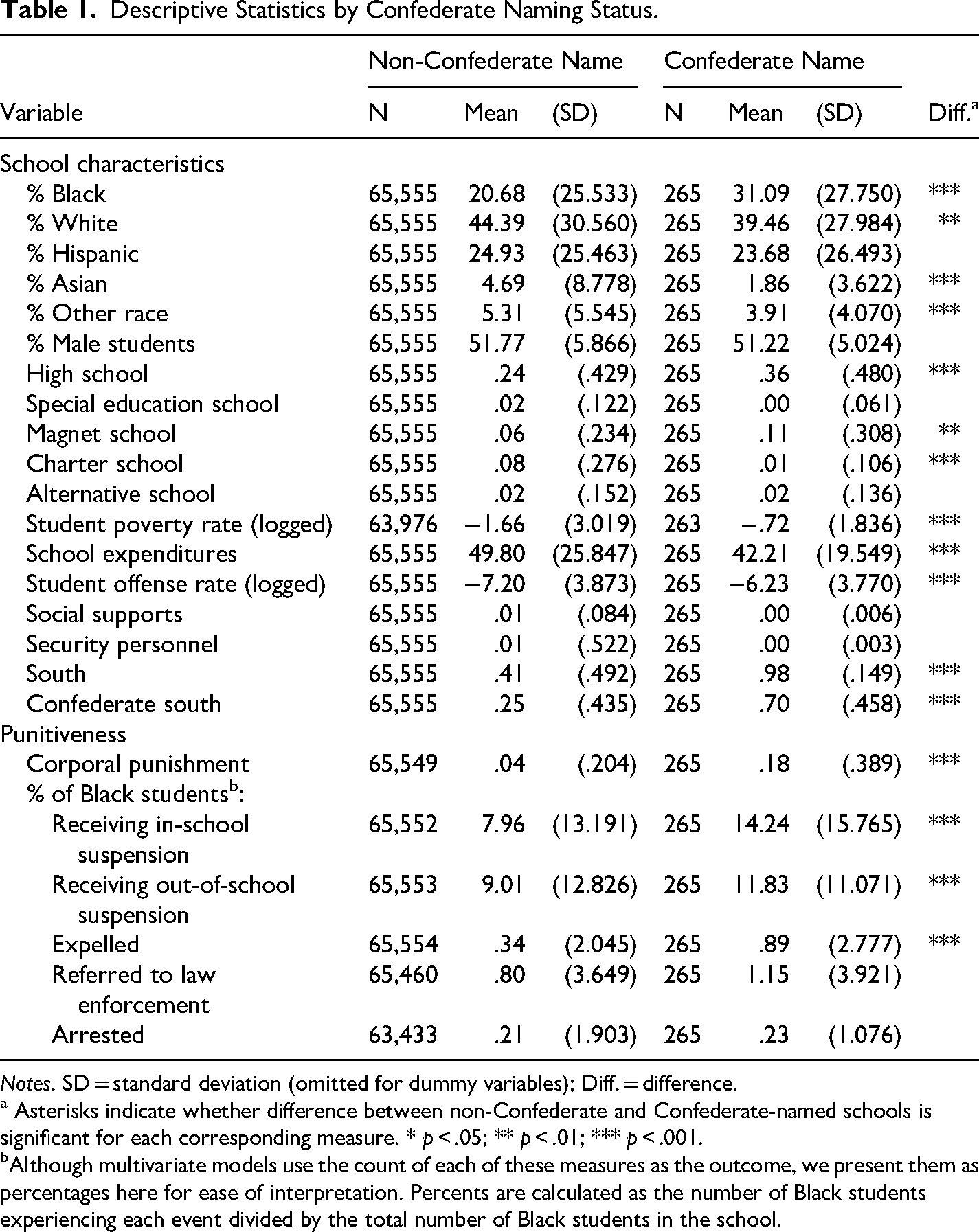
Notes. SD = standard deviation (omitted for dummy variables); Diff. = difference.
Asterisks indicate whether difference between non-Confederate and Confederate-named schools is significant for each corresponding measure. * p < .05; ** p < .01; *** p < .001.
Although multivariate models use the count of each of these measures as the outcome, we present them as percentages here for ease of interpretation. Percents are calculated as the number of Black students experiencing each event divided by the total number of Black students in the school.
Regarding punitiveness, more than 18% of Confederate-named schools allow for corporal punishment, compared to just 4% of non-Confederate-named schools. Further, a significantly larger percentage of Black students receive in-school suspensions, out-of-school suspensions, and expulsions in Confederate-named schools than in non-Confederate-named schools. Interestingly, we found no significant differences in the percentage of Black students referred to law enforcement or arrested at the bivariate level.
Multivariate Analyses
We turn now to models examining the association between confederate naming and punitiveness. 10 Results predicting the use of corporal punishment are shown in Table 2 and results predicting out-of-school suspensions, expulsions, and referrals to the police among Black students are presented in Table 3. 11 As seen in Table 2, Confederate-named schools have nearly 89% higher odds of using corporal punishment than non-Confederate-named schools, net of controls (p < .001).
Logistic Regression Model Predicting the Use of Corporal Punishment.
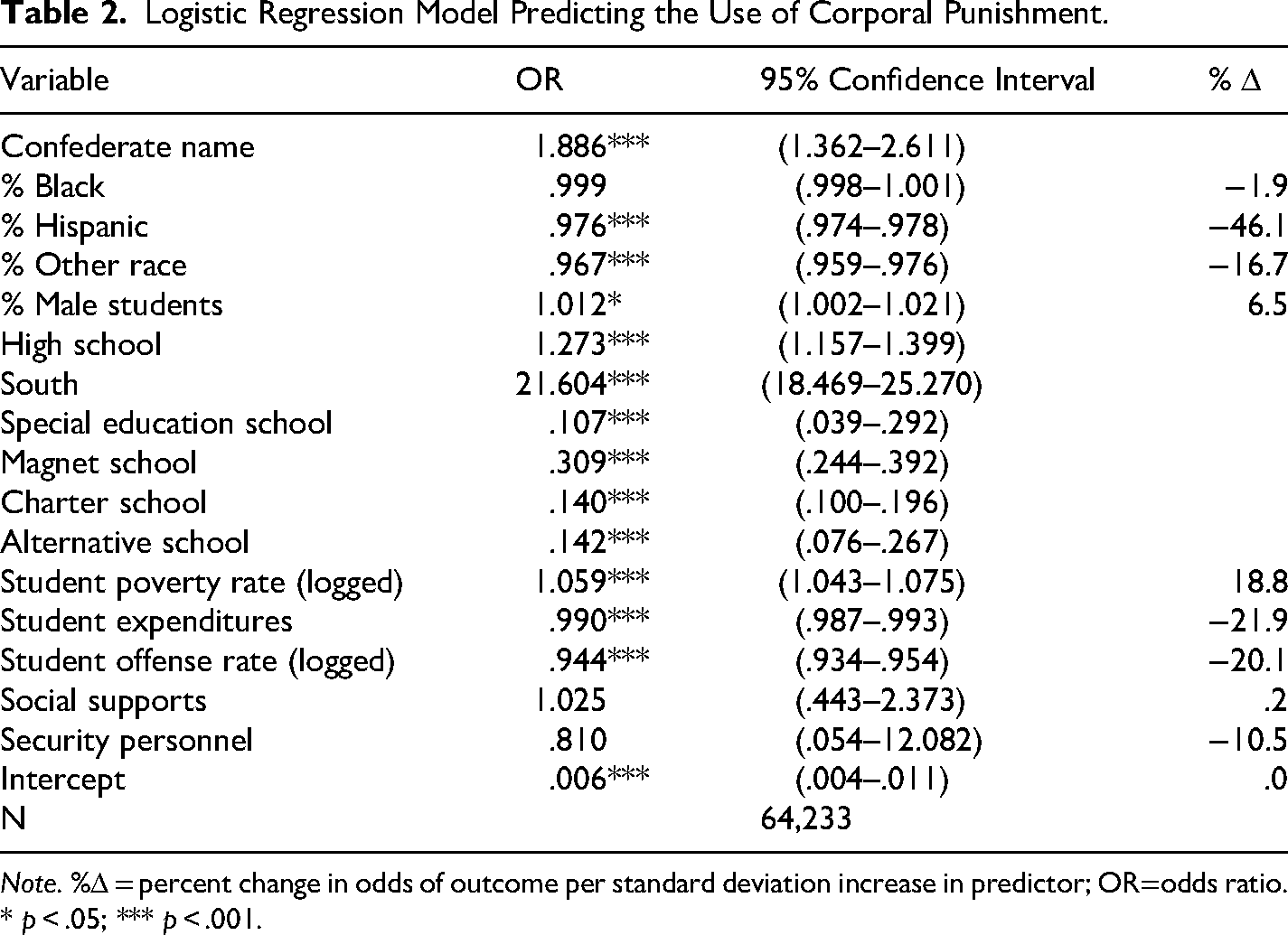
Note. %Δ = percent change in odds of outcome per standard deviation increase in predictor; OR=odds ratio.
* p < .05; *** p < .001.
Negative Binomial Regression Models Predicting Out-of-School Suspension, Expulsion, and Referral to the Police Among Black Students.
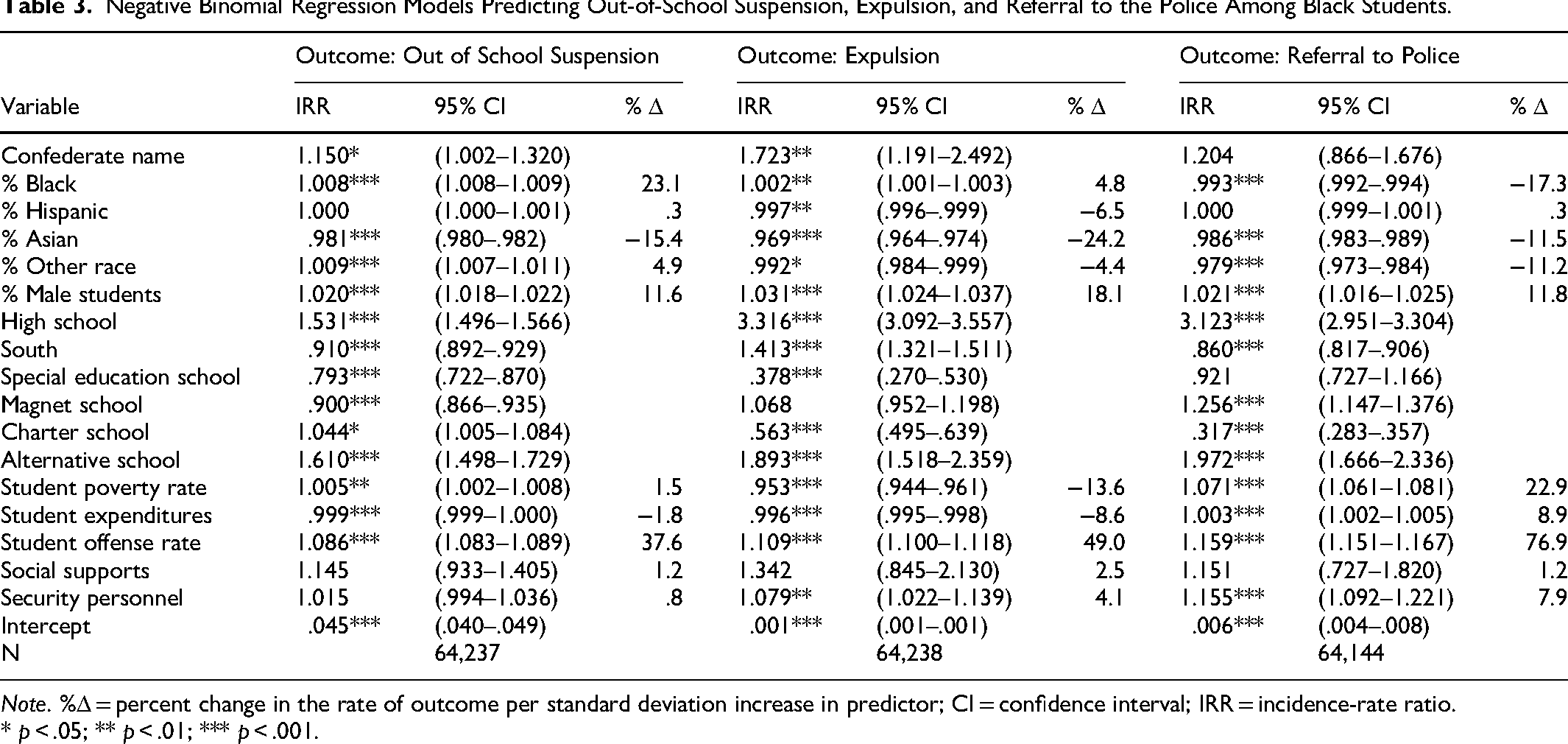
Note. %Δ = percent change in the rate of outcome per standard deviation increase in predictor; CI = confidence interval; IRR = incidence-rate ratio.
* p < .05; ** p < .01; *** p < .001.
Additionally, as seen in Table 3, Black students in Confederate-named schools have significantly higher rates of receiving out-of-school suspensions (p < .05) and receiving expulsions (p < .01) than in non-Confederate-named schools. Specifically, the rates of Black students receiving out-of-school suspensions and being expelled are 15.0% and 72.3% higher in Confederate-named schools than in non-Confederate-named schools, respectively. Confederate-naming is not significantly associated with the rate of Black students being referred to law enforcement net of controls; however, sensitivity analyses revealed that Confederate naming is significantly associated with a higher rate of referrals to the police among Black students prior to controlling for the student offense rate (IRR = 1.423; p < .05). We return to this point in the discussion. Interestingly, percent Black is positively associated with both out-of-school suspensions and expulsions but negatively associated with referrals to police. These findings are discussed further in the discussion.
Discussion
While prior research on the social impacts of place naming has been largely qualitative in nature, the current study was aimed at quantifying national-level trends and patterns for Confederate-named schools in comparison to non-Confederate-named schools using statistical regression. The purpose of the present study was twofold. First, we aimed to understand basic differences between Confederate-named and non-Confederate-named schools, with the understanding that Confederate memorialization likely has important implications for Black students. Second, we draw on prior research on the racialized character of institutions and the production of collective memory to argue that Confederate-named schools—given the implied omission of, and reluctance to engage with, white supremacist history in the United States—are probably more likely than other institutions to perpetuate racial inequities through racialized practices, including the use of punishment. We find significant evidence for these patterns; at least three findings are worth emphasizing.
First, Confederate-named schools have significantly larger Black student populations than non-Confederate-named schools. Schools were the most prominent institutions in the fight for racial integration, and it is likely no coincidence that hundreds of schools bear the names of Confederate figures. It is thus extremely compelling that Confederate schools have larger Black populations than non-Confederate schools. Critically, these patterns mean that there are Black students across the country who have worked to obtain a diploma, only for their name to appear on that diploma alongside that of a Confederate general.
Second, the use of punitive measures among Black students is more prevalent in Confederate-named than non-Confederate-named schools. The disproportionate use of corporal punishment in Confederate-named schools, in particular, is reminiscent of one of the most central mechanisms (i.e., violence) employed by slaveholders to maintain control over Black slaves under the institution of slavery (Ward et al., 2021)—the same institution the Confederate leaders these schools are named for fought to uphold. Additionally, the increased punishment, in the form of out-of-school suspensions and expulsions among Black students in these schools, in comparison to non-Confederate-named schools and in combination with our findings regarding school racial composition suggest that—even in predominantly Black schools—the rules are applied in ways that disadvantage Black students (see Dunning-Lozano, 2018; Mills, 1997).
Finally, although the coefficient for Confederate naming is nonsignificant in the model predicting referrals to the police, Confederate-naming is positively associated with the rate of referrals to the police among Black students prior to controlling for student offenses. Because referrals to the police should only happen in response to these offenses, it is perhaps unsurprising that the effect goes away once student offenses are controlled. However, Confederate naming is not associated with referrals to the police among white students, even without controlling for the student offense rate. Unfortunately, the CRDC data does not provide student offense data by student race; in other words it is not possible with the current data to assess whether the rate of Black student referrals is a reflection of the rate of Black student offenses. But the difference in the association between Confederate naming and the rate of student referrals for Black students in contrast to white students, prior to accounting for the student offense rate, suggests that the effect of Confederate naming on referrals is not completely spurious. Future research should aim to collect offense rates by race to disentangle these relationships further.
Taken together, we think it important to situate these findings within research on both path dependence and racialized organizations. Prior research on path dependence argues that historical patterns and actions become embedded in local contexts, passed down and reinforced over time (Acharya et al., 2018; Molotch et al., 2000). Confederate naming of an educational institution is a strong indicator of both the initial success of the UDC as a social movement, and local path dependence that likely perpetuates and facilitates racial inequality (see O’Connell, 2020, 2022). Relatedly, Ray (2019) defined racialized organizations as those that limit the personal agency and collective efficacy of subordinate racial groups while magnifying the agency of the dominant racial group. We find evidence that Confederate-named schools operate as racialized organizations, as they enact greater punishment on Black students than non-Confederate-named schools, while simultaneously upholding the names of white supremacist figures as school monikers. Confederate-named schools cannot—by their very nature—be considered race-neutral. According to Ray (2019), individual attitudes are filtered through and changed by organizations; the implications of this filtering process are significant when those organizations are named after white supremacists, tasked with educating American youth, and unlikely to explicitly acknowledge that white supremacist history. Our results suggest that racialized differences in punishment within Confederate-named schools, relative to non-Confederate-named schools, may serve as a mechanism to perpetuate racial inequity. Stated simply, many Confederate school names were implemented to present a particular history and these schools continue to function as racialized organizations, enacting disproportionate punishment on Black students.
The implications of these results are significant. Most importantly, our critical appraisal of these schools adds to a growing body of literature examining the important role of collective memory and the impact that commemorative landscapes have on competing ideas and intergroup behavior (Bodnar, 1992; Edensor, 1997; Lantz et al., 2024). O’Connell (2022) argued that Confederate memorialization is the result of a memory movement intended to alter perceptions of the “Civil War, the South, and ultimately race” (p. 1495). Our research argues that this is especially true for school naming memorialization, given schools’ explicit function as educational institutions. Confederate memorialization is the result of collective memory, and schools play a primary role in producing public memory.
Given these results, this study calls for immediate attention to the importance of Confederate memorialization in schools and the impact that names have on interpersonal dynamics within these schools. While slavery was legally dismantled following the conclusion of the Civil War, this was not coupled with widespread social recognition of Black citizenship and personhood (Dumas, 2016). Instead, portions of the Civil War—and the Confederate figures who fought to uphold slavery—are omitted from collective acknowledgment to such an extent that school entryways and jerseys across the US are still emblazoned with their names. As Adams (2022) stated, “memorialization of the past is not the place to find historical truth” (p. 14). Memorializing the Confederacy requires presenting these leaders in a positive frame, but doing so requires the deliberate omission of the white-perpetrated racial violence that the Confederacy upheld and ultimately stood for. As a nation, the United States has largely failed to acknowledge the legacy of slavery and related racial atrocities, especially compared to other countries with analogous histories of atrocity (e.g., the Holocaust, see Savelsberg & King, 2005). One consequence of this failure is the appalling fact that many Black youth are forced to attend public schools, which are named after white supremacist leaders who may very well have enslaved their ancestors and, at the very least, fought for the right for other white men to do so.
The failure to reckon with this history has substantial consequences. As one respondent in Ferguson's (2019) study noted, if educators truly had the best interest of Black students in mind, “they would have banded together to change the name, at least since the Charleston massacre” (p. 97). Indeed, the continued persistence of these names even after the Charleston church shooting, which forced a national reckoning surrounding the use of Confederate symbols, is demonstrative of the intensive path dependence of this idolatry. Thus, one implication of our research is the need for school names to reflect the values and ideals of the community in which those schools are situated, and the population they are tasked with educating, both as a matter of symbolic representation and as a measure of harm reduction. Many Confederate-named schools have substantial Black student populations, yet research has shown that Black people interpret Confederate symbols as symbols of racism and racial conflict (see Sanders, 2020; Strother, 2021); this is especially true among Southern Black people, who generally oppose Confederate symbols even more than Black people from other regions (Cooper & Knotts, 2006; Strother, 2021; Talbert, 2022). When there is a mismatch between these values and the name of the school, it follows that renaming—perhaps after prominent racial minority figures in that community—may serve to empower minority students and challenge the commemoration of white supremacist values. In this way, renaming schools formerly named for the Confederacy may serve as a harm-reduction strategy, signaling to students, teachers, and the broader community that the school is a safe place for all students, including Black students.
Although we recommend renaming schools currently named for the Confederacy, we recognize that changing school names is often a complicated and contested process, involving stakeholders with many competing interests. While current students are arguably the most impacted by their school's name, former students, parents, school administrators, and members of the broader community often have strong opinions about school naming. Unfortunately, there may not be a one-size-fits-all strategy for tackling the issue, but case studies suggest the importance of student involvement as crucial for successful change (Levy et al., 2017; Mansfield & Lambrinou, 2021). For example, Mansfield and Lambinou focused on the circumstances surrounding the renaming of several schools in Alexandria, Virginia; they emphasize “the need to carefully structure the policy change process to include students, families, and other community members in critical dialog and amplify the voices of those most impacted by the structural racism that needs to be dismantled: The students” (p. 19). In other words, case studies like those in Alexandria suggest that effective renaming involves centering student voices and prioritizing inclusive decision-making processes. At the same time, it is important to acknowledge that despite early signs of momentum behind the movement to remove Confederate naming from schools (e.g., Wong & Hagen, 2022), some formerly renamed schools have had their Confederate names restored within the past year (e.g., Chappell, 2024; Schultz, 2025). Future efforts to remove Confederate names will have to grapple with the current political and racial context that may assist in continuing this troubling trend.
Limitations and Future Research Directions
While our research is among the first to quantitatively assess the relationship between school-level Confederate memorialization and racialized victimization and punishment, it is not without limitations. First, while the CRDC data are representative of most schools, they do not include private schools, and thus cannot speak to the impact of Confederate memorialization in these contexts. Second, while we observe important patterns regarding punishment, it is likely that these are underreported. School personnel may bypass formal procedures for the use and reporting of punishments (Ward et al., 2021). This issue is worthy of future research focused on punishment within a school context. Third, we lack detailed attitudinal and behavioral information from students and school administrators, both of which could provide insight into the intervening mechanisms between Confederate naming and the outcomes we observe, and should be the subject of future quantitative (e.g., survey-based) research. Moving forward, attention to these mechanisms, which may be the result of various, interrelated processes—including racial socialization, systemic inequality, selective education, structured ignorance, and a host of other factors—is especially important for understanding not only the impact of Confederate memorialization, but also the role of localized historical racial antagonism in structuring the institutional behavior of schools more generally. Finally, while some schools formerly named for Confederate figures have been intentionally renamed, there were too few of these to examine them as a third category for comparison, due to limited statistical power. Future research should focus more closely on these schools, perhaps qualitatively, to understand the circumstances around their renaming, as well as to examine potential changes in racialized punishment outcomes after renaming.
Conclusion
More than three decades ago, Stump (1988) argued that “the naming of a school in honor of an individual has a special significance, creating an overt association between the person and community. This act is essentially hortatory, calling on the community to follow the path set by the school's namesake” (p. 204). In other words, school names and related honorifics serve as important reminders of important figures, and a call to follow in their footsteps. Yet, today, there are hundreds of schools across the United States honoring Confederate figures or events in this way. As one Black educator astutely remarked regarding Confederate names, “We gotta ask, who they’re reminding anyway?” (Ferguson, 2019, p. 108). As Cox (2021) observed, many Confederate monuments were built in public spaces, often in front of courthouses and analogous areas, to send a message about who made and enforced the law in a given community. Our results suggest that Confederate school naming may send a similar message regarding who educates the community and, more importantly, which aspects of history will be taught and not taught. Moving forward, understanding the consequences of Confederate school names is critical as scholars and the public continue to grapple with the need and implications of removing Confederate memorialization from the public sphere (De Velasco, 2019; O’Connell, 2022; Sheehan & Speights-Binet, 2019). The objective history behind this memorialization cannot be changed, nor can the collective efforts to impact public memory surrounding the Confederacy. The names of schools named after Confederate figures, however, can be changed, and doing so is an important—if preliminary—harm-reduction step toward addressing the structures which facilitate racial inequality in schools and beyond.
Supplemental Material
sj-docx-1-raj-10.1177_21533687261443467 - Supplemental material for Collective Memory and Racialized Punishment in Schools Named After Confederate Figures
Supplemental material, sj-docx-1-raj-10.1177_21533687261443467 for Collective Memory and Racialized Punishment in Schools Named After Confederate Figures by Marin R. Wenger and Brendan Lantz in Race and Justice
Footnotes

Funding
The authors received no financial support for the research, authorship, and/or publication of this article.
Declaration of Conflicting Interests
The authors declared no potential conflicts of interest with respect to the research, authorship, and/or publication of this article.
Supplemental Material
Supplemental material for this article is available online.
Notes
Author Biographies
References
Supplementary Material
Please find the following supplemental material available below.
For Open Access articles published under a Creative Commons License, all supplemental material carries the same license as the article it is associated with.
For non-Open Access articles published, all supplemental material carries a non-exclusive license, and permission requests for re-use of supplemental material or any part of supplemental material shall be sent directly to the copyright owner as specified in the copyright notice associated with the article.
