







Abstract
We investigated racial and ethnic differences in police trust among people who self-reported having previously viewed a video of police violence against Black people. Comparative Conflict Theory and intersectional considerations served as the theoretical framework for the research. Using data collected by the Pew Research Center, we tested four hypotheses, with racial/ethnic/gender-related findings. Trust in police among Black people was impacted more than other racial ethnic groups after viewing a video of police violence against Black people. An intersectional approach found that Black women were more likely than women of other racial and ethnic backgrounds to decrease their trust in police. We also examined whether there was an impact on police trust based on basic literacy in Black American history. Our results revealed that increased literacy in Black American history resulted in lower trust in the police. Finally, our study revealed that the level of police trust did not decrease among respondents who believe there has been racial progress in the United States. Considering these findings, we discuss the importance of literacy in Black American history in sensitizing the public to the stability of police violence against Black people in the United States.
Keywords
Public trust in police is important for the co-production of public safety. People who trust police are more likely to voluntarily obey the law and cooperate with the police (Tyler, 1990; Tyler & Huo, 2002). Police rely on the public as reporters of and witnesses to crime and, given the nature of the job is to interact with the public daily, the police need a predominantly nonconfrontational relationship with the public. However, public trust in police has waned in recent years; the widely publicized video recordings of police killings of citizens prompted demonstrations throughout the United States, which galvanized the Black Lives Matter social movement. This led to calls for police reform and arguably created the current crisis in police recruitment and retention (Fine et al., 2025).
Indeed, one of the most controversial practices in modern society is the public release of videos that display graphic imagery of police violence, especially the killing of unarmed Black men. Ironically, during the height of the Civil Rights Movement, film depicting police brutality against Black people was deliberately excluded by southern news stations because of fear that televising these disturbing images might lead to civil unrest (Classen, 2004). Despite these attempts to conceal this racial violence against Black people, the increasing access and reach of televisions sent images of brutal police violence against nonviolent unarmed Black children and adults across the globe (Govedar, 2015). It is well established that disseminating videos with these graphic images were considered a crucial element to shifting public support for civil rights legislation (Govedar, 2015). This period also dramatically changed the use of televisions which had largely projected wholesome images; the slew of assassinations and protests (for civil rights and against the Vietnam War) during the 1960s changed the tenor of the news coverage. Today, more than 97% of homes have televisions, with an average of 2.3 televisions used per household (Krantz-Kent, 2018), and internet accessibility and its use to view videos and social media has risen from 52% of adults using the medium in 2000 to 96% in 2024 (Pew Research Center, 2024).
Bearing in mind the wide access to television and the internet, these two mediums provide quick access to events that are easily disseminated to traditional and social media platforms. One such event that has often led to high-profile viral video posts on television and the internet is police killings of citizens. While there are police killings involving all racial and ethnic groups, those that have typically gone viral often involve Black men. Since the 1991 Rodney King beating by officers from the Los Angeles Police Department was captured on video and largely because of the rise in the use of cell phone cameras, there has been a continuous stream of videos released that depict beatings and killings involving Black suspects. In 2020, the George Floyd killing by Derrick Chauvin of the Minneapolis Police Department continued the practice of posting on the internet and social media sites viral clips of police killings of Black people.
Scholars have argued that there are negative health consequences to the widespread distribution of these videos (Nicholson, 2023; Suglia et al., 2015). Concerns have largely centered on the postvideo viewing trauma that some believe—coupled with other questionable practices in the justice system—contributes to the dehumanization of Black people (Nassauer, 2023; Owusu-Bempah, 2017; Perillo et al., 2023). Although the literature has addressed concerns about the dehumanizing effect of some criminal justice encounters, few (but a growing number of) studies investigate whether consuming videos containing police violence against Black people impacts trust in the police. Thus, studying whether the widespread viewing of videos of police violence against Black people affects public trust in police is crucial.
Moreover, to our knowledge, no research has considered whether familiarity or basic literacy in Black American history and perceptions of racial progress influence trust in the police. These concepts add notable yet overlooked factors in the literature on public trust in police. For example, basic literacy in Black American history arguably allows consumers to situate police violence in the American context, recognizing the potential influence of social structural factors in police interactions with people of color, which may influence trust in police. For similar reasons, perceptions of racial progress may affect how one interprets police interactions with people of color. Our research aims to include these unexplored explanatory variables in the emergent concerns about the influence of viewing police violence against Black people. We also add to the vast literature finding race and gender differences in attitudes toward police by incorporating an interactional approach to racial/ethnic and gender differences when considering the impact of these variables on trust in the police. We continue by reviewing the extant literature on trust in police before outlining Comparative Conflict Theory as our theoretical framework and describing the current study.
Public Opinions of Police
Police scholarship has established public attitudes in police, such as trust in police, differs by race (Bolger et al., 2021; De Angelis, 2016; Fine et al., 2022; Kochel, 2019; Pryce & Gainey, 2022; Sun & Wu, 2022) and sex (Bolger et al., 2021), among other factors (Fine et al., 2022; Lee & Gibbs, 2015). Indeed, Bolger et al.’ (2021) review of more than 66 independent studies related to confidence and trust in the police showed White individuals and women consistently have higher opinions of police than people of color and men, respectively. This is unsurprising, given that Black people experience more police misconduct than people of other races. Research consistently demonstrates that Black people are disproportionately stopped by police (Fradella et al., 2021), arrested by police (Kochel et al., 2011), subject to police use of force (Tapp & Davis, 2024), and killed by police (see The Washington Post, 2024)—to the extent that Black people are more likely than other people to view the police as a threat to be feared (Verhaeghen & Aikman, 2022). This disproportionate contact with the police leads to more lawful and unlawful police use of violence against Black citizens. This—and any form of state violence, legal or otherwise—holds unique significance for Black people. Black people continually have experienced racial oppression by government agents through slave patrols (Franklin & Schweninger, 2000; Reichel, 1988), Civil Rights era persecution (see Echols, 2024, for a quantitative demonstration linking slavery in Louisiana to police violence against Blacks during Civil Rights), and contemporary backlash to the Black Lives Matter (BLM) movement (Jackson, Fine et al., 2023; Updegrove et al., 2020; Virtiol et al., 2024) and attacks on Diversity, Equity, and Inclusion (DEI) initiatives. Thus, any police violence against Black people is likely perceived as institutional legacy (Reid, 2025) and another iteration of the continuation of dehumanizing anti-Black oppression.
While women tend to have higher opinions of police than men do, this sex difference seems to vary by race. That is, some studies show that Black men tend to have lower opinions of police fairness than Black women (Gabbidon et al., 2011), and Black women and girls tend to have more negative attitudes toward police than women and girls of other races (Hurst et al., 2005). These differences appear to emerge early in life. That is, opinions of police tend to decline as one ages and decline more substantially for Black youth compared to youth of other races (Fine et al., 2022).
Further, the literature has consistently found that trust in the police is often contingent upon issues related to police accountability (Kochel & Skogan, 2021), performance (Boateng, 2018; Wahyurudhanto, 2022), and professionalism (Abdi et al., 2025; De Angelis, 2016; Ruddell & Trott, 2022; Tyler, 1990; Tyler & Huo, 2002). Additionally, contact with police is a robust predictor of public opinion of police (Alberton & Gorey, 2018), and because most White people have limited direct contact with the police, studies show vicarious or indirect experiences with police also impact attitudes toward police (Hurst et al., 2005; Pryce & Gainey, 2021; Rosenbaum et al., 2005; Tom et al., 2024). Both the direct experience Black men and women have with police and vicarious exposure with police through hearing stories of police mistreatment of other Black people cumulate over time, creating a collective memory of negative interactions with police and affecting their perspectives on police much greater than people of other races (Kochel, 2019).
Recently, scholars have focused on the influence of exposure to high-profile police killings of unarmed Black men on public attitudes toward the police because these cases may demonstrate the lack of police accountability and professionalism (e.g., McCarty & Kim, 2024; Verhaeghen & Aikman, 2022). For example, Reny and Newman (2021) found that public attitudes toward the police became significantly less favorable following the George Floyd protests—although not among political conservatives or people who were racially prejudiced. They also found that perception of police rebounded quickly among White respondents but persisted among people of color. Perhaps the most robust test to date is by Fine et al. (2025), who used within-person design with a four-state longitudinal dataset with three waves between April 30 and June 13, 2020, finding public perceptions of police declined significantly during the third wave, which immediately followed the killing of George Floyd by former Minneapolis police officer Derick Chauvin.
While studies have begun to include measures of racialized attitudes as covariates (e.g., Baranauskas, 2023; Reny & Newman, 2021; Van Craen, 2013), two important concepts have been neglected from the literature on public attitudes toward police: knowledge of Black American history and the belief that there has been racial progress in the United States. This is important because knowledge of Black American history provides context to the pattern of police violence against Black people and likely affects public attitudes toward police in that those with a more indepth understanding of Black American history recognize the stability of government mistreatment toward Black people. As we are more familiar with the history of our own social groups, Black people likely are better acquainted with Black American history, which may partially account for the racial gaps in public attitudes toward police. Thus, exploring the intersection between race and knowledge of Black American history may add to the body of knowledge of public trust in police. Further, people often overestimate racial progress (Kraus et al., 2022). Viewing police killings of Black men through this racialized lens, overestimation of racial progress has the potential to excuse biased and unaccountable police killings of Black people as justified and, in the extreme, to make some behaviors falsely appear discriminatory toward White people. In contrast, when people perceive discrimination by the police, they are less likely to trust police (Madon, 2025; Van Craen, 2013). Viral videos of police killings of unarmed Black men and women, such as the case of George Floyd, demonstrate to the public that discrimination toward Black people remains prevalent and coincides with decreasing public favorability with the police (Reny & Newman, 2021). These concepts, coupled with the findings from the trust in police literature, can be situated in Comparative Conflict Theory.
Theoretical Framework: Comparative Conflict Theory
Our primary theoretical foundation is Comparative Conflict Theory (Hagan et al., 2005; Hagan & Shedd, 2005; Shedd, 2015; Shedd & Hagan, 2006), which provides a framework for understanding racial and ethnic differences in perceptions of criminal injustices. Hagan et al. (2005) formulated multiple Comparative Conflict Theory suppositions, three of which are of value here. First, the racial-ethnic divide draws on the levels of racial disadvantage over one's experience in America and predicts that African American and Hispanic individuals will perceive more criminal injustices than White people. Second, the racial-ethnic gradient thesis posits that perceptions of criminal injustices will be ordered as follows: African American individuals perceive the most criminal injustice, followed by Hispanic and White individuals. Finally, the differential sensitivity aspect of the theory anticipates that prior contact with the system will influence the perceptions of criminal injustice among African Americans and Hispanics. Considering that Black and Hispanic people are often overrepresented in multiple areas of criminal justice (Gabbidon & Taylor Greene, 2025), this supposition—given the aforementioned rise in the use of social media since the original formulation of the theory two decades ago—likely pertains to actual criminal injustices encountered at the hands of the justice system, as well as the vicarious exposure to criminal injustices through videos shared on the television, internet, and social media sites (Kochel, 2019; Nägel & Nivette, 2023).
The racial-ethnic divide aspect of the theory certainly predates the formulation of Comparative Conflict Theory with W.E.B. Du Bois conducting an early crime poll at the “Atlanta School” on perceptions of justice and finding a similar racial divide in his statewide poll of White and Black residents of Georgia (see Du Bois, 1904; Gabbidon, 2007; Wright, 2016). Today, the racial divide remains and has been widely supported in the empirical literature (e.g., see Hurwitz & Peffley, 2005; Peffley & Hurwitz, 2010; Pickett et al., 2022; Unnever, 2013; Unnever & Cullen, 2007a, 2007b; Weitzer & Tuch, 2006; Wilson & Krysan, 2022). Even so, there have been some recent experiments that provide evidence that the divide is likely less pronounced than previously thought (see Balcarová et al., 2024). Empirical tests of the racial-ethnic gradient thesis have also been generally favorable (Buckler & Unnever, 2008; Buckler & Unnever, 2008; Hagan et al., 2005; Shedd, 2015). More recent studies have found that while Black people continue to have the most intense perceptions of criminal injustice, Hispanic opinions tend to be more nuanced because of the complexity of the ethnic backgrounds subsumed under the Hispanic category. Thus, while their opinions in more recent crime and justice-related public opinion studies have not been significantly different from those of White people (see Buckler et al., 2008; Cooper et al., 2021; Cooper et al., 2023; Gabbidon & Jordan, 2013; Wright & Unah, 2017), there is clearly more to the story.
An unexplored nuance to Comparative Conflict Theory is that in its original formulation there was no discussion or suppositions presented as to where Asian Americans would fall along the gradient. Reid et al. (2025) posit that while Asian Americans have some of the most favorable socio-economic outcomes, it is possible that their views might align with those of White Americans and be largely supportive of the police. Despite this possibility, Reid and his colleagues also surmise that past and more recent instances of racism and discrimination tied to Covid-19 might “… motivate efforts to alter the status quo in ways that align their views more closely with those of other racial/ethnic minoritized views” (p. 4). Based on their analysis of Harvard University's 2020 Cooperative Election Study (CES) data, the authors did find that there was a “minority-group perspective” among Black, Hispanic, and Asian respondents that coalesced around support for police reform (Reid et al., 2025). Further, recent research by Kim and Sun (2026) confirms that Asian Americans who have experienced discrimination in the aftermath of the COVID-19 pandemic have lower satisfaction with police and are more likely to distrust police than Asian Americans who have not experienced discrimination within the 4 years prior to the survey.
Finally, the differential sensitivity aspect of the theory has links to the notion of procedural justice (Sunshine & Tyler, 2003; Tyler, 1990, 2003; Tyler & Huo, 2002). Thus, when citizens believe that legal authorities carry out their duties in what is considered a fair manner, there will be greater trust and confidence in the police. Recent studies have shown racial/ethnic differences in procedural justice as it relates to police legitimacy, with a recent review of multiple related studies finding some support for the racial divide in procedural justice research (Sun & Wu, 2022). This has been consistently supported in the literature (see Jackson, McKay et al., 2023). Recent literature has also argued that the news media can influence public opinion of controversial incidents (Baranauskas, 2022); by extension, viewing videos of police violence against Black people also may influence public opinion of police.
One limitation of Comparative Conflict Theory is that it does not account for intersectionality (see generally, Krenshaw, 1991; Parmar, 2017; Potter, 2015). Intersectionality is defined by Potter (2015) as “… the concept or conceptualization that each person has an assortment of coalesced socially constructed identities that are ordered into an inequitable stratum” (p. 2). Despite the lack of consideration of intersectionality during the original formulation of Comparative Conflict Theory, Hagan et al.’ (2005) initial test showed signs that the integration of the concept might be valuable. For example, they found that “… males perceive significantly more criminal injustice than females” (Hagan et al., 2005, p. 393). In addition, there were significant differences in perceptions of criminal injustice as the age of youth increased for both Black and Hispanic students (Hagan et al., 2005, p. 394). In recent tests of the theory, there have been additional evidence of intersectional findings in relation to gender, with women perceiving more injustice than men (Gabbidon & Jordan, 2013). Gabbidon and Jordan (2013) surmise that this is possibly “… the result of mothers having the perception that young Black males are typically the recipients of criminal injustice” (p. 294). In sum, very few studies have integrated intersectional insights when testing Comparative Conflict Theory. This paper, to our knowledge, is among the first to do so in relation to trust in police.
Current Study
We add to the robust trust in police literature by incorporating basic literacy in Black American history and perceptions of racial progress in the present study, which is framed by Comparative Conflict Theory. Taken together, we test four hypotheses:
H1: Black and Hispanic respondents will be more likely than White and Asian respondents to have lower trust in the police after having viewed a video of police violence against Black people.
H2: Black and Hispanic women will be more likely than White and Asian women to have lower levels of trust in the police after having viewed a video of police violence against Black people.
H3: Those respondents with greater literacy in Black American History will have lower levels of trust in the police after having viewed a video of police violence against Black people.
H4: Respondents who believe there has been racial progress in the United States will be less likely than those who do not believe there has been racial progress to lose trust in the police after having viewed a video of police violence against Black people.
Methods
Sample
The overall target population for the current study was adults in the United States who have had exposure to a video of police violence against Black People on news or social media. We used the publicly available American Trends Panel (ATP) survey data, collected from a nationally representative sample of noninstitutionalized adults over the age of 17 living in the United States. The survey was created and administered by Pew Research Center. A total of 5,073 panelists participated in the survey conducted in April 2023. We excluded about 8.85%, or 447 respondents, from the sample based on the screening question asking whether the respondent has “personally seen videos of police violence against Black people, either in the news, social media or in some other way,” to which the excluded respondents reported “never.” Other respondents were dropped from analyses through listwise deletion because they refused to answer items relevant to and included in this study, reducing the final sample size to 4,083.
Measures
Dependent variable
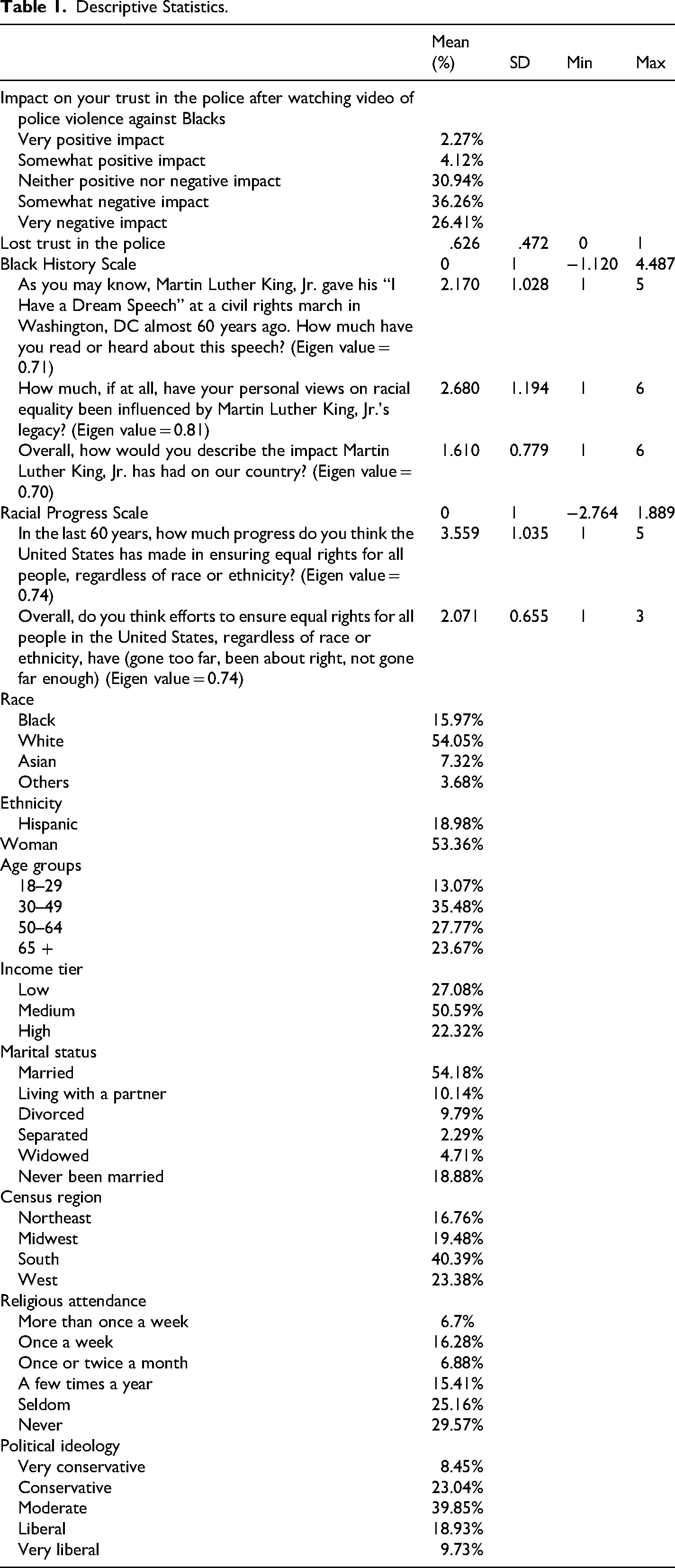
The outcome variable was measured by an item asking, “When you’ve watched videos of police violence against Black people, what kind of impact have they generally had on each of the following? Your trust in the police,” with 5-point Likert-style responses ranging from “very positive” to “very negative.” The majority of respondents reported on the adverse effect of the video on their trust in the police (see Table 1). Given the uneven caseloads between scale points which could lead to unnecessarily high degrees of freedom, we dichotomized the variable into whether (“somewhat negative” or “very negative”) or not (“very positive,” “somewhat positive,” or “neither positive nor negative”) a person lost trust in the police (hereafter Lost Trust in Police).
Descriptive Statistics.
Independent Variables
Concerning the differential sensitivity aspect of Comparative Conflict Theory, we used a set of items measuring how much a person is familiar with Black American history as it pertains to civil rights and anti-racism (see Table 1). We selected items asking respondents about their knowledge of Dr. Martin Luther King, Jr. as a proxy for rudimentary literacy in Black American history—given that the United States has a holiday named after Dr. King and that he is one of the few universal Black figures who is discussed in American history and is a central figure to Black history. Principle component factor analysis indicated the three items produced a single latent factor with Eigen value of 1.65, which we decided to identify as Black History Scale (BHS). Another set of two observed items was analyzed to acquire a latent factor with Eigen value of 1.11 named Racial Progress Scale (RPS) that dictates a person's view on how much progress the United States has made on equality for all races. Both BHS and RPS reported factor loadings ranging from 0.70 to 0.81 with a mean of 0 and standard deviation of 1.
The majority of the sample were White non-Hispanic respondents (54.05%), followed by Hispanic respondents (18.98%). The ATP survey data included “other” race as well as Black non-Hispanic and Asian non-Hispanic. Gender was included for the intersectional aspect of Comparative Conflict Theory. Slightly less than half of the sample was female (46.64%; men (53.36%; see Table 1).
We included other relevant variables to control for their effect on trust in the police based on the literature (see Table 1). Given that trust in police varies with age (see, e.g., Bolger et al., 2021; Fine et al., 2022; Kearns et al., 2020), age is included in the model. In terms of age groups, 30s and 40s accounted for the largest group (35.48%), whereas the smallest group of respondents were aged 18–29 (13.07%). Economic resources such as personal income affect trust in police (see, e.g., MacDonald & Stokes, 2006); thus, we included respondent income. Income had three tiers of low, medium, and high, with medium income tier accounting for the majority (50.59%). Married people tend to have different perceptions of police than others (Reid et al., 2025), so we included marital status as a control variable; the majority of respondents were either married (54.18%) or living with a domestic partner (10.14%) and never married (18.88%). Given the low cell counts in the other categories, we regrouped marital status into whether married or not.
Other demographic variables, religiosity, internet usage, and political ideology items were included as well. Census region was the quadrant regions of the United States, and over 40% of respondents were in the southern region. In terms of religious activities (see, e.g., Brañas-Garza et al., 2009), more than half of the respondents reported “seldom” or “never” attend religious service, while less than 7% reported “more than once a week.” Considering uneven caseloads, religious attendance was regrouped into three categories of low (seldom/never), medium (a few times a year and once or twice a month), and high (once a week or more often). Because nearly half (46.77%) reported a constant use of internet (see, e.g., Intravia et al., 2020; Reid et al., 2025), we merged all other usage frequency categories into nonconstant use of internet. However, preliminary analysis showed a presence of strong correlation between age group and internet use such that we decided to exclude internet use from the current study out of concern for multicollinearity. Last, respondents vary in their political ideology (see, e.g., Reid et al., 2025) with relatively few at either end of the spectrum. Therefore, the answers were reorganized into three groups of conservatism (“very conservative” and “conservative”), moderate, and liberal (“liberal” and “very liberal”) ideology.
Analytic Model
A baseline logistic regression model was developed to examine how race, gender, familiarity with Black American History, and perception of racial progress in the United States are associated with the log-odds of losing trust in the police after watching a video of police violence against Blacks. Pertaining to H2, the model also included a set of interaction terms to examine how the race effect is moderated by gender.
Concerning the interaction terms for the moderation effect, the coefficients are a vector of Black, Hispanic, others, and Asian women in reference to White men. The main effect for gender measures how the odds for White women differ from that for White men. The race main effect represents racial disparity between the groups of non-White men and White men. Relative to the base model, the benefit of interaction model is the examination of gender-specific race effects. Both models were run using STATA 18.5 (StataCorp, College Station, TX, USA) and recorded variation inflation factor of 1.46 and 1.75, respectively.
Results
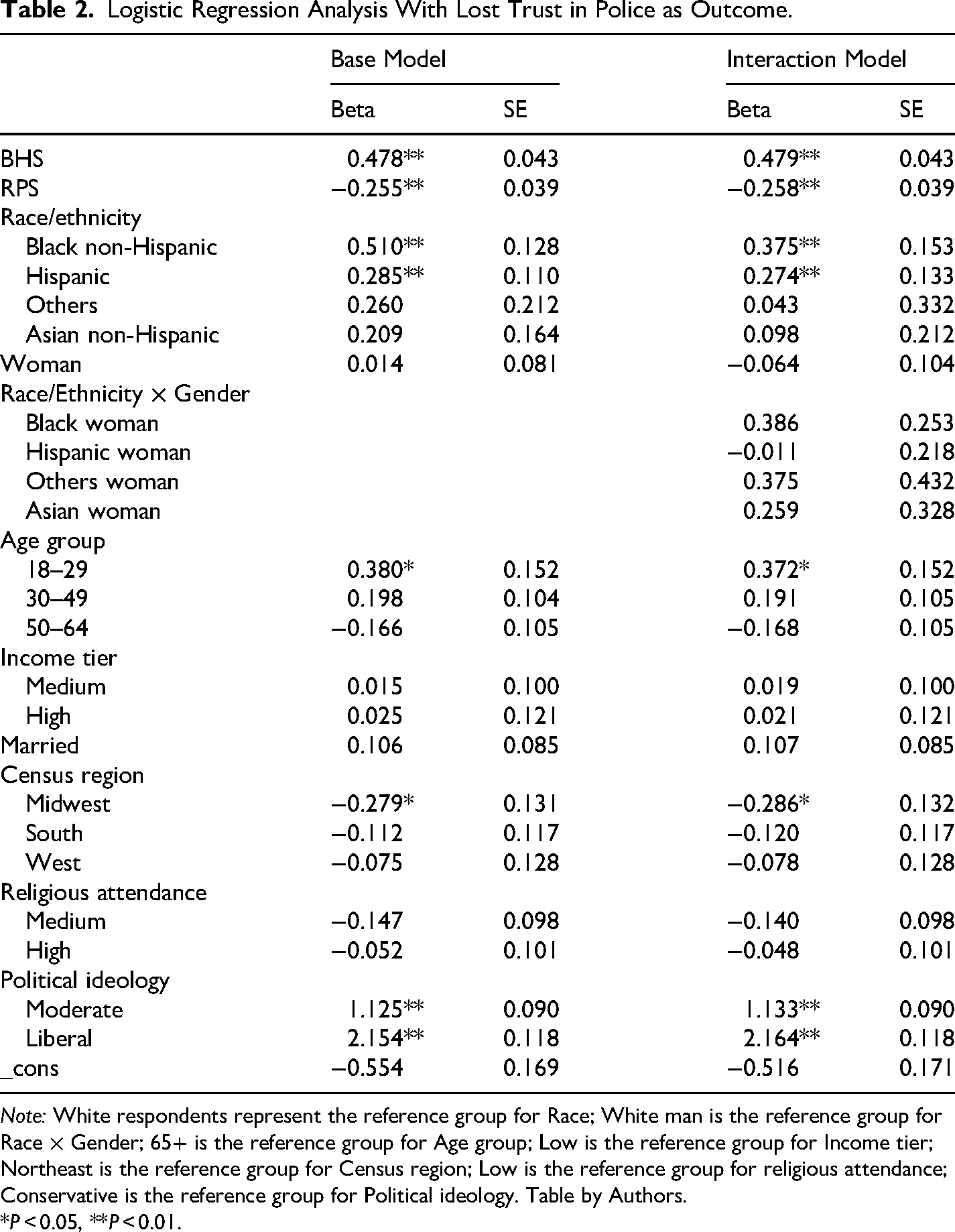
The base model in Table 2 shows that low RPS and high BHS were associated with elevated odds of losing trust in the police after watching video of police violence against Blacks. Specifically, for one-unit higher RPS the odds decreased by 23% (1 − exp (−0.258)). In comparison, one-unit increase in BHS appeared to escalate the odds by as much as 61% (exp (0.479) − 1). Black and Hispanic people, regardless of gender and other covariates, showed higher odds than White respondents, while all other races had no difference from White individuals. Next, those in the younger generation in their 20s, those in Northeast, and politically liberal respondents appeared to develop a stronger aversion to police after watching video of police violence against Black people than those in the older generation over the age of 65, those in Northwest region, and the conservatives, respectively. Meanwhile, marital status, income, and religious attendance had no significant association with the odds of losing trust in the police after watching video of police violence against Black people.
Logistic Regression Analysis With Lost Trust in Police as Outcome.
Note: White respondents represent the reference group for Race; White man is the reference group for Race × Gender; 65+ is the reference group for Age group; Low is the reference group for Income tier; Northeast is the reference group for Census region; Low is the reference group for religious attendance; Conservative is the reference group for Political ideology. Table by Authors.
*P < 0.05, **P < 0.01.
The interaction model replicated most of the findings in the base model. In addition, it offers insight into the gender-specific racial variation in the odds of losing trust in the police after watching video of police violence against Black people. In terms of the race main effect, Black and Hispanic men had a significantly higher log-odds than their White counterparts, whereas men of other races did not differ from White men. The gender main effect shows that, compared to White men, White women had no significant difference in the odds. The finding of no significant interaction terms indicates that the groups of non-White women had no significant difference from White men after taking into account racial disparity among men. Further analyses were conducted to test all combinations of race and gender. We found that White and Hispanic women had a significantly lower log-odds than their Black counterparts, whereas women of other races did not differ from Black women. In addition, intra-racial gender disparity was not found for any racial group.
Discussion
This study contributes to the literature on public trust in police through several findings. Our first hypothesis posited that Black and Hispanic respondents would be more likely than White and Asian respondents to have lower trust in the police because of self-reported prior exposure to videos of police violence against Black people. This was not fully supported. Black and Hispanic respondents were indeed more likely than White respondents to report losing trust in the police after they watched a video of police violence against Black people. Asian individuals, on the other hand, had odds that are somewhat in the middle of all other races, resulting in the statistically nonsignificant difference from other races. Given the limited—but increasing—studies that include Asian respondents to make meaningful statistical comparisons, we have limited prior literature to draw upon for this result. However, because the data were collected in 2023 in the aftermath of the COVID-19 pandemic, Asian individuals might have been sensitized by the violence (from residents not the police) perpetrated against them during the pandemic due to the linkage of the origin of the virus to Wuhan, China (see Gover et al., 2020; Kim & Sun, 2026; Lim et al., 2023).
Our second hypothesis combined insights from both Comparative Conflict Theory and intersectional understandings and anticipated that Black and Hispanic women would be more likely than White and Asian women to have lower levels of trust in the police because of previous exposure to videos depicting police violence against Black people. This hypothesis was also partially supported as Black women appeared to have a significantly greater odds than White and Hispanic women. Black women indeed recorded the greatest loss of trust in the police after viewing a video of police violence against Black people. Originating in the American South in the slave-era with slave patrols who hunted down black runaways (Franklin & Schweninger, 2000; Reichel, 1988), American policing has long reserved some of the most brutal treatment for Black men and women (Echols, 2024). State violence against Black people has persisted and the repetitive distribution of videos displaying tragic police action against Black people continues to be a prominent source of pain among Black women. Notably, because of this longstanding issue—for historical reasons—their pain is arguably unlike women of other racial and ethnic backgrounds. Moreover, the recency of having witnessed the killing of George Floyd screaming out for his mother while Minneapolis police officer Derrick Chauvin inhumanely killed him left another indelible image of the police that likely will not be soon forgotten by Black mothers. Both Asian men and women had average odds across the race in each gender group, which nullified any statistical difference from any other race. We again surmise that the spate of attacks on Asian individuals during the COVID-19 pandemic might be contributing to this result (see Kim & Sun, 2026).
Our third hypothesis speculated that basic literacy in Black American history would influence the loss of trust in the police after self-reporting having previously viewed a video of police violence against Black people. This suggests that basic knowledge of Black American history has considerable value in sensitizing citizens to the historical context surrounding police violence against Black people. This sensitizing effect is crucial because, as it has been found by a recent poll, BLM and other largely Black organizations with a sense of history have been unable to end these encounters by holding officers accountable for misconduct (Horowitz et al., 2025). Nonetheless, this finding suggests that an entire populous educated on Black American history will become a more potent force to seek the end to disparate police violence against Black people. However, some might interpret this finding as an argument for avoiding teaching the public unvarnished Black American history. We disagree. The educational process is one in which history should be told from a nonideological vantage point. As such, all the tragedies and triumphs of all racial/ethnic groups residing in American society should be discussed—one such tragedy is the historical mistreatment of Black Americans by the police.
Our final hypothesis studied whether respondents who felt there has been racial progress in America would be less likely to lose trust in the police after self-reporting that they had previously viewed a video of police violence towards Black people. This hypothesis was supported. Respondents may have considered these incidents as isolated and representing a situation involving a “bad apple” because of their belief that things have changed and the historical racial animus against Black people has dissipated. During the time of the data collection, this was understandable because there was a more inclusive mandate that was being pushed by the Biden administration. We suspect these results would differ in 2026 under the Trump administration, which has made it clear that inclusivity is not valued, and DEI has almost been outlawed. Such actions would likely be seen as major setbacks to racial progress. An interesting area of inquiry would be to explore whether the results would be replicable today.
Taken together, there was mixed support for the value of Comparative Conflict Theory to contextualize core aspects of our research. Thus, while our hypotheses were largely supported, the inclusion of intersectional insights and analyses clearly enhanced the interpretation of the nuanced results. These results suggest that states such as Florida that have attempted to regulate and sanitize Black American history also risk having citizens—of all racial and ethnic backgrounds—who are ignorant of a critical period of American history when police violence against Black people was initiated and especially exacerbated. Absence of such history will result in seeing these encounters as isolated incidents and not part of the Black American experience.
Limitations
These results should be considered in light of inherent limitations. First, the data were not collected to test any of the theoretical suppositions in this study. Thus, there could have been more precision and depth in the measurement. Including qualitative follow-up questions might have yielded additional insights on the findings. Our speculative insights provide a roadmap for future surveys. Similarly, the questions related to the viewing of videos of police officer violence against Black people suffered from the same lack of precision and specificity. For example, the question asked about previously viewing such videos, generally, instead of focusing on one specific event. The videos of Black people killed by police illegally or under ambiguous circumstances may elicit a different reaction than videos of justified police killings. Further, we are unable to ascertain the volume, frequency, or recency of respondent video viewing. In a similar vein, our Black American history scale provided basic proficiency in Black American history and did not provide advanced knowledge of Black history, which might have provided additional information on how increased knowledge of Black American history can impact public views on justice system outcomes. Longitudinal data that might have tracked the ebbs and flows of the immediate impact of Black American history understanding on trust in police would reaffirm the value of exposure to diverse curriculums. Finally, having additional measures on how people respond to video exposure of violence by police directed at non-Black victims would also measure the power of familiarity in the histories of other racial ethnic groups that have elevated numbers of incidents of police violence.
Another potential issue is the possibility of omitted variable bias, which applies to the internal validity of the findings in every nonexperimental study. The set of independent variables in our study is not meant to exhaust all factors of loss of trust in the police. Some of the omitted variables may have significant association with both independent and dependent variables in this study. For example, someone with direct or vicarious experience of police brutality could be more prone to rate low on both RPS and loss of trust in the police. Failure to include those variables could distort the parameter estimates in the statistical analysis and eventually lead to a wrong conclusion on the independent variables.
Conclusion
This study investigated core aspects of the Comparative Conflict Theory, along with some intersectional insights, to explain racial differences in trust in the police after having self-reported previously viewing a video of police violence against Black people. Our results offer future researchers two new variables to consider when crafting studies to determine the correlates related to trust in the police: literacy in Black American history and perceptions of racial progress. These two explanatory variables clearly demonstrated the potential to help contextualize influential factors in police trust. We anticipate that as people learn the general value of history that is not sanitized, citizens will possibly become more active in the pursuit of justice when police violence—against anyone—is witnessed either in person or vicariously, as in the case of videos that are viewed on television, the internet, or social media.
Footnotes
Acknowledgment
The authors thank Darnell Hawkins and Siddhartha Bandyopadhyay for commenting on an early version of this paper.

Ethical Approval
All procedures performed in studies involving human participants were in accordance with the ethical standards of the institutional and/or national research committee and with the 1964 Helsinki declaration and its later amendments or comparable ethical standards.
Informed Consent
This study analyzed publicly available anonymized data.
Funding
The authors received no financial support for the research, authorship, and/or publication of this article.
Declaration of Conflicting Interests
The authors declared no potential conflicts of interest with respect to the research, authorship, and/or publication of this article.