







Abstract
Minority threat theory hypothesizes that police exert greater coercive control over racial/ethnic groups perceived as dangerous in cities with relatively large and residentially segregated minority populations. One line of research testing this hypothesis examines the relationships of percent minority and minority segregation with the incidence of police-caused homicide. The limited research on Hispanics provides little supporting evidence for minority threat theory. However, past studies do not consider the possible influences of Southwest region and the relative size of foreign- and native-born Hispanic populations on police-caused homicide. In the present study, we incorporate these variables into a cross-sectional analysis of Mapping Police Violence police-caused homicide data in cities of 100,000 or more population in 2010. There were positive main effects of Southwest region in each analysis. There were also interactions involving Southwest region and nativity. Percent native born had a positive relationship with the total incidence of police-caused homicide in the Southwest but no relationship outside that region. Percent foreign born had a negative relationship with police-caused homicide of Hispanics in the Southwest and no relationship outside that region. Hispanic-White segregation had a strong positive relationship with both outcome variables that did not vary by region. Taken together, the findings indicate that Hispanic nativity, region, and residential segregation shape patterns of police-caused homicide in ways not captured in past research. They also reveal the need for more nuanced conceptualizations and empirical tests of minority threat theory.
Keywords
In recent years, police-caused homicides of citizens have been at the center of public and scholarly debate about whether the police treat all citizens equally or whether they treat citizens of color more harshly than they treat Whites. Increasingly, scholars have turned their attention to identifying and explaining racial patterns in police-caused homicide of citizens. 1 That research frequently relies on minority threat theory to analyze city-level data that include percent minority population and minority residential segregation variables. This conflict theory of law derivative hypothesizes that differentials in crime suppression efforts reflect the interests of powerful segments of the population in controlling relatively large and segregated minority populations that are perceived as especially threatening, irrespective of the degree of objective criminal threat they may actually pose (e.g., Liska, 1992; Liska & Yu, 1992). Some tactics, notably the use of violence, are said to serve the interests of police officers on the street, who may see these actions as necessary for self-protection from ostensibly dangerous minority citizens (Holmes & Smith, 2008; Jacobs & O’Brien, 1998; Liska & Yu, 1992; Sierra-Arévalo, 2024; Smith & Holmes, 2014). Research findings for police-caused homicides of Blacks generally support minority threat hypotheses (cf. Holmes, Painter & Smith, 2019; Jacobs & O’Brien, 1998; Liska & Yu, 1992; Smith, 2003; Sorensen et al., 1993; Willits & Nowacki, 2014). Although Hispanics make up America's largest racial/ethnic minority population and experience discrimination in the criminal justice system (e.g., Urbina & Álvarez, 2018), limited past research does not support threat hypotheses for police-caused homicide among that population (Holmes et al., 2019; Smith, 2003; Willits & Nowacki, 2014).
One potential reason for the lack of supporting evidence for Hispanics is that research has not incorporated characteristics of this population that may moderate the relationships of Hispanic threat variables with the incidence of police-caused homicide in cities. Hawkins’ (1987) insightful critique of conflict theory research maintains that it oversimplifies racialized patterns of criminal justice partly because it fails to account for these factors. Notably, he argues that conflict analyses must predict and explain regional differences in minority outcomes because variations in cultural attitudes of intolerance and bias may influence disparities in the criminal justice system. Although commonly used as a control variable, region has yet to be incorporated in a theoretically centered way in minority threat studies of police-caused homicide.
The Hispanic population of the USA comprises people of diverse national origins who share an ancestral connection to the Spanish colonization of the Americas (Sáenz et al., 2024). 2 Historically, a substantial majority of that population has been concentrated in the Southwest, which is commonly defined to include Arizona, California, Colorado, New Mexico, and Texas (e.g., Barrera, 1979; Holmes & Painter, 2023; McWilliams et al., 2016). The Hispanic population of that region consists primarily of Mexican-origin people and includes the great bulk of foreign-born Hispanics in the USA (Sáenz et al., 2024). 3 Although the Mexican-origin population is increasingly spreading throughout the nation (Massey, 2008; Sáenz et al., 2024), most of it (approximately 70%) 4 continues to reside in the five southwestern states. However, those of Mexican origin also comprise the majority of the Hispanic population in 35 states outside the Southwest and 90% of U.S. counties (Peña et al., 2023). Given the greatly disproportionate size of the Mexican-origin population relative to other Hispanic nationalities in the USA, the long historical Mexican-origin presence and experience with discrimination in the Southwest (e.g., Barrera, 1979; McWilliams et al., 2016), and the focus on the U.S.-Mexico border in the ongoing public debate about the alleged crime problem posed by foreign-born Mexicans (e.g., Flores, 2018; Massey & Durand, 2016), we primarily focus on the Mexican-origin experience with police violence to frame this study.
People of Mexican origin have long been culturally stereotyped as violent and criminally inclined (Bender, 2003; Durán, 2012; Martinez, 2002; Mirandé, 1987). Historically, the salience and prevalence of these cultural biases has varied regionally (e.g., Chavez, 2020; Muñoz Martinez, 2018), with tensions between police and the Mexican-origin population being deeply rooted in the history of the Southwest (e.g., Bender, 2003; Chavez, 2020; Durán, 2012; Mirandé, 1987, Muñoz Martinez, 2018; Romero, 2000). Durán's (2012) extensive review of research reveals that law enforcement has relied heavily on brutality to control this population in the segregated barrios of southwestern cities. Moreover, foreign-born Hispanics, especially those from Mexico, have long been stereotyped as dangerous criminals (Chavez, 2020; Flores, 2018; Harris & Gruenewald, 2020; Martinez, 2002). Past research on criminal justice disparities employs only a measure of the total Hispanic population, rather than disaggregating it into native- (U.S.-born) and foreign-born components (Weitzer, 2014). Failure to divide native- and foreign-born subpopulations into separate predictor variables may mask important intragroup differences in patterns of police-caused homicide of Hispanics. For example, police use of violence may be influenced by stereotypes of the foreign born, especially in the Southwest (see, e.g., Bender, 2003; Durán, 2012; Mirandé, 1987; Romero, 2000; Vega, 2022).
The unique characteristics of Hispanic population composition (nativity) and spatial distribution (Southwest location and residential segregation) are substantively important to understanding the deployment of coercive crime control measures by police. They may provide some insight into the lack of a relationship of total percent Hispanic with police-caused homicide if, for example, the relationship of percent Hispanic with police-caused homicide is limited to foreign-born Hispanics in the Southwest. We extend minority threat research on Hispanics by developing and testing hypotheses about the moderating influences of region and nativity on the incidence of total and group-specific police-caused homicide involving officers of police departments in large U.S. cities. We divide the Hispanic population into percent foreign- and native-born subpopulations, and we examine the main effects of Southwest region and the interactions between Southwest region and the nativity variables. The findings show that region, nativity, and segregation matter. They provide novel substantive and theoretical insights into the relationship of Hispanic threat with police-caused homicide.
Theoretical Framework
Threatening People
Structural-level research on coercive crime control in communities of color has commonly been framed with Liska's (1992, p. 18) threat hypothesis, which stipulates that “the greater the number of acts or people threatening to the interests of the powerful, the greater the level of deviance and crime control.” When a minority group is seen ideologically as posing a greater threat of crime and violence, more powerful groups mobilize to control that population (Blalock, 1967). Popular stereotypes associate Blacks and Hispanics with criminality (Bender, 2003; Quillian & Pager, 2001) and urban violence (Chiricos et al., 2004). Reflecting those beliefs, police authorities see relatively large minority populations as a special crime problem and employ coercive policies to control them (e.g., Jacobs & O’Brien, 1998). Of particular importance, the threat hypothesis directs attention to danger perceived by police officers on the street (e.g., Holmes et al., 2019; Jacobs & O’Brien, 1998; Liska & Yu, 1992; Smith & Holmes, 2003, 2014).
Social divisions within the larger society may become entrenched in the formal and informal organization of police agencies in ways that encourage the proclivity of police to target minority citizens for aggressive tactics (Chambliss, 2001; Smith & Holmes, 2003; Sierra-Arévalo, 2024). Street-level policing is guided by a “danger imperative,” which constantly amplifies and recreates the belief that officers must proactively avoid being the victim of violence, especially that perpetrated by minority citizens (Sierra-Arévalo, 2024). This belief system is inculcated during academy training and then continually reinforced during daily roll calls, memorials to fallen officers, and vicarious accounts from fellow officers. Police departments aver that officers’ actions are color blind (Sierra-Arévalo, 2024), yet stereotypes associating minority groups with violent criminality are deeply embedded in police subculture (e.g., Bolton & Feagin, 2004; Smith & Alpert, 2007). The appearance and behavior of certain citizens of color may symbolize threat to street-level police officers regardless of whether they pose any actual danger (Durán, 2013, 2018; Rios, 2011, 2017; Sierra-Arévalo, 2024; Skolnick & Fyfe, 1993). Insofar as the police associate minority citizens with danger, the presence of a relatively large minority population may amplify officers’ subjective perceptions of risk and increase their propensity to employ violence during encounters with minority citizens (Holmes et al., 2019; Smith & Holmes, 2014).
This minority threat argument often finds support in studies focusing on police-caused homicide in the Black population (cf. Holmes et al., 2019; Jacobs & O’Brien, 1998; Liska & Yu, 1992; Smith, 2003; Sorensen et al., 1993; Willits & Nowacki, 2014). The few studies considering Hispanics find no relationship between percent Hispanic and the total level of police-caused homicide (Holmes et al., 2019; Smith, 2003; Willits & Nowacki 2014), but one found a supporting relationship in a Hispanic group-specific analysis (Holmes et al., 2019). Based on the limited past research, we hypothesize: (H1) total percent Hispanic is unrelated to police-caused homicide.
However, the Hispanic population is not homogeneous, and intragroup variations may influence patterns of police-caused homicide. Notably, previous studies fail to separate the Hispanic population into native- and foreign-born components, which may have different relationships with police-caused homicide within and across the Southwest and other regions. Foreign-born persons of Mexican origin are commonly portrayed as “gang bangers,” “illegal drug smugglers,” and “superpredators” (Bender, 2003; Durán, 2013, 2018; Martinez, 2002; Rios, 2011, 2017; Romero, 2000). Although foreign-born Mexicans are seen as a special threat, Hispanics originating from some other countries are also stereotyped as criminals (e.g., Martinez, 2002; Pedraza Fariña et al., 2010; Sáenz et al., 2024). Such stereotypes of foreign-born Hispanics may foster perceptions of threat among the police and influence their street-level actions (Durán, 2018; Rios, 2017; Urbina & Álvarez, 2018).
Police officers also have more extensive interactions with foreign-born Hispanics in cities with relatively large foreign-born populations. They may become generally capable of distinguishing between foreign- and native-born persons based on certain cues, notably English-language proficiency and clothing style, which may impede police interactions with foreign-born persons (e.g., Culver, 2004; Durán, 2013; Rios, 2017). Moreover, the foreign-born may avoid and interact guardedly with police (e.g., Menjívar et al., 2018; Walker, 1997) because they fear deportation (e.g., Gómez Cervantes, 2021). Such cues may elicit negative behavioral responses to foreign-born Hispanics by police. This line of reasoning suggests: (H2a) percent foreign-born Hispanic is positively related to police-caused homicide and percent native-born Hispanic has a weaker (or no) relationship with police-caused homicide.
The foreign-born experience also suggests an alternative hypothesis. The majority of foreign-born Hispanics are manual workers with little education or formal skills (Alba & Nee, 2003). They usually settle in impoverished urban barrios that reinforce cultural traditions and create socially organized conditions that may reduce crime (Martinez, 2002; also see Ramos et al., 2023). Initially, they may develop positive attitudes toward the police, perhaps because of limited exposure to them and favorable comparisons with police in their country of origin, but over time their attitudes become more negative with greater exposure to mainstream culture (Correia, 2010). Their native-born children may perceive prejudice and discrimination by the larger society that alienates them and promotes solidarity in opposition to the discrimination they experience (Portes & Rambaut, 2001). This reactive process of identity formation leads some younger members of second and later generations to reject values and behaviors that signify “acting White,” which may contribute to the higher crime rates seen among that group compared with their foreign-born counterparts. Moreover, the police may see the demeanor visibly manifested in this oppositional identity as evidence of criminal inclinations (Durán, 2013, 2018; Rios, 2011, 2017). The police may thus perceive relatively large native-born Hispanic populations as especially dangerous. This suggests: (H2b) percent native-born Hispanic is positively related to police-caused homicide and percent foreign-born Hispanic has a weaker (or no) relationship with police-caused homicide.
Threatening Spatial Contexts
Perceptions of minority threat are not just tied to population composition. They are also influenced by the spatial context – region and residential segregation – in which encounters between police and citizens take place.
Region. Hawkins (1987) critique of conflict theory research emphasized that it fails to account for important regional differences in racial patterns of criminal justice administration. His analysis focused on the Black experience in the South versus the non-South, concluding that “a revised conflict perspective must predict the direction of regional differences… and provide plausible explanations for them” (Hawkins, 1987, p. 732). The threat hypothesis explains disparate criminal justice outcomes in terms of social forces that comprise enduring, large-scale patterns of social relationships within society, including longstanding stereotypes and discrimination experienced by communities of color (Holmes et al., 2019). The salience and prevalence of cultural biases conflating race and crime vary across regions, and beliefs about minority threat become deeply embedded among police in certain areas. Historically and today, the Southwest has played a prominent role in shaping the Hispanic experience in the USA (McWilliams et al., 2016), including their experiences with police (e.g., Durán, 2012; Escobar, 1999; Mirandé, 1987; Rios, 2011, 2017). The numerically dominant Mexican-origin subpopulation of the region disproportionately resides in segregated urban barrios where they often experience economic disadvantage (Alba & Nee, 2003; Durán, 2012). Most foreign-born Mexican persons (along with those from Central American countries) reside in southwestern barrios (Acosta & de la Cruz 2011; also see Pew Research Center, 2016).
Mexican-origin people in the Southwest have been stereotyped as violent criminals and targeted for brutality by law enforcement officials since early contact along the U.S.-Mexico border (Durán, 2012; Muñoz Martinez, 2018). Notably, the Texas Rangers unlawfully employed extreme violence against Mexican-origin persons well into the twentieth century (Durán, 2012; McWilliams et al., 2016; Muñoz Martinez, 2018). Although the most egregious practices were abandoned later in the century, disproportionate police use of violence against the Mexican-origin population in southwestern barrios remained widespread (Durán, 2012). A U.S. Commission on Civil Rights (1970) study of police discrimination in the Southwest concluded that excessive force was used more commonly against Mexican Americans than Anglos. 5 Surveys of citizens (Bayley & Mendelsohn, 1969; Holmes, 1998), analyses of federal civil rights criminal complaints of police brutality (Holmes, 2000; Smith & Holmes, 2003), and qualitative studies (Durán, 2013, 2018; Rios, 2011, 2017) likewise indicate that the Mexican-origin population of the Southwest still experiences disproportionate physical abuse and other forms of severe harassment at the hands of police. In recent years, changes in federal immigration policy and local law enforcement have increased racial profiling in the Southwest (Chavez, 2020; Durán, 2012; Macías-Rojas, 2016; Menjívar & Bejarano, 2004). Yet, the influence of this region remains largely unaddressed in minority threat research on police-caused homicide. A recent study using Uniform Crime Report Supplementary Homicide Report (SHR) data found that the total incidence of police-caused homicide was unrelated with Southwest region, but a strong positive relationship of Southwest was observed in the Hispanic group-specific analysis (Holmes et al., 2019). That study did not consider the moderating effects of region on minority threat variables.
Based on ongoing tensions between police and Mexican-origin people in the Southwest (e.g., Escobar, 1999; Mirandé, 1987; Munoz Martinez, 2018) and increased concern about crime among the undocumented population, we hypothesize: (H3) there is a higher incidence of police-caused homicide of Hispanics in the Southwest compared with the non-Southwest after controlling percent Hispanic measures; (H4) the relationships of the percent Hispanic measures with police-caused homicide are stronger in the Southwest than in the non-Southwest
Segregation. Minority threat theory has been elaborated to explain how the spatial distribution of minority populations within cities influences street-level policing (Liska & Chamlin, 1984; Liska & Yu, 1992). The “place” hypothesis maintains that residential segregation is central to the deployment of coercive strategies of policing (e.g., Holmes et al., 2019; Liska & Yu, 1992; Smith & Holmes, 2014). Hispanic and Black populations disproportionately reside in segregated urban neighborhoods characterized by an array of socioeconomic disadvantages, including poverty, crime, weapon availability, and social disorder/incivilities (e.g., Massey & Denton, 1993; Peterson & Krivo, 2010), conditions that heighten subjective perceptions of danger among police officers (Holmes & Smith, 2008; Sierra-Arévalo, 2024). As Liska and Yu (1992, p. 56) maintain, “segregation may increase the perceived threat for [police] who work in racially segregated ghettos, while decreasing it for those working outside these ghettos.” Officers may come to associate such locales and their residents with criminality and danger (e.g., Crank, 1998; Herbert, 1997; Meehan & Ponder, 2002; Sierra-Arévalo, 2024). They vicariously learn the places where danger is most common from other officers, and selective personal experience in these areas reinforces this subcultural knowledge. Police officers may generalize the threatening behavior of certain individuals to all citizens encountered in disadvantaged minority neighborhoods (Holmes & Smith, 2008; Smith, 1986). Simply entering such areas may trigger aversive psychological responses among officers that increase the likelihood of police-caused homicide of minority citizens (Holmes et al., 2019).
As discussed above, many southwestern Hispanics reside in disadvantaged barrios where historically they have experienced strained relations with the police (e.g., Durán, 2012; Escobar, 1999; Holmes, 2003; Mirandé, 1987; Rios, 2011, 2017). Police stereotype Hispanics residing in these barrios as dangerous and target them for violence and other abusive practices (Durán, 2012, 2013, 2018; Holmes, 1998; Mirandé, 1987; Rios, 2011, 2017; Romero, 2000). Despite the theoretical importance of residential segregation to police use of aggressive tactics, minority threat research on police-caused homicide rarely includes a measure of segregation. Studies of the relationship of Black-White segregation with police-caused homicide have produced somewhat mixed results (Holmes et al., 2019; Jacobs & O’Brien, 1998; Liska & Yu 1992; Piatkowska, Santana & Messner, 2025; Willits & Nowacki 2014), as has limited research on Hispanic–non-Hispanic White segregation (hereafter Hispanic-White segregation). Hispanic-White segregation had no relationship with police-caused homicide in one study (Willits & Nowacki, 2014). Another reported no segregation relationship in the total incidence of police-caused homicide analysis but found one in a Hispanic group-specific analysis (Holmes et al., 2019). Given the theoretical argument of the place hypothesis and the rich body of research indicating police deploy various aggressive tactics in southwestern barrios, we hypothesize: (H5) Hispanic-White segregation is positively related to police-caused homicide; and (H6) the relationship of Hispanic-White segregation with police-caused homicide is stronger in the Southwest than in the non-Southwest.
Community Violence
The primary counterargument to threat hypotheses focuses on “community violence” (Sorensen et al., 1993). In contrast to the subjective biases postulated by minority threat theory, this perspective emphasizes the objective threats police confront in encounters with citizens. Greater levels of violence in cities are said to increase the number of police-citizen encounters during which officers will have to use deadly force to protect themselves or citizens from dangerous suspects. Therefore, aggregate patterns of police-caused homicide are hypothesized to correspond closely with levels of violence in cities (Fyfe, 1980; Sorensen et al., 1993).
The social and economic structure of concentrated minority disadvantage may largely explain the high rates of violent crime (e.g., Peterson & Krivo, 2010) that are hypothesized to produce a higher incidence of police-caused homicide. Although these criminal acts are usually directed against fellow citizens, police may also encounter greater danger in disadvantaged locales. For example, cities with relatively large and highly segregated Black populations have a higher incidence of homicides of police (Kent, 2010). The community violence perspective emphasizes these objective threats, hypothesizing that neither percent minority nor minority segregation is related with the incidence of police-caused homicide after level of violence is controlled (Holmes et al., 2019).
Past minority threat studies of police-caused homicide include measures of violent crime within cities, but they differ somewhat with respect to the indicators employed (cf. Holmes et al., 2019; Jacobs & O’Brien, 1998; Liska & Yu, 1992; Smith, 2003; Sorensen et al., 1993; Willits & Nowacki, 2014). This research generally shows a positive relationship between various indicators of violence in cities and police-caused homicide, but findings are inconsistent. Moreover, the level of violence does not account for the relationships of percent minority with police-caused homicide, suggesting that subjective racial biases may influence these events consistent with the predictions of minority threat theory. We hypothesize: (H7) community violence indicators are positively associated with police-caused homicide but do not fully account for the relationships of Hispanic threat variables with police-caused homicide.
The Current Study
We tested the hypotheses of this study in a cross-sectional analysis of U.S. Census designated places with populations of 100,000 or greater in 2010 and independent police agencies (N = 264). We limited the analysis to police-caused homicides by officers of those agencies. Large cities have been analyzed in most minority threat studies of coercive crime control because police-minority tensions are prevalent in them and more reliable data are available for those locales. Smaller cities typically have few police-caused homicides, few minority residents, and substantial missing data.
Outcome Variable
Past minority threat studies rely primarily on UCR Supplementary Homicide Report (SHR) data to measure police-caused homicide. Those data substantially undercount police-caused homicide because of coverage/nonresponse and measurement errors by reporting agencies (Loftin et al., 2017). Here we employ the Mapping Police Violence (MPV) dataset (https://mappingpoliceviolence.org/), which contains a substantially more comprehensive count of police-caused homicides than the SHR (DeAngelis, 2024; Gray & Parker, 2019). This database includes “any incident where a law enforcement officer (off-duty or on-duty) applies, on a civilian, lethal force resulting in the civilian being killed whether it is considered ‘justified’ or ‘unjustified’ by the U.S. Criminal Legal System” (Mapping Police Violence, 2023, p. 6). 6 The data are sourced from multiple comprehensive and impartial crowd-sourced databases, as well as records such as police reports and obituaries.
We analyze the incidence of police-caused homicide during 2013 (first year of MPV data reporting) through 2023, which we calculated from the MPV database for each city police agency (deaths attributable to other agencies are excluded). We treated the aggregated incidence of police-caused homicide as single time point because these are rare events with too little within-year variation to allow analysis of annual data. The mean incidence of total police-caused homicide was 11.81, or about 1.07 annually, in the overall sample. The mean number of police-caused homicides of Hispanics was 2.94, or .27 annually. The timeframe captured in the outcome variable provides sufficient variation for analysis and minimizes the influence of random fluctuations, thus providing a more reliable measure than possible with fewer years of police-caused homicide data.
Predictor Variables
Following past research, we included predictor variables that captured racial threat, community violence, and police agency characteristics, as well as relevant controls (Holmes et al., 2019; Jacobs & O’Brien,1998; Liska & Yu, 1992; Smith, 2003; Sorensen et al., 1993; Willits & Nowacki, 2014). Racial threat variables included the standard measures of percent Hispanic and percent Black in a city population, which we calculated using 2010 Census data. We disaggregated the Hispanic population by nativity: percent native born and percent foreign born (calculated from the 2010 to 2014 American Community Survey [ACS] 5-year estimate). We used five-year estimates because they are more reliable than a single year of data.
We measured residential segregation with Hispanic and Black dissimilarity indexes for 2010. These indexes indicate the degree of separation of Blacks and Hispanics relative to non-Hispanic Whites across all neighborhoods of a city, with higher values representing greater segregation. The index values range from zero to one hundred, with zero representing complete integration and one hundred indicating complete segregation. We obtained these data from the “Diversity and Disparities” website (https://s4.ad.brown.edu/projects/diversity/segregation2020/Default.aspx). We treated Southwest region as an indicator of Hispanic threat because of the historical tensions between Hispanics and police in that region, as described above. Given the highly disproportionate representation of Hispanics and incidence of police-caused homicides of Hispanics in the Southwest (AZ, CA, CO, NM, and TX) relative to other regions (see Appendix 1), we collapsed region into a single dummy variable (non-Southwest = 0; Southwest = 1). 7 Additionally, we included the Gini index (2010‒2014 ACS) in the analyses to capture the possible influence of income inequality (economic threat) (e.g., Sorensen et al., 1993).
We used multiple measures of community violence to capture various aspects of threat perceived by police officers. These included the average annual violent crime and arrest rates during 2010–2016 (both were rescaled to 1,000s in the multivariate analyses). We calculated these measures from UCR and 2010 Census data. Aggregating several years of data provided a more reliable measure because police department reporting practices may be uneven over time and crime rates fluctuate, so a multi-year measure better captures the typical crime rate in a city. The violent crime rate measure includes murder, rape, robbery, and aggravated assault. It indicates the likelihood of encounters between police and potentially dangerous offenders (Liska & Yu, 1992; also see Krajewski, Worrall & Scales, 2026). Generally, past studies employ only a violent crime rate measure as an indicator of community violence, which is not sufficient to capture the level of objectively threatening acts police officers confront. The total arrest rate captures another aspect of potentially dangerous encounters with criminal suspects, as arrests may create the opportunity and necessity for the use of deadly force (Holmes et al., 2019; Willits & Nowacki, 2014). 8 The third measure indicates the number of police officer killed during 2010-16, which we obtained from the UCR Law Enforcement Officers Killed and Assaulted (LEOKA) database. Homicides of police officers are rare but highly salient events that may indicate the level of both objective (Holmes et al., 2019) and subjective threats police officers confront (Sierra-Arévalo, 2024).
In addition to the two sets of predictor variables of central theoretical interest, we included measures indicating the degree of minority and female representation in each department. Greater diversity may reduce tensions between police and communities of color because minority and female officers may better relate to those communities (Smith, 2003). We used 2013 Law Enforcement Management and Administrative Statistics (LEMAS) 9 and 2010 U.S. Census data to calculate the ratio of the proportion of Hispanic sworn police officers to the proportion of Hispanic residents in a city, and the ratio of the proportion of Black sworn police officers in the police agency to the proportion of Black residents. Higher values of these measures indicate greater representativeness of the agency (values greater than 1 indicate overrepresentation of minority officers). We used the percentage of female officers in agencies reported in LEMAS to capture female representation because there is little variation in the relative size of the female population across cities.
We included two control variables commonly used in aggregate-level analyses of coercive crime control strategies. These were city population (re-scaled to 10,000s in multivariate analyses) and population density (re-scaled to 1000s) reported in the 2010 Census. Population was important because cities with larger populations and police departments typically generate more incidents of police-caused homicide than do smaller cities (e.g., Smith, 2003, 2004). We included population density (city population per square mile) in the analyses because citizens may be more likely to die when police use deadly force in densely populated areas (Sorensen et al., 1993).
Analytic Strategy
Following past research (e.g., Holmes et al., 2019; Jacobs & O’Brien, 1998; Liska & Yu, 1992; Smith, 2004), we conducted two separate cross-sectional multivariate analyses of the incidence of police-caused homicide. The first examined the overall analytical sample, which determined whether threat predictors are related with the total incidence of police-caused homicide. We disaggregated the data for Hispanic decedents in the second analysis, which determined the predictors that are related with the group-specific (i.e., within subpopulation) incidence of police-caused homicide. The predictor variables (except region) were grand-mean centered in all analyses. Descriptive data for the variables (not rescaled) used in this study are presented in Appendix 1.
The outcome variable represents a count of a relatively rare event that was skewed toward the lower end of the distributions with large values occurring infrequently. This commonly occurs with count variables, which are appropriately modeled using Poisson regression. Valid statistical inferences from Poisson regression require equidispersion. The initial analyses using Poisson regression revealed overdispersion in our statistical models. Therefore, we employed negative binomial regression (NBR), which corrects this problem (Osgood, 2000).
We checked for multicollinearity using Ordinary Least Squares regression to obtain variance inflation factors (VIFs) for the full additive models. The highest VIF value in the total incidence analysis (Table 1, Model 2 below) was 5.7 for Black-White segregation, with no other VIF exceeding 3.6. No VIF exceeded 3.8 in the Hispanic group-specific analysis (Table 2, Model 2 below). The low VIFs indicate that no significant distortion of the findings was present in the additive multivariate analyses (see O’Brien, 2007).
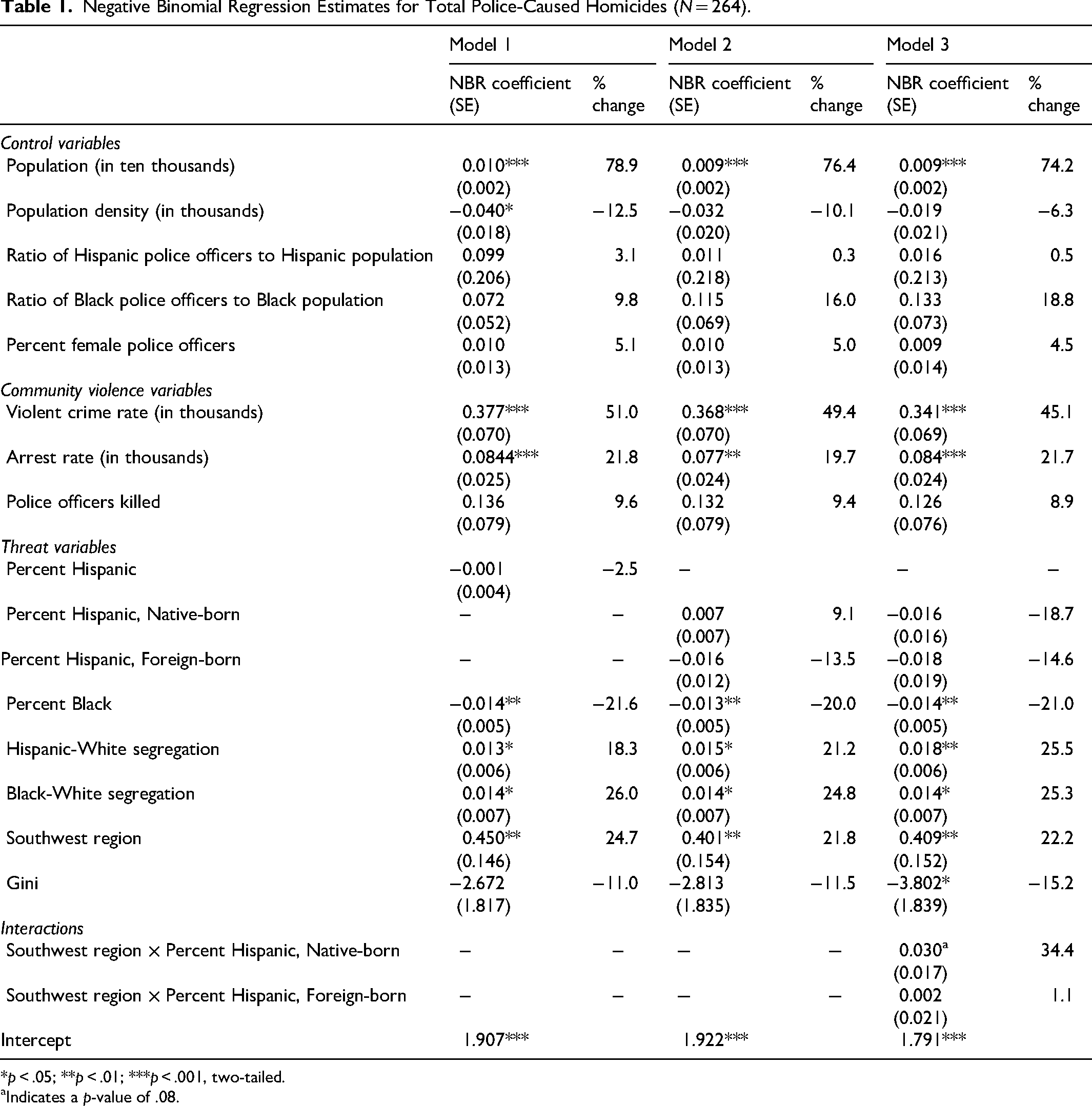
Negative Binomial Regression Estimates for Total Police-Caused Homicides (N = 264).
*p < .05; **p < .01; ***p < .001, two-tailed.
Indicates a p-value of .08.
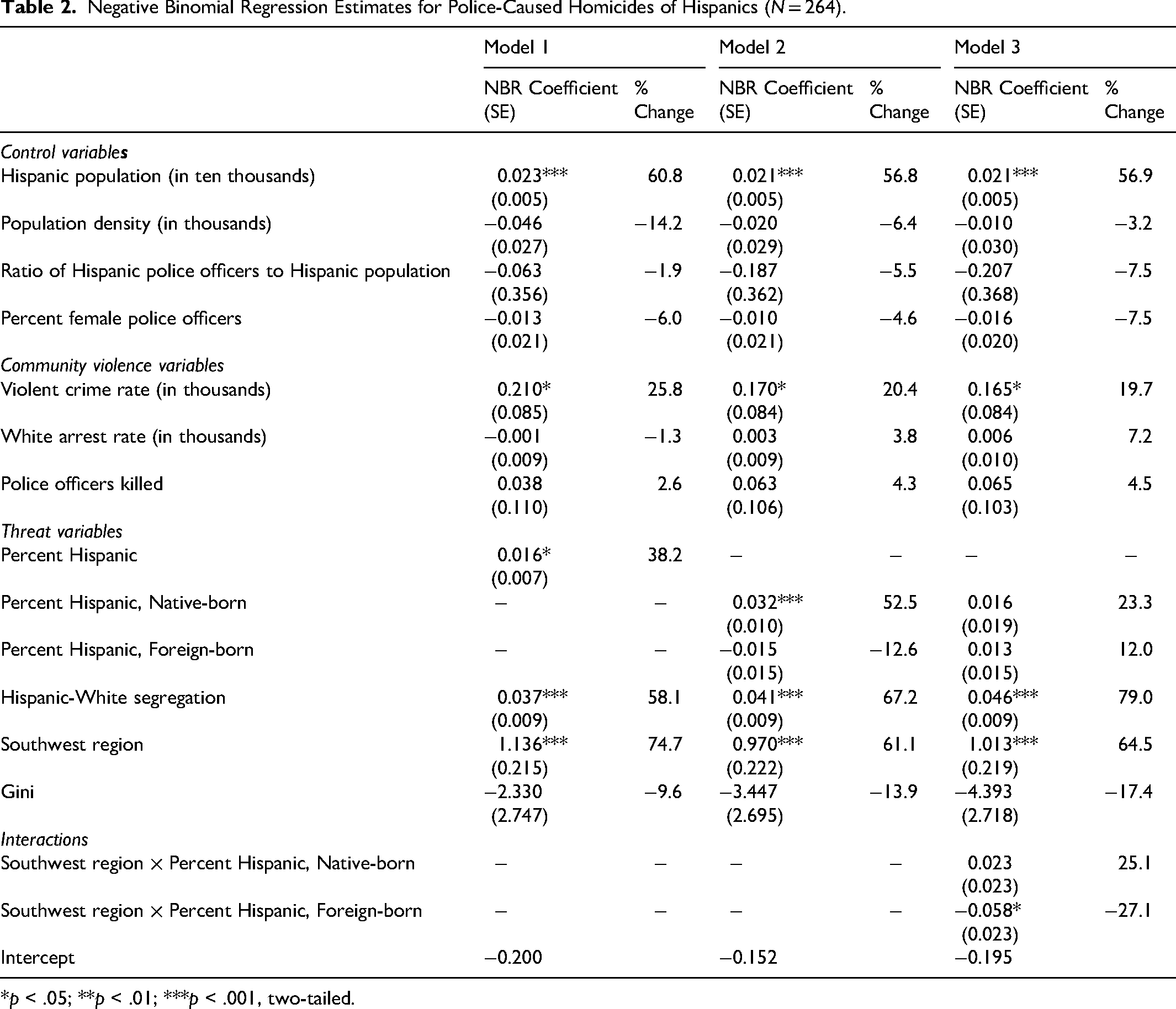
Negative Binomial Regression Estimates for Police-Caused Homicides of Hispanics (N = 264).
*p < .05; **p < .01; ***p < .001, two-tailed.
There were little missing data for the predictor variables. Arrest rate had 12.1% missing, the ratio of Hispanic officers to Hispanic residents and of Black officer to Black residents both had 7.2% missing, and percent female officers had 7.6%. We used multiple imputation (PROC MI in SAS 9.4) to address the missing values. Van Ginkel and colleagues (2020) demonstrate the superiority of multiple imputation to deletion-based techniques (listwise, pairwise) and single imputation. In contrast to other methods, multiple imputation retains information from all cases and uses this information to estimate missing values. Further, multiple imputation returns unbiased results. We imputed 10 complete datasets and estimated the NBR equations for each of them using Proc Genmod. We then used Proc MIAnalyze to merge the 10 sets of results.
Findings
Total Incidence of Police-Caused Homicide
Table 1 presents the multivariate models for the total incidence of police-caused homicide. Model 1 includes the full set of predictor variables, using the total percent Hispanic variable. Among the control variables, total population had a statistically significant positive relationship with the outcome variable and the largest standardized percent change score (78.9) in this model. 10 Population density had a significant negative relationship with police-caused homicide. None of the measures of police department diversity – ratio of Hispanic officers to Hispanic citizens, ratio of Black officers to Black citizens, or percent female officers – was statistically significant. Among the community violence variables, violent crime rate and arrest rate had positive, statistically significant coefficients as expected (H7), with violent crime rate having the second largest percent change score (51.0). The police officers-killed coefficient was positive but non-significant.
Among the threat variables, the total percent Hispanic in the city population was not related to the total incidence of police-caused homicide, as predicted (H1). Also as expected (H5), Hispanic-White segregation had a statistically significant, positive relationship with police-caused homicide. Percent Black had a statistically significant negative relationship, consistent with two recent studies (Holmes et al., 2019; Piatkowska et al., 2025), and Black-White residential segregation a positive relationship with the outcome variable. The Southwest variable had a positive coefficient, indicating that this region had a higher incidence of total police-caused homicide than the non-Southwest. The Gini coefficient (income inequality) was unrelated to total incidence of police-caused homicide.
Model 2 replicates the first model, except we substituted percent native-born and percent foreign-born Hispanic for the total percent Hispanic variable. The coefficients for these variables were not significant, contrary to both H2a and H2b.
Next, we tested for the hypothesized interactions involving Southwest by percent foreign-born Hispanic, by percent native-born Hispanic, and by Hispanic-White segregation. The native-born interaction term presented under Model 3 had a positive, albeit marginally significant coefficient (p = .08), consistent with H2b and H4. Substantively, the interaction term was quite large, with the change score (34.4) being the third largest in the model. It appears that the marginal significance test was attributable to multicollinearity, as indicated by relatively large VIFs (14.6 and 10.7, respectively) for the percent native-born Hispanic coefficient and Southwest by percent native-born Hispanic interaction term. Multicollinearity often inflates standard errors, which reduces statistical significance. This is a common occurrence in cross-product interaction analyses and is generally not indicative of a problem requiring corrective procedures (see, e.g., O’Brien, 2007). Although the percent native-born Hispanic standard error more than doubled between Models 2 and 3, nothing indicated the parameter estimates were affected. Other coefficients were stable across the models.
The interaction term represents the slope of the percent native-born Hispanic relationship with police-caused homicide in the Southwest, indicating that percent native born was positively related with the total incidence of police-caused homicide in that region. The significant positive coefficient for the Southwest dummy variable indicates that the intercept (baseline) was higher in that region. The percent native-born coefficient represents the slope of the relationship between percent native-born and total police-caused homicide in the non-Southwest. This negative coefficient was not statistically significant. Figure 1 depicts this finding graphically. At the lower limit of percent native-born Hispanic (.84), the expected count of police-caused homicides in southwestern cities was about 6.5 homicides higher than in non-southwestern cities. At 50% native-born Hispanic, the regional difference in the expected count of police-caused homicide jumped to almost 31 homicides. 11
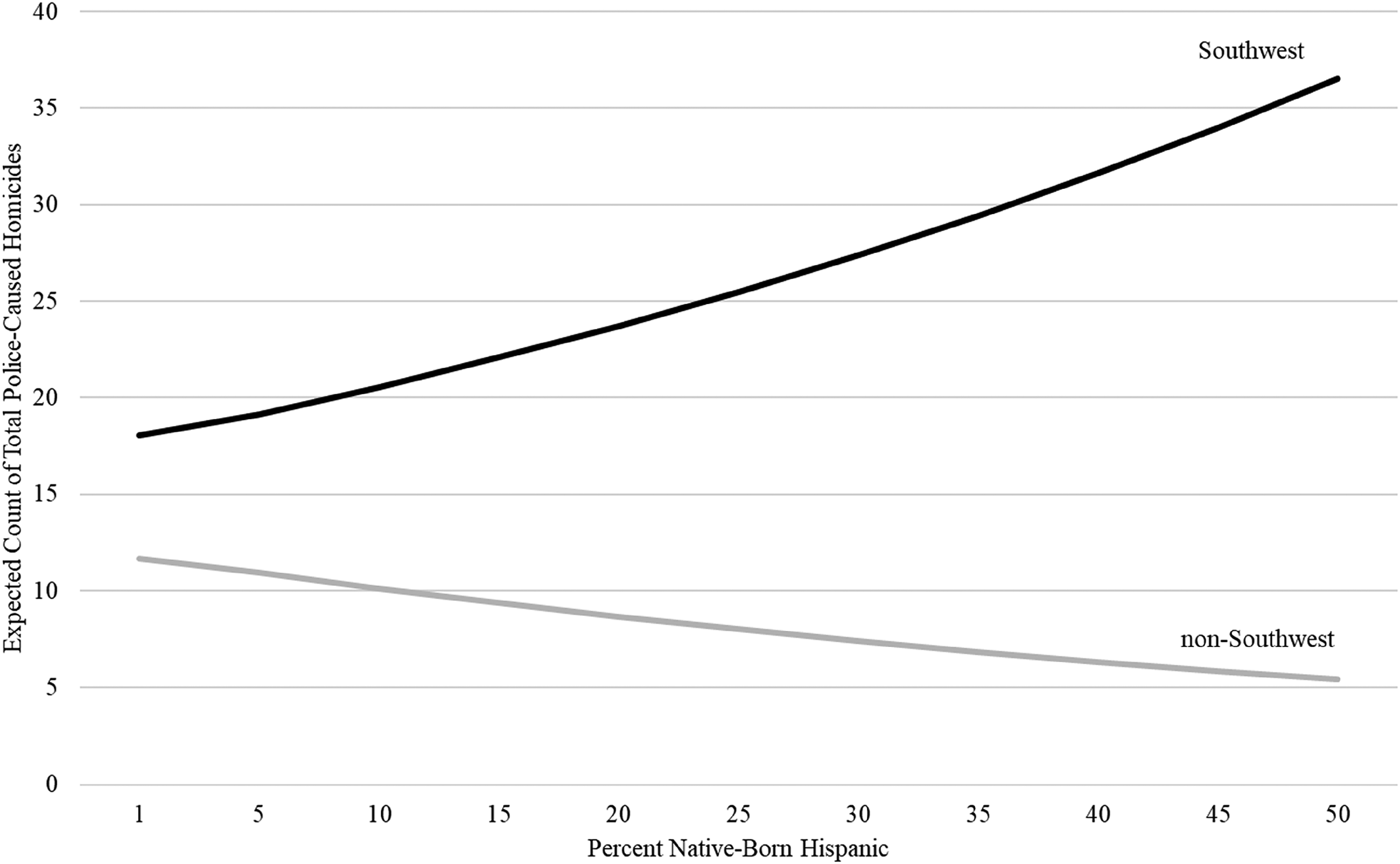
Expected counts of total police-caused homicides for the southwest and non-southwest by percent native-born Hispanic.
As shown in Appendix 2, percent foreign born and the Southwest by percent foreign-born interaction term were not statistically significant in this model, contrary to H4. Neither was the Southwest by Hispanic-White segregation interaction term statistically significant. Contrary to our prediction (H6), the relationship of segregation with police-caused homicide was not stronger in the Southwest than outside that region.
Hispanic Group-Specific Police-Caused Homicide
Table 2 presents the findings for the group-specific incidence of police-caused homicide of Hispanics. The findings under Model 1 show that the size of the Hispanic population had a statistically significant, positive relationship with the group-specific incidence of police-caused homicide. The change score (60.8) for this variable was the second largest in the model. The population density and the police diversity coefficients were not statistically significant. The only statistically significant community violence predictor was violent crime rate, which had the expected positive coefficient (H7).
Turning to the threat variables, percent Hispanic had a positive relationship with the group-specific incidence of police-caused homicide, contrary to our expectation (H1). The Southwest region and Hispanic-White segregation variables had the hypothesized positive relationships (H3 and H5, respectively). These variables had large change scores (74.7 and 58.1), with the Southwest score being the largest in this model.
Model 2 substituted percent native-born and percent foreign-born Hispanic for the total percent Hispanic variable. Percent foreign born was not significant. Percent native-born Hispanic had a positive relationship with this outcome variable, consistent with H2b. It appears that percent native-born Hispanic was driving the significant total percent Hispanic relationship observed in Model 1.
Model 3 includes a statistically significant interaction term, with non-significant terms presented in Appendix 2. Opposite the total police-caused homicide findings, there was no interaction between Southwest and percent native born, but there was for percent foreign born. Consistent with hypotheses (H4), the statistically significant coefficient for Southwest by percent foreign born was negative, but the nonsignificant coefficient for foreign born shows no relationship existed outside that region. These findings are depicted graphically in Figure 2. The expected count of police-caused homicide of foreign-born Hispanics was greater (by about 1) in the Southwest than the non-Southwest at the lower end of the foreign-born distribution. The region slopes converge slightly above 15%, after which the expected count of police-caused homicide of foreign-born Hispanics is lower in the Southwest than in the non-Southwest. As percent foreign born increases, so does the region gap. At 40% foreign-born Hispanic, there was almost 1 more police-caused homicide of Hispanics outside than in the Southwest.
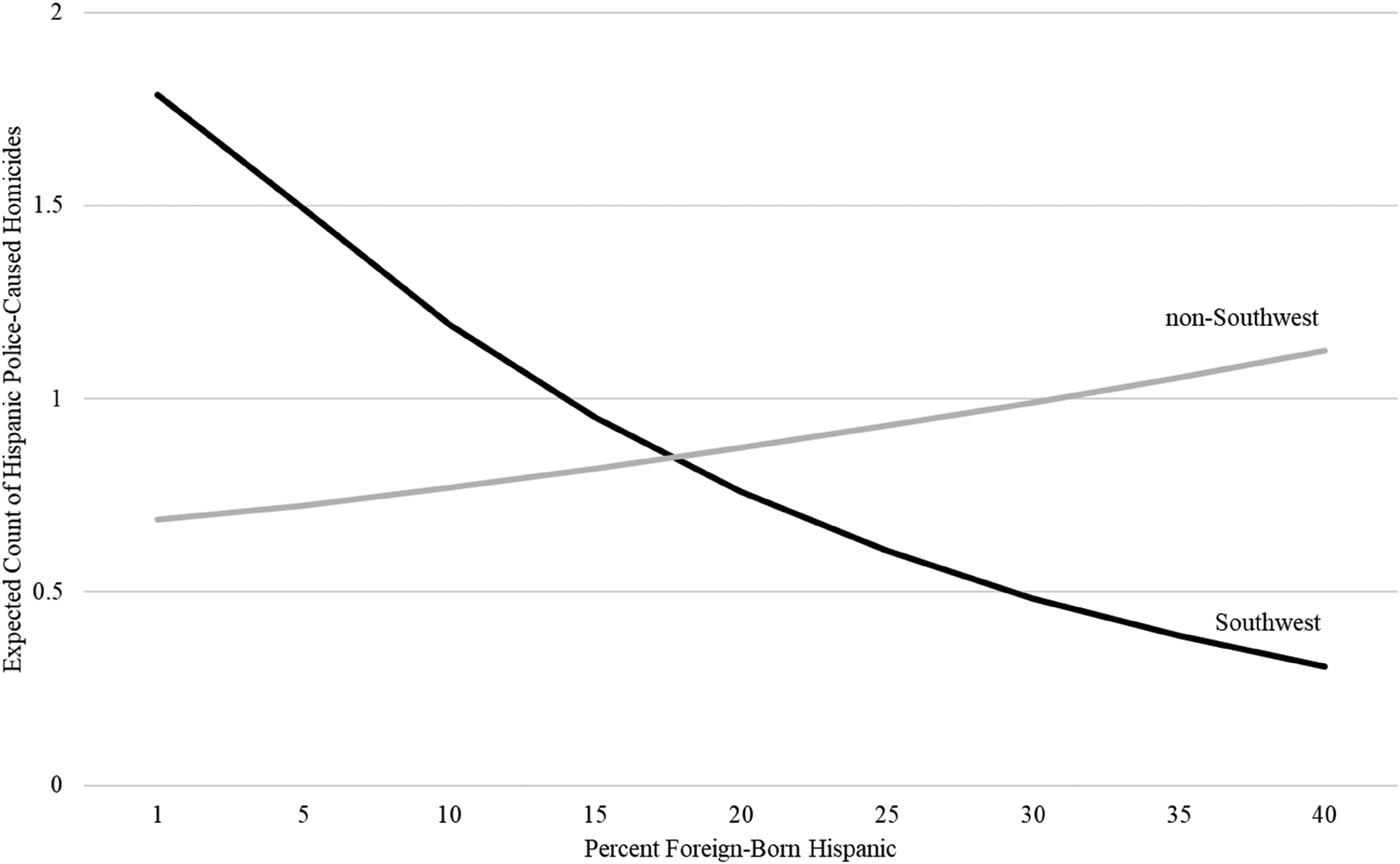
Expected counts of police-caused homicides of Hispanics for the southwest and non-southwest by percent foreign-born Hispanic.
As in the total incidence model, there was not a significant Southwest by Hispanic-White segregation interaction in the group-specific analysis. The segregation variable was, however, a powerful predictor of both total and group-specific police-caused homicide in both the Southwest and other regions, consistent with H5.
Discussion
This study seeks to advance knowledge about the relationships of Hispanic threat indicators with police-caused homicide. We build on past theory and research by elaborating the roles of region, nativity, and segregation as central indicators of Hispanic threat and adding multiple indicators of community violence. Following structural-level minority threat theory, we postulate that the composition of minority populations (e.g., Liska, 1992) and their spatial distribution within cities (e.g., Liska & Yu, 1992) and across regions (e.g., Hawkins, 1987) influence perceptions of Hispanic threat and, therefore, patterns of coercive crime control. Our findings accentuate the importance of examining how these characteristics of the Hispanic population are related with police-caused homicide, which has been largely ignored in past research. The findings contribute to the theoretical and research literature on race and coercive crime control in several ways.
Substantively, our results signal that region can have a central place in a research question, rather than being relegated to a control variable. Each of our analyses shows that there is a higher incidence of police-caused homicide in the Southwest. The concentration of foreign-born Hispanics and concern about the alleged crime problem among that population (Massey & Durand, 2016) may heighten police officers’ perceptions of danger in that region (e.g., Romero, 2000; Vega, 2022). Stereotypes of foreign-born crime are inaccurate, but nonetheless they may influence police officers’ street-level responses.
Moreover, the findings clearly support Hawkins’ (1987) argument that conflict theory research on racial disparities in criminal justice outcomes must consider moderating influences of region. The salience and prevalence of cultural biases conflating race and crime vary across regions. Here we see that there is an appreciably higher total incidence of police-caused homicide of native-born Hispanics in the Southwest compared with the non-Southwest at the higher end of the percent native-born distribution in our data. One explanation for this finding is that some younger members of second and later generations of Hispanics may perceive prejudice and discrimination that leads them to reject values and behaviors of the larger society and creates solidarity in opposition to the discrimination they experience (Portes & Rambaut, 2001). Police in southwestern cities may see the demeanor visibly manifested in this oppositional identity as evidence of gang membership and criminal proclivities (Durán, 2013, 2018; Rios, 2011, 2017). Although gangs are present in those cities, the majority of adolescents and young adults are not gang members. Yet, police may indiscriminately stereotype younger native-born Hispanics as if they were. Antagonistic police responses to those individuals may escalate tensions during street-level encounters, potentially increasing the likelihood of police-caused homicide occurring.
However, percent foreign born is negatively related to police-caused homicide in the group-specific analysis of Hispanics in the Southwest and unrelated outside that region. A plausible explanation of this pattern is that large foreign-born Hispanic populations in the Southwest (see Acosta & de la Cruz, 2011; Sáenz et al., 2024) pose less “cultural” threat compared to the much smaller foreign-born population in other regions (Chavez, 2020; Sáenz et al., 2024). Although intergroup tensions have long persisted in the Southwest, Mexican cultural traditions pervade day-to-day life in that region (McWilliams et al., 2016). These are far less familiar to those living outside the Southwest, where foreign-born Hispanics may receive a more contentious reception in newer migration destinations compared with traditional southwestern destinations that have large and stable foreign-born populations (Massey, 2008). Notably, stereotypes of and lack of English-language proficiency among the foreign born may complicate their interactions with police outside the Southwest, creating misunderstandings and fueling tensions (see Durán, 2012).
The lack of a percent foreign-born Hispanic relationship with both total and Hispanic incidences of police-caused homicide outside the Southwest was unexpected given the harsh political rhetoric identifying the foreign born as serious criminal threats (see, e.g., Flores, 2018; Martinez, 2002; Massey & Duran, 2016). However, police-caused homicide is likely influenced more by subjective and objective threats perceived by officers on the street than by political rhetoric (Holmes et al., 2019). Irrespective of region, the foreign born may avoid police and be cautious when interacting with them (e.g., Minjivar et al., 2018; Walker, 1997), and police stereotypes of foreign-born criminality may be challenged by the reality that foreign-born crime rates are low and the foreign born less confrontational during encounters with officers. These factors may help explain the lack of any relationship of percent foreign born with the total and Hispanic incidence of police-caused homicide. Although the foreign born may experience lesser abuses by officers (Durán, 2012), their demeanor is unlikely to trigger extreme police violence. Officers implicated in police-caused homicides involving questionable circumstances and allegations of unlawful behavior risk severe sanctions.
Additionally, this study shows that segregation is a central aspect of the Hispanic experience that influences street-level policing similarly across regions. The findings provide robust support for the place hypothesis that residential segregation of Hispanic (and Black) populations is central to the deployment of coercive strategies of policing (e.g., Holmes et al., 2019; Liska & Yu, 1992; Smith & Holmes, 2014). This hypothesis maintains that officers associate the disadvantaged neighborhoods of highly segregated cities with criminality, danger, and challenges to authority. The dynamics of intergroup encounters between police and citizens in such areas may heighten subjectively perceived threat among police officers and increase the likelihood of lethal police violence occurring.
Finally, this study makes a methodological contribution. Past tests of threat theory hypotheses about police-caused homicide have been called into question because they rely on SHR data (Klinger, 2012). However, the relationships of percent Black and Black-White segregation with total police-caused homicide reported here are analogous to those in a study using SHR data with similar models and an overlapping timeframe (Holmes et al., 2019). The results for Hispanics are less similar. Most notable is the finding for Hispanic-White segregation, which has no relationship with total police-caused homicide in the previous study and a positive relationship in this one. One reason for the different results may lie in the non-reporting of SHR data to the UCR by cities in Florida, some of which have relatively large Hispanic populations. The MPV data may provide more valid statistical estimates than the SHR in research that seeks to generalize to the entire U.S. Hispanic population.
Along with the contributions of this study, we also acknowledge its limitations pertaining to the study of Hispanic populations. One consideration is that estimates of the undocumented population for most of the cities used in this study do not exist, which makes it impossible to disentangle the relationships of the undocumented and lawful foreign-born populations with police-caused homicide at the city level of aggregation. The inability to identify the size of the undocumented population precludes any definitive conclusions about the relationship of the foreign-born Hispanic population with police-caused homicide at this time.
A related problem with measuring the Hispanic population is that available police-caused homicide datasets do not break down decedent identity by nationality. We are confident that findings for the Southwest reflect the greatly disproportionate representation of Mexican-origin people and their history with police discrimination in that region. We caution against conflating that population with other Hispanic nationalities outside the Southwest, where factors like greater Hispanic diversity may affect the relationship of percent Hispanic with police-caused homicide. Still, those of Mexican-origin comprise the majority of Hispanics in most non-southwestern states, and their presence certainly influences findings for that region.
Another important consideration is whether relationships of Hispanic threat variables with police-caused homicide have a temporal dimension, given the increase in the Hispanic population in recent decades. We aggregated the outcome variable because it captures a rare event (0.27 police-caused homicides of Hispanics per annum) over the limited number of years represented in the analytic sample, which makes a longitudinal analysis infeasible with MPV data. One potentially productive approach would involve employing a panel design that incorporates both cross-sectional and longitudinal dimension and uses SHR data over several decades, with predictor variables measured at the beginning of each decade and the total number of police-caused homicides for the first five years of each decade. However, researchers may confront reliability problems with SHR data, the only police-caused homicide data available for such an analysis, as well as inconsistent availability of certain predictor variables.
Conclusion
Despite being the largest minority population in the nation, Hispanics have received little consideration in research on police-caused homicide or the administration of justice more generally (e.g., Weitzer, 2014). This study points to the importance of considering how Hispanic nativity, Southwest location and residential segregation influence the incidence of police-caused homicide (and other police coercive crime control tactics) across cities. The nativity findings provide insight into how focusing solely on total percent Hispanic in a study may mask differences in native-born or foreign-born relationships with coercive control variables, as well as the ways these nativity variables may moderate the relationships of total percent Hispanic with the outcome variable. The interactions involving region and nativity highlight the significance of these factors, which play a central role in explaining patterns of police-caused homicide. The present study thus accentuates the importance of examining how unique characteristics of Hispanic population are related with coercive crime control, signaling the need for more nuanced conceptualizations of how structural factors shape street-level policing. This is especially true of Mexican-origin Hispanics, whose deep roots in the southwestern USA reflect their distinctive experience with socioeconomic disadvantage and violence at the hands of police.
While contributing to our understanding of how characteristics of the Hispanic population are related with patterns of police-caused homicide, the findings also have broader implications for minority threat theory. That perspective maintains beliefs of powerful groups, not just objective threats, are at the root of discrimination against certain minority groups (Blalock, 1967; Liska, 1992), which may help explain observed regional disparities in coercive crime control and other criminal justice outcomes. Relationships between threat indicators and these outcomes are not invariant; rather, they are contingent on beliefs common to certain geographical areas. Yet past police-caused homicide research treats region as a control variable without delving into its theoretical significance. In the Southwest, there are cultural, political, and historical patterns of settlement that remain deeply rooted and continue to shape beliefs about Hispanics (McWilliams et al., 2016). Those residing in different regions or are members of other racial/ethnic groups may have different experiences with policing, which requires relying on both minority threat theory principles about minority population composition/distribution and historical knowledge of various groups to develop testable hypotheses. Although our study advances knowledge about police-caused homicide of Hispanics, much remains to be learned about perceptions of threat and police use of violence in communities of color. We need more robust data and refined analyses to capture systematic structural variations in police responses to those communities.
Footnotes

Funding
The authors received no financial support for the research, authorship, and/or publication of this article.
Declaration of Conflicting Interests
The authors declared no potential conflicts of interest with respect to the research, authorship, and/or publication of this article.
Notes
Author Biographies
Negative Binomial Estimates for Total and Hispanic Police-Caused Homicides, including Southwest by Hispanic-White Segregation Interaction.
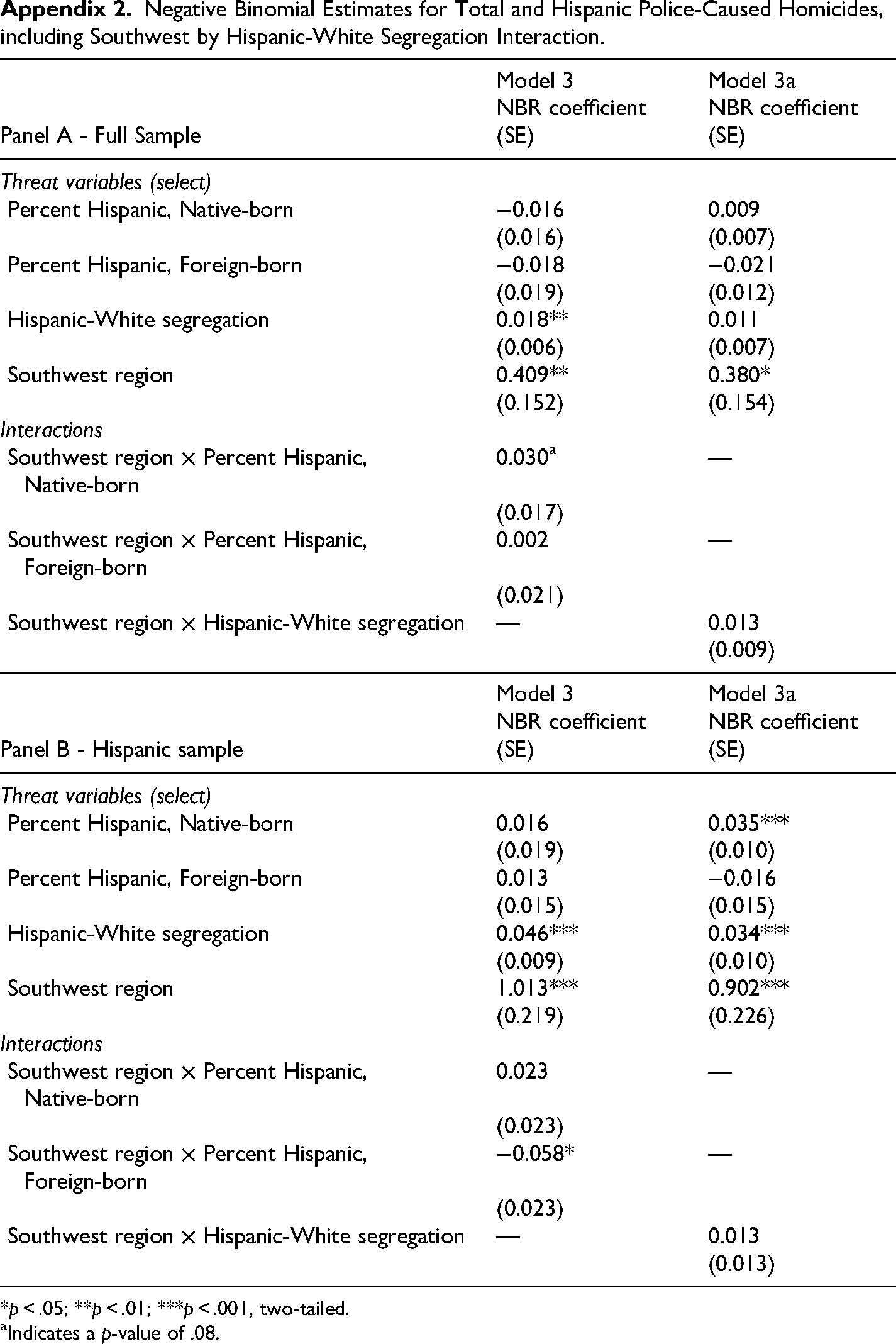
| Panel A - Full Sample | Model 3 | Model 3a |
|---|---|---|
| NBR coefficient (SE) | NBR coefficient (SE) | |
| Threat variables (select) | ||
| Percent Hispanic, Native-born | −0.016 | 0.009 |
| (0.016) | (0.007) | |
| Percent Hispanic, Foreign-born | −0.018 | −0.021 |
| (0.019) | (0.012) | |
| Hispanic-White segregation | 0.018** | 0.011 |
| (0.006) | (0.007) | |
| Southwest region | 0.409** | 0.380* |
| (0.152) | (0.154) | |
| Interactions | ||
| Southwest region × Percent Hispanic, Native-born | 0.030a | — |
| (0.017) | ||
| Southwest region × Percent Hispanic, Foreign-born | 0.002 | — |
| (0.021) | ||
| Southwest region × Hispanic-White segregation | — | 0.013 |
| (0.009) |
| Panel B - Hispanic sample | Model 3 | Model 3a |
|---|---|---|
| NBR coefficient (SE) | NBR coefficient (SE) | |
| Threat variables (select) | ||
| Percent Hispanic, Native-born | 0.016 | 0.035*** |
| (0.019) | (0.010) | |
| Percent Hispanic, Foreign-born | 0.013 | −0.016 |
| (0.015) | (0.015) | |
| Hispanic-White segregation | 0.046*** | 0.034*** |
| (0.009) | (0.010) | |
| Southwest region | 1.013*** | 0.902*** |
| (0.219) | (0.226) | |
| Interactions | ||
| Southwest region × Percent Hispanic, Native-born | 0.023 | — |
| (0.023) | ||
| Southwest region × Percent Hispanic, Foreign-born | −0.058* | — |
| (0.023) | ||
| Southwest region × Hispanic-White segregation | — | 0.013 |
| (0.013) |
*p < .05; **p < .01; ***p < .001, two-tailed.
Indicates a p-value of .08.