







Abstract
This study investigates racial disparities in specialty court participation in Indiana, focusing on drug, veterans, and reentry courts between 2013 and 2020. Using multilevel modeling and principal component analysis, results indicate that Black individuals are significantly underrepresented in drug courts and overrepresented in reentry courts relative to arrest rates and county demographic composition. Informed by Critical Race Theory and inhabited institutions perspectives, these patterns are interpreted as reflecting organizational and structural processes that shape access to specialty courts prior to case-level decision-making. Findings suggest that observed disparities in participation align more closely with institutional mechanisms that structure eligibility and access to specialty courts than with individual discretionary decisions alone. Policy implications point toward the importance of examining how referral systems, program capacity, and administrative practices may be unevenly structured across court types and jurisdictions. More broadly, the study highlights persistent structural inequalities in access to diversion and specialty court programs and points to the importance of institutional and longitudinal analyses of specialty court access.
Keywords
Specialty courts, or problem-solving courts, offer an alternative to traditional adjudication by addressing underlying factors contributing to criminal behavior, such as substance use, untreated mental illness, and domestic violence (Castellano & Anderson, 2013; Wolff, 2002). These courts emphasize rehabilitation over punishment, aiming to reduce incarceration, recidivism, and system costs while promoting community reintegration (Marlowe, 2011; Steadman et al., 2005). Common types include drug courts, mental health courts, reentry courts, and veterans’ courts, each targeting specific populations with distinct eligibility criteria and intervention strategies. Although all specialty courts share a common treatment-oriented approach, they vary in timing (e.g., pre- vs. postincarceration) and target demographics.
Despite being disproportionately affected by law enforcement practices that increase criminal justice involvement (Wolf, 2008), Black individuals are underrepresented in specialty court programs relative to their arrest rates (Steadman et al., 2011). Yet few studies have systematically examined how racial disparities vary across different specialty court models. Existing research suggests that eligibility criteria, referral pathways, and program design may unintentionally restrict access for high-need individuals of color (Huddleston & Marlow, 2011). Moreover, some specialty courts—particularly drug and veterans’ courts—are structured in ways that prioritize participants perceived as lower risk or more compliant, which may limit racial diversity in participation. Much of the current literature emphasizes program outcomes while paying less attention to how institutional arrangements and structural access mechanisms shape who is eligible to enter drug courts in the first place (Huddleston & Marlowe, 2011; Steadman et al., 2011).
To address these gaps, this study examines racial disparities in specialty court participation in Indiana. By comparing participant demographics aggregated across courts to local arrest rates, this analysis explores whether access to specialty courts reflects the racial makeup of those most frequently funneled into the criminal justice system. Ideally, participation rates should reflect arrest demographics to prevent exacerbating existing inequalities. Yet, prior research has demonstrated that compared to White individuals, Black persons face persistently lower referral, admission, and graduation rates in drug courts across jurisdictions, with disparities lasting over a decade (Cheesman et al., 2023). By highlighting potential barriers and areas of systemic inequality, this research aims to inform policy and practice to enhance equitable access and reduce disparities in the criminal justice system.
Literature Review
Mass incarceration has been a central concern within the US criminal justice system since the 1970s (Gottschalk, 2011), prompting the development of specialty courts as diversionary programs aimed at reducing incarceration and addressing underlying causes of criminal behavior (Winick, 2002). Specialty courts, which originated with juvenile courts in the late 19th century and evolved significantly with the establishment of the first drug court in 1989, aim to provide community-based treatment as an alternative to punishment (Nolan, 2002; Winick, 2002). Today, there are roughly 4,000 specialty courts nationwide, addressing issues like drug addiction, mental illness, and homelessness (Marlowe, 2011; Strong et al., 2016). However, disparities in participation persist, with racial and geographic factors influencing access and outcomes.
Funding Mechanism, Eligibility Constraints, and Disparities
Specialty courts rely on a mix of federal, state, and local funding, often with eligibility criteria tied to specific grants (Casey & Rottman, 2005). These criteria typically prioritize low-risk individuals, potentially excluding individuals who could benefit from diversion but do not meet the requirements (Sibley, 2021). Scholars note that such exclusions often arise by excluding participants with certain types of charges, such as those involving weapons, violence, or multiple prior offenses or from strict assessments of criminal risk (Huddleston & Marlowe, 2011; Lilley et al., 2019). Because Black individuals are disproportionately arrested for offenses linked to high-surveillance and high-violence environments, specifically drug distribution, weapon possession, and violent felonies (Gase et al., 2016; Tonry, 2010), these seemingly neutral criteria systematically reduce their eligibility for diversion programs. Because charges involving weapons or a history of violence often serve as automatic exclusions, these policing patterns effectively exclude many Black individuals from drug courts despite equivalent or greater treatment need.
Research shows that Black individuals, despite higher arrest rates, are underrepresented in drug courts compared to White individuals (Marlowe, 2011; Steadman et al., 2011).[9] In rural areas, limited resources further restrict access, disproportionately affecting Black communities (Wolf, 2008). These intertwined funding and eligibility structures often favor participants who present as more “compliant” or less system-involved—criteria that align more closely with White defendants and reinforce cumulative disadvantage for Black participants already overrepresented in arrest data. The complexities of eligibility criteria and resource allocation raise concerns about whether specialty courts are reinforcing existing racial disparities within the broader criminal justice system context.
Importantly, many specialty courts, especially drug treatment and reentry courts, are designed to serve individuals classified as high risk and high need due to their intensive treatment and ongoing supervision components (Marlowe, 2011; NADCP, 2013). However, when courts or funding agencies narrowly define “acceptable” high-risk profiles, they often exclude those with prior violent or weapons charges, leaving Black participants to remain systemically screened out at the front end (Lilley et al., 2019). This creates structural contradictions wherein courts intended to reach high-need participants may still service a disproportionately low-risk, less diverse population. Given that these courts are intended to prioritize such high-risk populations, Black individuals should theoretically comprise a sizable proportion of specialty court dockets.
Race and Specialty Courts
Although specialty courts encompass a range of models, much of the empirical literature documenting racial disparities has focused primarily on drug courts, with fewer studies examining variation across models with different eligibility structures, such as veterans’ or reentry courts. Available evidence suggests that while Black underrepresentation is a recurring theme in drug court research (Huddleston & Marlowe, 2011; Steadman et al., 2005, 2011), these patterns may not be uniform across other specialized models. For example, Morgan et al. (2016) found no significant differences in referral rates based on ethnicity, socioeconomic status, or attorney status within drug, driving while intoxicated, or reentry courts. This suggests that racial inequities may be tied to the specific programmatic requirements and exclusionary criteria of certain court models, such as the clinical focus of drug courts versus the supervision focus of reentry courts, rather than being a universal feature of all specialty court types.
Concerns have been raised by practitioners about the unintentional exclusion of minorities due to eligibility criteria (Lilley et al., 2019; Wolf, 2008) including by Robert Russell, founder of the Buffalo Drug Treatment Court and former chairman of the National Association of Drug Court Professionals (NADCP, now referred to as All Rise), and Dr Douglas Marlowe, also of the NADCP, both of whom emphasized the need to address these concerns. Research by Lilley and colleagues (2019) further highlights that drug courts might perpetuate past injustices from the War on Drugs by disproportionately excluding minority arrestees who do not meet eligibility criteria. Similarly, other studies have found that differences in criminal recidivism between White and non-White participants may reflect not only individual risk factors but also differential access to drug court itself. Screening criteria may exclude higher-risk non-White individuals from participation, thereby shaping both who gets into drug courts and who appears more “successful” postprogram (Gallagher et al., 2020). These findings support concerns that eligibility standards—though facially neutral—may inadvertently reinforce racial disparities in access and outcomes.
Theoretical Framework
This study conceptualizes access to specialty courts as shaped by organizational and structural processes that occur prior to individual case processing. Informed by Critical Race Theory (CRT) and inhabited institutions perspectives, access is situated within institutional mechanisms such as eligibility criteria, referral pathways, and county-level treatment capacity, which together structure who can be considered for diversion. These mechanisms limit which cases enter referral streams, which participants meet formal requirements, and which jurisdictions are positioned to support specialty court programming. Accordingly, racial disparities in participation may reflect broader organizational and structural constraints that unevenly distribute access across counties and court types. The present study therefore examines racial disparities in specialty court participation as the outcome of institutional access structures embedded within court systems.
Critical Race Theory
CRT emphasizes the structural forces within legal institutions that perpetuate inequality. CRT holds that race is not simply an individual trait but a socially constructed mechanism of power operating through ostensibly neutral legal rules, administrative categories, and institutional practices (Crenshaw, 1991; Delgado & Stefancic, 2017).
Racial disparities in specialty court participation emerge through institutional mechanisms that translate race into administrative criteria governing access to these programs, rather than through overtly race-based decision-making. Race becomes embedded within the neutral categories like risk level and program eligibility that are shaped by cumulative system contact, socioeconomic disadvantage, and differential enforcement patterns (Gase et al., 2016; Tonry, 2010). These categories function as racialized filters, determining which cases enter referral pathways and which participants meet formal eligibility thresholds before discretionary review occurs.
Geographic inequality further shapes access, as county-level variation in treatment capacity, court availability, and the concentration of available treatment and support services constrains diversion opportunities in ways that disproportionately affect Black communities (Casey & Rottman, 2005; Gase et al., 2016; Wolf, 2008). Funding structures and policy mandates often emphasize the diversion of low-risk, resource-stable individuals, which can unintentionally concentrate specialty court infrastructure in jurisdictions and populations already positioned to meet these criteria (Casey & Rottman, 2005; Huddleston & Marlowe, 2011; Marlowe, 2013). As a result, access to diversion is structured through institutional design, producing patterned differences in who encounters specialty courts early in the justice process and who is relegated to later-stage interventions.
Black individuals often have more extensive records, not from greater criminality but from systemic overpolicing, disproportionate surveillance, and differential prosecution (Gase et al., 2016; Tonry, 2010). Limited access to private counsel and weaker social supports further disadvantage them in prosecutorial and judicial decisions (Marlowe, 2013). These systemic inequities may be frequently misread as personal failings, reinforcing disparities in diversion decisions such as specialty court referral.
Inhabited Institutions Perspectives
The inhabited institutions perspective is a broader organizational framework, not developed specifically with specialty courts in mind. When applied to the criminal justice system (Ulmer, 2019), it offers a useful framework to understand how organizations function in practice, explaining how formal rules and policies governing specialty court access are enacted through organizational routines, formal and informal norms, and localized institutional practices rather than through isolated individual decisions. From this perspective, specialty courts are not neutral settings in which system actors exercise unfettered discretion. Instead, court norms and culture are produced through the interaction of participants and court actors, institutional roles, and organizational constraints that together structure how eligibility, referral, and access are enacted in practice. The theoretical implication is that disparities in specialty court participation arise from how institutions are collectively inhabited and operationalized, rather than from the cumulative effects of individual discretionary choices.
When considered alongside CRT, the inhabited institutions perspective helps explain how ostensibly race-neutral court structures can produce racially unequal participation patterns through their routine operation. Together, these frameworks direct attention away from individual-level decision-making by court actors and toward the organizational conditions and institutional arrangements that shape access to specialty courts across counties and court types. By locating disparities within institutional access structures rather than individual decision-making alone, this theoretical approach may be better positioned to inform lasting and effective reforms, as it targets the organizational conditions that systematically shape access across cases and jurisdictions.
Ray's (2019) theory of racialized organizations provides a useful bridge between these two frameworks. Ray argues that organizations are not race-neutral but are themselves racialized structures in which Whiteness is a credential that confers material and symbolic advantages, while racial categories become embedded in organizational rules, roles, and routines. Applied to specialty courts, this perspective suggests that the demographic composition of court actors (including judges, prosecutors, and court coordinators) is not incidental but is itself a structural feature that shapes how eligibility criteria are interpreted, referral decisions are made, and which participants are deemed suitable for diversion. From this vantage point, racial disparities in specialty court participation are not simply the aggregate effect of individual biases but are produced through organizations that are constitutively racialized in their design, staffing, and operation. The inhabited institutions perspective operationalizes this insight by directing attention to how these organizational characteristics are enacted through routines and norms in everyday court practice, while CRT situates these organizational dynamics within a broader legal structure that has historically concentrated power and resources around Whiteness. Taken together, these frameworks offer a multilevel account of how racial inequality in specialty court access is produced, reproduced, and potentially reformed through changes to the organizational conditions that govern diversion.
Current Study and Hypotheses
Building on this theoretical framework, this study examines racial disparities in specialty court participation in Indiana, focusing on drug, veterans, and reentry courts between 2012 and 2020. These court models were selected due to adequate sample size and distinct eligibility criteria, which may shape access differently across racial groups. They were examined separately to avoid masking court-specific patterns of access and disparity that may be obscured when specialty courts are treated as a single, differentiated category. Because the data are aggregated at the court and county levels, the analyses are designed to assess institutional patterns of access to specialty courts rather than individual-level discretionary decision-making.
Although all specialty courts aim to divert individuals from incarceration to treatment, they vary in timing, eligibility, and target populations. Drug courts typically operate preincarceration and screen for low- to moderate-risk individuals, criteria that often exclude high-need participants, including many Black participants (Huddleston & Marlowe, 2011). Veterans’ courts are limited to those with military service population whose racial composition differs from the broader criminal justice population; while the overall US veteran population is predominantly White, Black individuals represent approximately 13% of veterans (a proportion broadly similar to their share of the general population), though they remain underrepresented relative to their overrepresentation in the criminal justice system (Pew Research Center, 2023). In contrast, reentry courts function postincarceration and target high-risk individuals returning to the community. Given Black overrepresentation in prisons (Gase et al., 2016; Tonry, 2010), reentry courts may serve as later-stage intervention points for individuals excluded from earlier diversion opportunities.
Consistent with an organizational and structural approach to access, the following hypotheses focus on patterns of participation across court types.
H1: Black individuals will be underrepresented in specialty court participation relative to their arrest rates and residential population, reflecting structural constraints on access related to eligibility criteria.
H2a: Racial disparities in participation will be largest in drug courts, where early-stage intervention and restrictive eligibility criteria create greater structural barriers to access.
H2b: Racial disparities in participation will be attenuated in veterans’ courts relative to drug courts, reflecting the more proportionate representation of Black individuals within the veteran-eligible population and institutional eligibility requirements tied to military service, which replace the front-end drug court exclusions that most disadvantage Black defendants. Because Black individuals constitute approximately 13% of veterans (broadly proportionate to their share of the general population), eligibility barriers in veterans’ courts are less likely to produce systematic racial underrepresentation than the charge- and risk-based criteria of drug courts (Pew Research Center, 2023; Tsai et al., 2018).
H2c: Racial disparities in participation will be reduced or reversed in reentry courts, where access occurs later in the justice process and eligibility is less constrained by front-end screening.
The rationale for Hypotheses 2a–c draws on empirical trends and theory indicating that early diversionary courts serve lower-risk, White participants, while later-stage interventions are more accessible to individuals with deep system involvement (Huddleston & Marlowe, 2011; Steadman et al., 2011). From a CRT perspective, these patterns reflect cumulative disadvantage, whereby early exclusion compounds over time and limits access to diversionary opportunities (Delgado & Stefancic, 2017; Tonry, 2010).
Methodology
The data for this study were obtained from the Indiana Office of Judicial Administration, covering certified specialty courts between 2013 and 2020. Indiana specialty courts must complete a certification process to receive grant funding, ensuring adherence to evidence-based practices and standardized reporting procedures. This certification requirement creates a natural boundary for our analysis, as certified courts represent those operating under established best practices and receiving state oversight.
Of the specialty courts operating in Indiana during this period, our dataset captures 99 unique certified specialty courts, representing approximately 69% of the 143 total certified specialty courts documented in Indiana as of 2023. 1 This sample selection has important implications for our findings. Certified courts may differ systematically from uncertified courts in terms of resources, training, adherence to best practices, and participant demographics. Certified courts typically serve higher-risk populations and must meet specific performance standards, which may influence both referral patterns and racial composition. Specifically, performance standards tied to graduation rates, recidivism outcomes, and program completion metrics may incentivize courts to select participants who are more likely to succeed by these measures, which can inadvertently favor lower-risk, more resourced participants—characteristics that skew White in the context of cumulative criminal justice disadvantage. Such standards may therefore narrow the referral pool and reduce the racial diversity of participants who are formally admitted to certified courts. While this limitation constrains generalizability to all specialty courts in Indiana, it ensures that our analysis focuses on courts operating under standardized procedures and evidence-based practices, making comparisons across court types more meaningful.
Annually, all certified specialty courts in Indiana report aggregate-level information about participants, ensuring confidentiality while providing essential demographic and operational data. Our longitudinal dataset spans 2013 to 2020 and includes 613 court-year observations from the 99 unique specialty courts across 56 Indiana counties. It is important to note that these 613 observations represent multiple years of data from individual courts rather than 613 distinct courts. Within this dataset, seven specialty court models were included: drug and alcohol treatment, veterans, reentry, mental health, juvenile, domestic violence, and family dependency drug courts.
Due to small sample sizes that would limit statistical power and reliable estimation, our analytical sample focuses on three court types with sufficient observations: drug and alcohol treatment courts (51 courts providing 337 court-year observations), veterans’ courts (15 courts providing 138 observations), and reentry courts (13 courts providing 72 court-year observations). This yields a final analytical sample of 547 court-year observations across 79 unique specialty courts. The remaining 66 court-year observations from 20 additional specialty courts (representing mental health, juvenile, domestic violence, and family dependency drug courts) were excluded due to insufficient data.
An important limitation of our analysis is the absence of charge-level data distinguishing between felony and misdemeanor cases. Most specialty courts focus primarily on nonviolent felony offenses, while our arrest comparison data includes all offense levels, including misdemeanors and traffic violations. This measurement misalignment may partially explain observed disparities, as Black individuals may be disproportionately represented in lower-level offenses that do not meet specialty court eligibility criteria. Future research should incorporate offense-specific data to more accurately align comparison groups and isolate racial disparities net of legal eligibility requirements.
Despite these limitations, certified courts provide the most systematic and reliable data available for examining racial disparities in specialty court participation across Indiana. The courts in our sample operate under standardized reporting protocols and evidence-based practices, making them representative of best practices in the field.
Dependent Variable
Our analysis employs separate binary logistic regression models for each court type. The dependent variable in each model is binary, indicating whether a court is of a specific type (1) or not (0). This approach allows for more precise examination of factors associated with each court type while avoiding the complexity of multinomial modeling that could obscure court-specific patterns.
Independent Variables
The primary predictor variables are county-level arrest rates (percentage of Black individuals arrested) and court-level participation rates (percentage of Black court participants).
Supplementary Data Sources and Variables
Supplementary data on county-level racial composition and arrest statistics were collected to provide contextual measures. Racial composition data, specifically the percentage of Black residents in each county, were sourced from the US Census Bureau's Population and Housing Estimates Program. Arrest data, including the percentage of Black and White individuals arrested, were obtained from the Indiana Arrest Information Dashboard, managed by the Management Performance Hub in collaboration with Indiana State Police.
Demographic information on judges and prosecutors was collected from official listings, including the Indiana Prosecuting Attorneys Council's “Find Your Prosecutor” page and state court directories. Race and sex were determined through observational coding of official government biographies, professional photographs, and public records. To ensure accuracy, demographic data were validated across multiple platforms, including Google, LinkedIn profiles, government websites, news articles, and election records. Data were validated against official sources whenever possible, with government biographies and court records prioritized over secondary sources. The research team categorized race into Black and White identities, as no other racial categories were identified within the target sample of officials. Coding was verified by the principal investigator through periodic spot checks of the data to ensure consistency and descriptive accuracy. Judge sex and judge race were coded at the individual judge level and subsequently aggregated to the county level by computing the proportion of male judges and White judges, respectively, within each county for each year. Similarly, prosecutor sex was aggregated to the county level. These county-level averages were then merged with the court-year dataset for use as covariates in the regression models.
Control Variables
Socioeconomic and demographic variables were selected based on prior research linking economic opportunity, education, and health to criminal justice involvement and court access (Fajnzylber et al., 2002; Holzer et al., 2006; Lochner & Moretti, 2004). These variables serve as structural correlates rather than mediators, included to control for variation in opportunity structures that may confound relationships between race, arrest rates, and court participation. All control variables are measured at the county level, consistent with the county-level structure of the primary outcome and predictor variables in this study.
Health-related variables, including the percentage of individuals reporting poor health, acknowledge the well-established association between physical and behavioral health disparities and justice system contact (Vaughn et al., 2012). Geographic variation in court access was addressed by including a rural–urban classification, as courts in rural counties often face resource constraints that may limit specialty court capacity or eligibility (Weisheit et al., 2005).
To capture structural inequality, we included measures of racial and economic segregation (Massey, 1990; Peterson & Krivo, 2010), the percentage of multiracial residents, and the Gini coefficient as an indicator of income inequality. These factors contextualize participation trends within broader patterns of racial stratification and economic exclusion that may affect specialty court eligibility, referral, and outcomes. Together, these variables provide a multidimensional view of the community and structural factors that may influence both arrest rates and court participation, particularly across racial groups. These data were sourced from the Joint Economic Committee's Social Capital Project, 2 the statistics on all variables are detailed in Appendix A.
Principal Component Analysis
Preliminary diagnostics revealed a high correlation between county-level percentage of Black residents and percentage of Black arrests (r = .90). To address multicollinearity, we employed principal component analysis to create a composite variable (Arrest_County (pca)) capturing shared variance between these measures. The first principal component explained 95% of the total variance and was used in all models as a unified measure of county-level Black demographic and arrest context.
Analytical Strategy
This study employs a two-stage analytical approach using multilevel modeling to account for the hierarchical structure of courts nested within counties and repeated observations over time. In the first stage, paired t tests were conducted to examine whether Black individuals are underrepresented in specialty courts relative to their representation in county populations and arrest rates; these tests establish baseline disparities and provide justification for subsequent regression analyses. In the second stage, rather than employing multinomial logistic regression, we conducted separate binary logistic regressions for each court type (drug, veterans, reentry) to identify factors associated with higher Black participation rates within each model, with the primary analysis employing standard logistic regression. The models take the form:

Results
We begin with descriptive analysis, including the examination of court type distributions and racial participation patterns across different court models. Table 1 presents descriptive statistics for all variables included in the analysis. The sample comprises 613 court observations, with drug courts representing the majority (55.0%), followed by veterans’ courts (22.5%) and reentry courts (11.7%). Black participation in specialty courts averages 12.5% (SD = 18.6%), substantially lower than Black representation in county arrest populations (19.0%, SD = 14.3%) but higher than Black representation in county demographics (7.3%, SD = 7.6%).
Descriptive Statistics.
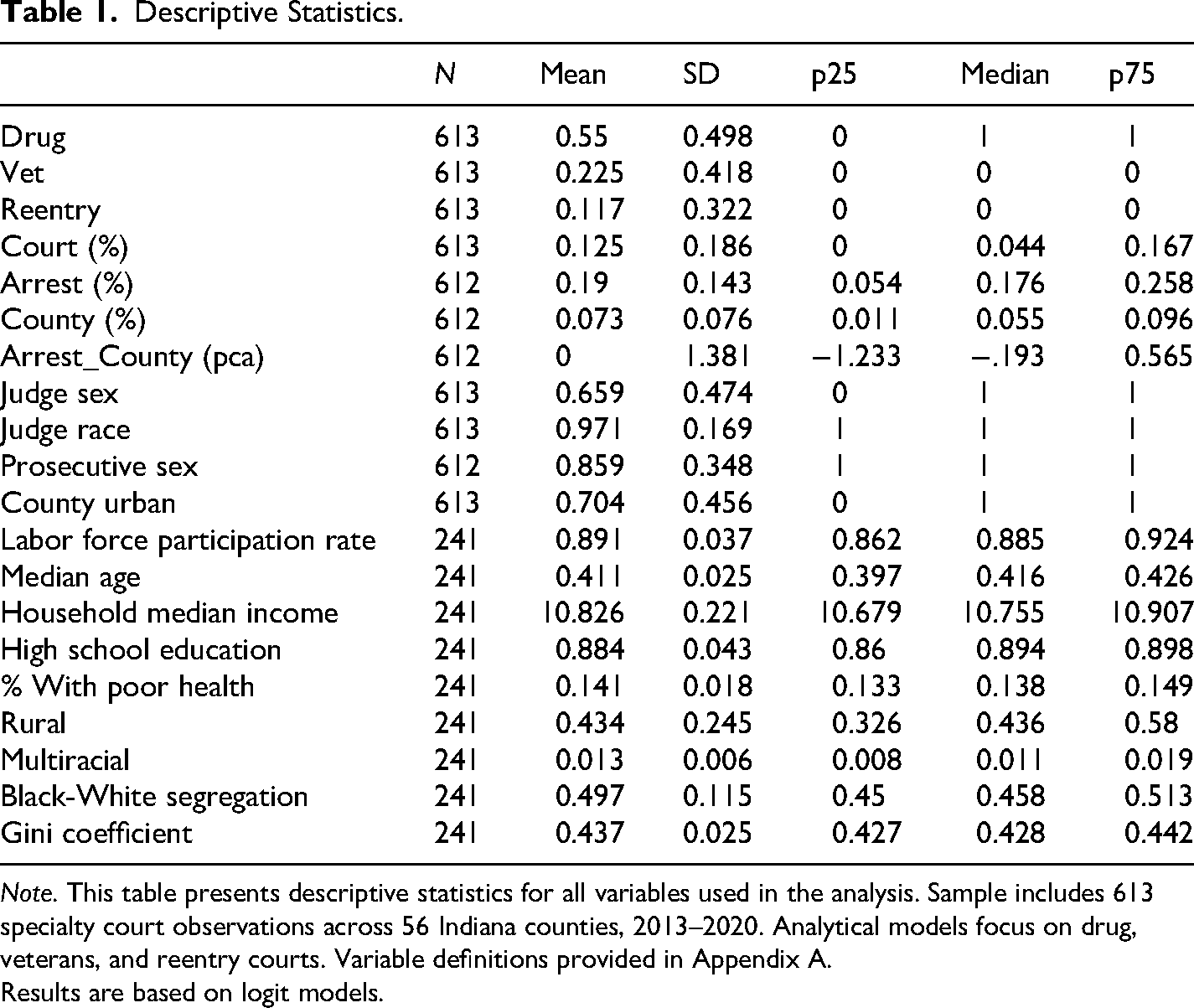
Note. This table presents descriptive statistics for all variables used in the analysis. Sample includes 613 specialty court observations across 56 Indiana counties, 2013–2020. Analytical models focus on drug, veterans, and reentry courts. Variable definitions provided in Appendix A.
Results are based on logit models.
A visual analysis of the data reveals important patterns in Black participation across court types (Figure 1). Drug courts show the most variation in Black participation rates, with a right-skewed distribution indicating that while most drug courts have relatively low Black participation, some courts serve substantially higher proportions of Black participants. Veterans’ courts demonstrate more consistent participation rates across jurisdictions, with less variability than drug courts. Reentry courts, despite having the smallest sample size, show notably higher average Black participation rates with considerable variation across jurisdictions.
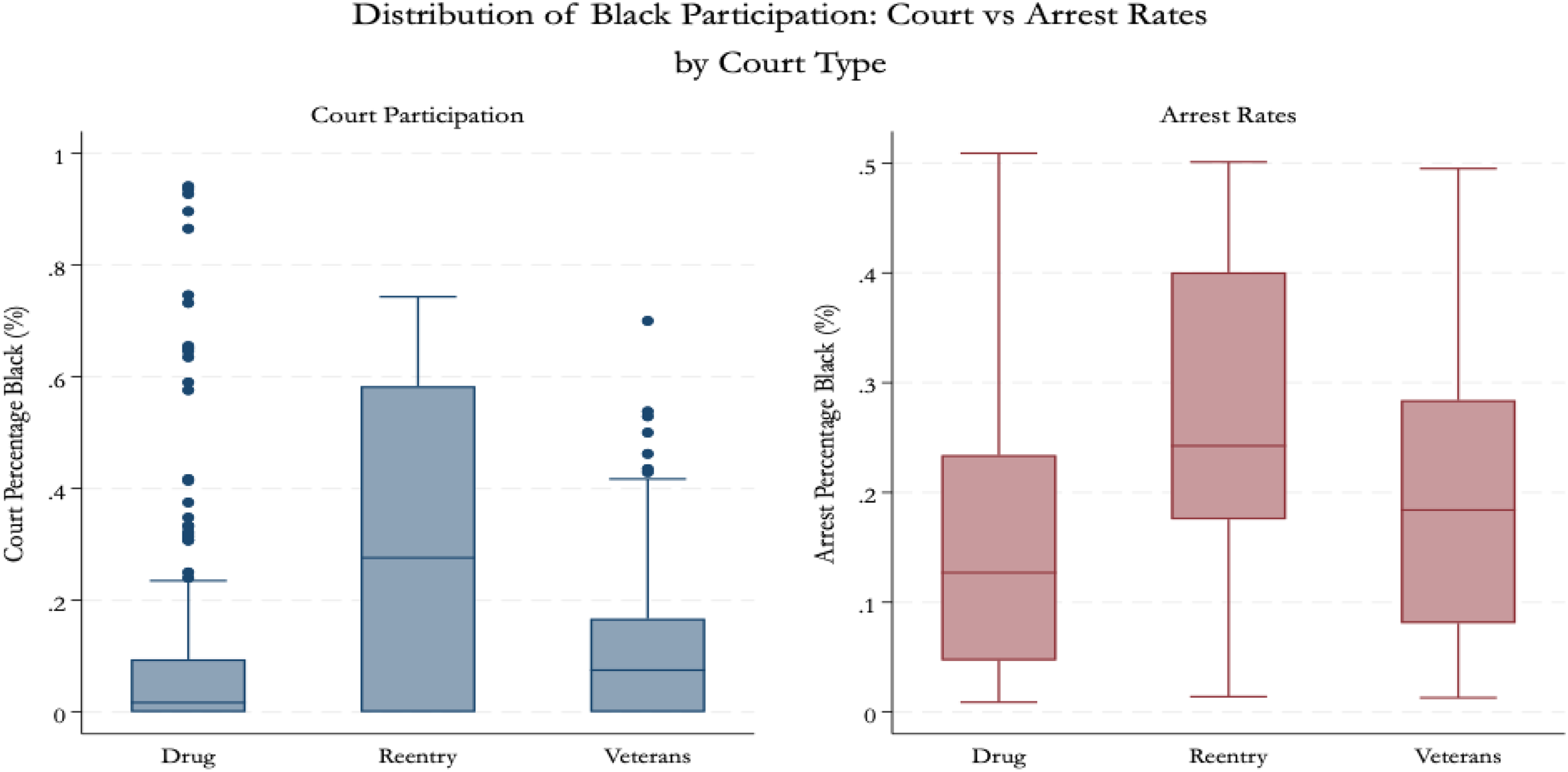
Participation rate and by court type. Note. This figure shows the distribution of Black participation rates across specialty court types using box plots. Sample includes 613 specialty court observations across 56 Indiana counties, 2013–2020.
Figure 2 presents mean Black participation rates by court type with 95.0% confidence intervals, providing statistical precision to these descriptive patterns. Veterans’ courts show the lowest mean Black participation (approximately 13.0%), followed by drug courts (14.0%), while reentry courts demonstrate significantly higher participation (approximately 31.0%). The confidence intervals reveal important differences: reentry courts have both higher means and wider intervals, reflecting both elevated participation and greater jurisdictional variation. Drug courts show moderate participation with relatively tight confidence intervals, while veterans’ courts demonstrate consistent but lower participation across jurisdictions.
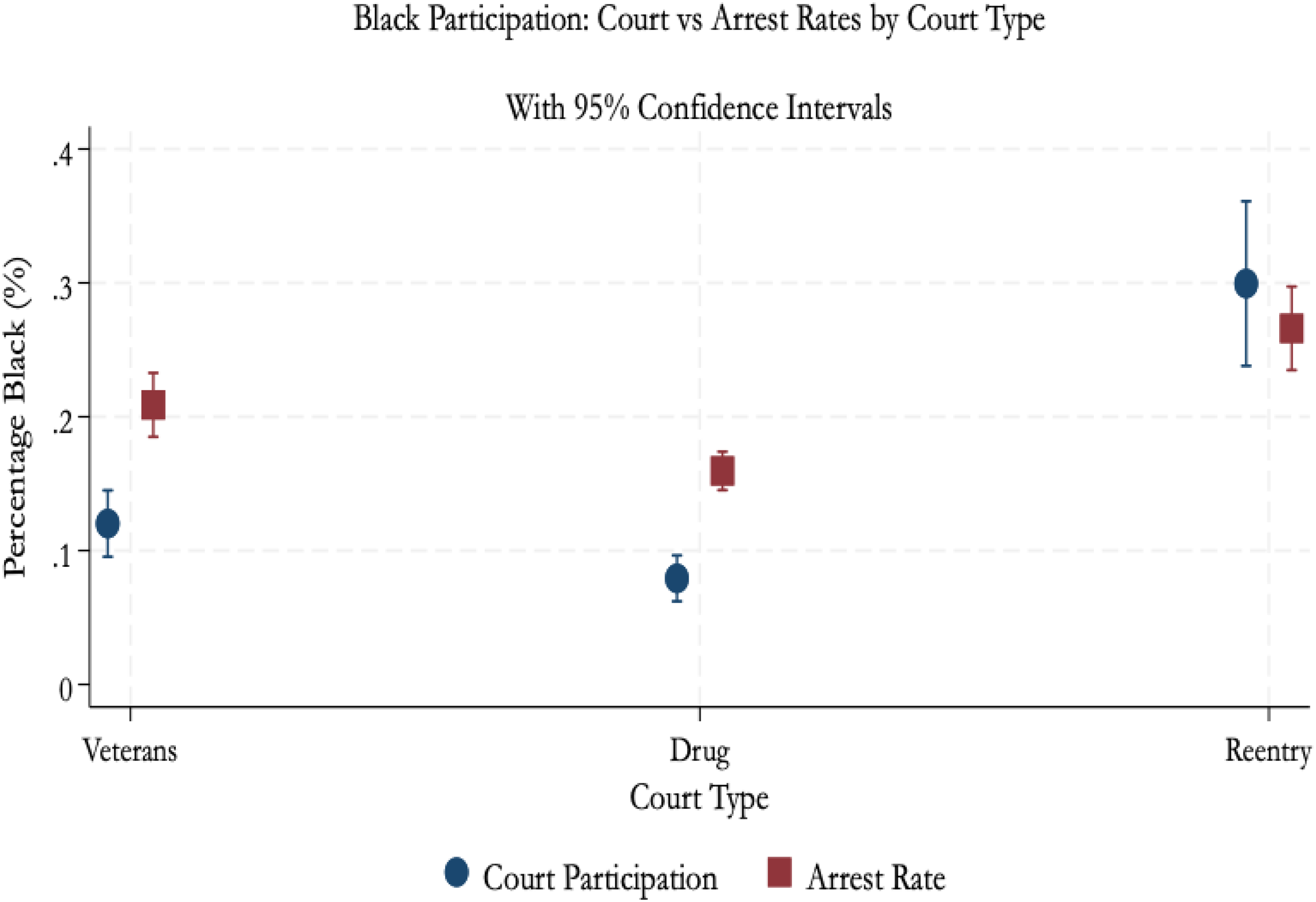
Participation rate with 95% confidence interval and by court type. Note. This figure presents mean Black participation rates by court type with 95% confidence intervals. Sample includes 613 specialty court observations across 56 Indiana counties, 2013–2020.
Paired T-Test Results
Paired t tests confirmed significant racial disparities in specialty court access (Hypothesis 1). Black individuals comprise a significantly higher proportion of specialty court participants than their representation in county populations (t = 8.18, p < .01) but remain significantly underrepresented relative to their proportion among arrestees (t = −10.03, p < .01). These findings indicate that while specialty courts serve Black individuals at rates exceeding their general population representation, substantial gaps remain relative to their representation in the criminal justice system.
Regression Results
These models reveal distinct patterns consistent with Hypotheses 2a, 2b, and 2c. Table 2 presents baseline results examining the relationship between Black court participation, arrest rates, and county demographics across court types. Panel A examines interactions between court and arrest variables, while Panel B explores relationships with county demographics and the principal component variable.
Baseline Results with No Controls.
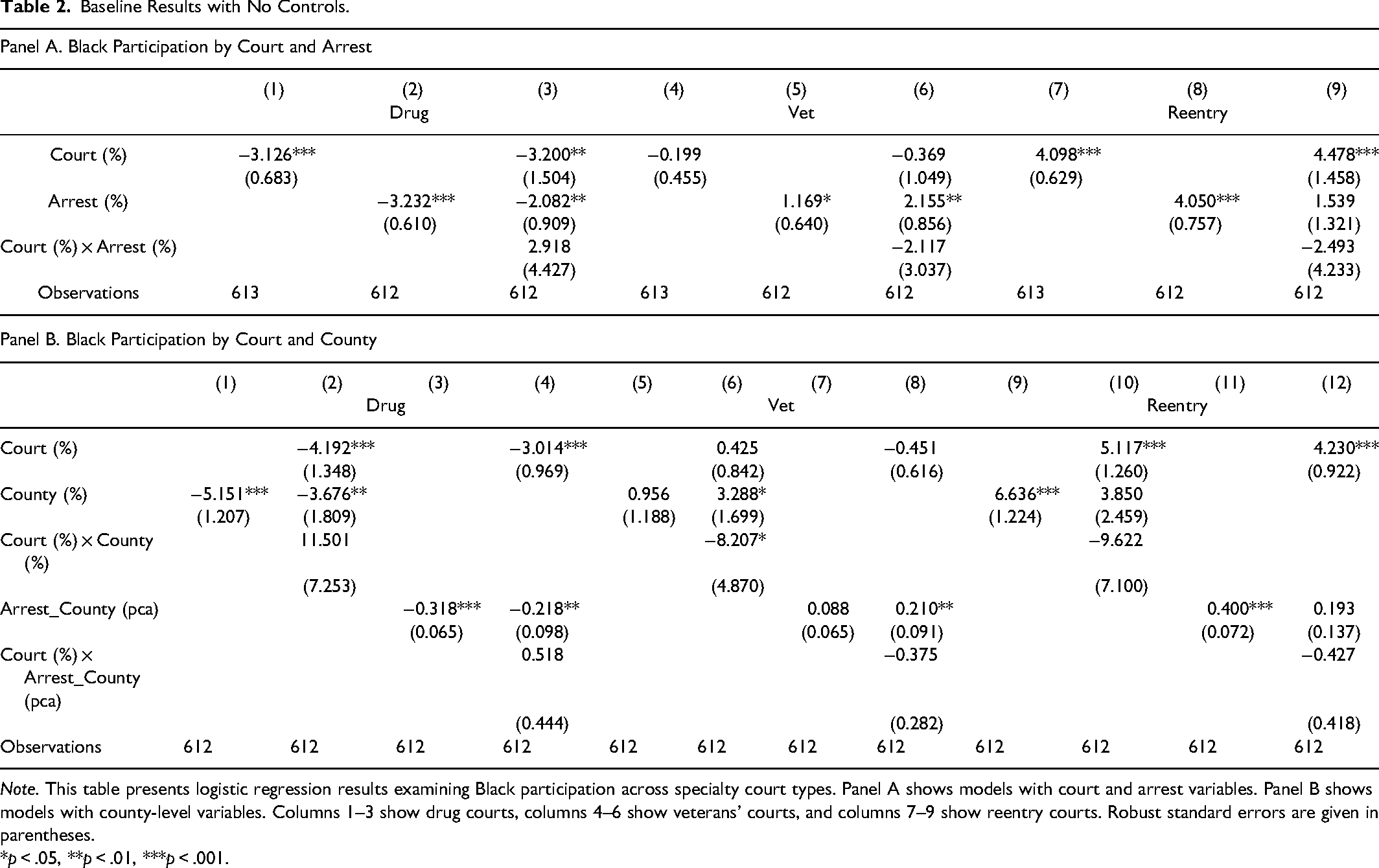
Note. This table presents logistic regression results examining Black participation across specialty court types. Panel A shows models with court and arrest variables. Panel B shows models with county-level variables. Columns 1–3 show drug courts, columns 4–6 show veterans’ courts, and columns 7–9 show reentry courts. Robust standard errors are given in parentheses.
*p < .05, **p < .01, ***p < .001.
For drug courts (Columns 1–3), court (%) shows a negative coefficient (
Additionally, there is a strong negative association between Black arrest rates and Black drug court participation (
While we find no evidence between court (%) participation rate and veterans’ courts (Columns 4–6), we find a positive association between arrest rates and veteran court participation (
For reentry courts (Columns 7–9), both variables show strong positive associations. Court (%) demonstrates a substantial effect (
Panel B examines relationships with county-level Black population (county (%)) and the principal component variable (Arrest_County (pca)). For drug courts, county (%) shows a strong negative association (
Robustness Checks
To ensure the reliability of our findings, we conducted robustness checks using alternative estimation approaches, specifically maximum likelihood estimation with hierarchical models that account for the nested structure of courts within counties. The general form of a linear mixed-effects model is:
These mixed-effects model results are presented in Appendix B and remained consistent with our main findings, confirming the stability of our conclusions across different analytical approaches. The mixed-effects models show similar directional effects and significance patterns, though with smaller coefficient magnitudes due to the inclusion of random effects that account for county-level clustering.
Full Models with Controls
Table 3 presents results including comprehensive set controls for judicial characteristics, socioeconomic conditions, and structural factors. These models test whether the observed racial disparities persist after accounting for potentially confounding variables and help isolate the independent effects of race-related factors on specialty court participation. Particularly, several coefficients change signs between model specifications, reflecting the complex relationships between judicial, socioeconomic, and racial factors.
Results with Controls.
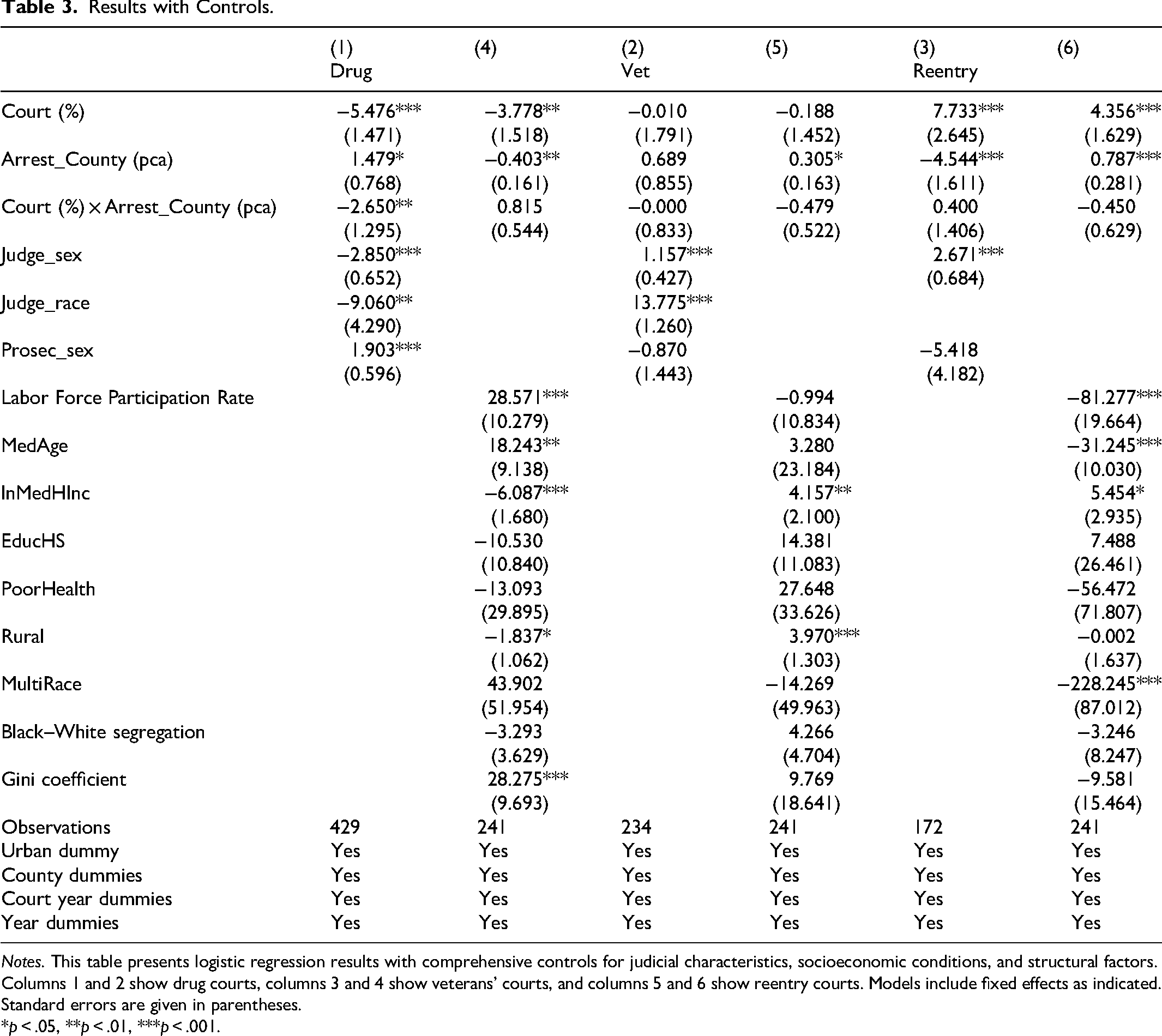
Notes. This table presents logistic regression results with comprehensive controls for judicial characteristics, socioeconomic conditions, and structural factors. Columns 1 and 2 show drug courts, columns 3 and 4 show veterans’ courts, and columns 5 and 6 show reentry courts. Models include fixed effects as indicated. Standard errors are given in parentheses.
*p < .05, **p < .01, ***p < .001.
Drug Courts
Court (%) maintains its negative association (
Participation patterns varied across courts with different institutional compositions; courts with male judges show substantially lower Black participation (
Veterans’ Courts
Court (%) coefficients remain consistently near zero across specifications, while Arrest_County (pca) maintains positive associations but with varying significance. White judges are associated with significantly higher Black participation (
Reentry Courts
Court (%) maintains strong positive associations (
Discussion
These findings provide new insights into racial disparities in specialty court participation in Indiana, demonstrating that access to diversionary programs varies systematically across court types. By examining drug, veterans, and reentry courts separately, the analysis reveals distinct racial patterns of participation, with Black individuals underrepresented in drug courts and overrepresented in reentry courts. Although these court types serve different populations and operate under distinct eligibility criteria, the observed patterns suggest that access to diversion is structured through institutional design rather than uniform court processes. These findings must also be considered in light of national efforts to monitor and address racial disparities in specialty court access.
Prior research has produced mixed evidence regarding racial disparities in specialty court access, underscoring the importance of examining court models separately. For example, Morgan et al. (2016) reported no significant differences in referral rates by race or socioeconomic status across drug, driving while intoxicated, and reentry courts, whereas earlier work by Steadman et al. (2005) documented an overrepresentation of White participants in mental health courts. Taken together, this mixed evidence reinforces the need to examine specialty courts by model, as disparities appear to emerge through institutional access structures, including eligibility criteria, referral pathways, and administrative capacity, rather than through uniform or case-level decision-making. While the hypotheses tested here emphasize eligibility as a primary access mechanism, the findings indicate that eligibility operates alongside referral practices and county-level capacity constraints.
National oversight bodies have issued guidance aimed at monitoring and addressing these inequalities. In 2010, the NADCP issued a resolution directing courts to monitor racial and ethnic disparities, followed by best practice standards requiring annual assessment and reporting (NADCP, 2013, 2015). Despite these directives, few courts systematically analyzed such data (Marlowe et al., 2016), and when disparities are identified, they are frequently attributed to race-correlated characteristics like education, substance use severity, or criminal history rather than to institutional design or access structures (Dannerbeck et al., 2006). This pattern has limited meaningful reform efforts and underscores the need for empirical evaluations that examine whether racial disparities in specialty court participation have diminished over time or persist despite national guidance.
The underrepresentation of Black participants in drug courts aligns with prior research indicating that eligibility criteria often prioritize low-risk individuals, who are more likely to be White (Casey & Rottman, 2005; Steadman et al., 2011). This pattern persists even after controlling for county demographics and arrest rates, suggesting that disparities reflect court-specific institutional processes rather than case-level variation (Burke & Leben, 2007; Steffensmeier et al., 1993). Variation in participation is also associated with judicial and prosecutorial demographics, indicating that institutional composition and organizational context shape how access to diversion is structured and patterned across court types. For example, counties with higher proportions of male and White judges were associated with lower Black participation in drug courts, while the presence of White judges was positively associated with Black participation in veterans’ courts. The divergent direction of the White judge effect across court types warrants further explanation. In veterans’ courts, where eligibility is tied to military service rather than charge-based exclusions, the organizational context differs fundamentally from drug courts. Veterans’ courts in counties with predominantly White judges may operate in jurisdictions with well-developed veterans service infrastructures (outreach programs, Veterans Affairs partnerships, and specialized prosecutors) that simultaneously produce more White-dominated judiciaries and more robust identification of Black veterans for diversion. Under an inhabited institutions framework, this would mean that the organizational routines governing veteran identification and referral in these counties are structured to actively include eligible veterans regardless of race, with the demographic composition of judges reflecting broader institutional capacity rather than individual judicial orientation toward racial equity. From a CRT perspective, this does not signal the absence of racial structure but may instead reflect context-specific eligibility criteria that shift the locus of racial filtering away from charge-based exclusions and toward service-access barriers that remain unmeasured in the current data. From a CRT perspective, these patterns more broadly reflect how ostensibly neutral legal structures and institutional arrangements can produce racialized outcomes through their design and implementation, rather than through explicit racial intent (Crenshaw, 1991; Delgado & Stefancic, 2017; Tonry, 2010). Addressing these disparities therefore requires attention to structural features of court access, including eligibility criteria, referral processes, and broader organizational contexts, rather than focusing solely on individual-level decision-making.
Economic variables, such as labor force participation and median age, significantly affected access to drug courts, indicating that socioeconomic stability plays a role in court accessibility (Casey & Rottman, 2005; Wolf, 2008). This suggests a need for targeted policy interventions aimed at increasing economic opportunities and access to drug courts in affected areas, such as expanding treatment capacity in underresourced counties, revising funding formulas that prioritize low-risk participants, and reducing financial or logistical barriers to program participation. Prior research on specialty courts highlights how funding structures, eligibility criteria, and treatment capacity shape access and participation (Casey & Rottman, 2005; Gallagher et al., 2023; Huddleston & Marlowe, 2011). Specifically, grant-based funding mechanisms often restrict eligibility to participants who meet narrow risk profiles, reducing access for high-need individuals with more extensive criminal histories; inadequate treatment capacity in underresourced counties limits the number of participants courts can serve, generating selection pressure toward lower-risk individuals more likely to complete the program; and eligibility criteria anchored to charge type, risk score, or substance use classification can function as racialized filters that systematically exclude Black defendants whose criminal histories reflect cumulative overpolicing rather than greater underlying risk. The positive association between high school graduation rates and participation in veterans and reentry courts, contrasted with drug courts, further points to educational inequities affecting court engagement, contributing to broader systemic barriers faced by Black communities (Cheesman et al., 2023; Gase et al., 2016; Tonry, 2010).
The overrepresentation of Black participants in reentry courts may reflect systemic barriers preventing effective diversion at earlier stages of the criminal justice process, consistent with the concept of cumulative disadvantage (Elek & Hannaford-Agor, 2020; Gase et al., 2016; Tonry, 2010) and broader patterns of racialized incarceration in the United States, where Black Americans are incarcerated at rates nearly five times that of White Americans (as cited in Gallagher et al., 2023). Although our data alone cannot establish causality, the negative relationship between the composite racial-arrest variable and drug court participation suggests that counties with higher Black populations and arrest rates face structural or policy barriers limiting equitable access. These patterns are consistent with CRT's emphasis on structural racism embedded in legal processes (Delgado & Stefancic, 2017). From this perspective, the underrepresentation of Black individuals in drug courts reflects institutionalized barriers to early diversion, while their overrepresentation in reentry courts may signal delayed intervention, where treatment is only made available after incarceration.
Supporting this interpretation, prior research found that non-White participants had 51.0% lower odds of graduating from a specialty court program compared to White participants (specifically within drug court programs); however, this disparity disappeared when variables such as substance use, mental health, and criminal history were included in the model (Shannon et al., 2018). While this could suggest that race is not an independent predictor, many of these factors are themselves shaped by structural disadvantage. From a CRT perspective, such findings demonstrate how racially neutral variables can obscure the cumulative effects of racism. Thus, nonsignificant racial effects in adjusted models should not be misinterpreted as evidence of equity.
The positive relationship between income inequality and drug court participation, although counterintuitive, could indicate that broader economic disparities are driving criminal justice trends rather than ensuring equitable diversion (Gase et al., 2016; Tonry, 2010). Further research is needed to understand how economic inequality shapes racial disparities in court participation, though. Additionally, people residing in rural areas had less access to drug courts compared to those in cities (Casey & Rottman, 2005; Wolf, 2008). This suggests that both the features of the courts and the conditions in each county play a role in determining who gets diverted to drug courts. This points to the need for policies that consider both individual needs and broader system issues to ensure fair access to these courts.
Veterans’ courts did not show significant racial disparities in participation, suggesting more balanced access. However, models controlling for county-level factors revealed a positive and significant relationship between veterans’ courts and larger Black populations, implying that these courts might be more prevalent in areas with larger Black communities (Tsai et al., 2018). While this balance suggests fewer disparities in access, it does not inherently confirm equity in terms of access; potential barriers like access to supportive resources during court processes were not measured in this study. Future research should explore whether any unmeasured barriers affect participation in these courts. Such barriers may include geographic distance from veterans affairs facilities that support court programming, differential access to veterans-specific legal representation, informal screening by prosecutors or coordinators based on offense type, stigma or distrust of court-mandated treatment programs, and intersecting disadvantages of race and military discharge status (e.g., other-than-honorable discharges, which disproportionately affect Black veterans, may limit eligibility for VA-based support services that undergird veterans’ court programming).
Policy Implications and Practice
The study's findings underscore the need for reforms to eligibility criteria, referral processes, and funding structures to improve racial equity in drug and reentry courts. The underrepresentation of Black participants in drug courts raises concerns about equitable access to diversion (Lilley et al., 2019), while their overrepresentation in reentry courts warrants examination of whether this pattern reflects differential need or the reproduction of structural inequalities later in the justice process (Campbell, 2015; Steffensmeier et al., 1998).
Improving access requires institutional reforms targeting front-end screening mechanisms. Standardizing eligibility criteria, prioritizing defendants with the greatest socioeconomic disadvantage (e.g., those facing poverty, housing instability, or unemployment) who may benefit most from diversion but are currently screened out by charge-based or risk-based eligibility thresholds, prioritizing needs assessments over risk assessments, clearly documenting referral pathways, and routinely reviewing referral and admission decisions by race (meaning that court administrators, certification bodies, and funding agencies should systematically collect and analyze referral and admission data disaggregated by race, identify stages where racial disparities emerge, and use these findings to trigger targeted adjustments to eligibility criteria, referral training, or prosecutorial guidelines) represent concrete steps toward reducing unequal access across court types (Marlowe, 2013; Sibley, 2021). While individual-level training initiatives may complement these efforts, the findings suggest that significant reductions in racial inequity are more likely to result from changes to institutional rules and structures than from reliance on individual discretion.
Funding structures also shape access. Federal, state, and local funding mechanisms frequently prioritize low-risk participants, systematically excluding marginalized individuals with complex legal histories—often those most in need of diversionary alternatives (Casey & Rottman, 2005). Revising funding criteria to expand treatment capacity in underresourced counties may therefore be essential for increasing access to drug courts. Although equity-oriented reforms may face political resistance, framing these changes around evidence-based outcomes, such as reduced recidivism, cost savings, and improved community safety, may offer a pragmatic pathway for advancing more inclusive specialty court practices.
Collectively, these interventions fall to state court administrators, specialty court teams, and funding agencies responsible for program oversight and certification. By directly targeting eligibility rules, referral pathways, and county-level capacity constraints, such reforms align policy efforts with the institutional mechanisms driving racial disparities in specialty court participation.
Theoretical Implications
This study's findings offer empirical support for CRT in explaining how racial disparities in specialty court participation emerge through institutional access structures rather than individual case-level decision-making. Conversely, the overrepresentation of Black individuals in reentry courts aligns with CRT's emphasis on structural disadvantage and cumulative exclusion, whereby individuals screened out of earlier diversionary options are more likely to encounter intervention only at later stages in the justice process.
The observed effects of socioeconomic variables, including income inequality, labor force participation, and education, further underscore how broader structural conditions shape access to diversion and perceptions of eligibility. These factors reflect patterns formed of racialized economic exclusion that disproportionately affect Black communities. While this study does not test a formal mediation model, these variables are theoretically grounded in both CRT and inhabited institutions perspectives, signaling how ostensibly neutral social and economic conditions intersect with institutional access mechanisms to shape who is considered eligible for diversion programs.
Together, the findings highlight that disparities in specialty court participation are produced through the interaction of institutional design, organizational context, and broader structural inequalities rather than through isolated discretionary decisions. Addressing these disparities therefore requires a multilevel reform agenda that prioritizes standardizing referral and eligibility criteria, expanding access for high-risk individuals currently excluded from early diversion, and confronting socioeconomic conditions that funnel Black individuals into later-stage interventions. These reforms are critical to ensuring that specialty courts fulfill their promise as equitable alternatives to incarceration.
Areas for Future Research
To address persistent disparities in access to specialty courts—particularly drug courts—future research should conduct comprehensive reviews of eligibility, referral, and treatment processes. Consistent with Ulmer's (2019) call for greater integration between research on institutional interpretations of formal rules and studies of aggregate outcomes, future work should take on qualitative and mixed-methods approaches to bridge analyses of court actors’ perspectives with patterns observed in population-level data. Such research is essential for understanding how discretionary access outcomes are jointly produced through interactions among court actors and institutional contexts rather than attributable to isolated decision-makers.
Other research is also needed to examine how institutional roles vary across court type, eligibility rules, and referral pathways to shape access to specialty courts. Priority should be given to analyses using individual-level data that trace the trajectory from arrest through referral and acceptance into specialty courts. Such research is essential for determining whether Black individuals are disproportionately excluded at earlier stages due to restrictive eligibility criteria or discretionary processes that cannot be examined with aggregate data. Following individuals across these stages can help pinpoint where disparities emerge and which institutional actors contribute most to inequitable outcomes.
In addition, qualitative studies with judges, prosecutors, and court coordinators could provide deeper insight into the rationale underlying referral and eligibility decisions, particularly in jurisdictions without standardized criteria. Future studies should also examine intersectional patterns like how race, gender, and socioeconomic status interact to shape referral, eligibility, and participation. These analyses require individual-level data capable of capturing overlapping identities and experiences that aggregate data cannot reveal.
While this study focused on aggregate patterns at the court and county levels, subsequent research should identify the mechanisms driving racial disparities by examining variation across court types, offense categories, or judicial demographics using detailed administrative datasets. Comparative studies across jurisdictions with different eligibility frameworks or longitudinal designs tracking changes before and after policy reforms may offer further insight into how court design and implementation affect equitable access to diversion.
Recent scholarship offers concrete guidance for operationalizing these reforms. For example, work on procedural fairness in specialty court selection emphasizes the importance of transparent eligibility criteria and clearly documented referral processes to reduce patterned forms of exclusion embedded in institutional selection processes (Sibley, 2021), while applied tools such as the Racial Ethnic Disparities Program Assessment Tool provide courts with structured mechanisms to audit referral, admission, and participation patterns and identify points where disparities emerge (Gallagher et al., 2023).
Limitations
Several limitations should be considered when interpreting these findings. First, the use of aggregated court- and county-level data limits the ability to directly observe the organizational processes through which access to specialty courts is structured. While the analysis identifies patterns of participation across court types and counties, it cannot empirically account for how eligibility criteria, referral pathways, or institutional routines operate within individual courts. Second, the aggregated nature of the data precludes examination of within-court variation, including differences across individual cases or changes in access patterns over time within the same jurisdiction. As a result, the findings reflect institutional patterns of access rather than case-level dynamics. Finally, the data do not allow for direct observation of referral pathways, including which eligible cases were not referred or where potential participants exited the diversion process. Future research using case-level or qualitative data could more directly examine how organizational practices and institutional arrangements shape access to specialty courts.
Footnotes
Acknowledgments
We would like to acknowledge the Indiana Office of Judicial Administration for providing the initial waves of data at no cost and for facilitating continued access across several years. We appreciate institutional support for funding additional data acquisition and PhD student Allica Campos for her contributions to the supplemental data. We also acknowledge the use of ChatGPT-4, which was employed solely for grammar, editing, and improving the flow of the manuscript text.

Funding
The authors received no financial support for the research, authorship, and/or publication of this article.
Declaration of Conflicting Interests
The authors declared no potential conflicts of interest with respect to the research, authorship, and/or publication of this article.
Notes
Author Biographies
Appendix A. Social Capital Project Variable Statistics.
All control variables were obtained from: https://www.jec.senate.gov/public/index.cfm/republicans/socialcapitalproject
Variable
Definition
Labor force participation rate
The percentage of the working-age population that is either employed or actively seeking work.a
Median age
The median age of the population
Household median income
The income level at which half of the households in a county earn more, and the other half earn less.
High school education
% adults graduated high school
% With poor health
The proportion of individuals in a county reporting that their health is either “fair” or “poor."
Rural
Areas classified as rural typically have lower population densities and are outside urbanized areas or clusters.
Multiracial
The percentage of the population identifying as being of two or more races.
Black–White segregation
A measure of the degree of separation or concentration of Black and White populations in different areas within the county.
Gini coefficient
A measure of income inequality within a county. Values range from 0 (perfect equality) to 1 (maximum inequality).
pcaBLK
A principal component analysis was conducted to create a composite variable (pcaBLK, based on the scores of the first component) that captures the shared variance between these two measures.
Appendix B. Mixed-Effects Model Results.
*p < .05, **p < .01, ***p < .001.
(1)
(2)
(3)
(4)
(5)
(6)
(7)
(8)
(9)
Drug
Vet
Reentry
Court (%)
−0.506***
−0.536***
−0.230***
−0.005
0.620***
0.416***
(0.086)
(0.181)
(0.065)
(0.140)
(0.072)
(0.157)
Arrest (%)
−0.502***
−0.281
−0.328***
−0.138
0.438***
−0.024
(0.169)
(0.186)
(0.108)
(0.128)
(0.117)
(0.140)
Court (%) × Arrest (%)
0.222
−0.607
0.648
(0.544)
(0.417)
(0.467)
Observations
613
612
612
613
612
612
613
612
612
Number of groups
56
56
56
56
56
56
56
56
56
Random-effects parameters
Yes
Yes
Yes
Yes
Yes
Yes
Yes
Yes
Yes