







Abstract
Despite substantial evidence disproving a link between immigration and crime, news media frequently suggest otherwise. As one of the most widely consumed sources of crime information, local television news can play a crucial role in shaping these narratives. While prior research has documented the medium's tendency to overrepresent racial minorities as perpetrators of violent crime, less is known about how immigrants are depicted in local television crime coverage or how these portrayals have evolved amid shifting political discourse on immigration. We conducted a content analysis of a nationally representative sample of local television newscasts of immigrant-involved violent crime aired between 2008 and 2018 to assess how immigrants are portrayed in this coverage. Our findings reveal a persistent pattern of asymmetrical representation where immigrants are depicted as perpetrators nearly three times as often as they are portrayed as victims—a disparity that widened significantly after 2014. Coverage more frequently emphasized the undocumented status and Latin American origin of perpetrators than of victims. The pronounced rise in portrayals of undocumented perpetrators coincided with escalations in anti-immigrant rhetoric that began during the 2016 presidential campaign, suggesting a convergence between media framing and political discourse.
Introduction
Public fears about immigration and crime persist, despite decades of empirical evidence demonstrating no meaningful link between the two (Ousey & Kubrin, 2018). One likely reason for this disconnection lies in the media's tendency to associate immigration with crime (Chavez, 2008; Farris & Silber Mohamed, 2018). News coverage has long served to construct and amplify narratives of immigrant criminality, shaping public understandings that diverge from reality. These characterizations have far-reaching consequences, reinforcing anxieties about immigration and bolstering support for punitive policy responses (Atwell Seate & Mastro, 2016; Figueroa-Caballero & Mastro, 2019). Yet we know far less about how these narratives are reproduced through routine, incident-based crime coverage that features prominently in everyday news consumption.
Local television news is a key site for examining mediated constructions of immigrant criminality, yet the nascent body of research on immigration and crime coverage has focused on print media (e.g., Harris and Gruenewald 2020; Harris et al., 2021). This is a critical omission. While it's prominence has declined in recent years with the rise of online news sources and social media, local television remains one of the most widely consumed sources of local news in the U.S. (Shearer et al., 2024; Wenger & Papper, 2018). Further, crime coverage dominates local television news, and has an outsized influence on individuals’ fear of crime (Beckett, 1994; Chiricos et al., 1997; Elchardus et al., 2008). This coverage tends to paint a particular picture of crime—one that characterizes it as violent and perpetrated by racial or ethnic minorities (Gilliam & Iyengar, 2000). Through episodic storytelling, local television news can amplify broader social anxieties within concrete and salient crime events. Such coverage may extend familiar immigration-crime narratives by portraying immigrants as perpetrators rather than victims and emphasizing markers such as national origin or legal status, which are imbued with racialized meaning (Dixon & Williams, 2015).
This study extends research on the cultural typification of crime coverage and scholarship on immigration discourse by examining how local television news portrays immigrants in violent crime reporting. We examine whether immigrant threat narratives are reflected in incident-level crime coverage by analyzing a nationally representative sample of violent crime stories involving immigrants aired between 2008 and 2018. Using a content analysis of closed captions, we assess both the frequency and framing of these portrayals—specifically, whether immigrants are depicted as perpetrators or victims and how references to nationality and legal status figure into these representations. By tracing patterns of coverage across a decade of heated political contestation over immigration, we show how local news content symbolically defines who is dangerous and who deserves sympathy. In doing so, we illustrate how media contribute to the production and reinforcement of social boundaries that can legitimize exclusionary policies in the name of public safety.
Conceptual and Empirical Foundations
News media play a powerful role in shaping public opinion, from signaling which issues matter to shaping how those issues are understood. The issues that media outlets decide to cover give audiences a sense of what is important, urgent, and worthy of their attention (McCombs & Shaw, 1972). This process, referred to as agenda setting, is especially evident in coverage of immigration and crime, which tends to intensify during periods of heightened political salience or in response to high-profile incidents of crime committed by undocumented immigrants (Harris & Gruenewald, 2020; McBeth & Lybecker, 2018). Yet media does more than merely convey what is worthy of focus; it also shapes how these issues are understood and interpreted. By selecting and emphasizing specific aspects of an issue while omitting or downplaying others, media outlets offer interpretations that define problems, diagnose causes, and present solutions (Entman, 2004). Such framing can operate subtly, through the selective inclusion of information rather than explicit claims, and is especially influential when audiences have little direct experience with an issue. Immigration and crime are areas in which firsthand exposure is limited for many people, increasing the influence of mediated information in shaping how these issues are understood.
The framing power of media is especially consequential in the context of immigration, where coverage frequently associates the topic with crime. Despite substantial evidence showing that immigrants are no more likely—and often less likely—to commit crimes than U.S.-born individuals (Ousey & Kubrin, 2018), news narratives routinely frame immigration as a public safety concern. Content analyses of print news coverage, from national newspapers (Chavez et al., 2010) to regional and local outlets (Brown et al., 2018; Harris et al., 2021; Young et al., 2021), consistently find crime to be one of the most prevalent topics in coverage of immigration. Rather than treating crime as a single, undifferentiated category, Harris and Gruenewald (2020) examined the specific ways outlets characterized the immigration-crime link. Analyzing eight nationally prominent newspapers, they found that nearly half of all articles employed a “criminogenic” frame—depicting immigrants as crime-prone, describing crimes committed by immigrants, or linking immigration to higher crime. Other common frames presented immigrants as crime victims (24%) or characterized undocumented immigration as a crime itself (12%). 1 Over time, criminogenic frames have become more common, while portrayals of immigrants as victims have declined (Gonzalez O’Brien et al., 2019; Harris & Gruenewald, 2020; Young et al., 2021). These narratives carry significant social consequences, as negative frames have been shown to heighten public anxiety and reduce support for immigration (Boomgaarden & Vliegenthart, 2009; Eberl et al., 2018; Ramakrishnan et al., 2016).
While prior research has primarily examined crime as a frame for immigration coverage in print media, far less attention has been paid to how immigration becomes a salient characteristic within crime stories themselves—particularly in local television news. Although its prominence has declined with the rise of online sources, local television news remains widely consumed (Shearer et al., 2024; Wenger & Papper, 2018) and powerfully shapes public understanding of crime and safety (Baranauskas & Drakulich, 2018; Callanan, 2012; Chiricos et al., 1997), making it a critical site for understanding how immigrant criminality is constructed through routine media storytelling. Crime coverage dominates local television news lineups (Klite et al., 1997) and often follows a “script” that emphasizes violent offenses, in which perpetrators and victims are typically identified or characterized within stories (Peelo, 2006), with people of color disproportionally portrayed as perpetrators (Dixon & Linz, 2000; Entman & Rojecki, 2001; Gilliam & Iyengar, 2000). While these patterns reflect organizational routines and editorial values (Scheufele, 1999), they are reinforced by newsroom incentives that favor stories that attract viewers and are relatively easy to produce. Violent crime stories meet both criteria as they are newsworthy and readily sourced from criminal justice organizations, which simplifies reporting and lowers production costs (Chermak, 1994).
Beyond organizational pressures, crime coverage also reflects and reinforces broader social hierarchies. Local television news, in particular, amplifies racialized fears by disproportionately portraying Black and Latino individuals as perpetrators of violent crime rather than victims (Chiricos & Eschholz, 2002; Dixon & Linz, 2000). These portrayals contribute to what Gruenewald et al. (2009) term “cultural typification,” where media rely on and reproduce familiar stereotypes that cast people of color as threats and non-minorities as victims. This dynamic also informs “ideal victim” stereotypes (Christie, 1986). While women are often viewed as more vulnerable and thus more newsworthy victims (Chermak, 1995), this presumption applies predominately to White women, who are more likely to be portrayed as innocent and sympathetic (Gilchrist, 2010; Slakoff & Brennan, 2023). By contrast, Black and Latina women tend to be depicted unsympathetically or blamed for their victimization (Slakoff & Brennan, 2019, 2023), reinforcing racialized tropes that undermine their recognition as legitimate victims. Immigrant legal status may further compound this exclusion because dominant “ideal victim” scripts hinge on notions of innocence and deservingness that media discourse often denies to undocumented immigrants (Flores Morales & Farago, 2021). In this way, crime reporting not only reflects existing social hierarchies but also actively reproduces them, reinforcing distinctions between those constructed as threatening and those recognized as legitimate victims.
Although not all immigrants are ethnic minorities, public discourse in the U.S. has racialized immigration by linking it to Latino identity and by constructing undocumented status as a racialized condition disproportionately associated with Mexican and Central American populations (Benson, 2013; Chavez, 2008; De Genova, 2004; Menjívar, 2021; Silber Mohamed & Farris, 2020; Sohoni & Sohoni, 2014). These associations partly reflect demographic realities, as nearly 95% of immigrants originate from outside Europe—more than half from Latin America—and over a quarter lack legal status, most of whom are Latin American (Kramer & Passel, 2025; Passel & Krogstad, 2025). That is, national origin and legal status function as racialized cues that shape how immigrants are represented in the media. Immigrants from Latin America—and Mexico in particular—are frequently singled out in political rhetoric and news stories that conflate immigration with criminality, while undocumented immigrants are portrayed not merely as outsiders but as inherently lawbreaking and threatening (Harris & Gruenewald, 2020). Just as race operates as a visual shorthand for danger, undocumented status evokes similar anxieties and is commonly linked with Latino ethnicity in media and political discourse (Chavez, 2008; Dixon & Williams, 2015; Pérez, 2016). By racializing both immigrant identity and legal status, public discourse extends the symbolic boundaries of threat, embedding these associations within routine media narratives.
Racialized and status-based distinctions of immigrants became especially salient at key moments between 2008 and 2018, a period marked by heightened political conflict over immigration. In 2010, Arizona passed SB 1070, which sought to expand state and local authority to enforce immigration law. Although legal challenges prevented most aspects of the legislation from taking effect, the law—and copycat measures it inspired—reflected a growing tendency among policymakers to frame undocumented immigration as a public safety concern. These themes resurged in 2015 with the launch of Donald Trump's presidential campaign, which built on these narratives by linking immigration—particularly from Mexico—to crime and violence. In the years that followed, particularly during the early years of the first Trump administration, television news coverage of immigration and crime spiked alongside increased local involvement in federal immigration enforcement (Muchow, 2025). Media attention to high-profile cases of violent crime committed by undocumented immigrants—such as the deaths of Kate Steinle and Mollie Tibbetts—further amplified these narratives. Such coverage bolstered claims by conservative politicians of rampant immigrant crime (Rector, 2024). Within this political climate, local television news may have increasingly foregrounded legal status and national origin as defining markers in coverage of immigrant-involved crime.
Study Contributions and Hypotheses
Although prior research has documented media linkages between immigration and crime, little is known about how local television news characterizes immigrants in violent crime coverage. Prior research has focused on print media, leaving it unclear whether similar framing patterns manifest in a medium that is both more widely consumed and influential in shaping perceptions of crime. Additionally, the research that does exist has analyzed broad, generalized coverage of immigration and crime rather than focusing on how immigrants are depicted in coverage of immigrant-involved violent crime incidents. This distinction is important because incident-based reporting is a central way audiences interpret localized risks, and violent crime stories are especially prominent in local television news. Given the tendency of violent crime coverage to portray racial and ethnic minorities as offenders, we contend that immigrants—who are frequently racialized and have become increasingly politicized as symbols of crime and disorder—are more likely to be depicted as perpetrators than as victims.
We draw from prior research on media framing, crime reporting practices, and racialized patterns of representation to inform our expectations. Our central hypothesis, that immigrants will be portrayed more often as perpetrators than as victims, builds on the notion of “cultural typification” (Gruenewald et al., 2009; Lundman, 2003), where crimes involving stereotypical participants are deemed more newsworthy because they reinforce popular notions of who poses a threat and who deserves sympathy. Latinos are frequently framed as criminal threats in media coverage (Chiricos et al., 2004), and immigration is often discussed through the lens of crime more broadly (Brown et al., 2018; Chavez et al., 2010). Because immigrant identity is commonly conflated with Latino identity (Chavez, 2008; Dixon & Williams, 2015; Pérez, 2016), these overlapping narratives make it likely that coverage of violent crimes involving immigrants will depict them as offenders. Moreover, we know that victims portrayed in news coverage are often groups perceived as more sympathetic, such as white female victims (Chermak, 1995), further reducing the likelihood that immigrants—who more commonly trace their origins to Latin America and Asia rather than Europe (Kramer & Passel, 2025)—will be represented as victims.
Second, we expect that immigrant-involved crime coverage will emphasize salient markers of difference more frequently when immigrants are portrayed as perpetrators than when depicted as victims. Prior research has shown that crime reporting reifies racial stereotypes of criminality, yet little is known about how undocumented status and Latino origin—which are defining markers of difference among immigrants and themselves carry implicit or explicit ethnic connotations—characterize immigrant-involved crime coverage. Given that both distinctions amplify perceptions of criminal threat (Chavez, 2008; Dixon & Williams, 2015; Harris & Gruenewald, 2020; Pérez, 2016; Wang, 2012), references to such markers may spark notions of perpetrators as “dangerous outsiders,” while also diminishing the legitimacy and sympathy afforded to victims who share these traits. As such, the same markers that heighten the newsworthiness of immigrant perpetrators may reduce the perceived vulnerability—and, thus, the newsworthiness—of crimes with immigrant victims.
Third, we anticipate that portrayals of immigrants as perpetrators—especially those identified as undocumented or Latino—will surge during periods of heightened political debate over immigration. Prior research has found that media depictions linking immigration and crime expanded in the early 2000s, receded after 2009, and resurged after 2014 (Gonzalez O’Brien et al., 2019; Harris & Gruenewald, 2020; Muchow, 2025). Our study period captures these cycles, from Arizona's passage of SB 1070 in 2010 to the 2015 launch of Donald Trump's presidential campaign and first two years of his presidency. These political conditions likely fostered coverage framing immigrants, especially those identified as undocumented or Latino, as criminal perpetrators rather than victims.
Data and Methods
To examine portrayals of immigrants in crime coverage, we collected data on the closed captions of local television newscasts that mentioned immigrants in violent crime stories between 2008 and 2018. Data were obtained from the media monitoring company, News Exposure, which maintains a proprietary archive of local television news content from more than 1,100 stations across all 210 designated market areas (DMAs)—providing comprehensive coverage of local broadcasts over our study period. 2 The company conducted searches of closed-caption transcripts from all local television newscasts for immigration and violent crime terms. 3 We restricted the search to violent crime, as this coverage is particularly influential in shaping fear of crime (Chiricos et al., 1997; Gilliam & Iyengar, 2000; Weitzer & Kubrin, 2004). The search yielded 40,646 news stories across 207 DMAs.
Given the large number of eligible stories, we drew a stratified random sample of 60 DMAs to allow for systematic examination of news portrayals across different market contexts. DMAs were first grouped into three strata based on immigrant population shares (less than 4%, 4%–7%, more than 7%), thresholds that correspond to the bottom quartile, interquartile range, and top quartile of the distribution. 4 From each stratum, we randomly sampled 20 DMAs, ensuring equal representation of markets with low, moderate, and high immigrant presence. Within sampled DMAs, we randomly selected up to five stories per year—or all stories if fewer than five were aired—resulting in 2,702 stories, approximately one-fifth of the 13,585 keyword-eligible stories broadcast in these markets.
We then conducted a content analysis of closed-caption transcripts from sampled stories to assess how immigrants are portrayed in immigrant-involved violent crime coverage. 5 We began by developing a coding protocol through an iterative process that involved four rounds of joint coding of 50 randomly selected stories. Discrepancies were used to refine coding rules, ensuring consistency and clarity. Intercoder reliability reached 85% agreement under the final protocol. 6 Stories were then divided among three coauthors for independent coding. We first identified whether a story involved a violent crime involving physical harm or an attempt to physically harm another person. 7 We then determined whether immigrants were identified as perpetrators or victims based on explicit references to country of origin or immigration status. Coverage meeting these criteria formed our analytic sample of immigrant-involved violent crime stories. 8 Among these stories, we recorded if the nationality of the immigrant involved in the violent crime was explicitly mentioned and, if stated, the specific country of origin. We grouped countries into six world regions using World Bank definitions. 9 We also coded whether the story mentioned or implied that the immigrant involved in the violent crime lacked legal authorization to live in the U.S. An occurrence that most often stemmed from stories referring to immigrants as “illegal.” 10
Using weights that account for the stratified sampling of DMAs and the within-DMA-year sampling of stories, we produced nationally representative estimates of immigrant-involved violent crime coverage for both the full study period and individual years. 11 We begin by presenting overall descriptive estimates of the proportion and number of immigrant-involved violent crime stories that portray immigrants as perpetrators or victims, where proportions reflect weighted averages, and totals are computed as weighted population counts. Within these frames, we estimated the prevalence of references to national origin and legal status. We then examine how these patterns vary over time by estimating the same quantities separately for each year.
Results
We begin by presenting our findings on the prevalance of frames employed in immigrant-involved violent crime coverage. The results of our overall weighted analysis are shown in Table 1. As seen therein, the frames employed in immigrant-involved local television news coverage show a striking asymmetry. Just over 77% of immigrant-involved stories depicted immigrants as perpetrators of violent crime, compared with only 26% of stories that portrayed them as victims.
Characteristics of Immigrant-Involved Violent Crime Stories.
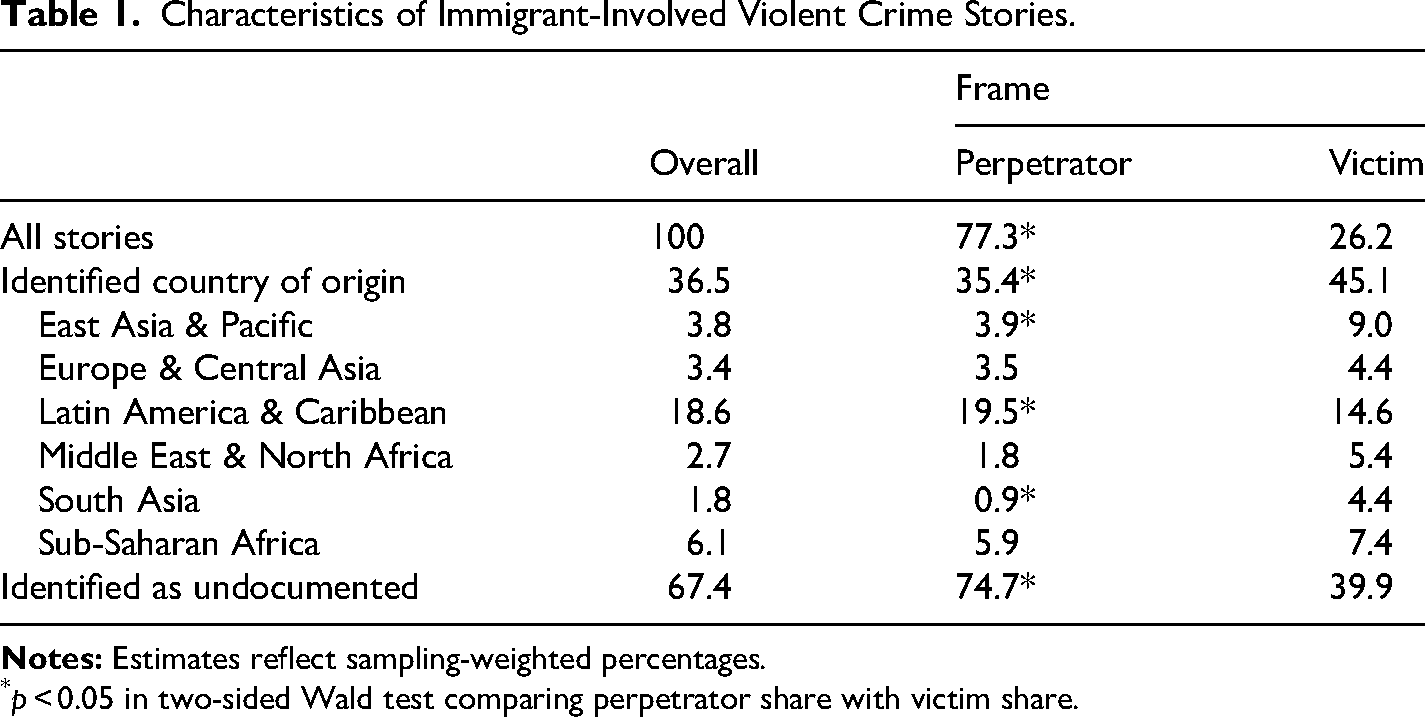
p < 0.05 in two-sided Wald test comparing perpetrator share with victim share.
Given prior evidence of racial cues in crime reporting, we also examined whether portrayals of immigrant-involved violent crime invoke racialized markers such as nationality and legal status. Table 1 shows that just over a third of immigrant-involved violent crime stories (36.5%) referenced immigrants’ country of origin. Contrary to our expectations, these references were more common when immigrants were framed as victims (45.1%) than when they were framed as perpetrators (35.4%). A closer examination of regional patterns, however, reveals important distinctions. As seen in Table 1 and presented graphically in Figure 1, immigrants from East Asia and the Pacific were more frequently depicted as victims (9.0%) than perpetrators (3.9%), and those from South Asia were similarly more often portrayed as victims (4.4%) rather than perpetrators (0.9%). By contrast, immigrants from Latin America and the Caribbean—the most frequently mentioned group overall, appearing in 18.6% of stories—were disproportionately framed as perpetrators (19.5%) relative to victims (14.6%). This regional pattern was primarily driven by references to Mexican and Salvadoran immigrants, which together comprised the bulk of country-specific mentions within the Latin American and Caribbean category. Legal status was an even more prominent marker of difference. Over two-thirds of all stories (67.4%) explicitly identified immigrants as undocumented, with such references concentrated in perpetrator frames (74.7%) and less often when immigrants were portrayed as victims (39.9%).
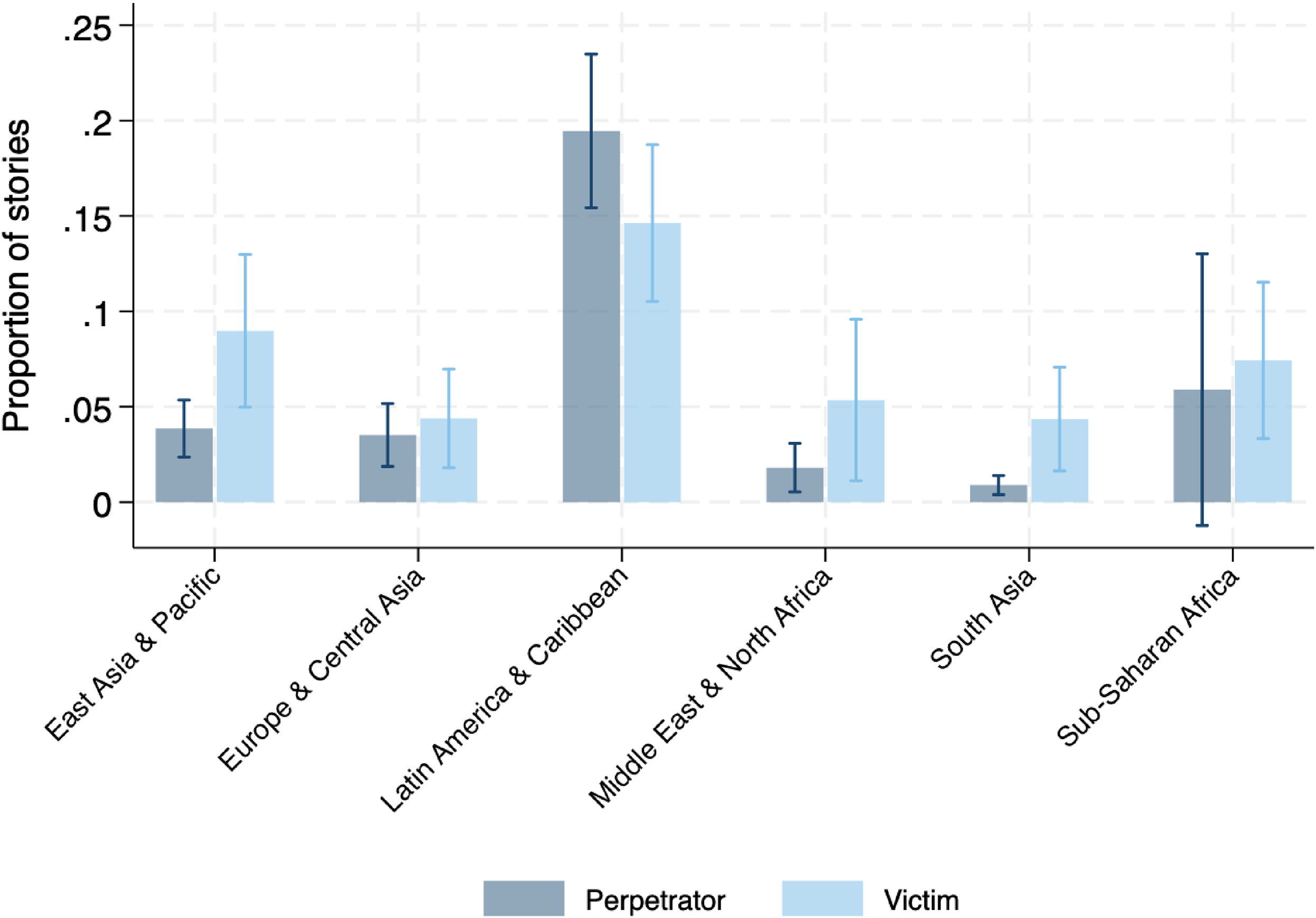
Proportion of immigrant-involved crime stories by frame and region of origin.
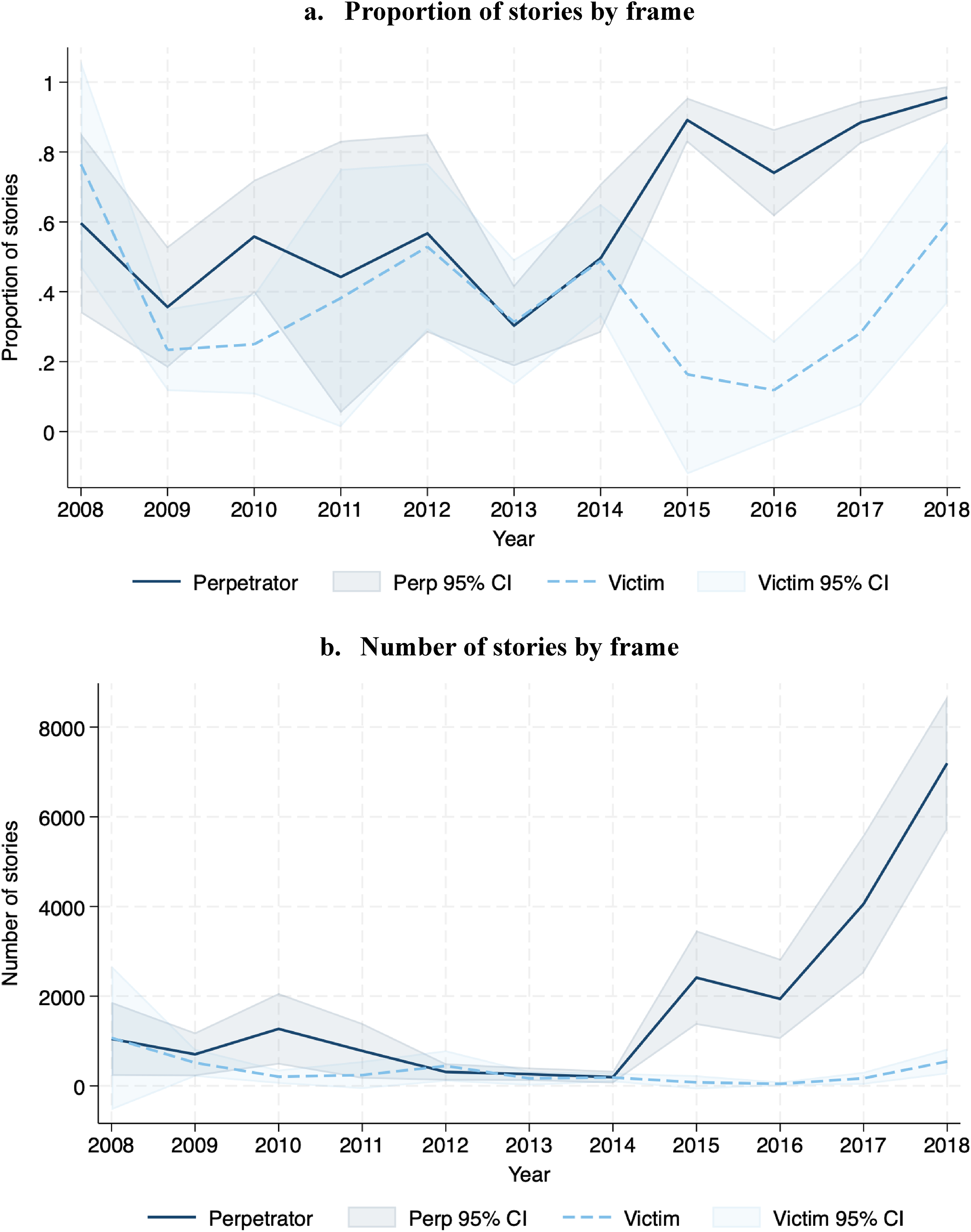
The estimates described above offer an overall picture of how immigrants were depicted in violent crime coverage but may mask important differences over time, given that our study period coincided with heightened—and often vitriolic—political debate around immigration. To better understand these dynamics, we turn to a temporal analysis. Figure 2 plots trends in the proportion and number of immigrant-involved violent crime stories that framed immigrants as perpetrators or victims. 12 As shown in Figure 2a, perpetrator and victim frames were relatively balanced from 2008 to 2009 and again between 2012 and 2014. Perpetrator frames became more prominent between 2010 and 2011 and, more dramatically, after 2014. The latter shift is especially evident in Figure 2b, which displays estimated national story counts. Whereas the pre-2015 peak reached roughly 2,000 perpetrator-framed stories in 2010, coverage increased sharply beginning in 2015 and rose to nearly four times that level by 2018. By contrast, the number of victim-framed stories remained relatively stable over time.
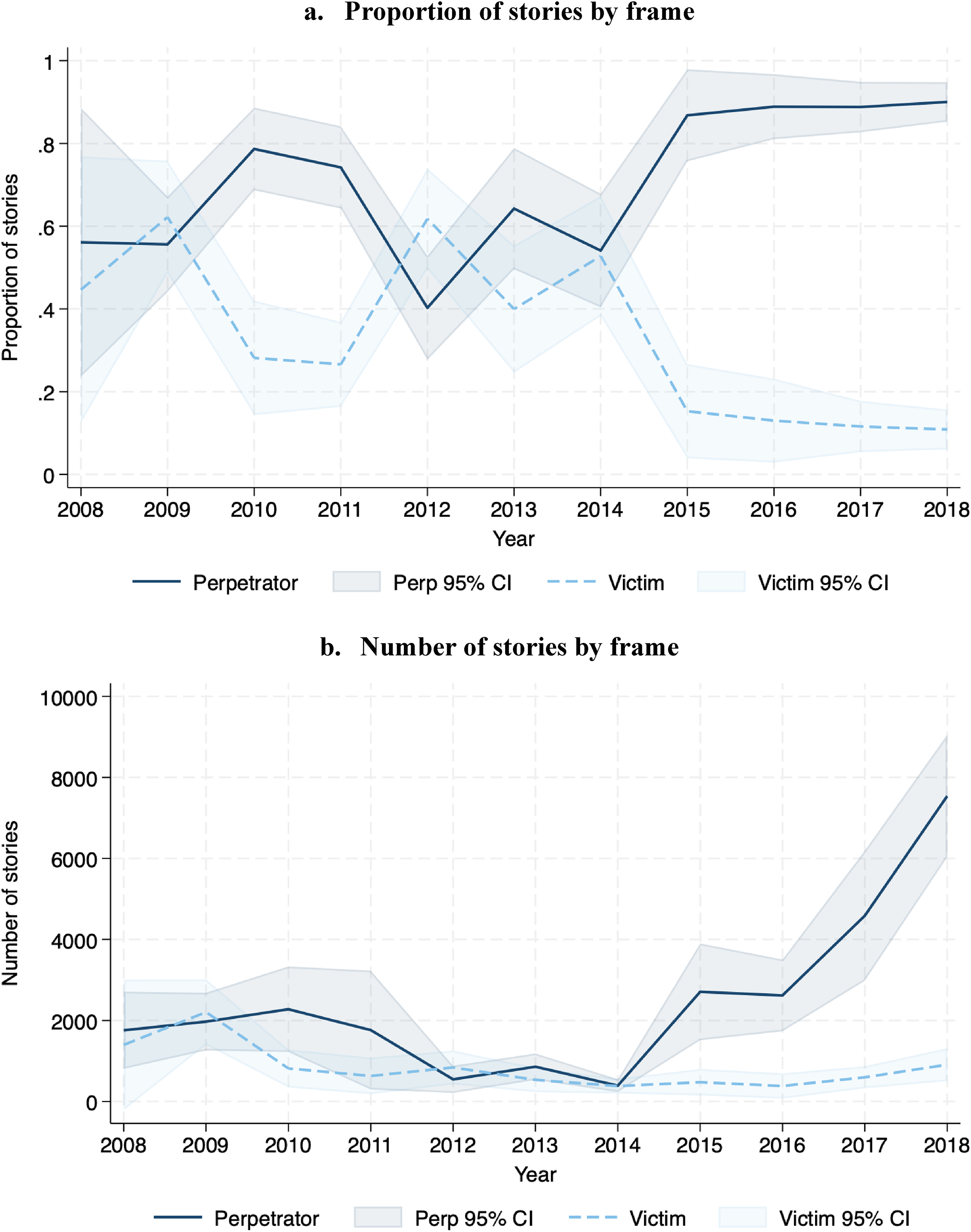
Perpetrator and victim frames in immigrant-involved crime stories over time.
The analyses in Table 1 indicate that Latino immigrants were the most frequently mentioned group in immigrant-involved violent crime coverage and that undocumented status was an even more common marker of difference—both disproportionately associated with perpetrator frames. Figures 3 and 4 examine whether these patterns varied over time. As shown in Figure 3a, the proportion of stories portraying Latino immigrants as perpetrators remained relatively flat, hovering around the 19% average shown in Table 1, and did not differ substantially from victim frames across the study period. However, the national story counts shown in Figure 3b reveal clear temporal fluctuations, with a brief spike in 2010 and a more pronounced increase in 2015 that accelerated through 2018. Coverage identifying immigrants as undocumented exhibited sharper shifts. Figure 4a shows that proportions began to diverge after 2014, with undocumented status increasingly emphasized in perpetrator frames while declining in victim frames. By 2017, victim-framed stories regained some proportional share, yet Figure 4b makes clear that in absolute terms, perpetrator frames dominated. That is, while proportional patterns suggest nuanced variation, story counts highlight a marked post-2014 surge in stories depicting undocumented immigrants as perpetrators of violent crime.
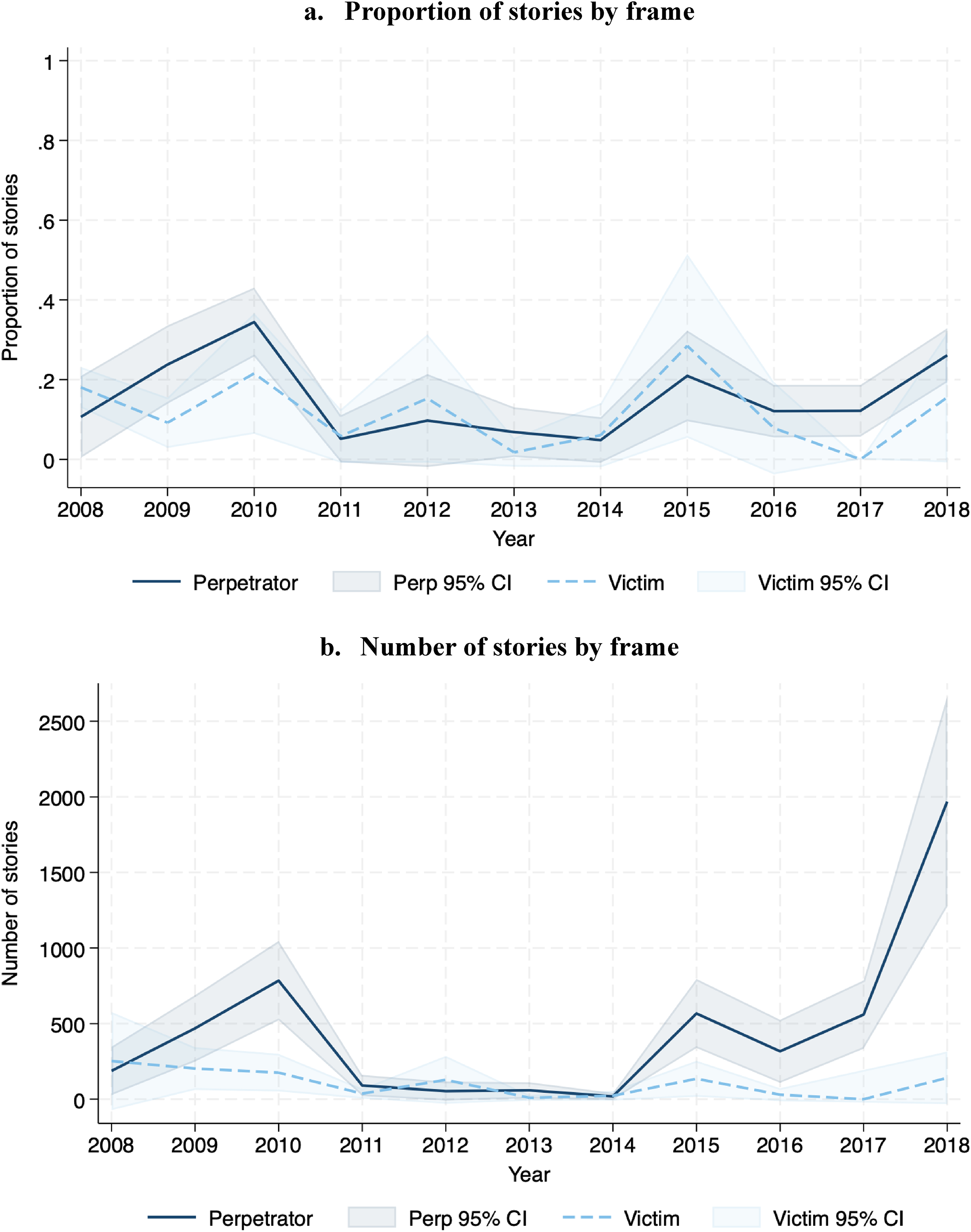
Immigrant-involved crime stories identifying Latino origin over time.
Immigrant-involved crime stories identifying undocumented status over time.
Discussion
Media narratives depicting immigrants as criminals have gained renewed prominence in recent years, fueled by political rhetoric casting immigration as a distinct public safety threat. These portrayals are especially consequential because most Americans have little direct experience with immigration or crime and come to understand these issues through what is presented in the media. Local television news plays a particularly influential role in this process as it remains one of the most widely consumed news sources and influences perceptions of threat. Importantly, this coverage frequently characterizes crime as acts committed by racial and ethnic minorities, reinforcing stereotypes about who is dangerous and who is vulnerable. Yet, despite many immigrants’ dual status as racial and legal minorities in the U.S., little is known about how they are represented in local crime news. To address this gap, we conducted a content analysis of closed captions from a nationally representative sample of local television newscasts between 2008 and 2018, providing the first systematic evidence of how immigrants are portrayed in coverage of violent crime.
Our analysis revealed a sharp imbalance in how immigrants are represented in local television coverage of violent crime. Immigrants are significantly more likely to be depicted as perpetrators than as victims, a pattern that supports our first hypothesis and aligns with prior research documenting the prevalence of criminal threat frames in print coverage of immigration (Chavez et al., 2010; Harris & Gruenewald, 2020). Our findings also extend scholarship on local television crime reporting, which has shown that racial and ethnic minorities are disproportionately portrayed as offenders rather than victims (Dixon & Linz, 2000; Gilliam & Iyengar, 2000). Applying a similar incident-based analytic lens to immigrant-involved violent crime, we find that immigrant status functions as another salient marker of difference through which media narratives signal who poses a criminal threat.
Beyond this general pattern, our analysis shows that immigrant identities are marked through nationality and legal status in ways that reflect racialized framing processes and are unevenly incorporated across perpetrator and victim portrayals. Consistent with our second hypothesis, references to nationality and legal status were unevenly distributed across frames. More than half of perpetrator-framed stories that identified an immigrant's country of origin involved Latino immigrants—most often from Mexico or Central America—compared to roughly a third of victim-framed stories. By contrast, immigrants from other regions—most notably from South and East Asia—appeared more frequently in victim rather than perpetrator frames. This divergence may reflect weaker associations between Asian immigrants and narratives of crime and illegality in U.S. media, even as they face other forms of mediated exclusion and stigmatization (Willnat et al., 2023). Perpetrator portrayals also frequently referenced an immigrant's undocumented status, a linkage that reflects and reinforces the close association between Latino origin and illegality in immigration discourse. That is, country of origin and legal status seem to function together as intersecting markers of difference, concentrating narratives of criminal threat within Latino and undocumented immigrant communities.
These patterns reflect broader processes through which media representations construct and sustain the idea of immigrant threat. Media discussions of immigrant crime tend to recycle familiar fears about specific immigrant communities, reflecting cultural typification processes through which news coverage reproduces assumptions about who commits crime and who is victimized by it. References to undocumented status operate as more than a legal descriptor; they function as moral and criminalizing cues that signal deviance. Similarly, references to Latino origin concentrate responsibility for crime within specific immigrant groups, rendering them as identifiable threats. By locating responsibility for crime within Latino and undocumented communities, local news coverage reinforces narratives that position these groups as socially and symbolically dangerous. In this way, these portrayals align with broader theoretical accounts of threat construction and group-based attribution of blame, while underscoring the media's role as an instrument of social control that helps reproduce existing social hierarchies.
During our study period, the political salience of immigration fluctuated, and these variations proved consequential in local television news portrayals of immigrant-involved crime. Early signs of this pattern appeared in 2010 and 2011, when the share of stories framing immigrants as perpetrators briefly increased. During this period, several states advanced restrictive policies—most notably Arizona's SB 1070—that criminalized everyday interactions with undocumented residents and required police to verify the immigration status of those they detained. This measure, and the wave of copycat laws it inspired, drew national attention and culminated in a 2012 Supreme Court ruling that struck down most provisions but upheld the provision allowing police to verify immigration status during lawful stops. Although the number of stories during this period was modest compared with later years, this early spike suggests that media portrayals of immigrant criminality may have been responsive to corresponding shifts in public discourse.
This pattern sharpened after 2014, as immigration regained national prominence. Both as a share of immigrant-involved violent crime stories and in the estimated number of stories aired, perpetrator frames surged in 2015—the year Trump launched his presidential campaign with remarks labeling Mexican immigrants “rapists” and “criminals” (Gabbatt, 2015). Parallel dynamics emerged for legal status, with references to undocumented immigrants concentrated in perpetrator frames and rising sharply after 2014, while mentions of undocumented immigrant victims increased only modestly after 2016 and remained comparatively low in terms of the number of stories aired. We did not see comparable trends for mentions of Latino immigrants when examining story composition. However, in absolute terms, the estimated number of stories referencing Latino immigrants in perpetrator frames also grew after 2014. This growth in story volume was evident in perpetrator-framed coverage as well as perpetrator portrayals referencing Latino origin and undocumented status. This expansion is consequential, as repeated exposure to such portrayals is more likely to influence public understandings of immigration and crime.
This distinction highlights an important dimension of coverage. While shifts in the relative composition of stories were most evident for perpetrator and undocumented frames, the absolute volume of perpetrator-framed stories increased across the board. As a result, audiences were exposed to substantially more coverage portraying immigrants—particularly those described as undocumented and, to a lesser extent, Latino—as violent offenders. These trends intensified during the rise of Trump-era immigration politics, suggesting that media representations of immigrant criminality became increasingly racialized, embedding legal status and ethnicity as salient markers of threat during periods of heightened political salience.
While our analysis offers the first systematic, incident-level examination of immigrant-involved violent crime coverage, it is not without limitations. First, our reliance on closed-caption data limits our analysis to verbal cues, meaning that we do not observe the visual and audio elements of television broadcasts, which can carry powerful symbolic meaning (Farris & Silber Mohamed, 2018). Television is a multimodal medium, and imagery—such as mugshots, footage of arrests, or neighborhood scenes—can communicate racialized identity (Lipschultz & Hilt, 2003). As a result, we were unable to capture the full scope of how television coverage evokes race, ethnicity, or other forms of difference. Future work combining closed-caption data with visual analysis could be especially powerful for examining how racialization and illegality are visually implied, even if not verbally stated. Additionally, we did not capture information on the gender of perpetrators or victims, which prevented us from examining patterns that prior research has shown shape crime coverage—particularly the tendency to pair minority perpetrators with white, often female, victims (Chermak, 1995; Slakoff & Brennan, 2023). While this question ultimately fell outside the scope of our study, incorporating gendered dimensions of representation would be a valuable direction for future research, offering deeper insight into how these intersectional dynamics unfold in crime coverage involving immigrants.
We are also limited in the broader inferences we can draw about media portrayals of immigrant-involved violent crime. First, because our analysis is restricted to immigrant-involved violent crime coverage, we cannot assess how frequently such stories occur within violent crime reporting more broadly. This also limits our ability to determine whether the patterns we observe are unique to immigrants or reflect broader shifts in how other groups are portrayed in such coverage. Examining the prevalence of immigrant-involved stories within violent crime reporting and comparing how immigrants are portrayed relative to other groups represent fruitful lines of future inquiry. Second, the absence of comparative data on crime incidents involving immigrants precluded an assessment of how closely media coverage aligns with empirical reality. Conducting a distortion analysis that compares media portrayals to underlying crime patterns would require national-level data linking offender and victim nativity to specific incidents, which do not exist and are, at best, disaggregated by race rather than ethnicity. While a large body of research has shown that immigrants, including undocumented immigrants, are less likely to engage in criminal behavior than native-born individuals (Light et al., 2020; Ousey & Kubrin, 2018), data limitations prevent a direct assessment of whether media portrayals diverge from underlying patterns of crime involving immigrants. Third, our dataset ends in 2018, excluding more recent periods marked by intensified anti-immigrant rhetoric. This limitation is not trivial, as the dynamics we document may have become even more pronounced amid rising political polarization around immigration.
Despite these limitations, our findings advance understanding of how media narratives reproduce and legitimize systems of social control. By tracing how legal status and national origin are used to mark difference, our study demonstrates that symbolic boundaries of threat evolve alongside political discourse. These portrayals link certain immigrants, especially undocumented and Latino, to criminality. In doing so, local television news not only reflects political rhetoric but embeds it within routine, emotionally salient crime reporting. This translation of abstract debates into everyday discourse can amplify ideas of immigrant danger and rationalize exclusionary and punitive policies. Scholarship and policy alike must contend with how media infrastructures sustain narratives of threat and belonging that shape public attitudes toward immigrants and, by extension, the broader logics of social control in American life.
Footnotes

Funding
The authors disclosed receipt of the following financial support for the research, authorship, and/or publication of this article: This work was supported by the Institute for Research on Race and Public Policy.
Declaration of Conflicting Interests
The authors declared no potential conflicts of interest with respect to the research, authorship, and/or publication of this article.
Notes
Appendix A
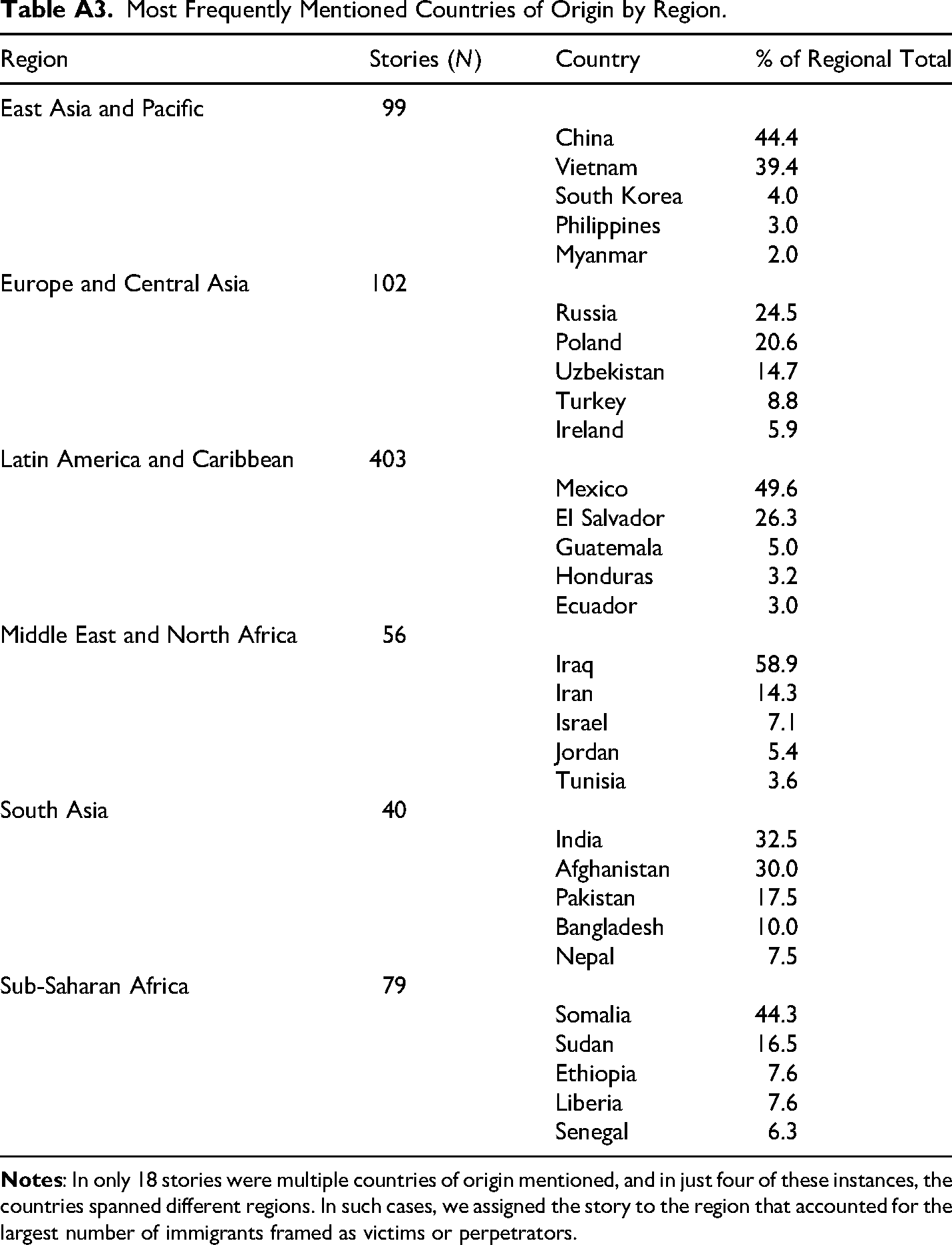
Most Frequently Mentioned Countries of Origin by Region.
| Region | Stories (N) | Country | % of Regional Total |
|---|---|---|---|
| East Asia and Pacific | 99 | ||
| China | 44.4 | ||
| Vietnam | 39.4 | ||
| South Korea | 4.0 | ||
| Philippines | 3.0 | ||
| Myanmar | 2.0 | ||
| Europe and Central Asia | 102 | ||
| Russia | 24.5 | ||
| Poland | 20.6 | ||
| Uzbekistan | 14.7 | ||
| Turkey | 8.8 | ||
| Ireland | 5.9 | ||
| Latin America and Caribbean | 403 | ||
| Mexico | 49.6 | ||
| El Salvador | 26.3 | ||
| Guatemala | 5.0 | ||
| Honduras | 3.2 | ||
| Ecuador | 3.0 | ||
| Middle East and North Africa | 56 | ||
| Iraq | 58.9 | ||
| Iran | 14.3 | ||
| Israel | 7.1 | ||
| Jordan | 5.4 | ||
| Tunisia | 3.6 | ||
| South Asia | 40 | ||
| India | 32.5 | ||
| Afghanistan | 30.0 | ||
| Pakistan | 17.5 | ||
| Bangladesh | 10.0 | ||
| Nepal | 7.5 | ||
| Sub-Saharan Africa | 79 | ||
| Somalia | 44.3 | ||
| Sudan | 16.5 | ||
| Ethiopia | 7.6 | ||
| Liberia | 7.6 | ||
| Senegal | 6.3 |
Appendix B. Regression-adjusted temporal trends
This appendix presents regression-adjusted versions of the temporal analyses shown in Figures 2 to 4 of the main paper. The goal of these analyses is to assess whether the observed trends in immigrant-involved crime coverage persist after accounting for local conditions that may influence news framing. We estimate sampling-weighted ordinary least squares regression models predicting whether an immigrant is framed as a perpetrator or victim. All models adjust for time-varying measures of local crime conditions, demographic and political context, immigration enforcement environments, and media ownership. Year fixed effects are included to estimate annual changes after adjusting for these covariates and the resulting coefficients are used to construct figures showing adjusted temporal trends.
We gathered a set of annual covariates plausibly related to crime coverage and framing. County-level crime and homicide rates were calculated using FBI Uniform Crime Reports obtained from the Inter-university Consortium for Political and Social Science Research (Kaplan, 2021). Overall crime rates account for broader patterns in crime reporting, while homicide rates—less susceptible to underreporting—serve as a more reliable indicator of serious crime. Demographic context is measured using the share of county residents who are foreign-born and the share who identify as Hispanic or Latino and are noncitizens. Political context is captured using the proportion of county residents who voted for Republican presidential candidates, drawn from the CQ Press Voting and Elections Collection, with values for non-election years generated via linear interpolation. To account for variation in immigration enforcement, we include indicators for whether a county had a 287(g) agreement in place using data from the Urban Institute's State Immigration Policy Resource. We also included an indicator signaling the presence of a local, county, or state sanctuary policy limiting cooperation with immigration enforcement, based on data from the Center for Immigration Studies. All county-level measures were aggregated to the DMA using weighted averages, where weights reflect each county's share of the DMA. Lastly, we control for local television news consolidation by measuring the share of stations within each DMA owned by the Sinclair Broadcasting Group using data from (Levendusky, 2021), given prior evidence linking Sinclair's market presence to more sensationalized and partisan coverage (Hedding et al., 2019; Matsa, 2017).
Using these models, we produced adjusted year-specific predicted probabilities for each framing outcome. These predictions incorporate the same sampling weights used in the unadjusted estimates reported in the main paper. We applied the same approach to examine temporal patterns in whether stories identify Latino origin or undocumented status. For these analyses, the sample is restricted to stories employing the relevant frame, and the outcome indicates whether the corresponding attribute is mentioned. To generate adjusted story totals, we multiply these predicted probabilities by the sampling-weighted estimate of the number of immigrant-involved violent crime stories in each year. Adjusted yearly estimates and associated confidence intervals are shown in Figure B1, and coefficient estimates from the regression models are shown in Table B1. Across all specifications, the adjusted trends closely track the unadjusted patterns shown in Figures 2 to 4, suggesting that the observed temporal shifts are not driven by changes in local crime conditions, demographic or political context, immigration enforcement, or media ownership.