






Abstract
The field of adolescent and young adult (AYA) oncology has experienced tremendous growth in the past two decades. A cancer diagnosis occurring during adolescence and young adulthood (commonly defined as between ages 15 and 39 years, with inconsistencies across the literature) is recognized as a profound, non-normative life event with serious implications across the survivorship continuum.1,2 Despite a steady rise in case rates over the past 13 years, long-term survival rates continue to improve, with 5-year relative survival rates at 86%.3,4 These trends have resulted in a rapidly growing population of over 2 million AYA cancer survivors.3,4 As a result, increased attention has been devoted to improving long-term health outcomes for this rapidly expanding and unique group of cancer survivors. However, the developmental needs of AYAs are often underrecognized, contributing to a widening survivorship gap marked by disparities in overall health and quality of life. 5 This perspective highlights the importance of a systematic, developmentally informed approach to AYA survivorship. This approach can guide future multidisciplinary clinical care, research, and policy priorities to comprehensively support the growing group of survivors.
The Life Course Health Development (LCHD) framework posits that there are developmental life phases during which health-related exposures greatly influence long-term health trajectories. 6 Within this framework, the timing and complexity principles suggest that there are time periods in life during which certain events or experiences may have a more profound impact on health due to complex interactions between an individual and their biological, psychological, and social networks. 6 AYA cancer, treatment, and survivorship can be understood as occurring during a particularly sensitive and influential stage of biological, psychological, and social development (Fig. 1). This dynamic life phase is often characterized by developments including biological maturation, identity formation, and shifting social role priorities. While variability exists in survivor experiences, these multi-level factors of exposure and influence support the notion that the AYA survivorship experiences differ significantly from those of other age groups due to their unique life stage. Understanding how cancer and cancer-related experiences impede developmental periods during adolescence and young adulthood is essential for the development of comprehensive and tailored guidelines and support structures throughout clinical, research, and policy spheres.
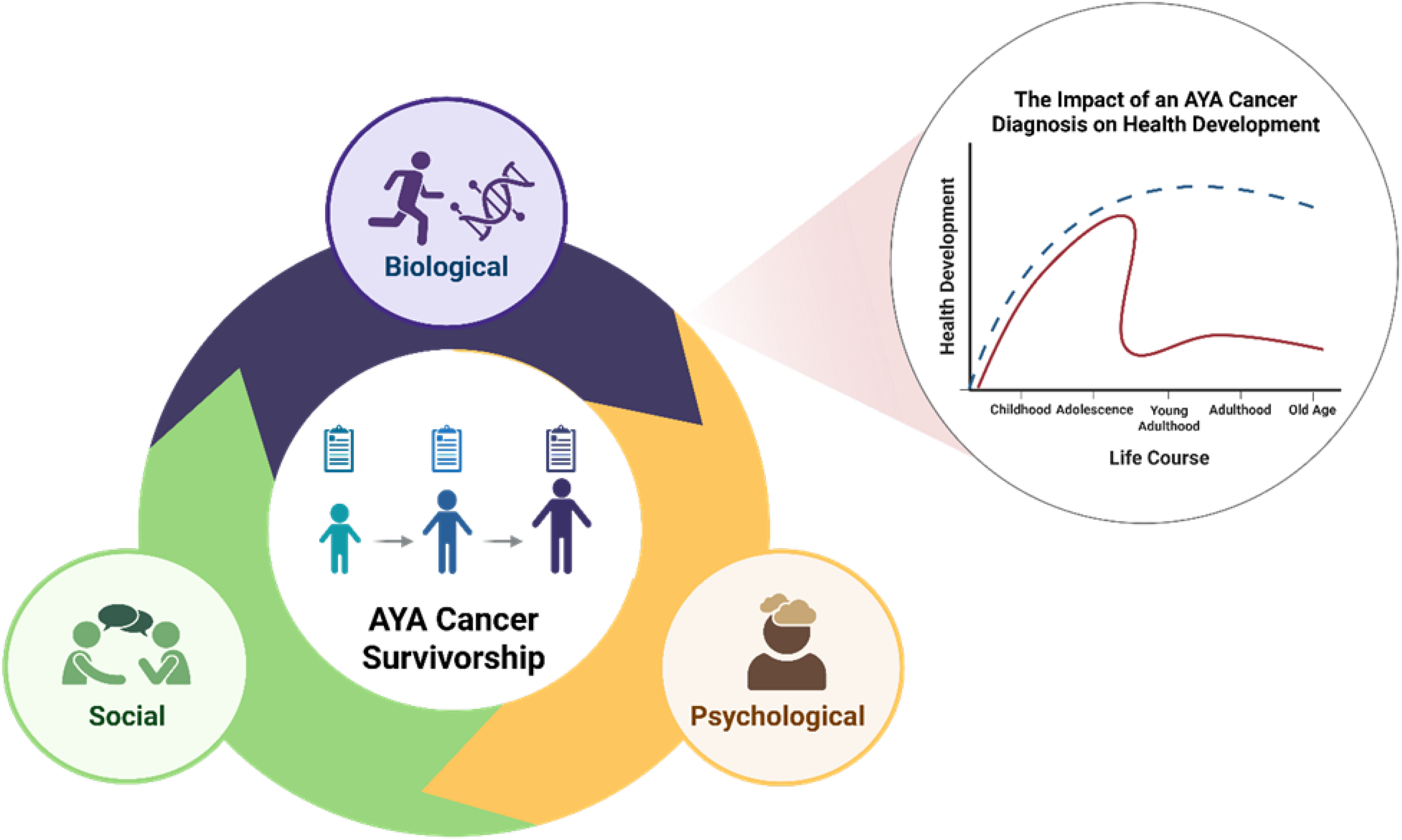
Developmentally Grounded Biopsychosocial AYA Cancer Survivorship Approach, Created in BioRender. Lustyik, A. (2026) https://BioRender.com/efou25j; adapted from Halfon and Forest, 2018 6 and “Systems Biology Cycle” BioRender Template. AYO, adolescent and young adult.
Biological Disruptions in AYA Survivorship
As identified in the LCHD framework, adolescence and young adulthood constitute extremely sensitive and complex periods of biological and physical development in which exposures may have more significant, downstream effects.7,8 AYA cancer survivors experience high rates of late- and long-term effects of cancer and cancer treatment (i.e., effects that arise or persist for varying times after treatment ends), including symptoms, comorbidities, and subsequent malignant neoplasms.9,10 These can be attributed, in part, to exposure to cancer and associated systemic anticancer treatment regimens during vulnerable physical maturation periods across endocrine, reproductive, musculoskeletal, and immune physiological systems. 11 Emerging evidence also suggests that AYA survivors age at a significantly faster rate than their non-cancer peers, prompting an active and growing body of research dedicated to understanding the underlying biological mechanisms of these accelerated, premature aging processes (e.g., inflammatory processes, genomic instability, and epigenetic alterations). 12 Notably, these disruptions in health and aging trajectories are highly incongruent with the generally positive health experiences typical of this younger, more resilient age group who are in a life phase normally characterized by low disease burden and optimal physical capacity. As AYA survivors continue to live a large portion of their lives with cancer and its therapeutics biologically embedded, long-term health trajectories continue to warrant further attention.
The Social Context of Adolescence and Young Adulthood
Consistent with LCHD principles, experts in developmental science have emphasized the prominent role that psychosocial factors play in AYA survivorship outcomes.13,14 In the social context, AYAs face significantly altered trajectories in relationship development and family formation alongside competing educational, occupational, and financial demands. 14 Despite being in a developmental period where relationships with others are prioritized, AYA survivors often report loneliness, isolation, and difficulties developing and maintaining peer relationships. 15 These patterns persist in intimate relationships, where AYAs report higher divorce and separation rates, increased marital stress, and broader concerns related to sexual functioning due to alterations in physical appearance and body image concerns. 16 Even among survivors that achieve meaningful intimate relationships, many report stress due to complex family planning considerations (e.g., fertility status, hereditary genetic risks, and evaluating alternatives to biological children).16,17 For AYAs, cancer also disrupts the completion of educational programs and subsequent transitions into the workforce due to absenteeism, physical or cognitive health concerns, or fear of workplace discrimination. 16 These domains in particular often have larger downstream financial impacts, with over half of AYAs reporting high levels of financial toxicity due to medical debt, costs of supportive care, lack of governmental assistance programs, difficulties initiating or maintaining employment, and limited accrual of assets.18,19 These complex social components underscore how the timing of a cancer diagnosis shapes long-term survivorship outcomes across the life course.
Cancer-Related Psychological Challenges in AYAs
The LCHD framework emphasizes the importance of psychological factors in overall health and well-being outcomes, an issue that has proven to be particularly salient for AYAs. 14 These survivors experience a cancer diagnosis during a period of fundamental psychological developmental milestones, the impact of which may vary by different developmental subgroups occurring under the AYA umbrella. 13 Adolescents (15–18 years old) are in a phase of impulsive behaviors, identity exploration, and emotional lability. 13 Emerging young adults (19–25 years old) experience instability in other domains, such as identity and independence, occupation, and education. 13 Late young adults (26–39 years old) are thought to be in a less turbulent phase overall but still face obstacles balancing personal, work, and family demands. 13 Across these subgroups, when cancer occurs in these life stages that consist of rapid psychological growth, key developmental milestones (e.g., establishing autonomy, executive functioning processes, maturation of coping mechanisms) may be impeded. 14 This contributes to an elevated risk of psychological distress for AYA survivors, as evidenced by AYAs consistently reporting some of the highest rates of depression, anxiety, loneliness, and post-traumatic stress of all cancer survivor age groups. 14 While some survivors are able to demonstrate resilience or post-traumatic growth (i.e., positive psychosocial change following traumatic life events), the impact of a cancer diagnosis in a life stage characterized by rapid and critical development results in long-lasting psychological sequelae for many survivors. 20
Implications for Clinical, Research, and Policy Settings
AYAs frequently face obstacles during diagnosis (i.e., diagnostic delays due to the rarity of cancer at their age, misinterpretation of vague warning signs, and varying levels of care team knowledge) and treatment (e.g., unique tumor biology, employing pediatric versus adult treatment regimens, and prevalence of cancer predisposition syndromes) that complicate care delivery. 11 Clinical teams also must balance patient preferences and autonomy with complex family dynamics and varying degrees of familial involvement in care. 11 Additionally, there are relatively few oncology care teams specializing in AYAs, leaving an overwhelming proportion of AYAs to receive care in pediatric or adult oncology settings that may not be equipped with the resources necessary for this developmentally complex group. 21 These gaps are particularly troublesome for AYAs as they age and face complexities associated with care transitions from pediatric to adult settings. 21 After treatment concludes, AYAs experience low engagement with and access to survivorship and supportive care, with previous literature demonstrating that a large proportion (i.e., 72%) of survivors did not receive long-term survivorship follow-up care. 22 Clinical care systems must prioritize the creation and implementation of developmentally informed care models that routinely screen for and offer supports for long-lasting biological, psychological, and social disruptions, as well as devoting increased resources to strengthening and expanding upon interdisciplinary AYA survivorship care infrastructure.
The development and implementation of evidence-based practice guidelines to improve these clinical care gaps are scarce and have been hindered by poor enrollment in clinical trials, where AYAs have some of the lowest trial enrollment and retention rates across cancer age groups. 23 Increasing AYA participation in research may be achieved by employing strategies that have been successful previously, such as utilizing digital outreach techniques, and partnering with peer- or community-based organizations and advocacy groups. 24 Additionally, national research organizations and funding agencies should continue to prioritize and facilitate cancer survivorship research designed to better understand and meet unique developmental needs across AYA life stages. Larger-scale policy efforts are also critically needed to support AYA survivorship experiences. AYAs face significant insurance instability, financial burden, and distressing fragmented care transitions. 25 Policy-specific considerations include expanding Medicaid eligibility and reimbursements for supportive care, supporting insurance coverage continuity, and facilitating coordination between pediatric and adult care systems. 25
Conclusion
Incorporating biological, psychological, and social domains, the LCHD framework allows for a contextualization of unique AYA cancer survivorship experiences and survivor needs through a developmental lens. Meaningful progress across the survivorship continuum can be strengthened using a theoretically guided and developmentally informed biopsychosocial approach to address AYA needs. This foundational framework can be leveraged as a launching point to guide ongoing refinements, theory development, and future systematic inquiry. Integrating this multi-domain biopsychosocial approach is essential to close the AYA survivorship gap and to ensure that advancements in survival rates are complemented by comprehensive improvements in long-term health and well-being for AYA survivors.
Acknowledgments
Ms. Lustyik acknowledges the Achievement Rewards for College Scientists (ARCS) Pittsburgh Chapter and the National Institute of Nursing Research (T32NR009759) for their support.
Authors’ Contributions
A.L.: Conceptualization, writing—original draft, writing—review and editing. S.M.B., B.C. and Y.P.C.: Writing—review and editing, supervision.
Footnotes
Author Disclosure Statement
No competing financial interests exist.
Funding Information
No funding was received for this article.