






Abstract
This qualitative research study explored the development and sustainability of a regional school counseling leadership team (RSCLT) organized by district school counselor supervisors. Four supervisors participated in two rounds of individual interviews. The data revealed five themes: (a) experience as chair; (b) leadership representation and structure; (c) resources, policies, and procedures; (d) professional development; and (e) university collaborations. Findings indicate that an RSCLT provides support for ongoing, meaningful, productive regional professional development for school counselors and assists smaller districts with limited resources. We discuss implications for school counselors and district school counselor supervisors.
Collaboration is fundamental in solving problematic issues for school counselors and their local students (Erford, 2015; Griffin & Farris, 2010). For school counselors who work in rural areas with limited resources, collaboration helps meet the needs of their student populations (Grimes, Haskins, & Paisley, 2013; Monteiro-Leitner, Asner-Self, Milde, Leitner, & Skelton, 2006). District supervisors of school counselors (also known as district directors of guidance) have long played a significant role in collaborating with local and community stakeholders and/or resources (American School Counselor Association [ASCA], 2016; Feldman, 1951; J. L. Miller & Menchinger, 1970). District supervisors of school counselors have also recognized a need to collaborate and coordinate with one another in garnering support for addressing issues related to limitations in resources for rural communities, developing leadership skills, and enhancing their skills in developing and implementing a comprehensive school counseling program (Larivee, 2002). Examining the collaboration of state supervisors of school counseling (also known as state supervisors of guidance) has inspired some district supervisors of school counselors regarding ways to collaborate regionally and locally.
State supervisors of school counseling, counselor educators, and counseling associations play an important role in assisting school counselors (D. Miller, 2006). In fact, areas such as Northern Virginia have gone so far as to develop a state school counseling leadership team made up of counselor educators, members of the state counseling association, and school district supervisors to help school counselors in their professional capacity to assist their students (Kaffenberger, Murphy, & Bemak, 2006). However, such a team is often limited in its abilities to provide enough support for school counselors attempting to address the needs in their local areas (Gysbers, 2006). According to Kaffenberger, Murphy, and Bemak (2006), state school counseling leadership teams have inspired regional and local leadership teams that work to address the specific needs of their area. These regional teams help influence policy, practices, and encourage integral collaborations. Although recognized as an important aspect of school counseling leadership, not much has been researched or written about regional school counseling teams (Kaffenberger et al., 2006). In 2003, in the far Western part of Texas, district supervisors of school counselors and counselor educators collaborated to establish a regional school counseling leadership team (RSCLT) covering a large portion of the area. The RSCLT is still in existence 13 years later, with a larger membership. State school counseling leadership teams have inspired regional and local leadership teams who work to address the specific needs of their area. These regional teams help influence policy, practices, and encourage integral collaborations.
The purpose of this study was to explore the development and sustainability of this RSCLT to provide meaning and insight to other school counselors and district supervisors of school counselors interested in developing and sustaining such a leadership team and to help them find ways to address limitations in resources.
Research Methodology
The researchers completed a single case study qualitative design following Yin’s (2009, 2012, 2014) guidelines to explore an RSCLT in the southwest region of a southern state in the United States. According to Yin (2014), three conditions satisfy the need for using the case study method: form of research question, no required control of behavioral events, and a focus on contemporary events (p. 9). In terms of the research question, case studies are appropriate for investigating “How or why did something happen?” (Yin, 2012, p. 5; 2014). The RSCLT study’s central question was, “How did district school counselor supervisors develop and sustain a regional school counselor leadership team?” The primary focus was on the development and sustainability of the team. This study was not an experiment; the researchers did not need to “manipulate behavior directly, precisely, and systematically” (Yin, 2014, p. 12). Finally, the study was focused on the contemporary RSCLT’s decisions and shared leadership. All in all, the study met Yin’s (2014) conditions for using the case study method.
Setting, Context, and Participants
The RSCLT represents a region covering 12 school districts. According to the state’s district types, three districts in this region are considered major urban, three are major suburban, two are nonmetropolitan, and four are small rural districts. These school districts range in size from as small as 200 students for an entire district to more than 60,000 students in one district for the past 3 academic years (Texas Education Agency, 2014, 2015). Of the 12 school districts, 9 have student populations of less than 12,000. The remaining 3 districts’ student populations range from 43,000 to 62,000 (Texas Education Agency, 2015). For additional demographic information for each district, see Table 1.
Student Demographics per District (2016).
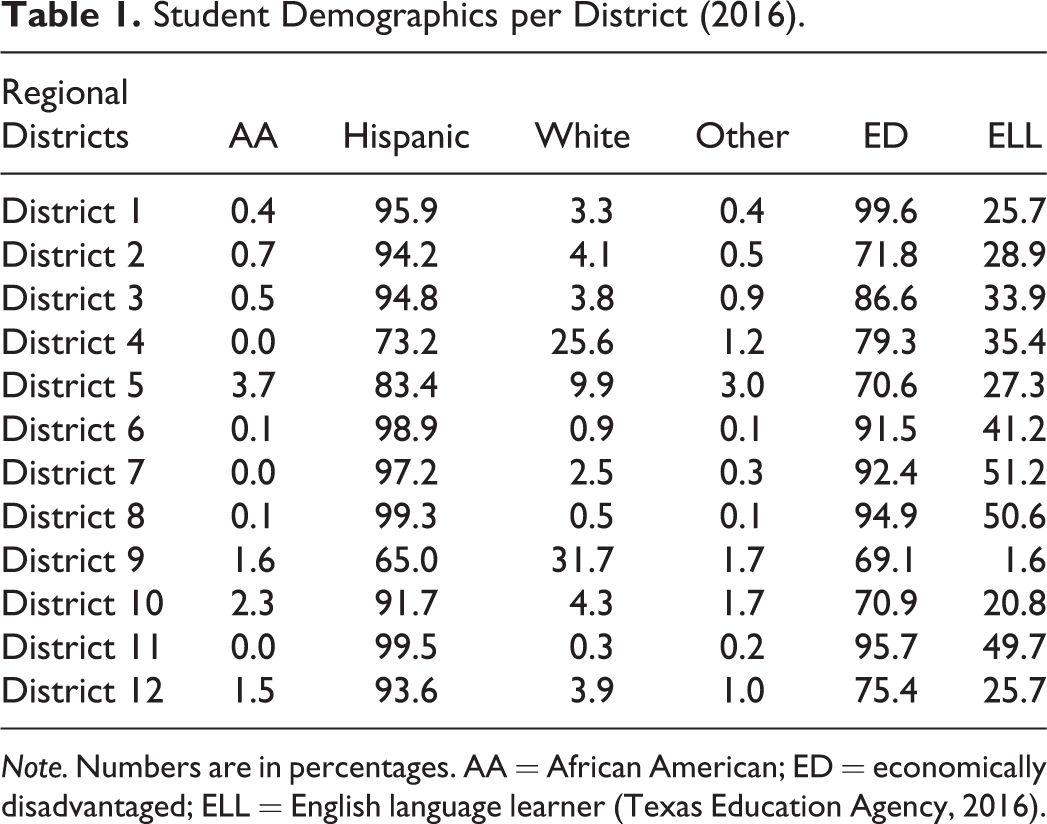
Note. Numbers are in percentages. AA = African American; ED = economically disadvantaged; ELL = English language learner (Texas Education Agency, 2016).
Through shared leadership and decision-making efforts, district supervisors of school counselors have collaborated to address challenges in meeting the needs of their local student population. Although most members of the RSCLT are district supervisors of school counselors representing the 12 school districts, team members representing the community include a military liaison, a representative of the local chapter of the state counseling association, an admissions staff member from the local university, and a counselor educator from the local university. Every 3 years, members representing the three larger school districts rotate to serve as chair of the RSCLT. The four interviewees (N = 4) for this study included chairs and cofounders of the team. Participant A is considered a cofounder of the team, served as the initial chair, and is now retired from the field of school counseling. Participant B, also a cofounder of the team and a previous chair, is still a member of the team and a district supervisor of school counselors. Participant C became a member of the team during the fifth year of the team’s existence and is a previous chair who is still a member of the team and a district supervisor of school counselors. Participant D also became a member of the team during the fifth year of the team’s existence; Participant D is the current chair of the team and a district supervisor of school counselors. All interviewees have school counseling experience and leadership training and/or education.
Role of the Researcher
The principal investigator has school counseling experience at each level (elementary, middle, and high school), leadership training, and experience in the field of counseling. Currently a school counselor educator at the primary university within the local region of the RSCLT, the researcher was asked by his immediate supervisor (department chair) to observe a couple of meetings of the RSCLT in fall 2015 with permission from the chair of the RSCLT. By the end of spring 2016, the researcher became a member of the RSCLT. Because of his membership, the researcher was considered a participant-observer for this study with respect to observing and participating in meetings, as identified by Yin (2014).
Research Sample and Data Sources
The researcher used purposeful sampling in requesting the current chair’s permission to compete the study. After receiving permission, he requested from the current chair details of previous chairs and members to interview. Yin (2014) identifies this technique as snowball sampling.
Participants were contacted by telephone and sent a formal invitation via e-mail. They were given informed consent letters explaining the study, confidentiality, and participants’ rights and involvement. The researcher used further data sources—including participant observation, research field notes, archival records, and documents—to confirm information from interviews.
Instrument and Data Collection
The researcher created a brief survey to obtain participant demographic information. Specific questions included gender, age during the time of the participant’s initial membership in the RSCLT, ethnicity, school counselor grade level, years as leadership chair, year of initial membership, length of membership time, years as a school counselor, years as a district supervisor of school counselors, leadership training, and certifications held. The information collected provided further context of the leadership of the RSCLT.
To fully explore the development and sustainability of this regional team, the researcher collected multiple sources of data (Yin, 2009, 2014). Beyond interview data, these included archival records and documents—meeting agendas, meeting notes, e-mails, presentations, calendars, and procedural and protocol documents—and observation notes.
The researcher conducted two interviews with participants. During the first interview, after ensuring informed consent, he asked all participants the initial prompt: “Please describe your background that led to your being a part of the leadership team and your knowledge of how the leadership team was developed.” He then asked follow-up questions based on guidelines developed from a state school counseling leadership team (Kaffenberger et al., 2006). One such follow-up question was, “How have the concerns expressed by team members affected the direction of short-term goals?” After the first round of interviews, the research team analyzed and coded the information. Based on this analysis, the second interview entailed more focused questions. All interviews were recorded and lasted up to 90 min each.
Data Analysis
The primary researcher analyzed and structured the collected data through protocols tailored to the study using Yin’s (2009, 2014) suggested format. Protocols were used to increase “reliability” and “guide the researcher in carrying out the data collection” (2014, p. 84). The first round of data included the first round of interviews and relevant documents such as policy resources, archival meeting notes, and agendas. The researcher analyzed this information via document/policy and interview protocols. The protocols included four sections as promoted by Yin (2014): an overview of the case study, data collection procedures, data collection questions, and a guide for the case study report (pp. 84–85). The protocols were also influenced by guidelines based on the Northern Virginia School Counseling Leadership Team’s model (Kaffenberger et al., 2006). The core areas of the protocol’s/guidelines’ data collection questions were membership, leadership, start-up meetings, short-term goals, long-term goals, providing trainings and workshops, and evaluations and assessments. The second round of data included the second round of interviews and relevant documents (i.e., additional resource materials, meeting notes, and agendas) analyzed through updated or revised protocols based on the results of the analyses of the first round of data.
In vivo coding was used for the first round of data to grasp what was deemed important or necessary from the participants (Corbin & Strauss, 2015; Saldana, 2013). Focused coding via a time series was used for the second round of data and more refined themes were developed (Saldana, 2013). The time series was broken into years of service as chair for relevant interviewee participants with a particular interest in decisions being made (needs, concerns, and structure) and shared leadership. Decisions and shared leadership made up the units of analysis. These units of analysis helped determine what data were to be collected (Yin, 2009). The time series analysis was used to assist in linking the data to the purpose of the study and interpreting the findings (Yin, 2009, 2014).
Validity and Trustworthiness
In addressing reliability, validity, and trustworthiness, the researcher focused on several methods. First, he created an audit trail and recruited two independent analysts to code data separately from his own coding; eventually, the three came together to establish intercoder reliability (Miles & Huberman, 1984). One analyst’s background is in engineering and the other has a background in psychology. Both analysts have master’s level education and training in qualitative methodology. Second, in terms of validity, the researcher recruited two peer debriefers with doctoral degrees in education leadership and training in qualitative methodology to assist with thinking through numerous ideas for addressing the study and findings. He asked participants to verify interview data through member checks. Last, the researcher utilized triangulation across interview data, archival records, and document data to establish rich, thick data for smoother transferability. In sum, the researcher used an audit trail, independent analyst, verification, and triangulation to develop reliability and trustworthiness (Bloomberg & Volpe, 2012; Lincoln & Guba, 1985).
Findings
Development Period
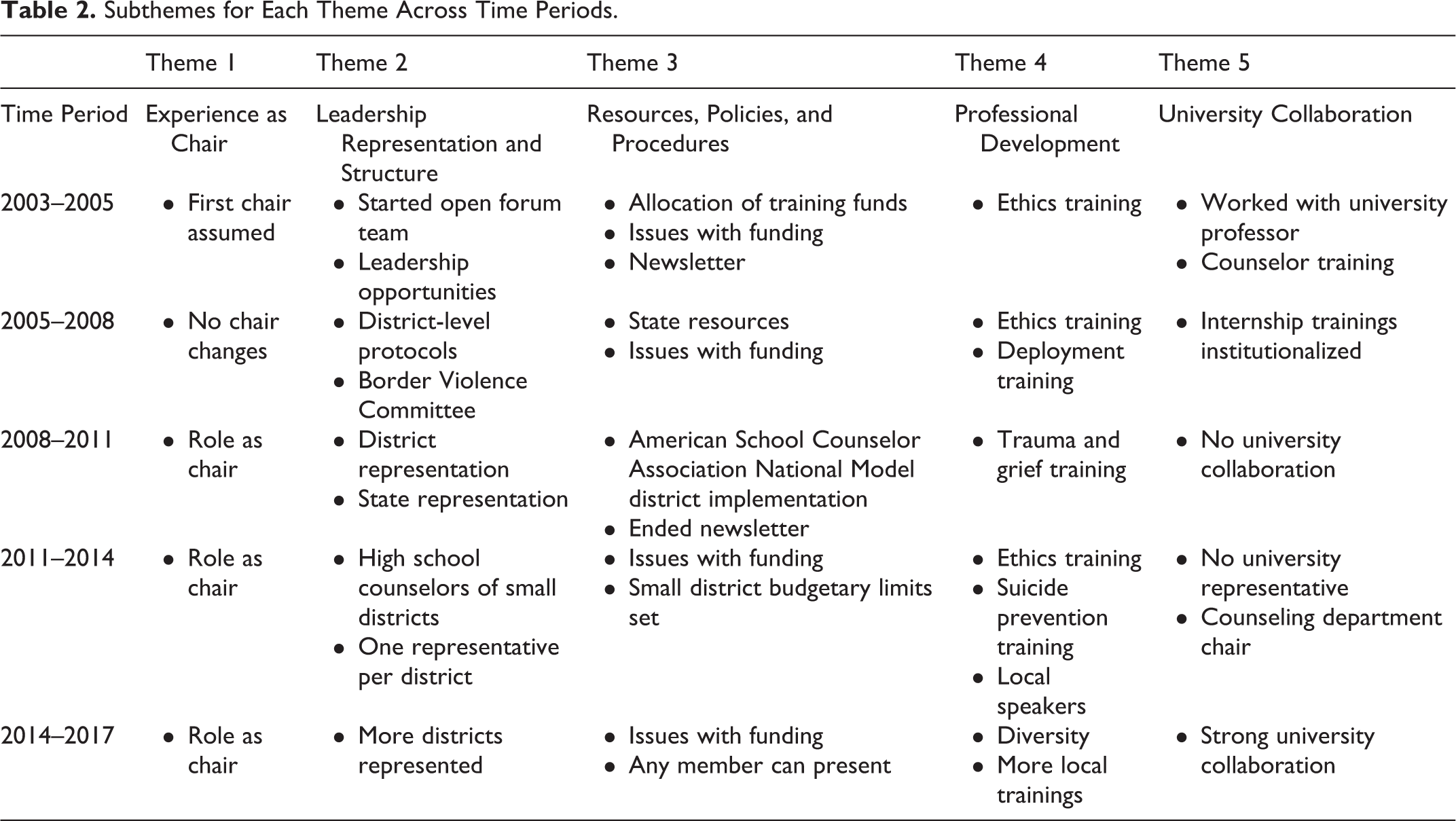
The development period represents the events that formed the RSCLT and lasted from 2003 to 2005. Data collected from this period include interviews; data were also confirmed through archival documentation (see Data Analysis section). Themes and subthemes are detailed below and displayed in Table 2.
Subthemes for Each Theme Across Time Periods.
Theme 1: Experience as chair
The main objective as the RSCLT chair, as described by the participants, was to better serve the local school districts, their school counselors, and their students. The participants described the procedures implemented and the challenges they encountered during their 3-year term. The following subtheme was identified: first chair assumed.
First chair assumed
As a cofounder, Participant A inherently became the chair of the RSCLT during its development period. The duties of the chair during the development period as described by Participant A included, “Role as a chair would have been recruited people…set the agenda…[and] contact [person].” The chair collaborated with members of the committee to develop and implement policies and procedures. Participant B elaborated, “[Participant A] and [local university counselor educator] co-chaired [but] [Participant A] was by far the leader. [Participant A] chair[ed] the meetings, put together the agenda, wrote the minutes.”
Theme 2: Leadership representation structure
The participants discussed the committees, subcommittees, and protocols initiated during their terms. They discussed the challenges they faced in providing equal representation to all the districts during the meetings. The subthemes started open forum team and leadership representation were prominent during the development period.
Started open forum team
Participant A stated that, after a few meetings: People [district representatives] started realizing that there was a venue that they could come to and be able to address the entire county as opposed to going from district to district…We always had an open forum for those things that didn’t make it to the agenda, but people had an opportunity to talk about something. What was powerful was that it was collaborative in nature and it wasn’t a power struggle, it wasn’t a one-up you, it wasn’t any of that…the strength in [the] open forum [structure] was that [of] sharing, “What are you doing for school counselors?”
Leadership representation
Participants discussed the importance of providing consistent leadership representation for all school counselors in the region. Participant B said, “We made a decision that we needed to have [representation] from the smaller districts [but] we may or may not have attendance.” Participant A explained, “Depending on the districts, sometimes we just didn’t get representation; sometimes we’d get somebody that [had] counselor [experience], not [always].”
Theme 3: Resources, policies, and procedures
The participants detailed their arduous experience trying to allocate funds for resources and training. Participants A and B had a pivotal role in developing and distributing a counselor newsletter to the local districts. The following subthemes were identified: allocation of training funds, issues with funding, and newsletter.
Allocation of training fund
One of the biggest challenges participants encountered was issues with funding. Participant B elaborated: Initially we wanted to provide the training free to the smaller districts…. We needed to have buy-in ownership from the smaller districts as well because they wanted to send people, but then they wouldn’t commit…we may or may not have a place, or we may or may not have any remuneration. We were often left trying to scramble and figure out how we were going to pay for people. We would look at…an expert, this is where they come from, this is the cost, how can we finance that, how can we fund that? Everybody [districts] would say okay, my budget I have, okay we can do that. Sometimes [a large] district would fund that one person and they would foot the entire billing and invite everybody.
Issues with funding
The RSCLT had to contribute money themselves to provide resources for school counselors. Participant A said, “We all pitched in money to run [newsletters], to pass them out, etc. That just became cost prohibitive.” Participant B further detailed the budgetary issues: The monies is always a major issue and just making sure that we adhered to legal requirements, ethical requirements, etc. Example, if you were from a small district and you ran into a money crunch and we were expecting $300 from you and you kind of blew it off, oops, the other three would have to scramble to try to make the difference. We said, ‘No, no, no, no, this is an ethical issue, you got to hold up your part of the bargain.’
Newsletter
The participants decided to disseminate a counselor newsletter, Participant A explained, “What we found is that some districts have their own little newsletter. Nothing was consistent and nothing was on a regular basis.”
Theme 4: Professional development
The RSCLT concurred that ethics training was imperative for the school counselor’s professional development. Participant A stated: We started looking at what were our biggest needs. Ethics was for sure on top of the list. Then we looked for who was a person that would be the guru of ethics for school counseling because we always had school counseling ethics, so we had counseling ethics typically through [local counseling association]. That was really not for the school; the focus was not school counseling.
Theme 5: University collaboration
The RSCLT collaborated with the local university to improve the training of school counselors and interns. Participant B was a representative for the local university and worked directly with the university professor. Two subthemes surfaced from this theme: worked with university professor and counselor training.
Worked with university professor
Participant A contacted a counseling professor at the local university. The university professor and Participant A started collaborating and consequently founded the RSCLT together. Participant A said, “[University professor] and I set up the agenda and had our first [RSCLT] meeting at [local university]…it was [university professor] and I, and I think it was somebody from [region], primarily [local university] people.” Participant B recalled, “[university professors] had all said, ‘You’re an adjunct. You’re starting at [district]. Why don’t you come represent both [local university and district]? You can fill in?’ I thought, ‘Okay, that sounds all right with me if everybody’s okay with it.’”
Counselor training
Participant A said: [Local university] would come and say, “We want to train,” because by then [development period], [local university] already had formal training for interns. [Local university] would say, “Our training with the interns is going to be on this date,” so that was always in the calendar.
Sustainability Periods
The sustainability periods show how each of the five themes was addressed during each time period. Data collected from these time periods include not only interviews but also archival documentation. Themes and subthemes are detailed per time period (and displayed in Table 2).
2005–2008
Theme 1: Experience as chair
Participants A and B were members of the RSCLT and worked closely with the chair. Participant A indicated that several changes happened during this time period, but the obligations of the chair were unmodified. The subtheme is no chair changes. Participant A expressed, “The function of the chair wasn’t changed up, it was still the same.”
Theme 2: Leadership representation structure
The participants were able to reach out and speak directly to the school counselors and had a vital role in founding committees and/or subcommittees to meet the needs of their students. Participant A had a central role in advocating for district-level protocols for the training of interns. The subthemes, district-level protocols and Border Violence Committee surfaced from this theme.
District-level protocols
Participant A recalled the inadequacy in management of internship trainings: One of the things that I started finding out is that interns would be placed without the director [district supervisor of school counselors] knowing. It would just be, I’m a teacher in a school, and I’m going to ask the counselor, he said I could do my internship here. The paperwork was brought directly…from [the university], went directly between the counselor and the intern, and it never came across my desk. [The inadequacies with internship trainings] forced protocols at the district level because then it was, me having to meet with counselors, you know, “You cannot have an intern without coming through me first.”
Border Violence Committee
Participant B explained the foundation of the Border Violence Committee: Counselors were expressing great frustration over the things that were happening and there was really no repository of services, support…. We were trying to [provide] additional support [in] trauma and loss training [due to] the unique challenges [of] border violence.
Theme 3: Resources, policies, and procedures
The participants explained how they eventually had trouble acquiring more funding. State resources and issues with funding were the subthemes that stemmed from this theme.
State resources
According to Participant A: [State agency] would give them a little pocket of money to provide the training. They would then provide the room for us to train. You may have a little bit of money then to run copies. Because we made some incredible tool kits. [State service center] was a good partner, especially when [state agency] had the little grants.
Issues with funding
The RSCLT had issues with funding due to changes in the state agency. Participant B stated, “We had about 4 years where there was some good money coming in and it started drying…[state agency] went through a transformation where money dried up.”
Theme 4: Professional development
The participants reiterated that offering training in the subthemes ethics training and deployment training was vital. Participant A said, “Some things that were always consistent, we had ethics every year.” According to the participants, offering deployment training was also crucial for the RSCLT during this time period. Participant A explained, “We really needed deployment training. We were able then to communicate that with [the Army post] and they came through. They gave us a very good…new training. Because that was huge.” Participant B elaborated: “Professional development on deployment, on special needs that the military population has, how we can assist them with their families, etc. That is the current makeup of the group.”
Theme 5: University collaboration
During this period, RSCLT continued its collaboration with the local university and began collaborating with online universities. The university professors continued providing internship trainings. The identified subtheme was internship trainings institutionalized.
Internship trainings institutionalized
Participant A stated: The working with the universities, it expanded from just [local university], to now [online university] and any other university, and any other private universities that wanted to put interns into [training]. If we’re asking [local university] to do this, we should be asking other universities to do the same…that never stopped [internship trainings]. That became institutionalized.
2008–2011
Theme 1: Experience as chair
Participant B assumed the chair position during the 2008–2011 term. Participants detailed the changes that took place and the challenges that emerged during this period. Role of chair was the subtheme that arose from this theme.
Role of chair
In describing the chair’s responsibilities, Participant C said, “The [chair was the] facilitator of the group…the one who really organized the meetings, organized the speakers, organized who was going to be coming in.”
Participant D elaborated: [Role of chair] is still pretty much…the same; you facilitate the meetings, you provide minutes…you develop the agenda, and you also secure the location. Then you’re the facilitator between presenters that need to come in and talk to the group.
Theme 2: Leadership representation structure
Efforts were made to have consistent representation from the districts. Participants wanted the RSCLT to be represented at the district level. This theme’s subthemes were district representation and state representation.
District representation
The participants agreed that district representation was not as stable during this term. Participant D said, “There was the big three [districts] and then you had a few of the smaller districts, and in some cases, it wasn’t even people related in counseling. You had someone from [academic program], and stuff like that.” Participant C recalled: Many times we had two [representatives] from [district]; sometimes we had two from [district]. So, right now we have nine districts, [local region] and sometimes it would be up to like 15 people and we only have nine districts, so we would have extra people in there.
State representation
Participant B explained the process: We wanted to have representation at the state level. When we did our first presentation as [RSCLT] and we did the [state counseling association] conference, that was our introduction, “Welcome to [city],” then we did another one on the evolution of [RSCLT]. Then we started having individuals run for or serve on committees at the state level.
Theme 3: Resources, policies, and procedures
During this time, the districts began implementing the ASCA (2003, 2012) National Model. The participants recalled the termination of the counselor newsletter and their continued difficulty in allocating funds. ASCA National Model district implementation and ended newsletter were the subthemes that emerged.
ASCA National Model district implementation
The districts followed the state model and not the ASCA National Model prior to this term. Participant C elaborated: A lot of districts implement the ASCA model. That’s not the [state] model, it’s the ASCA model…. It started with [a large] district doing it. It started through the [district supervisors of school counselors], and talking the language. Because we would always share what we were doing. The opportunity to share what you’re doing became professional development for those that did not know.
Ended newsletter
The RSCLT made the decision to discontinue the counseling newsletter due to budgetary issues. Participant B explained, “We didn’t do the newsletters anymore; we just did the professional development.” According to Participant A, “that didn’t work very well [newsletter]. There were some things that we were able to take care of, where we could say, ‘Okay, we don’t need to do that anymore…like that newsletter.’”
Theme 4: Professional development
The RSCLT offered trauma and grief training during this time period. Participant D stated about this subtheme: A huge influx of families leaving [neighboring city] for safety reasons and coming here. There was trauma associated with that move. Not only because they were being threatened, held hostage, but I can tell you, for example…we had a case that we had to respond to where the kids…had moved…because they saw their [family member’s] feet being burned…so they fled. How do you help process that?
Theme 5: University collaboration
The participants indicated that the strong collaboration forged with the local university during the development years was lost during this term. The prominent subtheme that emerged was no university collaboration. Participant B stated, “For a while we lost the connection with [local university] as well because [university representative] left…. It was more spotty. It stayed that way.” Participant D put it plainly: “That’s when [the local university members] were absent.”
2011–2014
Theme 1: Experience as chair
Participant C became the RSCLT chair during this period. In participants’ description of the role of the chair during this term, the subtheme that emerged was role as chair.
Role as chair
Participant C explained: “I’m contacting [people], I’m booking the person, I’m finding the place…doing everything.” Participant D elaborated that the role of participant C during this term was like previous terms: [The chair is] still coordinating the minutes, you’re still coordinating the location, you’re still producing the minutes for the meeting. You’re also facilitating if presenters, or whatever, wants to come through…. I’m contacting the person [presenter], I’m booking the person, I’m finding the place for [meeting].
Theme 2: Leadership representation structure
The RSCLT worked with the districts to reiterate the fact that every district has an equal voice. Thus, the subthemes high school counselors of small districts and one representative per district were selected from this theme.
High school counselors of small districts
Participant C explained: The smaller districts, [representatives] just kind of rotate off and on, because it’s usually a high school counselor and it just depends on whose turn it is to do it like [district] only has one…. The high school counselors, they have to go back and meet with elementary, middle [school counselors] and disseminate the information.
One representative per district
Participant D said, “We kind of said no…one representation [per district].” Participant C explained: We started looking at better member representation from each district. Up until that point, we’ve always said that but I don’t think we’ve ever really enforced it. So, we said ok, only one member representative from each district…. Since any of the districts were, you know, 10 times larger than the smaller districts and we wanted to make it equitable voice as possible.
Theme 3: Resources, policies, and procedures
The RSCLT continued having challenges with allocating funds. Consequently, the group established budgetary limits to improve the problems with funding. Issues with funding and small district budgetary limits set were the prominent subthemes.
Issues with funding
According to Participant C: Everybody was contributing [money] but it was kind of like a scattered mess; honestly, it was a scattered mess. In my term, I just set up a spreadsheet at the very beginning and we said “Okay, how much is everybody going to contribute?” right at the beginning of the year.
Small district budgetary limits set
The small districts did not have to contribute as much money as the large districts. Participant C explained: We kind of set up limits. Like we said for the smaller districts, like [district] and [district], they’re little bit bigger so $500…then smaller like [districts], $250, and the larger districts we would say like $3,000.
“The small districts really, really recognize that they’re actually the ones benefiting the most from the collaborative because there is no way they can afford to bring in [speakers].” (Participant D)
Theme 4: Professional development
During participant C’s time as chair, professional development focused on the three subthemes, ethics training, suicide prevention training, and local trainings.
Ethics training
Participant C reiterated: Of course, every year we do ethics…. For ethics we make sign-in sheets for all the districts, the smaller ones and we always get turnouts from all of them…. Everyone does a really good job of getting information out to their people.
Suicide prevention training
This was offered to the school counselors in the region because, as Participant D explained, “procedures for suicide response were minimal.” Participant C said, “The pouring of suicide outcries and suicide completion, that was a lot during my term and so we did do a lot of training, we brought in [speaker] to talk about grief, to talk about suicide ideation.”
Local speakers
Participant C stated, “We’d use [local speakers], we’d use [local speakers], we’d use, you know, all of those different resources to do our training.” Participant B confirmed, “People that we’d bring [were] local.”
Theme 5: University collaboration
Collaboration with the local university was limited during this time; no local university representative had participated since the last term. The participants indicated that university professors would sporadically offer trainings. However, the local university’s counseling department chair formed an alliance with the RSCLT. The subthemes that emerged were no local university representative and counseling department chair.
No local university representative
The participants recalled that the absence of a university representative was conspicuous during this time. Participant D said: They [university professors] were available to us as a resource, but they weren’t really a part of the planning group, I guess. It’s ironic because they had originally been part of the forming committee with [former university representative], with [Participant A].
Counseling department chair
According to Participant C: [Counseling department chair] came on board, we kind of stared collaborating with him but [counseling chair] wasn’t a school counselor…. But [counseling chair] had a lot of information that was helpful to us, like on the suicide plan, the crisis plan…. [Counseling chair] would come to the meetings and that was very helpful to us.
2014–2017
Theme 1: Experience as chair
Participant D became the RSCLT chair during 2014–2017. Participants explained the major changes that occurred during this term and the challenges they faced as chair. The subtheme role of chair stemmed from this theme.
Role of chair
The participants asserted that the responsibilities of the chair during this term were the same as in the previous term. Participant C said, “The role of the chair stayed the same…. Nothing really changed between [my term] and [Participant D’s]. Participant D confirmed: “It [the role of the chair] still pretty much was the same.”
Theme 2: Leadership representation and structure
The participants indicated that during this term, more districts were represented. Participant D stated about the subtheme, more districts represented, “Some of the smaller [districts] are actually taking more of a lead…. We really actively as a region reached out to the smaller districts to have representation.” Participant C said, “We were looking at a little bit of a different structure…better member representation from each district…. We ran into problems [from] region [community] people…we got a limit [on community people].”
Theme 3: Resources, policies, and procedures
The participants detailed the funding issues they encountered during this term and the policies that were set to have every district contribute money. The RSCLT also implemented procedures that allowed any RSCLT member to present during meetings. Subthemes identified were issues with funding and any member can present.
Issues with funding
Participant D recounted the following: It makes it a lot easier for one district to take care of the contract purchase order or the billing. “You take a percentage, you take.” No, that can be cumbersome. However, there are times we do have to do that.
Any member can present
Participant C stated, “They [speakers] just contact the chair and they just put them on the agenda and there’s never any bidding or anything like that, whoever wants to come in and present can come in.” Participant D added, “There will be a protocol that you’re going to follow…even how you’re going to notify me.”
Theme 4: Professional development
The participants began discussing diversity issues during meetings. The subthemes that emerged related to professional development were diversity and more local trainings.
Diversity
Participant D said: We [RSCLT] started seeing more acceptance and tolerance of diversity, and so our counselors have to be in tune with that. Some of the [professional development] is in line with that. Who are your homeless kids? If we’re looking at just some of the population groups we serve. At-risk children and what makes them at risk, embedded in there…we had two sessions where we were talking about LGBT issues.
More local trainings
Participant C said that local trainings continued during this term: “Most of the people that we’d bring are local and about half of them would talk about motivation. So, very rarely do we bring in national just because we’ve had a horde of national people.”
Theme 5: University collaboration
Participants C and D indicated that during this term, there was a strong collaboration with the local university. Participant D stated about the subtheme, strong university collaboration: Two things happened when I [Participant D] came on board. I reached out to [counseling chair] for two reasons, again. One is I was aiming for that representation, or collaboration, with the university. Not only that, but that was also the time when I was already entering my second semester in the district, and I saw what had happened [no university representative], and I reached out to [counseling chair] because of what I saw. That connection came in and it was just a natural fit. Then [counseling chair] came a few times and then [university professors] came on board.
Discussion
The research question for this study was: How did school counselor supervisors develop and sustain an RSCLT? The study focused on two primary areas, development and sustainability.
Findings indicate that the development stage took place between 2003 and 2005. The impetus for developing the RSCLT was to improve the training and professional development of school counselor trainees and school counselors. For instance, ethics and internship training were primary needs for school counselors in the region. In pursuing this goal through shared leadership and collaboration, cofounders (school counselors and counselor educators) contacted school counselors and supervisors in the region to attend meetings to discuss opportunities.
Another primary aim that arose for the team was for all districts in the region (regardless of student population) to have equal say in decisions made by RSCLT; therefore, meetings were structured as open forums. Challenges during the development period for the RSLCT included allocating funds across districts for regional training, communicating to all school counselors in the region, and districts not having a district supervisor of counselors or having one with little or no school counseling experience. Another need that arose was for someone to help organize meetings; thus, a cofounder (a district supervisor of school counselor and previous school counselor) assumed this role that would eventually be called the “chair.”
The sustainability period spanned 2005 to the present. During this period, significant changes included implementing a system of rotating chairs, creating subcommittees focused on regional issues such as the Border Violence Committee, setting reasonable yearly contribution requirements for smaller districts to help fund training while larger districts retained the primary responsibility, and allowing a representative or member and alternate (two individuals) to attend per district (i.e., if possible, one being a school counselor and the other a district supervisor of school counselors). The RSLCT also strengthened university collaboration and representations, added region-specific professional development such as violence and suicide prevention training, began using local speakers for trainings, and added community members to the team, such as an army liaison.
Although studies involving the development and sustainability of school counselor leadership teams have been limited, if any exist, the current study aligns with existing literature and research (Brott, Stone, & Davis, 2016; Kaffenberger et al., 2006). For instance, similar to the RSCLT of this study, the Northern Virginia School Counseling Leadership Team started with counselor educators and district supervisors of counselors who met to discuss collaborating to address the “local needs” and “shared concerns” of school counselors (Kaffenberger et al., 2006, p. 290). The group eventually expanded to include other members such as school counselors and supported a series of workshops or professional development (Kaffenberger et al., 2006). The RSCLT in this study developed and collaborated because of an identified need to address school counselor professional development and internship training in the region. Brott, Stone, and Davis (2016) detailed how the Northern Virginia School Counseling Leadership Team was able to conduct practical action research that identified a need to address site supervisor professional development and/or internship training.
Although similar, the RSCLT of this study differs from the Northern Virginia School Counseling Leadership Team in several ways. The Northern Virginia team evolved to a state counseling leadership team, added members that represented state-level associations or groups, and focused more on defining the identity of the school counselor, transforming university training programs, and influencing public policy specific to school counseling and Virginia (Kaffenberger et al., 2006).
Limitations
This study is only generalizable in terms of theory (Yin, 2009, 2014). A probable theory for this study is that an RSCLT emerged via decisions based on regional community needs and similar concerns, and the team has been sustained over time because of its open forum structure, ability to address ongoing regional professional development needs, and shared but equitable responsibilities among team members. Because of the paucity of research in this area to support this theory beyond this study, further testing of this theory through additional case studies on RSCLTs in other locations would be beneficial. The team has been sustained over time because of its open forum structure, ability to address ongoing regional professional development needs, and shared but equitable responsibilities among team members.
Another limitation was that the study included the two debriefers and independent analysts. Although trained and experienced in qualitative methodology, these professionals do not have a background in the field of school counseling, possibly limiting their understanding of discipline-specific terminology (e.g., ASCA, ASCA National Model). However, such a limitation may also have been beneficial in providing feedback and analysis without the influence of previous biases based on professional experience of the school counseling profession. Other limitations of the study include the researcher’s role as participant-observer (being careful not to manipulate events), reliance on interviewees’ memories, and the limited number of participants interviewed. The primary researcher extended invitations through various means, but these were not accepted by past and current members of the RSCLT who had different backgrounds from the interviewees who participated. These backgrounds included counselor educator cofounder, community member, school counselor supervisor without school counseling experience, and a current school counselor. To address these limitations, the researchers collected other sources of data rather than relying on one source, used well-defined protocols for the collection of data, and triangulated data collected from various sources for validation (Yin, 2009, 2014; see Instrument and Data Collection and Validity and Trustworthiness sections for more information).
Implications and Conclusion
This case study explored the development and sustainability of an RSCLT. The intent was to provide understanding of a school counselor leadership team that impacts local districts, communities, or the region. Research and professional literature indicate that some school counselors have challenges in supporting their own professional development and student populations due to limited resources (Griffin & Farris, 2010; Grimes et al., 2013; Larivee, 2002; McCarthy, Kerne, Calfa, Lambert, & Guzmán, 2010; Monteiro-Leitner et al., 2006). Pulling resources together and coordinating and collaborating through a school counselor leadership team may be beneficial in addressing such needs (Gysbers, 2006; Kaffenberger et al., 2006; Young & Bryan, 2015). Developing a regional school counselor leadership team may assist school districts with limited resources that school counselors can use in meeting the needs of their students. Such a team may also empower district supervisors of school counselors, especially those supervisors without school counseling experience, with support and resources to aid school counselors in implementing comprehensive school counseling programs, offering meaningful and productive school counselor professional development in the region, and strengthening advocacy influence and efforts for matters related to school counselors within the region (Kaffenberger et al., 2006; Young & Bryan, 2015). As a result, stakeholders who may benefit from this study include school counselors, counselor educators, state supervisors of guidance (or school counseling), and district supervisors of school counselors. A team may also empower district supervisors of school counselors, especially those supervisors without school counseling experience, with support and resources to aid school counselors.
Besides conducting similar case studies to assist in generalizing a theory of RSCLTs (see Limitations section), future research into the impact of RSCLTs on the work of school counselors would be beneficial. Previous researchers have conducted practical action research to examine the need for a school counselor leadership team to provide and improve site supervision training in their area (Brott et al., 2016). Future researchers could use practical action research to examine other professional development needs (e.g., implementing comprehensive school counseling programs) that RSCLTs are attempting to address and to consider such teams’ effectiveness or use of data to make informed team decisions.
Footnotes
Declaration of Conflicting Interests
The author(s) declared no potential conflicts of interest with respect to the research, authorship, and/or publication of this article.
Funding
The author(s) received no financial support for the research, authorship, and/or publication of this article.