







Abstract
Student attitudes toward accessing school counseling services were the focus of a survey of 3,584 middle school and high school students. Respondents identified barriers to seeking help from school counselors, including stigma, a desire to manage problems themselves, a lack of a positive relationship with their school counselor, and a concern that the counselor would not keep disclosures confidential. This study also examined the impact of gender, age, and race/ethnicity on students’ willingness to seek help from their school counselor. We present implications for practice and future research.
Considerable research has supported the value of counseling services for children and adolescents in schools (Fox & Butler, 2007; Reback, 2010; Whiston, Tai, Rahardja, & Eder, 2011). For example, analysis of a large national sample of elementary-aged students found that states with greater availability of school counselors, due to policies supporting elementary school counseling, showed higher third-grade test scores in math and reading and lower levels of internalizing and externalizing problem behaviors among students (Reback, 2010). Furthermore, a meta-analysis of the effectiveness of 153 school counseling interventions found a small to moderate effect size of d = .30, indicating that students who received school counselor interventions have measurably higher outcomes across cognitive, behavioral, and affective domains than students who do not receive those interventions (Whiston et al., 2011). School counseling services have also proven effective for a range of more specific issues and goals, from supporting immigrant students’ career development (Watkinson & Hersi, 2014) to reducing the achievement gap by increasing the academic achievement of African American high school students (Bruce, Getch, & Ziomek-Daigle, 2009). The broad finding is clear: Counseling in schools is an effective way to address a range of student issues (Reback, 2010; Whiston et al., 2011).
Despite the proven effectiveness of counseling for middle school and high school students, many adolescents have shown a consistent reluctance to seek and accept therapeutic help (e.g., Chandra & Minkovitz, 2006; Del Mauro & Williams, 2013; Gulliver, Griffiths, & Christensen, 2010). In fact, researchers have found that the willingness of youth with mental health issues to seek and accept counseling help dramatically decreases as they move through adolescence (Cuffe et al., 2001). Research inside and outside the United States reveals that more than half of all high school students may be reluctant to seek professional help for their problems (Heath, Baxter, Toste, & McLouth, 2010; Rughani, Deane, & Wilson, 2011). Reasons for this reluctance include the stigma surrounding mental health treatment, a fear that confidentiality will not be upheld, concern about being judged, a lack of faith regarding the effectiveness of counseling, and the belief that seeking counseling is a sign of weakness (Del Mauro & Williams, 2013; Fox & Butler, 2007; Gulliver et al., 2010; Rughani et al., 2011; Timlin-Scalera, Ponterotto, Blumberg, & Jackson, 2003). Adolescent boys—specifically African American boys—seem particularly reluctant to seek counseling services for social/emotional issues (Chandra & Minkovitz, 2006; Eliot, Cornell, Gregory, & Fan, 2010).
The findings above suggest that many adolescents are reluctant to seek help from counselors, even though counseling is a demonstrably effective service. Although a moderate body of research addresses general help seeking among adolescents (Chandra & Minkovitz, 2006; Eliot et al., 2010), minimal research has been conducted on middle school and high school students’ attitudes toward services provided by school counselors, and much more information is needed to better understand this phenomenon. An important step in delivering effective counseling services in middle schools and high schools is to better understand the reasons students may be reluctant to see their counselor. The purpose of this article is to explore students’ attitudes about school counseling services and examine barriers that may prevent them from seeking those services. To that end, we conducted a large, multistate study in which we surveyed middle school and high school students on their attitudes toward school counselors and school counseling services. Many adolescents are reluctant to seek help from counselors, even though counseling is a demonstrably effective service.
Attitudes Toward Seeking Counseling Help Among Adolescents
A large body of research indicates that seeking professional help for social–emotional problems is difficult for adolescents (Chan & Quinn, 2012; Corry & Leavey, 2017; Del Mauro & Williams, 2013; Fox & Butler, 2007; Raviv, Raviv, Vago-Gefen, & Fink, 2009). Survey research has consistently indicated that fewer than half of adolescents report being willing to seek help from a health-care professional for a variety of emotional troubles (Boldero & Fallon, 1995; Chandra & Minkovitz, 2006; Rughani et al., 2011). In a seminal study of 1,013 adolescents in Australia, Boldero and Fallon (1995) found that respondents were much more likely to seek help from friends (40%) or parents (36%), as opposed to a professional helper such as a doctor or counselor (12.7%). A more recent study of Australian adolescents found that only 17% of males and 29% of females were willing to seek help from a health-care professional for emotional issues (Rughani et al., 2011). Chandra and Minkovitz (2006) found a similar pattern of results when surveying 274 eighth graders in the United States, with respondents being more than 5 times more likely to turn to friends when experiencing an emotional problem, as opposed to turning to a counselor. More recently, Corry and Leavey (2017) found through focus group research that adolescents reported a persistent lack of trust that served as a barrier to seeking help from medical professionals. Perhaps most concerning is the finding that adolescents who have the highest level of suicidal ideation, and thus are in the greatest need of professional support, are least likely to report an interest in seeking help from either professional or informal sources of support (Goodwin, Mocarski, Marusic, & Beautrais, 2013; Wilson, Deane, & Ciarrochi, 2005).
Barriers to Seeking Professional Help
Researchers have identified several barriers that interfere with adolescents’ willingness to seek professional help for social/emotional problems (Boldero & Fallon, 1995; Chan & Quinn, 2012; Chandra & Minkovitz, 2006; Del Mauro & Williams, 2013; Fox & Butler, 2007; Gulliver et al., 2010; Wilson & Deane, 2012). A consistent finding across studies is that adolescents often prefer to manage problems on their own, rather than turn to professional helpers (Boldero & Fallon, 1995; Chan & Quinn, 2012; Chandra & Minkovitz, 2006). Although part of the reason adolescents may avoid seeking help from counselors is that they are engaging in the normal and healthy process of developing a sense of personal autonomy and desire to manage problems on their own (Wilson & Deane, 2012), this tendency toward self-reliance can also be a contributing factor in inhibiting adolescents from seeking needed professional counseling help. A second barrier to seeking counseling help is adolescents’ sense that the counselor is a virtual stranger with whom they do not feel comfortable sharing problems (Fox & Butler, 2007). Another barrier identified in the literature is the stigma adolescents frequently associate with talking to a counselor (Chandra & Minkovitz, 2006; Fox & Butler, 2007; Gulliver et al., 2010). Chandra and Minkovitz (2006) found that 59% of eighth graders were too embarrassed to see a counselor because of what other students might say if they found out. Similarly, Fox and Butler (2007) identified that fear of being seen by other students entering the counselor’s office is a barrier.
Stigma may serve as a barrier for many adolescents, but even those adolescents who do not appear to stigmatize help from counselors may still avoid seeking professional help. Focus group research with U.S. adolescents found that even if adolescents find value in counseling and would not judge peers who were in counseling, they would resist seeking professional counseling help for themselves (Del Mauro & Williams, 2013), a finding more pronounced for boys (Raviv et al., 2009). Adolescents tend to overestimate their ability to manage emotional problems, presuming they are better able to handle their own problems than may actually be the case (Raviv et al., 2009).
Another critical barrier that interferes with adolescents’ willingness to seek help from professional counselors is a lack of trust in the counselor. Multiple studies have found that startlingly high percentages of adolescents do not trust counselors and do not believe counselors will keep their conversations confidential (Chan & Quinn, 2012; Chandra & Minkovitz, 2006; Del Mauro & Williams, 2013; Fox & Butler, 2007; Timlin-Scalera et al., 2003). For example, when Chandra and Minkovitz (2006) surveyed a group of eighth graders to identify barriers to seeking counseling help, 42.7% of the respondents indicated that they did not trust counselors. Research has indicated that adolescents who report higher levels of trust regarding counseling are more likely to seek counseling help (Biolcati, Palareti, & Mameli, 2018). A final barrier that may impact adolescents’ desire to seek help from counselors is a fear of being judged; some studies indicate that adolescents may resist seeking counseling help because they are worried what the counselor will think about them and their problems (Del Mauro & Williams, 2013; Yap, Reavley, & Jorm, 2013).
Age, Gender, and Racial/Ethnic Differences in Help-Seeking Behavior
Within the context of the broad finding that adolescents often are reluctant to seek help from counselors, research has also revealed differences in help-seeking patterns based on age, gender, and race/ethnicity (Cuffe et al., 2001; Heath et al., 2010). Age appears to be closely related to use of mental health services. One longitudinal study found a striking decrease in use of mental health services from early adolescence to early adulthood, with usage rates across the three data collection points falling from 24% to just 3% (Cuffe et al., 2001). Other survey research has found that middle school students are more likely than high school students to seek help from school-based programs for nonsuicidal self-injury (Heath et al., 2010).
Researchers have also identified gender differences in help seeking with findings consistently indicating that adolescent boys tend to be more reluctant than adolescent girls to seek counseling help both in school (Eliot et al., 2010) and out of school (Boldero & Fallon, 1995; Chandra & Minkovitz, 2006; Cheung, Dewa, Cairney, Veldhuizen, & Schaffer, 2009). Among adolescents who experience suicidal ideation or attempts, boys are again substantially less likely than girls to access mental health services (Cheung et al., 2009). Although the broad finding is that adolescent boys are less likely than adolescent girls to seek counseling help, the research reveals more subtle gender differences. One study of more than a thousand adolescents in Scotland found that boys were more likely to view going to counseling as a sign of weakness, while girls were more likely to question the value of counseling (Chan & Quinn, 2012). Moreover, although girls are more likely to seek counseling, they are more prone to worry about being judged by the counselor (Yap et al., 2013).
In several studies, researchers have examined the relationship between race/ethnicity and adolescent help seeking (Bryan, Moore-Thomas, Day-Vines, Holcomb-McCoy, & Mitchell, 2009; Eliot et al., 2010; Ho, Yeh, McCabe, & Hough, 2007). Their results consistently revealed that race/ethnicity matters when examining patterns of help seeking, but showed that these relationships are complex and sometimes contradictory (Bryan et al., 2009; Eliot et al., 2010). As a case in point, a survey of more than 7,000 ninth-grade students found that African American students were significantly less likely to seek help for bullying and threats of violence as compared to other racial groups (Eliot et al., 2010). Conversely, examination of a large national sample of eighth-grade students in the United States showed that African American students were substantially more likely to see their school counselor as compared to White students, although it was not clear how many of those students sought out their school counselor voluntarily (Bryan et al., 2009). Other research revealed lower mental health usage rates among Latino and Asian/Pacific Islander adolescents as compared to White and African American youth (Ho et al., 2007). Research has identified several factors that may help explain racial differences in help-seeking behavior, including cultural mistrust of majority helpers (Duncan & Johnson, 2007) and strong parental affiliation with an alternative culture (Ho et al., 2007). In sum, the existing research suggests that race is an important influence on students’ willingness to seek counseling services, although the precise manner in which race is related to help seeking is complex and not yet fully understood.
To further examine the issues above in the specific context of school counseling services, we surveyed a large group of middle and high school students to assess their attitudes toward counseling and school counselors. Our ultimate goals were (a) identifying factors that feed the reluctance of middle and high school students to seek help from their school counselors and (b) developing recommendations to address these factors, thereby enhancing student willingness to access school counseling services. As a first step toward these larger goals, we designed the current study to seek preliminary answers to the following research questions: What attitudes or beliefs do middle school and high school students hold that either increase or decrease the likelihood they will seek help from their school counselor? What is the impact of gender, age, and race/ethnicity on students’ willingness to seek help from their school counselor?
Method
Procedures
Upon receiving approval for the study from the institutional review boards at our respective universities, we invited and received commitments from school counselors at 11 secondary schools (N = 11) in two Midwestern states to serve as site coordinators for the study. Coordinators were not invited at random but contacted based on their existing relationships with one or more of the authors, either as a graduate program alumnus or an internship site supervisor. In exchange for a US$100 stipend, coordinators were asked to distribute informed consent documents, invite students to participate, and ensure that a link to the online survey instrument was distributed to willing participants in a manner convenient for students and staff. Although each coordinator used a slightly different method for survey administration, they most commonly asked teachers to share the link with participants during a study hall, homeroom, or other noninstructional time. Site coordinators were given freedom to invite groups of students to participate according to school data needs and convenience. Ultimately, nine schools elected to invite all students to participate and two schools chose to invite selected grade levels. Site coordinators worked with their building and district administrators to determine procedures for parental consent, with all schools ultimately choosing to use a passive consent process. Site coordinators reported that no parent/guardian chose to opt their student out of the project and no student was unwilling to participate. This was confirmed by the researchers who discovered that all students who accessed the survey answered “yes” to the informed assent statement, signaling their willingness to participate.
Instrument
Unable to locate an instrument to measure all the variables in question, we created our own tool later named the Barriers, Experiences, and Attitudes Toward School Counseling (BEATS) survey. Design of the instrument began with a thorough review of literature related to adolescent help seeking, specifically in school and professional counseling settings. As noted above, previous research on the topic has uncovered numerous reasons why some adolescents tend to avoid seeking help and, when they do, which persons in their life they are most likely to approach. Ultimately, the 51-item BEATS instrument consisted of five sections, each grounded in the literature and designed to gather data related to the research questions: (a) basic demographics (e.g., grade, ethnicity); (b) experiences with the school counselor (e.g., number of meetings this year, reasons for meetings); (c) willingness to see the school counselor for various academic, college/career, and social/emotional issues (e.g., “Change your schedule,” “Explore college options,” and “You’ve been feeling very sad lately”) provided on a Likert-type Scale with responses from 1 (very unlikely) to 5 (very likely); (d) perceived barriers to seeing the school counselor for each issue above (e.g., “The counselor might tell someone what I said,” “I don’t know my counselor well enough to talk about this,” and “I like to handle stuff like this on my own”) provided on a Likert-type Scale with responses from 1 (definitely WOULD NOT stop me) to 5 (definitely WOULD stop me); and (e) open-response items (e.g., “What could the school counselors in your school do to be more helpful to students?”).
Prior to the study, we pilot tested the BEATS on seven willing adolescents between the ages of 12 and 18. Following completion of the survey, we asked these participants to provide feedback on length, clarity, reading level, and content. We revised the instrument based on this feedback, and the survey was deemed acceptable for use in the study.
Participants
The study was carried out at 11 secondary schools (N = 11) in two Midwestern states. General characteristics of the schools were as follows: two large, public high schools with Grades 10–12 (suburban); two medium-sized, Catholic high schools with Grades 9–12 (one suburban and one medium-sized city); three small, public high schools with Grades 9–12 (rural); one small, public secondary school with Grades 6–12 (rural); one large, public middle school with Grades 6–8 (medium-sized city); one small, public middle school with Grades 6–8 (rural); and one small, public middle school with Grades 7–8 (rural). Table 1 provides additional characteristics of the participating school sites, including student demographics.
Participating School Characteristics.

A total of 3,584 students in Grades 6–12 took the survey, with participants in Grades 6–8 (n = 1,287) categorized as middle school (MS) students and those in Grades 9–12 (n = 2,287) considered high school (HS) students. Ten participants did not indicate a grade level. Participants self-identified their gender in an open-response format and were categorized as male (n = 1,731, 48.3%), female (1,773, 49.5%), gender nonconforming (31, 0.9%), no response (21, 0.6%), or other response (28, 0.8%). Students similarly self-identified their ethnicity and were categorized as White (n = 2,756, 76.9%), African American (191, 5.3%), Latina/Latino (158, 4.4%), multiracial (135, 3.8%), Asian/Pacific Islander (121, 3.4%), American Indian (17, <1%), no response (90, 2.5%), or other response (116, 3.2%).
Results
Basic Descriptive Statistics
We analyzed quantitative data using the PSPP free statistical software package (GNU Project, 2016). Basic descriptive analyses revealed that the vast majority of students indicated knowing their school counselor’s name (90.4%) and office location (88.3%), although a lower percentage reported knowing how to schedule a meeting with their school counselor (73%). Students reported meeting with their school counselor (defined in the survey as an individual or group counseling session) approximately 2–3 times in the past year (M = 3.36, median = 2), although more than 20% of participants reported zero meetings with their school counselor during that time. Academics (46%) were the most common reason for these meetings, followed by college/career planning (29%), and social/emotional issues (18%). When asked to rate their willingness to seek help from their school counselor for specific issues across the academic, college/career, and social/emotional domains on a Likert-type Scale from 1 (very unlikely) to 5 (very likely), students reported being most willing to seek help for academic or college/career reasons, with the most likely scenarios being: “Changes to your schedule” (M = 3.47, SD = 1.50), “Exploring college options” (M = 3.42, SD = 1.35), and “Deciding which classes to take” (M = 3.33, SD = 1.36). Students indicated they were least likely to seek help for social/emotional reasons, with the lowest-rated scenarios being, “You’ve been feeling very sad lately” (M = 1.98, SD = 1.20), “Ongoing problem with your parents or friend” (M = 2.11, SD = 1.19), and “Anxiety or stress” (M = 2.31, SD = 1.31). Differences were detected by demographic variables on a number of items; we discuss this below. Students reported meeting with their school counselor approximately 2–3 times in the past year, although more than 20% of participants reported zero meetings with their school counselor during that time.
Barriers to Seeking Help From the School Counselor
To answer the first research question related to barriers to seeking help, students were asked to respond to a list of eight reasons an adolescent might choose not to seek help from their school counselor. As explained above, a small body of literature exists on general attitudes toward help seeking among adolescents, and the eight reasons selected for inclusion in this study were drawn from common findings across previous studies. In the present study, we asked participants to rate the degree to which each of these eight reasons would stop them from seeing their school counselor for various academic, college/career, and social/emotional issues, using a Likert-type Scale from 1 (definitely WOULD NOT stop me) to 5 (definitely WOULD stop me). Table 2 shows the results for this section of the survey. Regardless of the type of presenting concern, students consistently rated the following reasons as the greatest barriers to seeking help from the school counselor: (a) “I would talk to a parent, friend, or teacher about this instead”; (b) “I like to handle this stuff on my own”; (c) “I don’t know my counselor well enough to talk about this”; and (d) “The counselor might tell someone what I said.”
To What Degree Would the following Reasons Stop You From Seeing Your School Counselor for Help With Each Type of Issue?

Note. 1 = very unlikely; 2 = unlikely; 3 = undecided; 4 = likely; 5 = very likely.
Differences by Developmental Level, Ethnicity, and Gender
To answer the second research question, we utilized χ2 and one-way analysis of variance followed by post hoc tests (Bonferroni method) to detect differences by developmental level, ethnicity, or gender.
Differences by developmental level
We noted many differences between middle school and high school students, starting with the percentage of middle school students (47.7%) and high school students (17.3%) who reported no meetings with their school counselor in the previous year. The reasons for meetings that did occur also differed, with middle school students being much more likely than high school students to report meeting with the school counselor for a social/emotional reason (26.7% vs. 12.5%), while the opposite was true for academics (12.8% vs. 64.6%) and college/career planning (2.5% vs. 44.3%). As illustrated in Table 3, these findings paralleled student responses on items related to their willingness to seek help from the school counselor, with middle school students being more willing than high school students to seek help for all scenarios related to social/emotional issues, but significantly less likely for all scenarios related to academics and college/career planning (all differences significant at p ≤ .001). For example, the two issues for which middle school students reported being most likely to seek help from the school counselor were, “a friend told you they were thinking of harming themselves” and “bullying,” while these scenarios rated only seventh and eighth most likely for high school students.
How Likely Is It That You Would Go to Your School Counselor for the Following Issues?
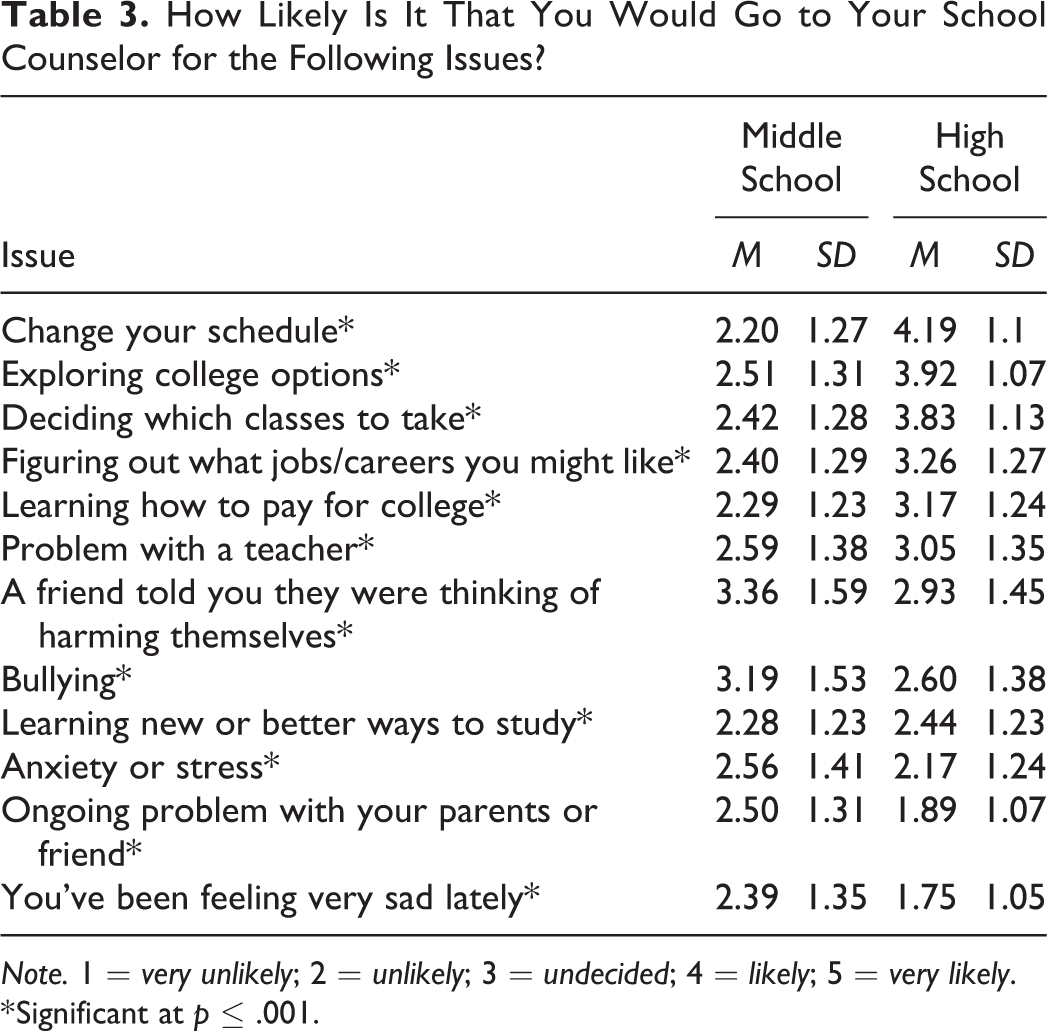
Note. 1 = very unlikely; 2 = unlikely; 3 = undecided; 4 = likely; 5 = very likely.
* Significant at p ≤ .001.
Very few developmental differences were found regarding perceived barriers to seeking help. Regardless of the domain of the scenario, both middle school and high school students endorsed two reasons far more frequently than others when asked what would stop them from seeking help from the school counselor: (a) “I would talk to a parent, friend, or teacher about this instead” and (b) “I like to handle this stuff on my own.” Those barriers were followed in likelihood by “I don’t know my counselor well enough to talk about this” and “The counselor might tell someone what I said,” with the order of these two reasons differing slightly by developmental level and domain of the presenting issue.
Differences by ethnicity
We also noted several differences by ethnicity, beginning with the finding that many students of color did not know their school counselor’s name. Specifically, White students were statistically more likely to report knowing their counselor’s name (92.7%) than were multiracial (83.7%, p ≤ .05) and African American (79.1%, p ≤ .001) students. Despite this finding, no significant differences were detected by ethnicity with regard to the number of reported meetings with a school counselor over the past year.
χ2 analyses detected statistically significant differences (p ≤ .01) by ethnicity with regard to reasons given by students for meeting with their school counselor over the past year. African American (15.7%) and Asian/Pacific Islander (10.7%) students were less likely than all other groups to report meeting with a school counselor in the past year for social/emotional reasons. This trend was also observed in student ratings on items related to their willingness to seek help from a school counselor for specific scenarios involving social/emotional issues. For example, when asked to rate how likely they were to seek out the counselor for help with “ongoing problem with parents or friend” on a scale from 1 to 5, African American (M = 1.82) and Asian/Pacific Islander (M = 1.71) students reported being significantly less likely (p ≤ .05) than White (M = 2.11) or Latina/Latino students (M = 2.24).
Conversely, African American students were most likely of all groups to report meeting with a school counselor for academic reasons (62.3%), and this was similarly reflected in their willingness to seek help from the school counselor for issues such as “change your schedule” (M = 3.66) and “learn about better ways to study” (M = 2.69). Finally, although African American students typically reported being more willing than White students to seek help for college/career planning, a smaller percentage of African American students (26.2%) reported actually meeting with their counselor for this reason as compared to White students (31.6%).
Differences by gender
We found very few statistically significant differences by gender in this sample, as male, female, and nonconforming students reported both similar levels of willingness to see the school counselor and similar perceived barriers to doing so. We did note differences in the number of contacts with a school counselor in the past year, with nonconforming students reporting significantly more (M = 8.68, p ≤ .05) than male (M = 3.4) and female (M = 3.27) students. The reported reasons for these meetings also differed, with female (22.3%) and nonconforming (45.2%) students reporting more meetings than males (12.1%) for social/emotional issues. Given the literature on help seeking and gender, we found the relatively sparse differences detected in this sample somewhat surprising.
Open-Ended Questions
Research trends are shifting to include qualitative data within quantitative studies as a way to reveal themes and common threads in a specific area being studied (Erwin, Brotherson, & Summers, 2011) and to provide a broader and more holistic understanding of the phenomenon (Wright, 2014). The primary purpose of qualitative questioning within a survey is to gain insight into the participants’ worldviews and capture their unique and authentic experiences and interpretations of these experiences (Marshall & Rossman, 1999; Rubin & Bellamy, 2012; Saris & Gallhofer, 2014).
To that end, the BEATS survey included the following four open-ended questions: What would be the biggest reason that would make you willing to see your school counselor if you had a problem? What would be the biggest reason you would NOT choose to see your school counselor when you had a problem? What could the school counselors in your school do to be more helpful to students? If you feel hesitant to see your school counselor, is there anything she or he can do to make you more willing to go? If yes, what would that be?
To explore the meaning and synthesize the open responses, two members of the research team conducted a thorough review of the data set by reading and rereading the text. Independently, the researchers carried out a descriptive content analysis of the data and determined main themes from the four open-ended questions. Next, the two authors came together and worked collaboratively to arrive at a consensus on the main themes and patterns that emerged from the data analyzed. This review of responses revealed a variety of clear themes and patterns.
For Question 1, two main themes emerged, each illustrating a condition under which the students would be willing to see the school counselor: (a) for help with task-oriented items and (b) when their perceived safety is at risk or there is a feeling of crisis. With regard to the first theme, seeing the school counselor for schedule changes or college-related questions was commonly described. One student shared, “I would only see my counselor if it was about college prep, SAT/ACT testing, or about my schedule.” These task-oriented meetings represent low-risk opportunities for quick interactions with the school counselor that do not require a prior relationship or put the student at risk of being judged. The second theme focused on safety concerns (bullying, suicide, abuse, etc.). Students reported a reluctant willingness to seek help in these cases, although seeing the counselor was clearly viewed as a last resort. For example, a student wrote that they would seek help, “If I had a serious problem like suicide, family problems, abuse, or severe bullying,” and another shared, “[If] one of my friends was having a serious mental health issue.” A number of comments portrayed seeing the school counselor as a last resort: “It would be that I cannot find any other way to solve it and no one else that knows better” and “If I could not get help anywhere else.” These responses suggest many students see school counselors as responsive services providers to be called upon only for simple tasks or during crises when nobody else can help.
The following five themes emerged across responses to Question 2, which asked students to identify the main reason they would not choose to see the school counselor: (a) concern about confidentiality, (b) lack of rapport/connectedness, (c) stigma associated with school counseling, (d) counselor competence, and (e) prefer others/self as support. The most prevalent among these concerns was confidentiality. Many students were clearly worried about their privacy and did not believe conversations with their school counselor would be kept confidential. One student expressed the concern in this way: “The biggest reason I would not choose to see my school counselor would be if they told everyone what you two talked about in private.” Another student shared a specific example of a breach of confidentiality: “Because of them telling about my family issues. They have done that before where they say things are confidential and then tell what I said.” The most prevalent among these concerns was confidentiality. Many students were clearly worried about their privacy and did not believe conversations with their school counselor would be kept confidential.
A second barrier mentioned by many respondents was a lack of rapport or connection with the school counselor that resulted in students being less willing to seek out their school counselor for support. This was reflected in comments such as “I don’t take my problems to people I don’t know” and “The biggest reason I would choose not to see the counselor would be that I do not know her very well and don’t feel comfortable talking about my problems.”
The third area that students discussed was the stigma surrounding school counseling. For example, one student stated, “My friends would think that I am weird if I go see the counselor.” Others made similar comments, such as “I am afraid someone might find out and make fun of me and tell everyone and they would make fun of me” and “The biggest reason…would be that I would be embarrassed if my friends saw me going to the office. I wouldn’t want other people starting to talk about me and wondering what problems I have.” These feelings seem directly connected to a negative perception of entering the school counseling office and speak to how the student body perceives the services offered as well as how “problems” are viewed in the school.
The final two themes were counselor competence and the preference to rely on others or self for support. Student responses indicated a general sense that the problem would get worse if they saw the school counselor or a feeling that the school counselor is not helpful or competent. One student simply stated, “They don’t know anything,” which, while harsh, accurately represented a number of student responses. In a similar vein, another student wrote, “Our school counselor never does anything about the situation until someone gets hurt,” and another said, “It might make the problem worse.” One student simply shared, “She isn’t very helpful.” These statements could indicate a lack of understanding of the level of training and scope of work of a school counselor, as well as a sense that students were not satisfied with how a previous issue was addressed. This might contribute to the finding that many students want to handle problems on their own or with friends and family, rather than with a school counselor. This was summed up by responses such as “I like handling it myself or talking to my closest friends and family” and “Friends are easier to talk to and more accessible.”
Four themes emerged from responses to the final two open-ended questions, providing insight into how school counselors might be more helpful to students. These themes (a) provide more individual meetings, (b) increase accessibility, (c) explain the roles/responsibilities of a school counselor, and (d) normalize help seeking. Students repeatedly stated a desire for school counselors to be more visible in the school, more involved in students’ lives, and to intentionally reach out to students. For example, one student noted that, “She [school counselor] could meet us in class and show us how to plan a meeting and talk to us one-on-one about our personal life.” Other students suggested that counselors could “Socialize with the students more so they can get to know them better” or “Have more scheduled meetings for students who don’t go and make appointments themselves” in order to build rapport and increase accessibility. Students repeatedly stated a desire for school counselors to be more visible in the school, more involved in students’ lives, and to intentionally reach out to students.
Interestingly, these sentiments seem to contradict the responses given to the previous questions when students reported a general distrust and lack of desire to seek help from school counselors. But when asked explicitly about how school counselors could be more helpful, many students stated that counselors should actively reach out to students and get to know them outside the counseling office. Students encouraged counselors to “just talk to us more” and “interact with more kids” as simple yet effective examples of how to foster openness in the student–counselor relationship.
In addition to a better relationship, students reported needing to learn the basics about school counseling, including the name of their counselor, how to schedule an appointment, the services offered by the school counselor, and the roles and responsibilities of a school counselor (including confidentiality). The following are a few examples of participant responses related to this need: “Assure me that I don’t need to be afraid to talk with them or other people,” “Make it more well known how to get in contact with them,” “Make it easier to set up appointments,” and “Email me or talk to me to see if I have problems.” In summary, the suggestions offered by students reflect a genuine interest in connecting with their school counselor in a meaningful, intentional way.
Finally, we emphasize that many students used the open-ended response items to state that their school counselor was doing a good job and should not change a thing (e.g., “Keep being awesome”; “I think they’re fantastic as it is”). Although the spirit of constructive criticism inherent in academic research tends to pull researchers’ attention toward issues that are problematic, we want to acknowledge the impressive efforts of the school counselors represented in our study and those across the country, most of whom are doing the best they can, given their training, caseloads, and constraints of their work settings.
Discussion
The results of this study highlight many notable patterns in secondary students’ attitudes toward seeking help from a school counselor. One important finding supported by both quantitative and open-ended responses was related to the reasons students choose not to see their school counselor. First and foremost, secondary students clearly prefer to solve all but the most serious problems on their own or with the help of a friend or family member before turning to a school counselor. Although the exact reasons for this are unclear, two contributing factors could be concerns about confidentiality and a lack of rapport/relationship with the school counselor, both of which students consistently expressed in quantitative and qualitative responses. All of these barriers have been identified in previous studies on help seeking among children and adolescents (Del Mauro & Williams, 2013; Fox & Butler, 2007; Rughani et al, 2011; Timlin-Scalera et al., 2003), and they also seem relevant in the context of school counseling services.
This study uncovered many differences by ethnicity and developmental level regarding the reasons students will see their school counselor. High school students were much more likely than middle school students to have met with their school counselor in the previous year, although the reasons for these meetings differed greatly, with most high schoolers reporting academics or college/career planning as the reason for seeing their counselor, while middle schoolers were more likely to report social/emotional reasons. Although this may be expected given the nature of student development and concerns at various ages, a counselor working within a comprehensive school counseling program would aim to provide students with needed services across all domains and at the very least work to ensure that students feel equally comfortable seeking help from the counselor for a variety of issues. That said, in this particular sample, middle school students indicated a far greater willingness to seek help for social/emotional reasons (e.g., “bullying”) than issues in the other domains, while high school students expressed the most willingness to seek help related to academics (e.g., “change my schedule”). Similar differences were noted by ethnicity, with African American and Asian American students expressing less willingness than White students to seek help for social/emotional concerns. Very few differences were detected by gender in this sample, with male, female, and nonconforming students reporting similar degrees of willingness to seek help from the school counselor and similar barriers to doing so.
The results of this study point to the importance of school counselors acknowledging and addressing student concerns and demographic differences through outreach, relationship building, and education on the role of the school counselor. Confidentiality weighs especially heavily on the minds of adolescents and is not a simple issue to address, given the complexities of balancing student trust and relationship with the counselor’s duty to disclose certain information when required by law or guided by professional ethics and decision-making (Stone, 2017).
Limitations
Like all research findings, the results of this study should be interpreted with caution. First, the study participants were not chosen at random, but out of convenience given their standing as students at a school where the research team had an existing relationship with the school counselor. This makes the results dependent on the work of just a few school counselors, all of whom were previously known to the researchers. Furthermore, the settings and demographics of these schools do not perfectly represent the states in which they are located (let alone the United States as a whole) and, therefore, are not widely generalizable. Third, given the nature of survey research, the degree to which participants’ responses accurately represented their feelings and experiences, rather than a pattern of social desirability, is also unclear. This is especially true in light of the findings regarding student concerns about confidentiality. Another limitation is the BEATS instrument, for which measurements of reliability and validity were not available since it was developed specifically by the researchers for use in this study and tested on only a small pilot sample of adolescents prior to deployment. Fifth, given the length and quantity of open-ended responses provided by participants, we were not able to analyze these data in a thorough, systematic manner, which may raise concerns about validity. Although the results may be interesting to some and useful in supporting quantitative findings, they should not be used to draw major conclusions. Finally, we did not measure the overall effectiveness of each school counseling program, including the degree to which counseling departments were using a comprehensive school counseling approach such as the American School Counselor Association (ASCA) National Model (2012). Research has shown that comprehensive school counseling programs provide many benefits (Carey & Harrington, 2010a, 2010b), and the variables examined in this study might have been impacted by the degree of structure within each school’s counseling program.
Implications for Practice
As noted above, we observed many differences by ethnicity and developmental level. Noting these differences, reflecting on possible reasons for them, and developing strategies to address them are critical for school counselors. For example, middle school students in the sample were far more likely and willing to see a school counselor for social/emotional reasons than were high school students. Counselors at both levels might consider whether this is the case at their school, and if so, why that might be. Are high school counselors doing enough intentional outreach, education, and prevention on social/emotional development and wellness? Conversely, are middle school counselors doing enough work related to academic planning and college/career readiness? School counselors are in a position to be change agents who work to address equity gaps and increase the multicultural competency of the faculty and staff. Effective comprehensive school counseling programs cannot survive without great efforts on the part of the school counselor to win the investment of the entire school community. School counselors can no longer work in silos or wait for students to approach them for help. Instead, counselors must take the lead in reaching out and educating students, teachers, administrators, families, and the general public on the value and scope of school counseling programs and on the importance of working collaboratively.
School counselors would also be wise to address the barriers to seeking school counseling services noted by the students in this study, especially since these findings were consistent with previous research on adolescent help-seeking behaviors. Concern about confidentiality, the tendency to rely on self or family and friends for help, and a lack of trust and rapport with the school counselor are issues that cannot be ignored if school counselors hope to establish an environment in which students feel comfortable seeking help for a variety of issues. Educating students and staff on the role of the school counselor and building an advisory council (ASCA, 2012) might be first steps toward addressing these concerns. By widely educating stakeholders and convening a team that understands issues such as confidentiality, program goals, and appropriate tasks and use of time, school counselors help ensure they have the trust and time needed for direct services to build rapport with students and establish a safe, secure environment in which all students feel comfortable seeking out school counseling services. Concern about confidentiality, the tendency to rely on self or family and friends for help, and a lack of trust and rapport with the school counselor are issues that cannot be ignored.
To ensure school counselors have the opportunity to implement evidence-based programming and develop more comprehensive school counseling programs, they must work closely with their building-level administrators to identify a shared vision for school counseling services and clear roles and responsibilities for the school counselor (ASCA, 2012; Mallory & Jackson, 2007). In an effort to build support for a more comprehensive program, school counselors may be helped by sharing research with principals demonstrating that students who feel their school counselor cares about them are more likely to feel connected to school in general, which in turn is associated with a host of positive academic and nonacademic outcomes (Lapan, Wells, Petersen, & McCann, 2014).
The ASCA National Model (2012) provides a framework for school counselors to develop and deliver outcome-based services to address the academic, social/emotional, and college/career readiness needs of all students through a comprehensive program organized around four components: foundation, management, delivery, and accountability. All the while, school counselors are called to display the key skills, attitudes, and dispositions needed to be effective, including the four specific themes of the ASCA National Model (2012): leadership, advocacy, collaboration, and systemic change. Although schools must examine solutions to the barriers identified in these research findings in the context of their specific settings and student populations, as a starting point, we offer suggestions that align with the ASCA National Model (2012). As with any intervention, counselors should target each action toward a specific goal and measure the effectiveness of the response in impacting student outcomes. Implement looping (i.e., having school counselor move through the grade levels with the same set of students) to maximize the development of close student–counselor relationships (Delivery, Collaboration, Advocacy). Hold regularly scheduled individual or small group meetings with students to build trust and rapport (Delivery, Collaboration, Leadership, Advocacy). Use technology to regularly communicate with students and make it easy to schedule meetings (Delivery, Collaboration, Leadership). In schools with multiple counselors, allow students to see any counselor without an appointment for simple requests. Use technology to communicate the content of these meetings to the assigned counselor (Delivery, Collaboration, Leadership, Systemic Change). Educate students and staff about school counseling. Possible topics include the training and expertise of school counselors, services provided, a typical meeting with the counselor, how to schedule appointments, and confidentiality. Reach out to students as early as possible, including at transition meetings, visits to other buildings in a district, and back-to-school events. Be proactive—do not wait for students to find you (Delivery, Collaboration, Leadership, Advocacy, Systemic Change). Seek regular feedback from students, staff, and parents regarding the effectiveness of the school counseling program, including barriers to seeking help. School counselors might use our study results as a starting point for surveying students on reasons they do or do not seek out their counselor. Keep an open mind and operate from a growth mindset when analyzing feedback. Remember that counselors are in schools to serve students, so we need to listen to their voices (Management, Accountability, Systemic Change, Leadership, Advocacy). Keep the school website updated with information about the school counseling program and protocols such as scheduling appointments so it is easily accessible to students and stakeholders (Foundation, Management, Leadership, Advocacy, Collaboration). Consider using volunteers for work that does not require access to confidential student information in order to free up time to meet face-to-face with students and build trust and rapport (Delivery, Collaboration, Leadership).
Suggestions for Future Research
Further research is needed in the area of student attitudes toward seeking help from the school counselor. For example, researchers might consider replicating this study in different geographic locales and/or with demographic samples more representative of the national population. Qualitative researchers might build on the findings from the open-ended questions using smaller samples and more rigorous methodology. Researchers also might gather data from other stakeholders such as school counselors, teachers, parents, and administrators to allow for comparison with student attitudes. Future studies might use experimental methods to determine the effectiveness of specific interventions targeted at student concerns raised in this study (e.g., confidentiality, trust). Especially helpful research would address such interventions embedded within a comprehensive school counseling program, such as one based on the ASCA National Model (2012) and studied longitudinally with an eye toward measurable student outcomes. Reviewing school counseling intervention research, particularly evidence-based programs that could be modified to address the needs of the school, might also be advantageous. For example, the All Hands on Deck program provides an excellent template showcasing a school counselor-led initiative focusing on academic pressure, social support, and relational trust (Salina et al., 2013). Finally, interested researchers might include other variables such as student-to-school-counselor ratio, degree and fidelity of implementation of a comprehensive school counseling program, and type of student–counselor interaction to measure any differences in student outcomes and attitudes.
Conclusion
School counselors provide essential support and services to students, but the results of this study indicate that a variety of beliefs, attitudes, and barriers impede the ability and willingness of students to seek help from their counselor. Finding ways to minimize these barriers is critical, so that students can receive the support and guidance they need. Some positive steps in this direction are easy, such as ensuring students know how to access school counseling services. Addressing other barriers, such as student concern about confidentiality, is much more complex. School counselors need to find ways to educate students and other stakeholders about the services they can provide and reach out to students who may be reluctant to seek help on their own. Further research clearly is needed in this area.