






Abstract
We evaluated a brief, bystander bullying intervention (STAC) adapted for ethnically blended, low-income middle schools. We examined changes in bullying victimization and bias-based bullying victimization among a sample of sixth-grade students using a mixed factorial design. Students reported a significant decrease in bullying victimization and bias-based bullying victimization from baseline to a 6-week follow-up, with no differences between White students and students of color. In this article, we discuss implications for school counselors.
Bullying is the most frequently reported discipline issue at public schools in the United States, with one in five students reporting being a target of bullying (Centers for Disease Control and Prevention [CDC], 2019). Rates of bullying peak in middle school, with 29.5% of sixth-grade students reporting being bullied (U.S. Department of Education, 2018). Further, students who identify as belonging to racial and/or ethnic minority groups in low-income schools lacking racial and/or ethnic diversity have reported elevated rates of victimization (Juvonen et al., 2006; Vitoroulis & Georgiades, 2017). Researchers have also found that economic disparity is associated with higher rates of bullying (Azeredo et al., 2015), and students attending low-income schools experience elevated rates of bullying compared to students attending school in affluent communities (Evans, Smokowski, & Cotter, 2014).
Students who identify as belonging to racial and/or ethnic minority groups in low-income schools lacking racial and/or ethnic diversity have reported elevated rates of victimization (Juvonen et al., 2006; Vitoroulis & Georgiades, 2017).
Negative Outcomes Associated With Bullying Victimization
A wide range of both short- and long-term negative consequences are associated with bullying victimization. Students who are targets of bullying report elevated psychological distress (Arseneault, 2018) and increased rates of depression, anxiety, and suicidal ideation (Moore et al., 2017). Bullying is also associated with negative consequences that extend into adulthood (Arseneault, 2017). For example, researchers have found that cumulative bullying victimization in childhood and adolescence is negatively associated with self-esteem and optimism at the end of high school (Evans et al., 2019). Adults who report having been bullied in school are at greater risk for anxiety (Copeland et al., 2013), depression, suicidality (Takizawa et al., 2014), and financial difficulties than their nonbullied peers (Brimblecombe et al., 2018).
Negative outcomes associated with bullying victimization are more severe for ethnic and/or racial minority students than for White students (Agirdag et al., 2011; Juvonen et al., 2006; Vitoroulis & Georgiades, 2017). This may be because many racial and/or ethnic minority individuals experience bias-based bullying (Toomey & Storlie, 2016; Walsh et al., 2016). Students who were targets of bias-based bullying reported poorer mental health outcomes (Espinoza et al., 2013), elevated rates of substance use (Russell et al., 2012), increased depressive symptoms (Cardoso et al., 2018), lower grades, and decreased school connectedness (Nishina et al., 2005) compared to students who were targets of non-bias-based bullying. Students who experienced bias-based bullying also reported more frequent absenteeism as a result of feeling unsafe (Baams et al., 2017). More Hispanic (9.4%) and Black (9.0%) students missed school daily due to safety concerns compared to White students (4.9%; CDC, 2018). Similarly, in schools with predominantly White and Hispanic students, Hispanic students reported significantly lower levels of safety than White students (Voight et al., 2015). This is particularly concerning because 15% of U.S. schools are classified as ethnically blended, with a predominantly White and Hispanic student body (Kena et al., 2016).
The Role of the Bystander
A bystander is a student who witnesses bullying but is not directly involved as a target or perpetrator (Twemlow et al., 2004). Bystanders can be categorized into four specific roles: (a) assistants who participate in the bullying perpetration, (b) reinforcers who witness bullying and laugh or watch, (c) outsiders who ignore or walk away from bullying situations, and (d) defenders who intervene in bullying situations on behalf of the target (Salmivalli, 2014). When bystanders acted in prosocial ways to defend targets, bullying victimization decreased (Padgett & Notar, 2013; Salmivalli, 2014; Salmivalli et al., 2011). However, Salmivalli (2014) found that only approximately 20% of students intervened in prosocial ways when observing bullying. Even though bystanders were successful when intervening 57% of the time (Hawkins et al., 2001), bystanders may not act because they lack the confidence (Midgett et al., 2020) or skills to intervene (Forsberg et al., 2014; Hutchinson, 2012). Thus, there is a need for bullying programs that teach student bystanders to intervene.
School-Based Interventions
In the United States, all 50 states require schools to implement antibullying policies and procedures to respond to bullying. Many school districts are required to adopt policies to address harassment, intimidation, and bullying, which include consequences for perpetrators, reporting procedures, and staff training (Stopbullying.gov, 2018). Many schools also implement school-wide programs either specific to bullying or targeting socioemotional learning. School counselors are well-positioned to play an important role in addressing bullying through both the development of antibullying policies and the implementation of comprehensive, school-wide antibullying programs (American School Counselor Association [ASCA], 2019).
One of the most widely used and researched antibullying program is the Olweus Bullying Prevention Program (OBPP; Gaffney et al., 2019; Olweus, 1993). OBPP is a comprehensive, school-wide program designed to decrease bullying by improving the school environment. OBPP includes intensive teacher training, school-wide events, committee meetings, classroom lessons, and supervision in areas where bullying is likely to occur (Olweus & Limber, 2010). Results from two large-scale, randomized controlled trials conducted in racially/ethnically diverse schools support the efficacy of OBPP in reducing bullying victimization among middle school students, with differential effects for ethnicity (Bauer et al., 2007; Limber et al., 2018). Specifically, Bauer et al. (2007) reported reductions in bullying victimization among White students only, whereas Limber et al. (2018) demonstrated larger intervention effects for White students than for students of color. Further, although these findings add to the literature on the efficacy of bullying programs for racially/ethnically diverse schools, neither study examined bias-based bullying as an outcome.
Some school-based programs that focus on social/emotional learning include bullying prevention components. Second Step (https://www.secondstep.org/) and Positive Action (https://www.positiveaction.net/) are comprehensive, school-wide programs aimed at improving the school environment by focusing on the social/emotional growth of students. Second Step is a teacher-delivered, 15-week curriculum covering topics such as empathy, communication, emotional regulation, problem solving, substance use prevention, and bullying. Positive Action is a school-wide program delivered in 140 15-min classroom lessons designed to be implemented by teachers 4 days per week. Positive Action covers a range of topics including self-concept, self-management, interpersonal behavior, and self-improvement and offers kits, including one for bullying prevention.
Researchers have examined the efficacy of Second Step and Positive Action on reducing bullying in racially/ethnically diverse, low-income schools. Findings for Second Step were mixed, with results indicating initial reductions among middle school students in physical bullying but not verbal or relationship bullying (Espelage et al., 2013), with no significant effects for bullying perpetration or victimization at a 3-year follow-up (Espelage et al., 2015). Although Positive Action is marketed for both elementary and middle school students, Lewis et al. (2013) could find only one study evaluating bullying outcomes that included middle school students. Findings suggested that reductions in bullying in elementary school were sustained into middle school, but Lewis et al. found no studies evaluating the impact of these programs on bias-based bullying.
Limitations of Comprehensive, School-Wide Programs
Although researchers have found that comprehensive interventions can be effective in reducing bullying in urban, predominantly White schools (Jiménez-Barbero et al., 2016), these interventions may not be effective or appropriate for schools in ethnically blended, low-income communities (Evans, Frasier, & Cotter, 2014). The implementation of school-wide programs places a high demand on schools and can be difficult to sustain. These programs are time and resource intensive, posing significant barriers, particularly for schools in low-income communities (Menard & Grotpeter, 2014; Peguero, 2012). Further, because approximately 70%–80% of students witness bullying as bystanders (Jones et al., 2015) and bystanders can positively impact bullying (Hawkins et al., 2001), bystander training is needed in bullying interventions (Polanin et al., 2012). The majority of comprehensive programs, however, do not focus on the role of bystanders (Gaffney et al., 2019). Thus, it is important to develop culturally appropriate bystander interventions that require fewer resources, thereby reducing implementation barriers for ethnically blended schools in low-income communities.
The STAC Intervention
STAC (Midgett et al., 2015) is a brief, bystander bullying intervention aimed at training students to intervene as defenders in bullying situations to reduce bullying. STAC is an acronym that stands for the four strategies student bystanders can use to act as defenders on behalf of targets of bullying: “stealing the show,” “turning it over,” “accompanying others,” and “coaching compassion.” The 90-min STAC intervention includes a didactic component to teach students about bullying, associated consequences, bystander roles, and strategies to intervene when students witness bullying. The training also includes role-plays for students to practice utilizing the four STAC strategies. The training is followed by two 15-min booster sessions to ensure students are using the STAC strategies correctly.
The STAC program was developed as a stand-alone, bystander intervention for elementary and middle school students with the goal of reducing implementation barriers and increasing sustainability for schools that do not have the resources to adopt comprehensive, school-wide bullying programs (Midgett et al., 2015). The program is available through Boise State University (https://www.boisestate.edu/education-counselored/stac/) and requires minimal guidance from the developer for implementation. The STAC program was also designed to shift program implementation from teachers to school counselors (Midgett et al., 2015), establishing school counselors as leaders in antibullying program delivery and helping students manage emotions and engage in prosocial interpersonal skills (ASCA, 2019). Objectives of the STAC program reflect the ASCA Mindsets & Behaviors (ASCA, 2014), including fostering a sense of belonging (M 3), empathy development (B-SS 4), ethical decision-making, and social responsibility (B-SS 5) and engaging in advocacy skills and asserting the self when necessary (B-SS 8).
The STAC program was developed as a stand-alone, bystander intervention for elementary and middle school students with the goal of reducing implementation barriers and increasing sustainability for schools that do not have the resources to adopt comprehensive, school-wide bullying programs.
The STAC intervention is based on social learning theory (Bandura, 1977), which suggests that individuals model the behavior of others that (a) they perceive as influential, (b) they see as rewarded for their behavior, and (c) are similar to them. Because bullying often occurs within the context of a peer audience (Salmivalli et al., 1996), when bystanders act as reinforcers or assistants, they reinforce the perpetrator (Salmivalli et al., 2011). A single student of high status or a group of students acting as defenders can shift attention and power away from the perpetrator (Salmivalli et al., 2011), discontinuing reinforcement, modeling prosocial behavior, and providing social support for targets. According to Bandura (2012), self-efficacy influences decision making, the ability to persevere in the face of difficulty, and the amount of emotional distress associated with a difficult task. Because many students report lacking the confidence to intervene in bullying (Johnston et al., 2018), they need opportunities to develop self-efficacy in order to intervene effectively.
Initial research demonstrated that students trained in the STAC program reported increases in knowledge and confidence to intervene in bullying situations (Midgett et al., 2015; Midgett, Doumas, & Trull, 2017), used the STAC strategies after training (Midgett, Doumas, & Trull, 2017), and reported decreases in bullying victimization and perpetration (Midgett et al., 2018). Further, results from a series of randomized controlled trials indicated that students in the STAC group reported decreases in bullying perpetration (Midgett, Doumas, Trull, & Johnson, 2017), decreases in alcohol use (Watts et al., 2019) and internalizing symptoms (Doumas et al., 2019; Midgett, Doumas, Trull, & Johnson, 2017), and increases in self-esteem (Midgett, Doumas, & Trull, 2017) and sense of school belonging (Midgett, Doumas, Trull, & Johnson, 2017).
Cultural Adaptation of STAC
Although STAC was designed as a brief intervention to reduce barriers for program adoption and increase sustainability, the program was originally designed for and evaluated in schools with a predominantly White student body in fairly affluent communities. Problems of fit and decreased engagement often arise when interventions developed for a specific cultural context are implemented in a different cultural setting (Colby et al., 2013). As such, Midgett and colleagues (2020) adapted the STAC program to be culturally appropriate for ethnically blended schools in low-income communities. Following Bernal et al.’s (1995) ecological model, Midgett et al. (2020) incorporated culturally sensitive elements on eight dimensions (i.e., language, persons, metaphors, content, concepts, goals, methods, and context). Based on the ecological model (Bernal et al., 1995) and feedback from focus groups conducted with students attending an ethnically blended, low-income middle school, Midgett et al. (2020) modified the STAC program in the following ways: (a) incorporated culturally appropriate language and concepts, (b) recruited a diverse group of trainers, (c) translated written documents into Spanish, (d) decreased group sizes for training activities and emphasized community building to foster engagement, (e) included student-identified relevant examples of bias-based bullying based on race, immigration, and socioeconomic status, (f) modified role-plays to reflect the types of bullying students discussed in focus groups, including ethnicity/race-related bullying, and (g) established goals that addressed students’ negative emotional experiences associated with bullying.
Findings from two pilot studies support the cultural validity of the adapted STAC intervention for students attending ethnically blended middle schools in low-income communities (Midgett et al., 2020; Moran et al., 2020). The majority of students (85%) indicated that the adapted program was culturally relevant and that the language and examples reflected what they observe at school (Midgett et al., 2020). Results from a mixed-methods study indicated that students trained in the culturally adapted program reported increases in knowledge and awareness, increased confidence to intervene, and use of the STAC strategies following training despite fears related to intervening (Moran et al., 2020). To date, however, no published research has evaluated the adapted STAC intervention on bullying outcomes.
Current Study
Although some evidence supports the efficacy of comprehensive school-wide interventions for diverse student groups (Lewis et al., 2013), other studies demonstrated poorer outcomes for students from ethnic/racial minority backgrounds (Bauer et al., 2007; Limber et al., 2018), and schools in low-income communities may not have the resources to implement school-wide, comprehensive programs (Evans et al., 2014). Further, although including bystander training in bullying interventions is important (Polanin et al., 2012), the majority of comprehensive programs do not focus on bystander intervention (Gaffney et al., 2019). Thus, a need exists for culturally adapted, brief bullying interventions that require few resources to reduce barriers to implementation and increase sustainability. To address this gap, developers of the adapted STAC program aimed to provide a culturally appropriate STAC for ethnically blended schools in low-income communities (Midgett et al., 2020). The purpose of the current study was to extend the research by evaluating the effectiveness of the culturally adapted STAC intervention on reducing bullying victimization. We also sought to assess bias-based bullying victimization because we could find no studies to date evaluating intervention effects on bias-based victimization.
Based on recommendations from a seminal study on a phased research approach for program evaluation (Flay, 1986), the current study builds upon previous studies and represents the next phase of the research, which consists of conducting a small-scale applied research study prior to an efficacy trial (i.e., applied pilot research). Consistent with this approach, we used a mixed factorial design within one ethnically blended middle school in a low-income community. We were interested in the following research questions: Did students report a decrease in bullying victimization from baseline to 6-week follow-up? Did students report a decrease in bias-based bullying victimization from baseline to 6-week follow-up? Was ethnicity a moderator of intervention effects (i.e., did the rate of bullying victimization differ between White students and students of color)?
Method
Research Design
Using a mixed factorial design at one school, we examined changes in bullying victimization and bias-based bullying victimization for students participating in the STAC intervention. We examined changes in bullying victimization outcomes between baseline and a 6-week follow-up and differences between White students and students of color across time.
Participants
Our research team recruited sixth-grade students from one middle school in the northwestern United States. The middle school was identified based on demographic criteria established during the pilot studies. The school is located in a low-income community with a population of approximately 46,000 residents and an economy driven by agricultural and farming industries (U.S. Census Bureau, 2017). The total enrollment of the school was 972 students with ethnic backgrounds reported as 52.0% White, 43.1% Hispanic, 3.0% multiracial, 0.8% Asian American, 0.7% Black/African American, and 0.3% Native American or Alaska Native. Approximately 57% of the school’s population qualified for free or reduced lunch.
All sixth-grade students (N = 354) were invited to participate in the study, and a total of 146 (41.2%) students returned a signed parent/guardian consent form, assented to participate, and completed the baseline survey. Because we were interested in ethnicity as a moderator of intervention effects, we only included in the results those students who reported their ethnic background (n = 140). Of the participants in the sample, 60.0% reported their gender as female (n = 84), 39.3% reported as male (n = 55), and 0.7% did not report gender (n = 1). Participants ranged in age from 11 to 12 years (M = 11.45, standard deviation [SD] = 0.50), with reported ethnic or racial backgrounds of 56.4% White (n = 79), 34.3% Hispanic (n = 48), 2.1% African American (n = 3), 1.4% Asian American (n = 2), and 5.7% Other (n = 8). Of the 140 students who completed baseline assessment, 93.6% (n = 131) completed the 6-week follow-up survey. We found no differences in demographic or outcome variables between students who completed follow-up measures and those who did not complete follow-up measures at the 6-week follow-up.
Procedures
The research team included one doctoral student who is a licensed school counselor enrolled in counselor education and supervision PhD program accredited by the Council for Accreditation of Counseling & Related Educational Programs (CACREP) and two faculty members in a CACREP-accredited counselor education and supervision program. The researchers collaborated with the school counseling team at the study location school to conduct the study procedures. With the permission of the principal, the school counselors adopted the STAC intervention for all sixth-grade students as part of the school counseling program. The principal sent all parents/guardians of sixth-grade students an informational letter explaining the school’s plan to implement a brief intervention to address school bullying and inviting their student(s) to participate in a study evaluating the intervention. The principal also sent parents/guardians an informed consent form to sign whether they agreed to their child’s participation in the study. The school counselors followed up by providing students with the same information to hand deliver to parents/guardians. The research team provided the school with English and Spanish materials to send home to parents/guardians. Students returned signed consent forms to their homeroom teachers, who then provided the returned forms to the school counselors. Teachers provided students who returned a signed consent form with a small candy to incentivize participation.
Although the STAC program was designed for school counselor delivery, the researchers determined that, because the adapted program is in the initial stages of evaluation, maintaining tight controls over intervention fidelity was more important than delivery by the school’s staff counselors. As such, the first author and a master’s student enrolled in a CACREP-accredited school counseling program were the lead trainers. School counseling graduate students trained all sixth-grade students in the program, but only students who returned a signed parent/guardian consent form and assented were eligible to participate in the study. The study procedures consisted of students completing a preintervention and 6-week postintervention assessment to evaluate the effectiveness of the program. The trainers collected all data during classroom time in the form of a paper-and-pencil self-report survey that took approximately 30 min to complete. We distributed packets to students containing either the study survey or crossword puzzles. Next, the trainers conducted the assent process and supervised students while they completed the packets. The university’s institutional review board approved all study procedures.
Measures
Bullying victimization
We utilized the Illinois Victim Scale (IVS; Espelage & Holt, 2001) to measure bullying victimization. The IVS is a 4-item self-report measure designed to assess how often students experienced bullying victimization within the past 30 days. The items include “Other students called me names,” “I got hit and pushed by other students,” “Other students picked on me,” and “Other students made fun of me.” Items are rated on a 5-point, Likert-type scale ranging from 0 (never) to 5 (more than 7), with responses summed to provide a total scale score. This scale has been normed on middle school students, and researchers have reported adequate validity and reliability, with Cronbach’s α = .88 (Espelage & Holt, 2001). For the current sample, Cronbach’s α was .88.
Ethnic and/or racial bias-based bullying victimization
We measured ethnic and/or racial bias-based bullying victimization using a modified version of Peer Discrimination Distress subscale of the Adolescent Discrimination Distress Index (ADDI; Fisher et al., 2000). The ADDI is a 15-item scale originally developed to measure the distress levels of adolescents associated with instances of perceived racial- and/or ethnic-based discrimination encountered in educational contexts. The Peer Discrimination subscale consists of 5 items. For this study, we were interested in race- and/or ethnic-based bullying in the school setting. We also sought to assess the four types of race- and/or ethnic-based bullying described in the program (i.e., physical, verbal, relational, and cyberbullying). As such, we modified the questions to include the school context and combined two questions assessing relationship bullying by using the term “activities” instead of “games” and “clubs.”
We used the following 4 items to assess how often students reported race- and/or ethnic-based bullying in the past 30 days: “Kids at your school did not include you in activities because of your race or ethnicity,” “You were called insulting names by kids at your school because of your race or ethnicity,” “You were threatened at your school because of your race or ethnicity,” and “Kids at your school posted something negative about you online because of your race or ethnicity.” Items are rated on a 5-point, Likert-type scale ranging from 0 (never) to 5 (more than 10 times), with responses summed to provide a total scale score. The ADDI was originally normed on an ethnically diverse sample of adolescents between 13 and 19 years but has also been used in multiple studies with middle school students (e.g., Darwich et al., 2016; Grossman & Liang, 2008; Juvonen et al., 2017). The measure has demonstrated construct validity, and the Peer Discrimination Distress subscale has good test–retest reliability (r = .75) and adequate interitem reliability (α = .60; Fisher et al., 2000). For the current sample, Cronbach’s α was .69.
The Culturally Adapted STAC Intervention
The STAC intervention consists of a 90-min training followed by two biweekly interactive booster sessions each lasting 15 min.
Didactic component
The didactic component includes icebreaker exercises, a slide show presentation, and experiential activities to engage students in learning about bullying. Topics include (a) the complex nature of bullying in ethnically blended schools, including race-related bullying, (b) different types of bullying (i.e., physical, verbal, relational, and cyberbullying) with a focus on spreading rumors, physical bullying, and name-calling, (c) characteristics of students who typically bully, (d) reasons students bully, including physical appearance, racist attitudes, and language, (e) negative consequences associated with being a target, perpetrator, and/or bystander, (f) the role of a bystander and the importance of acting as a defender; (g) perceived barriers for intervening; and (h) the STAC strategies described below.
Stealing the show
Stealing the show is a strategy aimed at interrupting a bullying situation by using humor or storytelling to get the attention off the bullying situation and target. The trainers teach students how to identify bullying situations that are appropriate for intervention using humor and/or storytelling. Students are trained not to use stealing the show to intervene during physical and/or cyberbullying.
Turning it over
Turning it over involves seeking out adult support to intervene in difficult bullying situations. Trainers teach students how to identify bullying situations that require adult intervention, specifically physical bullying, cyberbullying, and/or any bullying situation in which they do not feel comfortable intervening. During the training, students also identify safe, trusted adults that they can access to support with intervening.
Accompanying others
Accompanying others is a strategy aimed at offering support to the target of bullying. Trainers teach students to comfort targets either directly by asking them if they would like to talk about the incident or indirectly by spending time with them.
Coaching compassion
Coaching compassion is aimed at helping the perpetrator of bullying develop empathy for students who are targets. Trainers teach students to safely and gently confront those who are perpetrators by engaging them in conversation about the impacts of bullying and communicating that bullying behavior is never acceptable. Trainers also teach students to use this strategy only when they are friends with the perpetrator, older than the perpetrator, or believe they have higher social status and will be respected.
Experiential component
Students participate in small group role-plays to practice each of the four STAC strategies across a variety of bullying scenarios. Scenarios are based on students’ reported experiences with bullying at a low-income, ethnically blended school with predominantly White and Hispanic middle school students (Midget et al., 2020). Scenarios include different types of bullying, such as spreading rumors, physical bullying, and name-calling, and examples of racial/ethnic bias-based bullying such as derogatory language directed at a student’s race/ethnicity or leaving a student out based on their perceived race/ethnicity. Trainers lead small groups in which participants practice utilizing all four STAC strategies. Each small group presents a role-play to the larger group, and trainers provide both positive and constructive feedback to help students use the strategy more effectively in the future.
Booster sessions
Students participate in two biweekly booster sessions during which trainers review the STAC strategies, encourage students to share their experiences using the strategies, and brainstorm ways to help students be more effective. The trainers also invite students to share bullying situations that they have observed but did not intervene in and then provide suggestions for how to intervene in such situations in the future.
Fidelity
The two lead trainers had previous training and experience with data collection and delivering STAC at an ethnically blended, low-income middle school. The first author trained the additional graduate student facilitators, providing them with a video tutorial developed by the research team and training program materials, explaining their role in the training, and conducting in-person demonstrations and practice. The second author attended the 90-min training to ensure it was delivered with fidelity. She rated the delivery on a dichotomous scale (yes or no) to evaluate whether presenters accurately taught the definition of bullying, types of bullying, and STAC strategies and whether they deviated from training materials. The researchers also evaluated whether student trainers conducted all role-plays included in the training and students had an opportunity to practice the four STAC strategies. The trainers delivered all program components with fidelity.
Power Analysis
We conducted an a priori power analysis with G*Power Version 3.1.3 program (Faul et al., 2007) to ensure an adequate sample size to detect a medium effect size for each analysis. For an independent samples t test, the results of the power analysis indicated that a sample size of 98 was needed for power of ≥0.80 to detect a medium effect size. For a repeated measures analysis of variance (ANOVA), the results of the power analysis indicated that a sample size of 98 was also needed to detect a medium effect size for the between-subjects main effect and the interaction effect of Time × Ethnicity with an α level of .05. With a final sample size of 131, we met the requirement for adequate power for all planned analyses.
Statistical Methods
We examined the data for outliers and normality at baseline and follow-up assessments and adjusted outliers to 3.3 SD above the mean before conducting analyses (Tabachnick & Fidell, 2007). The researcher team then used independent samples t tests to examine baseline differences in bullying victimization between White students and students of color. To evaluate our research questions, we used general linear model (GLM) repeated measures ANOVAs. The two fixed effects were time (baseline, 6-week follow-up) and ethnicity (White, students of color). We considered analyses significant at p < .05. For effect size, the researchers used Cohen’s d for the independent samples t tests and partial eta-squared (
Results
Table 1 presents the means and SDs for bullying outcomes and the statistical contrasts for the GLM repeated measures ANOVA analyses.
Descriptive Statistics and Statistical Contrasts for Bullying Victimization and Bias-Based Victimization.
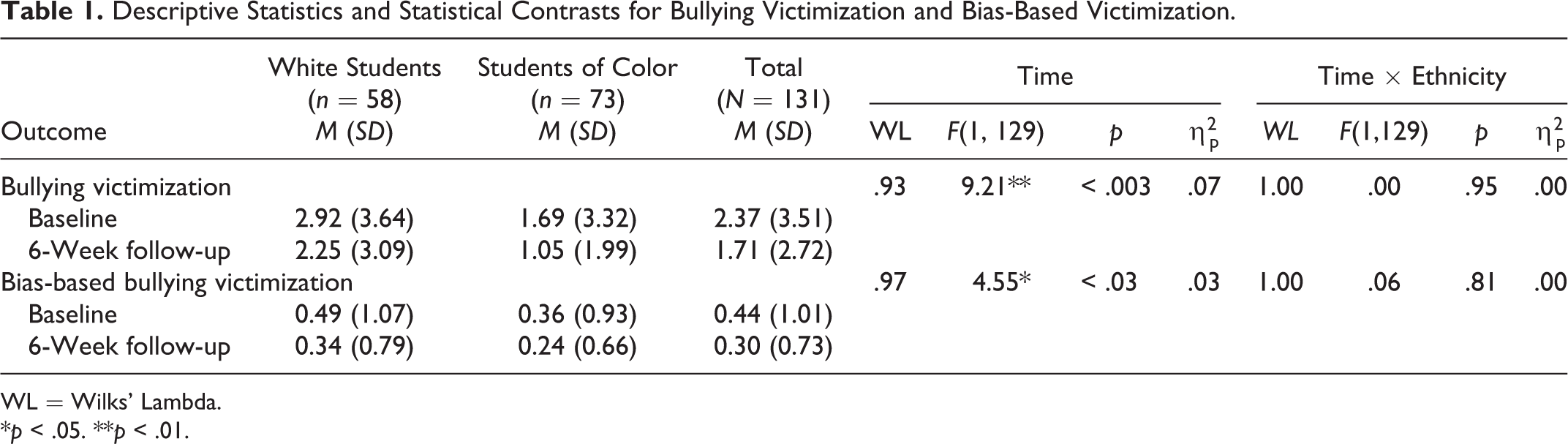
WL = Wilks’ Lambda.
*p < .05. **p < .01.
Preliminary Analyses
The researchers examined baseline differences in bullying victimization and bias-based bullying victimization between White students and students of color. Results revealed a significant difference in bullying victimization, t(129) =−2.01, p < .05, Cohen’s d = .34. In contrast, results were not significant for bias-based bullying victimization, t(129) = −0.75, p = .45, Cohen’s d = .14. As seen in Table 1, results indicated that White students reported a significantly higher frequency of baseline bullying victimization than students of color, but we found no significant baseline differences in bias-based bullying victimization.
Changes in the Frequency of Bullying Victimization and Bias-Based Bullying Victimization
We used GLM repeated measures ANOVAs to examine changes in bullying victimization and bias-based bullying victimization and to examine ethnicity as a moderator. As seen in Table 1, the main effect of time was significant for bullying victimization (p < .01) and for bias-based bullying victimization (p < .05). The effect sizes were in the small to medium range. In contrast, the interaction effect of Time × Ethnicity was not significant for bullying victimization (p = .95) or bias-based bullying victimization (p = .81). Results indicated a significant decrease in the frequency of bullying victimization and bias-based bullying victimization from baseline to the 6-week follow up for the whole sample, with no significant difference between White students and students of color.
Results indicated a significant decrease in the frequency of bullying victimization and bias-based bullying victimization from baseline to the 6-week follow-up for the whole sample, with no significant difference between White students and students of color.
Discussion
This is the first study to examine the impact of the adapted STAC program on bullying victimization and bias-based bullying victimization among students attending an ethnically blended middle school in a low-income community. Although comprehensive, school-wide programs can be effective in reducing bullying, due to the resources required to implement and sustain such programs, they are not always accessible to schools in low-income communities (Menard & Grotpeter, 2014; Peguero, 2012). Moreover, although as many as 80% of students witness bullying (Jones et al., 2015) and bystanders are effective in stopping bullying (Hawkins et al., 2001), the majority of comprehensive programs do not focus on bystander training (Gaffney et al., 2019). Because the majority of antibullying programs have been developed for predominately White schools (Jiménez-Barbero et al., 2016), developing and evaluating bullying interventions that are culturally appropriate for ethnically blended schools is important. Also important is assessing intervention effectiveness in decreasing bias-based bullying because such bullying is associated with poorer outcomes than non-bias-based bullying (Cardoso et al., 2018; Espinoza et al., 2013; Nishina et al., 2005; Russell et al., 2012). Overall, results of the current study indicated that the adapted STAC program is a promising approach for reducing both bullying victimization and bias-based bullying victimization among sixth-grade students attending an ethnically blended middle school in a low-income community.
Students in the current study reported a decrease in bullying victimization and bias-based bullying victimization from baseline to the 6-week follow-up. This finding is consistent with prior research demonstrating that the STAC program is effective in reducing bullying victimization (Midgett et al., 2018) and bullying perpetration (Midgett et al., 2018; Midgett, Doumas, Trull, & Johnson, 2017) among White students. The reduction in bias-based bullying is an important finding because research suggests students who are targets of bias-based bullying report poorer mental health outcomes (Cardoso et al., 2018; Espinoza et al., 2013; Russell et al., 2012) and school-related problems (Baams et al., 2017; Nishina et al., 2005) compared to students who are targets of other types of bullying. Further, most bullying prevention programs are developed for urban, affluent schools with a predominantly White student population (Espinoza et al., 2013). The current findings suggest that the culturally adapted STAC intervention may be a promising approach to decrease both bullying victimization and bias-based bullying in ethnically blended, low-income school settings.
In contrast, we did not find evidence for ethnicity as a moderator of intervention effects. That is, we found no differences in the reduction of bullying victimization or bias-based bullying victimization between White students and students of color. Consistent with preliminary research indicating that the adapted STAC intervention is appropriate for both White and Hispanic students (Midgett et al., 2020, Moran et al., 2020), the results of this study suggest the culturally adapted STAC intervention is effective in reducing bullying victimization and bias-based bullying victimization for all students, not just students of one racial/ethnic background.
At baseline, White students reported a significantly higher frequency of bullying victimization than students of color. This finding parallels national statistics showing that White students report higher rates of bullying (22.8%) compared to Hispanic students (15.7%; U.S. Department of Education, 2018). In contrast, we found no baseline differences between White students and students of color for bias-based bullying victimization. This finding is not consistent with national data indicating that, among students who are bullied, 17.1% of Hispanic students report being targets of race-related bullying compared to 5.5% of White students (U.S. Department of Education, 2018). One explanation for this discrepancy is related to the ethnic/racial composition of the school in this study. Research suggests that within the school setting, ethnic groups with smaller numbers of students are more likely to experience victimization compared to ethnic groups with larger numbers (Agirdag et al., 2011). The school in this study had relatively equivalent percentages of White students and students of color.
Limitations and Directions for Future Research
Although the results of this study support the effectiveness of the culturally adapted STAC intervention for ethnically blended, low-income middle schools, we must address several limitations. First, in the absence of a control group, we cannot assume that reductions in bullying victimization occurred as a result of the STAC intervention. Other variables (e.g., social desirability, history effect, or school effects) may have been related to the outcomes of the study. The lack of a control group, however, is common in school-based action research at the preliminary stages of program evaluation (Flay, 1986). Further, although findings from systematic reviews of bullying research methodology (Chalamandaris & Piette, 2015) and measurement strategies (Vivolo-Kantor et al., 2014) indicated that student self-report is the most common method used to assess bullying, recommendations for future research include implementing multiple source reporting to assess bullying victimization (Vivolo-Kantor et al., 2014). This study represents an initial step in evaluating the adapted STAC program, and we recommend future studies in which researchers examine the efficacy of the adapted STAC intervention using a randomized controlled design with multiple schools and collateral reports.
Although we conducted this study in an ethnically blended school, our sample consisted of predominately White and Hispanic students. Thus, we cannot generalize our findings to schools with a different ethnic or racial composition. Finally, because of the small numbers of students from other racial/ethnic backgrounds, we combined all students of color into one group. Being a target of ethnic and/or racial bullying may affect students of certain minority groups more than others (Rodriguez-Hidalgo et al., 2014). Thus, future studies with larger samples and greater ethnic/racial diversity are needed to examine intervention effects.
Implications
This study provides several practical applications for middle school counselors working in ethnically blended schools in low-income communities. The culturally adapted STAC program is an accessible, brief, cost-effective approach to bullying intervention that aligns with several of the ASCA Mindsets & Behaviors for Student Success (ASCA, 2014). School counselors can foster sense of belonging (M 3) by equipping students to engage with peers and adults in prosocial ways when they witness bullying at school. Further, school counselors can foster empathy (B-SS 4) by encouraging students to engage in perspective taking when discussing reasons students bully and consequences associated with bullying. School counselors also help students develop empathy by teaching them to befriend and/or console the target by utilizing the STAC accompanying others’ strategy. Through the coaching compassion strategy, school counselors teach bystanders to encourage students who perpetrate bullying to engage in perspective taking and increase their empathy for targets. By using role-plays, school counselors help students practice ethical decision making, social responsibility (B-SS 5), advocacy skills, and assertion (B-SS 8). Students can develop self-efficacy by observing peers utilizing the STAC strategies and having opportunities to practice and master a new or difficult task (Bandura, 2012).
School counselors can foster sense of belonging (M 3 [ASCA Mindsets & Behaviors]) by equipping students to engage with peers and adults in prosocial ways when they witness bullying at school. Further, school counselors can foster empathy (B-SS 4) by encouraging students to engage in perspective taking when discussing reasons students bully and consequences associated with bullying.
With the changing ethnic and racial demographics in the United States, school counselors’ concerted efforts to help all students feel safe in ethnically blended schools are imperative. The adapted STAC intervention provides school counselors with a culturally responsive program to address bullying. The intervention also aligns with the ASCA National Model for a comprehensive school counseling program that promotes a safe learning environment for all students and embraces ethnic and racial diversity (ASCA, 2019). Furthermore, because the STAC intervention is a stand-alone, brief intervention, barriers to implementation are low, and the program is sustainable for schools that may not have resources for comprehensive, school-wide programs. Schools can also integrate the STAC program into a tiered intervention approach (Bradshaw, 2013; Pugh & Chitiyo, 2012). Examples for school counselors include delivering classroom lessons about bullying to all students (Tier 1), intervening with small groups of students who are at high risk for bullying involvement (Tier 2), and providing interventions for students identified as targets or perpetrators (Tier 3; Bradshaw, 2013). Results of this study and prior research (Midgett et al., 2018) demonstrate the effectiveness of school-wide implementation of the STAC program in reducing bullying victimization. Researchers have also demonstrated the efficacy of the STAC program with students who bully (Midgett, Doumas, Trull, & Johnson, 2017).
Negative outcomes associated with bullying (Arseneault, 2018; Moore et al., 2017) and specifically ethnic and/or racial bias-based bullying (Cardoso et al., 2018; Espinoza et al., 2013; Nishina et al., 2005; Russell et al., 2012) can be deleterious and often require individualized mental health support beyond the scope and/or capacity of what school counselors can offer. Further, mental health resources may be scarce in low-income communities (Guo et al., 2015; Hodgkinson et al., 2017; Thomas et al., 2009) and therefore difficult for students to access. Thus, introducing a proactive approach to training students to act as defenders to reduce bullying could potentially decrease the associated negative outcomes and the need for mental health resources for students in these communities.
Conclusion
This study evaluated a STAC adapted for ethnically blended middle schools in low-income communities. This is the first study to examine the effectiveness of the culturally adapted STAC program for reducing bullying victimization and bias-based bullying victimization. Results indicated that sixth-grade students reported a decrease in bullying victimization and ethnic- and/or race-based bullying victimization after participating in the STAC intervention. These findings provide preliminary support for the culturally adapted STAC intervention as a promising school counselor–delivered approach to reduce bullying victimization and foster a safe learning environment for students in ethnically blended schools in low-income communities.
Footnotes
Author’s Note
Molly Moran completed this research while at Boise State University. Molly Moran has since moved to the College of Idaho.
Declaration of Conflicting Interests
The author(s) declared potential conflicts of interest with respect to the research, authorship, and/or publication of this article: The second author, Aida Midgett has a contractual agreement with Boise State that if the copyrighted STAC training sells, she receives a portion of the royalties. Although the fee for training is $250, generally, the fee is waived.
Funding
The author(s) received no financial support for the research, authorship, and/or publication of this article.
