







Abstract
This article suggests a group intervention for student-athlete boys of color who intend to play sports in college. This group is a component of a larger proposed school-wide program, the College Transition Program for Student-Athletes (CTPSA). The CTPSA’s suggested group intervention offers school counselors a college readiness option to support the college application process, college adjustment, and transition for boys of color who are student-athletes. We discuss the group’s purpose, design, format, curriculum, and expected outcomes and present implications for school counselors and other counseling professionals.
In a groundbreaking review of the literature spanning almost 50 years, Murty and Roebuck (2015) found that Black male college athletes at predominantly White institutions (PWIs) were at an increased risk of poor adjustment, low academic success, and lower retention than their peers who were White, nonathletes, and/or female. School counselors across P–12 levels are tasked with providing support to students for college and career readiness (Lee, 2001; Lewallen et al., 2015). Secondary-level school counselors remain on the front lines when it comes to the college application and transition phases (Guiffrida & Douthit, 2010; Watkinson & Hersi, 2014). Current school counseling programming, however, has been inadequate in preparing boys of color who are athletes for the realities of life after high school.
Not only are maladjustment, academic underachievement, and low retention dangers for male student-athletes of color once they reach college, but they are likely to face further challenges. They consistently encounter negative stereotypes based on both their athletic (Yopyk & Prentice, 2005) and racial (Bimper et al., 2013; Martin et al., 2010) identities. These young men must navigate friction in their attempt to connect with faculty members (Bimper et al., 2013) and are also exposed to systemic racism (Beamon, 2014). Being students of color, they are also more likely to be first-generation college students (Jenkins et al., 2009), and those attending a PWI often face social isolation (Sinanan, 2016). Together, these characteristics make male athletes of color less likely than their White peers to be retained after their first year (Johnson et al., 2013) and more likely to have lowered rates of persistence and graduation (Gill & Farrington, 2014).
School counselors are charged with helping to close the opportunity gaps and advocate for systemic changes that create more equitable schools and communities (American School Counselor Association [ASCA], 2019). The past two decades have seen increased awareness of the importance of addressing the needs of students of color through group intervention; however, few articles specify what these groups would entail (e.g., Watts et al., 2002; White & Rayle, 2007), and only a few explicitly measure group interventions’ effectiveness (e.g., Pérez-Gualdrón et al., 2016; Petitpas et al., 2004; Steen, 2009).
Group interventions do offer a means of closing these gaps. With adolescents, Petitpas et al. (2004) found that high school athletes of color who participated in a group targeting life skills had higher GPA and SAT scores than those who did not. Similarly, Pérez-Gualdrón and colleagues (2016) found that participation in a culturally responsive school counseling group led to males of color feeling more excited about their educational and social futures following the transition from high school.
Although extant research on psychoeducational group interventions for students of color has been promising, school counselors would benefit from specific interventions designed to meet the needs of their students of color. Moreover, specific attention to male student-athletes of color is necessary. Student-athlete boys of color are uniquely exposed to a set of circumstances that may hinder their postsecondary success (Harper, 2009b), and traditional school counseling curriculums have failed to address their needs (Goldberg & Chandler, 1995; Koehler, 1995
Student-athlete boys of color are uniquely exposed to a set of circumstances that may hinder their postsecondary success (Harper, 2009b), and traditional school counseling curriculums have failed to address their needs (Goldberg & Chandler, 1995; Koehler, 1995).
Several researchers (Harper, 2009a, 2009b; Melendez, 2016; Murty & Roebuck, 2015) have explored how counseling practitioners work to mitigate these challenges that boys of color face in high school and college. Despite the field’s awareness of the potential pitfalls for this population, no group interventions exist that are centered on college preparedness, adjustment, retention, and success for boys of color who are student-athletes.
To address this, we offer a program called the College Transition Program for Student-Athletes (CTPSA), a targeted college readiness program for high school boys of color who are student-athletes with goals of playing college sports. The CTPSA is a school-wide program that can be delivered in myriad ways. This article focuses on a suggested psychoeducational group component of the CTPSA designed to increase college readiness, positive adjustment, and retention for high school boys of color who are student-athletes intending to play sports in college.
Theoretical Framework
The CTPSA program and psychoeducational group are rooted in the theoretical constructs of Conley’s (2008) four keys to college and career readiness (Conley et al., 2010) and self-efficacy (Bandura, 1977). School counseling and other educational literature (Bjornebekk et al., 2013; DeAngelo & Franke, 2016) indicates that focusing on these areas in particular may serve to boost academic achievement, sense of belonging, and college retention.
Conley’s Four Keys to College and Career Readiness
The four keys to college and career readiness (cognitive strategies, content knowledge, contextual skills and awareness, and academic behaviors; Conley, 2008; Conley et al., 2010) provide a nuanced and comprehensive understanding of college readiness and incorporate circumstantial and environmental factors related to college preparation. Although all four components are important, the CTPSA group is anchored in contextual skills and awareness and academic behaviors, specific areas of need that are unlikely to be addressed in a traditional school setting (Roderick et al., 2009). They are also appropriate topics for group counseling interventions (Farmer-Hinton & Adams, 2006). Briefly, contextual skills and awareness refers to the hidden curricula of university settings that hold importance for adjustment and connection to an institution (Conley et al., 2010). Academic behaviors include actions and mindsets necessary for college success (Conley et al., 2010). These include self-management, time management, self-reflection, and the creation of and perseverance toward goals. The focus on perseverance found in academic behaviors makes it theoretically similar to self-efficacy.
Self-efficacy
Coined by Bandura (1977), self-efficacy is the extent to which a person believes in their ability to positively influence the outcome of events and achieve goals. Specifically, those with higher levels of self-efficacy are more likely to show persistence and sustained effort in the face of challenges (Bandura, 1977).
Self-efficacy is also domain specific (Artino, 2012), meaning that it is not a global trait present in all aspects of students’ lives. This is important because boys of color who are athletes may feel efficacious in their athletic ability but lack self-efficacy in other areas that will be important for college readiness and success. Literature supports the notion that self-efficacy affects the lives of college students (DeWitz et al., 2009), especially in relation to achievement (Yusuf, 2011), and persistence (Wright et al., 2013).
Foundation for CTPSA Psychoeducational Group
Although distinct, both Conley’s four keys and self-efficacy share underlying theoretical assumptions about important, nonacademic considerations for college readiness interventions. Further, college readiness and self-efficacy skills can be explicitly taught and increased (Cepukiene et al., 2018; Conley et al., 2010). Through a psychoeducational group, the CTPSA fosters knowledge, attitudes, and skills to boost academic behaviors and self-efficacy to aid students in persevering through unexpected challenges they may face in the college transition.
Conceptual Framework
Consistent with the literature on college adjustment among students of color, student-athletes, and first-generation college students (Bryan & Simmons, 2009; Gummadam et al., 2016; Johnson et al., 2013; Reynolds et al., 2012), the CTPSA group is anchored in a holistic approach to college readiness. We believe school counselors are skilled professionals who are most appropriate to deliver the CTPSA group curriculum. School counselors have specialized training in group dynamics and the group process (Janson et al., 2009). They are also multiculturally competent and trained to work with diverse groups of students (Bidell, 2012).
The College Transition Program for Student-Athletes (CTPSA) group is anchored in a holistic approach to college readiness. We believe school counselors are skilled professionals who are most appropriate to deliver the CTPSA group curriculum. School counselors have specialized training in group dynamics and the group process (Janson et al., 2009). They are also multiculturally competent and trained to work with diverse groups of students (Bidell, 2012).
The aims of the CTPSA group are twofold; first, to teach students about the realities of the college experience. These realities include specifics of campus and athletic life (e.g., schedules, dining, living, practice) coupled with conversations about how college students of color sometimes face distinct challenges (e.g., discrimination, stereotyping, stereotype threat; Palmer & Maramba, 2011; Pyne & Means, 2013; Roderick et al., 2009). Second, the group introduces students to soft skills needed to navigate the aforementioned realities and challenges. This includes skill building related to financial aid processes, making friends/social networking, communal living in residential halls, being involved on campus and understanding campus demographics, and increasing knowledge on National Collegiate Athletic Association (NCAA) rules and regulations.
The topics covered by the CTPSA group are influenced by the literature on the specific needs of the target population (e.g., Palmer & Gasman, 2008; Soria & Stebleton, 2012). Figure 1 shows how school counselors who adopt the CTPSA curriculum and group format for high school student-athlete boys of color may also experience increases in graduation rates and college enrollment among this population. As the figure shows, our hypothesis is that these factors, with the CTPSA group as the intervention, could lead to positive college adjustment, transition, and academic and athletic performance.
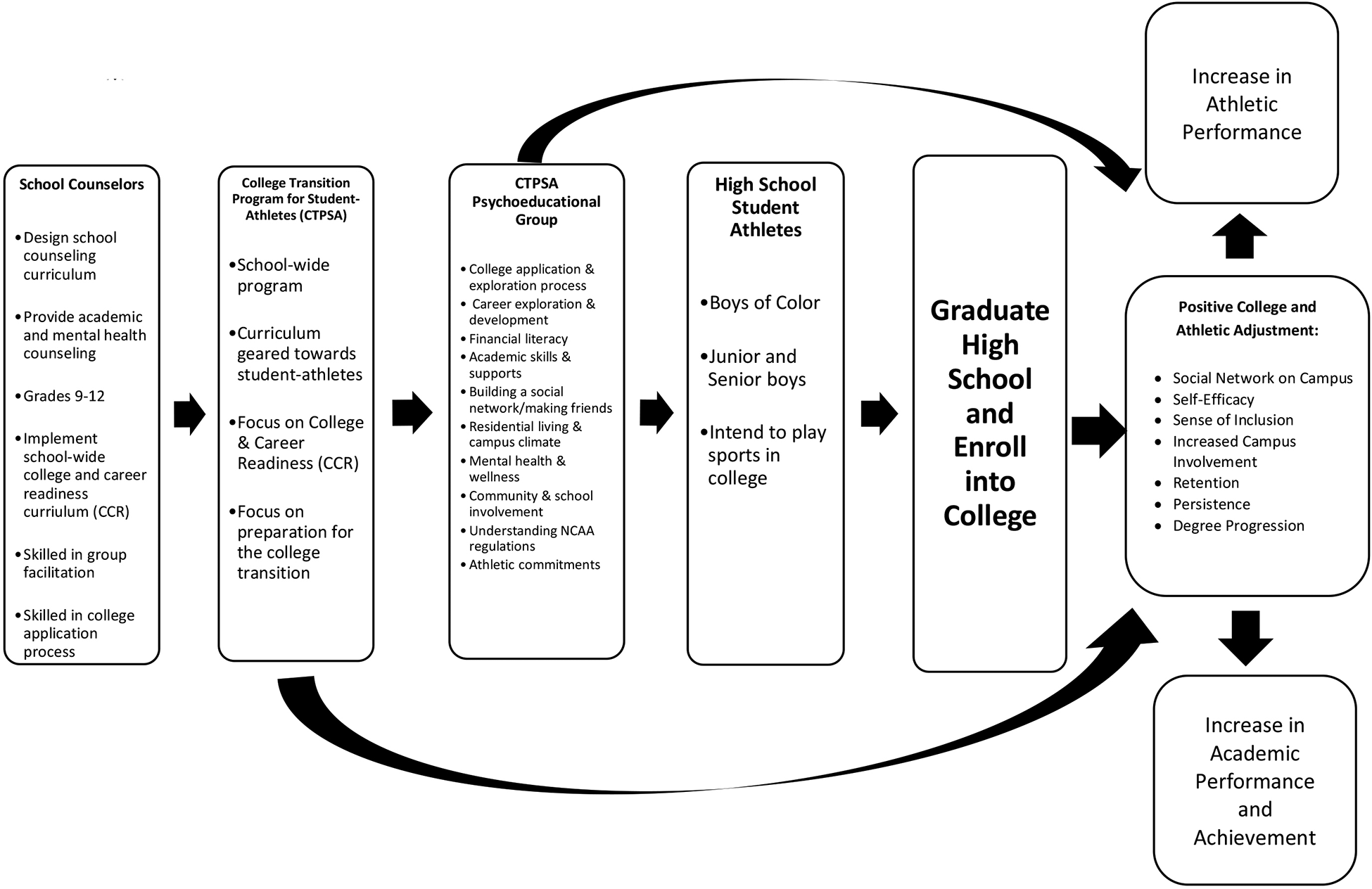
The College Transition Program for Student-Athletes (CTPSA) model. Note. The conceptual flow starts with the school counselor and their role with the CTPSA program and the potential impact the program can have on boys of color who are student-athletes. It depicts the role the school counselor plays in group design, curriculum development, implementation, and academic and mental health support. School counselors are critical to effectively enacting the CTPSA program and psychoeducational group and its components to enable student-athletes to feel prepared for the college application and transition process. The CTPSA program and psychoeducational group could lead to increase in self-efficacy, graduation rates, and college enrollment, along with improved college adjustment, achievement, and athletic performance.
Group Format and Membership
Closed-group format with a person-centered, multicultural approach
The CTPSA group is designed to prepare boys of color to navigate the college application and transition process as student-athletes. A major role of school counselors entails helping students develop personal awareness, manage their emotions, and make postsecondary plans (ASCA, 2019). For student-athletes, this would include gaining a deeper understanding of the athletic recruitment process in order to feel empowered through the transition to college. We suggest conducting the CTPSA group in a closed-group format that allows participants to form a cohort. The closed-group model promotes cohesion and a sense of community within the group (Lawler et al., 2000).
Although psychoeducational groups may require a more directive role from school counselors (Brouzos et al., 2015a), leaders can also be person centered. Facilitation of the group from a person-centered, multicultural approach (Quinn, 2012; Rogers, 1979, 2001) fosters an atmosphere of empowerment and racial and cultural awareness while incorporating mutual positive regard between the group leader and members. This is essential in creating a safe place for students to practice problem-solving and critical skills. A study by Brouzos and colleagues (2015a, 2015b) found that students who participated in a group led with a person-centered approach viewed their group leader as congruent, more likeable, and empathic. Quinn (2012) suggests incorporating activities that are adapted to the racial and cultural makeup of the group members to meet the aims of the group. The use of positive regard in the group process also engages boys of color, allowing them to feel welcomed and included.
Boys of color may respond better to educators and counselors who offer positive support in an authentic way, making the group more influential. Placing high expectations on boys of color prompts better decision making, motivation to improve academic and athletic performance, and deeper exploration of career aspirations (Huerta, 2015). Group facilitators should ensure that, in addition to relaying curricular content, they are providing a safe space for students to honestly discuss topics through modeling genuineness themselves, while also showing empathy and unconditional positive regard for group members.
A person-centered approach is a nondirective application of the CTPSA’s psychoeducational format. Use of the Rogerian approach could provide school counselors the opportunity to listen to the boys without judgment, provide support for the boys as they explore their racial and cultural identity (Quinn, 2012), and focus the group in a direction that assists the boys in their own self-discovery (Rogers, 2001). School counselors who are comfortable discussing multicultural issues among students of color tend to have higher levels of trust between counselor and student (Quinn, 2012). The development of this bond opens up opportunities for counselor and student to explore sensitive topics around racial and cultural identity and how it connects to athletics and the college transition process.
Participants and group recruitment
The CTPSA group offers support to boys of color who play a varsity sport and identify as African American/Black, Latino/Hispanic, Native American, or Asian American/Pacific Islander and come from families of any income status. The group has a comprehensive college readiness curriculum designed for this population. Group membership is recommended for high school boys who are juniors and seniors who have intentions of playing sports in college (i.e., Division I, II, or III). We do not recommend screening or selecting students based on academic performance, family income, faith, or sexual orientation. The CTSPA groups welcome boys of color regardless of recruitment or scholarship status. This means that the group is open to all male students of color who intend to play college sports, not only those who will receive full or partial athletic scholarships.
Students can voluntarily sign up to be a member of the CTPSA group. School counselors also should solicit recommendations from teachers, parents, coaches, and athletic administrators. To encourage membership, the group should be marketed to student-athletes through the school’s social media, newsletter, website platform, and in team meetings. Group membership and participation are voluntary, and we recommend that school counselors obtain student assent and parent consent prior to enrolling students into the group.
Group Session Format
We believe the group would be most effective if conducted during the school day to boost attendance and participation. We recommend running the group for 16 sessions, concurrently with the academic school year and segmented into two phases. Phase 1 would run for 8 weeks from August to November, with two sessions per month, and Phase 2 would begin in January and run until April for 8 additional weeks, two sessions per month. Holidays and vacation breaks should be observed.
Sessions should be held in a classroom setting with access to technology (i.e., wireless internet access, LCD projector, and screen) that allows effective multimodal facilitation (Goldberg & Chandler, 1995). If possible, the CTPSA group should be facilitated by two school counselors, although one counselor can be effective. We recommend a group size of 8–12 student-athletes if the group is led by one school counselor and 16–24 members if facilitated by two counselors. We recognize that personnel, time, and resources may be limited for many practitioners who choose to implement a group like this. We also recommend marketing the CTPSA group to boys who are current varsity athletes with serious intentions to play sports in college and to those who have signed a national letter of intent (see https://www.ncaa.org) to commit their athletic talents to a college program.
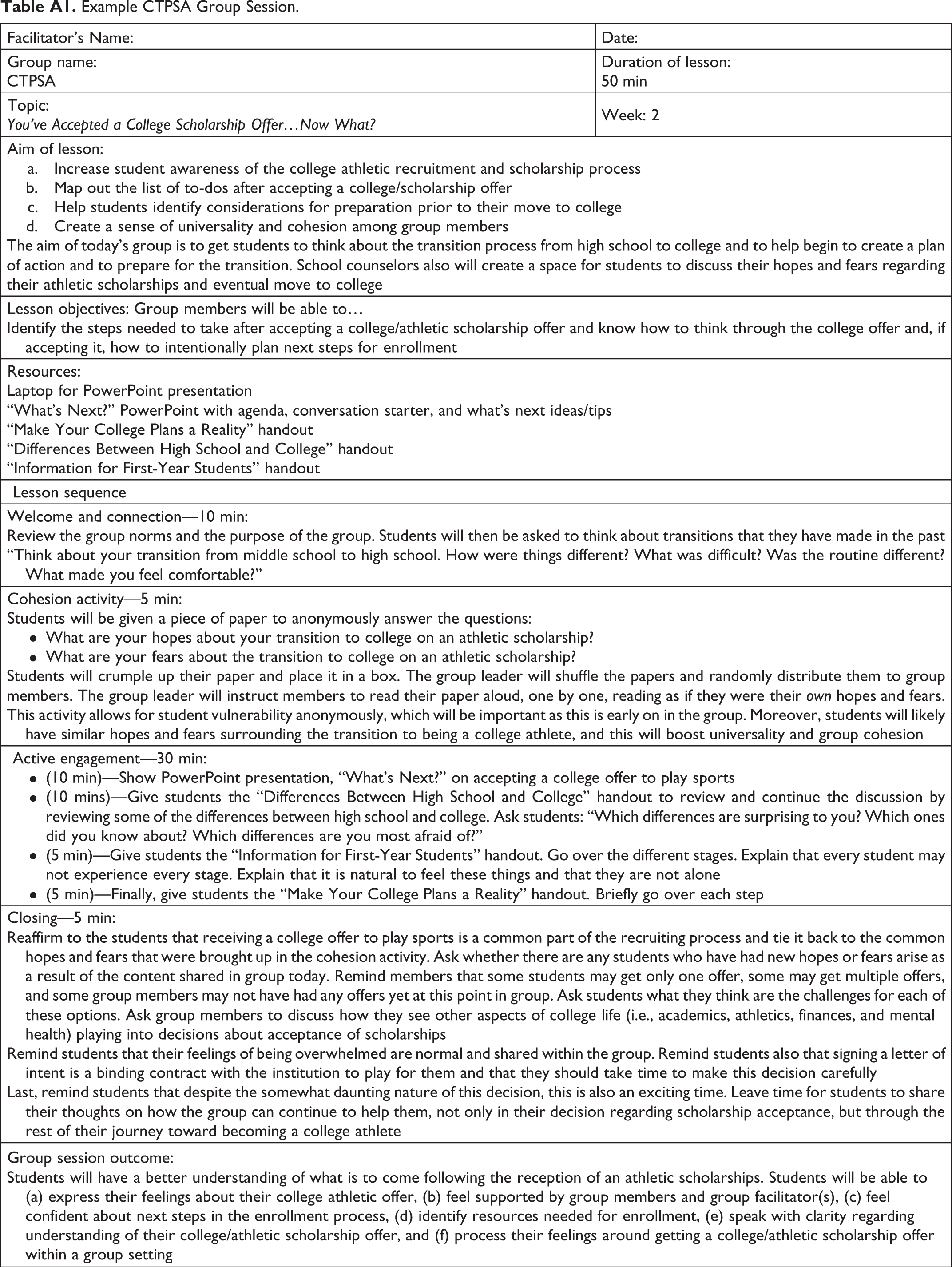
Delivery of the group material needs to be dynamic and engaging to keep students motivated throughout the 16-week program. Suggested approaches to successfully deliver curriculum themes would include lecture-style presentations, small group work, role plays, use of media, incorporation of social media and apps, and introduction to influential guest speakers. A session can be efficiently delivered in 50 min or one class period. The format of each session would vary but should generally incorporate (a) welcome and check-in with students, (b) introduction of the day’s lesson and topic of discussion, (c) brief lecture from curriculum (see Appendix A), (d) group activity (e.g., role play, view internet video, hands-on activity, small group discussions; see Appendix B), (e) question and answer, and (f) close of the group.
Curriculum
The curriculum addresses important academic, social/emotional, and college readiness considerations recommended by the ASCA National Model (ASCA, 2019). The CTPSA group addresses the needs of student-athletes regarding academics, athletics, and personal development as they pertain to college preparation, transition, and adjustment. A group format may be especially effective in addressing the unique circumstances that boys of color face in educational settings due to their race and gender (Gaylord-Harden et al., 2017).
Components of the CTPSA group focus on self-awareness, racial and cultural development, empowerment, and academic achievement as they relate to college readiness and adjustment (Bemak et al., 2005; Sánchez et al., 2018). At the onset, the program will introduce group members to models of racial/cultural identity development that will be revisited throughout the group’s duration. Students’ level of racial/cultural identity development will affect how they experience university life (Iwamoto & Liu, 2010; Walker et al., 2008); therefore, it is woven throughout the group’s curriculum.
Components of the CTPSA group focus on self-awareness, racial and cultural development, empowerment, and academic achievement as they relate to college readiness and adjustment (Bemak et al., 2005; Sánchez et al., 2018). At the onset, the program will introduce group members to models of racial/cultural identity development that will be revisited throughout the group’s duration.
The group curriculum is structured around core themes: (a) the college application and exploration process, (b) career exploration and development, (c) financial literacy, (d) academic skills and supports, (e) building a social network/making friends, (f) residential living and campus climate, (g) mental health and wellness, (h) community and school involvement, (i) understanding the NCAA regulations, and (j) athletic commitments.
In addition to the topics presented in the core themes, the CTPSA group has the potential to provide mentoring, academic support, and connections in the business community that may ultimately offer group members internships and job shadowing opportunities to enhance their career exploration and maturity. The most likely way for these partnerships to happen is through school counselors inviting local community members into the group to discuss one or more of the core themes.
These extracurricular opportunities also create a holistic experience that aides in social/emotional, professional, and academic development for student-athletes. Pragmatically, these opportunities and levels of involvement also make the student-athlete more attractive to the college or university during the recruitment process. Below, we present a description of a sample activity and further suggested topics for discussions within the core themes. Many of the themes have considerable overlap even though they are presented as discrete topics.
The college application and exploration process
Lessons and activities in this core theme will introduce group members to tools for exploring and applying to universities. Tools that will help in students’ exploration include Naviance, College Board’s Big Future, and NWEA’s Mapping the Road to College, among other state or local resources already utilized.
Other activities will focus on enhancing students’ understanding of the FAFSA application, including what information is required in applying for financial aid. Time may also be allotted for students to navigate and complete college applications such as the Common App. School counselors could help students self-advocate for recommendation letters from faculty (i.e., etiquette for requesting letters) and/or partner with language arts teachers to strengthen group members’ application essays.
Career exploration and development
This core theme focuses on the minutia of college academics, including picking a major, understanding how to interact with faculty members (e.g., email etiquette, visiting office hours, working with teaching assistants), and college courses and credits (e.g., general courses vs. major-specific courses vs. lab courses).
School counselors can also utilize group time for students to take career assessments such as the Strong Interest Inventory, Career Values Card Sort (Knowdell, 1993), and the Meyers–Briggs Type Inventory to better incorporate their strengths and interests into choices for major and career. If school counselors lack access to the aforementioned assessments, online tools such as the College Board’s Explore Careers assessments and Naviance’s StrengthsExplorer are options.
Sessions may include time toward helping students craft resumes and cover letters for peer feedback and editing. Similar to the previous theme, school counselors are in an excellent position to partner with classroom (i.e., language arts) teachers to deliver this material.
Guest speakers invited into this portion of the group should be males of color who may serve as role models and/or potential mentors to group members. This may include one-on-one conversations or a panel discussion with community members to expose students to various career options in the community. School counselors should also work with community members to determine the feasibility of creating internship or job-shadowing opportunities for group members.
Financial literacy
Financial literacy is an important skill set for students to make smart personal decisions and avoid debt (Jorgensen & Savla, 2010). Based on the recommendations of Totenhagen and colleagues (2014), school counselors should align their content with the motivations and interests of high school students. This theme would therefore focus on helping students understand basic money management concepts such as savings and credit, as opposed to more complex topics such as home ownership or retirement.
Further, school counselors should ensure that students understand financial knowledge situationally, through questions like, “If [you] go to the movie theater, will [you] still have enough money for the bus fare home? Or would it be better to buy pizza and invite friends home?” (Lusardi, 2015, p. 643). Counselors may partner with economics or mathematics teachers who may have a better grasp of the content.
Academic skills and supports
The activities and discussions within this core theme vary. School counselors may use it as a means of teaching students the most efficient and effective ways to study, especially for college-level work (Dunlosky et al., 2013). Sessions should also focus on teaching other soft skills such as time management and organizational skills that correlate with academic success.
In this theme, group leaders also introduce students to common on-campus college resources that will aid in their academic success. These would include tutoring centers, use of teaching assistants, peer study groups, and disability resource offices that provide accommodations for students with a documented disability. Many universities also have academic support specific to student athletes per NCAA regulations (Banbel & Chen, 2014) that also would be discussed here.
Building a social network/making friends
Social isolation and difficulty adjusting to college are major factors in students dropping out (Sanlo & Espinoza, 2012). This theme focuses on helping members recognize the importance of friendships both within and outside of their athletic careers. Students could be introduced to various social outlets available at most universities, such as Greek life, interfaith and religious groups, and ethnic student organizations (Park, 2014). Discussions of peer pressure and substance use may also arise during these conversations and are especially relevant topics to consider for soon-to-be college athletes (Yusko et al., 2008).
Group leaders may invite alumni (preferably alumni athletes) to discuss how they navigated and thrived within the social climate of college. Other guest speakers may include representatives from local campus ethnic groups that could better speak to the experience of being a student of color on a college campus.
Conversations here would also reiterate the role that racial/ethnic identity development may have in friendships and the importance of choosing a college that makes students feel welcome. School counselors may find it apt to introduce group members to differences between historically Black colleges and universities and PWIs and the implications that these distinctions may hold for school climate.
Residential living and campus climate
In a similar vein to the previous theme, this core theme would focus on the specifics of residential life on campus (e.g., residence halls, roommates, dining halls, student unions, athletic centers). On-campus residents typically have more social supports than their off-campus peers (Schudde, 2011), which could be a source of discussion within the group. School counselors should also create space for members to discuss implications for living with and among students of other cultures and utilize guest speakers to provide firsthand accounts of campus living.
Mental health and wellness
Discussions of mental health and wellness could begin with exploration of what students are currently doing in their lives to maintain wellness. This could lead to a larger discussion of coping mechanisms and means of reducing anxiety (e.g., mindfulness activities, anxiety reduction techniques). These conversations could branch to discussions of overall wellness, how it relates to athletics (i.e., the role of nutrition, exercise, sleep, and personal hygiene), and how each of these factors may look similar or different in a college athletics setting.
Other topics in this theme may include the effect of social media (Sanderson & Truax, 2014) and other sports media on student well-being and mental health and racial identity (Van Sterkenburg et al., 2010). School counselors should utilize this opportunity to introduce students to the existence of additional on-campus resources (e.g., counseling and psychological services) that support mental health. Discussions regarding hobbies, clubs, and interests can be revisited here within the context of supporting students holistically.
Community and school involvement
Gutierrez and colleagues (2018) acknowledged that a college student’s racial and ethnic background affects how they adjust to college and the level to which they get involved in college activities and events. This theme aims to introduce members to the importance of being involved in their campus community through making friends, joining clubs and organizations, engaging in volunteer and service-learning work, and participating in cultural events reflective of their own identities. Placing focus on community and school involvement enables members to better understand how a sense of community translates to academic, social, and emotional support.
Understanding the NCAA
High school student-athletes have limited knowledge of NCAA recruiting and eligibility process. Most do not clearly know what steps need to be taken to be recruited by college coaches, the rules of the recruitment process, and what courses and how many credits are necessary for eligibility to play ( NCAA, n.d. ). Understanding the NCAA theme focuses on those aspects of the transition from high school sports to college sports and other aspects (e.g., scholarship, differences in athletic divisions, conferences) outlined by the organization (see https://www.ncaa.org).
Athletic commitment
Collegiate athletic schedules differ from the schedules of college students who are nonathletes, often with conflicts between academics and athletics (Kamusoko & Pemberton, 2013; Simiyu, 2012). Activities in this theme would focus the realities of life as a college athlete, most notably the amount of time required to be a successful athlete and student. The sample activity Where Does the Time Go? (Appendix B) would be appropriate under this theme.
Also in this theme, students would be reminded of their commitments under NCAA regulations (i.e., amateurism standards). Content would introduce group members to the various responsibilities that come with being a student-athlete at the college level, which often involves managing time between athletic practice, nutrition, strength training, study hall, travel, and other team duties.
Sample Activity
One activity that may be conducted as part of the CTPSA group focuses on time management and is titled Where Does the Time Go? This activity provides students with two 24-hr calendars and a list of events that could comprise their day. Group members complete the activity by filling out how they spend their time during a day following their current schedule. Then, they complete the activity for a second day, this time with what they believe a sample day will look like when they enter college.
Given that collegiate athletics may comprise up to 20 hr of students’ schedules per week (Ayers et al., 2012), the time commitment athletics require of college athletes will likely be significantly higher than that required of high school student-athletes. This activity can guide the group into a discussion about the importance of time management. Students may discuss balancing academic and athletic duties in the context of changes that will occur once they reach college. This activity also provides school counselors a chance to segue into teaching time management skills. See Appendix B for a copy of this activity.
Proposed Evaluation of the Group
An important aspect of any structured group is the evaluation of its effectiveness. We recommend using a self-designed pre- and posttest as an evaluative measure to assess participants’ baseline knowledge and to determine whether the aims and outcomes of the CTPSA group have been met or need adjustment (Furr, 2000). The ASCA handbook, Making Data Work (3rd ed.; Kaffenberger & Young, 2013), offers three ways for school counselors to collect data on project or curriculum goals. It recommends that practitioners collect process, perception, or outcome data to assess whether the aims and goals of the group were met (Kaffenberger & Young, 2013).
School Counselor-Made Pre/Postsurvey
School counselors interested in collecting group members’ thoughts, feelings, and attitudes toward the group experience (i.e., perception data) can do so through the creation of a survey. Questions on this survey could be open ended or based on a Likert-type scale and serve to provide insight into members’ perceived takeaways while also informing modifications to future iterations of the group. School counselors should provide the survey before and after the series of group sessions, although some questions would be more appropriate only in the postgroup survey. Surveys can be distributed on paper or electronically; the use of technology (e.g., Google Forms, Survey Monkey) would allow for easier analysis and presentation of data.
Sample questions for both pre- and postgroup surveys may include (a) What are some of your concerns about transitioning to college? (b) How would you rate your level of awareness about the NCAA recruiting process? and (c) What words and thoughts come to mind when you think of yourself as a college athlete? Questions only on the postgroup survey may include (a) Overall, what did you think of the group? and (b) How effective was the group in helping you prepare for the college application process?
Implications for School Counselors
The CTPSA group has the potential to qualitatively change the lives of boys of color who are student-athletes. Group participation would enhance student-athletes’ understanding and self-efficacy related to the college transition and help them feel empowered and equipped to navigate the process. An impetus behind the creations of this group is to change the negative narrative that surrounds boys of color in popular media. Boys of color who are student athletes are bombarded with examples of the “underachieving student of color” and the “dumb jock.” Coupled with society’s perception of Black and brown males in athletics as criminals and gangsters (Gill, 2017; Williams & Kniffley, 2019), it is not surprising that males of color do not always feel welcome at institutions of higher education. The CTPSA aims to welcome positive self-talk and change self-perceptions of group members. Involvement in this group is expected to increase awareness, skills, and knowledge related to college life, leading to increased overall college exploration and readiness.
The CTPSA group has the potential to qualitatively change the lives of boys of color who are student-athletes. Group participation would enhance student-athletes’ understanding and self-efficacy related to the college transition and help them feel empowered and equipped to navigate the process. An impetus behind the creations of this group is to change the negative narrative that surrounds boys of color in popular media.
Traditional group interventions for boys have focused on topics including empowerment, social/emotional development, identity development, academic success, and positive behavior, among others (Gordon et al., 2016; Pérez-Gualdrón et al., 2016). The CTPSA group is novel in its target audience (boys of color who are student-athletes), its aims (college transition and readiness with a focus on sports and racial issues), and its approach (psychoeducational group led with a person-centered, multicultural focus).
School counselors can do more to assist boys of color who plan to play varsity sports in college. Many practitioners, however, have limited time, personnel, and resources to adequately meet the needs of this population. The CTPSA group represents a specific intervention to target this population within the context of a comprehensive school counseling program. Nevertheless, the ability to sufficiently support the college readiness and career exploration of young boys of color as both students and athletes requires additional considerations regarding collaboration with stakeholders and school counselors’ personal professional development.
The CTPSA group is proposed as a psychoeducational intervention delivered through a person-centered, multicultural approach to increase the likelihood of achieving the group’s aims. Although school counselors act as group facilitators, they are not alone in this work. Goldberg and Chandler (1995) suggest including parents as part of the triangle of collaboration (counselors, parents, and coaches) to ensure that student-athletes receive wraparound support during the college application and recruitment process. Incorporating coaches and parents into the implementation of the CTPSA program and psychoeducational group ensures consistency of services across the school, athletic, and home settings.
Similarly, Holcomb-McCoy (2010) encouraged school counselors to include parents of student-athletes in the college readiness process. This study found that low-income parents of color who collaborated with school counselors through school-based college readiness activities were more engaged, motivated, and knowledgeable about the college admissions process and were better able to help their college-bound child. The CTPSA group may serve as the college readiness tool that school counselors, parents, and coaches can implement collaboratively.
Involving parents provides an opportunity for students to be further supported during the college application and transition process. We suggest parents take a lead role in planning college tours, tending to health and nutritional needs of students, assisting in the completion of college applications, completing the FAFSA application, and encouraging continued academic motivation and school involvement. Above all, with parental support and involvement, students could persist from high school to college and earn a diploma that allows them to enter the workforce career ready.
In addition to collaborating with other stakeholders, school counselors can act to support their own ability and confidence to successfully run the CTPSA group. On an individual level, school counselor should gain a thorough understanding of the intersecting identities of being a student of color and being an athlete. Specially, these identities hold implications for students’ levels of efficacy, motivation, and self-confidence and contribute to this group of students facing different challenges than White students and nonathletes. This population, therefore, requires specific attention and support.
Although school counselors likely feel confident with their abilities to work with students from another culture, they may struggle with the athletic aspect of students’ identity. In fact, many student-athletes view school counselors as unhelpful in the college preparation process due to counselors’ lack of knowledge about sports eligibility requirements at the college level (Barnes & Seidler, 2007). School counselors therefore should enhance their own knowledge of the NCAA. The NCAA releases a free annual guide for high school counselors to become familiar with the organization’s rules, policies, and eligibility procedures.
Ultimately, the CTPSA can help school counselors form close and connective relationships with young men of color at a pivotal time in their high school lives. These school counselor–student relationships can serve as mentor–mentee relationships for boys of color to help them gain a better grasp of their dual roles as high school student-athletes and the intersection with who they are racially and culturally. CTPSA presents a space for open discussions between students and school counselors centered on the developmentally appropriate challenges faced because of race and gender. Further, it sheds light on how these challenges may manifest in a college setting. This program aims to expand the minds of members and instill in them the hope and drive to be academically, socially, emotionally, and financially successful through the goals of graduating high school and college.
Future directions for the CTPSA group include how to best deliver the curriculum based on time, personnel, space, and resources. School counselors who lack the time to develop, implement, and conduct such a comprehensive curriculum may need more support to be able to successfully meet the aims of the group. We recommend that school counselors consider, for a larger reach, conducting the CTPSA via a virtual platform (e.g., Zoom or Skype) to allow school counselors and students to meet through video conferencing. School counselors also can offer CTPSA webinars—prerecorded videos of curriculum in a module format that students and parents could access on a learning management system (e.g., PowerSchool, Naviance).
School counselors may also collaboratively partner with school counseling colleagues from other schools and districts to collectively offer CTPSA on a monthly basis in a combined meeting format. School counselors who are unable to find sufficient time and space to run the group at their school should utilize partnerships with community resources (e.g., churches, recreational facilities, youth service organizations) to offer the group in this alternate location. CTPSA may also be offered to family members and students as weekend workshops if time, space, and personnel are limited during the regular school week.
Conclusion
Extant literature indicates that school counselors may lack the ability to sufficiently address the comprehensive college readiness needs of male student-athletes of color (Barnes & Seidler, 2007). Many practitioners find working with this population to be a challenge due to their lack of understanding of what it is like to be a boy of color, a student-athlete, and the role that comes with those identities both in school and society.
Given the complexity and extensiveness of the college-going process for all students, school counselors can understand how this process would be further complicated for student-athletes of color who intend to play sports at the collegiate level, in part due to the unique set of circumstances this group faces. Despite limited resources (i.e., time, space, and personnel), school counselors are still tasked with serving the college and career readiness needs of all students (ASCA, 2019). The suggested CTPSA psychoeducational group offers school counselors a tool they can utilize to serve this special population to meet academic, athletic, and personal needs. Those graduation goals can help school counselors increase retention, persistence, and graduation rates among boys of color in their schools (Murty & Roebuck, 2015). In sports terms, this is a “win–win–win.”
Footnotes
Appendix A
Example CTPSA Group Session.
| Facilitator’s Name: | Date: |
| Group name: CTPSA |
Duration of lesson: 50 min |
| Topic: You’ve Accepted a College Scholarship Offer…Now What? |
Week: 2 |
| Aim of lesson: Increase student awareness of the college athletic recruitment and scholarship process Map out the list of to-dos after accepting a college/scholarship offer Help students identify considerations for preparation prior to their move to college Create a sense of universality and cohesion among group members |
|
| Lesson objectives: Group members will be able to… Identify the steps needed to take after accepting a college/athletic scholarship offer and know how to think through the college offer and, if accepting it, how to intentionally plan next steps for enrollment |
|
| Resources: Laptop for PowerPoint presentation “What’s Next?” PowerPoint with agenda, conversation starter, and what’s next ideas/tips “Make Your College Plans a Reality” handout “Differences Between High School and College” handout “Information for First-Year Students” handout |
|
| Lesson sequence | |
| Welcome and connection—10 min: Review the group norms and the purpose of the group. Students will then be asked to think about transitions that they have made in the past “Think about your transition from middle school to high school. How were things different? What was difficult? Was the routine different? What made you feel comfortable?” |
|
| Cohesion activity—5 min: Students will be given a piece of paper to anonymously answer the questions: What are your hopes about your transition to college on an athletic scholarship? What are your fears about the transition to college on an athletic scholarship? This activity allows for student vulnerability anonymously, which will be important as this is early on in the group. Moreover, students will likely have similar hopes and fears surrounding the transition to being a college athlete, and this will boost universality and group cohesion |
|
| Active engagement—30 min: (10 min)—Show PowerPoint presentation, “What’s Next?” on accepting a college offer to play sports (10 mins)—Give students the “Differences Between High School and College” handout to review and continue the discussion by reviewing some of the differences between high school and college. Ask students: “Which differences are surprising to you? Which ones did you know about? Which differences are you most afraid of?” (5 min)—Give students the “Information for First-Year Students” handout. Go over the different stages. Explain that every student may not experience every stage. Explain that it is natural to feel these things and that they are not alone (5 min)—Finally, give students the “Make Your College Plans a Reality” handout. Briefly go over each step |
|
| Closing—5 min: Reaffirm to the students that receiving a college offer to play sports is a common part of the recruiting process and tie it back to the common hopes and fears that were brought up in the cohesion activity. Ask whether there are any students who have had new hopes or fears arise as a result of the content shared in group today. Remind members that some students may get only one offer, some may get multiple offers, and some group members may not have had any offers yet at this point in group. Ask students what they think are the challenges for each of these options. Ask group members to discuss how they see other aspects of college life (i.e., academics, athletics, finances, and mental health) playing into decisions about acceptance of scholarships Remind students that their feelings of being overwhelmed are normal and shared within the group. Remind students also that signing a letter of intent is a binding contract with the institution to play for them and that they should take time to make this decision carefully Last, remind students that despite the somewhat daunting nature of this decision, this is also an exciting time. Leave time for students to share their thoughts on how the group can continue to help them, not only in their decision regarding scholarship acceptance, but through the rest of their journey toward becoming a college athlete |
|
| Group session outcome: Students will have a better understanding of what is to come following the reception of an athletic scholarships. Students will be able to (a) express their feelings about their college athletic offer, (b) feel supported by group members and group facilitator(s), (c) feel confident about next steps in the enrollment process, (d) identify resources needed for enrollment, (e) speak with clarity regarding understanding of their college/athletic scholarship offer, and (f) process their feelings around getting a college/athletic scholarship offer within a group setting |
|
Appendix B
Acknowledgment
The authors thank research assistants Joanna DeJesus and Richard Levy for their work on this article and also thank Elisabeth Hubert for her contribution to this article.
Declaration of Conflicting Interests
The author(s) declared no potential conflicts of interest with respect to the research, authorship, and/or publication of this article.
Funding
The author(s) received no financial support for the research, authorship, and/or publication of this article.