







Abstract
In this editorial, we introduce snapshots of the entire set of published articles in this special issue of Professional School Counseling. We also incorporate our own individual and collective journeys reading, digesting, editing, and reacting to this material. We take the opportunity to present our impressions both visually and narratively to demonstrate how group counseling in schools remains relevant and continues to expand while holding on to salient foundational concepts. In particular, these articles are visually situated in relation to the multitiered systems of support (MTSS) framework as a way to demonstrate the impact groups can have on entire schools and communities. Throughout this introduction, we raise questions that have yet to be answered and challenge scholars to explore others not addressed by this compilation of articles. Finally, we conclude by offering several questions for the reader to consider in their own group counseling practice endeavors.
Professional School Counseling, the peer-reviewed journal of the American School Counselor Association (ASCA), publishes high-quality articles on theory, research, and best practices for the profession. With greater attention to accountability in pre-K–12 schools, school counselors must use advocacy, leadership, and collaboration to bring about systemic change through school counseling programs. We chose group counseling as the focus in this special issue, entitled Visualizing Systemic Change Through Group Counseling: Established and Emerging Approaches.
We assert that group counseling, both educational and process-oriented, is growing more than ever before. The unique aspect of group counseling that cannot be experienced through other modalities is the notion that a collective of humans with intersecting identities come together in a safe space to explore an array of thoughts, feelings, emotions, and topics, while simultaneously connecting, observing, and practicing interpersonal and intrapersonal skills. If the clinical skills used capture metacognitive aspects and intentional exploration of self-awareness, the whole process can be a dynamic and powerful life-changing moment. In the last few years, we have observed that this same process can be a catalyst for acknowledging and taking action to change oppressive educational systems (Holcomb-McCoy, 2021).
In this editorial, we reflect on the entire set of published articles; discuss our own individual and collective journeys reading, digesting, and reacting to this material both visually and narratively; and offer further questions yet to be answered. For example, authors within this special issue challenge us. We are still wondering: If we do not rely simply on data alone to understand what groups are necessary for our students (Mayes et al., 2024), how do we continue to expand these strategies to engage students? Due to the complexities of schools and the myriad systems existing within schools, this may still be unclear. Challenges range from using specified curricula to only being able to participate in groups during lunch and specials, to a potential long list of interruptions while working in states with laws and policies that limit the breadth and depth of conversations. Yet the collective body of scholarship these authors espouse concerning our minoritized students and families they represent demonstrates unapologetically that school counselors can and will continue to use group counseling to advocate in concert with and on behalf of all students.
Initially, this special issue was narrowly focused on exploring groups within the multitiered systems of support (MTSS) framework and Tier 2 interventions in particular, because this is commonly accepted as when and how a group counseling intervention should be created, based on needs of students that are unaddressed or overlooked within Tier 1. Our goal for this special issue was to see what types of group counseling is occurring in schools, especially at the Tier 2 level, and to solicit innovative work that is pushing the use of group counseling to move systems forward. In fact, research has shown that group counseling (e.g., Tier 2 interventions and programs, within MTSS) is effective at improving student outcomes (Annis, 2020). However, we perceived the limitations of this original goal and recognized that the literature within the broader scholarly mass for Tier 2 groups needs to grow exponentially. Therefore, we present in this issue research, practice ideas, and emerging areas for exploration within training that embodies intersections of race, gender, and class within groups in school settings that span beyond Tier 2. This important aspect and byproduct of our editorial experience stimulates insight and optimism. To illustrate, please see Figure 1. Group counseling research, practice, and concepts across the MTSS framework.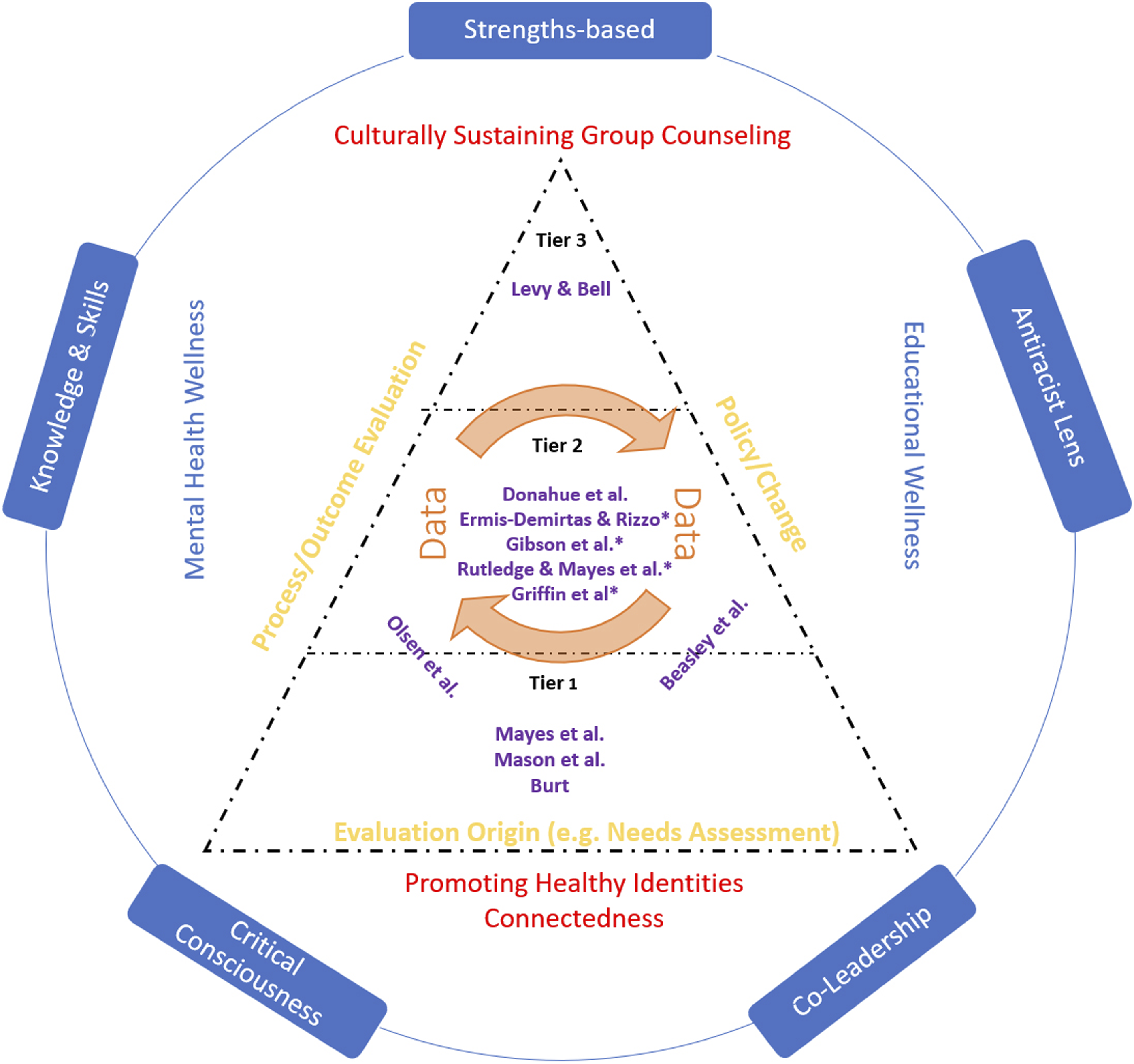
Figure 1 demonstrates a comprehensive view of how each of the articles in this special issue (in purple text) fits within the traditional MTSS triangular framework. We include (a) the roles of evaluation, policy, and change that occur at each level (yellow text); (b) the duality of promoting mental health and educational wellness (blue text); (c) the centrality of data as an iterative process (orange arrows); and (d) the competencies that school counselors must constantly work to embody and employ (outer circle).
This graphic helps to situate the articles based on other characteristics. For instance, nearly half of the articles are conceptual yet they provide ideas for implementation. The other half offer research designs that are not limited to quantitative or qualitative, but also include mixed methods (Ermis-Demirtas & Rizzo, 2024). Essentially, these publications illustrate both traditional, strengths-based psychoeducational groups (Gibson et al., 2024; Rutledge & Mayes, 2024) and innovative school counselors bringing group programs into the community for youth beyond school building walls (Levy & Bell, 2024). When synthesized, the contributions demonstrate ways school counselors engage our students from racially minoritized backgrounds in positive, celebratory, creative, and affirming ways (Burt and Tosado, 2024; Mayes et al., 2024). The included research studies provide a set of important findings around the implementation, impact, and evaluation of groups. For example, Olsen et al. (2024) describe the importance of utilizing a culturally sustaining system that applies information gleaned from the group experience to inform Tier 1 programming. Donahue and colleagues (2024) take a step back from traditional, evidence-based outcome evaluation to prioritize process evaluation (e.g., by examining implementation fidelity).
We confidently state that these articles are well suited to attend to the celebration of race and the strengths associated with infusing race into the group program (Beasley et al., 2024; Griffin et al., 2024) and into school counselor training and preparation (Dosal-Terminel et al., 2024). And, while we are proud of this, we also acknowledge the limits of this compilation of articles. Taking an inclusive lens makes clear that some studies acknowledge aspects of participants who may identify in nonconforming gender ways (e.g., trans or queer); however, we received no proposed article in response to the initial call for the special issue nor does this final set include any article that single-mindedly addresses the LGBTQ+ community. We point out this important concern because more questions and opportunities remain to explore not only the LGBTQ+ community, but also neurodiverse individuals, people with disabilities, and other minoritized populations. We hope that scholars will add insight that is beyond cursory and explores the distinct within-group differences to avoid perpetuating systemic oppression.
Nevertheless, the authors of this entire collection—school counseling educators, researchers, graduate students, and practitioners—use group counseling interventions and programs to advance equity, access, inclusive excellence, and social justice for our nation’s youth. Even though we have synthesized a body of scholarship by connecting with our colleagues engaging in this work, we acknowledge that we all still have room to improve in ensuring that we maintain postures that are culturally sustaining and actively combating systemic oppression. We leave you with three essential questions to ask yourself while reading these articles and reflecting on your own group counseling experiences: 1. Does your group work (e.g., research, teaching, or practice) center the empowerment of students over forcing compliance? 2. Do your group counseling programs empower students to be critical collaborators in systemic change? 3. What will your role, as a school counselor educator, practitioner, or both, be in advancing systemic change through group counseling?
Footnotes
Declaration of Conflicting Interests
The author(s) declared no potential conflicts of interest with respect to the research, authorship, and/or publication of this article.
Funding
The author(s) disclosed receipt of the following financial support for the research, authorship, and/or publication of this article: This study is supported by Diversity Research Action Consortium.
