







Abstract
This research investigated the relationship between elementary school counselors and principals as a predictor of ASCA National Model implementation, employing a quantitative, non-experimental survey design. Data, which were collected through the Principal-Counselor Relationship Rating and the School Counseling Program Implementation Survey, revealed a significant predictive association between their relationship and the extent of school counselors’ implementation of the ASCA National Model. Notably, the mission and vision subscale of the Principal-Counselor Relationship Rating emerged as the only standalone predictor of program implementation. Using the Ecological School Counseling Theory as a framework, this research underscores the importance of building a strong school ecosystem through collaborative efforts and mutual goals between school counselors and principals, contributing evidence to support school counselor and principal relationships and implementation of the ASCA National Model. The results prompt further discussion on the implications for research, practice, and policy aimed at fostering healthy school ecosystems to improve life-readiness and academic success for students. The findings from this research serve as a valuable resource for school counselors, principals, and training programs, enabling them to better equip schools to serve each and every student.
Keywords
Created in 2003, the American School Counselor Association (ASCA) National Model emphasizes the positive outcomes of comprehensive school counseling programs (American School Counselor Association, 2019; American School Counselor Association, 2025). Now in its fifth edition, the model continues to serve as the cornerstone for many school counseling programs nationwide. While the profession of school counseling has continued to evolve, so has the ASCA National Model, in order to assist school counselors in developing academic, college and career, and social/emotional skills for all students (ASCA, 2025).
The ASCA National Model recognizes that collaborative relationships between educational partners improve student success. The Ecological School Counseling (ESC) theory emphasizes that many factors impact student success, and educators uniquely address those ecosystems (Hilts et al., 2022). School counselors and principals can impact each system, including the microsystem, mesosystem, exosystem, macrosystem, and chronosystem (McMahon & Mason, 2019).
As an underpinning for the research, the ESC theory recognizes that school counselors and principals have the opportunity to collaborate in building healthy school systems that prioritize mutual understanding and goals, where everyone contributes (McMahon & Mason, 2019). This ecosystem approach recognizes that educational partners cannot individually be solely responsible for change but that multilevel interventions can initiate and cause change to occur, resulting in healthier systems for all (McMahon & Mason, 2019). Ideally, the school counselor and the principal work collaboratively to create an equitable school environment that includes a comprehensive school counseling program that addresses systemic disparities in order to best serve all students.
Research supports implementation of the ASCA National Model and the positive impact of an effective school counselor and principal relationship (Camelford & Ebrahim, 2017; Fye et al., 2017; Randick et al., 2018). However, an unknown was whether there is a predictive relationship between the school counselor and principal relationship and the extent of a school counselor’s implementation of the ASCA National Model. This research study used a quantitative, non-experimental survey design to examine whether the relationship between elementary school counselors and principals predicts elementary school counselors’ implementation of the ASCA National Model. The study sought to provide information for school counselors, principals, and training programs to better prepare these partners for effective collaborative relationships and implementation of the ASCA National Model.
Literature Review
ASCA National Model
School counselors create comprehensive school counseling programs defined by the ASCA National Model in order to improve life-readiness and academic success for each and every student (ASCA, 2019). Program implementation can impact the school environment by strengthening the microsystem, mesosystem, exosystem, macrosystem, and chronosystem (Williams, 2016). School counselors can address students’ microlevel challenges by working directly with students, families, and school staff to benefit students’ skills and outcomes in academic achievement, social/emotional development, and college and career readiness (ASCA, 2019). Addressing academic outcomes, research has found that school counselors are effective in closing achievement and opportunity gaps (Leon et al., 2011), decreasing racial disparities in Advanced Placement (AP) course enrollment (Davis et al., 2013), increasing crucial skills needed for long-term academic success such as organization, time management, and motivation (Berger, 2013), addressing educational disparities (Gay & Swank, 2021), and improving student attendance, which can be a contributing factor to academic success (Akos et al., 2019).
School counseling program implementation benefits students’ social/emotional development at the microlevel by working with the educational team to create an accountable, safe, and nurturing environment (ASCA, 2019). Midgett and colleagues (2018) found that comprehensive school counseling programs can increase knowledge and confidence in students’ ability to report and stop bullying incidents. Additionally, Steen and colleagues (2018) found that implementing small groups as part of a comprehensive school counseling program increased confidence and empowerment (Steen et al., 2018). Further, school counselors strengthen the microsystem with the implementation of Multi-Tiered Systems of Support (MTSS) and Positive Behavioral Interventions and Supports programs that can positively impact the overall school environment (Goodman-Scott, Betters-Bubon, & Donohue, 2018).
Finally, comprehensive school counseling programs can influence college and career development. Lapan et al. (2019) found that high school students with access to a fully implemented comprehensive school counseling program aligned with the ASCA National Model can make better informed college decisions because they have more access to college counseling opportunities. Students who meet with a school counselor to discuss postsecondary options are three times more likely to attend college and seven times more likely to apply for financial aid (Velez, 2016). Similarly, Jones et al. (2019) confirmed that a comprehensive school counseling program that received the Recognized ASCA Model Program (RAMP) distinction resulted in higher student SAT and ACT WorkKeys scores as well as increased college enrollment.
In addition to directly supporting students’ academic, social/emotional, and college and career development, the ASCA National Model emphasizes that school counselors utilize advocacy to strengthen the mesosystem by seeking the formation of interactive relationships between educational partners (Williams, 2016). School counselors also use collaboration to bolster the exosystem by encouraging partnerships among social services, community agencies, and other resources not typically available within schools (Williams, 2016). Research has found that school counselors and principals are increasingly understanding and supporting families and communities through macro-level work (Boyland et al., 2019; Trombly et al., 2022). Systemic change can eliminate barriers at the macrosystem and chronosystem levels (Williams, 2016). Together, school counselors and principals can intertwine the themes of comprehensive school counseling programs as defined by the ASCA National Model with ESC theory to ensure equitable educational services for each and every student.
The role of the school counselor has continued to evolve from a once reactive position that served some students to a preventative, proactive role that benefits all students through the creation of the ASCA National Model (ASCA, 2019). While the ASCA National Model has added a structured framework and provided a clearer definition of the school counselor’s role, earning recognition among professionals as a best practice in school counseling, research frequently identifies the lack of principal support as a significant barrier to its effective implementation (Camelford & Ebrahim, 2017; Fye et al., 2017; Hilts et al., 2019; Randick et al., 2018). The relationship between the school counselor and principal has been cited as the most influential factor in ASCA National Model implementation (DeSimone & Roberts, 2016).
School Counselor and Principal Relationships
The school counselor and principal relationship can result in benefits at multiple levels of the school ecosystem (Dahir & Geesa, 2022). At the individual level for school counselors, collaborative support from the principal could be a protective factor from work-related stress that can lead to burnout for school counselors (Fye, Bergen, & Baltrinic, 2020). Furthermore, positive school counselor and principal relationships can result in higher job satisfaction (Mullen & Gutierrez, 2016) and improved job performance (Randick et al., 2018). Students also experience benefits at the individual level, including increased student achievement when collaborative efforts occur (Yavuz et al., 2017). In addition to improving academic achievement, partnerships can create more inclusive learning conditions for all students (Beasley & Ieva, 2022; Wikoff & Wood, 2022). Wikoff and Wood (2022) found that the perception of a collaborative relationship between school counselors and principals improved student advocacy efforts for lesbian, gay, bisexual, transgender, and questioning or queer students. Additionally, Beasley and Ieva (2022) emphasized the importance of school counselors and principals in dismantling racist practices and working toward systemic change to create a more equitable environment.
Further, at the microsystem level, Mullen and Gutierrez (2016) noted that when school counselors had a positive relationship with the principal, there was an increase in the direct services provided to students, which can positively impact the school. Similarly, Waalkes et al. (2018) added that when school counselors can provide school-wide preventative instruction and can consistently consult, the school counselor and principal relationship improves. Rock et al. (2017) pointed out that a collaborative environment improves the school microsystem’s overall climate. Lawrence and Stone (2019) acknowledged that while principals have a pulse on the entire school, school counselors have a pulse on every student. School counselors and principals have a unique opportunity to collaborate to serve the school (Howell et al., 2019). Furthermore, the Professional Standards for Educational Leaders call on principals to collaborate to meet student needs (National Policy Board for Educational Administration, 2015).
The mesosystem benefits from the school counselor and principal relationship when the school ecosystem creates a school-family-community partnership (Bryan et al., 2017). For instance, following the COVID-19 pandemic, research recommends that schools create leadership teams that include the principal, the school counselor, and other family and community partners so that the school mesosystem can strengthen specifically in the face of a traumatic event or emergency (Kruczek et al., 2022). At the exosystem level, Lowery et al. (2018) suggested that working relationships between the school counselor and principal can eliminate systemic inequalities and increase social justice in schools. School counselors and principals are called not only to collaborate on behalf of students but also to do so through social justice leadership that can lead to school improvement and possible reform (Lowery et al., 2018). The benefits of effective relationships stretch through each layer of the school ecosystem.
Despite significant benefits to school counselor and principal relationships, there can be barriers to successful relationships. Historically, research cited differing views of the school counselor’s role and how school counselors spend their time as a significant barrier (Chandler et al., 2018). ASCA published a research report that surveyed over 1600 school and district administrators, finding that many school counselors are assigned non-school counseling duties, such as managing students’ Section 504 plans or coordinating testing programs (ASCA, 2023). ASCA (2023) stated, “Such duties detract from their essential responsibility to ensure all students succeed” (p. 12).
Additionally, a mixed-methods study with over 500 school counselors and principals found disparities in perceptions of school counselors’ competencies and priorities for serving students, which further complicated effective collaboration (Hannor-Walker et al., 2022). Research has indicated that inappropriate and administrative tasks are particularly prevalent in rural schools (Odegard-Koester & Watkins, 2016). The assignment of inappropriate tasks not only results in school counselors being unable to implement comprehensive school counseling programs but can also lead to dissatisfaction and burnout (Fye, Bergen, & Baltrinic, 2020; Fye et al., 2022). However, Lewis and colleagues (2022) found that principals can correctly identify appropriate school counseling tasks. While the principal participants in this study appeared to have a strong understanding of the role of the school counselor, other studies have found different results, and researchers continue to cite role confusion as a barrier to the implementation of the ASCA National Model (Lowery et al., 2018). It is also of note that the principal perceptions of appropriate and inappropriate roles and what principals actually expect school counselors to do in the school may differ (Lewis et al., 2022).
While principals’ understanding of the role of the school counselor has continued to be a barrier for some school counselors, research has indicated that policy, mandates, and legislation surrounding the role of the school counselor can increase principals’ knowledge of comprehensive school counseling programs (Cinotti et al., 2022). The outcome of research by Cinotti and colleagues (2022) indicated that policies such as mandated comprehensive school counseling programs effectively increased knowledge and effective collaboration between school counselors and principals in New York. The state researched in the present study did not have policies similar to the New York state mandate surrounding the delivery of a comprehensive school counseling program.
Another barrier to school counselor and principal relationships is finding time to meet (Duslak & Geier, 2016). Effective relationships are a process that takes time and, ideally, this process is well-planned out using a framework for productive partnerships (Jordan, 2022). Although principals and school counselors have many responsibilities that make finding time to meet challenging, Duslak and Geier (2016) emphasized that meeting together frequently must be addressed. Kruczek et al. (2022) found that both school counselors and principals desired more collaborative time together, specifically following disruptions to the educational system, such as the COVID-19 pandemic. Nevertheless, they did not prioritize finding time to meet (Kruczek et al., 2022). While school counselors are three times more likely than principals to desire more collaborative time together, both parties identify collaboration as a beneficial tool that is too often disregarded due to time restraints (Duslak & Geier, 2016; Kruczek et al., 2022). Informal interactions, such as those during arrival, lunch, hallway passes, or breaks in the day, can provide valuable opportunities for connection when structured meeting times are not available (Lowery et al., 2018). Together, school counselors and principals can address barriers to effective school counselor and principal relationships and work towards building effective relationships that benefit all.
This study adds to the knowledge and identifies the need for additional research to address both the ASCA National Model implementation, and school counselor and principal relationships. Research has consistently shown that the ASCA National Model is effective (Lapan et al., 2019; Mullen & Gutierrez, 2016), and some studies have shown what factors impact effective school counselor and principal relationships (Duslak & Geier, 2016; Waalkes et al., 2018). How these elements predict each other was still relatively unknown. The synthesis of the research findings resulted in a need for new research on whether the perceived strength of the school counselor and principal relationships predicts ASCA National Model implementation. This study aimed to examine whether elementary school counselor and principal collaborative relationships predict the implementation of the ASCA National Model, using the following research questions: (1) Does the school counselor and principal relationship, as measured by the Principal-Counselor Relationship Rating (Roffers, 2021), serve as a predictor of ASCA National Model implementation as measured by the School Counseling Program Implementation Survey (Clemens et al., 2010)? (2) Which Principal-Counselor Relationship Rating (Roffers, 2021) subscales (collaboration, communication, mission and vision, respect, responsibility, and trust) predict the implementation of the ASCA National Model as measured by the School Counseling Program Implementation Survey (Clemens et al., 2010)?
Positionality Statement
Maintaining a reflexive stance in quantitative and qualitative research has been regarded as a way to help readers understand who the researchers are and what they bring to the study as unique individuals (Jamieson et al., 2023). This consideration helps to account for bias and viewpoints that we may have as a part of our background and identities. The authors of this study share a collective commitment to advancing the school counseling profession. The lead author has served as a school counselor and state-level leader, with national-level involvement, including serving on the ASCA Board of Directors and being an ASCA-Certified Trainer. Their area of expertise includes presenting training to principals across the county regarding the ASCA National Model. The second author is a counselor educator and supervisor with experience directing practicum and internship, preparing future school counselors to implement evidence-based practices rooted in the ASCA National Model. The third author’s background includes professional service as a school counselor and as president of a state School Counselor Association, where their leadership emphasized policy advocacy and legislative engagement to support comprehensive school counseling programs. Collectively, our experiences inform our research lens and our commitment to strengthening school counselor and principal relationships as a foundation for effective ASCA National Model implementation.
Method
Participants
Demographics of Sample.

Note. Total participants N = 163.
Descriptive Statistics of Sample.

Note. Total participants N = 163.
Procedures
This IRB-approved study used a non-experimental, quantitative survey design to address school counselor and principal relationships and the level of implementation of the ASCA National Model, in order to determine if the variables predicted one another. Participants completed three surveys: a demographic survey, the Principal-Counselor Relationship Rating (Roffers, 2021), and the School Counseling Program Implementation Survey (SCPIS) (Clemens et al., 2010). The study utilized linear regression with the survey responses to determine if the variables predicted one another.
All potential participants gained access to the study through a SurveyMonkey link. The participants were shown the informed consent document, which included an acknowledgment that participants voluntarily agreed to participate in the study, that participants were provided with clear and accurate information concerning the study, and that participants understood the information and had opportunities to ask questions. Following informed consent, the school counselor or principal responded to a series of questions to ensure they met the inclusion criteria. If the participants qualified, they were then directed to the next page to provide demographic information.
Following the demographic survey, the participants were directed to the Principal-Counselor Relationship Rating (Roffers, 2021) and the School Counselor Program Implementation Survey (Clemens et al., 2010) to complete both surveys. We expected that the surveys would take approximately 25 minutes to complete. At the conclusion of the surveys, the participants were directed to a screen that thanked them for their time and then exited the survey. All survey data was stored on SurveyMonkey, a password-protected online survey platform, until it was uploaded into JASP for data analysis (JASP Team, 2023).
Instrumentation
School counselor and principal perceptions of their relationship as defined by collaboration, communication, mission and vision, respect, responsibility, and trust were measured using the Principal-Counselor Relationship Rating (Roffers, 2021). This survey is an updated version of the original “Principal-Counselor Relationship Survey” (College Board, 2011). The original survey and the updated version were created in collaboration with the College Board, the National Association of Secondary School Principals, and the American School Counselor Association to uncover what school counselors and principals report as the most critical aspects of an effective collaborative relationship (Finkelstein, 2009; Roffers, 2021). After the creation of the original survey, the College Board surveyed 2386 school counselors and principals using the instrument, and used the results to create the Enhancing the Principal-School Counselor Relationship Toolkit (College Board, 2011). The survey has a Cronbach’s Alpha of .868 (Roffers, 2021). We obtained permission to use this instrument from the College Board; Dr. Doreen Finkelstein, original author and research scientist; and Dr. Alison Roffers, the author of the updated survey.
We measured the level of implementation of the ASCA National Model using the SCPIS instrument (Clemens et al., 2010). This widely used instrument is considered the most commonly utilized tool for researchers to measure implementation of the ASCA National Model (Clemens et al., 2010; Olsen et al., 2021). The SCPIS is a three-factor model with 17 questions. The programmatic orientation factor had a Cronbach’s alpha of .79, school counseling services factor had a Cronbach’s alpha of .81, and school counselors’ use of computer software factor had a Cronbach’s alpha of .83. A decade later, Fye and colleagues (2020) used the SCPIS, which resulted in an internal consistency reliability of .91. While the survey has relatively high internal consistency, aspects of reliability beyond that have not been evaluated (Clemens et al., 2010). Limited test-retest reliability has been established for the SCPIS (Fye et al., 2020, Memis, et al., 2020). For this study, we gained permission, although researchers can use the SCPIS without obtaining specific permission (Clemens et al., 2010).
Data Analysis
For this study, the first research question used simple linear regression. The question explored if the strength of the school counselor and principal relationship predicts the level of implementation of the ASCA National Model. The dependent variable was the ASCA National Model’s implementation level measured by the SCPIS (Clemens et al., 2010). The predictor-independent variable was the strength of the relationship measured by the Principal-Counselor Relationship Rating (Roffers, 2021).
The second research question used multiple regression because it included multiple independent variables. This research question asked which Principal-Counselor Relationship Rating subscales (collaboration, communication, mission and vision, respect, responsibility, and trust) predict the implementation of the ASCA National Model. Again, the dependent variable was the level of implementation of the ASCA National Model measured by the SCPIS (Clemens et al., 2010). The predictor-independent variables were the subscales (collaboration, communication, mission and vision, respect, responsibility, and trust) of the Principal-Counselor Relationship Rating (Roffers, 2021).
Results
Research Question 1
Regression Results for the Principal-Counselor Relationship Rating.

Note. Overall Model: F (1, 161) = 60.472, p < .001. R2 = .273. Adjusted R2 = .269.
***p < .001.
Research Question 2
Regression Results for the Principal-Counselor Relationship Rating Subscales.
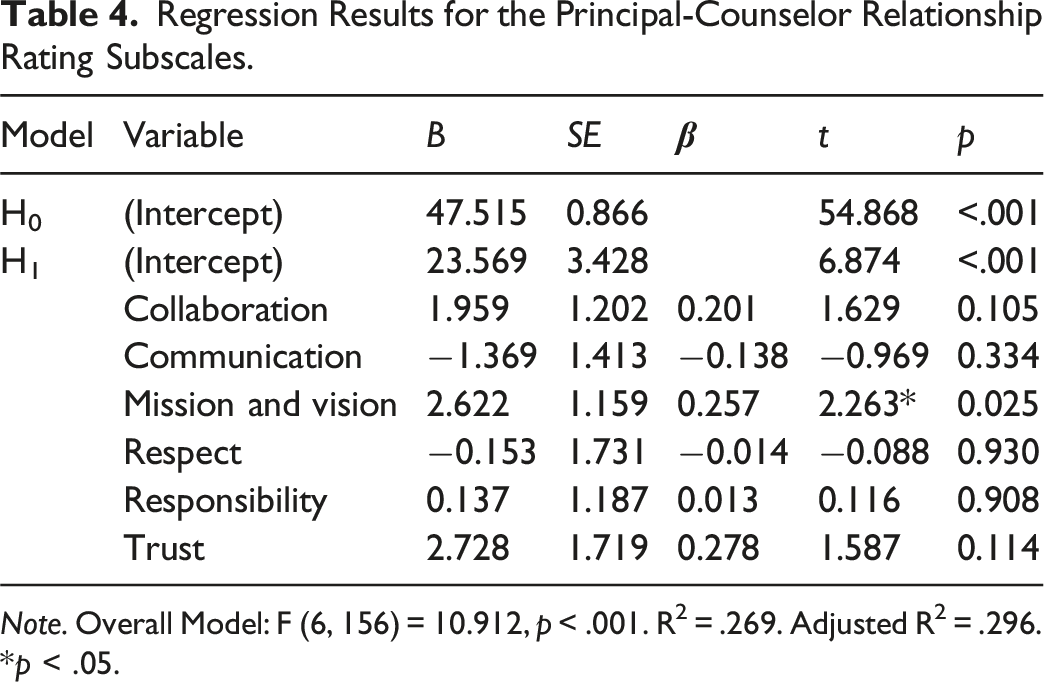
Note. Overall Model: F (6, 156) = 10.912, p < .001. R2 = .269. Adjusted R2 = .296.
*p < .05.
Discussion
This study investigated how the relationship between elementary school counselors and principals serves as a predictor of ASCA National Model implementation. Previous research has identified that the school counselor and principal relationship can positively impact multiple levels of the school ecosystem. This impact can be seen at the individual and microsystem levels in various ways, such as decreased burnout and higher job satisfaction for school counselors (Fye et al., 2020; Mullen & Gutierrez, 2016); improved job performance by school counselors (Randick et al., 2018); increased student achievement (Yavuz et al., 2017; Young et al., 2015); more inclusive and equitable learning conditions for all students (Beasley & Ieva, 2022; Boyland et al., 2019; Wikoff & Wood, 2022); and improved school climate (Rock et al., 2017). Additionally, the school counselor and principal relationship can impact the mesosystem through strengthened school-family-community partnerships (Bryan et al., 2017), especially in the event of a traumatic event or emergency (Kruczek et al., 2022). At the exosystem, working relationships between the school counselor and principal can address systemic inequalities and increase social justice leadership (Lowery et al., 2018). The research identifies that the school ecosystem can improve by implementing the ASCA National Model and cultivating positive school counselor and principal relationships. This study adds to the knowledge of both the ASCA National Model implementation and school counselor and principal relationships.
The results of the first research question indicated a strong statistically significant predictive relationship between the school counselor and principal relationship and the implementation of the ASCA National Model, as measured by the SCPIS (Clemens et al., 2010) and the Principal-Counselor Relationship Rating (Roffers, 2021). As the school counselor and principal relationship rating score increased, so did the ASCA National Model implementation rating. This finding aligns with previous findings identifying the school counselor and principal relationship as vital to the success of the school counseling program (Camelford & Ebrahim, 2017; Fye et al., 2017; Randick et al., 2018). The study contributes new insights into how the relationship between school counselors and principals can serve as a predictor of ASCA National Model implementation.
The findings of research question two explored whether any of the specific subscales of the Principal-Counselor Relationship Rating (collaboration, communication, mission and vision, respect, responsibility, and trust) predicted ASCA National Model implementation. The mission and vision subscale had moderate predictive significance of ASCA National Model implementation. When each subscale was measured separately, only the mission and vision subscale score significantly increased as the ASCA National Model implementation rating increased. Roffers (2021) defined the mission and vision subscale as having shared goals for the school that increase opportunities for student success. This subscale captured the spirit of school counselors and principals having aligned goals rather than a specific written mission or vision statement. Similar to the findings in this research study, ESC emphasizes collaborative practices prioritizing mutual understanding and common goals, where everyone contributes (McMahon & Mason, 2019). The results identifying mission and vision as the most predictive subscale supports the idea that mutual goals are paramount in the success of schools. This aligns with the ecosystem approach that recognizes that no individual should be solely responsible for the success of a school. Instead, ideally, partners come together as part of a broader framework of multiple interconnected systems to provide collaborative interventions, equitable practices, and a focus on success for each and every student (Goodman-Scott et al., 2018; McMahon & Mason, 2019).
Implications
The findings from this research offer implications for school counselors, principals, and training programs. This study answered whether there is a predictive relationship between the school counselor and principal relationship and the extent of a school counselor’s implementation of the ASCA National Model. With previous research supporting the implementation of the ASCA National Model (Lapan et al., 2019; Mullen & Gutierrez, 2016), we can infer that the profession would benefit from an increased focus on the school counselor and principal relationship, since it predicts implementation of the ASCA National Model, which has been proven to have positive results for students.
Because the results of this study found that implementation of the ASCA National Model is predicted by the school counselor and principal relationship, school counselors and principals could benefit by understanding that the relationship they build with each other could lead to an increase in ASCA National Model implementation. In turn, the ASCA National Model positively impacts the school ecosystem by promoting data-driven, student-centered practices that enhance academic success, social/emotional development, and college and career readiness (ASCA, 2019). This knowledge emphasizes that school counselors can partner with their principal to create a collaborative and positive culture that leads to a healthier school system (McMahon & Mason, 2019). Nourishing the relationship can take time, and often prioritizing collaboration can be challenging (Duslak & Geier, 2016; Jordan, 2022; Kruczek et al., 2022). However, this study shows school counselors and principals that there are potential benefits to prioritizing this relationship. It is of note that when policy, mandates, and legislation support comprehensive school counseling programs, principals are more likely to have knowledge about the ASCA National Model (Cinotti et al., 2022). The Enhancing Principal School Counselor Relationship Toolkit can assist in this process (College Board, 2022).
Because principal participants were included in this study, the results are relevant to principals and their role in improving the school ecosystem. The results indicate a predictive relationship between the mission and vision subscale and implementation of the ASCA National Model, which can benefit principals by emphasizing the need to prioritize and protect this collaborative time together, specifically the need for aligned goals through their mission and vision. In addition to time together, research has indicated that principals with an accurate understanding of the role of the school counselor are better prepared to support school counselors (Chandler et al., 2018; Lowery et al., 2018). Principals can use this information to prioritize effective relationships, active collaboration, and aligned mission and vision.
Additionally, knowing that the school counselor and principal relationship predicts ASCA National Model implementation can benefit training programs, including school counselor education and principal preparation. When school counselor education and principal preparation faculty know the predictive value of the school counselor and principal relationship, they can incorporate the importance of the relationship into the curriculum. Faculty can focus on helping school counselors- and principals-in-training foster skills to create an effective school counselor and principal relationship that could lead to improved student success through ASCA National Model implementation. School counselor educators can partner with principal preparation programs at their colleges and universities to co-create curriculum on the school system, including how the role of the school counselor can uniquely impact the ecosystems and ways to create an effective school counselor and principal relationship (Brown, 2016). Additionally, school counselor educators can enhance school counselor trainees’ knowledge and skills of leadership and advocacy to help prepare them to support the creation of intentional policy regarding the implementation of comprehensive school counseling programs (Mullen et al., 2023).
Recommendations for Further Research
Areas for further research include considering instrument application and research design. This study used a new tool to measure the relationship between principals and school counselors. Dr. Roffers published the tool in 2021, and this is the first study to use the tool beyond the initial publication. For that reason alone, additional research could use the tool and attempt to add reliability and validity information. Additional research could further explore how school counselors and principals rate their relationship. For example, this study, using only participants who worked in elementary schools, found the Principal-Counselor Relationship Rating mean score to be 24.81 with a possible range of 6–30. In contrast, Roffers (2021) used only participants who worked in secondary schools and found a mean relationship score of 13.08. This is a substantial difference in mean scores. Similarly, the mean total score for the SCPIS was 47.515, with a possible range of 20–68. The mean score for the SCPIS for school counselors was 46.12, while the mean score for principals was 50.33. This indicates that principals in the study perceived the school counseling program to be more implemented compared to the school counselors in the study. Additional research could further examine the differences to understand the discrepancies in the mean scores for both survey instruments. This could be done through specific sampling methods collected in context, including focusing on specific grade level settings, within a school district, or using matched pairs of school counselors and principals at the same site.
A replication of this study using matched pairs of school counselors and principals from the same school could help further validate the instruments and provide additional context about the school counselor and principal relationship and its ability to predict implementation of the ASCA National Model. This research design could further investigate how school counselors implement the ASCA National Model, what implementation looks like in the school, or the impact of implementing the ASCA National Model. Additional information about principals’ perceptions of their school counselors, or if they understand the role of the school counselor, could also be collected through matched pairs. While matched pairs research design is typically done with experimental studies, it is believed that it could generate beneficial information in a study similar to this one (de Winter & Dodou, 2017). Although there is limited information about this type of research in educational and social science fields, it is believed that the ability to allow the researcher to compare the perceptions of the school counselor and principal relationship of participants who work together would add valuable knowledge to the profession.
Another research design that would be informative is a longitudinal design that could follow school counselor and principal participants through a “pre-test,” a training opportunity, a “post-test,” and a follow-up after a set amount of time. The pre-test could discuss the school counselor and principal relationship and the ASCA National Model implementation. Then, a training opportunity could provide thorough professional development on the ASCA National Model and the school counselor and principal relationship. The post-test could use the same tools as the pre-test to measure any change in perceptions. Finally, the follow-up could measure any change in perceptions or behaviors after a prolonged period of time. Similar research has indicated significant benefits of longitudinal research on educational practices in order to see long-term perspectives and growth (Ertl et al., 2020; Milton & Forlin, 2017).
Limitations
This study had limitations concerning the participants used in the sample. To begin, there was a disproportionate number of school counselor respondents, with 108 school counselor participants (66%) and 55 principal participants (34%). This disproportionality could be because of the topic of the study and more school counselors having an interest in the results. Additionally, those who chose to participate may have had a more positive relationship with their counterpart, indicating potential selection bias, which can be challenging to address. The study had a low response rate, with a 12% response rate for school counselor participants and 4% for principal participants. The low response rate should be acknowledged when generalizing the results to all school counselors and principals. Additional caution should be considered because all of the participants in this study worked in an elementary school and were from a single state in the west south central United States.
Another limitation of this study was the survey instruments used. Both the Principal-Counselor Relationship Rating (Roffers, 2021) and the SCPIS (Clemens et al., 2010) had limited psychometric data available. Both tools lack sufficient reliability and validity information, and more data are needed to confirm their effectiveness. Although this study had limitations that could be addressed in future research, the results from this study identified knowledge that has practical implications for the profession.
Conclusion
The ASCA National Model is considered a best practice in creating comprehensive school counseling programs that can improve academic success for students. School counselors are best equipped to implement the ASCA National Model with support from their principal. However, before this study, it was not known if the school counselor and principal relationship predicted ASCA National Model implementation. The study confirms that the overall Principal-Counselor Relationship rating does serve as a statistically significant predictor of ASCA National Model implementation. Additionally, the mission and vision subscale, which captures the importance of shared goals between the school counselor and principal, was the only standalone subscale to significantly predict implementation. Overall, this knowledge emphasizes the vital importance of the relationship between school counselors and principals. Having a shared mission and vision can lead to a school counselor’s ability to fully implement a comprehensive school counseling program. This collaborative relationship and ability to implement the ASCA National Model can create a school ecosystem that can nurture the development and success of each and every student.
Footnotes
Declaration of Conflicting Interests
The authors declared no potential conflicts of interest with respect to the research, authorship, and/or publication of this article.
Funding
The authors received no financial support for the research, authorship, and/or publication of this article.