







Abstract
White school counselors increasingly work in racially diverse school settings. Although White racial identity development has been linked to multicultural competence and advocacy, less is known about how counselor preparation and professional experience shape White racial identity development or how it, in turn, influences school counseling practice. This study explored how school counseling preparation and professional experiences influence racial identity development among White school counselors and how shifts in racial identity development affect their work with students of color. using a constructivist grounded theory methodology. Twenty-eight White school counselors working in schools in the southeastern United State participated in semistructured interviews. Interview data was analyzed iteratively through constant comparison and line-by-line and focused coding. This process led to the development of a theoretical model of White school counselor racial identity development. Findings indicate that White racial identity development among school counselors is shaped by both preparation experiences and professional practice. These experiences contributed to a shift from color-evasive to color-conscious perspectives and increased engagement in broaching, advocacy, and trust building with students of color. Emotional experiences such as guilt, shame, and discomfort often functioned as catalysts for reflection and change. However, participants also experienced tension related to belonging and concern about backlash in their advocacy efforts. Overall, results suggest a bidirectional relationship between White racial identity development and school counseling practice, with implications for school counselors, counselor educators, and school leaders.
The racial identity experiences of White school counselors who work with students of color are, like those of other White individuals, often impacted by a sense of racial invisibility (Helms, 2020; Lensmire, 2017). Because whiteness, a cultural construction that encompasses the beliefs, values, attitudes, and behaviors associated with the racial category White (Helms, 1990, 1995; Lensmire, 2017), is incorporated into nearly all elements of American society, it can be difficult for White people to recognize the impact their race has on their overall lives. However, school counselors are unique in that they, due to the demographic makeup of American schools, are likely to find themselves facing interracial encounters regularly. Furthermore, school counselors are guided by educational programs and professional standards that emphasize racial and cultural awareness and social justice advocacy (American Counseling Association [ACA], 2014; ASCA, 2021a, 2023b, 2025; Bayne et al., 2021; Ratts & Greenleaf, 2018; Ratts et al., 2016; Singh et al., 2010). Recent research suggests that contextual factors, such as these, may significantly impact the racial identity development process of White school counselors (Ponterotto, 2011; Shand-Lubbers & Baden, 2023; Toporek, 2011). This grounded theory study examined how school counselor preparation and professional experience impacted the process of racial identity development of White school counselors and how changes in it subsequently impacted their work as school counselors. Understanding the experiences of White school counselors who work with students of color in American schools can provide insight into how racial identity influences these professionals’ multicultural competency and advocacy behavior. Thus, the primary research question for this study was: How do school counseling preparation and professional experiences influence the racial identity development of White school counselors?
White Racial Identity
An individual’s understanding of oneself as a racial being is influenced by numerous factors. Physical features, such as skin color, and the racial category ascribed by others based on these features are one element that influences an individual’s racial identity (Helms, 1990). However, one’s historical, political, and social context, including interaction with people of the same and different races, also profoundly influences one’s understanding of race (Helms, 1990; Sue, 2011). Furthermore, the theory of intersectionality posits that other social identities, such as one’s gender, sexual orientation, and class, also impact one’s racial identity (Collins & Bilge, 2016; Crenshaw, 1989; Moffitt & Rogers, 2022; Noble & Renn, 2021). Despite the multitude of factors that influence racial identity, multiple theorists describe similar patterns of thoughts, feelings, and behaviors that constitute racial identities and organize these patterns into theoretical models of racial identity development (Cross, 1971; Gallegos & Ferdman, 2012; Hardiman, 1982; Helms, 1990; Horse, 2012; Kim, 2012; Rowe et al., 1994; Wijeyesinghe, 2012). Although several distinct models of White racial identity development have been proposed over the past 40 years (Ponterotto, 1988; Rowe et al., 1994; Sabnani et al., 1991; Sue & Sue, 2003), each with its distinctive explanations for this development, nearly all of the models retain a processual stage or status-driven structure and propose that movement between statuses is prompted by exposure to racial experiences that cause dissonance in one’s current understanding of race.
Because Helms’s model of White racial identity development has been empirically tested and continually updated (Carter & Johnson, 2019; Day-Vines et al., 2021; Gushue & Carter, 2000; Helms, 1990, 1995, 2020; King et al., 2015; Malott et al., 2021; Utt & Tochluk, 2020), it served as the theoretical foundation of the present study. The model contains six schemas of White racial identity development, ranging from the contact schema, wherein the individual is primarily unaware of the impact of race and approaches racial difference with a color-evasive mentality, to the final schema, autonomy, in which the person integrates their racial identity into their personhood.
Changes in White Racial Identity
A significant criticism of existing racial identity development models is that, although they may accurately describe patterns of thoughts, attitudes, and behaviors related to race, the process of moving between stages, statuses, schemas, or phases is largely unexplored (bib_moffitt_et_al_2021Moffitt et al., 2021; Toporek, 2011). In Helms’s (2020) most recent reiteration of White racial identity development theory, she described the “stages” of development as being “fluid, changeable constructs rather than discrete, linear, stepwise mutually exclusive stages” (p. 29). Further, Helms (2020) noted that “attitudes, behaviors, and emotions do not necessarily evolve at the same rate” (p. 29), and individuals can progress toward higher levels of racial identity and quickly regress toward earlier phases.
Helms maintained that racial identity is a developmental process, with change in schemas influenced primarily by exposure to race-related content, such as interracial relationships, race-related education, or sociohistorical events. For Helms, growth occurs as a result of need. Conflict can arise if one’s primary schema does not adequately incorporate the new information or experience. The experience of conflict impels the individual to explore a new primary schema in an effort to reconcile the internal conflict (Helms, 1995).
The hypothesized forces that propel movement or act as barriers in racial identity development for White people are primarily conceptual. Limited empirical research exists supporting claims that exposure to race-related content and interracial relationships push individual White people toward different racial identity schemas. A handful of qualitative studies on the racial identity development of White teachers indicated that proximity to and interaction with students of color influenced changes in racial attitudes (Bloom et al., 2015; Deutschman, 2022). Perry (2002), in an in-depth study of the racial identity of White high school students, concluded that interpersonal relationships with students of other races had the most impact on the development of students’ racial identity. These studies suggest interpersonal relationships with people of color may be a significant catalyst for changes in White racial identity.
Other research has found a connection between education on race and racism and changes in White racial identity (Dass-Brailsford, 2007; Malott et al., 2021; Shand-Lubbers & Baden, 2023). In an in-depth, qualitative study with White individuals identified as operating from Helms’s autonomy schema, Malott et al. (2015) highlighted how participants achieved this schema in large part due to exposure to “new information” (p. 338). Processing new learning with educators or activists helped participants integrate the information into their understanding of their racial identity. These studies indicate that exposure to people of other races and education on race and racism are primary factors in individual change.
White Racial Identity, Social Justice Advocacy, and School Counseling
Individual racial identity development has critical social implications, especially in school counseling. School counselors are guided by ethical guidelines set by the American School Counselor Association (ASCA), which include expectations of multicultural counseling competence, the ability to work effectively with students and clients from diverse backgrounds (Ratts et al., 2016), and the expectation that school counselors “understand and advocate for all students’ rights to be treated in a manner that honors and respects their identity and expression, including but not limited to race, gender identity, gender expression, sexual orientation, language and ability status” (ASCA, 2022, Section A.10.e).
Extensive empirical research links racial identity development and multicultural counseling competency (Chao, 2013; Constantine, 2002; Middleton et al., 2011; Neville et al., 1996; Ottavi et al., 1994; Parker et al., 1998). Ottavi et al. (1994) found the level of White racial identity development was statistically significantly correlated with multicultural counseling competence among graduate students in counseling. Chao (2013), although not using Helms’s model specifically, found similar results among practicing school counselors. Chao’s study concluded that, although White school counselors had lower levels of multicultural competency than racial/ethnic minority school counselors overall, multicultural training moderated this association; when school counselors received higher levels of multicultural training, the association between race and multicultural competency decreased significantly. Day-Vines et al. (2021) also found that racial identity predicted school counselor broaching behavior. School counseling interns with lower levels of racial identity were less likely to broach racial and cultural differences with their students.
White racial identity development levels are also linked to engagement in social justice advocacy among counselors (Malott et al., 2019, 2021; McMahan et al., 2010). Helms (2020) included working toward the end of racial oppression as a characteristic of the autonomy stage of development. Indeed, social justice activism is consistently linked with higher levels of racial identity development. In a qualitative study on White people with Helm’s autonomy level as their primary schema, Malott et al. (2021) found that participants’ active involvement in antiracist work was common at this stage of development. This research suggests that racial identity development plays a significant role in enhancing school counselors’ multicultural competence and capacity for social justice advocacy. Moreover, the increasing diversity of American schoolchildren underscores the need for these skills.
School Counseling and Racial Diversity
Public schools in the United States are increasingly racially diverse. In 2020, nearly half of schoolchildren in the United States were non-White (National Center for Education Statistics [NCES], 2020). Despite attention to the continued inequities facing students of color in schools, achievement gaps persist (NCES, 2020; Reardon et al., 2024). Students of color consistently graduate at lower rates, miss more school, and perform less well on standardized tests than White students (Appling & Robinson, 2021; Maynard et al., 2017; Morris, 2016). Students of color are also referred for discipline infractions at much higher rates than White students (Annamma et al., 2020; Chin et al., 2020; Morris, 2016). Further, students of color are more likely to experience mental health concerns such as anxiety, depression, and behavioral disorders (Benner et al., 2018; Hoffmann et al., 2022).
School counselors can play a pivotal role in addressing the needs of students of color in schools. They are both educators and mental health professionals (Levy & Lemberger-Truelove, 2021), and the school counseling profession is guided by a commitment to social justice and advocacy for all students (ASCA, 2021a, 2025). However, the trend toward racial diversity among schoolchildren is not mirrored in the makeup of the school counseling profession. Despite increasing diversity among students (ASCA, 2023a, 2024; Data USA, 2016) and the push for more diversity in counselor education programs (Foxx et al., 2018; Shin et al., 2011), the current makeup of the field is overwhelmingly White and female. To effectively address the needs of students of color, school counselors must be aware of the cultural context of their students and engage in practices that are effective within that context (Ratts & Greenleaf, 2018). For White school counselors, this means understanding how their own racial and cultural backgrounds may differ from those of their students.
Multicultural awareness and competency are essential for school counselors to perform their role effectively. Existing research suggests that individual racial identity is associated with both multicultural counseling competency and social justice advocacy among school counselors (Chao, 2013; Constantine, 2002). However, the process by which changes in racial identity occur is less clear (Toporek, 2011). One theory proposes that social context (including one’s professional context) can “create tension, and ultimately, movement” (Abrams & Todd, 2011, p. 426) in racial identity. However, empirical examination of this assumption is limited (Abrams & Todd, 2011; Ponterotto, 2011; Schmidt et al., 2015), with very little new research produced in over a decade. The present study was designed to address this gap by using a constructivist grounded theory methodology to examine how the experience of working as a school counselor with students of color influences the racial identity development process of White school counselors. Understanding the experiences of White school counselors who work with students of color in U.S. schools can provide insight into how racial identity influences these professionals’ multicultural competency and advocacy behavior.
Method
Because the aim was to explicate a process of development that occurs over time and is based on the meaning participants assign to specific experiences, we chose a constructivist grounded theory methodology. The goal of constructivist grounded theory is to create an explanatory model of a particular process of a phenomenon, while maintaining an interpretivist philosophical approach. The data that emerges from constructivist grounded theory is co-created by the researcher and participant, and the interpretation of that data is marked by the social context in which it was collected. The theoretical model resulting from a constructivist grounded theory approach is designed to be of practical use (Charmaz, 2014), another factor in the decision to utilize this method in the current study.
Researcher Positionality
Constructivist grounded theory recognizes the researcher’s subjectivity and influence throughout the study, from shaping participant responses during data collection to interpreting the data (Charmaz, 2014). Accordingly, we share our values, beliefs, and social identities to contextualize our role as instruments in the research process.
The targeted population of this study was White school counselors. The lead researcher is a White woman with a professional background in school counseling. The personal and professional background of the lead author was highly influential in the research question and design. As a White school counselor working primarily with students of color throughout her career, the lead author recognized how these experiences impacted her understanding of herself as a racial being and how these changes in understanding impacted the way she interacted with students. Because she shared both a racial and a professional identity with the participants, the lead researcher engaged in constant reflexivity and frequent consultation with members of the research team to guard against her shared identities leading to assumptions of shared experiences. The second author identifies as a Black woman and served as the lead author’s dissertation advisor during the time this study was conducted. She is also a former school counselor and has conducted research on racial identity development among Black youth. The third author is a White female counselor educator, and the fourth author is a White male counselor educator. Both the third and fourth authors are also former school counselors.
Collectively, the authors share a commitment to supporting equitable and culturally responsive practices in schools. We value the diverse cultural identities students bring into schools and believe that affirming those identities is essential to effective school counseling. Our interest in this study is rooted in the reality that cross-racial relationships are a routine part of school counseling practice. School counselors regularly work with students whose racial identities differ from their own, and these interactions have important implications for students. We see school counselors’ awareness of their own racial identity as a key component of their ability to build meaningful relationships and provide equitable support.
Participants and Sampling Procedures
We invited White school counselors who work with students of color to participate in this study. Because the study’s research questions focused on the development of White racial identity among practicing school counselors, only individuals who identified as White and were employed as school counselors were eligible to participate. Participants were recruited via a combination of purposive, convenience, and theoretical sampling methods. Members of the research team sent information about the study to their professional contacts via email. The lead researcher also generated a list of school districts in the southeastern United States, randomly selected five at a time, and searched for publicly available email addresses of school counselors employed in those districts. All school counselors whose email addresses were publicly available in each randomly selected district received emails. In some cases, the recruitment email was sent to a district leader with a request to distribute it to school counselors. Interested school counselors were asked to return the signed consent form and schedule an online interview using a digital scheduling application. After conducting approximately 10 interviews with participants recruited in this manner and analyzing the resulting transcripts, we employed theoretical sampling to contact other school counselors working in schools with diverse demographic makeups to test emerging ideas. Theoretical sampling is a method of choosing participants based on their potential to refine emerging analytical ideas (Charmaz, 2014). We recruited 18 additional participants via these means. Although theoretical saturation was reached after 24 completed interviews, four additional school counselors were interviewed beyond this point to confirm the saturation of the data.
A total of 28 White school counselors participated in this study. Participants were not asked to share their specific age as part of data collection procedures, but age ranges were reported. Seven participants (25.0%) were in their 20s at the time of the interview, 10 in their 30s (35.5%), 7 in their 40s (25.0%), 3 in their 50s (10.7%), and one in their 60s (3.5%). Most participants (n = 21; 75.0%) identified as female, while seven (25.0%) identified as male. This gender breakdown is similar to that of the school counseling field as a whole (ASCA, 2023a; Data USA, 2016; NCES, 2020). Participants’ years of experience ranged from 1 year to 27 years; the median number of years in the field was 6. Just over one third of the participants worked in elementary schools at the time of the interview (n = 11; 39.3%). The same number of participants worked in high schools (n = 11; 39.3%), while five (17.9%) worked in middle schools. One participant worked at the district level and served students in both middle and high school (n = 1; 3.5%). Although all participants worked in schools located in the southeastern region of the United States, the racial makeup of the participants’ schools was nearly evenly split between those with a majority-White student body (n = 13) and those with a majority of students of color (n = 14). A participant table is included in Appendix A.
Data Collection
We collected data through semistructured interviews, which are conducted using an interview guide, or protocol, a flexible tool to create a loose structure for the conversation between researcher and participant (Roulston, 2022). The initial interview protocol (see Appendix B) included questions designed to explore racial identity development and professional experiences, and questions that gathered demographic information, such as age, gender identity, and years of professional experience. Over time, we adjusted the protocol in response to data gathered from early interviews (Charmaz, 2014; Roulston, 2022). For example, later participants were asked how often they thought about their race, a theme that emerged in early theoretical explorations of the data.
All 28 interviews were conducted online via Zoom. Interviews lasted between 36 and 72 minutes, with an average length of 54 minutes. All interviews were recorded using Zoom software and initially transcribed using the Zoom AI transcription tool. Permission from participants to use this tool was secured as part of the informed consent procedures and approved by the lead researcher’s university’s institutional review board. The lead researcher checked the interview transcripts generated by the Zoom AI transcription tool, listening to the recording and editing the written transcript as needed. Once this task was completed, the interview recordings were permanently deleted. Participants were assigned pseudonyms, and all identifying details were removed from the transcripts.
Data Analysis
In constructivist grounded theory, data analysis occurs concurrently with data collection (Charmaz, 2014). The lead researcher completed initial coding of interviews no later than 2 weeks after each interview was completed and transcribed. Each line of the transcript was coded, and emerging categories were noted in memos. This stage of analysis resulted in a list of initial codes, which were subsequently organized into larger categories (Charmaz, 2014). After coding approximately seven interviews, the lead researcher reviewed the resulting list of codes and began sorting codes into categories that ultimately served as the building blocks of the overall grounded theory. At this point, the transcripts and categories list were shared with members of the research team for feedback. Minor revisions to emerging analytical ideas were incorporated to generate a list of focused codes.
As line-by-line coding of each subsequent interview transcript was completed, the resulting list of codes generated from the new transcripts was compared to the existing list of focused codes. Memos, defined by Charmaz (2014) as “informal analytic notes” (p. 162), were written throughout the process as researchers reflected on the data and drew various drafts of the theoretical model. Because constructivist grounded theory is designed to be an iterative process, researchers explored emerging ideas as they developed.
Trustworthiness
We employed several strategies commonly used in qualitative research to enhance the trustworthiness of the current study. A constant comparison method of data analysis helped ensure that all data was included in the analysis (Glaser & Strauss, 1967). The lead researcher attempted to schedule interviews so that each transcript could be examined for preliminary patterns or themes before meeting with the next participant. This strategy ensured that emerging ideas could be addressed in subsequent interviews, allowing the researcher to test out potential themes (Charmaz, 2014).
Credibility was addressed through memo writing, wherein the lead author noted preliminary analytical thoughts about the data as it was collected and analyzed, and through reflexive journaling, in which the lead author made more general notes about their personal experience as a researcher (Roulston, 2022). These strategies were employed using a continuous document housed in a secure folder in the lead researcher’s files that served as a record of how and when themes emerged in the research process.
The lead author maintained well-organized data files, including researcher memos, journal entries, and deidentified participant transcripts, creating an audit trail (Lincoln & Guba, 1985). Because this research was conducted as a dissertation study, the entire process was supervised by the lead author’s dissertation committee. The lead author also participated in a peer feedback group with two fellow doctoral students, who served as research team members. The members of this group were intentionally selected to ensure that diverse perspectives on the data were represented. Research team members provided critical feedback on the research process and the resulting codes and themes (Patton, 2002). Participants were also invited to review their interview transcripts, a trustworthiness strategy recommended by Lincoln and Guba (1985), although none responded to this invitation.
Findings
The theoretical model that emerged from the data (Figure 1) describes a process in which school counseling preparation and professional experience influence growth in the racial identity development of White school counselors. The findings suggest that professional school counseling experience can serve as a catalyst for change in White racial identity development and that corresponding changes in this development influence the behaviors of practicing school counselors, indicating a bidirectional relationship. Although personal experiences also influenced changes in how participants understood their racial identity, as would be theoretically expected, they were most impactful in how participants experienced their racial identity development prior to entering the field of school counseling. Because this manuscript focuses on the impact of school counseling preparation and professional experience on White racial identity development, we do not include this element in the model and will discuss it as a standalone finding in a future article. A theoretical model of white school counselor racial identity development
Impact of School Counseling Preparation and Professional Experience on White Racial Identity Development
The focus of this study was to examine the impact of professional experience, specifically school counseling, on changes in racial identity. Professional experiences, including professional preparation, led to shifts in participants’ understanding of their racial identity along several continuums. As a result of their professional preparation and experience, participants described shifts in their racial identity, specifically greater awareness of racial privilege and its meaningfulness.
School Counseling Preparation
All participants (n = 28) identified meaningful educational experiences as a primary catalyst for change in racial understanding. Most participants (n = 16) referenced their multicultural counseling course as the educational experience that had the most significant impact on their understanding of racial identity. For some (n = 5), taking this course as part of their graduate program was their first experience with formal instruction on issues of privilege and oppression. Further, for several participants (n = 11), graduate school was the first time they had the opportunity to build relationships with people of color.
Opportunity to Develop Interpersonal Relationships With People of Color
A majority of participants (n = 18) mentioned opportunities to develop relationships with people of color built on mutual respect that arose from preparation experiences as a powerful catalyst for new understanding. All participants in this study (n = 28) were raised among other White people. They lived in families and neighborhoods and attended schools and churches where they were part of the racial majority. As Nina stated: “Where I lived was not very culturally diverse. I spent a lot of time around middle-class White humans and didn’t really understand the experiences of anyone else.” Mackenzie recalled that “there were maybe 10 people who weren’t White in my graduating class.”
Several participants (n = 11) referred to professors of color as memorable moments of exposure to difference. Having a professor of color, “the one Black professor I had in my whole life,” teach her multicultural counseling course was an experience that highlighted to Jennifer how little she knew about racial issues. She remembers feeling embarrassed that the professor had to teach a “roomful of White dummies.”
Nina recalled the relationships she cultivated with cohort members of color. While acknowledging that “it’s not people of color’s job to inform you and educate you,” Nina expressed gratitude “to have had a lot of people in my cohort who wanted to help me learn.” During Micki’s internship, she was mentored by several women of color who encouraged her to think of how “norms” between groups can be different. She credits this experience with helping her to “empathize and connect” with people different from her and reminding her to reflect on her own racial and cultural identity and biases constantly.
Being Part of a Numerical Minority
Several participants (n = 11) described learning in cohorts where they were part of a numerical minority. Most participants (n = 19) described moments in their lives when they experienced some degree of marginalization as significant to their racial identity development. Soon after moving to a new state for graduate school, Emily visited a store where she was the only White person. She realized that she was quite old to have experienced for the first time a situation where she was in the racial minority. This realization made her recognize “a lack of insight” into her racial identity and served as a catalyst for change. Samantha, too, recalled changes in her understanding of herself as a White person resulting from experiences in graduate school, where she was the only White person in a group. Experiences where she felt like she was “sticking out like a sore thumb as a blonde-headed White girl with green eyes, not looking like anybody in the room, and everyone knowing I’m different” gave Samantha a “new perspective” on herself as a racial being. These experiences allowed participants a deeper examination of race that extended beyond interactions with people of color to include critical reflection on whiteness itself, especially in situations where they were in the racial minority.
Influence of White Cohort Members
Exposure to different forms of whiteness also helped stimulate reflection on racial identity for participants. Participants described childhoods where the topic of race was largely avoided; when race was discussed in their families, it was approached from the standpoint of something other people had but did not apply to their lives as White people. The participants reported that having opportunities to unpack their racial socialization through discussion with other White people often helped stimulate growth of their own racial identity. Mike recalled: “It was interesting to see where some White people were on their journey and how uncomfortable it was for them.” Participants frequently (n = 18) mentioned exposure to alternative White racial identities in the counselor preparation classroom as a stimulus for racial identity development.
Emotional Experiences
While emotional responses to racial situations can be classified as an element of racial identity, they can also serve as a catalyst for development. Some emotional responses were so discomforting that participants felt compelled to change to avoid feeling the negative emotion again. Guilt, shame, and embarrassment were mentioned by half of the participants (n = 14) as both a descriptor of White racial identity and a catalyst for change. Grace described strong feelings of guilt stemming from newly acquired knowledge. She worried about “unknowingly causing harm to people as a kid” due to her lack of awareness about her own racial identity. Mike shared that he “feels guilty for the life I chose, the area I live in … When I look back at my students, and think about their experiences and their lives, I feel guilt.” These feelings of guilt, however, motivated Grace and Mike to grow in their understanding of racial identity.
Feelings of shame and embarrassment also stimulated growth among participants. Clarissa described her initial experience of learning about racial privilege as a “slap in the face.” She was embarrassed by her lack of awareness and didn’t want to let the others in her group know that she was struggling with her racial identity development. Alison reported feelings of shame and embarrassment when she realized she had implicit bias. She recalled a moment when a colleague described a situation with a student who had experienced an unintentional pregnancy. When Alison discovered that the student was White, she was surprised. She realized she was expecting the student to be Black, and feelings of shame and embarrassment hit her. Such emotional experiences stimulated participants to explore new understandings of racial identity.
Belongingness
A related catalyst for movement in racial identity was the search for a sense of racial belonging. Participants shared that, as a result of changes in their racial understanding, they felt they didn’t belong in any racial group. Educational experiences that occurred as part of their counselor preparation led many participants (n = 18) to seek out alternative White racial identities. These participants spoke about finding ways to distance themselves from White identities. Jennifer, who now feels secure in her racial identity, shared: “It used to make me anxious if someone lump me in with White people. I’d be like, ‘but I’m not one of those White people!” However, by distancing themselves from dominant understandings of what it means to be White, participants experienced a sense that they didn’t belong in any group. Ariel described this feeling of not belonging: To be White means that I truly don’t belong anywhere. I don’t belong in the family that I grew up in because I don’t share their values, and I don’t belong in spaces with people of color because my presence is unsafe to them … Being White means I’m in limbo trying to figure it out.
Developing a more critically conscious White racial identity left many participants (n = 15) with a sense of not belonging as they struggled to renegotiate their relationship with their whiteness, especially as they navigated their role as a school counselor working with students of color.
School Counseling Professional Experience
For the participants, entering the field of school counseling was a time of transition marked by significant changes in racial identity. Working with students and families of color as school counselors helped participants recognize themselves as racial beings and stimulated growth in their understanding of racial issues. Clarissa described whiteness as being invisible, to “go about your day without thinking about your race.” Leo described being White as not having to think about how one is different: “When I go into the world, I don’t have to think about how I’m being perceived the way other people do.” Almost all participants (n = 22) described having a “colorblind” or “color-evasive” (Annamma et al., 2020) mindset as a youth. Working as a school counselor among students of color, however, helped participants transition from a color-evasive mindset to a more color-conscious one.
Undergoing Atypical White Racial Experiences
Most of the participants (n = 24) described their racial identity by comparing their understanding of being White to that of other White people. Further, nearly all (n = 26) emphasized their experiences in schools as being atypical among other White people in their lives. Christina spoke at length about how being a school counselor has led to experiences that she feels are rare among White people, even those who work in education. In her role as a school counselor, she has frequently served as the school’s primary point of contact for students and families facing challenging situations. At such times, she said, the family is not working to help the outsider (herself) feel more comfortable in a different environment. Experiences such as these have highlighted to her how often her students of color and their families modify their behavior to fit White cultural expectations. If she were not a school counselor, she doubts she would have had the opportunity to experience these moments, which have led to growth in her understanding of her cultural norms and expectations. Leo also emphasized how working as a school counselor provides him with atypical interpersonal experiences: I think a lot of people are not pushed to confront race in the same way we are as school counselors because we need to be prepared to work with people from all different backgrounds and understand how their experiences influence the thoughts and feelings they are going through.
For Tara, who grew up in the same community in which she now works, being a school counselor: showed me that I actually didn’t know the area I lived in at all. I feel like I lived in a cloud because I wasn’t aware of the issues that were facing people that I lived next to and went to school with.
Participants frequently mentioned experience working as a school counselor as a catalyst for change in their racial identity. These changes in racial understanding also led to adaptations in how participants approached their work as school counselors with students of color.
Being Challenged by Students
Derrick attributed his own racial identity development to his work with students. As the only White person at the elementary school where he worked, he stood out as “different.” His students often asked questions about his hair, his clothing, and what he ate. However, Derrick reported that it took him time to recognize that what they were asking questions about were the attributes of his race. Their questions helped Derrick gain an awareness of the fact that he was racially different from his students and challenged him to open up about his race: “My experience as a minority in the school helped me learn what whiteness is from a Black perspective.”
Clarissa described a memorable moment with a student that led to a change in her racial identity. A student showed her his new shoes. When she asked, “Why are you spending so much money on shoes?” he responded by asking her why she had spent so much on her watch, challenging her to reconsider the differences between the objects one values. Like others, Clarissa claimed she had already been educated about privilege and cultural differences, but this interaction with her student highlighted the need to engage in interpersonal relationships to fully understand how these concepts play out in real life. For many participants (n = 16), being challenged by students acted as a catalyst for change in their racial identity development.
Developing Professional Relationships
Participants frequently (n = 16) described colleagues as having a significant impact on racial identity development. Christina spoke of the “subtle feedback” she received from colleagues of color: “They saw that I was trying and making an effort, and they would model different behaviors and interactions for me. I paid attention to them, and they helped guide me.” Derrick worked in a school where he was the only White person on staff for many years. He recounted a situation where he was accused of racist behavior by a parent. Following the incident, he recalls he “immediately went to my fellow teachers, who were Black, and checked my racism.” Leo’s co-counselor is a woman of color, and he credited her with helping him “reconsider things from a different angle.” He described working with her as “a big asset to me as a counselor.” Leo lamented the lack of people of color in the field: “It makes me wonder how many other counselors have the same opportunities. I think back to my cohort and how largely White we were.” For Leo, the opportunity to work with and receive both direct and indirect feedback from people of color in a supportive relationship was a powerful catalyst for change in racial identity and had a significant impact on his practice as a school counselor.
Impact of Change in White Racial Identity Development on School Counseling Practice
Changes in participants’ racial identities, stimulated by professional experiences, influenced their subsequent work as school counselors. Their growth in racial identity helped participants acknowledge the racial identities of students and families of color in their schools. Participants spoke of “thinking about race all the time” as one key feature of their racial identity development. Julia described feeling like “you have to think about race constantly” as a school counselor, even though she works in a school that is primarily made up of White students. She stated: “I think I would be doing a disservice if I weren’t.” Clarissa also shared her belief that maintaining a constant awareness of racial differences and inequities is important for school counselors: “I think about how all my interactions. . . in their mind, can be threatening.” Alison succinctly declared: “Do I treat Black and White families differently? Yes, and I should. It’s in the back of my head all the time.” This awareness of race and racial differences as a significant factor in participants’ work as school counselors highlights the shift toward color-consciousness that was a marked feature of their racial identity development.
Building Trust With Students
Nearly all (n = 24) of the participants described being White as a disadvantage in their work as school counselors with students of color; connecting cross-racially and establishing trust with students of color in the school counseling environment was challenging. As Clarissa stated: “It takes a while to gain trust.” Likewise, Jennifer recognized that, as a White person, she “represents the system” and that some of her students don’t trust her because they have “been burned” before. She stated that she “just has to work harder to build that trust.” Samantha reported that some students interact with her reluctantly. One student recently told her why she was hesitant to talk to Samantha: “My mama said, ‘Don’t talk to that White counselor.’”
Participants described several strategies they have utilized to build trust with students of color. Many attempted to demonstrate approachability by responding promptly when a student of color requested to be seen. For example, William noted that many students of color distrust or are unaware of the services offered by school counselors, and he knows that “talking to the White guy” can be threatening. So when a student does make the effort, William does his best to be present for that student immediately. Maintaining a consistent presence in the school was another strategy mentioned by several participants. Veronica reported: “I always follow up.” By establishing themselves as, in Nina’s words, “a source of stability,” participants hoped to demonstrate trustworthiness to students and families of color.
Sharing information about the ways dominant systems work was also mentioned as a strategy for building trust with students and parents as a school counselor. Christina expressed that, because she is White and “fully immersed in understanding the dominant culture and the expectations of the American school system,” she can explain these systems to students and parents of color.
Broaching
As participants moved beyond a color-evasive mindset, they developed skills in broaching that they began to use in their work with students of color. Bailee spoke of acknowledging her differences and working through the “awkwardness” that occurs in cross-racial counseling relationships. She expressed that this is a unique part of the school counselor’s role, noting her feeling that many White people “see differences and are turned off from the conversation—they don’t want to deal with it.” But as a school counselor, Bailee believes it’s her “job to take on the awkwardness and push through.” Tara shared her belief that racial differences have an impact on her “ability to understand what students are going through,” but also sees differences as a way to “open the door to talk about it.” Mackenzie expressed that discussing race can be difficult, but “you just have to have those hard conversations that make people uncomfortable.” Similarly, Nina reported that having difficult conversations can create a sense of safety for students: “I want to make sure I’m engaging with you in the safest manner possible, and that might mean bringing up the fact that I am White.”
As a White school counselor, Derrick feels he can help students of color better understand their racial identity by talking about his race. He recounted several incidents where his openness about his cultural values, often communicated in a humorous way, has opened conversations with students and parents. Derrick described connecting with students across racial lines as “being playful, and unconditional positive regard, and really bad jokes.” His goal is to help others feel comfortable discussing difficult topics. Sharing elements of one’s own identity humorously is a strategy for building connections that several participants mentioned. Bailee was able to broach cultural differences with a group of students by describing her upcoming wedding plans and encouraging them to discuss how her wedding differed from the ones they had attended. She encouraged them to laugh at some of the customs she described. Frankie noted that they also use humor to broach the topic of racial differences. “It depends on where we are in the relationship, but I’ll make jokes about being White to let students know we can say it.”
In addition to addressing areas of difference in interpersonal relationships, some participants (n = 13) explored topics of systemic privilege and oppression as part of their overall approach to building relationships with students and families. Nina shared the sense of responsibility but admitted struggling when broaching systemic issues surrounding race in her counseling relationships: “When do you just say, ‘That’s a tough experience, let me help you get through it,’ and when do you share information about systemic issues?” Although many participants (n = 20) referred to broaching as “challenging,” they saw it as necessary to increase the student’s sense of safety in the counseling relationship. By exhibiting broaching behavior, participants underscored their commitment to navigating potential discomfort in pursuit of genuine connections with students.
Providing Corrective Experiences
Notably, although being White was often seen as a challenge to overcome as a school counselor, most participants (n = 24) also referenced advantages to being a White school counselor. A common advantage of being a White school counselor to students of color was the opportunity to provide a corrective experience. Leo reflected: “I think it’s meaningful for students of color to be seen and accepted and see that somebody is trying to understand.” Nina expressed hopes that she: can be one person who can combat any negative experience they have had with someone who is White. Not as a White savior, but more like, this is one opportunity for them to see that there are people who look like me but don’t act in a way that’s been hurtful.
Similarly, Clarissa shared that she often wonders, “Maybe I’m the first experience they are having with somebody that isn’t reinforcing negative stereotypes.”
Many participants (n = 19) recognized that representing a different version of whiteness can be a positive experience for students of color. Derrick worked in a school where he was “the only White guy in the building.” He felt that “it was my job to help kids understand that not all White people are scary and mean.” Mackenzie also expressed a feeling of responsibility to represent a “different” form of whiteness for her students. She reported that having “those hard conversations as somebody who is White, I think that gives students of color an understanding that there is somebody who is different than me who loves me and advocates for me.”
Engaging in Advocacy Work
Being intentional about building trust among students and families, and broaching topics of racial difference, was supplemented by advocacy work, including sharing resources, implementing or supporting new clubs and activities, and initiating conversations to address inequities in the school. Participants shared stories of starting new clubs in partnership with students of color, challenging bias in student award recognitions, displaying physical symbols of diversity, such as holiday decorations, and creating small groups focused on issues of inclusion.
Participants also shared stories of difficult conversations they had on behalf of their students. Julia related the story of an elementary school boy who was being treated differently by his teacher based on his race and how she advocated on his behalf with the teacher. Nina also described engaging in “difficult conversations” with teachers about issues of difference and pointing out bias in their accusations of family neglect.
Many participants (n = 18) spoke of the challenges they face when advocating for students. Mike indicated his desire for “all students to feel welcome at my school,” but he is also aware of the potential for backlash, which could hinder progress. His sense of caution and uncertainty has led to what he described as “strategic” behaviors in his role as a school counselor. For example, he aims to support student-led advocacy movements rather than initiate them alone. He is aware of implicit bias, color-evasiveness, and contrasting “political views” among teachers and parents associated with his school. William expressed ambivalence about displaying Black Lives Matter posters in his office. He wants to show students of color that he is an ally, but at the same time, he wonders how much his display means to students and families of color. William wonders if, perhaps, the poster only serves to push away White students and families. Nevertheless, despite concerns over backlash, changes in participants’ racial identity often led to increased advocacy behavior in their schools.
Discussion
The findings of this study led to the formulation of a grounded theory model that explains the process of racial identity development among White school counselors and how changes in racial identity understanding impact White school counselors’ work with students of color. Very little research exists on how professional experiences influence the development of White racial identity. Helms (1990, 1995, 2020) does not specifically mention professional work in her explanation of White racial identity development, except to note that the workplace can serve as an environment for cross-racial encounters. Although school counseling literature has recently examined how a school counselor’s racial identity is linked to multicultural counseling competency and the action of justice-oriented advocacy work (Day-Vines et al., 2021; Shand-Lubbers & Baden, 2023), missing in the empirical literature is data on how working as a school counselor influences the racial identity development of the individual school counselor. The findings from this research indicate that school counseling experiences do have a meaningful impact on changes in racial identity among White school counselors: All the participants in this study identified school counselor preparation and professional experience as significant catalysts for change in their racial identity development.
Although all the participants referred to educational experiences as significant in their growth, most found it difficult to pinpoint how impactful their educational experiences would have been had they not also had personal experiences with people of color. For some participants, their experience with racial situations motivated them to learn about diversity and equity issues; for others, the learning that occurred through educational experiences provided the confidence necessary to pursue cross-racial experiences. It was not unusual for participants to refer to both factors in the same sentence, indicating that they worked in tandem. Regardless of the specific mechanism, educational experiences played a crucial role in the racial identity development process of the White school counselors who participated in this study. These findings support recent literature identifying the ability to foster a classroom atmosphere marked by intellectual curiosity and to broach difficult dialogue as core teaching competencies for counselor educators (Swank & Houseknecht, 2019). Negative emotions, such as guilt, shame, and resentment, are often associated with early stages of White racial identity development (Helms, 1990). Sue (2011) hypothesized that the threat of experiencing these emotions acts as a significant obstacle to racial identity growth for White people. The participants in this study exhibited a change in their racial identity despite experiencing these emotions. In fact, for many, emotional experiences served as a catalyst for positive change. The cognitive exploration of these emotions led them to an awareness that they were failing to take accountability for their racism. Toporek (2011) suggested that emotional responses, both positive and negative, can serve as an impetus for growth: By “shifting the focus from guilt toward responsibility and then facilitating the development of skills and resources to institute change,” emotional discomfort “can be an empowering place to be as a White person who hopes to be a positive force” (p. 412). Overall, emotional discomfort was not simply a description of the White racial experience; participants’ inquisitive approach toward exploring negative emotional experiences, in many cases, facilitated growth.
Several aspects of the school counselor role also stimulated racial identity development among the participants. For example, helping students explore how their racial identity impacts them led participants to reflect on their own racial identities. Further, the participants in this study emphasized how working as a school counselor with students of color provided multiple opportunities for debunking stereotypes. Gaining insight into a child’s behaviors by exploring the context of their lives in depth was mentioned by all participants as having a significant impact on how they view not only their students’ racial identities but also their own. By engaging with students, participants dismantled their preconceived stereotypes while simultaneously recognizing the importance of providing corrective experiences for students and families. These findings support existing literature in counselor education that points to the vital role of meaningful relationships between school counselors and the students and families they work with on student success and feelings of belonging (Appling & Robinson, 2021; Smith et al., 2021). Overall, the work of school counselors was influenced by their racial identity, with shifts in racial awareness frequently shaping their approaches to school counseling.
However, participants also expressed considerable uncertainty surrounding advocacy work in schools. Although they expressed a desire to distance themselves from racism, they experienced conflict related to belongingness. They still sought acceptance and group approval, but as they shifted away from racist understandings of whiteness, they found they no longer received this from the other White people in their lives, nor were they fully accepted by people of color. This feature of higher levels of White racial identity development has been hypothesized by several authors as a major obstacle to growth (Hagerman, 2018; Sue, 2011; Thompson & Carter, 1997). As Sleeter (1996) posited: “No White person is exempt from pressures from other White people to fit in with the price of nonconformity often being the loss of approval and friendship” (p. 263). These feelings of uncertainty over how to respond to other White people in their lives influenced participants’ decisions to engage in or, in some cases, not engage in advocacy behavior. Concern about backlash from White students, parents, or the community at large caused some participants to question whether their actions were supportive or a hindrance. The element of uncertainty common to White racial identities led participants to question how best to act as a social justice advocate for students and, in several cases, stymied action. The challenges expressed by participants in this study reflect barriers reported by school counselors in other recent literature (Fears, 2024; Johnson et al., 2023). These findings indicate that, despite recent attention to social justice and antiracist standards and competencies in the counselor education literature (Mason et al., 2021; Mayes & Byrd, 2022; Stickl Haugen et al., 2022), gaps remain in fully understanding how school counselors implement these guidelines amidst such barriers.
Implications
Our theoretical model of White school counselor racial identity development emphasizes the bidirectional impact of the school counselor profession and White racial identity development. Working as a school counselor had a significant impact on the racial identity of the White school counselors who participated in this study; these changes, in turn, influenced the participants’ approach to their work. This finding supports previous findings that racial identity development is linked to an increase in antiracist action (Shand-Lubbers & Baden, 2023). Other research has found that higher levels of racial identity development are positively correlated with multicultural counseling competency and advocacy behavior among counselors (Chao, 2013; Constantine, 2002; Middleton et al., 2011), two factors that are integral to the school counselor professional identity (ASCA, 2021a; 2021b, 2022). Thus, the findings of this study have significant implications for practicing school counselors, counselor educators, and leaders of professional organizations.
First, the study’s findings suggest that educational experiences play a significant role in the growth of racial identity among White school counselors. Most participants referred to their multicultural counseling course taken as part of their master’s program as a primary catalyst for change in their racial understanding. Learning about issues of diversity, privilege, and oppression from an academic perspective provided participants with an intellectual framework that enabled them to better understand their interactions with people of color.
One of the features of these educational experiences that had the most impact on participants was the opportunity to discuss racial identity and other race-related concerns with their instructor and peers in the classroom. By creating learning environments that encourage open discussion on topics of racial and cultural differences, counselor educators can help support the development of racial identity in White school counselors in training (Dorn-Medeiros et al., 2020; Melamed et al., 2020; Thompson & Bridges, 2019). For example, instructors can begin or end each class session with reflective prompts that students discuss with one another in pairs or small groups. Program coordinators may also consider expanding the curriculum to incorporate more opportunities for students to learn about race as part of their school counselor preparation (Gonzalez & Cokley, 2021). Adding a course focused on race or infusing elements of identity exploration into all counseling core courses would provide further opportunities for school counselor trainees to grow in their racial awareness in a supportive and structured environment.
We also found that exposure to different understandings of race, both from people of color and from other White people, stimulated growth in racial identity. Notably, the participants in this study named situations where they, as White people, were the numerical minority in a group as impactful on their racial identity development. Thus, cohort models where White people make up the minority of the group will not only help increase the number of people of color entering the field, but they can also serve as a stimulus for racial identity development for White school counselor trainees.
Second, participants described emotional responses to racial situations not only as a feature of White racial identity, but also as a catalyst for growth. Although feelings of guilt, shame, and resentment were uncomfortable for the participants, they acted as a powerful motivating factor to change their racial understanding. These findings suggest that counselor educators and school counseling supervisors should welcome emotional experiences related to race and racial identity development among school counselors in training. DiAngelo’s (2018) concept of “White fragility” describes the phenomenon of White people experiencing intense discomfort when faced with racial inequity and the subsequent inclination to avoid situations that trigger this discomfort. Not only does the individual experiencing emotional discomfort often seek to avoid situations that trigger it, but so do the people surrounding them (DiAngelo, 2018). Counselor educators and supervisors must be diligent in ensuring they do not create situations that allow White school counselors in training to avoid emotional distress that may otherwise serve to encourage growth in racial understanding.
At the same time, the obstacles that White school counselors face in the process of learning to see themselves as racial beings indicate that both challenge and support may be necessary for them to accomplish growth. Several participants described feeling a lack of belonging among both people of color and other White people during their racial identity development process. Moving past racist understandings of whiteness created a sense of distance from other White people for many participants. Counselor educators and school counselor leaders may consider establishing White affinity groups, separate from educational and professional environments, for school counselors in training and practicing school counselors to support racial identity development and foster a sense of belonging among White school counselors (Dosal-Terminel et al., 2024). Creating educational and professional development environments that both challenge and support growth in racial identity may help create new pockets of belonging for White people as they explore their racial identity.
Finally, although most participants in this study recognized their responsibility to create more equitable experiences in schools for students of color, they faced challenges beyond the difficulties inherent in their own racial identity development. One was the presence of backlash politics within the educational system. A handful of participants felt conflicted over actions surrounding social justice due to the threat of pushback. For several participants, determining how to engage in advocacy while monitoring the threat of being silenced entirely by other stakeholders created doubt and, at times, stymied action. Support for school counselors experiencing these threats can be initiated via legislation that protects school counselors as they build school counseling programs focused on social justice. Practicing school counselors and counselor educators can support professional organizations, such as ACA, ASCA, and state counseling organizations, as they monitor legislative actions in states experiencing strong backlash movements and collaborate with each other to develop strategies to maintain professional integrity in the face of such turmoil. Further, counselor education programs can incorporate program advocacy skills, such as community building and effective communication, into the core curriculum. Practicing school counselors can also benefit from similar educational experiences in the form of professional development.
Limitations and Directions for Future Research
Several limitations to this study are worth noting. First, although the sample was representative of school counselors broadly in terms of age, gender, years in the field, position level (elementary, middle, or high school), and school demographics, all participants were currently working in schools located in the United States South. The process of racial identity development for school counselors working in other U.S. regions may be different than the one described in this study.
The school counselors who participated in this study self-selected based on the information communicated in the recruitment email; those who volunteered to be interviewed were aware that they would be asked about their race, racial identity, and school counseling experiences. School counselors who were invited but chose not to participate in this research may have had different experiences and understandings of the topic. Moreover, the data analyzed in this research relied on self-reports. Although constructivist grounded theory views participants as experts of their own experiences, it is possible that an outsider might view each participant’s developmental process differently than the participant does.
The goal of qualitative research is a greater depth of understanding of a phenomenon or process (Creswell & Poth, 2018). Although this research yielded an explanatory model of the racial identity development process among White school counselors and demonstrated how racial identity development can influence the practice of school counseling, the results are not generalizable to all White school counselors. As such, future studies could explore the process of White racial identity development quantitatively using a random sample.
Another consideration is that the findings from this study indicate that personal experiences impact the racial identity development process of White school counselors. However, the impact of personal experiences was most relevant to participants’ identity development prior to entering the field of school counseling. As such, we excluded these findings from the model, which may limit its comprehensiveness. How personal cross-racial experiences influence the decision of individuals who eventually enter the field of school counseling is an area that merits future research.
We also recommend that future studies examine the impact of the school environment on the racial identity development of White school counselors. Although this study gathered basic demographic information on participants’ schools, it did not explore the impact of these variations on racial identity development. Differences in school culture, student demographics, and leadership structures may significantly impact school counselors’ racial identity development. Further, the results of this study indicate that working as a school counselor influences the overall process of racial identity development for White school counselors. Future research could explore how working as a school counselor influences the development of racial identity in school counselors with other racial identities.
Conclusion
The theoretical model derived from this study outlines a process through which school counselor preparation and professional experience contribute to the progression of White school counselors’ racial identity development. The findings suggest that professional preparation and experience can serve as catalysts for growth in White racial identity development, while evolving racial identity reciprocally influences the behaviors of White school counselors. These findings thus point to a bidirectional relationship between White racial identity development and professional practice, with implications for both school counselor preparation programs and professional practice.
Footnotes

Funding
The authors received no financial support for the research, authorship, and/or publication of this article.
Declaration of conflicting interests
The authors declared no potential conflicts of interest with respect to the research, authorship, and/or publication of this article.
Author Biographies
Appendix
Participant Table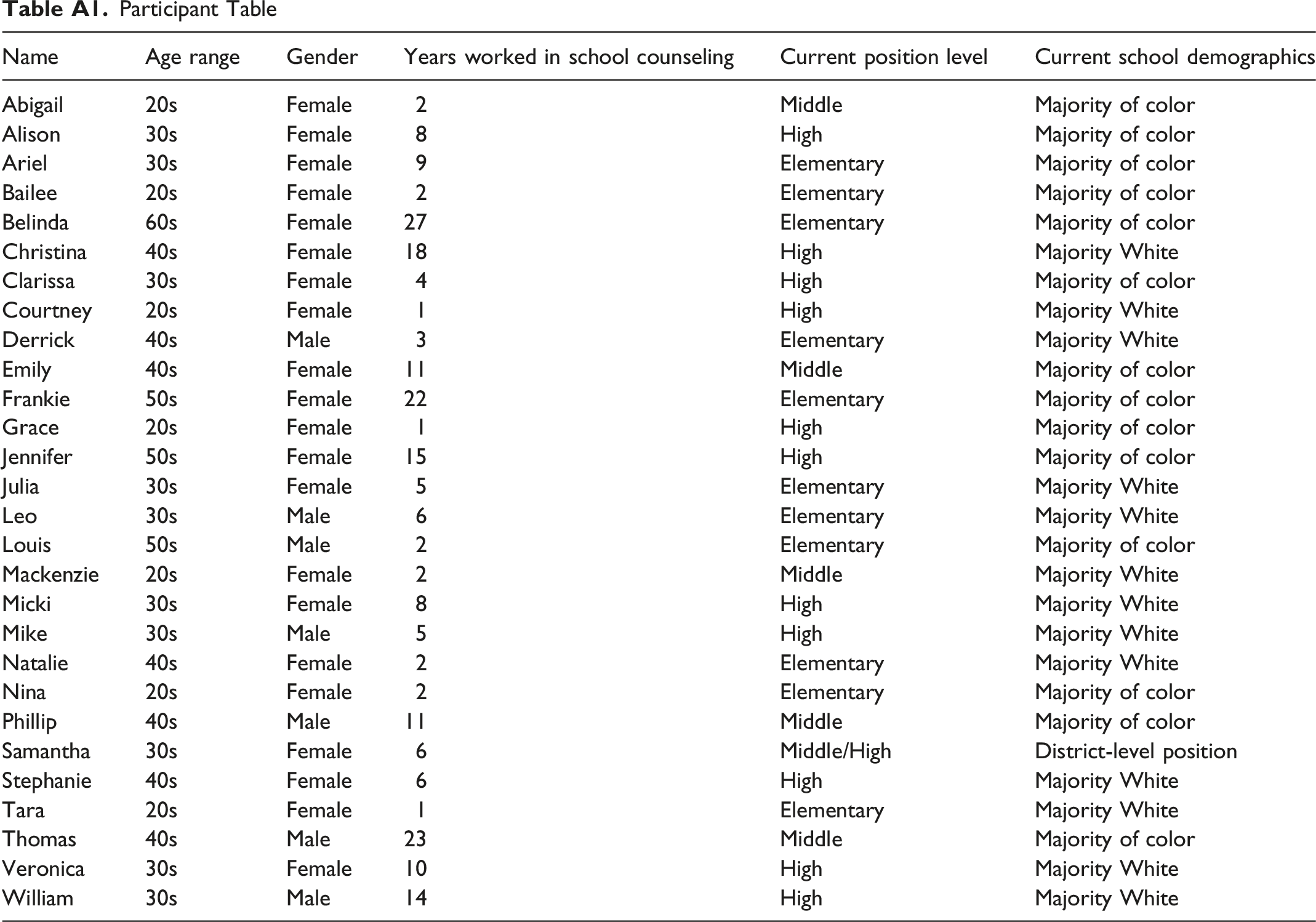
Name
Age range
Gender
Years worked in school counseling
Current position level
Current school demographics
Abigail
20s
Female
2
Middle
Majority of color
Alison
30s
Female
8
High
Majority of color
Ariel
30s
Female
9
Elementary
Majority of color
Bailee
20s
Female
2
Elementary
Majority of color
Belinda
60s
Female
27
Elementary
Majority of color
Christina
40s
Female
18
High
Majority White
Clarissa
30s
Female
4
High
Majority of color
Courtney
20s
Female
1
High
Majority White
Derrick
40s
Male
3
Elementary
Majority White
Emily
40s
Female
11
Middle
Majority of color
Frankie
50s
Female
22
Elementary
Majority of color
Grace
20s
Female
1
High
Majority of color
Jennifer
50s
Female
15
High
Majority of color
Julia
30s
Female
5
Elementary
Majority White
Leo
30s
Male
6
Elementary
Majority White
Louis
50s
Male
2
Elementary
Majority of color
Mackenzie
20s
Female
2
Middle
Majority White
Micki
30s
Female
8
High
Majority White
Mike
30s
Male
5
High
Majority White
Natalie
40s
Female
2
Elementary
Majority White
Nina
20s
Female
2
Elementary
Majority of color
Phillip
40s
Male
11
Middle
Majority of color
Samantha
30s
Female
6
Middle/High
District-level position
Stephanie
40s
Female
6
High
Majority White
Tara
20s
Female
1
Elementary
Majority White
Thomas
40s
Male
23
Middle
Majority of color
Veronica
30s
Female
10
High
Majority White
William
30s
Male
14
High
Majority White