







Abstract
Guided by the life course perspective and the stress severity perspective, this study aims to evaluate the question: Does the Three Gorges Project–induced relocation affect people of different ages differently? Using a quasi-experimental design, we collected pre- and post-relocation data from a sample (n = 1,056) that consists of both relocatees and nonmovers from the Three Gorges region in China. We found that relocatees of all age groups have experienced a similar level of elevation of depressive symptoms due to the relocation. No age group was exempted from the detrimental effects of the Three Gorges Project–induced relocation. Although it is usually much easier for young adults to relocate, as compared to older adults, a forced relocation is such an extraordinary stressor that its strong effects have overridden other forces that normally shape our life experiences at different life stages.
In 1994, China began the construction of the Three Gorges Dam, the world’s largest hydroelectric project located in the midsection of China’s Yangtze River. From 1992 to 2008, a total of 1.27 million people, both young and old, were relocated to make way for the dam and a new reservoir (China News Week 2009). While past studies on development-induced relocations in China and other countries have documented their negative impacts on the affected population in general (Cernea 1997), little attention has been paid to whether individuals of different ages are affected differently by the same process. As suggested by life course theory, the exposure to the same life event is expected to have a different impact for individuals at various stages of the life course because of their differential needs, experiences, and resources (Elder, Johnson, and Crosnoe 2003). For example, the relocation resulting from the building of the Three Gorges dam may be embraced by young involuntary migrants because it represents a new opportunity to move out of poor mountainous areas; simultaneously, it may be shunned by their older counterparts because of their entrenched life in their communities and physical decline in later life.
Previous studies of development-induced relocation seldom evaluated possible differential effects of relocation for people at different life stages. Using pre-relocation data, Hwang et al. (2007) reported that anticipating an impending involuntary relocation to be brought about by the Three Gorges Project (TGP) had a negative impact on the would-be relocatees’ mental health. Xi (2007) examined potential age variations in anticipatory distress and found that among the three groups being examined, only older designated migrants had a significantly higher level of anticipatory distress than nonmigrants (used as the control group). The middle-aged and younger migrants did not experience more anticipatory distress. However, because these studies were conducted using only pre-relocation data, they did not actually measure the effect of the relocation per se, but only the effect of its anticipation.
To our knowledge, no empirical study has evaluated age differentials in the effect of a project-induced forced relocation. Although a small number of studies focusing on refugees resulting from natural or manmade disasters have explored the issue, no conclusive age differences were found (Weintraub and Ruskin 1999). To explain the lack of age differentials, some scholars argue that stressors with high levels of severity override the effects of other risk factors (e.g., age) that normally differentiate the impacts (March 1990; Shore, Tatum, and Vollmer 1986; Weintraub and Ruskin 1999). Project-induced relocations are similar to disaster-induced relocations in that in both cases, external forces uproot individuals of all ages from their normal life (Cernea 1997). Both types of relocations are highly stressful as they forcefully interrupt the normal tasks assumed by people at different stages of the life course (Hwang et al. 2010; Porter and Haslam 2001, 2005). If the severity of the stressor argument holds, the TGP relocation, like disaster-induced relocations, would impact people of all ages similarly. Using pre- and post-relocation data collected from a sample consisting of both relocatees and non-relocatees from the Three Gorges region, this study aims to evaluate whether or not the TGP-induced relocation affects people of different ages differently.
Theory and Hypotheses
After 60 years of debates, investigations, and planning, the construction of the TGP was approved in 1992 by the national Congress of China and formally launched in 1994 on the Yangtze River—the third longest river in the world. Completed in 2009, the TGP created a reservoir about the size of Lake Superior in one of China’s highly populated areas. The number of people who have been relocated (1.27 million) to make way for the TGP was unprecedented (China News Week 2009). Among the relocatees, many had to move far away due to the shortage of arable land in the Three Gorges area (China News Week 2009). Although some long-distance relocatees moved with their co-villagers, a large majority of them were divided into smaller units and resettled in diverse receiving areas because of the shortage of farmland in the region and greater accommodation challenges when resettling large groups (Guo and Wang 2010; Hwang et al. 2007).
Project-Induced Forced Relocation as a Severe Stressor
Relocation has long been seen as a significant stressor that affects migrants’ psychological well-being because it entails tremendous social and economic costs but uncertain benefits (e.g., Ben-Sira 1997; Lev-Wiesel 1998; Magwaza 1994). Stress results from the anticipation and actual experience of changes and from post-migration readjustments. The link between migration stress and emotional distress has been established by voluntary migration studies (Noh and Avison 1996), involuntary migration (Hwang et al. 2007; Hwang, Cao, and Xi 2010), and refugee studies (e.g., Beiser 1999; Porter and Haslam 2001, 2005).
Unlike refugees, who are often driven out of their homeland unexpectedly by natural disasters or wars, project-induced relocations are imposed upon the relocatees by the state in a planned manner. In both cases, relocatees are victims of powerful external forces over which they have little or no control (Albrecht 1995), a condition that is particularly prone to distress (Pearlin 1989). There is, however, an important difference between planned state relocations and natural disasters. While natural disasters are likely to be perceived by relocatees as unavoidable or the will of a divine force, development projects are planned over years and entirely up to the volition of humans. Thus, project-induced relocatees may feel greater distress. In addition, a sense of injustice is likely to prevail among project-induced relocatees because they are making sacrifices for the benefits of others (Albrecht 1995).
Many disaster-induced refugees return home and resume their normal life once the situation that triggered the relocation is back to normal. This option is not available for project-induced relocatees. Relocatees in the Three Gorges have no homes to return to because they have been submerged in the reservoir. Due to the shortage of farmland in the resettlement areas, many relocated farmers have to take non-farm jobs for which they have neither training nor qualifications (Hwang et al. 2007). For those who have moved out of the Gorges, they had to learn to grow different crops in a different environment for which they had little knowledge or experience (Xi and Feng 2001).
Evidence suggests that project-induced relocations are often devastating (McDowell 1996). For example, it is reported that more than 7 million, or roughly 70 percent of China’s existing 10.2 million reservoir relocates, were living in extreme poverty (Leading Group of Economic Development of Poor Areas 1989). The situation in India is even worse (Chakrabarti and Dhar 2009). Based on the worldwide evidence, the World Bank has summarized eight outcomes that commonly accompany project-induced population relocation: landlessness, joblessness, homelessness, marginalization, increased morbidity and mortality, food insecurity, loss of access to common property resources, and social disintegration (Cernea 1997). Thus, project-induced relocation has been characterized as a traumatic event with significant mental health impacts (Cao, Hwang, and Xi 2012; Dwivedi 1999; Hwang et al. 2010; Scudder 2009; Scudder and Colson 1982).
Because communist ideology encourages personal sacrifice for the sake of the collective and traditional Chinese social norms highlight the obedience to authority, the unique Chinese political and cultural context might help the TGP relocatees avoid the mental distress typically associated with relocation. However, an empirical study on the TGP relocation has instead documented a startlingly high level of depressive symptoms among those relocated (Hwang et al. 2010), which is way above the levels observed among general Chinese populations in past studies (Cheung, Liu, and Yip 2007; Pan et al. 2009). Comparing levels of depressive symptoms for populations exposed to different stressors documented in the mental health literature, the TGP relocatees have a much higher level of depressive symptoms than Chinese populations exposed to other stressors, including caregiving, voluntary migration, and bereavement (Chou 2012; Lv et al. 2010; Wang et al. 2010; Zhang, Tong, and Zhou 2005). On the other hand, the reported level of depressive symptoms for the TGP relocatees is similar to, if not higher than, that for refugees who were displaced by wars and other social conflicts such as defectors from North Korean (Kim et al. 2011), Yugoslavian refugees in the Netherlands (Van den Heuvel 1998), and Iraqi refugees in the United States (Takeda 2008). In the following, we review our two competing perspectives: the life course perspective and the stress severity perspective.
Life Course Perspective
The TGP required the relocation of people of all ages whose homes were below the water level of the planned reservoir, exposing people at different life stages to this extraordinary event. As noted in the aging and life course literature, along the age axis of human life, different processes simultaneously shape our experiences at different life stages. For example, entering and quitting social roles, an accumulation of experiences and maturation, and psychological decline are life stage–related changes that affect individuals’ experiences at subsequent stages of the life course (Drentea 2005; Mirowsky and Ross 1992, 2001; Pearlin et al. 2005; Ross and Drentea 1998; Schieman, Van Gundy, and Taylor 2001; Yang 2007). Empirical evidence on the general age pattern in depressive symptoms or psychiatric disorder displays a mixed picture, with some evidence indicating increased symptoms as people getting older (e.g., Kessler et al. 1992; Mirowsky and Reynolds 2000), some suggesting the opposite (e.g., Feinson 1985), and still others depicting a “U”-shaped curve with middle age suffering the least depressive symptoms (e.g., Mirowsky and Ross 1992; Schieman et al. 2001). More recently, research has shown that the pattern is different for different age cohorts, based in large part on the educational achievement of different cohorts (Clarke et al. 2011).
One of the principles of life course theory is key here: the principle of timing. That is, the same events may be experienced differently by individuals, dependent upon one’s stage in the life course (Elder et al. 2003). For example, voluntary migrants are usually self-selected by age (Hirschman 2005; Plane and Jurjevich 2009; Rogers 1988). Given the societal norms, while younger people are expected to move in pursuit of better educational or job opportunities, those in middle age are more inclined to settle down to rear children. People in the oldest ages are least likely to move not only because their lives are deeply entrenched in their community and home, but also because of their declining physical health and increasing dependency on caregivers and social networks that provide emotional support and informal care (Angel et al. 1999; Plane and Jurjevich 2009). Thus, when all ages are forced to relocate, the involuntary relocation is likely to be experienced differently by relocatees of different ages who have different needs associated with their life stages.
It has been reported that many young Three Gorges residents seek jobs elsewhere, even without the impact of the TGP (Jim and Yang 2006). Pre-relocation studies have found that young Three Gorges residents tend to view the relocation as an opportunity for them to move out of the poor mountainous areas (Li 1996; Xi 2007). On the contrary, for older people, the population relocation resulting from the TGP not only uprooted them from their homes, but also sometimes tore apart their clan-based social networks. Thus, it is not surprising that a previous study (Xi 2007) reported that older relocatees showed a considerably higher level of anticipatory distress than relocatees of other ages.
Life course stages affect not only the tendency, capability, and motivation to relocate, but also the distribution of social and personal resources that usually protect individuals from negative effects of stressful life events (Pearlin 1989). As people age and exit from social roles that they previously occupied, they generally experience decreases in social connection and declines in sense of mastery, resources that are important to protect them from harsh life situations (Mirowsky and Ross 1990, 1992; Schieman et al. 2001). Therefore, life course and stress process theories lead us to expect more adverse relocation effects on people of older ages.
Stress Severity Perspective
Epidemiological and clinical research usually focuses on the effect of exposure to a specific traumatic event such as a war or a natural disaster. Because disaster-induced refugees bear a lot of similarity to project-induced relocatees, this literature should be informative for us to understand the impact of the TGP relocation on individuals across age groups (Cernea 1997).
Although there are conflicting findings, many studies on both natural and manmade disasters have found no age differences in the prevalence of posttraumatic stress disorder (PTSD) symptoms or psychiatric symptoms (Weintraub and Ruskin 1999). All age groups, young and old, are found to be negatively affected by hurricanes (Hudson and Picou 2010; Kohn et al. 2005), tornados (Bell 1978), floods (Phifer 1990), earthquakes (Goenjian at al. 1994), tsunamis (Miller 2005), dam collapses (Green et al. 1990), volcanic eruptions (Shore et al. 1986), nuclear accidents (Bromet and Schulberg 1986), and technological disasters such as train collisions and aircraft crashes (Chung et al. 2004, 2005).
To explain the lack of age differences, researchers have proposed an explanation that emphasizes the severity of a stressor or the intensity of exposure. When a stressor is severe, its effects would override other risk factors and make them less important (Chung et al. 2005; March 1990). For example, a tsunami can change the life of every affected individual, physically and psychologically, no matter their life circumstances. No age group is exempted from its impact (Miller 2005). People who lost their homes from floods, volcanic eruptions, a war, or any other disaster are facing a demanding task: dealing with the losses and rebuilding their lives. The process is usually so traumatic that they would interrupt the normal tasks assumed by people at different stages of life (Miller 2005).
When there are differences in levels of exposure to a trauma (e.g., distance from the crash site of an aircraft, level of damage from a hurricane), researchers have found a strong relationship between the intensity of exposure and psychiatric symptoms (Galea and Resnick 2005; Sprang 1999). Combined with the null age differential in the responses to traumatic events (Chung et al. 2005), these findings lead researchers to conclude that the intensity of exposure overrides life course stages as a mechanism that differentiates individuals’ response to traumatic events (Chung et al. 2005; Weintraub and Ruskin 1999). Some researchers have further evaluated age differentials within exposure strata. For example, a study on the mental health effect of a tsunami found age differentials for respondents who lived in areas moderately damaged or undamaged by the tsunami but no age differentials among those who lived in heavily damaged areas (Frankenberg et al. 2008). In other words, when the exposure is intensive, the effect of a trauma is uniformly damaging to all age groups.
The stress severity perspective suggests that intensive exposure to an extraordinary negative event would outweigh other forces that normally shape our life experiences and affect people at all ages similarly. Like a disaster-induced displacement, a project-induced relocation is often considered a severe stressor because such an experience often consists of grieving for a lost home, anxiety about an uncertain future, trauma and hardship experienced in the relocation process, disorientation generated by the loss of control over fundamental features of their lives, and dramatic changes in life circumstances that follow the relocation (Cao et al. 2012; Dwivedi 1999; Scudder and Colson 1982). It is documented in the literature that project-induced relocatees suffered a similar level of depressive symptoms as refugees dispelled by wars (Hwang et al. 2010; Kim et al. 2011; Takeda 2008). A project-induced forced relocation requires the uprooting and transplanting of lives of all those who have to move to make way for the project. In other words, all resettlers are experiencing a high intensity of exposure. If the stress severity perspective holds, we would expect no age differentials in the psychological impact of the TGP relocation.
Methods
Relying on retrospective data, results from previous studies on disaster-induced refugees are doubtful due to the possibility of faulty memories and post factum rationalizations (Campbell and Stanley 1966). In this study, we evaluate the differential effects of exposure to a project-induced relocation using a quasi-experimental design. The TGP relocation as a scheduled event permits us to conduct pre- and post-relocation surveys, rather than having to rely exclusively on retrospective measures to assess relocation consequences (Hwang et al. 2010). In addition, the construction of the Three Gorges dam and the reservoir requires the relocation of all residents whose houses are below the water line of the planned reservoir. As such, this relocation was on a nonselective basis. This unique setting also allows us to select a strategic control group, those who lived in the same communities but their houses located above the water line of the planned reservoir. Therefore, we are able to measure relocation effects free of confounding selectivity and control for any age differentials that might have been caused by other historical factors.
Data and Measurement
Our pre-relocation survey sample consists of 975 designated relocatees and 555 nonmovers recruited from five communities (clusters) randomly selected from the Wanxian Relocation and Development Region (WRDR)—which was formerly a part of the Sichuan Province where 80 percent of designated migrants resided (Weng 1999). Face-to-face interviews were conducted in late 2002 and early 2003 by 29 sociology graduate students from two Chinese universities. The survey has a response rate of 99 percent, a high rate, which is typical of face-to-face interviews in China (Feng 2007).
Our sample is made up of 51 percent urban and 49 percent rural residents. Fifty-five percent of our respondents are female. The sample has an average age of 45 and an average educational attainment of 7.48 years. The apparent “overrepresentation” of women, elderly, and less educated respondents likely reflects the high out-migration rate of the region even before the TGP (Roberts 1997). A comparison of the demographic profile of our sampled households with the 2000 census results for the WRDR (Chongqing Statistical Yearbook 2003) indicates that our sample closely mirrors the population in terms of age, sex, educational composition, and average family size.
Although the decision to relocate or not did not involve self-selection, elevation of residence, which ultimately determined relocation status, might be associated with social economic conditions. We evaluated the potential bias by comparing movers whose houses were below the water line of the planned reservoir and nonmovers whose residence was above the waterline in terms of social, demographic, and economic characteristics. We found few significant differences between the two groups in these characteristics. Compared to nonmovers, relocatees had a similar distribution in age, gender, education, family structure, and annual income. In terms of economic measures, nonmovers were more likely than their counterparts to own a house and possess more household appliances such as a washing machine or a refrigerator. We see these differences as a better reflection of migration status than economic status. It is simply irrational for prospective migrants anticipating an imminent move to invest in a house and expensive appliances.
A follow-up survey was conducted in early 2006. The researchers successfully traced and interviewed 1,056 participants, with a success rate of about 70 percent. Fourteen respondents who had moved before the first survey but returned to their residence temporarily were captured in our pre-migration survey. They were excluded from the analyses. Among those who were successfully traced, 350 respondents are nonmovers, 420 are designated relocatees who have moved, and 286 are designated relocatees but have not moved. The relocation of people in the inundated areas took place in stages corresponding to the three-stage schedule of the reservoir impoundment. The water level was first raised from 96 to 135 meters in 2003. The second and third stages of the inundation raised the water level further to 156 and 173 meters in 2006 and 2009, respectively. The designated relocatees who had not yet moved at the time of the second survey consisted of those who lived in places of higher elevation. To evaluate possible biases that might result from the attrition, we replicated our analysis by adjusting for an attrition factor (Berk 1983; Hwang et al. 2010). 1 The effect of attrition was never significant in any of the statistical models used in the analysis, and thus was not reported.
Outcome measure
Our relocation outcome of interest is depressive symptoms, which were measured at both pre- and post-relocation survey by the 20-item Center for Epidemiologic Studies Depression Scale (CES-D; Radloff 1977). Although not free of limitations, the CES-D scale has known psychometric attributes and well-established reliability and validity (Vega and Rumbaut 1991). It has also been proven to be appropriate for studying Chinese populations (Lai 1995; Lin 1989; Lv et al. 2010; Yu 2008; Zhang et al. 2005). The scale asks respondents if they have experienced any depressive symptoms from a list of 20 during the past week. Responses for each item were coded as 0 = none of the days, 1 = 1 to 2 days, 2 = 3 to 4 days, and 3 = 5 days or more. We reverse coded the few positive items. The scale was constructed by summing the scores for all 20 items with a theoretical range of 0 to 60. The same scale was used in both the pre-relocation (α = .87) and the post-relocation survey (α = .89). Changes in depressive symptoms were measured for each respondent by subtracting the pre-relocation CES-D score from the post-relocation score. In this way, each individual served as his or her own control, an effective way to rule out pre-relocation variation across respondents and capture the amount of depressive symptoms elevated during the study period (Allison 1990).
Relocation status
Relocation status is captured by two dummy variables: Moved relocatee is coded 1 for relocatees who have completed the relocation and 0 otherwise; designated relocatee is coded 1 for relocatees who have not yet moved at the post-relocation survey and 0 otherwise.
Age groups
To test differential relocation effects across different life stages, the sample was broken down into three age groups according to their age in the pre-relocation survey: young adults (18 to 30 years old at time 1), middle-aged adults (31 to 50 years old at time 1), and older adults (51 or above at time 1). The rationale for the choice of breaking points is as follows: First, in Chinese culture, 30 and 50 are considered important turning points in the life course. Second, according to the Chinese Population Information Center, in 1997 the average age of marriage is 23.6 years, and the average age for the birth of the first child was 24.48 years. Thus, by age 30, most adults have children who begin to reach school age, and as a result, the family needs change greatly (Abu-Lughod and Foley 1960). Finally, in China, 50 is the beginning of the official retirement age (Department of Labor and Social Security of China 1999). At the time of our first survey, the average retirement age was 51.2 years old (China Daily 2006). These breaking points are broadly accepted by other researchers who study Chinese society (Li 1996).
Life course variables
We use marital status and employment status to capture life course effects. Both variables are time-varying. Marital status is coded 1 for married at interview time, 0 for the others. Changes in marital status are coded into two dummy variables to represent three situations: (1) married at time 1, but in other marital statuses at time 2; (2) in a status other than married at time 1, but married at time 2; and (3) no change in marital status from time 1 to time 2, which is used as the reference group. Employment status is coded 1 for unemployed at interview time, 0 for employed. Changes in employment status are coded into two dummies in the same way changes in marital status are handled.
Resources and coping variables
The experiencing of undesirable life events other than the TGP relocation represents other sources of stress (Pearlin 1989). We use a 15-item inventory to record the experiencing of any negative life events during a 12-month period prior to the interview. The measure is adapted from a widely used instrument developed by Holmes and Rahe (1967). The 15 items include the following: death of a spouse, death of other family members, divorce, marital separation, personal injury or illness, death of a close friend, health problems of family members, dismissal from work, domestic conflicts, troubles with in-laws, foreclosure of mortgage or loan, incarceration, trouble with a boss, being in debt for the big expenditures on household appliance or cars, and minor violations of the law. 2 The sum of the 15 items yields a count measure.
We measure two types of protective resources: psychological resources and social resources. Psychological resources are indicated by a mastery scale (Pearlin and Schooler 1978), which measures “the extent to which one regards one’s life changes as being under one’s control in contrast to being fatalistically ruled” (Pearlin and Schooler 1978:5). The first- and second-wave Cronbach’s alphas for the mastery scale are 0.74 and 0.78, respectively. Social resources are indicated by social support. It is measured by Lin, Ye, and Ensel’s (1999) perceived routine support scale, which quantifies the extent to which the respondent perceives that he or she is able to obtain useful instrumental, informational, and emotional support from his or her social network in addressing problems commonly encountered in daily life. The scale is reliable with a Cronbach’s α of 0.83 for the first wave and 0.89 for the second wave.
We also include positive comparison to capture the effects of coping (Pearlin 1989). Positive comparison, or the subjective evaluation by the respondent that he or she is better off relative to others in a similar situation, is a coping strategy that people use to manage their emotions (Pearlin and Schooler 1978). In the case of the relocation, in which the orders of the powerful government are out of an individual’s control, individuals might resort to emotion-focused coping strategies, such as making positive comparisons, in order to reduce stress. We used a four-item scale to measure positive comparison: “Compared to those who you know, would you say that you are (a) much worse, (b) somewhat worse, (c) about the same, (d) somewhat better, or (e) much better in terms of (1) income, (2) occupation, (3) social prestige, and (4) social connections (guanxi)?” Responses to the four questions are summed to form a scale with scores ranging from 4 to 20. The scale has a Cronbach’s alpha of 0.79 and 0.81 for the first and second waves, respectively.
Because stressor and coping variables are time-varying, we assess their effects in our regression analysis using change scores calculated by subtracting the scores measured in time 1 from the scores taken in time 2. Thus, a negative change score indicates a decrease in the score during the period and a positive change score indicates an increase. Although mastery could be considered relatively stable in normal settings, we consider it time-varying because the government-imposed relocation is likely to make the relocatees feel powerless.
Lastly, we controlled for changes in household income from time 1 to time 2 and also a dummy variable indicating whether the respondent has moved out of the Three Gorges area, a proxy for migration distance.
Analytical Strategy: The Difference Model
The panel data was analyzed using the “difference model” (Allison 1990, 1994; Halaby 2004), a form of the fixed effects model.

We first regress the change score in CES-D on relocation status to capture the effect of relocation (δ), or the increase in the CES-D score from time 1 to time 2 for relocatees using nonmovers as the reference group. We then examine age differentials in the relocation effect by adding into the model the interactions between age group dummy variables and relocation status (β). In the last step, we control for the effects of change scores for a set of time-varying factors (X) including the life cycle variables, resources, coping, and other control variables. 3
The difference model has several advantages over other alternatives for panel analysis (Allison 1990, 1994; Firebaugh and Beck 1994; Halaby 2004). The most important one is that time-invariant exogenous variables, many of which are unobserved, can be automatically controlled for (Allison 1994). For example, surviving to an older age is usually associated with certain personality traits that are relatively stable and thus can be differenced out (Xi2 − Xi1 = 0). The ability to minimize selective survival makes the difference model superior relative to other methods when the effect of aging is of interest. The model is often “the first choice of methods for estimating the causal effects of so-called natural experiments” (Halaby 2004:515).
However, because the difference model automatically controlled for all time-invariant variables, it is unable to estimate their effects. Although age is not time-invariant, all respondents in our sample experienced the same amount of increase in age from the pre-relocation survey to post-relocation survey. Therefore, the main effects of age are differenced out of the model.
Results
Table 1 reports the mean CES-D score by age group, wave of survey, and relocation status. The information presented serves to answer two questions: (1) whether there is any significant difference in depressive symptoms between relocatees and nonmovers before and after the relocation and (2) whether any of the observed differences are age specific. While we found no significant difference between relocatees and nonmovers for any age groups prior to the relocation, the differences became statistically significant for the two older age groups following the relocation. The post-relocation results indicate that the average CES-D score for the relocatees were significantly higher compared to those for nonmovers and designated relocatees who have not yet moved, with the differences being particularly noted for the two older age groups.
Sample Mean Depressive Symptoms (Center for Epidemiologic Studies Depression Scale) by Age Group, Survey Time, and Relocation Status
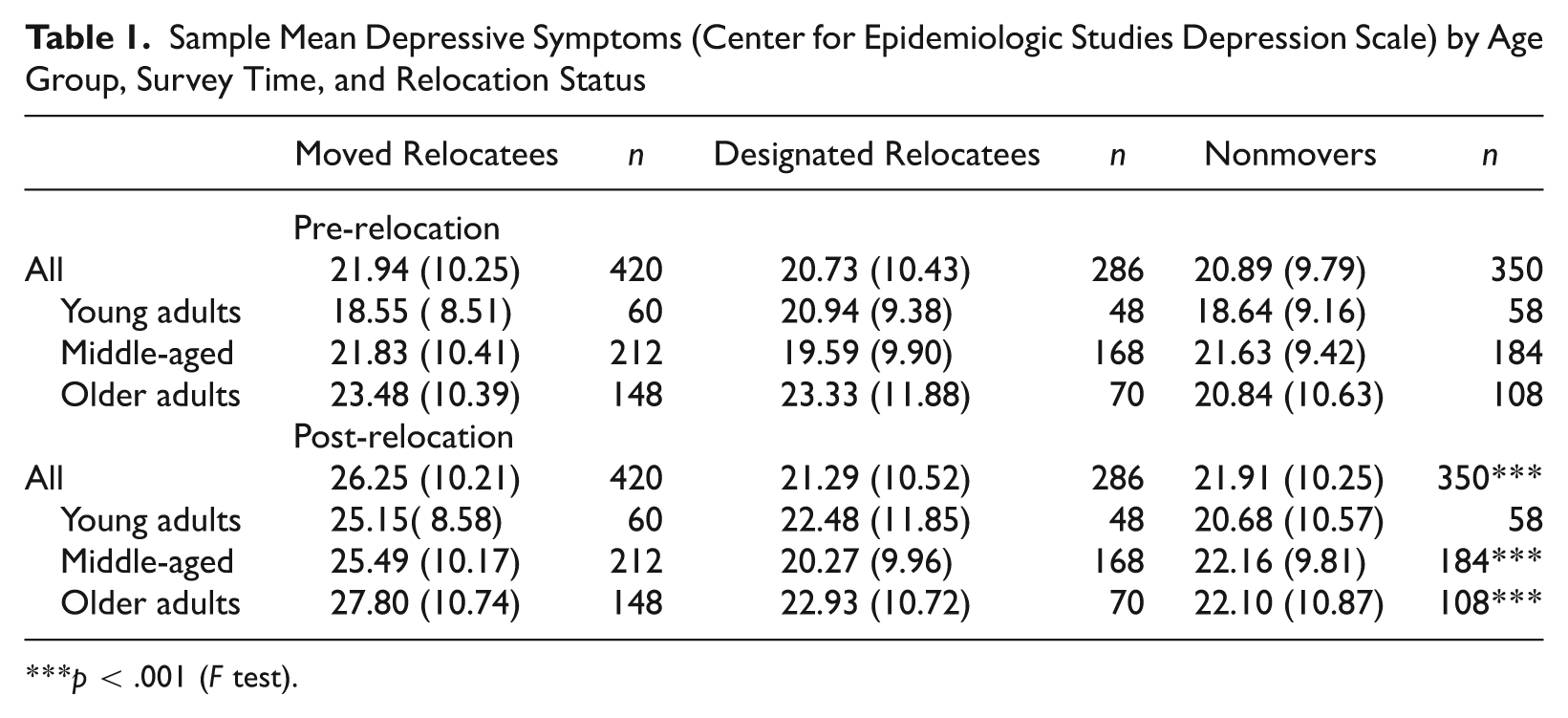
p < .001 (F test).
To formally test the age differences in relocation effects, we estimated our difference model and reported the results in Table 2 (descriptive statistics for difference score measures used in the difference model were reported in the appendix). In the first model, we included only relocation status to capture the relocation effect. Because an extremely high level of pre-relocation depression would leave less room for the further elevation of depressive symptoms, the ceiling effects that are common in longitudinal research can bias our estimates for relocation effects. This was especially the case for the older relocatees, who tended to report a high level of depressive symptoms in the pre-relocation survey. We controlled for ceiling effects by including the mean-centered initial CES-D score in our model (Firebaugh and Beck 1994).
Regression Analysis of Depressive Symptoms (Center for Epidemiologic Studies Depression Scale) Using Difference Model, Time 2 − Time 1 (n = 1,056)
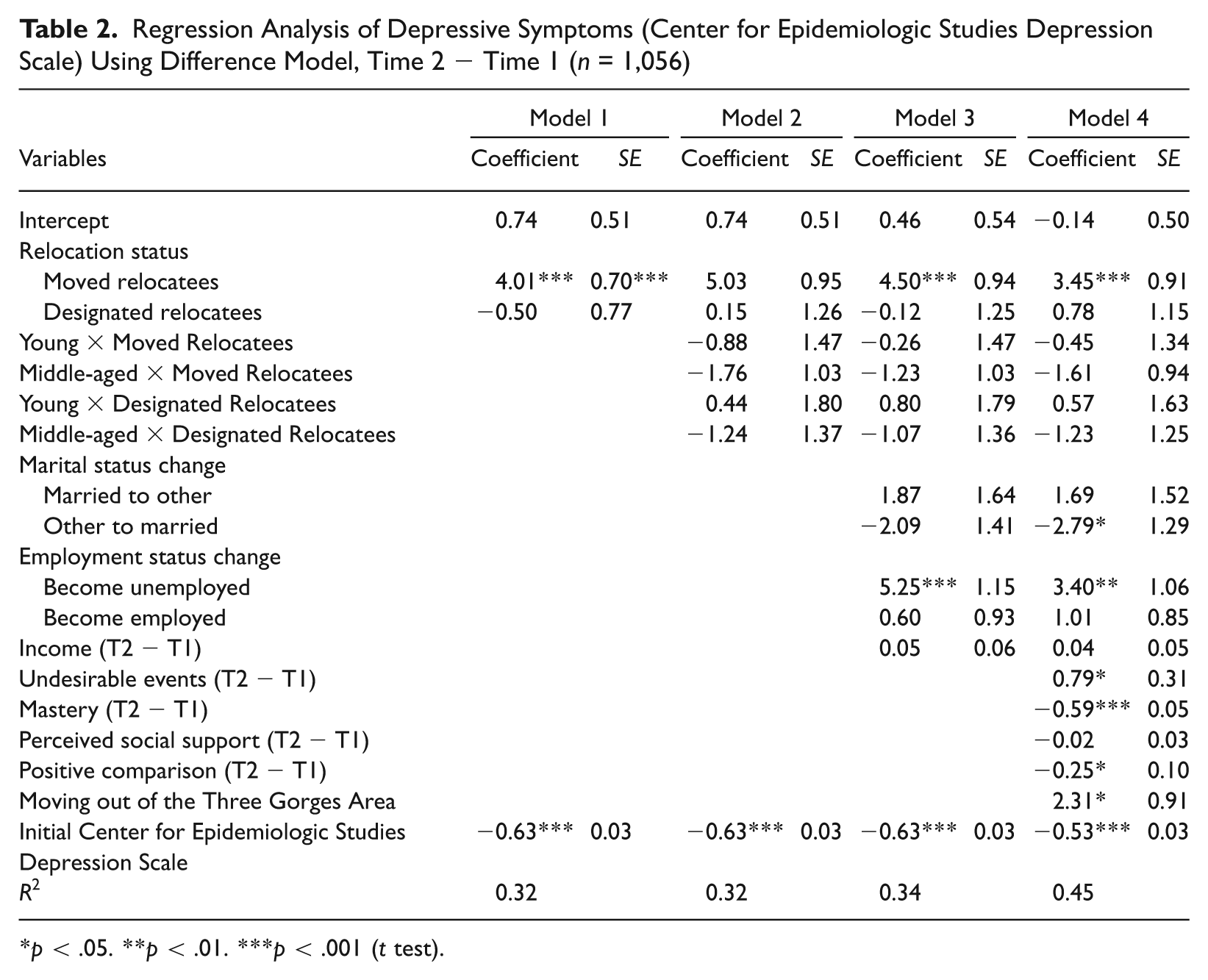
p < .05. **p < .01. ***p < .001 (t test).
As discussed in the Methods section, the coefficient for moved relocatees captured their elevation in depressive symptoms from time 1 to time 2, as compared to those who did not move. It seemed that moved relocatees on average reported 4 more units of elevation in depressive symptoms during the study period than nonmovers. The coefficient was statistically significant with the model implicitly controlling for all time-invariant variables. The initial CES-D score was negative and significant, indicating the existence of ceiling effects (Firebaugh and Beck 1994).
In Model 2, we added the interactions between age groups and relocation status into the model to detect age differences in the relocation effect. The coefficient for moved relocatees now captured the elevation in depressive symptoms from time 1 to time 2 for older relocatees, as compared to older adults who did not move 4 (the reference age group). The coefficient was statistically significant. Compared to the corresponding nonmovers of the same age, the older moved relocatees experienced an estimated 5.03 units greater increase in the depressive symptoms. For young moved relocatees, relocation elevated depressive symptoms by 4.15 (5.03 − 0.88 = 4.15) units, which was a smaller increase than for the older relocatees. However, the difference between the two groups was not statistically significant. The difference between the middle-aged and older adults was also not significant.
Controlling for the life course variables in Model 3 slightly attenuated the relocation effect. Still, we did not find any statistically significant age differentials in the relocation effect. As expected, those who became unemployed suffered a much greater elevation in depressive symptoms compared to those whose employment status remained unchanged. Controlling for adverse life events, resources, and coping in Model 4 further reduced the relocation effect. The age differentials predicted by life course theories, however, were not found. It was also evident that those who experienced a greater increase in the number of adverse life events reported a greater increase in depressive symptoms during the study period. Those who reported a greater decrease in mastery or in the use of positive comparison during the period reported more elevation in depressive symptoms. Those who have moved out of the Three Gorges area also experienced a greater increase in depressive symptoms.
About 37 percent of moved relocatees (15 percent of the total sample) moved out of the Three Gorges area. The distance of relocation might suggest a different level of intensity of exposure. In additional analysis, we further differentiated moved relocatees into two categories: moved to a higher ground within the Three Gorges area and moved out of the Three Gorges area. Those who moved out of the Three Gorges area experienced the greatest amount of elevation in depressive symptoms. Again, no age differences were found.
Conclusion and Discussion
The literature on mental distress generally agrees that the effect of a stressor largely depends on the characteristics, previous experiences, resources, and agency that individuals bring into the situation. Because factors that differentiate the stress process are not equally distributed across life stages, to understand the effect of a forced relocation, theories from the life course perspective predict different effects for people at different life stages. Results from our analysis were unable to support these predictions. In the absence of age differences, the stress severity hypothesis suggests a better explanation that says a severe stressor would override forces that normally shape our mental health experiences across the life course. Using panel data collected from a sample of TGP relocatees and nonmovers, we found similarly strong relocation effects for all age groups. Our findings suggest that a forced relocation induced by a development project was such an extraordinary stressor that it was detrimental for people at all life stages. In other words, regardless of the different needs and resources people at different life stages have, the forced relocation had the similarly high level of adverse impact on their mental health. No age group was exempted from the depressive effect of the actual relocation. Although a pre-relocation study (Xi 2007) has found that the young were hoping to have a better post-relocation life, the short-term relocation impact detected in this study was not promising. The oldest relocatees reported more depressive symptoms prior to the relocation, and their situations became even worse after the move.
It is worth noting that in the depression literature, a CES-D score of 16 has been suggested as a threshold for depressive symptoms that are clinically significant (Radloff 1977). As indicated in Table 1, all age groups at both surveys had a mean CES-D score higher than 16. These findings were startling because it was not only the relocatees but also the nonmovers that showed high depression levels. The high depression levels do possibly support the severity of stressor hypothesis. The TGP project appears to be highly distressing to everyone. The high depression level observed in our sample was understandable because the TGP project was economically and socially disruptive not only for the migrants, but also for nonmigrants who lived in the affected region. For example, communities adjacent to the flooded areas were disturbed by the auxiliary activities taking place in or near their communities; they were also disturbed by tensions arising from the government’s imposition that their limited resources be shared with the newly relocated migrants. Thus, even for those residents who were exempted from the forced relocation, the relocation still had ripple effects. In other words, the impact of forced relocation was felt not only by migrants but also by nonmigrants as a result of contamination effects (Hwang et al. 2007, 2010). It is possible that the relocation effects estimated in this study have been attenuated by the contamination effects. Although nonmovers in the same communities as movers served as a natural control group for this study, given the contamination effects, future studies should also consider comparison groups selected from communities outside of the exposure area.
Because the project started in 1994, residents in the area were impacted by the project before we were able to conduct the pre-relocation survey to gather the baseline information. This helped explain the high level of depressive symptoms for both relocatees and nonmovers observed in our pre-relocation survey. Thus, our failure to detect any age differences in the relocation effect could be seen as the working of the ceiling effect associated with a high level of baseline depression for everyone. Our study would have been able to better evaluate the age differentials in relocation effects or capture the anticipatory distress if we were able to conduct the baseline survey earlier.
Several features of our research design have also limited the applicability of our findings. First, despite its advantages, the difference model precludes the possibility of estimating the effects of time-invariant variables such as gender and education. 5 Also precluded are some variables of unique significance in the Chinese context, such as communist party membership and rural/urban residence, that may have important bearings to our outcome variable. For example, communist party membership has been documented in the literature as an important political resource in China (Bian and Logan 1996). We also expected the rural/urban divide, probably the most important social distinction in modern China (Potter and Potter 1990), to make a significant difference in the relocation effects. But both of these variables have been cancelled out of our difference models because there were few changes in them during the study period. In supplemental analysis, we estimated effects of gender, education, communist party membership, rural/urban residence, and their interaction effects with relocation status using only post-relocation data but were unable to detect any significant gender differences or rural/urban status differences. Being a member of the communist party benefits nonmovers but not relocatees. We did find that higher educational attainment was protective for both relocatees and nonmovers.
Second, with a three-year study period, we were able to evaluate only the short-term impact of relocation. It was possible that different age groups adapted to the new community differently, and thus the long-term impacts of relocation might be different. In our analysis, we didn’t consider the timing of the relocation. The primary reason for the omission was that time since relocation was a measure relevant only for relocatees. In supplemental analysis, we evaluated the effect of time since relocation for relocatees only. We found that the depressive symptoms of relocatees reduced as they stayed in the new community longer.
Third, we were unable to separate the age effect from the cohort effect. The three age groups coincide roughly with three unique birth cohorts of historical significance in China (Ouyang 2006). The young adults group (born after 1973) includes those who were born or were brought up during the post-Mao period, a period characterized by profound social transformation both economically and ideologically in China. These young adults have been called “the Disconnected Generation” because they are least connected to the traditional Chinese values and the communist ideology compared to previous generations (Ouyang 2006). The middle-aged (born between 1953 and 1972) are those who grew up during the Cultural Revolution—a historical period when the zeal of collectivism overwhelmed personal interests. They have participated in or witnessed China’s nationwide movement of rustification in 1960s and 1970s, when 20 million urban high school graduates were sent to remote areas of China and villages for reeducation (Zhou and Hou 1999). These two cohorts are expected to be different from each other and from the older cohort (born before 1953), who were born around or before the establishment of the communist government. Although the division of age groups happens to coincide with the division of cohorts, our data do not provide advantages to separate the age effect from the cohort effect because of the short time interval between the two surveys and the lack of measurements for cohort-specific experiences. Because cohort effects are rooted at the unique cultural and historical background of respondents, our findings might not be generalizable to another population with a different cultural and social-historical background.
Furthermore, our sample only contained adults; the relocation impact might be different for children, as suggested by the trauma literature (Porter and Haslam 2005). Further studies need to include children in the comparison to provide a complete picture of the impact of a forced relocation on people at all segments of the life span. Lastly, we rely on CES-D as the only available measure of mental health. Future studies should consider alternative measures of mental health, such as instruments for anxiety and posttraumatic stress disorder, to compare with findings of the current study.
This research on age differentials in the effect of a forced relocation, however, was superior to previous studies because it employed a research design and a statistical model that controlled for many sources of spuriousness by which previous studies were plagued. First, the quasi-experimental design we have used made it possible to control for extraneous factors that were unrelated to relocation but would affect different age groups. The pre-relocation data helped us to control for preexisting age differentials and singled out the relocation effects. The difference model further controlled for all time-constant covariates, including pre-experience and maturation, as well as personality traits associated with selective survival, therefore greatly reducing the model specification error.
With this careful research design and statistical study, we found that everyone in the relocation area experienced high levels of depressive symptoms, lending support that the severity of the situation wreaked havoc on all involved. Further lending support, we found that the more undesirable events in one’s life, the greater the depressive symptomatology. Sociologists, psychologists, public health officials, and even governments should consider the great impact of a forced migration. Unlike a natural disaster, this relocation gave warning and yet was still associated with high levels of distress. Since unemployment explained some of the depressive symptoms, we should consider garnering job programs during a forced relocation. In addition, since sense of mastery explained some of the depressive effects, we suggest attention be paid to the psychological effects that can be addressed in counseling or more broadly in a public mental health program suitable to the country of origin (Tan and Pen 2009). Of final note, as our ability to change the physical landscape increases with technology, government-mandated forced migrations are on the increase as a by-product of technology and change in the developing world (Scudder 2009). For instance, the “South-to-North Water Diversion” in China expects to relocate at least 425,000 people (Jia 2009) by creating a long-distance canal. In these types of projects, it is warranted to allocate resources to help individuals adjust to their new homes, given the mental health impact on those who move.
Footnotes
Appendix
Descriptive Statistics for Key Variables Measured by Change Scores (Time 2 Measure Minus Time 1 Measure)
| Mean or Proportion |
SD
|
Mean or Proportion |
SD
|
Mean or Proportion |
SD
|
|
|---|---|---|---|---|---|---|
| Young Adults | Moved Relocatees (n = 60) | Designated Relocatees (n = 48) | Nonmovers (n = 58) | |||
| Depressive symptoms (T2 − T1) | 6.60 | 10.58 | 1.54 | 10.86 | 1.50 | 11.18 |
| Marital status change | ||||||
| Married to other | 0.03 | 0.02 | 0.00 | |||
| Other to married | 0.15 | 0.10 | 0.17 | |||
| Employment status change | ||||||
| Become unemployed | 0.08 | 0.06 | 0.00 | |||
| Become employed | 0.08 | 0.17 | 0.10 | |||
| Household income (T2 − T1, in ¥1,000) | 3.14 | 12.48 | 3.17 | 15.07 | 5.88 | 17.87 |
| Undesirable events (T2 − T1) | 0.53 | 1.20 | −0.38 | 0.70 | −0.07 | 0.84 |
| Mastery (T2 − T1) | −1.08 | 6.03 | −0.98 | 5.25 | −2.67 | 4.48 |
| Perceived social support(T2 − T1) | −1.60 | 8.33 | 1.79 | 8.33 | −0.10 | 9.58 |
| Positive comparison (T2 − T1) | −0.33 | 2.65 | 0.67 | 2.44 | 0.38 | 2.84 |
| Middle-aged Adults | Moved Relocatees (n = 212) | Designated Relocatees (n = 168) | Nonmovers (n = 184) | |||
| Depressive symptoms (T2 − T1) | 3.65 | 12.30 | 0.76 | 10.45 | 0.53 | 11.55 |
| Marital status change | ||||||
| Married to other | 0.04 | 0.01 | 0.02 | |||
| Other to married | 0.04 | 0.01 | 0.02 | |||
| Employment status change | ||||||
| Become unemployed | 0.04 | 0.07 | 0.04 | |||
| Become employed | 0.10 | 0.13 | 0.17 | |||
| Mean or Proportion |
SD
|
Mean or Proportion |
SD
|
Mean or Proportion |
SD
|
|
| Middle-aged Adults | Moved Relocatees (n = 212) |
Designated Relocatees (n = 168) |
Nonmovers (n = 184) |
|||
| Household income (T2 − T1, in ¥1,000) | −0.41 | 32.76 | 4.71 | 10.00 | 2.77 | 10.28 |
| Undesirable events (T2 − T1) | 0.19 | 1.00 | −0.14 | 0.76 | 0.05 | 0.75 |
| Mastery (T2 − T1) | −1.43 | 6.09 | −0.60 | 5.85 | −1.21 | 5.79 |
| Perceived social support (T2 − T1) | −0.48 | 9.33 | 2.12 | 8.49 | 1.75 | 8.79 |
| Positive comparison (T2 − T1) | −0.45 | 3.18 | −0.06 | 2.73 | 0.13 | 2.57 |
| Older Adults | Moved Relocatees (n = 148) | Designated Relocatees (n = 70) | Nonmovers (n = 108) | |||
| Depressive Symptoms (T2 − T1) | 4.48 | 11.52 | −0.40 | 13.16 | 1.26 | 10.91 |
| Marital status change | ||||||
| Married to other | 0.05 | 0.01 | 0.08 | |||
| Other to married | 0.04 | 0.03 | 0.05 | |||
| Employment status change | ||||||
| Become unemployed | 0.14 | 0.10 | 0.11 | |||
| Become employed | 0.09 | 0.07 | 0.07 | |||
| Household income (T2 − T1, in ¥1,000) | −0.15 | 14.41 | −2.25 | 18.03 | 2.04 | 9.82 |
| Undesirable events (T2 − T1) | 0.02 | 0.78 | −0.36 | 0.98 | −0.05 | 0.96 |
| Mastery (T2 − T1) | −1.56 | 6.18 | −0.06 | 5.28 | −1.14 | 5.99 |
| Perceived social support (T2 − T1) | 0.02 | 11.72 | 0.63 | 8.07 | 0.04 | 8.71 |
| Positive comparison (T2 − T1) | −0.23 | 3.31 | 0.26 | 2.87 | −0.22 | 2.67 |
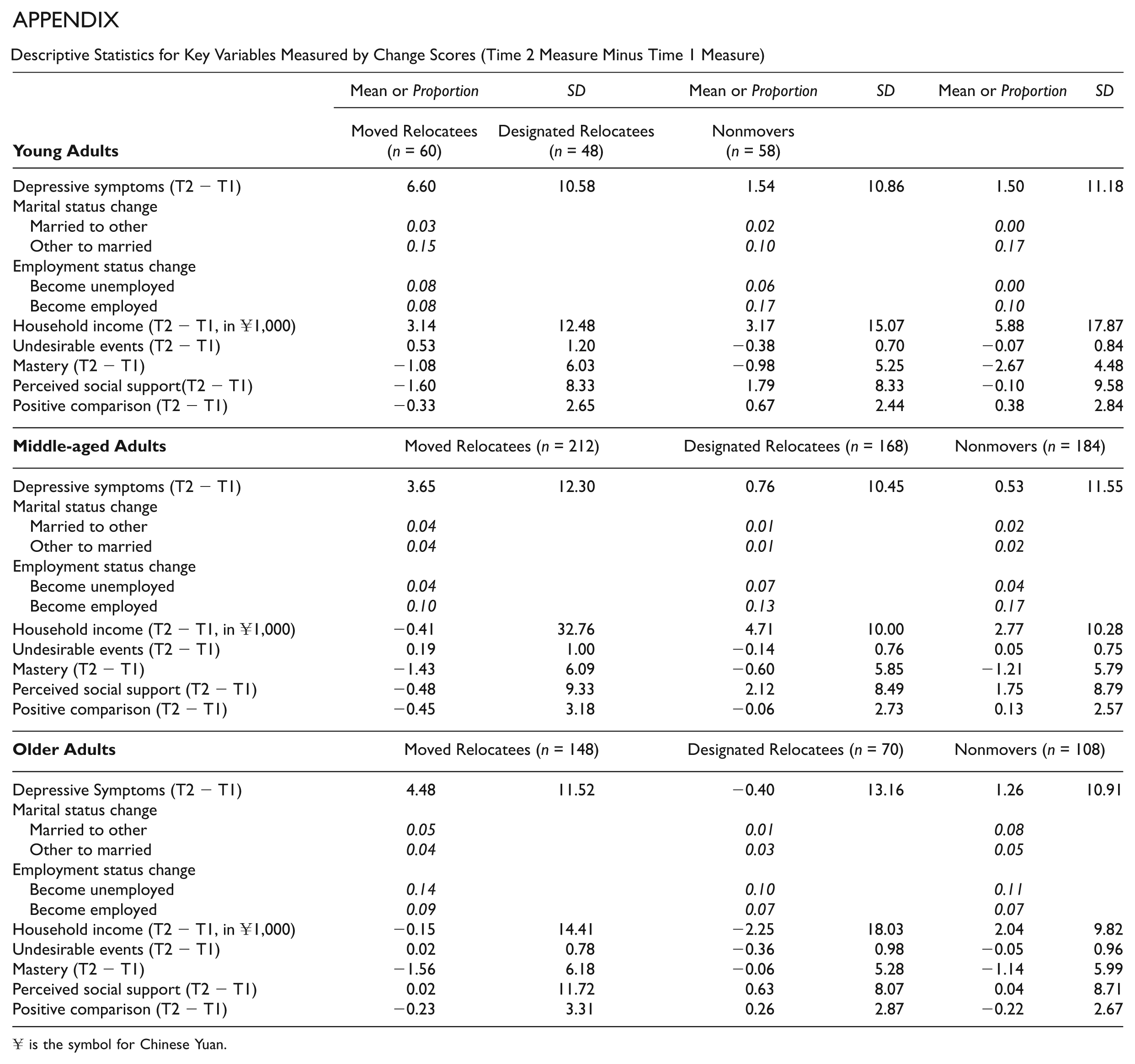
is the symbol for Chinese Yuan.
Acknowledgements
This research is supported by a grant (R01 HD040243) from the National Institute of Child Health and Human Development. We thank the Editor and anonymous reviewers for their helpful comments. We are also thankful to Zachary Simoni and Peter Barr for their assistance. An earlier draft of this article was presented at the 2011 Annual Meetings of the American Sociological Association in Las Vegas.